



Abstract
Success in attracting talent in the hospitality industry rests on employers’ ability to project value proposition that closely corresponds with the requirements of its target employees. Despite their importance to the hospitality industry, Gen Z perspectives on employer attractiveness received limited attention in the academic literature. This study applies an employee-centric approach to employer brands to identify motivational structures which determine Gen Z hospitality employer choices. Underpinned by means-end-chain theory, the study uncovers the hierarchical knowledge structures that link employer attributes, the benefits derived from these attributes, and personal values. Findings confirm the usefulness of the means-end-chain theory in generating insights into motivational structures of potential employees. The value structures of Gen Z are psychological, development and social value. Findings are relevant to hospitality employer brands as it allows them to understand how attributes are interpreted by potential employees, and lead to benefits and higher value forms. In turn, this enables employers to tailor their value proposition to match their offer to Gen Z and employers’ resource base.
Introduction
The ability to attract, motivate and retain high-quality employees is critical for businesses to survive and thrive in today's highly competitive environment (Bhattacharya et al., 2008; Turban and Greening, 1997). This is particularly true in high customer-contact and labour-intensive service sectors, e.g. hospitality, which rely on employees to provide satisfactory and memorable customer experiences (McColl-Kennedy et al., 2015). Nonetheless, owing to unfavourable characteristics of most hospitality jobs (excluding those at managerial levels or technical in nature), such as low wage, unsocial working hours, lack of career development opportunities etc. (Baum, 2008), attracting and retaining talent remains a recurring challenge for hospitality employers (Financial Times, 2021; Goh and Okumus, 2020). The Covid-19 pandemic has exacerbated this challenge, as both existing and prospective hospitality employees are reportedly seeking non-hospitality jobs which provide higher compensation, better work-life balance, and more job security (Clough, 2021; Ross, 2021), thus magnifying the concerns over the long-term sustainability of the hospitality industry. To complicate things further, hospitality-trained personnel are in high demand as many service organisations (e.g. banking, healthcare, and retail) seek to improve customer experience by applying hospitality-driven principles (Robinson et al., 2019a; Smith et al., 2018).
In recognition of the critical role that employees play in gaining competitive advantage, employer branding (EB) emerged as a means for organisations to differentiate themselves from competitors in the labour market (Lievens and Highhouse, 2003) and achieve positive outcomes in talent attraction and retention (Backhaus and Tikoo, 2004; Tanwar and Prasad, 2016). EB rests on the idea of an employer projecting a distinct and attractive employer value proposition (EVP), that closely corresponds with the needs and expectations of its target employees (Berthon et al., 2005). In the hospitality industry, such EVPs (often reflected in job adverts) are, historically, provided to appeal to the generic workforce, with emphasis on the ‘economic’ (e.g. ‘we offer competitive rates and benefits’) and/or ‘social’ value (e.g. ‘we are a leading hotel company’, ‘you are joining a great team’) of working in the organisation. We contend that such a traditional view of hospitality EVPs fails to adequately consider the employees’ true needs and expectations, and any continuous use of such EVPs in today's recruitment activities is unlikely to help organisations compete for the best talent, especially in the emergent dominant hospitality workforce, the Generation Z (Gen Z) (Goh and Okumus, 2020; Mooney, 2016; Robinson et al. 2019b). This is because job seeker's needs and expectations are not static; and Gen Z have been found in several studies (e.g. Goh and Lee, 2018; Sakdiyakorn et al., 2021) to possess distinct values and work motivations compared to their counterparts in previous generations. Yet, our understanding of Gen Z's needs and expectations that determines their hospitality employment choices is limited. Given the ongoing global shortage of hospitality workers, as well as a worsening image of hospitality employment (triggered by ramifications of Covid-19), this research aims to answer the question: ‘What makes an attractive hospitality employer in the eyes of Gen Z job seekers?’
Inspired by the work of Ronda et al. (2020), this research applies a ‘means-end-chain’ perspective to identify key characteristics of hospitality employers that Gen Z find attractive in determining employment choice. The ‘means-end-chain’ theory explains how a product or service choice enables the achievement of personal values by uncovering hierarchical knowledge structures of consumers (Gutman, 1982). The theory proposes that consumers link product or service attributes (the means) to their benefits and then inner values (the ends). Applied in the context of employer branding, this requires the identification of employer attributes that are key to target employees, the benefits derived from these attributes, and relevant personal values. Uncovering these links is key as they illustrate how employment choice decisions might be driven by personal values (Schwartz, 2012), which are manifested through chosen employer attributes and benefits.
This research contributes to the EB and talent management literature by applying an employee-centric approach to employer brands and providing insights into motivational structures which underpin Gen Z hospitality employer choices. The findings we report are of relevance to employers that seek to attract Gen Z hospitality-trained employees.
Literature review
Employer brand and employer branding process
EB is “a targeted, long-term strategy to manage awareness and perceptions of employees, potential employees, and related stakeholders regarding a particular firm” (Sullivan, 2004). To Backhaus and Tikoo (2004), EB is a process that seeks to build an identifiable and unique employer identity, which is established by an employer brand. According to Ambler and Barrow (1996: 8), an employer brand can be defined as “the package of functional, economic, and psychological benefits provided by employment, and identified with the employing company”. This offer of unique employer characteristics is also known as EVP (Eisenberg et al., 2001). Theurer et al. (2018) argue that EVP can be understood as an ideal employer identity, or, how the firm wants to be perceived by applicants or employees as an attractive employer.
The literature recognises different stages of the EB process. A recent review of EB research by Theurer et al. (2018) proposes a four-stage EB value chain model. These are (1) employer knowledge development and investment; (2) applicant/employee mindset; (3) firm performance and competitive advantage; (4) financial market performance and shareholder value. The link between the first and second stages is the focus of this paper.
Concerning the first stage, EB is understood as a three-step process composed of: (1) development of EVP; (2) external marketing of EVP to target employees and organisations of interest such as recruitment agencies, and (3) internal marketing of EVP to the existing workforce (Backhaus and Tikoo, 2004). Given that EB is concerned with applying marketing principles to human resources management (Minchington, 2010), it requires a marketing orientation focussed on applicant and employee segments (Maheshwari et al., 2017). In this approach, an EVP becomes a fundament of a strong employer brand, and its development is based on the understanding of target employees’ needs, including functional, economic, and psychological preferences (Moroko and Uncles, 2009). Such insights allow firms to better align with the target market needs and the characteristics that make a firm a great place to work. This step in EB aims to design an EVP that is unique, compelling, and relevant to the target market (Minchington, 2014). For instance, recognising differences in the relative importance to job-seekers of different employer characteristics, an EVP may need to be positioned differently for first-time applicants than in the case of experienced applicants.
Means-end-chain theory and development of EVP
The means-end-chain theory (Gutman, 1982) has been introduced to recognise the role of personal values in marketing consumer products (Veludo-de-Oliveira et al., 2006). The theory focuses on providing insights into important meanings consumers associate with products and services they purchase and use (Gengler et al., 1999). According to Gutman (1982: 60), the theory can be defined as “a model that seeks to explain how a product or service selection facilitates the achievement of desired end states”. The theory suggests that consumer knowledge structures are organised hierarchically into means-end-chains (MECs), in that product or service attributes (the means) are linked to their consequences or benefits, and the personal values (the ends). The central tenet of the theory is that consumers’ personal values drive buying behaviour by determining why some product attributes (and their consequences) are personally relevant and meaningful to consumers (Homer and Kahle, 1988). Products or services are selected based on their attributes (e.g. contactless payment), which indicate their ability to produce the desired consequences (e.g. convenience and safety). In turn, the consequences are prioritised on their ability to help the customer achieve a valued state of being (e.g. happiness or self-esteem). In this sense, MECs represent “the linkages between where a person wants to be and the means chosen to get there” (Gutman, 1982: 68).
Uncovering MECs is important because attributes provide only a surface understanding of why individuals purchase and use products and services (Botschen et al., 1999). Understanding how people link product attributes to their value system is key because personal values govern perception, memory, and ultimately behaviour (Reynolds and Gengler, 1991).
According to Vriens and Hofstede (2000), the results of a MEC can be used for new product development, brand assessment and brand positioning, advertising strategy development, and market segmentation. Such insights are also key to brand persuasion as adverts which reflect all levels of the means-end hierarchy of a target consumer can be more effective (Reynolds et al., 1995). Building values into marketing communications creates the potential for matching more closely the content of messages to valued end-states considered by consumers to be vital. In other words, the links of attributes to benefits and values increase the strength by which the product or brand is perceived to be consistent with one's personal values (Vriens and Hofstede, 2000). Given the highly competitive nature of the employee market or the “war for talent”, organisations need new positioning strategies that are more directly relevant to the decision-making criteria of target employees.
Attributes
Product attributes are features or aspects of products or services (Reynolds and Gutman, 1988). Attributes can be divided into abstract and physical (or concrete) characteristics. Physical or concrete characteristics can be understood as properties that are objective and measurable in physical units, for instance, colour or weight. Abstract characteristics are more subjective in nature, for instance, intense flavour or friendly atmosphere. In a similar vein, in the employer context, Lievens and Highhouse (2003) differentiate between two types of employer attributes. Functional attributes describe elements of employment in more objective terms, whereas symbolic attributes concern more symbolic organisational features. These attribute categories are reflected in EB literature. For example, functional or concrete employer features include “desirable geographical location” (Agrawal and Swaroop, 2009) or “above average wages” (Bellou et al., 2015). Abstract attributes concern features such as “external reputation” (Lievens and Highhouse, 2003) or ‘freedom of opinion’ (Bonaiuto et al., 2013).
Consequences/Benefits
Consequences can be understood as direct or indirect outcomes of the purchase, use, or consumption of products or services (Reynolds and Olson, 2001). In marketing, desirable consequences of using a product or a service are typically referred to as benefits (Vriens and Hofstede, 2000). Benefits and attributes are different in that attributes reside in the product or service, and benefits are derived from the relationship between the consumer and the product or service attributes (Zeithaml, 1988). The hierarchical nature of MECs means that consequences cannot affect product or service attributes but using products or services with certain attributes can produce different consequences (Gutman, 1982).
Olson and Reynolds (1983) differentiated between functional and psychosocial benefits. Functional outcomes concern the direct benefits received by the consumer following consumption (e.g. “saves money and time”), whereas psychological outcomes indicate psychological or social outcomes following product or service use (e.g. “wins more friends”, “others think I am special”). Following a review of EB literature, Ronda et al. (2018) recognise three employee benefit categories, i.e. functional, psychological, and experiential. For example, functional benefits include ‘flexible working hours’ (Baum and Kabst, 2013) or “few hours overtime” (Tüzüner and Yüksel, 2009), symbolic or psychological benefits comprise of “self-confidence” (Roy, 2008) or “acceptance and belonging” (Aliancik et al., 2014), and experiential benefits may include items such as “supportive and encouraging colleagues” (Alnıaçık and Alnıaçık, 2012) or “team atmosphere” (Bonaiuto et al. 2013).
Values
A personal value is an “enduring belief that a specific mode of conduct or end-state of existence is personally or socially preferable” (Rokeach, 1973: 5). Personal values can be considered self-relevant, ultimate goals a person strives to accomplish in life (Pieters et al., 1995).
Rokeach (1973) proposed two types of value: terminal and instrumental. Terminal values are the ultimate ideal end-states of being (e.g. happiness, security), and instrumental values are related to modes of behaviour (e.g. honest, fair, open-minded etc.) needed to achieve the end-states. In the workplace context, employee perceived value has been seldom studied (Ronda et al., 2018). Examples include social value, development value, application value, interest value, and economic value (Berthon et al., 2005).
Gen Z as future hospitality workforce
Generation theory suggests that birth-year ranges define different generations, such as Baby-Boomers (born between 1946–1964), which are indicative of a set of characteristics shared among individuals of this generation (Strauss and Howe, 1997). For instance, individuals from the same generation are likely to have common work values and attitudes toward work (Gursoy et al., 2008). These characteristics are relatively stable and are said to be an outcome of key life experiences shared among a generation (Schewe and Noble, 2000).
Gen Z has most commonly been defined as individuals born between 1995 and 2009 (Goh and Lee, 2018). Limited number of studies to date devoted attention to characteristics of Gen Z to better understand their needs, wants, and expectations (Goh and Okumus, 2020). According to Ozkan and Solmaz (2015), Gen Z embraces team spirit, expect workplace flexibility, assurance for their future career, a work-life balance, faster career progression, and seek independence and happiness at the workplace. Goh and Lee (2018) studied Gen Z attitudes, difficulties associated with hospitality work, and important social reference groups. Their findings indicate a mixture of desired and unwanted employer attributes, such as “opportunities for training”, “long/odd hours”, or “low pay”. The attitude category also suggests a range of consequences, such as “mentally and emotionally exhausting”, which could be an unwanted outcome of the attributes mentioned above. Goh and Lee (2018) suggest that Gen Z hospitality workers are motivated by job satisfaction, and to attract talent, hospitality employers should emphasise the ability to offer employees dynamic, fun, exciting, and stable international careers. Self et al. (2019) note that Gen Z seeks opportunities to travel and work in multiple countries and receive continuous feedback over annual appraisals.
According to Sakdiyakorn et al. (2021), Gen Z is characterised by a distinctive set of values. Based on Schwartz's theory of values (2012), the authors demonstrate that the most important values of Gen Z university students are universalism (value e.g. harmony, justice, fairness, integrity and helping others), benevolence (value e.g. sincere relationships and personal connections), self-direction (value freedom and independence), achievement (value e.g. recognition, appreciation, growth) and security. The above studies provide valuable insights, highlight the need for more attention to Gen Z, and specifically, disentangling the potential links between attributes, benefits, and values represents a gap in this area of research.
Methods
The laddering method was used to uncover the attributes – consequences - values (ACV) hierarchical structures which underpin the means-end-chain theory (Gutman, 1982). The method has been used extensively to identify underpinning drivers of consumer decision-making (Phillips and Reynolds, 2009), including in organisation research focussing on concepts such as employer attractiveness (Ronda et al., 2020). The laddering method involves in-depth, semi-structured interviews, which guide the participants through different steps in the ladder of abstraction associated with individual choices (Reynolds and Gutman, 1988).
The research sample consisted of 40 final-year undergraduate and master's hospitality management students at a UK university. The sampling technique was convenient in that we accessed students enrolled at our own university; yet, it was also purposive as we specifically targeted Gen Z hospitality job seekers. At the time of research, these students made a suitable research sample of potential employees because they were highly active in employment search and evaluation due to proximity to graduation. They had varying levels of hospitality employment experience, ranging from 6 months to 4 years. The appropriateness of using graduating students as a quality research sample for hospitality employer attractiveness studies was also recognised in the work of Kapuściński et al. (2021). Although the advised sample size of laddering interviews that achieve validity is between 20 and 25 (Reynolds and Olson, 2001), we decided to increase this number to ensure that enough individual voices in the focus group were heard. Participants were recruited on campus during term time with posters and leaflets about this study handed out after class. Those who were interested in participating were asked to contact the lead researcher to confirm the focus group interview they could attend (or, simply, to find out more about the research). To encourage participation and involvement, we offered Amazon vouchers.
Data were collected between January 2020 to February 2020 and involved six focus group interviews, each including six to eight participants. Discussions were conducted face-to-face and took place in meeting rooms on the university campus. The length of each interview lasted between 75 min to 90 min. Following the well-documented procedures, we developed the interview protocol. The interviews started with identifying attributes that are personally relevant to participants in a projected situation. The respondents were asked, “What do you pay attention to in a potential employer?” or “In your opinion, what makes an attractive employer?”. The responses were then used to formulate probing questions that sought to uncover the reasons as to why the attributes are important to the respondent. For instance, the respondents were asked, “Why is this important to you?” or “Why is it important that an employer has this quality?”. The probing questions were asked until the respondent revealed the consequences of desired attributes. The interviewer continued to ask probing questions to uncover why the consequences of personally relevant attributes are desirable to the respondent. This part of the interview sought to uncover the personal values or end-states of existence and was revealed by more abstract ideas such as “It gives me a sense of happiness”. Following the means-end-chain methodology and the associated laddering technique, questioning persisted to a point of saturation. This was identified as a point where probes were no longer leading to new ideas, and the participants agreed that all attributes of importance, as well as their consequences were captured. With participants’ permission, all focus group interviews were recorded and transcribed verbatim.
The choice of the number of focus-groups was theory-driven as qualitative researchers should theoretically reflect on gathered data to decide whether to collect more. Theoretical saturation in this context means that no new relevant data emerges concerning a category, that categories are well-developed and links between categories are well-established (Strauss and Corbin, 1998). Theoretical saturation was reached after focus group number six.
The focus groups were moderated by two researchers. One researcher led the discussion, and the second took notes and drew a graphical representation of key ACV concepts and linkages. This allowed the construction of an initial Hierarchical Value Map (HVM). After the laddering part of the interview concluded, the researchers checked the connections between different levels of ACV structures to ensure these accurately represented participants’ views.
Data analysis followed the laddering technique procedures specified by Reynolds and Gutman (1988). The first step involved coding all transcripts to identify key words and phrases which relate to the elements of the means-end hierarchy i.e. the ‘attributes’, ‘consequences/benefits’ and ‘values’. All authors participated in the coding and each coded two transcripts.
The second phase involved the development of meaningful categories by grouping key words and phrases with identical meanings. This was achieved with reference to phrases and key words used by participants, and concepts derived from the literature review. For instance, if the participants mentioned that employers should be in locations that are easily accessible, this statement was linked to ‘workplace location’. The research followed an iterative process of recoding data, splitting, and combining categories.
In the last phase, we aggregated codes across focus groups, which allowed us to represent our findings in a series of HVM diagrams, defined by Gengler et al. (1995: 245) as “a graphical representation of a set of means–end chains which can be thought of as an aggregate (e.g. market-level) cognitive structure map”.
To facilitate a high inter-coder reliability, we selected one transcript and identified one section for each author to code. Independently, we started by reading through the agreed section to highlight key words, phrases and sentences related to ‘attributes’, ‘consequences’, and ‘values’ and labelled them mostly in the same term as they were mentioned by participants. All authors then shared and compared each other's initial codes, where any inconsistency was noted and resolved through discussion. When all authors achieved the same understanding in this coding exercise, we proceeded to code our assigned full transcripts.
Anonymity of participants, defined as keeping participants’ identity secret (Saunders et al., 2015), was achieved to a point of keeping the identity of participants hidden from everyone but the researchers involved in primary data collection. As in most qualitative research contexts where researchers know who participants are (Scott, 2005), true anonymity was by definition not achievable. To protect participants’ identity, we did not report identifying details such as the participant names, name of the university where participants study, or any additional participant information such as their age or nationality. Moreover, recordings of focus groups as well as transcripts were kept in a secure, password protected cloud, only accessible to the research team. Although keeping what participants said could not be confidential as we chose to quote participants in this manuscript, participant identity cannot be discovered on this basis. These procedures were explained to participants through a participant information sheet, at the beginning of the focus group, and consent was obtained.
Findings
The analysis of focus group interviews revealed 20 attributes, 21 benefits, and seven values. In line with the literature (Ronda et al. 2018), we categorise benefits into functional (e.g. convenience), psychological (e.g. sense of freedom), and experiential (e.g. agreeable work environment) benefit types. Following the coding phase, these were organised into three HVMs: psychological, development, and social. These maps are presented in sections below (Figures 1–3). In all three cases, value is satisfied from multiple benefits. For instance, in the case of the psychological value map (see Figure 1), the value of ‘mental health’ is linked to the benefits of ‘self-esteem’ and ‘sense of freedom’. Moreover, the benefits are organised in chains, for instance, benefits of ‘self-growth’, ‘feeling of belonging, direction, and purpose’, ‘pride from membership’, and ‘fit with organisational identity’, result in ‘self-esteem’, which refers to confidence in one's self-worth. In the same vein, ‘financial security’ and ‘convenience’, akin to a good perceived work-life balance, lead to a ‘sense of freedom’. We conceptualise ‘sense of freedom’ as a sense of having the power in life to act as wanted, as well as being able to perform work duties without undue restrictions from the employer.
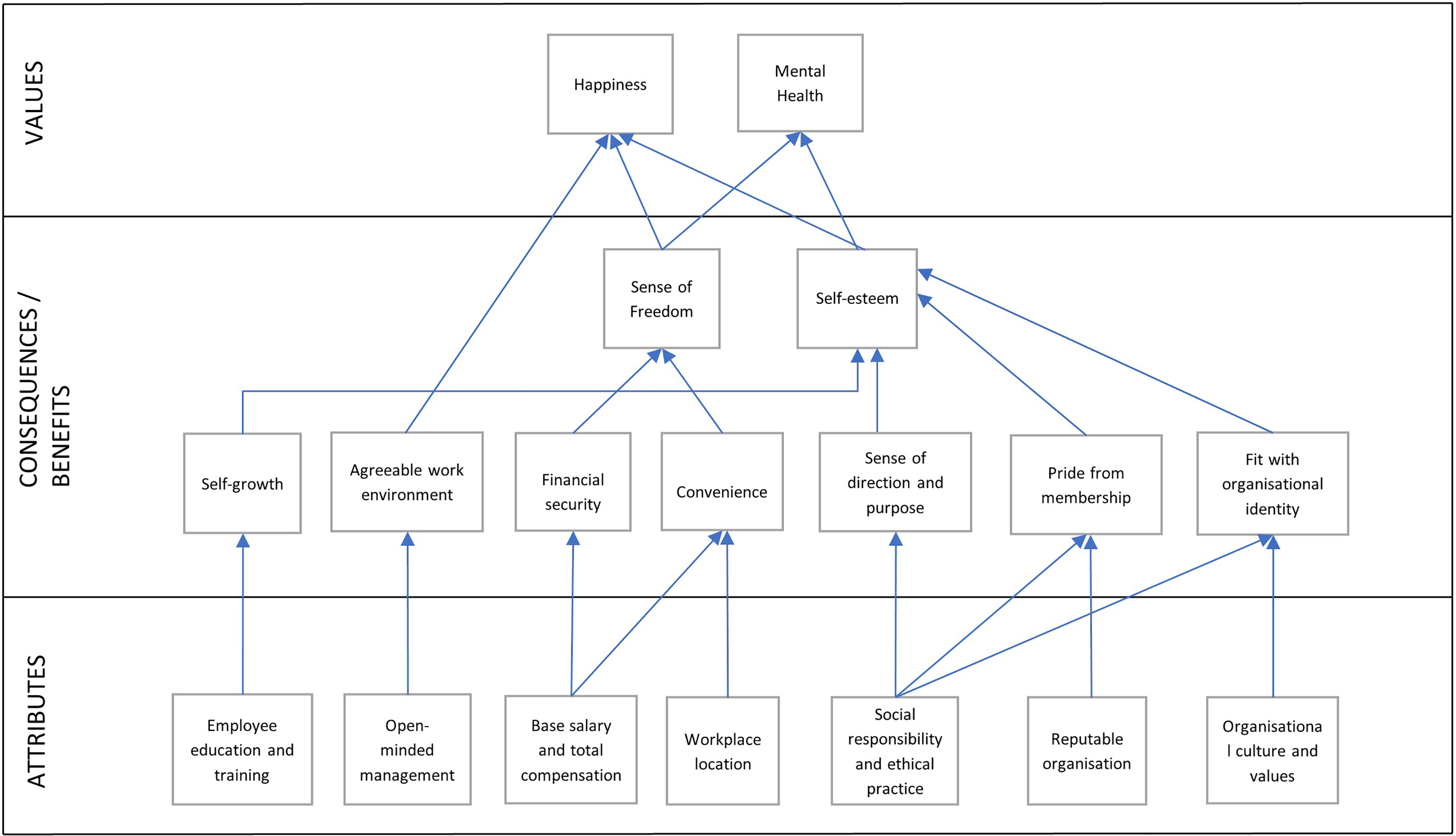
Hierarchical value map: Psychological value.
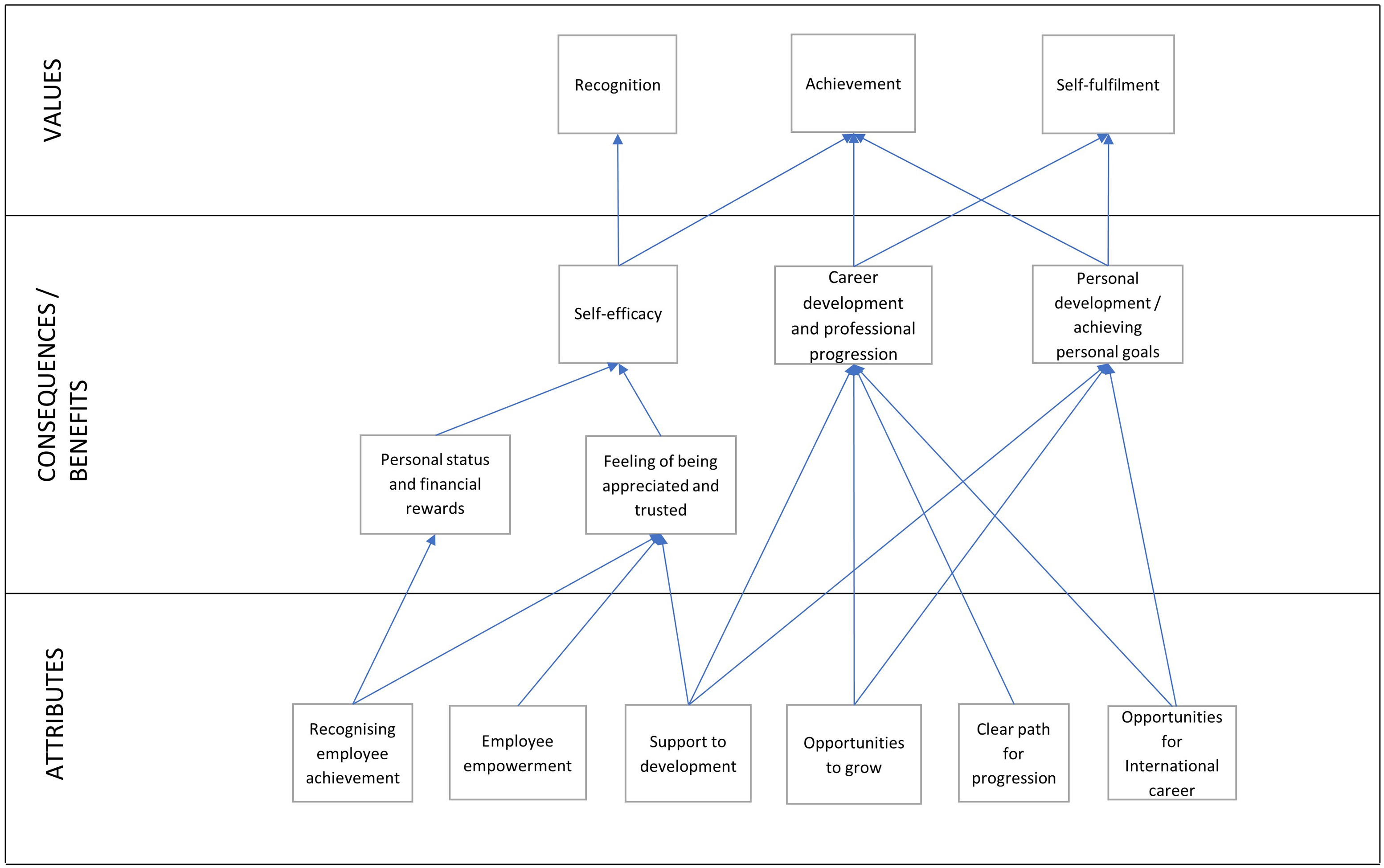
Hierarchical value map: Development value.
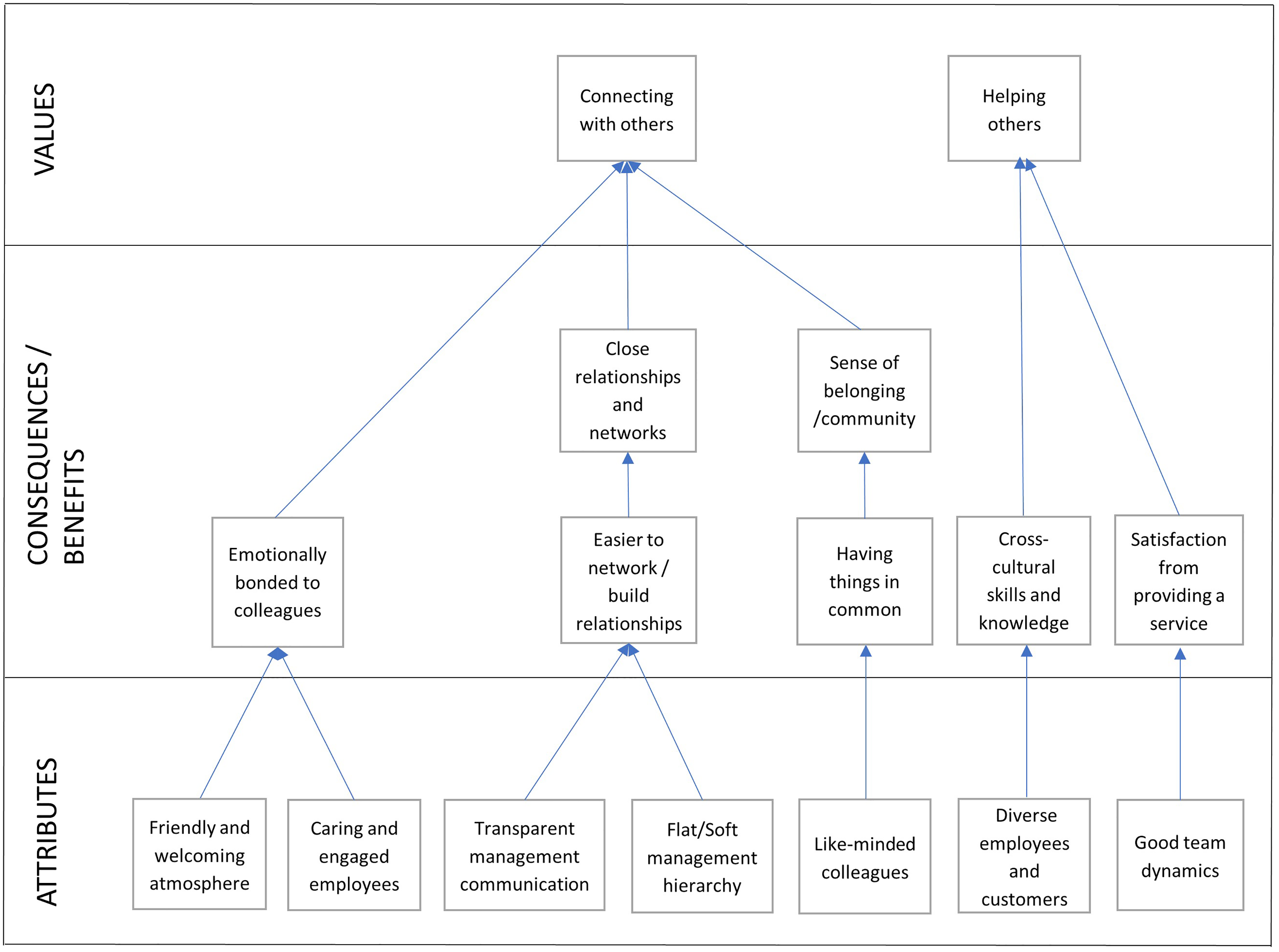
Hierarchical value map: Social value.
Similarly, a benefit may result from one or more attributes, for instance, convenience is linked to attributes such as ‘base salary and total compensation’ and ‘workplace location’. By extension of this argument, one employer attribute can lead to one or more benefits, for instance, ‘base salary and total compensation’ results in ‘financial security’ and ‘convenience’.
Psychological value
The psychological HVM (Figure 1) reveals two psychological values important to Gen Z hospitality job seekers when making employer choices: ‘happiness’ and ‘mental health’. Although the frequency of each value mentioned differs, we do not claim that one value is superior to another value. Happiness signifies enjoyment or satisfaction at work and/or in life. Mental health refers to mental wellbeing.
The attributes relate to abstract organisational characteristics, such as ‘reputable organisation’, ‘organisational culture and values’, ‘open-minded management’, and tangibles, such as ‘workplace location’. Other important attributes concern ‘base salary and total compensation’, ‘employee education and training’, and, reflecting the global nature of the hospitality industry, ‘travel and international exposure’. These attributes are linked to benefits categorised as psychological: ‘sense of direction and purpose’, ‘self-esteem’, ‘self-growth’, ‘sense of freedom’, ‘pride from membership’, functional: ‘convenience’, ‘financial security’, and experiential: ‘agreeable and exciting work environment’, ‘fit with organisational identity’.
The HVM also depicts linkages among attributes, benefits and psychological values, which are evident from the participants’ reasoning. For instance, one informant revealed why the attribute of ‘reputable organisation’ is personally meaningful: “If the company has a high reputation, they probably have high expectations of me, and if I made it … it makes me proud. It's like OK, coming back to the self-esteem, gives me confidence, happiness … boosts you up”. Several other informants commented on the importance of the organisation being reputable from the guest perspective and inferred that being employed by these companies would ‘reinforce their sense of self-worth’. Another important attribute is the ‘social responsibility and ethical practice’, which leads to a range of benefits, including a ‘sense of direction and purpose’. One participant indicated, “It helps with seeing a purpose, not just going to work every day, doing the same, leaving and sleeping and waking up and going to work, but it's like you can see a purpose in what you do … and you see what is the higher mission and vision of where you are going.” This quote suggests that the ‘sense of direction and purpose’ appears to make hospitality work more meaningful to Gen Z and help with overcoming hardships and enduring mundane aspects of daily tasks. Also related to the attribute of ‘social responsibility and ethical practice’ is the ‘organisational culture and values’, which leads to benefits of a ‘fit with organisational identity’, ‘self-esteem’, and, ultimately, the value of ‘happiness’. This is stressed by one participant, “company culture is important in that actually … that you share the same values, cause you have to comply to their standards, but you still want to be yourself.” The informant elaborates, “being yourself and working in that environment [of shared values] makes your confidence … self-esteem … you don't need to hide anything. Being yourself is important because we just can't pretend to be someone else, and that would take a direct hit on you. It could lead to frustrations within the workplace, unhappiness”.
Moving beyond the implications of abstract employer attributes, participants revealed a link between the attribute of ‘base salary and total compensation’ and the benefit of ‘financial security’, which points to future-oriented career planning. One participant explains, “there comes, I think, a time in every woman's life when they need to think about the job that they have and whether that can fund when they go on maternity leave or if they start to plan a family, so I think good pay gives me security”. Salary and compensation also lead to a shorter-term benefit of ‘convenience’, meaning the participants have the financial resources to cover daily expenses as well as to enjoy themselves by engaging in leisure activities. Through this, participants obtain a healthy ‘self-esteem’ and a ‘sense of freedom’, which are relevant to the ultimate goals of ‘happiness’ and ‘mental health’. Interestingly, the relationship between salary and compensation, freedom, and happiness, is characterised by a sense of unsettlement and inner pressure for change. Reflecting on these concepts, one informant stated, “I’d like to have money. And I’d like to see a different, change of job after a while … because I can be happy and, what's next? … in Western society, we always want to move forward, we want to move forward in our career, in our lives, you want to do something new.”
Development value
The second HVM (Figure 2) concerns Gen Z development, which includes values of ‘recognition’, ‘achievement’ and ‘self-fulfilment’. Recognition refers to the need of being recognised or to be respected at the workplace. Achievement signifies gaining career-enhancing experience and a sense of achievement or accomplishment at the workplace. Self-fulfilment denotes the need for personal development or feeling good about oneself as a result of working for the organisation.
Attributes important to Gen Z are centred on aspects of organisational culture and values: ‘opportunities to grow’, ‘clear path to progression’, ‘opportunities for international career’, and employee-employer relationships: ‘recognising employee achievements, ‘support to development’, and ‘employee empowerment’. These lead to benefits which are psychological: ‘self-efficacy’, ‘personal development/ achieving personal goals’, ‘feeling of being appreciated and trusted’, and functional: ‘gaining personal status and financial rewards’, ‘career development and professional progression’.
‘Employee empowerment’ was a notable attribute revealed through a range of practices that Gen Z look out for. These included the provision of additional responsibility to junior staff and trusting employees to be capable of solving problems. Reflecting on the importance of ‘employee empowerment’, respondents note implications for benefits such as ‘feeling of appreciation/support, and ‘self-efficacy’. One participant explains, “it shows that they trust you, which is really exciting when you are given some more power, some more authority … if they give me the responsibility to do that, they know that I can do this job. So I’m confident I’m gonna do it properly”. Another prominent chain is revelated through the focus on the importance of a ‘clear path for progression’, which leads to the benefit of ‘career development and professional progression’. According to one participant, “You want to see what the options are [for career progression] … going there knowing that I can actually build up from here … I wanna feel like I’m going somewhere professionally”. Participants also recognise the importance of the international dimension to personal and career development. The attribute of ‘opportunities for international career’ is associated with the benefit of ‘varied and interesting work’. Interestingly, the lack of an international dimension, as revealed through a comparison to the alternative of working in one geographical region, appears to be associated with a negative sentiment. As one participant explains, “It means I can work in an international environment or have tasks and projects all over the world and not only focus on one country or one region or one city. So for me, it makes it more interesting, more varied work and more differences in your tasks and not only the same kind of locations or projects or environments”. This highlights that although Gen Z job seekers place significant attention on professional development opportunities, they are also conscious about their personal development and enjoyment and are searching for a career that can contribute to their idea of a meaningful life through ‘self-fulfilment’.
Social value
The third value structure (Figure 3) is the social value. This comprises two values: ‘connecting with others’ and ‘helping others’. Both values underscore the aspects of work that are specific to service contexts. The high customer and co-worker contact character of hospitality work is reflected in the category of “others” common to both values. ‘Connecting with others’ concerns meaningful employee to employee relationships, whereas ‘helping others’ denotes provision of good quality service which leads to employee personal satisfaction.
Attributes important to Gen Z are centred around the characteristics of employees and customers: ‘like-minded colleagues’, ‘caring and engaged employees’, ‘diverse employees and customers’, and the quality of relationships with work colleagues: ‘friendly and welcoming atmosphere’, ‘good team dynamics’, ‘flat/soft management hierarchy’, ‘transparent management communication’. These attributes are linked to a range of benefits which are psychological: ‘sense of belonging/community’, ‘emotionally bonded to colleagues’, ‘satisfaction from providing a service’, functional: ‘easier to network/ build relationships’, ‘cross-cultural skills and knowledge’, and experiential: ‘close relationships and networks’, ‘having things in common with colleagues’.
One of the important chains noted during the discussion regarded the attribute of ‘flat/soft management hierarchy’ and benefits relating to the quality of relationships and networks. This feature of an organisation makes it ‘easier to network/build relationships’, and leads to ‘close relationships and networks’. The closeness of relationships is a key benefit, as expressed by one participant, “it's really important to have someone that you can genuinely express feelings to. If you don't feel like you can talk to them, even about something minor, it can then become a bigger thing”. We note that the consequences of a flat/soft hierarchy also have a professional networking dimension, as expressed by comments such as, ��networking is definitely a benefit because then I can meet different people, find out what they do … it helps because I know that I want to move around, go and try different companies”. Ultimately, the attribute and its consequences are personally meaningful to Gen Z because it allows them to attain the value of ‘connecting with others’, which is well captured by one respondent who notices, “for me hospitality is all about connections”. A different chain demonstrates why the attribute of ‘good team dynamics’ is relevant to Gen Z. It is noted that the attribute leads to the benefit of ‘satisfaction from providing a service’, and ultimately, the feeling of ‘helping others’. As explained by one participant, “in some brands you are expected to give a completely different type of service to the guests … like a different class with a better team and overall work dynamics. For me, personally, I get a lot of satisfaction from giving a good high service”. On the contrary, poor team dynamics lead to a negative outcome, “staff that do not work well together, I personally would be kind of afraid that that's … I would lose the satisfaction from doing a good job”.
Discussion
The findings of this study contribute to research on employer branding and talent attraction by providing insights into motivational structures which underpin the choice of employers by Gen Z job seekers in the hospitality industry. This was achieved by applying a widely used means-end chain theory (Gutman, 1982) in the context of employer brands, which allows recognising hierarchical structures of employer attributes, employee benefits and employee values that exist in job applicants’ minds. Studies that differentiate between attributes, benefits, and values associated with employer choices are rare (Ronda et al., 2020), and this study confirms the usefulness of applying this theoretical lens to understanding what drives Gen Z employees in the hospitality industry. This is an important perspective, as it allows hospitality employer brands to move beyond the surface understanding of attributes of relevance to job seekers, to identify how attributes are interpreted by employees to lead to benefits and higher value forms. In turn, employers can use this knowledge to tailor their EVP to match their offer to target employee needs and the employer resource base.
Overall, our findings point to three prominent value structures, namely, psychological, development, and social value. Social and development value structures are reflected in categories proposed by Berthon et al. (2005). Social value refers to the extent to which employees perceive that the employer “provides a working environment that is fun, happy, provides good collegial relationships and a team atmosphere” (Berthon et al., 2005: 159). We find that in the hospitality industry context, the social value structure comprises ‘connecting to others’ and ‘helping others’. The social aspect of work is of value in the sense of ‘connecting to others’ through a positive collegiate atmosphere and networking, but also in ‘helping others’ through applying cross-cultural skills and personally satisfying service. To Berthon et al. (2005), development value refers to obtaining “recognition, self-worth and confidence, coupled with a career-enhancing experience and a springboard to future employment” (Berthon et al., 2005: 162). This study shows that beyond the value of recognition, Gen Z employees also pay attention to the value of ‘achievement’ and ‘self-fulfilment’, which arise from self-efficacy, and career and personal development. The third value structure we identify, namely, psychological value, was previously recognised by Sivertzen et al. (2013), who conceptualise it as the extent to which employees trust that working for the employer will make them feel better about themselves and feel more confident. Sivertzen et al. (2013) demonstrate that psychological value comprises two items, i.e. self-esteem and confidence, previously conceptualised by Berthon et al. (2005) as part of the development value. We find that psychological value comprises ‘happiness’ and ‘mental health’, which arise from ‘self-esteem’, ‘agreeable work environment’ and a ‘sense of freedom’. We argue that psychological value structure may be particularly important to potential employees in the context of changes to employment realities brought by the Covid-19 pandemic.
On a theoretical level, in line with broader consumer behaviour studies (Wu et al., 2020) and studies that focus on the employee perspective (Ronda et al., 2020), we confirm that relationships between attributes, benefits, and values include multidirectional links. Although previous studies in the employer branding context often note a direct relationship between an attribute and benefit, e.g. the salary attribute typically result in an economic benefit (Berthon et al., 2005), our findings suggest that salary is meaningful to Gen Z as it allows to realise two types of psychological value (i.e. happiness and mental health). Moreover, contrary to assumptions of past research regarding the unidirectional relationship between attributes and benefits, our findings showcase that one attribute can lead to multiple benefits, e.g. attribute ‘social responsibility and ethical practice’ leads to benefits of ‘sense of direction and purpose’ and ‘pride from membership’ (see Figure 1). Equally, one benefit can be realised by several attributes. Therefore, we argue that using the means-end chain theory is beneficial as it allows employers to understand that, for example, salary can be interpreted in various ways by potential employees. This understanding is key if the EVP is to truly reflect the needs of the target employees.
Practical implications
Practical implications can be inferred from this study. First, the HVMs presented in this study can assist employers in understanding which attributes help Gen Z job seekers to differentiate between employers in the hospitality industry and why these attributes are personally meaningful. These findings provide hospitality organisations with information to construct EVPs that reflect values sought by Gen Z job applicants. For instance, given that Gen Z are motivated by feelings of appreciation and support, an employer might focus on the provision of employee empowerment (e.g. through additional responsibility), support to development (e.g. through a mentorship or buddy programme), and recognising employee achievement (e.g. through sharing employee success storeys on social media channels). Moreover, given the importance of benefits such as personal and career development to development values, offering opportunities for an international career is key. This can be achieved by increasing staff mobility by offering training or work opportunities in different locations/countries.
Second, seeing that the hospitality industry is dominated by independent SMEs that tend to be challenged in the provision of attributes such as competitive pay, our study suggests that highlighting other attributes which are closer to the resource base of SMEs may result in an attractive value proposition to Gen Z employees. For instance, owing to smaller team size, hospitality SMEs may want to signal strong social value by highlighting they pay particular attention to good team dynamics, and a caring, collegiate, family-like work atmosphere. This highlights that insights into employee means-end chains afford employers more flexibility to build EVPs based on attributes they can realistically deliver.
Third, the means-end chain framework we apply in this study can help organisations to conduct studies with their target employee base. As we argued, revealing the motivational structures of potential or existing employees could allow employers to develop more effective EVP that responds to their needs. Although the soft laddering method we utilised in this research is relatively time consuming and requires experienced interviewers and coders, the hard laddering approach (Phillips and Reynolds, 2009) has been found to produce similar results, yet it is easier and less costly to administer, which may be more suitable to SMEs.
Limitations and future research
Limitations of this study are related to the sampling strategy. First, although the participants included non-Europeans, the sample is dominated by potential employees from the UK, which provides a largely Western perspective to what makes an attractive hospitality employer. This may limit the extent to which these findings are transferable to other contexts, therefore, findings should be applied with caution. Therefore, future studies should consider participants from different cultures to allow the comparison of value structures. Second, it cannot be ruled out that students who were financially motivated by the vouchers, and those who were more actively engaged in employer search were more likely to partake in the study. Moreover, students who were not physically present during the events (employment mentoring events) and classes we targeted (these were compulsory modules for the entire student cohort) were less likely to be included.
Moreover, it is important to acknowledge potential biases introduced during focus group interviews. As this method is associated with the possibility of outspoken individuals dominating the discussion, we took steps to minimise this by referring to each group member by name and encouraging equal participation in turns. Another issue concerns social pressure from the interviewer and other participants. Some participants may want to appear respectable and overly mature, which may misrepresent reality and lead to artificial answers. To minimise this issue, we sought to make participants at ease and to encourage a natural atmosphere by providing refreshments.
Another issue concerns the researcher bias introduced in data analysis. Separation of participant ideas into attributes, consequences and values is delicate and depends on accurate content analysis. This was minimised by reliability procedures we explained in the methods section.
With respect to the application of the laddering method, one of its limitations is that interesting insights emerging from interviews may be overlooked because they do not fit with the pattern imposed by the technique. In addition, the method applied in this study does not consider the relative importance of different attributes and benefits identified by participants. Therefore, researchers in future studies should consider alternative methods that allow addressing such questions. Moreover, this study did not differentiate between different types of hospitality employment such as hotels versus restaurants, or the different qualities of employers within such sectors, such as the size of the employer hotels, i.e. SMEs versus large hospitality groups such as Hilton or Intercontinental Hotels Group. Future research may seek to identify whether different employer types impact on value structures of potential employees.
Footnotes
Declaration of conflicting interests
The author(s) declared no potential conflicts of interest with respect to the research, authorship, and/or publication of this article.
Funding
The author(s) received no financial support for the research, authorship, and/or publication of this article.
