




Abstract
This article examines how the material, and specifically visual, aspects of organizing contribute to understanding control and resistance issues in organizations. Whereas the role of visuality in workplace power relations has been acknowledged, the processes by which specific visual affordances contribute to power contests are not well understood. We argue that the diverse affordances of visual images offer opportunities for both control and resistance, where control is exerted via the normalizing and objectifying feature of visuality, while resistance draws on bricolage and juxtaposition to subvert dominant management discourses. Based on an ethnographic study of an industrial print company, we show how the diverse uses of visuality create a field for negotiating organizational tensions. We draw conclusions for the study of visual affordances as a tool for control and resistance struggles in organizations.
To realize some of the potentials of things, and not others, is the stuff of historical struggles and contingencies
Struggles over power and resistance in organizations (e.g. Jermier et al., 1994; Thomas et al., 2011) often involve visual images (e.g. Kuronen, 2015; Quattrone, 2009; Rodrigues and Collinson, 1995). Images are used to establish and mark power and authority (Andermann, 2010) and can form a ‘visual battleground on which dominant discourses’ compete for attention (Panayiotou, 2012: 15). Visuals constitute a means of exercising power (Bell and Davidson, 2013; Puyou et al., 2012; Quattrone, 2009) through their ability to direct attention and frame meanings (Hollerer et al., 2013). If Winner’s (1980) argument that ‘artefacts have politics’ applies to visual images, then images can be understood as objects of struggle and resistance, around which power relations are played out.
In organizational settings, images have been linked to resistance (e.g. Rodrigues and Collinson, 1995), often in the context of organizational humour (e.g. Collinson, 1992, 2002), whereas popular culture images reflect wider views of worker concerns (O’Doherty, 2011; Rhodes and Parker, 2008). Most current approaches analyse images’ content for work-related messages, reflecting a ‘critical semiotic’ approach (e.g. Bell and Davidson, 2013), where power relations are decoded and interpreted as meanings (Rose, 2010). In such approaches, it is the meanings of images that reinforce or subvert dominant notions of power through representation (e.g. Nichols, 1981).
Focusing on the symbolic meanings of contents, however, should not obscure the materiality of images (Endrissat, Islam & Noppeney, 2016; Rose, 2010), as supports for practice. Although social and power relations are expressed materially (Dale, 2005; Leonardi and Barley, 2010), we know little of how actors employ the materiality of objects, specifically within visuals, to influence power relations in practice. We contend that such uses complement the semiotic focus on meaning, to produce an image’s power.
As material artefacts, images involve ‘affordances’, defined as features that ‘favor, shape, or invite, and at the same time, constrain’ practices (Zammuto et al., 2007: 752). Drawing on visual affordances (Islam, Endrissat & Noppeney, 2016; Paroutis et al., 2015) clarifies why images support social practices in ways that are neither arbitrary nor completely determined. The visual affordances of a given image assemble possible uses of material features (Keane, 2005). These features permit a range of associations that are contingent across contexts and can be juxtaposed and reworked for various purposes. Because interpretations both depend on such features and are influenced by them, we contend that the visual semiotics of images work together with affordances in mutually constituting images’ impact.
Resistance theorists acknowledge the mutual interdependence of symbolic and material features (e.g. Fleming and Spicer, 2007; Mumby, 2005), and classic views on the labour process examine how objects and material artefacts involved in work-related conflicts (Braverman, 1974). Visual artefacts, however, are largely absent from such analyses, and few studies explore the ‘co-constitution of visuality and materiality’ (Rose and Tolia-Kelly, 2012: 2) in control and resistance struggles. Meanings and materials co-constitute each other because of what Keane (2005) calls the ‘openness of iconicity’, referring to contingent material possibilities co-present and bound up in visual artefacts. Although these possibilities are material, they are not fixed prior to the situated uses of an artefact. The openness of visual images suggests that they are not only representations of meaning but additionally provide possibilities for action and meaning in use.
In this article, we report results drawn from an ethnographic study of an industrial printing setting in Northern England, where formal and informal visual postings served as supports for negotiating competing understandings of the organization. We build on emerging scholarship on visuality (e.g. Bell and Davidson, 2013; Meyer et al., 2013) and materiality (e.g. Hardy and Thomas, 2015; Leonardi and Barley, 2010) in organizations, arguing that different actors draw on distinct visual affordances to establish control versus resistance possibilities. Our results suggest that affordances should be understood contingently and that some affordances are recruited for control while others are mobilized for resistance efforts.
We position our study among emergent discussions of how materiality relates to control and resistance (e.g. Belmondo and Sargis-Roussel, 2015; Courpasson et al., 2012; Dale, 2005; Hardy and Thomas, 2015; Leonardi and Barley, 2010). These discussions recognize materiality as a factor in power struggles, and we complement them by exploring how the material and semiotic features ‘afforded’ by artefacts become entangled with everyday workplace struggles. Affordances have been used to understand materiality in organizations (e.g. Demir, 2015; Jarzabkowski and Pinch, 2013; Zammuto et al., 2007), with the idea that material features support and encourage forms of practice. However, the contingent and ‘open’ nature of affordances is rarely acknowledged; that is, whereas affordances support practice, they may simultaneously support different or even opposing forms and therefore are not deterministic. It is this open aspect that makes alternative uses of artefacts the ‘stuff of historical struggles’ (Keane, 2005: 194) and opens up spaces for contestation. Artefacts’ diverse possibilities are leveraged across actors, opening up an overlooked political dimension to affordances. Specifically, affordances allow actors to position themselves vis-à-vis abstract organizational rules and subvert meanings through bricolage and juxtaposition.
To examine the question of how visual images are used in organizational struggles over control and resistance, we emphasize the contingent nature of affordances. We explore the empirical uses of visuals in practice in an ethnographic study of an industrial printing factory. In this setting, visuals were used by managers and workers to present contrasting images of the workplace. From the case, we draw several paths for the study of power and images, broaching the question of the emancipatory potentials of such images. Finally, we discuss the conceptual potentials and limitations of our approach in terms of theorizing visual materiality as a form of control and resistance.
Visual affordances and organizational power struggles
Artefacts make up the everyday spaces of organizational life (Leonardi and Barley, 2010). According to Joerges and Czamiawska (1998), ‘all organizing, in its symbolical, political and practical aspects, needs to be inscribed into matter in order to make organizations durable (indeed, possible)’ (p. 371). Such inscriptions translate ideas into objects (Joerges and Czamiawska, 1998; Quattrone, 2009), opening possibilities for control or resistance based on struggles over interpretation (Hardy and Phillips, 1999; Thomas et al., 2011). However, such possibilities also depend on the material features of the medium, which ‘invite new projects’ (Keane, 2005: 193) by shaping the types of messages that can be expressed. The possibilities and constraints for practice given through material features are termed ‘affordances’ (Gibson, 1979; Jarzabkowski and Pinch, 2013; Zammuto et al., 2007) and are distinct from meanings (which involve representations) and uses (which involve realized potential), although meanings, affordances and uses are mutually entangled in any given action. In short, affordances describe what can be done around the materiality of a given medium. Affordances hold out both a range of possibilities (here, because an image can do many different things) and a set of limits (because images can only do certain things – that is, things involving practices of seeing).
Images involve both the symbolic properties (e.g. what they are about, mean or represent; for example, Bell and Davison, 2013; Morgan, 2005) and material possibilities (e.g. their compositional and sensory effects; e.g., Islam et al, 2016). The affordances of images involve materiality and representational aspects that are widely discussed (e.g. Barthes, 1993; Edwards and Hart, 2004; Rose and Tolia-Kelly, 2012).
Keane (2005) argues that artefacts not only carry meanings but also affect practice through shaping the types of possible expressions from which actors can choose. Objects structure background meanings by opening certain aspects of the environment to display. The ability to evoke particular qualities of experience or opportunities for action involves not only meanings but also the qualities of the medium (Keane, 2005). Because only some of these qualities and possibilities are ever realized in a given moment and could be substituted, Keane notes the ‘openness of iconicity’, explaining cultural remixing, appropriation and the possible subversion of meanings. Iconic features do not form tightly coherent narratives; instead, they exist in contingent ‘bundles’ of co-existing features that can be reconfigured because of this material contingency. Keane (2005) focuses on appropriation, remixing and resistance as persistent possibilities of the material, relevant to workplace resistance because the latter often involve reworking dominant symbols (Collinson, 2003).
Analysing images in terms of their ability to promote competing frames through playing with material features suggests a view of affordances as flexible and contextual. Whereas affordances refer to the experiential and practical possibilities of artefacts (Gibson, 1979; Jarzabkwoski and Pinch, 2013; Zammuto et al., 2007), their openness to remix and their combination of semiotic and material aspects make them useful for examining visual images within workplace struggles. Unlike material properties, affordances describe how material artefacts interact with agents to allow certain ways of thinking or acting, both individually and in collectives (Fayard and Weeks, 2007). Artefacts do not cause action; instead, they offer possibilities for action, suggesting what organizational actors can do or imagine within a given space (Zammuto et al., 2007). Thus, they are neither ‘meanings’ nor ‘properties’ but experiential potentials that can support practice. If materiality characterizes control and resistance manoeuvres within organizations (Hardy and Thomas, 2015), these potentials help explain how such manoeuvres are achieved.
Specifically, organizational control recruits material artefacts to reproduce dominant power structures (Leonardi and Barley, 2010), inscribing rule systems within everyday spaces and establishing power at the material level. Whereas most literature focuses on the materiality of technological objects and tools in structuring work processes (Leonardi and Barley, 2010; Orlikowski, 2007), some studies have extended this principle into visual and other sensory modalities (Islam et al., 2016 ; Riach and Warren, 2015) and link these modalities to ideological domination in the workplace (e.g. Alcadipani and Tonelli, 2014; Meyer et al., 2013; Styhre, 2010).
As such, understanding the political dimension of affordances offers insights into many current concerns of organizational resistance scholars. For example, resistance theorists have long been concerned with the material and symbolic elements that workers use to resist managerial prerogative, or conversely, that are used to establish managerial domination (e.g. Vallas, 2003; Hodson, 1995). Also, resistance scholars increasingly focus on material analyses, including analyses of spaces (Courpasson et al., 2016) and bodies (Mavin and Grandy, 2016). Third, some work examines how material artefacts take part in organizational power struggles, as organizational communities transform objects for their own ends (McGivern and Dopson, 2010). Each of these concerns involves thinking with artefacts and demonstrates how power struggles are materially mediated.
The political possibilities of objects reside, in part, in the observation that artefacts always contain more material possibilities than suggested by dominant (Keane, 2005). The ‘stuff’ of organizations is local and embodied, defined by its position in a time and place and within a network of meanings (Boltanski, 2011). In this view, because general rules never completely capture the particularity of material artefacts, the latter open spaces for resistance to dominant rules. Workplace resistance and critique emerge from the discovery that the material has potentials beyond the dominant managerial order, whose claims to be embodied in material reality are never completely substantiated (Boltanski, 2011). Thus, material artefacts, and visual images specifically, can either entrench or subvert dominant power holders (Andermann, 2010) and are tools of organizational and institutional legitimation (Hollerer et al., 2013). As such, artefacts are likely to embody power struggles within the workplace.
Such struggles should take a particular form, with power holders attempting to recruit material objects to represent or embody dominant organizational rules, whereas those wishing to resist these attempts work either to distance material objects from their representative functions or to resignify material forms in ways that do not reflect managerial prerogatives. As such, how materiality offers both power and resistance opportunities requires explanation. In our field setting, visual artefacts form a locus of struggle at which actors deploy images to frame managerial control and worker resistance attempts.
Fixing images: visual affordances and the politics of control and resistance
Studying affordances politically means discerning which affordances are mobilized (or suppressed) for which ends. What this entails is not stipulating the stereotypic ‘effects’ of a given aesthetic modality (e.g. ‘smell causes emotion’, ‘sight causes objectification’), but instead acknowledging that all modalities ‘afford’ a diverse range of uses and mobilizations. Touch can communicate not only intimacy but also threat; writing can convey not only desire to communicate but also formality. Actors can selectively (de)emphasize features of a modality, mobilizing specific affordances to strategically frame communications.
Visuals consolidate power by ordering and relating phenomena in ways that reinforce underlying structures (Meyer et al., 2013; Quattrone, 2009; Scott, 1998). Visuals build organizational identity through creating iconic images (Foster et al., 2011; Vaara et al., 2007) and work implicitly to occlude critique and pass implicit messages about organizational reality (Dougherty and Kunda, 1990). Visual images thus reinforce top-down power by imposing dominant images (e.g. Guthey and Jackson, 2005). However, images are ambivalent, containing multiple interpretive possibilities (Meyer et al., 2013), a flexibility that allows images to be mobilized for multiple purposes, such as transforming powerful images into artefacts of ridicule, irony or resistance (Brown, 2010; Quattrone, 2009). Whereas some research explores how such ambiguity can facilitate resistance in the discursive mode (e.g. Giroux, 2006; Islam, 2010), the uses of visual ambiguity in organizational control struggles are not well understood.
On one hand, visual affordances can produce the illusion of clarity through objectification (e.g. Kuhn, 1985). Images produce the sense of a known, objective reality that seems to bridge the concrete object and the abstract (Rheinberger, 1997), conferring a sense of authenticity to appearances (Kuhn, 1985) and legitimating the status quo. The sense of objectivity may relate to a ‘taken for granted’ aspect of visual objects, hiding relations of domination (Fleming and Spicer, 2007; Lukes, 2005 [1974]). For instance, Scott (1998) describes how state-builders relied on orderly, geometric visual images and models that reinforced a sense of sovereign control, a point reinforced by Andermann’s (2010) analysis of visuals as state-building technologies that ‘discipline’ the visual field. In these cases, battles between the local and the global are fought on the terrain of the visual, where trans-local actors impose standardizing schemas on local, ‘confusing’ representations (Scott, 1998). Importantly, such control does not necessarily rely on the coercive intentions of actors, although they may deploy images strategically, rather, it depends on how messages are constituted through the material affordances available in a given medium, which both constrain and enable forms of expression.
Images convince through their ‘deictic’ aspect (Hanks, 2005), meaning that they seem to point directly to things, making their contents seem both unquestionable and present. This aspect suggests what Meyer et al. (2013) call the ‘performativity of visuals and visual discourse’, that is, that visuals constitute social objects through their presentation (see also Puyou et al., 2012). The visual ‘gaze’ (e.g. Carr and Hancock, 2003; Styhre, 2008) has been discussed as a source of objectification and control. Managing the visual gaze has been cited as an important aspect of organizational control (Fleming, 2009; Winiecki, 2009) and critical perspectives have discussed the perspectives of the targets of the gaze (e.g. Prasad, 2003). These perspectives all share a focus on visuality as domination and control.
That said, visuality affords possibilities other than objectifying, controlling, and reifying. Because of their openness in interpretation, visual images allow multiple points of view to coexist around a given image (e.g. Rose, 2001), undermining a single dominant narrative. Furthermore, visual elements of images are spatially, rather than analytically, related; they do not necessarily have to be logically coherent with each other (Keane, 2005). This aspect means that messages in images are transferred via analogical relations between their elements (Stafford, 1999), where elements are related via co-presence rather than logical implication. Consequently, images may be open to collage or ‘bricolage’, where novel relations result from juxtaposing pictorial elements in novel ways. Bricolage promotes novel ways of thinking (Boxenbaum and Rouleau, 2011; Perkmann and Spicer, 2014) and may work to loosen fixed social norms. The power of visuals to create novel connections through juxtaposition has been noted (Islam et al., 2016), but the resistance possibilities of this principle remain to be explored. By placing familiar images in unexpected contexts, images can de-centre conventional meanings, invoking irony and humour (e.g. Collinson, 1992).
As argued below, workers at our field setting used images to undo the fixed and objectifying meanings embedded in ‘official’, management-produced images against the reification of organizational norms, thus providing a space of critique through bricolage. Whereas images associated with managerial control mobilize visual affordances linked to the reality-effect, establishing dominant norms, resistance images should take advantage of the openness of images and their ability to overlap and juxtapose various meanings. Resistance images, in the words of Spivak (1999), ‘overflow into irony’, inserting commonplace objects into new and surprising contexts (p. 156).
Our fieldwork focuses on images in an industrial setting with contested worker–management relations. We explore below the diverse uses of visual materiality in power dynamics to answer the question of how actors from various positions deploy visual materials so as to exert or resist organizational control.
Research setting and methods
The fieldwork for this study was carried out at a newspaper printing factory in England. At the time, VisualCo (a pseudonym) had 290 employees, with a majority of middle-aged English males. The newspaper industry was in crisis; new digital technology had largely made traditional printing obsolete and classified advertising, once a stable of print, had moved online (Meyer, 2004). Furthermore, a VisualCo client and outsourcer of newspapers had proposed joining efforts with VisualCo to purchase new state-of-the-art printing machines, making a multimillion-pound investment to change approximately half of the newspaper printing presses. At first, the news of the change created excitement at the plant, seeming to assure VisualCo’s future. However, new presses meant fewer workers, and new technology demanded new forms of labour. As a result, a redundancy exercise was set up to promote the voluntary turnover of operators. Moreover, VisualCo created a selection process among shop floor workers for the new operator positions. The impression was that the ‘select few’ would keep their jobs for the long term, whereas the remaining workers on the old machines would be under a constant threat of redundancy.
As an ethnographic study, the first author participated in and observed the organization’s daily activities for nearly 9 months. The data collection involved weekly (3–5 days/week) observation over the entire period for 8 to 12 hours per day. Both day and night shifts were observed. Field notes were taken after each day’s observations and subsequently transcribed.
A visual approach was chosen to represent ethnographically how work relations were aesthetically and materially represented (Bell and Davidson, 2013; Dougherty and Kunda, 1990). Our focus on the images in this article follows classic statements of visual ethnography strategy (Grimshaw and Ravetz, 2005; Schwartz, 1989). Images were analysed in conjunction with written materials, notes and interviews, with the idea that ‘Print communication often works in parallel with linguistic messages’ (Bell and Davidson, 2013: 8). The visually recorded objects included diverse, mundane material artefacts (e.g. notice boards, machines, light systems, presses parts, etc.) and constituted the commonplace objects that translate ideas into materialities and can induce action. For example, some images ‘announced’ organizational norms (e.g. safety signs such as ‘No Hard Hats No Work’) or structured workplace spaces or temporalities (e.g. a company notice placed on a notice board about a meeting on pension schemes), whereas others seemed to flout official norms (e.g. humorous or satirical portrayals of managers). Following the approach presented above, we sought to ‘read’ the images and thematically decipher content features, while putting the images in context, exploring their composition and placement, and to discuss the images with workers, placing them against the larger organizational story. Our approach relied on both interpretation and use in context; importantly, we do not argue that a single reading is sufficient to exhaust such an analysis. Central to our perspective is that images offer multiple perspectives not only for use but also for reception, and so we assume that our readings, while supported with content and contextual evidence, exist in parallel with possible counter-readings.
The researcher was granted permission to take photos at liberty by the VisualCo managing director (MD), and images were copiously collected at the factory, with the idea that they might communicate in different ways than texts (Warren, 2012) and provide a counterweight to the verbal component of the research (Bell and Davidson, 2013). The visual component comprised photographs covering various aspects of work situations and physical environments as part of the overall project. Because we focused on control and resistance in this study, we selected only those pictures that had become the locus of discussions or conflicts or were marked by respondents as related to conflicts. This does not mean that all worker or management-produced images were conflictual or that their positions were defined only by opposition; this choice reflects our analytical objective to understand points of conflict. This selection allowed us to narrow down our images to 35, focused around both old and new presses, so that from an original study of the organization as a whole, we narrowed our focus to a particular space (the presses) where conflict arose within a particular medium (the images). In this space, several images were commented on by workers – both ‘unofficial’ images such as graffiti and ‘official’ images such as new signposts or posters displayed by management. The illustrations shown in this article illustrate both manager- and worker-produced images.
The use of visual material in research poses specific methodological challenges (see Bell and Davidson, 2013; Ray and Smith, 2012; Warren, 2009). In relation to interpretation, we do not suppose that images represent an objective truth beyond discourse (e.g. Ray and Smith, 2011), a vision of images that Bell and Davidson (2013) call ‘the myth of transparency’ (p. 2). For Rose (2001), interpreting images is ‘not the discovery of their truth’ but, as with discourse, an interpretive act (p. 2).
Following this cautionary note, we follow the stance advocated by Rose (2001), Bell (2012) and Bell and Davidson (2013), considering images as meaningful within social (and sociomaterial; Orlikowski and Scott, 2008) contexts. That is, understanding images requires both interpretation as symbolic content and engagement with the material presence of visual artefacts within a given space (Ewenstein and Whyte, 2007). By affirming the multiple interpretive possibilities of images (Rose, 2001), we acknowledge that a given set of interpretations does not foreclose alternative counter-interpretations (Bell and Davidson, 2013; Rose, 2001).
To analyse the fieldwork data, we read all of our field notes in conjunction with the photos several times attempting both to find recurrent patterns and to understand the photos in the light of field notes taken by the researcher. In the particular case of the images being discussed in this article, the first author’s ethnographic experience in the field led us to identify dynamics of power and resistance in VisualCo workplace. For example, in the field notes, the managing director warned the researcher against being ‘contaminated by the workers’ point of view’. On the other side, workers frequently criticized management, often in lewd or aggressive ways. Based on these observations, we focused specifically on comments and images related overtly to control or resistance. To analyse the visual materialities, we looked at each of the images and formulated keywords describing their form and content. This process was repeated until a set of common themes emerged (e.g. control and resistance, clarity vs multiple meanings, real images vs ‘cartoonish’ images). On the basis of these themes, and in conjunction with the fieldwork and notes, we illustrate below the various modes of control and resistance features, situating them in their specific organizational contexts.
Although we rely on images for data, we acknowledge the partial nature of images as representation; our perspective also allows counter-interpretations and thus remains open to dialogue. To better understand the material role of the images, we complemented our analysis with textual material taken from conversations and observations during the ethnography. Although the focus of our analysis is the visual materials, we also used this supplementary material in our conceptual themes (see Table 1) in an auxiliary role. The role of looking at employee comments and dialogue is thus to guide our understanding of the context within which we read the images, but not to replace the images themselves. For illustrative purposes, we therefore also mention worker comments throughout the results to clarify our readings of the visual images.
Control versus resistance uses of visual images at PrintCo.
Contested images: representing print visually
At VisualCo, visual boards and images were frequently affixed within, but were not limited to, common areas. Part of the printing process involves ‘checking copies’, that is, scanning recently printed newspapers for quality and adjusting machines accordingly. While doing so, workers commonly ran across images that they would associate with everyday events. This stimulated a kind of visual ‘bricolage’, where workers would use images on hand to construct ad hoc expressions of current organizational concerns. For example, a picture resembling a co-worker or depicting events evocative of the factory would be opportunistically appropriated during copy checking. Workers would clip images from the newspaper, write or draw on them and post them publicly on the press notice board, on common areas or at passage points (see Figure 1).
Figure 1 depicts a column decorated in this way on the shop floor. The picture of the giant fish held by several men illustrates the often ironic tendency of the images – The picture alludes to a group of co-workers claiming to have caught a large fish on a friendly outing some time earlier. One worker, referring to the image, commented, ‘the bastard claimed to have caught a large fish, WTF!! They are useless! They would never catch a fish!’. Their co-workers posted the giant fish in jest, to ‘take the mike out’ of the fishing “pals”’. While not itself a resistance theme, the image illustrates the attempt to ‘localize’ workplace culture within a community of humoristic informal relations. The placement of the photo consolidated the group, though, an ‘inside joke’ while bringing the leisure activities of the group into the workspace. Nevertheless, the mere act of putting up the image, as a violation of plant rules, had a transgressive element.
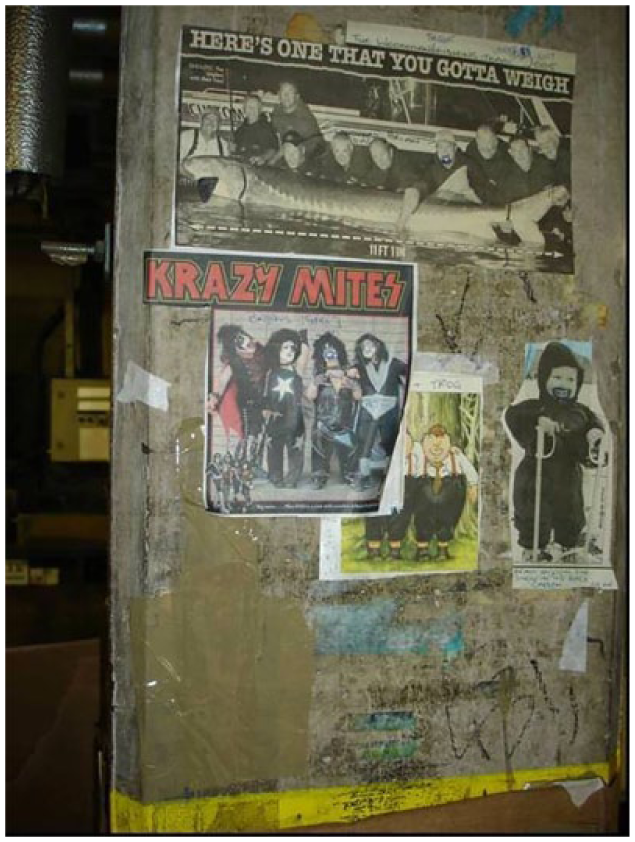
Improvised decoration of press notice board.
These improvised and often polysemic visual creations contrast with ‘official’ images displayed as communiqués or statements of company values. These ‘popular’ images, produced and displayed by workers, were replete with inside jokes, double meanings and irony, not only marking a local culture of collegiality among the workers but also potentially expressing collective discontent when mobilized against managerial threats or workplace changes. The workers did not simply post the images, instead, they would pay attention to them and use them in interactions, talking to peers about the images and using them as anchors for hallway conversations. Micro-interactions based on the images were common, with workers approaching and chatting about the posts during and between work periods.
The images became a vehicle for contestation during the study period in a context marked by high tension over recently proposed changes in which the changeover to the new presses was causing deep rifts with the management and among the workers. Among the workers, these changes produced vehement criticism, with printers producing texts such as ‘the barbarians are no longer at the gates – they’re in office’ placed in columns on the shop floor alongside the visual images, along with posting executive pay raises to contradict managerial discourses about facing restrictive economic conditions. In the above case, the researcher observed a worker examine the image, and subsequently physically punching one of the new machines, exclaiming, ‘What a shit place to work! We get peanuts here!’
Allegories of control versus assemblages of singularity
Visual images facilitate domination by presenting individuals as exemplars of types who are subsumed under general categories and therefore are easier to characterize and control (Rose, 2001). Alternatively, images can undermine control by highlighting singular, dissonant or abnormal aspects of organizational situations, undercutting claims that individuals are subject to generalized rules. In this sense, visual affordances can either invite objectification or highlight exceptions. At VisualCo, management-produced images often displayed visual ‘lessons’ or allegories involving instrumental and causal relationships. Such images (e.g. signs, directives) embodied management control whether or not such control attempts were intentionally leveraged; for example, signs like ‘keep out’ may enact coercion while reflecting ‘normal’ everyday coordination procedures. In contrast, resistance images highlighted unintended consequences of rules, rather than consequences of not following them. In the former case, an objective, clear set of rules is communicated in a top-down fashion, whereas in the latter, the social and personal effects of these rules is made apparent.
For example, Figure 2 depicts an ‘allegorical’ image regarding workplace safety, posted by management. The image shows what seem to be two workers talking about safety, with the younger one dismissive of the importance of ‘safety business’. He is suddenly and violently rocketed off, making the threat of exclusion again a direct topic of communication in its visual materiality. The force carrying the worker away is not known; presumably, it is some type of workplace explosion, but all that we see is his or her immediate dismissal and the co-worker’s surprise and dismay. The image conveys a threat to those who think that safety at work is ‘bullshit’. The human resources (HR) manager, who asked about the image, responded, ‘Workers here think they know it all, but they sometimes forget the basics … and if we have an accident, we may have problem with our bonuses. So, every little bit helps!’ The youth of the worker depicted, perhaps an infantilizing gesture, contrasts with workers at VisualCo, most of whom were more than 45 years of age. In the context of the threat of layoffs, the threat is double; we do not know who or what has ejected the worker, only that an overwhelming force has been applied. The caption at the bottom does not specify the (mis)behaviour endangering the employee, but menacingly warns about ‘safe attitudes’. The image could be read simply as a negative consequence of ignoring safety, or more critically as a consequence of disobedience or bad ‘attitudes’. The command from the company is straightforward: unsafe attitudes lead to danger.
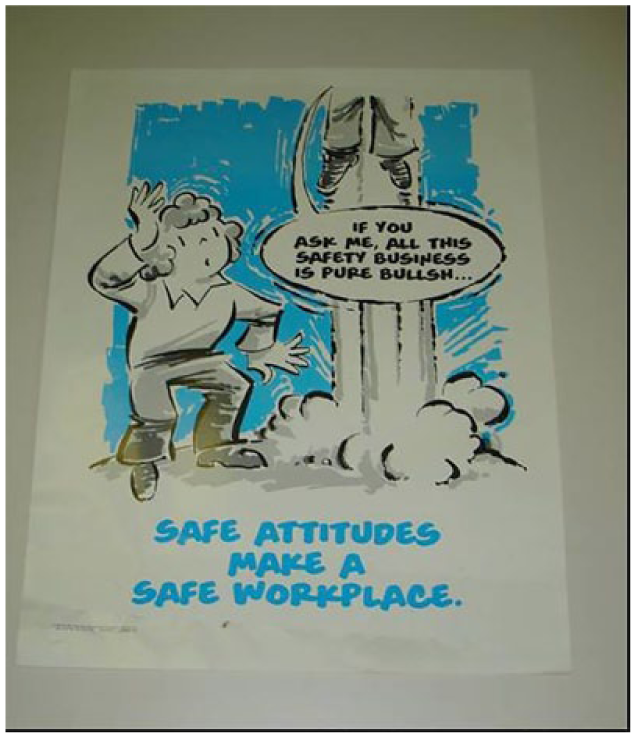
Cartoonish representation of workplace safety.
Furthermore, many signs represented direct commands. Figure 3, placed on a fence protecting the new presses, depicts a sign excluding ‘non-authorized’ people from entry or use of the machines on the opposite side. The fences were originally placed while the new presses were being commissioned, with their construction involving potential hazards. However, the fence remained in place long after the construction, throughout the training of the new press workers, when no apparent physical danger was present. New press workers were selected to leave the old machines for the new positions, to the dismay of workers who had unsuccessfully applied for those jobs. This was a constant cause of distress on the shop floor, creating a rift between old and new press workers, with the distinction between the two groups materially marked by the ‘no entry’ sign and the surrounding fence. The workers remaining on the old machines were forbidden to touch the new equipment or to enter the new space, although the original safety concerns had not involved such actions. In showing the new presses fenced off with that particular sign, Figure 3 visually represents the divided shop floor, with two ends separated by what came to be referred to by the workers as an ‘iron curtain’, reframing what management had labelled a ‘protective barrier’ into a political symbol. Without discarding the initial safety concern, the sign took on additional readings. Workers would often mention that the ‘fence shows a divided shop floor. They divided us for nothing, what a shame’. The image visually embodies, by materializing a command of exclusion, a key concern on the shop floor during fieldwork, that is, the division of the workers and the continued internal tensions.
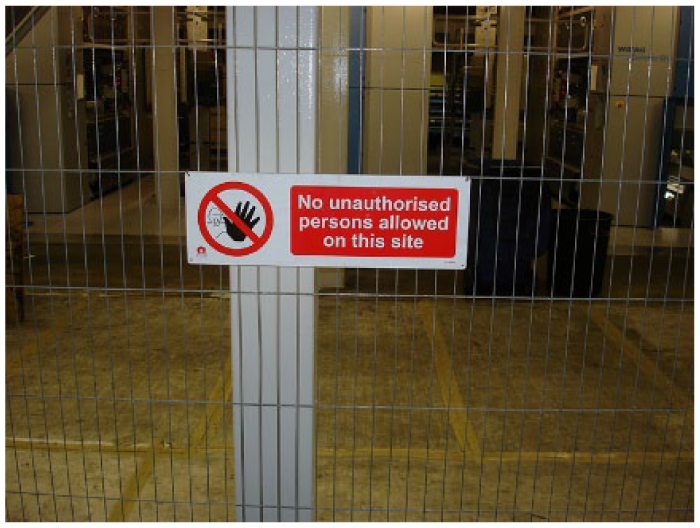
Visual marker of separation between older and newer workers.
The previous two images depict visual material forms at VisualCo that translate company commands related to tidiness, safety and shop floor location, promoting control and coordination of workers. These images use stylized visual gestures of command to effect forms of exclusions, and both Figures 2 and 3 also materialize threats.
If Figure 3 depicts the exclusion of the old press workers from the new space, Figure 4 uses distinct visual affordances to stage the resistance of the old press workers to the new order. The shop rules demanded a ‘clean’ shop floor; posting bills was expressly forbidden. However, Figure 4 depicts a series of photographs placed in an old press command room in defiance of this rule. The figures allegorically depict the new press workers (‘Wifag being the name of the new machines’). Taken from print newspapers and adding mocking subtitles, the first, portraying a man in strange dress, seems to mock the new press workers (‘WiFagots with new overalls’); the second, portraying a hanged man, contains a threatening premonition of future layoffs from the new machines, contrasting with management’s claim that people on the new machines had increased job security (‘WiFag’s first reject’). Finally, the words ‘THE END’ following the previous images alluded to the much-discussed fear among the workers that they would be fired as soon as the new machines came to replace the older ones. As old press workers usually put it, ‘We have no future here. This is a dead end’.
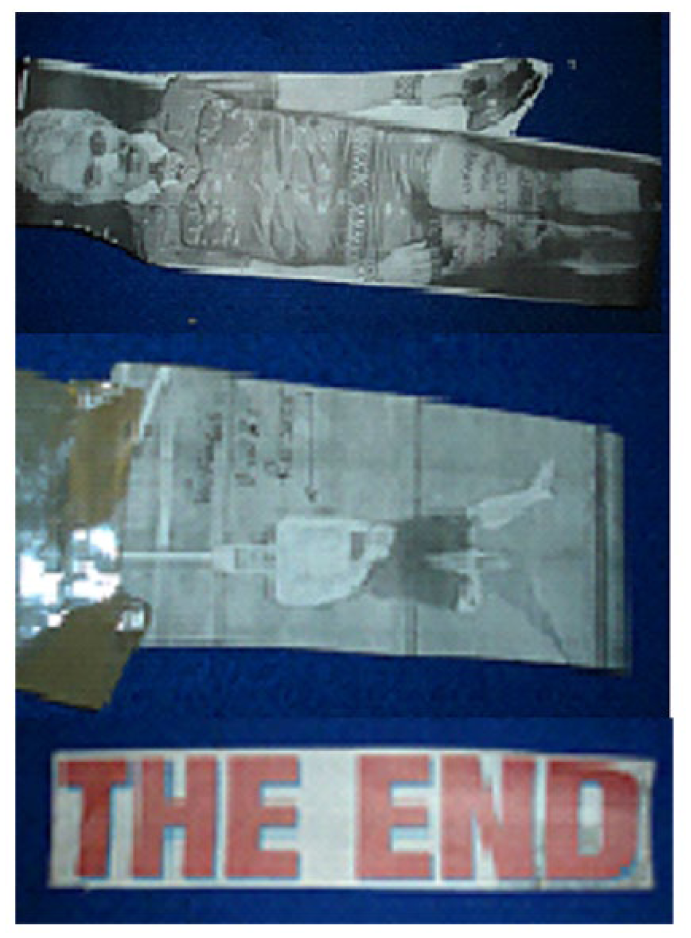
Mocking new press workers.
In observing this series, we noted an apparent ambivalence regarding the new press workers vis-à-vis the new work system. In the first image, for example, the old press workers seem to lash out at the new workers with derogatory and aggressive mockery; however, the second image seems to warn them of impending violence within the system itself, posing the new press workers as subject to ‘hanging’, and the last image shows the old press workers again fearing redundancy. As many treatments of workplace critique and resistance have stressed (e.g. Fantasia and Voss, 2004), workers are often turned against each other in the midst of workplace transformations, but can show moments of solidarity; in the below series, we argue, both of these tendencies seem present. Resentful of those selected for the new presses, the workers also saw these members as victims, expressing their ambivalence in mixed attacks on the people and the system. The ability for visual affordances to mark this ambivalence by layering different images in sequence contrasts with the normalizing affordances of the control images, and the organization is revealed as producing divisions and exclusions, alternatively identifying individuals as dupes of the system and as victims.
Beyond the ambivalence of content, however, the way that such resistance images are portrayed invokes distinct compositional elements imparted to the managerial artefacts, invoking affordances related to individuation versus generalization. Whereas the managerial images represented control through abstract allegorical figures, the images in Figure 4 were highly specific to shop floor workers’ allusions. Although they could still be described as allegorical, they relied on singular images that had an effect by making analogies to specific figures. Understanding these images relies on recognizing the characters and connecting with the current situation.
In this example, the clarity and universality of standard images were aligned with a top-down attempt at control, whereas bottom-up resistance retained a focus on singularity, analogy and the ‘inside story’, which were required for communication via indirect suggestion, rather than transparent clarity.
The new machines were a constant topic of workers’ bricolage. The images were usually placed on old presses or in common areas, challenging the workers’ situation in relation to the new equipment. In the above example, the hanged man was cited by one worker saying,
They thought they were very special for being on the new machines. The truth is that the company doesn’t care. If you do not perform, you are out! They need to fire someone to keep everyone working hard. Management here is cruel, they are fucking cruel people.
Such images work allegorically and analogically to identify the ‘dark sides’ of new policies’. They thus foreground the issue of exclusion in a relatively aggressive manner in opposition to the received idea that new press workers would benefit from job security.
In short, whereas both managerial and worker-driven images affected exclusions, the former placed exclusion either as a person’s fault for not obeying rules (e.g. the worker ignoring safety rules) or as necessary for security (e.g. the ‘no entry’ sign). Conversely, the worker-driven images highlighted the unintended consequences of working on the new press, as well as the individual frustrations, and internal fissures as resulting from the organizational system. It did so by juxtaposing images of the system with individual consequences and placing danger (e.g. the hangman) as central, not incidental, to the organizational system. Each image afforded a presentation of the individual against the organizational background, but the managerial images normalized rule systems, whereas the resistance images pointed them out as bizarre. Both sets presented visually distinct sides in a dispute over what the organization was and whose interests it served.
Anonymity versus personalism: the stylization of images
Related to the theme of control, part of the abstraction associated with managerialist attempts to subsume workers into categories involved anonymity. Drawing on visual affordances to suggest that neither workers nor management are localized or individuated as community members, the mechanisms of power can be made to appear as anonymous, disembodied principles or forces. Resistance to power in this context involves re-embedding workers within personal and social contexts that designate them as actors.
In terms of visual images, we observed that official images tended to be of generic or ‘cartoonish’ people meant to represent any worker or manager. Resistance images allude to personal resemblances and particular colleagues, personalizing instead of anonymizing them. For example, in Figure 2, mentioned above, rather than enacting its allegorical message via actual humans, we drew them ‘cartoonishly’, removing a sense of the individuality and reality of the individuals involved.
In another instance, ‘cartoonish’ figures can substitute for management. Figure 5 shows one such image. It was located around a trash bin for discharged papers. The image depicts a male manager wearing a red tie, pointing his indicator finger with a rather serious face. The letters’ style and colours, the way the manager is positioned, his furrowed brow and pointing finger, and the message caption (‘TIDY UP OR PACK UP’) together position the stylized manager as angry and aggressive. No background is given; the figure stands as if totally decontextualized and absolute against a white background. Figure 5 threatens dismissal for those not following managerial commands and stresses tidiness inside the factory. Tidiness was one of the key management priorities noticed during the fieldwork, especially because the new presses required a very tidy environment to operate without problems. According to the press hall’s manager, ‘the new machines cannot be as shit as the old machines. New equipment requires ultimate tidiness’. Thus, the issue of ‘ultimate’ tidiness implicitly intersected with the planned organizational shift to the new machines and therefore was a sensitive point. Both around the new machines and more generally, the relations between the workforce and management were very tense, with mutually aggressive behaviour. Figure 5 can be interpreted as materializing this company climate.
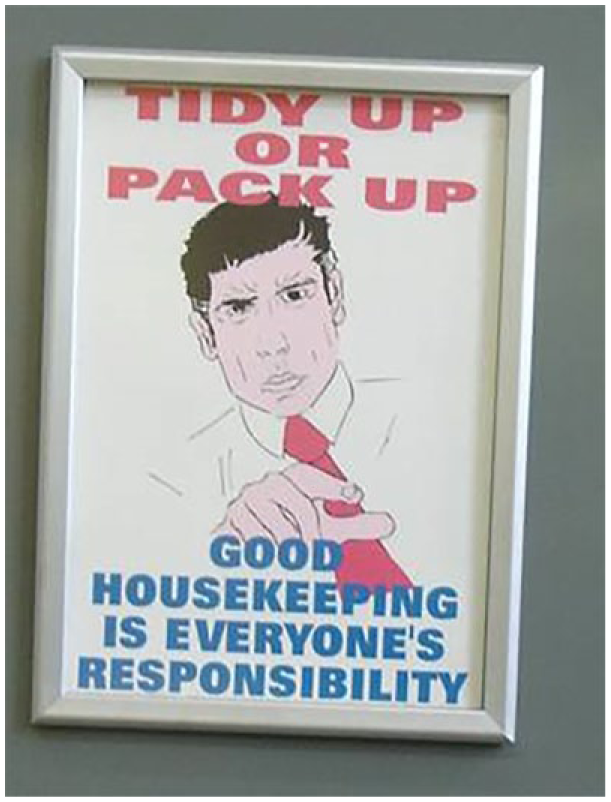
Anonymous authority – Generic image of workplace rules.
We can see how the depersonalizing move towards homogenization is contrasted with a personalizing frame by considering the ‘modification’ of a safety sign in Figure 6. Although workers did not directly complain about having to use protective equipment, the use of de-individuated signs to give orders led to small acts of ‘vandalism’ such as in Figure 6. Here, a typical standardized sign is ‘decorated’ with a face, giving a personal touch to the sign in a gesture that may seem to be a familiar or common way of personalizing official signs. Upon seeing that, a worker commented, ‘Why do they need to be so faceless? They have to be fun!’ Small modifications such as this are not overt resistance messages; however, they do show a willingness to exert agency regarding the sign, changing a blank sign into a ‘face’ and adding personalization onto an otherwise anonymous image.
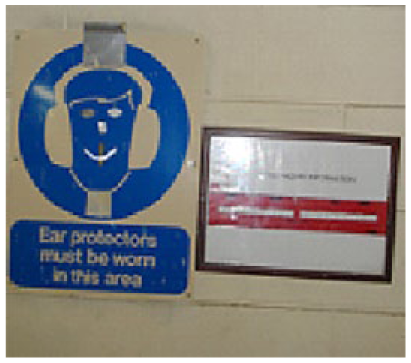
‘Re-facing’ image.
Unlike the anonymous, undifferentiated image of the angry manager or the standard anonymous worker, worker-produced images seemed singularly driven to re-individuate their subjects, turning company policies into concrete outcomes for individual workers (and often, ex-workers).
Beyond layoffs, working conditions were a frequent topic of visual displays. In one case, the words ‘Trapped in Hell’ were posted in red capital letters, taken from a special supplement of a newspaper and displayed on the main door of a press control room. The workers on presses 6 and 9 also complained about work conditions during the United Kingdom’s severe winter. In wintertime, a lack of heating and a broken gate meant very cold temperatures at the bottom of the press while workers changed the machine paper reels. A worker, speaking to another worker, said, ‘that is fucking freezing! All winter it’s like that, but the company does not care! They talk a lot of bullshit about health and safety, but at the end of the day they want us to fuck off’. The workers selected a picture of an almost-frozen adventure in the newspaper, adding the caption ‘The coldest winter in years! Ask the reel handlers on presses 6 and 9’ (see Figure 7), a personalizing gesture localizing the problem for specific workers. Referencing the picture, they made jokes and noted the lack of company action as a sign that the company did not really care about their well-being. The picture became a point of discussion around the presses, culminating in the convocation of a meeting to discuss the reel handler for presses 6 and 9, which had a gate that was unable to close during winter. As Hendry and Seidl (2003) have argued, the meeting as a space of change, resistance or autonomy is a significant material achievement in this regard. In our case, this meeting led to a decision to have the faulty gate replaced. Although we do not argue that concrete change followed from all such visual postings, this example holds out, at least, the possibility of effective change.
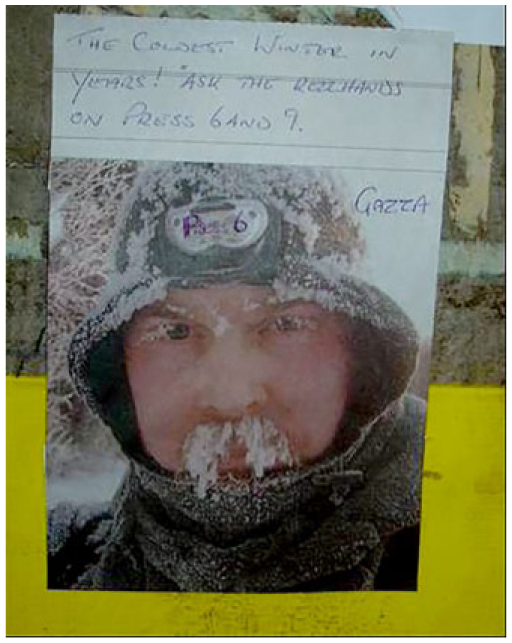
Cold weather on presses 6 and 9.
Both these worker-driven images, beyond the earlier point about rules’ unintended consequences, worked through the personal side of organizational policies, focusing on localized experience and, particularly, personal suffering. Whereas the stylized affordances of images give a sense of clarity and decontextualization through stylization, the affordances of personalization can resist such stylization through a gesture of familiarity. Such uses show the absurdity of organizational policy through, in Figure 7, the caricature of a frozen worker.
The functionalism of illustration versus the irony of bricolage
Following the logic of categorization and de-individuation via stylized images, management-driven images also emphasized clarity and literal meaning. Clarity of expression can support domination by allowing the marginal or singular to be more easily subsumed within a given category. Conversely, resistance affordances may facilitate the expression of the non-literal, the non-representational or other effects of obscuring or complicating meanings. Juxtapositions, hybrids and other ways of creating multiple meanings (e.g. Knox et al., 2008) have been recognized as tools of resistance from the margins (e.g. Frenkel and Shenhev, 2006). In line with this phenomenon, at VisualCo, we identified different images as functional versus ironic: The messages in official pictures, while sometimes humorous, carry straightforward meanings meant to influence behaviour (e.g. the ‘cartoonish’ allegory in Figure 3), whereas the juxtaposition of images in the bricolaged resistance images does not clearly spell out a single message, instead superimposing different messages.
When producing many of the improvised and ad hoc visual materialities at VisualCo, the workers acted as bricoleurs (Lévi-Strauss, 1966) who use ‘the means at hand … which had not been especially conceived with an eye to the operation for which they are to be used … to change them whenever it appears necessary’ (Derrida, 1978: 360). Taking the image in Figure 1, when asked about this, a worker said,
This is a way of making jokes to each other in the shop floor. This makes our situation here bearable. Management hates it. They say we should not do it because it makes the shop floor a shit hall. Who cares?
Several managers, however, expressed the view that the workers’ attitude was wrong and that such images damaged the workplace environment.
Figure 8 is a photo of a photo of an office material craftwork that was posted on the wall of the print shop. The craftwork involves a wound-up ball of twine with a Post-it drawing depicting a sad face, and the open questions, ‘Good day, bad day? Fed up?’ with the ‘WiFag’ label, referring to the situation on the new machine. Explaining the image, a worker noted, ‘They sold this as paradise on earth. The reality is that we are much more pressured and make less money. Never trust a manager! They are all liars!’ This bricolaged ad hoc craft piece frames the disconcerted worker as wound up and fed up, directly linking this situation to the new system. In addition, it led to an argument with management, who removed the image, citing the importance of keeping the new presses tidy. After the picture was removed, workers posted it again. Bricolage was here an act of defiance, a kind of visual ‘sabotage’ against workplace tidiness.
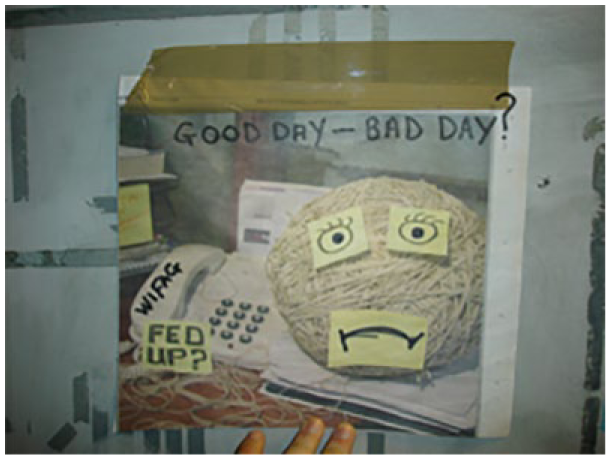
Craft bricolage image.
Juxtaposition and bricolage affordances were highlighted in many of the ironic images posted, such as that of Figure 9, a ‘cannibalistic’ reference to the new press, labelled ‘WiFag fitted with safety mask’. The juxtaposition associates the safety equipment demanded by company policy with the safety mask donned by the insane serial killer from the movie Silence of the Lambs, depicting the opposite of protection. ‘Here, they [management] always get us!’, as one member joked. By inverting this symbol of the mask and allegorizing it with a well-known case of maniacal insanity, the juxtaposition works on several levels. Ironic, bricolaged and juxtaposed images formed a type of consciousness-raising and resistance to the ‘official’ VisualCo discourse, ‘naming and shaming’ particular problematic situations. Workers would see these images, make comments on them, and show them to each other, creating moments of micro-resistance in everyday shop floor situations.
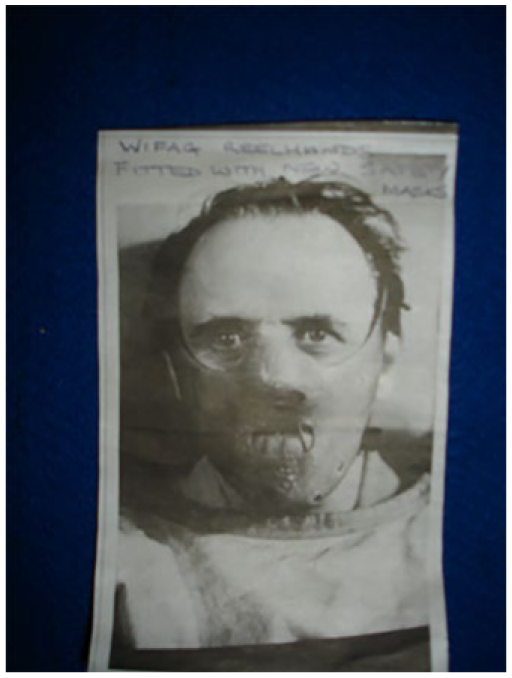
New Press cannibal safety helmet.
Despite the focus on the workers’ juxtaposition, individuation and irony, some images more closely approached direct pleas or claims with more overt content. During the fieldwork, several cut-outs appeared on the old presses with phrases such as ‘We have got no chance here’, ‘Jobs facing the axe’, and ‘Your jobs. Gone’, making explicit the issue of exclusion and opposing the factory’s official discourse of opportunity associated with the new presses (see Figure 10). These phrases were cut from newspaper headlines and link the workers’ experience with those of other workers in the economy, legitimating not only the workers’ job-loss fear but also the distress situation experienced on the shop floor. As the workers put it, ‘Newspaper printing is ending. We are all the walking dead’. In this way, as discussed below, both individualizing and universalizing gestures are operative in resistance artefacts and cannot be specified a priori; notably, in this case, the universalizing artefacts are images of words instead of physical objects or human figures. In Figure 10, one story reads, ‘Millions are stressed out’. While collective rather than individual, this artefact names the ‘victim’, as opposed to the interpellating finger pointing to an anonymous subject in Figure 5, for example. Such phrases challenged management promises that no further redundancy exercises were planned.
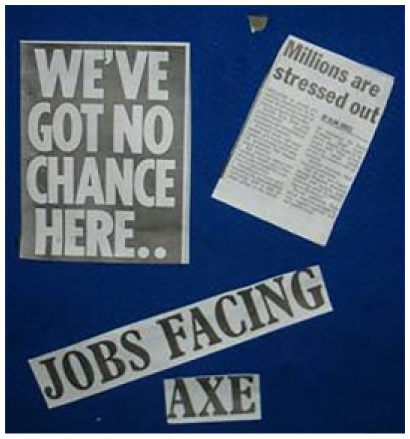
No further redundancy?
In summary, the above three dimensions suggest how different visual affordances were recruited in official images, emphasizing generalizing and clarifying aspects, with resistance affordances emphasizing individualizing, problematizing and idiosyncratic features to images. The ability to promote the singular rather than the universal rule was used as a subversive potential of images, where bricolage enabled the juxtaposition of multiple images and humour marked the spaces between subversive images’ multiple meanings.
Discussion
Drawing on visual data within the context of ethnography, we argue that control and resistance can be inscribed from the diverse affordances of visual materiality. Whereas most studies of organizational materiality focus on technologies, tools, and other concrete artefacts (Leonardi and Barley, 2010; Orlikowski and Scott, 2008), our analysis focuses on mundane organizational materialities in the form of visual images. In our data, workplace politics was interwoven with and expressed by visual materialities, and various organizational actors took advantage of the material affordances of visual images in ways related to their relative power positions. We know, from disparate literatures, that power regimes in organizations rely on sociomaterialities (Dale, 2005), that artefacts may support forms of politics (Winner, 1980) and that the labour process relies on objects and technologies that support power and resistance (Braverman, 1974). However, little empirical work attests to how visual artefacts support control and/or resistance in the workplace or to how the different political objectives change how materials are deployed or interpreted.
In this way, this article contributes to understanding visual materiality in organization in two distinct but related ways. First, we extend discussions of power and materiality (e.g. Leonardi and Barley, 2010) to control and resistance, showing how material, and particularly visual, artefacts come to mediate wider workplace power struggles. Second, we extend the literature on visuality to examine the differential uses of material affordances, linking affordances to the openness (Keane, 2005) of visuality, which gives images a plasticity based on their diverse affordances. Below, we elaborate on each of these contributions.
Control and resistance via material affordances
Control and resistance involve working with materiality (Leonardi and Barley, 2010). Workplace politics become ‘durable’ through material inscription (cf. Joerges and Czamiawska, 1998), while visual materialities inform ongoing interactions around organizational events and struggles. The images discussed above co-engaged humans and material objects (ideas, newspaper presses, printed newspapers, printing knowledge, pictures, knifes, boards, the will to challenge, etc). In practice, it was difficult to separate the images from the discussions, arguments and jokes about the images and the spatial and material contexts materiality surrounding them (e.g. the iron fence, the old vs the new press, the common area). Accordingly, workplace politics at VisualCo is interwoven with a sociomateriality that is integral to organizing from below.
The images originating from workers’ bricolage were in a ‘constant process of adaptation, subversion and re-inscription of dominant discourses’ (Thomas and Davies, 2005: 687). First, by taking images or phrases from the newspapers, writing on them and posting the bricolage images on public places in the factory, the workers attached new and different meanings to the original newspaper articles; their practice as printers came to involve practices of inscribing new meanings and uses of the newsprint. Second, the postings constituted an act of defiance against management, especially at a time when the company was implementing quality control initiatives and regarded the images as a ‘lack of cleanliness’. Thus, remixing messages, taking images out of context and decorating the company with unofficial images decentred managerial attempts to produce standardized meanings visually in public. The novelty we bring to this process is in analysing how these resistance efforts marked a contrast within the affordances of visual artefacts themselves, as actors used a diversity of material possibilities across images to selectively frame messages.
Visuality is important for power and resistance because it makes social symbols concrete and gives a palpable existence to elusive ideas (Scott, 1998; Toraldo, Islam & Mangia, 2016). Focusing on the embodied and material bases of control and resistance moves researchers towards the micro-processes by which abstract power relations are made concrete in artefacts; however, we see also that although some artefacts are created to point to generalities, others foreground the singular. Social theorists have noted that a key feature of power and domination is the question of how the singular is or is not subsumed into normative and universal structures (e.g. Boltanski, 2011). We explore how micro-processes of materiality express this question in everyday practices through the differential use of visuals.
On one hand, materiality can be recruited to construct, extend and maintain dominant power structures (Leonardi and Barley, 2010). Because control systems, to be effective, must find ways of connecting to the material bases of everyday life (Boltanski, 2011), artefacts establish settings for the exercise of power. As Orlikowski (2007) notes, organizational rules and principles become ‘constitutively entangled’ with material artefacts in organizations, leading to a sociomaterial system that is at once material and symbolic (p. 1437).
On the other hand, material representations ground human life in the specificities of everyday work life. Because of the inevitable gap between the specificity of everyday life and the generality of organizational principles, the latter work to ‘hide and disavow’ the seeming irrationality of particular individuals in the forms of universal rules (Adorno, 1984: 79). As some organizational scholars note, the individual, although socialized, is not totally subsumed by categories (Fleming, 2009) and is able to assert singularity over and against wider logics (Islam, 2013). Although this assertion can have ambivalent effects (Boltanski and Chiapello, 2005; Fleming, 2009), at VisualCo, affirming individuals and their local culture became a way to fight changes in the organization and wider structural changes in the print industry. While we do not argue that such affirmations always lead to, or are equivalent to, concrete organizational change, we have described their role within a wider context of symbolic and material processes from which concrete change emerges.
Working with affordances: singularity, personalism, and bricolage
We highlight affordances (e.g. Gibson, 1979; Jarzabkowski and Pinch, 2013; Leonardi and Barley, 2010) to explain the pliability of visual possibilities, building on Keane’s (2005) work on materiality and contingency. Organizational literature tends to focus on the material possibilities of a given form (e.g. Leonardi and Barley, 2010; Zammuto et al., 2007) instead of the social uses of that form, even as it is recognized that affordances involve materiality-in-practice (Jarzabkowski and Pinch, 2013; Zammuto et al., 2007). For example, Zammuto et al. (2007) state, ‘The materiality of an object favours, shapes, or invites, and at the same time constrains, a set of specific uses’ (p. 752). However, how different sets of affordances are selectively deployed by different actors to facilitate or foreclose certain workplace experiences has not been systematically developed.
Focusing on affordances allows us to discuss materiality without asserting that the material fixes or determines organizational outcomes. Materialistic positions may pose the danger of falling into determinism, whereby material affordances drive interpretations (cf. Dale, 2005). Treating affordances as bundles of contingent material possibilities (Keane, 2005) opens avenues into an ‘interactionist’ perspective on materiality that avoids determinism. Affordances bound experience, but do not determine which experiential possibilities will become realized in an artefact. Instead, various groups seize upon diverse aspects of a material modality (in this case, the objectifying and normalizing vs the juxtaposing and ironizing aspects of visuality). The distinct affordances given by visual images interact with social motives to explain differences in visual composition across the various artefacts. Although workers and managers both invoked visual messages, they chose among the various affordances of visual expression in very different ways.
Visual forms of resistance at VisualCo worked similarly to discursive forms in that they targeted organizational meanings (e.g. Hardy and Thomas, 2015). Similarly, past studies of visual resistance in organizations have used images, often cartoons, to study how meanings are reframed to challenge dominant discourses (Hardy and Phillips, 1999; O’Doherty, 2011; Rodrigues and Collinson, 1995). Such approaches are related to a larger literature around popular cultural sources of resistance messages (for reviews, see Parker, 2006; Rehn, 2008). Virtually ubiquitous to such literature, however, is a focus on the content meanings of media, reflecting discursive or ‘critical semiotic’ views of interpretation (Bell and Davidson, 2013). Our approach is consistent with these views but complements them by adding a material layer to such perspectives. Moreover, by showing how workers and managers invoke specific affordances that coalesce with positions in an ongoing struggle, we show how visual struggle is related to but distinct from discursive views.
To illustrate, our field site contained cartoon-like images, evoking classic studies such as Rodrigues and Collinson (1995), which used humour in a union newspaper via cartoons to demonstrate resistance (see also Hardy and Phillips, 1999; O’Doherty, 2011). Whereas Rodrigues and Collinson (1995) highlight irony and humour via cartoon content as critique, our study focused on how visual composition, as depersonalizing and generic, served a control function. The worker images at VisualCo were not organized in an official union publication but were fragmented and sporadic; one might speculate that their more individualizing, bricolaged and less cartoonish features could relate to these conditions of production, although clearly more research would be needed to establish this. The point is that by adding a material ‘reading’ to a content reading, we open the consideration of images to a new level of analysis, prompting questions of how these levels reinforce each other or, conversely, complicate straightforward meaning through juxtaposition and contrast.
Using visual bricolage, workers at VisualCo struggled with management over the types of visual practices that would dominate the workspace. These bricolage practices served to bring awareness to specific workplace situations, such as lack of safety, the shop floor division, redundancies and difficulties with the new machines. The visual materialities at VisualCo play a role in making explicit particular events, in ‘naming and shaming’ problematic aspects on the shop floor that may challenge management’s version of events.
The images posted around the presses were highly critical and added to a sense of indignation and injustice. These visuals, by undermining stylized representations and juxtaposing images, denounced workplace conditions in a way that would be difficult via language (Bell, 2012), and such denunciations may provide an important step in revealing contradictions and relations of domination. The ability to transform workplace materiality in ways that either reinforce control (e.g. Dale, 2005) or frame possibilities for resistance is an important piece of workers’ wider struggles.
Future directions and conclusions
The visual material approach described above uses affordances to suggest differential uses of visuals, but future research should extend such findings to both different fields and different material modalities. As some have noted (e.g. Islam et al., 2016), organizations do not work across a single material modality; thus, researchers should examine organizational interactions across material modalities to more fully understand the repertoires of power among actors.
Furthermore, material and discursive expressions work alongside economic and coercive forms of domination and resistance. Although we allude to the social and economic contexts of the images (i.e. technological changes, workplace restructuring), we do not integrate these diverse forms of power into a single analysis. Because it is not obvious when visual images will become a locus for struggle, the question of when they do so becomes important. Sociomaterial studies should attend to the interfaces of different forms of power and how the arenas of struggle are decided, linking material and discursive strategies with traditional adversarial worker struggles to demonstrate how the two interact.
For example, the use of bricolage with regard to the images constitutes an interesting contribution to current discussion of bricolage (e.g. Boxenbaum and Rouleau, 2011; Perkmann and Spicer, 2014). Current literature has focused on the use of bricolage in organizational change and links to materiality by emphasizing change as a material practice. However, the particularity of the visual to allow bricolage through its unique affordances opens up an interesting avenue for research. Specifically, the fact that bricolage leans on particular material modalities, and that these modalities can offer diverse opportunities for control and resistance, means that the study of change processes should take into account the possibilities promoted and foreclosed by particular artefacts in organizational settings.
Relatedly, a lingering question is how such forms of workplace resistance come to complement, substitute, or otherwise relate to more conventionally studied forms of worker resistance such as labour unions and overt protest. Does resistance via visual images reflect new potentials beyond such conventional means or does it constitute a ‘weapon of the weak’ (Scott, 1985), a palliative measure when other avenues have been closed off? Worse, could such forms of visual image provide a kind of ‘decaf resistance’ (Contu, 2008) that is all image and no substance? In some cases (e.g. the case of the faulty gate, Figure 7), the concrete effects of the image and its surrounding discussion were clear; concrete action was taken to remedy the situation. In others (e.g. the cannibalistic Figure 9 image, drawn from popular culture), the effects are less obvious and the images seem to project an aggression without a clear goal. Future research should thus examine not only how images interact with other forms of collective action but also when images themselves have more concrete versus more diffuse effects.
Furthermore, it is likely that the visual affordances described above are context-bound, a possibility that follows from the thesis of the openness of affordances. In our data, visual images emphasizing singularity, locality, and juxtaposition affordances offered resistance possibilities against a totalizing view of organizational rules using cartoonish figures, bereft of irony and emphasizing clarity. However, singularity and personalizing affordances are not unequivocally associated to resistance versus control. Indeed, theorists of the ‘new spirit of capitalism’ (Boltanski and Chiapello, 2005; see also Fleming, 2009) emphasize that contemporary controls often highlight individuality, flexibility, and ‘being oneself’. Furthermore, cartoonish images carry resistance, not control, functions in Rodrigues and Collinson (1995), where their presentation involves caricature and sarcasm. Rather than viewing the VisualCo struggle as one of emancipation versus managerial hegemony, it is one of competing hegemonic projects, where different ideological orders struggle for dominance. 1 In our setting, an industrial print factory typical of the ‘old spirit’ of manufacturing, recognition of singular individuals and humoristic juxtaposition served as resistance strategies; however, such strategies may operate differently elsewhere. Thus, although affordances have political uses, such uses are tied up in the specific material conditions of a given struggle and may shift or invert in a different struggle. As set forth above, affordances do not signal material determinism but instead provide material artefacts that take on significance against a wider field of social understandings.
Thus, our findings aim to illuminate one of the many forms in which power struggles unfold, showing an aspect of materiality that is salient for power in organizations. We focused on a work situation where open discussion is suppressed, work is precarious, and organizational and technological changes place the organization and its members on thin ice. In such contexts, members search for ways to articulate discontent and affirm their singular identities. The deployment of images on the factory walls, although different from classical visions of worker organization(s) or resistance, allowed members to demonstrate their ongoing ability to project meaning onto their work in the face of a difficult situation. This study, in acknowledging the validity of these images as an object of study, also validates the significance of such attempts.
Footnotes
Acknowledgements
The authors would like to acknowledge the kind help of Maria Laura Toraldo, Stephane Jaumier, Damon Golsorkhi and the participants of the MOTI seminar at Grenoble Ecole de Management for their comments on previous versions of this paper. We would also like to thank Craig Pritchard and three anonymous reviews for their in-depth engagement with our manuscript.
Funding
The author(s) received no financial support for the research, authorship, and/or publication of this article.