




Abstract
This paper shows the importance of more-than-human materialities in surfacing how affective processes of leaderful resistance emerge in the workplace. Employing a Spinozo-Deluzian approach to affect, we develop a new materialist analysis showing how more-than-human materialities resist in encounters with humans, generating flows of affect that lead. Based on a 9 months affective and virtual ethnography, we uncover two ways more-than-human matter resist we label affective hindrance – subtle barriers; and decompositional rupture – the undermining or breaking of relationships. These affective forces help explain how processes of resistance are co-produced in material encounters and how such relations both lead and resist in day-to-day organising, resulting in changes to work processes or reverberations that surface later, generating further leaderful resistance. Our work extends research that understands leadership as a less positive and organised process unfolding in unexpected ways.
Introduction
There is a growing body of research on leadership and resistance in the workplace. Authors have discussed how leaders can manage and suppress dissent (Lundy and Morin, 2013; Tourish and Vatcha, 2005), productively harness the power of resistance (Mabin et al., 2001; Nijstad et al., 2014), resist corporate power (Courpasson et al., 2012; Jamjoom and Mills, 2023), and how followers resist leadership (Güntner et al., 2021). One thing common across this diverse body of work is that authors conceptualise resistance as a human and often heroized activity. As a result, scholars treat leadership as a separate process that can solve resistance (Carroll and Nicholson, 2014), prescribing styles and competencies for humans to adopt to restore order and boost collective performance (Tourish and Vatcha, 2005). Leadership is therefore assumed to be a compositional force that keeps the organisational collective assembled and harmonic in everyday interactions. However, we understand leading and resisting not in opposing terms, but as mutually-reinforcing and co-productive forces (Collinson, 2005) emerging “from dynamic and evolving relationships” (Zoller and Fairhurst, 2007: 1355). We propose the idea of ‘leaderful resistances’ to explain such relations and their ongoing directional effects (Crevani, 2018), a process that unfolds through subtle shifts in power (Hynes, 2013) embedded in everyday flows of ordinary work that ‘move’ organisational collectives in manifold ways.
An integral part of organisational collectives are the more-than-human matter such as technologies, offices, colours, desks and so on; yet, these are often suppressed, silenced, or forgotten in accounts of organisations (Sayers, 2016). Whether intentional or not, leadership writing too overlooks the role of more-than-human materialities or ‘things’ (Bennett, 2010). The relationships between human and more-than-human matter is difficult to research, but affect has been identified (Fotaki et al., 2017) as a useful way of revealing invisible forces and intensities between compositions of human and more-than-human materialities (Gherardi et al., 2019) and how they shape leadership. Extending this work, this paper explores how more-than-human materialities participate in relations of leaderful resistance by studying a software and design company using affective and virtual ethnographies. In-person and online observation, interviewing, and participation gave us insight into the day-to-day affective relations integral to work between humans and more-than-humans. We attended to the flows of affect in everyday interactions informed by a Spinozo-Deleuzian approach (cf. Fox and Alldred, 2022; Thanem and Wallenberg, 2015), and uncovered two processes of leaderful resistances we label as (1) affective hindrance, a quality of encounters where nonhuman agencies resist human intentionality by dictating to humans what to do through recommendations and obstructions on how to develop the projects; and (2) decompositional rupture, where relations were disturbed by micro-shocks and rhythmic oscillations that decreased organisational capacities to act, because they undermined relations between humans. Both processes illustrate how more-than-human materialities led humans by helping them form or break alliances shaping work and goals, channelling energies or resisting aims, circumscribing activities, causing difficulties between them, and creating fissures in their work. The processes of hindrance and decomposition were routine features of work and had the effect of moving the human actors in unanticipated directions. As such, instead of leading people forward like an idealised leadership prototype, these hindrances and ruptures had the capacity to send people back on repetitive iterations of work or create unwelcome reverberations that resurfaced to haunt the team at unexpected moments. These emergent qualities of relations show that both human and more-than-human matter can lead and resist, and such activities are integral to everyday organising.
Our contributions are twofold: First, we build on the research that investigates the relationship between leadership and resistance at work by exploring how more-than-human materialities both lead and resist human intention and break the linearity of routine through subtle shifts in power at the level of intensities. Second, we contribute to the embryonic field of affective leadership by introducing a less positive, more disruptive conceptualisation of this idea, arguing that leading can entail rupturing affects that undermine relationships and decrease organisational capacities to act. This article unfolds as follows. First, we review work on leadership and its relationship with resistance and materiality in organisations. Second, we present the theoretical framework that underpins this research based on the writings of Spinoza and Deleuze on affect. Third, we outline the methods used in the study. Fourth, we present our empirical stories of material encounters. Finally, we outline our discussion and concluding remarks.
Resistance and Leadership
Previous research has acknowledged that resistance is a fundamental part of leadership dynamics (Banks, 2008; Collinson, 2005; Zoller and Fairhurst, 2007). Authors conceptualise resistance as “a form of organisational misbehaviour that is a response by employees to employer control – a response that tries to establish and maintain autonomy and dignity” (Karlsson, 2012: 185) at work. Organisations have identified multiple acts of resistance (Courpasson et al., 2012) including a number of faces (Fleming and Spicer, 2007) or strategies (Collinson, 1994) such as strikes, sabotage, whistleblowing, distancing, empty labour, cynicism, and humour. These heterogeneous forms of resistance have been labelled either as productive (Courpasson et al., 2012), overt acts of resistance that challenge management decisions, temporarily modify power relations, and produce a change in the work conditions; and routine (Prasad and Prasad, 2000), unplanned, informal, spontaneous, and often covert signs of dissent with little organisational impact, a kind of soft or ‘decaf’ resistance that “threatens and hurts nobody” (Contu, 2008: 370). However, irrespective of the kind of resistance; acts of dissent and their consequences for organisations are seen as disruptive and undesirable forces. This can lead to a focus on organisational leadership as the solution to the resistance ‘problem’.
An influential strand of research depicts leadership as a key managerial technology in preventing, mitigating, counteracting, and suppressing the detrimental effects of resistance. This body of research perpetuates what Grint (2010: 100) labelled one of the ‘sacred’ aspects of leadership: “the silencing of opposition”. Scholars identify styles, competencies, and actions for leaders to placate followers’ resistance. They invoke several leadership prototypes to create a passive and compliant workforce for instance, how transformational (Oreg and Berson, 2011), charismatic (Tourish and Vatcha, 2005), authentic (Mousa et al., 2020), and empowering (Vecchio et al., 2010) leaders can inspire followers to self-regulate, reducing or neutralising their intentions to resist. If resistance emerges, research contains recommendations leaders can apply to silence it (Gaubatz and Ensminger, 2017), or what kind of strategies corporate leaders can employ to harness the productive power of resistance (cf. Mabin et al., 2001; Nijstad et al., 2014) for their own ends. Alternatively, others have examined a darker side of leadership portraying how destructive leader behaviours can suppress or ignite dissent by employing coercive methods including fear, humiliation, intimidation, and punishment showing how charismatic leaders create ‘totalistic’ corporate cultures using their ‘visions’ to demonise dissent (Tourish and Vatcha, 2005). A few studies have begun to explore how processes of resistance are led by the resistors (e.g. Courpasson et al., 2012; Güntner et al., 2021; Sutherland et al., 2014) highlighting a more collective approach to studying leadership. Such studies tend to perpetuate leadership romanticism, widening the lens from heroic individuals towards dissenting but ‘harmonic’ collectives (Collinson et al., 2018) where resistance is an emancipatory, productive, and positive process, overlooking possible retaliation and disciplinary costs employees may have to pay for participating (Collinson et al., 2018) including being fired, stagnated, threatened, and marginalised (Tourish and Vatcha, 2005). Such a perspective advances a division of labour between those who ‘lead’ and ‘follow’ placing managers in positions of unquestionable power becoming manufacturers of consent (Collinson, 1994). As such, managers’ leadership unfolds in the form of multiple tactics of domination including repression, seduction, and production (Ryan, 1998) alluring followers into relinquishing their criticality, control, and identity depicting leaders as agents of silence, as individuals with unique traits who must push dissent back seducing workers to ‘resist’ the temptation to resist. This heroic and human-centric rhetoric tends to ignore multiple agencies, especially more-than-human ones.
The material aspects of leadership-resistance
Much of the research on resistance and leadership focuses on behaviours between humans. Even though more-than-human materialities have been part of the discussion (e.g. Courpasson et al., 2012; Turnage and Goodboy, 2016), the affective role these materialities play in co-producing leadership/resistance processes has not been fully recognised or explored. A number of studies have shown the relationship between leadership and technological/digital materialities including how prototypical leadership styles influence the acceptance of technological innovations (Schepers et al., 2005); how leaders either facilitate the implementation of new technologies (Haber and Carmeli, 2023), influence or resist digital transformation processes (Zulu and Khosrowshahi, 2021), and decrease the resistance and turbulence associated with the adoption of technology (Frick et al., 2021); how new technologies ignite employees’ resistance (Prasad and Prasad, 2000); and what responses implementers can enact when resistance occurs (Rivard and Lapointe, 2012).
Other researchers have shown that acts of resistance include not only social practices but also the mobilisation of material artefacts, ‘objects of resistance’ –such as business reports– that humans create to convey dissent (Courpasson et al., 2012). Likewise, digital technologies like email can facilitate the voicing of dissent, acting as a shield for safe expression (Turnage and Goodboy, 2016). New technological artefacts can positively affect processes of resistance by igniting a myriad of intentional and unintentional acts of dissent (Prasad and Prasad, 2000). However, even though more-than-human materialities play a pivotal role in the performative co-constitution of workplace resistance (Harding et al., 2017), materiality is considered only as a companion or aid, as something that humans can use or discard at will. This research privileges techno- and human-centric approaches focussing on the instrumental and functional qualities of technology and how humans interact with, around, or against it (Orlikowski, 2007) paying scant attention to how materialities –such as software packages– constrain or afford organisational practices (Leonardi and Barley, 2008).
A small but growing body of research has begun to acknowledge the role that more-than-human materialities play in leading organisations (cf. Clifton et al., 2021; Hawkins, 2015; Oborn et al., 2013). Their main argument is that studying humans and their relations is not sufficient to explain leadership as “materialities are not passive mediators or neutral channels for leadership but are consequential” (Oborn et al., 2013: 256). Mailhot et al. (2016) suggest that material artefacts can either facilitate or constrain coordinated action arguing that leaders can mobilise objects and promote the negotiation of the meaning of those objects, materialities that in turn, can either hinder or contribute to project development. For Clifton et al. (2021), software packages can ‘do’ leadership by speaking through human operators, as a ventriloquial effect in which authority is mobilised when the hybrid presence of bodies is ‘made relevant’ affecting how work evolves. This research understands leadership not as a property of human beings; rather, as a process that emerges and unfolds as the product of relations between human and nonhuman bodies. As a result, work is “an evolving relational configuration” (Crevani, 2018: 83).
To summarise, the literature on leadership and resistance centres on relations between humans, some seen as heroic, others as villainous with more-than-humans overlooked or underplayed. How more-than-human materialities lead or resist humans back remains to be studied. To examine human-nonhuman relations, we turned our attention to affect theory due to its power to reveal flows and intensities between different kinds of bodies.
Affect and leadership
The turn to affect may have emerged in the humanities and social sciences in the mid-90s, but its emergence in organisational studies is relatively recent (Gherardi et al., 2019). Affect has been examined from multiple perspectives (see Seigworth and Gregg, 2010, for a review). In this paper, we follow the Spinozo-Deleuzian approach. In his writings on ethics, Spinoza (1996: 70) asks what bodies can do holding the view that a “body can be affected in many ways in which its power of acting is increased or diminished”. Affect is not a thing, a feeling, or a characteristic that belongs to someone or something; rather, it is an effectuation of power, a force that circulates between bodies in a constellation of relations (Ahmed, 2004) “producing a continually changing distribution of intensities” (Thrift, 2000: 219) that flow and emerge in a world of encounters. Crucial to the Spinozo-Deleuzian conceptualisation of affect is that bodies are seen as sites of potentiality and intensity, defined by their fluctuating capacities to affect and to be affected, as well as the material effects that such flows of intensities produce (Fox and Alldred, 2022). When bodies encounter each other, they enter into relations of composition and decomposition (Deleuze, 1988). Composition means adding by forming a more powerful composite of bodily capacities, increasing power. Decomposition is subtraction of forces by destroying a union, decreasing power. Affect is therefore about forces and intensities in motion, continuous variations, transitions, or passages between degrees of power that bodies exercise and experience when encountering each other.
Even though affect theories have begun to permeate organisation studies (e.g. Fotaki et al., 2017), in leadership they remain embryonic and under-explored (cf. Knights, 2018; Munro and Thanem, 2018). As Munro and Thanem (2018) suggest, rather than being led by individuals and organisational hierarchies, organisations are instead led by flows of affect that increase or decrease the organisational capacities to act. Affect writers conceptualise leadership as an emergent property of relations rather than inherent characteristics and behaviours belonging to human individuals. Rooted in ethical leadership theories, ‘affective leadership’ denotes the organisation of good or joyful encounters that increases collective capacities for action, advocating for a sense of care and well-being (Munro and Thanem, 2018). However, this approach tends to reproduce and perpetuate the widely unquestioned assumptions that leadership works as a force for good (e.g. Collinson, 2012). Moreover, even though these studies have begun to consider bodily capacities and forces, they still privilege humans, taking for granted the affective capacities of more-than-human materialities. These limitations open opportunities to explore further what kinds of affective flows humans and nonhumans produce when encountering each other, and what directions and possibilities these encounters produce. We argue that leadership also entails processes of resistance that emerge within decompositional encounters at work, fluctuations of power and bodily forces that decrease the organisational capacities to act leading in unpredictable ways.
Studying affective flows enables a less abstract day-to-day approach to examining leadership, more about ‘molecular’ relationalities, a combination of ‘a thousand tiny’ leaderful moments (Deleuze and Guattari, 1987) emerging in trivial, mundane, vague, unruly, incoherent, and fragmented ways. Whilst molar organisations (like mainstream leadership thinking) contain and limit what may seem ambiguous or different, molecular forces push us out through “ruptures that occur at the level of intensities” (Gordon et al., 2021: 538). The molecular opens “an entire world of unconscious micropercepts, unconscious affects, fine segmentations that grasp or experience different things, are distributed and operate differently” (Deleuze and Guattari, 1987: 213). Thus, we offer a micropolitical analysis of mundane moments of resistance that may not look like leadership at a first glance but which have the effect of leading organisations in multiple directions. Such analysis sheds light on affect as a theory of power (Thanem and Wallenberg, 2015) depicting the subtle ways in which intensities circulate between bodies as “an ensemble of actions” (Foucault, 1982: 786) that unfold when bodies relate to each other, modulations in power emerging as a flow of micro-shocks and cuts that unfold in daily encounters (Massumi, 2009). In this way, affect theory offers an alternative to understand how the doings of bodies at the micropolitical level modify other doings and how they force and resist each other. Therefore, our study questions are what flows of affect emerge from encounters between human and more-than-human materialities, and how do they produce leaderful resistances at work?
Methods
Human participants.
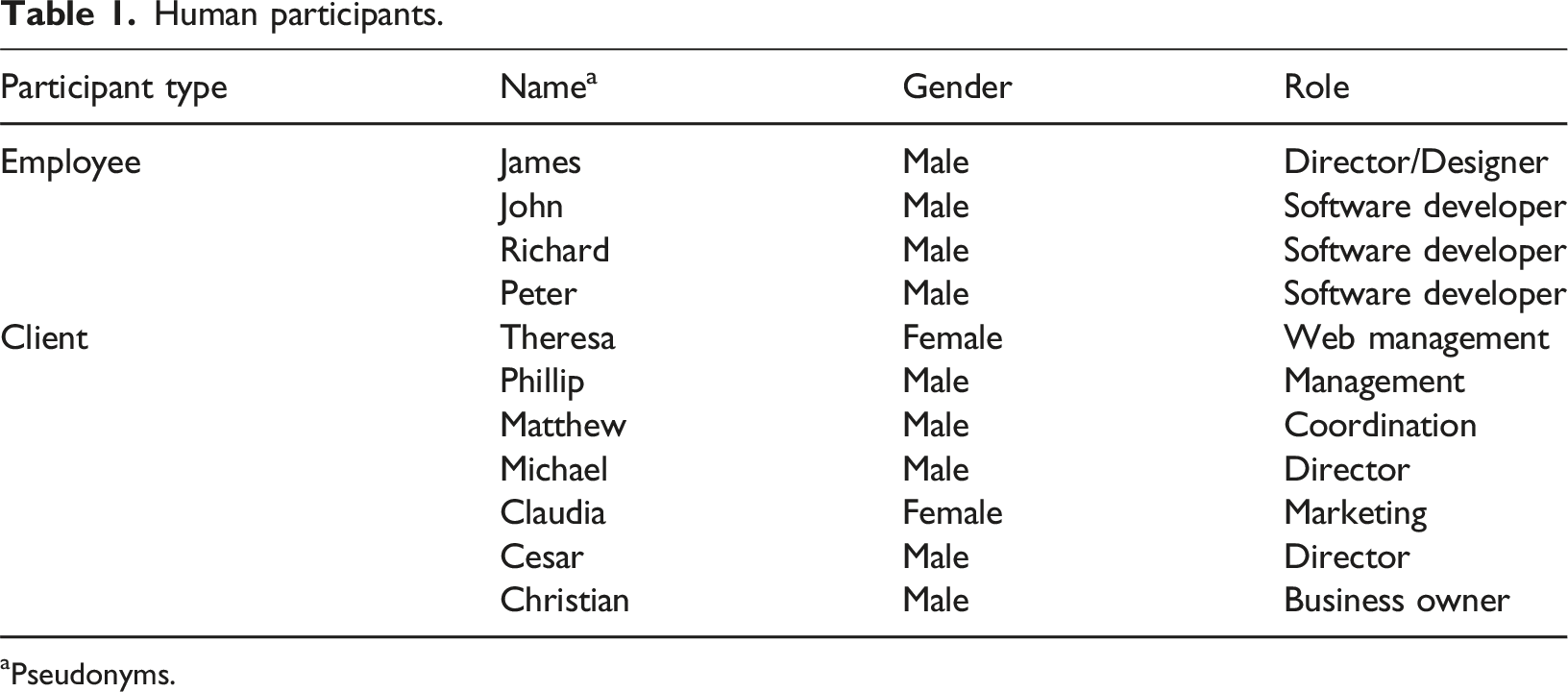
aPseudonyms.
Ethnographic method is the study of people and their cultures, norms, values, activities, and meanings they assign to their lived experiences (Watson, 2011). However, ethnographic observations often focus on human meaning and interpretation dealing poorly with the ‘empirical invisibility’ of materiality (Schubert and Röhl, 2019). However, more-than-human materialities are not passive actors, they have the capacity to influence, aid, and constrain human action and intention (Pickering, 1993). To make more materialities visible we followed an affective approach to ethnography (Gherardi, 2019) sensitising ourselves toward material-discursive entanglements (Barad, 2007). Affective ethnography has been described as a style of ‘doing fieldwork’ that seeks to capture ‘ordinary affects’, “the varied, surging capacities to affect and to be affected that give everyday life the quality of continual motion of relations, scenes, contingencies, and emergences'' (Stewart, 2007: 1–2). Researchers shift their attention from static representations of organisations towards flows of intensities, forces, rhythms and capacities (Beyes and Steyaert, 2012). Doing affective ethnographies implies the capacity to resonate with the materiality of the field following ‘things that happen’ (Stewart, 2007) rendering visible the role that more-than-human beings play in organisations (Schubert and Röhl, 2019).
During the pandemic, our study company conducted most of its activities remotely, employing information and communication technologies (ICTs). Consequently, a virtual approach to ethnographic data collection was employed when embodied presence was restricted. Virtual ethnography, “adapts ethnographic research techniques to study the cultures and communities that are emerging through computer-mediated communications” (Kozinets, 2002: 62). As Postill (2016) argues, online data collection does not imply an ‘inferior’ or ‘illegitimate’ approach in relation to face-to-face modalities. On the contrary, collecting data through technologically-mediated methods can obtain meaningful insights into the situated life of participants allowing researchers to intensify their co-presence in the field strengthening the research’s authenticity and multivocality (Akemu and Abdelnour, 2020).
The paper is based on a detailed analysis of online observations, supplemented by semi-structured interviews. Observations were conducted by the first author via Slack, a messaging and work collaboration application. He gained access to the corporate dedicated Slack spaces where company members exchange messages and information. Most of the time, the researcher remained silent at his ‘observational spot’, with his webcam turned off, taking notes. However, occasionally he would participate in Slack conversations and ask questions about topics as they unfolded. Extensive field notes were compiled in a research diary recording experiences and events, personal thoughts, screenshots of discussions on Slack, and thorough descriptions of the various human and nonhuman actors, intensities and relationships.
A series of semi-structured interviews were conducted with the objective of ‘inviting in’ materiality (Hultin, 2019) with questions addressing human-more-than-human relations. Participants described in rich detail their everyday routines including what they used to do on a normal day of work, how they did it, and what tools and resources they employed. In total, 16 semi-structured interviews were conducted: 10 with employees and 6 with clients, lasting between 18 and 156 min each. The interviews were recorded and transcribed verbatim for analysis. Anonymised data can be viewed by contacting the lead author. It is important to note that even though multiple lockdown breaches were reported by the media during the pandemic (e.g. Cantarutti and Márquez Reiter, 2022), we conducted our research considering the principle of ‘damage avoidance’. We followed our University’s policy on research integrity and reviewed ethics to address any concerns and potential risks regarding the wellbeing of those involved. Thus, we strictly followed the lockdown rules of the time.
Data analysis consisted of an iterative process combining grounded theory (Corbin and Strauss, 1990) and abductive reasoning (Timmermans and Tavory, 2012). First, codes and categories were developed to organise, interpret, and identify patterns grounded in data. Codes also emerged abductively re-reading Spinoza’s and Deleuze’s texts on affect along with the transcripts and notes collected in the field. To invite materiality into our analysis, rather than coding what people said, we traced affects, relations, capacities, and encounters by following a Spinozo-Deleuzian approach to coding described as ‘ethological analysis’, an approach to data analysis that aims to uncover bodily capacities, encounters, and the consequences of such encounters (Fox and Alldred, 2022). As Duff (2010: 629) observes, ethology “suggests that affects and relations constitute the basic mechanisms by which capacities and orientations are exchanged or transmitted in encounters between bodies”. Although coding can be regarded as ‘offensive’ or ‘antithetical’ by some posthumanists, it should not be entirely discarded; rather, it can be seen as an open-ended experiment “with order and disorder, in which provisional and partial taxonomies are formed, but are always subject to change and metamorphosis, as new connections spark among words, bodies, objects and ideas” (MacLure, 2013: 181).
As affective qualities and relations used to overlap and repeat across multiple encounters, we present our themes as stories of material entanglements. Material storytelling renders visible material-discursive entanglements of space, bodies, and artefacts (Jørgensen and Strand, 2014). To select our stories, we focused on events that would ‘glow’ to us, drawing our attention towards specific entanglements “intensifying our gaze and making us pause to burrow inside it, mining it for meaning” (MacLure, 2010: 282). Therefore, we present three stories of intensities that portray interwoven aspects of human-nonhuman encounters at work where processes of leaderful resistance unfolded.
DigitalCo
DigitalCo is a UK-based digital and creative micro-business composed of four males: James, the owner, director, and design lead; and three software developers: John, Richard, and Peter, who reported directly to James. The team had different but overlapped roles in offering clients design, software development, web applications, hosting, maintenance, branding, and graphic design services. As mentioned above, the company heavily relied on Slack software to channel all activities. It was not a passive communication medium; Slack led proceedings by enabling humans to work together, increasing their capacity to do so. Messages via Slack heralded the new working day, it hosted the main daily meeting for project status ‘check-in’, a time-space moment to organise work, solve problems, and pool ideas. Staff worked on incremental improvements to existing websites including blog pages, news pages, cookie banners, navigation menus, landing pages, and data visualisations. At the time of study, DigitalCo had six main clients, the paper describes encounters with five: a University, a College, a Drawing School, a Legal Practice, and a Recruitment Software Company.
Silktide
John informed the team at a check-in meeting that he was working on the ‘College’ project, mentioning he had been trying out new tools to help the accessibility of the client’s Web site. Accessibility is a term used to describe whether individuals with disabilities can use web technologies. James explained that they had to comply with the ‘Web Accessibility Guidelines 2.1 or WCAG 2.1, a web standard that was adopted by the UK Government under the Equality Act 2010 which extended to public organisations in September 2018. As a result, several clients’ technologies had to comply with the standard which attracted a grading of A, AA, and AAA (highest). Most of WCAG 2.1 work entailed specific adjustments to typographies, colours, shapes, backgrounds, and other visual or audio elements to help users. Clients needed to reach the ‘AA’ standard. James, the boss, remarked it was not ‘the sexiest job in the world’, as there were many mechanical and repetitive tasks involved, but he emphasised they needed to carry out this task.
After the team had been working on accessibility for different clients for a while, John explained at a check-in meeting that he thought one of the programs he had been exploring called ‘Silktide’ could help and shared a link in Slack (Figure 1). John sharing Silktide on Slack.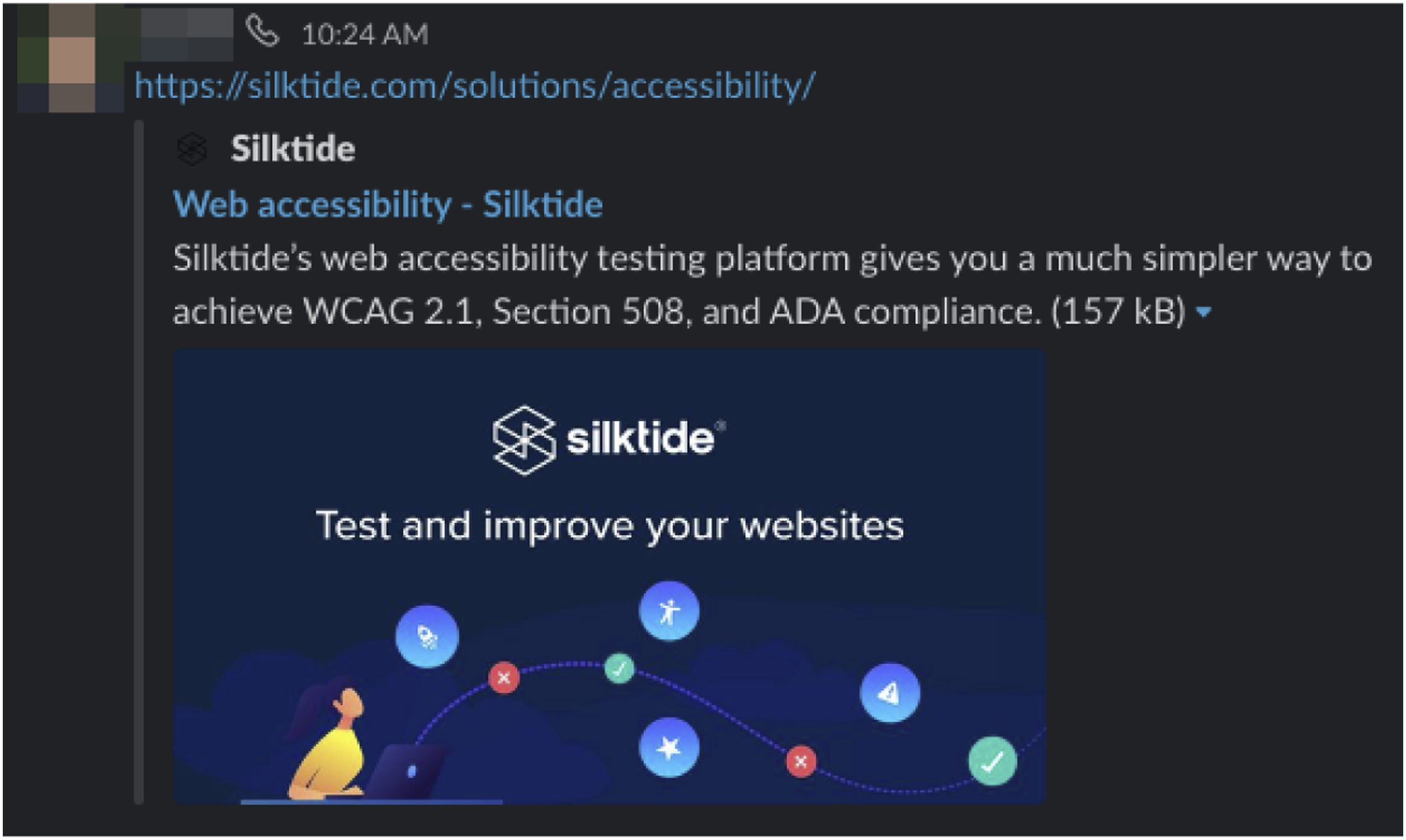
He thought the ‘College’ project had a very good Web site, but it had a low accessibility score. John believed that this tool could help the team to improve the projects they were working on, thereby increasing their organisational capacities to meet accessibility standards. John was leading on investigating Silktide’s capacities, the affects it could exercise or not; what it could do in relation to the team’s existing skillset or composition.
The team explored the software John shared, and James replied somewhat excitedly: “I do not know why we do not have that!” and Silktide joined the team immediately, because it automated testing to find then fix accessibility issues. It generated a report that gave a site a percentage score and allocated a grading of A to AAA, indicating the most common issues to resolve, the average issues per page, and the number of issues according to visual, auditory, motor, and cognitive categories (Figure 2). Finally, it proposed the actions needed to solve the issues and meet the desired WCAG standard. An example of Silktide’s accessibility report.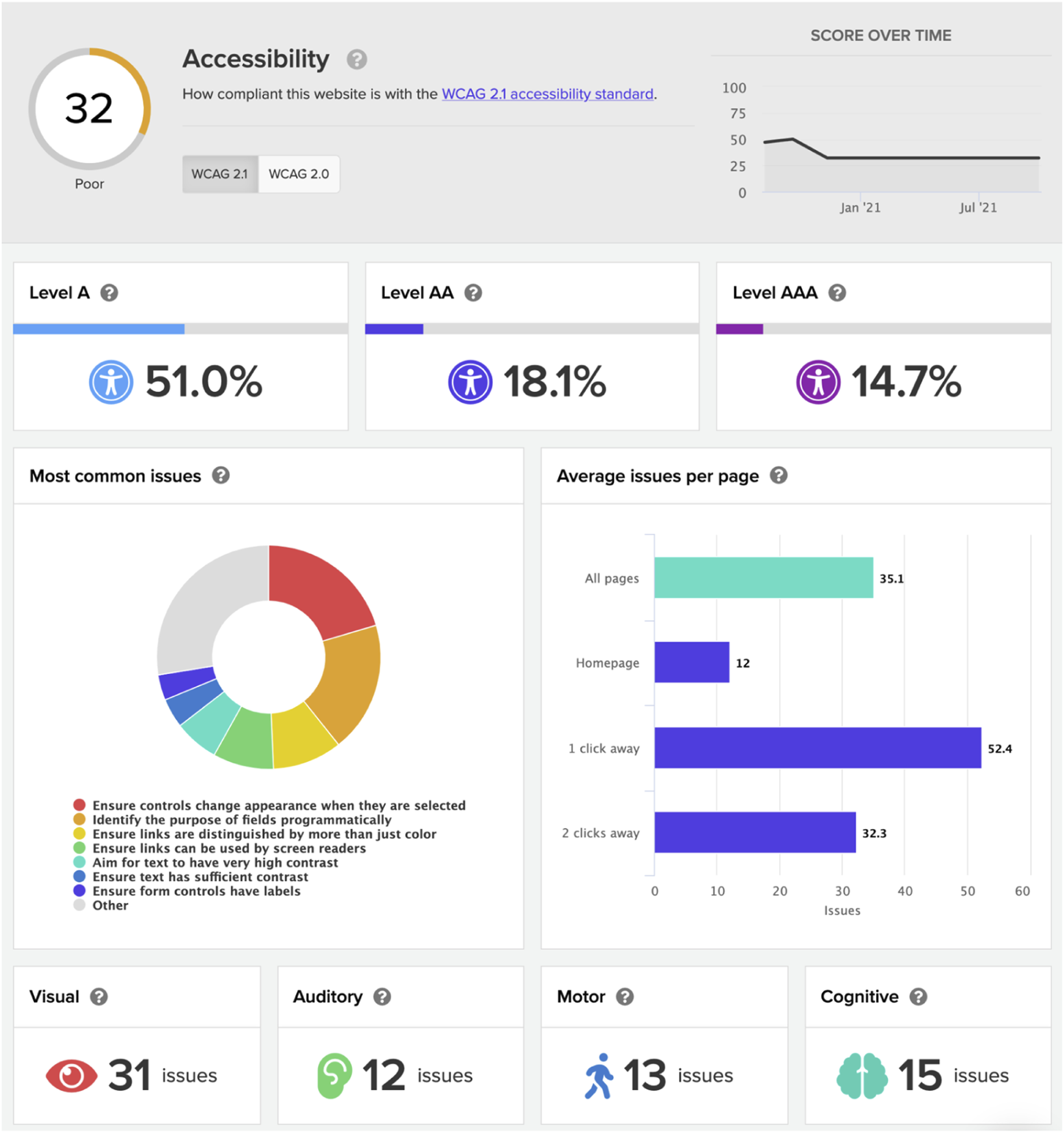
By introducing the new program John altered the composition of material bodies, affecting it, and increasing the team’s capacity to act. His desire to find a new tool acted as a leading force, although quickly the added non-human capacity began to play a more leaderful role in the projects, resulting in unforeseen resistances for the humans, creating affective hindrances, changing project direction, and limiting the team's creative freedom as they tried to conform to its wishes.
The accessibility scores, leading, resisting and traces of rupture
The check-ins began to focus on improving Silktide scores: “We have reached 92% per cent!”, James would report. “We are very close to meeting the accessibility standards”, John would reply. “I’m checking text contrast and colour issues”, Peter would add, to show what he was doing to increase the score. New capacities and flows of affect began to unfold in the organisation and its projects. Silktide provided the project leadership vision and resisted alternatives, by marking deviations from its intentions then demanding changes. It produced a series of affective hindrances for the humans in their work by highlighting parts of each webpage in a focus box that its algorithm thought undermined accessibility (Figure 3). Example of Silktide highlighting an issue in a Web site.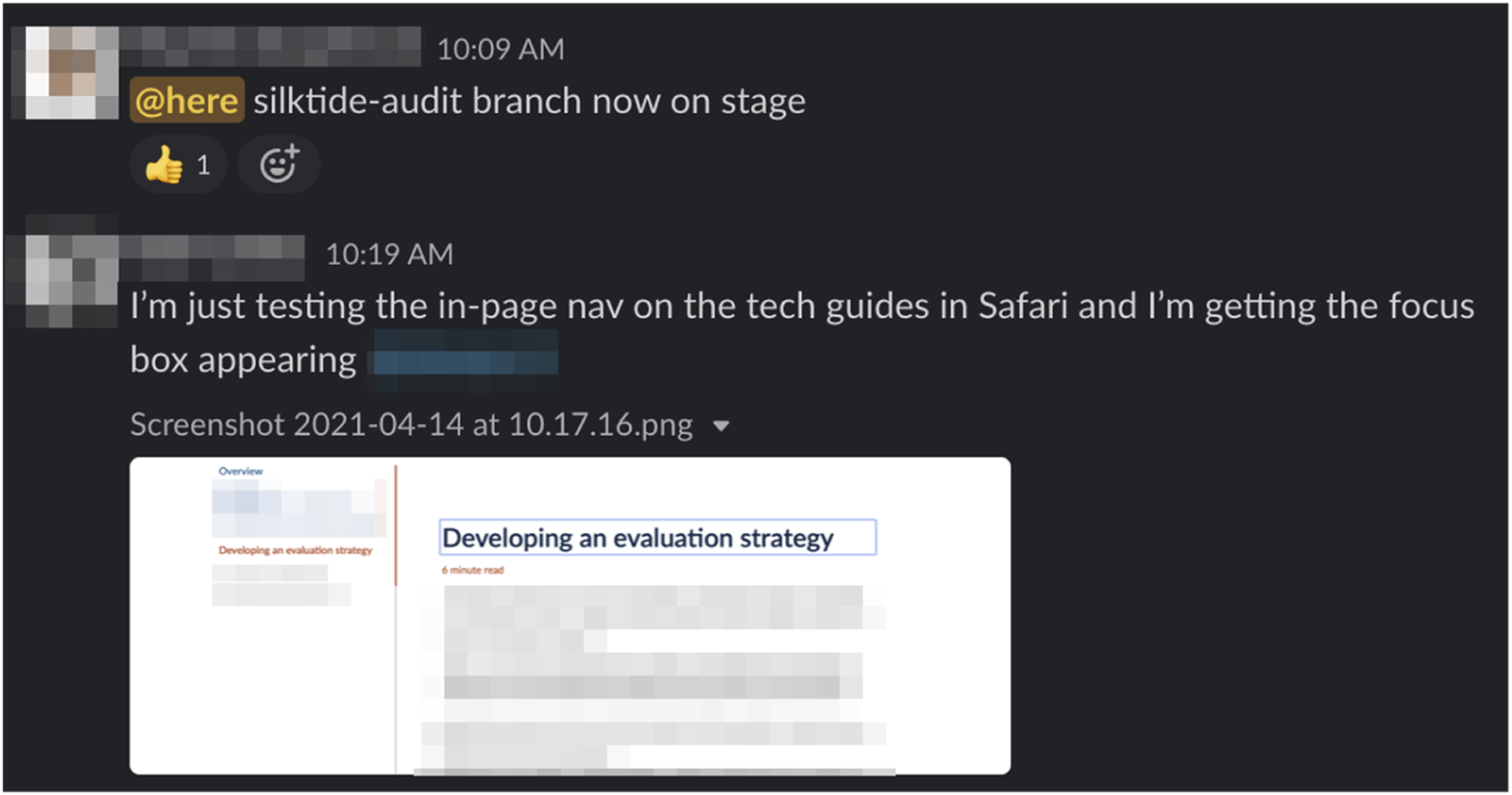
Despite generating issues, Silktide was in demand. Peter began to improve accessibility for the ‘Drawing School’ client and asked James on Slack for access to Silktide to help. Shortly after, James replied that Silktide could only work on one project at a time. The software was beginning to reveal certain limitations. Peter had to wait until James swapped client projects within the platform. The next day, Peter informed the team that Silktide had found accessibility problems: contrasts, colours, and headlines were decreasing the overall scores. The Silktide report was leading work, forcing the team to negotiate and make changes. Simultaneously, it was resisting deviations from its embodied idea of accessibility, producing affective hindrances for the team, both human and non-human. Later, when Peter was working on the site background’s accessibility, Silktide indicated a bright red colour produced issues. James said to him that they needed to pay attention to what Silktide was ‘telling them’, as by doing so the site was reaching 97% for the AA standard, the team was getting close to their goal. James seemed to have ceded elements of his leadership to Silktide.
Suddenly, while people were busy resolving Silktide generated issues, John interjected saying that it guided them, but that it was not a ‘panacea’. He began to resist Silktide, creating a rupture in the human/nonhuman team, strange since he was the person who suggested the platform in the first place. It was not an isolated incident. John’s resistance centred on the scores Silktide emitted. Once, when the team discussed how to talk to a client about Silktide and improving accessibility, John said they needed to be careful how they reported the scores. Accessibility standards could change, they were less fixed and mandatory than they seemed. He warned James that they should not be too precious about Silktide’s scores and they should amend its report to the client to be less specific. Afterwards, there seemed to be rhythmic oscillations of leading and resisting between John and Silktide, introducing hindrances that constrained projects.
As well as reporting accessibility issues, Silktide began to create hindrances for James’ design work, by similarly generating cycles of issues, investigations and changes. James had to modify his proposals for the ‘University’ project’s new landing page based on Silktide’s lead. At a meeting, James explained to the team that he needed to change the background image as Silktide indicated it did not provide enough contrast with the text. James also mentioned he had added shadows to a piece of text and was not sure whether this would affect the accessibility score (Figure 4). The Silktide report and the scores were leading and affecting James’ decisions, producing new trajectories in the project, but also at the same time resisting him and constricting his design choices. Screenshot of the university project Web site. The background image and the text effects had to be changed due to Silktide’s possible recommendations.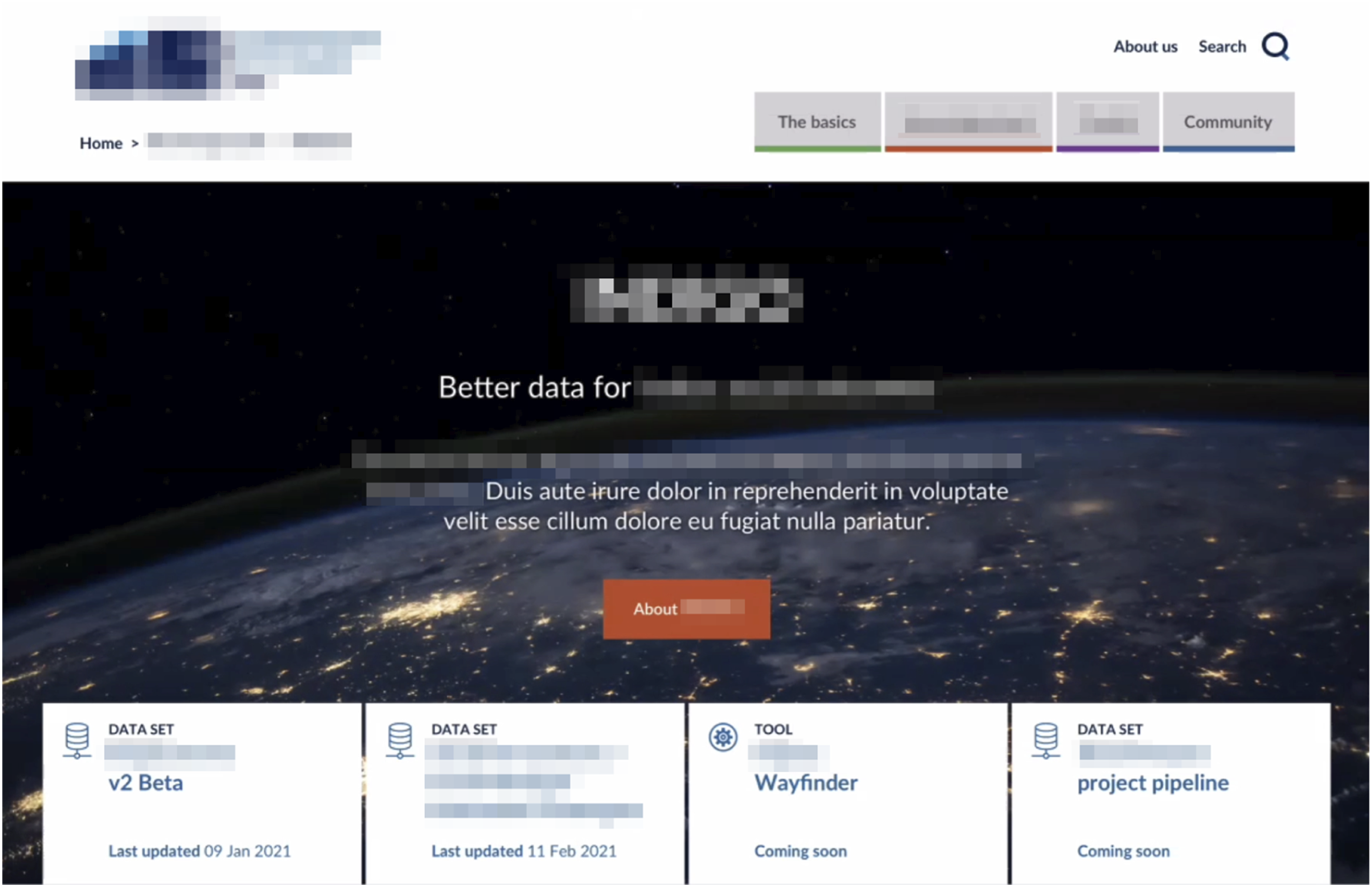
A couple of weeks later, the team were discussing how the University’s accessibility report could reach a 90% AA score. John asked what they had to do to reach the target, and Peter replied the remaining issues were located in the code semantics. Interestingly, John exclaimed, “the algorithm just seeks to justify the computer”, Silktide was overcomplicating the process in order to justify its own existence, the user with accessibility needs might not appreciate its suggestions. Silktide continued to be demanding, making change requests for all aspects of any Web site. James shared a screenshot to show the team an issue with some headlines. While the team discussed the issue, Peter commented that there were some additional problems with the colours of the site affecting scores. Richard replied that he probably did not pick the right one. After a couple of hours of work, James re-tested the site. They achieved 99.2% WCAG 2.1 AA standard (Figure 5). Silktide as leader and therefore the team felt finally satisfied. A team member sharing a Silktide’s score on Slack.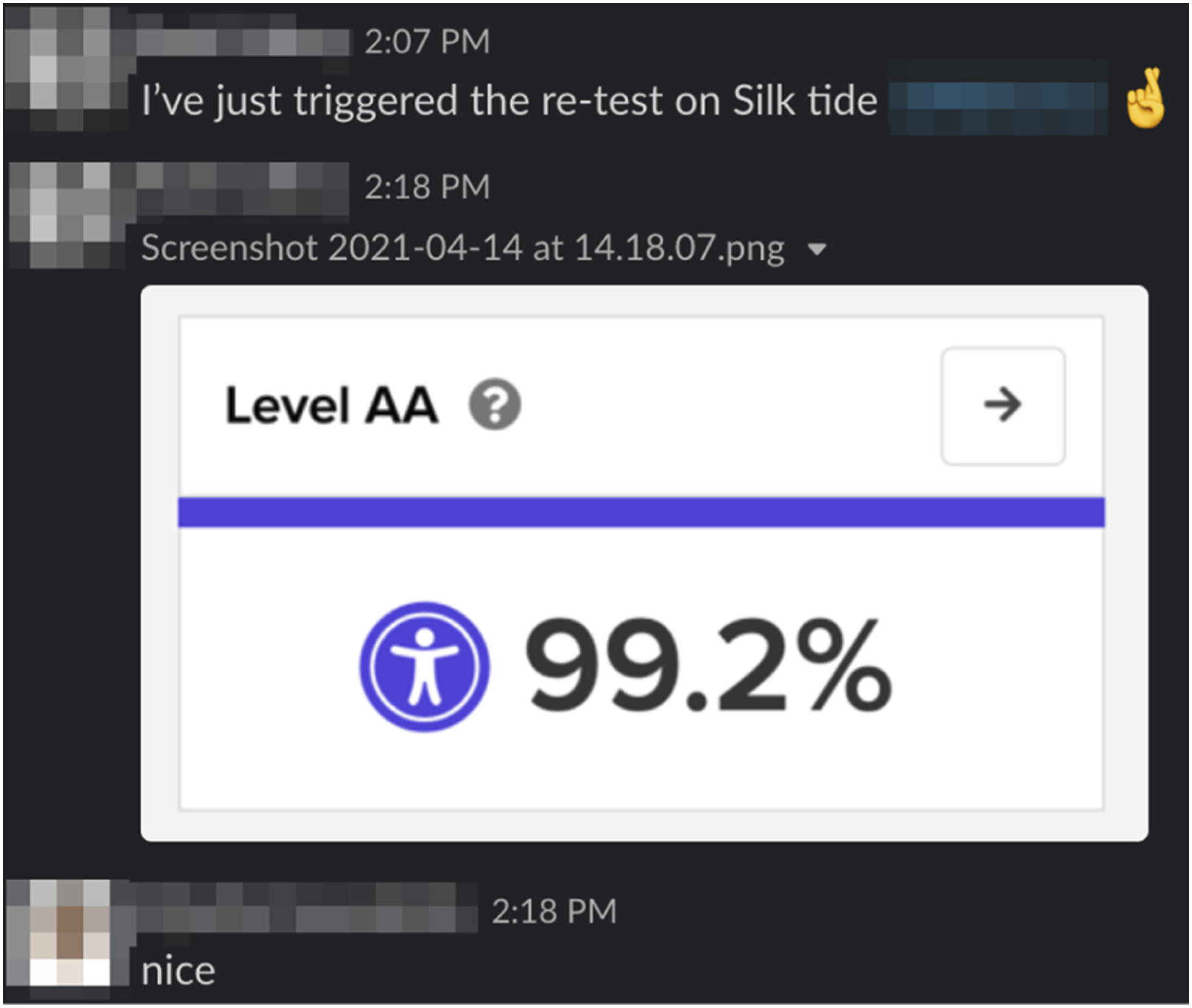
Compositions of human and more-than-human bodies such as government regulations, international standards, software and reports, colours, shapes, typographies, images, and scores collided together, producing direction, changing trajectories, and affecting the project. Within this entanglement, Silktide became a powerful force, leading work by setting direction, demanding changes in the projects, producing material effects, and resisting or pushing back on developer ideas. Originally seen as a tool to support human work, it created affective hindrances for the actants, resisting forms of creativity and reconfiguring relationships, rupturing them and decomposing the team. Tracing Silktide’s relationship with other materialities revealed the always-in-flux nature of bodily encounters between humans and more-than-humans, and how the flows of affect they produced continually mutated. The team followed the score and the proposed software actions to fix the issues. James complied; John sometimes resisted – the nonhuman leading and producing affective hindrances or new trajectories.
The nasties of work
A typical day at DigitalCo flowed, with compositions of people and things producing work with clients at a steady pace and rhythm. However, sometimes unexpected problems would break the flow, producing rupture and generating short bursts of intense flows of affect around resistances. “I think problems as well [lead us]... the problems that we hit upon along the way… how we spend our time on a given day will be influenced by problems that we've had upon and have to overcome, or we haven't quite overcome yet. Or probably… somebody or something lands on our desks.” (James, interview)
First traces of rupturing events would appear in Slack conversations and check-in meetings (Figure 6). One of the developers described them as the ‘nasties of work’. Nasties revealed tensions in encounters between human and nonhuman bodies, acting as a disruptive yet productive force. These nasties could be problems, requests, bugs, traffic overloads, all unexpected. Example of an unexpected request.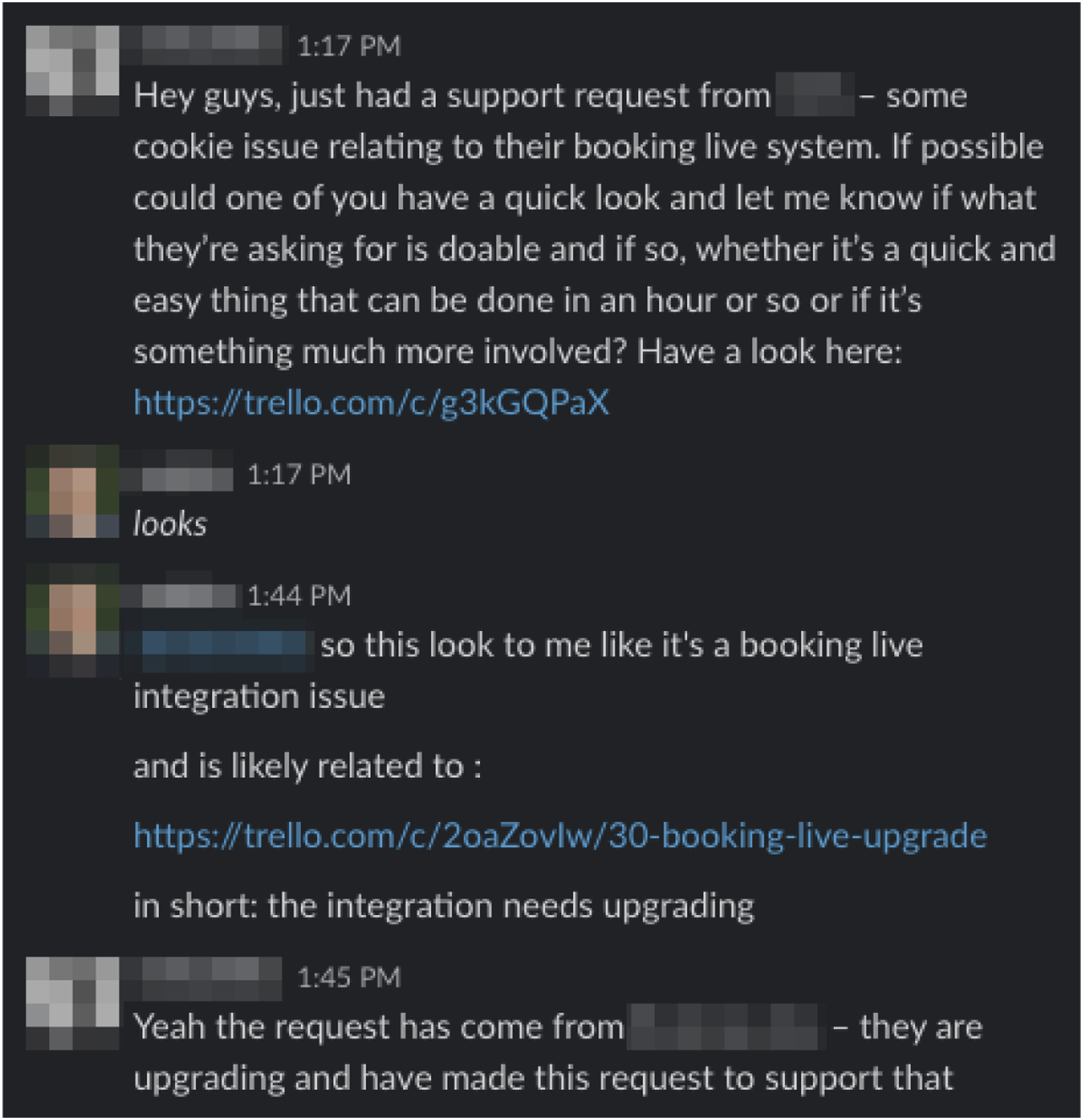
A software bug crawling into the Lawyers’ Web site
James remarked on Slack that the Lawyer client was annoyed, because a software bug was causing trouble, undermining the client’s capacity to correctly visualise digital CVs. On a web page there was an option to download a PDF file of each barrister’s biography. However, the client spotted that for some unknown reason downloading was now producing unwanted gaps between text, corrupting the file. The client sent James a screenshot to illustrate the issue (Figure 7). A rupture emerged in the project and began to produce unintended affects of leaderful resistance. Screenshot sent by the client. The red circle illustrates the unwanted text-gap.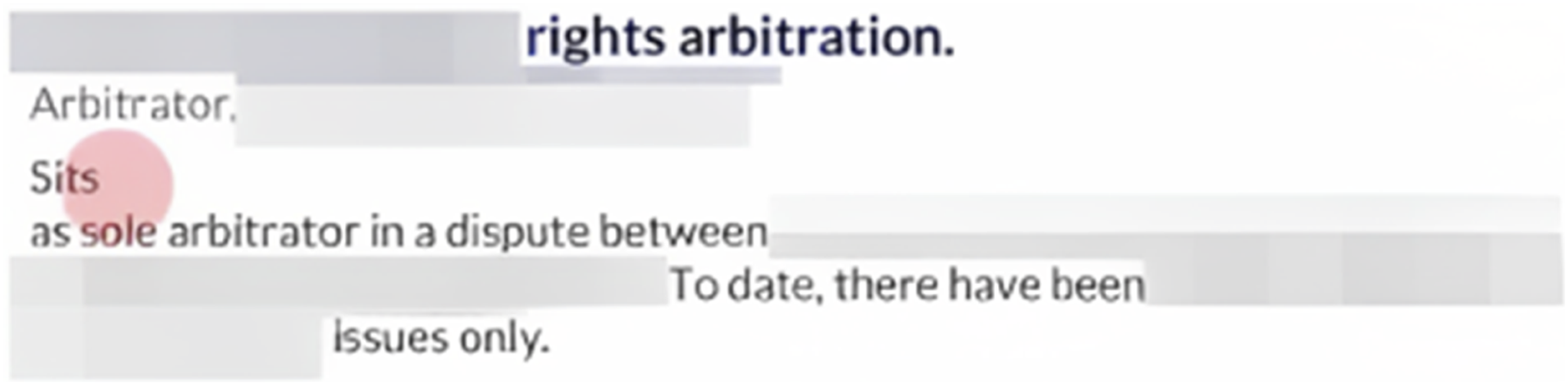
As the team tried to find a solution together on Slack, John replied to James that he did not know what could be causing the problem and James needed to assess the situation. James wondered whether there was a fault with the PDF exporter tool embedded into the Web site’s management platform they had bought, and maybe other clients or users were experiencing the same thing. Richard added the problem could originate from a lack of ‘hygiene’, that maybe there was a ‘dodgy character’ creating a line break inside the text file. The team wondered whether the problem was produced by the person at the Lawyers who created the document. However, the client showed that was not how the problem began, it was not a user’s mistake. The bug produced material effects, a cut on the flow of work, making Richard and John investigate, then navigate throughout the content management system and the source code of the Web site (Figure 8). The team navigating the Web site’s source code.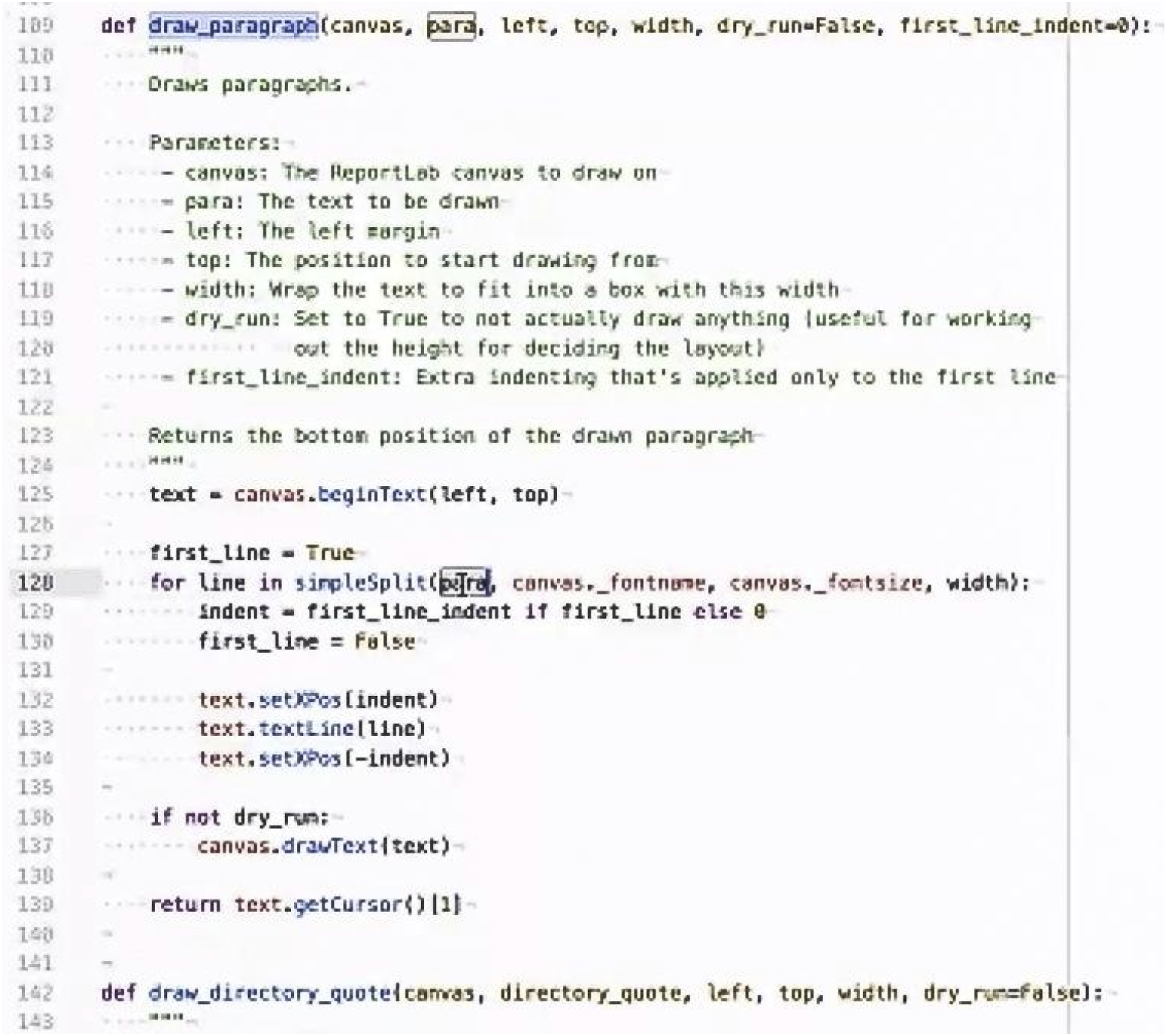
James logged in to the client’s Web site, and attempted to download the barrister’s CV, but the issue remained. The team could not find the source of the problem. A software bug was co-leading the event, resisting the team, creating affective hindrances and ruptures in relationships. Meanwhile, Richard inspected the site’s code, copying and pasting a faulty paragraph into another text editor to check whether some hidden character or symbol was generating the issue to no avail. It was a pressing matter to resolve, as the client had discovered the bug while trying to win business. If they could fix the problem “the client would be very happy”, James said. A couple of days later, the team discovered that the problem did indeed originate from the bought in PDF exporter tool. A non-human body from outside their organisational boundaries created a problem and by doing so affectively led the team until it was resolved, reconfiguring how they worked, producing micro-ruptures in their relationship with the client, generating new work trajectories, and producing reverberations.
A very tense meeting
Late in the study an intense meeting occurred on Google Meets between four DigitalCo members and Michael, the Recruitment Software client, accompanied by his developer colleague. James and the team had been developing a desktop app to capture and store recruitment video interviews. The meeting was to demonstrate prototype features to the client. Bodies, human and otherwise, were ready to relate (Figure 9). John sharing his screen on Google Meets to showcase the software.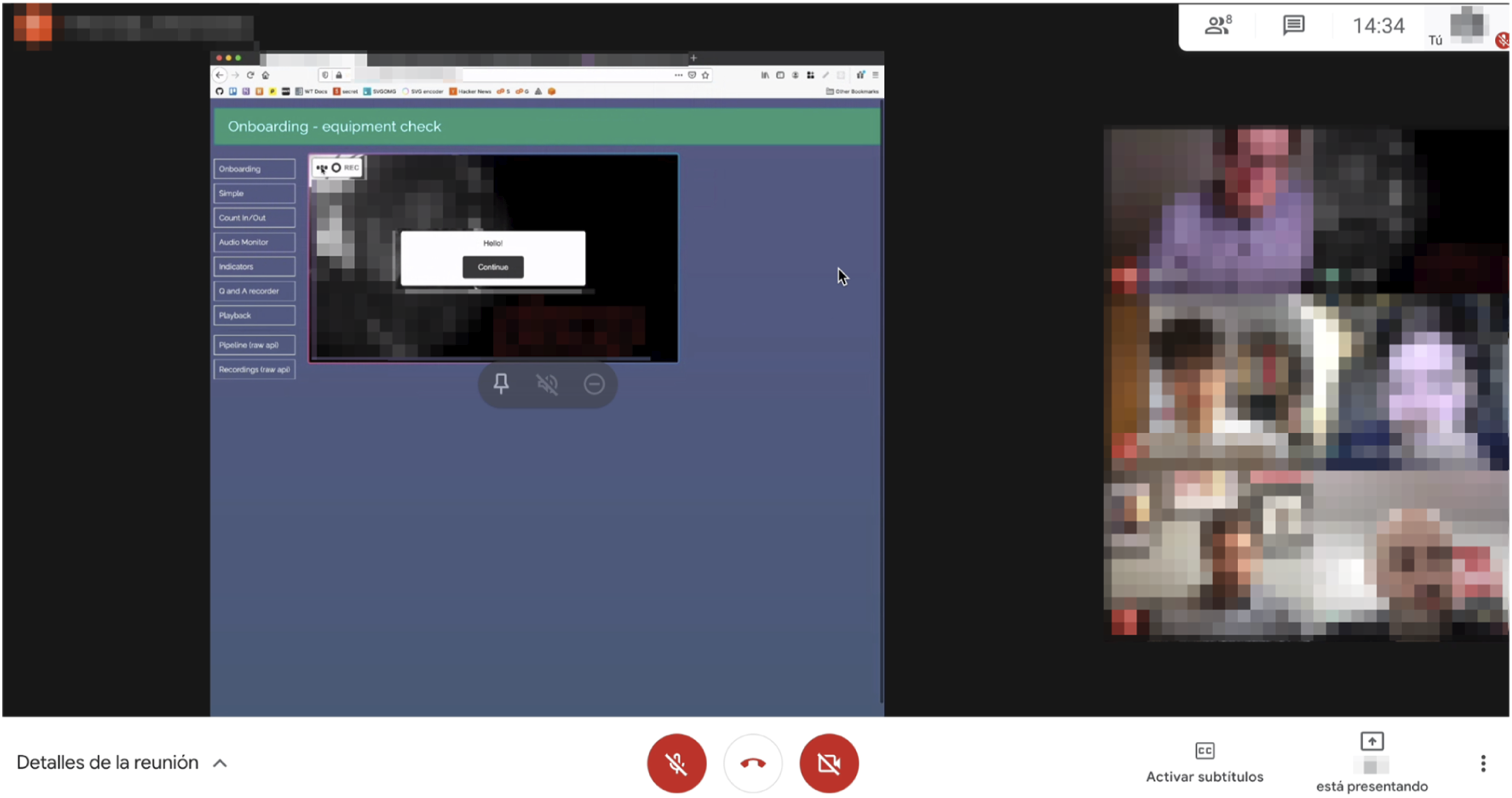
John began by explaining the user journey, and the human participants seemed attentive and focused. However, when John was navigating through the prototype, a failure emerged to disrupt the process: an animated icon for sound did not work properly. John explained that this was caused by a bug and it was a very simple issue to fix. He located the problem, added some new lines of code, and showed the icon working (Figure 10). It should not have caused concern, because everyone knew it was a test program, not the final version. John navigating the source code, highlighting and fixing the software bug.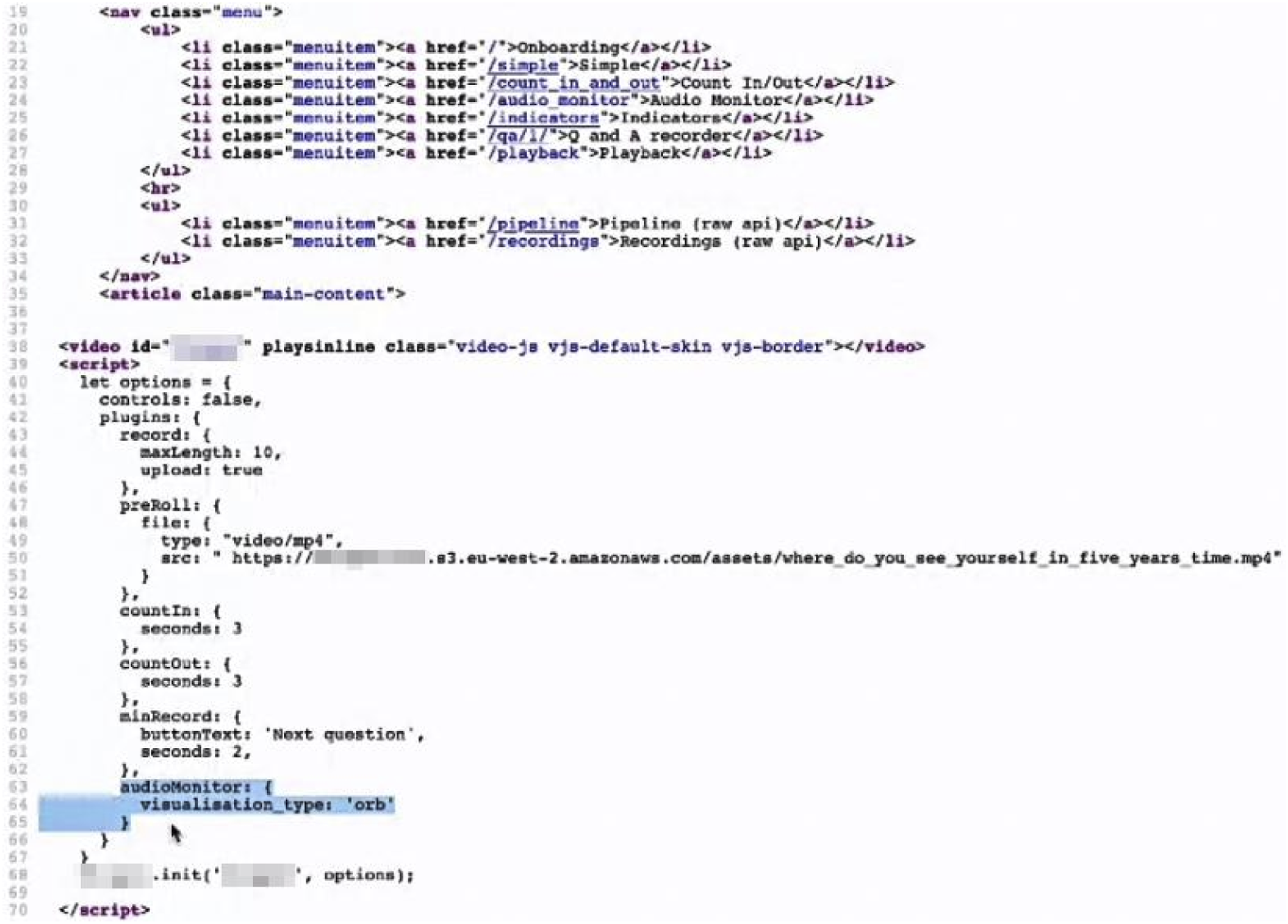
However, the audio icon issue caused a rupture and rhythmic reverberations for the rest of the meeting. Repeatedly, Michael began to interrupt the presentation. First, he interjected to ask whether they should deploy a warning message when there is no audio on the platform. John replied that the team did not think that was necessary as the user had to test and configure the video and audio inputs at the start of the process. Michael was then worried about the timing for the interviewee to answer questions, explaining that in a previous demo, the timer indicator went slower due to frontend issues, meaning some users might have more than the allotted 2 min to answer a question. John replied that the problem had been solved and that the user could configure time constraints for each of the interview questions. Through successive questions Michael was directing the meeting, taking control over the rhythm of the event and marginalising John. The rupture increased Michael’s sense of power, he was using problems to lead the discussion, resisting John’s attempts to resume control. Michael was joining with the software to compose a human/nonhuman form of resistance.
Then Michael asked whether the app worked on all types of browsers, especially Apple’s Safari. For weeks the team had been trying to enable the software in this browser, however, their efforts had been fruitless because Apple had not released key updates. Therefore, John had to admit that Safari was a ‘no-go’ yet but would work soon. Bodies outside the client-company composition were affecting the flow of the project, decreasing the team’s capacity to act. Michael looked perplexed and asked why he could use another program, ‘CameraTag’ with other platforms but not DigitalCo’s product. Tension started to build up. CameraTag allows users to record videos and upload them to a server and had been chosen by Michael. As John explained several weeks before this meeting, CameraTag did not support an ‘emerging W3C standard’ regulation that aids developers to produce websites for multiple platforms. To illustrate the issue, John shared his screen with the demo loaded into the Safari browser. As expected, the software failed to enable the webcam, but he then showed it working in Google Chrome explaining that this was the browser that had fewer problems. Michael then checked again CameraTag working in Safari. To help, Richard shared a link in the chatbox with CameraTag specifications for each browser (Figure 11). Richard sharing CameraTag’s specifications on Slack.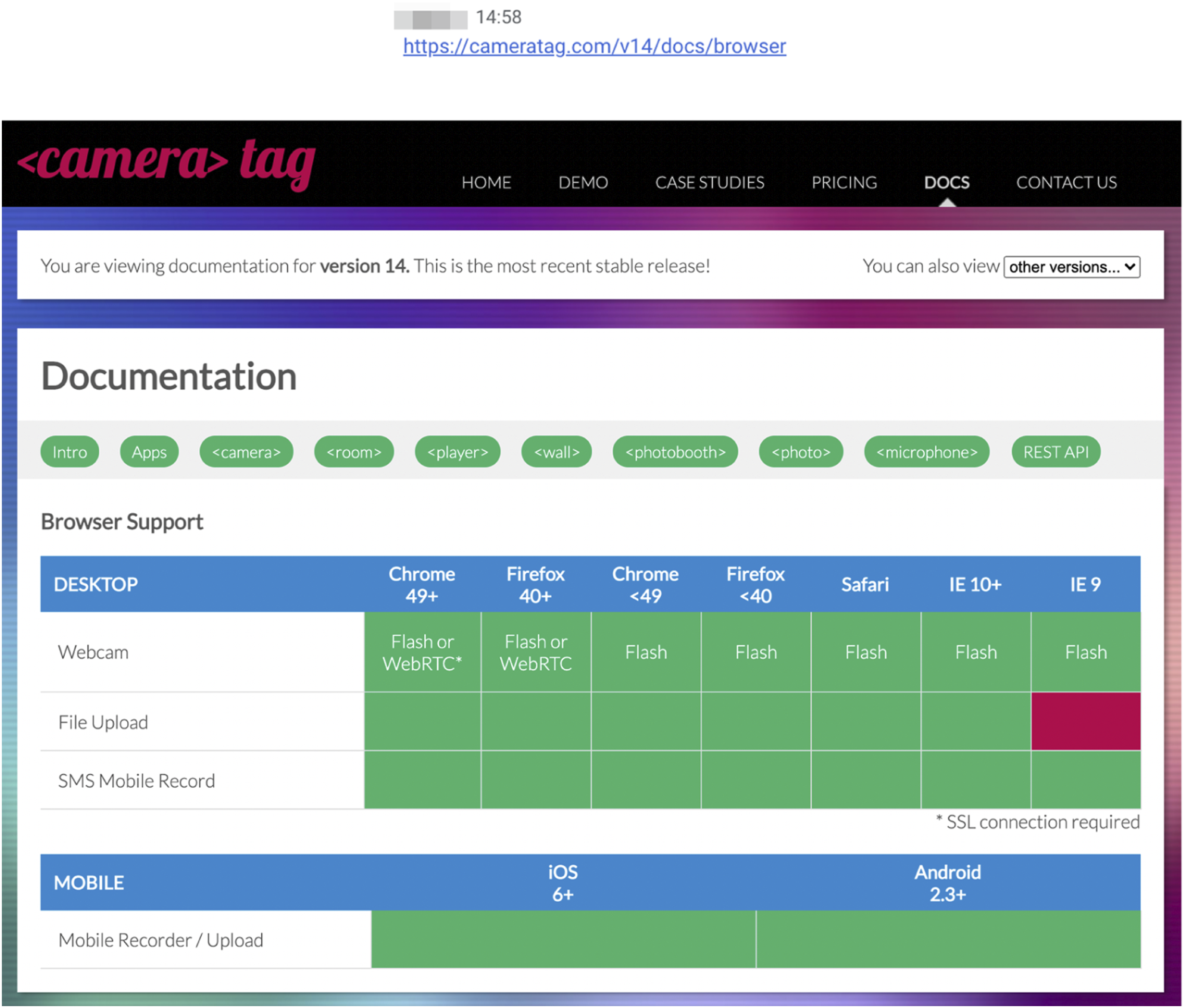
Michael seemed fixated, pushing the team hard to look at how CameraTag worked on Safari, reintroducing it into the discussion again and again. Even though Safari was not the main browser his clients used, he insisted that the app had to work with it. Things were heating up. Faces looked serious; the atmosphere felt dense and strange. Michael’s leaderful resisting presence grew after each problem encountered. He then asked about mobile functionality, which mirrored the desktop issue with Android working but not yet iPhones. He said in a very deep, serious voice, almost angry: “it seems to me that you haven’t tested that”. John, under considerable pressure, replied with tension in his voice: “I will defer to James” who explained to Michael that they intended only to cover the desktop version that day, not the mobile one. However, John began to load the platform in a phone-sized format to show that the app was responsive on mobile devices. He said the text seemed crowded at the moment but that the size could be configured (Figure 12). John demonstrating a mobile version of the software.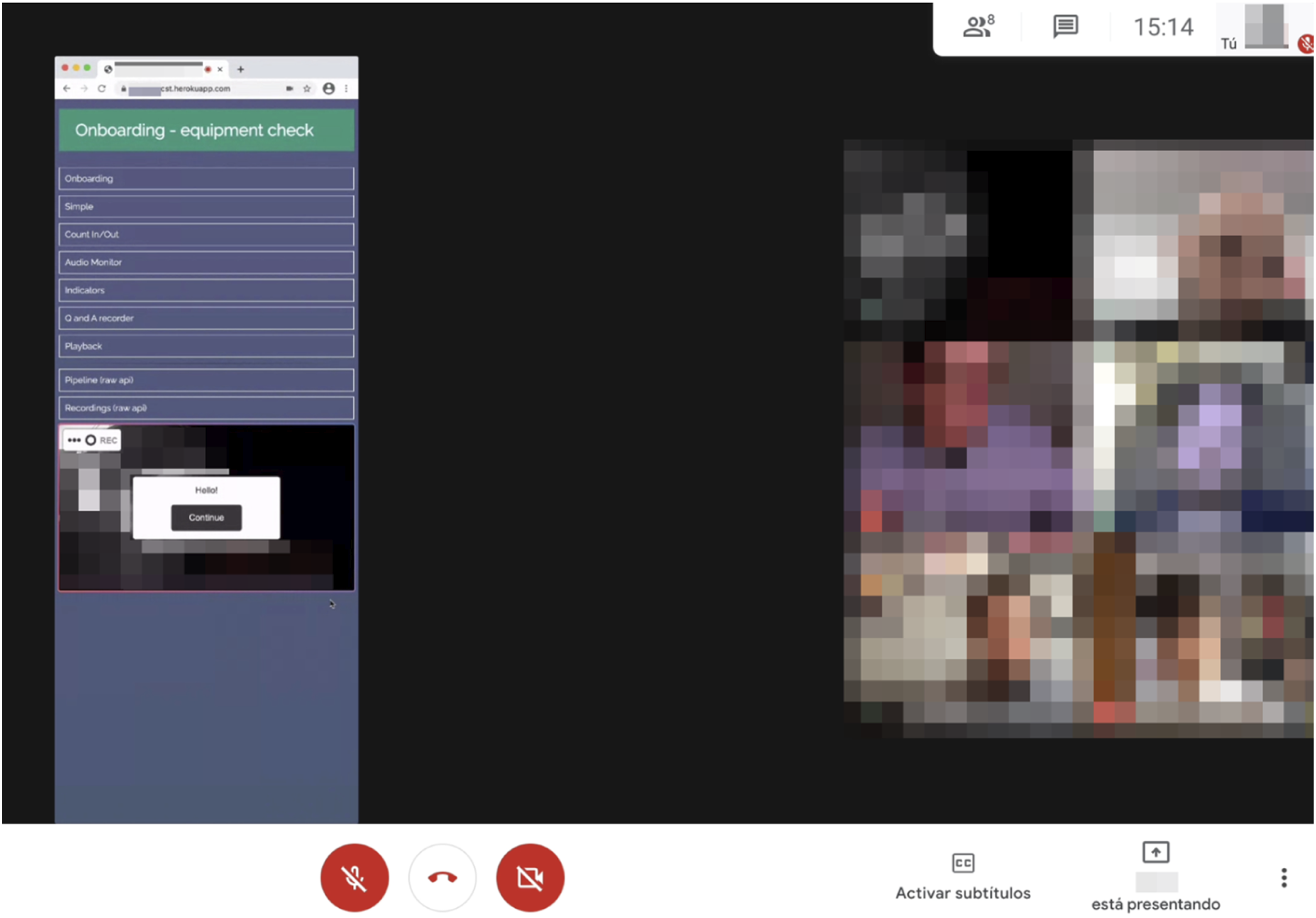
Michael had concerns with the user interface and asked whether the app was ready for use, asking James for an answer who replied calmly that the idea of the meeting was to check the desktop app and note any concerns. John replied that the software integration to the client’s infrastructure was fairly simple. Michael then asked how many users could simultaneously record videos and whether high Web site traffic could produce a ‘bottleneck’. At that point, Michael’s colleague interjected saying that testing for this might be difficult to emulate. As the meeting was approaching its end, Michael said that he would further check the software to raise any concerns about any bugs he and his team may find. Finally, both teams agreed on the next steps as Michael wanted to prepare the product for mass testing. The tensions and ruptures experienced in the meeting continued to leave material traces on Slack, as the team shared a series of comments afterwards (Figure 13). The team discussing the meeting in Slack.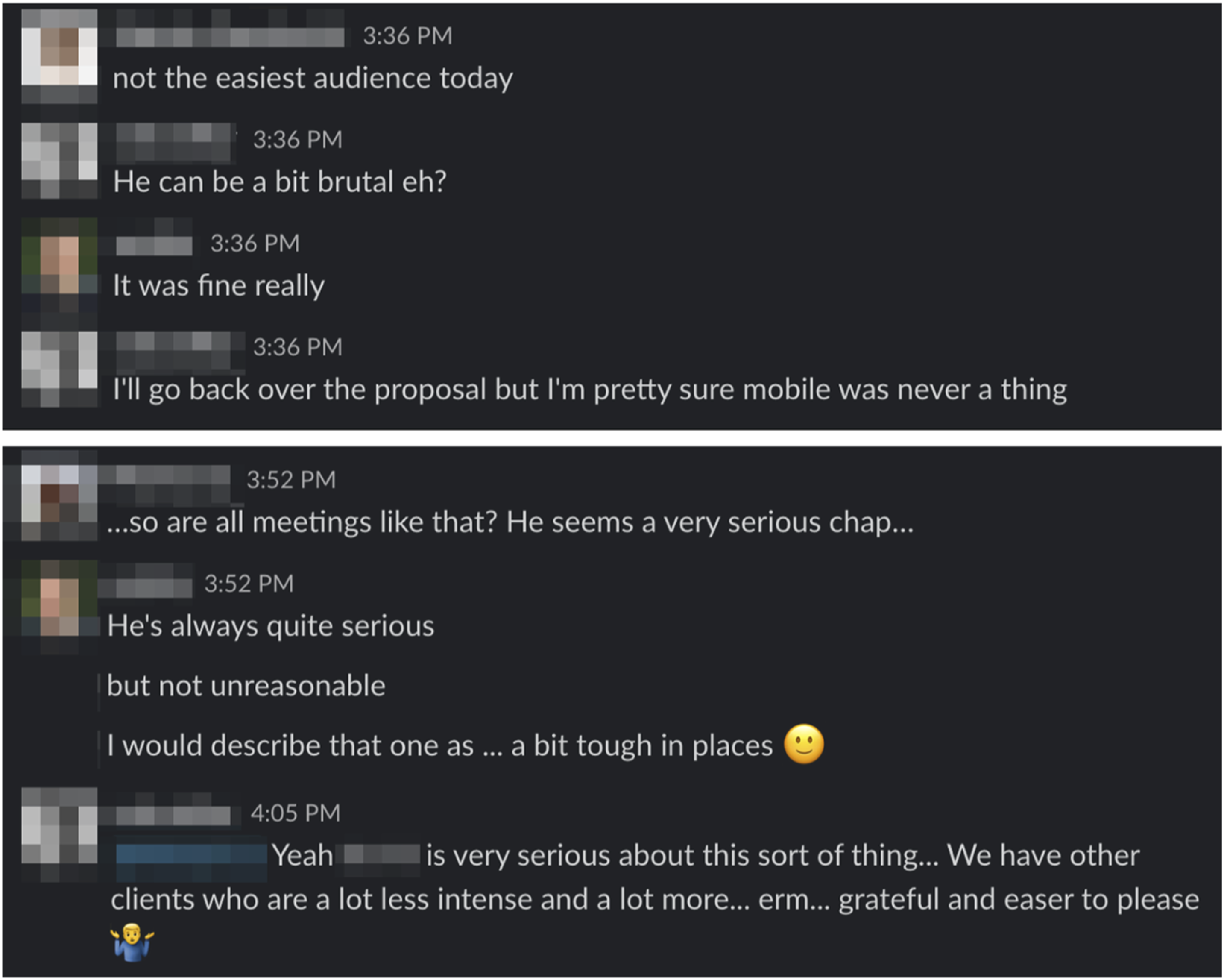
This chain of events shows how humans and more-than-humans interact to lead or resist based on tensions or ruptures, taking the meeting in multiple directions that progress or hijack the event. One perceived problem, a tiny and almost insignificant software bug, led to a cascade of interactions, showing how affective hindrances created rhythmic reverberations that led to further decomposing ruptures intertwined. Such a chain of events allowed Michael to join the nonhuman bug in igniting a process of leaderful resistance, composing a powerful team whilst decomposing James and the developers.
Discussion
Our findings contribute to the discussion on the mutually constitutive relations between leadership and resistance (Collinson, 2005), understanding resistance as a form of leadership (Carroll and Nicholson, 2014; Zoller and Fairhurst, 2007). In order to capture the essence of this discussion, we coin the term ‘leaderful resistance’. Mainstream leadership offers carefully curated versions of what it means to lead and resist in work organisations (cf. Levay, 2010; Mousa et al., 2020; Vecchio et al., 2010), conceptualising leadership as a positive composing activity and resistance as a disruptive force that needs to be eradicated. Such an approach derives from human-centred, heroic assumptions that ignore or marginalise more-than-human materialities. Although previous work suggests that nonhuman artefacts can help humans accomplish leadership resistance (Courpasson et al., 2012) or even push back human intention (Mailhot et al., 2016), there have been no studies on how encounters between different forms of matter can lead and resist. We aimed to investigate relations between human and more-than-humans, and what kinds of flows of affect emerge within such encounters. In doing so, we uncovered how leadership and resistance are less about human leaders/resistors but more about flows of affect produced by human-nonhuman encounters that unfold in the minutiae of routine. Previous studies have acknowledged, for instance, how technologies can ignite or transport processes of resistance but they treat more-than-human matter as passive receptors of human intent (Hawkins, 2015). Our research brings socio-material thinking (e.g. Orlikowski, 2007) to leadership studies by considering more-than-human matter as co-producing leaderful resistance.
We have witnessed instances of leaderful resistance in mundane moments: Silktide, the software bugs, and CameraTag reconfigured encounters and work routines through flows of forces we labelled as (1) affective hindrance and (2) decomposing rupture. Affective hindrances – such as Silktide’s scores not being high enough, suggestions and restrictions on how James could develop his design work, what colours to pick for a Web site – dictated what could be done or not, for the machine had to be satisfied in such a way that the team could reach the desired target. These hindrances not only pushed humans back, but created subtle shifts in power that directed the human team and their projects. On the other hand, decomposing ruptures such as an unexpected bug creating problems in a PDF tool used by the client reconfigured priorities for the team, creating a rupture in the flow of work, leading James and the team by producing new directions for how time would be used. The humans did not suspect that the problem was caused by a software bug, assuming instead that it was a mistake made by a client staff member inserting a ‘dodgy character’ somewhere. However, as the team investigated the issue, they realised that the bug originated from the provider of the piece of software they had bought. Likewise, the absence of a particular technology embedded in the Safari browser created ruptures in the workflow dragging humans, such as Michael, to join forces with other nonhumans and engage in active moments of resistance against James and his team. Software incompatibilities led Michael to resist, producing stoppages and delays that decomposed team-client relationships albeit temporarily. These ruptures would reverberate and produce subsequent oscillating rhythms in encounters. The more-than-human materiality had the capacity to amplify previous issues, grievances, and produce a cascading leaderful effect.
These processes of hindrances and ruptures reveal that, more often than not, nonhumans have the capacity to reconfigure patterns of work producing relations of composition and decomposition (Deleuze, 1988) that often undermine the smooth and ‘planned’ functioning of the organisation. For instance, as Silktide entered the organisation as a strong compositional force, praised by the human team who embraced it as the solution to accessibility, yet over repeated encounters, relations with this more-than-human began to make fissures in the relationship with humans, in particular, John who began to question its scores and suggestions. These qualities of affective encounters shed light on the precarious nature of leaderful resistance as an unstable ephemeral flow of affective encounters, in contrast to the programmed, linear, and static leadership prototypes common in the literature such as the transformational, charismatic, and empowering (cf. Levay, 2010; Mousa et al., 2020; Oreg and Berson, 2011; Vecchio et al., 2010). These flows of affect not only portray the pre-meditated organisation of ‘good encounters’ (Munro and Thanem, 2018) but reflect a more comprehensive understanding of how nonhuman materialities can ignite processes of decomposition that decrease collective capacities for action. For instance, Silktide was an active participant in stopping James’ work, making him reformulate his design ideas to avoid accessibility issues. These subtle relations and the effects they produce allows us to better understand the micropolitics of leadership.
We have surfaced subtle modulations in power that unfold in and through situational interactions, affective transitions that produce ‘cuts’ and ‘micro-shocks’ (Massumi, 2009) in the flow of daily experience, leading organisations into the unknown. As Massumi (2009: 4) describes, “There is always something-doing cutting in, interrupting whatever continuities are in progress. For things to continue, they have to re-continue. They have to re-jig around the interruption”. Such mundane interruptions are an aspect of leadership and resistance that often get overlooked by organisation scholars. We argue that leadership consists of endless and tiny shifts in power which human and nonhumans actors co-produce in encounters propelling them in multiple directions. We do not understand such fluctuations in power in terms of leading or misleading, but as a mutually constitutive (Collinson, 2005) and molecular re/configuration of forces and capacities, as perpetual motion embedded in actions upon actions (Foucault, 1982). Thus, whilst mainstream research highlights leading as a distinct and quasi-religious set of activities outside the realm of ordinary work, our conceptualisation advocates a mundane view of leadership that unfolds through flows of intensities and forces at the molecular level. Matter is not only active and agentic, but it acts and counteracts producing several forces and counterforces that lead organisations towards unpredictable paths of conflict, tension, and disruption.
Concluding remarks
Our work invites leadership scholars to include more-than-human matter in their thinking as a way of countering the dominant heroic rhetoric underpinning much of the leadership literature. This entails not seeing resistance as a problem to overcome but as a productive and leaderful force that emerges in everyday human-nonhuman encounters. Such a perspective offers a novel approach to understanding organisational phenomena.
We have argued that organisational direction emerges as a micropolitical effect of molecular encounters and movements between human and nonhuman entities producing forces and frictions that displace the flow of work. However, it is important to note that there will always be a myriad of bodies that we will not be able to account for or understand. As such, the events, relations, and encounters this paper reveals were circumscribed by the access we were able to obtain under the pandemic having to accept that multiple actors would be missed in a constellation of bodies that could easily extend beyond the organisational boundaries.
Footnotes
Declaration of conflicting interests
The author(s) declared no potential conflicts of interest with respect to the research, authorship, and/or publication of this article.
Funding
The author(s) received no financial support for the research, authorship, and/or publication of this article.
