




Abstract
The appearance of ‘Olly the cat’ on the doorsteps of a major UK international airport provides occasion to reconsider the role of the animal in organization and offers suggestive insight into how we might have to learn new ways of being within extended multi-species or interspecies ontologies. Olly is found to lead multiple lives that cannot be reduced to the status of object or media of human intentionality. Her increasing political involvement in the management and organization of the airport challenges orthodox understanding of agency and organizational action. As the ethnography becomes progressively more implicated in the entanglements between human and animal, the concept of ‘feline politics’ is proposed and deployed. This allows research to retain focus on actions and behaviour and modes of thinking that would ordinarily be occluded by conventional modes of organizational representation. In these ways the ethnography moves beyond the interpretative and symbolic treatment of organization analysis and finds resource in the recent ‘ontological turn’ in the social sciences. Embracing what is the inevitable participation of the social sciences in the reflexive and recursive enactment of its phenomena, the ethnography discovers new potentialities and new capacities for action as emergent properties of ‘the human’ and ‘the animal’ were mutually learnt, exchanged and acquired. This article adds to what we know about the limits of management as it confronts a radical undecidability characterized by the co-existence of multiple and interacting ontological becomings.
‘May my animals lead me’ Spake Zarathustra, ‘Thus began Zarathustra’s down-going’ Zarathustra’s Prologue, 10 ‘… a sort of attempt to desubjugate historical knowledges, to set them free, or in other words to enable them to oppose and struggle against the coercion of a unitary, formal, and scientific theoretical discourse.’
Many years later our ethnographer would remember a remarkable sight that once greeted the visitor to ‘Olympic House’, the corporate headquarters of the Manchester Airport Group. Amid the roar of traffic and the scream of powerful jet airline engines, with pin stripe suits coming and going, a ginger mackerel tabby cat is sat on a mat at the foot of the marble entrance. It is sat outside the entrance to its own rather imposing mini ‘Berkshire-style’ wooden townhouse that abuts the tinted windows of the concrete and glass steel tower of Olympic House. According to the receptionists, Olly (or Olivia) 1 —named after the building at which she had first arrived (Olympic House)—had turned up at the airport sometime in early 2007 but soon became full-time resident. At first she slept on the marble steps of the corporate headquarters but then later took up residence in what was colloquially known as the ‘cat penthouse’, purchased with funds donated by airport staff (Figure 1). It is difficult to avoid this Cheshire cat—and indeed the story about to be told might recall for some the world of that other ‘Cheshire Cat’ made famous by Lewis Carroll who acts as guide and interpreter to Alice’s adventures in ‘Wonderland’.
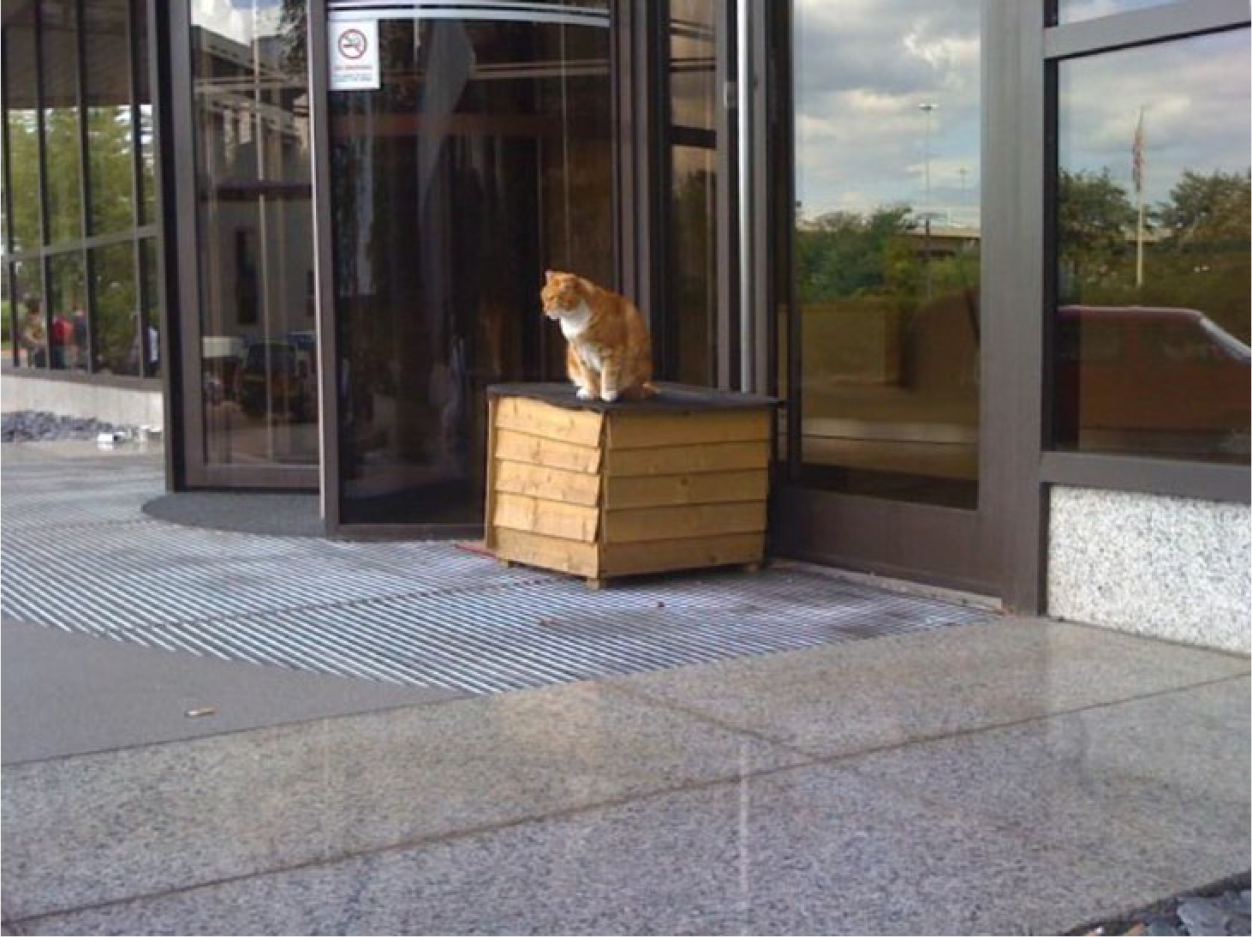
Olly the cat (photograph by author).
Night and day she is sitting there, sometimes on guard, on other occasions lying sprawled and recumbent, forcing those who seek admittance to tread carefully or to step to one side, and to use the side entrance if the cat has positioned herself in such a way that makes it impossible to step inside the grand revolving central glass doorway. By 2008, Olly was writing a regular column in the staff newspaper and by 2010 had a following of over 1800 friends on Facebook. Here we discover that her religious views are ‘catholic’ and her politics ‘libertarian’. With one slightly torn ear and rather stiff gait, Olly the cat looks a little forlorn on occasion, but today one might be excused for thinking she looks a little bemused. There appear to be votives and offerings collecting around the kennel marked by an assortment of greeting cards and tins of food. There is also a handmade deep blue cushion embroidered in red and sealed in a clear plastic protective sheath which hangs from a hastily adapted pavement poster grip board. It reads ‘Olly’s place’.
Despite this spectacular corporate promotion of Olly, the animal remains neglected in management and organization studies, which is ironic given that the constitutive basis of management is founded on the relation between man and animal. Revealed most obviously in the etymology of ‘management’ and derived from the Latin manus (hand)—as deployed in the Italian maneggiare—management finds its early distinction in the training or handling of horses, specifically in the manege—a school where equestrianship is taught and horses trained (Mant, 1977). Indeed, that the animal is never very far from modern management and organization should comes as little surprise. Ford’s modern assembly line, perhaps the most archetypal feature of modern organization, was based on his observations of livestock at the ‘Swift and Company’ slaughterhouse and meatpacking company. Ford realized that the pulley and conveyor system designed for the mass destruction of animals could be put into reverse and used for the production and assembly of motor-cars (Ford and Crowther, 1922: p. 81), a process through which the animal eventually returns in the sublimated form of the ‘Falcon’ model, the ‘Mustang’, and ‘Thunderbird’ (see also Shukin, 2009). Motor-cars named ‘Cougar’ and ‘Jaguar’ are also testimony to the fact that the cat is a significant presence in the business of human–animal relations.
But it is in vain that we study the annals of scholarship in management and organization studies for recognition of the animal. The rare pieces that appear remain marginal to the discipline and have made little inroads into the mainstream of management thinking and practice. Outside the specialized syllabi of the agricultural colleges (Sayce, 1992; True, 1929), if animals do make an appearance it is only in the form of a particular type of ‘raw material’ or economic material that introduces localized problems associated with process flow and operations management. Against this grain, Ten Bos (2004) has written imaginatively on the ‘fear of wolves’, and Lindsay Hamilton continues her studies of organizational culture among veterinary workers exploring the role animals play in organizing and ‘humanizing’ the workplace (Hamilton, 2007; Hamilton and Taylor, 2012). This adds to the now classic study of ‘the slaughtermen’ by Ackroyd and Crowdy (1990), who note in passing, but leave largely undeveloped, their fascinating observation that in ‘sticking’ or killing the animals the slaughtermen begin to ‘act like animals and in a sense become transformed into them symbolically’ (p. 11; emphasis added).
Transformed into them ‘symbolically’ implies the existence of a clear line of distinction in which the human remains fundamentally different to the animal. Counterpoised to the symbol is always something that is being symbolized, an underlying material reality or an empirical represented and mediated by way of the symbol. Symbols are deployed because they appear to enjoy a capacity to integrate and synthesize. In this way symbols come to represent ‘a whole’ made present by the interpretive and epistemological efforts of human communities who desire to make sense of their environments and organizations. There are of course dominant symbols and minor symbols. These inchoate signs of the animal in organization studies might well reflect an emerging but still minor mode of symbolism. Through the auspices of the standing conference on organizational symbolism (SCOS), the ‘school’ of ‘culture and organizational symbolism’ has done much in its 30-year history to extend and develop an understanding of the role of symbols in organization (Frost, 1985; Gagliardi, 1990 ; Gherardi, 1995; Pondy et al., 1983; Strati, 1998; Turner, 1990). Heavily influenced by the work of Clifford Geertz (1973) and Victor Turner (1967), the use of symbolic and interpretative methods remains a major force within contemporary organization studies (see Hatch and Cunliffe, 2012) and is now even being picked up by perhaps the most dominant paradigm in organization studies—institutional theory (Aten et al., 2011).
However, what if Olly was something more than a symbol, and this ‘transformation’ of the human in the encounter with the animal something that could not be confined to the symbolic, as Ackroyd and Crowdy (1990) suggest? After all, the distinction between man and animal is not so clear. Superficially, for example, one can point to the shared physiological organization of the pig and the human, which is perhaps one of the most acute examples of the ways in which the animal troubles the presumed sovereignty and uniqueness of ‘the human’ (Stallybrass and White, 1986). The reduction of the animal to the role of symbol is rooted in a much deeper series of categories and dualisms upon which the late social scientific discipline—organization studies—has been constructed and on the basis of which its knowledge practices proceed: nature/culture, representation/real, subject/object, theory/empirics, explanation/description, structure/agency, and so on. What happens if we are forced to refuse these separations?
Much debated, the question of dualisms has prompted a number of responses or solutions that include efforts to adapt or incorporate the work of people like Archer, Bourdieu, Bhaskar, Giddens and Elias into organization studies (Connolly and Dolan, 2013; Hassard and Wolfram Cox, 2013; Knights, 1997, 2015; Marsden, 1993; Mutch, 2002; Newton, 2001; Orlikowski, 2007; Reed, 1997, 2003; Willmott, 1993, 2005). For those taking an ‘ethical turn’ attention has been focused on the texts of Derrida and Levinas as resources for resolving the problem of dualism (Jones et al., 2005; Parker, 1998; Rhodes, 2009). Yet, despite these grand theoretical gestures, dualisms persist in the routine analysis and descriptive practices of organization studies, a persistence we might explain by virtue of the celebration and reification of ‘Theory’. The various attempts to resolve these dualisms have been ill-prepared to consider the possibility that it is the very starting points that are misleading (Latour, 2005). To try to remedy an initial error is therefore likely to lead into the most abstruse and fantastical worlds of theory and its empirical illustration!
The ‘Nine Lives of Olly the Cat’ provides occasion to challenge the persistence of some of these dualisms in organization studies, not least the one that posits a break between the human and the animal, which remains perhaps one of the oldest of divisions that since Aristotle has provided the basis upon which the whole existential and philosophical endeavour of modern and ‘Western’ man has been constructed (Agamben, 2004; Deleuze and Guattari, 1988; Derrida, 2002; Haraway, 1989; Heidegger, 1995; Wolfe, 2003). While for Aristotle (Pol. 1.1253a) man is the ‘talking animal’, the unique property that makes ‘politics’ possible, this article develops the concept of a ‘feline politics’ that arises out of the discovery of a progressively more complex series of entanglements between the human and the animal. These entanglements defy those classifications available within the habitual dualisms of social science: culture/nature, subject/object and so on. In this article we find resource for working beyond these dualisms in what has been called an ‘ontological turn’ 2 in the social sciences. This ‘turn’ takes a variety of specific forms but common to all is the acknowledgement that representation does not float free of material co-implication. Instead representation is better conceived as ‘enactment’ or ‘performative’ reproduction (Callon, 1998; Mol, 2002; MacKenzie et al., 2007)? What difference would the animal then make?
This ontological turn poses a number of challenges to the practice of ethnography and only by suspending many of the conceptual reifications extant within contemporary organization theory are we able to make progress in unfolding (or re-folding) the story of Olly. Indeed, drawing on Haraway (2008) this suspension of habitual categories and dualisms constitutes an important lesson ‘when species meet’. It is a lesson that we might describe as one of the ‘nine lives’ of Olly and its teaching helps avoid the temptation to inscribe and normalize the nine lives of Olly the cat into existing theoretical registers and repertoires of language available to the organizational theorist—organizational symbolism; control and resistance; parody, subversion and transgression, for example (and for which there exists whole libraries of references). However, it is the very capacity to suspend our all too human desire to control through knowing that is perhaps the most challenging lesson that Olly poses.
The article first explores the way the cat might be understood to mediate organizational politics. A range of practices associated with a ‘cult of the cat’ are discovered here, manifest in versions of what is understood as ‘Totemism’, ‘potlatch’, ‘carnival’, ‘resistance’ and so on. However, the article shows we cannot restrict Olly to the role of carrier or ‘symbol’ of wider organizational issues, a screen upon which (human) members of organization project a whole set of issues looking for a vehicle for its articulation. There are multiple cats at work in Manchester: some are essentially conservative, sentimental and saccharine—prompting analysis to consider the role of anthropomorphic projections and transferences—but others are more disruptive and challenging. Irrespective of whether the cat may be deemed a conservative influence or a creative (and subversive) stimulus to routine practices of management and making organization, the problem of the cat opens up a space prior to the separation of ‘the human’ and ‘the animal’.
In this space things appear which are neither simply human nor animal, and the article asks its readers to consider the possibility that there are forms of politics in organization that are neither simply human or non-human. Hence, ‘feline politics’ marks a dimension of organization where a peculiar feline-inflected ontology might be at work. Organization risks becoming incredulous in dealing with such an ontology and our thinking and ethnographic practices necessarily must change in order to become more receptive to its incertitude and disquiet. Ethnography is thereby challenged to find a mode of narration, or story-telling, that is able to retain and extend a certain suspension of disbelief. 3 This opening, and the thinking and practice to which it gives rise, invites a greater appreciation of ontological undecidability in organization where a more dynamic range of actions and capacities is generated. Much of this action remains unpredictable and volatile, but it appears always immanent to organization and always liable to spiral out of control.
First encounter: a fascination with cats
Glorious sunshine bathes the polished marble steps of Olympic House on the morning of 9 October 2009. A few people are milling around the entrance doors, but the day has not yet started for most of the corporate executives and senior managers of Manchester Airport Group. Things move in and out of the doorway as if in slow motion. It is a little after 8 a.m. as I walk towards the head office on my way to negotiate access for a proposed ethnographic research project. Suddenly, in front of me, only a few steps away, there appears the large and imposing figure of the group chief executive. I am a little intimidated, both by his role and by what I have heard of his approach to management and so I hang back a little, keen to avoid a precipitous encounter. I am due to meet him in a couple of days, but today I am scheduled to see the director of group projects. The chief executive is in his early 60s, and in less than a year’s time the chairman of the board of directors will announce his retirement. As he moves towards the entrance, he makes what appears to be a sudden detour and moves towards the left of the main doorway to articulate a sweeping arc that takes him up to the service entrance. As he moves out of my line of vision, I notice, sprawled on the floor, a fluffed up ball of soft ginger striped hair and matter. This was Olly the cat. She is lying on her side with her back arched, her eyes closed and front paws stretched out in front of her, luxuriating in the Autumn sunshine. Described as bullish and dogmatic, the chief executive officer (CEO) seems to have had to make way for this cat. As he moves, crab-like, sideways—presumably so as not to disturb the cat—I notice his knees are stiff and wonder whether he suffers from arthritis. 4
This was my introduction to Olly the cat and my first encounter with the animal in organization. A back-story began to be pieced together in which I discover that Olly had arrived on the steps of Olympic House semi-feral, underweight, riddled with fleas and sporting a clipped or chopped ear. 5 She was limping badly, refused the offer of milk, and would not allow anyone to approach. However, after a degree of trust was established between some members of the Olympic House management team, Olly was admitted to veterinary care. Staff then pooled money to pay for expensive emergency dental work and explorative surgery to examine possible hip replacement. The ‘Berkshire-style’ townhouse was subsequently purchased, and soon afterwards blankets and toys began to appear. She became quite a celebrity and the local BBC dispatched a camera crew to make a short film about her life. I later learn about her appointment as a ‘cub-reporter’, and regular columns began to appear in the weekly Manchester Airport staff newspaper Plane Talk. There was also a ‘philosophy corner’ penned by Olly and published in the eponymously titled Manchester Airport Group quarterly group publication MAGazine where staff could read her occasional ‘words of wisdom’; the February 2010 issue of MAGazine, for example, told us that ‘We were given two hands to hold, two legs to walk, two eyes to see, two ears to listen’, and asks ‘But why only one heart?’ The answer is ‘Because the other was given to someone else. For us to find’. Such wisdom was extraordinary in the context of 6 months of ethnographic immersion in management practices in which I had become proficient in the minutia of technical and administrative matters shaped and informed by the aspiration to master formal systems of project management such as the ubiquitous ‘PRINCE 2’ methodology. Although I could find no evidence of her in the financial accounts or in the annual general report, Olly was clearly a significant member of this organization.
In studies of social organization, animals are ‘good to think with’, at least according to Lévi-Strauss (1962). For many, cats are not only good to think with (Alger and Alger, 2003; Derrida, 2002; Rogers, 2001, 2006), but in their absence our very human community and civilization is unthinkable (Wastlhuber, 1991). With their renowned qualities for hunting and catching rodents, their early domestication and companionship made possible the construction of grain stores and the establishment of more sedentary ways of living. Since Egyptian times, cats are often associated with spiritual and mystical dimensions of being and were often sculpted or carved to stand guard at the gates of various temples. Great teachers of mystery and magic, in certain myths the fluctuating shape of their eyes is deemed to track the movement of the lunar calendar. Vested with seer-like status they are often understood to offer portals of communication into the worlds of the dead and un-dead (Briggs, 1980). According to some accounts, the cat could even take on the ailments and symptoms of those around it. One of the most important classical Egyptian deities is Bastet who is often depicted in the form of a long, sleek and elegant cat, or with the body of a woman and the head of a cat. In the wake of this deification the cat becomes a ubiquitous feature of Egyptian art after 950
The cat has also been used to mobilize a sense of danger and threat. Widely reputed to be the first recognizably English novel, William Baldwin’s 1561 Beware the Cat features a nightmarish underworld of talking cats who scheme and plot against the realm of the human (Ringler, 1979). With the rise of Christianity and the demonization of the ‘pagan’, the fortune of the cat has suffered.The image of the ‘black cat’ is now almost synonymous with devilment and the witch’s ‘familiar’. Geoffrey Household’s (1975) recent genre-bending ‘science fiction’ The Cats to Come imagines a future state in which the human is subordinate to the world of cats who variously harvest and breed humans for low-skilled functions and tasks useful to the management of the community. A fascination with the cat was arguably the cause of the downfall of the Egyptians at the sacking of Pelusiam in 525
Getting too close or familiar with cats seems to have its dangers, but this first ethnographic encounter is revealing of the stimulation to thought provoked by the appearance of Olly at Manchester Airport. It was the very incongruence of her appearance on the marble steps of Olympic House that prompted reflections about the historical role of cats in human community and organization. With the more strictly regulated procedures and techniques of more conventional methodologies in management and organization studies, it might not have been possible to consider the importance of Olly. The ethnographer, however, is uniquely placed to admit ‘data’ or phenomena that could not have been anticipated during the research design; indeed, it is precisely that which is overlooked or dismissed, deemed irrelevant, an oddity or idiosyncracy, which can become the fulcrum around which the research might need to be reoriented and through which new insights into organization might be seized. It is immediately notable that the ethnographer appears to write his account in ways that respond to what the human and animal shares. As Olly is seen to limp, the ethnographer notices the stiff gait of the CEO, who walks crab-like; a certain empathy is then aroused for the CEO; there then follows a recollection that his approach to management is considered ‘bullish’ and ‘dogmatic’; reflections on time and mortality are subsequently prompted as the ethnographer trawls the landscape for connections and associations. This is suggestive of a rudimentary ‘thinking otherwise’ that others have noted is prompted by ‘encounters with companion species’ (Haraway, 2006) and uniquely privileged by ethnography (Green, 2014). However, this still remains in the realm of an ethnographic quest for deeper meaning, a search for a yet unknown but more profound truth of organization, using Olly as a symbol or leitmotif upon which to exercise such speculations. The ethnographer must also ask, how is Olly understood by indigenous members of the organization. In asking these questions, of course, ethnography begins to draw attention to certain phenomena that help precisely bring about that which the research aims to study. In other words, the ethnographer begins to participate and enact certain ways of making organization that marks a first breach of the representation/reality dualism ingrained in modern social science (Hacking, 1983).
Mobilizing the cat: totem and taboo
There are clearly dangers when coming too close to cats, not least for an ethnographer who shares a similar commitment to thresholds and doorways, travel and crossings, and for whom a similar trajectory to that of the cat seemed his fate (O’Doherty, 2014). Responding to my increasing interest in the role and status of Olly, Bob the receptionist invites me to the back of the entrance lobby where behind a narrow recessed corridor one discovers a small desk. Above the desk there is a picture of a ginger mackerel tabby sat in a field surrounded by flowers and rolling hills. A closer look reveals that the bird appears to have landed on top of a strawberry plant next to the cat from where it is offering the cat a small worm. I was struck by further apparent incongruities, marginalia and ostensibly random juxtapositions. 6 On the desk, there is a miniature snowman sporting a felt bucket hat and a handmade crochet red and white scarf, a bottle of Heinz tomato ketchup, a carafe of vinegar and a small glass bowl filled with water and a spray of flowers. What appears to be a white plastic spoon has also been placed into the water, for what purposes it is difficult to imagine. Whilst I was struggling to decipher this picture, Bob turns to a large white Formica enamelled filing cabinet and opens the doors. A cornucopia of tins and food parcels spill out from the cupboard—Whiskas ‘favourites in jelly’, Vitacat 12 pouch multipacks, Tesco ‘premium cuts’ in jelly with rabbit and game, kitty-nibbles, Go-Kat biscuits, catnip and various treats, a toilet roll, black plastic bag bin liners and a bottle of anti-bacterial spray cleaner.
It is tempting to see this attention and devotion to the cat as a surrogate resource that provides an informal means through which organizational culture is formed and expressed, a source of mediation that enables social relations to be worked and stitched together (Hamilton and Taylor, 2012). At a time when executive control had been taken out of the hands of the local representative district councils who shared formal ownership of the airport and was being subsumed and incorporated into the form of an increasingly commercialized and privatized corporate entity, the cat seemed to provide a rallying point around which otherwise neglected dimensions of collective well-being were articulated and worked through. As one member of the management team told me, ‘Staff respond to the cat Damian, and you can see that it helps people. People learn to be more giving and generous, it brings out the better side in a lot of us’. This confirms what Hamilton and Taylor (2012) have discovered about animals in the workplace, helping humans establish a ‘common work ethos’ that contributes to the development of a ‘distinctive sense of common purpose and symbolic value’ (p. 46).
At the same time as Olly was helping to generate a community of compassion, airport management were concerned about low trust and morale within the organization and were devoting considerable resources into changing what senior executives understood to be ‘the culture’ at the airport. Operational staff would often repeat the mantra ‘poor morale’ and ‘low motivation’ to describe their most recent experiences at the airport. During one of the regular monthly ‘open forums’ to which all employees were invited, one member of the airfield engineering team, becoming increasingly frustrated with his efforts to articulate to management the feelings of many ‘operational staff’, shouted out, ‘its all broken promises’. ‘You don’t need pie charts on a wall or a £5 voucher’, he continued, ‘a lot of things are not monetary’, before going on to explain that his team had been involved in a major airfield snow clearance operation after which there ‘had not even been a thanks’.
As management sought to address some of these perceived problems, bringing in more and more consultants and outside expertise to provide guidance, Olly continued to motivate precisely the kind of behaviour and compassion that airport management were seeking to design with vast and expensive ‘cultural engineering’ programmes (Casey, 1995). A marked and increasing emphasis on the discourse of ‘authentic leadership’ also began to circulate in policy pronouncements and official communications with the tag line ‘You asked, we listened’ acting to brand a whole series of policies and initiatives. Was the lack of trust in management repaired or being replaced by the emergence of trust and community centred around Olly? In many ways, it seemed as if the ‘cat’ provided a form of domesticity at a time when changes in management were considered to be developing a more corporate style marked by slick communications strategy and impersonal, contract-based and performance measured targets.
This association with family is made explicit by the receptionist: ‘At one time’, though, ‘this [the airport] had all been family’, Bob explains. ‘When I started out as a baggage lad, you would get fathers and sons, you know’. As he is talking, two colleagues join us, one of whom I am later told is taking early retirement and with whom Bob obviously goes back a long way. ‘Do you remember, Ron?’, he says inviting the other two into the conversation, ‘you’d be able to look up and say, “Hey, there’s Geoff’s lad.” Do you remember?’ They then go on to trade stories about this particularly infamous character, Geoff, who apparently used to walk around ‘thinking he was really important’, carrying and displaying to all the world that he was reading The Guardian, and ‘you know, a bit above the rest of us’. With its association with family and domesticity, it was possible that the cat helped recover elements of history and ‘culture’ that was widely perceived to have been lost in recent years, replaced by low trust and broken promises.
Arriving at the airport mangy and lame, and in general distress and poor health, it is also possible that a significant number of airport staff found common alliance with the cat, projecting into Olly a certain identification, allowing otherwise difficult and unspoken emotions to find expression. Over time, elements of valued community seemed to be being re-built around a mascot of family and home, returning the towers of Olympic House back into the vernacular of a more domestic scaled dwelling. The therapeutic qualities of cats has been long established, and Brickel’s (1979) paper is particularly worthy of note in this respect showing the importance of cats in the treatment of geriatric hospital patients, but more widely the importance of ‘companion species’ for general counselling and psychology has been reported across a range of literature (see also Fick, 1993; Wells et al., 1997; Wilkes, 2009). However, this would provide a rather conservative analysis in non-therapeutic organizations, and the underlying inspiration of Freud and Durkheim would make such analysis consistent with some of the most regressive understandings of corporate culture in management and organization studies. In so doing, we risk reducing the cat to a symbol of integration and also little more than a passive vehicle for the symbolic projections of humans, which recalls that form of analysis developed in Geertz’s (1973) classic study of the cock-fight. As many have argued, however, the cat occupies a liminal space in the house and largely refuses the domestication of the human.
In the next section, we go on to consider evidence that suggests the cat might be something more than an object of succour and consolation, and a more active participant in a more radical politics. Meanwhile Olly begins to feature increasingly regularly in the local press. A short BBC film is made about her exploits. And she soon attracts ‘fan mail’ from around the world, the first one arriving from Egypt, and then one wishing her Merry Christmas from Venice.
Beyond the encounter: resistance, parody, subversion
‘Olly basically divides the organization in two’, the terminal 1 operations manager tells me. There are those who love the cat, and those who think she is not appropriate for a place of work, and particularly a corporate head office with a carefully managed brand image. Olympic House is the space where senior executives of airlines, politicians and the local government CEO, the leader of the council and representatives of global capital investment firms, regularly meet. To have to step over and around a cat, displaying increasing signs of incontinence, together with her gaudy paraphernalia of gifts that at times seemed to resemble votive offerings to some deity—and her home becoming an increasingly elaborate gimcrack shrine—Olly started to become the cause of considerable discomfort among senior executives. However, the threat that the cat might have to leave prompted the formation of a ‘cat committee’ and it was only after considerable lobbying and a dramatic intervention by the CEO’s PA, in which she confronts him with an impassioned oratorio, that Olly was eventually allowed to stay at the airport. ‘He likes the publicity that comes with the cat, but he’s shown no interest in her other than that’, one of the civil engineers tells me.
Here we begin to detect the first possible stirrings of non-human agency. It is Olly that is the cause of the division among different factions of management, at least according to some reports. Meanwhile, as the gifts become increasingly extravagant, one might be prompted to consider the extent to which Olly might be manipulating her human companions. On Christmas day, American Airlines staff present Olly with a whole Salmon freshly caught from the upper Hudson valley. A member of the airport staff makes a cushion for Olly, embroidered to read ‘Olly’s place’, which is hung ceremonially like a crown above her ‘penthouse’ outside Olympic House (Figure 2). A pop band formed by members of the airport staff write a song about her and a BMi baby Boeing 737 is named after her as ‘Olly Cat Baby’. Such gift giving necessitates a call for moderation and a Christmas letter published in December 2008 tells staff that Olly has been ‘slightly overwhelmed’ by the profusion of Christmas presents. The open letter goes on to say that ‘Olly asked me if he could share some of his food and bedding with his many feline and canine friends at the Society for Abandoned Animals who have not been as fortunate as him’. Meanwhile, a new doormat appears, and for a while it sits outside Olly’s kennel. Inscribed in bold letters, it reads ‘The Boss’. 7
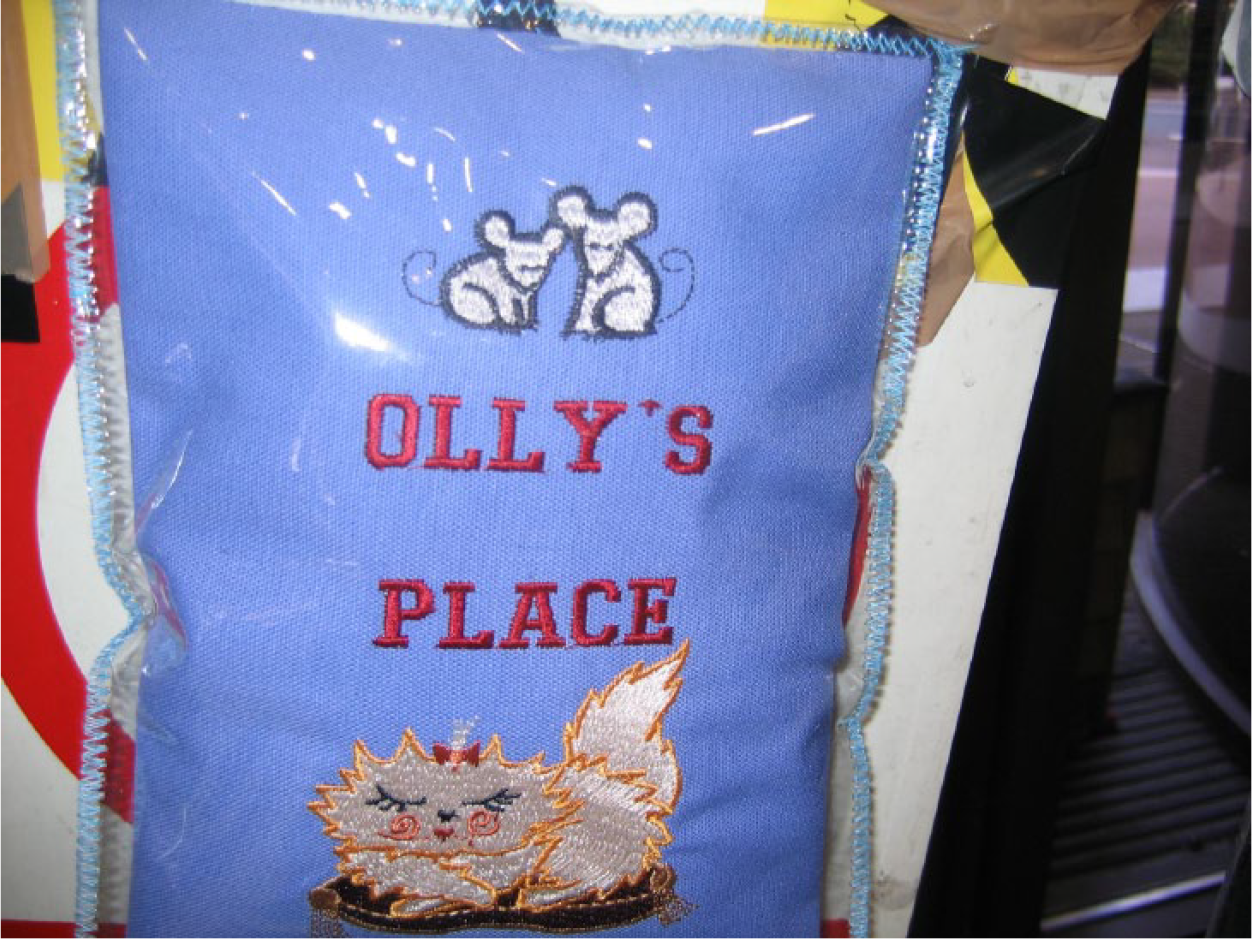
Olly’s place (photograph by author).
Around this time, I began to notice that Bob on reception was a little shifty as we talked about the cat. His eyes would often look over my shoulder, rapidly moving from left to right and vice versa. If he looked in her direction, he would not cast his gaze directly at her, but to one side. The cat of course had the complete freedom of the airport campus, she would come and go, as cats are want—some of her excursions regular and apparently ‘scheduled’, while others might have been thought as more bespoke and ‘chartered’ in nature. I began to wonder whether there was not some kind of deference to the cat or perhaps signs of some conspiratorial relationship among human members of the airport. Was the cat not only a symbol of freedom and escape but also a cause of its greater motivation and desire—a secret resource, in other words, to which I was being tested as to whether I was worthy of being initiated into or invited to share? Or, was there a parodic intent behind this deference and apparent deification of the cat—a recognition that she could not be constructed in any consistent or singular way?
In terms of subversion, Stallybrass and White (1986) revisit the work of Michel Bakhtin in their seminal study of the ‘politics and poetics of transgression’ to show how animals are used to subvert and parody the prevailing political and social order. Their particular interest is in the pig and the European carnival tradition in the medieval period. Similar to Leach’s (1964) argument, they show that the pig is an abject threshold creature. Pigs not only lived in close proximity to their human masters, they also ate the same food, and its pigmentation and nakedness also ‘disturbingly resemble the flesh of European babies’ (Stallybrass and White, 1986: 46). In many ways, the pig transgressed the man–animal opposition, which is perhaps explanation for why it has remained an object of contempt and disgust. At times revered, and at others despised, the pig remains an ambivalent creature mobilized in a multitude of ways by a host of domain specific discourses (in terms of the farm, the theatre, the church, the fair or the study). By virtue of these characteristics, the pig is ideal for the work of symbolic inversions and human–animal hybridizations that take place during carnivals. During carnival, the ‘world is turned upside down’ so that that which is high becomes low and vice-versa—the body elevated, the spirit degraded. Hence, the corpulence and fleshiness of the pig is mobilized to variously mock, parody and subvert the gravity of established order with its carefully delineated ranks of power and status. In carnival, the pig becomes king for the day or is depicted ceremoniously slitting the throat of the butcher. In comic theatrical productions commissioned for the carnival, these reversals and un-doings of the human–animal would find further expression in popular plays where a typical denouement would reveal that what the audience thought was a crying baby was in fact a pig. Following Bakhtin, who in turn is following Rabelais, Stallybrass and White (1986) suggest that such inversions force the audience to ‘acknowledge the interchangeability of pig and baby’ so that transgressing the human/animal distinction allows ‘the audience to enjoy what it had always known but found it difficult to acknowledge’ (p. 59).
It is possible that Bob’s shiftiness was a sign that Olly the cat was being similarly mobilized, at least by certain elements of the airport community. The celebration and veneration of Olly, her placement at the steps of the golden entrance, the fact that even the CEO was forced to give way, literally and metaphorically, is all suggestive in this respect. Far from being simply an object of sentimental attachment, Olly might have been used as a way of exposing and ridiculing the pretensions to power of the chief executive and his corps of senior managers. Capital was often made of the fact that the CEO was not born with a ‘golden spoon in his mouth’, but instead had made his way up from the ‘school of hard knocks’ in construction. His bullish physical presence and distinctive British north-east regional accent also allowed people to identify him as a man of modest working-class background. Festooned with cards and gifts Olly’s penthouse seemed to parody the possible pretensions of corporate display and may have acted to recall the CEO to his own more humble origins.
Olly may also have provided a form of protest against the perceived lack of empathy and the decline of ‘the family’ as increasing numbers of managers appointed to an ever more elaborate and complex corporate hierarchy put more distance between management and staff. Typically, managers at Olympic House were not ‘local’; they tended to be university educated, mobile middle-class professionals who did not have family roots in Manchester or its environs. Despite the efforts to promote progressive ‘human relations’ by senior managers, a general lack of trust and suspicion amongst some sections of the workforce meant that management policies and pronouncements were often greeted with cynicism. 8 Given this, it is possible that Olly provided a resource to remind people that authenticity, emotional attachments, care and nurturing could still be enacted whilst simultaneously exemplifying formal management failure to respect these features of organization. ‘She brings out the emotions and generosity’, Bob explains, ‘she makes people feel good’, in ways that helped mediate and subvert the ever increasing chains of command that stretched between the most senior and the most lowly of staff members at Manchester Airport.
Despite all the efforts management had made to reconstruct the airport as a ‘retail experience’, it was the cat that seemed to draw out the most passionate and intense emotions among travellers. On one occasion, a swarm of passengers had gathered in front of Olympic House waiting to be bussed to another airport on account of their aircraft being diverted. Such crowds were a fairly regular feature of airport life. However, on one occasion, amid all the stress and confusion of hundreds of passengers with bags and luggage being corralled into various holding stations by overworked airport and airline staff, with buses pulling up and crowding the driveway, the growl of diesel engines spewing out large black plumes of exhaust smoke, a little girl spotted Olly sat in front of Olympic House. Her eyes lit up and with what can only be described as astonishment and unselfconscious joy she rushed from the milling crowd to approach Olly. Lying down next to Olly, she began stroking and talking to the cat, imploring her mother to come and join her. She lay there for several minutes, the cat responding to the attention and petting, curling herself around the girl’s hands, her tail erect and her head stretching upwards.
Scores of relationship marketing expertise and experiential retail engineers have sought a similar reaction among passengers travelling through the terminal (see Lofgren, 2008). The new Terminal 1 retail experience at Manchester Airport is designed as an immersive ‘cinematic’ experience, for example, with its zones of ‘transference’, and ‘desire’, ‘reassurance’, ‘explore’ and ‘relax’. These designs attempt to amplify emotional intensities and create a vibe, or what the lead designer called a ‘fuck yeah attitude!’ As he goes on to explain this has helped excite certain mind-sets leading him to conclude that the retail experience has ‘got sex now’. It is with similar ambitions that the drinks giant Diageo launched its own ‘Take your summer spirit with you’ campaign in terminal 1 at the time. This was a campaign that sought to create a similar relationship between products and the consumer, deploying a range of experiential triggers including what they call ‘engaging concourse activations, easy serve sampling, promotional recipe cards, vibrant visuals across advertising, as well as value deals (including a beach bag GWP)’ (quoted in Newhouse, 2010). Despite all this science and design, it was the cat sat on its mat that seemed to generate the greatest amount of excitement and experience, building relationships, long-term commitment and identification.
Becoming feline: transformations beyond the symbolic
The more I studied this cat, the more entangled I became in the complexity and depth of relation between human–animals. And it was an experience which slowly taught me that there was something more than symbolic about the cats’ presence. Following the cat beyond the symbolic leads us into a dimension of organization that produced an otherness and excess beyond the capacity of management to understand, control or contain. We have already seen how Olly helped stimulate all kinds of displays of emotional behaviour and attachments that were the cause of discomfort and perhaps even disgust amongst some members of the community. Every day people would come and pay tribute to the cat. On the marble steps of Olympic House, they would crouch down in front of her and engage in acts of stroking, rubbing, tickling, petting, nuzzling, smelling, hugging, grooming and kissing. Both partners to these practices appeared to take pleasure, during which bodily properties were exchanged, including hair, scent and perspiration, with the cat occasionally licking the hand and sometimes even the face of her attendant. Human and cat share a degree of intimacy here that goes far beyond routine comfort and approaches something more akin to an intensive bodily and even sexual enjoyment (see Beetz and Podberscek, 2005; Dekkers, 2000). When it was discovered that Olly was in fact female, sexual associations were made even more explicit. One colleague reported, ‘We’ve heard all the jokes from staff and some of them say we shouldn’t be surprised as she’s always been a bit of a Diva’. Beyond the corporeal, people would also try to find ways of talking to her, soliciting conversation and even counsel. ‘How are you Olly?’ many would ask, ‘What are we going to do with you, hey?’, or ‘What do you think, eh, Olly?’. As I got closer to the cat, it was obvious that human preoccupations extended to concerns about her behaviour and even a certain moral anxiety, ‘Have you been a good girl?’. At times people became flirtatious and even promiscuous, ‘who’s been a naughty pussy then?’
As I became more preoccupied with the cat, it suddenly dawned on me that there were signs of Olly everywhere. Cats are widely seen to be proliferating in popular culture and for a while it seemed that cats and their ‘memes’ were almost running wild at the airport. Appearing on greeting cards, calendars, badges—and the ubiquitous cute-kitten photographs of course, cats propagate and multiply around the desks and common areas at the airport; they are pinned up on office privacy screens, and displayed in digital format as screen savers. For Berland (2008), this contemporary multi-media procreation and reproduction reflects ‘the proliferation of human–cat networks in urban and electronic space’ that for her is ‘part of an emergent “post-human” landscape’ (p. 431). As Olly became increasingly centre stage, she began to act as a medium but also stimulus through which a whole range of activities and behaviours could be interpreted and understood. The influence of animals could be seen in descriptions of the ‘crab-like’ walk of the CEO, for example, or in descriptions of his behaviour as ‘bullish’. It also seemed that there were people who would prowl; there were also those who bitched; and some who had their claws out (Manchester Evening News, 26 July 2011). There were others who were involved in a ‘cat and mouse’ game and some identified as ‘copycats’; accusations of corporate ‘fat cats’ are legion, and during one project in the terminal at that time, the supervision of commercial floor layers was described as a process akin to ‘herding cats’. At the airport, there were also cats’ eyes on the runway, leopard print swim suits for sale in the zone of desire, a tiger car rental and a Rampant Lion pub (‘where all the deals at the airport used to be done, Damian’), and images of cats were spread as corporate livery across the fuselage of the Cougar Airlines fleet of Boeing 727s.
If the roots of our language and conception of the world are found in a genealogy of nautical terms (Kemp and Dear, 2006), there is also a case to be made that the history of the cat and our relationship to it also provide a not insignificant mode of ontological orientation. The cat therefore opens up a whole range of behaviours for identification and reflection: feline, furtive, slinky, sneaking, stealthy—all of which have become common vernacular in the popular ‘warts and all’ tales of corporate life (Prashad, 2002). As an organizing motif, the cat also encourages analysis to make sense of a whole set of otherwise disparate phenomena, drawing associations and connections that reveal hitherto neglected dimensions of integration in the workplace. Inside the terminal, for example, passengers were invited to ‘step inside’ another cat, ‘The Jaguar’. Displayed on a 40-ft plasma screen, the advert seemed to trade on its association with its animal-like prowess with the growl of its engine attempting to animate something akin to ‘animal spirits’ that Keynes (1936) once suggested help explain the boom and bust of the economic business cycle. Such connections and associations are sufficiently suggestive for some to characterize contemporary business and economics as a form of ‘animal capital’ (Shukin, 2009). Elements of the cat are even appropriated for signs of rank and distinction; the stripes on the shoulder boards of the pilots and co-pilots, for example, seemed to offer a visual rhyme with the mackerel tabby stripes of Olly the cat.
Everywhere one looked, there was evidence of the cat, and it dawned on me that ‘organizational behaviour’ and ‘social relations at work’ were thoroughly immersed and enmeshed with a trans-species community of animals. This ubiquity of the cat is suggestive that something more than symbolism is at stake. Olly was providing a resource that helped members of organization find a mode of orientation to the wider organization that was not simply representational but also ‘constitutive’ and interventionary, manifest in tangible and ‘material’ form and in behaviours and activities that made the organization work in other ways. As a resource that helped show the constitutive and reflexive capacities available to members of organization, it was inevitable that my own activities as an ethnographer would be understood as cat-like: snooping, undercover, covert, secretive and sneaking. Which way round we might like to posit cause and effect is problematic here. Was the feline ontology an (illusionary) effect of the ethnographer getting too close to the cat—a relationship that was helping develop language and concepts that made the world appear increasingly feline? Or, was the inchoate epistemology an effect and requirement of having to deal with a world that was experienced as feline?
I was not the only one ‘becoming feline’. At the risk of straying too far into Wonderland, consider Bob, the receptionist, who might also be considered to be increasingly assuming the form and look of the cat. Like Olly, he too is ‘perched’ on the front steps of Olympic House; his name Bob ‘Molloy’, a near anagram of Olly and—like Olly—his hair was ginger and neatly trimmed. In this relationship with the cat, there appeared to be evidence of considerable visual ‘mirroring’ or ‘rhythm’ between human and animal, which is a well-observed phenomenon in pet–owner relations and which might be described in more complex terms as ‘mise-en-abyme’ like structure (temporally emergent, but cause/effect difficult to identify) or a ‘synecdoche-like’ structure which extends beyond the immediacy of a one-to-one relation to include the visual rhyme played out between Olly’s miniature house that is nested inside Olympic House (Olly, Olivia, Olympic House, Molloy …). This forms a ‘logic’ of organization consistent with the way Derrida’s texts work and deployed as ‘applied grammatology’ in Greg Ulmer’s (1985) work (see also O’Doherty, 2009; Rhodes, 2001). Indeed, Bob’s activities could be described as cat-like. His capacity to move silently and stealthily through the crowds of people milling in reception and waiting for admission to the offices in the corporate towers, for example, was almost feline. One might be engaged in a conversation when out from nowhere he would appear, a tap on the shoulder or a quiet word in your ear. There is also a photograph of Bob in a magazine showing him crouching over to feed the cat. He is wearing a three-quarter length ginger-brown brushed suede leather coat that matches his brown moccasin-style shoes, his white chest adding to the visual mirroring of cat and man. Both he and the cat seem to mimic each other, backs arched, face down, their paws extended, one behind the other. Who might be ‘following’ who becomes difficult to identify (Figures 3a and 3b).
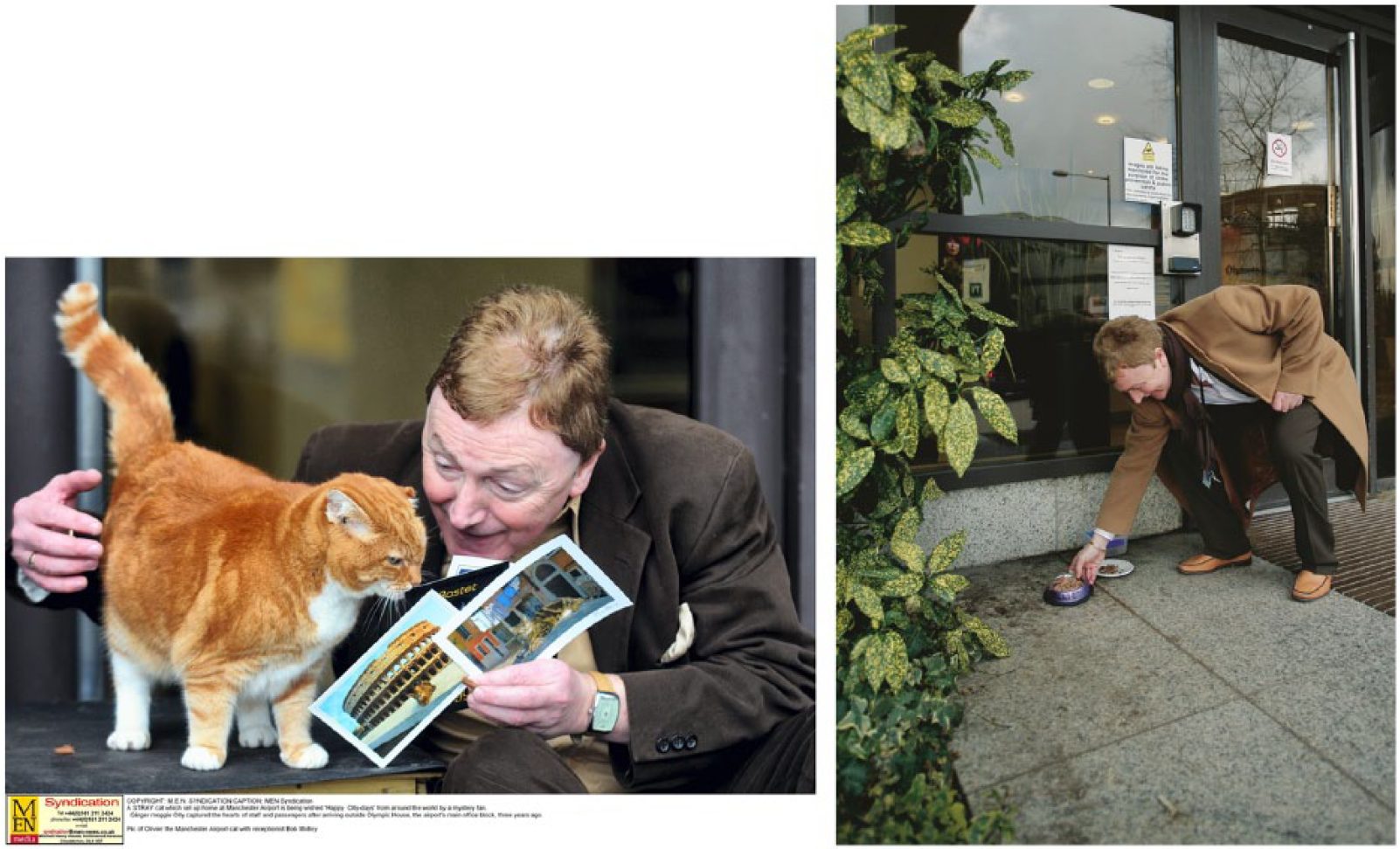
©Neil Hepworth/Your Cat magazine, used with permission.
Organization in uproar: towards ontological undecidability
We might not have gone so far into ‘cat ontology’ as White (2013), but the evidence we have gathered is highly suggestive that there are ways of enacting the feline in organization in ways that might be understood, after Annemarie Mol (2002), as a minor ‘mode-of-ordering’. It is also a significantly post-human mode-of-ordering, but one in which it is not clear who is the dominant actor, or indeed whether one can even abstract a singular actor out of what is a collective multi and trans-species network actant. It is a network that some have suggested might be further extended to include a far greater range of living organisms, including geological materials and even vegetable matter—where there are possibilities according to some researchers for the cultivation of ‘plant thinking’ (Marder, 2013; see also Barua, 2014; Hustak and Myers, 2012; Kirksey and Helmreich, 2010). Haraway (2003) sticks to the possibilities arising from what she calls ‘companion species’, where she argues that intimate and close relations between human and animal provokes a methodological challenge that provides occasion to learn something new every day. It is a relationship through which we also learn and become otherwise. Earlier we saw how the ethnographer began to respond to what might formerly have been dismissed as a minutia of heterogeneous and fragmented, disconnected marginalia—a desiderata of plastic spoons, emotions, felt cotton hats, tiger stripes, snatches of conversation about family, body dispositions and movements, colours and sounds—all of which could be assembled and juxtaposed to create various patterns and meanings. Oridinarily such materials would not attract the attention of research, particularly organization research within the context of business and management studies! Yet, this is precisely what we find members of organization doing, a practice that is made more evident as we turn our attention to follow this increasing obsession with Olly. However, these human–animal entanglements and the phenomena and kind of organizing to which these relations draw attention, demands concepts that will allow us to retain focus and discipline whilst extending our conception of what is considered relevant.
The concept of feline politics is suggestive because it allows us to hold together some of these otherwise neglected features of organization revealed by an emerging cat–human trans-species network. It also inhibits the tendency to separate the human and the animal, a separation that confines ‘politics’ to the human realm whilst ignoring the potential politics that is taking place between the human and animal. ‘Between’ implies that the agent of political action is not necessariy known or easily identified. It also marks a dimension of organization where actions and behaviours are difficult to predict.
This article has shown how we are forced to consider this world in ways that take it beyond an all-too-human realm of the symbolic; but we now must consider more seriously its ontological status. And in many ways, the ontological status of this dimension of organization remains difficult to settle. Is it in the eye of the beholder, only there if you want to see it? Or does it have a greater sense of shared reality? Is it objective or subjective? It is causal or an effect of something other? We have proposed that feline politics focuses analytical attention on phenomena that splits these differences: coming before these divisions ‘feline politics’ both generates new subject positions and countervailing worlds of objectivity; but it also exceeds these settlements as it continues to subvert and unsettle organization.
That the generation of new insights, behaviours and capacities can be attributed to this post-human network is an additional characteristic of this feline politics.We have seen that capital was made out of the cat, helping to promote the activities of the airport and acting as free publicity. However, consider the front cover of the June 2010 ‘World Cup’ special edition of the airport staff magazine ‘Plane Talk’ which carries a full spread colour photograph of Olly wearing a specially adapted ‘octopus hat’ designed in the colours of the St George’s flag, complete with mini flags sprayed out in an elaborate fan. ‘Olly roars for England’ the headline reads. Capital might be being made but what is remarkable is that the creativity of the marketing and communications team seemed to know no bounds. This creativity grows from strength to strength. A Christmas issue of the magazine features Olly wearing the antlers of a reindeer (a strange cross-breeding straight from the pages of Dr Moreau), a prop it seems in which readers were reminded of the ‘retail offer’ and special prices on selected range of products for Manchester Airport staff. Olly was not, however, quite so passive an object for publicity and promotion. She had refused to allow her agents to dress her in a full England football T-shirt prior to the photo shoot, for example, and several members of staff had joked that there might be a case for calling the animal protection league.
Management it seems is both troubled and in part inspired, even rejuvenated by this becoming feline. It is a becoming that includes what appears to be an increasing autonomy of her agency, but as we follow proceedings events become increasingly fantastic, or even incredulous—up to a point at which it becomes difficult to judge the sincerity of its organization, or rather the nature of this sincerity.
Lets begin with the appointment of a new CEO in June 2010. Soon after, speculation begins about the future of Olly with some rumours suggesting her days were numbered. It seemed that she was no longer needed in the ambitions the new CEO had for the group and as announcements were made that the group was investing in a major architectural and design refurbishment of the corporate head office, people began to wonder about the implications this might entail for Olly. Nevertheless, management had to tread carefully. Olly had become quite a celebrity and her number of Facebook friends was by now quite considerable—with over 2000 worldwide followers. Clandestine investigations were made to discover the human responsible for the ghost writing of the cat and enquiries were made to find out where her Facebook page was located and who was responsible for its maintenance.
Deputations were also sent to the Cat Committee and a project team established to look into the possibilities of a refurbishment of Olly’s kennel. From the available documentation it appears that an 8-page project brief was commissioned and published on 20 August 2010. Created by ‘Vector Design Concepts’, the brief summarizes the main parameters of acceptability: ‘It has to look like a piece of street art’, the document declares, so that ‘those who hate her can appreciate the art, those who love her can appreciate the new Olly house’. Also important was the clause that ‘It has to be fitting to be outside the Head Office of a multi million pound business’. It seemed that her existing house was the cause of some difficulties and embarrassment because it ‘gets buried in blankets that then get sprayed by foxes, other cats etc. and it then smells like we have a permanent tramp outside our building’. In responding to some of these issues, the brief proposes an outline design inspired by a set of principles and a ‘philosophy’ that sought to incorporate the aesthetics of flight/aviation. The design proposes a sculpture crafted from the latest acrylic materials that seems to replicate the contemporary ‘glass and steel’ minimalism of corporate architecture, which has attracted some interest in organziation studies (Burrell and Dale, 2003; Chugh and Hancock, 2009; Parker, 2015) (Figure 4). Here, the detailing of the design and its renderings is remarkable. The design development of the base unit, for example, reflects the accommodation and integration of a multiplicity of interacting variables. It is noted that cats will not sleep and eat in the same space, for example, and so the designers propose a tripartite structure made up of a ‘sleeping zone’, a feeding zone and a watering hole, a structuring that recalls the zoning of the terminal 1 retail scheme and that of the Escape Lounge project, projects roughly concurrent with this cat kennel project. The watering hole is particularly impressive. Designed to be replenished from rainwater collected from the roof, the ingenious design proposes a system based on running water—‘as cats prefer it’, the brief notes—which could be achieved by ‘pumping the water through a carbon filter, then up to an outlet’. Most ingenious of all, the designers note that the ‘water could act’, in addition, ‘as a method of cooling the sleeping zone in the summer months’.
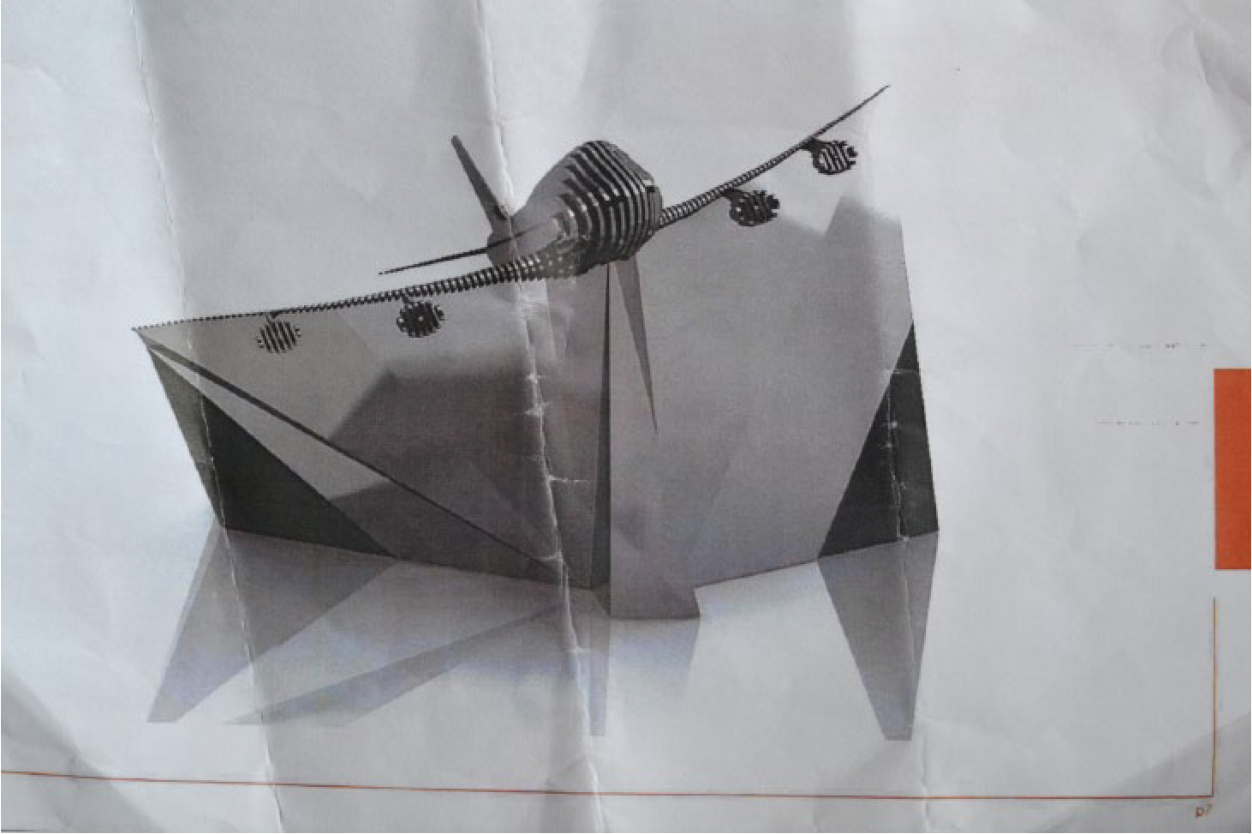
Computer rendered model of Olly’s proposed new penthouse (photograph by author).
The visuals supplied with ‘the brief’ suggest some hybrid architectural form combining elements of Zaha Hadid’s dramatic swooping cantilevers and angular projections with the organic ribbons of Anish Kapoor. One might say these ribbons appear tense and coiled, as if ready to spring and leap as the eye is led from the ground up to the sky, where the sculpture culminates in a dramatic replica of a Boeing 747 on take-off. Much like the creative energies of the marketing and communications department, Vector Design Concepts seemed to harness and extend a form of ‘curiosity’ that was most unusual in Olympic House, a form that might best be described as the logic of ‘and’ (Styhre, 2002; O’Doherty, 2005)—a playful and lateral movement of ideas not driven by the usual iterative and linear sequencing of the PRINCE 2–type methodologies at work in the airport. The result of all this is a design that realizes a strange human–animal–machine hybrid, something we might perhaps describe as a cat-becoming-kennel-becoming-aircraft.
What explains these creative energies and the monstrous form of this sculpture? Perhaps we might venture the idea that it was no one actor, no one species, but rather a multi-species becoming, where the cat appears to form part of a complex system of inspiration and creativity. However, what was perhaps most perplexing and beguiling was the fact that the ethnography could never establish how serious it all was. For a while I felt like the unnamed narrator in Poe’s System of Dr Tarr and Professor Fether. In a tale that has been the inspiration for other theorists of organization (Sievers, 1996), it slowly dawns on the reader that the narrator has been a victim of a charade, the wardens of the hospital having been imprisoned by the patients who have assumed the role of management themselves. Despite considerable effort to draw out my informants, it was impossible to ascertain whether this project, with all its creaturely creativity and inspiration, was genuine, fake, wishful thinking, deliberately subversive or parodic, or even in part designed for the appetite of ‘the anthropologist’. In this sense, there was a considerable ontological undecidability about the project. I recalled the furtive sideways glance of Bob as he looked ‘towards’ Olly. Were Olly and Bob in cahoots? Was there a formal ‘client’ that had commissioned this project brief? The paperwork would suggest there was indeed a request made somewhere for a design brief. Would it likely be denied by more senior members of the executive team? There is no doubt that if it might be a subsequent cause of embarrassment, senior managers can be expected to have prepared a counter-rationale that would allow them to deny any involvement, reflecting a version perhaps of what Munro (1995) called ‘managing by ambiguity’.
How sincere was this project? How serious were members of the organization who were involved in the project? These questions are difficult to answer, and they remain key to the emerging sense of an ontological undecidability. What could not be denied was that on 27 July 2011, workers arrived at Olympic House to find that Olly’s home had been removed. The night before the Manchester Evening News ran with the headline ‘Claws come out as Manchester Airport chiefs show exit door to Olly the cat’, and Olly’s Facebook pages later verify the truth: ‘Dear Friends … I can confirm that I am being retired by the Airport as Olympic House Security Cat. I am very saddened by the news but unfortunately I do not have a choice …’. Despite the careful media management and behind-the-scenes negotiations involving the Royal Society for the Prevention of Cruelty to Animals (RSPCA), the outpouring of protest and grief following this news was astonishing, a reaction that shook many members of the senior management team. A selection of the posts to Olly’s Facebook conveys some of these emotions, reflecting a combination of disbelief, defiance and despair:
Olly will be going nowhere, she’s part of the airport and so many people love her … They’d [sic] be up roar I’m sure … I’ll fight for it. Ollie belongs at Manchester Airport. We need to keep her there. How can they do this to her. She does not harm. I called into Olympic House today and I got a lump in my throat & my eyes filled up with tears. Oh olly I think my heart broke in two when I walked round the corner to find no trace of u tonight … Maybe its time for a demo outside OLYMPIC HOUSE. I call a strike. I keep praying for a miracle … I still keep checking outside of Olympic House to see if you’re there Olivia my gorgeous chicksi!!!
One might well ask, how earnest all of this is. Well, the power of Olly seemed to attain even greater heights. Soon after Olly’s retirement, Bob the receptionist fell ill and had to take extended time off work for respiratory problems. After more than 35 years of service, Bob himself took early retirement on grounds of ill-health in June 2014. Did natural processes and the usual physiological deterioration of an ageing body cause this illness? But we know that ‘illness’ is partly the product of modern medical practices and its culturally specific forms of diagnosis and treatment (Foucault, 1973). Given this, might we speculate that there is some ‘sympathetic magic’ between the cat and human?
Bob was not the only one to be ‘taken in’ by the cat. The director of learning and development also confessed that the true motivation for his resignation was the departure of Olly: ‘It was the cat, Damian’. Adding another dimension to this tone of undecidability, he told his tale in ways that would not admit the separation of ‘the literal’ and ‘the symbolic’. It was impossible to tell whether Olly was being deployed metaphorically—as a surrogate through which to express otherwise disavowed or clandestine criticisms of group under the new CEO—or whether the former director meant it was literally the cat that forced his resignation. If it was literally the cat, then there is no implication that her departure could be interpreted as something that was symptomatic of a wider malaise in the organization, or any sign of disaffection with the new CEO’s visions for the future of the airport. And what role did Olly play in all this? One is still left asking whether the cat was a projection of human sentiment, or whether she helped teach her human companions ways of thinking that helped foment discontent with emerging corporate priorities.
Conclusion
We have been able to trace something of the difference brought to bear on organization by Olly the cat as he/she has been constructed at Manchester Airport 2007–2011 and as Manchester Airport was (re)constructed around her. She was anything but marginal or insignificant. Olly the cat has prowled these pages in a multiplicity of forms: from company mascot to subversive ally, object of sentimental projection, to saccharine emotionality. She has also served as a potentiality and resource that occupies a point of passage for the generation and mediation of competing agendas and differences in organization. However, she was also agenda making in her own way and was not just the plaything or mediation of all-too-human affairs in organization. Far from providing a resource for a human-centred ‘symbolic transformation’ similar to Ackroyd and Crowdy (1990), or Hamilton and Taylor (2012), there is a very real possibility that Olly shows one way in which animals might form part of a radically new form of ‘post-social’ action in organization.
In the hunt for our prey, we have been increasingly led towards the possibility that the cat both exceeded what it was possible to know and that it remained, in the words of Adrian Franklin, ‘mysterious, secretive, sexual (female), aloof, intellectual, independent and spiritual’ (quoted in Fudge, 2008: 80). Olly also gave rise to originary and often surprising actions that pushed management and staff into ever-greater degrees of creativity and struggle. New potentialities and new capacities were realized out of this relationality as emergent properties of ‘the human’ and ‘the animal’ were mutually learnt and acquired. Members of the airport seemed to acknowledge Olly as a fully fledged non-human actor, and this article has helped show how she is an element in an assemblage of heterogeneous parts out of which action is emergent. At the same time, she cannot be confined to a world upon which the human acts or represents, or indeed in a world that the ethnographer seeks to fully re-present or know. Olly remains beyond representation, and acts to resist and deflect our desire for consistency and the unity of a single meta-narrative. This is all suggestive of the possibility that the ‘nine lives’ of the cat is not just an idle metaphor.
Politics at the airport is also made different because of the cat. At the same time, this politics would seem to fall short of the currently fashionable term ‘ontological politics’ (Mol, 1999, 2002, 2008; cf. Alcadipani and Hassard, 2010). This is because there is nothing so definitive as an ontology or even a well-defined series of multi-ontologies—and value judgements as to which ontology might be preferable to commit or enact are difficult to assess, and dangerous to adjudicate. However, this exploration of Olly has helped isolate an ‘ontological undecidability’ in organization, which also contributes to the understanding of politics in organization. One dimension of this undecidability has become apparent in the doubts one is forced to consider about the seriousness of the ‘Olly project’, if we may call it thus. What are the intentions of the various actors? Do we end up in a space of resistance and parody, or is this management by other means? This was a question that also faced senior management. Difficult to call one way or another, there was no doubt that mis-reading the complexities and subtleties of the organization that had formed around Olly could trigger reactions that might be catastrophic for senior management control and reputation. It was interesting that management had to adopt stealth-like tactics in finding ways of removing the cat and while not entirely devoid of protest and resistance it could have been a lot worse. Might it be suggested that this is another sign of becoming-cat, where we learn to see/exercise stealth in ways akin to properties associated with the feline?
Another dimension of this undecidability concerns the fact that the same mundane practices and organizational infrastructure that helped realize the Olly project were also in use on more ostensibly serious projects such as the terminal redesign (a £80 million project) or the new departure lounge (O’Doherty, forthcoming). Spreadsheets, project briefs, project management methodologies, architectural drawings and designs, and other bureaucratic resources—including committees and their paperwork and other accoutrements—all formed part of the Olly project. Like characters and objects in a David Lynch film, everything forms part of at least two diverging series where realities flicker from the conscious to the unconscious or from shadow into light. As we have followed Olly through the corridors of power in Manchester Airport, we have discovered that it is these ‘elements’ that embody multiplicity. Available to be used in a variety of ways the same elements perform different but co-emergent realities. This made it difficult to clearly demarcate out a series of distinctive or coherent ontological multiplicities at the level of something like organization. Instead, there was undecidability at a more disaggregated level—in the very mundane materials and artefacts of routine organizational life.
Part of this undecidability also refers to the fact that we can only say they are realities in the sense of potential and immanence: never fully realized, never fully completed, and more like patterns formed out of a swarm of heterogeneous and fissile elements that could always be appropriated for other ends. We are left to wonder when is a spreadsheet being used for purposes we should take seriously—or at least for the purposes of what the official representations of management would designate as serious—and when is it being used for purposes of parody or a ‘testing’ of organization to see what latitude there might be for alternative or deviant future states of organization? Feline politics conjures a dimension in organization in which one is never very clear what might happen next and—whether serious or frivolous—actions and behaviours remain unpredictable and undecidable. Indeed, it is possible that the various energies in organization become charged and inflated by virtue of the very suspension of certainty and knowingness. This undecidability is perhaps a routine feature of management in modern corporations, albeit it is one that is difficult to research.
Finally, it is worth making explicit the fact that the article began in a peculiar mode of articulation, a temporal disjuncture or aporia marked by the ‘[m]any years later’ in which it remains unclear whether this time has passed or is still yet to come. It recalls the strange temporality out of which the literary form of ‘magical realism’ is written in which certain futures have already in a sense happened while some memories and recollections are still waiting to be spoken. In finding ways of writing ethnography that can embrace and work with this receptivity to the unknown, we perhaps begin to listen to emerging trans-species actor-networks in organization. Hence, feline politics helps trace a form of ‘politics by other means’ in organization. As a working concept, it holds together an extended repertoire of actors and agents through which new resources and new collectivities are made available for mobilizations that may have the capacity to challenge existing relations of power and inequality. Such efforts can be expected to give rise to what may appear ‘monstrous’ forms of thinking, being and creativity—and this ethnographer will no doubt be charged with culpablility. Seeing/being with the cat helps enact different forms of organization in reflexive and constitutive ways, and as the article became progressively more entangled itself in these human–animal relations we were able to glimpse what might amount to embryonic and alternative ‘post-travel’ ontologies of transport in organization.
That these are found latent within the airport, widely condemned as a major contributor to catastrophic levels of global warming, is perhaps even more remarkable. In prising open these alternative forms of travel, the article gives access to what Haraway (2008) calls ‘other worlding’ 9 that at times we have likened to a Wonderland. A Cheshire cat has been our guide into this Wonderland. Here we found an expanded ‘multi-species’ or ‘interspecies’ ecology where things like agency and organizational behaviour must be extended to include animals. Such findings are suggestive of a need for further studies that can explore the agencies latent or inchoate in a multitude of non-human forces. This might includes various materials, organisms, energies and plants (Kirksey, 2014; Kirksey and Helmreich, 2010; Kohn, 2013; Tsing, 2015), all of which might need to become full-fledged participants in the making of organization in the era of the Anthropocene. In other words, Olly’s time has not yet passed.
Footnotes
Acknowledgements
The paper is dedicated to Bob Molloy who in various roles has served the community at Manchester Airport for more than 35 years, and I thank him for his help and permission to publish this paper. I would also like to thank the special reviews editors and the anonymous reviews for their fine handling of this paper. Earlier versions of this paper were read at the Institutionen för Teknikvetenskaper at Uppsala University, Lancaster University Management School, Cardiff Business School in Cardiff University, and the Lincoln Business School in Lincoln University.