



Abstract
Smart city (SC) experts in India often center-stage citizens as an alternative to a technology-led transformation. A substantial body of literature on smart cities sustains this resultant binary between techno-centrism and citizen-centrism. Mobilizing ANT sensibilities, we generate an ethnographic narrative on how the smart city discourse has translated into everyday processes of city administration and urban governance in India. Our account unmutes more-and-other-than-human actants—event-stage, glossy publications, ceremonial awards, conference producers, and decision-makers—in the translation of SC discourse, with following effects: the uncertainties in the translation process are foregrounded which potentially destabilize center-staged actor identities; and the work of heterogeneous actants in articulating the citizen as the center of their efforts is revealed, thereby de-naturalizing the binarized reality. Furthermore, when unmuted, more-and-other-than-humans spell out their ongoing collaborations and negotiations and generate a nuanced reading of the clashes and accommodations made in the process of translating SC discourse in everyday settings of city administrations. These effects lead us to emphasize the translation of SC discourse as an uncertain socio-material process proceeding through episodic clashes and tentative accommodations. They also invite a conceptual expansion of translation as constitutive of the ontological politics of organizing, which insists on attending to ongoing collaborations and negotiations among more-and-other-than-humans that compose organizational realities. Thus, we address critical organization and management studies’ concerns regarding ANT’s alignment with its objectives by locating politics in the performance of, and interference into, the multiple realities that are being enacted through practices that assemble experts, decision-makers and non-humans.
Keywords
Introduction
The term Smart City (SC) signifies a global managerial discourse through which the future of world cities is currently being imagined and worked upon (Joss et al., 2019). The collage above (Figure 1) created from our field ethnographic materials highlights the attempts to center-stage the citizen as opposed to a technology-led transformation as part of SC initiatives in India. The top-left entry, for example, references an SC panel discussion in a major summit wherein a prominent speaker goes thus:
“Cities are made up of citizens. They are the main components of any city. . . infrastructure is the requirement of citizens and technology is an enabler. It is very important to ensure that citizens themselves are ready to be smart and build a smart city by involving themselves. . .” (Choudhary, 2018: n.d.).
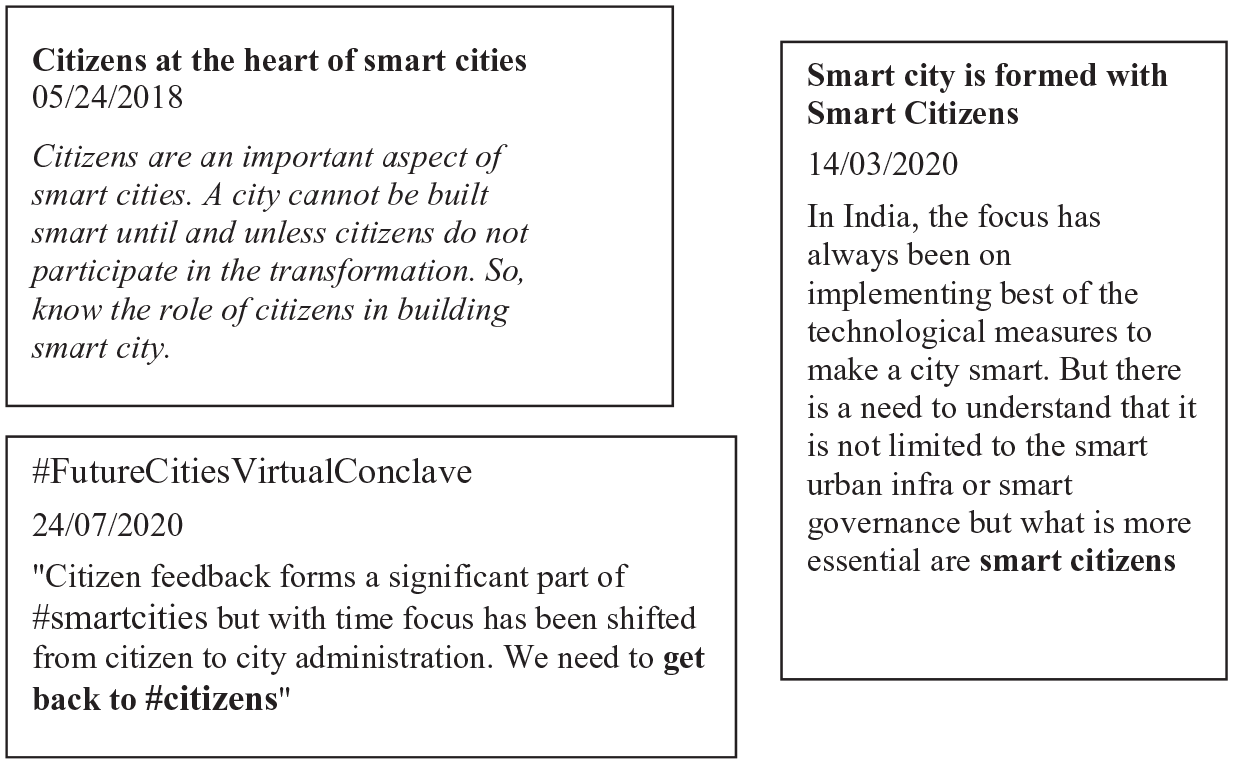
Center-staging the citizen.
The desire to connect with the citizens in the process of building smart cities has been reverberating through the flagship scheme—Smart Cities Mission (SCM)—of the federal government of India since June 2015. The scheme aimed at transforming 100 cities into “smart cities” “that provide core infrastructure and give a decent quality of life to its citizens, a clean and sustainable environment and application of ‘Smart’ Solutions” (Ministry of Urban Development, 2015: 5). The SCM policy documents, including the mission guidelines, repeatedly emphasize “the aspirations and needs of the citizens” which urban planners provide for (Naidu, 2016). Further, the center-staging of the citizen predominates smart city scholarship (for a review: Coletta et al., 2018; Joss et al., 2019; Karvonen et al., 2018), which critiques the extant SC literature for its technology-centrism (Cardullo and Kitchin, 2019; Levenda et al., 2020; Shelton and Lodato, 2019) and the crowding out or subordination of citizens by other actors, particularly multinational technology firms (McNeill, 2015; Sadowski and Bendor, 2019; Söderström et al., 2014; Wiig, 2015).
The center-staging of the citizen and the binarization (citizen vs others, particularly multinational technology firms) that it produces with the central focus on actors in both scholarship and empirical settings are our points of departure. We attend to the crucial but currently discounted roles of non-humans and the everyday process of organizing, with an emphasis on the uncertainties in the translation of SC discourse, in order to challenge the stabilized identities of currently center-staged actors, namely, the citizen and technology agents. To do this, we mobilize Actor-Network Theory (ANT) sensibilities that consider human and non-human actants—those who act and are acted upon—as semiotically equivalent and their participation in the material processes of organizing as symmetrical (Blok et al., 2019; Czarniawska, 2017; Jensen and Sandström, 2020; Michael, 2016; Styhre and Brorström, 2021; Vandeventer and Lloveras, 2021).
Our theoretical grounding is in the ANT tradition of pursuing a processual understanding of organizing (Blok et al., 2019; Czarniawska, 2017; Jensen and Sandström, 2020) and translation studies (Czarniawska, 2009; Hultin et al., 2021; Waeraas and Nielsen, 2016). While studies examining the circulation of management ideas have themselves been instrumental to embracing of ANT sensibilities in critical organization and management studies (COMS) (Czarniawska and Sevón, 2005), the metaphor of translation as such has inspired scholarship with divergent theoretical groundings (van Grinsven et al., 2016). We build on the strand emphasizing uncertain and unexpected material displacement of ideas, objects, technologies, people, etc. leading to a transformation in the associations (Czarniawska, 2009; de Laet and Mol, 2000). Thus, translation of SC discourse for us, is not a shift in language shared by urban experts, bureaucrats, and consultants, but an everyday organizing process involving transformation in the association among them. Our account shows that this transformation in the Indian context has taken place through the work of more-and-other-than-human actants which include event-stage, glossy publications, ceremonial awards, urban experts, conference producers, and decision-makers within the city administration and higher-levels of government. We explore their collaborations and negotiations and the uncertainties thereof through an ethnographic engagement which stays focused on actions and their interconnections rather than actors (Czarniawska, 2008; Hultin et al., 2021; Michael, 2016). Our exploration attempts to challenge the stabilized identities, their center-staging, and in turn their domination which happens via enactment of managerial discourses (Czarniawska, 2009) such as SC, which are concerns shared by COMS as well (Adler et al., 2007).
Further, our efforts of bringing together ANT approach with the conceptualization of translation as an uncertain socio-material process has theoretical-political implications for COMS. ANT has been critiqued for its lack of alignment with the criteria that sets apart “critical” scholarship in organization and management studies (Whittle and Spicer, 2008). At the center of this dialog has been the notion of denaturalization, which initially emphasized “uncovering the alternatives that have been effaced by management knowledge and practice” (Fournier and Grey, 2000: 18), and ANT works were adjudged as not undertaking this task (Whittle and Spicer, 2008). Responding to this charge, Alcadipani and Hassard (2010) mobilized Mol’s (1999) concept of ontological politics to reinterpret denaturalization within ANT context as an exploration of the ontological politics of organizing, whereby research accounts bring out enactment of organizational realities through processes that involve symmetrical participation of humans and non-humans. Building on this reinterpreted notion of denaturalization, our narrative account conceptually expands translation as constitutive of the ontological politics of organizing, which insists on attending the ongoing collaborations and negotiations among more-and-other-than-humans that compose precarious and provisional organizational realities. Thus, while connecting translations studies with ANT inflected works, we locate politics in the performance of, and interference into, multiple realities that are being enacted within everyday organizing which assembles experts, decision-makers and non-humans and keeps connecting their emergent actions in order to translate managerial discourses.
The paper henceforth is structured as follows. The next two sections elaborate the suitability of the ANT approach and uncertain translation process for our research focus, and situates our study in the burgeoning SC literature. The following section elaborates our ethnographic engagement and analysis. More-and-other-than-human actants enacting smart city discourse in India become louder from the subsequent section onward. They first enliven the uncertain socio-material process of translating SC concept, followed by clashes and tentative accommodations in this process. The recognition of their work helps break the binaries while unraveling how they often collaborate to articulate citizens at the center of their efforts. We discuss how our work leads to (re)conceptualizing translation as constitutive of the ontological politics of organizing. We conclude with reflections on how this reconceptualization opens up avenues for future research.
Smart cities literature: Focus on macro-actors and its implications
Until a few years ago, SC scholarship sustained a sharp ideological division (Kitchin, 2015). A significant body of work, which initially came out of computer science and MIS disciplines and multiplied through corporate-branding campaigns, celebrated the promises of the ICT interventions in increasing the efficiency of public services and responsiveness of governments to citizens (Caragliu et al., 2011; Deakin, 2013). Soon, erupted a critique from social sciences which raised issues regarding the techno-utopianism inherent in the promises of SC advocates (Wiig, 2015), and pointed toward a disciplinary strategy advanced by SC technologies to depoliticize urban governance while increasing the influence of consultants, technocrats and private companies (Vanolo, 2014).
Critical studies of smart city discourse challenged the technocratic imagination of smart cities by highlighting the dominant role and ideology of multinational technology firms in creating, exploiting and selling these imaginations to government agencies (Grossi and Pianezzi, 2017; McNeill, 2015). For instance, Söderström et al. (2014) highlight story-telling in IBM’s marketing material, which is oriented toward changing the conception of urban management toward a “technocratic fiction,” relying exclusively on high-level data and software for planning and doing away with local knowledge and contextual interpretation. Sadowski and Bendor (2019) extend the argument to CISCO by analyzing a broader corpus of marketing material and excavating therein a construction of impending and inevitable crisis only avertable through smart technology. They concur with previous analysis (McNeill, 2015) to suggest that global technology firms have been more or less successful in constructing a coherent view of smart urbanism, which they sell to city administrations across the globe, while crowding out “alternate visions and corresponding arrangements” (Sadowski and Bendor, 2019).
Over the last decade or so, SC literature has explored the involvement of the citizen as an alternative to technology-centered imaginations around building smart cities. These works showcase how citizens are either absent or serve as sensors in smart city imaginaries (Vanolo, 2016), their participation in actual planning practices remains tokenistic (Khan, 2019; Levenda et al., 2020) and attached to hashtags which espouses passive consumption rather than active assertion of rights and entitlements (Datta, 2018), serving to legitimize corporate-interests (Shelton and Lodato, 2019), and reproducing neoliberal subjectivities (Cardullo and Kitchin, 2019). While this epistemic concern with citizen participation to make SC agenda more democratic is surging, barring a few exceptions (Cowley et al., 2018), the entity of citizens remains essentialized and at the center, both within SC advocacy and its critique. Thus, there are clear dominant patterns and implications of interest to COMS: (1) Discourses propelled by a familiar set of actors—large multinational technology firms like IBM and CISCO, entrepreneurial local businesses and local governments—gain traction in the literature while a much wider set of practices are ignored (Farías and Mendes, 2018; Odendaal, 2021); (2) the scholarly gaze remains on macro-actors and organizations, and away from the everyday organizing through which such discourses enroll other diverse actors such as bureaucrats, elected representatives and others working with urban local bodies (Wathne and Haarstad, 2020).
There have been attempts to shift the focus away from familiar actors and associated discourses toward the ongoing urban processes of administering and governing that collide with smart city projects (Farías and Mendes, 2018; Farías and Widmer, 2017; Odendaal, 2021; Tironi and Criado, 2015). Much of this scholarship mobilizes concepts and methods from Science and Technology Studies (STS). The focus, however, in this sparse SC literature within STS tradition is mostly on actants within city-spaces. For instance, Farías and Widmer (2017) attend to actors mobilizing non-digital logics in “ordinary” smart cities. They rightly point out that the “political trajectories” (Latour, 2007) of smart urbanism indeed go beyond negotiation on insertion of digital devices in city spaces to include the terms of urban development projects which are made to collide with smart city projects. We join this body of literature, sharing their ethics and politics of “countering the disembodied versions of smart city projects.” Complementing it, we focus on the organizing processes enacting smart city discourse—one where corporate-sponsored presentations unfold through event-stages, glossy publications and award ceremonies, while there are episodic clashes and tentative accommodations made with elected representatives and municipal officials whose everyday knowledge of what needs repair and upgradation in the city are appropriated, discounted, and reformulated in the translation of smart city discourse.
Ontological politics of organizing in translation
The concept of translation is traceable to Callon (1986), who developed it in an attempt to “uncover the mechanisms of power of science and technology” and thus narrated how actors define and distribute roles to other entities, institute a strategy to make them indispensable, displace entities to become part of new ways of organizing, and finally, simplify the relationships or black-box them for smooth everyday operations. While Callon (1986) is accommodative of resistance in each of these attempts, still his framework, as Czarniawska (2008, 2009) indicates, focuses on the “homologizing effect” of translation and on macro-actors including organization, relatively ignoring the process of organizing that stabilizes and reifies into organization.
The homologizing focus and the resultant oversight are evident in some ANT-informed SC studies, particularly in those which adopt Callon’s notion of translation. For example, Söderström et al. (2014) employ Callon’s (1986) framework to analyze IBM’s smarter cities campaign, and argue that the focal actor—the firm—has been successful in creating “obligatory points of passage” for city administrations to attach themselves with the smart signifier. Our approach of employing ANT departs from this approach as we found it limiting in explicating translation as a socio-material process that goes beyond the linguistic/discursive realm, wherein ideas are imbricated into material arrangements and thus travel across space and time (Czarniawska, 2008).
Czarniawska (2008) suggests a focal shift from actors to repeated actions, which inscribes meaning into objects, spaces, and relationships between heterogeneous entities. Her emphasis is on the uncertainties in this process as she asserts that all entities that are involved in translation have an unstable identity as each of them change through repeated uncertain actions. They may or may not emerge as having stabilized relations (and as an organization), thereby qualifying them to have a single macro-actor or a spokesperson. In articulating these uncertainties, Czarniawska (2008) draws on Latour (2005), who suggested provocatively that the word actor in ANT should be a call for dislocating the perception of action as “coherent, controlled, well-rounded, and clean-edged affair.” Latour (2005) indeed advises an ANT researcher to view action as “borrowed, distributed, suggested, influenced, dominated, betrayed, and translated. If an actor is said to be an actor-network, it is first of all to underline that it represents the major source of uncertainty about the origin of action” (Latour, 2005: 46). This uncertainty in the process of translation resonates in the study of the Zimbabwe Bush Pump by de Laet and Mol (2000). For instance, the inventor of the pump in their account is a modest actor who contributes to the making of an “appropriate technology” by “attending, being attuned, and adapting to what happens to the Bush Pump in the world-out-there” (de Laet and Mol, 2000: 226). More recently, to emphasize the uncertainty about origin of action, Hultin et al. (2021) suggest explicit engagement (and even exclusive) with actions and locating agency within possibilities that flow from prior actions to subsequent actions. Keeping our focus on actions, we attend to actor-networking among more-and-other-than humans to rethink the stabilized actor identities and thus “politicize state of affairs” in relation to the enactment of SC discourse (Blok et al., 2019: xx).
Aligned with ANT sensitivities toward uncertainty in the process of translation, Mol (1999) has been developing an expanded notion of politics—one that actively shapes reality and does not operate in the given “conditions of possibility.” Interestingly, Mol (1999) invokes this phrase—“the conditions of possibility we live with”—to mark the classic meaning of the term ontology, and then departs from it by insisting on the multiplicity of such conditions (ontologies) and attention to politics that perform and interfere with them (ontological politics). This active mode of politics, she argues, opens to us when we take forward the focus on material agency and non-humans to engage with how realities (yes, they are multiple) are done and enacted. Note that politics is not being denied as having ideological clashes and discursive contests which is the key thought process in COMS (Adler et al., 2007), but our emphasis, following Mol, is on understanding clashes and contests as the site of enacting multiple realities.
Alcadipani and Hassard (2010) draw upon the expanded notion of (ontological) politics to address the charge regarding ANT’s lack of alignment with the criteria that sets apart “critical” scholarship in organization studies (Whittle and Spicer, 2008). They argue that this expanded notion of politics involves an act of denaturalizing ontology, that is, showing how things could become otherwise, which constitute COMS ethos. However, the active mode of (ontological) politics, following an ANT grounding, goes beyond representing marginal voices as alternatives (e.g. center-staging of the citizen) to explore the socio-material process of (re)assembling relations among heterogeneous elements through which the entities of any discourse become real (Müller, 2015). As Mol (2014) emphasizes, ontology in this thought process “does not precede or escape politics, but has a politics of its own. Not a politics of who (who gets to speak, act, etc.) but a politics of what (what is the reality that takes shape and that various people come to live with?)” (p. n.d.). Such ontological exploration of politics, or an expansion of political gaze onto how entities become real through their enactment as relations among heterogeneous elements, offers a de-naturalization of organizing processes that enact managerial discourses (Alcadipani and Hassard, 2010) such as smart city.
Not considering ontology as prior to or outside of politics follows from ANT’s sensibilities of symmetrical participation of humans and non-humans as well as their semiotic equivalence. Attention to this active mode of politics where more-and-other-than-humans are seen as collaborating and negotiating which materialize in episodic clashes and tentative accommodations, bridges the alignment between ANT and the goals of “critical” scholarship in organization studies. Walking on this bridge, we undertake an ontological exploration of politics of organizing rather than conceiving it in structural terms such as ideological clashes and discursive contests. Specifically, we ethnographically explore such ontological politics of organizing within the processes through which global managerial discourses such as Smart City are translated with all uncertainties in our everyday worlds.
Methodology
This article draws on 2-year extended fieldwork (November 2016–October 2018) which involved following experts and decision-makers at the sites of knowledge production and circulation over smart cities. The selection of fieldwork sites was primarily inspired by a reading of urban policy mobilities literature, which set the first author toward conducting an ethnographic study of spaces in which “policy knowledge is mobilized and assembled” such as “conferences, seminars, work-shops, guest lectures, fact-finding field trips, site visits, walking tours, informal dinners and trips to cafes and bars, among many others” (McCann and Ward, 2012: 47). Encouraged by ANT writings within organization studies, we do not spend energies on searching for and fixing the original core actors (or the network builder who enrolls others through blackboxing) of SC network in India from where a stabilized discourse can be seen as passing down to decision-makers (Bruni, 2005). Following Czarniawska (2008), we accord analytical primacy rather to organizing action that works to develop and stabilize connections within which actants emerge that are crucial to the processes of translation.
This paper reports on events whose official purpose is to organize discussions on the “best-practices across the country.” Besides smart cities, the event management companies brand their events using many other signifiers such as digital innovation, higher education, waste management that are seen as conducive to assemble corporate sponsors, policymakers, and decision-makers within the government. Our focus in this paper has been on action that assembles experts and decision-makers who are concerned with India’s SCM. However, such actions have a transnational continuity across multiple geographies where smart city discourse has been translating into the everyday process of city-administrations (Wathne and Haarstad, 2020).
The first author conducted participant observation at 10 smart city events organized in five different Indian cities by four private media companies and one not-for-profit industry association. Eight events were in a city different from our host institution and required travel for around a week. Following up on the actors during field-visits, the first author has conducted in-depth interviews with 18 experts working at (or traveling to) the field-sites before and after the event. Three other individuals have been interviewed over the phone after following up on the brief meetings during fieldwork. To ensure anonymity of our research participants, we are withholding the dates and venues of the events. Please see the online Supplemental Material for details of the interview. All data extracts from participant observations, except where a minister has publicly made speeches, have been anonymized here.
While reassembling ANT, Latour (2005: 23) keeps rehearsing the following methodological advice: stay away from quickly employing abstract critical sociology concepts and pay “the full cost of any displacement” from instances to dark forces governing social “out of its [your] own pocket.” We experienced having paid this cost by writing field-reports on each field-visit. In the process of writing these field reports, we have combined ethnographic observations with analysis of a range of archival material: policy frameworks, prescriptions, and technological solutions posted by governments, consultants and other knowledge-producing actors; audio-visual recordings made available online by the event organizers of the events attended physically; audio-visual archives of the past events; posts made by event organizers and attendees on online professional networking platforms: LinkedIn and Twitter. The analysis here needs to be seen as methodologically emerging from relativity between different textual accounts (Latour, 2005): notes made at the site, post-fieldwork writing that generated different field-reports, analytical memos combining texts from multiple field-reports, doctoral dissertation drafts, and drafts of this manuscript. It is through a relativity between these textual accounts that select episodes of the action of translation involving us have walked into this manuscript to the exclusion of others.
Our account zooms into those episodes of action where (1) uncertainty in the process of translation is explicit, (2) heterogeneous actants are working with one another to articulate the citizen at the center of their efforts, and (3) clashes between actors and accommodations made by them can be felt. In re-assembling these episodes, our observations from three smart city events, which were spread out in the 2-year period of fieldwork, form the bulk of reporting. However, the interpretations are shaped by participation at a larger set of events.
Uncertain translation involving a wide range of sponsors and partners
The smart city agenda attracted budgetary support from Government of India (GoI) first time in June 2014, when the then finance minister Arun Jaitley articulated the scheme as a step toward realizing the Prime Minister (PM) Modi’s “vision of developing ‘one hundred Smart Cities’” (Jaitley, 2014). The budget allocation invited numerous commentaries in the national media (Chattaraj, 2014; Dalvi, 2014). While the SC commentaries were gaining media traction, the action picked up further in the form of meetings and events in high-end hotels of Delhi, assembling decision-makers, technology vendors, and a host of experts and consultants who sensed business opportunities in SC consulting space. An event took place almost a week after the budgetary allocation to smart cities (18th June 2014) which set for itself this objective: “take forward the government’s agenda of smart cities by finding out the best possible contribution from each stakeholder toward the development of smart cities across the nation.” 1 The inaugural session had a key-note address from an academic, Jagan Shah, who was also serving as the director of an internal think-tank of the federal government. His emphatic speech on the event-stage countered the idea that smart cities were merely about application of ICTs in the government process, as those labeling SC as a western concept would suggest. He concluded the stage-act with this exhortation: “We all need to make sure that there is a thunderstorm about it. That we all need to buy in this smart city vision. And really make it happen.”
A new centrally-sponsored scheme, SCM, was announced on June 25th 2015, which called upon cities to participate in a national competition to receive federal funds. Soon after, “SC conferences” multiplied to the extent that the company that had organized their third event in June 2014, boasted of having organized 25 such summits by 1st February 2018, some of which had the presence of PM Modi, Vice-President of the country and several ministers and secretaries at the national and sub-national governments. As the number of event-stages increased and gained prominence in the bureaucratic circles and the media, the number of event organizers surged as well, each claiming their own distinct business model, but sharing the practices of assembling decision-makers from different levels of government, vendors of smart city technologies, urban experts and management and technology consultants. The centrality of these practices of event-organizing to the translation of smart city discourse was articulated by a minister in federal government, at a time, when the government felt the pressure to showcase the transformation on ground that SCM was supposed to achieve:
“You cannot measure the success or the implementation of something as gigantic as a smart city project by the money spent. Because you know you have to conceive it; you have to build a special purpose vehicle; you have to get international consultants mostly! They will then draw the program. . . So, when people ask me - Where are the smart cities? I tell them the very fact that
While we follow Puri’s words to observe and analyze the action at the events, we differ with his denotation of this process as “transition in [merely] thinking,” which implicitly suggests that it is only a cognitive process. Instead, we approach it as an embodied and distributed process of translation, wherein a set of human bodies become entangled with certain material artifacts stabilizing relations that are semiotically inflected. Participant observation at these events opened to us the struggles in pulling off these events and challenged our conceptions about the origin of action that translates smart city discourse in India, as several observations led to further discovery of the contingency of the action on yet another actor (Latour, 2005). Following episode expands this point.
While we were yet to plan the travel for an upcoming event, we unexpectedly received an email from a private media company seeking our partnership for an upcoming smart city event organized by them. The word partnership, as we learned from this email, connoted participation in the event in exchange for a monetary contribution. It was hardly another word for a more conventional understanding of sponsorship to events such as conferences and workshops. For example, the body of this email presented “key themes” that would be discussed during the event and emphasized that the goal of the event is to “act as a platform to showcase” the host city “as a city of opportunities and investments for the implementation of smart ideas.” It further listed the departments within the federal government that would be represented at the summit and a list of “confirmed speakers till date” which included one cabinet minister, the Secretary (senior-most designation in Indian bureaucracy), four decision-makers from the hosting city (the commissioner, joint-commissioner, additional-commissioner and Mayor of the hosting city), three smart city CEOs from outside, and 22 other bureaucrats working at different levels within the Indian state.
The email reached us with two attachments. The first was a four-page event promotion magazine sharing the details that were already present in the email but with more decorations. The second was a two-page PDF document. Its first page had photographs of the chief minister and federal minister who were slated to attend the event. The second page listed the packages through which one could invest in the event. Figure 2 shows a portion of this page. It presents seven different packages for potential partnership—the most valued being Presenting Partner costing around INR 20 lakhs (26,000 USD) with benefits such as “part of inaugural session,” “speaking slot in any one session,” “four-page coverage in magazine,” etc. While rates are clearly mentioned as if they were fixed, we have learned that nearly every transaction is negotiable and sensitive to the sponsor’s pocket size, the sponsorship targets for the event, and the potential value that the performer may bring to the particular event and its future versions (Interview with MediaProfessional1 and Consult4). This negotiation aspect can also be observed in our own participation in several of these events. With two event organizing companies, our direct negotiations for attending the event without paying the fee turned out unsuccessful.

Packages for potential partnership in the event.
The email contents, specifically the offerings as part of different packages, bring out the extended agency of the event-stage as a non-human actor which enables collaboration and negotiation among different actors to get intensely associated with it. The partnership dossier format (see Figure 2), which reaches out to potential partners and sponsors, is precisely facilitating these collaborations and negotiations. Before the payment is made to event-organizers, there is an uncertainty to them getting connected. Aware of this uncertainty, the event-stage works with another actant, whom we call glossy-publications to add further promises to the attempted associations. The promises include generating glossy stories of on-stage proceedings, interviews with decision-makers in the host city before and after the smart city events, and feature articles on the host city authored by professionals working for event organizing companies. These stories are collated as part of special issue magazines and newsletters (both virtual and physical). These publications connect a variety of actants by becoming part and parcel of SC event proceedings, being showcased in front of the panel members before they begin discussion, and featuring on the digital screens when the action on stage is waiting to happen.
As Figure 2 suggests, the glossy-publications in magazine form usually reserve significant space for paid articles (see point 4 in the first list of benefits), which discuss strategies that public administrations should adopt soon and the role that technology can play in “improving governance.” However, there is significant content independent of monetary exchange as well, with contributions from reputed consultants and experts, who are usually delegates in the event, in the form of interviews or authored articles. Thus, glossy-publications are crucial in not only advancing the smart city performances to wider audiences but also producing material that outlives the event and contributes to opening unpredictable points of connections to a wide array of actors in other time-spaces.
Another actant intensely working with event-stage is the ceremonial award, which is often received by representatives of city administrations from the hands of mostly event-organizers. Occasionally ministers and representatives of sponsors also present awards to the city officials. The categories in which awards are given are fluid, and are open to last minute modulation. As one PWC consultant informed us, conference producers try to ensure that almost every decision-maker that travels to these conferences receives an award (Interview with Consult2). Similar to glossy publications, these award ceremonies may seem trivial at first. However, we learned from interviews with event organizers that they have often been instrumental in making a successful pitch to a critical decision-maker, who may become “in charge of the performance” as co-organizer of the future event. As Styhre and Brorström (2021) suggest in the context of urban development projects in a Swedish city, these awards given against projects even at the stage of planning and documentation contribute to expanding of the “agential capacities” of those giving the award. In our case, through the ceremonial awards, the event organizers are able to connect the current actor-in-charge (i.e. the host decision-maker) and their actions with the potential future actor-in-charge (i.e. the same decision-maker being the host in future) and their actions.
The actants, which we have primarily attended to so far—event-stage, glossy-publication, and ceremonial award—all receive assistance from the event organizers and parts of the local city administration. The provision of this assistance can be observed not only during event proceedings but also in meetings that happen in high-end hotels and sometimes in city administration offices before and after the event. Actants discuss with the potential future actor-in-charge of the event (the city commissioners or the officials of the provincial governments) the broad location (city/region), venue and key partners. They assess sponsorship and work toward filling any gaps in this area. Plans are made to reach out to partners, sponsors, and decision-makers. To assist each of these discussions, the event-organizers do background work that includes meetings with government officials physically and virtually. Furthermore, they take multiple follow-ups with attendees in the days leading to the event to ensure their attendance. The highly skilled nature of this work has been recognized on LinkedIn by the job title of conference producer. Figure 3 presents the job description for a similar position. As the first point in it denotes, to qualify for this job, the applicant needs to be “well connected with bureaucrats in various ministries and PSU’s” so as to make them contribute interviews and/or articles in the glossy publication, attend the event even at a short notice, and come to the event-stage.
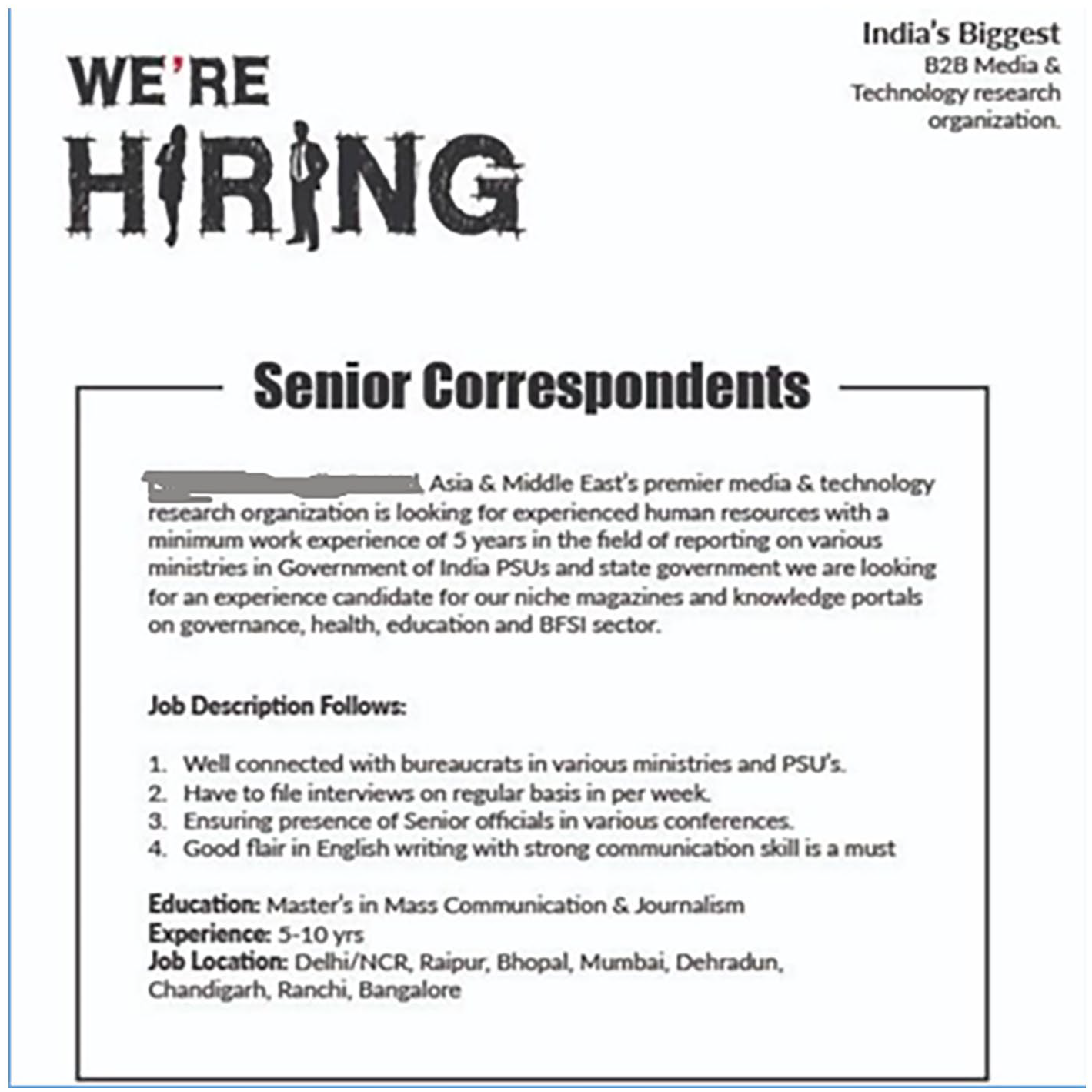
Job description of a conference producer.
Despite these potential associations, SC events are often re-scheduled to bring greater participation of bureaucrats, experts and sponsors. For instance, an event was called off almost a week before its scheduled date since enough sponsors could not be identified. An event tends to be “successful” (in the words of one conference producer), when special arrangements are worked out with the host city administration. Beyond speaking on the event-stage and subsequently receiving ceremonial awards there, such arrangements, for instance, make district collectors and municipal commissioners write or sometimes just sign off letters drafted by the media company to their colleagues in the provincial government requesting their participation in the event. These arrangements ease logistics and also ensure that the event is advertised well in their social networks and these decision-makers. For instance, one municipal commissioner was able to generate a 30% discount on what was about to be billed to the organizers by the hotel that hosted the event.
In the actions we have described so far, it is difficult to locate any associations being made directly with the citizens. However, citizen participation is often the focus of speeches and panel discussions that unfold through the assistance of event-stages and glossy publications. Hence it is interesting to focus on the work of these actants in relation to the center-staging of the citizen.
Heterogeneous actants articulating the citizen as the center of their efforts
Below we report on one SC event where much effort was put in to brand the approach of the host city as citizen-centric: The inaugural ceremony of the event opened with a welcome speech from the CEO of the media company organizing this event. He briefly narrated the company’s journey, and emphasized its mission to promote technological innovation and enable knowledge sharing within the public sector. He shared the plan to organize an event like this in each of the one-hundred smart cities, inviting audience applause. The event co-host, the Smart City CEO, spoke next. He highlighted the city’s unique cultural and economic aspects, followed by screening of a video documentary on upcoming smart city projects. While sharing the unique initiatives planned by the city administration, he branded the approach of his city with a tagline – “my city X” – that sought to communicate the
This episode features an urban expert taking assistance of the event-stage to appreciate citizens’ involvement in the SC projects. This expert was reached out following her chance meeting with the co-host, Smart City CEO, in a major smart city event in Delhi. Their discussions in the period leading up to the event significantly influenced the choice of the tagline for the event as “my city X” (Interview with CEO). Several of these discussions were mediated by conference producers who were working on the tagline and branding of the event in order to secure decent sponsorship for the event. In this process, ideas about a citizen-centered smart city were exchanged with the mayor, elected representatives, and even real-estate businesses who were major sponsors of the event. The glossy magazine released at the event carried interviews of the urban expert, CEO, and Mayor, and senior officials of the government which explored their views on citizen-centric approach to smart cities. In this episode, conference producers, urban experts, bureaucrats at city scale, local real-estate businesses, event-stage, glossy publication etc., can be seen as working together to articulate the citizen as the center of their efforts. This narration thus complicates the binarization of citizen versus others, in particular the staging of the citizen as an alternative to domination by multinational technology corporations.
In the above episode, the event-stage and the ceremonial award could be seen as taking the assistance of an elected representative—the mayor—to do their work. Usually, in SC events, the mayor is given a speaking slot in the inauguration ceremony. They tend to be in charge of the lamp lighting ceremony at the start of the conference, circulation of glossy publications at the event and to the press, and exchange of garlands all through the event. However, on some occasions, they can also be spotted as outstepping the role that the conference producers assign to them, for instance, commenting about where the smart city money should be or should not be flowing. Such speeches tend to be judged as inappropriate among various expert sub-groups in the audience and jettisoned from the material collated for future glossy-publications. Extensive research in the area of urban governance suggests that in most Indian cities, elected representatives tend to be connected to citizen groups on an everyday basis and mediate their demands onto city administrations (Benjamin, 2004; Oldenburg, 1976). However, such mediation, materializing in the form of on-stage political speeches and backend cajoling of officers, unsurprisingly, is judged as inappropriate by mobile experts in the SC events organized in high-end hotels. Aware of such dynamics, elected representatives and local officials enter into episodic clashes, which are followed by tentative accommodations, as there are career compulsions to collaborate and negotiate with citizen groups as well our actants. Some of these clashes and accommodations become explicit on stage, while others are discussed only as part of the confidant groups during lunch and snacks breaks. We venture next into action from two different SC events where such clashes and accommodations could be felt.
Episodic clashes and tentative accommodations
While the event-stage was in action during the after-lunch session at one SC event, the first author was also listening to a conversation among a small group of officials present in the audience, who were sitting around one round table. Disappointment with the contents of the speeches made on the stage was quietly evinced. An official, who worked as an engineer in the newly setup SC company in the host city after nearly two decades of service at the municipal corporation, asked around if anyone was willing to join him for tea. Two officials went out of the event hall, and the first author followed and joined them. With tea having loosened up the overtones of reservedness, the exchange of discontent among the three became intense, and the engineer made the following remarks: -
“This is a very bad culture happening all over the country, started by Modiji [the PM]. See this expensive hotel booking. So much five-star food and people buying air tickets for this nonsense talk where there is no sharing. Better would have been
Soon after this exchange the two officials re-entered the hall, while the first author took half an hour trying to record his immediate reflections and exchange greetings with those present outside the hall. When he re-entered the hall, an award was being presented to one of the two officials as a representative of his city administration for the smart city projects that it undertook. The event seemed to have wrapped up, as all the delegates on the event-stage were seen exchanging visiting cards and greetings. Upon noticing the first author in the hall, the engineer invited the former to join for the photographs that were being clicked on the stage along with his team-members. The first author felt the click of the photograph with some irony since the three were being entangled within the practices that they were critiquing half-hour ago.
It can be tempting to interpret the engineer’s remarks along the binary of citizen-centric and technology-centric perspectives which prevails in the SC literature. To do that we would highlight the engineer’s articulation of the disapproval of the format and the logics behind organizing this event as an instance of local resistance to global technology-centric SC agenda. We would then also include the officer’s “hardly [having] a choice” as part of the local resistance to technology-centric approach that is advanced by the mobile experts making presentations on SC technologies. However, unmuting more-and-other-than-humans makes the human actors spill out of the binaries of local and global, and technology-centered and citizen-centric. It reveals that the engineer is equally dismissive of elected representatives occupying the event-stage as he is of the mobile experts visiting from outside. Yet he makes tentative accommodations with these actors with the help of the event-stage that makes his work recognized. The actors embedded in the municipal bureaucracy—for instance, the “officers in charge” and the engineer in the above episode—are negotiating with the event-stage and other actants, who are central to the translation of SC discourse, in ways that opens up their importance in the action while preventing any damage to their career trajectories. Clashes do happen but our actants tend to be tentatively accommodated while simultaneously experiencing the shaping of their organizational realities.
We witnessed a more explicit and unpredictable clash between mobile experts, local officials, and elected representatives at an SC event that was elongated to everyone’s surprise, to accommodate the then urban development minister as chief guest for the award ceremony. The event was originally scheduled for 2-days to intersect with his visit to the city for reviewing progress on various centrally-sponsored schemes. However, the latter’s last-minute postponement stretched the event to 3 days, creating a challenge for the event organizers to keep the event-stage engaged. Hence, on the second day multiple panel discussions unfolded with extensive participation of a number of elected representatives. These sessions suddenly shifted the on-stage lingua-franca from English to Hindi. The host mayor exhorted all the experts to deliver their presentations in Hindi to the possible extent. Subsequently, the event-organizers made chits with a message—“Please speak in Hindi”—that were placed on the podium of the speakers, as they delivered their presentations. The clash surfaced on the event-stage during the second day, when a visiting mayor remarked that SCM took a step back on the constitutional agenda of decentralization, inviting applause from those on the stage against the event organizers’ expectations. The first author, who was in the audience, followed up on this remark to have conversations with the mayors. He was left amused when one of the mayors at the lunch-table stated, “there is a limit to how much criticism one can make on stage and that is hardly productive. We have to (rather) find ways to use the money that the scheme is offering.”
Much like that of municipal officials, the organizational realities of elected representatives are also interfered with and even impinged into, by the practices of organizing events involving city administration in luxury hotels. They mount criticism about their systemic exclusion, when an opportunity arises in the form of an elongated event-stage proceeding or during a lunch-table conversation. However, on other occasions they collaborate with conference producers to facilitate closed-door deals between the technology-vendors and the host smart city company on upcoming projects. The complexity of this action spills outside the framing of the enactment of SC discourse in terms of select intentioned human actors. It underlines that in translating SC discourse there aren’t just humans negotiating among themselves—who need to be privileged—local or global, expert or a citizen representative, while their reality [the (re)assembling of relations] is intact. Instead, more-and-other-than-humans are active in the negotiation, and thus enacting multiple realities which are being performed and interfered into by the ongoing practices, in this case, of frequently organizing SC events in high-end hotels. It is through such negotiations that the uncertain socio-material process of translation proceeds, not as an exception but as integral to it, as they create moments of interconnections among actors interpreting SC discourse in divergent ways. Such organizational realities cannot be understood as interaction between intentional human actors, but as collaborations and negotiations among more-and-other-than-humans. Therefore, politics in the processes of translating SC discourse in such realities is not just ideological or discursive in nature but markedly ontological.
Discussion and conclusions
Departing from the predominant citizen-technology binarization in smart city (SC) literature, our account unmutes certain non-humans—event-stages, glossy publications, and ceremonial awards—foregrounding the uncertainties involved in translating SC discourse in India. Crucially, we have drawn attention to episodes of translation, where these actants have collaborated and negotiated with technology and technology vendors to assert the citizen as the center of their efforts. We do not seek to deny the role played by more familiar actors, such as management consultants and experts representing multinational IT companies that are registered in the global SC literature (McNeill, 2015; Sadowski and Bendor, 2019; Söderström et al., 2014) and in the analysis of smart urbanism in India (Das, 2020; Khan et al., 2018). Rather, in our accounts, these more familiar actors are yet another actant contributing to actor-networking or the socio-material process of translation that proceeds off event-stages, glossy publications, and ceremonial awards. Thus, we extend the growing literature that seeks to counter the dis-embodied visions of smart city proponents by drawing attention to the socio-material practices enacting such discourses (Farías and Mendes, 2018; Farías and Widmer, 2017; Odendaal, 2021; Tironi and Criado, 2015).
In shifting the gaze away from the binarized center-staged actors toward repeated actions inscribing meaning and (re) assembling heterogenous actants, we have sought to unfold the uncertainties in the processes of translation (Czarniawska, 2009; de Laet and Mol, 2000; Latour, 2005). Unfolding of uncertainties made us relate intensely with the episodic clashes and tentative accommodation in the SC organizational worlds, and locate there an active mode of (ontological) politics that involves both collaboration and negotiation among more-and-other-than-human actants. These engagements attest that in the process of translation, politics need not necessarily be thought of as operating within a stable prior ontology or “the conditions of possibility we live with” (Mol, 1999). Rather, we can also locate it in the performance of, and interference into, multiple realities that are being enacted within everyday practices that assemble experts and decision-makers. We hence propose to conceptualize translation as constitutive of the ontological politics of organizing, whereby it makes visible the ongoing collaborations and negotiations among more-and-other-than-humans, and thus, the enactment of organizational realities through processes (re)assembling relations among heterogeneous elements. In our study, this conceptualization has helped in revealing uncertainties in translation, running into collaborations, episodic clashes and tentative accommodations, and thus unsettling the binarized reality of smart cities as a choice between technology and citizens. We thus address the concern regarding ANT’s alignment with the objectives of COMS that insist on “denaturalizing ontology” (Fournier and Grey, 2000).
Translation as a concept has flourished with quite divergent theoretical underpinnings within Management and Organization Studies (Waeraas and Nielsen, 2016). Arguably, its most productive employment has been toward explaining how global ideas travel across space and time while getting translated into new objects and spaces (Czarniawska and Sevón, 2005; Nielsen et al., 2022). Expanding this stream of studies, through the Smart City case, we draw attention to the agency of more-and-other-than-humans—event-stages, glossy publications, ceremonial awards, conference producers, and elected representative—in the enactment of managerial discourses (McCabe and Russell, 2017), and the collaborations and negotiations that they make with one another. This conceptual focus opens up various sites and processes for further research in the COMS tradition. For instance, one could explore the ontological politics of organizing in the enactment of global managerial discourses such as resilient cities (Campos and Zapata, 2012; Roberts et al., 2020) and sustainable organizations (Cho et al., 2019). There are likely to be more-and-other-than-humans composing the ecology of such enactment, which perhaps include affected workers, plants, animals as well as the infrastructure of local governments facilitating discussion, interpretation and implementation of these ideas (Latour, 2007). Exploring their collaborations, clashes, negotiations, and accommodations could enable us to interfere in the discourses of select actors, such as national and international development organizations and NGOs.
Supplemental Material
sj-docx-1-org-10.1177_13505084221150364 – Supplemental material for Beyond the technology-centric and citizen-centric binary: Ontological politics of organizing in Translation of the Smart City Discourse in India
Supplemental material, sj-docx-1-org-10.1177_13505084221150364 for Beyond the technology-centric and citizen-centric binary: Ontological politics of organizing in Translation of the Smart City Discourse in India by Harsh Mittal, George Kandathil and Navdeep Mathur in Organization
Footnotes
Acknowledgements
Thanks are due to media companies and other smart city professionals who have been forthcoming to enable fieldwork and interviews. This paper draws on Harsh’s doctoral research that gained much from discussions with Solomon Benjamin, Ankur Sarin, Katharina Paul, Advaita, Rama Mohana Turaga, Varun Patil and many other colleagues. An earlier draft of the paper was presented at the EGOS 2020 virtual conference. We are grateful for the comments, and encouragement received there. The paper has tremendously benefited from the comments and suggestions made by Martin Fougère, and two anonymous reviewers. Also, we thank Rajeshwari Chennangodu for providing comments and discussion on an earlier draft.
Funding
The author(s) disclosed receipt of the following financial support for the research, authorship, and/or publication of this article: This research has been financially and intellectually supported by the Indian Institute of Management Ahmedabad through a doctoral fellowship and a grant by its Research and Publications Office.

Supplemental material
Supplemental material for this article is available online.
Notes
Author biographies
References
Supplementary Material
Please find the following supplemental material available below.
For Open Access articles published under a Creative Commons License, all supplemental material carries the same license as the article it is associated with.
For non-Open Access articles published, all supplemental material carries a non-exclusive license, and permission requests for re-use of supplemental material or any part of supplemental material shall be sent directly to the copyright owner as specified in the copyright notice associated with the article.
