




Abstract
Despite the growing body of research on human–animal studies in various disciplines, attempts to systematically include animals in organization studies have been limited. In this article, we build on organizational role theory and propose a typology of five roles of animals in human organizations (i.e., animals as commodities, clients, co-workers, companions, and acquaintances) as a framework for analyzing organizational human–animal relations. The identified roles emerge as distinct categories that illuminate the varying degrees of agency afforded to animals in certain organizational settings and the extent to which human work is focused on animals. Lastly, we outline how advancing scholarly perspectives on animals in organizations requires going beyond anthropocentric and anthropomorphic perspectives and suggest various avenues for future research.
Keywords
Introduction
Organizations are multispecies spaces (Dashper, 2020) or spaces where species meet (Haraway, 2013). Nowadays, billions of animals 1 are present in human organizations 2 and millions of humans engage in work that is substantially focused on animals (Hannah and Robertson, 2017). All around the globe, animals are livestock in the agricultural industry (Baran et al., 2012, 2016; Collard and Dempsey, 2013), used for entertainment in zoos and circuses (Bunderson and Thompson, 2009; García-Rosell and Hancock, 2020), “work” in the police or the military (DeAngelo, 2018; Knight and Sang, 2020), are treated at veterinary clinics (Clarke and Knights, 2018; Treanor and Marlow, 2021), act as office companions (Cunha et al., 2019; Kelemen et al., 2020; Wilkin et al., 2016), or roam around construction sites (Sage et al., 2016), all of which represents a wide range of “organizational” human-animal interactions (Doré and Michalon, 2017).
Despite the widespread presence of animals in human organizations, various scholars have noted a lack of systematic inclusion of animals in organizational research and theorizing (Doré and Michalon, 2017; Labatut et al., 2016; Lennerfors and Sköld, 2018; Sage et al., 2016; Smart, 2020). To date, organization studies have primarily focused on human experiences and interactions, even in the study of human-animal relations (Dashper, 2020). Organization research has mainly considered animals as resources (Connolly and Cullen, 2018; Cunha et al., 2019; Tallberg et al., 2022), focused on work interactions with animals in specific functions, such as office or service dogs 3 (Cunha et al., 2019; Kelemen et al., 2020), or highlighted workplace exploitation of human workers in animal industries (Dashper, 2020; Hamilton and McCabe, 2016). While these research streams represent a critical and crucial aspect of the study of animals and human-animal relations in organizations, the prevalent focus on specific organizational contexts or animal species (e.g. dogs; Cunha et al., 2019) contributes to a fragmentation of the research field.
To advance a more holistic understanding of animals and human–animal relations in organizations, we provide a role-based typology of animals in human work contexts. We focus on animal roles in terms of human-held expectations placed on animals based on their assigned organizational position. This perspective allows us to draw attention to how animals are embedded in organizational structures, and the rules, hierarchies, and power relations that shape organizational human-animal interactions. Adopting animal roles as a framework for analyzing organizational human-animal relations aids in revealing how human organizations shape the lives of both humans and animals and accentuates organizations as political environments in which human–animal relations are negotiated (Coulter, 2017). By uncovering and emphasizing animal rather than human roles, we aim to challenge the notion of human exclusivity in organizations (e.g. Cunha et al., 2019) and answer calls for multispecies scholarship that reframes animals as important actors in organizational settings (Cunha et al., 2019; Knight and Sang, 2020; O'Doherty, 2016). We acknowledge that by focusing on animal roles as defined by humans we adopt anthropocentric and anthropomorphic perspectives. Nonetheless, we do not argue that humans should be the sole focus of organizational research, nor that animals should only be considered when their presence affects humans. Rather, we regard the systematic inclusion of animals in organization studies as an important step toward incorporating animal perspectives and raising consciousness about animals in organizations (McCarthy and Grosser, 2023).
In the following, we first discuss how animals are conceptualized in modern Western human societies and how this affects capacities for animal agency in human organizations. We then illustrate how organizational role theory (Biddle, 1986, 2013) can enhance our understanding of organizational human–animal relations. Next, we identify five roles of animals in organizations (i.e., commodities, clients, co-workers, companions, and acquaintances) across various human work contexts and examine how these roles shape organizational human–animal relations. We position these animal roles along two dimensions: the capacities for animal agency afforded by a certain role and the degree to which human work is focused on animals as role holders. We then critically reflect on our typology by highlighting how animal role transitions and role ambiguity may subvert animal roles and what this means for organizational human-animal relations. We conclude with a research agenda for studying animals and human-animal relations in organizations.
Animal agency in organizations
Organizational human–animal interactions do not exist in a social vacuum (Coulter, 2017). Therefore, to gain a better understanding of how humans relate to animals in organizational settings, one must first examine how animals are framed and positioned in the human societies in which these organizations are embedded in. Most human societies, in particular modern Western societies, subscribe to the general assumption of a “human over animal hierarchy”, where “animal” usually refers exclusively to non–human animal species (Stibbe, 2001). The system by which this “human over non-human hierarchy” is imposed is called speciesism and is characterized by an attitude of bias in favor of the interests of members of one’s own species and prejudice against members of other species (Ryder, 2006). Speciesism, as expressed in and illustrated by statements such as “animals exist to serve our needs” and “the benefit to humans outweighs the harm to animals” (Fox, 2000: 464), is frequently used to legitimize the use of animals in human organizations. As an ideology, speciesism allows humans to regard other animals as objects devoid of moral value, transformative capacity, and agency (Sanders, 1995). 4 Here we draw on the concept of animal agency to better understand organizational human–animal relations, as agency “highlights how animals live in the world” (McFarland and Hediger, 2009: 3), in this case: human organizations.
In the field of sociology in particular, there has been much scholarly debate over what exactly constitutes animal agency and if animals as nonhuman actors can be considered to have agency (for an inter-disciplinary discussion of animal agency, see e.g., McFarland and Hediger, 2009). This can be partially attributed to the fact that the concept of agency has been developed and evolved from an anthropocentric perspective and thus often focused exclusively on humans (Carter and Charles, 2018). Approaches such as actor-network theory have contested human-centric conceptualizations of agency and proposed that anyone or anything that has an effect on its environment has agency, for example, persons, plants, machines, and animals (Dwiartama and Rosin, 2014; Whittle and Spicer, 2008). Building on this understanding of agency as rooted in one’s relational existence in the world, Nimmo (2011: 72) proposed thinking of animals and animal agency in terms of vital movements and flows, thus likening animal agency to animal being. While all of these approaches develop important, non-anthropocentric conceptualizations of agency and highlight the position of animals as part of rather than apart from society, the notion that everything or every living “thing” has agency, may obscure the active and often intentional and goal-directed participation of animals in human organizations (Doré and Michalon, 2017).
Animals are not merely passive objects but often (pro-)actively engage with humans in organizational spaces, such as veterinary clinics, laboratories, zoos, animal shelters, or office buildings, thereby exhibiting behaviors that can be regarded as goal-directed (e.g., to seek comfort or alleviate discomfort). Consequently, scholars have argued that animals do have interest in agency in terms of “self-willed or initiated action which carries an expectation of efficacy” (Donaldson and Kymlicka, 2016: 235). Although it has been debated whether or not animals or certain animal species have capacities for self-willed or intentional action, and thus, agency (for a detailed discussion of whether certain animals or animal species can be regarded to have thoughts, beliefs and reasons for action or a sense of self, see: MacIntyre, 1999), many scholars have concluded that the question of differences between human and animal agency is better understood as a matter of degrees and types of agency (Carter and Charles, 2013; McFarland and Hediger, 2009). 5 As Schlosser (2011: 27) puts it: “agency comes in shades of gray, as it were, not as an all-or-nothing phenomenon”. Thus, while it may be debatable whether or not every single animal or even all animal species possess capacities for agency in terms of intentional actions, it is challenging, if not impossible, to dispute that many animals do. However, the question we seek to answer in this paper is not as much whether all animals have capacities for intentional agency, but rather, how organizations shape animals’ capacities to exert agency. We thus view animal agency not as an inherent attribute of certain individual animals or animal species, but as socially constructed through their interactions with humans (Lindgren and Öhman, 2019).
Previous research revealed that human-centric power relations often shape animals’ abilities to exercise agency (Carter and Charles, 2013; Charles and Wolkowitz, 2019) and that even though some previous literature suggests that animals do have capacities for intentional agency, this is frequently ignored or even actively suppressed in our relationships with them (Donaldson and Kymlicka, 2016). In relationships with humans, animals often have limited scope to exercise agency other than through acts of resistance, and, to a lesser extent, adaption and coping strategies (Blattner et al., 2020). As Smart (2020: 13) points out “when cows are milked, chickens are butchered, and cheetahs are displayed, these acts are not intentional, and the animals do not thereby exhibit agency”. Notably, this line of argument could also be used to dispute the agency of humans who face discrimination and other forms of violence at work, meaning that while they may have agency, they are not always able to exert agency in organizational settings (Chrispal et al., 2021). Thus, while capacities for intentional agency certainly do affect whether or not animals can exercise agency (i.e., act by their own volition) in organizations, their potential for action is also shaped and often limited through their organizational relations to humans.
In research laboratories, dogs, rabbits and rats are allowed very little capacity to decide whether, where, and how they live, sleep, eat, drink, defecate, express their sexuality, or have contact with peers and humans. Further, they cannot change the situation they are in through intentional interactions with humans; they are unlikely to escape painful experiments by growling, whining, or biting even though their actions may lead to minor changes in human behavior (see Lynch, 1988, for examples of rat behaviors changing experimental protocols and “handling”). An office dog who is regarded and treated as companion animal may have more possibilities to exert agency. As recognized members of an inter-species social group, these dogs can intentionally act to bring about change for themselves. For instance, dogs may bark or carry their leash when they wish to go for a walk, prompting their human companions to respond accordingly.
The above illustrates how organizational rules, policies, and organizational human-animal relations shape or condition animals’ possibilities for self-willed action, consequently enabling or hindering their capacities to exercise agency. In doing so, organizations set agential conditions for animals; that is, being a mouse on a construction site comes with a different set of agential conditions compared to being a mouse caged in a research laboratory (Carter and Charles, 2013). Consequently, animal agency is not necessarily about exercising choice nor generating an effect, but rather about the possibilities available to animals and how these are shaped by the sort of agent they are (Carter and Charles, 2018). Departing from the above line of argument, we define animal agency as animals’ capacities to act by their own volition, that is, engage in “self-willed or initiated action which carries an expectation of efficacy” (Donaldson and Kymlicka, 2016: 235), and analyze how organizations set agential conditions that may either allow for or suppress animal agency. We propose that animal roles, reflecting the shared, human-held expectations placed on animals based on their assigned organizational position, can provide an approach for assessing capacities for animal agency in organizations as they aid in exposing the “sort of agent” an animal is in certain organizational settings.
A role theory perspective on animals in organizations
According to role theory (e.g., Anglin et al., 2022; Biddle, 1986), a role represents a core set of behavioral expectations applied to individuals based on their social group or category. In the organization and management literatures, role theory has mainly adopted either structural-functional approaches concerned with relatively fixed social roles and role expectations or symbolic-interactionist perspectives focused on role identities, the latter of which are open to interpretation and negotiation by individuals (Anglin et al., 2022). Given our focus on animals within the social system or structure of human organizations, we adopt a rather narrow structural-functionalist induced definition of roles based on organizational role theory (Biddle, 1986: 73; Sluss et al., 2011). Specifically, we define animal roles as assigned, identifiable social positions of animals in human organizations. Animal roles may be more or less formalized and come with a core set of normative, behavioral expectations, which are uniformly imposed based on the animal’s position in the organization (e.g., Anglin et al., 2022). Since roles are relational and often depend on one another for meaning, such as leader and follower (Biddle, 2013), or in the case of human–animal roles, livestock and handler or pet and guardian, animal roles do not only set behavioral expectations for animals as role holders, but also for humans in corresponding counter-roles (e.g., Sluss et al., 2011).
Role theory provides a valuable theoretical lens for studying and better understanding how individuals relate to and interact with one another in organizations. We argue that this also applies to organizational human-animal relations. Since we focus on work interactions between humans and animals, our analysis only includes human work settings in which animals are physically present and in which the animal involved is alive for at least part of the interaction. In line with Hannah and Robertson (2017), we distinguish between two types of interactions. First, human-animal work, defined as human work that is substantially focused on live nonhuman animals (e.g., zookeeper), and second, work that is performed in the presence of but not substantially focused on living animals (e.g., bringing a “pet” dog into the office). We therefore exclude human work that is solely concerned with formerly living animals or their parts (e.g., meat or leather processing; Gillespie, 2021) or the use of animals as symbols (e.g., company logos; Cunha et al., 2019). By extension this also excludes work settings where animals are not physically present, even though the work or even organization appears to be substantially focused on animals such as pet companies producing toys or food for companion animals or animal advocacy organizations where humans work for animals (Coulter, 2016).
While we draw on different examples of human-animal relations in organizations that are often tied to specific animal species, the roles we identified are not species exclusive. The same species member may be assigned different “roles”, depending on the organizational (i.e., social) context in which they are embedded. A dog may be a laboratory, therapy, sled, police, rescue, or office dog. Further, some, but not all, of these roles may be filled by members of various species (e.g., horses or rats). Thus, applying role theory perspectives on organizational human-animal relations provides avenues for overcoming species-centric foci on animals in these settings. However, we acknowledge that although species membership does not necessarily define an animal’s assigned role, along with individual abilities, it does play into the selection of animals for certain roles. Employees would certainly be surprised if a co-worker brought their companion pig to work, and people are often more concerned about experiments on dogs than rats (Higgs et al., 2020). In this way, societal and speciesist believes and norms influence the likelihood of animals holding specific organizational roles.
A typology of animal roles in organizations
Based on extant literature, we propose five generic roles assigned to animals in organizations, that is, animals as commodities, clients, co-workers, companions, and acquaintances. Figure 1 provides an overview of the five animal roles, which we organize according to the following conceptual logic: First, in line with literature on human-animal work (Hannah and Robertson, 2017), we distinguish between human work that is substantially focused on nonhuman animals (i.e., human-animal work) and work settings where animals can be regarded as peripheral to human work (i.e., work i.e. carried out in the presence of but not substantially focused on animals). Second, highlighting how these roles shape organizational human-animal relations through human-centric power relations, we structure the five animal roles according to the capacities for animal agency they afford (i.e., the degree to which a certain role allows animals to exercise agency). We place these roles on a continuum from low to moderate, rather than low to high, since we argue that in organizational settings, animals will hardly ever be granted full capacity to exert agency as their potential for action is constrained by humans. 6
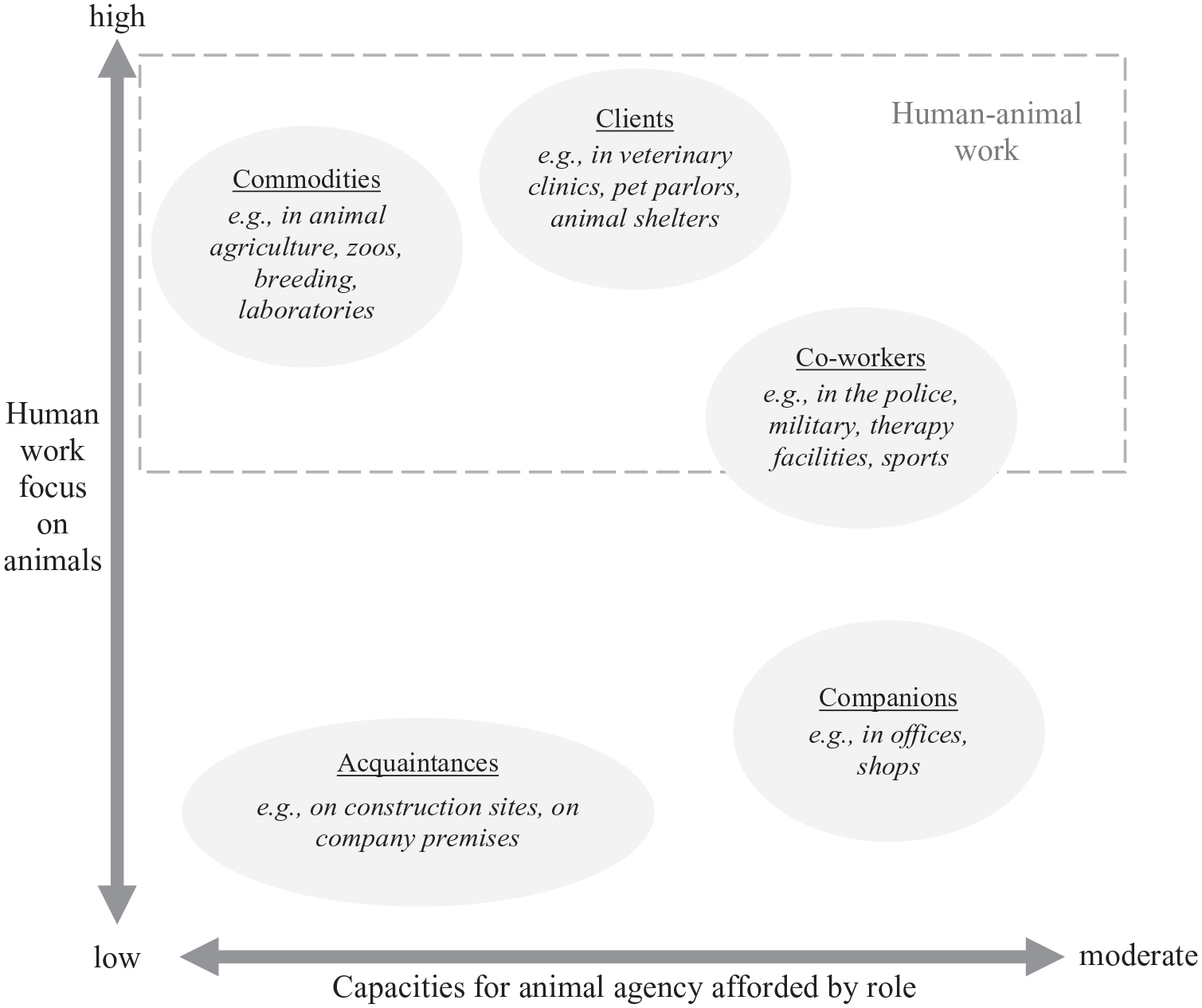
Typology of animal roles in organizations.
Before delving into the description of animal roles, we briefly want to emphasize that although the animal roles we outline are identifiable, they are not necessarily fixed or static, but rather flexible and fluid. Animals may change roles over time and roles may be ambiguous, that is, not commonly shared by organizational members (Anglin et al., 2022). We expand on these notions in our section on animal role transitions and role ambiguity.
Animals as commodities
The most widespread role of animals in organizations is that of animals as commodities, which is also reflected by much of the management literature describing animals as tools, objects, and commodities for human use (Connolly and Cullen, 2018; Tallberg et al., 2022). With commodities, we specifically refer to animals as “lively commodities”, that is, “commodities whose capitalist value is derived from their status as living beings” (Collard and Dempsey, 2013: 2684). Animals as commodities include “livestock” animals on farms, in zoos, animal breeding, exotic pet trade, and laboratories. Taking dairy cows as an example, in the agricultural system, their value is derived from converting natural functions, such as pregnancy and lactation, into unconsenting labor (Hribal, 2012). Notably, in industries like the meat or dairy industry, animals often move on a continuum from lively, to soon-to-be-dead, to once-living commodities (Gillespie, 2021). Animals who are commodified are granted limited capacities to exert agency and often de-individualized and objectified by humans. Framing animals as objects facilitates disregarding their moral value and interest in agency (Sanders, 1995). Further, it has been argued that the objectification of commodified animals and much of the violence that animals — and humans — endure in organizations is deeply entangled with the everyday organizational logic of maximizing productivity (Costas and Grey, 2019), whereby one facilitates the other.
The de-individualization and objectification of animals is often reflected in the terms used in animal industries. In the meat packing industry, chickens are considered — and sometimes even referred to as — efficient vehicles or machines for transforming feed grains into higher-value meat “products”, and their bodies are counted by “piece” or by pound (Boyd, 2001). In animal testing, laboratory animals are frequently referred to as “animal models” that are “created” or “engineered” to model certain human diseases (e.g., Ericsson et al., 2013). For research purposes, animals are genetically changed—sometimes even cloned—and selected to fit uniform characteristics, thus intentionally stripping them of their individuality. The same may apply to breeding in other industries, such as animal agriculture or the pet industry, where dogs are specifically bred to exhibit certain characteristics desired by their future “owners”, as reflected in terms like “purebred” or “designer” dogs (Beverland et al., 2008). Commodified animals are seldom regarded as sentient beings and (social) actors but as production factors to be exploited for economic gain (Schwartz, 2020). Whereas violence toward animals is generally despised in human society, it is usually accepted for profit motives if it is directed toward commodified animals (Cudworth, 2015). This is also reflected in laws pertaining to companion versus agricultural animals; the same act of violence may yield very different legal consequences based on the institutional role of the animal in question (Overcash, 2011).
As mentioned earlier, commodified animals have little opportunity for transformative action. Humans, and in some cases, algorithms developed by humans, usually determine the scope of activities available to commodified animals (Donaldson and Kymlicka, 2016). Animals may resist treatments that cause pain and discomfort, however, animal resistance may not always lead to lasting change. For instance, animals who escape from slaughterhouses are often killed if they are caught; unless humans intervene to change their role status, for instance by taking them to an animal sanctuary (Carter and Charles, 2013). Similarly, humans who work with commodified animals, for example, slaughterhouse workers, breeders, or researchers in an animal testing labs, are often limited in the ways in which they can relate to animals. Their actions are also confined by their occupational role and associated behavioral expectations, e.g., killing animals. This may not be an issue if humans relate to these animals in the ways that their job or occupational role requires; for instance, by commodifying animals in slaughterhouses (Hamilton and McCabe, 2016).
However, even when animals are regarded as commodities that lack capacities for agency, most humans are not immune to perceiving animals as individuals with capacities to feel and suffer and who have intentions, wishes, and emotions (McLoughlin, 2019; Sage et al., 2016). This “constant paradox”, that is, “the definition and treatment of animals as functional objects, on the one hand, and sentient individuals, on the other” (Rowan in Arluke and Sanders, 2009: 18) can lead to emotional distress when humans have to treat animals as “things” rather than individual beings (Amiot and Bastian, 2015; Collard and Dempsey, 2013). This can be exacerbated by a high focus on and close interactions with animals at work, as illustrated by cases of laboratory workers developing pet-like relationships with laboratory animals (Arluke, 1988), which in turn can create moral discomfort and role conflict (Hamilton and McCabe, 2016).
Animals as clients
Animals as clients are conceptualized as animals who have a service performed on or for them rather than—willingly or unwillingly—performing a service to humans (see animals as co-workers). Animals in this role may be clients in veterinary clinics, pet daycare centers, or animal and wildlife rehabilitation shelters, i.e., places where human work is largely focused on animals. The services performed on animals as clients are distinct from other types of “jobs done on animals” in the sense that they are geared toward preserving or increasing an animal’s well-being (e.g., relieving pain or grooming) rather than extracting some form of commodity from them like meat, milk, or wool. Although the term “client” implies a certain notion of voluntariness or active service seeking, this is not always the case. Indeed, in the veterinary practice, the term “client” is often reserved for humans, whereas animal companions are referred to as “animal patients” (Clarke and Knights, 2018; Treanor and Marlow, 2021). Hence, we do recognize a certain ambiguity regarding who the real “client” is, especially since animals are often involuntarily subjected to services performed on them. Certainly, many people who have visited a veterinary clinic with a cat or dog can attest that animals are often unwilling to receive medical treatment.
Even in human–animal relations where animals are clients, the degree to which animals are granted capacities for agency will depend on the service provider (e.g., veterinarian, animal shelter worker) or the “owner” of the animal. Again, most of the power in the relationship resides with humans. Given that humans who work with animal clients often have a high affinity for other animals or even an “animal-motivated” occupational calling (Bunderson and Thompson, 2009; Pradies, 2023; Schabram and Maitlis, 2017), they may advocate for animals, thus enabling them to exercise agency. However, individuals working with animals as clients may have role expectations that create moral conflict, for example, when caring for animals involves animal euthanasia; also known as the “caring-killing paradox” (Arluke, 1994; Rohlf and Bennett, 2005). Animal shelter and veterinary workers in particular have reported moral tensions pertaining to their role expectations, which can be exacerbated when they form close bonds with the animals in their care or when they feel socially accountable for inflicting pain on or killing animal clients (Atwood-Harvey, 2005; Tallberg and Jordan, 2022).
Animals as co-workers
The third role we propose is that of animals as co-workers or workers. Animal co-workers can be found in the police, the military, circuses, therapy facilities, and sports. They are considered “organizational property” by law (unlike companion animals who are the “property” of single employees), but they form a distinct category from animals as commodities, as organizational value creation stems from human–animal interactions and the animals have usually some level of innate or “taught” skill to “do the job”. For example, co-working horses may be used for transport, sport, or entertainment shows. They perform explicit tasks, as requested and directed by their human “managers” with whom they interact, and thus actively “work” (Dashper, 2020). Scent detection dogs may sniff out explosives or COVID-19 patients at airports and rats may sniff out landmines (DeAngelo, 2018). Additionally, cats, rats, dogs, horses, or alpacas may be trained and “employed” for animal-assisted therapy in healthcare facilities, schools, and prisons to decrease stress, anxiety, or loneliness in patients and inmates (e.g., Barker, 2005).
As co-workers, animals are conceded a more active role in organizations and are usually granted more agency than animals as clients or commodities. Nevertheless, they remain under extensive control and supervision by their human managers. Even if they are recognized as workers, their status is lower than that of humans (Dashper, 2020), and their work is often marginalized or made invisible (Evans and Miele, 2012). When animals receive recognition and press coverage as co-workers, this often involves anthropomorphism. Anthropomorphism is the attribution of human mental states and characteristics, including thoughts, feelings, motivations, and beliefs (e.g., “brave” rescue dog) to animals, which may also be expressed through naming the animal (Serpell, 2003). One implication of anthropomorphism is that perceiving an animal to be human or human-like renders them worthy of moral care and consideration (Gray et al., 2007). However, anthropomorphizing animal co-workers, such as police dogs or race horses, often attributes agency to them only as constructed, human-like characters but does not empower them as animals, since it undermines their actual, individual differences and characteristics (Scott, 2009). With animals as co-workers, individual animals and humans will often — but not always — form close bonds that may even go beyond work, for example, when therapists live with therapy dogs, or police dogs live with police officers (Knight and Sang, 2020). Close human–animal bonds are especially likely to develop when humans and animals are trained together and when performing the work requires a high degree of human–animal interaction (Knight and Sang, 2020). In these circumstances, the human and the animal role are closely intertwined as one cannot perform their role-related tasks without the other. This task interdependence is also maintained when animals are trained to work with different humans. However, since both humans and animals work together to achieve a certain goal and humans may also carry out their work in different ways that does not include animals, the human work does not necessarily need to be substantially focused on animals at all times.
Animals as companions
Moving on from work that is substantially focused on animals, that is, human-animal work (Hannah and Robertson, 2017), we now turn toward work performed in the presence of but not necessarily focused on animals. We start with the role of animals as companions, which has most often been studied with regard to office dogs (Cunha et al., 2019). In comparison to animal clients and co-workers, animals as companions do not perform a job or service nor have one performed on them; although services may be provided to them (Wilkin et al., 2016). Work alongside animals as companions is seldom focused on animals, even though some organizations may take measures to accommodate for companion animals’ needs, such as cat litter stations, dog water fountains or “barking lots” (Wilkin et al., 2016). Further, animal companions occupy a rather unique role in organizations in the way that both their role and presence in organizations is almost exclusively tied to their relation to certain humans.
The role of animal companions is rarely formalized or institutionalized, although this may change as it is increasingly recognized that companion animals at work benefit employee wellbeing (e.g., Kelemen et al., 2020; Wilkin et al., 2016). This does not only apply to dogs as “office mascots” or more or less formally appointed “feel-good managers”, but also to service dogs who make workplaces more accessible to disabled people (Jammaers, 2023). Yet, while certain animal behaviors are deemed acceptable or even favorable, for example, friendliness toward humans, other “animal” behaviors, such as barking, are not accepted and may lead to removal from the organization (Charles and Wolkowitz, 2019; Dashper, 2020). Exclusion may also occur due to animal-related allergies or phobias (Cunha et al., 2019). Therefore, the bond a human shares with their animal companion may add to the marginalization and discrimination of humans, for instance when disabled people are discriminated against by proxy of their animal companion (Jammaers, 2023). However, role relations between animals as companions and humans can still be regarded as fairly equitable. Both human and animal can share the role of companion, take on roles such as protector and guide, or switch between care-taker or care-giver. Thus, animal companions will likely be afforded more capacities for agency than animals in other roles, the degree of which may however depend on their human companion.
Animals as acquaintances
Lastly, we consider animals who are not brought in to organizations by humans, but who voluntarily or involuntarily enter organizations or interact with humans in organizational spaces; for example, moles on construction sites, pigeons on and around office buildings, and rats on waste disposal sites. We call them acquaintances. As humans take up more and more space on earth and industries like (animal) agriculture, fossil fuels, and construction expand into previously untouched habitats, animals are increasingly forced to adapt to spaces shaped and occupied by humans (Haraway, 2013). Since both humans and animals frequently meet at the margins of or share spaces of human settlement, animals interact with and sometimes even form relationships with humans in these spaces (Philo and Wilbert, 2000).
Work on animal geographies in particular has highlighted how human-animal interactions in these marginal spaces involve various types of human-animal boundary work and negotiation over spaces (Philo and Wilbert, 2000; Wolch and Emel, 1998). These types of human-animal boundary work have been described as exclusion, invitation, and disturbance (Sage et al., 2016). Exclusion refers to the process by which animals are made absent from organizations, for instance when insects, frogs, rats, wolves, dogs, or cats are regarded as “vermin” or feral “pests” to be removed (Hillier and Byrne, 2016). Conversely, humans may also invite “feral” animals into organizations. This is illustrated by the case of Olly, a stray cat who lived at the headquarters of the Manchester Airport Group. Through interactions with airport employees, Olly even became a mascot and point of identification for employees, thereby reshaping their role (O'Doherty, 2016). Third, animals can be “troublemakers” who renegotiate organizational boundaries through disturbance (Sage et al., 2016), for example when organizations cannot act upon their desire to exclude animals, such as moor frogs on building sites, due to wildlife-protection laws (Tryggestad et al., 2013).
We note that the role of animals as acquaintance is not so much defined by organizations and organizational rules and role expectations but rather in relation to organizations and embedded in wider human society and laws and regulations (e.g., wildlife protection laws may prevent the expulsion of certain frog or bird species). Thus, while organizations may have a preference for animal invitation or exclusion or see them as disturbance (Sage et al., 2016), the degree to which this affects the animal’s capacities to exert agency will likely depend on other influencing factors such as laws and legislations, or cultural norms. These factors may sometimes skew the usually human-centric power balance between humans and animals in favor of animal acquaintances (e.g., Philo and Wilbert, 2000).
Animal role transitions and role ambiguity
The animal roles we outlined above are not permanent or fixed, but rather fluid in the way that individual animals may move between these roles, which can also be referred to as role transitions (Ashforth, 2000). Further, although the animal roles we outline are identifiable, roles may be ambiguous and open to interpretation. According to previous research and theorizing, role changes or transitions may occur as psychological or physical movements between either sequentially (i.e., macro role or inter-role transitions; see: Ashforth, 2000; Louis, 1980) or simultaneously held organizational roles (i.e., micro role transitions; Ashforth et al., 2000; also referred to as role alternations; Allen and Van de Vliert, 1984). While these concepts are concerned with human role identities rather than animal roles in organizations, we propose that they can also apply to animal role transitions. As previously established, the animal roles we identified are based on the human rather than the animal vantage point, meaning that they are based on and open to human interpretation. Therapy dogs may be either perceived as pets or working dogs, and similarly, the human’s role can shift from handler to companion or caretaker (e.g., Charles and Wolkowitz, 2023).
In organizations, macro role changes can be observed when a dog starts their life as a commodity in the pet-breeding industry, is trained to become a co-worker in a rescue organization, visits a veterinarian clinic as a client, and eventually “retires” to live as companion animal who occasionally accompanies their human to work. Role transitions may thus occur between certain organizational animal roles, but also place animals outside of organizations, for example, when animal co-workers are “retired”. Further, even if the formal role or physical location of an animal role holder does not change, a human holding a corresponding or counter-role, may mentally shift their role along with the associated behavior toward the animal. These micro role changes may occur when laboratory staff start perceiving and treating laboratory animals as companions (Arluke, 1988), thereby potentially subverting organizationally assigned animal roles. Notably, the currently held animal role may determine future role transitions and also the future life of the animal. While some police dogs receive “pensions” as esteemed former co-workers (Cochrane, 2016), certain taught and previously desirable behaviors, such as barking and biting in the police or military context, may lead to the animal being deemed “unsuitable” to live with humans and thus being killed after their “career” (Knight and Sang, 2020).
Although role transitions are mostly instigated by changes in human perceptions of and behaviors toward animals as role holders, it is important to note that animal actions can also bring about role changes. This is once again illustrated by the case of Olly the — former — stray cat, who transformed their role as acquaintance through their own actions. Olly continuously showed up on company premises and interacted with humans in a way usually associated with companion animals which prompted humans to adapt their behavior accordingly (e.g., by providing food and designated spaces for Olly and marking them as “Olly’s place” and the “cat penthouse”; O'Doherty, 2016).
While Olly’s actions can be regarded as a form of self-invitation, other animals aim to escape human organizations, for instance, when pigs, cows, or chimpanzees escape slaughterhouses or zoos (Hribal, 2011). Here it can be argued that by removing themselves from organizational spaces and thus breaking or ending their organizational relations with humans, they also escape their human-assigned role. Consequently, through these actions, animals change their role-induced agential conditions that shape their capacities for action (e.g., Carter and Charles, 2018); that is, if they are not caught or killed (by humans) after their escape. By escaping human organizations and thus resisting their position within them, animals can be regarded to “inject” their own agency into the setting (Philo and Wilbert, 2000). However, while acts such as escaping cages may result in the assumedly intended result for the animal, acts of resistance may also change an animal’s role status in ways that may not be regarded as an “improvement” from the animals’ point of view; for instance, when a riding horse repeatedly refuses to be trained, they may be sold to a butcher, changing their role from potential co-worker to soon-to-be-dead commodity (e.g., Gillespie, 2021).
Finally, animal roles may not only be subject to more or less conscious role transitions but also to role ambiguity. Role ambiguity occurs when role expectations and boundaries are not clearly defined (Rizzo et al., 1970; Van Sell et al., 1981), or when a role is not uniformly accepted or shared by organizational members (Anglin et al., 2022). One example in which animal role ambiguity may arise is when humans develop diverging perceptions of an animal and their role within a specific organizational context. In their theorizing on therapy dogs in the workplace, Charles and Wolkowitz (2023) point out how the guardians of therapy dogs may perceive them as “pets”. However, from an organizational or client perspective, they may be regarded as non-human co-workers of human volunteers.
Animal roles and human-animal relations in organizations: Steps toward inter-species scholarship
Organizational human-animal relations provide various opportunities for studying diverse aspects of organizational life and organizational behavior, such as social construction, role conflict, emotion regulation, and meaningful work (Hannah and Robertson, 2017). We applied role theory perspectives to identify five roles of animals in organizations. In outlining how these roles shape organizational human-animal relations, we highlight “what it means to be human in organizations inhabited by animals and what it means to be animal in organizations inhabited by humans” (Doré and Michalon, 2017: 776). While our work contributes to building toward a more systematic understanding of organizational human-animal relations in this largely fragmented research field, it is also subject to both anthropocentric and Eurocentric biases. More specifically, the animal roles we outline are based on human-centric social systems, that is, human organizations, in mostly capitalist organizations. This limits our understanding of organizational human-animal relations and the scope of a potential debate thereof. We therefore do not claim that our typology is exhaustive. Rather, we hope that by proposing a framework for this debate, our work can ultimately contribute to the discussion of organizational human-animal relations moving beyond this frame, that is, our typology.
A promising avenue for future research lies in the exploration of animal role boundaries and the liminal spaces created by role transitions and ambiguities, the latter of which may open up areas for alternative human-animal relations. Notably, role transitions may take place within, that is, between the proposed roles, but also outside or at the borders of our framework, for example, when an animal is captured, killed, or retired. Future scholars could investigate how both upholding and transgressing role boundaries shape organizational human-animal relations and how processes of (de-)animalization, emotional detachment, mechanization (Hamilton and McCabe, 2016), or anthropomorphism (Serpell, 2003) may either ease or heighten role-related tensions. We would also like to encourage the reader to think about how our typology would change or shift if one applied an animal-centric, rather than an anthropocentric perspective. Would the roles we proposed still hold? For example, do therapy dogs regard themselves as workers, given that their understanding of “work” may be fundamentally different (e.g. Hribal, 2012)? Do animals view their human “co-workers” as colleagues? Which roles do humans take from an animal’s perspective? As indicated by these exemplary questions, studying relationships only from one, that is, a human perspective, can only paint part of the picture. Hence, there is a need for future work that examines animal work, suffering, and enjoyment from an animal vantage point (Coulter, 2016).
Arguably the biggest challenge for studying animals in organizations from non-anthropocentric perspectives is that all human scholarship relies on human research methods and interpretation (Knight and Sang, 2020). For instance, we can hardly ask animals if they consent to certain human actions, but we may observe animal behaviors, which could be interpreted as assent or dissent, that is, willfully affirming or refusing an action or interaction (Healey and Pepper, 2021). While dissent may be easily observable in cases of animal resistance (Carter and Charles, 2013; Hribal, 2011; Lynch, 1988), other behaviors may be more subtle and their expression vary based on species membership (e.g., fish cannot scream in ways audible to humans). Thus, adopting an animal vantage point likely requires embracing inter-disciplinary approaches and incorporate work from sociology, psychology, biology, and animal behaviorism and observing animals in organizations that do not purposefully limit their capacities for action (e.g., animal sanctuaries; Blattner et al., 2020).
Indeed, scholars often study animals and human-animal relations in spaces of animal use and exploitation, which shape both animals’ behaviors and capacities for action (Gillespie, 2019). Since individuals make assumptions about others’ abilities and characteristics by observing roles others occupy in a social context (Ross et al., 1977), by witnessing animals in certain roles, humans might infer that these animals, as role holders, possess characteristics that legitimize their role status. Hence, animal roles may become interwoven with how humans perceive certain animals or animal species outside of organizations as “(species) prejudice tends to be reinforced if we primarily see or study animals in contexts where their agency is radically suppressed or constrained by human aims, structures, practices, and preconceptions (as in farms, zoos, labs, etc.)” (Blattner et al., 2020: 1). Human scholars are not immune to this. Therefore, to inspire different ways of thinking and theorizing on human-animal relations in organizations, it is necessary to study contexts that promote “radically different kinds” of relating to other animals such as animal sanctuaries (Blattner et al., 2020; Gillespie, 2019: 19) or “humane” jobs (Coulter, 2017), that is, jobs that are good for both humans and animals and which are characterized by multispecies respect and dignity (Bendl et al., 2022; Coulter, 2017). Since much of the violence in organizations is promoted by organizational logics that seek to maximize productivity and profit (Costas and Grey, 2019), moving toward humane jobs would likely require creating employment opportunities that are not exclusively driven by these interests (Coulter, 2017). Studying these settings would also aid in contesting violent contexts such as slaughterhouses as normal research settings for human-animal relations (Gillespie, 2019) and by extension contribute to de-normalizing violent research settings in general (Abdelnour and Abu Moghli, 2021).
Gradual shifts in organizational human–animal relations may also be achieved by acknowledging animals as workers and organizational members (Hribal, 2012; Knight and Sang, 2020) or by granting them labor rights (Cochrane, 2016; Shaw, 2018). Nevertheless, even if animal-oriented ways of thinking contributed to legal protection or more “humane” conditions for animals (and humans) in organizations, it remains that many of the human-animal relations in current organizations cannot be regarded as consensual (Hribal, 2012). Hence, we propose that truly incorporating animals and animal perspectives in organization studies would also require radically rethinking organizational human-animal relations and the use of animals in organizations.
To conclude, by identifying animal roles in organizations and highlighting how these roles shape organizational human-animal relations, we sought to contribute to a scholarly practice of raising consciousness about animals in organizations (McCarthy and Grosser, 2023). Although recent years have seen an increasing scholarly interest in human-animal relations, organizational research remains a predominantly anthropocentric field (Tallberg et al., 2022). The hesitance to include animals in organization studies may be attributed to concerns over accusations of “impure social science scholarship” associated with “dirty” interspecies work contexts or activist-orientated scholarship (Kjærgaard et al., 2023; Wilkie, 2015). However, given the widespread presence of animals in human organizations, incorporating animals in organization studies is not solely animal advocacy, but rather a necessary step toward understanding the complex social processes and relations — both human and nonhuman — that shape human organizations. Thereby, acknowledging and incorporating experiences with animals in research may even inspire organization scholars to think, write and even care “differently” (Huopalainen, 2022).
Footnotes
Acknowledgements
The authors would like to thank the editors and the anonymous reviewers for their valuable comments, suggestions, and guidance to improve the quality of the paper. We would also like to thank Christina Hoon, Madleen Meier-Barthold, Anna Zentgraf, and Bijan Ghaemmaghami for their insightful comments on earlier versions of this manuscript.
Funding
The author(s) received no financial support for the research, authorship, and/or publication of this article.
