




Abstract
This article carries out a long-term exploration of the changing forms of organizing commemorative space in postcolonial Cuba. From a non-representational and processual approach, it argues that there is a close connection between different ideologies, and the social and material organization of commemoration. Because commemorative spaces are socially constituted and embedded in power relations, this study addresses the shifting forms of connecting the subjective and objective sides of memory, that is, how commemoration organizes the relation between people and the materiality of commemorative artefacts. During both the capitalist-republican and communist-revolutionary periods, commemorative spaces were constructed and reworked to renew political hegemony under different premises. These transformations are examined through three conceptual metaphors—text, arena and performance—and three organizing practices—enchantment, emplacement and enactment. The focus is placed on one of the main Cuban commemorational spaces: the Civic Square or Square of the Revolution of Havana.
Keywords
Introduction
Cuban independence from Spain in 1898 led to a process of state and nation building that is still ongoing and contested in this Caribbean island. The need to create an identity between heritage, people, territory and state required the implementation of hegemonic strategies of political incorporation. This usually involves the fashioning of symbolic imaginaries to ensure consent and the construction of a national character and identity that generate collective action and allow the state to be perceived and understood as a reality through concrete manifestations of legible form and materiality. The state represents itself as a reified entity with specific spatial properties through the operation of images, metaphors and representational practices, in what Ferguson and Gupta (2002) call the spatialization of the state. Like organizations, states undergo transformations that are based on ideological and functional assumptions that condition new rules, procedures and aesthetic systems (Strang and Jung, 2005). State institutions and social structures can be organized through the control of collective action, which usually requires the achievement of social consent based on notions of tradition, identity and collective memory.
The present study is based on Dale’s (2005) idea that the production of space results from combined social and material processes of organization that cannot be disconnected from society and ideology. Following Beyes and Steyaert (2012), it advocates a non-representational approach to the organization of space. Because research has stressed the tendency of Lefebvrian accounts of the production of space to reify spatial categories of analysis (Taylor and Spicer, 2007), this investigation emphasizes the need to address the processual and dynamic nature of spatial production through a long-term historic investigation. This approach provides the necessary context to understand the relations between changes in the organization of space and different ideological, aesthetic and political regimes. There is a well-established strand of research in the fields of geography, heritage, memory and urban studies, conceiving the intersection between commemoration and urban space as processes of meaning-making intrinsically related to the politics of collective memory and the legitimization of states (Foote, 2003; Hayden, 1997). Also, the literature has considered the materiality of commemoration from various standpoints (Benton-Short, 2006; Burk, 2006; Sider and Smith, 1997). Little research, however, has addressed explicitly the long-term relation between commemoration, ideology and the state and different organizing practices. That is, the materialization of symbols, ideas and imaginaries through what Bell (2012) has called the ‘social construction of organizational memory’ (p. 4).
This article asks whether a connection exists between the social and material organization of commemorative spaces, changing ideologies and institutions, and their relationships with the organization of the state and different organizing practices. Addressing this issue requires examining how various regimes of organizational commemoration generate different patterns of relationship between the social and the material, subjects and objects, people and power. If, as Taylor and Spicer (2007: 329) argue, most spatial research ignores the power relations that make up the surface manifestation of actual spatial articulations, it is necessary to analyse space and materiality in close relation with power and commemoration. Analysing this will provide an understanding of how commemoration can shape perceptions and experiences of spatial distance and proximity, influencing the self-making relations between objects and individuals and their relations with power and materiality. What is the relation between changing patterns of organizational commemoration, ideology, collective action and perceptions of proximity and distance? In what ways has the organization of commemorative space served to generate a shared interpretation of the national past, present and future? What organizing practices of commemoration prevail under different ideological and political constituencies?
If ‘space and the spatial are also implicated in the production of history and, thus, potentially in politics’ (Massey, 1993: 46), we must inquire into how the production of historical meaning and space through commemoration serves to renew political hegemony. As public symbols, commemorative spaces both reflect and help to construct and legitimate the hegemonic social order (Schein, 2006). A commemorative space can be defined as an intervention in a public space with symbolic references to past characters or events, which assembles a number of material culture elements such as banners, monuments, statues, street names or heritage sites. Cuba is a perfect place to explore the long-term changes of organizational commemoration, as different regimes guided by different ideologies have attempted to enact deep transformations in the organization of Cuban society and culture. To problematize these issues in the Cuban case, I follow Dwyer and Alderman’s (2008) call to denaturalize commemorative spaces, multiplying ‘the number of analytic moments that can be brought to bear on a memorial scene’ (p. 166). Exploring organizational commemoration in different periods and ideological contexts reveals their state of becoming in parallel with shifting political and power regimes. The focus is placed on the quintessential Cuban place of memory, the Civic Square (later on renamed as Square of the Revolution) and the commemorative monument of José Martí presiding over it. The four main periods under scrutiny are the Republic (1898–1959), the early Revolution (1959–1975), the Sovietizing Revolution (1975–1990) and the late socialist Revolution (1990–present).
This article offers new insights into the intricate Cuban process of postcolonial nation building and the impact of the Revolution and subordination to Soviet Marxist-Leninist ideology in it. It also advances knowledge in the spatial symbolic representation of complex organizations like states, by exploring the role of ‘architecture in constructing meanings, social spaces and organizations, in both material and interpretive forms’ (Dale and Burrell, 2008: 32). This is a fundamental task to ensure organizational legitimacy, as organizations ‘seek to establish congruence between the social values associated with or implied by their activities and the norms of acceptable behavior in the larger social system in which they are a part’ (Dowling and Pfeffer, 1975: 122). Because socialist organizations tend to produce spatial and scalar hierarchies that are replicated at different levels (government, party, public companies, hospitals, schools, factories or monumental areas), investigating the relation between commemorative and statist orders in a significant place of memory as the Cuban Square of the Revolution can shed light on their hegemony and legitimacy-seeking strategies.
In order to analyse the production of Cuban commemorative spaces, I draw on the theoretical coupling between the three conceptual lenses to study memorial landscapes described by Dwyer and Alderman (2008) and the synthesis of the Lefebvrian theory of spatial production into three levels tailored for the analysis of the organization of spaces developed by Dale and Burrell (2008). The first analytic metaphor employed by Dwyer and Alderman (2008) is the ‘text’, which ‘emphasizes a critical reading of the histories and ideologies given voice … as well as the dynamic nature of (re)inscribing memory into space’ (p. 166). In turn, the ‘arena’ metaphor highlights the physicality and materiality of memorials as ‘sites for social groups to actively debate the meaning of history and compete for control over the commemorative process’ (Dwyer and Alderman, 2008: 166). Finally, the ‘performance’ metaphor focuses on the rituals, cultural displays and enactments that bring meaning to memorials. This triad can be equated and complemented by the active organizing practices described by Dale and Burrell (2008): the creation of meaning through symbolism (enchantment), the fixed construction of places for certain activities (emplacement), and the use of space by people (enactment). These categories are combined in practice in actual contexts of spatial production, but what matters in terms of analysis is to understand what organizing metaphors and practices prevail in each period: re-enchanting the meaning of previous texts, emplacing new commemorations as arenas or enacting performances in different ways by transforming the social organization of commemoration. These conceptual tools are used to explore the intersection between spatial and identity politics as deployed by the Cuban state in commemorative spaces, revealing the different forms of articulating the relation between the individual and the collective in the attempt to shape collective action and identity.
The contested organization of commemoration and national identity: the republican Civic Square (1898–1959)
After attaining independence from Spain in 1898, postcolonial Cuba was ridden by socio-political instability over the course of six decades. In an attempt to create a collective identity and memory, the state used heritage and commemoration to represent hegemonic values and cultivate notions of nation (Iglesias Utset, 2003). If ‘the heritage inevitably reflects the governing assumptions of its time and context’ (Hall, 1999: 6), the republican Cuba spatialized the values of an elite that adopted European and North American models, considered to be successful civilizing projects. This section explores the emergence of the organization of commemoration in postcolonial Cuba. It illustrates the contested nature of nation building and capitalist development in a context where, to put it simply, two main social groups had conflicting views of the state: a democratic one based on a strong civic society, and another led by Colonel Batista promoting authoritarianism. Both stances, however, did not see an organic connection between national identity and collective memory on one hand, and the organization of society and labour on the other. In other words, for them, the symbolic constitution of society was an ideological formation independent from the state institutions and social structures. The materiality of commemoration was therefore to be passively observed by citizens, which were not considered an organic part of the organization of the body politic in any immanent form. Thus, the prevailing organizing practice was emplacement, the construction of fixed symbols conveying a text to the citizenship.
The creation of hegemonic commemorative spaces or ‘rhetorical topoi’, civic compositions that ‘assume that the urban landscape itself is the emblematic embodiment of power and memory’ (Boyer, 1996: 321) served the powerful classes and the state to educate citizens with senses of collective memory and national history. The different European-inspired urban plans for Havana projected the creation of interconnected symbolic areas and spaces for monumental display (Gómez Díaz, 2008). The greatest commemorative project was the Civic Square and the monument commemorating José Martí, leading figure and martyr of the Cuban independence wars, presiding over it. The design and construction of the square lasted from 1937 to 1960. During this period, the debate about the national question was central in the definition of the text of the project, that is, the histories and ideologies given voice and inscribed into space. The heated intellectual and political debates concerned mainly the aesthetic and visual representation of Martí. Indeed, the commemorative space served as an arena for the politics of collective memory, where political struggles took place about competing notions of the material representation of the past. The project emerged from the desire of the state and different politicians and dictators to develop a solid symbolic power through the iconic representation and co-optation of Martí.
Because ‘historical representation is not only a product of social power but also a tool or resource for achieving it’ (Dwyer and Alderman, 2008: 171), it comes as no surprise that the future Cuban dictator Colonel Batista was a supporter of the commemoration plans since the 1930s. Indeed, he saw the monument as an opportunity to construct purposive memories supporting his position as an organizational leader. The commemoration of Martí was used to gain legitimacy and to align present political projects with a specific interpretation of the hero and martyr. The commission responsible for organizing the competition for the project set the text of the square and the monument, affirming that its aim was the ‘erection of a Monument, symbolic of the unique personality of José Martí, a writer, poet, thinker, philosopher and orator, an Apostle and Martyr of our struggle for Liberty, which culminated with Cuba’s Independence’ (Comisión Central Pro-monumento a Martí, 1938: 43–44). The commission decided to situate the square, which was intended to become the new city centre of Havana, in a privileged position at the top of a hill, completing the memorial complex with buildings devoted to cultural institutions of national significance, including the Auditorium, the Academies of History and Arts and Letters, the National Archives and the National Library. The project was seen as the completion of modern urban plans in Havana that connected the new and old cities. Interestingly in terms of the role of representation in the organization of commemoration, operations of enchantment and emplacement were intrinsically linked, the commemorative space fulfilling both material and symbolic needs. The modernizing thrust of the Cuban elites led to the creation of a new city centre in the outskirts of Havana, but the symbolism accorded to the commemorative space had to be rooted in the values of Cuban nationalism and tradition represented by Martí. The memorial had to materialize a connection between Cuba’s past and present, enacting a symbolic affirmation of Cuban autonomy from Spain but also, and fundamentally, from the United States.
The international competition for the monument to Martí was won by a Cuban team led by architect Maza and sculptor Sicre in 1942. Their project could be considered representative of a democratic pattern of organizational commemoration. As can be seen in Figure 1, it envisioned a monumental open-air temple of classical forms, with friezes representing Martí’s life and a large statue of an Olympian, muscled and nude Martí in the centre, surrounded by a library. However, dictator Batista dismissed the project and decided to build the one that had come 4th in the competition: a star-shaped tower proposed by architect Labatut and his colleagues, closely related to the dictator. The contest over different conceptions of the organization of commemoration was closely bound to political struggles, as conservative sectors of the Cuban elites considered that giving voice to the figure of Martí, a revolutionary, was dangerous for their political project. In turn, the most prominent Cuban democratic intellectuals supported the original Maza and Sicre project (Figure 1).
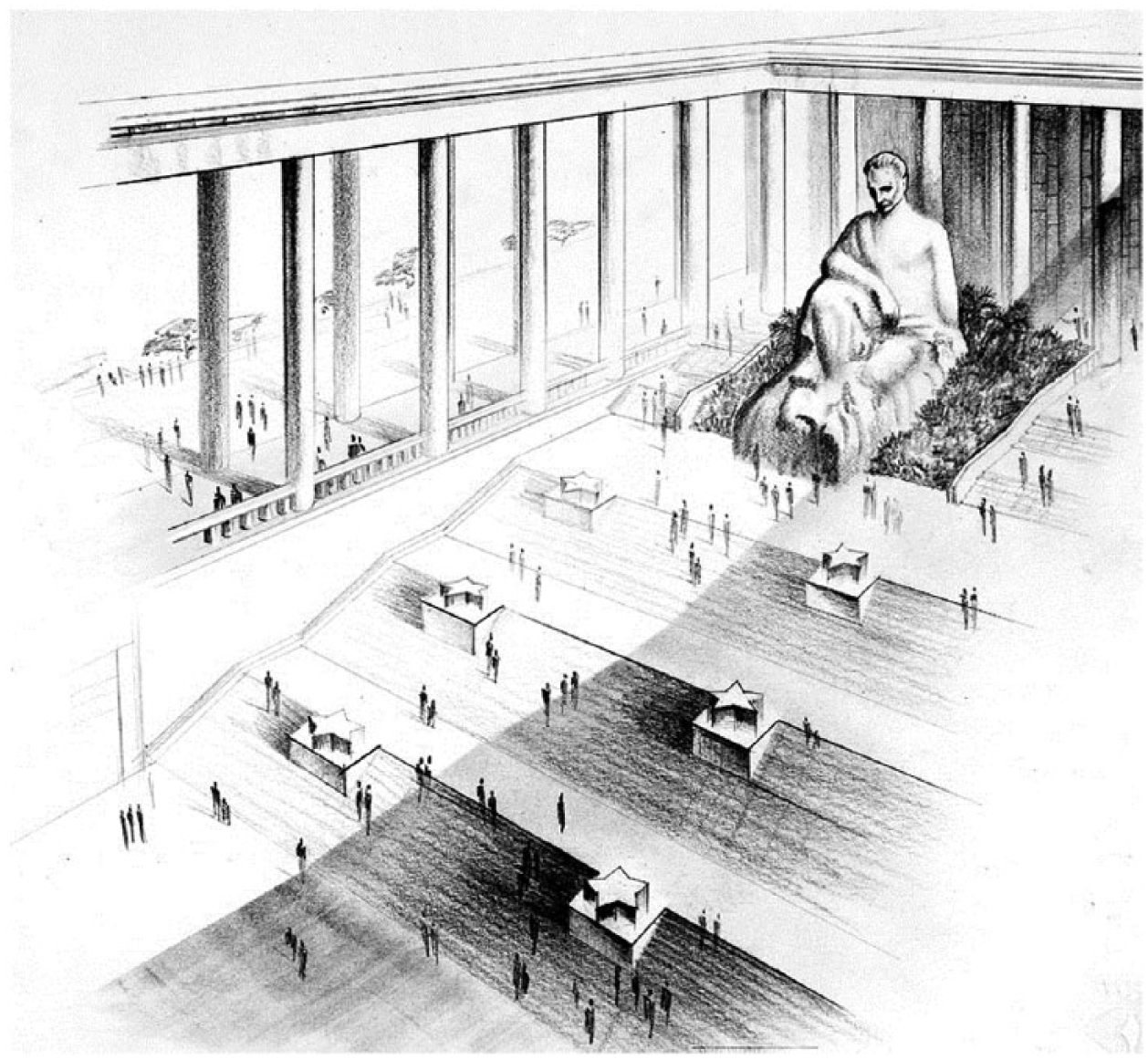
Original Maza and Sicre’s project for the Monument to Martí, who is represented as an Olympic divinity within a classic temple.
The classical references in Maza and Sicre’s project envisaged an Olympian Martí as a timeless figure outside history. The emplacement of the commemorative space as a temple aimed at organizing commemoration to establish a sacred interaction between Cubans and Martí, the ‘Apostle’, through the creation of a sacred sense of place whereby Cubans and their master could interact—physically and symbolically. Their project opened the possibility of bodily performance between Cubans and the materiality of the commemorative space, individual and collective memories. The emplacement of this commemorative space could be interpreted as democratic, insofar as it allowed people to interact and participate with and within the representation of state power. Contrarily, Labatut’s project was embedded in the progression of history. The idea of the nation was represented in the enchantment of a historical artefact: the Cuban flag and its star embodying the Cuban nation. Indeed, as evinced in Figure 2, his star-shaped tower sought a metaphorical relation of iconicity between Martí, the nation and the monument.
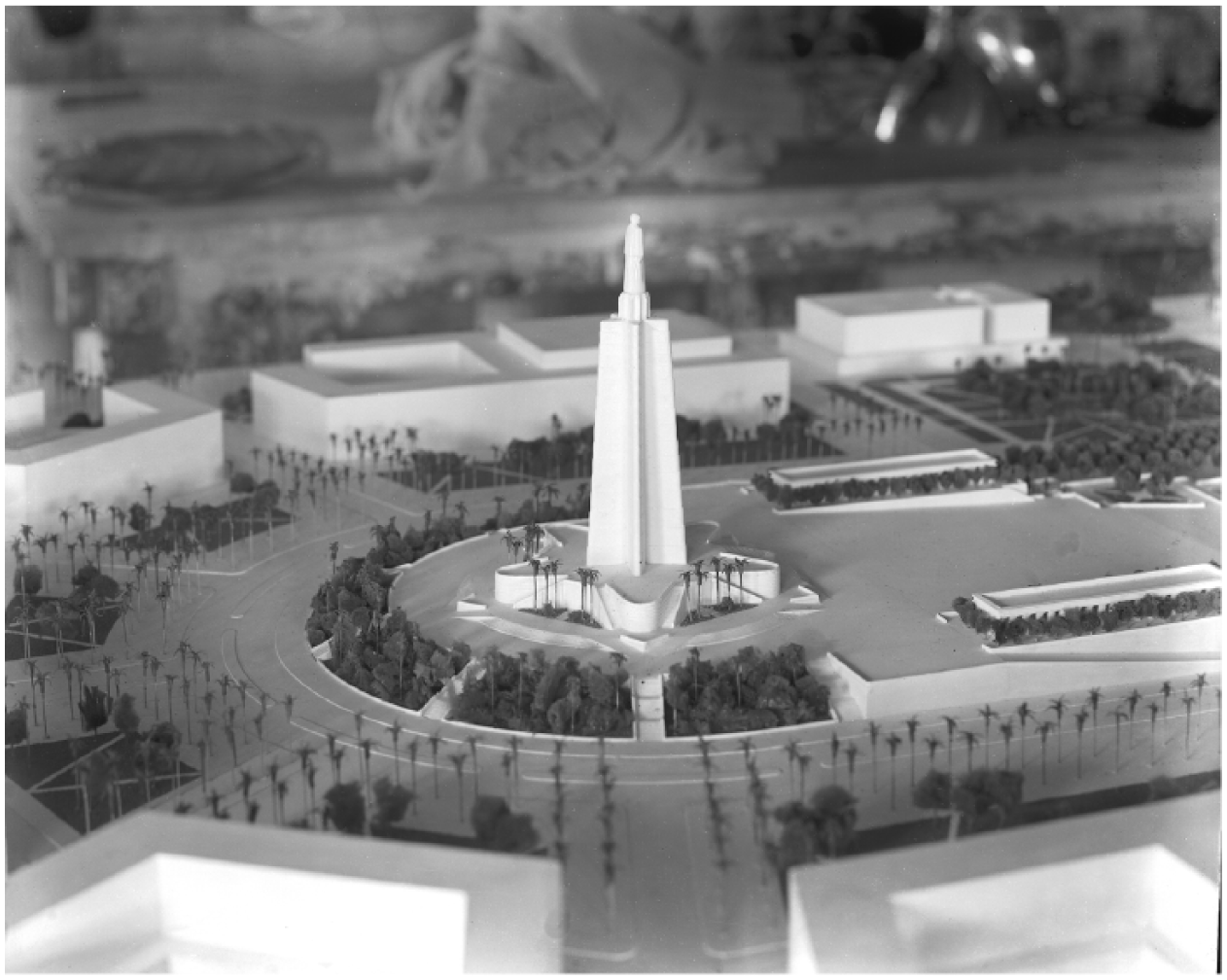
Original Labatut’s Plan of the Republican Civic Square with the Monument to Martí in the centre and his statue at the top of the tower.
In the context of dictatorship, the two projects organized different purposive memories as commemorative texts drawing on different claims from the past. Maza and Sicre ‘posited a temporality of timelessness. Labatut with his colleagues recognized and conceded the ineluctable progression of history’ (Hyde, 2012: 252). The emplacement produced by Labatut involved the superseding of the past through its representation in commemoration, thus conveying an idea of modernization and progress rooted in tradition that suited the organization of the state established by Batista. The triumph of Labatut’s project meant that the memories and histories of other social actors were excluded and disinherited. Those opposing the monument considered Labatut’s project part of the modern eclecticism promoted by Hitler, Franco and Mussolini in Europe (Porro Hidalgo et al., 1958: 46; Segre et al., 1986). They argued that Martí would not have supported the construction of a monument and, if so, it would have been a functional work. Moreover, they accused the project of being a fascistic pastiche that copied elements from US architecture, and of being at the service of the modernizing project of Batista’s dictatorship.
The contestation surrounding the politics of memory in republican Cuba evinces how commemoration became an important arena for political debate, characteristic of a society with a more or less strong civil society or public sphere. What seems to be almost absent in this pattern of social organization is the organizing practice of enactment, the performance of public rituals near or within monuments. This question needs contextualization in debates about commemoration and monuments. At the time, Cuban architecture treatises considered monuments as ‘educational ornaments of the city’ (Martínez Inclán, 1949: 22), thus signalling the intrinsic relation between commemoration and the organization of society, fundamental in the constitution of civic consciousness and sense of socio-political belonging. This bears the question of the relation between the materiality of commemorative space and people, that is, of how certain ideological regimes organize the relation between subject and object. In Monuments and Memorials (1952), Labatut argued that monuments establish a relation between expressive materiality and a receptive viewer via an intermediate context. The architectural design of the monument has to organize space to reconcile the subjective dimension of interpretation and its objective materialization. Ultimately, he accorded a primary role to vision and the interpretation of the observer, thus curtailing the capacities for enacting performances in commemorative spaces. Therefore, understanding the text of the monument, producing meaning from it, would require a previous knowledge about Martí and Cuba on the part of the observer. For Labatut (1952), monuments create an architectural air space or small visible man-made world of which each individual is a center, an observer … The quality of man’s judgment … will depend on many factors … the size of the elements and their shape, texture, and relationship; the motion of the observer’s eyes; the time spent looking; the motion of the observer’s body in relation to the environment; the successive distances from the elements of the environment to the retina; the visual sensibility of the observer and his knowledge, feeling, and imagination; the influence of preceding visual experiences … (Author’s emphasis)
The design of the Martí monument reflected Labatut’s emphasis on visual aspects and motion, and his conception of the citizen as a passive observer. Contrary to Maza’s project, Labatut organized the commemorative space in ways that precluded individual reflection and self-identification with Martí. The tower was there to be looked at and to look from it, providing both the representation of the nation and the God eye’s view from where to contemplate it. In fact, visitors could go up to the top of the tower and view a panorama of Havana, the monument not only symbolically embodying the nation but practically enabling citizens to observe it (Hyde, 2012: 247). Moreover, the emplacement of the Civic Square as a central traffic hub in Havana made it clear for Labatut that those viewing the monument would engage with it from cars rather than on foot: the gaze in motion had to prevail over socio-cultural interaction.
The inherent contestation over whose version of commemoration would predominate in the Civic Square resulted in a combination of elements from both projects as evinced in Figure 3, producing an ambiguous hybrid of modernist architecture with neoclassical figurative sculpture, almost finished before the Revolution. The republican attempt to organize commemoration in tangible sites with fixed meanings evinces an understanding of memorials as attempts at closure (Sider and Smith, 1997). Indeed, Martí’s revolutionary ideas were silenced and replaced by a reified national icon. Eventually, the text that prevailed in the monument displaced attention from the politically contentious interpretation of Martí’s writings towards a visual and material representation of uncomplicated reading. The open-ended reading of Martí’s ideas was arrested to create a transcendent symbol disconnected from the organic composition of society.
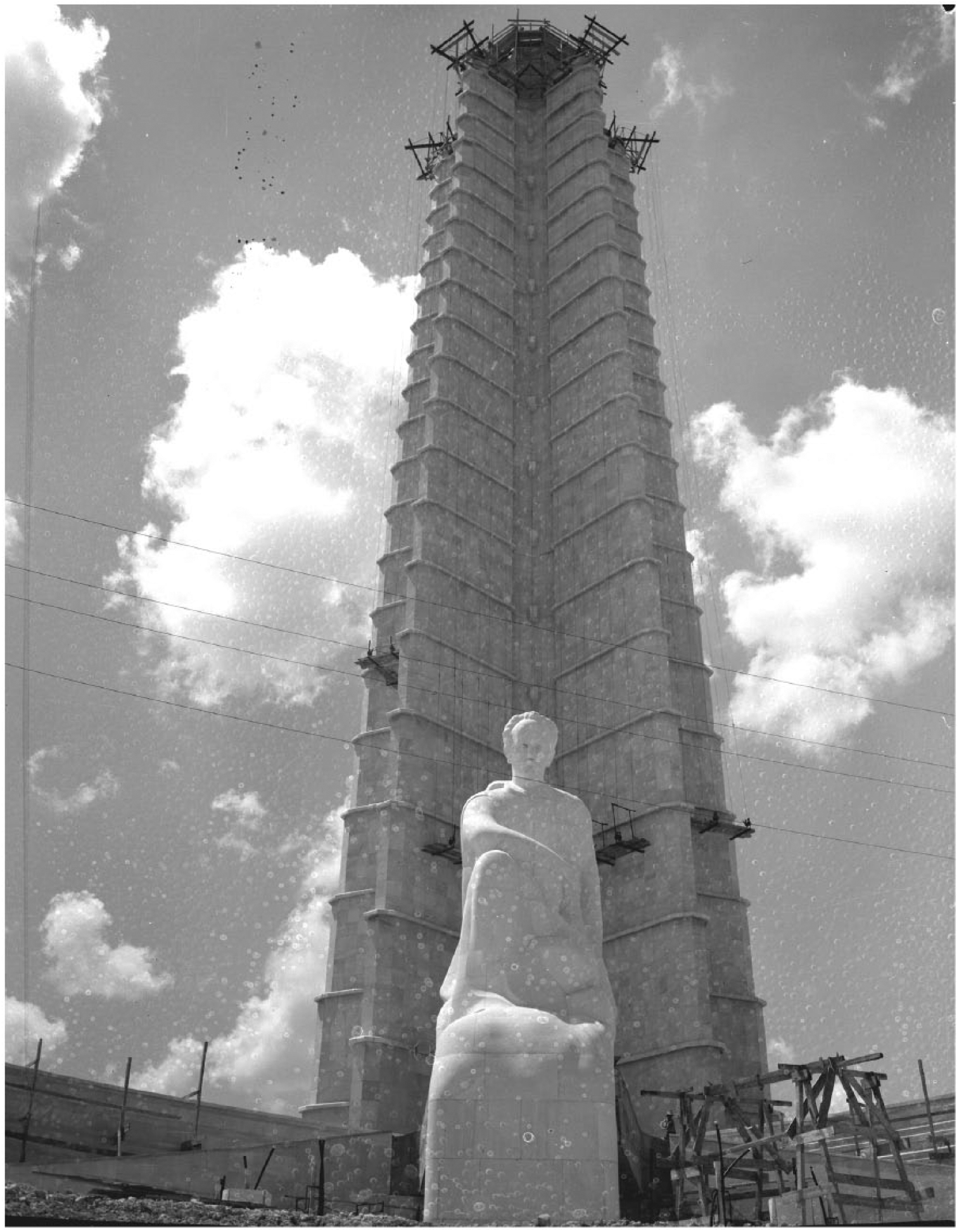
The Monument to Martí in 1958. The final outcome and hybrid aesthetics result from the combination of Labatut’s modernist tower and Sicre’s classic sculpture of Martí.
As a commemorative space, the Civic Square and the monument to Martí functioned as arenas for political struggle, with competing views about the text that should be inscribed onto the monument and its material emplacement. However, the monument left no room for enactment, thus being unable to transform Lefebvre’s (1991: 39) passive representational space into a performative site of ideology. Started shortly after Batista’s initial rise to power, the project was consistent with his ideal of the organization of the state. In the context of dictatorship, Martí could only provide purposive memories for enhancing collective action and memory as a silent and reified icon. By making him appear as the symbol of certain transcendent and a-historic ideas, he was embedded in the power struggles over the definition of the national polity that—quite literally—fought for hegemony during the 1950s.
The early revolutionary years: organizational commemoration as performance (1959–1975)
The Revolutionary attempt to transform society required new forms of control ‘incorporated into different spatial and material arrangements … combined with cultural and textual interventions to convey strong values and generate individual commitment’ (Dale, 2005: 660). This section examines the transformation of the organization of commemoration in terms of text, arena and performance, and its connection with ideological changes and shifts in the relation between power and citizens, and between commemoration and the structuration of labour in society. The organization of commemoration in this period can be framed under what Aguirre (1984) defined as the conventionalization of collective behaviour in Cuba, whereby individual behaviour became regular and predictable through the political mobilization of the masses. Following Strang and Jung (2005), organizational change can be understood as a social movement that attempts to make transformations self-sustained and institutionalized. In it, logics of personal involvement in mobilization replace authority. This insight allows us to explore how the organization of commemoration and the state organization of labour became tightly connected, and how enactment became the dominant organizing practice.
After the end of the war in 1959, the new revolutionary historiography projected a self-image that emphasized a rupture with certain aspects of the past. However, revolutionary states are often worried by identity and establishing continuity with the past, and Cuba was no exception (Marris, 1974). For Nora (1996: 6–7), when a nation is under threat or undergoing rapid political transformations, it takes refuge in certain lieux de memoire or places of memory. The Revolution showed that the monument to Martí in the Civic Square was the key Cuban lieu de memoire. However, the symbolic narrative text of the monument had to be rescripted to ensure a symbolic continuity with the past. Although the emplacement, the material structure of the square, was not much transformed, the text had to be radically shifted according to the new ideology. The Civic Square can be conceived as a palimpsest, a symbolic system that has been written and rewritten through a process of symbolic accretion whereby different historical meanings were layered onto it.
The new ideology that emerged during the early years of the Revolution can be conceived as a mixture of Cuban nationalism embodied by Martí and Marxist-humanist ideas embraced by figures as Che Guevara. However, the influence of Soviet Marxism-Leninism gradually permeated Cuba, conditioning urban and commemorative policies. The Soviets saw urban planning as a way of organizing communist space and of shaping society. Monumental architecture and sculpture were employed in the design of large spaces to highlight the unity between the Party and the People. Because in Soviet Marxism-Leninism the economic base conditioned the superstructure, the attempt to transform society and create the so-called new socialist man required builders and architects to lay down the material foundations of that transformation. What Humphrey (2005) has described as the ‘materialization of ideology in infrastructure’ in the USSR implies that, as an organizational device, ideology is not only textual and semiotic, but a political practice ‘that is also manifest in constructing material objects’ (p. 39).
Today, the linkage between the Square of the Revolution with the Revolution itself is so inexorable that for most Cubans, knowledge of its republican origins comes as a surprise. However, at the time, the square was symbolically related with the dictatorship of Batista (Gonçalves, 2001: 30). Consequently, the regime could not let the ambiguity of meaning over the monument to Martí to last. The question emerged of how could a similar arena be re-enchanted and its text rescripted. That is, how could a new organization of commemoration transform the narratives and meanings conveyed, as well as the relation between commemorative landscapes and citizens, without transforming the materiality of the space? This question troubled many Cuban architects and academics, who wondered how, as art historian Pereira (1994) did, ‘an artwork [can], without changing its material structure, form, or geographical location, transform its semantic and expressive content in three decades’ (p. 2).
First, it was necessary to transform the text through a rewriting of the official memory of Martí. Thus, the official revolutionary discourse started to affirm that Martí’s figure and ideas had been seized and misinterpreted by the bourgeoisie during the republican period (Portuondo, 1982). However, his figure could only be commemorated and his true ideals implemented by the Revolution, because these were now subject to ‘objective scientific analyses’. These ‘analyses’ were provided by the official historiography of the Cuban Communist Party (PCC).
Second, the physical transformation of the arena involved few, but symbolically significant, material additions. Most buildings in the square surrounding Martí’s monument were intended to political institutions such as the Ministries of Communication and Home Office or the PCC headquarters. Of the different cultural institutions included in the original republican project, only the National Library remained in place. Clearly, the square was becoming a representation of the organization of the state and turning into a ‘dominant space’ (Lefebvre, 1991: 39). Nonetheless, the process of reorganization was not simple and straightforward. The imposition of a one-party rule entailed the end of the square as an arena for the competition between different social actors. However, the governmental disorganization of the early revolutionary years led different institutions representing competing power groups within the government to target the square for their projects for the organization of commemoration. While Castro and his team planned the speeches and rallies in association with official regime feasts, the Revolutionary Army projected the creation of the Museum of the Revolution in the basement of the monument. In turn, the Ministry of Construction (MICONS) planned urban and architectural changes and continued referring to the square using the republican name ‘Civic Square’, while Castro and the Revolutionary Army started calling it ‘Square of the Revolution’. If the power to name is a fundamental form of political power that puts people in particular categories within the symbolic order (Bourdieu, 1991: 105–106), the name and function of the new square was contested terrain during the early revolutionary years, reflecting that different organizations within the state apparatus operated as autonomous islands.
The transformation of Martí’s monument started a month after the revolutionary triumph, in February 1959. A podium intended for Castro’s speeches, electricity and a microphone were installed. Gradually, cabins for radio and TV were added to the monument, and buses were transformed into mobile toilets, cafeterias and ambulances deployed for mass rallies and meetings (MICONS, 1962–1964). The new emplacement gradually defined the kinds of activities that could be performed in the square. In parallel, MICONS architects kept designing a series of utopian projects that planned the total transformation of the square. Although they were never implemented, MICONS projects recalled the organizational patterns of pre-Stalinist Soviet ‘visionary planning’, which ‘celebrated the visual prowess of scientific expertise and artistic creativity’ and envisioned ‘a society where scientific expertise and scientific management governed society systematically, without need for more direct police or administrative intervention’ (DeHaan, 2013: Chapter 1).
The uncertainty of MICONS architects and bureaucrats over the square, as well as concern over the role that MICONS, architecture and urban planning should play in the Revolution, revealed the lack of clear guidelines for addressing the organization of commemoration in public space. This was evinced in a 1962 report. After elaborating a technical analysis of the area of the square, MICONS architects affirmed that ‘although we do not know which the future prospects are for the Civic Square, in our opinion it should remain the administrative and cultural center of the city’ (MICONS, 1962). Meanwhile, the Revolutionary Army sent architect Raúl Oliva to be trained in the USSR for the design of the Museum of the Revolution at the basement of Martí’s monument. The museum opened in 1961 but was dismantled in 1968: Castro wanted the monument for his exclusive use in his encounters with the masses.
Thus, the third strategy to fulfil the symbolic re-enchantment of the square was its transformation into a site of enactment, serving as a stage for the performance of public commemorations, rituals, marches and civic ceremonies. The republican conception of monuments put forward by Labatut emphasized the relationship between the monument and the observer. What counted for Castro, however, were the participation of the observer and the establishment of standardized procedures of participation that reflected the organization of the state.
If the spatial organization of relations of distance and proximity are manifestations of underlying power relations (Harvey, 1969), the analysis of organizational commemoration reveals Castro’s attempt to transform the relation between power and people, subjects and objects. However, Castro was careful to co-opt previous social memories and commemorations. As evident in Figure 4, the large stage designed by MICONS placed Castro in front of the monumental sculpture of Martí and at the highest point among the other people standing on it. In placing himself between the monument and the people, Castro became an organizational leader drawing on public performance to provide the official interpretation of ideology and to stage state power. This strategy can be defined as performative ritual and can be employed to frame political legitimization through the association with a certain symbolic order (Pumar, 2009). The mobilization of the masses was orchestrated by Castro, requiring the participation of Cubans in commemorative events. The performances held in the square were one of the constituent parts of a larger plan intended to establish an organic connection between labour and commemoration. Work centres, schools, factories and hospitals had to change their names to commemorate revolutionary leaders and build statues and museums commemorating local patriots (PCC Holguín, 1978).
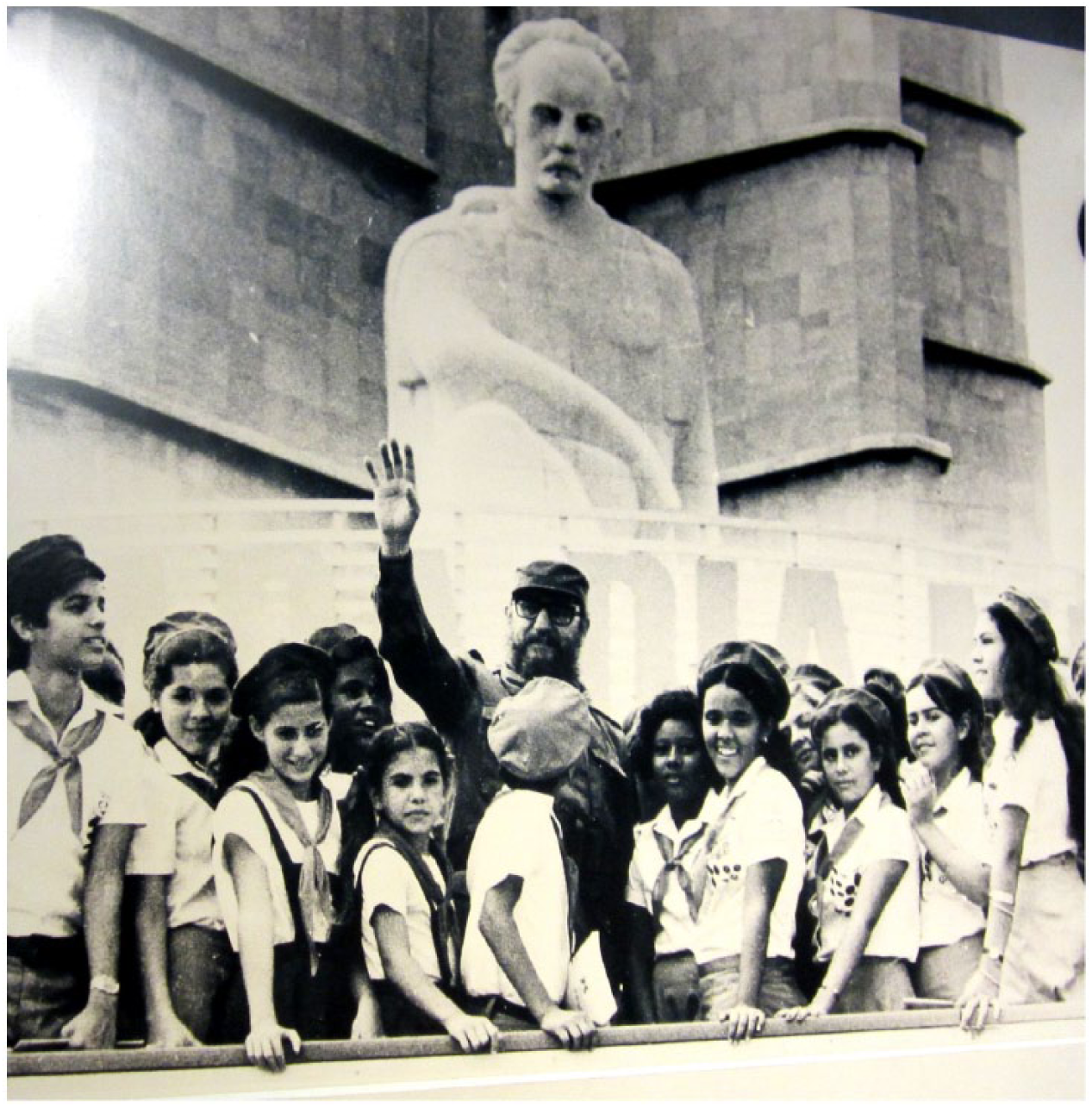
Castro used the Square of the Revolution as a space of political ritual to establish a new symbolic atmosphere that highlights his connection with José Martí.
As the performative ritual of remembering involving large numbers of people serves to reinforce the bonds of people with the ruling class and among each other (Connerton, 1989), Castro insisted on gathering the masses in the Square of the Revolution, where he delivered his first massive speech on 8 May 1959. However, the organization of mass speeches in the square did not become ritualized until the following year, when Castro gathered nearly a million peasants for his 1 May speech as a show of strength. In addition, he included the highly symbolic date of 26 July in the standardized calendar of mass celebrations to commemorate the Moncada assault. These massive commemorations were new in Cuba, but they were largely adopted from the Chinese and Soviet contexts (Lane, 1981). These organizational principles of commemoration endured until the fall of the URRS in 1990, when they were readapted to the new ideological context.
The implementation of massive commemorations required a complex interorganizational coordination, as hundreds of thousands of Cubans had to parade orderly in front of the authorities and Castro in the Square of the Revolution. Two mass organizations played a key role in the scheduling, management and justification of mass commemorations: the Central Organization of Cuban Trade Unions and the Committees for the Defense of the Revolution. Although assistance was not a legal requirement, the system of intersubjective control made it better for every individual to assist and conform to state expectations, as it provided ‘moral capital’ that could be exchanged in society in various ways (Aguirre, 1984). Indeed, the organization of commemoration functioned as a mirror of the pattern of social organization of the country and labour, as assistance to revolutionary acts was considered as a form of voluntary work. The intrinsic connection between commemoration and labour partially derived from the communist assumption of an ontology of labour in Cuba, that is, the celebration of work as a transhistorical category and organizing principle of communist society (Postone, 1993).
The commemorations at the square became the central conveyors of the official version of history. As most commemorations, they served to project the self-image of the regime by establishing purposive memories that shaped an idea of the future envisioned by the revolutionaries: the coming of Communism rooted on the autochthonous ideals of Martí. Connecting notions of collective memory with the organization of commemorative public space served Castro to reorganize the normative social order and ground his legitimacy on the symbolic relation between himself and Martí—a way of articulating the official national revolutionary narrative, affirming the unity of Cubans, and providing a sense of continuity and belonging. This powerful combination of a spatial text, arena and performance allowed Castro to shape social transformation, but also reflected his political ambitions. Indeed, material and spatial realities reflected underlying forms of power and control, and Castro openly employed the Square of the Revolution to reiterate the idea of the guerrilla core as the sole forbearer of the Revolution against the increasingly powerful state and PCC bureaucracies and other revolutionary groups that threatened his power (Kapcia, 2008).
If modern organizations such as states need bureaucracies and instrumentalization to gain legitimacy in terms of economic and organizational performance and efficacy, the Cuban nation and the Revolution demanded passion and emotional bonds (Fernández, 2000: 84). The way commemoration was organized in the early revolutionary period showed that Castro and his close circle of collaborators largely preferred to be associated with the latter, which probably explains the longevity of the Revolution.
The Sovietization of organizational commemoration: iconographic planning in the provincial Squares of the Revolution (1975–1990)
During the 1970s and 1980s, Cuba underwent a process of institutional, bureaucratic and territorial reorganization under the aegis of growing Soviet influence, which led to an increased role of the PCC and the expansion of state power. The general principles of organizational memory were expanded throughout the country and materialized through the creation of fixed commemorative landscapes in the provinces. Thus, a new relation between the social and the material emerged, combining the organizing practices of enactment and emplacement. Performance remained central, but the construction of new commemorative spaces was underscored for keeping alive the ideology of the regime and to replicate Havana’s model to other areas. At the time, the influence of Stalinist and post-Stalinist urban planning in Cuba became apparent. Under Stalin, ‘visionary planning’ gave way to a socialist realist ‘iconographic’ approach to urban planning whereby iconographers (i.e., planners) copied sacralized models articulated elsewhere (i.e., in the Moscow city plan) onto their own palette … so Moscow became the new icon, the aesthetic model to which all cities and villages in the Soviet Union had to conform … architectural mimicry of the capital signaled provincial success, even as it affirmed the provinces’ subordinate position in the socio-geographic hierarchy. (DeHaan, 2013: Chapter 4)
Both in the USSR and other Eastern European countries, the central districts of cities served as arenas to organize collective action and reinstate state power, developing spacious boulevards and public squares that functioned as marching grounds and hubs for the proletariat (DeHaan, 2013; Răuţă, 2013). What made Cuba unique was the centrality of organizational commemoration in new city centres and squares.
The connection between commemoration, spatial planning and social control was apparent, and the PCC developed a nationwide plan of commemoration that envisioned the implementation of ‘monumental complexes located in the center of provincial capitals named after a significant local patriot’ (CODEMA, 1981). This plan envisaged the emplacement of squares of the Revolution in the provincial capitals following Havana’s model. However, the new ideological context demanded new patterns of organization of materiality from the squares. The Civic Square in republican Havana had been conceived as a text to be looked at, while the early revolutionary Square of the Revolution had been reworked to become the stage for the enactment of commemorative performances. Instead, the provincial squares were commemorative urban spaces conceived as models of the organization of the state. Contrary to Havana’s square, provincial squares were planned from scratch, thus revealing the underlying assumptions of the Revolution in terms of the organization of commemoration.
The squares functioned as performative stages where narrative texts were conveyed to the masses. They represented the utmost attempt to bring together all the spheres of spatial production in terms consistent with Marxism-Leninism. According to socialist architect Meyer (1972), this implied the ‘materialization of the commingling of the most diverse artistic proletarian expressions: massive cinema, theatre, sport, massive demonstrations’ (p. 73). In sum, it was believed that the socialist spatial organization would determine the behaviour, social identity and subjectivity of the masses. Such spaces were therefore orientated towards the production of memories that would promote certain ways of thinking and doing. The connection between the social and the material was considered direct and unmediated. This belief, as well as the impossibility of carrying out performances with the same intensity as in Havana, turned the squares into sites for the emplacement of an ideological text, while their potential as arenas for the performance of collective action decreased.
The manifold functions that the squares had to fulfil brought together different professionals and disciplines in their conceptualization and implementation. In terms of their emplacement in the urban landscape, they were conceived as the new socialist city centres and located on the outskirts to facilitate urban growth around them, while traditional city centres were neglected. In Matanzas, the project to create the Juan Gualberto Gómez Square went at length to explain the reasons why the colonial centre was outdated, useless and worthless, and had therefore to be replaced. It was described as ‘congested with traffic and pedestrians, polluted by noise and dust, lacking green areas, parking lots and urban functions generally’ (CODEMA, 1990). Similarly, when the Mariana Grajales Square was being built in Guantánamo in 1984, people were told that it would constitute the new ‘urban heart of Guantánamo’ (Longa, 1984). If the location of commemorative sites actively conditions the process of commemoration (Benton-Short, 2006), the will to locate new city centres around commemorative squares in urban peripheries, while neglecting the historic city centres, reflected the attempt to denigrate the past and highlight the association of communism with modernity and the future. New organizational memories required the erasure of previous embodiments of memory and emotions attached to certain places by people. This can be related to Soviet urban policies and their iconoclastic attempt to ‘transcend the particularities of custom and location’ and ‘to rip away the foundations of the old world’ (DeHaan, 2013: Introduction).
Furthermore, the squares were conceived as commemorative artefacts to be looked at. In this sense, their organization of distance between object and subject was similar to the one generated by the authoritarian project of the Monument to Martí in the Civic Square designed by Labatut: the squares conveyed a text to be looked at by a passive individual. The underlying intention was to orientate such commemorative spaces towards the connection between past collective memories, present collective action of the organized proletarian labour force and power institutions. As sites for the display of power, they enacted the organization of the state in a material form, hosting the buildings of People’s Power, provincial PCC and other institutions. Those surrounded the monuments that presided over each square and were devoted to a local hero. The monuments contained the text and meaning to be conveyed, usually a representation of the Marxist-Leninist national narrative. Their performative function was fulfilled by large platforms in the monuments, from where speeches could be addressed to the masses in commemorative dates or mass mobilizations. To improve the potential of the squares for ideological spread, soundtracks with patriotic themes were constantly played, and colourful banners intended to reinforce the meanings conveyed by the monumental area surrounded each square.
Because the squares were seen as future areas for leisure and social life, planners surrounded them by large prefabricated buildings for housing, sports stadiums, theatres and houses of culture, as seen in Figure 5. Those areas were emplaced in tight physical connection with the buildings of state institutions and with the monuments. At the time, the squares were considered the highest symbolic expression of the revolutionary culture of each town … Rather than a public space, a Square is a meaningful environment. Human beings create these meanings with their historic memories and their imagination of the future. They do so by living their quotidian socio-economic, ideological and cultural relations in close connection with these spaces. (Salinas, 1985: emphasis mine)
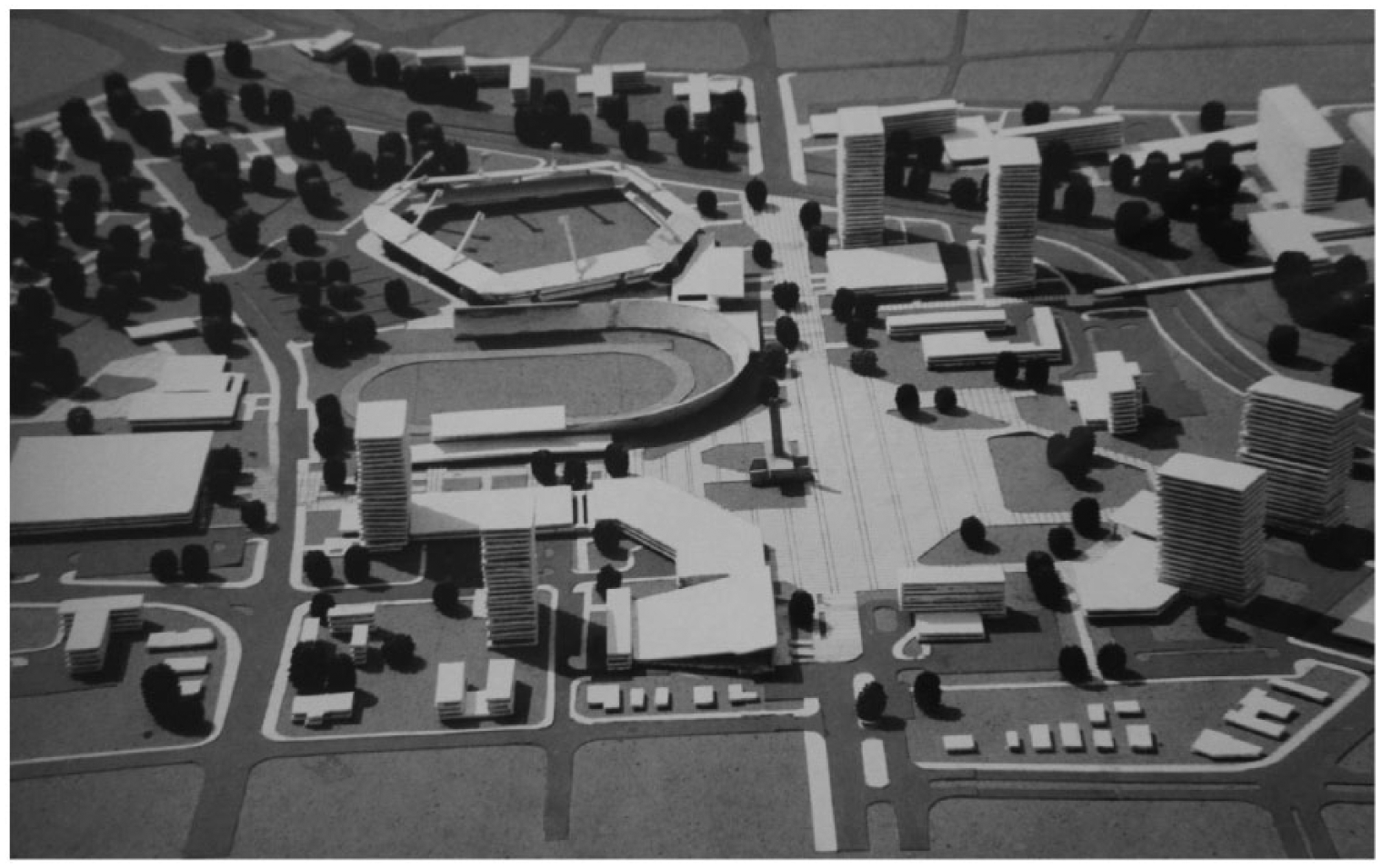
Original plan of the Square of the Revolution ‘Ignacio Agramonte’ in Camagüey. The Square was intended to become the new city centre replacing the old colonial centre. As in every other Cuban city, the attempt failed.
Because the infrastructural or material base would condition the ideological and social superstructure, it was thought that a daily exposure to these physical environments would transform Cubans into new socialist men.
The performance of mass rallies required the development of vast esplanades to celebrate the 1 May and 26 July. Most squares were inaugurated in these commemorative days to establish a symbolic link between the revolutionary past and its future-oriented projection. In addition, the Squares were designed to function continuously as places of performance. There were administrative teams running the museums located at the basements of monuments, and their different activities such as diplomatic visits, oaths by pioneers and students, graduations and tours for workers, or conferences and conventions.
The monuments played a key role in the enchantment of space intended by the authorities, that is, in the creation of historic meaning through symbolism. The squares became an arena for the negotiation of internal dissent, as their construction prompted a heated debate among groups wishing to represent the past differently, namely between the cultural and artistic elites and the PCC bureaucracy. This contestation partially stemmed from the fact that this monumental typology was new in Cuba, requiring the development of new organizational memories consistent with the new ideology. Unsurprisingly, the regime wanted to secure strict control of the works to prevent artists from deviating from the official canon of socialist realism, which demanded artists to produce works with socialist contents and realist forms. In turn, artists contested the standardization of contents and forms in the production of commemorative monuments that socialist realism entailed, and advocated abstract forms.
The increasing complexity and hybrid forms of Cuban revolutionary monuments reflected the attempt to reconcile artistic freedom with the interests of party bureaucrats. For instance, in the Agramonte Square in Camagüey, the artistic project that won the public bid to build the monument to commemorate the Cuban hero Agramonte, designed a predominantly abstract representation of him. However, political pressures forced the inclusion of another freestanding socialist realist sculpture of Agramonte. Similar hybrid monuments were implemented in the Squares of Guantánamo and Santiago de Cuba, a split into two distinct representational styles that reflected underlying political tensions, evincing that the social production of memory is embedded within relations of power and control (Willmott, 2000).
If monuments usually entail symbolic and interpretive closure (Sider and Smith, 1997), this is even more the case with realist monuments, which had to reflect life and erase any abstraction or remnant of transcendence standing outside ideology. For Marcuse (1958), the reasons for this were clear: as the regime has absorbed philosophy into the official theory, literature and art become dangerous. Ethical philosophy becomes a set of rules, and Western philosophy is discredited. With the negation of philosophy, the main ideological struggle then is directed against the transcendence in art. Soviet art must be ‘realistic’. (p. 128)
As with Labatut’s Monument to Martí, totalitarian forms of organizing commemoration tend to produce immanent material monuments, erasing any trace of transcendence or narrative text that could remain outside an ideologically informed explanation.
To ensure the correct organization of its monumental plan and monitor the development of the squares, the PCC created a Commission for the Development of the Monumental and Environmental Sculpture (CODEMA). However, party bureaucrats did not even trust CODEMA and the first provincial Squares of the Revolution in Holguín (1979) and Bayamo (1982) were commissioned and built by party-loyal artists. As a rule, the monuments of provincial squares presented large stages where the regional political authorities stood in rallies, parades and speeches. Behind them, there were monumental friezes and panels—61 m long in Holguín, for instance—with realist low reliefs that materialized the official narrative into a spatial text. The official narrative combined the Cuban nationalist history with a Marxist-Leninist class-based narrative. The nationalist narrative celebrated the patriotic and independence wars and local heroes—for example, Agramonte or Maceo. The Marxist-Leninist narrative incorporated the histories of those minority and subaltern groups that had been hitherto excluded, namely aboriginals, Afro-Cubans and proletarians. It followed patterned stages of evolution representing dialectical pairs of oppressive and subaltern classes: aboriginals-conquerors, slaves-aristocrats and proletarians-bourgeois. Monumental friezes enacted history through scenes of simple visual recognition and interpretation. In the square commemorating Agramonte in Camagüey, inaugurated in 1989, history began with a colonizer subduing the natives with a cross. At the end of the narrative, Martí and Castro appeared together to highlight the symbolic connection of their revolutionary ideals and to underscore historic continuity, as evinced in Figure 6.

Monumental frieze of the Square of the Revolution ‘Ignacio Agramonte’ in Camaguey. The frieze represents the teleological Marxist-Leninist metanarrative with low reliefs of the most salient heroes and subaltern groups.
Minority groups were represented in the text, but as reified icons of certain classes, overlooking historical heterogeneity and complexity. The structure of organizational commemoration demanded regional nationalist histories to converge with the national canon, and the material representation of each class disregarding the local context. Thus, in squares of central and eastern Cuba, where slavery was less significant or non-existent, it had to be represented anyway. The symbolism of the spatial text was not therefore oppressive for silencing minorities, but because of its disentanglement from reality and the abstraction from historic dynamics (Alonso González, 2015).
The organization of commemoration played a key role in the construction of a sense of belonging to the national-revolutionary identity, and in the enactment of this identity through the production of specific places and the conventionalization of behaviour through performance. Organizational memories served to incorporate regional identities and memories, patriots and histories, into the broader national framework. Thus, the concern for celebrating local patriots and memories was not a bottom-up attempt to highlight local identities but rather a top-down organizational strategy to demonstrate that every person in Cuba was consistently part of the same national narrative. Indeed, only the memories of those historic figures, classes or heroes that converged with the official narrative were given voice and materialized in commemorative spaces, reflecting a tension between the national and the local. In Camagüey, Crespo Baró, ex-director of the management team of the Agramonte Square, recalls how narrating local histories and celebrating local heroes in the museum or the monumental area could bring political problems before 1990 (Interview, 10 April 2013) (Figure 7).
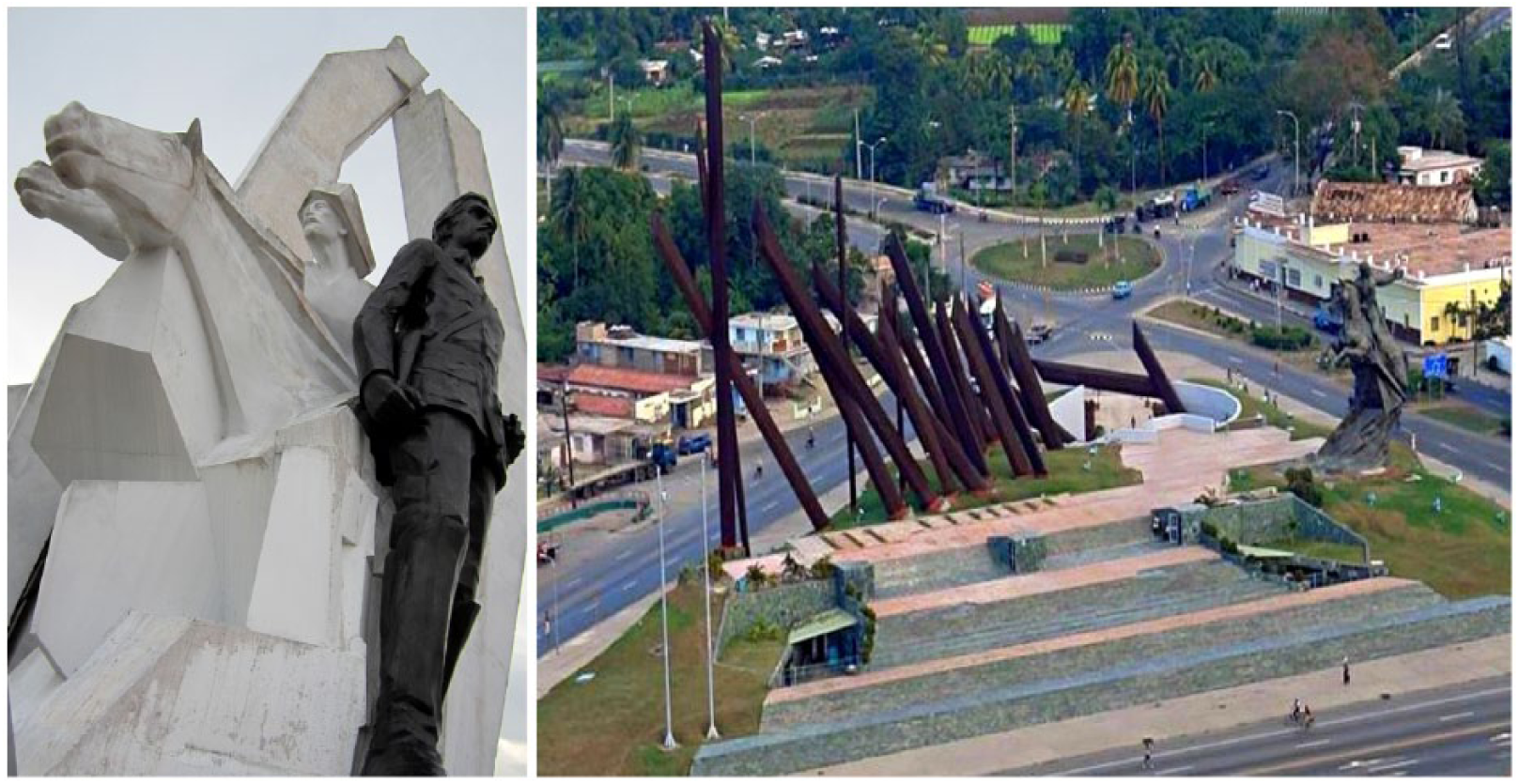
Monumental complexes of the Squares of the Revolution of Camaguey (left) and Santiago de Cuba (right). The conflict over-representation between PCC bureaucrats and artists led to hybrid expressive forms combining abstract and realist aesthetics.
In terms of commemorative enactment and the relation between subjects and commemorative artefacts, the massive performances held by Castro in Havana’s Square became ossified in the provinces, where official history was reified into visual representations of national identity. In Havana, Castro’s performances established a symbolic connection between him and Martí, expressing the relation between the revolutionary leader and an ideal of nation embodied by Martí. Thanks to the organization of commemoration in performative terms, the link between nation and Revolution had gradually become a symbol by virtue of the establishment of a public interpretive habit. In it, physical or contextual resemblances were nearly non-existent between Castro and the denoted object, —that is, the revolutionary nation. However, in tune with Stalinist iconographic urban policies, the provincial squares resorted to a blatant socialist realism that established an iconic, rather than symbolic, relation between the social character of the leader and the material expression of official history. Because memorials are rendered silent when no audiences perform memorial practices in them (Cresswell, 1996), the provinces required different organizational commemorations with unambiguous socialist realist icons. Unlike in Havana, Castro could not habitually perform in them and thus create interpretive habits. As in the porticoes of medieval cathedrals, history had to be emplaced and constantly displayed in public even when the ritual of mass was not being held. The return to the pervasiveness of the gaze over performance in the organization of commemoration, and the creation of dominant spaces representing state power, hints to a totalitarian organization of commemoration in Cuba between 1975 and 1990.
Late socialist self-commemoration: the re-organization of commemoration as cultural heritage (1990–present)
The fall of the USSR caused a devastating economic crisis in Cuba during the 1990s. Following suit, Cuba started a process of de-Sovietization and ideological transformation that emphasized again the figure of Martí. The Cuban Revolution entered a reflexive phase that involved a return to the pre-revolutionary past as a source of legitimacy. The authorities focused now on ensuring historic depth to the new dominant rhetoric through the transformation of ideology into heritage. This process has been partially triggered not only by the demands of international tourism and the Cuban need for foreign currencies, but also by the desire of the authorities and people to root cultural identity and collective memory in the historic past rather than in a utopian future.
These changes are intrinsically related to the organization of the country and labour. As in other contexts of decreasing stable socio-political relations (Du Gay, 1996: 57–58), organizational control in Cuba has shifted from vertical and hierarchical authority based on bureaucratic rule, towards a more horizontal structure involving individual responsibility and peer control. In these contexts, social control rests more on cultural features attempting to generate self-discipline. The increased organization of civic society and private companies has been epitomized by the ‘Business Improvement Plan’ of 1998, whose main objective was to end with socialist central planning and to encourage the self-identification of workers with their companies on an individual basis (Martín, 2002). The change in the relations between individuals and society is reflected in the reorganization of commemorative policies. The construction of new commemorative spaces to spread new ideological texts has come to a halt, while commemorative performances have decreased. The new dominant organizing practice in terms of the organization of commemoration rests now on the creation of a metacultural relation between the present and the past, whereby the legitimacy of the Revolution is based on tradition and cultural memory (Alonso González, 2014).
As in other post-Soviet contexts (Forest and Johnson, 2002), it had become apparent that Cubans could not connect their individual stories with the Marxist-Leninist revolutionary narrative. The provincial squares of the Revolution declined and they seem doomed to decay in the peripheries of Cuban cities. They lost their potential for organizing commemoration, conveying the new ideological text, and serving as metaphors of the state’s organization. Although they were not destroyed, their public contemplation and political use was not officially encouraged anymore. Their role as arenas for political performance diminished, with the gradual decrease of the frequency, scale and intensity of ritual performances, which have almost entirely ceased after the coming to power of Raúl Castro in 2008. The nationwide monumental plans were stopped and most provincial capitals remained without commemorative squares: only one more square was built after 1990, in Las Tunas. In turn, the ones that existed lost their physical and symbolic maintenance, what Nora (1996) would describe as the ‘commemorative vigilance’ (p. 6) necessary to render commemorative spaces permanent.
The squares have become symbols of decadence and testimonies of the revolutionary failure to organize urban space according to Marxist-Leninist utopian spatial politics. For José Antonio Choy López, the famous Cuban architect who participated in the design of provincial squares and monuments, the Squares are damned … because they are dead spaces disconnected from life … Given that someday we will need to reconstruct our cities, there is no place for the squares because of their tight links to the symbols of power … we will need to recycle and transform them into public spaces of socio-cultural use, recovered by society. (Interview, 17 May 2013)
In parallel with the demise of the squares, Cuban national and municipal authorities started to emphasize the need to restore and reinvigorate the colonial historic centres. The Square of the Revolution of Havana remained a central commemorational space and was, once again, rescripted according to the new ideology to convey a sense of stability and continuity. The seasonally changing image of Che became a fixed monumental representation in 1993, and a few years later, a fixed monument to Camilo Cienfuegos joined ranks with Che in 2009 (Figure 8).
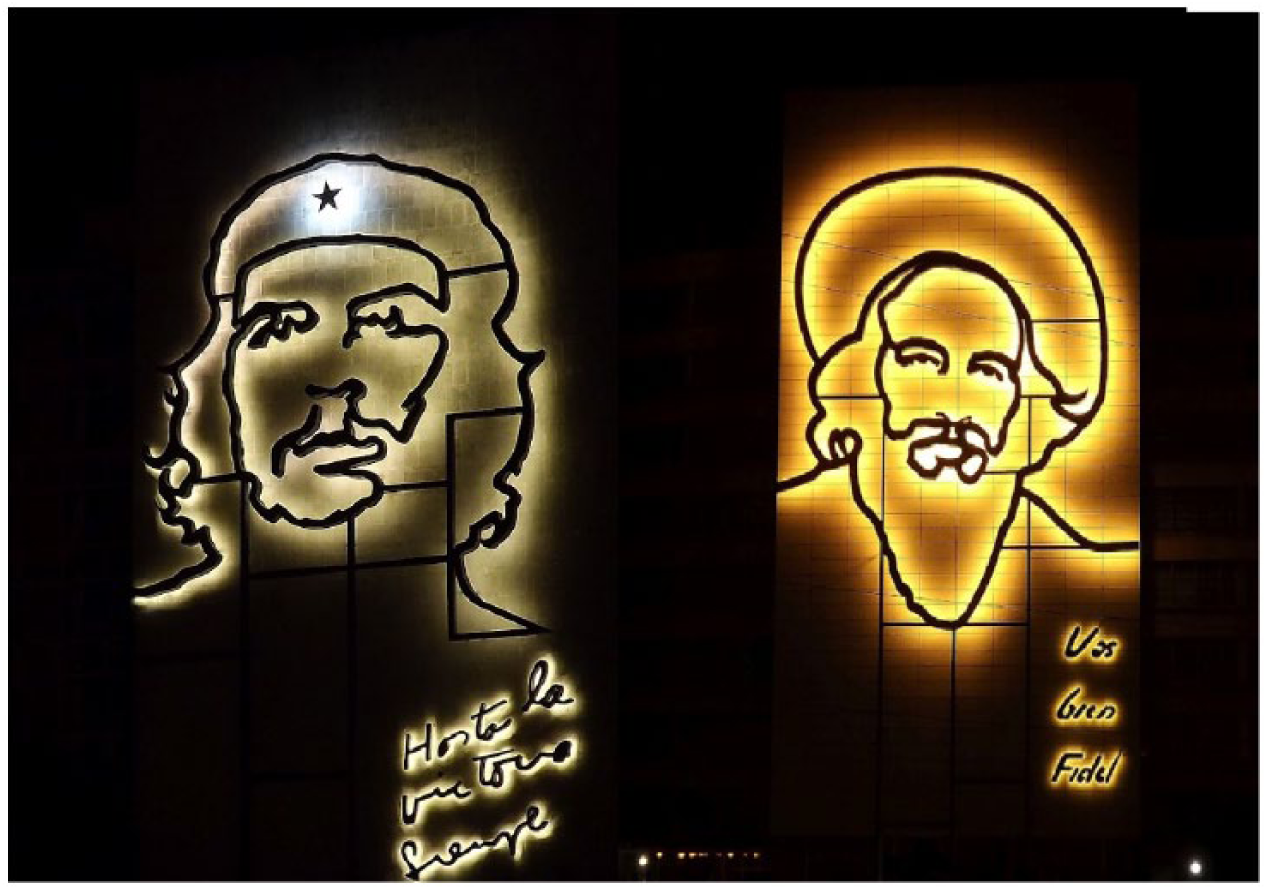
Monuments to Che Guevara and Camilo Cienfuegos in the Square of the Revolution of Havana, unchanging after 1990.
The basement of the monument to Martí presiding over the square was transformed into the Memorial José Martí in 1996. The Memorial represented the symbolic separation between the national-revolutionary and Marxist-Leninist texts. After the 1990s, the regime resorted again to Martí in another effort to ground a new ideological shift on familiar traditions in relation to which Cubans should shape their collective memories and identities. The Memorial turned the organization of commemoration into a metacultural narrative of cultural heritage. It presented a historic account of Martí’s life and established a connection with Castro, a link that is symbolically established through the visual articulation of their shared values: emphasis in the role of the youth, internationalism and anti-Imperialism. More interestingly, the Memorial enacted a form of self-commemoration, whereby the revolutionary past was represented as national heritage in panels and text, as seen in Figure 9. While in the 1960s the image of the nation coalesced in the relationship between Martí and Castro and its enactment through massive public performances in the Square of the Revolution, in the 1990s this relation was mediated by the manufacturing of heritage in the Memorial.
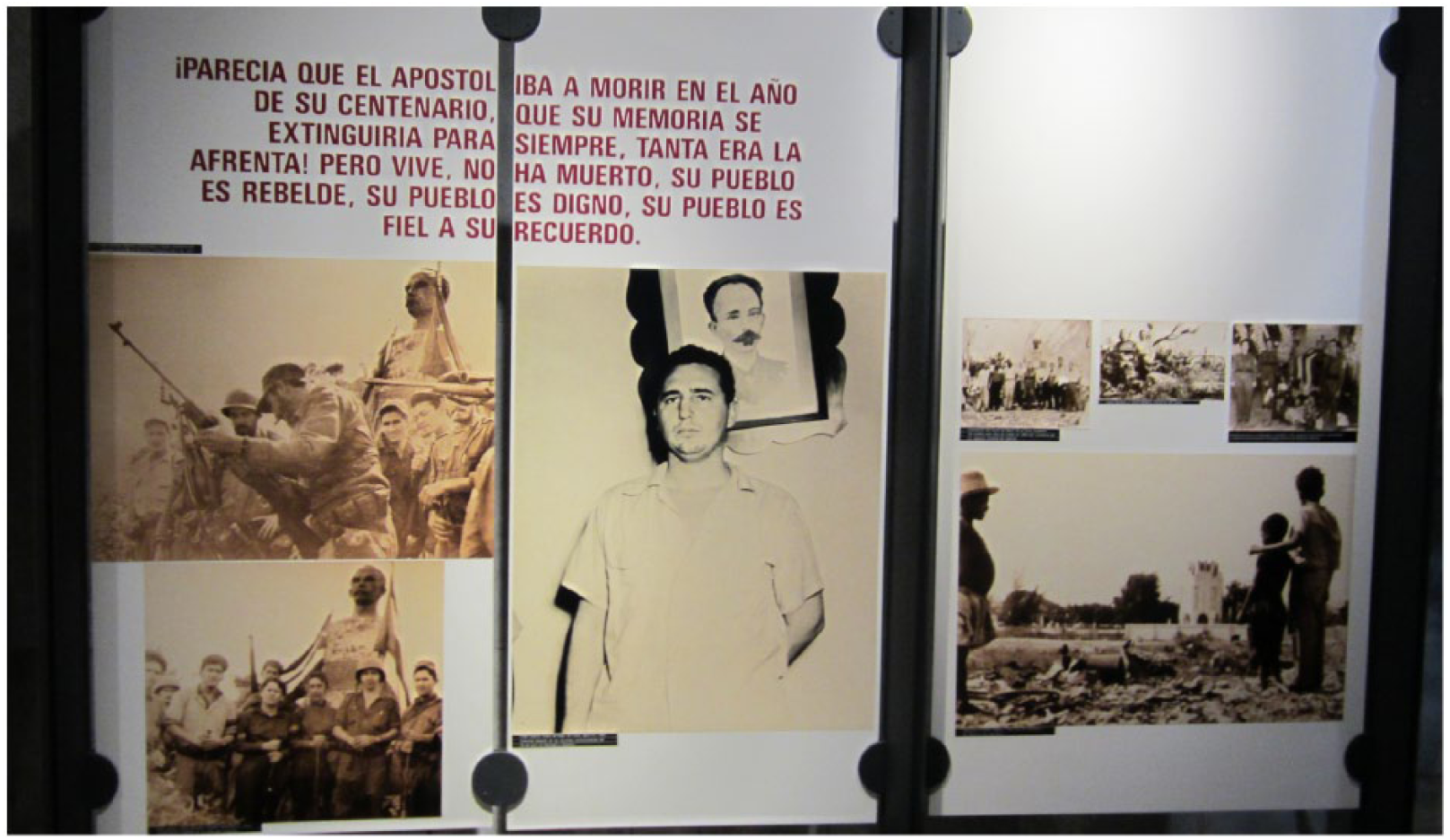
One of the panels in the José Martí Memorial highlighting the symbolic connection between Castro and Martí, where he appears close to different monuments of the ‘Apostle’.
Indeed, the Memorial highlighted the history of the Square of the Revolution and exhibited the performances of Castro during the 1960s as heritage discourse. The new text of the square can be interpreted as an attempt to provide legitimacy and real historic grounds—not only symbolic—to the Martí-Castro connection. The abandonment of performance became apparent in the inaugural ceremony of the Memorial. It was no longer a public performance of Castro and the PCC authorities in front of the masses using the square as a symbolic arena, but rather a private event for the restricted elite circle. The masses were only allowed to celebrate and occupy the streets a day after (Gonçalves, 2001). The Revolution has started a process of self-commemoration of its own past as heritage, reflecting a symbolic closure and the lack of prospective memories associated with future-oriented political projects. The relations between subjects and commemorative space are now mediated by a metacultural discourse, orientated towards self-reflection and identification with a Revolution that is portrayed as a constituent part of Cuban national identity. The Revolution does not attempt to spread new ideological texts, to create new material commemorative spaces, or to conventionalize collective behaviour, but to awaken individual identification with the Revolution enacted as commemoration. In this sense, the transformation of ideology into heritage can be considered a new organizational practice that should be incorporated to the notions of emplacement, enchantment and enactment in the analysis of organizational commemoration.
Conclusion
This article has analyzed the long-term relationships between the socio-materiality of commemoration, ideology and the state, showing the intrinsic connection between the organization of commemorative space and the production of hegemonic order and control. The study of the social construction of organizational memory in the Cuban case suggests that a relation exists between transformations in the state and ideology, and different organizing practices of commemoration. This analytic insight has implications for understanding how various articulations of distance between subjects and objects are constructed in the commemorative process. These relations reveal how different aesthetic experiences address the gap between past and present that organizational commemorations attempt to bridge, and how this serves to create the purposive memories that undergird political legitimacy. The legitimacy provided by commemoration is socially produced by power relations, conditioning whom, how and for what someone or something is remembered and materialized in the public sphere. From a non-representational standpoint, this article suggests the need to carry out long-term approaches to processes of commemoration in order to understand their changing dynamics and outcomes.
During the Republic, there was agreement about the emplacement of the Civic Square and the Monument to Martí in the outskirts of Havana, as a modern symbol of progress and a new city centre. However, the organization of commemoration became an arena, a physical or symbolic site for social groups to debate the meaning of history and struggle for power. Here, alternative interpretations of the past and political projects competed around the text, the histories and ideologies given voice by the memorial. Progressive intellectuals envisioned a commemorative space highlighting the revolutionary ideas of Martí. The enactment of the monument would have allowed Cubans to establish a physical relation with it, performing the democratic ideal of egalitarian relations between citizens and power. Instead, conservative groups emphasized the enchantment of the site, the creation of meaning through symbolism, over enactment: The commemoration should be organized to make of Martí a reified public symbol to capture the gaze of passive individuals, rather than a site to perform civic collective encounter.
After the revolutionary triumph in 1959, the text of the Civic Square was symbolically re-enchanted as the Square of the Revolution without major material transformations. The Square became a place where the encounter between the masses and political power was enacted through performance. Organizational commemoration served to conventionalize collective behaviour through patterned performances. In them, labour was organically connected to commemoration and performance, serving as a mirror for the socio-political organization of the country. Moreover, the revolutionary government constantly used martyrs and heroes to grant legitimacy to its projects.
During the Sovietizing period after 1975, the organization of commemoration focused on the construction of provincial squares. Based on realist socialist ideas of Soviet origin, the provincial squares were conceived as sites of socio-political encounter. They had to materialize the official ideological text and to stage mass performances, although with less intensity than in Havana. They functioned as arenas for competing understandings of how the past should be represented between artists and bureaucrats. Ultimately, however, they were dominant spaces due to their emphasis on organizing commemoration through a form of iconographic symbolism that erased any form of transcendence.
The failure of this Marxist-Leninist utopia after 1990 resulted in a re-organization of commemoration through a new organizing practice that emphasized cultural heritage and memory. The enactment of mass commemorative performances decreased gradually in Havana’s Square of the Revolution, which itself was transformed into a site of memory. Indeed, the construction and revolutionary re-enchantment of the square was exhibited in the Memorial José Martí. Here, Cubans were not supposed to engage with commemorative performance in an orderly fashion, or to passively observe Martí’s monument, but to engage in individual self-reflection and identification with the exhibition representing the Castro-Martí connection. This process reveals the functioning of dystopian commemorative policies in late socialist societies, where rulers base their legitimacy on history and heritage rather than on future organizational plans. Also, it reflects changes in the organization of labour at a broader scale in Cuba.
The construction of artefacts of commemoration in postcolonial Cuba was a contentious issue throughout the century. Their analysis sheds light on the actual organization of the state and the official representations of the desired state organization to be achieved. Commemorative spaces contributed to this end, because fixing historical consciousness, producing memory and attaching it to specific places was considered equivalent to fixing identity, memory and, ultimately, political allegiance. In terms of organizational legitimacy, the Cuban case shows how efficacy and the rational allocation of resources can be secondary to the creation of affective bonds and symbolic allegiance through state strategies of temporalization and spatialization. Indeed, this article suggested that the endurance of the Cuban Revolution in the face of the collapse of the Soviet bloc can be partially explained by Castro’s strategy of creating collective emotions and establishing affective bonds with the masses through commemorative performance, and of disconnecting himself symbolically from the bureaucratic apparatus. Therefore, the exploration of commemorative spaces as open-ended symbolic systems can shed light on how organizational structures gain acceptance from society, and how the material configuration of organizations intersects with the political relations between citizens and power.
Footnotes
Acknowledgements
The author thanks Pablo Riaño Fanjul at the Archive of the Historian’s Office of Havana and Tomás Lara and all the CODEMA staff for their support.