



Abstract
Alternative organizations have become increasingly of interest in organizational theory. Previously understudied, these organizations have also been ignored or forgotten in the dominant narratives and spaces of commemoration. This further limits what we know about the past and the potential of alternative organizations. To illustrate this problem, we offer a specific case study of the forgotten alternative organizations and marginalized space of a former Finntown alongside the commemorative narratives and practices of capitalist entrepreneur heritage spaces. Extending organization theory on memory and forgetting, we detail how commemoration not only tends to legitimate capitalist forms of organizing, but also excludes alternatives. Finntowns, with their emphasis on cooperative organizations and community, provide a unique opportunity for organization studies to explore commemoration and forgetting in terms of power relations, time, and space. These marginalized spaces contained alternative organizations coexisting and contrasting with dominant capitalist organizations. Remembering their contributions means taking alternative organizations seriously, acknowledging their historic importance as well as their ability to be models for contemporary organizations.
Introduction
Finntowns, once prevalent ethnic enclaves of the 19th and 20th centuries, make for interesting case studies for analyzing the spaces of commemoration and alternative organizations. A Finntown can be defined as a relatively self-sustaining settlement of Finnish immigrants where Finnish language would have been the dominant language spoken within the many established Finnish organizations. Koivukangas (2004) uses the criteria of specific institutions such as Finnish churches, cooperatives, temperance, or labor organizations as a baseline for a Finntown; community meeting halls and a community sauna are also distinguishing characteristics. Although independent businesses existed within Finntowns, cooperatively run businesses were a particular feature of Finnish immigrant culture (Alanen, 2014; Karni, 1980; Karni and Ollila, 1977). Finntowns comprised a large population of Finns, yet other ethnic groups often coexisted in these places and created their own organizations. Not all concentrations of Finns in North America constituted a Finntown with its assemblage of organizations. Some areas of North America had an extremely low population or lacked a consistent population of Finns, in contrast to others, such as the Upper Peninsula in the United States and Thunder Bay or Greater Sudbury in Ontario, which historically and currently have very large concentrations of Finns (Holmio, 2001; Loukinen, 1997; Saarinen, 1999).
Finnish cooperatives and community organizations were developed by the late 19th century within spaces that Finns themselves referred to as ‘nesting places’ or pesäpaikat, with the term ‘Finntown’ used perhaps around 1880 by non-Finns to identify these settlements (Alanen, 2014: 55). These organized communities were tied to the possibility of work in the mining, lumber or manufacturing industries for Finnish laborers. Some were also developed from Finnish farmstead communities (Alanen, 2014; Holmio, 2001; Koivukangas, 2004; Saarinen, 1999). Most provided a haven for Finns where their language and cooperative practices could be found within the wider culture that they worked in or interacted with daily. Although the beginning of the cooperative movement in Finland is generally dated at 1899, Finn’s experience in cooperatives from their homeland was not necessarily guaranteed nor an explanation for the origin of Finnish-American cooperatives (Alanen, 1975). These Finnish-American cooperatives were informed by the Rochdale cooperative principles developed in England in 1844, and only perhaps further encouraged by the extensive development of cooperative organizing in their homeland of Finland. The main reason for organizing cooperatively, as stated by early Finnish-American cooperators themselves, sprang from the need for economic relief from the exploitation of capitalist merchants and employers alike. Many Finns also had a vision for an expanding cooperative form of economic organizing that would become an alternative to capitalism (Martilla, 1919; Nummivuori, 1919). Similarly, radical labor organizations within Finntowns were in direct contrast and a part of the opposition to dominant capitalist organizations and practices (Karni and Ollila, 1977; Kaunonen, 2009; Kivisto, 1983). Currently, no former Finntown space has been fully materially preserved, although some individual buildings within these former spaces have been designated as significant historical sites (Alanen, 2014: 70).
Our research into the lack of commemoration of Finntown organizations contributes to the growing literature on organizational memory by including a focus on alternative forms of organizations (Cheney et al., 2014; Parker et al., 2014; Schneiberg, 2013). We address how alternative forms of commemoration can be achieved by careful excavation of silenced historical narratives (Decker, 2013, 2014) and through the use of multi-vocal antenarratives to counteract a single and exclusionary commemorative narrative (Boje, 2001, 2011). In our exploration of public commemorative spaces and the marginalized space of Finntown, our work also aligns with the recent spatial turn in organizational theory (Beyes and Steyaert, 2011; Clegg and Kornberger, 2006; Dale and Burrell, 2008; Zhang et al., 2008). Overall, our article is framed using a critical theoretical perspective and shares some similar concerns of postcolonial theory. We examine commemorative narratives and practices, in particular what is seen as important to remember and what is forgotten, not just within a single case of organization memory but rather how entire types of organizations become valued over others.
We contend that in our case of Finntown, the commemoration narrative of the large capitalist manufacturing companies of rich and powerful barbed wire barons has silenced commemoration of immigrant owned and cooperative organizations coexisting alongside the dominant form of organizing. Historical research on Finntowns can enrich organizational studies by reclaiming the contributions of significant, yet forgotten alternative organizations. Our research has implications beyond this immediate historical case and can contribute to future studies on commemoration, including those of contemporary alternative organizations within marginalized spaces. In the article, we detail how the practice of creating commemoration narratives of dominant capitalist organizations may exclude coexisting alternative organizational types. Our article asks what challenges exist for the commemoration of alternative organizations when they contrast with the dominant capitalist mode of organizing structure and inhabit a marginalized space. Given these challenges, how can alternative organizations be effectively commemorated?
Creating space for alternative organizations
Collective memory scholars have made clear distinctions between history and commemoration (Halbwachs, 1980 [1950]; Schwartz, 2008). Schwartz distinguishes between an objective record of history and the use of historical records for the subjective construction of commemoration. Commemoration of the past may vary during different historical time periods since ‘the issue which motivates its selection and shaping is always to be found among the concerns of the present’ (Schwartz, 1982: 395). Organizational theory has also begun to interrogate the uses of history within organizational studies, which has a similar link to the use of organizational commemoration (Decker, 2013; Rowlinson et al., 2014a, 2014b; Suddaby et al., 2010). History can be understood critically in terms of rhetoric or power as strategists within organizations view history as a malleable asset to be used to their advantage (Suddaby et al., 2010). This use of ‘rhetorical history’ becomes a resource for organizational image creation. An illustration of this process is Rowlinson and Hassard’s (1993) and Rowlinson’s (2002) study of the Cadbury corporation in their selective narrative construction of their history used to create an identity aligned with their Quaker roots and values. Those creating the narrative for the corporation sanitized this history by choosing new ‘founders’ and removing earlier instances of Quaker involvement in slavery. The corporation also used history selectively in its commemorative narrative. Both the centenary and the bicentenary were strategically chosen dates that did not reflect the actual timeline of the company’s history, but rather assisted in the constructed narrative. Rowlinson and Hassard (1993) perceive this strategy to be the case more generally, noting, ‘organizations impose the significance of historical events such as centenaries upon history, history does not impose these events upon organizations’ (p. 310).
Casey and Olivera (2011) further consider the aspect of power in this active process of organizational remembering and forgetting. They claim there is a ‘purposeful use of power and agency to shape what organizations remember and forget’ (p. 308). Citing a need for more research into these active processes, they include the factor of time, such as the decay of memory over time, the role of cyclic events in organizations and the intentional shaping of the future organizational image. Anteby and Molnár (2012) also illustrate this issue of time in their archival analysis of a French aeronautics firm whose ‘structural omissions’ shaped the corporate historical narrative not in a single creation but over a 50-year period. This strategic management of contradictory elements created collective memory for the firm, especially by consciously forgetting. Not only are historical narratives created by organizations, sometimes with the aid of in-house historians, but also memorialization of these rhetorical histories takes shape in company museums and heritage sites, as illustrated by sites such as Cadbury World (Rowlinson, 2002).
Nissley and Casey (2002) specifically consider the strategic use of corporate museum exhibits as a way to present organizational image through both the politics of memory and forgetting. In their exhibition practices, corporations manage their image by remembering certain aspects of their past but also by strategically forgetting. As Nissley and Casey (2002) describe, Hormel’s SPAM museum exhibit is clearly represented through a management lens and has almost no representation of labor issues. The commemoration of the corporate story is one ‘with the “labour” memory marginalized or, more accurately excluded’ (p. S42). The role of memory and forgetting is clearly a strategy for organizations in shaping their historical narrative. Commemorative narrative and practice within organizations can be carefully designed to remove any contradiction or unflattering aspects (Anteby and Molnár, 2012; Decker, 2014; Nissley and Casey, 2002). As Feldman and Feldman (2006) claim, ‘Acts of commemoration … not only help us to remember but also silence what does not fit the social order’ (p. 871).
Finntowns present an added challenge for organizational theory since their alternative organizations no longer exist and are often forgotten. The emphasis on cooperative organizations in Finntowns also tends to be an organizational type on the periphery of organizational studies. Cooperative organizations have qualities that distinguish them from their well-researched capitalist counterparts (Cheney et al., 2014; Latinne, 2014; Rothschild, 1979; Rothschild and Whitt, 1986). Whether they are housing, consumer, or worker-owned cooperatives, they abide by similar cooperative values of ‘equality, equity, mutual self-help, democracy and solidarity’ (Webb and Cheney, 2014: 71). They offer alternatives to individualistic, instrumentally rational, profit-focused corporate organizations that exist as the dominant organizing form within capitalist societies.
Alternative organizations are of recent interest for organizational theory, in part as a response to crises in advanced capitalism and the rise of anti-capitalist movements (Cheney et al., 2014; Parker et al., 2014). As defined by Parker et al. (2014), viable alternative organizations adhere to three general principles: autonomy, collectivity, and concern for the future, for instance, the practice of sustainability (pp. 36–39). One type of alternative organization, worker-owned cooperatives, has been cited as a successful example of an alternative to the dominant capitalist forms of organizing. Their unique organizational structure and values of collectivity have inspired innovations in organizational theory and empirical case studies (Cheney et al., 2014; Flecha and Ngai, 2014; Lambru and Petrescu, 2014; Schneiberg, 2013). For instance, the Mondragon Cooperative Group of Spain’s Basque Country includes 110 cooperatives and is the 10th largest business group in Spain (Cheney et al., 2014: 593). Flecha and Ngai’s (2014) research into this system of cooperatives claims that despite expansion in response to globalization pressures, they have ‘remained devoted to cooperative values’ (p. 667). Clearly, there are alternatives to the dominant competitive model of organizing within capitalism that are worthy of research. We agree with Parker et al. (2014) on the significance of alternative organizations for organization studies, yet we add that their commemoration is another area of previous neglect that needs to be addressed. Our case study of a former Finntown illustrates how alternative organizations and the marginalized spaces they inhabit tend to be overshadowed by a dominant narrative of commemoration, one that reinforces the idea that capitalist organizational structures are the only history worth remembering.
Problems of visibility may exist for alternative organizations, especially those within marginalized spaces. Commemoration at the national level in the West often reflects gendered and racialized spaces, privileging narratives of powerful elites and capitalist ideologies such as competition and individualism. Organizational identity narratives often tend to be constructed in line with these larger national identities, silencing some voices in order to portray a monolithic, cohesive identity that does not exist (Anteby and Molnár, 2012; Jack and Lorbiecki, 2007). If commemorations in public spaces tend to be of the ‘great men’ of history or capitalist elite organizations, this is a political process that includes forgetting others. As Lefebvre states, Space is not a scientific object removed from ideology or politics; it has always been political and strategic. If space has an air of neutrality and indifference with regard to its contents and thus seems to be ‘purely’ formal, the epitome of rational abstraction, it is precisely because it has already been occupied and used, and has already been the focus of past processes whose traces are not always evident in the landscape. Space has been shaped and moulded from historical and natural elements, but this has been a political process. Space is political and ideological. (Lefebvre, 1976: 31)
When powerful organizations help to define the identity of space they are situated in, their commemoration may contribute to overshadowing other organizations. Organizations can become important symbols of identity for the communities they exist within, contributing to the organization of space beyond their organizational walls.
Our case study of Finntowns extends the literature on strategic remembering and forgetting within individual organizations; to the dynamics of commemorative narratives between types of organizing that become enacted through public space. In determining whose lives matter and who should be remembered, Judith Butler (2004) argues for a ‘theory of collective responsibility’ (p. 44). This fundamental relationality speaks to the need for remembering alternative organizations, such as cooperatives in the marginalized space of Finntowns, as they have historically coexisted alongside capitalist organizational forms. Alanen (1975) claims of the Finns in the United States that ‘no other group, immigrant or otherwise, succeeded in establishing such a large number of consumers’ cooperatives that have existed over such a long period of time’ (p. 104).
In the process of remembering the significance of the Finnish organizations located within Finntowns, we do not want to further ‘other’ those within marginalized space, creating a less nuanced understanding for the interconnections and differences within spaces and between them. To create a more inclusive, multi-vocal approach, Boje’s (2001) idea of an ‘antenarrative’ allows for commemorative stories to be told in place of fixed, linear narratives. Dominant narratives attempt to close off possibilities, but interaction with them provides ‘living stories’ and the tension between these two forms can result in identifying the antenarrative, or what was previous to the narrative. The living story connects to walking and touring interactions with material space (Boje, 2001), and can also encompass archives and oral histories that have not been hardened yet into a narrative. A commemorative antenarrative best represents the stories of alternative organizations and their relationship to the dominant commemorative narrative.
After outlining our specific case and elaborating our methods, we begin with the presence of the dominant commemorative narrative of the barbed wire baron’s capitalist form of organizing, then the partially reconstructed story of Finntown’s alternative organizations, and finally, the possibility for a relational, multi-vocal commemorative antenarrative.
Forgetting through time and space
The former Finntown of DeKalb, Illinois, is representative of the type of Finntown within a midsize manufacturing town (Alanen, 2014). DeKalb, IL, is a city approximately 60 miles west from Chicago, with a population of 43,862 (U.S. Census Bureau, 2010), and known as the ‘Barb City’ because it is the place functional barbed wire was invented (Figure 1). This city, located an hour from Chicago and on train routes, was promoted by the DeKalb Improvement Association at the time as ideal for industry, as seen in the text insert of the 1892 map featured in Figure 1. The key industry for the city was barbed wire. Barbed wire, once symbolic of the reshaping or ‘taming’ of the West in the United States, has become an even larger symbol of control throughout the world (Krell, 2002; Razac, 2002; Starr et al., 2011). Ironically, the origin story of barbed wire is also connected to commemorative boundaries, exclusion, and control, as the official narrative of barbed wire excludes the very workers who made the product.
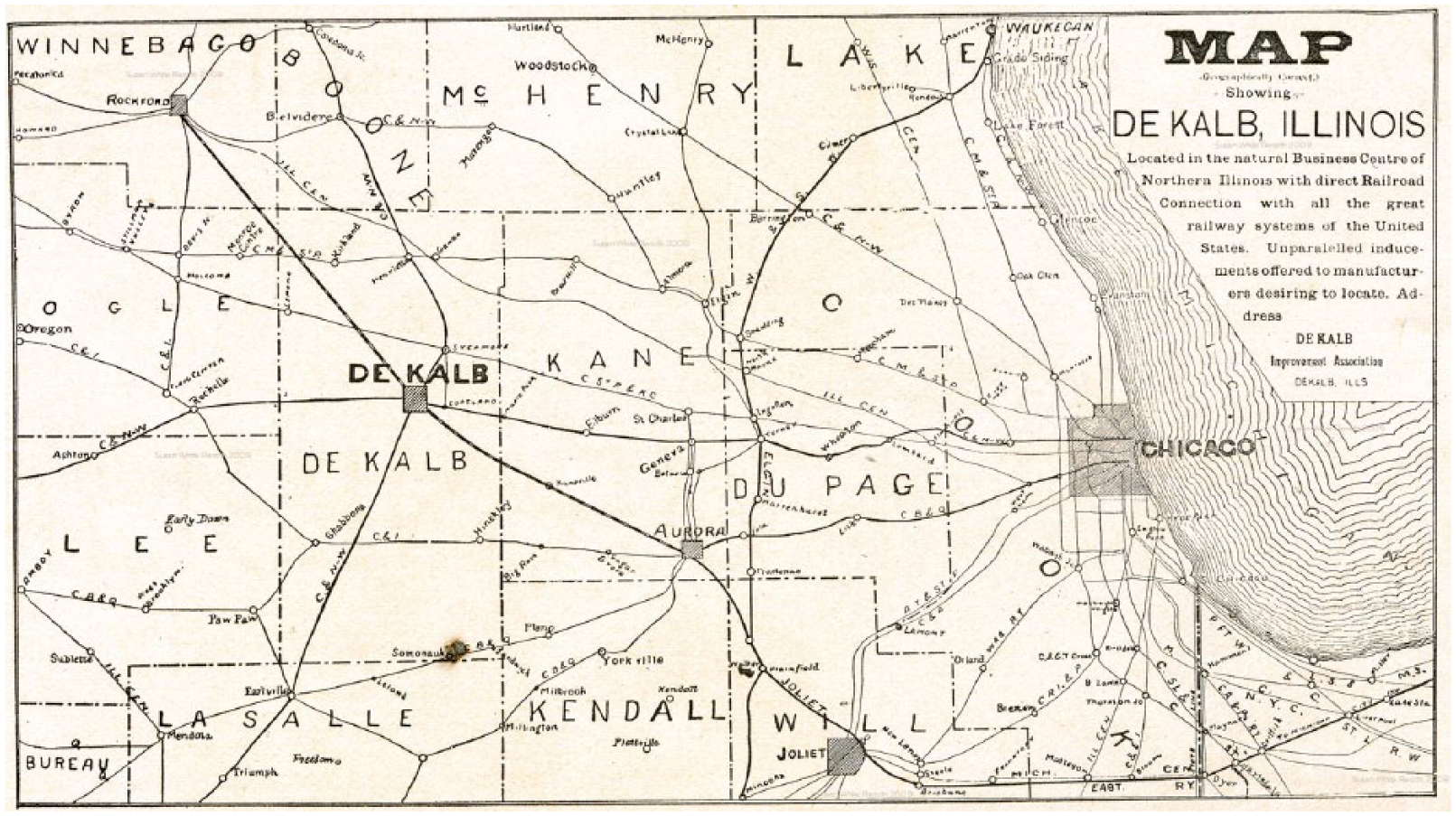
1892 Map of DeKalb, Illinois.
While the capitalist barbed wire barons’ organizing contributions are predominantly remembered, the presence of Finns in DeKalb as a cohesive immigrant population inhabiting the 3rd Ward from the late 1800s to 1970s and their organizational emphasis on cooperation are scarcely mentioned in official histories. There are still some Finnish Americans living in DeKalb; however, they are no longer concentrated in the 3rd Ward and are second- or third-generation Finns. The significant buildings built by the Finns that created this Finntown are still standing in the 3rd Ward: the Temperance Hall, the Worker’s Hall, the Mercantile Cooperative, and the Dairy Cooperative, as well as former boarding houses, private businesses, and homes. These buildings do not have official city markers of any kind explaining their history. Former factories also exist in this area and the Finnish workers lived within walking distance to these factories. Some of these factories are abandoned and some are actively used for current businesses.
Exploring presence/absence and commemoration
In our historical case study of the alternative organizations of a forgotten Finntown, we utilized public and private archival data, and then triangulated these data with an interpretive analysis of dominant commemorative textual narratives and material spaces. We wanted to understand how a significant number of alternative organizations, many organizing cooperatively, had been excluded from the dominant commemorative narrative. The former Finntown is located in an area separate from the location of capitalist entrepreneur heritage sites and we only learned of its history through attending a public event at one of the former Finnish halls that currently operate as a community center. From the fragmented stories we heard during this visit, we realized that the investigation into Finntowns offered insights into a group of organizations within a space set apart by their alternative type of organizing built around community and cooperation. We examined the dominant commemorative narratives and practices to understand the exclusion of these alternative organizations of Finntown.
One way commemorative narratives are constructed and reconstructed is through archival data. We had access to two local public archives that hold regional collections, and we searched their records for Finnish organizational documents from the late 1800s through the 1950s, the historical time period of most Finntowns. Through our contacts from the existing community center, we gained access to partial and random personal archives of a few Finnish American residents. These residents also suggested a secondary source written by a local archivist that provided an overview of the local Finnish community. We followed the leads provided in these sources to identify our archival search terms for organizations such as the DeKalb Milk Consumer Cooperative. All of the archival data that were available on Finns locally were in English and therefore accessible to us. We searched two major local archived newspapers the DeKalb Chronicle and the True Republican and commemorative programs for data on Finnish organizations and events over the same time period. Archived foreign language newspapers were not available in any local public institutions or from any private sources. In addition to the above primary local documents, we used secondary sources on Finnish immigrant community locally and nationally for historical context. As discussed more in-depth later in the article, the lack of local archives on Finnish organizations became part of the evidence that this Finntown and its alternative organizations had been further marginalized in historical records. Our lack of archival results on the former Finntown brought about new methodological questions and pushed us to explore the dominant commemorative narrative as presented to the public through text and material space.
We examined the commemorative places promoted by the pamphlets and walking tour guides that the DeKalb County Convention and Visitor Bureau meant for public consumption in the prominent areas of the city, comparing extensive notes and our interpretations. These designated commemorative spaces included house tours of the city’s early capitalist entrepreneurs, museums, and self-guided walking tours. We conducted an interpretive analysis of the Convention Center and Visitor Bureau documents and their presentation of commemorative spaces, not only as text, but through interaction with material space. As much as commemoration may be produced, it is also consumed through interpretation, and as Young (1993) notes, there is a ‘fundamentally interactive, dialogical quality of every memorial space’ (p. xii). Dale and Burrell (2008) suggest using Michel de Certeau’s concept of ‘walking rhetoric’ when analyzing space and organizations (p. 110). They have connected this to Lefebvre’s ideas that the everyday organization of space incorporates both representational and represented space and thus becomes negotiated (Dale and Burrell, 2008: 110). The notion of representational space assumes that those taking the historical tours are free to interpret the representation of space in varied ways; however, this organized space is intended to commemorate the capitalist mode of production: Thus space may be said to embrace a multitude of intersections, each with its assigned location. As for representations of the relations of production, which subsume power relations, these too occur in space: space contains them in the form of buildings, monuments and works of art. (Lefebvre, 1991 [1974]: 33)
Following the commemorative narrative as it existed in public spaces provided us with empirical data derived from its material representation.
There were no pamphlets or self-guided walking tours of the former Finntown available at the Convention and Visitor Bureau. Therefore, through secondary sources and some archival data, we found names and addresses of former Finnish organizations and then walked through the neighborhood to identify these places and note if their former buildings still existed. Many of the buildings of the former Finntown were still there; however, we also noted that they were not publicly recognized by any historical markers. We needed to reimagine the places of these alternative organizations of Finntown without the aid of much archival data to consult and only unmarked spaces to encounter. We had to reconstruct an antenarrative to understand Finntown’s organizational history, using the fragments of the forgotten as suggested by Boje (2001, 2011). This included interpreting this contrast of presence and absence from archives and material space.
We found Decker’s (2013) ‘silence of the archives’ pertinent to our case as it addresses the influence of postcolonialism on historical research, in particular as it pays close attention to the absences in archives. There are many ways that the creation of archives becomes an incomplete record of history, sometimes even unintentionally. According to Decker (2013), this can include ‘the suppression of certain kinds of information by archivists through access policies or weeding, decisions about what to deposit by business, as well as what kind of information organizations deem important to collect in the first place’ (p. 12). Private archives can also suffer from a similar weeding process as public archives, due to decisions about what is important over time. For instance, in the case of Finnish organizations, many third-generation Finns do not speak Finnish and the significance of archives written in Finnish may not always be fully realized by these descendants. It may also be that archival information that had been available in private collections was never contributed to public archives. And even this assumes that the original organizations had kept historic records and passed them down through private individuals. As Decker (2013: 8) notes, businesses may be uninterested in their past or in preserving their records. This could be one conceivable reason that there are no records for many of the cooperative groceries, bakeries, and other cooperative ventures of Finntown.
Identifying the commemorative narrative of barbed wire manufacturers
The commemoration narrative uncovered through our archival research and analysis of commemorative material space largely reflects a ‘Great Man’ approach that is the dominant narrative. In this case, the ‘Great Men’ are not surprisingly the inventors and manufacturers of barbed wire: Isaac Ellwood, Joseph Glidden, and Jacob Haish—the capitalist elite of the time. We found these men to be commemorated in many ways, including street names, museums, home preservation, and plaques. Ellwood perhaps features the most prominent of the three men. The Ellwood House, on the National Register of Historic Places, is open for visitors and tours, maintained and operated by the non-profit Ellwood House Association and the DeKalb Park District (Figure 2). In archival records, we found that the Ellwood House Association was created in 1969, taking over joint management of the house following the transfer of the house from the DeKalb County Fine Arts Association (DeKalb County Fine Arts Association Collection, 1961–1979). Additionally, the neighborhood surrounding the home was declared a historical district in 1997, after the efforts of the Landmark Commission came to fruition (Datema, 1997).
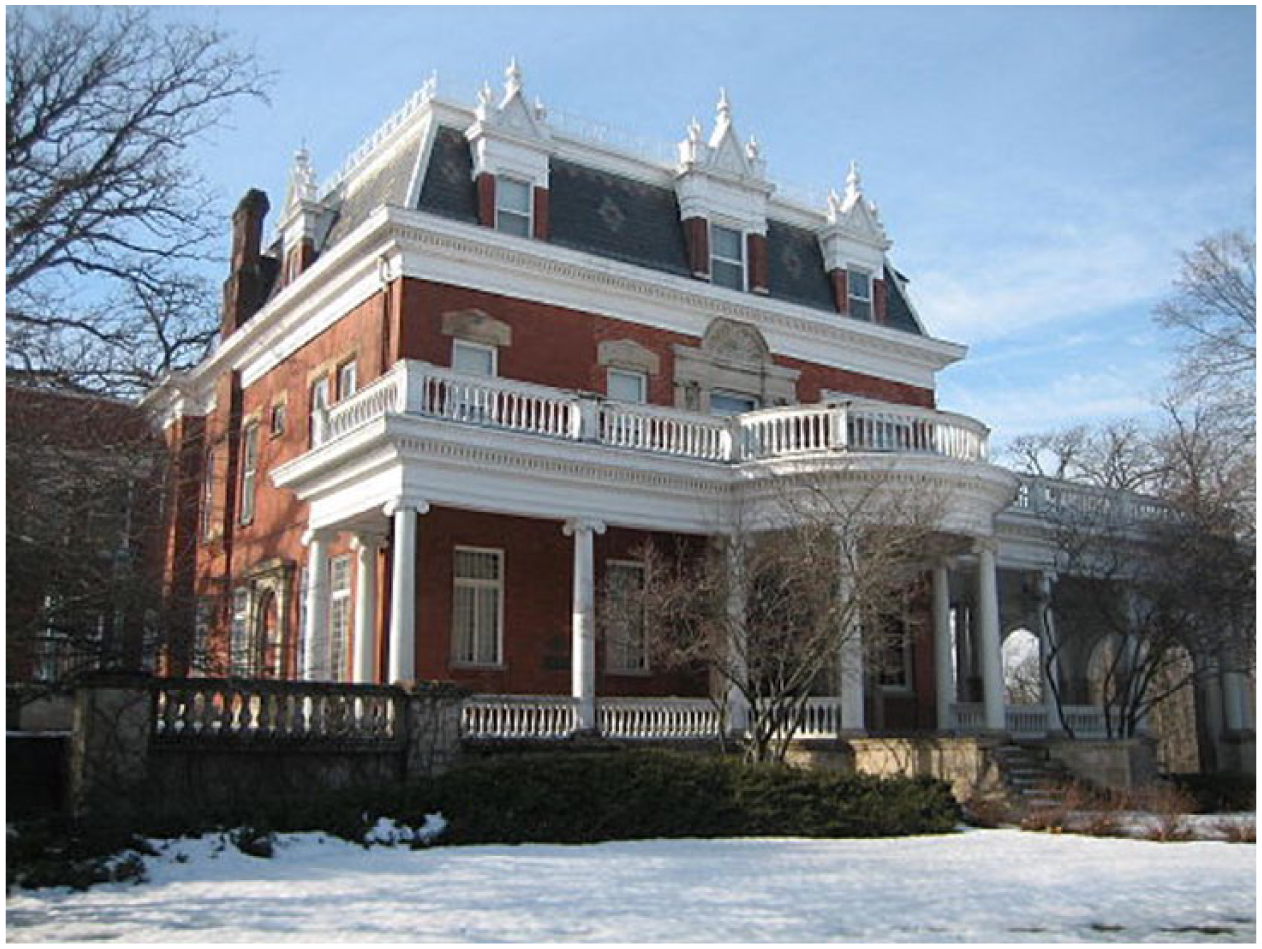
Ellwood House.
Our first commemorative site to explore, the Ellwood mansion, featured a visitor center adjacent to it with an exhibition on the history of barbed wire and the manufacturing companies that produced this significant invention. We examined the permanent exhibit, which includes a wall of physical samples of the many types of barbed wire, photos, and narrative of the factories and the mansions of the capitalist owners. The exhibit also features a detailed history of barbed wire patent wars and disputes with ranchers who did not want the range to become fenced. This nod to a more contested narrative of barbed wire offers some idea that this industry had conflictual elements, but it does not include all of these, leaving out labor disputes and other groups besides ranchers affected by the fencing of the West. Barbed wire has been named as a tool for the ‘political management of space’ (Razac, 2002: 72). (Also see McCallum and McCallum (1965) for more on the history of barbed wire.) The exhibit on the history of barbed wire was installed in 1997, replacing an exhibit on farming, Native Americans, and horses. According to a docent we spoke with, these themes gave way to the ‘more important’ theme of the history of barbed wire in DeKalb (2011, personal communication). The restored Ellwood House represents the lifestyle of the barbed wire millionaires. As summarized on the Ellwood House website, The story of the Ellwood House reflects the central role of Isaac Ellwood in the development of the barbed wire industry in America. The magnificent estate is also a testimony to three generations of the Ellwood family whose tastes shaped the evolution of the house and grounds. As you visit Ellwood House you will be aware of the comfort and quality of workmanship that wealth could provide. (http://www.ellwoodhouse.org)
Unlike recent trends in museums exhibits, there is not any comparison to the lives of the workers of the factory. We found a few pictures of unidentified groups of male workers in the exhibit. The guided tour we took of the Ellwood mansion included the servant’s room and more detailed discussion of one long time loyal female Swedish house servant. Finnish community members have told us that this is not representative of the many Finnish female domestic workers who were supervised by the Swedish employee and did not live in the house.
Another prominent figure in the larger commemoration narrative is Joseph Glidden, who is regarded as the first to invent barbed wire in 1874. There had been some forerunners of the idea; however, Glidden’s invention is the one associated with successful functioning barbed wire. According to the information we obtained from the Glidden’s Homestead website, ‘Glidden’s invention is a true American story. His innovation not only affected DeKalb County, but it had far-reaching impact on the development of the American West and ultimately, the world’ (Vance Siebrasse, http://www.gliddenhomestead.org). Ellwood and Glidden became partners and founded The Barb Fence Company. Glidden sold his share of the company in 1876 (retaining royalties) to Washburn and Moen, who along with John W. Gates, Isaac Ellwood, and his I.L.Ellwood Company transformed the business into American Steel and Wire in 1898–1899, which eventually became a subsidiary of US Steel in 1901 (McCallum and McCallum, 1965). We visited Joseph Glidden’s Homestead, which includes a museum and gift shop. The building is in the process of being fully restored and is also on the National Register of Historic Places (Figure 3).
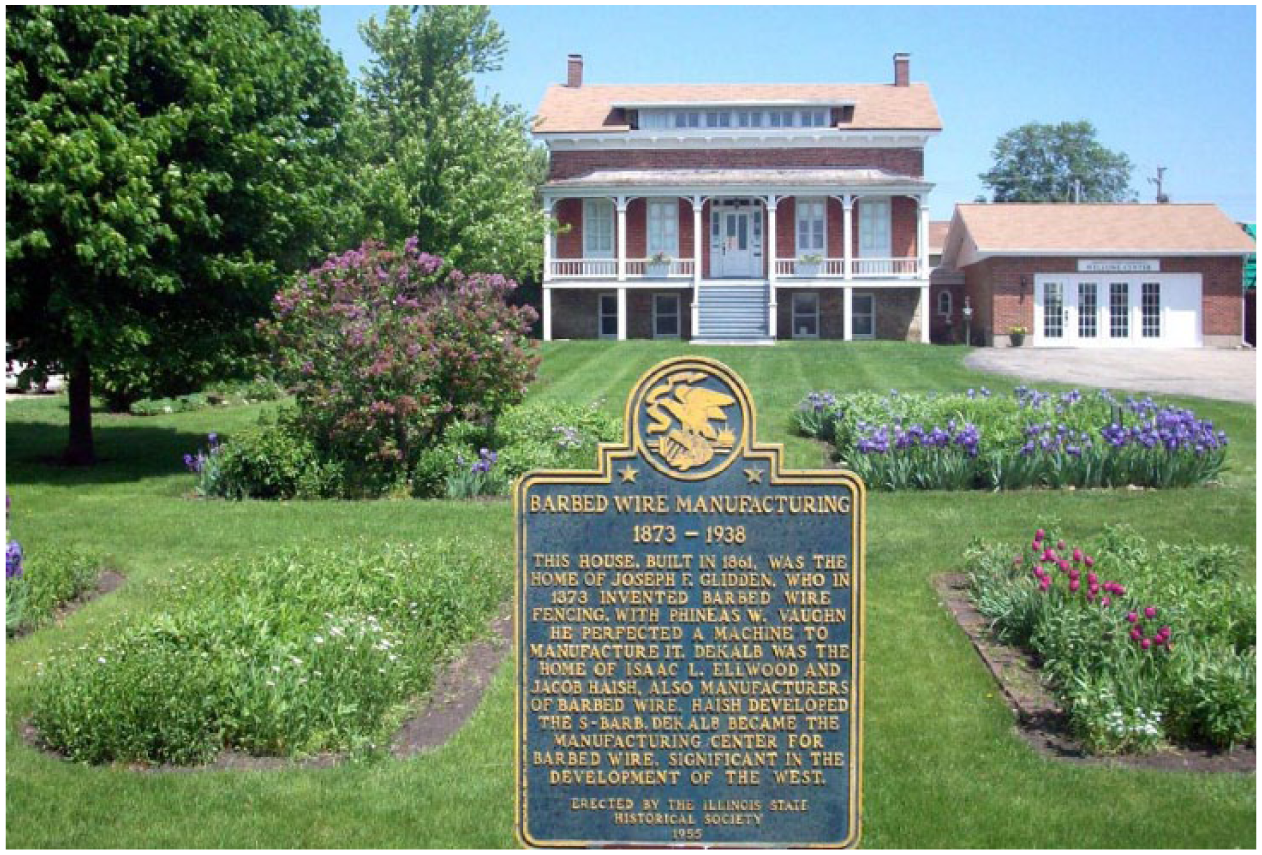
Glidden Homestead.
Jacob Haish, who challenged Glidden over the first patent on barbed wire and eventually lost this patent battle, is another recognized name in the city. He became known as the inventor of the ‘S Barb’ type of barbed wire and started the Barb City Manufacturing Company in 1895. Haish was responsible for building many of the city structures during his time, yet only some of them remain. He had an elaborate mansion; however, this was torn down in 1961 (http://www.jacobhaishmfg.org/). Although we were not able to view the Haish mansion, photos of the mansion, as well as his colorful barbed wire advertising posters, were featured in the barbed wire museum. We were able to visit the public library, one of the buildings that bears his name, built due to his generous donation and listed in the National Register of Historic Places. Like the other two barbed wire factory owners, there was also a website we were able to view for information that expanded the commemorative narrative.
Together, Glidden, Ellwood, and Haish became known as the ‘Barbed Wire Barons’. Although the descendants of the barbed wire barons contribute to their legacy through financial support and donations of material artifacts, active others who can be termed ‘agents of memory’ (Schwartz, 1991; Vinitzky-Seroussi, 2002) have helped to elevate the level of commemoration for these barbed wire barons and their manufacturing companies. Individual agents of memory become powerful influences as they are tied to organizations that serve as institutional agents of memory. The local historical society, landmark commission, and the societies formed to support each of the barbed wire baron homes and museums were all involved in maintaining and in some cases recreating the legacy of the capitalist elites. They were also aided by state and national organizations that supported this legacy, viewing it as significant to the state and the nation. The commemoration of the barbed wire barons through these agents of memory goes well beyond enclosed museum space and rather encompasses large sections of the city. Steve Bigolin is the former chair and co-founder of DeKalb’s Landmarks Commission, which was created in 1978. Since 1986, Bigolin gives historic bus tours of the city during Cornfest, an annual city sponsored event originating in 1977 and attracting 100,000 people currently. A local newspaper’s description of one of these tours explains the focus: ‘Bigolin featured 30 residential and commercial buildings five times daily Saturday and Sunday, describing the history of DeKalb through the eyes of prominent historical figures’ (Aschinger, 1999). These prominent historic figures do not include anyone from the immigrant community of former Finntown.
While these historic DeKalb tours happen annually, other tour opportunities exist through special events. There are also brochures for year-round self-guided walking tours available at the city’s Convention and Visitor Bureau. The main tour that we engaged with features the downtown area including heritage museums, murals, and memorials. These tours were created in 1990 by the DeKalb Landmarks Commission from the results of their historical and architectural survey of the downtown area. As Bigolin explained, ‘In the process of conducting the survey … commission members developed the basis for a sidewalk and back-alley walking tour of downtown DeKalb’ (Bigolin, 1991). These self-guided tours promote a proscribed, dominant narrative attempting to direct the everyday experiences of space. The map of heritage sites features a commemoration of the capitalist elite and their organizations without including the material sites of the means of production or identifying any immigrant worker heritage sites, physically cutting the tour map off at one side at the start of the original boundary of Finntown. The history and former locations of cooperative organizations are also effectively removed from the commemorative narrative.
We encountered three major murals in our walking tour and a significant war memorial site all located downtown. The three major murals in the downtown are visible from Main street: one commemorates Lincoln Highway with a representation of a high end motor car and elite of the day riding on the highway during its early days; another features famous luminaries connected to Illinois and DeKalb. The city can surely claim to be the only one in the world that has a mural that includes Abraham Lincoln and hometown supermodel Cindy Crawford portrayed together. One prominent mural features Annie Glidden, niece of Joseph Glidden, as a farming woman, as well as a picture of the three barbed wire barons and stories of the early history of the city. Memorial Park is adjacent to the Annie Glidden mural on First Street. The small park contains a tank and a Soldiers and Sailors of World War I (WWI) Memorial Clock dedicated in its downtown location on 13 February 1924 (Higgins, 2004: 114). The Memorial Clock Monument is quite visible in DeKalb on the corner of First Street and Lincoln Highway. The nearby tank is also a gathering point and a Memorial Tank Service is held there on Memorial Day. This memorial site connects DeKalb to the larger national identity of patriotism.
Bodnar (1992) maintains that the pressure for patriotism following WWI included pressure on immigrant communities to replace their specific cultural identities to be more in line with the nation-state. The initial response of Finns led to the sense that their collective ethnic identity needed to be preserved. Local DeKalb Finns formed specific cultural organizations to preserve their culture. Similar to the Finnish cooperative organizations, these cultural organizations fit criteria set out by Parker et al. (2014) for alternatives as they featured not only the ability for individual autonomy but also supplied collective welfare through mutual aid and a concern for the future of the alternative space of Finntown. DeKalb Finns formed a Knights of Kaleva chapter, a National Society, and Finnish Folk Dancers group in an effort to preserve their cultural heritage (Arra, 1971). Yet, they were eventually pulled into the larger cultural activities of the city, which sometimes conflicted with maintaining this cultural heritage and their focus on cooperative organizing.
In 1956, the city of DeKalb held a Centennial that stretched for several days in the month of June and included a ‘huge historical pageant-spectacle’ titled ‘The DeKalb Story’ (DeKalb Centennial/Bicentennial Records, 1903–2006). Our analysis of the centennial archival documents revealed that coverage of events which represented the early pioneer and settlement of DeKalb and history up to 1956 did not have any mention of immigrant history or labor. However, the DeKalb Centennial, a special commemorative booklet, featured a small paragraph about the Finns. This focus is very telling for the commemorative framing of Finns by 1956 in DeKalb: The Finnish people of DeKalb early banded together for worship. In 1895 they began to meet in the Finnish Temperance Hall and later built a church of their own at State and Market Streets. In 1955 on the 60th Anniversary of the Bethlehem Lutheran Church they voted to build a new church to care for the growing needs of the congregation. (DeKalb Centennial Souvenir Booklet, 1956: 66)
This new church was moved to a space outside of Finntown and began to gradually become less exclusively Finnish. The story of the Church Finns is communicated as representing the Finns of DeKalb altogether (and interestingly the Church location in the description is also recorded incorrectly). Only one of the two meeting halls that the Finns built is mentioned. Finnish connection with temperance and religious organizations is marginally represented, but cooperative or radical labor organizations are completely absent.
In this same commemorative booklet, the success story of the barbed wire barons radiated out to all local capitalists in a general way. Capitalist businessmen became ‘pioneers’: To mention the names of the merchants whose fair dealings and large stocks brought business to DeKalb would be impossible. They were the pioneers who served a trading area many miles in extent [sic]. Today the successors of these merchants are upholding the reputations won by hard work and good merchandise. (DeKalb Centennial Souvenir Booklet, 1956: 44)
The ‘founding narrative’ becomes rewritten to feature capitalism and its entrepreneurs in a dominant narrative, without the competing narrative of the cooperatives or any radical political organizations of Finntown.
In 1892, the same year that the first few Finns arrived in DeKalb, the major local newspaper, the DeKalb Chronicle established in 1879 with the first publisher none other than Joseph Glidden, barbed wire baron, published a special edition on the history of DeKalb: ‘The City of DeKalb. Its History and Institutions, with Illustrated Sketches of its Industries and Some of Its Citizens’. It was not the first history of DeKalb to be published, but the first to represent DeKalb as more related to industry than farming. The few past histories dealt with the first settlers, farmers, and early businessmen. The special edition of this history, which fits with the commemorative narrative of the city currently, set out specifically to represent the history of the town in a different light than previous accounts. The special edition begins, It is not the purpose of this article to deal in ancient history. It is only the antiquarian that is interested in knowing when the noble red man erected his tepee on the ground where now stands the city hall, or the wild beast sought his lair on the sight of the Glidden House. The living, pushing business man of today has to do with the present. What are DeKalb’s advantages as a literary, religious and social centre? What are its relations to the marts where buyer and seller meet? What are its industries? What is the reputation of her products? (DeKalb Chronicle, 1892: 9)
The image of the city put forth was claimed by this leading area newspaper to be objective and ‘without embellishment’ (DeKalb Chronicle, 1892: 9). However, the narrative does place a premium on industry and is from the vantage point of business, as it seems to promise from the first article in the DeKalb Chronicle’s special edition on the history of the city. The highlighted feature of the city is manufacturing: The chief interest of our lively little city is centered in her manufacturing interests. We have three that are world-wide in reputation: viz., The Ellwood Manufacturing Company, the largest barbed wire factory in the world; The Haish Manufacturing Company, whose product is known wherever the English language is spoken, and The Superior Barbed Wire Company, that is doing a successful business in nearly every state and territory in the Union. (DeKalb Chronicle, 1892: 9)
The report on labor paints a positive view of labor relations in DeKalb: ‘Labor is plenty and there is a noted absence of strikes and interruptions as is so frequent in other places’ (DeKalb Chronicle, 1892: 9). The future of the city is described as indebted in large part, if not fully, to the capitalists of DeKalb: ‘The demand for dwelling houses is away in advance of the supply. Our capitalists will speedily fill this void by distributing over the city a large number of fine cottages of moderate cost and low rental’ (DeKalb Chronicle, 1892: 7). DeKalb was not a company town, as were some early industrial settings; however, the low rental housing can easily be assumed to be for the immigrant workers of the barbed wire factories. A later local history published in 1963 by H. Davy commemorates DeKalb’s capitalists in a chapter titled ‘Benefactors of Mankind’. Capitalists were portrayed as being generous benefactors toward workers and the city.
The forgotten alternative organizing of DeKalb’s Finntown
Although unrecognized by the city’s commemorative narrative, immigrant workers are also very much a part of the barbed wire story. As some of their descendants emphasized to us, Finnish workers are the ones who made the barbed wire. However, other than a few generic references to workers, they are largely absent in the official commemoration narrative of the city. We were able to find population details from private archives and census records. As early as 1892, a few Finnish men came to DeKalb to work in the barbed wire mills, soon to be followed by others. Finnish women eventually arrived and worked as domestic servants in the homes of the barbed wire barons (Metzger, 1990). By 1930, the 3rd Ward population peak was 2,203—the largest ward in the city’s total population of 8,545 (US Bureau of the Census, 1930: 324).
During our self-created ‘walking tour’ of the former Finntown, we verified street names and building addresses to correspond to archival data and stories we had been told of former cooperative organizations, social and cultural organizations, independent businesses, and collective housing. We started at one of the remaining buildings in the former Finntown which is a large, striking building once known as the Majakka Hall, built for the Finnish Temperance Society in 1917 and now home to the non-profit DeKalb Area Women’s Center (Figure 4). The former Worker’s Hall is approximately two blocks away and was built in 1914. Currently, this building houses the non-profit organization Conexion Comunidad that offers a range of services to the Latino(a) community and creates awareness of Latino(a) culture to the entire DeKalb community (http://www.dekalbcountynonprofits.org). We had access to the inside of both of these halls as they are contemporary community centers and open to the public. We also located the original Finnish-built buildings still standing that housed the first Mercantile, Bakery, and Dairy Cooperatives. The buildings are currently used for other businesses and residential sites in the neighborhood.
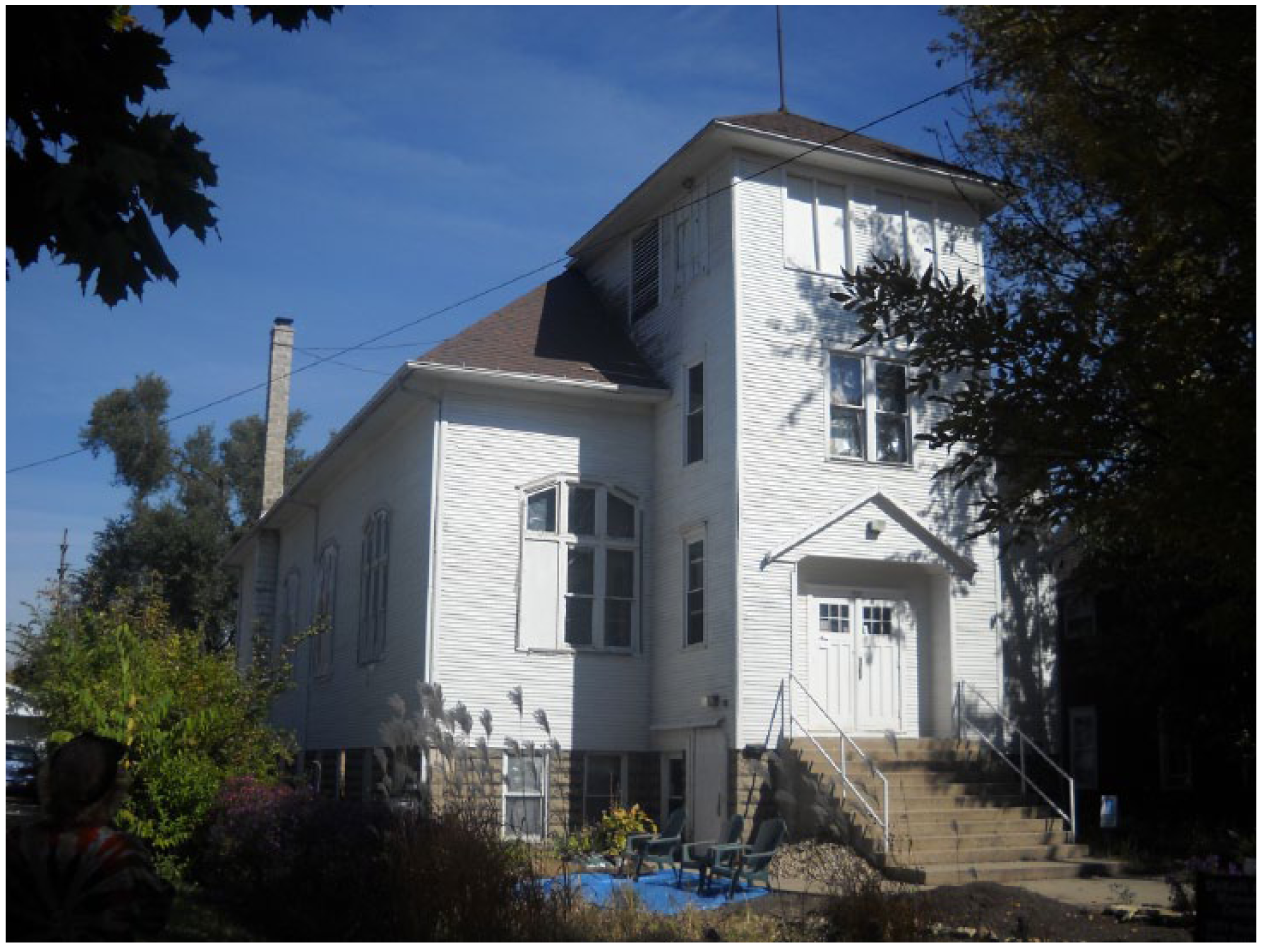
Majakka Hall.
The history of the two main Finnish Halls connects these spaces to important organizations within the former Finntown. We have a general story of these organizations from secondary sources, a limited amount of public and private archival data, and a few recorded oral histories. Majakka Hall was just one of the former temperance buildings emerging from the local Finnish Temperance movement. DeKalb had two early Temperance societies that split on ideological differences. The Kylvö society was formed in 1896 and was officially terminated in 1921; it was the stricter of the two temperance societies. Kylvö was a member of the Finnish National Temperance Brotherhood (Arra, 1971; Metzger, 1990). The building that it met in is still standing in the 3rd Ward and now used as an apartment building. The other temperance organization, the Majakka Society, began in 1901, eventually building their own hall and dedicating it in 1918 (Arra, 1971). From private archives, we were able to view surviving photos of Majakka Hall, clearly showing it as a significant place of many cultural activities such as plays, music, dances, and gymnastic clubs. These activities were meant as wholesome alternatives to alcohol but took on importance as cultural continuity as well. Mutual aid was provided, as a cooperatively run cafeteria was located in the basement of the Hall. According to secondary sources, large summer festivals for Illinois’ Finnish temperance groups were regularly held in DeKalb, drawing in crowds from other cities. DeKalb was also the site of a larger significant Temperance event for the Upper Peninsula and Midwestern societies, as an archival photo of the ‘Peace Meeting’ of Temperance representatives standing outside the Temperance Hall illustrated (Arra, 1971). The Majakka Temperance society lasted officially until 1953, although the Majakka Hall was sold in 1949 to non-Finns (Arra, 1971; Metzger, 1990).
We learned from secondary sources that the DeKalb’s Worker Society, established in 1904, built the Worker’s Hall in 1914 (Arra, 1971; Metzger, 1990). The cornerstone still displays the dedication date of the building. It is a smaller building as compared to the Temperance Hall, but both halls have a similar stage, balcony, and functional basement area. The Worker’s Hall was also a social hall similar to the Temperance Hall, sponsoring music, plays, dances, and clubs such as gymnastics for men and women (Arra, 1971). Women were an active part of the radical labor movement in DeKalb, as elsewhere. In Finland, women had the right to vote and be elected to parliament as early as 1906, influencing Finnish-American women involvement in US social movements organizations (Ross and Wargelin Brown, 1986). DeKalb Finns were at various times affiliated with the Imatra League, the Socialist Party of America, and the Industrial Workers of the World (Arra, 1971). Finnish involvement in these national organizations also speaks to their awareness and support of the larger transnational labor movement. The DeKalb Workers Hall was sold in 1941, the dwindling membership related in part from unemployment and relocation of workers when the local barbed wire mills shut down in 1938 (Arra, 1971).
Both the ‘Church Finns’ and radical Finns were involved in local Finnish cooperative organizations. This distinct Finnish immigrant alternative or economic supplement to capitalism became very important to the larger Finnish community, an example being the Central Cooperative Exchange (CCE) formed in 1917 in Superior, Wisconsin. The CCE was an umbrella organization providing central purchasing for Finnish cooperatives throughout the Midwest (Karni and Ollila, 1977). Many Finnish cooperative organizations were very successful, yet their success is not often remembered and their archival records scant or nonexistent. In DeKalb, the Milk Consumers Association began in 1917 and was in operation for 50 years, serving the full ideological spectrum of Finns as well as being available for others in the neighborhood (Arra, 1971). Not many in-depth records exist on this coop, but we know that ‘during the last years of operation there were 400 members in the cooperative. At the same time, the regular number of consumers was over 2,000’ (Arra, 1971; DeKalb Milk Consumers Association Records, 1922–1971). DeKalb had two Mercantile cooperatives, one lasting for 5 years and the other for 10 years (Arra, 1971). The Majakka Temperance Hall operated a cooperative dining hall in the basement of the building; its purpose was to serve meals to the Finnish men working in the nearby mills (Metzger, 1990).
Some of the other Finnish buildings in Finntown we searched for had burned down or were torn down. One of the old church buildings had burned down and the new one had been relocated out of the 3rd Ward. We visited the current location of the church to view some pictures of the old church in Finntown that they have displayed on their walls. In walking through the Finntown neighborhood, we also found the site of the former sauna, a former significant community gathering place. The lot is empty and unmarked. The sauna was in use all the way into the 1970s and was torn down in a campaign to tackle perceived blight in the 3rd Ward in the late 1980s (Metzger, 1990). A neighborhood organization, the Third Ward Coalition, was formed in 1988, claiming a loss of ‘pride’ in the neighborhood and seeking physical changes to buildings and grounds as a way to resolve this problem. They received assistance from the city and the 3rd Ward alderman specifically requested funds for demolition. A resulting news article of this process featured the Finnish sauna being torn down and the headline ‘Ward seeking “pride”’. The building had been condemned the year before. Some Finns had built home saunas to continue the tradition after the community sauna was closed in 1982 (Zech, 1989). There is no available record of any attempt to restore the building or recognize its historic significance.
Our analysis of the Daily Chronicle archived newspapers had no mention of the building of the two Finnish halls, the dedication ceremonies, or any other local Finnish events during the period of Finns living in the 3rd Ward. The DeKalb Review also had no discernible mention of local Finns or their activities. The nearby town’s newspaper True Republican contained a bit more mention of Finns in the area, although not a significant amount. Lack of coverage of Finnish activities by the English language papers is not that surprising, even though it adds to the lack of information available to those in the present. The larger Finnish community produced many Finnish language national and regional papers at this time (Kolehmainen, 1947; Kostiainen, 1988). The Finnish community of DeKalb read these papers, as they were available by subscription or through the lending libraries of the Halls. These newspapers are not available in the local public archives and none in any private archives we had access to at the time. There are no local subscription records to gauge readership; however, the True Republican in January of 1914 did once mention subscriptions for the radical daily paper Työmies: ‘There come to DeKalb nearly every day nearly 200 copies’ (True Republican, 1914: 3). Undoubtedly, the Finnish newspapers helped to support the alternative space of Finntown through their discussion of Finnish issues, events, and even advertisement of Finnish businesses, both independently owned and cooperatives.
Despite the absence of the story of Finntown in public commemoration, Finns have not been passive in their attempts to garner recognition within the dominant commemorative narrative. Local Finns have presented some of their stories, sharing them with the historical society through oral histories and through written contributions. The DeKalb County Historical Society, which had a highly active role in getting landmark status for the capitalist elite buildings, creating promotional materials, and deciding on an agenda of what would be significant and valid historical interest for the county, began including some focus on immigrant worker’s presence beginning in 1976 and until 1988. In their mission to provide ‘programs and projects to preserve the heritage of DeKalb County’, a few oral histories were conducted with local Finns. A few programs were held, for instance, a slide show including working men’s homes, and some talks on the Finnish community specifically, given by members of the community. Despite this inclusion, the historical society does not have on record any ongoing strategy for commemoration of local ethnic groups’ contributions to the barbed wire industry, their alternative organizations, or the former Finntown. There have been no plans for inclusion in existing museums, landmarks, or memorials for the workers, the ethnic community, or Finns in particular (DeKalb County Historical Society Records 1865+).
Finnish community members of Illinois did come together briefly to form their own historical society. In 1971, after publishing a book on the Finns of Illinois, the Illinois Finnish-American Historical Society disbanded. The book soon went out of print and is not available at the local public library. In 1994, local Finns also hosted Finnfest, a national heritage festival that is held in different sites across the country annually. This is a very large event and did attract some attention in the city resulting in a local newspaper article on Finnish contributions. For 5 years following the national event, two local Finnish organizers presented annual ‘Old Finn Hall’ programs, bringing in Finnish musicians to perform. They eventually moved their cultural event organizing out of DeKalb, partnering with Chicago Finns to garner more participation. Although the collective memories among remaining local Finns still exist, their representation in the commemorative narrative of the city has been a struggle that has not resulted in permanent recognition to date.
Discussion
Commemorative spaces serve to legitimate the historical importance of organizations and types of organizing. The findings from our case study illustrate how the construction of a dominant commemorative narrative of capitalist organizing came to overshadow the story of alternative organizing of a Finntown. An entire space of alternative organizing had been forgotten in relation to commemoration of the capitalist entrepreneurs of the barbed wire industry. Finnish workers who made this industry possible felt a need to create alternative organizations to sustain themselves within a capitalist system, but their contributions to the barbed wire industry, their communities, and alternative organizations had been forgotten. Recent literature in organizational studies on alternative organizations pinpoints their significance and the challenge of their marginalization in organizational studies (Cheney et al., 2014; Parker et al., 2014, Schneiberg, 2013). Our research contributes to this literature, particularly adding the neglected issue of commemoration for alternative organizations. Along with the need for organization studies to conduct research into alternative organizations, we need to understand how the process of commemoration excludes them, erasing their historic presence. Our case study illustrates how researchers, organizational managers, and historians can contribute to reconfiguring commemoration to include forgotten, yet significant organizations.
Our work not only highlights the need for the commemoration of alternative organizations but also adds to the literature on remembering, and especially forgetting in organizations. We address how this marginalized space of Finntown and its organizations came to be forgotten, why they are important to remember, and the challenges faced in reconfiguring commemoration. The type of memory and forgetting we explore in connection to commemoration of organizations is an active, dynamic process as suggested by recent work in organization studies (Anteby and Molnár, 2012; Casey and Olivera, 2011; Feldman and Feldman, 2006; Nissley and Casey, 2002; Rowlinson et al., 2014a, 2014b; Suddaby et al., 2010). With the construction of dominant commemorative narratives, the process of remembering and forgetting can go beyond a single organization and encompass larger public spaces that define one type of organizing as more meaningful and worthy of remembering. Although public commemoration is often assumed to simply reflect a consensus on what is important to remember about a shared history, instead it is a contested arena. Organizational practitioners and other agents of memory creating a dominant commemorative narrative make assessments about what should be remembered and what is acceptable to forget (Butler, 2004; Irwin-Zarecka, 1994; Spivak, 1988, 2008). Similar to Anteby and Molnár (2012), we use a ‘conceptualization of forgetting as a collective identity enactment strategy rather than just an accidental cognitive failure of individuals’ (p. 532). This ‘systematic forgetting’ happens repeatedly over time changing the identity of organizations (Anteby and Molnár, 2012). Agents of memory who create and maintain commemoration for capitalist organizations create an enlarged space for the future imagining of capitalist organizations. The exclusion of commemoration for alternative organizations adds to their ongoing challenges of marginalization. If I walk by a former building of a cooperative without any historic marker describing the previous organization, I lose that opportunity to become aware of the existence of alternatives to capitalism.
The loss of information about particular types of organizing has an impact on contemporary organizational possibilities and organization studies. As we found, studying alternative organizations can be more challenging due to their absence of commemoration and lack of historical records. Archival data that might have otherwise been used to understand organizational history may instead privilege some and marginalize others. To better understand the process of forgetting Finntown’s alternative organizations, we found that Decker’s (2013) ‘silence of the archives’ emerged in three ways: the lack of archival material on Finns in the local public repositories, absence of representation of Finnish immigrant workers in archives and museums of the barb wire organizations, and difficulty in obtaining personal archival data centered on Finnish business organizations. As Decker (2013) notes of the postcolonial perspective on such silences, ‘The very creation of knowledge and historical records show evidence of “othering” and selective “silencing” …’ (p. 15). Therefore, adding to Cheney’s list of challenges for alternative organizations, such as worker-owned cooperatives, we would add their lack of historical records and visible commemoration. This lack of historical context and visibility means a loss of continuity for understanding the structure and processes of cooperative organizations for research scholars and organizational practitioners. Contemporary alternative organizations lose possible models of cooperative strategies and the legitimacy that commemoration of alternative types of organizing might confer in the present attempts. Lost archival data and unmarked alternative material spaces create difficulties for marginalized organizations to counter the construction of a dominant commemoration narrative with their own story of organizing.
In our particular case study, along with our analysis of archival documents, we examined material space for what was remembered and what appeared forgotten in the public commemoration spaces. Lefebvre’s theories on the social organizing of space include material and ideological culture, both of which create dominant commemorative space. For instance, not only the commemorative narrative found in archival documents, but buildings, murals, and memorials are important physical markers that can be ‘representations of space’ but also ‘representational spaces’ with a history of lived experiences (Lefebvre, 1991 [1974]). DeKalb’s material and ideological heritage spaces of local capitalist elites resonated with a larger national cultural space of individualism and capitalist success. Suddaby et al. (2010) consider corporate heritage sites ‘memorialized and concrete versions of rhetorical history’ (p. 163). These public heritage sites become more like the corporate museums examined by Nissley and Casey (2002), yet their use of rhetorical history defines not only one organization but they also have the ability to exclude alternative organizations and spaces. As Murray (2013) claims about collective memory and museums, ‘Without the counterweight of alternative interpretations and understandings, they can easily serve to legitimate or “naturalize” official versions of public memory’ (p. 22). The public commemorative space of the ‘Barb City’ presents a dominant narrative of capitalist organizing while excluding its history of the alternative organizations of Finntown.
The social practice of commemoration and the organization of official history require ‘a need for records, markers, stones, reminders, the full information base of remembrance’ (Irwin-Zarecka, 1994: 116). But simply noting an absence of this information does not make this absence significant. In establishing a case of social forgetting, researchers must not only document absence but also show that it qualifies as ‘absence-which-ought-not-to-be’ (Irwin-Zarecka, 1994: 115–17). DeKalb’s forgotten Finntown might be expected to have a more visible presence in the commemorative narrative and practices of the city for several reasons. The focus on the invention and industry of barbed wire requires a fuller, more complex account, with attention to the factory workers, many of them Finnish Americans. Furthermore, the influence of DeKalb’s once-thriving Finntown’s organizations and institutions is significant for the city itself, but their significance even extends beyond the city limits. Social movement organizations of the DeKalb Finns were usually chapters of larger national organizations; local delegates attended national meetings and DeKalb local organizations sponsored some regional meetings in their halls. DeKalb Finns also had international connections to Finland and Russia through migratory ties and events such as the Finnish Civil War and the Winter War between Russia and Finland.
Not just connections of geographic space but also time needs to be considered in the case of forgetting DeKalb’s Finntown (Casey and Olivera, 2011; Harvey, 1996: 265). Lefebvre’s (1991 [1974]) ‘long history of space’ accounts for the interrelationship between his conception of representational spaces and representations of space. Space is social and reflects the relation and products of production (p. 116). Visible markers and information may become more or less accessible; interpretations may change in different social and political contexts (Casey and Olivera, 2011; Decker, 2014; Schwartz, 1991, 1996; Young, 1993). One might expect that the existence of a working class, ethnic neighborhood and its residents would be marginalized in earlier official histories. However, social movements and the new social history of the 1960s and 1970s called for inclusion of marginalized groups. Recovering stories of racial and ethnic minorities, women, working class, lesbians, and gays was deemed important. This also signaled new approaches by archivists, preservationists, historical societies, and museums on a national and local level (Decker, 2013; Irwin-Zarecka, 1994; Nissley and Casey, 2002; Thompson, 1963). So, although the official history might be expected to become more inclusive along with more awareness over time, instead, DeKalb’s creation of barb wire baron heritage sites and the history of barbed wire from the capitalist elite perspective continued to be built upon and only strengthen as the dominant identity for the ‘Barb City’. Far from neutral, commemoration is involved in conflict over who or what should be remembered (Butler, 2004; Decker, 2013; Murray, 2013; Nissley and Casey, 2002; Schwartz, 1991). As Gillis (1994) states, Commemorative activity is by definition social and political, for it involves the coordination of individual and group memories, whose results may appear consensual when they are in fact the product of processes of intense contest, struggle, and, in some instances, annihilation. (p. 5)
We do not assume that the status of forgotten alternative organizations of Finntown is a permanent one. Like all organizing of space, it is a dynamic social process and can be altered through interaction. Forgetting and commemorating practices are interrelated, and while a dominant space of commemoration may obscure alternative organizations and marginalized spaces, with some effort, they can be remembered.
Possibilities for commemorative stories
Although the dominant representation of space appears to be a one-dimensional narrative that attempts to restrict and define, space is always open to lived experience and resistance (Beyes and Steyaert, 2011; Dale and Burrell, 2008; Halbwachs, 1980 [1950]; Irwin-Zarecka, 1994; Young, 1993). Young (1993) calls for preserving the ‘complex texture of memory—its many inconsistencies, faces, and shapes—that sustains the difficulty of our memory work, not its easy resolution’ (p. xi). The case of the DeKalb Finntown is one example of a city with a strongly created dominant commemorative space that can be challenged to expand and remember alternative organizations. The idea of antenarratives by Boje (2011) offers a way to conceive of the story of Finntown without mimicking the commemoration narratives of the barbed wire barons and their capitalist organizing forms. What might motivate capitalist elite organizational commemorations to incorporate ‘others’ into an antenarrative and acknowledge their coexistence with alternative organizations? Jack and Lorbiecki (2007: S94) maintain that one incentive for contemporary organizations to be more inclusive is by better understanding the connection between their organizational identity and the way this might marginalize variously situated employees within the organization. We would add that organizational histories involved in public commemoration sites and practices can have a direct effect on descendants of former employees who do not experience the contributions of their ancestors in these commemorations. We often heard Finns express pride in their community’s role in the barbed wire industry and in creating their own space full of thriving Finnish organizations. These stories are missing from the larger barbed wire commemorative story.
Typically, archives provide historical data used in the creation of commemorations. Our assumption as current researchers led us to believe that archival records on Finntown should exist; however, we were also aware that attitudes of the time about what was considered important archival data may limit availability. Decker (2013: 13) describes one reason that public repositories of archives in the past may not have pursued documents of alternative organizations or weeded them out of their collections later if previously donated; they simply were not considered relevant at the time. As she states, … the research areas that history considers relevant have changed significantly in previous decades. While once it was only the political decisions of great men that mattered, today’s research is also interested in the everyday practices and shifting attitudes, and these theoretical concerns have led to the investigation of different types of records.
To overcome some of these past deficiencies in archives, postcolonial approaches attempt to reconstruct silenced stories that emerge from the more dominant narrative (Decker, 3013, 2014; Rowlinson et al., 2014b; Spivak, 2008). Decker’s use of postcolonial theory paired with archival ethnography extends this by contextualizing archives in a way we found particularly useful for our case. She claims that An archival ethnography allows buildings to be researched in the context of their creation and reveals multiple layers of meaning which can be reconstructed on the basis of material that survived as well as memoirs that recount events from the past. (Decker, 2013: 521)
Our interest in commemorative narratives also included critically analyzing the practices of historic recognition for buildings in relation to the social context of time, space, and power.
As researchers, we can assist in gaining commemorative status for alternative organizations that fall outside of the dominant capitalist form of organizing. Using our research, we were able to put together a proposal for Landmark status that required proving the significance of Finntown’s contributions at the local, state, and national level. By presenting data on why the alternative organizations of Finntown are important to commemorate, one of the former halls was awarded local landmark status in 2013, which in turn helped it receive media attention. We also began a preservation project for this former Finnish Temperance Hall with an end goal of submitting it for the National Register of Historic Places. The significance of physical buildings in public spaces was noted by Halbwachs (1980 [1950]), who claimed that ‘the “material aspect of the city” captures the imagination of people and endures in memory’ (p. 131). However, historic buildings that are not commemorated remain silent on their former organizational history, unable to evoke alternative imagination or memories. To commemorate Finntown and its cooperative organizations would highlight the dynamic relationship between the manufacturing companies of the barbed wire barons and the cooperative organizations of the Finnish community; a community that also supplied the barbed wire factories with workers. Boje (2001) describes some antenarratives as having rhizomic qualities as opposed to linear narratives, and this is true of reconstructing the story of Finntown’s organizations. There are endless possibilities for the commemoration of this Finntown and others like it that can offer a historic legacy of alternative organizing.
Conclusion
Alternative organization practitioners face challenges in having their stories heard, and researchers can assist with this problem. For contemporary alternative organizations, gaining a historical presence demands active participation in their own commemorations, locating archive repositories that will welcome their documents, working toward historical markers for buildings and other significant spaces, and taking seriously their contributions toward the larger legacy of cooperative and community organizing. The history of capitalism includes non-capitalist forms of organizing that have consistently coexisted or challenged capitalism. These should also be recognized, especially those that may prove useful models for future alternatives, whether these are intending to coexist or attempt to replace capitalist forms of organizing. Boje (2001, 2011) describes antenarratives as a ‘bet on the future’. The antenarrative of cooperative organizations offers a distinct possibility for a change in organizing from strictly competitive capitalist forms. Including the story of alternative organizations within marginalized spaces forever alters the ability to create one dominant narrative, instead offering a more complex, multi-vocal, and dynamic commemoration antenarrative of organizing.
Footnotes
Acknowledgements
The authors wish to thank the anonymous reviewers and special issues editor Leanne Cutcher for their discerning comments and guidance that enriched this article. We also owe a large debt of gratitude to the Finnish-American community members in DeKalb and the director of DAWC for talking with us about the forgotten local Finnish-American past. Scholars Peter Kivisto and Jonathan Markovitz provided helpful feedback on an earlier draft of this paper.
Declaration of Conflicting Interests
The author(s) declared no potential conflicts of interest with respect to the research, authorship, and/or publication of this article.
Funding
The author(s) received no financial support for the research, authorship, and/or publication of this article.