




Abstract
This paper explores how the local population of two Malinese villages in Dogon country, Kani Kombolé and Teli, are both managing their cultural heritage (on the United Nations Educational Scientific and Cultural Organization (UNESCO) World Heritage List since 1989) and creating a cultural tourism experience. The research is based on a project initiated by the National Ethnology Museum of the Netherlands and the Mission Culturelle in Dogon country to restore these villages. These institutes appear to be proponents of the authorised heritage discourse which perceives ‘heritage’ as aesthetic monuments which need to be ‘conserved as found’. The main question is: does the local population of Kani Kombolé and Teli comply with the authorised heritage discourse approach of these institutes or do they feel empowered to conserve, use and manage cultural heritage in their own way? It can be concluded that the local population partially manages their cultural heritage on their own terms and that this is not achieved without conflicts.
Keywords
Introduction
The reader will doubtless be aware that Mali is just emerging from a war with Al-Qaida au Magreb Islamique and that elections were held in July and August 2013. At the time of writing a new government is currently being formed. This research reflects the situation before the war and the coup d’état of March 2012. Mali was then a striking example of a democratic and politically stable African state which welcomed a relatively high number of tourists each year. Most were attracted by the unique mud architecture which is characteristic of Mali. United Nations Educational Scientific and Cultural Organization (UNESCO) and the Malian government consider this of world importance and therefore the cities of Djenné, Timbuktu, the tomb of Askia in Gao and the whole of Dogon country are on the World Heritage List and these form the main tourist attractions. This paper explores how the local population of two Malinese villages in Dogon country, Kani Kombolé and Teli, is both managing their cultural heritage and creating a cultural tourism experience. The villages Kani Kombolé and Teli in Dogon country, Mali, are used as a case study. The villages are part of the natural and cultural sanctuary of the Bandiagara escarpment called Dogon country, which consists of 289 villages covering 400,000 ha with a population of around 250,000 inhabitants and have been on UNESCO’s World Heritage List since 1989 (UNESCO, 2014a). Dogon country, of which Bandiagara is the gateway to the southern part, is located 1600 km east of the Malian capital Bamako, close to the border of Burkina Faso (Figure 1).
Map of Mali. Source: Reproduced with permission from Stichting Dogon Onderwijs, 2011, Jurriaan van Stigt, September.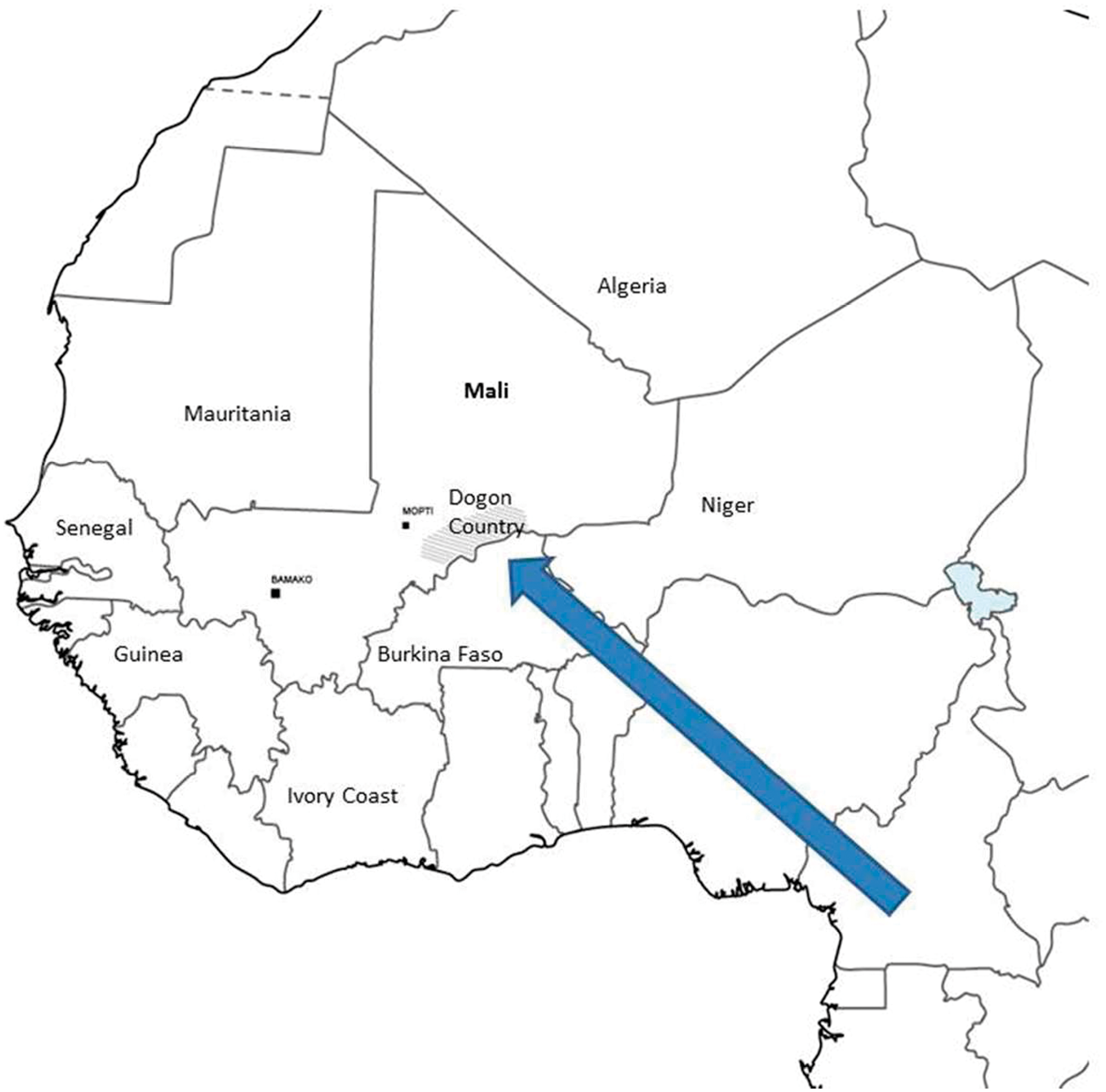
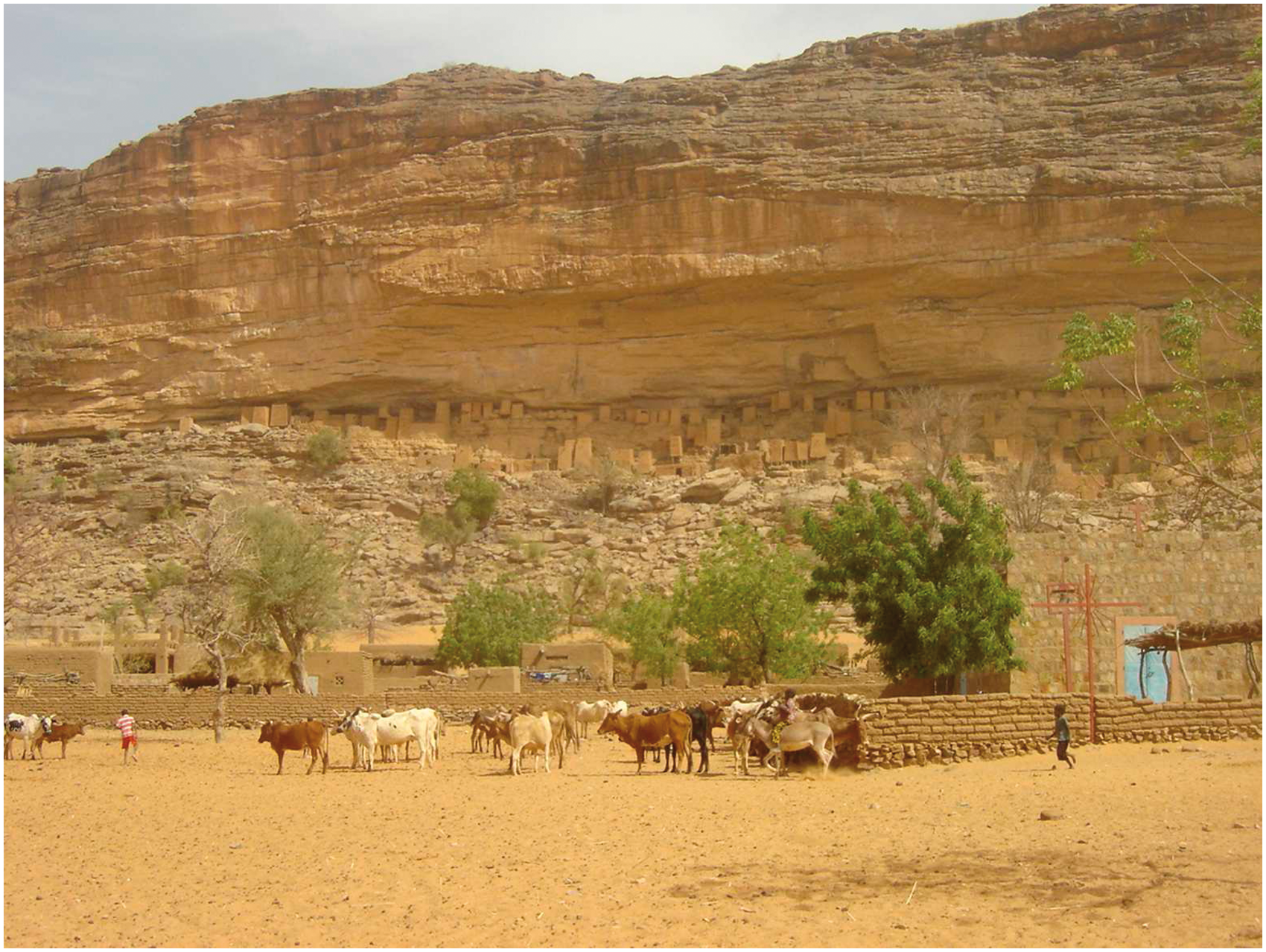
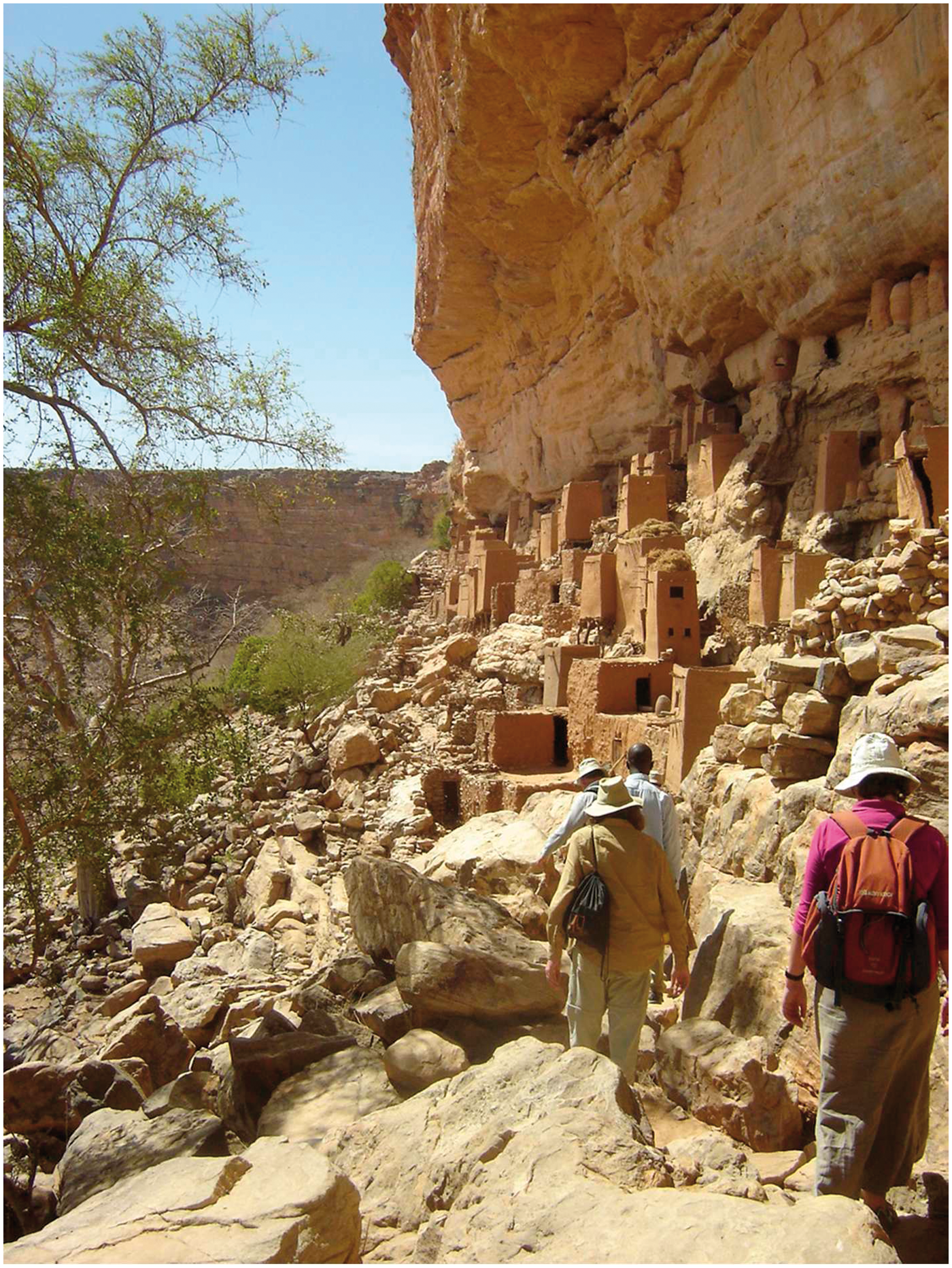
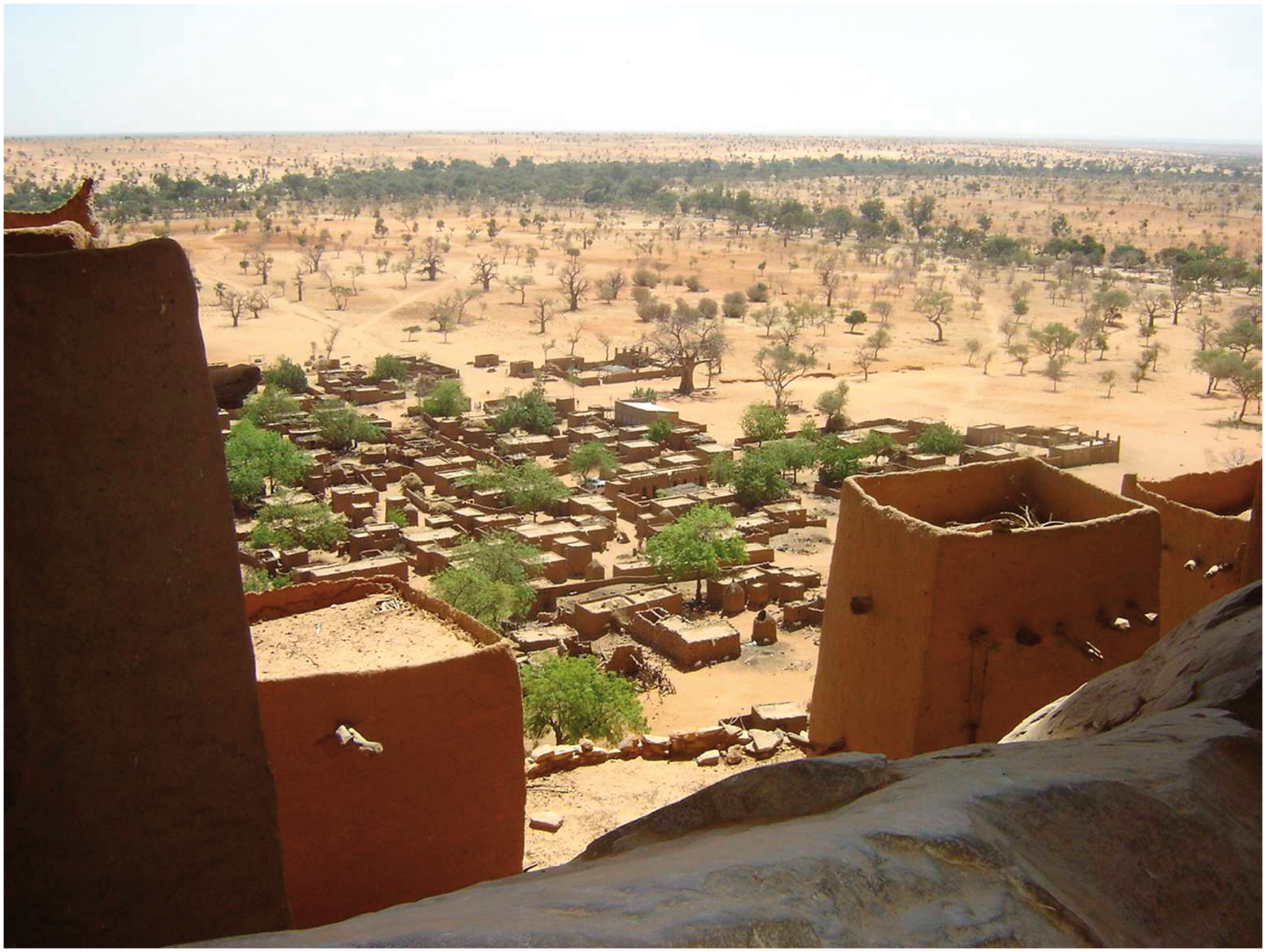
The Dogon villages are scattered between three natural regions: sandstone plateau, cliff and plains (Figure 2). In this landscape, the Dogon created exceptional mud architecture: houses, granaries, altars, sanctuaries and toguna (communal meeting places) which UNESCO classifies as tangible heritage. UNESCO (2014b) states that tangible heritage includes buildings and historic places, monuments and artefacts which include objects significant to archaeology, architecture, science or technology of a specific culture. In the 15th century the villages of Kani Kombolé and Teli were constructed in the cliff, a place that was difficult to access for slave traders and invaders who wanted to convert the Dogon to Islam (Figures 3 and 4). Since French colonisation in the 19th century and the end of tribal warfare, people left the villages located in the cliff for the plain where life is easier (Figure 5). Due to the abandonment of the ancient villages in the cliff the architectural heritage is vulnerable and threatened (UNESCO, 2014a). To protect these fragile monuments, cultural heritage management and maintenance are crucial: ‘Protection and management of World Heritage properties should ensure that their Outstanding Universal Value, including the conditions of integrity and/or authenticity at the time of inscription, are sustained or enhanced over time’ (UNESCO, 2013: 25).
Dogon Country the cliff and villages Kani Kombolé and Teli in the southern part of the escarpment. Source: Reproduced with permission from Wolf H.M. Schijns, 2005, 16 March. View on ancient site in the cliff in Teli. Visitors in the ancient site in the cliff in Teli. View from the cliff on the contemporary settlement on the plain in Teli.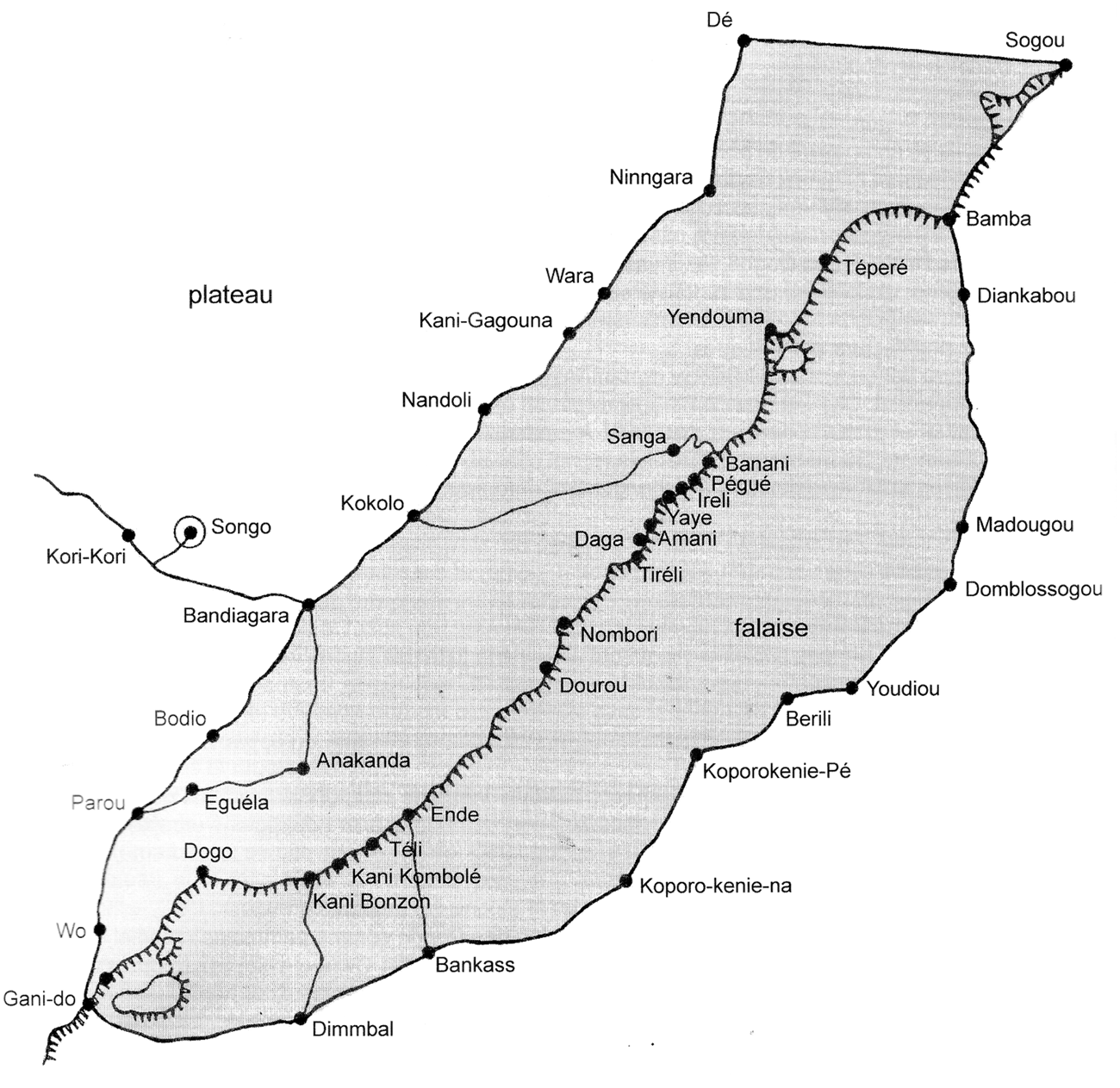
This paper is based on a research which formed part of a larger project that was initiated by the National Museum of Ethnology in Leiden, The Netherlands in 2002, to restore the two abandoned, traditional Dogon villages of Kani Kombolé and Teli, in order to rehabilitate them into their former glory. It was carried out in close collaboration with the local population and the Malian governmental cultural institution: Mission Culturelle in Bandiagara. By preserving local knowledge systems surrounding traditional building techniques, both knowledge and the restored ancient sites were saved for future generations. By involving local communities in the restoration of the ancient sites in the cliff the Malian government tried to combat the illegal sale of cultural items. The vision of the National Museum of Ethnology and the Mission Culturelle Bandiagara was to prolong the sustainability of this restoration through effective cultural heritage management and by actively involving the local population in its exploitation as a tourist attraction. The Malian government and their Dutch counterparts raised questions about the awareness of the local population in Kani Kombolé and Teli regarding conserving their cultural heritage and dealing with tourists.
For the research an inventory was carried out amongst all stakeholders in Kani Kombolé and Teli to gain insight into the current situation in local tourism development and the groups and individuals involved in the tourism process. The stakeholders in this research are UNESCO; the Malian government (L’Office Malien du Tourisme et de l’Hôtellerie (OMATHO) and Mission Culturelle); the National Museum of Ethnology in Leiden, the Netherlands; the local population including those involved in restoration, entrepreneurs in the villages: accommodation managers, retailers and souvenir sellers; international, national, regional and local village guides; international and national tour operators and tourists. The tourist attraction is created by a dialogue between these different actors. ‘It is an arena where different actors compete for power, influence, prestige and control’ (Olivier de Sardan, 2005: 71). For this research, data were collected amongst all stakeholders through observations, 14 focus groups, 30 semi-structured interviews and many informal discussions. 1
What was considered necessary in this research was to focus on the views of the local population in Kani Kombolé and Teli on the conservation, the use and management of their cultural heritage on the one hand and how they create a cultural tourism experience in their villages on the other hand. Before analysing the local perspectives on tourism and cultural heritage management, the tourism process in Dogon country needs to be sketched as well as providing an insight into cultural heritage management in Mali and Dogon country.
A tourist visit to the Dogon
Generally in Kani Kombolé the tourist visit consists of a walk through the contemporary settlement to admire the largest mud mosque in the southern area of Dogon country and if it is market day also a visit to the colourful market (Figure 6). The tourist experiences in this way daily life that takes place in and around mud houses of gin’nas (extended families). The basic unit in Dogon society is the grande famille or gin’na. The contemporary settlement of Kani Kombolé consists of four gin’nas and has about 400 inhabitants as estimated by the local population. Each grande famille consists of a large number of families; several large families form a clan. All clans form a tribe: the Dogon (Guindo, 2005). The architecture of the gin’nas is organised in a way that daily life takes place in a closed courtyard with all the houses and granaries around it. After a stroll through the contemporary settlement, a local village guide takes the tourist to the ancient site in the cliff which is separated from the contemporary settlement. After paying site tax of approximately 1€, they get to see the ancient houses, granaries, altars, sanctuaries and toguna. After visiting the ancient site in the cliff, most tourists go to a campement (accommodation) in the contemporary settlement for refreshments and/or lunch. If one wants to have lunch in a campement, this needs to be booked with the chef when arriving in the village. The preparation of the meal takes a lot of time because the simple meals are cooked on a wood fire. The tourist can choose from couscous or pasta with tomato and onion sauce which is considered tourist food by the local population, as tourists are not fond of the traditional Dogon dish tô. There is always a chicken running around ready for slaughter and sometimes there are fries on the menu. Shelters are built in the campements: covered areas with wicker chairs and tables where lunch can be used after which a siesta follows. A campement consists of a number of mud buildings with rooms for up to 20 guests who can sleep on reed beds with mattress or on the roof to avoid a little of the heat of the hot Sahel climate. To spend a night under the stars one needs to climb up a narrow wooden ladder. There are no showers but simple booths where one can refresh oneself with a bucket of water and toilets consist of latrines (hole in the ground). Not all tourists stay in the campements, sometimes one arrives there only to have refreshments or lunch and visit a souvenir shop. There are now four campements in Kani Kombolé that are all run by the local population: three private and one community (public) campement set up by the Mission Culturelle Bandiagara.
Mud Mosque in Kani Kombolé.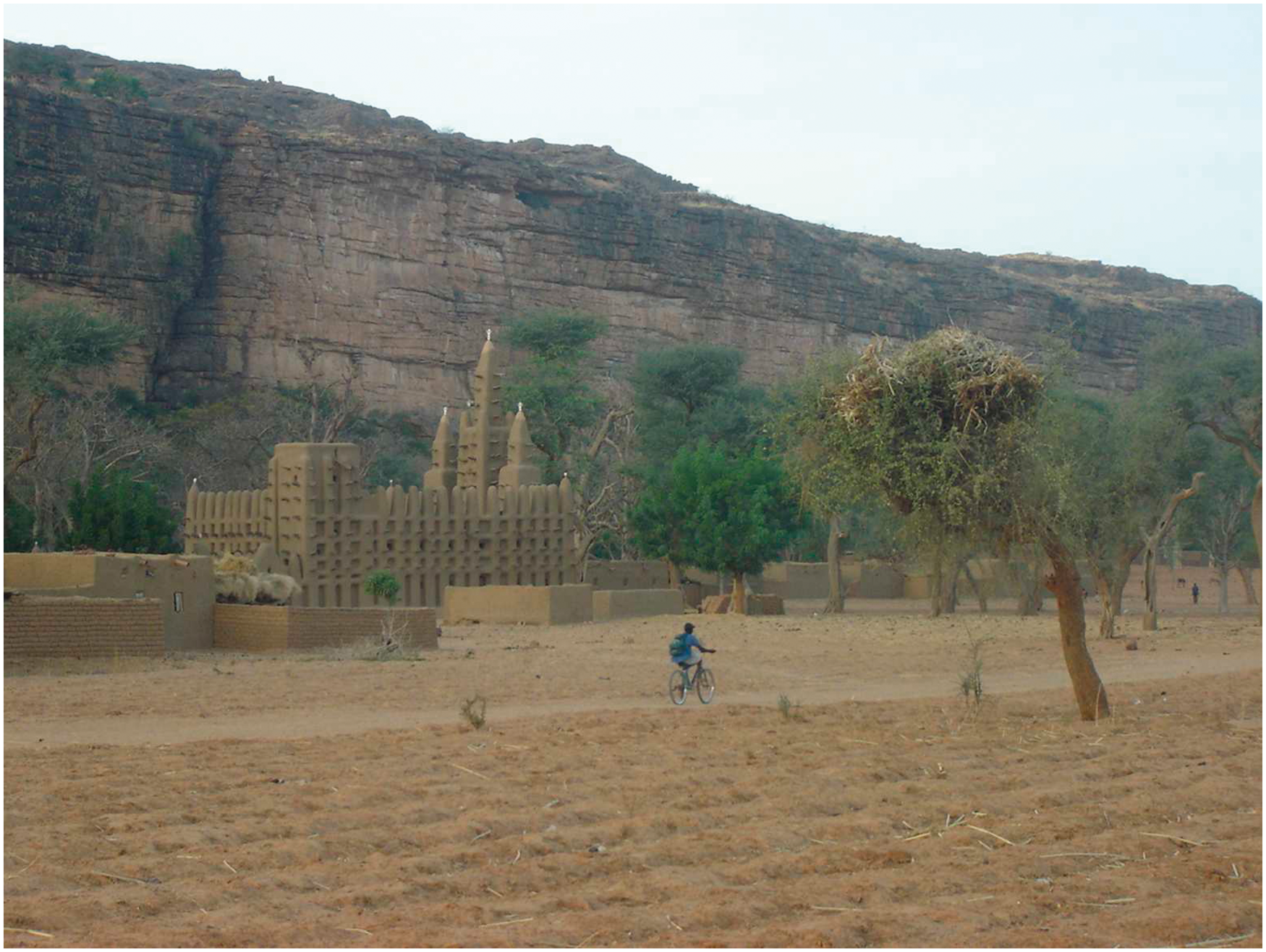
After the siesta most tourists walk or drive in a four-wheel drive to the next village, Teli, 3 km away where they pass by onion and millet fields. The local population combines agricultural activities with working in seasonal tourism. Teli is slightly larger than Kani Kombolé and consists of seven gin’nas and has about 750 inhabitants as estimated by the local population. After paying visitor tax, one can climb up to the ancient site in the cliff, preferably in morning hours avoiding the heat in the afternoon of the dusty, dry and hot Sahel climate. After visiting the ancient site in the cliff in Teli, a meal is served in the campements where tourists relax while chatting with guides. In Teli are four campements, all in the private sector. The campements are slightly more ‘modern’ than in Kani Kombolé because there are improvised showers. In general, everyone goes to bed early because around 06:00 in the morning the whole village is awake again. A local breakfast consisting of fried dough balls and powder coffee is then consumed and tourists usually continue their trip to Ende, a village 5 km away, known for its bogolans (mud cloths), indigo cloth and local museum.
To summarise, the local population in Kani Kombolé and Teli create a cultural tourism experience in their villages by building campements and adjusting meals for tourists, opening souvenir shops, arranging local guides and collecting site tax. The following paragraph looks at cultural heritage management in Mali and Dogon country.
Heritage management in Mali
At the 18th session of UNESCO’s World Heritage Committee in 1994 it was noted that there were mainly European historic towns and religious buildings on the World Heritage List. A more ‘global strategy’ was then proposed to also cover developing countries (Harisson and Hitchcock, 2005). Mali is one of those developing countries which has signed the World Heritage Convention in 1977 (UNESCO, 2014d). Although there is now a more global strategy, Smith (2006) argues that there is an authorized heritage discourse (AHD) in the uses of heritage. This discourse has its roots in a Western European tradition and deals with heritage as ‘things’ i.e. as aesthetic monuments that need to be ‘conserved as found’. It is in that discourse (AHD) that heritage as physical embodiment can be mapped, managed, preserved, restored and investigated and its protection may be the subject of national legislation and international agreements, conventions and charters from UNESCO and International Council On Monuments and Sites (ICOMOS) amongst others. According to Smith (2006) this is a ‘professional’ discourse that privileges expert values and knowledge about the past and its material manifestations, and dominates and regulates professional heritage practices in which heritage is conserved as an unchanging moment of the past and should be conserved as found. The traditional unilateral perspective within the AHD is developing over time and institutions like UNESCO also adopted the Convention for the Safeguarding of the Intangible Cultural Heritage in 2003 in which ‘intangible cultural heritage’ means the practices, representations, expressions, knowledge, skills that communities, groups and, in some cases, individuals recognise as part of their cultural heritage (UNESCO, 2014d). 2
Smith (2006) sees all heritage as intangible because tangible heritage comes to life via intangible heritage so they are inseparable. Smith (2006) together with other authors state that tangible and intangible cultural heritage can give local inhabitants the feeling of belonging somewhere, i.e. a sense of belonging (Lyons, 2002). ‘Thus, a heritage place may represent or stand in for a sense of identity and belonging for particular individuals or groups’ (Smith, 2006: 77). This tangible and intangible heritage is also very important for the national identity of a country, as this heritage contributes to the historical awareness of a region or country of local inhabitants (Lyons, 2002).
To preserve the country’s tangible and intangible cultural heritage the Malian government set up a cultural institution Mission Culturelle in the last part of the 20th century. Each city or area with a recognised UNESCO World Heritage Site has a regional office of the Mission Culturelle. They are responsible for controlling the property, regularly reviewing the general state of conservation and involving all stakeholders in developing a shared understanding of the property (UNESCO, 2013). Since 1993 Dogon country also has a regional office of the Mission Culturelle which is located in Bandiagara. They are engaged in increasing the awareness of the local population with regard to tangible and intangible cultural heritage, promotion, conservation, research and developments in cultural tourism (Mission Culturelle de Bandiagara, 2014). McKercher and Du Cros advocate collaboration between cultural tourism and cultural heritage sectors: The great challenge for cultural tourism is how to integrate cultural heritage and tourism management needs in a process that will result in a product that is appealing to visitors, while at the same time conserving cultural and heritage values (2002: 171).
The institutions that are engaged in cultural heritage management and cultural tourism in Mali and Dogon country mainly focus on heritage such as architecture or ‘things’ as in the AHD. But it should not be forgotten that local people often value heritage differently, but not necessarily as less important, than heritage experts such as art historians, archaeologists and others (Wall and Black, 2004). This also corresponds to the vision of Smith (2006) in which she perceives that actors such as indigenous peoples are neglected in the AHD.
Smith (2006) states that there is a subaltern discourse to AHD in which heritage is not seen as a thing but as a social and cultural process, something vital, alive and as moments of action in places of heritage. ‘… places become places of heritage both because of the events of meaning making and remembering that occur at them. It is this tension between action and material representation that is an important element of heritage’ (Smith, 2006: 83). In the subaltern discourse the Western traditional conceptualisation of heritage maintenance is challenged. An example is the debate around ‘re-painting’ rock art sites in Western Australia by their Aboriginal custodians in the 1980s. They were accused of destroying ancient rock art by using non-traditional materials when re-painting it. They had not restored the rock art according to the principle conserved as found. In the Aboriginals’ point of view, the ‘act’ of re-painting was vital in keeping alive certain values and meaning in a way that the simple existence of the site could not. In other words, it was the ‘practice’ that maintained meaning and cultural knowledge (Smith, 2006). A similar restoration was performed by the Dogon which provoked a considerable discussion between the Mission Culturelle and the local population which will be described later in this paper.
Smith (2006) looks critically upon the AHD that seems to value ‘original materials’ most and only slightly acknowledges other forms of dealing with heritage and the ‘past’. Other forms of maintenance and practice and meaning should be taken into consideration in heritage management (Smith, 2006). In Kani Kombolé, for example a village school was built in the contemporary settlement and funded thanks to the efforts of Dutch architect Joop van Stigt who has been active in building schools and water wells in Dogon country for 20 years. However, this school had a corrugated roof. The villagers were very proud of their school in the contemporary settlement and for them the new mud building with corrugated roof was a sign of progress and modernity. The corrugated roof, however, was not made of local natural materials and therefore did not meet the standards of UNESCO’s Operational Guidelines (UNESCO, 2013) of a World Heritage Site. It had to be changed under pressure of the Mission Culturelle Bandiagara. The villagers are still grumbling about it and felt they were literally stopped in time and development. This ties in with what Lanfant writes: At the moment that tourism makes communities emerge from their isolation and set out on the road to modernity, they have to reinvent their past and keep alive their traditions in order to maintain the image that tourists have of them. (1995: 10) If a remote destination develops, it modernizes, and becomes more like the tourist’s society. Less different and distinct, and no longer ‘primitive’, it loses its appeal. As cultural assets are refined as consumables for tourists, culture becomes commoditized. The destination appears less authentic and so the value of the product is reduced. (2007: 945)
The local perspective on cultural tourism and cultural heritage management
The local population did not seem to be a passive actor in the development of this World Heritage Site as tourist attraction. As mentioned earlier they are involved in the formation of a tourist attraction by building campements and adjusting meals for tourists, opening souvenir shops, arranging local guides and collecting site tax. Besides this the local population is also actively involved in the restoration project of the ancient sites in the cliff under supervision of the Mission Culturelle Bandiagara. However, the question remains: does the local population of Kani Kombolé and Teli comply with the AHD approach of this institute or do they feel empowered to conserve, use and manage cultural heritage in their own way? In this paragraph some examples will be discussed about how the local population of Kani Kombolé and Teli deal with their tangible and intangible cultural heritage and create a cultural tourism experience. In order to analyse this, Bourdieux’s (1986) notion of different forms of cultural capital will be applied to describe their uses of heritage.
Cultural capital
Cultural capital can be described as cultural knowledge, competence, educational qualifications, material possessions and involvement in cultural practices. Bourdieux (1997) described ‘cultural capital’ as existing in three forms: in an embodied state; an objectified state in the form of cultural goods; and in an institutionalized state that confers original properties on ‘cultural capital’ that is presumed to guarantee, for example educational qualifications. (Corsane, 2005: 232)
Embodied cultural capital
According to Bourdieux (1986), an embodied state of cultural capital can be understood as an individual in the process of verbalising and communicating their cultural capital. An example of an embodied state of cultural capital is the picture that the local people produce of their tangible and intangible cultural heritage as ‘cultural brokers’. This process of meaning-making is called cultural brokering. A cultural broker is someone who acts as an intermediary between the tourist(s) and the culture(s) that they are visiting (Jennings and Weiler, 2006). The local village guides draw a picture of Dogon country to tourists by storytelling. Souvenir sellers also contribute to this by selling tourist art such as masks, statues and typical Dogon doors. When selling they tell a story about the objects. The local population uses their cultural knowledge which they acquired from their surrounding culture and which evolves over time. Embodied cultural capital represents in this case self-presentation through storytelling. ‘Cultural and heritage tourism places have been described as destinations with a story, with cultural tourism described as the process of telling that story’ (McKercher and Du Cros, 2002: 124). The Dogon are proud of their identity and are fascinated by their own culture and understand that tourists find their lifestyle interesting. In other words, their cultural self-awareness is high compared to other African ethnic groups (Van Beek, 2003). In the encounter with the tourist this consciousness increases even more. Cultural identity can be reinforced by cultural tourism (Picard, 1995). The local population is proud to share their cultural heritage with tourists. By sharing a place’s heritage it brings meaning to a place, it brings it to life and makes it relevant for tourists (Smith, 2006). Sharing does not automatically mean that the locals want to show or tell the tourist all aspects of their cultural heritage and history. The local village guide makes sure that tourists do not visit, or take pictures of, sacred places and private property. ‘Brokering is about providing or limiting access to a number of identifiable elements, such as particular places, spaces, people, information, cultures, and environments’ (Jennings and Weiler, 2006: 65). In Teli access to certain areas of the ancient settlement in the cliff is prohibited to visitors because, according to the older generation, animist rituals were performed there in the past and this is still respected. This is made clear with a sign on the ground with the text acces interdit. In Kani Kombolé there are four areas that are prohibited. The dead are buried there and no one is allowed to enter this area. The local village guide informs tourists about these prohibited areas. It indicates how tourists should behave with respect to this cultural heritage. ‘What stories are selected to be told also provide signals about what activities are acceptable or unacceptable at that asset’ (McKercher and Du Cros, 2002: 125).
Another example of an embodied state of cultural capital is the competence of locals as cultural brokers in anticipating the needs and expectations of tourists. A guide acts as a broker who assists in meaning-making in the tourist’s process of (re)constructions of his or her experience. Guides are brokers in facilitating ‘quality tourist experiences’ (Jennings and Weiler, 2006). If the experience matches the tourists’ expectations they describe their experience as having quality. Consequently for communication to be effective, the style of the messages needs to be relevant for the listeners, and to do this, they need a sound knowledge of what the listener already knows and what the listener cares about (Jennings and Weiler, 2006). When one considers that most cultural tourists have read the stories about Dogon country, as mentioned in tourist handbooks which are mostly based on research done by the anthropologist Marcel Griaule in the 1930s, it is not surprising that tourists expect a version of Griaule’s history of the Dogon and their traditions during their visit to the villages. Therefore, they expect to see animists, altars, shrines, fox fields, Hogons (village priests) and their homes, masks and mask dances, rituals, celebrations, ancestor worship, traditional mud houses, granaries and toguna. This is considered as authentic by tourists. Depending on the tourist the local village guide sometimes tells accepted, controlled narratives and sometimes plays with these narratives (Jennings and Weiler, 2006). It seems hard to realise by tourists that Griaule’s version of the history of the Dogon and their traditions is a myth and nowadays most ancient villages located in the cliff have been abandoned and the Dogon live on the plains. In this part of Dogon country, animism is slowly disappearing or is mostly intertwined with Islam.
Objectified cultural capital
An example of an objectified state in the form of cultural goods is the house of the Hogon (village priest). The villagers said they started the restoration project with the restoration of the house of the Hogon because it was a tribute to their ancestors. The house of the Hogon has been restored and painted red, black, white and decorated with symbolic images of snakes, crocodiles and turtles (Figure 7). The brightly painted house certainly attracts attention from the contemporary settlement when one looks up at the cliff to the ancient site. The villagers in Kani Kombolé are confident that they will attract more tourists with the restored house of the Hogon and try to distinguish themselves from other villages. However, this restoration has generated a conflict with the Mission Culturelle Bandiagara. During a work visit they indicated that the house of the Hogon was not restored to its original condition. In other words, not ‘conserved as found’ as dictated by the AHD. The villagers had made use of traditional Dogon colours but had deviated from the original patterns and symbols. From conversations with villagers it became clear that for them it does not matter whether the Hogon house actually had these exact colours and symbolic decorations. They are very pleased with the restoration although it is not an exact copy of the past. As Kirshenblatt-Gimblett indicates: ‘Heritage is not simply inherited. Rather “heritage” is constantly constituted and renewed’ (1998: 242). The locals therefore fail to understand why this created a conflict. Cultural heritage is not static but a social and cultural process in which locals give shape to the authenticity of Dogon country. What they consider authentic deviates from what is considered authentic in the AHD in which original building techniques and materials are prescribed (Smith, 2006). Moreover, the Dogon ‘played’ with the Western concept of cultural heritage management because to them it was about creating a representation of how a Hogon house might have looked. It was the practice that maintained meaning and cultural knowledge and not the building alone. After the rainy season in Dogon country, the bright colours of the house of the Hogon faded away. Thus, the harsh climate in the Sahel has the final say.
House of Hogon in Kani Kombolé.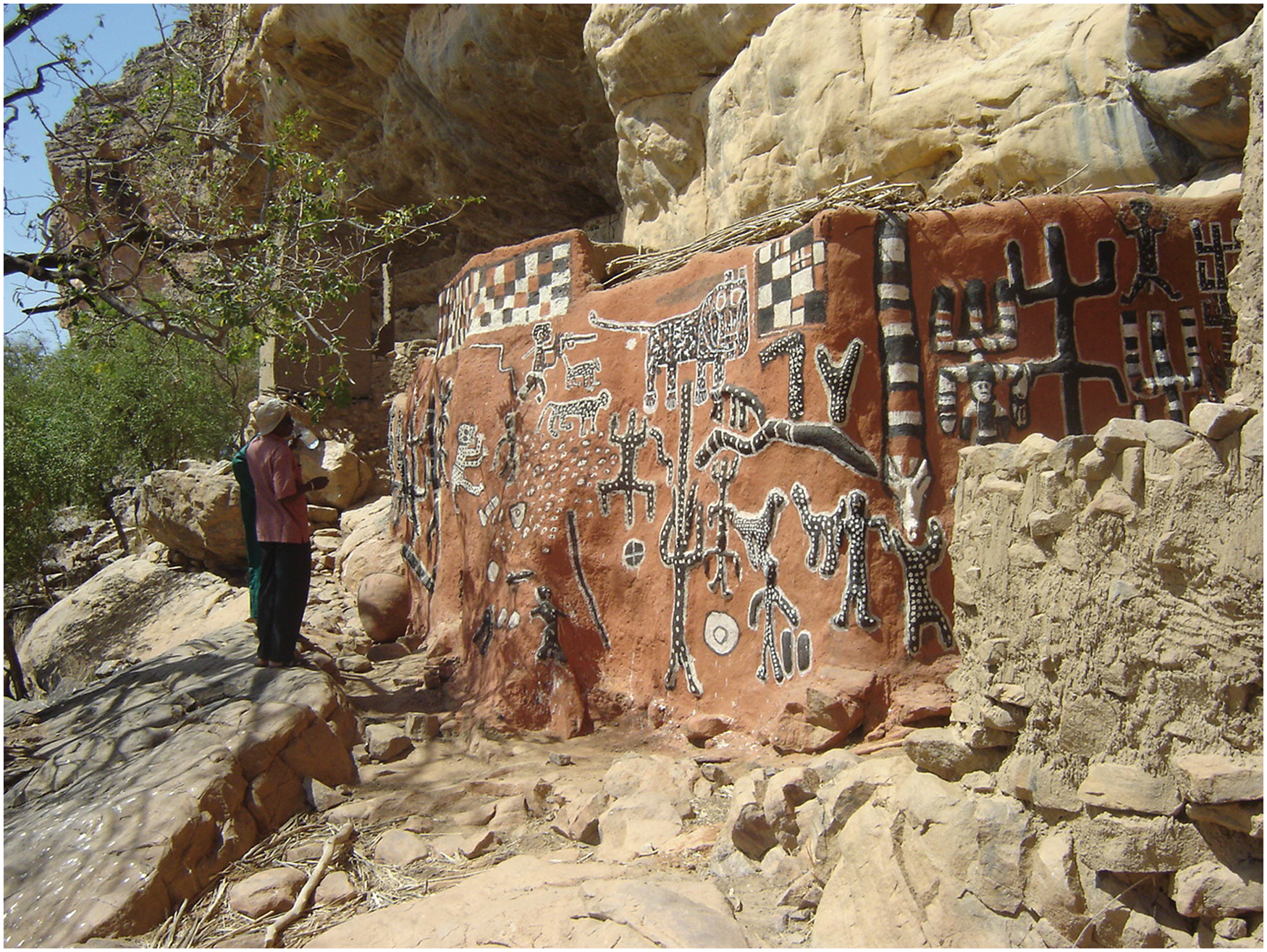
Institutionalised cultural capital
As described in the Introduction, the villagers are those who restored tangible cultural heritage under supervision of the Mission Culturelle Bandiagara. Everyone in the villages was involved: the elders gave instructions on how the former houses were put together; the men laid bricks while the boys fetched banco (mud) and the women water. Through the restoration the villagers transferred their knowledge about the traditional methods of restoration, old customs and habits to younger generations. As Smith (2006) states heritage is a practice, something that is ‘done’: ‘… a range of activities that include remembering, commemoration, communicating and passing on knowledge and memories, asserting and expressing identity and social and cultural values and meaning’ (Smith, 2006: 83). During the data collection of this research, it became obvious that it was important for the older generation to recite their history to the younger generation not at the contemporary settlement but surrounded by their cultural heritage in the ancient site in the cliff. It illustrates heritage as a cultural process in which shared memories can be attached to material objects and places. The sense of being at the places where these things happened was emotionally useful in underlining the memories and values being past on to other family members or for individuals simply remembering and reaffirming their own identities and social values. (Smith, 2006: 305) Cultural revitalization and education of younger generations are key outcomes sought from such programs. Tourism can be a key benefactor as well as an important initiator of this process, with interest by outsiders being recognized as providing the motivation and economic rationalization for indigenous communities to rediscover their own culture. (McKercher and Du Cros, 2002: 85)
As described earlier, it appears that the local population in Kani Kombolé and Teli deployed embodied and objectified cultural capital to gain more control in cultural heritage and tourism management. They are the ones with their own ideas about the use and presentation of their tangible and intangible cultural heritage. This ties in with what Stronza writes: ‘Locals may be active agents in determining what they want to preserve, purposely inventing traditions and/or folk art for tourists, yet entirely cognizant themselves of what is real or staged, authentic or spurious’ (2001: 273). Although the local population restored the ancient site in the cliff under supervision of the Mission Culturelle Bandiagara, this did not mean that they completely complied with the AHD in conserving, using and managing their cultural heritage and creating a cultural tourism experience.
Conclusion: Re-balancing power
This case study examines how locals deal with concepts such as cultural tourism and cultural heritage management, which affect their community. The local population has different ideas about cultural heritage management and the importance of conservation than their Western partners, such as UNESCO, in other words the AHD. The AHD conceptualises heritage as things which need to be ‘conserved as found’. The local population adapted Western concepts and mixed them with their own ideas and interpretations of conserving, using and managing their cultural heritage as seen in the example of the restoration of the house of the Hogon. As Smith (2006) states, the Western traditional conceptualisation of heritage maintenance is challenged in the subaltern discourse. Moreover, heritage can be seen as a cultural and social process in which tangible heritage comes to life through intangible heritage. Examples that were discussed in this paper of such a nature are storytelling, the competence of locals as cultural brokers to anticipate the needs and expectations of tourists and transmitting cultural knowledge to the younger generation through the restoration project. The Dogon are proud of their cultural identity and want to pass it on to future generations to show to tourists, Malians and other Africans.
In this paper, insights are gained into the complexity of cultural tourism and the process of interaction between locals, tourists, stakeholders in the travel industry and cultural heritage management in Dogon country. Interests, needs and expectations of these different actors have to be taken into account. Although there will always be differences in power and locals will never have complete power and control over the formation of a World Heritage Site into a tourist attraction, they have certainly a degree of ownership. As is apparent from the preceding paragraphs, cultural heritage management is not without conflicts and different interests. In other words, where there is heritage, there is the politics of heritage.
It can be concluded that the local population is indeed involved as an active actor and benefits from cultural tourism through deploying their embodied and objectified cultural capital. ‘There exists the possibility that some Third World communities will take a degree of control on their own exploitation of tourism, and particularly new forms of tourism, all which will represent, at least for them, a re-balancing of power’ (Mowforth and Munt, 2003: 301–302). It is important to remain critical. To some extent locals will have to conform to the standards of UNESCO’s Operational Guidelines. Their ideas about the management of cultural heritage are not always compatible. But locals also ‘play’ with these ‘rules’. In addition, no community is homogeneous, and there will always be differences of interpretation in cultural heritage management. This means that not all members of a community uniformly share the same ideas about conserving, using and managing cultural heritage. ‘The discourse can be or is nuanced and mutable over time and space’ (Smith, 2006: 299).
However, in order to secure sustainable cultural tourism and cultural heritage management, further research is needed about visitor management and ongoing cultural heritage education. This World Heritage Site remains vulnerable because the site consists of fragile monuments which need to be re-plastered every year after the rainy season. Given that the restoration was a one-off event and the history of the Dogon is based on oral transmission with rapidly developing modernisation of the area, the accumulated cultural heritage awareness and future cultural heritage management is therefore at risk. Another risk factor is the current political situation of crisis and armed conflict in the northern regions of Mali and in the proximity of Dogon country. The integrity, authenticity and Outstanding Universal Value of Dogon country as a World Heritage Site remains intact, but there is currently a shut down on cultural tourism (UNESCO, 2014e). That will hopefully change soon in order to secure sustainable cultural tourism and cultural heritage management.
Footnotes
Glossary
mud cloth accommodation plastering extended family village priest governmental cultural institution traditional Dogon dish communal meeting-places
Acknowledgements
The authors gratefully acknowledge all respondents for their participation in this research, in particular the local population of Kani Kombolé and Teli. This research has been made possible by the National Museum of Ethnology in Leiden, the Netherlands and Mission Culturelle Bandiagara. We would like to thank Karin Bras, Philippa Collin and Angelique Lombarts for reviewing the text.