




Abstract
Employee-owned businesses have recently enjoyed a resurgence of interest as possible ‘alternatives’ to the somewhat tarnished image of conventional investor-owned capitalist firms. Within the context of global economic crisis, such alternatives seem newly attractive. This is somewhat ironic because, for more than a century, academic literature on employee-owned businesses has been dominated by the ‘degeneration thesis’. This suggested that these businesses tend towards failure—they either fail commercially, or they relinquish their democratic characters. Bucking this trend and offering a beacon—especially in the United Kingdom —has been the commercially successful, co-owned enterprise of the John Lewis Partnership whose virtues have seemingly been rewarded with favourable and sustainable outcomes. This article makes comparisons between John Lewis Partnership and its Spanish equivalent Eroski—the supermarket group which is part of the Mondragon cooperatives. The contribution of this article is to examine in a comparative way how the managers in John Lewis Partnership and Eroski have constructed and accomplished their alternative scenarios. Using longitudinal data and detailed interviews with senior managers in both enterprises, it explores the ways in which two large, employee-owned, enterprises reconcile apparently conflicting principles and objectives. The article thus puts some new flesh on the ‘regeneration thesis’.
Keywords
Introduction
Since the start of the global financial crisis in 2008, there has been a massively increased interest in, and reference to, possible ‘alternative’ forms to conventional investor-owned firms (IOFs). Prominent among these alternatives has been the employee-owned enterprise. In Britain, the central example par excellence of this tendency has been the advocacy of the ‘John Lewis Model’. In Spain—and of course beyond—Mondragon has attracted renewed interest.
Prominent politicians from all the main political parties in the United Kingdom have advocated the John Lewis model as a possible ‘answer’ to failures in the prevailing system of what has been termed ‘irresponsible capitalism’. Likewise, it has attracted attention internationally. The John Lewis Partnership (JLP) has existed since the 1930s but has not always been so lauded and celebrated as it is today. Its current commercial success (which contrasts markedly with many conventional competitors) and its distinctly different ownership structure and other associated core features encourage politicians and other influential commentators to extol JLP as a ‘model’ for others to follow. This has added to the new allure of employee-owned firms (EOFs). Yet, not so long ago, the mutuality model was generally regarded as old fashioned, anachronistic, dowdy and restrictive. This view impacted, for example, the Cooperative Society in the United Kingdom as it lost market share to commercial competitors. The downbeat mood was reflected also in the de-mutalisation of the building societies and other institutions. This retreat from mutualism was seen as a form of modernisation. A similar sceptical view was also applied to the JLP for a number of years prior to its revival by new approaches (examined below) beginning around the year 2000. 1
Now, under current circumstances, the twin attributes of ‘principled’ businesses and commercial success in a landscape strewn with organisations exhibiting neither of these have made the John Lewis model look extraordinarily attractive.
Likewise, there has been renewed interest in Mondragon. This is in part because the Mondragon cooperatives point to a working alternative, and in part because of the historically better relative performance of the Mondragon cooperatives during previous recessions (Arando et al., 2010; Basterretxea and Albizu, 2010; Bradley and Gelb, 1983, 1987; Morris, 1992). There was also a low failure rate of businesses in the group during previous decades (Arando et al., 2010; Ellerman, 1984; Smith, 2001). However, the vulnerability of the Mondragon cooperatives to market forces was made evident by the recent dramatic failure of its domestic white goods manufacturer, Fagor Electrodomésticos. In October 2013, it announced it was forced to default on payments. The Cooperative Group in the United Kingdom with businesses in retail, banking, insurance, funerals and other businesses based on a consumer ownership model has faced similar economic challenges.
Mondragon’s largest cooperative, the retailer Eroski, is of focal interest to us here because it serves as a comparator for JLP. For many decades, the history of Eroski has also been a history of success and growth, rising from 88 employees in 1969 to 52,711 in 2008. Nevertheless, Eroski’s commercial performance has been under strain since 2008. This has been due to overall reduced consumer spending for the sector as a whole, increased competition from the low-cost retailers and the weight of large investments made by Eroski just prior to the crisis. In response, Eroski managers have sought to ameliorate its financial difficulties by a series of sometimes controversial measures such as closing subsidiary stores, firing many non-members, increasing working hours of members and reducing wages of both members and non-members. As a result, its reputation has taken a hit.
Given these varied fortunes of two large co-owned retailers, it is all the more necessary to understand how managers in the two selected cases have steered their respective paths through the divergent tendencies of degeneration and regeneration which figure so prominently in the literature on employee-owned businesses.
The degeneration thesis was advanced by the democratic socialists, the Webbs, at the end of the 19th century (Potter, 1891; Webb and Webb, 1920). Analysing the evolution of different cooperative production societies in Great Britain during the 19th century, Beatrice Webb (nee Potter) found a record of commercial disaster and repeated failure. The few organisations that survived, she argued, quickly ‘degenerated’ by moving away from their democratic roots. This occurred in different ways such as employing a growing percentage of outside labour; concentrating power in managers’ hands; selling parts of the company to outside shareholders; and disqualifying members from taking part in decision making and governing bodies. This view that cooperatives are bound to fail or to degenerate into capitalist forms of business has remained prevalent in the literature on EOFs for close to a century (Ben-ner, 1984; Meister, 1974, 1984; Miyazaki, 1984).
The cooperative degeneration process has been traceable in Mondragon (Bakaikoa et al., 2004; Cheney, 1999; Errasti et al., 2003; Kasmir, 1996; Luzarraga et al., 2007) mainly because of the nature of the growth strategy followed in recent years and the consequent increase in non-members in the workforce. The level of member participation in the Mondragon group as a whole reduced sharply from 86% in 1991 (Moye, 1993) to 29.5% in 2007 (Altuna, 2008).
However, in line with authors who contend that degeneration is not inevitable and who argue that cooperative ‘regeneration’ can take place (Batstone, 1983; Cornforth, 1995; Cornforth et al., 1988; Estrin and Jones, 1992; Hernandez, 2006; Stryjan, 1994), recent research on Mondragon highlights that a cooperative regeneration process could be slowly reversing the degeneration (Azkarraga et al., 2012). While degeneration via reduction of membership rates has been more extreme in Eroski than in other cooperatives of Mondragon, Eroski has also played a leading role in the introduction of a number of innovative cooperative regeneration programs which will be described and explored below. Similarly, in JLP, there have been periods when the democratic experiment lost momentum and episodes when there has been concerted effort to breathe new life into the representational forms (Bradley and Taylor, 1992; Cox, 2010; Flanders et al., 1968).
Our work seeks to add light to this degeneration–regeneration see-saw within the contemporary context of an unusually prolonged economic recession with a slow recovery, by examining the workings of the biggest cooperative in the Mondragon group alongside the largest employee-owned business in the United Kingdom.
While recent widespread misgivings about IOFs provide the trigger for renewed interest in employee ownership, our prime purpose here is not to make direct comparisons between them and EOFs. Rather, the focal objective of this article is to shed light upon how managers in two major EOFs in Spain and the United Kingdom handle the tensions between commercial viability and employee interests.
The article is organised as follows. The next section presents a brief comparative profile of the two organisations; following that, we review literature relevant to understanding the nature, tendencies and management problems in EOFs. This is followed by an outline of the research methods used in the project reported here and that in turn is followed by a presentation of results. The final section is devoted to discussion and conclusions.
JLP and Eroski—summary profiles
The JLP is a UK retailer with two major business units: John Lewis department stores and Waitrose supermarkets. In the 1930s, the founder, John Spedan Lewis, took the highly unusual step of giving away a large portion of his business to his employees by placing his shares in a trust using an ‘irrevocable settlement’ (Spedan Lewis, 1954). Article 7 of the Constitution states,
The Partnership’s ultimate purpose is the happiness of all its members through their worthwhile and satisfying employment in a successful business. Because the Partnership is owned in trust for its members they share the responsibilities of ownership as well as its rewards—profit, knowledge and power. (JLP Constitution, as printed in Spedan Lewis, 1954: 222)
The stock as a whole rests with the Trust; whether this amounts to ‘ownership’ or even ‘co-ownership’ in any strict sense is a moot point. Allocating responsibilities to beneficiaries in this way represents a modified form of Anglo-Saxon Trust law.
The founder also created a governance system, set out in a Constitution that was, and remains, both commercial in orientation and, in the founder’s own terms, ‘democratic’. Indeed he referred to JLP as ‘an experiment in democracy’ (Spedan Lewis, 1948). The extent to which it can truly be described as a vibrant democracy in practice is another area for debate. In the founder’s words,
In the John Lewis Partnership, democracy, the sharing of power, has been carried out as far as is practicable. If other people can see how to do it better, let them start another partnership and show how far they are right’. (Spedan Lewis, 1954: 10)
Partner voice is based on a series of elections to representative bodies. There are three governing authorities: the Partnership Council (elected representatives of workers), the Partnership Board (includes appointed senior managers) and the Chairman. The fact that the Partnership is not answerable to shareholders or the City is seen as a key feature which allows its senior managers to make decisions free from short-term constraints. The organisation summarises its character as follows:
The John Lewis Partnership’s 91,000 Partners own the leading UK retail businesses—John Lewis and Waitrose. Our founder’s vision of a successful business powered by its people and its principles defines our unique company today. The profits and benefits created by our success are shared by all our Partners. (JLP, 2014b)
As noted, such has been the commercial success in terms of growth, quality of service, customer and staff satisfaction and other measures that it has become fashionable to call for widespread emulation and indeed no less than the promotion of a ‘John Lewis Economy’. This is a turnaround indeed.
Eroski S.Coop was founded in 1969 as a result of the merger of 10 small consumer cooperatives located in the Basque Country. In the early 1990s, Eroski began a regional expansion to other parts of Spain, opening new hypermarkets and acquiring many supermarket chains. Sales in Mondragon’s Retail Area grew at an average annual rate of 14.4% from 1991 to 2008. As a result of this expansion, Eroski Group became the biggest company in Mondragon and the third largest food retailer in Spain. This growth path has changed since 2008 as a result of the economic crisis. There have been difficulties in renegotiating debt and this has resulted in high financing costs. At the same time, there have been historic falls in consumer spending and a decline in value of Eroski’s real estate.
Eroski is a consumer cooperative with special by-laws that give consumer members and worker members equal representation on its elected governing bodies. There are two governing authorities: the General Assembly and the Governing Council with both consumer and worker members being represented on each. The chairman’s position is occupied by a consumer member. The main business of the Eroski Group is concentrated in hypermarkets and supermarkets, although the Group has diversified into new businesses as can be seen in the Table 1.
Descriptive comparison of the two cases.
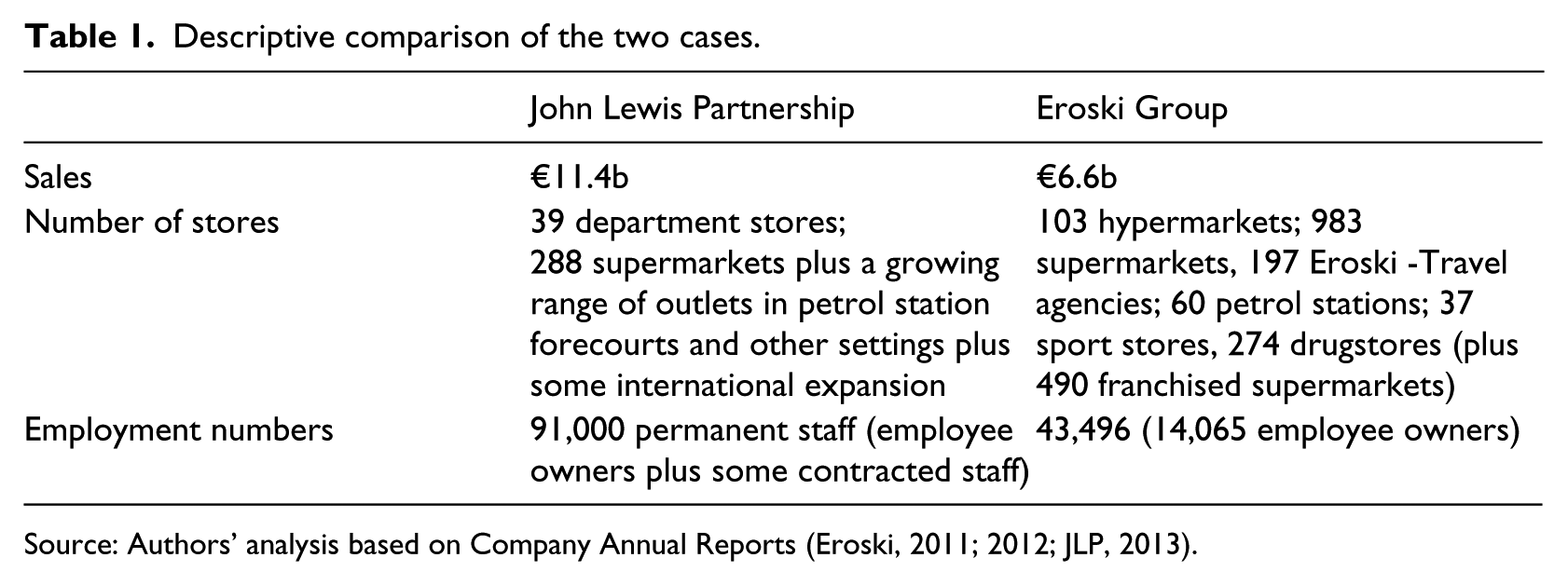
Definitions of ‘cooperatives’ and ‘worker-cooperatives’ vary. Few commentators regard JLP as a cooperative while accepting that Eroski and other Mondragon enterprises fit this label. Yet, in a number of respects, JLP displays cooperative features. The World Declaration on Worker Cooperatives provides an extensive definition, the key features of which include voluntary membership, democratic self-management, work undertaken by these members in pursuit of job creation and maintenance, and striving for quality of life of members and for community development (International Co-operative Alliance (ICA), 2005). Eroski and JLP share many of these characteristics with the notable exception of the community development aspect in the case of JLP which is in this respect much more clearly described as a ‘partnership’ working for collective self-interest. Notably, in his writings about the partnership, the founder talked about his ‘experiment in industrial democracy’ as a form of ‘producer-cooperation’ (Spedan Lewis, 1954). Current JLP managers do not describe the enterprise as a cooperative, nor do we seek to do so; rather, the essential indicators are the core ideas of representative structures, co-ownership and profit sharing. Or, as the Constitution succinctly states, the sharing of knowledge, profit and power.
Literature on employee-owned businesses
As noted in the introduction, the literature on EOFs has been dominated for more than a century by the ‘degeneration thesis’ (Ben-ner, 1984; Bonin et al., 1993; Meister, 1974, 1984; Miyazaki, 1984; Potter, 1891; Webb and Webb, 1920). According to this view, mutuality is always a transient phase on a deterministic trajectory either away from mutuality in order to prioritise commercial goals or towards further mutuality and accompanying commercial failure. Such a view posits an opposition between EOFs and effective management, suggesting that any constraint on managers’ ability or authority to manage reduces management efficiency, and thus the firm’s performance.
Degeneration may result from different dynamics. 2 Some cooperatives start to deny membership status to parts of the workforce. This may occur as cooperatives take on temporary staff without membership rights, or they outsource certain activities, or they acquire conventional capitalist firms (overseas or locally) with working conditions and working arrangements very different to that of an employee-owned parent company (Bakaikoa et al., 2004; Defourny, 1999; Errasti et al., 2003). A further type of erosion of the cooperative ideal stems from what has been termed ‘goal degeneration’. Cooperatives may increasingly prioritise profits or growth as their prime purpose. Additionally, there may be ‘organizational degeneration’ when power and control are increasingly concentrated in a few oligarchic hands (Cornforth, 1995; Cornforth et al., 1988).
According to the degeneration literature, cooperatives and other democratic associations often have a ‘life cycle’ in which degeneration takes place progressively. Meister (1974, 1984) describes this process of erosion as occurring in four stages. In the first, idealism and commitment are high, decisions are made in the assembly, but economic activity is poorly established; second, a period of transition during which, if the cooperative survives, conventional principles of organisation are adopted, initial idealism slowly gives way to indifference and the power of management is reinforced; third, degeneration signs are many, democracy becomes restricted to a representative board, cooperative values are subordinated to economic ones; fourth, members and their representatives lose all their power and managers assume total control.
Hence, managers of cooperative firms, it is argued, face a distinct challenge unlike that experienced by managers in conventional companies. They are expected to submit to continuous and critical internal scrutiny and control by cooperative members. This, together with controlled differential salaries between workers and managers, may make recruitment into the managerial cadre of worker cooperatives problematic (Basterretxea and Albizu, 2011b; Eccles, 1981; Morales, 2004). It has also been suggested that managers coming from IOFs find it difficult to adapt to the culture and values of the cooperatives. As a consequence, they may experience difficulties in their relations with employees and, perhaps most of all, with the Governing Councils (Bataille-Chedotel and Huntzinger, 2004). Such external managerial recruits have a greater tendency towards short tenure (Chaves and Sajardo, 2004). Some authors suggest that such managers may have difficulties with worker participation and that they may undermine the influence of worker owners and are an impediment to cooperative success (Meek and Woodworth, 1990). Thus, managers themselves may be a potent source of the degenerative effect (Davis, 2001; Münkner, 2000; Spear, 2004).
The literature also points to a number of other limitations and challenges facing cooperatives including problems in accessing capital (Novkovic, 2007; Van der Krogt et al., 2007) and risk aversion (Domar, 1966; Park et al., 2004; Spear, 2004; Vanek, 1970). In other words, the literature tends to suggest a host of reasons why commercial success might not be expected in cooperatives.
But many authors (Batstone, 1983; Cornforth, 1995; Cornforth et al., 1988; Estrin and Jones, 1992; Hernandez, 2006; Stryjan, 1994) have argued that cooperative degeneration is not inevitable; cooperatives can also regenerate. These authors stress that regeneration takes place in cooperatives with a culture of open criticism and discussion (Cornforth, 1995) and where there is an active and explicit commitment of members to change their organisation (Stryjan, 1994). Lending empirical support to this optimistic view, Batstone (1983), using data from French cooperatives, found that besides surviving in market terms, these cooperatives maintained a high degree of democracy. Batstone suggested that Meister’s life cycle model was too pessimistic and he proposed a new life cycle model of three stages progressing from initial enthusiasm, through a progressive decline of primitive democracy and the recruitment of non-members along with an increasing gap between managers and members, to a third stage of ‘resurgence of democracy’ (Batstone, 1983: 152). Similar results were found by Estrin and Jones (1992), and Hernandez (2006) argued that cooperatives are neither fully democratic nor oligarchic, and should be understood as ‘a site of unresolvable contestation between oligarchic and democratic forces’. From this literature, internal contradictions and tensions described by the degeneration and regeneration literatures do not necessarily lead to resolution, but rather are everlasting.
Using our two comparative cases, we seek to dig deeper into the actual processes constituting this contestation in order to reveal how managers handle it and how they themselves reflect upon it.
Research methods
While recognising the nature of the forces identified in the literature on employee-owned enterprises of the kind discussed above, we want to pay close attention to how the incumbent band of managers in Spain and the United Kingdom interpreted their duties and their objectives. Hence, our underlying orientation was to try to gain advantage from a methodological approach based on critical realism (Archer, 1995) and naturalistic inquiry (Lincoln and Guba, 1995). We wanted to recognise the interdependence of structure and agency. So, while, to an extent, we drew upon a common framework of issues constructed from the literature, we also drew on our extensive background knowledge of both cases which extended over 10 years. We gave weight to agents’ understandings in a manner not reliant upon positivist methods. The initial comparative framework was iterated between the two research teams in the United Kingdom and Spain and then applied to JLP and Eroski. But the actual conduct of the latest field research phases in both Spain and the United Kingdom was pursued by both research teams seeking most keenly to understand in a comparative perspective how the managers in these enterprises interpreted their situations and how they acted.
In the most recent phase of our work with John Lewis, interviews took place between 2010 and 2013. Interviews were conducted with members of the main board (known as ‘The Partnership Board’), and also with members of the main management boards of John Lewis (department stores) and Waitrose (supermarkets). Further interviews took place with senior managers in finance, logistics, human resource management and other central functions. A total of 25 managers were interviewed some of them more than once. All interviews were recorded and transcribed. Furthermore, we were allowed access to the archives and from these a very detailed timeline was constructed which revealed variations in business policy and democratic arrangements over time. Additionally, we were able to observe managerial and board meetings.
In Eroski, the research drew upon extensive knowledge of the Mondragon enterprises as they had been researched by the local team over many years (Albizu and Basterretxea, 1998; Basterretxea, 2011; Basterretxea and Albizu, 2010, 2011a, 2011b; Basterretxea and Martínez, 2012). Additionally, for this specific comparative project of these two retailers, a common framework was developed and a common set of interview topics explored. Interviews in Eroski took place between November 2012 and February 2013. Eight interviews were conducted with senior managers. We placed a special focus on the human resource, organisation and member’s mobilisation areas of management. In order to gain a matching longitudinal view for the case of Eroski, we also interviewed the former president for the period 1995–2011 and used the data emerging from three conferences held between 2011 and 2012 with the currently serving president, the chief executive officer and the former president. Each of these interviews and events were recorded, transcribed and used in the research.
In addition to the interviews, relevant company documents were consulted in both enterprises and comparative data assembled.
Results
We analyse the cases in terms of two main critical aspects of these ‘alternative’ forms. Both aspects will help shed new light on the notion of tendencies towards ‘degeneration/regeneration’. The first of these points of focus is on purpose. This means examining what informants thought their organisations were ‘for’. The second point of focus is upon the ways in which managers tried to achieve their objectives with special attention paid to the implications of their actions for the principles on which these employee-owned businesses were based.
Making sense of organisational purpose
Cooperatives and related bodies are ‘alternatives’ only if they pursue different goals, maintain different structures and/or pursue goals in different ways (using different procedures and modes of decision making). In this section, we focus on alternative purposes in the sense of the struggle to find a place for something other than, or additional to, the pursuit of profit. A related aspect is who this work is for: that is, who is a member?
What is the ultimate purpose?
Central to the recent performance success of the JLP is a clear sense of purpose among executives and managers. The dominant coalition of senior managers refute the opposition between the purposes and principles of cooperatives and commercial success: indeed, they insist that the principles can, with good management, be the means towards achieving commercial success. In terms of the history of the JLP, such clarity may seem surprising—an achievement—given the founder’s apparently deliberate ambiguity. He defined the ‘ultimate purpose’ of JLP as ‘the happiness of all its members through their worthwhile and satisfying employment in a successful business’ (Spedan Lewis, 1948). This could be interpreted as a coherent statement of purpose. But while some actors within the system choose to emphasise the member-benefits aspect, others give emphasis to the imperative of a ‘successful business’. Hence, there is, in practice, an ongoing debate about whether the right ‘balance’ is being maintained.
That approach, as noted, is challenged by senior managers who seek to argue that partner benefit (happiness) is inextricably tied-in with successful business. The current Chairman asked the question of his colleagues: is the purpose of the partnership to be ‘Nicer or Better?’ (than rival firms). The emergent consensus among the senior team was to argue that it is both better and nicer and that each of these qualities feeds-in to the other. The partnership advantage has to be leveraged so that committed and involved ‘co-owners’ make exceptional efforts and provide exceptional service (which in the main they do).
Not all managers accept this formulation: some believe there is an ongoing tension between two principles (commercial success and partner benefit) and that part of managers’ jobs as temporary custodians of the partnership is to strike that balance while facing constantly changing vicissitude in the marketplace. If that balance is not struck, then degeneration of the ideal will ensue. Managers are paid to avoid that while simultaneously operating a competitive business. So, how competitive should it be? Reflecting the original constitution, current JLP principles state that
The Partnership should make sufficient profit to sustain our commercial vitality and distinctive character, allow continued development and distribute a share of profits each year consistent with partners’ reasonable expectations. (JLP, 2014a; and Spedan Lewis, 1948: 222)
For some members, this self-evidently means not seeking to maximise. However, some managers argued the necessity to keep pace with competitive rivals or risk being diminished. How the Partnership did business and treated customers, staff and suppliers was, and would remain, different and distinctive. Consider the following reflections of a director:
I have to compete against Tesco, I have to compete against their prices. I can have wonderful product and I can do all these things, but of themselves they will not be enough. Around the year 2000 we were making an operating profit of 3%. On the basis of a 3% operating margin we could only open one or two shops a year. So, on a yearly basis we were going backwards in terms of comparative space. Hence, I see absolutely no conflict at all between the JLP model and the push for competitive success … it always comes back to: so how do you use the model to gain some kind of competitive advantage? (Senior Director 1 JLP)
This analysis is crucial: the JLP ‘model’ and its component elements (consultation, quasi-democratic processes, representation, strong shared values and shared profits) were regarded as important in themselves and important instrumentally as a source of advantage.
Current senior management argue that the components of the model must be made to work for the success of the business, and it is management’s job to ensure that the costs of the various components of the model are recovered through increased performance. The engaged partner (employee), motivated and committed because of the JLP model, would, in consequence, treat the customer in ways which enhanced profitability—this was the Partner–Customer–Profit cycle in action. But, for the model to work, they insist, requires skilful managerial practice.
In Eroski, management was defined by some informants as indeed about managing tensions. Some managers argued that the potential conflict between social and business goals was avoidable:
Everyone knows we are results-oriented, and some people think you can’t be aiming at two things at once. But, I think that orientation towards results and people are compatible, not contradictory. I think we have to keep looking for results, because this is a business. The first thing is that we are a business. We can have a great project, but if we don’t get it profitable, is worthless. But we are not as capitalist firms. In a cooperative the result is for us, things are done by people for people … the result is for the cooperative members. (Eroski Manager 1)
Of course, there are risks, one of which is failing to give due weight to cooperative principles:
There have been times in our history when the business side weighed more than the social side. Then, you start to forget your differential elements based on cooperative principles, and by the time you realize this you find you are acting like conventional firms. (Eroski Manager 2)
As in JLP, managers in Eroski identify their model as one that provides the potential for gaining competitive advantages, but this potential is only converted into real advantages if managers are able to manage specific requirements of the model:
Our model is a very powerful platform to gain advantage. We have consumers and worker owners in our governing bodies, the two most important stakeholders for the sustainability of the company. This gives us more power, but managers need to know how to handle it, because managing this model is arduous. Being a cooperative does not give by itself a competitive advantage, it gives you on a platform to get this advantage. (Eroski Manager 3)
So, in key respects with regard to underlying purpose, the two organisations are similar.
A related issue concerning purpose is who is, or who ought to be, a member? Who benefits?
Who is a member?
If everyone who works for the enterprise is a co-owner with similar rights and privileges, then the idea of joint enterprise is relatively clear. Matters become more complicated if some workers are members and others are not. If tranches of work are ‘outsourced’ to non-members, this raises questions about identity and boundaries. Co-owners begin to take on the character of employers/owners who employ other workers—thus re-inventing the capital–labour divide. The way in which this core issue is raised and resolved reveals much about underlying views of strategic purpose.
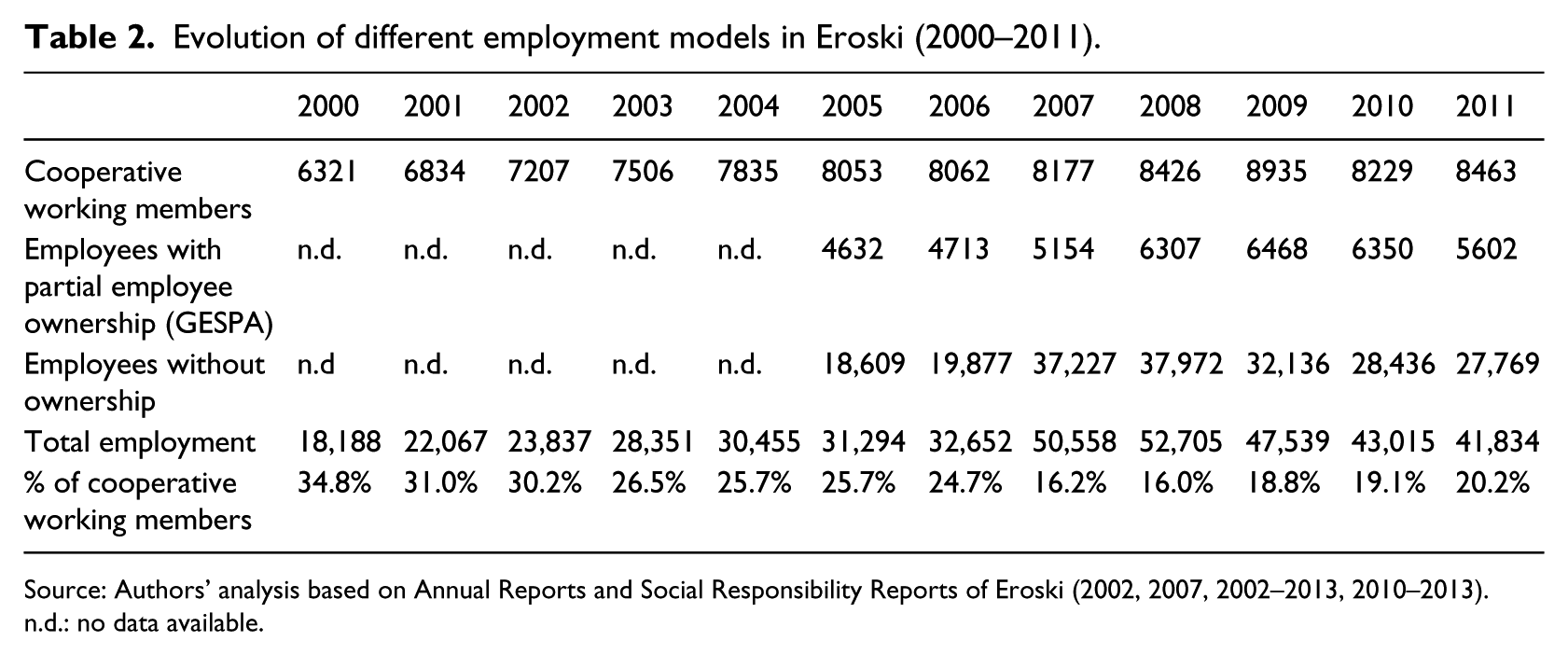
Most of the cooperatively owned stores of Eroski Group are in the Basque Country and neighbouring provinces. In 2011, 80% of the employees in the cooperative parent company were cooperative working members. But this ownership pattern is not replicated in other parts of Spain. According to Arando et al. (2010), in the early 1990s, Eroski felt it was too slow and complicated to expand by using cooperative legal structures. It expanded by developing other employment models in its subsidiaries. One mode of expansion was through the acquisition of a number of conventional firms with no employee ownership. An additional model of expansion was developed: a group of firms known as Gestión de Participaciones (GESPA) which have only partial employee ownership. This GESPA model was created in 1997 with the intention of replicating aspects of the cooperative model into some of the subsidiaries of the group. This employee ownership plan involved about 5600 employees in 2011 (16% of non-cooperative working members of the Eroski group). Other cooperatives of Mondragon have considered imitating this approach. The VII Congress of Mondragon in 2003 approved a new corporate expansion policy for its cooperatives, encouraging the participation of employees in subsidiaries following the Eroski-Gespa model (Altuna, 2008). However, the GESPA model was not capable of following the growth path of Eroski and now is considered as an incomplete model. 3
The evolution in time of those different employment models can be seen in Table 2.
Evolution of different employment models in Eroski (2000–2011).
Source: Authors’ analysis based on Annual Reports and Social Responsibility Reports of Eroski (2002, 2007, 2002–2013, 2010–2013).
n.d.: no data available.
So, in 2011 just 20.2% were full members and 33.6% had partial ownership in GESPA subsidiaries. Some informants argued that this low ratio indicated a move away from founding principles.
This move to employing non-members was also found within the JLP even though by no means on the same scale as in Eroski. This phenomenon has occurred in particular areas: IT outsourcing, diversification into new smaller formats in deals which often entail working with other companies, contract cleaning, and some parts of transport and logistics. The move to e-commerce has implications for the growing numbers of non-partner employees: contract staff are cheaper and more flexible. They may be brought in-house for special short-term projects or some operations may be outsourced to India on account of cost. A similar logic has operated with regard to the 3500 cleaners in JLP stores. These are outsourced to specialist cleaning contractor companies as is the norm in the industry—a decision which has caused some soul-searching for the partnership. But cost is not the only factor. The logistics function with its transport and distribution centres employs many non-partners. This has been used to access the knowledge and expertise which global logistics firms can bring and to take advantage of lower cost employment practices. Likewise, experimentation with multi-channel and multi-format customer offers has led to opening JLP in motorway service areas and other non-conventional settings. Overseas ventures can be added to this list. These varied arrangements lead to mixed forms of partner–non-partner working arrangements.
Besides going against cooperative principles, growing with different business models has created some positioning problems for Eroski. While John Lewis and Waitrose stress in their communication that employees are partners, and also other retail cooperatives in Italy and Great Britain communicate broadly their cooperative nature to customers and try to build a competitive advantage using the cooperative difference, that did not happen in Eroski’s expansion. As one informant acknowledged,
I believe that most Spanish customers don’t know that we are a cooperative, and we haven’t told it to customers neither. We don’t say to our customers that we are a cooperative. (Eroski Manager 1)
While some informants consider this lack of communication of the cooperative nature to customers as a deficit, others justify this policy as a conscious decision, arguing that the ‘coop’ image is not ‘modern’ and that previous coop failures in other sectors as in the building industries are an obstacle to portraying a contemporary, commercial and customer-oriented image. Conversely, in Britain, the worker-owner notion attached to JLP has market appeal.
The issue of non-member workers has become a very important issue in Eroski in recent years and the company is now making a conscious drive to ‘re-cooperativise’. It was argued,
We started our ‘cooperativization project’ because we wanted our management practices to be consistent with our principles … Among the considerations we made in Eroski, one had to do with our model: the inconsistencies arising from having worker/owners in one part of our business and only workers elsewhere. We believe that a cooperative is the best model to develop a business and develop people. (Eroski Manager 2)
Both JLP and Eroski management display a vigorous interest not only in ensuring that the mutual model delivers commercial advantage but also in monitoring (and when necessary modifying) the balance between commerciality and principles. Debate about membership goes to the heart of the decisions on the purpose of the organisations—for whom, and for what, do these organisations exist? It was evident that managers in both enterprises were willing to justify certain specific departures from the member-only pathway.
In the next section, we study how managers reconcile competing principles and priorities.
Achieving purpose: managing in a mutual
JLP senior management contend that not only are the principles of the Partnership compatible with commercial success, they actually contribute significantly to such success—but only when management actively intervenes to ensure this linkage. Mutuality on its own does not assure success. Many respondents argued that an earlier generation of managers had presided over complacency and neglect: ‘Through the 1990s and into the early 2000s, the business had stagnated under the leadership at the time and we just kept turning the handle on one way of doing things’ (JLP Manager 5). So, the business had to ‘go through an accelerated period of modernisation and catch up with the best of the competition’.
Of what does this ‘modernisation’ consist? For some informants, it meant that ‘Now we are very clear that management make the decisions’ (JLP Manager 5). But for others that is too crude a statement. While managers have certainly become far more ambitious, informed and assertive, they also understand managing in the partnership context to be of a different order, it requires an ability and indeed a desire to engage with the workforce, to listen to their ideas and to convince and carry them through the changes required.
Over the past 15 years, JLP has undergone significant change. Rigorous business planning using performance metrics that are little different from those used by conventional retailers was introduced. An increasing proportion of middle/senior management appointments are from outside the Partnership. These newcomers have introduced challenging new ideas. Sometimes, the outsiders were ahead of their time and they were forced out. Occasionally, the ideas they brought were ahead of their time and they might be adopted at a later date. Enormous investment in refurbishing stores and expansion has resulted in growth of sales and of staff. E-commerce takes an increasing share of sales.
This assertive management strategy is associated with dramatic business performance. Since 2008, JLP has consistently outperformed its competitors. During this recent period, some of the core institutions of the JLP model have undergone change. Some critics object that these changes represent a degree of ‘dilution’. Managers claim they represent ‘modernisation’ in the face of increasing size and competitive (cost) pressure. We found different interpretations about the current state of the democracy in JLP. It is not too difficult to mount a case which seems to show a dilution of the democracy. The number of senior posts dedicated to the ‘Critical Side’ (institutionalised checks and balances at director level) has been reduced over the past decade from five to just one, and the critical edge of the company magazines which Spedan Lewis introduced has, in recent years, been muted.
JLP and Eroski managers may differ on where they would draw the line beyond which employment model changes and which modes of action would represent a fundamental breach of the core principles. But, they agree that there is a line and they would agree that these issues require constant attention and debate: they see the benefits and they see the risks. Soul-searching and concern was evident:
A Waitrose convenience store in a Shell petrol station run by partners? Yes, I can get my mind around that. The Boots model [Waitrose goods in a retail chemists chain] is just product supply, really so again no real problem for me. We haven’t got any partners involved so I can get that as well. But, I am not so comfortable with the idea of a Shell petrol station run by a Sri Lankan family working God knows how many hours and just paid the minimum wage. If you try to build the partnership model into that, it just doesn’t work. But I can get my mind around the partner model being slightly different in different environments. (JLP Manager 3)
The concession to a ‘slightly different’ version of the model is revealing. Equally revealing is the evident mental struggle between what variations or stretch of the model to accept or challenge.
In Eroski, as in other cooperatives of the Mondragon Group, cooperative members participate in equity, in results and in management. Participation in management takes place at two levels: participation in governing and advisory bodies, and day-to-day participation at the level of shop operations. This last type of participation was, according to our informants, severely reduced during the growth and expansion period between 1995 and 2008, with a rising grade of centralisation of decision making in central offices to simplify growth and search advantages of standardisation, efficiency and economies of scale. Reduction in participation was also caused by complacency of partners:
When things were going well, in good times, participation was much lower. Because business results were good, partners did not question business decisions. (Eroski Manager 4)
Together with this lower involvement of members, some informants mention that participation and discussion became bitter because many members were dissatisfied with the way that the balance between social goals and business goals was being managed:
In 2008, we made a self-critical reflection we called ‘social mobilization’. In this self-criticism we saw that in the boom years, while we had record financial results year after year, we also had major conflicts at the Annual General Assembly, where we received very fierce criticism from working partners. In our reflection we concluded that we had been very results-oriented … Many partners didn’t attend meetings, they didn’t participate much in day to day decisions, and they didn’t care too much about information of the cooperative, and then complained at the General Assembly. (Eroski Manager 1)
A key process of any self-managed organisation is the reproduction of an active membership (Stryjan, 1994), something that was difficult in Eroski in its rapid expansion phase. It was argued,
When we grow we have to incorporate people who think cooperatively and we must couple them to a cooperative model and to cooperative practices. When Eroski grew too fast it was very difficult to incorporate all this. The current crisis has given us a number of lessons on how our growth model has to be, on how we must combine business growth with ideological and corporate growth. (Eroski Manager 4)
Thus, we see managers from both JLP and Eroski seeking to correct for past neglect of democratic aspects and seeking to persuade themselves that this form of renewal is also good for business.
Initiatives directed at cooperative renewal
In both organisations, the achievement of an appropriate balance between commercial success and maintenance of the core principles was a subject of open discussion and review. The result in both organisations was a process of periodic readjustment and ‘renewal’. For example, in 2005, Eroski took part in the Mondragon corporate self-reflection debate entitled Reflection on the Meaning and Future Directions of the Cooperative Experience. In this reflection, Mondragon concluded that there had been a loss of an explicit ‘cooperative identity’. It decided that it was necessary to update and renew cooperative practices (Azkarraga et al., 2012: 84). According to our informants, reflections at the Eroski Group level reached similar conclusions, and many of the cooperative regeneration practices implemented in the 2005–2009 and 2009–2013 Strategic Plans of Eroski have their roots in those reflections.
A program with the aim of bringing decision-making power to the stores was launched. Employees of each store began to organise their work schedules in a participatory way; they had more power to decide how to deal with complaints from customers, and how to solve common logistic problems at the shop level. The process of ‘empowerment’ can be seen with regard to both consumer members and employees. For example, with regard to consumers, there was the creation of consumer participation forums in 2006. Then, for employees, there was the conversion in 2012 of two subsidiaries in second-degree cooperatives and the conversion of 4142 employees to full cooperative membership. This ‘cooperativization project’ will be offered to other subsidiaries. Crucially, this project is seen not simply as renewing the principles of the cooperative but also as a way of achieving a differentiation strategy compared with competitors and gaining competitive advantages.
As with JLP, the Eroski case shows that cooperative ‘degeneration’ can be reversed.
In the next section, we move from management to governance.
Developing and maintaining purpose: governance processes
A risk for cooperative democracy, as illustrated by both Eroski and JLP, is that the greater complexity and size of the business makes the participation of non-management partners on the governing bodies more difficult. Informants in Eroski emphasised that any working member can stand for election and be elected as one of the members of the governing council. But a close look at the profile of the working members elected for the governing council during the last few years challenges this optimistic point of view. Prior to reforms in 2012, five of the six elected council members were middle managers. In the renewed Eroski council, all six working members are managers (three supermarket managers and three hypermarket managers). Informants mentioned as reasons a combination of self-selection and peer-selection due to the complexity of the tasks. A similar bias occurs in JLP.
Eroski is also a consumer cooperative and half of the members of the governing council are consumer members. According to informants, fear of ‘enemies’ entering the governing council of Eroski through the figure of consumer members drives the cooperative to closely monitor the nomination and election of consumer members. This monitoring process has generated an inbreeding of consumer members’ selection. Furthermore, Eroski allocates some of the places on the governing council which in theory are reserved for consumer members in the governing council, for outside non-executive directors (mainly managers of other Mondragon cooperatives). If many consumer members on the governing council of Eroski are senior managers from other Mondragon cooperatives, there is a risk that they may not be genuinely independent. And yet, on the other hand, informants suggested that those outside directors are often the most critical and challenging.
Overall, the results suggest that the core themes of investigation which drove the research—questions about ultimate purpose, about who was a member and who should benefit, and how to counter degenerative tendencies—were indeed all very live issues in both case organisations. Senior managers were alert to them and had taken steps to handle them. In the next section, we reflect upon the ways they had done this.
Discussion and conclusion
Economic crisis, revelations of unethical practices and the broad negative socio-economic impact of investor-owned businesses have stimulated a renewed interest in ‘alternative forms’ such as those represented by JLP and Eroski. In the case of the JLP, especially, continued sales growth and generally positive news has been implicitly ‘explained’ by the fact that it is described as an ‘employee-owned’ firm. This has led to wide endorsement of the John Lewis model. In the case of Eroski, its economic fortunes took a dip in 2008 and it has struggled to recover in the ensuing 5 years. In this context, this article has reported on research which explored managerial perceptions and practices in these EOFs in order to reveal the extent to which and the ways in which they have been able to enact regeneration strategies so as to achieve sustainability.
As noted, attempted departures from the established norms of the capitalist firm have been regarded as prone to a range of problems originating from their deliberate deviance (Ben-ner, 1984; Bonin et al., 1993; Meister, 1974, 1984). In that context, we explored how the senior managers in JLP and Eroski were responding. We found that many of the managers in the two organisations discussed in this article rejected the polarities of the degeneration literature. Instead, they contended that ‘with the right management’, a way can be found to facilitate customer benefit and commercial success from the increased commitment and engagement of employees who can be persuaded that they are working for themselves. We revealed how both retailers had learned how to articulate a compelling conviction that commercial advantage could be gained from the democratic elements. In the case of JLP, the managers had even learned how to leverage that difference externally to create and sustain a positive market image.
On the basis of this analysis, it cannot of course be claimed that there are no tensions between commerciality and the principles of mutuals; there clearly are. But, what can be claimed is that in these two co-owned businesses, this tension has been managed so that it is shifted from a zero-sum relationship to a mutually supportive relationship with positive linkages between structures and processes of accountability and commercial endeavour. The two cases also reveal that while the co-owned model can be a source of competitive advantage, it is by no means an automatic causal connection.
An intricate picture emerges. Changes to some aspects of the mutual model underpinning the two cases have occurred. And in both organisations, there are internal as well as external critics who see the amendments as attacks on the mutual principles and structures. In fact, many of the observations made by interviewed managers in Eroski over its expansion period (sharp reduction of the percentage of members; priority of economic goals; passivity and loss of interest by members; etc.) are almost identical to the degeneration processes in Meister’s (1974, 1984) third stage of the degeneration life cycle. Similarly, we also found signs of degeneration in JLP, as the employment of a growing rate of non-members, and a growing concentration of decision making in management hands and a weakening of the power of the Council attest. But, it is by no means clear that these changes in both companies represent across-the-board dilution of mutual principles. As shown, there were periodic attempts at renewal.
Our study corroborates and deepens the findings of the regeneration literature (Batstone, 1983; Cornforth, 1995; Cornforth et al., 1988; Estrin and Jones, 1992; Hernandez, 2006; Stryjan, 1994), showing that long-term survival can be accompanied by a resurgence of democratic features, principles and practices. In both cases, it is evident from our data that management is engaged in healthy, explicit, active and vigorous internal debate about the achievement of the appropriate interplay between commercial success and the maintenance of the distinctive underpinning principles. In the case of Eroski, this debate has led to a significant retreat from previous policies of centralisation and the employment of non-members. In JLP, it has led to reforms in management and employment practices and in governance structures.
The dilemma suggested by the degeneration thesis would appear to be neither inescapable nor insurmountable. Our cases suggest that the equilibrium will be dynamic and prone in an ongoing way to over-enthusiastic pressure from the commercially focused, or from defensive sallies from the cooperative fundamentalists. We suggest that this ongoing dynamic between the ‘modern managers’ and the defenders of traditional tenets of cooperative and co-owned ways of organising and managing is healthy and productive.
The article shows that managing these co-owned enterprises is not easy. Many cooperatives less favourably endowed have failed. There are numerous dangers: over-zealous modernising managers not fully steeped in the principles of the mutual often neglect to understand or respect them; a focus on commercial success could lead to commercially sensible decisions which dilute these principles; it is tempting to look for ways to avoid the scrutiny and questioning of democratic representatives. But interestingly, JLP managers were adamant that the success of the organisation was not at the expense of the model but was a result of the model. In Eroski, managers said that they expected that the model and the cooperative regeneration practices will help in the economic recovery of the company.
A contribution of the present study to the cooperative degeneration–regeneration literature is the finding in both enterprises of a relation between sustained economic success and member passivity. Long periods of economic success can generate complacency among members who consider past success as a signal of good management and reduce their control over business decisions. In the opposite direction, cooperative regeneration can be sometimes fuelled by poor economic results as happened recently in the case of Eroski. Apart from active policies aimed to regenerate cooperative life, informants consider that the economic crisis in the post-2008 period played an important role breathing life back into cooperative practices, increasing the desire of members to be informed, to attend meetings and actively take part in decision-making committees and governing bodies.
The main learning point from these cases is this: managers in both organisations suggest not only that commerciality and mutuality can be mutually supportive but that the real key to success resides in their insistence on not being satisfied that this balance has been achieved successfully. In fact, this balance is dynamic, and following the paradoxical perspective proposed by Hernandez (2006), we find that JLP and Eroski are neither fully democratic nor oligarchic but sites of continuous and unresolved contestation between oligarchic and democratic tensions. JLP managers worry that new business formats may stretch or even breach the core principles, and they discuss this and worry about it. Eroski managers, observing the increasing centralisation and use of non-member employers, are seeking to reverse these trends. Recognition that these kinds of balance are key, inherently unstable and requiring of constant attention is a fundamental lesson.
Footnotes
Funding
This research was funded in part by the UK Economic & Social Research Council (ESRC) with an award to Prof John Storey for the project “A Better Way of Doing Business? Lessons from the John Lewis Partnership”. Award number: ES/K000748/1.