




Abstract
The Mondragon Cooperative Experience has been one of the worker-owned alternative organizations that has received the most attention in the academic world. Despite its economic success, this experience has also been wrought with its own share of tensions and internal paradoxes. Surprisingly, the perspective of worker–member–owners in the analysis of those inconsistencies in Mondragon has been given very little prominence. Similarly, the equivalence between the formal policies defined in that experience and the day-to-day activity has been widely taken for granted in the literature. This article aims to fill this gap and contribute to the literature by analyzing the extent to which Mondragon’s basic cooperative principles are applied in the daily practice from the perspective of worker–member–owners. To that end, in-depth interviews were conducted with worker–member–owners of Mondragon outside their working environment. An interpretative analysis provides evidence of a decoupling of cooperative principles from the workers’ daily activity. Furthermore, a tacit and non-formal principle frequently surfaces in the interviews: the principle of the primacy of secure membership and guaranteed employment. This seems to be the most solid tie that binds members to their organization, in a context with growing individualization and precarious employment conditions, together with a ubiquitous managerial discourse that encourages shallow forms of workplace participation. This work contributes to the broader field of organizational theory and sheds light on the dissociation process in formal policies of organizations governed by alternative founding principles. It also tries to contribute to the study of the sustainability of such alternative organizations.
Keywords
Introduction
Worker-owned organizations are among the best known and most highly regarded forms of alternative organizations. The literature often asserts that contradictions are more obvious and prevalent in alternative organizational forms (Trethewey and Ashcraft, 2004), although few works analyze such contradictions in detail. In this field, the case of the Mondragon Cooperative Experience, 1 in the Basque Country, Spain, has been one of the experiences that has aroused the most interest. According to its own statements, Mondragon is a business-based socioeconomic initiative that combines the objective of generating wealth in the society through business development, with the commitment to solidarity, participation and the use of democratic methods for organization and management (Mondragon, 2013a).
Mondragon successfully developed and flourished for over half a century, once the initial seeds had germinated in its fertile social humus, an aspect that is frequently overlooked. Indeed, traditional Basque society boasted a long tradition of workplace and community participation. Max Weber himself drew attention to this fact in a letter written in 1897 during a brief visit to the Basque Country when he said that ‘The entire structure of the country, society’s uses and institutions, are strictly democratic’ (Weber, 2002: 309). Clearly, one would have to qualify such an impressive statement, although historical and anthropological studies do seem to agree that a certain level of social egalitarianism (Otazu, 1986) and organizational democracy (Caro Baroja, 1974) were already deep-rooted in the Basque social structure from which the Mondragon project germinated and sprouted.
Since the early decades of its journey, the Mondragon Cooperative Experience attracted international academic interest (e.g. Bradley and Gelb, 1985; Gutierrez-Johnson and Whyte, 1977; Oakeshott, 1978a, 1978b; Whyte and Whyte, 1988), which became consolidated over subsequent decades (e.g. Cheney, 1999, 2005; Clamp, 1999, 2000; Miller, 2002; Ridley-Duff, 2010; Whyte, 1998). Indeed, as recently highlighted by Azkarraga et al. (2012), Mondragon ‘has taken on a mythical status in some circles, especially in commentaries over alternative economic and organizational forms’ (Azkarraga et al., 2012: 76). During the second half of the 20th century, Mondragon was the model for successful cooperative businesses to follow (Santa Cruz et al., 2012), as a kind of ‘exemplary model’ of feasible alternative forms of enterprise in today’s globalized economy (Arando et al., 2010), one which has contributed to the fair economic development of the main region in which it has developed.
However, real tension increased over the extent to which the Mondragon cooperatives could achieve their targets in terms of social values (Azkarraga et al., 2012; Cheney, 1999, 2005; Taylor, 1994). These tensions and paradoxes between business success and social values within Mondragon have been studied by a set of scholarly contributions which have a complex and nuanced critical content. Conversely, in the prolific management literature that has analyzed Mondragon from the dominant uncritical perspective in management (see the following section), the experience has been romanticized and fictionalized to a great extent. Hence, two main limitations of these conventional works might be underlined. First, these contributions tend to analyze the organizational and managerial reality of Mondragon taking into account only the opinion of one of the agents involved in the organization—namely, its managers. In so doing, this literature has totally overlooked noteworthy distortions, such as managers’ social desirability bias (Crowne and Marlowe, 1964). Second, studies have tended to take for granted that there is an equivalence between the formal policy of the cooperatives and the day-to-day activity that takes place within them. But the scholarly literature supports the idea that formal organizational statements and principles are frequently disconnected from real actions, since decoupling of practices from formally adopted policies is ubiquitous in different types of organizations (Boxenbaum and Jonsson, 2008). Notwithstanding this, in the literature about alternative organizational forms, such as that of the Mondragon Cooperative Experience, this perspective has not been the focus of any interest.
Taking these gaps into consideration, this article aims to contribute to the literature in three ways. First, it aims to contribute to organizational theory by examining the dissociation process of formal organizational policies in organizations such as worker-owned companies, which are usually governed by different founding and guiding principles from those of conventional business organizations. Adherence to and dissociation from some basic cooperative principles (BCP) developed from a code of conduct which formally reflected the aspirations of Mondragon’s pioneers are therefore analyzed. Second, this article updates previous analyses of the complexities of organizational life within Mondragon from the perspective of the worker–member–owners, in a particularly relevant set of circumstances arising from the major systemic economic crisis surrounding the economic structure within which it is embedded and the intense process of individualization in the social context of Mondragon. Third, this article also contributes, on another level, to the study of the sustainability of alternative organizations and, in particular, worker-owned organizations, by considering the role they play in relation to the internal and external aspects of such organizations.
To this end, this article has been organized as follows. Following this introduction, there will be a brief critical review of the mythical status of Mondragon from both popular and academic perspectives. Next, basic principles of Mondragon and the theoretical perspective from which this analysis is to be conducted will be presented. The following section features the methodology of the empirical study that was performed. The final section discusses the main results obtained and provides concluding remarks, which also touch upon the limitations of this work and a brief proposal for further lines of research.
Short review on the mythical status of Mondragon, BCP, and theoretical lenses
Inside the Mondragon Cooperative Experience, internal critical scrutiny, debate, and reflection have been conducted continuously over the years (see, for a review, Altuna, 2008). This seems, as Whyte and Whyte (1988) pointed out, intrinsic to the legacy of Don José María Arizmendiarrieta, Mondragon’s inspirer and guide. Similarly, in the social environment of Mondragon, ideological criticism was very visible during its first two decades (see, for instance, Ansola, 1973), in a socio-political context characterized by an extraordinarily active civil society combined with the political situation that was emerging at the time. Critical discourse about Mondragon was even reflected in some didactic school materials and the odd leftist protest song (Heras, 2003). This initial critical attitude became diluted over the years (Zelaia, 1997). Indeed, the economic drive of Mondragon and, above all, the national and international expansionism that enabled the group to overcome a series of economic crises in the 1980s and 1990s would appear to have silenced part of this ideological criticism. Nevertheless, a certain popular external critical discourse about Mondragon has steadily gained momentum, as a reaction perhaps to the excessively flattering and self-indulgent media discourse that has surrounded it. The critical discourse is not only associated with a certain political perspective, such as that of the radical left in the Basque Country, which has been especially critical with the Mondragon Cooperative Experience (e.g. Badiola, 2011), or with different Basque trade union trends. Rather, it would appear to be a case of a more widespread conventional wisdom. In this respect, one should note the appearance of popular texts that are critical of the experience, such as the adaptation of Kasmir’s academic works (Kasmir, 1999a), as well as other critical works (e.g. Uribarri, 2000), and even some sensationalist works (e.g. Lertxundi, 2002). The thrust of these works is that the Mondragon Cooperative Experience is morally degenerate and that, in the words of Uribarri (2000), ‘many years ago [Mondragon] chose to pursue the irreversible path towards abandoning the ethical principles demanded of a cooperative movement’ (Uribarri, 2000: 102).
In the prolific scholarly literature about Mondragon, two broad academic traditions or dominant approaches can be distinguished. On one hand, there is an approach that recognizes and tries to analyze the tensions, lack of consistency, and internal paradoxes of the Mondragon Cooperative Experience. And on the other hand, there is the academic tradition that overlooks those tensions and promotes Mondragon as a sort of a managerial success story.
Many different kinds of works can be found in the first tradition. These range from contributions which are extremely critical of the experience, such as the academic work of Kasmir (1996, 1999b), who suggests that ‘Mondragon-inspired cooperation is part of a broader cultural and ideological attack on unions, political parties and working-class activism, and that cooperative management strategies are part of a regime of flexible accumulation’ (Kasmir, 1999b: 395), to studies which have aimed to compile descriptive and interpretative evidence from comprehensive field studies conducted from both anthropological (such as the work by Greenwood et al., 1989) and sociological (Whyte and Whyte, 1988) viewpoints, to far more highly developed contributions such as those by Taylor (1994), Cheney (1999, 2005), Miller (2002), and Azkarraga et al. (2012), which describe in depth the complexity of the paradoxes, tensions, and inconsistencies within the Mondragon Cooperative Experience from a cross-disciplinary perspective. Similarly, certain academic contributions about the experience written by insider-researchers have influenced the internal debate and reflection (e.g. Altuna, 2008; Azkarraga, 2006, 2007; Sarasua, 2010). Other local contributions (e.g. Bakaikoa et al., 2004; Errasti et al., 2003; Garmendia, 2004) have analyzed some of the main relevant aspects of what is referred to as the cooperative degeneration of Mondragon. After years devoted to its study, Azkarraga (2006) summarizes the main inconsistencies of the Mondragon Cooperative Experience like this: in theory, ownership and decision-making capacity are in the hands of cooperative members, but in reality, it is the managers who make the decisions; furthermore, the differential in wages has grown, the number of temporary workers has greatly increased, in both relative and absolute terms, and the internationalization process is taking place outside the cooperative movement; and finally, the contradictions in Mondragon greatly increased owing to the need to join the European Union (EU) in the 1980s and to adapt to the globalizing process of the 1990s.
Yet, these complex and critical issues are clearly absent from the second academic tradition. In complete contrast to the previously mentioned contributions, inconsistencies or tensions are not analyzed, or are considered very superficially. This conventional approach is deep-rooted in the Spanish academic tradition of management studies. It is an approach where it is assumed that management knowledge has no politics (Parker and Thomas, 2011). Therefore, a flattering and indulgent view prevails in this approach that derives from business analysis or is similar to corporate public relations. In this tradition, the perspective on the alternative experience has gone beyond the mythical status highlighted by Azkarraga et al. (2012) and has evolved into a monolithic myth, where descriptions of Mondragon such as a ‘unique experience in the use of democratic and participatory methods in management’ (Forcadell, 2005a: 255) are commonplace. The main objective of this type of work is to analyze the most noteworthy policies of what is assumed to be a best way and of its business success. As a result, the focus of these works is strategic factors, such as the highly diversified nature of the business structure (Basterretxea, 2011), the intense socio-political support and high degree of networking and cooperation (Basterretxea and Martínez, 2012), and the intense commitment to internationalization (Luzarraga and Irizar, 2012). Other factors more related to internal contingencies such as the availability of better managers and the development of practices of in-group advanced management (Basterretxea and Albizu, 2011; Charterina et al., 2007; Fernández de Bobadilla and Velasco, 2008), and the greater capacity for involving individuals and greater flexibility in adapting to changes and crises (Forcadell, 2005b) are also analyzed. Needless to say, this is a line of work that is currently in vogue (e.g. Arando et al., 2010; Basterretxea and Albizu, 2010; Elortza et al., 2012), given the extent of the crisis that is currently being experienced in Spain.
However, this line of work takes for granted that all these business practices can be reconciled with Mondragon’s foundational principles and values, simply because such principles are declared and supposedly guide its activity. From the outset, these BCP were shaped to ensure they are at the core of the Mondragon Cooperative Experience. As Smith (2001) puts it, ‘Mondragon is held together by a set of shared principles’ (Smith, 2001: 13, 46). Briefly, these BCP are the following (based on Ormaechea, 1993):
Open Admission;
Democratic Organization;
Sovereignty of Labor;
Subordinate Character of Capital;
Participatory Management or Self-management;
Payment Solidarity;
Inter-cooperation;
Social Transformation;
Universality;
Education.
As represented in Figure 1, within the recent Corporate Management Model proposed by the technostructure of the Corporation (Mondragon, 2013a), these principles are present ‘as the point of departure, on the understanding that as a whole they define the specific features of our cooperative culture’ (Mondragon, 2013a: 8). Furthermore, it is stated that the proposed management model does not question those principles, but ‘[i]nstead, it takes them as the point of departure and develops the way in which they are implemented in day-to-day management’ (Mondragon, 2013a: 9).
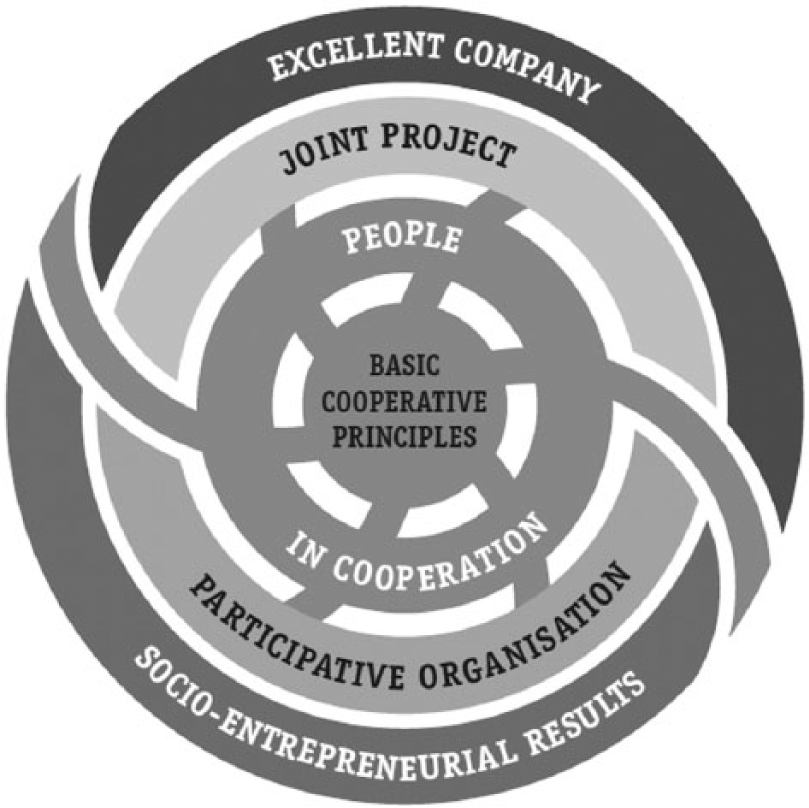
The BCP within the Corporate Management Model of Mondragon.
As has been pointed out, academic works in the field have, broadly speaking, taken for granted that there is an identity between the organizational discourse and rhetoric of the type referred to previously and the day-to-day activity that takes place within such organizations. Organizational rhetoric is found in formal, public messages, and discourses such as mission statements concerned with the possible impacts of symbolic communication (Cheney, 2004), and additional complexity arises because this type of rhetoric usually has an ambiguous intent beyond a self-contained effect (Cheney et al., 2004). Organizational discourse may be strategic, purposive, and deliberate; it may be detached from intention (Henderson et al., 2007), and, although it may have an impact on the daily working life of the organization, it may also be seen as detached from action. Indeed, the discrepancies between formal policies and organizational discourse and real activity have been highlighted from different theoretical perspectives that can be seen as part of the mainstream of organization studies. For instance, Meyer and Rowan (1977) note that the frequent ‘decoupling’ between the adopted organizational discourses and methods and the real practices or needs of organizations result in ‘myths’ and ‘ceremonies’ intended to meet the requirements of the external environment superficially. In brief, decoupling refers to creating and maintaining gaps between symbolically adopted formal discourses and policies, and actual organizational practices (Meyer and Rowan, 1977). Brunsson (1989), going beyond the seminal concepts of American institutionalists, refers to ‘organized hypocrisy’, to stress the significant divergences between ‘talk’, ‘decisions’, and ‘actions’ which are often the norm within the organization’s life. Brunsson notes that observers of organizations are prone to ‘make the mistake of supposing that organisational statements and decisions agree with organisational actions’ (Brunsson, 1989: 231).
These perspectives therefore provide evidence of the fact that organizations tend to create idealized portrayals or fictions. Thus, the discourse contained in corporate statements or principles can be viewed from this critical perspective as stories that unidentified authors disseminate simply to decorate the simulacra they produce.
Santa Cruz et al. (2012) mention in the special issue of Organization that the study of the adoption of Mondragon’s principles in practice may prove interesting from the perspective of the worker–member–owners. Even among the previously mentioned articles which adopt a more critical, nuanced, and complex perspective of the Mondragon case, there is a dearth of works that attempt to reflect the workers’ views. And those that have been done (e.g. Greenwood et al., 1989) were published a long time ago, in a different economic and social context that existed before the more recent and prominent processes of globalization and individualization (Beck and Beck-Gernsheim, 2002). As Azkarraga (2006, 2007) and Azkarraga et al. (2012) pointed out, the social and cultural flows between Mondragon and its larger social–political–economic context may have influenced the evolution development of the experience. Especially, the move toward more individualistic patterns of community and civic life, among many other factors aspects, seems to have lowered the levels of communitarian social capital to historic minimums in the Basque Country (Calzada, 2013). As stressed by Azkarraga et al. (2012), ‘The process of de-ideologization has affected the whole of society and, as members of that society, the cooperative social body as well’ (Azkarraga et al., 2012: 78).
Fieldwork: talks over coffee with worker–member–owners outside the Iron Cage
With a view to finding answers to the questions raised earlier, an empirical, qualitative study was designed based on in-depth interviews with worker–member–owners of Mondragon, or socios, a word that means member or associate. The research carried out was interpretive in nature (Gephart, 2004), based on in-depth interviews designed to obtain narrative descriptions from the workers. Fieldwork was carried out between February 2010 and September 2012. A series of in-depth interviews were conducted with 27 socios who do not hold important managerial posts from 11 cooperatives that belong to the sectors of Finance, Industry, and Retail of Mondragon. A total of three interviewers contributed to the data collection using a broadly structured script, following certain pre-determined themes, while also allowing space for free-flowing discussions. Interviewed socios were identified using a combination of theoretical, purposive, and snowball sampling (Patton, 2002).
The interviews were carried out outside Weber’s symbolic Iron Cage (Weber, 1968),that is, outside the workplace, away from the metaphorical instrument of dominant authority (Boiral, 2003), and away from any institutional constraints of the organization. Interviews were carried out in community centers (local kulturetxeak), coffee shops, and quiet bars, as recently suggested by Alvesson (2013). To prevent organizational silence (Morrison and Milliken, 2000), absolute confidentiality of the research was assured in writing. Likewise, in order to allay social desirability bias, we asked those being interviewed for their analysis to be extremely sincere, assuring them that the information obtained would be managed and used with the utmost confidentiality.
The work was confined to the aforementioned number of interviews because, as the fieldwork went on, fewer and fewer new ideas were being gathered and it was clear that theoretical saturation was reached (Strauss and Corbin, 1990). In order to obtain as wide a range of respondents as possible, the main variables taken into consideration when selecting respondents were the following: the cooperative organization they came from and the cooperative’s sector of activity; type of employment (directly or indirectly related to the production or provision of services); age and length of time as a member of Mondragon; the geographical variable; and, finally, the experience of belonging to corporate bodies of representation or participation.
Of the 27 respondents, 3 belonged to a cooperative organization within the area of Corporation Finance, 19 of the respondents belonged to 8 cooperative organizations in the industrial sector, and 5 to a cooperative in the distribution sector. In terms of age, 1 respondent was under 25 years of age, 4 were between 25 and 30 years, 10 were between 36 and 45 years, 10 were between 46 and 56 years, and 2 were over 56 years. The majority of the respondents (20 to be precise) had more than 5 years’ experience in organizations from Mondragon. It should also be noted that 10 of the 27 respondents had had some kind of previous experience in corporate bodies of representation. As far as the geographical variable is concerned, it should be noted that all interviews were carried out in the Autonomous Community of the Basque Country. Of the interviews, 10 were conducted in the Alto Deba district, where the Mondragon Cooperative Experience came into being. Due to the strict confidentiality promised in the interviews, and to guarantee the absolute anonymity of respondents, the standard summary table of all the respondents’ profiles, providing information on each respondent’s cooperative and their personal characteristics, is not included.
Owing to the size limitations of this article, the analysis below focuses on the core principles of Democratic Organization, Participatory Management, and Education. Given the interpretive study methodology employed, the amount and quality of the qualitative information and the production of meanings (Gephart, 2004) emerging from the interviews in relation to these three BCP were the main criteria considered. It became clear from the interviews that these are the three principles which most stakeholders base themselves on and are most influenced by and are also those that can have an influence on their daily activity. In the literature on the subject, these three principles are among those that can be most easily, directly, and comprehensively assessed by worker–member–owners, as they are linked to some of their more substantial rights and responsibilities (Ormaechea, 1991). As argued by several experts in Mondragon (e.g. García-Insausti, 2003; Ormaechea, 1991), democratic organization is the chief characteristic of the experience. García-Insausti (2003) notes that Mondragon strives to create a new collective subject which can transform the relationship between labor and capital since it amalgamates the worker and entrepreneur into a single subject. According to this author (García-Insausti, 2003), this new contribution offered by the experience is reflected in Mondragon’s two essential principles: the Democratic Organization Principle and the Participatory Management Principle. The latter has also been regarded as one of Mondragon’s core principles (e.g. Altuna, 2008). Similarly, it is also noted that the Education Principle is at the core of the BCP, according to both the corporation—‘the basic mainstream principle that feeds and feeds off all the others’ (Mondragon, 2013a: 17)—and academic discourse, for example, ‘Education is the glue that binds the co-operative principles together’ (Winther and Sørensen, 2009: 151). It is also clear that there is a strong tie between these three selected principles. As highlighted by Ormaechea (1991), the democratic nature of cooperatives involves progressively developing self-management which, in turn, requires systemically implementing social and professional training schemes for members.
Decoupled cooperative principles: a summary of findings
Broadly speaking, the socios who were interviewed view the BCP as having two distinct connotations. On one hand, they are seen as a discourse which presents an initial, general approximation to the principles, and which are seen as a set of rather abstract values, that is, not very clearly defined, which an individual may have internalized. As one interviewee put it: ‘I’m one of those who shares those principles; I lean towards them’ [I.#7]. In other words, the BCP are seen as basic ethical constituent principles which, among older interviewees, even resemble a religious decalogue: ‘For some, these [principles] are like our ten commandments’ (I.#4).
On the other hand, respondents also clearly associate these principles with a more rhetorical or formal level of corporate discourse, in the form of a declared formal corporate statements of compliance (Seidl, 2007). These are statements which, broadly speaking, they do not seem to have assimilated, since 24 out of the 27 interviewees were unable to list them even approximately—‘Those theoretical concepts [the BCP] are forgotten with the day-to-day activities, as they are not used’ [I.#9]. They are statements that the interviewees associate with the formalities of the Corporation: ‘That thing about the principles is the typical stuff that comes from above, from those in the Corporation, who come up with theories about all this’ [I.#6]. This attitude is predominant among all interviewees, but it is especially prevalent among young socios, although it does not appear that it is caused by their belonging to a cooperative organization that is characterized by rather low levels of debate and internal reflection about cooperative principles and values. In short, there seems to be a prevailing attitude that these BCP are corporate discursive elements that are detached from day-to-day decisions and activities.
As regards the Democratic Organization Principle, interviewees are mostly critical of its supposed day-to-day presence and commitment. There is a relatively unvarying discourse among the interviewees that is critical of the real practical potential of the main democratic bodies, such as the Assembly or the different councils, especially the Social Councils. From the information gathered from the interviews, there does not seem to be any difference in this regard between respondents who had direct experience participating in corporate decision-making bodies and those who had none. The majority of respondents shared the opinion that, in practice, there was limited participation in these key democratic bodies on the part of members, in particular on the part of the youngest and most recent ones: ‘I note a great difference—the youngest people pay no attention to all of this (participation in bodies)’ (I.#19). Also noteworthy is the fact that such representative member bodies tend to be monopolized by people with a certain political profile (i.e. left-leaning people who are critical of Mondragon) or who aspire to ‘go up the ladder within the organization chart’ (I.#21). There is a mainstream discourse that, using different terms, criticizes the lack of ‘practical’ value of the Democratic Organization Principle, pointing out that this principle constitutes ‘mere formalism’ in day-to-day activity (I.#14), ‘a pointless gesture’ (I.#17) or ‘a fictitious democracy that is conspicuous by its absence’ (I.#12).
Similarly, there is also a discourse shared by some respondents, especially the youngest ones, which expresses a very extreme version of this criticism focusing on the supposed day-to-day application of this principle. They point out that despite the fact that a certain formal democracy exists which allows some decisions to be made democratically, ‘[t]hese have little to do with that perspective of one person-one vote’ (I.#11), as in the day-to-day activities of their organizations all substantive decisions are made at the top. On this matter, the examples and cases referred to by those interviewed are very heterogeneous, although most of it could be summarized as examples of relatively specific decision-making, in which the real top-down perspective and criticism of supposed empowerment of socios prevail. What is more, the lack of transparency of information with regard to this principle is criticized by the vast majority of respondents, who link it to a deficiency in the day-to-day application of this Democratic Organization Principle.
It is important to stress at this point that the Democratic Organization Principle established in Mondragon refers to the democratic government of organizations and not to supposed democratic or democratizing day-to-day management. The bases of a democratically organized company are specified: the sovereignty of the General Assembly which operates on the basis of ‘one member, one vote’, the democratic election of governing bodies, and the collaboration with management bodies designated to manage the company through the delegation of the members as a whole (Mondragon, 2013a). Therefore, this principle does not promote assembly decision-making, as it seems that is interpreted with criticism by many of the interviewed. While this may be a criticism that can be linked to other aspects of organizational democracy, such as the issue of transparency in communication (Cheney, 1999), it is clear that the regular exercise of full democracy in day-to-day decision-making does not necessarily derive from the principle under analysis (Ormaechea, 1991). As pointed out by García-Insausti (2003), organizational democracy can be oriented either toward the political-institutional level relating to the overall management of the company or toward the more technical level relating to each job.
It would thus seem that a clear, active reinterpretation by respondents is taking place with regard to the formal Democratic Organization Principle included in the BCP, giving it a meaning and content that go beyond its literal sense. Consequently, the complexity of the concept of organizational democracy becomes apparent, as does its bond—as mentioned previously—with the Participatory Management Principle in the case of Mondragon, as suggested by Altuna (2008).
The Participatory Management Principle implies a progressive development of self-management and, therefore, of the participation of the members in business management (Mondragon, 2013a), which requires the development of adequate participation and consultation mechanisms, transparent information with respect to the performance of the basic management variables, the systematic application of social and professional training plans, and the establishment of internal promotion as a basic means of filling positions with greater professional responsibility. Most of the comments by the interviewees focused on the first two elements of the principle, and the prevailing discourse among those interviewed is also that the principle is quite remote from their daily activity, as their ability to participate competently in decision-making and the management of the organization is very limited and not the real focus of attention, and thus it does not produce substantial improvements on a day-to-day basis. The following are some of the comments made by the interviewed socios:
That thing about participation and self-management sounds like an anachronism to me—someone needs to come and explain to me what this has to do with the reality of our situation. [I.#2] There is little commitment to or participation in managing things. I do the bare minimum and then head off for home. I know I’ve got some job security, and so I do my eight hours and that’s it. [I.#24] Participation is not a priority—compliance is. He who goes up in the organization is the one who complies without complaining about what the managers are ordering. [I.#6]
Together with this highly critical discourse, a more positive discourse is also present which values achievements with regard to participation and self-management within their own organizations, in comparison with participation found in conventional organizations. This can be seen across the board and particularly among newer workers and respondents from the industrial sector. Nevertheless, we are dealing with a complex discourse which highlights the fact that the established expectations of participation fail to be met. In the words of some of the respondents,
There is participation, but not all there should be—or, at least not how we are supposed to participate. [I.#7] We don’t reach the level of participation we set as an objective. (…) People participate, but not like before, when we were small and everyone knew each other and there weren’t so many obstacles. [I.#18]
Although there is indeed a discourse that emphasizes the democratic and participatory nature of the cooperative organizations to which the respondents belong, many of those interviewed do not seem to think that these two principles could be reasonably expected to be implemented to a greater extent in the day-to-day practice:
It’s difficult to try and be democratic and participatory in such a tough, competitive situation as the one we’re living in. [I.#5] We can’t continue to expect that one socio one vote thing for all decisions—things would end up in chaos. [I.#8] This isn’t an NGO—that thing about (organizational) democracy sounds all nice and well, but it wouldn’t appear to be very compatible with the competitive economy in which we’re living. [I.#19]
The discourse among those interviewed would seem to evidence a broad erosion of the Democratic Organization Principle and the Participatory Management Principle, although there may be no perception that such erosion exists, owing to the degradation of these concepts and some internal tensions. Rather, one can discern a type of discourse among the socios that justifies the existing sense of neglect or giving up, for instance, in the area of participation in representative member posts. Some interviewees express an especially critical tone toward the managerial elite of Mondragon. Nonetheless, the prevailing feeling among the interviewed members—which is even more obvious among the younger socios—seems to be that the degeneration of the democratic principle is necessary in order for the experience to continue to be viable. This critical discourse only emerged with regard to political-institutional participation, but not with regard to participation at work, which they see as behind closed doors and do not feel is mediated by external factors like the external economic pressures from Mondragon (Cheney, 1999), such as the constant threat of offshoring of production activities. More specifically, this source of pressure regarding global competition when defining an acceptable degree of participation was particularly common in the discourse found in members who belong to cooperatives from the industrial sector, working in the production of labor-intensive products, and who are exposed to direct competition from other organizations that manufacture in countries with low labor costs.
With regard to the Education Principle, a reinterpretation of this foundational principle can also be observed. Even though the literal sense of this principle covers not only aspects relating to cooperative education and training, but also more wide-ranging aspects of Education and Lifelong Learning (Mondragon, 2013b)—that is, training in knowledge, competences, and values, as highlighted by Agirre et al. (2001) and Altuna (2008), who adhere to the Arizmendian training perspective—practically all the interviewees focused on aspects related to cooperative training. In relation to this specific aspect, a very poor and distorted cooperative education is in evidence, relegated to mere formal training about the BCP that is geared toward filling an existing gap identified by Mondragon itself, according to the socios interviewed—especially the newer ones. Most of the people interviewed described how specific training courses are offered by the Corporation to socios on the BCP.
2
For instance, Interviewees 7, 8, and 9 received a 1-day training course about these principles. Furthermore, many of those interviewed considered this training to be very theoretical and far removed from day-to-day reality. Here are some of their comments:
Very theoretical training—all very nice. (…) I think that the people who provide this training don’t put themselves in our place and tell us things that prove difficult for us to assimilate. [I.#8] A load of gobbledygook—I didn’t understand anything. [I.#10] [The training] is offered to keep up appearances, just to say that it’s been done. [I.#14]
Some interviewees also expressed the same tone when pointing out how, on joining the cooperative, each socio received a type of training manual: ‘When you become a socio, everyone is given a little book at the beginning—it’s like a bible’ [I.#13]. Likewise, the members also expressed a feeling that the training received as insufficient, as it failed to meet expectations in terms of suitable cooperative training:
Analyzing, internalizing and understanding each principle takes time. (…) One day isn’t enough for this. [I.#13] This training course might perhaps raise some awareness in the socio, but doesn’t train them. [I.#18] After working ten years at the cooperative, I received two days’ training. [I.#26]
Some/many/all of those interviewed pointed out that cooperative training should be given more often. They also state, in a critical tone, that a hierarchy exists among socios and that those who hold managerial posts receive more complete training: ‘There is a hierarchy, and the bigger the job, the higher up the scale, the more days of training courses there are’ [I.#14].
Yet, in addition to these comments about BCP within Mondragon, one could sense from the interviews a certain tacit and non-formal principle, which is prevalent among the socios, especially among the younger ones. A principle which was expressed by one of them in this way: ‘At the end of the day, that’s what there is, I’m a socio and they can’t throw me out—that’s the only principle that is abided by’ [I.#11]. This attitude seems to be prevalent in the daily activities of those interviewed. Indeed, there are many stories and anecdotes about this principle in their conversations. In most cases, this discourse is also critical of members’ tendency to go along with the system: ‘Many socios just go along, for they know that even in the worst case scenario they will not be fired, but relocated [to other cooperatives]’ [I.#12]. We can call this attitude the principle of secure membership and employment, which is mainly what binds the worker–member–owners to Mondragon, namely, job security. In the words of one member,
… deep down, what is it you are actually sharing, what ties you to (name of organization omitted), to this cooperative thing, the cooperative movement, to all this history? … And that’s the point, that being the socio that you are, your job is guaranteed. (…) That’s what binds you to all this. [I.#3]
Discussion: paradoxes within, coherence outside
In spite of their more or less critical standpoint toward Mondragon and of the values summarized in the BCP, interviewees from all organizations and sectors seem to view these principles as a non-binding sort of formal code of corporate governance (Weil et al., 2003). They predominantly view them as part of the organization’s rhetoric, as a representation of the formal macro-organization that is Mondragon—mainly of the Corporation, rather than the original cooperative. This is talk that is detached from daily decision-making and actions. Moreover, in the fieldwork, one can clearly see what was discerned years ago by Cheney (1999, 2005), when he pointed out that the value commitments of the founding generation, such as the culture of sacrifice or the culture of solidarity, have come to be seen as outdated by the younger socios. These are workers with a more individualistic perspective on career and values, especially those who have had no family ties either with the community or the experience.
The Democratic Organization Principle would seem to be detached from practical application, according to the people interviewed. They perceive it as a theoretical statement, one which is far removed from day-to-day decision-making. This perspective clashes with the discourse of the Corporation, such as its assertion that Mondragon ‘believes that the democratic nature of a cooperative is not limited to the membership side, but also involves the progressive development of self-management’ (Mondragon, 2013a). It also clashes with the approach highlighted by authors who have analyzed Mondragon from the uncritical perspective mentioned above (e.g. Forcadell, 2005a, 2005b). These authors argue that in organizations that form part of the Mondragon Cooperative Experience, there is growth of democratic management that implies advances on two levels, in decision-making and in the democratic governance of the firm. This result is probably not incompatible with a less sycophantic and more self-critical perspective, such as that of Arizmendiarrieta himself (Arizmendiarrieta, 1999) or Ormaechea (1991), one of Mondragon’s main ideologists. These perspectives that emanate from Mondragon itself explain the true scope of the principle of organizational democracy by referring to the wide delegation of powers proposed and the impossibility of this principle fulfilling the democratic desires of each and every socio (Arizmendiarrieta, 1999; Ormaechea, 1991).
Parallel to this, the Participatory Management Principle also tends to be referred to as one of the key reasons for the success of Mondragon, especially from the management standpoint, since these are firms that approach the concept of best practice in Human Resources (e.g. Lertxundi, 2011). From what can be gathered from the interviews, there would seem to be a clear decoupling between the organization’s policy and the practice described by the socios. This lack of coherence would not appear to give rise to any real tensions inside the alternative organizations, if we confine ourselves to statements by the interviewees made outside the ‘Iron Cage’, which is in keeping with the shallowness of workers’ participation in these organizations. In this regard, one should consider the evolution witnessed over the past two decades in corporate philosophy and managerial discourse on worker participation, which has shifted from the periphery to the center of corporate philosophies (Stohl and Cheney, 2001). This is a phenomenon that has been especially noticeable in the Basque Country, which has experienced an intense regional policy to promote the adoption of ‘dominant regimes of managerialism and productivity’ (Cheney, 2005: 197)—a policy in which the Mondragon cooperatives have played a key role (Heras et al., 2008; Heras-Saizarbitoria and Boiral, 2013).
As a result, there has been a major clash between two cultures of participation, something which was discerned over a decade ago already by Taylor (1994), Stohl and Cheney (2001), and Mathews (2003). On one hand, we find the conventional or weak employee participation culture proposed by programs such as total quality management (TQM) and, on the other, the culture of substantive or strong worker participation in the Mondragon tradition. In an environment in which such managerial initiatives have been nearly omnipresent and where a range of business and institutional policies involving individualization of the job market have reached their peak (Castillo, 2009), the conventional culture of participation would appear to have prevailed, as suggested in previous works (Cheney, 1999, 2005; García-Insausti, 2003).
Respondents value the participation and self-management within their own organizations, but there is clearly a hint of disillusionment along the lines detected by Greenwood et al. (1989) more than two decades ago, ‘like a familiar refrain’, (Greenwood et al., 1989: 112, 113). Disillusionment is sprinkled with a heavy dose of idealizing the past and maybe even nostalgia. Furthermore, the fieldwork detected a clear disinterest, weariness, and even neglect with regard to the dialectics of balance between the economic and social dimensions of the system as presented by Greenwood et al. (1989), Taylor (1994), and Cheney (1999, 2005), among others. For instance, Greenwood et al. (1989) demonstrate in their study that members speak of the differences existing between what is and what they hope for. In other words, there is a desire and will to improve and the conviction that improvement is possible. Despite these difficulties, ‘the aspiration to be a member and the hope persists that, by means of dialogue, there will be a change toward a greater degree of participation’ (Greenwood et al., 1989: 131). However, this discourse is not confirmed by our fieldwork where a prevailing discourse of desperation, disillusionment without involvement and blame-placing disappointment is indeed found. The discourse that is common among socios fundamentally places blame on the senior management of their own cooperative or the actual Corporation. It is a discourse that perhaps resembles more a rhetoric of abandoning the cooperative spirit than a rhetoric of disillusionment.
With regard to the Education Principle, the evidence obtained from the fieldwork once again corroborates the systematic deficit existing in cooperative training in Mondragon, as highlighted by various previous authors (e.g. Azkarraga, 2006). The Corporation has set different initiatives in motion in an attempt to alleviate this situation. As Basterretxea and Albizu (2011) mention, all workers who join the cooperatives attend a formal course and receive an explanatory dossier called Ongi etorri kooperatibara (Welcome to the Cooperative)—the bible referred to by the interviewee above. Likewise, between 2006 and 2011, over 6000 cooperative members took part in training sessions organized in the various cooperatives, which received a very positive internal rating, at least according to their promoters (Aizpúrua, 2011). However, on this point, as on many others, the possibility of decoupling in this type of formal training program should at least be considered. From what was gathered in the interviews, it is clear that there is much room for improvement in terms of cooperative education, and the Corporation itself seems to be aware of this, as the new training steps being considered are going to be ‘more geared towards action than reflection, and more geared towards day-to-day behavior than any philosophical grounding’ (Lekuona, 2011: 25).
Finally, as a result of the interpretative work carried out, the proposed principle of the primacy of secure membership and employment—what really seems to bind socios to Mondragon—is also worthy of discussion. In the fieldwork, it has become quite clear that the main feeling of membership the socios have is not for the most part dependent on their participation in decision-making nor on participation in ownership of the cooperative. The main source of their sense of membership has more to do with a longer-lasting principle or value in this age of precarious, temporary work. It is a principle that has been reinforced both formally (among other reasons due to the relocation policy, cf. Goienetxe, 1996) as well as informally (in terms of their experience within Mondragon): the socios’ secure and long-lasting employment—even more long-lasting than the organization itself, due to existing solidarity mechanisms that require transfer of members (Flecha and Santa Cruz, 2011). In this sense, this principle could be the glue that links the other principles together in the BCP, including the principles of Sovereignty of Labor and of Inter-cooperation among the cooperatives. In contrast with this, other rights (and obligations) attached to the socio which derive from the BCP, such as participating in a democratic organization and actively making decisions, either belong to a more abstract or rhetorical level or would seem to be linked to the Corporate rhetoric.
This observed principle of secure membership and employment—which could be related to the principles of Sovereignty of Labor and Inter-cooperation—ties in with the results of other studies highlighting that stability of employment is the variable which best predicts satisfaction with cooperative arrangements (Freundlich, 2009). Similarly, this could also be linked with what Greenwood et al. (1989) highlighted in their study, as job security was also an omnipresent idea among the members interviewed: ‘In an era in which work has become scarce, job security is one of the strongest cooperative values and everyone interviewed recognizes it’ (Greenwood et al., 1989: 103, 104). These authors mentioned that this was one of the main value-added features of being a member, ‘one [dimension] especially appreciated in the recent times of crisis is security in terms of employment’ (Greenwood et al., 1989: 128). It has been a long time since this study was conducted, but these authors’ findings seem to be more relevant now than ever. One might thus wonder about the impact of the current economic crisis in Spain on this discourse shared by respondents that gives the job guarantee such a prominent role. Although the influence of economic circumstances may be powerful, it seems that the statement by Greewood et al. transcends the specific conditions that they allude to for; even though unemployment rates have fluctuated and will continue to do so, the true issue underlying the employment crisis arises from precariousness and instability (Prieto and Miguélez, 2009). In short, going beyond circumstantial eventualities, what seems to have a decisive influence on the prominent role of the principle of a guaranteed job is the influence of the structural crisis on stable employment, which has prevailed now for decades in the geographical area where Mondragon developed. It is a principle that seems to encourage most workers to remain quiet and compliant in a system that gives them limited ways to participate.
Concluding remarks
Mondragon’s foundational principles appear to be a formal corporate statement or code of governance that is symbolically adopted and decoupled from the daily activity of the cooperatives. This study shows that this disconnection is a highly complex process in which the key actors in the organizations, in this case the worker–owner–members, play a very relevant role. Indeed, it shows that these actors interpret and reinterpret, or actively translate those formal organizational principles.
Even though traditional neo-institutional theory does not focus on the complex and dynamic processes behind the adoption of formal policies, both the organizations adopting them and the people who make up such organizations play an active and complex role in reinterpreting the formal elements of day-to-day practice. Research into the disconnection of formal policies from practices has not addressed the role of the different internal stakeholders of the organizations, such as the organizational leaders and the employees. Among the few exceptions, Westphal and Zajac (2001) suggest that decoupling occurs, not because it is functional for an organization, but because it serves the interests of organizational leaders. As can be seen in this study, decoupling occurs in Mondragon because it serves both the interests and experiences of the technostructure and the interests of the worker–owner–members of the organizations. In other words, this process of decoupling is sustained over time because it rewards different stakeholders in practical terms, and this process seems to be connected to the erosion of the authenticity of alternative organizational forms such as the ones of Mondragon. According to mainstream institutional theory (e.g. Meyer and Rowan, 1977), decoupling enables organizations to gain external legitimacy while also maintaining the internal flexibility with which they can address practical considerations. In the case of Mondragon, where there is great institutional pressure and tension, planned disconnection could be the key to understanding the resilience of the organizations that are part of it.
This finding clashes strongly with both the popular press accounts of Mondragon and with the uncritical scholarly perspective described in the literature review, as there is evidence of a more complex and paradoxical organizational reality. Conversely, the evident decoupling of form and substance is compatible or consistent with the alternative academic tradition that highlights the ongoing change from direct collective management to conventional management in these participatory organizations. In the case of the Mondragon cooperatives, this decoupling would not appear to give rise to any internal tension between worker–member–owners and managers of the type that might be expected in a community-based organization (Peredo and Chrisman, 2006), as the socios seem to share a positive discourse that renounces some underlying rights and duties attached to their status as partners and members of the organization with a certain amount of apathy. Worker–member–owners, who have direct democratic mechanisms at their disposal, would appear to have opted for a rhetoric of abandonment of the cooperative spirit and an abstainer stance within the formal democratic organization in which they work, as they would seem not to advocate for a more genuine integration of the principles on a day-to-day basis.
This erosion may perhaps be part of the phenomenon of cooperative degeneration and the limited development of the ideological and socio-educational aspect of the cooperative mindset stressed by Sarasua (2010). However, this decoupling and erosion should be analyzed taking into account the social environment in which alternative organizational forms such as Mondragon are embedded. So, in the case of Mondragon, we may ask, ‘What happened to that social humus that Weber referred to during his visit to the Basque Country?’ The erosion of that soil would appear more evident in the individualization process of the post-modern globalized society and would seem to affect, to a greater extent, alternative organizational forms such as Mondragon’s. Most of the worker–member–owners—especially the newer generations—remain quiet and compliant because they find no stimulus to participate in an organizational context where, as in the social context, the communitarian tradition has been deeply eroded. As Sennett (2012) has recently stressed, it is clear that cooperation has been shaped by, among other factors, managerial discourse, which in turn appears to be omnipresent. And this also seems to be the case for participation. Previous concerns underlined many years ago in the more discerning academic works on this topic (e.g. Cheney, 1999, 2005) might be confirmed. Managerialism from the ‘inside’ (Cheney, 2005), but also from the ‘outside’—with the aforementioned pressure of the dominant regimes—would seem to have influenced the reshaping of the concept of participation within Mondragon’s cooperatives.
There are some limitations to this work, due to the obviously interpretive and explanatory nature of its objectives and the use of a qualitative study methodology. Mondragon is a complex experience in which organizations from very different backgrounds and contextual factors come together, and in which—as has been stated—there appear to have been dynamics of degeneration and regeneration emanating from heterogeneous organizations at play. There is also a possible methodological distortion introduced by conducting the interviews outside the organizations of such an intense social reality as Mondragon, where many of the members collaborating in this study have been able to use the interview as a catharsis, as also mentioned by Greenwood et al. (1989) in their study. From our perspective, this bias may even increase when interviews are conducted outside the Iron Cage with guaranteed anonymity, since this setting provides an opportunity for respondents to air some of their feelings such as doubts, fears, and frustrations (Haynes, 2006). Furthermore, the fact that the interviews were conducted at a time of serious general economic crisis may have biased the results obtained. Similarly, deep financial problems faced by a number of cooperatives of Mondragon in recent years (e.g. Fagor Electrodomésticos and Eroski) may also have led to a certain bias, even though the interviewees made no direct significant reference to this issue.
Looking to the future, the different levels of decoupling should receive greater attention in complex cases such as Mondragon, where such a disconnection has been detected between the macro-organizational rhetoric of the Corporation and the rhetoric emanating from the cooperatives (Heras-Saizarbitoria, 2013). Likewise, it would be interesting to analyze the specific contingencies and strategies that have supported and eroded the adoption of the main cooperative principles (e.g. workplace democracy). Very interesting examples currently exist within Mondragon that should be subject to critical and rigorous discussion, such as the case of Eroski, whose external subsidiaries are fully immersed in the process of cooperativization—which for some observers is an example of the re-orientation of Mondragon’s policy in order to renew emphasis on the social values (Arando et al., 2010; Bakaikoa et al., 2014), whereas for others it is one of the most critical situations that Mondragon has faced in its history (Martinez de Arroyabe et al., 2008). Moreover, it is clear that thorough consideration needs to be given in the future to the symbolic, institutional, and social effects of the crisis that has erupted at Fagor Electrodomésticos at the time of completing this article, one of Mondragon’s flagship cooperatives. 3 If the literature on such an emblematic experience of alternative organizations underlines the great resilience of these organizations, as a result of the very cooperative principles and values on which they are based (Viñafiel, 2010), the factors leading to a breakdown of such resilience need to be analyzed in depth.
These conclusions also have implications of a more practical nature. Sennett (2012), following the same humanistic lines of Arizmendian thought, argues that cooperation, more than being a moral or ideological attitude, is a matter of skill, an embodied craft which is conveyed by social rituals. If that is the case, then genuine cooperative training is of crucial importance in the regeneration efforts to maintain a project involving an alternative organizational form. Training in cooperative principles should be seen as a fundamental task embedded in the workers’ day-to-day activities and not as a formal and specific educational program that can easily be decoupled from those activities. Additionally, such a substantive socio-educational project should go hand in hand with the promotion of a number of managerial initiatives to ensure that both are mutually reinforced.
Perhaps the main practical implication of this work for Mondragon, and for other experiences that are seeking to replicate this inspiring alternative to business as usual, is that there has to be an active, continuous, and self-critical safeguard policy, aimed at preventing the disconnection of the basic or foundational organizational principles from their daily practice. For those alternative organizational forms’ day-to-day shared principles need to be more than a mere mechanism to achieve organizational coordination. Those principles and values are more than a means to an end; they are an end in themselves.
Footnotes
Acknowledgements
The author acknowledges the input of the Co-Editors of the Special Issue of Organization and of the three reviewers; their constructive criticisms and suggestions helped to improve and develop the article. Similarly, the author would like to thank Olivier Boiral, Jon Aske, and David Turner for their comments on earlier drafts. The author wishes to express his gratitude to all interviewees from Mondragon for giving their time to this research. He also wishes to give his heartfelt thanks to the research assistants Erlantz Allur, Paula Esnal, and Iker Laskurain.
Funding
Research for this article was supported by grants from the Basque Autonomous Government (Grupo de Investigación Consolidado del Sistema Universitario Vasco IT763-13/GIC12-158).