




Abstract
Although worker cooperatives offer an organizational model that critical management scholars could adopt to demonstrate the utility of their normative ideals, little is known about how academia can contribute to the creation of worker cooperatives. Building on the concept of performativity and the case of the Technological Incubators for Popular Cooperatives in Brazil, we provide an account of constructing incubators for worker cooperatives across multiple universities. Our study uncovers the challenges that scholars face in performing the model of worker cooperatives by cognitively embedding actors within both economic and cooperative principles through teaching. Our results clarify the role of feedback loops, knowledge circulation, and the building of ‘chains of translation’ in the concrete manufacturing of worker cooperatives, and we show how universities can help develop a multilevel, flexible, and complex support network that enhances the performativity of the worker cooperative model. We advance the concept of a ‘critical performativity engine’ to describe the process whereby the first method for incubating cooperatives was developed and then translated across settings.
Introduction
As an organizational form, a worker cooperative embodies significant aspects of critical management ideals such as ownership by workers, democratic decision-making, profit sharing, and emancipation. Thus, worker cooperatives have been described as credible alternatives to the organizational forms that dominate contemporary capitalism (Hertz, 2012; Lewis and Klein, 2004), and even as ‘organizational weapons’ (Selznick, 1952) that promote anticapitalist ideals (Yaffe, 2009). Paradoxically, worker cooperatives have been neglected by critical researchers. For example, a search on previous issues of Organization suggests that no paper has yet been published specifically on the subject of worker cooperatives. This neglected status of worker cooperatives in critical management studies (CMS) is unexpected at a time when concerns have been raised about the need for scholars to ‘perform the critical project’, that is, to draw from their conceptual and practical tools to confront social and economic issues, influence actual practices, and actively contribute to positive social change (Cheney et al., 2013; Spicer et al., 2009; Voronov, 2008). However, though an increasing number of authors insist on the need to develop this type of engagement, there is little empirical research about how this type of performative scholarship can be conducted and the specificities and challenges that ‘performing’ the critical project might entail.
This article seeks to advance this debate by investigating the process whereby the organizational model of worker cooperatives is transformed into social reality, and more specifically, by showing how scholars and universities can contribute to this process by supporting the incubation of this alternative organizational form. Our analysis is informed by prior organizational studies of worker cooperatives and recent developments in the field of performativity. Although organizational analyses of worker cooperatives have documented the challenges (Cheney, 1999; Schneiberg et al., 2008; Whyte and Whyte, 1988), barriers and enablers (Cornforth and Thomas, 1990; Schneiberg, 2013; Staber, 1992), and tensions that are faced by the actors who manage these cooperatives (Cornforth, 2004; Varman and Chakrabarti, 2004), these analyses have neglected the central role of the constitution and translation of a body of knowledge in the concrete manufacturing of worker cooperatives. As a result, they have overlooked the role that scholars could play in supporting the development of such cooperatives by helping to capitalize and diffuse the knowledge and know-how that is related to this organizational form.
However, the tenets of the ‘performativity of economics thesis’ have acknowledged that economic models, concepts, and knowledge are the central components in the constitution of economic activities (Callon, 1998, 2007; Fourcade, 2007) and highlighted the role that is played by prominent economists and educational institutions such as business schools in the rise of financial economics (Fourcade and Khurana, 2013; MacKenzie, 2006; Thrift, 2005). To date, the research on performativity has focused on the processes of ‘economization’ (Calışkan and Callon, 2009, 2010), in which actors are ‘disentangled’ from social relations and are ‘cognitively embedded’ within economic principles to perform market mechanisms and related economic activities (Callon, 1998; Callon and Muniesa, 2005). Such research has not investigated whether and how alternative organizations such as worker cooperatives can be ‘performed’ in a capitalist context. This notion raises the complex issue of how an organizational form that is based on principles that are alternative to capitalist principles can operate within a capitalist economy. Investigating the double socioeconomic process of ‘entanglement’ whereby worker cooperatives are embedded within their local communities and their economic contexts can help researchers address this gap.
To investigate the performativity processes through which worker cooperatives are established, we draw from a case study in Brazil to examine how scholars can engage in the incubation and diffusion of worker cooperatives in deprived communities to improve the living conditions and favor emancipation. Our study analyzes how scholars and their universities can develop an incubation process to transform the normative ideals that are inherent in the worker cooperative model into social reality. Our findings make explicit the role of scholars and academic knowledge in this process, as they reveal how a method for cooperative building is progressively ‘theorized’ to support teaching activities and translate the incubation model across universities. The translations of the worker cooperative model enable the development of new incubators that can support the development of worker cooperatives in a variety of communities, which enhances the reach of this model.
In shedding light on the performativity of the organizational model of worker cooperatives, this article seeks to make a threefold contribution to organizational analysis. First, we complement the previous organizational studies of worker cooperatives by clarifying the role of feedback loops, knowledge circulation, and the building of ‘chains of translation’ (Callon, 1986; Czarniawska and Joerges, 1996; Latour, 2005) in the concrete manufacturing of worker cooperatives across a variety of settings. Our findings confirm the challenges of cognitively embedding actors with both economic and sociopolitical principles to maintain the integrity of this organizational form through its incubation (Cheney, 1999; Varman and Chakrabarti, 2004). However, the specific context of incubation allows for those particular conditions that facilitate the blending of these principles both before and after the inception of a worker cooperative. In addition, our results highlight the need to stabilize a knowledge corpus on how to perform cooperativism and how to build flexible, multileveled networks that support divergent translations of this corpus across a variety of settings.
Second, we augment and enhance the concept of ‘critical performativity’ (Spicer et al., 2009) by clarifying the link between this notion and the economic sociology studies of performativity. Specifically, we show how the economic sociology perspective on performativity (Callon, 1998, 2007; MacKenzie, 2006, 2007) can enrich the critical performativity concept (Spicer et al., 2009) by providing empirical accounts of the processes whereby critical or alternative forms of knowledge can be performed and by analyzing the incubators of worker cooperatives as ‘critical performativity engines’. Thus, we unleash the political and emancipating potential that is embedded in the economic sociology analysis of performativity (Butler, 2010; Cochoy et al., 2010).
Finally, our case shows how academic and educational institutions can concretely support the creation and maintenance of organizational forms that are alternative to the dominant capitalist organizations. Thus, this article advances the continuing debate on the concrete impact of organizational analysis on society (Cheney et al., 2013; Voronov, 2008) by showing how scholars and academic institutions can ‘walk the talk’ of critical performativity and not merely subvert managerial discourse (Spicer et al., 2009) by supporting the development of alternative organizational forms and delivering the methods and knowledge that are related to the construction of these organizational forms.
The article is organized as follows: section ‘Manufacturing worker cooperatives: A performativity perspective’ demonstrates that a performativity perspective can highlight the neglected dynamics that are critical to the creation of worker cooperatives. In section ‘Context, method, and data’, we introduce the context of Technological Incubators of Popular Cooperatives (ITCPs) 1 in Brazil and present our methods and data. Our findings are presented in section ‘Building worker cooperatives: The role of critical performativity engines’. Then, the implications of our research are discussed.
Manufacturing worker cooperatives: A performativity perspective
The challenges of building alternative organizational forms
Worker cooperatives have been conceived as organizational forms that significantly depart from traditional economic organizations, and thus, they can contribute to developing an economic activity that is alternative to capitalism in at least four ways. First, in contrast to the modern legal corporate form that is focused on making profits for its shareholders (Bakan, 2004), worker cooperatives provide the opportunity for their members to share in the profits made by the organization (Vanek, 1970; Meade, 1972), which is based on economic participation.
Second, democratic governance is central to this form of organization (Cornforth et al., 1988), which opposes the model of hierarchy (and its inherent authority structure) that characterizes the modern corporation (Coase, 1937; Miller and O’Leary, 1989). In contrast to this hierarchical model, worker cooperatives rely on a community and/or trust approach to organizations (Adler, 2001). Nowhere are the democratic principles of cooperativism more clearly expressed than in the cooperative principles of the International Cooperative Alliance (ICA), which affirms the importance of democratic control (see Appendix 1 for the full list of principles).
Third, worker cooperatives tend to include the normative ideals of cooperation, solidarity, and a communitarian economy as well as assumptions about how members should behave (e.g. acting as ‘good citizens’) in the organizational context and beyond. Here, cooperative principles are again instrumental in clarifying the values of autonomy, independence, and a concern for the community, which constitute the normative ideals that are embedded in worker cooperatives as organizational forms.
Finally, worker cooperatives aim to ensure the emancipation of individuals both within and beyond their organizational borders. Internally, worker cooperatives help emancipate their members from traditional capitalist and managerial domination and enhance workers’ self-esteem and self-confidence (Whyte, 1986). Externally, the ICA cooperative principles require cooperatives to be involved in the sustainable development of the communities in which they are embedded and help emancipate community members from the pressures they face (ICA, 1995). For example, the Mondragon cooperatives complex is not only a central part of the economic development of the Basque community in Spain, but it also contributes to the improvement of the community’s educational system (Cheney, 1999; Cornforth, 1988).
Unsurprisingly, the worker cooperative organizational model has struggled to maintain its prominence over the last few decades in developed Western countries, which have witnessed the rise of financial markets and the concurrent decline of the organizations-based model of capitalism (Davis, 2009; Useem, 1996). After the ‘neo-liberal’ ideology came into prominence (Harvey, 2005), worker cooperatives received less attention from researchers who are interested in the organization of economic life. Tellingly, in the field of economics, cooperatives have almost vanished from textbooks; although they were abundant in early 20-century economics textbooks, cooperatives are virtually absent from their modern counterparts (Chamard, 2004; Kalmi, 2007; Laurent, 2000). Kalmi (2007) documents this trend and concludes that the disappearance of cooperatives from economics textbooks corresponds to the paradigm shift from institutional to neoclassical analysis that has led to a quasi-exclusive focus on for-profit organizations. In the management literature, cooperatives are also a topic of declining importance. In the Harvard Business Review over the course of the 20th century, there were a dozen papers that focused on cooperatives, and there has been a clear decline in interest that began in the 1970s. Eventually, the mainstream analyses of economic activity, which are grounded in economics or management, came to either ignore cooperatives or treat them as a ‘transitory and aberrant’ phenomenon (Schneiberg et al., 2008: 637).
In parallel to the weakening of the research and dissemination of knowledge about cooperatives in educational institutions, previous organizational studies of worker cooperatives have thoroughly documented the challenges that are inherent to their creation, maintenance, and development. The first challenge relates to the need for support in the foundation and development of cooperatives (Cornforth, 1988). While the research has studied worker cooperatives that have become major economic players, such as Mondragon or John Lewis, most of the worker cooperatives are small businesses that are isolated and vulnerable. Hence, these organizations struggle to access funding and credit and to recruit trained managers, who can obtain better salaries in traditional companies (Cornforth and Thomas, 1990). As a result, worker cooperatives can benefit greatly from support organizations, which are essential for the cooperative sector to thrive and develop (e.g. Cornforth et al., 1988; Joshi and Smith, 2008; Vanek, 1970; Whyte and Whyte, 1988). It is worth noting that given such support, cooperative organizations are often present in developed countries, and they are less common in developing countries (Birchall, 2008). In addition, prior studies of support organizations have overlooked the role of knowledge in the process through which actors learn how to create cooperatives.
A second problem is related to the management of tensions within worker cooperatives, which arise from the contradictions between social and economic values (Varman and Chakrabarti, 2004). Worker cooperatives must permanently balance the principles of cooperativism and solidarity upon which they are based with the market and managerial principles that dominate their environment and pervade their organizational boundaries. This paradoxical situation has generated ongoing tensions that are well-documented in previous studies (Cornforth, 2004; Darr, 1999). For example, in an in-depth case study of the Mondragon Cooperative Complex, Cheney (1999) shows that a decline of the social values and commitment to economic justice occurred because of contradictory market pressures coupled with the importation of managerial ideology and the bureaucratization of the organization. Indeed, such contradictions have been shown to challenge the democratic governance of worker cooperatives (e.g. Varman and Chakrabarti, 2004).
A third core problem identified in the literature is related to the conditions that enable the diffusion of the worker cooperative organizational form (Staber, 1992). According to prior studies, the need for cooperative members to develop close relationships with the members of the community within which they operate may prevent or decelerate the diffusion of the worker cooperative model (Cornforth and Thomas, 1990). Indeed, cooperative principles state that worker cooperatives are committed to contributing to the sustainable development of the community within which they operate, and their ultimate goal is to enhance the people’s autonomy and solidarity within their social context. However, when they expand beyond their local communities, worker cooperatives may lose their commitment to these cooperative ideals (Errasti et al., 2003).
To investigate how academic and educational institutions can help address these challenges, we adopt a perspective that is inspired by the concept of critical performativity.
A critical performativity perspective on worker cooperatives
The notion of performativity can explain how organizational theory and critical scholars can help promote alternative organizational forms, and furthermore, it sheds light on how the challenges of building worker cooperatives can be overcome. The notion of ‘critical performativity’ proposed by Spicer et al. (2009) focuses researchers’ attention on how implementing alternative or critical theories can impact social realities. Spicer et al. (2009) refer to critical performativity as follows:
active and subversive intervention into managerial discourses and practices. This is achieved through affirmation, care, pragmatism, engagement with potentialities, and a normative orientation. (p. 538)
Following this approach, a critical performativity perspective considers how alternative bodies of knowledge can influence social reality and points to the role of academics in this process. However, Spicer et al.’s (2009) developments of critical performativity mainly remain bounded to a discursive interpretation of performativity as ‘doing things with words’ (Austin, 1962); however, the authors refer to the works of Butler (1993), which consider the materiality of the performativity process. As a result, the effects of the discursive strategies that critical performativity advocates advance to transform capitalism remain limited because they do not challenge the dominant organizational forms.
The relationship between a theoretical body of knowledge such as CMS or organizational theory and the social reality that it seeks to influence is more precisely described by economic sociology scholars, who have advanced the ‘performativity of economics’ thesis (Callon, 1998; MacKenzie, 2006). According to this view,
Economics does not describe an existing external ‘economy,’ but brings that economy into being: economics performs the economy, creating the phenomena it describes. (MacKenzie and Millo, 2003: 108)
In considering economics to be a core ‘technology’ that co-constitutes the dynamics of capitalism (Fourcade, 2007: 1025), the performativity approach has stimulated the development of studies that highlight the various social mechanisms whereby economics is turned into social reality. Prior works have documented how the theoretical assumptions of financial theory (MacKenzie and Millo, 2003; MacKenzie, 2006), economic concepts and language (Ferraro et al., 2005), or rational choice theory (Cabantous and Gond, 2011; Cabantous et al., 2010) have been transformed into social and organizational reality despite their unrealistic assumptions about human behavior. In the course of researching how theoretical models came to influence practices, performativity studies point to the dynamic and recursive relationships among expert bodies of knowledge, material artifacts, organizations, and actors’ activities, which contribute significantly to turning normative ideals, organizational models, and theoretical relationships into reality (Callon et al., 2007; MacKenzie et al., 2007). These works suggest that the construction of economic activities involves a process of ‘economization’ (Calışkan and Callon, 2009, 2010) in which actors are cognitively embedded within economics and progressively disentangled from their social contexts (Callon and Muniesa, 2005). Previous studies have also documented the looping mechanisms whereby economic knowledge is ‘self-confirmed’ through the performativity process (Barnes, 1983; Ferraro et al., 2005; MacKenzie, 2007), and they have highlighted the role of academic institutions as organizations that contribute to this performativity process (MacKenzie, 2006). For example, specific academic departments and a few leading financial theorists have played a central role in organizing from business schools the rise of financial economics, which has drastically reshaped economic activities over the last 20 years (Davis, 2009; Fourcade and Khurana, 2013; MacKenzie, 2006; Thrift, 2005; Whitley, 1986).
The economic sociology approach to performativity has the potential to shed new light on the dynamics that underlie the construction and diffusion of worker cooperatives; notably, this potential can be realized by stressing the role of knowledge production, circulation, and self-confirmation through educational and academic institutions (Thrift, 2005). Nevertheless, this approach has rarely been used beyond the context of the financial marketplace or to consider the influence of noneconomic principles and organizational models. Focusing on the construction of worker cooperatives can advance our understanding of performativity as a process that consists not only of reproducing capitalist dynamics but also of altering those dynamics by linking economic activities to an alternative set of principles or bodies of knowledge. In addition, the performativity perspective can help document how scholars, universities, and educational institutions can address the three problems that are inherent in the construction of worker cooperatives by building, running, and reproducing organizations that are devoted to the performativity of this critical project. Accordingly, we suggest that developments on critical performativity should not be limited to what academics say to intervene in managerial discourses and practices, but more actively about what they do and how they shape different environments to support the realization of alternative bodies of knowledge. We approach this issue as a ‘critical performativity engine’ that supports the realization of the organizational model for worker cooperatives. We refer to this context as an ‘engine’ not because of the mechanistic nature of this metaphor (Morgan, 1986), but to stress the importance of considering the principles of cooperativism to be the elements that actively co-constitute worker cooperatives and do not simply describe a set of pre-existing organizations. This definition reflects MacKenzie’s (2006: 9–12) reading of Milton Friedman’s (1953) argument about the realism of economic hypotheses: we consider the organizational model of cooperativism to be a potentially unrealistic and politically utopic organizational form with the potential to shape reality into its image by being discussed, operationalized, and enacted across organizational settings.
In this article, we empirically investigate the critical performativity of the organizational model of worker cooperatives by addressing the following research questions:
RQ1: How is the ideal form of a workers’ cooperative turned into social reality through the creation of a critical performativity engine?
RQ2: What is the role of academics and universities in this process?
RQ3: To what extent can this critical performativity engine be reproduced and diffused?
To address these questions, we study the creation and development of a specific type of critical performativity engine, that is, the ITCPs in Brazil, which are designed to incubate worker cooperatives in economically distressed communities.
Context, method, and data
Case context: Incubating workers’ cooperatives
Incubators offer convenient and relevant contexts for studying the creation of new organizational forms, as they are specifically designed for that purpose. Focusing on the case of an incubator that aims to create and maintain worker cooperatives allows us to capture the many dynamics that are involved in the performativity of a worker cooperative’s organizational form through a single organizational context. ITCPs are university-based incubators that scholars and students manage to incubate worker cooperatives that are based in deprived communities; these cooperatives are referred to as ‘popular cooperatives’.
The first ITCP was founded in 1996 by The Alberto Luiz Coimbra Institute Graduate School and Research in Engineering, also know as COPPE, the technology department of the Federal University of Rio de Janeiro (UFRJ) in reaction to the country’s growing unemployment. The idea was to use COPPE’s know-how to manage a technology-based incubator and to create a similar platform for cooperatives (Almeida, 2008). The incubator’s mission was to support the creation of popular cooperatives, particularly those that were initiated by disadvantaged people. The activity of this first ITCP (UFRJ/ITCP) has currently reached more than 1200 people in the city of Rio de Janeiro. Starting in 1998, the ITCP model diffused as other universities adopted it. Currently, there are 42 ITCPs in locations across Brazil. Although no systematic data were available to track the impact of the ITCPs’ overall activity, the data we collected suggest that in 1996 alone, the UFRJ/ITCP either created or coached the development of seven cooperatives in domains such as cleaning, civil construction, and cooking. Each of these cooperatives created between 50 and 100 jobs. Since its founding, the UFRJ/ITCP has incubated 125 cooperatives (see Appendix 2 for the list).
The deep and lasting involvement of scholars in these incubators provides a second justification for our selection of this organization: the scholars who are involved in the ITCP believe that a project that is an alternative to the traditional capitalist organization can be developed. Their aim is to show that worker cooperatives can represent efficient solutions for marginalized people. Hence, ITCP’s context presents an interesting empirical fit for our objective of analyzing how scholars can perform a critical body of knowledge.
A third interesting feature of this case is that it is located in a Southern country with a vivid critical tradition (e.g. Motta, 1980; Tragtenberg, 1974). While much of the research on worker cooperatives has been conducted in Northern countries, it is our intent to contribute to Organization’s interest in Southern voices (Alcadipani et al., 2012; Imas and Weston, 2012) and to account for the Brazilian approach to the development of worker cooperatives.
Data collection and data analysis
The choice of the case study approach was justified by the exploratory nature of our inquiry (Eisenhardt and Graebner, 2007; Yin, 2003). The performativity of the worker cooperative model has not yet been investigated, and the proposals of critical performativity scholars are still rarely addressed in the literature (Spicer et al., 2009). In line with Siggelkow’s (2007) recommendations for developing a persuasive case study, we aimed to describe in context the performativity of the worker cooperative model. Furthermore, we sought to inspire scholars from the critical performativity stream of studies by unveiling the challenges associated with the implementation of an alternative and critical organizational model by proposing a new concept: the ‘critical performativity engine’. This methodological choice is consistent with both prior performativity studies (e.g. Cabantous et al., 2010; MacKenzie, 2006) and prior empirical analyses of workers’ cooperatives (e.g. Cheney, 1999; Cornforth, 1988).
To develop our case study, we conducted exploratory interviews with members of the ITCPs and then searched for the existing data on our object of inquiry. Based on our initial contacts and visits with one of the authors at the UFRJ/ITCP, we were provided with a list of 44 documents concerning the historical operation of the organization. This rich empirical material included internal reports that were produced by researchers and staff from the ITCP as well as academic articles and other reports that were produced by third-party stakeholders. This corpus was completed by research on ‘Google academico’ because most of the material that has been produced about ITCP Rio de Janeiro is in Portuguese, and hence, it was important to rely on a dataset that would concentrate its research efforts in this language as well as extend research to the development of the network of ITCPs in Brazil. This search contributed 26 additional documents to our initial corpus. Hence, a total of 70 documents from reliable sources that represent more than 1000 pages of texts were collected. This dataset was especially rich and diverse: it provided us with the perspectives of multiple internal and external stakeholders of the ITCPs as well as with historical and critical perspectives on the development of these cooperative incubators. Therefore, we decided to rely mainly on this empirical material to conduct our analysis, and we systematically analyzed its content to elaborate a narrative that accounts for the performativity of cooperatives by ITCPs.
To construct a narrative that could support our research questions, we followed a two-stage data analysis process. The first stage consisted of reducing the data to a set that we could handle more easily (Richards and Morse, 2007). By drawing from the different sources, we developed a single-spaced narrative of 80 pages. This narrative included raw data (quotes from interviews, field notes, video references, and extracts from documents), and it accounted for the growth and activities of both the UFRJ and the ITCP, the main cooperatives the ITCP incubated, and the other ITCPs and the network of ITCPs.
In the second stage of our data analysis, we built a theory-informed narrative (Langley, 1999) that highlights a three-stage process consisting of (a) the foundation of the first ITCP in Rio, (b) the institution of a method to incubate worker cooperatives, and (c) the translation of the ITCP model across a variety of settings. In our findings section, we adopted a storytelling approach to account for those three steps, and we relied on the performativity vocabulary to shed light on the roles of expert bodies of knowledge, actors’ activities, and feedback loops in the incubation processes. Finally, to enhance the validity of our findings, we talked to a leader and founder of the first ITCP in Rio de Janeiro as well as a scholar who had been involved in ITCPs to read and comment on our findings to ensure their relevancy. Our discussion elaborates theoretically on these findings and shows how they address our three research questions.
Building worker cooperatives: The role of critical performativity engines
This section explores the period in which the ITCP was founded, developed its method, and was subsequently replicated by other ITCPs that were created in other universities in Brazil. To guide our presentation of the findings, we identify three core topics that are related to the performativity of cooperativism: the process by the ITCP was initially constituted as a critical performativity engine, the internal dynamics that are inherent to its incubation method, and the spreading of this critical performativity engine to other universities.
Building a critical performativity engine
Learning how to perform the cooperativism project required persistence. Engaging local deprived communities and managing internal tensions were daily challenges in the first years of the process. The decision to build an incubator of popular cooperatives began at UFRJ as both a part of the extensão policy through which Brazilian universities develop programs to engage with segments of the population that do not have access to higher education. In addition, the university’s decision to join the COEP, that is, the Comitê de Entidades no Combate à Fome e pela Vida (the Committee of Public Institutions against Hunger and for Life), was critical. Moreover, the university had social issues in its neighborhood, including a drug war in the Manguinhos complex, which is an ensemble of favelas (shantytowns). As a result of this war, growing violence began to affect the security of the employees in the nearby university’s research center on health policy, namely, the Foundation Oswald Cruz (Fiocruz). As stray bullets began to hit the Fiocruz building, the university decided to take action. To engage with the population of the favelas, the university asked for the help of both retired former employees who lived in the complex and the complex’s inhabitants who were in charge of cleaning at the foundation. Their enrollment allowed a meeting to be organized between scholars, students, and 80 representatives of the favelas close to the university. Following this meeting, the university helped to create a local worker cooperative and employed its members to do the cleaning and gardening for the foundation. The cooperative form was favored, as it could achieve the objective of economic improvement while meeting the COEP’s political agenda by prioritizing opportunities for the integration of citizenship, which were aligned with the aims of the ‘Campaign against Hunger’ (Singer, 2006). It is in this context that COEP asked the university to become more involved and create an incubator for popular cooperatives.
The ITCP was formally founded and hosted by the COPPE in 1995. The initial idea behind the ITCP project was to build on the expertise that had been achieved by the university incubator through the incubation of traditional ventures, and the chosen means was to transfer this knowledge to the context of creating cooperatives. The ITCP would make
… academic knowledge available to popular cooperatives, contributing to the education and consolidation of economic initiatives based on self-management principles that are both economically viable and founded on solidarity. (Guimarães, 1998)
Although relying on established entrepreneurial processes may seem relevant to overcoming the barriers to creating cooperatives (Cornforth, 1988), organizing the knowledge transfer that is needed to perform the principles of cooperativism represents a challenging task that requires the specific capacity to manage internal tensions on the part of the ITCP. Even though the extensão policy made it simpler to recruit academics and students with either social science or engineering backgrounds into the ITCP, the development of an incubation model proved to be more difficult than had been anticipated, and it took a few years for the ITCP to stabilize its approach. Through the lessons of experience, the method was developed through the incubation of a dozen worker cooperatives around Rio de Janeiro. As the ITCP team had no previous experience in incubating cooperatives, its members learned in the midst of the process, which resulted in problems in the structuring of the team and frequent changes in the sequencing of the actions that were undertaken during the process. At that time, courses were generally not offered according to a structured plan; instead, they were designed to address the specific needs of cooperatives. With an increased workload and an increasing number of cooperatives being incubated, the lack of planning became a significant problem, and tensions emerged between the members of the first incubator.
These tensions were grounded in the differences in the knowledge bases of the ITCP members, which were reflected in the backgrounds of the first members: the newly created structure enrolled social scientists with prior experience working with disadvantaged populations along with engineers who mainly had technical knowledge. However, neither of these groups had experience in incubating cooperatives, and they could not rely on or refer to any prior common experience. These differences and gaps in knowledge between the two groups could have allowed for the creation of an original incubation model that benefited from complementarities in experiences and know-how, but instead it increased the tension between the two groups, as ITCP members disagreed on which types of knowledge should be conveyed and which methods should be followed (De Barros, 2003).
Indeed, the ITCP members with backgrounds in social sciences were highly politicized, often younger (with ITCP being their first job) and willing to convey cooperative principles and employ the techniques from their problem-solving education, which was developed by Paulo Freire (1993), to guide the incubation process. 2 Accordingly, they regarded incubation as a process that must be co-constructed with other incubated cooperatives, informed by critical thinking, and focused mainly on the political dimension of the cooperative construction project. Therefore, they thought that less attention should be paid to the project’s technical components. However, the other group was composed mostly of technicians who advocated for the design of an alternative methodology that would allow the incubated cooperatives to become competitive in the market and convey technical knowledge without completely ignoring the political aspects of building cooperatives.
As the first group became more prominent, the tension increased. It also became clear that they could not address the technical needs of the cooperatives. The cooperatives’ members insisted that they needed ‘technicians, not philosophers’ to help them. Some cooperatives that were still in the process of incubation even decided to leave the incubator because they were dissatisfied with the technical support they received. For example, The Cooperative of the workers from Mangueira, COOPMANGA, whose incubation began in 2007, left the incubator after just 6 months. Reflecting on this difficult relationship, the financial director of COOPMANGA indicated,
You can unite theory and practice, but you need to understand how you can combine your theory and your practice. Sometimes when you combine theory and practice, the outcome is more interesting. We also need to determine when we can say ‘No’ [to the ITCP]. Those who are here [in the cooperative] know how things work every day. (Pereira, 2002: 86)
Several attempts were made to reorganize the work to alleviate all of the tensions. For example, the content and order of the delivered modules were revised. 3 Nevertheless, in 2000, the tensions between the two groups developed into an open conflict in the ITCP, and as a result, most of the members decided to leave. Consequently, the ITCP needed to react to survive and to more efficiently serve the cooperatives, but it still had to maintain its commitment to perform the normative ideals of cooperativism. A new team was assembled with a large majority of social scientists and former cooperative founders who had joined the ITCP to provide technical support based on their prior experience. The method was reviewed and finally completed.
Operating a critical performativity engine
In 1998, the ITCP published the ‘Incucoppe’ method. This method was designed based on the knowledge that had been accumulated from feedback regarding the experiences of previous incubation projects conducted by the ITCP between 1995 and 1998, and it presented several original features. First, the ITCP adopted a rather long incubation process, which lasted approximately 3 years and continued through a four-stage process of selection, pre-incubation, incubation and de-incubation (Guimarães, 1998). At each stage of this process, the cooperative and market principles were considered and balanced because performing cooperativism involved forming citizens’ knowledge bases of how democracy works within their organizations, with more than the concept of ‘homo economicus’ constituting the calculative abilities required for successful engagements in market exchanges (Callon, 1998; Garcia-Parpet, 2007; Fridman, 2010).
The selection of cooperative projects is done by an ad hoc committee of external experts based on self-established teams (Almeida, 2008). While no previous training is required, it is requested that 70% of the members be literate. In the first half of the 1990s, 40% of the new slum dwellers were migrants from the northeast of Brazil with low education levels, and they were often illiterate (Do Lago, 2001). The intention here was to develop a dynamic so that those who know how to read and write can provide literary training for the others. In addition, interviews evaluate the maturity of a project and how much members are willing to work together and are prepared to work as a cooperative. The selection is finally based on a candidate’s relationship with the community: the ITCP explores the potential of the cooperative members to more broadly influence the community in which they are situated.
Pre-incubation begins with a general evaluation of the founders’ professional and educational levels, and a preliminary assessment of the economic and financial feasibility of the cooperative is also made. The cooperative founders are encouraged to organize their basic civil documents such as their ID cards, social security registration forms, and voter registration to enforce their civil rights and to play more active civic roles in their communities. The motivation of the cooperative’s members and the maturity of the project are discussed with the founders to decide if the project is ready to move to the incubation stage.
Incubation involves basic modules and more specific support. Consistent with the need to articulate different principles, basic training is provided in business economics (e.g. identifying consumers’ needs, the price setting, and doing the necessary business planning) and cooperativism.
4
This last course is used to better assess the group’s potential to work as a cooperative and intends to facilitate the ‘cognitive embeddedness’ (Callon, 1998) of each cooperative’s founders within the set of normative principles that constitute the normative ideal of cooperativism. Hence, this stage aims to transform future cooperative members into ‘homo cooperativus’ and ‘homo politicus’. One incubator’s member made this note:
It was clear that the ITCP/Coppe/UFRJ should enforce a socio-political bias in the courses developed for the cooperatives … it was necessary to recognize them as actors who can fight for their rights as citizens (regarding work and revenue). (De Barros, 2003: 101)
This training creates awareness of the principles of cooperatives and ensures solidarity so the cooperative can survive in difficult times:
Nobody knew what a cooperative was…When they showed the project of popular cooperatives, we started to understand. Most of us didn’t have a job. Those that had jobs, like me, earned a minimum salary. We couldn’t do anything; it was a real battle to legalize our organization. We faced several challenges, really. And the cooperative almost went bankrupt because many of us didn’t believe in the project. However, we kept our operations because some believed in the potential of the project. I like to remember and say that I was one of those who always believed and who will always believe. (Testimonial of cooperative’s member ‘Dona Divina’—Ossos do Oficio, p. 15)
The incubator also has to help the future members of the cooperative be inserted into the market by providing them with basic economic and managerial training. Most cooperative members have no previous business experience and need to learn how to interact in a business environment, find business partners, and develop work proposals. Using the university’s resources, the ITCP also provides specialized training that depends on the type of activity that is pursued by the cooperative. In addition, the incubator helps the founders legalize their cooperative through the appropriate legal procedures.
Following its inception, the incubator provides day-to-day monitoring. The cooperative’s transparency vis-à-vis the ITCP must be complete, and the cooperative must provide a copy of every document to the incubator (Pereira, 2002). A major issue during these first steps into the business world is to ensure that the whole set of cooperative principles is enacted and that the management remains consistent with the normative ideals of democratic functioning and interindividual cooperation. Furthermore, the cooperative must be provided with assistance when problems arise. For example, if managers turn out to be authoritarian and threaten the enactment of democracy in the workplace, cooperative members can ask for the incubator’s help to replace them.
De-incubation is achieved when the incubator determines that the cooperative and market principles are well integrated and that a cooperative can function on its own. Achieving this state of organizational autonomy is a demanding task. The ITCP provides strong support and day-to-day monitoring over a long period of time because of the specific population of deprived workers with whom they engage, as most of them have no previous experience or training in business, and the process of establishing and sustaining a cooperative model in these organizations is very complex. However, there is a fine line between such close monitoring and interfering with a cooperative’s management. The ITCP may eventually be perceived by some cooperative members as a ‘straightjacket’ (Pereira, 2002: 88) that imposes too many restrictions. For example, Cunha Dubeux (2004) reports that during the initial phase of the ITCP’s development, a cooperative had decided to sanction a member because he had arrived at work drunk by putting him on forced leave for a few days. The ITCP opposed this decision and insisted that this person was a human being who could make mistakes and should not be sanctioned but given help to quit drinking. Following this dilemma between the principles of solidarity and democracy, which are both core to the ideals of cooperativism, a cooperative member who reported the story insists,
it is incredible that they [the members of the ITCP] did not even realize that this decision helped us much less in our building process to develop internal democracy than to let us decide according to the principles agreed upon in our group. (Cunha Dubeux, 2004: 216)
While the relationship between incubated cooperatives and the ITCP has remained complex and even difficult in some cases, the ITCP has managed to fully incubate or help many worker cooperatives. The ITCP management insists that the development of worker cooperatives is meant to improve not only the members’ living conditions but also their self-confidence. However, a former hotel concierge who did not increase his salary by joining the cooperative states that
Everything is different now. Now I run my own company. I spend my days working with others, helping them to do things … The ITCP’s courses were outstanding. However, now I want my MBA. It’s expensive, but I think this is the next step for me. (cited in Morris, 2008)
In addition to the incubation process, in 1996, the ITCP hosted the first seminar with the cooperatives that they had incubated to promote the exchange of experiences among these cooperatives. This seminar eventually became the starting point of a cooperatives forum. As the incubated cooperatives discovered that they had common problems and could learn from each other, they also found a supporting structure in the forum when the ITCP was overwhelmed with work or conflicts, and consequently, could not provide the needed support. In particular, the forum helped the cooperatives develop in the market economy; it even managed to find contracts for the cooperatives and provided support when the cooperatives had problems enforcing the cooperative principles within their organizations. Moreover, the forum provided feedback to the ITCP about the cooperatives’ needs. The creation of the forum marked a shift in the ITCP’s strategy, as the organization realized it had to rely on other supporting structures to extend its activities and reduce its workload.
Translating a critical performativity engine
Because the experience of the ITCP had proved to be of interest, a national program known as PRONINC (Programa Nacional de Incubadoras Tecnológicas de Cooperativas Populares) was established in 1998 to extend its mission to other universities. The sponsoring bodies, that is, the federal agency funding the incubators (FINEP), COEP, the Bank of Brazil Foundation, and COPPE, decided to finance the replication of the ITCP model in five other federal universities in Brazil. The initial training was provided by ITCP team members who detailed the philosophy of incubation and the principles of popular cooperativism as the philosophy and principles of a solidarity economy. The ITCP developed a method handbook to outline its incubation method, and it offered short case studies of incubated popular worker cooperatives and testimonies of cooperative members (Guimarães, 1998). The method handbook played the role of a ‘quasi-object’ (Czarniawska and Joerges, 1996), as it related the know-how and experience gained through prior cooperatives’ creation and enabled attempts to construct other incubators. The ITCP model went beyond transformations in the lives of disadvantaged people: it became a source of internal change for the universities that were engaged in the process. Indeed, ITCPs in universities were perceived as places for the development of new and transformational knowledge (Guimarães, 2002).
While the other universities drew inspiration from the methods of the UFRJ and the ITCP, they locally translated the initial model (Callon, 1986; Czarniawska and Joerges, 1996) to develop their own versions of the ITCP and the incubation process (Cruz, 2005). Furthermore, their success was such that many other ITCPs were spontaneously created in other universities without any outside support. The main differences between the initial UFRJ and ITCP model and the ITCPs that were subsequently created can be shown by comparing two dimensions of them.
First, some of the ITCPs aimed to implement specific ideological approaches to cooperativism that were anchored in local perceptions of the expert knowledge that was intended for transfer to worker cooperatives. For example, when the ITCP was established at the University of Sao Paulo (USP), Paul Singer became involved in the project. Singer is a prominent intellectual and activist, a Professor of Economics at USP, and one of the founders of the Workers Party.
5
He eventually became National Secretary in charge of the solidarity economy in 2003, and he was one of the few intellectuals who had long reflected on worker cooperatives. Arguably, Singer is one of the most important authorities in Brazil on solidarity economies (Castro, 2008). Drawing from the Rochdale and Mondragon experiences as well as from Owen, Fourier, and the utopian socialists, Singer and De Souza (2000) argue that solidarity activities and worker cooperatives should not be considered as microlevel responses to unemployment but rather as a revolutionary project. Singer and De Souza’s (2000) view is that worker cooperatives have little chance of survival if they have to confront the traditional economy. He argues for the existence of a specific economic sector both to buffer the cooperatives against the imperatives of the oppressive economic system and to maximize the cooperatives’ chances of surviving and succeeding. Following this view, the ITCP of the USP insists on solidarity between popular cooperatives and the engagement of those cooperatives in communities beyond the market, performing a more specific set of theoretical principles. However, recasting the original ITCP model to bridge it with other political orientations sometimes resulted in increased tensions between the economic and solidarity principles, as explained by one of the participants in this specific translation at Sao Paulo:
Marketing was also defined as the tool of the evil, especially among the most radical ones [participants in the ITCP] … so ‘oh, no, we are not going to talk about marketing, because marketing is a very capitalistic thing’ … One of the most important things was this kind of struggle … and we (professors and students from FGV) were always trying to not be patronizing … one day we were working with another group of people who were trying to create a cooperative producing fast meals, and they were trying to bring us (professors and students) to be the managers of those things, and one of the students says ‘it is just like Paulo Freire always says, the dominated always carries the dominant inside himself’. (ITCP founding member of the FGV/SP, interview)
Second, the initial ITCP incubation model is usually translated to better fit local conditions and specific needs and demands. This process of translation and adaption may influence the knowledge content that is delivered through the incubation process and the balance between the economics-based knowledge, the cooperative-based knowledge, and the specialized knowledge that is taught in the incubation context. For example, the ITCP that was created at the Federal Rural University of Pernambuco at Recife decided to focus on incubating popular cooperatives that specialized in family-based agriculture or solid waste recycling. This decision was based on the expertise that the professors involved in the ITCP could provide the specificities of the rural areas where the university was based and the feedback from prior incubation experiences.
In 1999, the ITCPs established a network (Rede de ITCPs) between them to exchange experiences and develop mutual support. In 2003, the Workers Party won the elections, and as a result, Paul Singer and De Souza entered the government. Consequently, new support was provided to the ITCPs movement, the funding of PRONINC was reactivated, and ITCPs were further developed. In 2010, the network included 42 ITCPs throughout Brazil (De Oliveira Ataualpa, 2012). The network allowed staff members access to training, which proved to be important because most of the incubators did not train their staffs (Cruz, 2005) due to their limited means. Furthermore, the network provided the ITCPs with opportunities to discuss and share their specific approaches to the incubation of worker cooperatives. This process facilitated the sharing of knowledge and the discussions that sought to identify the main principles that form the bedrock of cooperativism.
The network eventually adopted by-laws in which ITCPs agreed to some common features of what all of the ITCPs perceive as a ‘solidarity economy’. For example, the network decided that self-management was the basis of solidarity management (Singer, 2011). While there are very diverse approaches among the network members with respect to what the mission of an ITCP should be and how it should be conducted, the collective work of the network provides feedback and might eventually contribute to institutionalizing a view of those issues that are shared by all of the ITCPs.
Discussion and implications
In this article, we sought a better understanding of the process whereby the organizational model of worker cooperatives is brought into being to shed light on the role of academics in this process. The performativity perspective provided us with a theoretical lens with which to cultivate a description of the ITCP’s emergence and to provide its translation to other settings; in this process, we specified the ITCP’s instrumental role in the development of numerous worker cooperatives across Brazil. In this section, we rely on our empirical findings to address our research questions and discuss the theoretical implications of the ITCP experience on the literature on worker cooperatives, performativity studies, and the emerging field of critical performativity.
How is the ideal form of the workers’ cooperative transformed into social reality through the creation of a critical performativity engine?
Our findings shed light on the central role of incubators as critical performativity engines that generate worker cooperatives. The incubator operates as an engine within which the body of knowledge on cooperativism is developed, transmitted, and then experimentally exposed to the reality of the cooperative’s future members’ and founders’ actual practices within the boundaries of a university setting. Hence, the practical and academic knowledge on worker cooperatives contributed to the realization of the object it describes (Callon, 1998; MacKenzie and Millo, 2003). This setting facilitates a process of learning how to create a new organizational form. Furthermore, the ITCP case shows the challenges of striking a balance between the contradictory principles of a market-based economy and cooperativism, and these challenges need to be taken into account through the incubation process. The appropriate balance is achieved as a result of both the management of internal tensions within the incubator between scholars with contrasting views about how to balance their principles and the flow of feedback from the experiences of cooperatives that have already been incubated. Our results suggest that striking the right balance is a complex process that requires trial and error and internal conflict; our findings also show that this balance can be further transformed through the translation of the critical performativity engine across settings.
These findings have implications for the research on worker cooperatives. Whereas previous research concentrated on the support that is provided by a network of cooperatives or specific public structures (Cornforth, 1988; Cornforth and Thomas, 1990), our case suggests that university-based incubators can provide crucial support for creating new worker cooperatives, especially in deprived communities with no previous tradition of cooperativism and no existing support structure. The study also points to the importance of balancing various types of knowledge (i.e. managerial knowledge versus knowledge that is based on cooperative principles) when educating future worker cooperatives’ members to give them a combination of skills and competencies. Specifically, the ITCPs experience indicates the need to organize the complementarities between groups of scholars with different backgrounds by having them work together. However, the history of the ITCPs suggests that building harmonious relationships between groups of scholars with either sociopolitical or technical/managerial expertise can be a challenging task. Although the alternative political project that is inherent in the promotion of worker cooperatives is likely to attract politicized scholars, technical skills and managerial expertise remain necessary to ensure the survival and development of incubated cooperatives in the marketplace. Maintaining a balance of scholars’ expertise is required to embed cooperative founders in both cognitive frames.
The case of worker cooperative creation within incubators also provides new insights to performativity studies. Whereas the existing research on performativity has focused on how economic models or theories are performed through actors’ ‘disentanglement’ (Callon, 1998; Callon and Muniesa, 2005), this study highlights the complexity of performing an alternative organizational model in contexts that are dominated by market-based rules. Specifically, our data suggest that the performativity of critical knowledge involves a more complex process of simultaneous temporal disentanglement (in the incubator) and re-entanglement (in the local community), which results in a double inscription of the new organizational form both within its community and in the market environment. Previous organizational research has suggested that creating hybrid organizations requires embedding actors with contradictory principles, which can be achieved through the selection of individuals and their socializations (Battilana and Dorado, 2010). The case study of the ITCP complements this analysis by pointing to the role of training and education in this process and confirming the insights from prior studies on worker cooperatives (e.g. Basterretxea and Albizu, 2011; Meek and Woodworth, 1990). In addition, our findings shed light on the potentially crucial role that scholars’ engagement can play in providing the needed training and education.
The members of the community are disentangled from their context to be cognitively embedded within a new organizational representation that balances economic and sociopolitical principles. Still, their capacity to reconstruct and maintain strong relationships within their communities is a necessary condition of their economic success. This process of ‘double embedding’ reconciles Callon’s (1998) vision of market-building as economization with Polanyi’s (1957) early insights, which imply that substantive economic activities can never be fully separated from their social and institutional contexts and correspond to a form of socioeconomic hybridization. Hence, in line with prior studies (e.g. Banerjee and Duflo, 2011), this research suggests that it is necessary to work with community members and to address their demands to ensure the performativity of the critical project and to adapt the means by which it is performed. In the present case, this means amounts to the incubation process. This finding is especially important given that part of the critical project is to favor emancipation, a dimension that can hardly be unilaterally defined by scholars (Wray-Bliss, 2003).
What is the role of academics and universities in this process?
The case of the ITCPs reveals the central role that academics and educational institutions can play in the creation of an incubator for worker cooperatives, the performativity of the organizational model of worker cooperatives, and the subsequent translations of such a critical performativity engine across organizational settings. Specifically, our findings allow us to distinguish a variety of roles that scholars play in the making of worker cooperatives that relate to the management of knowledge. First, our results open the black box of support organizations (Cornforth, 1988) by showing how scholars have struggled to progressively theorize and stabilize a method of incubation that could sustain a worker cooperative development. These data highlight the importance of the production of ‘quasi-objects’ in this process, such as a stabilized method in our case study, that facilitate the translation of organizational forms in different environments.
Second, our results suggest that universities and academic institutions can play a privileged role in organizing and consolidating the ‘circuit of knowledge’ (Thrift, 2005), whereby the know-how and principles that are needed for worker cooperatives can be capitalized and diffused. Hence, the disappearance of worker cooperatives from textbooks and journals is not a fatality, and it can be rebalanced through deliberate attempts on the part of scholars who seek to perform alternative projects. Whereas interest in the solidarity economy is well established in Brazil’s universities due to the tradition of extensão, this tradition does not exist in most other countries, which should lead to further reflection about how to motivate experts in management to join such incubators. As such, it is important to notice that ITCPs are distinct from other support organizations of worker cooperatives, in particular because of the importance of training workers to increase their skills and educating cooperative members with little previous education. ITCPs contribute to the development of workers’ cooperatives in the specific context of deprived communities where the local education levels are often very low. Hence, ITCPs stand in sharp contrast to the support organizations that operate with cooperatives where the education level is higher. For example, Mondragon is based in the Basque Region, where the literacy level is among the highest in the world (Euskal Etxeak, 2008), and this organization trains skilled workers and has developed a centralized system that is different from the light network structure of ITCPs. Table 1 summarizes our findings and the prior studies of Mondragon to highlight the core differences between Mondragon and the ITCPs, which are related to organizational structures, ideological orientations, types of markets and products, workers’ competencies, and the modes of knowledge management.
A comparative analysis of Mondragon (MCC) and ITCPs.
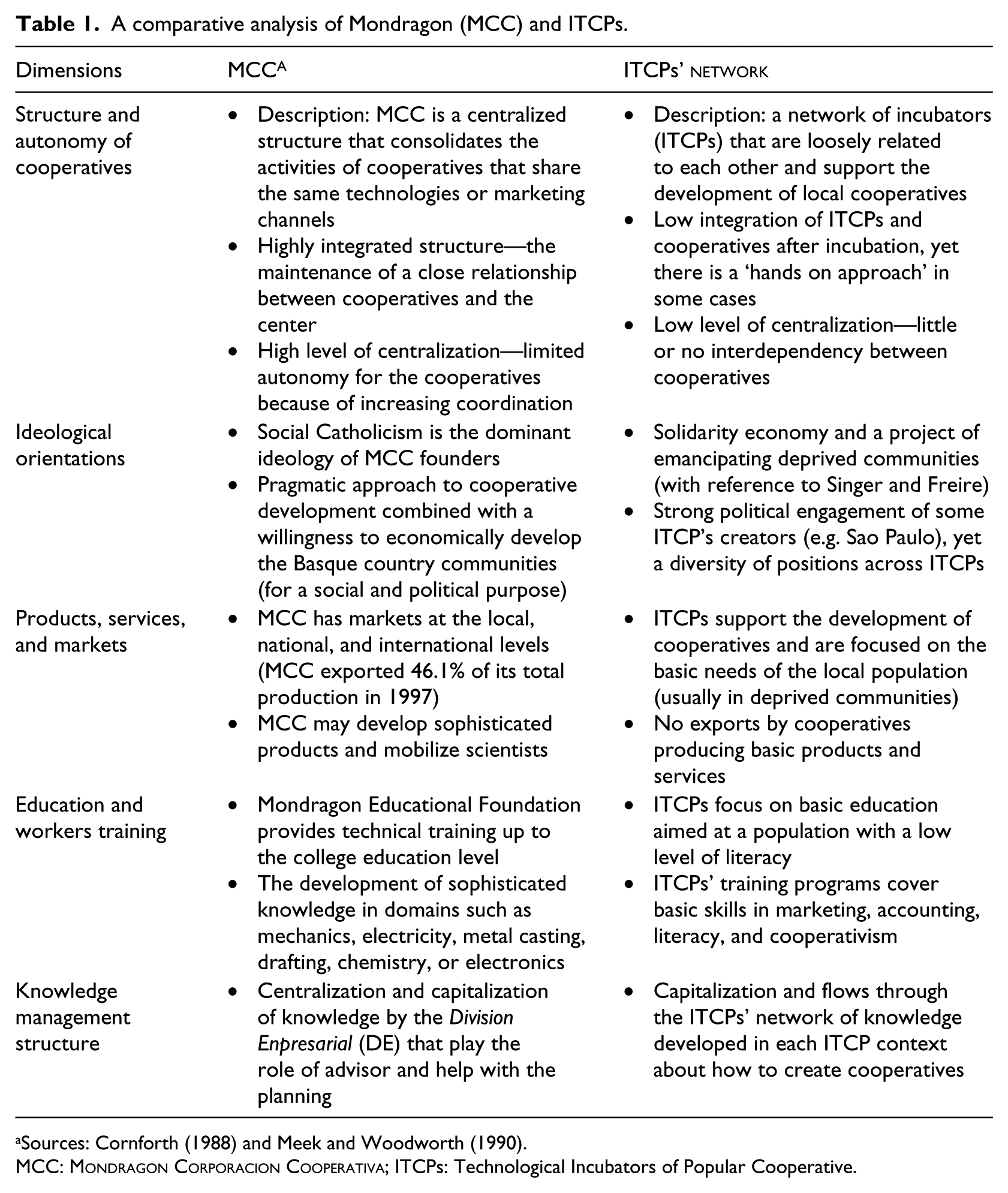
Sources: Cornforth (1988) and Meek and Woodworth (1990).
MCC: Mondragon Corporacion Cooperativa; ITCPs: Technological Incubators of Popular Cooperative.
This comparison suggests that ITCPs are a distinctive form of ‘second-level organizations’ that support the development of workers’ cooperatives in a less centralized and integrated manner; furthermore, they address the needs of a specific population and perform a distinct set of political projects. The case of ITCPs can also be positioned in relation to the Argentinian National Movement of Recovered Enterprises (Movimiento Nacional de Empresas Recuperadas, or MNER), which helps workers who are already trained and takes over their companies with legal support and political lobbying (Dinerstein, 2007). In contrast to those support organizations, ITCPs help the development of less sophisticated cooperatives and focus more on the inclusion of disadvantaged workers. Future comparative studies could investigate how the specific combinations of features that are inherent in each model could influence their capacities to enhance the efficiency and long-term success of cooperatives by means of methods such as fuzzy-set Qualitative Comparative Analysis (Fiss, 2007).
Finally, the advent of ITCPs suggests that academics can also support the diffusion of divergent interpretations of the same organizational model by translating the appropriate method and linking it to their own local political project. This flexibility supports a process of worker cooperative production that is consistent with the notion of ‘translation’ (Callon, 1986; Czarniawska and Joerges, 1996), which insists on the adaptation and transformation of concepts and practices when they are implemented in different local settings and allows for the propagation of dynamics that sustain their emancipation from universities. In this translation process, ITCPs are relevant settings because of their role as incubators: they are in contact with popular cooperatives, located in a university and managed by academics. Hence, ITCPs operate as interfaces between multiple constituencies with divergent interests and needs, and hence, they could be conceptualized as ‘boundary organizations’ (Guston, 2001) where the academic knowledge (as kept and developed in universities) is improved, practically refined, and applied to practical problems (as an incubator does) due to the co-presence of academics and future cooperative members in the same ‘liminal space’. Figure 1 provides an overview of this interfacing position and a summary of the multiple roles played by ITCPs according to our findings.
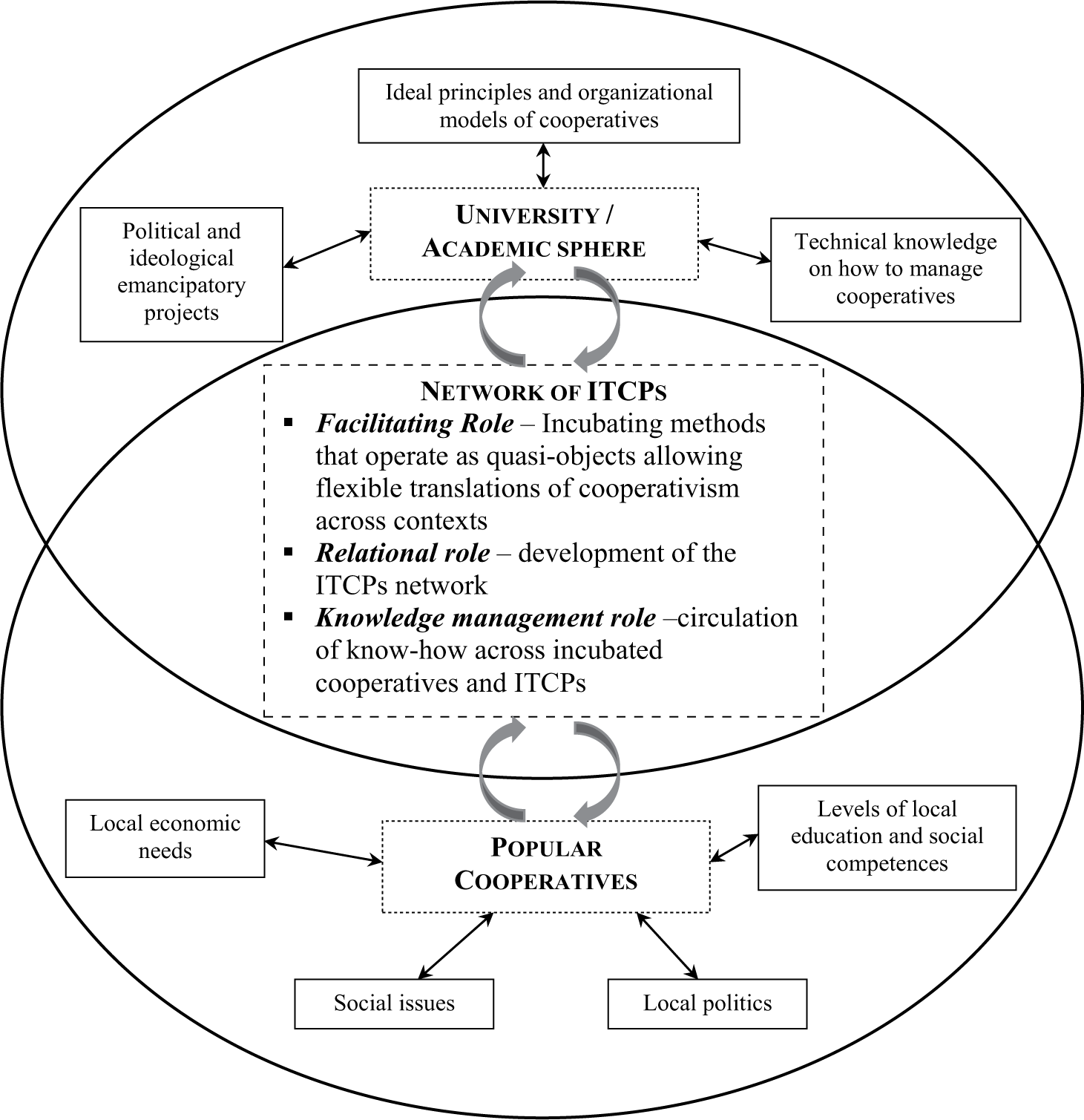
The interfacing role of critical performativity engines.
As boundary organizations, ITCPs allow us to examine how university members influence the development of worker cooperatives. Our findings highlight the complexity of this role: when academics impose an overly academic or an overpoliticized approach to cooperativism, they may cause problems as their views become perceived as less relevant in the eyes of incumbent cooperative workers. We also show that having an incubation procedure co-constructed by academics and cooperative members can favor the elaboration of new knowledge that is both relevant and rigorous. Building on the distinction of academia with respect to theoretical frameworks and incubation as a process, we suggest that critical performativity is a balancing and adjusting process whereby theoretical frameworks are applied to practical issues and are eventually reorganized to address these issues without necessarily losing their critical or political dimensions.
As a whole, the case of ITCPs sheds light on the numerous types of roles that CMS scholars can engage in to perform or design organizational models that are better aligned with their normative ideals, addressing the recurrent call for action in the field (Cheney et al., 2013; Voronov, 2008).
To what extent can this critical performativity engine be reproduced?
Our case study also accounts for attempts to reproduce the ITCP model at other universities through translation. The method developed in Rio was instrumental here. As an ITCP founder indicates,
The ITCP from COPPE/UFRJ was a very well established group… they had a handbook, something like a toolkit, in order to do it… So in the first meeting we had with Gonçalo [who was in charge of the ITCP at COOPE/UFRJ], he brought us many different books, writings and toolkits and everything else … (ITCP founding member of the FGV/SP, interview)
While these attempts favor the diffusion of the general model of incubating worker cooperatives, our findings highlight the importance of local reinterpretations to fit the ideological orientations and normative views on worker cooperativism within each local context. Hence, the circulation of the model does not reflect a linear diffusion model but rather a set of multiple translations, as each ITCP develops its own model of incubation (Akrich et al., 2002). This process can be described as ‘allomorphic’ (Lippi, 2000), as the original model is profoundly altered through its translation. This process of allomorphic translation provides insights for research on the role of supporting structures for worker cooperatives. The ITCPs develop as a loosely connected network of local supporting organizations, and each incubator is linked to the local worker cooperatives that they incubate. The resulting structure of ITCPs can be described as a multilevel, flexible, and complex support network.
The support network is multilevel, as it consists of a network of supporting structures, that is, the ITCPs. Each ITCP is already connected to a network of local worker cooperatives. This support network provides flexibility because each network member can benefit from the knowledge that circulates through the network and retain enough autonomy to operate completely independently on a day-to-day basis. There is no form of interdependence that might threaten the autonomy of the ITCPs or the cooperatives, but these structures can rely on the network to learn about innovations and request any training that they might need. This support network is ultimately complex because every member develops its own interpretation of what a worker cooperative should be and brings this perspective into being. At the cooperative level, the vision of what a worker cooperative should be depends on conversations with the ITCP, specific local activities and historical relations with the local community, social interactions within the cooperative, and prior discussions with other worker cooperatives from the network. At the ITCP level, the vision is influenced by the specific type of theoretical approach that it adopts, the feedback that it receives from already incubated cooperatives and past experiences of incubation, interactions among scholars within the incubator, and finally, discussions within the ITCP network. All of these factors create space for multiple interpretations of what a worker cooperative is or should be and facilitate the exchange of ideas and knowledge that can be locally reinterpreted and recombined.
This multilevel, complex, and flexible support network is an alternative to more centralized and expensive forms of training and knowledge diffusion, such as the educational system that was developed by Mondragon, which even includes a university (Meek and Woodworth, 1990). In contrast to such centralized structures, the ITCP network certainly has weaknesses. In particular, our case study can barely demonstrate that ITCPs can teach workers how to become highly skilled technicians, which Mondragon’s educational system can do (Meek and Woodworth, 1990), and it cannot be argued that the management standards are higher in worker cooperatives that are incubated by ITCPs than in conventional firms, which is contrary to Mondragon cooperatives (Charterina et al., 2007). However, in contrast with Mondragon, the ITCP network appears to be simpler and more frugal, and we would argue that it is more flexible (see Table 1). As such, this support network might be well suited to spread the worker cooperative model across large distances at a relatively low cost and provide support to local incubators.
In addition, this translation process provides insights for further research on performativity, and more specifically, on the organizational conditions for critical performativity. In contrast to prior studies, which have tended to focus on how a detailed body of expert knowledge is performed, such as the Black and Scholes formula (MacKenzie and Millo, 2003; MacKenzie, 2006) or the axioms of rational choice theory (Cabantous et al., 2010), the present case shows how a set of principles that define an organizational form are performed. During the performativity process, this set of principles is linked to differentiated types of local knowledge, which permit important variations in performativity outcomes. These variations in the enactment of the worker cooperatives reflect the ITCPs’ different views of how the cooperative principles should be combined and balanced. As a result of this flexibility, the support network can be described as a space within which knowledge is circulated and shared, but this knowledge is also creatively and critically reinterpreted and recombined to facilitate the performativity process across a variety of settings.
This feature of the performativity of the worker cooperatives’ model has important implications for the concept of critical performativity (Spicer et al., 2009). Indeed, this concept suggests that the performativity of critical knowledge that is aimed at facilitating emancipation may involve the creation of support networks that facilitate the circulation of models that embed alternative normative assumptions and permit a plurality of ideological interpretations. Hence, the ITCP case suggests that critical performativity should avoid making the critical project overdetermined and predictable; conversely, it should insure its social relevance by connecting with the local conditions. Moreover, networks proved to be useful in securing support from multiple actors. Because the scholars who were involved in the creation of ITCPs were also militants and activists, they could leverage their connections to advance their projects, and this political support became massive once the Workers Party had become the ruling party. This crucial role of networks might resonate with the importance of relational strategies for decentralized independent groups that act collectively to challenge the dominant capitalist ideology that Hardt and Negri (2004) call a ‘multitude’. In addition, our study sheds light on the specificity of critical performativity as an organizational process. As a complement to the increasing interest in organizational research for hybrid organizations that (as with worker cooperatives) can combine contradictory principles and offer alternatives to traditional capitalist organizations (e.g. Battilana and Dorado, 2010), critical performativity points to the importance of emancipation as an inherent goal within the process of critical performativity. However, our findings point to the difficulty of ‘performing’ emancipation, which is particularly acute when specific forms of emancipation contradict the normative ideals of critical researchers. Such results resonate with both Wray-Bliss’s (2003) warning that critical researchers might impose their views and their call for further research on how to practically achieve emancipation. Finally, this study suggests that a good way to understand how to perform a critical project is to ‘look South’: whereas Northern management scholars have raised several questions about how to perform a critical project, practical examples can be found in the South. Brazil is an especially interesting setting where many initiatives are developed from Freire’s ‘problem-solving education’ to incubators for worker cooperatives. Those initiatives do not offer turnkey solutions. In our case study, we documented many problems that are related to the ITCPs’ work. However, these initiatives provide a solid foundation from which to study these problems and reflect on them. They also provide models that can potentially be translated to the North as ways in which to perform a critical project. By addressing the need to engage more with the practices and development in the South, it is also our intention to participate in Organization’s tradition of giving special attention to what can be learned from the South (Alcadipani et al., 2012).