




Abstract
Critical performativity has become a promising notion for critical scholars who want to have concrete impact on society. Although the number of studies contributing to this literature has significantly increased in recent years, most of them are still restricted to theoretical debates. Rarely are those who have analyzed empirical cases and explored the institutional context that strengthen or limit the chances of critical projects to be successfully performed in practice. In this article we draw on the case of Popular Cooperative Incubators in Brazil to address this blind spot in current literature on critical performativity. We particularly focus on the institutional context for critical projects to be performative and on how actors shape the institutional context. We develop the notion of “critical performative work” to better show how the combination of institutional theory and critical management studies can help advance critical performativity. We offer both new theoretical contributions and practical suggestions for critical theory to have a larger impact in practice.
Introduction
Since Spicer et al. (2009) introduced the concept of critical performativity, we have seen a growing recognition among critical management scholars of the importance of developing “performative” interventions for organizational change to create or favor social change. Along with the interest in this new approach, two issues have emerged.
First, it is unclear whether this initial “call for action” has prompted any changes in the way that critical management scholars engage with organizational issues and develop practical interventions. The literature on critical performativity has largely limited the discussion to theoretical debates on concepts and assumptions imported from the broader debate on performativity in social science and organizational studies (e.g. Cabantous et al., 2016; Fleming and Banerjee, 2016). Authors have speculated about how critical performativity could be relevant in domains such as corporate social responsibility (Wickert and Schaefer, 2015) or leadership (Alvesson and Spicer, 2012), but to date, most discussions have remained theoretical and abstract. Empirical studies on, or accounts of, practical projects aimed at being critically performative are limited (for exceptions, see Esper et al., 2017; Leca et al., 2014). This is ironic, given the initial critique by Spicer et al. of critical management studies (CMS), that later scholars distancing themselves from the concrete activities of managers and Spicer et al. (2009) argument that critical performativity is intended to help critical management scholars engage in direct practice through critical interventions and projects.
Second, some authors have pointed to the fact that the performativity debate has underestimated the importance of the organizational, institutional, and political context (Beunza and Ferraro, 2019, Fligstein and Goldstein, 2010; Mirowski and Nik-Khah, 2007) in which a performative project takes place. Fleming and Banerjee (2016) suggest that the initial approach to critical performativity overestimated the power of language to achieve emancipatory change and to question why discursive performative approaches might actually fail to enact the desired material changes. Notably, they point to the institutional context and suggest that it might contribute to the current failure of CMS discourse to achieve the desired material outcome due to lack of support.
Because of both the emphasis on theoretical debates and the lack of attention paid to the institutional context that might actually help CMS produce effects, there is a clear risk that critical performativity might become confined to theoretical and academic discussions, which is a tendency that we argue is too common in CMS. This tendency may inevitably deflect the conversation from the original ambition of the authors who introduced the notion—that is, to advance the “unfinished business” of CMS research, which is to have a real impact on practice—and eventually reduce or annihilate the power of the notion.
Following authors who insist on the importance of institutional context in performativity (Bourdieu, 1975, 1992; Fleming and Banerjee, 2016) and building on the idea that actors can actually engage in changing this institutional context to favor performativity (Beunza and Ferraro, 2019), our intention in the present paper is to explore how critical scholars and activists can engage in shaping the institutional context to favor the performativity of critical discourse and ideas. This approach is consistent with recent claims that critical performativity must be recognized as a multifaceted process (Esper et al., 2017) that requires practices that go beyond discourse (e.g. Cabantous et al., 2016; Callon, 2007) and takes into account the context in which actors undertake a critical performative project (Beunza and Ferraro, 2019; Fleming and Banerjee, 2016).
In particular, we build on Beunza and Ferraro’s (2019) invitation to build a bridge between the performativity and institutional literature, proposing the concept of critical performative work, which is defined as a specific type of institutional work aimed at enabling critical scholarship to impact practice. In other words, a specific type of institutional work aimed at purposively creating, maintaining or disrupting institutions favoring the performativity of critical discourse and ideas. Empirically, we rely on a case study of the Technological Incubator for Popular Cooperatives (ITCP) founded in Brazil by the Federal University of Rio de Janeiro (UFRJ), which is widely recognized by scholars as a successful example of critical performativity (e.g. Cabantous et al., 2016; Spicer et al., 2016; Wickert and Schaefer, 2015) but is also considered to be specific to the Brazilian institutional context (e.g. Oliveira, 2017; Singer, 2002). The ITCP at UFRJ is an especially interesting case because the scholars involved in this initiative tried to perform a socialist utopia informed by multiple critical works, some of which were historically distant (e.g. Marx, Fourier, Proudhon) and some of which were elaborated in relation to the specific context (e.g. Freire, Singer). This makes their work critical performative work as they seek to bring their scholarship to life in bricks and mortar.
Specifically, we first describe the main characteristics that make this case a successful illustration of critical performativity. Then, we take a step back and look at the historical process whereby the institutional context of the ITCP emerged and developed. Particularly, we consider the critical performative work done during this historical process, which eventually contributed to shaping this institutional context. In so doing, our study makes a threefold contribution.
First, we contribute to current calls to consider the contextual setting in the development of performative projects. We respond to growing requests to bridge performativity and institutional theories (Beunza and Ferraro, 2019; Marti and Gond, 2018) and extend our contribution to the literature on critical performativity. Our case shows that the ITCP could not be created and maintained without the favorable institutional context of “extensão” programs at Brazilian universities. Second, we extend Beunza and Ferraro’s notion of performative work and propose the concept of critical performative work. In particular, we suggest that critical performative work allows us to go beyond a “discursive” approach to critical performativity and embrace the need to understand the work of relevant actors in shaping the institutional context where critical projects take place. Finally, based on our case study, we suggest bridging insights from institutional theory and CMS to discuss how critical scholars can influence the institutional context to facilitate the performativity of critical discourse.
Theoretical background
Current research on critical performativity
Critical performativity was initially developed based on the assumption that CMS had little impact outside academia and that this could be changed through scholarly engagement with real projects, such as trying to perform concepts and models inspired by critical theory (Spicer et al., 2009). The initial idea of critical performativity has attracted the interest of many organizational scholars and has been rapidly appropriated by the broader debate on performativity in organizational theory. We suggest that this turn has had two consequences.
First, current research on the broader concept of performativity has been characterized by a surge of different and potentially contradictory streams as researchers in management have engaged with and tried to combine the multiple approaches to performativity developed in the social sciences. Such streams include the Lyotardian, Butlerian and Barnesian approaches (Gond et al., 2016). A consequence of this method is an increase in theoretical discussions regarding what different authors mean by the term performativity. Influenced by this broader discussion on performativity, scholars interested in critical performativity have started questioning Spicer et al.’s interpretation and the use of the authors that they cite (e.g. Cabantous et al., 2016; Spicer et al., 2016). For instance, Cabantous et al. (2016) suggest that Spicer et al. (2009) have misread Austin and Butler and misunderstood the concept of performativity. Cabantous et al. (2016) also insist that Spicer et al. (2009) have focused too much on discourse while overlooking the essential material aspects of performativity. Fleming and Banerjee (2016) also insist that Spicer et al. (2009) have overstated both the power of language to achieve change and the capacity of critical scholars to do so on their own. While these theoretical debates are certainly important for clarifying concepts and basic assumptions, they run the risk of restricting critical performativity research from paying attention to empirical experiences involved in trying to perform critical projects. Consequently, many authors struggle to develop and ultimately disagree on common definitions and theoretical issues, spending less time interacting with empirical experiences, and trying to unveil how the institutional contexts that facilitate the success or failure of critical projects emerge.
A second consequence is that most research on critical performativity has adopted a constitutive approach to performativity. This approach builds on the original definition of performativity by Austin, which states that what is performed (i.e. the discourse or theory) is constitutive in nature. A classic example of performativity is taking an oath in court. This approach views the relation between “saying” and “doing” as one of constitution and not causation. The speech act constitutes the action. This approach is consistent with other critical approaches outside of management studies, such as that of Judith Butler, who revealed the dominating power of mundane and repeated statements in performing discrimination and showed that questioning this power could actually open major avenues by which to challenge established domination and eventually change the world with words. This approach also calls for new forms of discourse that engage with audiences beyond academia and constitutes, as Roscoe and Loza (2019: 217) put it, “a call for discourse and engagement with participants, for new kinds of texts and for writing that can transcend the seminar room.” In this vein, some authors have suggested that CMS might actually become performative as managers adopt and use related discourses. For instance, in the context of corporate social responsibility (CSR), Wickert and Schaefer (2015) argue that speaking repeatedly “about alternative and more positively loaded subjects, such as social and environmental responsibility” might stimulate managers to “commit themselves gradually to such goals” because stating something is similar to making an act. In this example, the clear risk is ignoring greenwashing, decoupling, and other uses of CSR discourse as a façade that argue that CSR is performed only because managers use its language. The constitutive perspective offers important insights into the potential impact of discourse and warns researchers of the consequences of unreflexive and uncritical performativity in their writing. Moreover, this constitutive perspective has been extended beyond discourse to material aspects by authors drawing on the insights of ANT (e.g. Barad, 2003; Haraway, 1988), that is, insisting on the merits of a relational ontology to show how performativity happens through continuous intertwined material and discursive aspects (Callon, 2010; Garud et al., 2018) and adopting a decentered view of agency (e.g. Cabantous and Sergi, 2018; Muniesa, 2018) consistent with the ANT tradition (Modell et al., 2017).
In this paper, we take a different, potentially complementary perspective that focuses on the institutional context. Building on previous research (e.g. Beunza and Ferraro, 2019; Fleming and Banerjee, 2016), we intend to link studies on critical performativity with institutional theory, to explore the role of institutional context in critical performativity and to examine how actors can shape this context to facilitate critical performativity. Our intention is to offer insights for researchers involved in the study, and potentially the practice, of critical performativity.
An institutional approach to critical performativity
Our starting point here is the ongoing critique of performativity scholars for overlooking the institutional context in the analysis of how theories are performed (Felin and Foss, 2009; Fligstein and Goldstein, 2010; Mirowski and Nik-Khah, 2007; Zuckerman, 2012). Such an oversight is consistent with the constitutive approach, which examines phenomena through discourses, devices, and practices that combine to form complex networks (e.g. Akrich and Latour, 1992). This constitutive approach adopts a relational and flat ontology, insisting on the fluidity of permanently evolving plans (Callon, 2007). As Fourcade (2007: 1025) states, “The social ‘structure’ thus exists only to the extent that networks coalesce and collective identities form a posteriori out of local spaces of action, through the progressive enlargement of micro-networks (Barry and Slater, 2002; Callon and Latour, 1981).” As such, ANT has focused more on ongoing processes while paying less attention to their historical contingency and the possibilities of more enduring forms of social stability (Elder-Vass, 2008; Fourcade, 2007; O’Mahoney et al., 2017). Institutional research takes a different approach. Adopting a “depth ontology” (Leca and Naccache, 2006; Modell et al., 2017), institutional theory insists on the importance of the social constructions of social structures that actors eventually come to consider as being taken for granted and real (e.g. Modell et al., 2017). Once established, such structures enable and constrain the practical actions that actors ordinarily take (Holm, 1995). Institutional theory is interested in the historical process whereby social structures are constructed and eventually come to endure (Berger and Luckmann, 1966; Mutch, 2018). It also holds that because such structures endure and are difficult to change, change is not permanent, and this implies effortful and purposive action aimed at influencing existing institutions referred to as “institutional work” (Lawrence and Suddaby, 2006; Lawrence et al., 2009). From this perspective, the institutional context matters, as it is likely to both enable and constrain the performativity of theories. Beunza and Ferraro (2019) have recently initiated the “bridging” of the literature on performativity and institutional theory. Empirically, they follow the strategy of a company in promoting a new investment practice—environmental, social, and governance (ESG) integration—in the responsible investment field and find that developing calculative devices is not enough and that this strategy initially failed to achieve the expected results. Observing a turn in the company’s strategy, the authors suggest that the strategy became successful when the company considered the established regulatory and normative institutions and managed to enlist allies to change them to develop a context more likely to support the acceptance of the new approach. Building on the notion of institutional work, defined as purposive activities aimed at shaping institutions (Lawrence and Suddaby, 2006), they labeled such activities as “performative work” to designate the institutional work needed to enable translation and the subsequent adoption of a calculative device. The authors insist on the importance of the institutional context to explain how performative projects unfold. Eventually, they suggest that performative work is about coalescing actors to assemble networks to change norms and regulations to favor the performativity of a project.
Building on this work, our intention herein is to further extend the emerging institutional perspective on performativity and use it to examine the critical performative work that we define as the type of institutional work aiming at enabling that critical scholarship impacts practices.
Empirically, we examine how actors have historically engaged in critical performative work in Brazil through “extensão” activities at universities and how this contributed to shaping the institutional context that eventually enabled the creation of the ITCP in 1994.
Case study, data, and analysis
Case study and research design
Our study proposes the notion of critical performative work as a way to advance the literature on critical performativity and better understand both the institutional context underlying the performativity of critical projects and how actors shape that context. To do so, we adopt a case study approach, consistent with the exploratory character of our research (Eisenhardt and Graebner, 2007; Yin, 2003). The choice of the specific case of the ITCP-UFRJ is justified, as it is a clear and rather rare acknowledged case of successful critical performativity (Cabantous et al., 2016; Fleming and Banerjee, 2016; Spicer et al., 2016). Previous research on this case has focused on local conditions, mainly in the vein of actor-network theory (ANT) (Leca et al., 2014), but it has not said much about the institutional context or about how those institutions have been shaped to allow critical performativity to take place. Our intention in this paper is to document and analyze the multiple effortful activities of activists and scholars in shaping the institutional context to favor the performativity of critical theories. We trace these activities from the introduction of “extensão” programs in Brazilian universities in the 1910s through all the following efforts that eventually contributed to establishing an institutional context favorable to the creation of the ITCP in the 1990s.
Interestingly, the critical performative work done to shape this context constitutes a case in which scholars joined forces with social movements to strengthen the impact of critical theory. The shaping of the institutional context that eventually strengthened the impact of critical theory offers an interesting example of intervention by academics engaging in practice rather than staying within the safer realm of discourse.
Data and analysis
To develop this analysis, we built on a larger project to understand the origins, emergence, development and functioning of the ITCP in Brazil. We relied mainly on 172 documents related to the university network of Technological Incubator for Popular Cooperatives (the Rede de ITCPs) in Brazil, most of which refer not only to the experience of the first ITCP project created at the UFRJ but also to the broader evolution of extensão programs and the development of the economia solidária (solidarity economy) in Brazil. We used internal reports and official material produced by researchers and staff from the ITCP-UFRJ, including academic papers, practitioner and policy reports, official websites, and other sources, to reconstruct the history of the ITCP-UFRJ and trace the emergence of the institutional context that influenced its creation and maintenance. Of particular importance for our research is the methods textbook published by the ITCP-UFRJ, which details its history, structure, and practice in incubating cooperatives (Guimarães, 1998). Overall, more than 2000 pages of text were collected. Most of the documents were written in Portuguese, with a few in English or French.
We analyzed our data in three steps. First, we examined all of the collected documents to build a comprehensive account of the evolution of the extensão programs and the emergence of the ITCP (see Table 1 for a chronology). Both authors had access to primary sources and shared their thoughts about them. Following Richards and Morse (2007), we developed a long narrative to provide a summary of sources in a structured way that could be easily handled. The first author took the lead in creating this first draft. The second author, who is Brazilian and has in-depth knowledge of critical scholarship in Brazil and civic movements in the country, validated or challenged some elements until a consensus was reached. Both authors used documents in Portuguese, English, and French, the second author being much more fluent than the first author in Portuguese. The second author also supervised a Brazilian research assistant to dig further into issues and collect new data when it was thought necessary. Challenges involved identifying important Brazilian critical authors whose work influenced the process as well as in identifying the main steps of the historical process and connecting the critical performative work done with the institutional and social context of the period. Consensus was reached by adding more information and reworking the narrative so that it remained clear yet complex. The final version of the narrative was an 86-page text that included raw data (extracts, quotes, and references from available documents) and summarized both the characteristics of the ITCP as an exemplar of critical performativity (the first part of our findings) and the historical, institutional, and social background (as well as the most relevant actors involved) in which the creation and maintenance of the ITCP took place (the second part of our findings). At this stage, the narrative contained extracts from sources and links to those sources to remain as close as possible to the data and maintain a rich account of the empirical material. Second, a more focused approach was adopted to identify the activities developed by key actors over time to either favor or limit a more politically and critically engaged role for scholars and universities under the extensão programs. At this stage, the two authors identified these activities separately, aiming to identify those that had an impact on the institutional context and were inspired by critical theories or ideals and could thus be classified as critical performative work. Then, the authors compared and consolidated their views, separating activities that would be considered CPW and those that would not. We further reworked our narrative to depict phases, actors, and CPW in a clear and systematic way. To define our periods, we focused on the key historical moments defined in the literature as related to extension programs in Brazil. To determine each of these moments, we tried to identify the main “waves of CPW” in which we observed scholars’ influence on the development of extension programs in universities. Organizing our findings in this way allowed us to show how the institutional conditions (through extension programs) were influenced, which in turn facilitated the emergence of the ITCP.
Chronology of events.
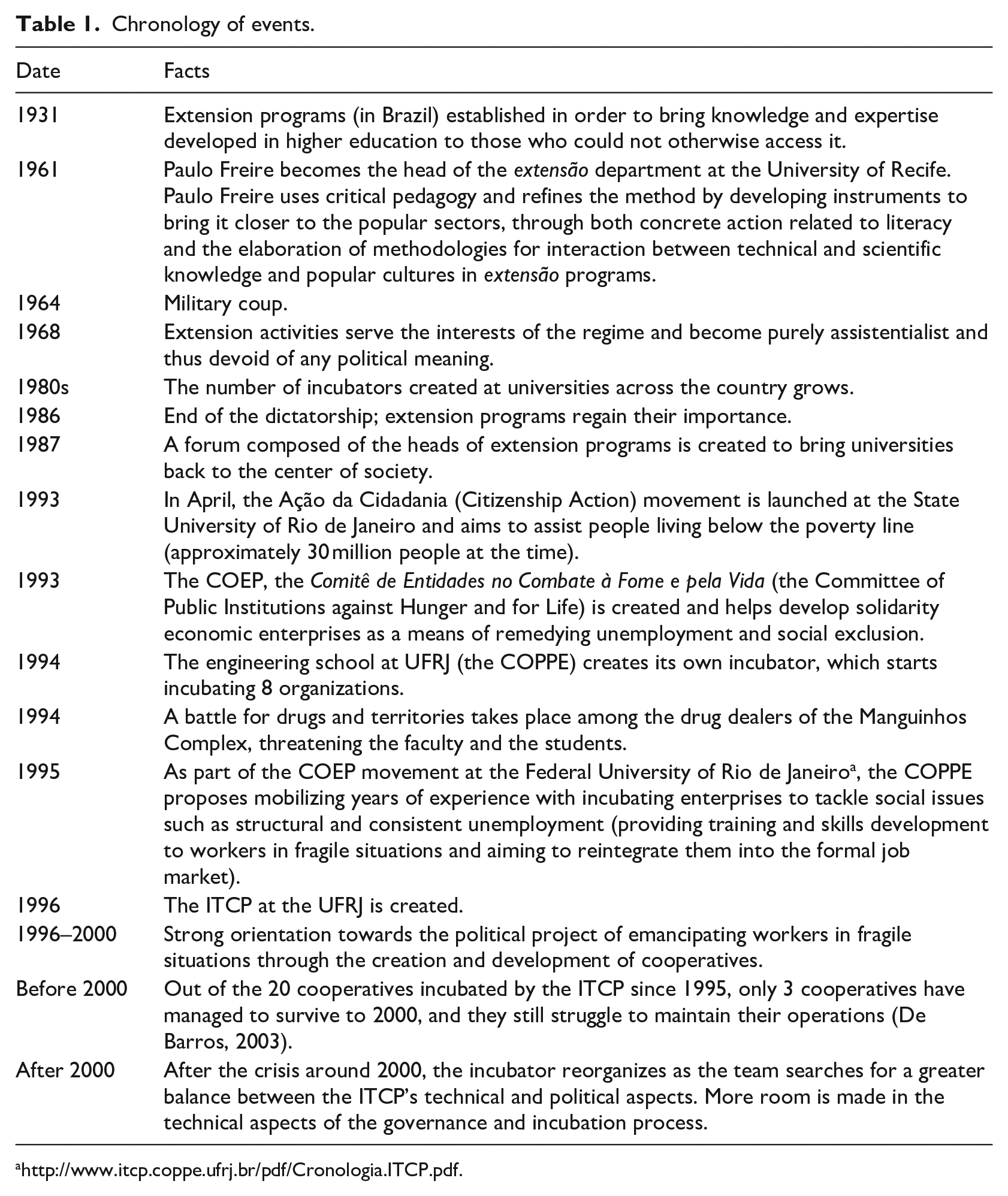
Finally, we asked a Brazilian scholar who participated in the ITCP movement in Brazil to read our complete narrative and check the coherence and validity of the information and analysis provided as well as to challenge our temporal division of phases, the forms of CPW identified and the potential impact CPW had on the ITCP. For instance, based on this step of validation, we were able to be more precise about the contribution of the work of Paulo Freire and Paul Singer to the ITCP movement.
Critical performative work and the emergence of the ITCP
In this section, we first briefly present the critical theories from which activists and scholars in Brazil have drawn and implemented the solidarity economy movement. We then discuss the critical performative work through which activists and scholars attempted to change the institutional context to make it more favorable to the enactment of critical theories. Finally, we show how this institutional context and the ongoing efforts of activists and scholars enabled the creation of the ITCP in 1994.
Critical theories and the solidarity economy in Brazil
The ITCP emerged from the broader movement to develop the solidarity economy in Brazil, which critical theoretical work played a crucial part in. Paul Singer (2008), who is widely considered one of the main inspirations for the solidarity economy in Brazil, defines such an economy as an alternative to capitalism based on a different production mode that draws on utopian socialism. As he argues:
We usually define solidarity economy as a mode of production that is characterized by equality. For equal rights, the means of production are the collective possession of those who work with them – this is the central characteristic. And self-management, that is, the enterprise of solidarity economy, is managed by the workers themselves collectively in an entirely democratic way, that is, each partner, each member of the enterprise is entitled to one vote. (Singer, 2008: 289)
This and other critical writing draws from previously existing works but also includes texts developed in direct relation to the Brazilian solidarity economy. The initial development of this movement can be traced to the influence of utopian socialism and associated with the presence of cooperativism in Brazil since the 1910s. The Brazilian cooperativism is different from the cooperativism whereby producers mutualize production means. It is an emancipatory project (Cheney, 1999; Singer, 2002) standing for a democratic and egalitarian organization of self-management that includes collective decision making, with democracy being the main organizing principle (Cruz, 2005). This cooperativism is considered the foundation stone of the solidarity economy (Castro, 2008) and a way to combine “the industrial way of production along with the communitarian organization of social life” (Singer, 2002:115). Singer made a distinction between heteromanagement, which describes a hierarchic and competitive environment among workers, and self-management, which establishes democratic and cooperative relations (Castro, 2008). Self-management is considered a way of changing working relations within organizations but also a way of changing behaviors in other spheres of society, questioning authority, and considering the possibility of developing more horizontal structures. Another major influence for activists and scholars in Brazil is Paulo Freire’s “pedagogy of the oppressed,” which is a pedagogical approach in which students, not teachers, are the center of the process and in which knowledge is co-constructed between teachers and students rather than imposed by the teachers (Freire, 1993).
Contributing to making the ITCP possible: Critical performative work and the development of a solidarity economy in Brazil
The ITCP was created as part of the solidarity economy. It emerged after almost a century of activists and scholars being engaged in critical performative work to produce a Barnesian kind of performativity—that is, a form of performativity in which practices are altered to better correspond to theory (MacKenzie, 2006; Roscoe and Chillas, 2014). This form of performativity implies a before/after analysis, since performing theory actually creates new practices. How critical performative work contributed to shaping the institutional context to favor the Barnesian performativity of critical theories in an otherwise market-dominated national economy is what we examine in this section (see Table 2 for a summary).
Summary of the main waves of critical performative work and actors involved.
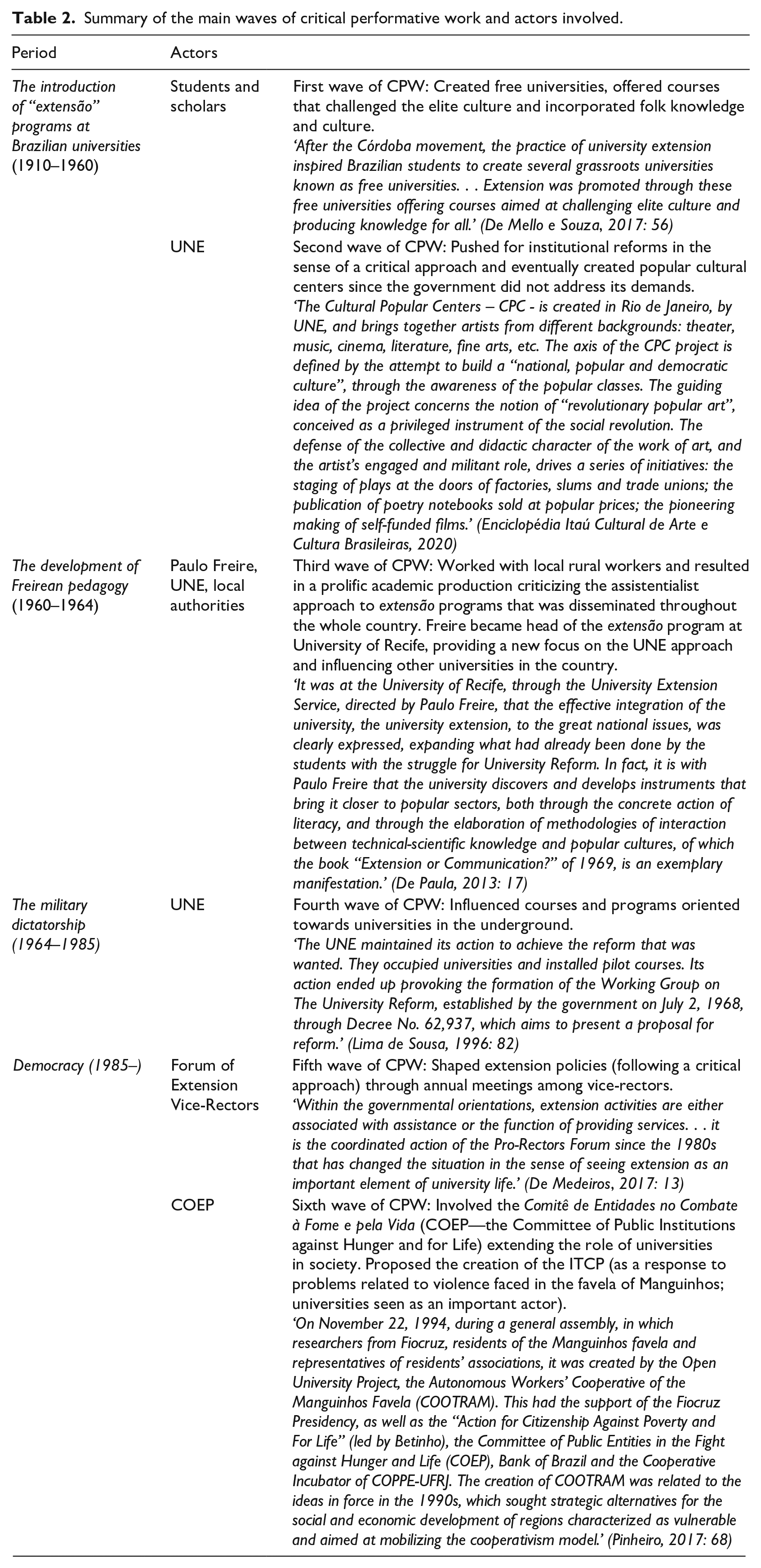
The introduction of “extensão” programs in Brazilian universities (1910–1960)
Students and scholars offering free courses—first wave of CPW
Starting in the 1910s, efforts to develop extension programs in Brazil emerged at local universities. Students and professors in cities such as São Paulo, Rio de Janeiro, Viçosa (in Minas Gerais) and Manaus (in Amazonas) gained inspiration from two potentially opposed traditions, namely, the Anglo-Saxon and French traditions (Dubeux, 2007; Lima de Sousa, 1996). Higher education extension programs were initiated in England in 1845 to prepare the working class through technical courses to take on working positions created by the Industrial Revolution. In the United States, such programs were first created in 1860 to teach farming skills to those who lived on the rural frontier. In France, the model was more politically oriented. The popular universities (universités populaires) established in 1882 intended to offer free education to the masses and provide both technical and theoretical knowledge (De Medeiros, 2017; De Souza et al., 2013; Lima de Sousa, 1996). French popular universities were the result of activist workers and left-wing intellectuals who joined forces to provide not only education but also free spaces in which critical thinking could develop (Premat, 2006). Such popular universities were separated from traditional universities, even though important scholars such as Durkheim called for popular universities to be managed by traditional universities (Durkheim, 1976 [1900]). This tension between the technical and political traditions in extension programs structured the development of “extensão” programs in Brazil, with activists and left-wing scholars drawing from the political tradition to orient the “extensão” programs.
In line with the French tradition, students were important actors in this period and played an important role by creating grassroots universities known as free universities. The first ones were established in Manaus in 1909, and in São Paulo and Paraná in 1911. These free universities intended to offer courses aimed at challenging elite culture and incorporating folk knowledge and culture (De Mello e Souza, 2017). However, when the Brazilian government provided a legal definition of the “extensão” programs in 1931, it was more in line with the Anglo-Saxon tradition than with the French tradition: the sole purpose of the “extensão” programs was training workers. “Extensão” activities thereafter became one of the three mandatory missions of Brazilian universities, along with teaching and research (Dubeux, 2007).
UNE creating popular cultural centers—second wave of CPW
However, while the law provided a restrictive definition of the “extensão” programs, in practice, activist students used it to maintain and extend a more critical approach. The National Student Union Movement (União Nacional dos Estudantes [UNE]), founded in 1937, pushed to have a more political approach to the “extensão” programs. In 1938–1939, the union organized its Second National Student Congress, where it proposed the alignment of the “extensão” programs with the French concept (Lima de Sousa, 1996). In 1961, the UNE held the first National Seminar for Higher Education Reform. The seminar, held in Bahia, resulted in the signing of a declaration in which the students suggested the following:
To open the universities for the people, through the creation of courses accessible to anyone; to use the academic directories as organizers of adult literacy courses, master builder courses in engineering schools, and union leadership courses in law schools; to hold the courses not only in university facilities but also in favelas, factory neighborhoods, and working-class districts; to put the universities at the service of the state, above all in the interior of the states; to put the universities at the service of the poor, with the creation of offices of health, legal, dental and technical assistance, while guaranteeing that this is not done in a paternalistic way, respecting the popular conscience and culture. (Declaração da Bahia—I Seminário Nacional de Reforma Universitária, UNE, 1961)
However, the government did not answer these demands. Consequently, it was the unionized students and not the universities who created popular cultural centers in the late 1950s (centros populares de cultura, CPC). These centers aimed to prepare the poor population to occupy the industrialized job market while raising political awareness against the status quo.
The development of Freirean pedagogy (1960–1964)
Freire emancipatory view of the “extensão” programs—third wave of CPW
A new actor had an important influence on the UNE’s political views on “extensão” programs. Paulo Freire used critical pedagogy and refined it by developing instruments to bring the concept closer to the popular sectors, through both concrete actions related to literacy and the elaboration of methodologies for interaction between technical and scientific knowledge and popular cultures in “extensão” programs. He elaborated a literacy program for youths and adults that was initially used to serve local rural workers and was then diffused by volunteers throughout the country. A reader of Marx and Catholic authors, such Jacques Maritain and Georges Bernanos, concerned with the situation of disadvantaged people, Freire drew on their works and his practical experience to elaborate his pedagogy of the oppressed in which knowledge appropriation by the oppressed is a central idea. Appropriation here means that the learner is placed in a position to reinvent what has been learned rather than merely apply it. Freire suggested that knowledge must be co-constructed with the learner rather than merely transmitted by the teacher. Appropriation also served as the basis for Freire’s 1969 book “Extensão ou Comunicação?” in which he discussed the bases of effective communication between agrotechnical knowledge and peasants. The book was a critique of the assistentialist approach to the “extensão” concept—defined as a patronizing, charity-like approach only responding to basic physiological (food, health, and shelter) and safety (work, clothing, education) needs—which was criticized for its unilateral implications and invasive nature, as opposed to an approach in which students are not reified but instead considered partners to the professors in the construction of knowledge that resonates with their practices through dialogue, communication and sharing, as Silveira (1993) suggests in the following:
Freire sees in this other dimension, which he called “communication”, broad possibilities of action that were not prescribed for extension until then. He perceives communication as processes of relationships, which includes a wide spectrum of actions, which would have in common only the requirement to ensure a dialogical character to communication. Freire, by establishing this concept of communication, would be opposing all the instrumentalist tendency in force and, thus, ensuring a critical character to his interpretation of the extensionist practice. (Silveira, 1993: 88)
In 1961, Freire became the head of the “extensão” department at the University of Recife, a position that allowed him to engage in critical performative work and influence the academic context and the role of “extensão” programs. His radical critique of the “assistentialist” approach to the “extensão” programs forced those who wanted to continue to use the term “extensão” to contend with a radical reconceptualization that incorporated the essence of Paulo Freire’s perspective, as he says:
We opposed these assistentialist solutions, while not accepting the others, because they hold a double contradiction in them. First, they contradict the natural vocation of the person – that of being subject and not object, and assistance makes those who receive the assistance passive object [. . .]. The great danger of assistance lies in the violence of its anti-dialogue [. . .] it does not offer conditions for the development of its consciousness that, in authentic democracies, must be increasingly critical (Freire, 1987, p. 65).
Lima (1981) insists on the transformational view mobilized by Freire:
For Freire, the extension has been understood as transmission, transference, invasion and not as communication, as co-participation of the subjects in the act of knowing. He says: “the term extension is in a significant relationship with transmission, delivery, donation, messianism, mechanism, cultural invasion, manipulation, etc. And all these terms involve actions that, turning man into almost ‘thing’, deny him as a being of world transformation. In addition to denying, as we shall see, the formation and constitution of authentic knowledge. In addition to denying true action and reflection to those who are objects of such actions.” Human beings are essentially communicative beings. To prevent communication is to reduce the human being to the condition of thing, of object, of submissive subject. Communication appears in Paulo Freire as an expression of existential and ontological reality and as a social relationship (Lima, 1981: 75).
As Torres (2013: 19) states, “These were times of enormous political activism.” The Popular Culture Movement (Movimento de Cultura Popular) in Recife was created under the administration of the local mayor, Miguel Arraes, to increase people’s consciousness and promote literacy. The Grassroots Education Movement (MEB) was formed based on an initiative of the Catholic Church to improve literacy. In 1962, the local government of the State of Rio Grande do Norte approached Freire, due to his growing reputation, and asked him to develop a literacy project in the small town of Angicos. Looking for resources to start the project, Freire received the support of the local UNE, which formed a team of teachers/facilitators for the project. Through implementing his particular critical method, Freire managed to help 300 rural workers learn to read and write in 40 hours. This spectacular result attracted much attention, and on April 2, 1963, Brazil’s president, João Goulart, attended a ceremony where certificates were delivered to those 300 people, and he expressed his wish that hundreds of such courses be taught so that people could “participate and integrate themselves in the life of the nation” (Kirkendall, 2010: 40); in addition, projects were initiated with the hope of summoning Paulo Freire to Brasilia to start a national program (Gadotti, 2019: 36). All these plans collapsed with the military coup in 1964.
The military dictatorship (1964–1985)
UNE’s resistance and underground work—fourth wave of CPW
After the coup, the military regime began dismantling previous attempts to institutionalize a critical approach in the “extensão” programs and imposed a contrary ideology of authoritarian nationalism. Paulo Freire was exiled to Chile because of his literacy work in Angicos. The military government disbanded and outlawed the student movement (as well as any other union) and created the Central Student Directory (Diretório Central de Estudantes, DCE, which still exists today) to replace the UNE. However, the popular cultural centers were banned and replaced by CRUTAC (centros rurais universitários de treinamento e ação comunitária, or rural university centers of training and community action). “Extensão” programs were redirected to suppress any reference to emancipatory projects or Freire and to align them with the military agenda aimed at building a nationalist spirit with a focus on national security and economic development supposedly shared by everyone (De Medeiros, 2017; Gonçalves and Vieira, 2015). The military government promoted the “extensão” as a flagship program for social change in Brazil, urging students to volunteer in extensionist activities and using the students as a workforce for assistentialist services (Lima de Sousa, 1996).
In 1967, the military government inaugurated the “Rondon Project,” an experimental program suggested by Professor Wilson Chueri at Guanabara State University and a number of military officers; the project had the official aim of redirecting student discontent towards “responsible” developmental goals with the slogan “Speak Less, and Work More.” Inspired by the English Voluntary Service Overseas and supported by USAID, the project was placed under the supervision of the Ministry of the Interior (Lima de Sousa, 1996). The Rondon Project provided Brazilian student volunteers with the opportunity to use their academic training in the most remote areas of Brazil during their vacations. Supported by heavy propaganda to encourage the enrollment of students, the Rondon Project was not an attempt to change living conditions in Brazil but rather an attempt to change students’ perceptions so that they would keep quiet (Rosenbaum, 1971). Through the project, 350,000 students and professors from public universities were sent on short-term campaigns to remote locations where they would teach in rural communities (De Medeiros, 2017; Lima de Sousa, 1996). The Rondon Project exemplified the unilateral and invasive approach of imposing teaching on local communities that Freire opposed.
In 1968, during the most repressive period of the regime, the military government pretended to give in and adopted UNE’s suggestions from 1938 (Lima de Sousa, 1996). It passed Bill 5540/1968, that is, the University Reform, which restructured higher-education organizations and made “extensão” programs mandatory for all universities (De Medeiros, 2017; Dubeux, 2007). “Extensão” programs were then used by the government to help students develop professional skills under strict political and ideological control (De Melo Neto, 2002).
This control was partly loosened in 1975, when the Ministry of Education and Culture (MEC) launched the University Extension Workplan and, for the first time since the dictatorship began, took the ability away from the Ministry of the Interior to define how universities should operate their extension programs. This change also increased the participation of universities in the planning and execution of extension programs. It eventually paved the way for more critical and engaged extension programs that developed after 1985, when democracy was reinstated (De Medeiros, 2017). Moreover, even during the more radical period of the military dictatorship, the UNE kept operating underground. The extent of its influence was reduced, but its members were active in certain universities, continuing critical performative work by influencing courses and the orientation of programs.
The return of democracy (1985–)
The push from the Forum of Vice-Rectors of Extensão for the reintroduction of an emancipatory approach to “extensão” programs—fifth wave of CPW
The fall of the military dictatorship brought democracy back to Brazil. This era, which saw a period of neoliberalism followed by a period of social democracy, was also marked by the retreat of the government from educational affairs, particularly from the “extensão” programs.
In 1985, the law changed, and top administrative positions (rectors and vice rectors) at universities stopped being nominated by the government and were elected by the faculty through a direct vote (Dubeux, 2007; Lima de Sousa, 1996). More socially oriented rectors and vice-rectors were elected, and extension programs became promoted as a link among research, teaching and society (Dubeux, 2007; Lima de Sousa, 1996). In 1987, vice-rectors from 33 universities in charge of extension programs created an important actor in this period, the Forum of Extension Vice-Rectors (Fórum de Pró-Reitores de Extensão) (De Souza et al., 2013). This group aimed to use the “extensão” programs as a response from universities to societal problems. The forum engaged in critical performative work to undo what the military had done and redirect the extensão programs from assistentialism to an emancipatory and critical approach (Dubeux, 2007; Lima de Sousa, 1996; Sousa, 2013): The central axis that guided the creation of the Forum was set up around discussions about the university’s action and its relationship with the community-society in general. Around the Forum were born consensual ideas about the Extension and its role in the community where the University is inserted. They were created from discussions organized by the Pro-Rectors of Extension in a regionalized way and then discussed nationally. (De Medeiros, 2017: 11)
While the government remained relatively passive, it was the Forum of Extension Vice-Rectors that shaped the extension policies through annual meetings among the vice-rectors. They took turns organizing the meeting, providing the others with the opportunity to learn more about what was being done at the particular university that hosted the meeting. Another important form of critical performative work took shape when many vice-rectors and coordinators of the extension programs moved from the universities to the Ministry of Education, helping ensure support from the ministry for extension programs and facilitating relations. In 1993, the Ministry of Education formed the University Extension Committee, which was composed of the directors of the forum, vice-rectors and the extension directors (Lima de Sousa, 1996). In 1994, the Ministry of Education initiated a funding program to help universities secure external funding for extension programs, thereby institutionalizing support for their projects. This program was based on an initial suggestion by the forum (Florido, 2009; Lima de Sousa, 1996). As Lima de Sousa (1996) notes, this was an important moment for the institutionalization of the Freirean perspective in the “extensão” programs, as advocated for by the forum of vice-rectors, which rejected “assistentialism” and pleaded for coparticipatory partnerships as a specific view of “extensão” activities at different levels:
It deals with issues related to the financing of the “Extensão” in Universities. This is a moment, in the period in which we live, when the extension begins to assume a key space in a new form of power. It is likely from this moment that we begin to perceive new interests in extensionist practice and, consequently, about its institutionalization at all levels. (Lima de Sousa, 1996: 130)
The forum was instrumental in expanding the understanding of the concept of “extensão” by defining it as an exchange between society and university in which each contributes to the other through its situated knowledge (De Souza et al., 2013).
Although multiple efforts to give “extensão” programs a central role in Brazilian universities have been made, the majority of scholars still consider this “third mission” less important than teaching and research. This can be explained by the fact that most scholars were (and still are) hired based on their knowledge of and ability to teach a specific topic, and most of the academic incentive structures (locally and internationally) were and still are based on research and publications. As a consequence, those who decided to engage in “extensão” programs usually did so with fewer resources, incentives and rewards. Nevertheless, “extensão” programs continued to attract scholars and students, who were often politicized and committed to contributing to social change.
COEP mobilization of multiple actors against misery and hunger—sixth wave of CPW
Initiatives expanded beyond universities in 1993 as the country faced certain political (President Fernando Collor de Melo was impeached and replaced by Itamar Franco), economic (economic instability was increasingly pronounced), and social (increasing violence in the favelas) issues. More than 30 million people were living below the poverty line.
In April 1993, the Ação da Cidadania (Citizenship Action) initiative was launched at the State University of Rio de Janeiro around Hebert de Souza, a sociologist better known in Brazil as Betinho. A popular figure in Brazil, Betinho published a manifesto called the Carta de Ação da Cidadania (Letter for Citizenship Action) in the following year alongside Brazilian TV celebrities and other important personalities. The manifesto called upon the Brazilian population to mobilize in the fight against hunger and misery. This manifesto represented the official launch of the movement, Citizenship Action against Hunger, Misery and for Life. 1
In the same year, the Comitê de Entidades no Combate à Fome e pela Vida (COEP—the Committee of Public Institutions against Hunger and for Life) was created. In the context of the national campaign against misery and hunger, one of the activities of this organization was providing assistance to emerging solidarity economic enterprises as a strategy for remedying unemployment and social exclusion (Cunha-Dubeux, 2004: 179). In Rio, the COEP’s membership included universities, public agencies, and funding bodies. Important member organizations included the Oswaldo Cruz Foundation (the Foundation hereafter); the Coordination of Masters Programs in Engineering (COPPE), which belonged to the UFRJ; the Banco do Brasil Foundation; and the National Innovation Agency (FINEP) (Etzkowitz et al., 2005: 420).
Together, the ongoing efforts to impose a critical approach to “extensão” programs, the development of Freirean pedagogy, the Citizenship Action against Hunger, Misery, and for Life campaign, and the COEP initiative contributed to shaping the institutional context that facilitated the creation and development of the ITCP.
Epilogue—the creation of the ITCP
Eventually, these efforts accumulated over decades and facilitated the creation of the ITCP.
The contextual trigger for the creation of the ITCP was the response of an important actor, the Oswaldo Cruz Foundation, part of the UFRJ, to violence between gangs in the nearby favela of Manguinhos in 1994. Stray bullets hit the Foundation’s building presented a physical threat to the professors and students (Singer, 2006). In 1995, the Foundation suggested discussing the problem during the first COEP meeting, which took place in Rio de Janeiro. The meeting was organized in the favela of Manguinhos with scholars, students, and 80 representatives of the favela (Singer, 2006). It was during this meeting that the idea to incubate cooperatives in the community to promote social inclusion for work and revenue generation and reduce violence emerged (Pateo, 2008, p. 42); this provided the first seeds for the subsequent development of the ITCP at UFRJ University.
At the university level, the Foundation engaged in critical performative work and justified the creation of this incubator of popular cooperatives as an extension program. It was clear that this extension project was intended to be conducted following a Freirean pedagogy, whereby knowledge would be co-constructed with the cooperative members (Leca et al., 2014; Guimarães, 1998). The project benefited from the technical support of another central actor in the creation of the ITCP, the COPPE, which brought its know-how to the incubation process of traditional companies. The COPPE was a university branch that incubated traditional companies; it was facing the increasing criticism that its traditional incubation was funded by the government but usually benefited already privileged entrepreneurs whose economic initiatives usually generated few jobs and were then useless for solving Brazil’s social problems (Cruz, 2005: 34–35). COPPE members were willing to engage in a more critical approach and support cooperativism. They engaged in critical performative work by joining forces with other scholars and students from the social sciences who joined the project with a Freirean perspective, aiming to work with popular classes, as suggested by Matarazzo and Boeira (2016): As part of this larger movement, called the solidarity economy, the ITCP emerged in the context of civil society demands in 1995. That year, sociologist Herbert José de Souza, known as Betinho, led the Committee of Entities in the Fight against Hunger and Life, an entity that was born in 1993, amid the mobilization with the Movement for Ethics in Politics. The main objective of the Committee was to pool efforts in the business field in order to articulate and implement actions in the fight against hunger and poverty. In 1995, the Committee of Entities in the Fight against Hunger and Life was structured with the Coordination of Graduate Programs in Engineering of the Federal University of Rio de Janeiro (COPPE/UFRJ) for the construction of an incubation methodology aimed at popular cooperativism, which could be disseminated by the universities of the country. (Matarazzo and Boeira, 2016: 215)
The COEP’s members helped. The decision was made at the moment when the COEP decided to give priority to the solidarity economy as a means to remedy unemployment and social exclusion. Buss (2000) even suggests that the material help provided by the COEP and the social projects shared by the entities that constituted the COEP were important in pushing Fiocruz to adopt the cooperative model. This allowed the initial funding to be secured from the FINEP and the Banco do Brasil Foundation (Guimarães, 1998). The Banco do Brasil Cooperatives Management office helped develop cooperative empowerment, which was carried out by the Higher Institute of Cooperativism at the Federal University of Santa Maria (UFSM) and provided ITCP members with initial insights into the management of cooperatives.
All the critical performative work that had been done over the decades contributed to building the institutional context in which a project such as the creation of the ITCP appeared to actors as a legitimate solution to a social problem.
This institutional context also helped diffuse the ITCP model across Brazil. In 1997, the Unitrabalho Foundation, which aimed to integrate academic knowledge with social practice, created a solidarity economy workgroup coordinated by professors Paul Singer, Candido Vieitez and Newton Briand, who were all influential critical thinkers. The group also included workers and discussed issues related to cooperativism and self-managed organizations. In 1998, the University of São Paulo (USP), where Paul Singer was a professor, decided to open an incubator for workers’ cooperatives (ITCP-USP). While the principles of this incubation were different from those of the ITCP-UFRJ, the incubator also performed critical ideas. In what can be seen as a form of “translation,” the USP incubator drew on both Singer’s own approach and Freire’s pedagogy. Later, a network of 60 ITCP projects emerged and were consolidated in the country:
Based on the proposal of popular cooperativism and the principles of solidarity economy, the University Network of Technological Incubators of Popular Cooperatives (Network of the ITCP) with six incubators (UFRJ, UFC, USP, UFPR, UNEB, UFRPE) emerged in 1999, inspired by the work of the original ITCP, born in the Coordination of Graduate Programs in Engineering (COPPE) of UFRJ and whose experience spread in the following years throughout Brazil. The ITCP network was created with the purpose of sharing academic knowledge with popular cooperatives, collaborating, for the design and solidification of self-managed economic initiatives, economically viable and conducted collectively (Lopes and Cançado, 2014: 139)
Because of the existing specific institutional context, in the immediate circumstances, the creation of the ITCP appeared to be a legitimate solution for engaging with local disadvantaged communities. The existence of an emerging incubation tradition made the creation of an incubator an obvious solution. The “extensão” tradition, the importance of the Action for Citizenship against Hunger, Misery, and Life movement, and the involvement of the university in the COEP collectively provided the context that spawned a solution based on the incubation of worker cooperatives supported by critical scholars who were also activists. Thus, a legitimate solution emerged for both historical and political reasons.
Discussion
The intention of this paper is to move beyond the scholasticism of current debates on critical performativity. While there is certainly value in highly theoretical debates on the multiple versions of performativity, it is unclear how this contributes in any regard to the actual performativity of critical management studies. Moreover, while a dominant view of performativity as constitutive seems to emerge, we are concerned that the notion will lose its main critical edge. The idea that CMS should go beyond strictly academic debates to have a practical impact has often been raised in the past (e.g. Alvesson and Willmott, 1992; Faria, 2014; Voronov, 2008) with limited success. The notion of critical performativity seems to have achieved unprecedented momentum, generating a rich debate among CMS and organizational theory scholars. We argue that this momentum needs to be used not only to generate more theoretical debates but also to consider the practical aspects of critical performativity, starting with the observation that CMS currently have a very limited impact outside academia and on organizational practices. In other words, that CMS are not currently performative and that to render CMS performative more theoretical discussions will not be enough to change practices. We insist that a constitutive approach to CP would have limited impact on making CMS address the concerns regarding their practical impact. We take another perspective, considering (i) how institutional context might both enable and constrain critical performativity, (ii) how the institutional context can be shaped, and (iii) how this can be distanced from uniquely academic debates to prioritize practical issues faced by actors leading critical projects in the field.
Our intention in this paper is to contribute to this perspective. To do so, we examine how the critical performative work of activists and scholars shapes the institutional context to favor the performativity of critical discourse and ideas. In this section, we build on our findings to address this issue and discuss the broader theoretical implications of our research.
How critical performative work shaped the institutional context
Our findings shed light on how critical performative work contributed to shaping the institutional context in which the ITCP ultimately emerged. They also show that this was not a deterministic process whereby multiple actors directed efforts over decades to render the ITCP possible and successful but rather that the ITCP was part of a larger process of critical movement in which multiple actors have engaged over decades to favor the performativity of critical theories. This critical movement crystallized at different periods in different ways, with the ITCP being the latest entity one examined during the study period.
The first wave of critical performative work we identify was the activities of students and scholars to create free universities, offering courses that could challenge the elite culture and that considered folk knowledge and culture. This perspective was not retained when the “extensão” programs were made mandatory for universities in 1931. However, the activist student union, UNE, started a second wave of critical performative work, pushed for institutional reforms following a critical approach and eventually created popular cultural centers when the government failed to address the students union’s demands. The UNE was also active in the third wave of critical performative work, which contributed to helping develop and promote Paulo Freire’s pedagogy. Freire’s pedagogy was a further elaboration based on existing theoretical critical work and his own experience. To be implemented and impactful, this pedagogy had to be used, diffused and potentially institutionalized, which was a process that demanded critical performative work. This involved the UNE, as well as the municipality of Recife and the local government of Rio Grande do Norte, suggesting that all those forces, when allied, could actually achieve the institutionalization of such a critical approach, especially since the federal government had shown interest in the project. However, such effortful critical performative work was halted due to the military coup in 1964. Eventually, the UNE engaged in a fourth wave of critical performative work, this time underground, in an attempt to influence the courses and the orientation of programs at the universities with no hope of official institutionalization. The end of the military dictatorship marked a new wave of critical performative work, officially conducted through the Forum of Extension Vice-Rectors, which directed the “extensão” programs using a critical perspective. The creation of the COEP in 1993 corresponded with a sixth wave of critical performative work marked by an expansion beyond academia with a social movement gathering members of civil society, public bodies and private companies around a solidarity economy project embodying a critical perspective. Finally, the accumulation of all those forms of critical performative work over decades shaped the institutional context in a way that favored the performativity of critical discourse and ideas that allowed the ITCP to emerge.
The approach developed in this paper and the findings have implications for research on performativity, the critical performativity literature, and the articulation between CMS and institutional theory as well as practical implications.
Implications for research on performativity
The first contribution of our paper is to the literature on performativity. Research on performativity in organizational research has mostly adopted a “constitutive approach” whereby neither saying and doing nor theory and practice can be dissociated. The alternative causal perspective that considers theory to precede and provoke changes in practices and to attempt to identify the boundary conditions for such performativity to take place (e.g. Marti and Gond, 2018) has been criticized for being too deterministic (Garud and Gehman, 2019). Our work points to a third direction between the constitutive and causal perspectives. Focusing on the particular case of Barnesian performativity, where practices are altered to better correspond to theory (MacKenzie, 2006; Roscoe and Chillas, 2014), we take a historical perspective, considering how the institutional context affects the potential of a theory to impact practices and how the institutional work of activists shapes the institutional context in such a way that eventually favors changes in practice. This approach builds on Beunza and Ferraro’s (2019) notion of performative work that we extend in two ways; that is, we extend its scope from a longitudinal to an historical perspective and from favoring the performativity of a device to focusing on the performativity of critical theories. Our argument here is that critical performativity is achieved through accumulation and that such accumulation is not linear. We do not argue that the present historical perspective is performative in itself. Instead, we argue that to trace down the multiple efforts made over decades to concretize critical scholarship, it is necessary to take an historical perspective. Taking a more historical perspective, which is more often developed in institutional theory than in ANT (e.g. Mutch, 2007; Suddaby, 2015), our study revisits research on incubators for workers’ cooperatives that was initially conducted with an ANT lens (Author, 2014) by using a wider and more historical perspective with an institutional theory lens and considering how activists contributed to shaping the institutional context in which the ITCP was created. Taking such an historical perspective and considering how the institutional context has developed allows us not to simplify how we account for the performativity of theories but rather to complexify it. Rather than being disjunctive and attempting to identify minimal conditions for performativity, this approach is conjunctive (Tsoukas, 2017), accounting for a long, uncertain, nonlinear, and open-ended historical process in which efforts were developed to shape the institutional context of the moment over decades, showing relations with the context where performativity eventually takes place. It offers a richer approach that allows us to move beyond the immediate relation between theory and practice specific to the constitutive approach and can be of interest for qualitative researchers interested in how in-depth single or historical case studies contribute to the performativity debate.
Our findings also highlight that while theories shape contexts, theories themselves are also shaped over time. This is consistent with D’Adderio et al. (2019), who point out that theories are not objectified and standalone entities. Multiple critical theories were mobilized by actors in the Brazilian case. What was eventually performed was an accumulation of critical work, some of which was historically distant (e.g. Marx, Fourier, Proudhon) and some of which was elaborated in relation to the specific context (e.g. Freire, Singer). Moreover, those theories were interpreted and reworked in a particular context of intervention. This is not to say that performativity can be subsumed under practices that could be interpreted as loosely related to some theory without further evidence and references by the actors to the theory. Rather, we insist that while relations can be established between practice and a specific theory, it is most often part of the theory itself that is being performed. In sum, our case study provides evidence that theory, practice, and institutional context evolve in a recursive and historical manner. The institutional context influences how theory is deployed. Over time, theory is reshaped by practice and the evolving institutional context. In turn, actors who engage in performative work build on theory in their activities to shape the institutional context to favor the performativity of the theory they support.
Implications for critical performativity literature
The second contribution refers to existing work on critical performativity. Consistent with Fleming and Banerjee (2016), we insist on the importance of institutional context in critical theory being performative. Building on Beunza and Ferraro’s (2019) notion of performative work, we define the notion of critical performative work as the specific type of institutional work aiming at enabling that critical scholarship impacts practices. From this perspective, what defines institutional work is not the type of activity done (e.g. advocacy, defining, vesting, etc.) but the purpose of the work. This is consistent with Spicer et al.’s (2009) notion of critical performativity and Beunza and Ferraro’s (2019) notion of “performative work.” Both notions are theoretically defined by their purpose and not by the activities that are done, which can be diverse. Finally, this is also consistent with Hampel et al. (2017), which pointed out that institutional work can be apprehended by what institutional actors try to influence through their work, who engages in institutional work and how institutional work is done while noting that this last aspect had already been extensively researched. Critical performative work differs from other forms of institutional work not in terms of the type of activities that are done but rather in terms of what actors try to achieve by bringing critical scholarship to life in bricks and mortar. In addition, our findings also point to two specific aspects of critical performative work.
First, our findings point to specificities regarding the actors who engage in critical performative work. These actors are not initially from the most dominant groups in society, which is unsurprising, but neither are they from the most disadvantaged groups, such as people inhabiting the favelas. Our case study suggests that the latter might not be aware that the institutional context can be shaped and that they live as though it is being imposed on them or that they lack the means to act. In the Brazilian case, the actors who engaged in shaping the institutional context by strengthening critical performativity were predominantly scholars, students, and social movements emerging from civil society, such as the COEP. This points to the diversity of actors engaged in critical performative work and the central role of scholars. Scholars do not operate in isolation. They contribute to developing and expanding larger collectives that act to shape the institutional context. While existing research on critical performativity suggests that critical scholars can engage on their own (Spicer et al. 2009) or at local levels (e.g. Author, 2014; Esper et al., 2017), the present study suggests that in order to shape the institutional context, critical scholars need to attract the interest of and engage with much larger movements.
Second, our study provides insights into the way critical performative work is done. Compared with other forms of institutional work, critical performative work is specific in several ways. First, it appears to be unplanned and opportunistic, as actors use circumstances to advance their agenda. Facing a context that is often hostile, they use any fracturing in the dominant hegemony as an opportunity to lobby allies. Second, critical performative work is nonlinear. Institutional context can be made more conducive at some point and less conducive later on. For instance, actors worked hard to establish the socialist utopic tradition as a bedrock for the “extensão” programs in Brazil. The military dictatorship destroyed this effort, forcing actors to rebuild this context when democracy returned and then to extend this context further. This suggests that the results of critical performative work are better viewed as securing fragile results, especially when the dominant ideology is opposed to critical theory, and that these results thus demand permanent reworking. One implication that follows is that critical performativity has to be opportunistic but also enduring, as shown by the UNE working underground to maintain the critical tradition during the military dictatorship.
Our research can also contribute to the critical performativity literature by pointing to the benefit of giving greater consideration to Barnesian performativity in the debate. This form of performativity is different from the constitutive form because the former seeks to examine how theories can have causal effects in the organization of social phenomena and how practices are altered to better correspond to theory (MacKenzie, 2006; Roscoe and Chillas, 2014), implying a form of before/after analysis. We submit that turning to Barnesian performativity can help the field move beyond debates around the constitutive approach to performativity and beyond the assumption that critical discourse has an impact on practices just because it exists (e.g. Wickert and Schaefer, 2015). Considering Barnesian performativity can redirect attention towards the hard work done by actors to render critical performativity impactful, to document who they are and what they do, to look for practical implications, and to eventually reconnect and advance the initial project of critical performativity to increase the impact of critical theory outside academia (Spicer et al., 2009).
Implications for the articulation between CMS and institutional theory
Institutional theory and CMS have always had close but unequal relations. CMS scholars have often been critical of institutional theory on multiple fronts, particularly regarding the lack of attention to power and domination in institutional theory (Willmott, 2015). On the other hand, institutional researchers have voiced their intention to make their theory more critical (Hampel et al., 2017; Munir, 2019). Our paper intends to build on these discussions in two ways.
First, we suggest that considering institutional theory in a way that further extends our understanding of how CMS can become performative might be useful. This perspective was first suggested by Fleming and Banerjee when they argued that CMS discourse was unlikely to have effects because of the context in which it was being deployed. We suggest that research on institutional theory can help further examine how actors can change this context. While there are certainly very good reasons for questioning the existing literature on institutional entrepreneurship and institutional work from a critical perspective, we suggest that beyond legitimate theoretical debates, such literature might provide useful insights into how actors can modify, at least partly, the institutional context to strengthen critical performativity. From this perspective, we submit that the notion of critical performative work can be useful and that the present study provides initial insights into how such activities can be undertaken.
Second, we suggest that combining institutional theory and CMS can help both approaches overcome an important limitation they both face: their practical impact. Institutional researchers have increasingly voiced concerns that despite institutional theory being well received in academia, it has little impact on practitioners (e.g. David and Bitektine, 2009; Hampel et al., 2017). Critical researchers have voiced the same concern (e.g. Voronov, 2008), which is central to the notion of critical performativity (Spicer et al., 2009). Our present study suggests that institutional theory can provide the means by which to analyze the institutional environment and provide insights into how this environment can be at least partially changed. CMS can provide directions regarding the goals to be achieved, which is something that institutional theory has not necessarily considered so far. Combining both approaches might be a way to overcome the common limitations of the practical implications that both literature streams currently face.
Practical implications
Our main intention in this paper was not only to contribute to the ongoing theoretical debates but also to insist on the importance of practical aspects. To achieve this, we focused on the Brazilian case of the ITCP because we view it as an exemplary case of successful critical performativity.
Previous studies on critical performativity have suggested that the practical role of critical scholars is to produce a critical discourse within both academia and the larger public sphere that has an impact on practices (e.g. Spicer et al., 2009, 2016; Wickert and Schaefer, 2015). However, some authors have insisted that this approach overestimates the power of discourse (Fleming and Banerjee, 2016), and the literature insists that theoretical discourse only translates into concrete change when appropriate social conditions exist (MacKenzie and Millo, 2003; Marti and Gond, 2018). While recommending further involvement with activists, the authors who insist on the importance of the institutional context tend to consider institutional conditions as taken for granted and outside the scope of action of critical scholars. Our study diverges by documenting a case in which scholars became involved in collectives that eventually managed to shape the institutional context and rendered it more likely that critical theory could have a practical impact. This is an important difference from other settings, such as that of the worker-recuperated enterprises in Argentina (Esper et al., 2017). First, in the case of Argentina, workers decided to recover enterprises that went bankrupt during the financial crisis. Just after that, a social movement emerged, and scholars from the University of Buenos Aires decided to participate and provide different forms of support. Contrary to what we see in the case of the ITCP in Brazil, in which an “extensão” project initiated the whole movement and the program, in Argentina, scholars engaged in critical performative work to provoke institutional change that happened only after the recuperations in the 2000s. In other words, in Argentina, workers, not scholars, started the process, and workers had to operate in conditions that initially lacked sufficient institutional stability to support their movement. Hence, as Vieta and Ruggeri (2009: 204) indicate, in contrast with other Latin American countries such as Brazil, “in light of the lack of any consistent institutional support, the relative longevity of ERTs (WRE) in Argentina is a testimony to the resilience, agency, and innovative capacities of its workers,” as the necessary critical performative work to obtain a favorable institutional context was done not before but only after the recuperations of companies, thereby leading to much controversy around worker-recuperated enterprises and to a limited diffusion of this organizational form.
We argue that if critical scholars in organizational research want critical theory to impact practices on a larger scale and more durably, they need to engage in institutional work such as critical performative work. This kind of work is significantly different from relying on critical discourse (Spicer et al., 2009, 2016), engaging with local organizations (Author, 2014; Esper et al., 2017) and managing public criticism (Fleming and Banerjee, 2016), to name some of the directions suggested by existing work that considers how critical theory can have a more significant impact. Critical performative work involves scholars engaging in collective work to achieve institutional change not only at the organizational level (i.e. at business schools or universities) but also at the broader level of how public policies are designed and implemented. In the case of the ITCP, the institutional context had been shaped over decades and through multiple initiatives (e.g. extension programs, the Forum of Extension Vice-Rectors, the COEP) by collectives in which scholars were actively engaged. As such, we believe that the notion has value not only for theoretical debates on critical performativity but also for the activities such a concept points to in practice. Overall, the Brazilian case is an example of ongoing active and critical academic involvement in politics and society. It also shows that academics can be instrumental in achieving change in the institutional context.
Finally, we believe that this Brazilian case can inform current debates in the Western CMS community about critical performativity and that it offers avenues for reflection and action. On the one hand, examples from scholars in South America, such as Brazilian (Author, 2014) or Argentinian (Esper et al., 2017), seem not to distinguish among practical action, experimentation and theory building; to help disadvantaged populations while pushing a critical agenda; and eventually, as in the Brazilian case, to engage in shaping an institutional context that favors the positive impact of critical theory. On the other hand, we believe that organizational scholars in general and those from the North in particular, who distinguish between theory and practice, are often more involved with theory building than with activists and disadvantaged communities. This might not be the case in other academic areas, such as anthropology or political science, where the real-life consequences of research have animated scholars for decades (Roscoe and Loza, 2019).
Arguably, this outcome might be due to the institutional context in societies dominated by neoliberal ideology (Fleming and Banerjee, 2016) and the academic pressure to “publish or perish,” which forces these individuals to produce knowledge that is limited to academic journals included in “journal guides” (e.g. Mingers and Willmott, 2013), whose diffusion outside of academia is very limited. Such a situation is certainly likely to prevent the potential impact of critical thinking on organizational practices. The Brazilian case still suggests that such an institutional context can be challenged. While we lament the neoliberal underpinnings of business schools, engaging in critical performative work appears to be one way to change this situation. Ultimately, the notion of critical performative work draws attention to the responsibility of critical scholars to engage in action.
Footnotes
Acknowledgements
The authors thank João Miguel Peixoto Guimarães Milanez for his help in collecting and analysis the empirical material, and Mario Aquino Alves for his constant support, help, advices and friendship over the years as well as his critical review of this research. We are indebted to Iain Munro for great editing which allowed us to make our ideas clearer without renouncing them, to the reviewers for their generous help and comments and to Raza Mir for his support. The responsibility for any error in the text in solely the authors’ own.
Funding
The author(s) received no financial support for the research, authorship, and/or publication of this article.
