




Abstract
Social innovation education has become an increasingly prominent means through which higher education institutions seek to create positive societal impact. One approach is through place-based learning, in which students are enabled to achieve learning outcomes through experiential work in the community. Although addressing real-world problems is widely regarded as beneficial for participant organizations, communities, and learners, less is understood about how such engagement is transformed into shared social value. Our research explored how place-based learning in social innovation education creates shared social value. Drawing on an analysis of 82 projects conducted across six annual cycles of place-based learning, we develop a model of social value co-creation that illustrates how educators’ facilitation of collaboration between key stakeholders (practitioners, educators, and students) lies at the heart of successful social innovation education. The model captures a contextualized understanding of the different perspectives involved in place-based learning, thereby advancing understanding of the co-creation of social value and its significance for both researchers and educators in social innovation education.
Keywords
Introduction
Higher education institutions (HEIs) increasingly define their role in society not just as experts in research and teaching, but also in delivering social value to society (Cavalcanti and Silva, 2024) through socially innovative activities. Social innovation can be defined as the process of change in cultural, normative, or regulative practices that improve the collective power of disadvantaged communities (Mulgan, 2019). Empowerment is a central element within social innovation, delivered either to individuals or communities through access to resources, fiscal or otherwise (Moulaert et al., 2013). While social innovation can be viewed as a globally normative construct (Do Adro and Fernandes, 2020), it also has a strong local, place-based component that gives it a tensional duality, as both a global phenomenon but also as a response to the problems of globalization (Roy and Hazenberg, 2019). Social innovations can occur anywhere in socioeconomic ecosystems and can be delivered by numerous stakeholder types including corporates, governments, nonprofits, civil society organizations and HEIs (Murray et al., 2010). Social innovation is a key element in HEIs’ efforts to deliver social value in their local and global communities (Wang and Horta, 2024).
Social value has previously been defined as the use of tangible and intangible resources, by a collaborative collection of actors (individuals or institutions), that when employed at a grassroots level in communities, creates positive change in society (Jain et al., 2020). The process is one of value co-creation enabled by social action and institutional mechanisms of support (i.e. policy windows), leading to social value creation in a cyclical process between stakeholders (Jain et al., 2020). In relation to the work of HEIs in their communities, social value can thus be conceptualized as the benefits accrued to distinct stakeholders; for students, this consists of learning and professional development; for educators, value is pedagogical innovation. For organizations and their communities, value is a contribution to their work and social purpose, a perspective that has received less attention to date (Willness et al., 2023). Of course, there can be different opinions and values held within each of those three communities, but broadly the distinctions hold. The essence here is around a dynamic process of collaboration and co-creation within place-based social innovation education (SIE), that while delivering different types of value for each stakeholder group, nevertheless, also leads to social value creation in communities.
One of the ways that HEIs in general and business schools in particular can deliver social value is through place-based learning, a type of SIE that has been growing across HEIs (Elmes et al., 2012), in which students are enabled to achieve learning outcomes through experiential work in the community (Alden Rivers et al., 2015). This type of learning enables the creation of shared social value, as students are able to engage with real-world problems (Mailhot and Lachapelle, 2024; Shantz et al., 2023) and help to solve these alongside community organizations (Elmes et al., 2012).
For educators and students to co-create social value within the wider community, they need to be able to both teach and learn social innovation in their collaboration with socially innovative community organizations (Alden Rivers et al., 2015). We deliberately use the term ‘educators’ to denote anyone involved in the delivery of the place-based learning approach, including professors/lecturers, consultants, social entrepreneurs and other university staff or practitioners. Within this article, we seek to theoretically develop a model of place-based SIE that builds upon (but is distinct from) prior conceptions of service-learning. Eyler and Giles (1999) argue that service-learning is a pedagogical approach that engages students in community service that they then reflect upon as part of their academic development/studies. In this way, service-learning can be viewed as a means of developing shared value within the community as part of academic curricula (Nikolova and Andersen, 2017) and therefore can be seen as having close links with place-based approaches to SIE (Elmes et al., 2012; Mailhot and Lachapelle, 2024; Shantz et al., 2023).
To date, there remains a paucity of research that develops understanding around the role that educators play in this type of SIE, and the interplay that occurs between students and community-based organizations. This is a critical area for SIE, as it is the interaction between students and community-based organizations, and how these are shaped by educators, which determines the success (or otherwise) of such programmes. The risk is that HEIs’ efforts to deliver positive social value pressure local communities to engage with them in ways that are not mutually beneficial and even harmful to those communities, harking back to the familiar community development principle: do no harm (Chupp and Joseph, 2010). This article seeks to fill this gap by moving beyond traditional explanations of service-learning and real-world problem focus in management education (Block and Bartkus, 2019; Godfrey et al., 2005; Govekar and Rishi, 2007), to instead explore place-based learning through a theoretical lens centred on SIE and shared social value. Thus, we ask: ‘How does place-based learning in social innovation education create shared social value?’
In answering this question, we have developed a new model of social value co-creation that illustrates how collaboration between key stakeholders (practitioners, educators and students) lies at the heart of successful SIE. The educator’s facilitation of that collaboration is crucial to ensuring that the multiple tensions can serve as a source of social value. This argument is unique, as we position it within a place-based learning approach, to argue that maximized co-creation of social value lies within a combination of insider (ideographic knowledge) and outsider (nomothetic knowledge) (Evered and Louis, 1981). Only by adopting this dualist position can SIE programmes develop broad and shared concepts of social value (for students, educators and community groups) that overcome the narrower focus that currently exists around measurable outcomes that tend to be reductionist (Brest, 2020), thus creating meaningful social value creation from the community’s perspective.
Literature review
SIE
SIE is a relatively new, emergent area of pedagogy in the higher education sector, and arguably challenges the traditional models of teaching that predominate across academia. SIE, like social innovation itself, can be viewed as a global construct that also has distinct local flavours. There are different types of SIE, with research identifying the dichotomy between formalized approaches to SIE in curricula and informal approaches to using SIE to repair problems in society (Maldonado-Mariscal and Schröder, 2023). SIE acts within a feedback loop where social innovation can both be a means of developing innovative educational approaches to solve problems, and a product of educational initiatives (Batista and Helal, 2023), as can be seen with place-based learning in this article. Furthermore, Wu, Goh and Mai (2023) identified three types of SIE within HEIs, namely, curriculum transformation, community–university partnership and helix partnerships (between academia, business, civil society and government). SIE can take many forms and both be led by HEIs but also influence HEIs through socially innovative changes in the structures of society.
Place-based is another type of SIE and focuses on delivering experiential learning with students engaging in solving real-world problems to deliver impact in communities (Alden Rivers et al., 2015; Elmes et al., 2012). This type of learning enables students to become immersed in the holistic ecosystem within which social problems exist, whereby social problems are embedded in the community (Knapp, 2014) within specific historical, political, social and economic contexts, and where boundaries are blurred or non-existent (Elmes et al., 2012). The significance of ‘place’ in SIE builds on what McDowell (1999) argued as the intersections of different flows and interactions (sociocultural and otherwise) within a spatial setting, to effectively co-create social value. Indeed, this links to wider arguments of a community’s understanding of their local context, what Thomas (2020) termed ‘community terroir’, and how educators need to balance the tensions between institutional curricula and community needs. This enables students to contribute towards solving these wider societal problems through the co-creation of shared value with community organizations in the real-world settings (Elmes et al., 2012), an area that is critical for place-based SIE.
Place-based SIE builds upon previous work that has focused on regional and institutional contexts in entrepreneurship education, albeit the academic focus on engaging students with place has been limited to date (Larty, 2021). Place-based focus in social innovation is not new in a wider sense, with previous studies showing the importance of place-based approaches for legitimizing socially innovative organizations at the local community level (Samuel et al., 2022); however, it is an approach that is increasingly being adopted in SIE. Place-based approaches also build on prior work around service-learning in giving students autonomy, connecting them with the local community and socially innovative organizations, and allowing them to learn in real-world settings, thus creating tangible shared social value (Nikolova and Andersen, 2017).
However, place-based approaches are often easier to design than to implement, with educators needing the requisite skills to teach in this manner (Cederquist and Golüke, 2016), a factor that can cause resistance within institutions, both from the educators themselves and the institutions that do not see value in the extra investment. These barriers are not aided by the overt focus on entrepreneurial aspects of social innovation that has been the dominant discourse in SIE (Pitt-Catsouphes and Cosner Berzin, 2015), driven by business school engagement in the area. Business schools’ historic focus on entrepreneurship teaching in regional and institutional factors (Larty, 2021), as opposed to local, place-based understanding of phenomena, often ignores the impact found in less enterprise-focused areas such as social work. Resistance can also be understood through the lens of pedagogical conflict, in which new place-based approaches may clash with existing, more traditional pedagogies embedded within institutional contexts.
The design of social innovation curricula must also consider the importance of extra-curricular activities and research informed materials, as well as coproduction of resources with students (Pitt-Catsouphes and Cosner Berzin, 2015) and community partners (Wang and Horta, 2024). The role of coproduction is critical here, as is that of creativity and diversity in supporting social innovators (or students interested in social innovation), to learn and identify possible solutions to problems that span sectoral boundaries (Córdoba-Pachón et al., 2021; Schröer, 2021). In identifying these problems, the role of critical reflection, of relationship building (between students and partner organizations) and of inclusive practices ensure that place-based learning approaches can support social innovation and enable students to engage in impactful experiential learning, building on prior service-learning approaches to SIE (Otten et al., 2022). Indeed, inclusivity and students’ ability to reflect power dynamics in relation to partner organizations and their communities is crucial in ensuring that the solutions to societal problems can be co-created between the students/academics and the practitioners of social innovation, placing the educator (and course) at the nexus of shared social value creation.
Wider ecosystem factors both within the HEI and externally in the community (locally, nationally and internationally) are important shapers of SIE. The focus on relationship building, co-creation, inclusivity and recognition of the partial and incomplete view that any one observer has due to their positionality (Williams, 2014), is an insight which is itself a form of spatial learning (Langran and DeWitt, 2020). Certainly, effective SIE requires the engagement of the community in learning design and even systems-thinking in pedagogical practice (Lake et al., 2022). SIE programmes also have ethical and institutional tensions at their heart, as they must navigate within HEI structures, while also seeking to challenge entrenched power and support systemic change. These tensions can be further exacerbated when universities are not clear as to what their role in the community is and how they should support their localities (Harris, 2021), as well as what partnerships they want locally and how they utilize the data gathered (Langran and DeWitt, 2020). This can place significant ethical and hybrid tensions between the students, educators and partner organizations/communities, which require careful management to overcome, particularly if genuine social value is to be created.
Shared social value
The creation of value through student projects, the methods that produce this value, and the corresponding impact are not always tangibly obvious. Prior research has identified partner readiness, holistic project design and effective project delivery as key components of generating direct value (Block and Bartkus, 2019). Place-based learning can aid the collaborative process for social value creation as students embed their learning in-situ, while partner community organizations gain motivation and learning from the experience (Elmes et al., 2012). In many ways, SIE builds on service-learning, which can include volunteering, community service, internships and field education (Sigmon, 1997). Similarly, service-learning approaches to classroom theory and real-world project applications aid student learning, while enabling impact within communities (Godfrey et al., 2005; Montalto, 2023). When students engage in reflective practice within experiential learning settings, the potential for impact creation is high (Godfrey et al., 2005). Thus, we can see that place-based approaches to SIE do borrow from some aspects of service-learning in seeking to create social value.
In service-learning approaches, where there is a required commitment to shared social value creation from all key stakeholders, students need to be prepared to engage time and extra-curricular work to support community partners. Community partners need to openly engage with students and share data where required. And, educators need to go beyond standard pedagogical practice by selecting suitable community partners. These approaches support relationship building between students and partners, while allowing for the monitoring of performance and impact within partnerships towards creating social value through collaborative analysis and problem-solving (Nikolova and Andersen, 2017). Community-based research addresses these needs as it is typically collaborative, with the organization itself identifying the project focus rather than the educators, thus ensuring value for the organization as well as for the students (Harwell Schaffer, 2012; Strand et al., 2003). In this way, community-based research can be linked with both place-based and service-learning approaches to the co-creation of shared value relevant to specific community needs or ‘terroir’ (Elmes et al., 2012; Nikolova and Andersen, 2017; Thomas, 2020)). Therefore, it can also form an integral element in any SIE approach.
While the central focus of this article is on the ways in which students engage community partners within projects to create value, another key facet of enquiry relates to the educator’s role in facilitating this engagement. De Vere and Charny (2017) observed that when ‘students lack access to users and communities in need. . . Cultural and contextual aspects can be misunderstood, and solutions may be misdirected’ (p. 109). The educator’s role in managing these relationships, in light of the discussion above on SIE and shared social value creation, means that they have to adopt multiple roles. Prior research has emphasized that the educator’s role is inherently relational, shaped through connections with others and by questioning traditional notions of expertise based solely on knowledge gathering and ‘knowing’ (Carroll and Smolović Jones, 2018). Similarly, in place-based SIE, the educator, in bringing together diverse perspectives and managing institutional tensions, is acting relationally.
Methodology
We conducted a longitudinal place-based study to address the research question ‘How does place-based learning in social innovation education create shared social value?’ The study focuses on our own teaching of one MBA course over 6 years at a European business school. In the MBA course, educators, social innovators and students engaged in pedagogic practice (Lake et al., 2022) for student and community benefit through the development, delivery and review of consultancy projects with socially innovative organizations, hereon referred to as ‘SIPs’ – Social Innovation Projects, to solve business and community problems in real-time (Dilworth and Willis, 2003). In Table 1, we provide an indicative sample of these SIPs.
Examples of social innovation projects (16 out of 82).
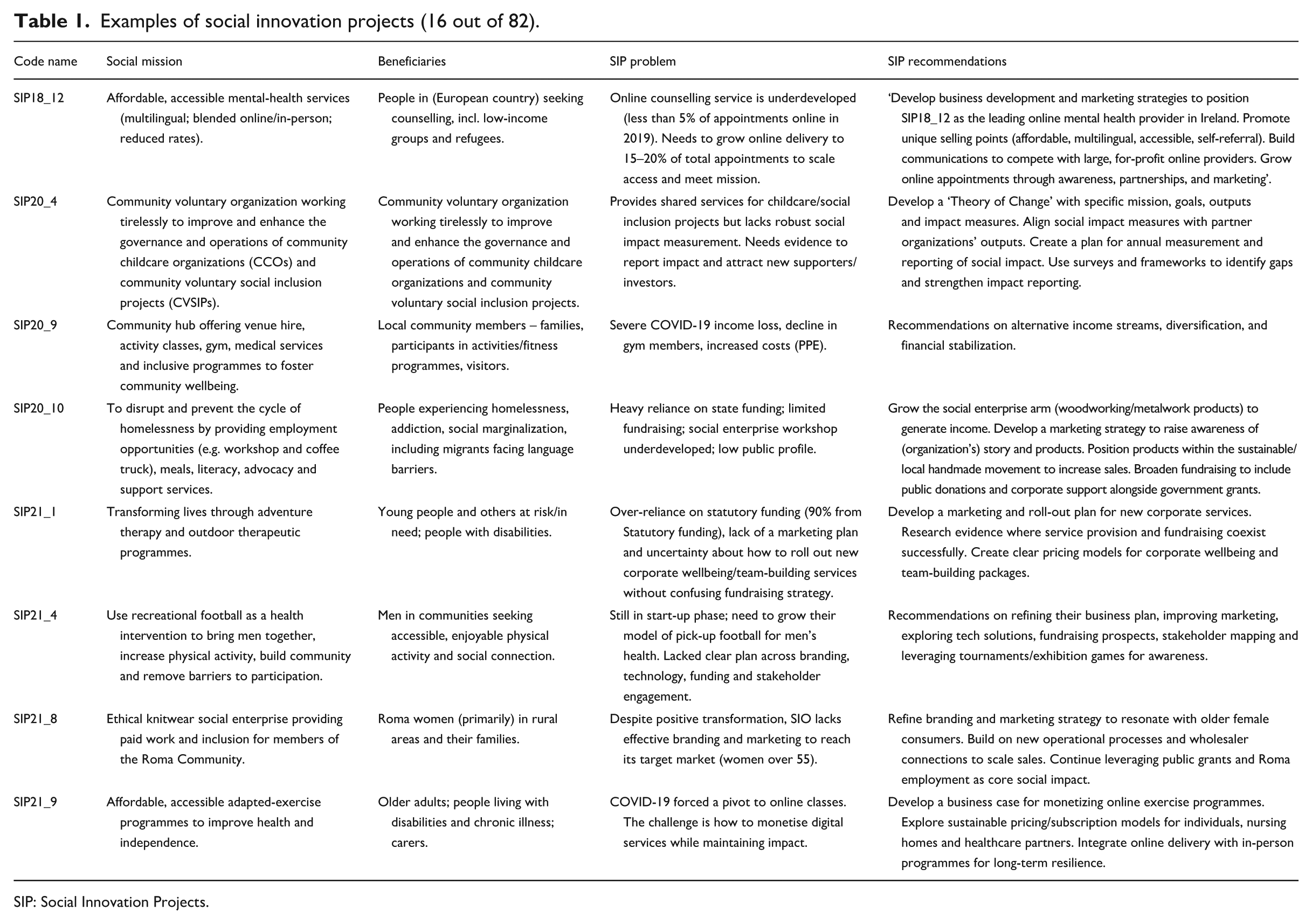
SIP: Social Innovation Projects.
We framed the study as an insider–outsider inquiry, with inquiry from inside the empirical context, and from outside it, two distinct modes of research originally proposed and developed by Evered and Louis (1981). Conceptualizations of researchers operating from inside or outside the specific empirical context are valuable for considering educators and students engaged in SIE working alongside socially innovative organizations, and for exploring the multiple dimensions of place in place-based learning. Furthermore, we adopted a reflexive approach to reviewing each year of the 6 years of programme activity, with organizational and student participants reflecting on their learning. We anticipated this process as being key for academic and practitioner relationships, with outsider researchers able to foster reflexivity in insider researchers in a manner that creates impact (McKenzie and Bartunek, 2023). Employing Evered and Louis (1981), we positioned insiders as immersed actors within the organization focused on detail and situational learning, and outsiders as those remaining detached from the setting of inquiry to gain generalizable knowledge.
The author team included all the educator contributors to the MBA course. The first author was the academic module coordinator for the student community projects for 5 years of data gathering, with an academic background in organization theory and social entrepreneurship. The second author had originally designed the module in 2012 before the data gathering began and has a background in organization theory and nonprofit management. The third author was the module coordinator for 1 year (Year 6) and has a background in social innovation, social impact measurement and social enterprise support. The fourth author joined the team as a practitioner–academic in Year 4 and helped to provide the links between student teams and the socially innovative organizations. Finally, the fifth author joined the team during the development of the article and has contributed to the project theoretically and reflectively.
For this article, the first author led on the methodological design and the data analysis/results, while the second, third and fifth authors developed the theoretical contribution; the fourth author led on much of the data gathering and practice-based reflection. Conceptual themes evolved through this teaching collaboration and reflection. For example, the concept of institutional hybrid tension began as a discussion of the 2018 survey results, in an attempt to address the issue that some of the community-based organizations were not experiencing the intended benefit from the student recommendations. The educational aim of the university programme (learn through providing consultancy to a social enterprise) was in tension with the needs of the organization (to deliver its social mission). This theme arose in multiple sources of data. Discussions between the authors moved us from the empirical experience of engaged teaching to subthemes, to the theoretical concept of hybrid tensions. The diverse range of data sources enabled a deeper discussion and analysis of the themes that arose.
We obtained ethical approval from our university’s research office following ethical guidelines and data protection policy at the start of the project. We returned to the research office for further approval in Year 4 of the research as the research plan had evolved and changed into a longer and larger project.
Data
From 2015 to 2021 across 6 academic years, we conducted 82 MBA company projects with socially innovative organizations in a course delivered on both the full-time and executive MBA programmes (refer to Table 1 for descriptions of 16 indicative examples). These projects took place within 65 different socially innovative organizations embedded in specific communities, all focused on creating social value for their beneficiaries and restructuring embedded power relations, with many operating as social enterprises. Across all years of the project, we conducted 29 exit interviews with the organizations and 302 anonymous evaluations with the students. Each year we analysed the data, which shaped and influenced how we organized the projects in the subsequent year. Each year we wrote up observation notes (23 pages) during the project delivery. At the end of each cycle the research team conducted self-reflection through writing and in discussion meetings (captured in six reflection notes). After the completion of six cycles of place-based learning, we conducted one final focus group involving the SIP educators (authors 1–4) to conduct a reflective meta-analysis of all six cycles focusing on the roles and relationships between educators, students and the socially innovative organizations. Data sources are recorded in Table 2.
Data sources.
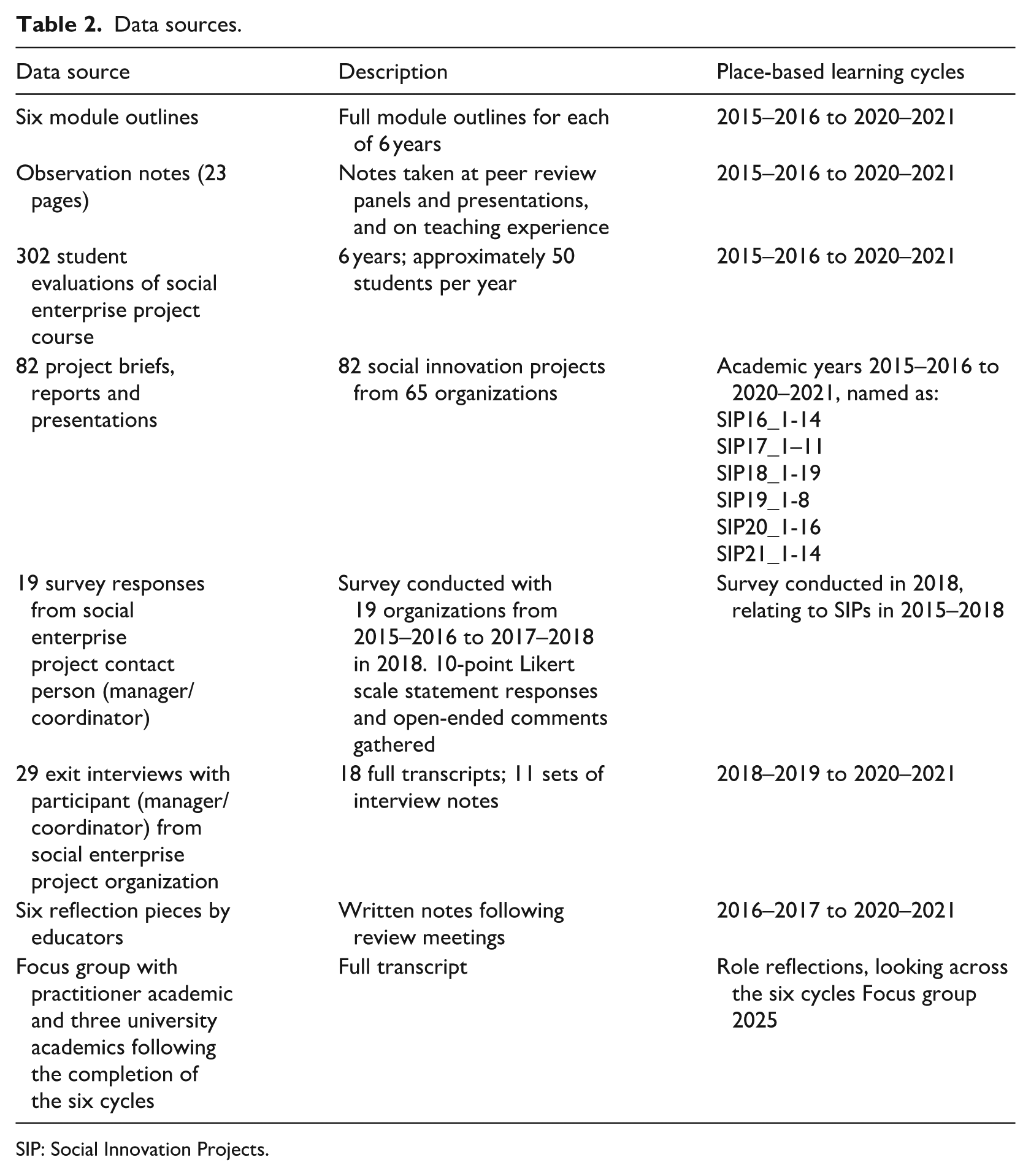
SIP: Social Innovation Projects.
Data analysis
The annual cycle of project planning, preparation, implementation, data gathering, reflection and adjustment took place over 12 months, as is illustrated in Figure 1.
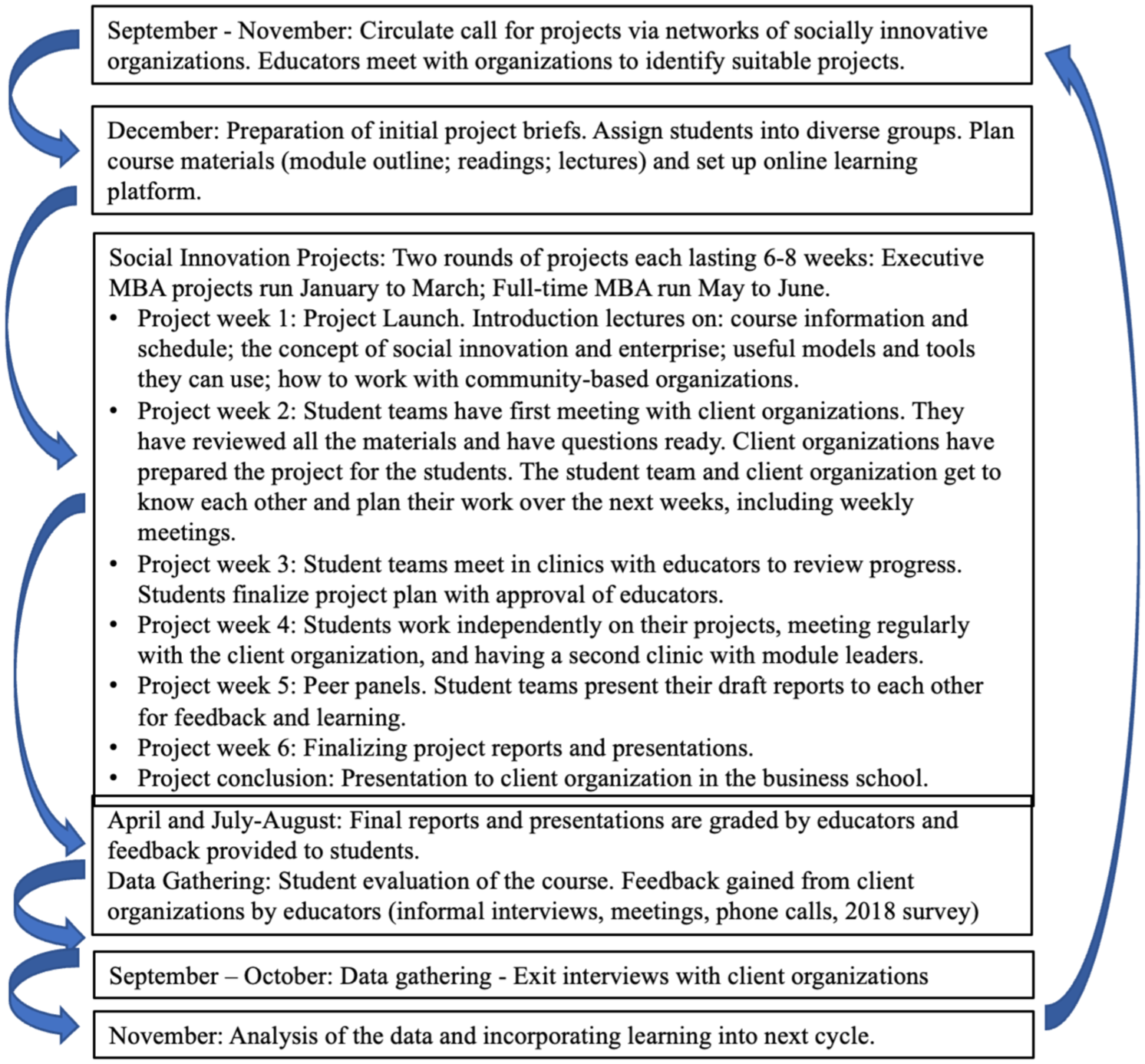
Annual place-based learning cycle.
While Figure 1 illustrates the content of each of the learning cycles, Figure 2 illustrates the ways in which cycles differ from each other, and the clustering of the six cycles into three phases, that is, Phase 1 (2015–2018), Phase 2 (2018–2019) and Phase 3 (2019–2021). While we made small adjustments based on our learning after each cycle, we implemented two significant actions that distinguish the phases from one another and that reflect key tensions in the process. The key tensions were analysis versus problem-solving modalities and insider versus outsider driven action. Furthermore, we see these tensions as particularly relevant for place-based learning. Analysis and problem-solving modalities are found in both service learning and community-based research. The analysis modality prioritizes research, with the goal of learning and understanding usually centering the student’s learning outcomes (Nikolova and Andersen, 2017). When the research is driven by educators outside the community-context, this is described as top–down, applying academic frameworks to real-world contexts (Strand et al., 2003). The problem-solving modality focuses on identifying solutions to challenges that are either identified by the organization itself, or by the educators, and is more commonly found in business schools and professional education approaches, than in schools of public administration, policy and social work (Mirabella and Young, 2012).
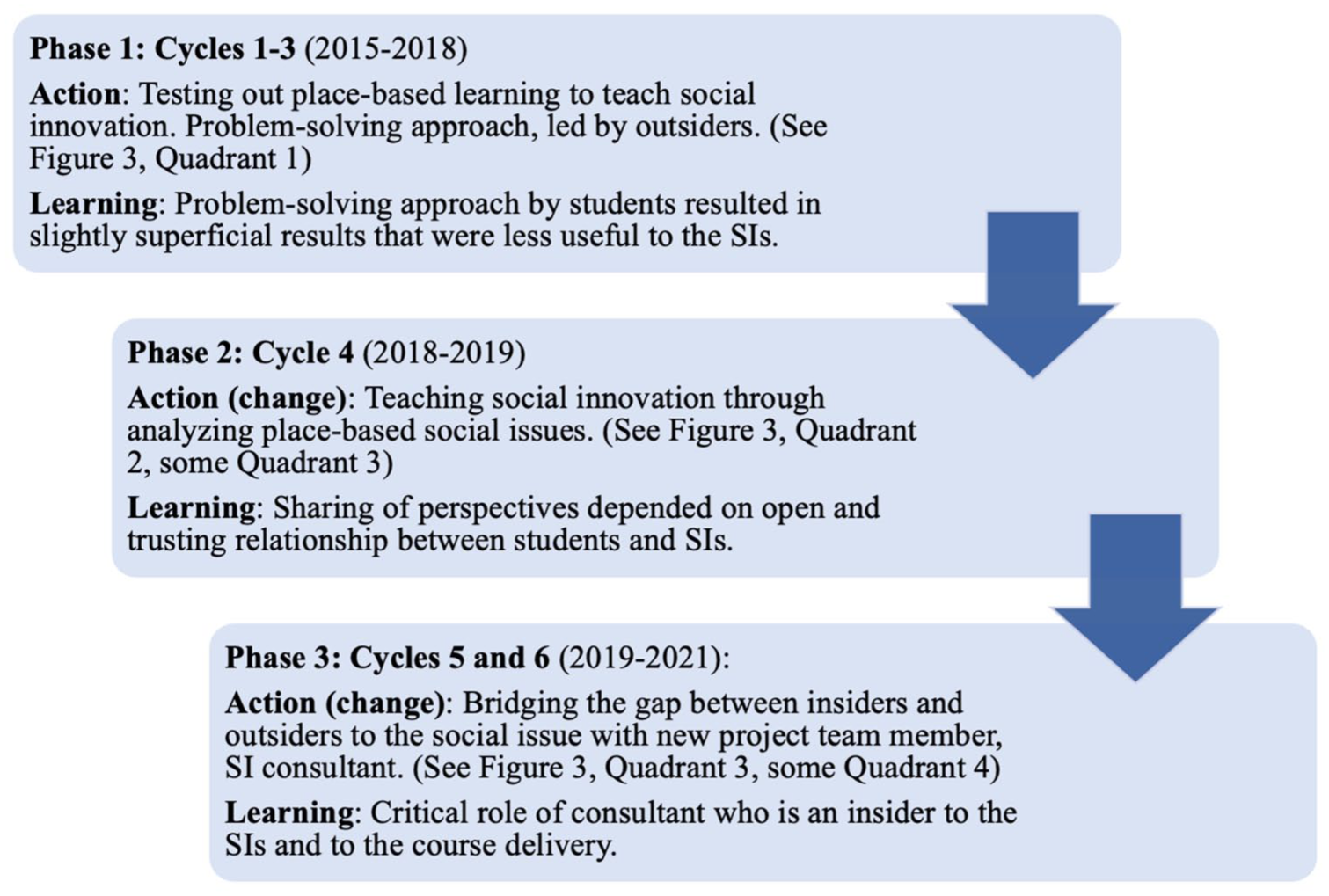
Six cycles of place-based learning in three phases.
After three cycles where we prioritized a problem-solving modality, asking students to focus on developing actionable recommendations to address the challenges the organizations were facing, we conducted an anonymous survey in July 2018 with the organizations that had participated in 2015–2018. Using a 10-point Likert-type scale, 19 respondents were asked about students’ understanding of social mission, their ability to create social value for the organization, the utility of student recommendations and whether they had been implemented. The 19 respondents also provided comments for at least one of the questions.
In the fourth cycle (academic year 2018–2019), in response to our own analyses and the questionnaire results, we shifted to a focus on analysis of the social issue rather than on problem solving per se. We did this by preparing the students to learn about the social issue and the organization’s social mission, rather than just intending to solve a problem. Thus, the fourth cycle (2018–2019) focused on analysis of the specific social issue, rather than problem-solving.
The learning from Cycle 4 (2018–2019) was that stronger relationships with the organizations were needed to facilitate successful sharing of perspectives. For the subsequent two cycles, we brought in an additional educator in the form of a project leader, who was a consultant with a strong network of socially innovative organizations and an insider from their perspectives. The project leader and university professor together were able to facilitate understanding between the perspectives of the student teams and of the organizational participants, bringing complementary skillsets as part of the educator team to translate the real-world problems as viewed by the social enterprises and the students.
The data analysis strategy included inductive and abductive reasoning as part of researcher self-reflection (Holian and Coghlan, 2013) and situational analysis as a way of operationalizing the concept of place (Clarke et al., 2024) within this place-based learning experience. Figure 1 shows that data analysis took place in November of each cycle as we prepared to start the following cycle. In that step, the data from one cycle were analysed (module outlines, project briefs, reports, presentations, student evaluations, observation notes and exit interviews with Sis). Each subsequent year, one cycle was analysed in relation to the previous years, as we added data (six reflection pieces, and finally the focus group). Thus, we developed Figure 2 through reflecting on multiple cycles at a time and the changes we implemented.
We worked with the concepts: problem-solving approach, analytic modality, insider perspective and outsider perspective. We relied on a wide range of data sources, listed in Table 1, to triangulate the findings as they were emerging. At the end of each cycle of place-based learning, the research team conducted self-reflection through writing and in discussion meetings (captured in the six reflection notes). This ‘first-person reflexive practice’ (Holian and Coghlan, 2013: 402) was an important part of identifying and clarifying the different perspectives and roles that each of us played at different times. We mapped out the context into distinct situations (Clarke et al., 2024): university programme and social innovation. These two additional aggregate themes helped to make sense of the tensions arising and to distinguish inside versus outside in relation to those contexts. Discussions and writing on what had changed over the 6 years, along with the literature review underpinned the theoretical implications and the creation of the social value creation model for place-based learning.
Findings
The findings below are presented according to the two pairs of concepts in tension throughout the 6 years: insider versus outsider driven projects, and analysis versus problem-solving focus, which are presented in Figure 3. As indicated in the previous paragraphs, in Phase 1 (2015–2018, which includes cycles 1–3), the projects were outsider-driven with a focus on problem-solving. This profile is represented in quadrant 1 in Figure 3. In response to the feedback from the organizations, the projects in Phase 2 (2018–2019, which is cycle 4) included a bigger focus on analysis (quadrant 2), with a slight shift towards insider driven (quadrant 3). Phase 3, which includes cycles 5 (2019–2020) and 6 (2020–2021), shifted towards quadrant 4’s insider driven bottom-up problem-solving, but with an overall awareness and acceptance of the tensions between insider- and outsider-driven approaches, and analytic versus problem-solving modalities. The organizations recommended a more collaborative effort to co-create value – a balance of learning and action – where the emphasis was on the different perspectives, and regular communication between students and organizations. This change was perhaps best embodied by the recruitment of a consultant, who acted in what Nikolova and Andersen (2017) called the ‘client engagement coordinator role’, essentially acting as the translator between the students and the organizations.
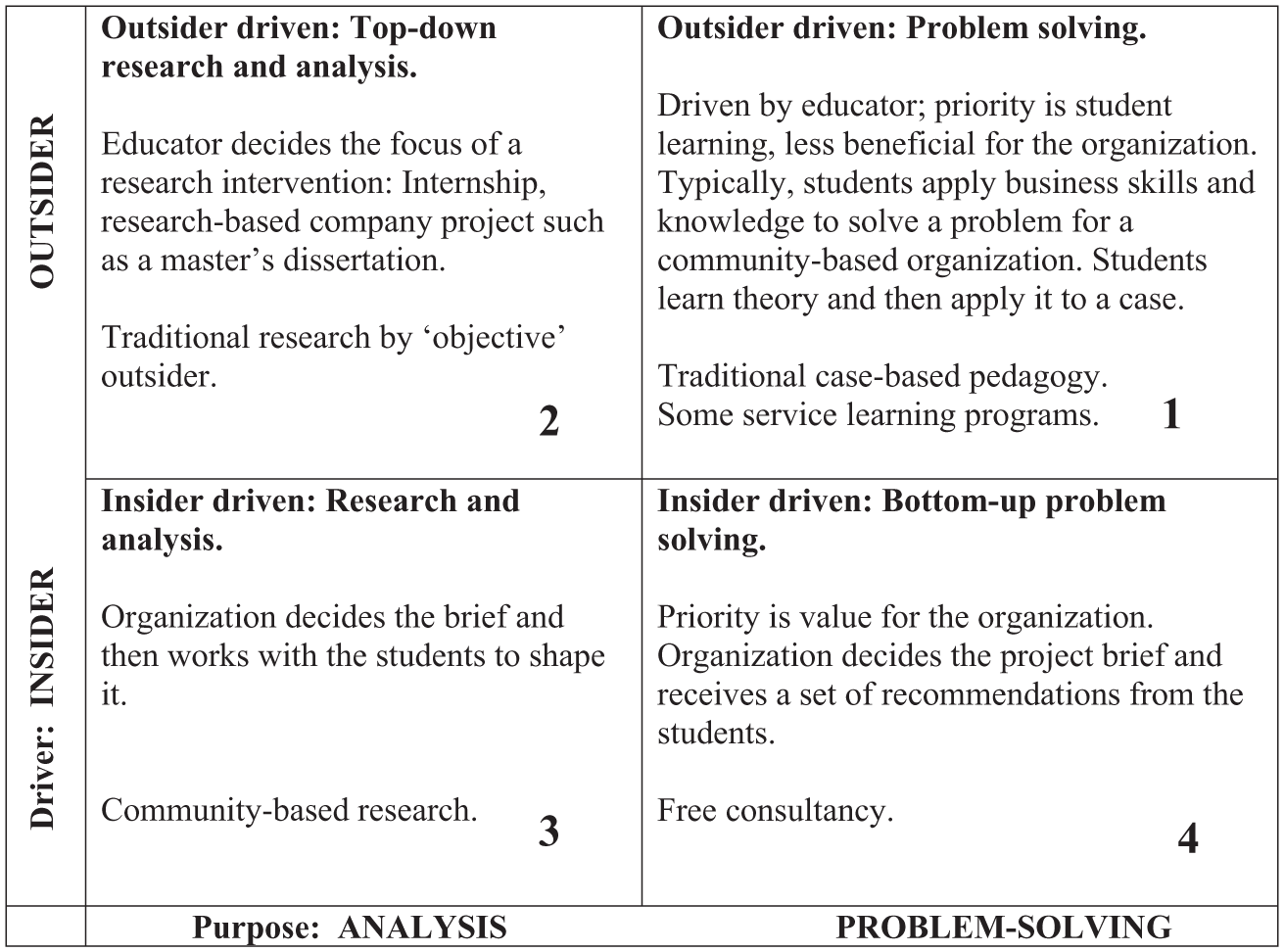
Four modes of social innovation education: approaches to engagement between HEIs and community-based organizations.
Outsider-driven problem solving (Phase 1)
From 2015 to 2018 (Phase 1), the project was designed to be a short, intense consultancy experience; the students would immerse themselves in the challenge for a short period of time and propose solutions to specific issues faced by the organization (quadrant 1 in Figure 3). The purpose was ‘to deliver evidenced-based solutions to a challenge that the socially innovative organization is facing’ (module outline, 2016). During this period, the value of the projects was embodied in the recommendations for the client organizations. One effect of this problem-solving focus was that project briefs listed out a wide range of problems that the students could address, for example, ‘Provide support in developing our three-year strategic plan including clarifying the vision, developing more measurable goals, identifying priority market segments, improving relationships with stakeholders, how to resource the strategy, identifying risks’ (SIP2016_4 Project Brief). The educators worked to sharpen the focus of the projects, but the end result was often a list of problems, failing to give a clear focus to the students.
For the students, the learning outcomes were that they would understand how their MBA skills and the tools they learned could apply in a community context, tied to a social mission. However, in the 2018 survey, while many of the organizations found the student recommendations valuable, a significant minority of organizations (5 out of 19, 26%) rated the recommendations given to them as ⩽6/10, while 14 out of 19 organizations (74%) rated the value of the recommendations as ⩾7/10. The low perceived value by some organizations was in some cases because the feedback was only telling them something that they already knew. As one organization stated, I was nervous working with the MBA students as they are high-flyers. But in the end, they didn’t know anything that I didn’t know. I have done all the trainings in strategic planning, businesses analysis, financial planning, digital media. There was nothing new there. That was a positive message for me, that I have all the knowledge I need; there isn’t some pool of knowledge out there that I haven’t accessed yet. (Exit Interview 2018_5)
Similarly, when it came to how innovative the recommendations were, the response was lower than expected, with 7 of the 19 responses (37%) rating innovativeness as ⩽6/10, while 12 responses (63%) rated it as ⩾7/10. The problem-solving approach was not enabling the creation of shared social value between stakeholders, limiting the value that the students could deliver to the community organizations.
In 2016 and 2017, feedback from the organizations suggested that some of the student recommendations lacked depth, were unrealistic or were not particularly innovative. For example, one MBA team in a project to develop a new marketing strategy for the organization recommended hiring a marketing manager. The organization felt that this was an obvious need, but also did not have the resources to do so: ‘We know that we would benefit from hiring more staff, but our financial situation as a nonprofit doesn’t allow us to do that’ (Exit Interview 2017_7). Again, this demonstrates the students’ lack of appreciation of the context of the organization, hence explaining their inability to deliver shared social value. In contrast, observation notes taken during the final presentations to clients expressed glowing gratitude and appreciation of the value of the project: ‘Client found the marketing advice excellent, very grateful’ (Observation notes 2016_7). Thus, the multiple sources of data gathered provided insights that were not immediately obvious from participating in the projects.
Outsider–insider analytic approach (Phase 2)
In 2018 for Phase 2, we shifted the focus of the projects to research and analysis to coproduce useful data that would inform recommendations that the students and organizations crafted together. The data and analysis by the students could be used internally by the organizations to drive a new direction. For example, ‘The study and report were important to convince the Board to make the mission/vision change’ (Exit Interview 2019_8). Thus, the managers were able to use the MBA reports (analysis) to support and inform their own ideas for future direction (their own problem-solving), rather than expecting the student teams to provide that direction in the form of recommendations. While this did not represent the students becoming insiders, it did mean that their analysis was coproduced with the organizational insiders, co-creating more tangible and impactful solutions for the SEs as part of a process of insider–outsider co-creation.
The managers considered the projects highly valuable when they informed decision-making within the organizations. This use of analysis was also supported by the increased communication between the teams and the organizations.
The background research that the team undertook . . . helped us clarify our thoughts on the problem outlined and positively influenced our decision to introduce a new service within the organization (Exit Interview 2020_3, interview related to SIP in 2019, Phase 2): We are used to donors telling us what to do and the assumption is that the outsider knows best. Swoops in with all the resources to save us. What I appreciated about working with the MBA students is that they assumed we had the knowledge, and they were keen to work with us to support what we know we need to do. (Exit Interview 2019_12)
Co-creation of value
In cycles 5 and 6 (2019–2021), following a review of student evaluation and organization of exit interviews and survey data, the educators shifted the focus towards facilitating the relationship between insiders and outsiders, the social issue and the sharing of different perspectives. The students’ shift in focus from analysis back to problem-solving was facilitated here by a new team member. A project leader was hired who was a social entrepreneur (author 4), and as a consultant delivered training and advice to a wide network of socially innovative organizations. The project leader was, alongside the wider educator team, able to help orient the students towards the needs of the organizations in terms of the top-down analysis that they could provide, and how that would be useful for the organizations and used for bottom-up problem-solving, either during or following the MBA project. Thus, we saw a shift in Phase 3 to analysis followed by collaborative problem-solving. In this way the project leader enriched the translational ability of the educator team in supporting the co-creation of social value between students and organizations, enabling an ‘inside-out’ approach to overcoming the hybrid, ethical and institutional tensions at play (Harris, 2021; Lake et al., 2022; Langran and DeWitt, 2020; Larty, 2021) and acting as a relational leader (Carroll and Smolović Jones, 2018). Preparation lectures with the students tasked them with learning about the organization and their motivations, experiences and knowledge of their beneficiaries. Specifically, we drew attention to these perspectives as part of the course learning: On a daily basis we talk about societal equality and how that looks within a more ESG focused world. Working with [organization name] allowed me to stop talking and looking from a distance at social enterprises and appreciate the value of what these enterprises are trying to achieve, ultimately with a focus on improving communities and groups who are marginalized in one way or another. (Student evaluation, 2021_17)
An example of top-down analysis followed by bottom-up problem-solving is SIP21_4 (see Table 2): One MBA team applied the marketing funnel framework to a challenge (increase brand awareness, scale) faced by a social innovation (use of recreational football to improve men’s mental health). The team conducted market research in the form of a customer survey. The team met with the client and presented the applied funnel model; the client identified where it was relevant and where it did not apply or fit. Through their discussions of where the model did not fit, they were able to collaboratively discuss realistic solutions to their lack of brand awareness. The subsequent market research (customer survey) implemented by the MBA team was more aligned with the SIP’s mission. The final report then reflected that top-down research combined with bottom–up problem-solving, which had merged into a collaborative approach.
As part of this shift to top-down analysis, sharing perspectives and bottom-up problem-solving, students were instructed to check-in regularly with the organizations by having weekly meetings. Planning time to check-in during the projects made a big difference to the communications between the students and the organizations: The team kept us abreast of what they were doing, which was exciting for us to see how the project was unfolding and could steer it. (Exit Interview 2019_2) We worked together very well as a team . . . They went off and did what they had to do, and when they came back, they were very interactive with me. (Exit Interview 2021_1)
These regular meetings helped to ensure that the often naïve initial ideas by the teams were sense checked with the client: In the first clinic, the project leader challenged the team’s obvious recommendation to use Google Ads, asking them if they had checked to see if the client had already thought of that. So, they went back and checked. This prevented the team going down a road, wasting time, that ultimately would not be helpful to the client. (Reflection notes 2020)
Regular communication and an awareness of the different perspectives involved helped the students become familiar with the world of the social enterprise and understand how their project fitted into the organization’s work. In essence, the interactions between the students and the organizations were more than just an issue of good communication or effective project management, but instead highlighted the importance of sharing different perspectives, and providing time to learn about the other perspective: The context was so different from what I am used to. It took me a long time to even understand why the organization existed. (Student evaluation 2020_18) Working with the MBA team made us realize how much of our context we take for granted. We had to explain things that we thought were obvious. (Exit Interview 2020_1)
Phase 3 transcended the quadrants in a way, as the work became more collaborative; however, we still refer to the tension between the two dimensions, as these different drivers and purposes lead to co-creation. That tension as a source of co-creation is apparent in the two quotes above, where both students and the client companies gain self-awareness from interacting with each other as a means to critique their own normative assumptions.
Often the value was created when the analytic focus led to recommendations that the organization itself produced, and were either part of the students’ final report, or followed from the report: When we gave a weekly update [to the organization], we got feedback. Sometimes it was even one small comment that would get us thinking. Or, if we didn’t understand their response, we could ask for clarification, which opened up a whole new dimension to the project. (Student evaluation 2020_33)
While some of the valuable recommendations came from the organization, they were co-created in the process of the students conducting the analysis and gathering data about a social issue. This process showed how this type of interaction is based in shared learning, knowledge transfer and ultimately insider–outsider co-creation that has social value. This was ultimately facilitated by the educator team being able to adopt an inside-out approach to the module that translated and facilitated communication between the students and the organization, ultimately overcoming existent tensions.
Discussion
A longitudinal, place-based learning method for addressing real-world community and organizational problems enabled us to experiment with and reflect on two dichotomies in the process: insider versus outsider-driven approaches, and analysis versus problem-solving modalities. Addressing these two sets of tensions underpinned collaborative creation of social value for the students, educators and socially innovative organizations. Figure 4 illustrates this approach to co-creation of social value in SIE.
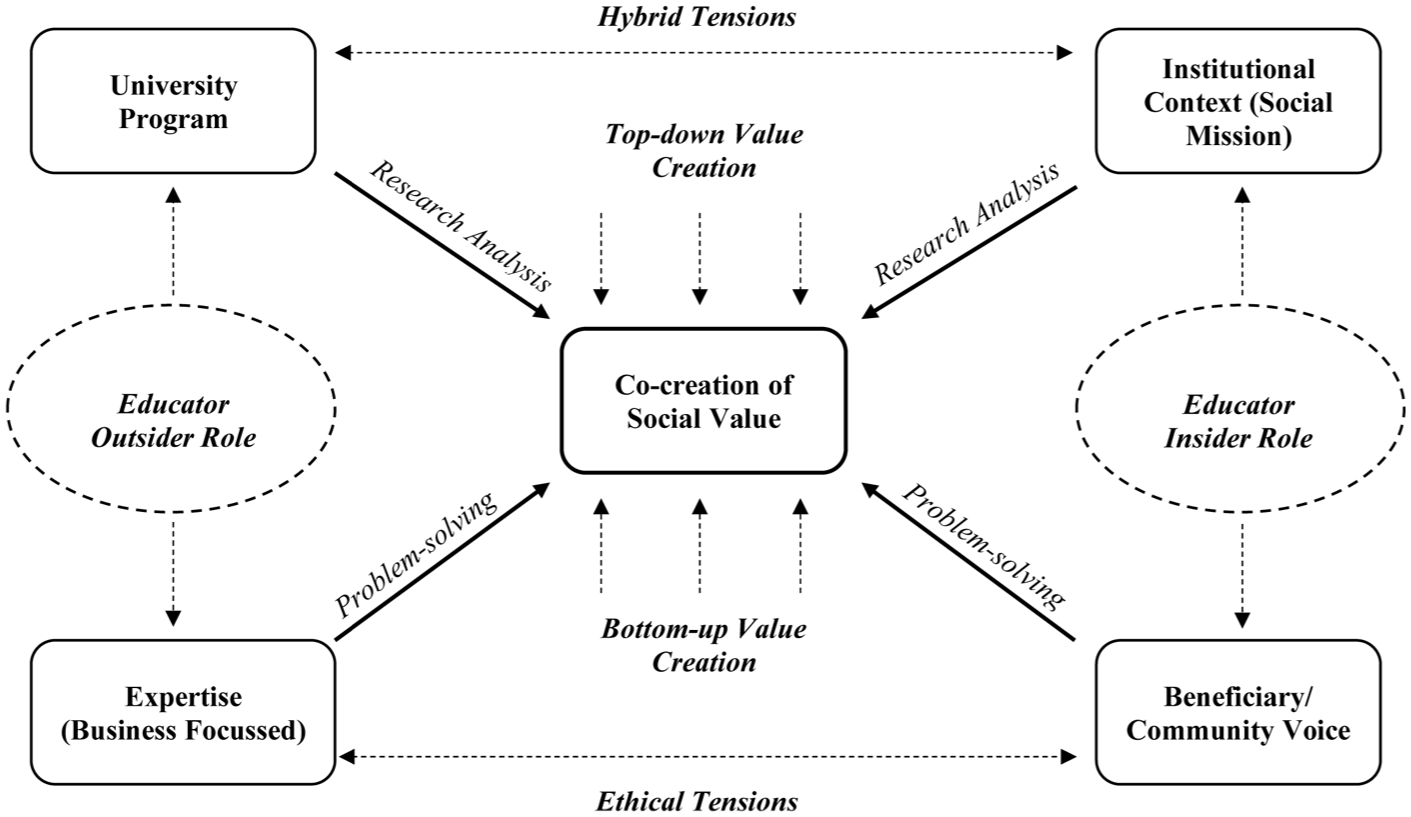
Social value co-creation model in place-based social innovation education.
Co-creating value through social innovation projects taught within universities is a challenging process. Our analysis points to a need for the educator/education team to operate as insiders and outsiders from the perspective of the organization being supported, as well as having an awareness of the differences and tensions between a bottom-up problem-solving or a top-down research/analysis approach. We argue that this dual approach to analysis and problem-solving is necessary to drive the co-creation of social value with the partner organizations, as it illustrates the place-based nature of the work being conducted and the spaces that the organizations and students operate in. Indeed, this emphasizes the importance of the insider and outsider roles within the team. Skillsets to facilitate an inside-out approach that overcomes hybrid tensions (Harris, 2021; Lake et al., 2022; Langran and DeWitt, 2020; Larty, 2021) are required and these take time, investment and most likely programme iterations to develop.
The MBA students are most often outsiders to the social issue, seeking to understand the institutional context of the organization and the wider context within the community. They are seeking to deliver top-down value to the organization through research and analysis (business planning, financial forecasting, marketing support), while simultaneously learning to understand the bottom-up social value creation processes of the socially innovative organization, and the beneficiaries/communities they work with. As most MBAs have commercial backgrounds and are focused on economic value, this balance can be difficult to maintain. Conversely, socially innovative organization personnel are more often focused on the social mission, the primary purpose underpinning their organization’s existence.
The contrasting perspectives held by these stakeholders in different roles and places lead to tensions within the project with regard to hybridity and ethics, as the students’ skillset is (mostly) focused on economic rather than social value (hybrid tension), while also having to adhere to the aims of the MBA module (and the summative assessment criteria), alongside the organization’s commitment to its beneficiary base (ethical tensions). This is where the role of the educator(s) as translators and facilitators becomes critical, as they need to develop consensus and balance these tensions by adopting both an insider and an outsider perspective. Through this process, educators seek to raise appreciation, within outsider and insider perspectives, of the others’ place and space.
In this respect, the educators aim to facilitate the process for both insiders and outsiders by understanding the needs of the organizations and guiding the students to support them directly, while also ensuring that the students achieve the learning outcomes of the MBA. As collaboration and team teaching with industry experts has been formalized, it has become an essential part of the programme, as our practitioner–academic colleague explains: My experiences working in the social enterprise and being that practitioner gives me good perspective. What was constantly happening was expectations were being set so high. ‘Our students are going to come in and they're going to fix it all for you’. When I go out to social enterprises, I'm trying to look for those organizations that have the capacity and the ability, and generally, I'm looking for a project that is on their strategic plan, that this group could help them cut that forward by 6 months. That's a genius piece, because the group can step in and make that happen. (Focus group 2025-1)
Educators must balance between top-down research analytic approaches and bottom-up problem-solving, and translate between insider and outsider perspectives, enabling optimization of social value creation within the project. The maintenance of these balanced approaches and the ability to translate between the stakeholder groups is what enables optimum solutions to the real-world problems identified. In this approach, the educators become the key to supporting the students to understand the nuances of the ‘community terroir’ that they are operating within (Thomas, 2020).
The insider–outsider relationship in place-based learning within SIE goes beyond whether the project content is driven by the practitioners within the organization or driven by educators and students outside the organization. It is more about the interplay between these two environments, and how the actors involved (students, educators, practitioners and consultants) manage the hybrid and ethical tensions (Cunliffe and Ivaldi, 2021; Lake et al., 2022). In many ways, community-based research (Harwell Schaffer, 2012) is a reaction against traditional research conducted by ‘objective outsiders’, applying theories to specific cases for the purpose of theory building or teaching. In community-based research, the intention is for the organization to benefit; while in traditional scholarship, it is unclear how or if the organization benefits. We have shown that the tension between different perspectives can be a useful source of learning, and thus value, for both insiders and outsiders, especially when drawn together by educators with relational leadership approaches that can bring together shared conceptions of social value between the students and the community.
When the teaching team deliberately facilitated understanding between different perspectives, they were able to explicitly spell out for both students and organizations that the learning and value of the project depended on a deliberate exchange of perspectives. This role goes beyond communicating with the organizations and coaching the students (Nikolova and Andersen, 2017). The process of bridging the gap between those two perspectives needed to be facilitated throughout the project, not just set up at the beginning. In this place-based research, the teaching team came to recognize teaching and SIE project places as arenas for action and interaction, where different actors were in relation to each other and the teaching team was ‘part of the network of relations in a place’ (Horlings et.al., 2020: 474). This does not mean that working in relation to each other is easy, or immediate or even always successful, as academic project partners reflected: I kind of felt like the students found it far more engaging, the real-life experience. And then if I'm bringing it back to, like, a reference and a framework, that that's less . . . Interesting, and it’s harder to sell that as something they should know. (Focus Group, 2025-2) I think that the students find it (practitioner–academic perspective) much more interesting and real and authentic. This is what really happens, versus this is what has been written about; this is the research. But I guess the two together, that's where the value is. (Focus Group, 2025-3)
Through iterations of learning cycles, the teaching team became ‘more conscious of their context-specific capabilities with respect to the places they research’ (Horlings et al., 2020: 475), allowing participants to handle the tensions between contrasting perspectives involved in these projects, which then allowed for the co-creation of value. Our practitioner–academic educator provides an example of how they and an academic educator have complementary context-specific roles: When we’re in clinics with the students, [Academic Partner] and I will pick up on different things, you know, like they will talk about the particular model being used incorrectly, and I pick up on common sense nonsense that the students come up with that is absolutely pointless. (Focus group, 2025-1)
In a place-based facilitation role, the education team serves as ‘translators’. They need to have familiarity with both institutional contexts, in order to bridge the perspectives and discourses. Facilitating inter-personal differences within an institutional context is a specific skillset that can be learned in conflict management courses, leadership training and elsewhere, and very much requires a relational leadership approach (Carroll and Smolović Jones, 2018). Facilitating inter-institutional differences, or managing hybrid tensions, requires an individual or teaching team that has familiarity and professional history in both contexts.
Conclusion
The co-creation of social value in place-based learning initiatives involves collaboration between practitioners, educators and students. It needs to be deliberately facilitated, appreciating and articulating the different perspectives and the hybrid tensions that arise between different institutional contexts. The significance of the new theoretical model of social value co-creation (Figure 4) is that the concept becomes more than just a ‘benefit’ to the various parties, as has been previously understood (Block and Bartkus, 2019; Nikolova and Andersen, 2017). Such deliberate social benefit can be compared with social value, in that they are both the purposeful outcomes of an initiative and can be objectively quantified and measured (e.g. Ebrahim and Rangan, 2014). The approach to co-creating shared social value in our study relates to the place-based learning approach (Alden Rivers et al., 2015; Elmes et al., 2012), which preserves the insider perspective, or maintains the importance of ideographic knowledge, alongside the outsider perspective, or nomothetic knowledge (Evered and Louis, 1981) and recognizes the context-specific capabilities of the teaching team for facilitating learning (Horlings et al., 2020). Thus, shared social value involves a subjective normative judgement of what is of benefit, which originates from within a specific perspective of an insider to an institutional context. Much concern about social value is about whether or how much it exists (Rawhouser et al., 2017), and more critical approaches highlight its narrow focus as reductionist (Brest, 2020). In contrast, social value exists if the participants say it exists because it arises from ideographic knowledge. Therefore, relevant questions about social value include how it is experienced, the process of facilitating it, understanding different perspectives on and types of value, among others. Social value, therefore, may serve as a useful counterbalance to impact, where the former captures subjective descriptions, while the latter focuses on the more quantifiable aspects of a social programme that are often more important to donors and sponsors, than they are to practitioners and their communities (Brest, 2020).
The limitations of this research include the case setting and the applicability of the data to other locales. The research reports data drawn from one MBA course within one university department raising the question as to what the experience would be in other HEIs globally and what place-based learning might look like in different locales. Given our focus on the importance of locality, it is feasible that experiences could be different for students, scholars and organizations in different areas. Therefore, further exploration of the defined approaches and tensions is required in other settings to understand these dynamics.
In presenting our six-stage approach to the development of the MBA course, we seek to offer other teachers and practitioners the opportunity to learn from our approach to developing modules with place-based learning approaches and outcomes. This is not to say that others must go through the same three phases sequentially, rather that they can use this as a learning tool to develop their own work and reflect on their approach to creating social value. It is our hope that the article most clearly shows the critical impact that constant iteration and reflection have on ensuring that university programmes develop alongside their local areas and are thus able to understand and manage the hybrid tensions inherent to place-based learning approaches. In this way, such programmes can maximize place and space relevant to social value creation for communities, as well as for students, educators, business schools and universities.
Footnotes
Acknowledgements
The authors thank all of the social enterprise staff and MBA students who took part in this research. This study has not received any outside funding.

Ethical considerations
All authors have contributed to the preparation of this manuscript. This manuscript and research comply with the ethical standards set out by COPE (Committee on Publication Ethics). This study was approved by the Trinity Business School Research Ethics Committee (Approval no. not provided) on 17 January 2021.
Consent to participate
Written and/or verbal consent was obtained from the study’s participants across interviews, survey responses and observations.
Consent for publication
Not applicable.
Funding
The authors received no financial support for the research, authorship and/or publication of this article.
Declaration of conflicting interests
The authors declared no potential conflicts of interest with respect to the research, authorship and/or publication of this article.
Data availability statement
The datasets generated during and/or analysed during the current study are available from the lead author on reasonable request.