




Abstract
The digital technology sector is often subject to reports of ageism. Given this context, our study examines how age is discursively negotiated within the identity work of older digital technology knowledge workers. Our discursive analysis demonstrates how our participants resist, reposition and reimagine their ageing identities in ways that disrupt common stereotypes about technology and age. We propose this is achieved through identity work that downplays established ideas of the digitally limited ageing subject by amplifying more complex and occupationally desired identities. This research adds nuance to understandings of age categorisations and the ageing knowledge worker, explicates socio-technological insights and explains how an ageing identity can be constructed within the digital technology sector.
Introduction
The challenges of ageism at work have been extensively researched (Berger, 2021; Riach, 2022; Spedale, 2019), but despite legislation (UK Government, 2010), analyses show ageing workers continue to be treated as not being ‘organizationally viable’ in subtle and insidious ways (Cutcher et al., 2022: 975). Such ageism is based on assumptions of declining productivity, increasing cost, worsening health and diminishing capacity to learn (Irni, 2009; Riach, 2022). Researchers investigating ageing have considered this in the wider context of disadvantage, including intersections with gender (Irni, 2009; Pritchard and Whiting, 2022). Others have focused on the importance of organisational context, including those associated with younger people such as call centres (Cutcher et al., 2022) and sport (Brown and Coupland, 2015). We extend this approach of exploring specific occupational contexts, here examining a contemporarily important form of knowledge work within the digital technology sector.
Knowledge work is defined as that involving ‘informational processing, problem solving and the production of knowledge’ (Benson and Brown, 2007: 122). The history of knowledge work and knowledge workers is inextricably connected to technology (Anthony, 2021). This is encapsulated in the term ‘epistemic technologies’ (Scarbrough et al., 2025: 1886) highlighting that digital technologies (including Web 2.0 and artificial intelligence, AI) are implicated in knowledge work and intertwined with knowledge workers. This leads to continual reappraisal as to what counts as knowledge work in contemporary workplaces. However, this can result in challenges for those who do not fit the expected norms and whose ‘displays of competence’ (Knox et al., 2024: 792) may not be validated. From a research perspective, given widely reported disparities in pay and progression, disadvantages due to gender have been the focus (Young et al., 2023), while concerns about ageism have been less examined (Svensson, 2023).
The UK digital technology sector is considered innovative and dynamic (Stypińska et al., 2023) but is demographically skewed towards workers under the age of 34 (ONS, 2023). This sector goes beyond the traditional bounds of information technology, encompassing Web 2.0, platforms, social tools and an emerging emphasis on AI (Scarbrough et al., 2025). Digital technology is a growing UK knowledge sector, contributing a Gross Value Added (GVA) of £286,325 million and employing over 2.6 million people (Department for Science, Innovation and Technology, 2025). However, ageism is arguably prevalent (Rosales and Svensson, 2021) and digital sector knowledge workers are often subject to age discrimination as young as 35 (CompTIA, 2021; ONS, 2023) or even 30 (Kaarst-Brown and Birkland, 2011). This is a much younger chronological age than 50, the general age at which workers are usually considered older (CIPD, 2022). While there are undoubtedly other forms of disadvantage in the digital technology sector, including gender, ethnicity and disability, to facilitate in-depth analysis, here, we focus specifically on age.
Within digital technology, inferences of inadequacy (Rosales and Svensson, 2021) not only impact a chronologically younger worker than in other sectors but are reinforced via popular generational stereotypes. While, with others (Reed and Thomas, 2021), we problematise how generational differences are evidenced, we note the significant impact of generational stereotypes as social discourses. Thus generational differences are perpetuated through popular discourses of growing up (Tapscott, 2008) or being ‘born digital’ (Palfrey and Gasser, 2011: 1). In this way, generations are theorised to connect age cohorts to the events, experiences, and artefacts of a particular time, including available technologies (Ivan and Cutler, 2021; Spedale, 2019). These ideas have become normalised as socially acceptable catagorisations of a naturally occurring age-related digital divide. The stereotype of the ageing worker as technologically challenged is therefore reinforced by these problematic generational associations (Mariano et al., 2022). From this, we suggest that examining the intersection of age and digital technology and its significance within contemporary work is now overdue (Mariano et al., 2022; Peine and Neven, 2020; Rosales and Svensson, 2021).
Despite a lack of research on age and technology, studies exploring age and knowledge work more broadly have been conceptually framed through the lens of identity (Cutcher et al., 2022; Goretzki et al., 2023). An extensive literature now considers how opportunities and threats shape individual identity work across a wide range of contexts (Avnoon, 2021; Bolander et al., 2024; Sveningsson and Alvesson, 2003). Overall, there is much agreement that, at various levels of analysis, individuals, groups and organisations work to secure advantageous and reject disadvantageous identities. Especially since Sveningsson and Alvesson’s (2003) classic discussion of identity work, research has placed less emphasis on fixed identity states but rather sought to understand identity processes. These identity processes are continual, effortful, interactional, fluid and reflexive but also crucially situated in work contexts (Brown, 2022). Knowledge work has emerged as a particular area of focus given the significance of ‘intellectual tasks’ (Anthony, 2021: 1175) and credible displays of expertise. Meanwhile, studies of age have also highlighted the challenges older workers face sustaining credibility (Riach, 2022; Riach and Cutcher, 2014). Both these areas of research utilise the notion of identity threat as a means of generating insight (Bolander et al., 2024).
Consequently, we examine the discursive strategies adopted by participants aged 35 and over working in the digital technology sector. We explore how workers negotiate their ageing identities in the face of identity threat, considering how they counteract negative socio-technological discourses drawn on generational lines. Fifteen participants from a wide range of digital technology organisations were interviewed twice over a two-year period. These 30 interviews were discursively analysed enabling us to unpack how our participants resist, reposition and reimagine their ageing identities. We extend previous understandings of how age as an identity dimension is negotiated in the face of threat, offering insights into the discursive strategies deployed at the intersection of age, knowledge work and technology (Bolander et al., 2024).
Below, we begin by examining the significant nexus of ageing, generations and digital technology. We then turn to the specifics of being ‘older’ within the digital technology sector and unpack the significance of identity threat. We outline our qualitative methodology before presenting our findings. Finally, we discuss the contributions of our research and recommend further lines of enquiry for this under-researched and important occupational group.
The nexus of ageing, generations and digital technology
The older worker is generically depicted as in decline, with reducing mental and physical capability, productivity and commercial value (Beck, 2014); slowly edging (voluntarily or otherwise) towards organisational exit (Irni, 2009). Technology has been persistently linked with cohort and aged identities in terms of a lack of skill and engagement, suggesting older workers are out of step with digital development (Sink and Bales, 2016). Increasing digitalisation presents specific challenges in a world which normalises the idea that technological skills are always associated with younger workers. Even recent research cites employers as ‘less willing to recruit older candidates if a job requires computer skills’ (Turek and Henkens, 2020: 564).
Despite a paucity of empirical research into ageism in the digital technology sector, research into the related field of IT (hardware and software provision and maintenance) highlights that the threat of career precarity and obsolescence results in pressure to constantly prove occupational value (Avnoon, 2021). Digital technology itself is often associated with disruption, risk and enterprise (Rosales and Svensson, 2021) within a sector often painted as a site of ‘youth centrism. (where) 35 is the age programmers go from being young to old’ (Svensson, 2023: 71). Thus while 50 is often regarded as the chronological lower boundary of the older worker, this varies significantly across sectors, with over 30 or 35 being regarded as old in the digital technology sector (CompTIA, 2021; Kaarst-Brown and Birkland, 2011; Svensson, 2023).
However, it is not simply this chronological age boundary that is significant here, but additionally how generational stereotypes cement age-technology assumptions about digital capability and engagement (Reed and Thomas, 2021). Generational cohorts are defined by birth year and linked to a set of historically meaningful shared experiences particularly during formative years (Twenge et al., 2012). The generational concept originates from Mannheim (1952[1927]) and Bourdieu (1993), who highlighted the need to consider taken-for-granted influences beyond traditional social and economic factors. Shared cohort experiences are thus considered to exert a significant influence on personality, work preferences and cultural affinities (Reed and Thomas, 2021). Advocates suggest that generation is ‘real and useful’ (Campbell et al., 2015: 324) in explicating cohort values and motivations (Twenge et al., 2012). However, critics note a lack of conceptual clarity and unclear definitions of generational boundaries (Parry, 2014). Nevertheless, research suggests there is an increasing generationalisation of the workplace in which broad generational labels frame subjectivities (Reed and Thomas, 2021) and influence policy and practice (Costanza and Finkelstein, 2015).
This is important because certain generational labels infer digital technological capabilities. Labels such as ‘digital native’ (Prensky, 2001) infer natural digital affinity for those born after 1980 by virtue of ‘growing up’ with technology. Conversely, those born before 1980 are labelled digital immigrants and assumed to be less exposed to and therefore less skilled with digital technologies (Prensky, 2001). This implied aged digital divide is common across popular culture, media and organisational life, and like other generational labels, are often used without explicit reference to years of birth (Parry, 2014; Reed and Thomas, 2021). Building on ideas of cohort categorisation, while in principle the terms suggest that those born before 1980 – digital immigrants – are disadvantaged due to lack of exposure (in common with other generational terms) these labels are often used less precisely to imply a generic but significant difference due to age (Parry, 2014). From such assumed norms, exceptions are accentuated, including labelling technologically active older people as ‘silver surfers’ (Birsen, 2018: 2175) or their activity on the social media platform TikTok as quirky or unusual (Ng and Indran, 2022). Similarly, younger people who disengage, reduce their online consumption or struggle to navigate contemporary hybrid working contexts are othered (Kale, 2018). While still in popular usage, the digital native has recently been challenged, as, if strictly applied, cohort members may now be 45 (Judd, 2018). Nevertheless, generational discourses are remarkably persistent, often being used in broad terms despite debates about specific membership (Parry, 2014; Reed and Thomas, 2021). Moreover, where generational cohort and chronological age stereotypes coalesce, the nature of digital capability and engagement is delineated in ways that are limiting for older and younger workers.
Consequently, ageing workers are assumed to have dwindling interest in new technologies with skills limited to older, legacy technologies (Rosales and Svensson, 2021). Even at a relatively young age, workers become associated with ‘old’ technology, devalued and with diminishing productivity, while employers favour replacement with newer ‘models’ (Avnoon, 2021). In this way, as newer technologies emerge, they become connected to those who are young at that time. Cohort and age stereotypes work together to effectively time stamp individuals, setting up a challenge for them to position themselves as knowledge workers in relation to newer digital technologies. Having outlined the nexus of ageing, generations and digital technology below, we examine the implications of this as an identity threat for older digital sector workers.
Negotiating identity threat as an older digital knowledge worker
Many studies draw on Sveningsson and Alvesson’s (2003: 1163) definition of identity work as ‘being engaged in forming, repairing, maintaining, strengthening or revising the constructions that are productive of a sense of coherence and distinctiveness’. From this work, there is much discussion as to when and how identity work becomes pertinent, with identity threat emerging as a key concept (Slepian and Jacoby-Senghor, 2021). Given linkages between technology, age and generational stereotypes, it is uncontroversial to propose that older digital sector workers face identity threats and that encountering these may lead them to accentuate and amplify alternative aspects of their selves (Avnoon, 2021; Bolander et al., 2024; Goretzki et al., 2023). Indeed, across the wider literature, identity threats are seen as inherent within contemporary knowledge work as the digital technology sector is essentially unstable and unsettling (Prester et al., 2023). Identity threats have been described as ‘situation/s that make salient a conflict between one’s current context and (the) marginalised identity one has’ (Slepian and Jacoby-Senghor, 2021: 392), where here the marginalised identity is the ageing digital knowledge worker. Such threats thus result in identity work, including the negotiation and adjustment of self-presentation (Bolander et al., 2024; Caza et al., 2018). This requires careful navigation and negotiation of an individuals’ identity to sustain respect, credibility and salience (Brown and Toyoki, 2013; Coupland and Spedale, 2020).
As highlighted previously, the rapid evolution of digital technology (Vaast and Pinsonneault, 2021) creates the challenge of demonstrating competence and relevance (Knox et al., 2024) to avoid the threat of obsolescence (Anthony, 2021). Thus while in traditional conceptions of knowledge work, experience is often positively valued and assumed to accrue with age (Avnoon, 2021; Young et al., 2023), within digital technology experience (and thus age) becomes negatively associated with being stuck in the past, with ‘new types of experts’ continually emerging (Goretzki et al., 2023: 254). Therefore, Vaast and Pinsonneault, (2021: 1088) highlighted the relevance of digital technology as identity threat, observing that ‘constant innovation’ within the sector refers not only to technologies but to the pressure on knowledge workers to continually reinvent themselves to stay relevant. Such threat is particularly challenging for those who do not fit the expected norms – here older digital knowledge workers – and whose ‘displays of competence’ (Knox et al., 2024: 792) may not be validated. We acknowledge that these challenges may also be experienced by younger workers who do not fit the expectations of digital competence and recognise that in prioritising issues of age, we overlook many other aspects of difference that are undoubtedly significant (Young et al., 2023). Nevertheless, we suggest that the mutually reinforcing understandings of digital and individual obsolescence require specific investigation (Anthony, 2021).
Research in other sectors has suggested that older workers may seek to disrupt normative views of age appropriateness, such as accentuating their interest in being a lifelong learner or career flexing (Cutcher et al., 2022; Riach, 2022). Alternatively, they may seek to appear ‘ageless’ (Pritchard and Whiting, 2022) or accentuate aspects of appearance or life choices to seem youthful (Bytheway, 2000). It has been further suggested that it is possible to draw on implicit lay associations between age, experience and wisdom (Conley, 2018). However, the literature on this topic diverges with organisational scholars focused on measurement issues of experience and wisdom (North, 2019), gerontologists interest in sociological embeddedness (Bianchi, 2011) and practitioners emphasis on career guidance (Conley, 2018).
Nevertheless, studies of older workers have shown them to be active agents of discursively downplaying their age to avoid marginalisation (Riach, 2022). Similarly, Cutcher et al. (2022) explore how organisational and occupational viability is negotiated at work by the older subject noting the complex social structures, constraints and opportunities for agency. Importantly, from their research within a call centre, they note that it is possible for vulnerability and viability to coexist, a positioning known as ‘subjective viability’ (Cutcher et al., 2022: 829). Thus, there is a complexity to older worker identity (Spedale, 2019) rendering age classifications, chronological or otherwise, as ambiguous, situated and performed (Riach, 2022). Moreover, rejecting the idea of a fixed, stable identity, in favour of the ongoing, active, and interactional processes of identity enactment is now well established (Brown, 2022) and has long been positioned as ‘of great significance’ to knowledge workers (Alvesson, 2001: 876). Negotiating assumed identities pertaining to age or other dimensions, preferred or otherwise, involves broad strategies such as rejection, modification, reframing, construction and revision (Caza et al., 2018) or identity protection (which might involve challenge, concealment or attempts to reframe as positive), and restructuring (by adjusting the relative importance of the identity, negotiating the meaning or abandoning the identity all together) (Bolander et al., 2024). Thus, individuals’ discursively piece themselves together drawing on internal and external resources (Kuhn and Simpson, 2020). Relatedly, Brown and Coupland’s (2015) exploration of elite sports people (who were also considered older at a much younger age than 50) showed how identity threats such as career longevity, physical fitness and performance are treated as ‘flexible resources’ (p. 1315) to be appropriated to achieve desired identities. Such studies show how identity threats lead subjects to inhibit, reject or contradict elements of themselves to achieve acceptance. We note how Ibarra and Obodaru (2016: 60) offer a divergent approach to considering identity as work, suggesting degrees of ‘playful agency’ in identity negotiation in response to threat where individuals can draw on a range of resources in some contexts that are less constrained by stereotypes. Overall, as Costas and Kärreman (2016: 63), observe identity work is always ‘in interaction with surrounding discourses and practices’, which, as we have explored, are significant in relation to age within the digital technology sector.
However, prior scholarship of age-related identity threat has mainly explored the impact of organisational change noting how social stereotyping of ageing as limiting infiltrates the organisational context in ways that suggest diminishing value (Knox et al., 2024). The ways in which wider social and cultural discourses shape these stereotypes, and how individuals navigate them, calls for a deeper understanding of organisational interactions to uncover imposed limitations on older workers (Riach, 2022). Building on these discursive perspectives, we focus on how knowledge workers in digital technology negotiate ageing and being older to achieve a continued sense of occupational credibility and how age delimitations and social categories are negotiated (Spedale, 2019). We argue that there is a particular need for such exploration given the technological change landscape, which is regarded as inherently risky, both with respect to older workers but also due to wider social discourses of technological risk (Scarbrough et al., 2025).
Consequently, our research reinforces the importance of taking a discursive perspective in exploring how age identities are negotiated and enacted in the face of threat (Alvesson, 2001; Brown, 2022). This enables a nuanced consideration of discursive strategies, which is how ‘people can generally choose what threats they talk about and how those threats are talked about in relation to the self’ (Brown and Coupland, 2015: 1318). In summary, organisational subjects are often confronted with chrono-normative ideas of their assumed attitudes, beliefs, behaviour and capabilities. Generational beliefs exacerbate such preconceptions through socially acceptable and often heuristic ideas of connection and belonging (Costanza and Finkelstein, 2015). We explore how such identities can be reworked in ways that contest ideas of the essentialised older worker as depreciating in organisational and occupational value within the digital technology sector.
Methodology
Our research asks what it means to be older in the digital technology sector. Our interest lies in the discursive strategies adopted by ageing digital knowledge workers, as members of a particular occupational group. Discourse analysis is well established in studies of age and identity (Berger, 2021; Cutcher et al., 2022) as offering the opportunity to examine how individuals negotiate identity threat. Following institutional ethical approval, 15 participants from the UK digital technology sector were recruited via purposeful sampling and snowballing over a two-year period. All participants identified as White British: this is reflected in their pseudonyms (see Table 1). They were interviewed on two separate occasions, 12–18 months apart, giving an overall data set of 30 semi-structured interviews. Interviews were chosen as the means of data capture as talk is a performative form of discourse as social practice (Burkette, 2022). This allowed for an exploration of how broader social discourses are present and even reinforced in identity work within the interview (Burkette, 2022; Cutcher et al., 2022). Following the first interview, all participants confirmed their willingness for a repeat interview. Prior to this taking place, a short summary of the first interview was provided as a refresher. This second interview allowed for a deeper discussion of topics, and it was noted that participants had often engaged in further reflection about experiences of ageing, thus developing themes from the initial discussion.
Research participants.
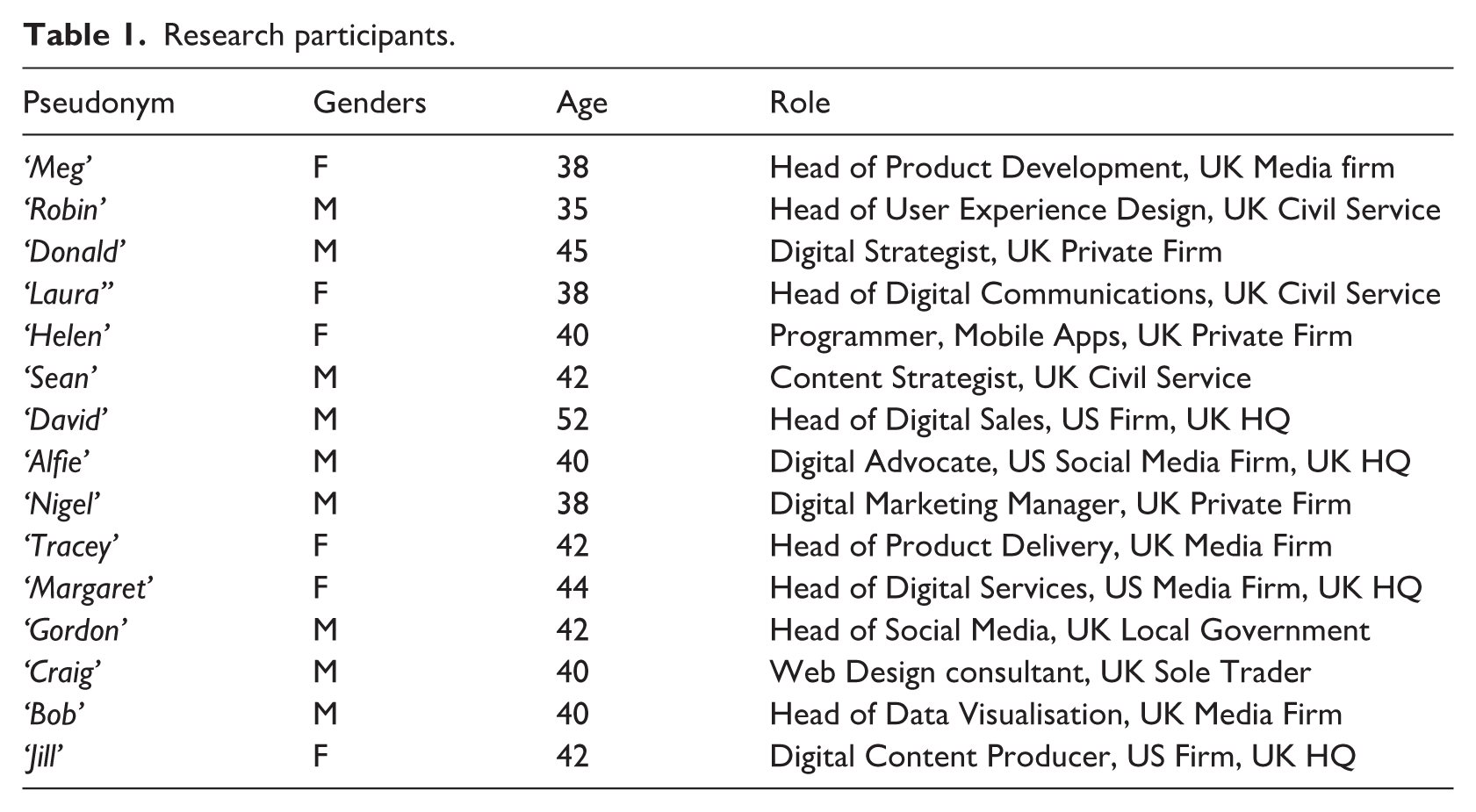
Participants worked across various organisations within the public and private sectors, in varying roles from start-ups to well-known global technology firms and were employed in both permanent and contract work (see Table 1). All participants were over the age of 35 at the point of interview reflecting older worker status in the technology sector (CompTIA, 2021). Despite attempts to recruit a wide range of older digital workers, only one participant in his early 50s responded to the research call; however, this does reflect the lack of over 50s within the sector more widely (ONS, 2023). Interviews lasted between 45 and 90 minutes, were digitally recorded, and subsequently transcribed. Participants were invited to talk freely about their experiences of being older and ageing in their respective organisation and the sector more broadly.
Our analysis took place in two stages: first, data familiarisation and review adapting key steps from Braun and Clarke’s (2021) reflexive thematic analysis and, second, undertaking more detailed discourse analysis (Kuhn and Simpson, 2020). Together, these facilitated an exploration of pattern-based discursive strategies with a focus on language usage. This enabled a reflexive discursive undertaking, moving beyond the descriptive and allowing us to examine how participants view themselves and the world in relation to the topic under investigation (Cutcher et al., 2022). This allows us to unpack the nuances of technology-age-related talk and how these might both draw on and contribute to wider discursive resources (Keskinen et al., 2023). As there are many different forms of discursive analysis and wide variation within specific named approaches (Fairhurst and Cooren, 2018), below we explain our analysis in further detail.
In the first stage of analysis, we followed Braun and Clarke’s (2021) process of data set familiarisation before proceeding to code the transcripts focusing on discussions of age and technology across the interviews. Subsequently, each code was reviewed and refined to consolidate understanding and the process of grouping codes and interpreting themes began. The first author undertook this thematic analysis alongside reflexive notes made at the time of the interviews. Initial codes (such as: alternative identities; labels and categories; personality traits; lifestyle; belonging and community; risk; role models; rejection; symbolism; playfulness; youthfulness; maturity) were then organised into three broader themes (age/ageing resistance; age/ageing repositioning and age reimagined or reconstructed). These themes constituted experiences of being older, or how participants view colleagues of different ages, what age identifications are offered, and how age categories and descriptions are rejected or accepted. This was an iterative process involving both authors to revise and refine ideas.
We then moved to stage two involving reviewing each theme with a focus on language in use. This involved considering, for example, how certain expressions and language choices reinforce, resist and reposition age-based categorisations and identifications connected to technology. We noted the discursive strategies involved which ranged from appropriations, contradictions, and connections through language use drawn from wider ideas related to understandings of age and technology. This enabled us to explore identity work in action through specific linguistic devices and tactics used by participants to adopt certain subject positions, where they accept, resist or contest age (Cutcher et al., 2022). This in turn allowed us to focus on how this relates to broader discourses where certain constructions of age and technology are normalised (Riach, 2022). From there, we narrowed the lens to explore how such expressions reinforce or create certain understandings, for example, ‘older workers are more experienced and wiser’ and how these connect to emerging assumptions, for example, ‘a greater need for trust in an increasingly digital world’. As a result of this analytic work, we unpack three overarching discursive strategies in our findings section that follows.
As authors, we are aware of the inevitable issue of drawing ideological presuppositions about the data based on one’s own identities, as digitally engaged older workers in an increasingly digitised world (Burkette, 2022). Furthermore, the first author was cautious of an insider-outsider positioning due to previous experience in the digital technology sector (Brown and Toyoki, 2013). We were also mindful of the potential for demonstrating our own internalised ageism and stereotypes relating to age and technology (Ivan and Cutler, 2021) and were therefore cautious to reflexively interrogate our analysis in discussion between the two authors.
Findings
We analyse three overarching discursive strategies of how age is negotiated by our participants, as they resist age-based categorisations as limiting or even applicable; reposition age by constructing the multi-dimensional digital worker, thus denying age as significant for this occupational group and reimagine the older digital worker as a positive, desirable elder.
Discursive strategy 1: resisting chronological age-based categorisations
Our participants actively resist categorisations linked to aged life stages and/or generations. For example, Alfie (40) describes colleagues of a similar age to himself: I generally cease to ask or notice people’s ages . . . when I turned 40 there were three other gentlemen in this office who also turned 40 this year. And we were all like ‘oh yeah so we are the old boys in the office now’ kind of thing . . . But look it wasn’t an issue. I don’t look at them and think ‘this is a problem’ and I wasn’t really like them, so it wasn’t a problem for me. (Alfie)
By positioning himself as ‘not noticing’ age, Alfie offers an age-agnostic worldview which suggests resistance to age and its relevance at work. Yet by then commenting on colleagues’ ages, Alfie positions himself as a paradoxical subject. First describing himself and colleagues (gentlemen) in stereotypical, but affectionate, terms as the ‘the old boys’, he then quickly exempts himself and resists the idea he is like them. This illustrates how participants struggle with broader social tensions and constraints of being an older worker. Elsewhere in the interview he expanded on his difference from these old boys in terms of their appearance and interests, and through such resistance deflected the problem of ageing even applying to him.
Relatedly, our analysis examined how participants used the term ‘digital native’, debating whether and how they might be placed in this generation: I suppose I consider myself to be, erm, am I a digital native well I maybe I suppose I’m slightly too old to be one but well I guess I still am. I grew up with technology erm I started using computers from a very early age. You know the first computer we had in the house was a Spectrum from the early 80s, so I had a very early introduction to technology. But I’ve always been into tech as soon as we had one (a spectrum). And I suppose for that reason I don’t really fear it as maybe some other people do so maybe I’m slightly older than what one considers to be a digital native . . . It’s my job so I guess I am one. (Meg)
Meg hesitates and hedges while proclaiming herself a digital native, justifying this by describing herself as a technological aficionado from a young age. By foregrounding the aspect that she ‘grew up’ with technology, has ‘always been into’ it and repeating ‘very early’ she resists a digital immigrant identity. Rather, she reclaims the premise of technology influencing her during formative years, albeit invoking older technologies. Meg distances herself from association with an undesired digital immigrant identity, namely, ‘other people’ who fear technology. In doing so, she disrupts the idea of the digital native as generationally fixed, resisting the idea that digital engagement and capability are age-specific.
Other participants also resisted a digital immigrant label by repositioning themselves as digital natives: I wouldn’t use the phrase ‘immigrant’ . . . I think native sort of works (for me) because while it implies born after the 1980s in a way and it’s like having (being) digital by default . . . that is what native implies but ‘immigrant’ . . .. I think that is probably the wrong language to use. (Tracey) I don’t agree with digital immigrant . . .? It doesn’t sit well with me. I get Digital Natives yeah that’s better. I’ll take that. (Sean) There are probably some there who are digital natives but others who just throw themselves into it (learning new skills) like me – regardless of age. We can be more native. (Bob)
For these participants, digital immigrant is rejected as ‘it doesn’t sit well’ with Sean, feels ‘wrong’ to Tracey and the repeated use of ‘like me’ by Bob suggests participants invoke digital native membership. Sean also suggests membership is flexible, stating ‘I’ll take that’. This resists the harsh cut-off or binary nature of nativism and as such it becomes degenerationalised. Bob claims he is ‘throwing’ himself into learning new technologies, allowing him to claim he is ‘more native’. This resists a chrono-normative connection between age and digital proficiency but maintains the desirable digital native identity.
However other participants critiqued broader generational categories: I think the term millennial has become very devalued in probably the last two years . . . It had a meaning for a short period of time, now it’s become very much hipster douchebag . . . we all used it but it’s laughable now. (Alfie)
Alfie explores how generations (here ‘millennial’) might have an expiry date, mocking the ongoing relevance via the slang ‘hipster douchebag’. This places this, and by inference other, generational identity as beyond redemption. Across this discursive strategy, we unpack the various ways in which participants resist chronological age-based categorisations by exposing their limitations in both generic terms but also in ways that relate to individual circumstances and experiences. This paves the way for the subsequent repositioning explored below.
Digital strategy 2: repositioning age: the multi-dimensional digital worker
Here, we explore how participants reposition age by foregrounding non-work activities and character descriptions. When asked whether age is contributes to her work experiences, Meg focuses on non-age attributes of her colleagues: People that I work with . . ., they are all quite different people–but they have some common traits . . . a kind of intellectual curiosity, they are excited by new things and new discoveries . . . I think that is quite common in digital [technology] workplaces where people are really keen to share things. And that is something that is quite important to my peers at work, as we are very much into the tech and constantly sharing stuff. (Meg)
Meg foregrounds desired attributes such as passion, curiosity, innovation, excitement, illustrated through knowledge-sharing and an implied desire for lifelong learning. In turn, Meg constructs her occupation – and herself – via terms such as excitement and curiosity, which are typically associated with younger people but also connected to knowledge worker identity more broadly. She diffuses the identity threat that older people lack these attributes by extending the point that she and her ‘peers’ behave similarly. Meg reinforces this with a definitive claim that digital technology workers are different and implicitly repositions age as secondary to other characteristics. Here, Laura also repositions age as less significant, offering an alternate means of belonging: I don’t even think age is the right category to use it’s more about attitude, I know people of all ages who are like ‘wow this (technology) is fantastic, I can send photos and chat to people like never before’, but you also have certain people, who are just suspicious . . . I don’t think age is the great barrier it’s more attitude. You can be any age (to engage with technology) with the right attitude. (Laura)
Laura repositions age by foregrounding relevant attitude, often reflecting wider discourse about emerging technologies. This repositions age as insignificant in her occupation, thus diffusing the idea of ageing as a threat in the sector.
Meg reflects a similar sentiment, comparing herself to the late BBC DJ John Peel, who was often depicted in the media as youthful. She compares herself through her passion and engagement for digital technology, positioning Peel as a role model: You know an example that will always spring to mind is John Peel. I always think of him because with music, when you are young, and you are really into music you get very passionate and excited about it . . . for most people you lose that as you get older . . . But someone like John Peel he loved discovering new music right to the end . . . I think it is entirely possible that you can get into your seventies and eighties and still get excited by this stuff you know I mean? I still get excited about things particularly technology, I’d really like to be thought of in the same way as John Peel. (Meg)
Here, John Peel symbolises lifelong excitement, curiosity, passion and implied energy, enabling Meg to reposition the negative associations of ageing to achieve agelessness and avoid older age-stigma. Like Laura, shared characteristics (such as curiosity, passion, enthusiasm and energy) are foregrounded so that age is underplayed or even eliminated as a concern. While Meg reflects on a perceived reality where most people ‘lose’ such attributes as they age, through invoking John Peel, she presents an alternative understanding.
An emphasis on outside interests, particularly in technologically related fields such as robotics, is also offered to signify desired traits and connect to pastimes commonly associated with younger people. In some cases, this is made explicit: I have so many interests and hobbies, I’ve recently got into the whole robot scene. I’m even building my own robot. I think for people like me having that is key, never thinking that you cannot be bothered anymore, that it’s just a job. No way. Look, I love messing about with tech at home and I tell people at work about it. (Sean) My son has a robotics group at his school . . . so I’m thinking this is a primary school but that’s the way it’s going so I’m having some of that. So I thought right . . . I did actually buy myself a little robot to build, as you do [laughs] (Tracey)
Expanding on hobbies conveys a sense of age-nonspecific tribalism among participants, reinforced by phrases such as ‘people like me’ or ‘my people’. Participants bolster their work identities by enrolling in relevant hobbies, highlighting that they may need to reach beyond the workplace for identity resources. Moreover, through self-depictions as geeks and nerds, participants further positively identify with labels (and stereotypes) closely affiliated with technology: I’ve always been a bit of a geek. You just need to take a look at my CV (Sean) People think I’m a geek, they say I’m a geek, I have no problem with that . . . I think affectionately, and I am proud to be a geek . . . it’s not an insult (Margaret) My wife uses nerd because like me she is into computers, and she can code and is into comic book art and sci-fi . . . these are my people. I consider that to be a very strong identity . . . I embrace it (Bob) It could be something from a newspaper or . . . like a geeky cartoon you know whatever it is but you think that your peer group will like (Meg)
These categorisations have the advantage of prioritising technological affinity and providing strong group affiliation. Moreover, these seem to offer an opportunity of a somewhat ageless identity and provide a way of repositioning age as less relevant while maintaining a group association.
We suggest that participants use broader identity dimensions and role models to reposition themselves. They foreground non-age identity elements to deflect attention from the possibility of identity threat and risk through obsolescence. Participants also link older worker identity with youth-oriented ideas (such as playfulness and specific pastimes) in ways that position them as atypical. This exceptionalises them and serves to distance them from threats to their relevance and credibility. Symbolism is also used to defend and legitimise their peer group. Age is repositioned as secondary, and other aspects of identity are invoked in ways that demonstrate digital capability in a multitude of ways. This aligns behaviours and attitudes, childhood and recreational selves in ways that usurp age as a dominant identity marker of credibility for digital knowledge workers.
Discursive strategy 3: reimagining the older digital knowledge worker as a positive, desirable elder
Here, we examine how participants present the older digital knowledge worker as valued and desirable. Participants offer themselves as possessing unique skills, experience, wisdom and vantage points specific to being older. By drawing on resources such as knowledge and interests, participants create a position of privilege in a digital world fraught with mistrust, misinformation and bad actors. Age is essentialised with experience and maturity and, therefore, used as a resource where occupational and commercial value in being younger is diminished.
Below, Gordon affords himself the insight, capability, and maturity to anticipate, navigate, and troubleshoot. Furthermore, he positions this as reputationally vital. This shifts the value from the technology and digital skills per se to his maturity and expertise: If I go out and I look at all the jobs that are going and in terms of marketing and I go onto the websites of the agencies it’s hipsters with silly hats talking and they are repeating the same stuff over and over and over again . . . they have all drank the kool aid . . . when you challenge them for example and they try to sell you something you still get a script . . . they are just like trained chimps . . . they are just regurgitating the same stuff over and over. And they are often a lot younger and working for a lot less than other people. It’s a very young crowd. And there will be someone older running it, with the brains and maturity. When I look at [names website] everyone is really, really young. So they don’t necessarily get a lot of the heavier stuff than we do when we’ve been around the block. The reputation management stuff. (Gordon)
Gordon belittles younger workers, describing them as ‘hipsters with silly hats’, constructing them as gullible, lacking autonomy and judgement (they drink ‘the Kool aid’ and are just ‘trained chimps’). By infantilising them, he sets up the need for an older, more experienced worker – like him – to lead them. This equates older subjects with intelligence and wisdom (‘brains and maturity’), allowing Gordon to also construct himself as experienced and wise.
In between the first and second interviews, Nigel experienced redundancy from his search engine optimisation expert role, which was replaced by artificial intelligence: I just think . . . who teaches the AI to be innovative? Who teaches the AI experience? I think this is perhaps an age-related thing but its kids programming these computers now. What experience do they have? (Nigel)
Using rhetorical questions, Nigel constructs younger workers as inexperienced ‘kids’, infantilising them while positioning himself as responsible in an immature world. This implies a broader concern regarding a future constituted with artificial intelligence and perhaps reflects an increased awareness of his own position, given his recent change in circumstances.
Robin also remarks that older digital workers bring quality, not quantity, to their role and organisation: As you get older it’s kind of less about proving yourself, you are more confident in your abilities, . . . when you get older but you are more focussed, you know how to add value, you don’t need to scattergun to add value . . . you don’t need to work 12-hour days as you given them 8 hours of pure gold. (Robin)
Through metaphorical statements such as ‘8 hours of pure gold’ and less focus on having to ‘prove yourself’, Robin positions younger workers as lacking focus and strategy, needing to ‘scattergun to add value’. Moreover, in the extract below, distinguishing himself from inexperienced ‘children’, Robin continues to offer a positive older worker identity by celebrating the grey hairs which symbolise his value: . . .. I’m not . . . I’m not concerned . . . I mean I think if anything . . . I like the grey hairs in my beard, I like the grey hair on my head . . . I think it gives me a little bit more authority . . . going into meetings they know I’m not an inexperienced child and that I have the years of experience to back up what I’m saying. So, I’m not at all worried about me ageing in my career . . . I think it’s going to be a benefit rather than a curse . . . (Robin)
Here, grey hair provides the physical symbolism of superiority and is positivised to signify experience, and in turn, trust in Robin’s work. Moreover, Sean seems keen to present himself as mature so that he is perceived as a thinker: I’m hoping that they now see me as a thinker not a doer, doing strategy, adding value not like the kids doing the coding. (Sean)
Again, we see that Sean infantilises younger colleagues as ‘kids doing the coding’, further dismissing that this activity is as valuable as strategic analysis or ‘thinking’. By implication, there is a separation between younger and older people that the young cannot be perceived as ‘thinkers’. He seeks to position himself as more strategic, less operational, distancing himself from younger colleagues but also desiring – ‘hoping’ – others also see him in this way.
Our analysis further highlights how participants move in and out of identifying as young, old and/or viewing age positively, negatively or neutrally, sometimes even while discussing the same experience or example. While there is a contradictory and paradoxical nature to their identity work, analytically, this indicates a sense of agency (or presentation of themselves as agentic). For example, despite Robin liking his grey hair, at other times appearances seemed to matter (and appearing younger is more acceptable) in relation to conforming to a younger workforce. Here, Alfie simultaneously positivises his age and celebrates his experience but fits in by appearing young: I love what I’m doing. I’m good at what I’m doing, I bring a lot of experience, but I fit in here as I’m relatively young looking. (Alfie)
Older age is also objectified as a resource and contrasted with the limitations of younger workers: they [prospective managers] so need to have a bit of age about them . . . they [younger workers] have poor attention span, poor memory and the result of that in the digital space is their lack of problem solving for anything outside of the delivered digital world and it is that which most strikes me. (Donald)
Here, Donald associates older age with trust and younger age with poor performance through the euphemism ‘having age about them’, which allows a slight hedge and protects him from an allegation of ageism. In contrast to common assumptions about youth and technology, Donald’s account invokes normative assumptions about age and career trajectories and treats outliers with suspicion, as somehow deviant.
In this section, we see how our analysis provides an overview of how older identity is reworked as more valuable than youth while retaining a positive essence conveyed by youthful associations (energy, curiosity, passion) and the foregrounding of other identity markers such as experience, appearance and interests, aspects of self often underplayed in work contexts.
Discussion
Since much research defines older workers as over 50, there is very little empirical investigation of workers in sectors such as digital technology who become regarded as older at a much younger chronological age (Brown and Coupland, 2015; Svensson, 2023). Attending to this significant context of contemporary knowledge work, our research explicates the discursive strategies deployed as participants resist, repurpose, and reimagine aged identities. Consequently, we offer two conceptual contributions. First, we examine how age is constructed within the identity work of older digital knowledge workers, highlighting the implications for age categorisations and explicating socio-technological understandings of age. Second, we detail how an ageing identity can be constructed as an asset in the face of an emerging identity threat. After setting these out below, we conclude with the implications for studying ageing in this occupational field and beyond.
Age in identity work in older digital sector knowledge workers
Our work responds to calls for attention to interactional complexity in considerations of identity work (Brown, 2022). We highlight how age categorisations are themselves complex and propose the additional complexity of socio-technological constructions to extend understandings of older knowledge workers (Brown and Coupland, 2015; Cutcher et al., 2022; Riach, 2022). We suggest such insights are significant not only for our specific research context but, because of the magnitude of both age(ing) and digital technology, resonate across many contemporary workplaces.
Age as an identity dimension has often been considered as anchored to chronology or cohort (Riach, 2022). While there is significant debate about the meaningfulness of generational and other categories (including the typical chronological designation of older workers), that these exert significant influence is well documented (Reed and Thomas, 2021). Recent explorations (Cutcher et al., 2022) suggest the potential for complex identity projects by older workers in roles typically associated with younger age groups. This highlights how age intersects with other dimensions to produce identities that are ‘open-ended, fluid and fuzzy’ (Spedale, 2019: 49). Our research offers important empirical and conceptual extension of this work by examining identity processes in the contemporary context of digital technology knowledge work. Here, rapid technological development increases the threat of obsolescence, a threat that is compounded as both cohort and chronological stereotypes coalesce. Given this, we offer an extension of Ibarra and Obodaru’s (2016) suggestion of identity agency in response to identity threat in contexts such as the digital technology sector, where strong social stereotypes are embedded.
While at times generations are outright rejected, we evidence how generational cohort identities are also flexed and supplemented, loosening any perceived attachment to specific birth years. While this reflects wider use of generational discourse (Reed and Thomas, 2021) our research extends critique by providing empirical evidence of specific processes of this re-generationalisation in the workplace. As such, we demonstrate how positive attributes (particularly associated with skill and attitude) are asserted so that ‘native sort of works’. These are supplemented by other characteristics that our participants could more easily lay claim to. Thus, we see the discursive expansion of ‘digital nativism’ away from its generational cohort origin; redefining this as reliant on growing up involved in technology (rather than raised during a digital era) and as being enthusiastic about technology at any age (Mariano et al., 2022). Importantly, while generational and aged assumptions might pose a threat, they also provide discursive resources for these participants, albeit ones which require careful work, evidenced in the way that they resist, repurpose, and reimagine age. Here we develop Cutcher et al’s (2022) work by including attention to cohort as well as chronological age and offering an examination within the context of digital knowledge work. Moreover, our work offers a deeper, situated explication of identity threat responses, adding important contextual detail to the general reactions identified to date (Bolander et al., 2024; Caza et al., 2018). In response to the threat of technological insufficiency (Rosales and Svensson, 2021) we see how our participants capitalise on occupational knowledge in the context of technological risk; as explored further in the next section. Nevertheless, in pursuing a position of exception, we highlight how this reinforces generic stereotypes of both older and younger workers (Cutcher et al., 2022).
Thus, our analysis explicates how generations function as both identity threat
Building on our point above, our research further highlights the significance of technology as a means through which ageing becomes understood by digital knowledge workers (Scarbrough et al., 2025). Our research both provides empirical evidence and allows further conceptual clarity as to the ways in which technology is aged. This aged connection between digital technologies, and our participants is evident in their identity work, whether this is through a working up of a technological chronology (starting with a Spectrum computer, for example) or by invoking young technologies such as robotics. Thus, in building on Cutcher et al. (2022) emphasis on dynamics between different age groups, we suggest that these dynamics extend to the material. Therefore, we propose that within digital knowledge work, ageing is not solely understood as a biological or human process, rather a complex socio-technological perspective of age and ageing is established. Since technology is the significant material component for this occupational group, technology becomes embedded within their identity work, and they recursively construct a socio-technological understanding of ageing (Prester et al., 2023). We suggest that this allows human characteristics to be applied to technology and vice versa so that the ageing digital knowledge worker might be embedded in the digital world (Scarbrough et al., 2025). We therefore propose that this reinforces chronological primacy as the means of understanding both technology and individuals in the workplace. This is further significant since digital technologies are rapidly evolving, knowledge work is continually reinvented and the challenge of aligning with newer digital technologies may become more problematic. While this has been observed in relation to knowledge workers identity more broadly (Avnoon, 2021; Goretzki et al., 2023; Young et al., 2023), we offer additional nuance by connecting these concerns to discussions of age.
The ageing identity constructed as asset
Much research on older worker identity focuses on experiences of marginalisation, incongruence and career obsolescence (Brown and Coupland, 2015). While recent research has investigated how older workers attempt to disrupt stereotypes (Cutcher et al., 2022), understandings of the digitally capable occupational subject continue to be seen as incompatible with being older, particularly for those working in the technology sector (Keskinen et al., 2023; Rosales and Svensson, 2021).
Our analysis illustrates how participants construct a desired version of the self (Brown, 2022) positioning themselves as essential digital elders. We suggest that the notion of technological risk provides a discursive resource that is less attached to a particular technology and allows experience to be reasserted despite the wider context of rapid technological change (Vaast and Pinsonneault, 2021). This positioning is complex since it balances a youthful association with the digital but also enrols understandings of experience and wisdom that are embedded in being an elder. Through this balancing act participants are thus able to retain occupational and organisational relevance, repositioning themselves from victims under threat (of career jeopardy) to organisational guardians against other threats posed by the very technology they have been negatively associated with (Anthony, 2021). We suggest that this is particularly significant in the context of digital knowledge work where constant change and evolution is seen as the norm (Avnoon, 2021). Thus, the ability to craft relevance across changing technological regimes seems particularly valuable. This highlights a further significance of the socio-technological understandings of age that emerge through our research given the wider (and ever expanding) discourse of technological risk (Scarbrough et al., 2025). However, our research also offers an important qualitative understanding of elder identity work, in an area that has currently been dominated by lay assumptions, generic career advice or alternatively detailed quantitative measurement concerns (Conley, 2018; North, 2019). Thus, our research offers insight into how both organisational and occupational viability can be negotiated at work by the older subject (Cutcher et al., 2022) and how, despite socially established views to the contrary, understandings of technology can be deployed to reframe the value of ageing. Analytically, we extend previous interest in older workers as a source of organisational value which has been broadly proposed (Conley, 2018; North, 2019) but rarely subject to in-depth qualitative research in an age-contested occupational domain.
From this research, we highlight the potential to challenge older identities as necessarily starting from a position of marginalisation and inequality (Berger, 2021) and explain the potential to leverage socio-technological discourses for their own ends, here about technological risk requiring our participants’ extensive experience. Thus, we extend the theoretical scope of age explorations highlighting the importance of disrupting deep-rooted assumptions of the ageing subject (Reed and Thomas, 2021) and positive-negative, older-younger ‘binary dualisms’ (Spedale, 2019:38). Through deploying such discursive strategies in their identity work, our participants reposition themselves as simultaneously younger (with respect to their digital affinity) and older (with respect to their experience and ability to manage digital risk) while also managing to reject unwanted associations with each of these positions – kids doing coding and older people who fear technology. We suggest this is theoretically significant as it contests the idea of the essentialised older worker as resolute to their fate and instead leans into a sense of greater disruption of delimitations of age (Cutcher et al., 2022). In short, negative identifications of ageing in contemporary organisational contexts are not inevitable. As highlighted earlier, we suggest that the flexibility of generational discourses provides further resources for our participants who can selectively enrol the digital native and reject digital immigrant identities (Reed and Thomas, 2021). Yet through working up and balancing their position, we see glimpses of how identity projects can be manipulated to denigrate others in a bid to elevate their own status. This extends the view that older workers can be simultaneously perceived as the victims and perpetuators of inequality, highlighting how knowledge workers’ identity often relies on positioning others as less expert (Avnoon, 2021; Benson and Brown, 2007). However, here our participants work to diminish both other older (who are not digitally literate) and younger (who are not experienced) workers. Our research thus draws attention to the nuance of age discourses, and the ways in which chronological and cohort positionings might combine in unexpected ways.
As outlined earlier, this study led us to question our own underlying assumptions as older employees engaged with certain types of technology, our own preconceptions and self-stereotyping (Mariano et al., 2022; Ng and Indran, 2022) and how this potentially leads to assumptions of age-related technological connections on our part. As academics, this prompts us to reflect on the impact of age-technology categories that might be afforded to us within a world of increasing artificial intelligence, noting our role and responsibility as future knowledge producers.
Conclusion
This study offers insights into the experiences of older digital knowledge workers’ attempts to address complex identity threats. Through an analysis of discursive strategies, we contribute to the existing literature by explicating how age is constructed for older digital knowledge workers. We explicate the complexity of oft-assumed static age categorisations and highlight the importance of socio-technological understandings. Moreover, we go beyond generic assertions about the potential value of age in the workplace providing a situated consideration of how, in the context of technological risk, the asset of age can be established.
Empirically, this study extends the small pool of research on age tensions within the digital technology sector (Rosales and Svensson, 2021). While we recognise that these workers may in many respects be seen as privileged, we hope this study may deepen the conversation on how organisations review preconceived stereotypes of not just older workers more broadly but the co-constitution of age and technology (Peine and Neven, 2020). This is particularly relevant considering the urgent call to understand our interactions with AI and their evolving impact on discourse (Scarbrough et al., 2025). We recognise that this poses significant challenges for practitioners; however, we suggest that it is critical to recognise that competition-based age narratives (whether cohort or chronological) are potentially impeding how organisations capitalise on this technological change. Despite our focus here on older workers, these age-technology associations highlight the challenging context that workers of all ages and disciplines must navigate.
We are conscious that this study is limited to a particular occupational sector and to our participants’ specific roles. Therefore, experiences of other occupational groups within the rapidly evolving digital technology sector may differ (Goretzki et al., 2023). While research on gender in this context is gaining momentum (Young et al., 2023), further examinations of intersections of age, gender and other demographic differences are now required. We further suggest that research that considers the implications of digital knowledge workers contractual context warrants urgent attention (Aroles et al., 2024). We are also mindful that this study is situated geographically and temporally, the latter particularly pertinent in relation to ever-evolving age-technology discourse. Longitudinal research which tracks ageing experiences across this time of technological revolution would be a particularly worthwhile extension. Moreover, additional consideration of whether our findings resonate with experience of ageing in other high-performance or innovation-driven industries would expand our understanding. We therefore invite others to push the boundaries of understandings of age and interrogate experiences of being both younger and older in contemporary digital workplaces (Caza et al., 2018; Scarbrough et al., 2025).
There is an emerging interest in new forms of digital knowledge work and how these are connected to different ways of working (Aroles et al., 2024; Scarbrough et al., 2025). Our work demonstrates the importance of connecting this line of investigation to discussions of age in the workplace. Finally, as digital natives within the sector are now in their 40s and edging towards classification as older workers in the wider sense, we suggest there is further value in exploring how they experience and negotiate ageing (Stypińska et al., 2023). Similar considerations of other ‘younger’ occupations and workers would thus be a useful extension of this work.
Footnotes

Ethical considerations
The authors confirm that institutional ethical approval was received for this research and all participants provided informed consent.
Funding
The authors received no financial support for the research, authorship and/or publication of this article.
Declaration of conflicting interests
The authors declared no potential conflicts of interest with respect to the research, authorship and/or publication of this article.