




Abstract
The article advances critical perspectives of leadership and leadership learning through a feminist study exploring experiences of leadership work-caused trauma. The study explores why trauma appears for those in leadership and how this is experienced. It illustrates the harm done to those in leadership. Ten women’s experiences are explored through the following four themes: (a) Malicious, Avoidable, Morally Indefensible; (b) Suffering: Completely Shocked, Deeply Distressed, Frightened; (c) Loss; and (d) Feeling Obliterated and Fearing Eradication. The study demonstrates organizational leadership as a dangerous “enough” context for trauma research. Analysis highlights how actions associated with leadership cause psychological and emotional damage and how those in leadership suffer trauma, severely injured and diminished. The article conceptualizes leadership work-caused trauma and theorizes women leaders’ experiences as professional annihilation, where they are fundamentally destroyed. This new knowledge prompts relational dialogic reflexivity, provides opportunities for leadership learning and development, and contributes new avenues for future research.
Keywords
‘It’s like a, a, big, big hammer, which, you know, knocks you out of shape, and, and you cannot restore yourself. You can put yourself back into shape, but somehow, it’s not quite where it was before. It absolutely hits you like a big hammer’.
Introduction
The article advances critical perspectives of leadership and leadership learning through a study exploring experiences of leadership work-caused trauma. Rather than focusing on the harm that leaders do, this study uncovers previously hidden traumatic leadership experiences and theorizes the harm done to those in leadership, highlighting disturbing psychological and emotional consequences of leadership work. Through qualitative research with 10 women, the study explores why trauma appears for those in leadership and how this is experienced. It disrupts normative leadership learning based on ‘largely white, male, cisgender, heterosexual, able-bodied and neurotypical’ men (Knights et al., 2024: 2), addresses a disconnect between leadership theory and practice (Hibbert and Cunliffe, 2015) and aims to provoke reflexive dialogic learning (Corlett, 2013; Cunliffe, 2002).
Trauma studies are rare in management and leadership (Miralles et al., 2022). Understood here as psychological and emotional (not physical) injuries with associated hurt and pain, trauma results from a highly upsetting, extreme and unexpected (incidents de Klerk, 2007; Stein, 2016). Studies in Management Learning have conceptualized psychological trauma as ‘shock’ when managers return to formal learning (Griffiths et al., 2005) and explored executive coaching with those who experience the trauma of unemployment (Gray et al., 2015). Individual trauma, resulting from a person’s work has been a focus in Management and Organization Studies, concerned with dangerous extreme contexts (e.g. Hallgren et al., 2018), and workplace bullying in organizations (e.g. Lutgen-Sandvik, 2008). However, experiences of leadership work-caused trauma (which may or may not lead to job loss) have not received research attention and are silent in leadership learning.
Leadership in those organizations which do not engage with vulnerable populations or in extreme contexts has not been considered dangerous “enough” for trauma research. Generally, leaders in organizations are not seen as exposed to risk of personal harm and trauma. Research proposes the opposite, that leaders cause psychological trauma, through toxic leadership (e.g. Smith and Fredricks-Lowman, 2020). When organizations experience trauma, leaders are expected to lead compassionately through it (Dutton et al., 2002), as “toxic handlers”, acting as shock absorbers for workplace emotion (Frost and Robinson, 1999). Leader rationality is often a given; they are ‘expected to control their own emotions and keep the emotions of others in check’ (Fein and Isaacson, 2009: 1329). Leaders’ painful experiences are mostly presented as heroic accounts, where they overcome hardship through inner strength, resolve and resilience (Cullen, 2022). There is growing interest into learning from leaders’ emotions and when moving on from trauma (e.g. Hibbert et al., 2022) but no studies of leadership work-caused trauma.
Embodied and emotional accounts are limited in leadership theory and learning, not only because normative studies are based on heroic men (Collinson and Tourish, 2015), but also because of the stigma attached and the taboo associated with those in leadership who leave “under a cloud” or “disappear” from organizations. While critical leadership learning (e.g. Reynolds and Vince, 2020) draws attention to the emotional messiness of socially constructed, situated leadership, this lacks empirical illustration of trauma in leadership. Trauma is ‘much more than a pathology, or the simple illness of a wounded psyche: it is always the story of a wound that cries out, that attempts to tell of a reality or truth that is not otherwise available’ (Caruth, 1996: 5). If traumatic experiences of those in leadership are silenced and kept hidden, then we cannot understand or learn from them.
The study offers opportunities for socially constructed, relational (Cunliffe and Eriksen, 2011) and experiential (Stead and Elliott, 2019) leadership learning through ‘reflexive dialogical practice’ (Cunliffe, 2002) in how women’s accounts of leadership and author interpretations together ‘question and surface taken-for-granted aspects of everyday [leadership] experience’ (Corlett, 2013: 454). It aims to prompt ‘moral reflexive practice, questioning who we are in the world and how we can act in responsible and ethical ways’ (Cunliffe, 2008: 180). Here experience is a resource for learning (Stead, 2013), where leadership practice and leadership learning connect sense-making, knowledge and action (Kempster and Stewart, 2010).
Feminism, understood as ‘a theory and approach . . . that specifically values and advocates for the equal opportunities of women’ (Fotaki and Pullen, 2024: 594), provides ‘opportunities for distinctive practices of knowledge production’ (Bell et al., 2024: 4). The research focuses on women’s accounts of why and how trauma appears in leadership, expanding the ‘narrow recognition of women’s experiences as equally important’ in developing knowledge (Mavin and Yusupova, 2021: 95) and providing a feminist perspective to leadership learning. It is a decade since Management Learning considered learning from women’s experiences of leadership (Stead, 2013) and 20 years since the journal first considered women learning to become managers (Bryans and Mavin, 2003). Significantly, women are more likely to face career trauma (Hernandez et al., 2021; Ryan et al., 2016). Women CEOs are more likely to be replaced than white men and to ‘be forced out of office than men’ (Ryan et al., 2016: 453). Leader failure (loss of role) increased during the COVID-19 pandemic, beyond the pre-pandemic estimated 50% of appointments, and this derailment increased mostly for women (Hernandez et al., 2021). However, there is silence around how women experience derailment, including in existing trauma studies for example, women executives were underrepresented in Gray et al.’s (2015) study of unemployment trauma.
Exploring traumatic experiences in leadership is tender territory; talking about a taboo, sensitive subject which participants rarely, if ever, articulate. This is disruptive and disconcerting research. Even the mention of trauma can move our bodies into defence mode. Viewing leadership experience as a setting for socially constructed and situated learning, the study surfaces shocking damage to those in leadership and outlines psychological and emotional injuries challenging to digest. There are three key contributions. First, the study advances critical leadership studies (e.g. Knights et al., 2024) by conceptualizing leadership work-caused trauma, demonstrating how leadership is a site for disturbing psychological trauma and theorizing the women’s experiences of trauma as professional annihilation. Second, it contributes new knowledge of trauma present in leadership relations which questions truth claims, illustrates reverse power dynamics where those in leadership are powerless and subject to oppression, and details distressing consequences of leadership. Third, the women’s accounts provide a resource for leadership learning in exposing learners to psychological and emotional destruction in leadership. This advances critical leadership learning (e.g. Reynolds and Vince, 2020) and has potential to prompt reflexive dialogic learning (Corlett, 2013; Cunliffe, 2002), in ‘creating new readings of experience, challenging assumptions, critically questioning our practice’ (Cunliffe, 2002: 37) and prompting us to reconsider ‘our ways of being, talking and acting’ (p. 36) with possibilities for change.
Those in leadership
Those in leadership in organizations outside extreme contexts and vulnerable populations are not generally understood as being at risk of harm and psychological trauma. Organizations are understood to experience trauma (e.g. Gabriel, 2012) and leaders’ dysfunctional personalities can develop toxic organizations (Cruz, 2014). While leadership is understood as relational and ‘occurring in embedded experience and relationships’ (Cunliffe and Eriksen, 2011: 1429), research has focused on: leader narcissism; neurotic and defensive psyches; disturbed, repressive, erratic, and dysfunctional leaders; brutal, toxic, and abusive leaders; and the harm that leaders do. Normative research which considers leaders’ personal traumas presents them as recalling testing, traumatic experiences as ‘“crucibles of leadership” (Bennis, 2002) where “leaders survive . . . with learning, wisdom, and enthusiasm”’ (Stein, 2016: 932).
Women leaders are understood to remain out of place and abject in organizations (Mavin and Grandy, 2016a), to face persistent gendered challenges in progressing to senior roles (Stead and Elliott, 2019), and ‘struggle to be evaluated as credible and respectable as leaders and as women’ (Mavin and Grandy, 2016b: 380). Women in organizational leadership remain a minority in the West, with a recent global survey finding their success under attack in organizations around the world, as ‘successful women are bullied and belittled and challenged on their successes’ (Billan, 2023: 3). Glass cliff research demonstrates how women leaders are more likely than men to face career trauma (Ryan et al., 2016). They are more likely to be appointed to senior roles under poor organizational performance, be disproportionately represented in risky and precarious positions, be replaced and removed from their positions (Ryan et al., 2016), and fail, facing blame and humiliation (Ryan and Haslam, 2005). These career traumas are used to confirm their inappropriateness for senior leadership (Ryan et al., 2016). However, women’s experiences of these leadership traumas have yet to be explored.
Trauma and annihilation
Psychological trauma from organizational leadership is under researched and lacks conceptualization, therefore, crucial elements of its characteristics are considered (see Radstone, 2007, for detailed discussion of trauma theory). Trauma can appear as shock to an unanticipated frightening situation which has overwhelming impact (Hurvich, 2003); it ‘rips apart assumptions and robs the person of meaning and control’ (Nguyen, 2011: 31). The emotional power of trauma overwhelms people, for example, betrayal of trust, various forms of harassment and abuse of power (de Klerk, 2007), inflicting damage on the psyche where, at least temporarily, individual capacity is overwhelmed (Briere and Scott, 2014) and usual coping abilities no longer work. Work-caused psychological traumas challenge individuals’ beliefs about their work, work identity, relationships to their organizations and their careers (Maitlis, 2020). The focus here is how women in leadership experience trauma from ‘devastating and shattering experiences that result in internal disruption (A. Freud, 1967)’ (Hurvich, 2004: 53), as an existential blow (Nguyen, 2011).
Interpersonal trauma is important to leadership learning as it brutally disrupts the implicit relational connections which underpin our everyday sense of identity (Crossley, 2000). Relationally provoked trauma can ‘disrupt and impair personal, internal schemas about safety, trust, power and intimacy (Resick et al., 2014), interfere with the construction and maintenance of a coherent self-identity and develop generalized negative schemas about social relations and sense of self’ (Kouvelis and Kangas, 2021: 118). The centrality of an interpersonal traumatic event to one’s identity (e.g. leadership) is significantly linked to symptoms of complex posttraumatic stress disorder (PTSD) due to formation of ‘a fear network in opposition with the person’s preexisting memory structures’ (Kouvelis and Kangas, 2021: 145). This can impact on the ability to cope with day-to-day life; cognitive processing for example, memory, attention, and thinking; interpersonal relationships requiring trust in others (Sweeney et al., 2018: 319); and make it challenging to associate with others who hold similar social roles. Trauma at work can result in loss of attachment, relationships, job, career, and professional identity as ‘overlapping personal and professional losses’, reflecting ‘layers of loss that go deeper and are more prolonged’ (Greenberg and Hibbert, 2020: 124).
Trauma ‘tears the integrity of the psychophysiological or psychosocial system, where that system cannot be psychically restored’ (Reisner, 2003: 395). It ‘breaks in upon a person: at the limits of their analytic capacities, at the limits of their endurance, at the limits of their moral insight’ (Reisner, 2003: 396–397), producing ‘a sense of intractable ethical paradox’ (pp.396–397) which radically challenges comprehensible life. Effects of trauma are cumulative: the more traumatic experiences a person is exposed to, the greater the impact on mental and physical health, and people can be retraumatized by ‘the use of “power-over” relationships that replicate power and powerlessness’ (Sweeney et al., 2018: 322). In experiencing trauma, people feel emotional shock, panic, pain, stunned, helpless, that nothing is real, confusion, high anxiety, ‘terror, hypervigilance, constant arousal, psychosis, numbing and dissociation which cause exhaustion and wear people down’ (Sweeney et al., 2018: 321). Responses to trauma include fight (combative, overly defensive), flight (abruptly removing oneself from the situation), freeze (shut down, unable to make decisions), fawn (overly sensitive to pleasing, overly agreeable) and faint or flop (total disorientation, disengagement, loss of control, lack of emotions and even total bodily collapse; Paredes, 2022). Following a traumatic event, people can experience PTSD where ‘repetitive displays of fragments of the event elicit hyperarousal and dissociation’ (Schauer and Elbert, 2010: 109), for example, triggering, panic attacks, nightmares and flashbacks.
Dissociative trauma responses reflect fractured mental systems (Schauer and Elbert, 2010), where people suffer lack of control and lose information recall. They lose certain memories and experience depersonalization, reflective of ‘an altered state of consciousness characterized by alienation of oneself or the external world’ (Schauer and Elbert, 2010: 113). Dissociative responses to fear can deny a premorbid level of functioning, involving a disintegration of the self; a ‘dead like state’ (Schauer and Elbert, 2010). From a psychoanalytical perspective, a significant emotion associated with psychological trauma is annihilation anxiety (Hopper, 2003), reflecting senses of destruction, obliteration, eradication of the self. Trauma can trigger ‘moral terror, an extreme psychic danger reflected in feelings of annihilation anxiety’ (Hurvich, 2004: 51). ‘It’s danger is a threat to one’s survival’ (Hurvich, 2003: 581) – the ‘terror of extinction’ (Hurvich, 2004: 52), which manifests as concerns over one’s preservation and ability to function safely. Annihilation anxiety surfaces as feeling ‘destroyed, overwhelmed and unable to cope, disorganization of the sense of self, loss of needed support, vulnerability, anger, and expectations of additional catastrophes’ (Hurvich, 2004: 52).
Trauma-induced annihilation anxiety can also provoke the ‘death imprint’ (Lifton, 1967) as extreme, unwanted, invasions of ‘images of threat to or end to life’ (Hurvich, 2004: 167) with heightened fear of ‘imminent destruction – mortal terror’ (Hurvich, 2004: 57). This subverts the individual’s whole way of making sense of their world (Atwood et al., 2002). In being human, we exist in relation to others, and our relations can be sustained or annihilated by others as ‘epic destruction – a one-time event that obliterates totally’ in a ‘particular kind of social murder, where one’s self-hood and social standing are lost’ (Klassen, 2016: 61). Trauma can therefore be experienced as a sudden, potentially deadly like experience where our social norms are damaged, we lose agency and connecting with others is challenging (Hibbert et al., 2022). Such trauma has violent impact, is disabling (Cruz, 2014), subjective and leaves lasting troubling memories. It can be experienced as loss and grief, including the loss of belief in safety or permanence and, despite trying to mitigate, ‘loss cannot be cured’ (Reisner, 2003: 410).
Traumatic derailment can happen for those in leadership and, as research demonstrates, career trauma is more likely to happen to women in organizations. However, the taboo of talking about those who leave “under a cloud” or “disappear” from organizations, and the shame attached to derailed individuals, means their experiences are silent in leadership research and learning, leaving a knowledge-practice gap. As the concept has been reserved for highly unusual and extreme situations, we know little about trauma in organizational leadership; why trauma appears for those in leadership and how this is experienced. This study explores women’s experiences of leadership work-caused trauma to surface new understandings and provoke reflexive dialogic learning (Corlett, 2013; Cunliffe, 2002), critically questioning our practice and creating new understandings from experience.
Research approach
Understanding meaning and social realities as subjectively created with relational others (e.g. Cunliffe, 2008), I take a social constructionism and feminist approach to the research. I prioritize women’s subjective experiences and voices, often silenced and suppressed, and recognize the personal as political (Griffin, 1995). My researcher positionality and theoretical background is inseparable from interpretations and findings (Benschop, 2021) and I ‘aim to produce the least distorted version of the truth’ (Harris and Ashcraft, 2023: 13) by declaring how my subject position shapes interpretation (Harding, 1991). I am a white, cisgender woman with experiences of senior leadership. I am sometimes privileged and have multiple vulnerabilities. I view organizations as relational, gendered and imbibed with gendered power and recognize ‘that to study power is to make power’ (Harris and Ashcraft, 2023: 8). After Bell et al. (2019: 5), taking a feminist approach ‘offers a unique and distinctive way of understanding social life’ by ‘seeing through what is already crazy about the world, notably the cruelty and injustice with which it tends to go about organizing itself’ (Rose, 2014: x).
Reaching the women
Researching traumatic experiences in leadership is highly sensitive; people rarely talk to others about such deeply painful and shameful situations. The population is invisible and hard to access. However, five women leaders from personal and professional networks spoke with me individually and intimately, about feeling traumatized by horrendous and sometimes unthinkable experiences at work and some asked if I could recommend research to help make sense of what had happened. Beyond ‘Tall Poppy’ and ‘glass cliff’ studies, demonstrating that women in leadership are chopped down and experience career trauma, there was little in the management and leadership literature to help their sense-making. These initial relational discussions motivated the study and the research question; why does trauma appear for those in leadership and how is this experienced? Over a period of 3 years, eight women from these networks took part in the research and when hearing about the study, another woman made contact. I also reached out to a further woman, having read about her experiences in the media.
Those who experience work-caused trauma are subject to processes of silencing, where there is significant fear of the consequences of speaking up (Pérezts and Mandalaki, 2023), having been treated in ways that provoke contradictory feelings of shame and injustice. Speaking out requires significant courage to remove the shroud of secrecy serving as self-protection. Ironically, this secrecy also protects the organization and organizational others from exposure and, along with silencing legal agreements, ensures we do not hear about or learn from traumatic leadership experiences. Therefore, the study required an ethical framework which assures anonymity, and respects participants. I approach this functionally: the women’s organizations and the five sectors are not named. Role titles are replaced with common business equivalents and identifying information has been removed. One woman leader was a founder of organizations. Others were organizational leaders at senior hierarchical levels appointed by those at C-suite level and all worked full time. The women chose their own pseudonyms; four identified both a first and second name.
Methods
The qualitative study took place between 2021 and 2023 involving a four-stage approach: (a) pre-interview briefings, (b) pre-interview journaling, (c) semi-structured interviews on an online platform and (d) follow-ups. To build trust in social relations, there was significant investment in numerous pre-interview briefings where we discussed the ‘pros and cons’ of the study. Trauma was not defined by the researcher during the research. The inclusion of pre-interview journaling was informed by how writing can support sense-making in organizing painful thoughts (Siegel-Acevedo, 2021), where people retain agency as they decide whether to share or talk about the writing. A briefing note for the journaling process was provided with a set of prompt questions (see Table 1).
Prompt questions for journaling and interview.

Five women engaged in pre-interview journaling then attended interview. Five chose interview only. The interview was designed as a place to make sense of what happened, memories, thoughts, feelings and responses (de Klerk, 2007). I asked women to revisit memories, to process messy situated experiences and form co-constructed narrative accounts. If they had completed journaling, I read this several times to identify up to four follow-up questions to contextualize the interview. Having been fully briefed, those who went straight to interview were asked, ‘what do you want to expand upon?’ and, where appropriate, asked questions from the journaling prompt questions with follow-up probes. The online interviews, which lasted between 46 minutes and 1 hour 39 minutes, were recorded and transcribed.
Analysis
The individual journaling and/or interview transcript and any follow-up data were analysed through initial and focused coding (Charmaz, 2000) to identify specifics of what had happened (see Table 2). Next, prompted by the data, I focused on interpreting the ways the women talked about their experiences as trauma and completed a comparative analysis (Glaser and Strauss, 1967). The accounts conveyed striking patterns of injury, hurt and pain, and psychological and emotional responses to what they described as traumatic situations. This influenced my choice of trauma as the theoretical frame and by to-ing and fro-ing between data and literature, four themes were identified which illustrate the patterns across the women’s experiences: (1) Malicious, Avoidable, Morally Indefensible; (2) Suffering: Completely Shocked, Deeply Distressed, Frightened; (3) Loss; and (4) Feeling Obliterated and Fearing Eradication. I was struck by how the women’s accounts articulated feelings of powerless, being without voice, a sense of no longer existing and stark references to death. This led me to the annihilation literature which I use to theorize the women’s experiences in the discussion.
Women in leadership participants.
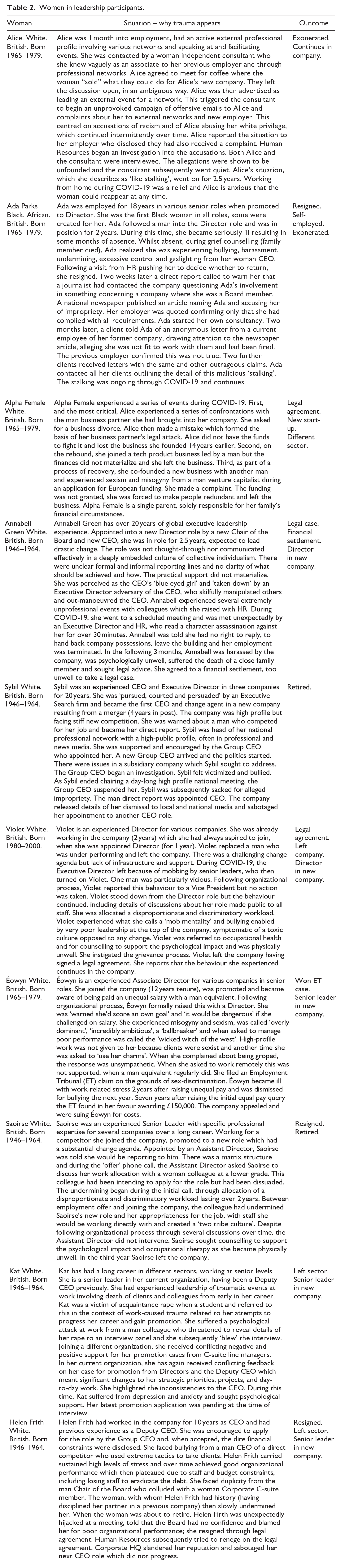
I chose particularly vivid and visceral accounts to best illustrate the themes and experiences across data, while including a breadth of participants. I am acutely aware of ‘remaining respectful to those who allow us into the intimacy – the suffering and pain . . . of their worlds’ (Vijay, 2021: 56) and in researching suffering I have power in ‘setting the rules of the game’ (p.55) and presenting accounts to be read as trauma (Radstone, 2007). My interpretations are co-constructions of the fluidity of subjective experiences in relation to others within complex contexts (Cunliffe and Eriksen, 2011) and my aim is to provoke reflexivity, challenge assumptions, provoke new understandings, and therefore, impact leadership learning. I recognize that these interpretations are ‘open to multiple, contestable, divergent or contradictory readings’ (Radstone, 2007: 24) and to reflect the ethical feminist framework and for resonance, two women participants read the paper (one read three versions) and responded positively.
Experiences of leadership work-caused trauma
I begin by introducing the women participants and summarize their situations, explaining why trauma appears for them (at Table 2). I then present my authoring of the women’s experiences of leadership work-caused trauma under the four themes.
Malicious, avoidable, morally indefensible
This theme encapsulates how the women articulate the actions towards them as a result of their leadership as malicious, avoidable, and morally indefensible, and provides context to their feelings of intense vulnerability and exposure to personal harm in organizational leadership. The women talk about their situations at work as ‘unbelievably traumatic. Absolutely traumatic’ (Helen Frith). Sybil journals her experience as ‘traumatic, unfair, malicious’. Violet journals her situation as ‘trauma, traumatic, avoidable’ and at interview explains,
It had a really significant impact. I always give 100% and then, when something happens when your work is such a massive part of your life . . . when you put your heart and soul into something and then something bad happens. It was bad that it happened, but then the fact that nothing was done about it afterwards I think that was probably, that was more traumatic. It happening was horrible and awful. When you go through the appropriate channels, it’s almost worst to be told that you will be supported and things will happen, and then, when they don’t, it just magnifies everything again. For me it’s about when things are unfair, I find that really difficult, when things happen that you know aren’t right and that actually are indefensible.
Violet’s account highlights her lack of agency and moral outrage (‘unfair’, ‘aren’t right’), huge personal investment in her leadership work, and the breakdown of trust in being let down by others, which she finds ‘worse’ (retraumatizing) and ‘indefensible’. Alpha Female, who lost her own company to her man business partner, wrote in a post-interview follow-up response:
Without a shadow of a doubt, I was royally ‘shafted’ and, by that, I mean that I was treated harshly and unfairly . . . For me it is more about the ‘injustice’.
Across accounts, women leaders associate injustice with their situation which is a deeply dehumanizing process (Bell and Khoury, 2011). The women convey feelings of being treated unfairly with prejudice, in ways perceived to be unwarrantable and morally wrong. Saoirse, who went straight to interview, explains her experience as
Completely miserable. Traumatizing. I was the kind of sacrifice in the middle of that. I don’t use the word sacrifice lightly. I think when you talk about trauma, it’s very important to identify the kind of language, and I think trauma is a very charged word, and I just used ‘sacrifice’. It has a similar challenge to it and I’m quite deliberate about that. Because I was like a sacrifice to the relationship between those two.
Saoirse illustrates leadership work-caused trauma as relational. Her ‘deliberate’ choice of language, as a sacrificial victim within complex political dynamics, is important. The dynamics (‘between those two’) work to her detriment, causing her harm. Annabell Green prevaricated over journaling and at interview expresses how she dreaded doing it because the journaling was triggering. She had taken great care over the writing (‘it did take me a very long time, and by the time I went downstairs from my office . . . I was in floods of tears, and in fact I was quite hysterical’), and had shared it with her partner before sending:
What I was concerned about was my ability to recount the horror of. . . . The circumstances before, during the event, and actually for the three or four months afterwards, because I wouldn’t trust myself to be able to do that and actually reading it back. It was. It is almost impossible for me to write down. . . . I was harassed. I was intimidated and, and I, I, actually, I couldn’t write that down, I think it’s, as you know, summarized in a sentence or two.
In her journaling, the wording Annabell Green uses to summarize her experience are,
The wicked thing that happened to me. The vicious attack on me, or the day I was mugged and left for dead.
Annabell conveys a dissociative response to her shocking work-caused trauma, losing memory retrieval and disintegration of the self (Schauer and Elbert, 2010). She sees her situation as atrocious, shocking, as a potentially fatal experience and expresses the deep horrific impact of frightening, intimidating organizational actions. She talks about her work situation as a ‘cataclysmic event’ which continues to impact, bringing her ‘back to square one’:
. . . I have regular nightmares about it. Often the whole situation runs around my head, and I feel like I’m back at square one. Those close to me understand that I am rehabilitating after a cataclysmic event. . . . I’m, actually terrible, my anxiety levels, I really try and stay out of the city. . . . Why? I could have done so much for that organization, I was doing so much for that organization. ‘Why am I not over it?’ just comes into my head, then I get bizarre little flashes and go through the whole ‘I was expelled from school’ thing, which is how it feels.
Annabell Green reflects the trauma, incomprehension, shattered mental frames and overwhelming anxiety embedded across the women’s accounts (‘why me?’), PTSD ‘flashes’, the deep shame (‘it’s my fault’) and betrayal, which shatters trust (Sweeney et al., 2018). Helen Frith also illustrates how leadership is a site for psychological trauma. Leadership is both ‘exciting’ and ‘shit’, and ‘all too often’ ‘exposing’, involving ongoing personal vulnerability and risk of losing one’s economic security and future career:
Also, that leadership is shit. Basically, it’s very exposing. and it’s an important, exciting, high level of responsibility. . . . So, I’m mindful . . . of the absolute, the absolute, disgusting disgrace in the vulnerabilities that can affect people’s income, livelihood, and future. When these sorts of things happen, and they happen all too often.
Helen Frith conveys how leadership is seductive, juxtaposed with the injustice in her situation reflected in the ‘absolute, the absolute, disgusting disgrace’ of organizational actions towards her. These situations in leadership ‘happen all too often’ with leaders vulnerable to violent harm and significant losses. From the details of the women’s traumatic events and their accounts, we learn how those in leadership can experience traumatic shocking actions perceived as malicious, avoidable, and morally indefensible. Such actions threaten or end their business, leader positions, promotions or their employment, and impact on their futures. By illustrating experiences of work-caused trauma, the accounts begin to close the knowledge-practice gap, provoking reflexive learning by questioning our understandings of leadership and prompting us ‘to question the social practices, organizational policies and procedures that we are involved in creating . . . identifying specifically what is troublesome within our own practice and then what we can do about it’ (Hibbert and Cunliffe, 2015: 180).
Suffering: completely shocked, deeply distressed, frightened
The accounts demonstrate how leadership work-caused trauma is experienced as devastating suffering and overwhelmingly emotion, with significant fear. When faced with a vicious accusatory attack from the consultant, Alice feels ‘victimized’, ‘self-doubting’ and ‘vulnerable’:
I was deeply distressed, frightened, and felt pulled into a situation that wasn’t really about what had happened, but about that individual’s general experiences of the world. Self-doubting, victimized, stupid for allowing myself to be vulnerable to someone whom I felt was persecutory from initial contact. . . . Completely shocked and thought ‘what I have I done wrong?’. . . . It was so kind of grotesque. . . . The level at which I felt like this person was trying to eradicate my professional identity was pretty traumatic. Because it definitely felt like she was doing to me what she was accusing me of doing to her, which was trying to eradicate her.
Alice’s response is complex. She knew someone was out to harm her yet internalizes why this might be the case (‘what have I done wrong?’), showing frustration that, even aware of the danger, she was still shocked and scared. Her trauma, associated with relational others, reflects a ‘grotesque’ fight over survival; her professional self was under threat of eradication. Saoirse illustrates leadership work-caused trauma as shocking cruel behaviour towards her:
It was also traumatizing because it was such a shock. . . . I couldn’t reason it. I couldn’t work out how to behave to, to actually make it any better. I used to drive in every morning and sit and cry in the car park. I remembered to make time, to give myself time to cry before I went in – the release that, you know. And it was barbaric . . . I thought you’re never going to get out of it . . . I felt pathetic, crying, friendless, I wish I’d never taken the job. ‘Why did I do that to myself?’ . . . I’m not kind of safe. That’s what she did. I hoped the job would be safe, and it wasn’t. . . . I still feel emotion. I still feel really upset. At times I’m confused about why it was so personal and made me doubt myself. OMG, I thought even my safe place at work has gone and I think that’s it in a nutshell . . . I would have to stress it, it was a terrible shock. What happened to me. Also, this sense that, you know, ‘What did I do?’ because it started so immediately.
Saoirse is unsafe, alone (‘friendless’), and overwhelmed by emotion so that usual coping strategies no longer work (de Klerk, 2007). She conveys related agony and emotional suffering, along with intense self-doubt (‘what did I do?’), which presents significant disturbance to Saoirse’s understandings of her world. Confused, she swings between what the woman ‘did’ to her and doing it ‘to myself’ as she struggles to make sense of her ‘barbaric’ situation. Emotional suffering is also reflected by Ada Parks who talks of shame, and how her leadership trauma caused panic attacks:
Initially I couldn’t talk about what I felt. Shame, I guess. It took me some time to really understand and for my mind to catch up with what was going on. . . . I had a full-on panic attack in a hotel. I had to get someone to come and get me. . . . I lost my mind. That experience, so bullying, gaslighting . . . that does something to you as a person, to your confidence, your self-esteem, and your well-being . . .
From the women’s situations and accounts, we learn how leaders with significant power are also subject to toxic behaviours, can experience ‘bullying, gaslighting’ and how leadership work-caused trauma can be so extreme (‘I lost my mind’) that it profoundly affects on and fundamentally changes one’s sense of self. Kat’s work-caused trauma is different, related to personal trauma in her past when she experienced acquaintance rape. At work, when a man peer threatened to reveal the details of this trauma to a work selection panel just before they were both interviewed, Kat ‘blew’ the interview and said,
I did also have ‘it’ [feelings of trauma] after he did that, 15 years after the rape happened. . . . It brought back my panic attacks, general anxiety, and depression. I carried on working. I didn’t take time off. I didn’t have medication this time. There were a few times when I couldn’t complete things because of, of, the panic attacks. . . .It was very difficult to speak in public for a while . . . and I remember having to do a presentation to another company and it was really hard, and having to do a presentation with lots of companies and I did end up saying, ‘I’m not doing this’. Well, that also limited me, because that then made me cautious about promotion. You know, promotion, me moving myself forward and . . . it probably slowed me down in my career progress.
Kat conveys trauma imprint, with new trauma triggered by leadership work which subsequently limited her career. She expresses achievement in not having to take medication ‘this time’, but the retraumatization, feeling unsafe, unmoored and shame were ‘really hard’ and constrained her. Violet illustrates fight or flight (and freeze) responses to leadership work-caused trauma embedded across accounts, conveying a combination of psychological and physical responses to her situation:
It became clear to me that remaining here would be bad for my physical and mental health and that appropriate support would not be given. Confused, upset, angry and then swinging between fight and flight. In the end flight won. My blood pressure increased significantly, my headaches returned, and my IBS was triggered. . . . I had symptoms of stress and depression. There was almost a physical trauma and psychological trauma. . . . Real frustration that there were so many missed opportunities to stop it happening and they weren’t taken. . . . I went through lots of different phases – hysterical, wanting to run away and occasionally a hint of it’s going to be okay. Then another cycle of disappointment that things weren’t followed up and the uncertainty and not knowing who I could trust. . . . I think I had stages of real anger and confusion. A mixture of anger and upset. . . . So, everything felt like a fight and being afraid.
Violet experiences her leadership trauma as a continual fight, where she was continually afraid. She is let down, trust has gone, and her connections are broken. This is retraumatizing when power-over relationships leave her powerlessness ((Sweeney et al., 2018); ‘many missed opportunities to stop it happening’). She communicates her suffering, ‘hysteria, anger, frustration, stress and depression’, which range from physical to existential and ‘disrupt assumptions of morality, values, principles, identity, beliefs, ideals, meaning and purpose’ (Valent, 2012: 38). Violet continues her account and expresses war and death imagery as ‘never knowing where the next shot was coming from’ and knowing that if she was shot, ‘they’ would step over the body:
Knowing that there would be shots fired from so many different angles and that struggle about do I just keep quiet and not do things that benefit clients, it’s not fair on them. . . . It was treacherous in the respect that it was just fear and you never knew where the next shot was going to come from and knowing that, if you get shot, people will probably just step over the body – hell.
Violet’s moral dilemma for her leadership is clear, succumb to organizational expectations or let down clients. She feels fear and treachery (‘hell’) which threaten her sense of self, sever connections and she is left for dead. Helen Frith conveys the retraumatizing injurious impact of her leadership work-caused trauma which continues to trigger and be disabling:
It’s affecting me still. It significantly affected me, and my next role. and it still affects me now, even though I’m in another company. . . . I’m still highly vulnerable to manifestations of anything which echoes that sense of blaming. I recognize a kind of paranoid response that I know intellectually may or may not be manufactured by my previous experience. . . . That sort of conditioning through trauma is very real and very disabling. . . . When I need to perform under stress, what regularly happens is a disabling of my capability because of some sort of triggering . . . But the interplay between emotional distress and the trauma affects performance. Never mind well-being. . . . Yes, it’s paralyzing but it also negatively affects performance. It sort of switches off capability . . . somehow it’s fight or flight, like inability to respond effectively when it feels like I’m being vexatiously challenged. . . . I’m also hypersensitive when I know that there is negativity. . . . I haven’t got over it. . . . It made me feel just very abandoned, very let down that I been subjected to very unjust behaviour. . . . There was a significant instant shift in the story. It was insurmountable. . . . of having had the possibility of making more of a difference stolen. Also, just distress and pain and this recurring panicky trauma that literally has me shuddering wide awake in my sleep when it feels like something looming that is deemed to be my fault somehow. . . . Oh, so absolutely horrendous. It is the physicality of it. It’s horrendous. Proper physical manifestations . . . it’s frightening.
Helen Frith expresses disturbing, ongoing anguish and ‘emotional distress and trauma’ continue to impact. She is vulnerable, paralysed, triggered and afraid. Having felt unfairly blamed, she reflects annihilation anxiety, that something else ominous is ‘looming’ and she will be blamed again. Powerlessness and fight-flight-freeze responses reappear alongside physical manifestations of frightening ‘panicky trauma’. She conveys painful loss as having ‘making more of a difference stolen’ as well as loss of relational connection (‘abandonment’).
The women’s accounts reflexively challenge assumptions about normative claims of rationality and objectivity in leadership (Fein and Isaacson, 2009) and the embodied and emotional messiness of relational leadership (Reynolds and Vince, 2020) in surfacing the ongoing devastating misery of leadership work-caused trauma and subsequent triggers which replay the trauma. The feelings do not always disappear over time and can continue to break into the psyche as an influential burden. The women convey extreme damaging consequences of leadership and offer learning about leadership work-caused trauma as psychological, intense, complex emotional suffering, and painful injuries resulting from shocking, distressing, relational, and morally unjust work situations.
Loss
The accounts carry monumental losses from leadership work-caused trauma. Adding to losses illustrated in previous accounts, Alpha Female talks of leadership trauma as bereavement and visceral loss of her baby:
The word that keeps springing to mind is ‘loss’. The physical loss of the business, the physical loss of the money, but mainly the loss of part of my identity – something I will never get back . . . It was really difficult, really, really, really difficult and I went through a huge bereavement process, because in fact my business was my baby. My baby that I had nurtured for 14 years . . . You know, I was very, very emotional when I stepped down; I felt like I had lost a child. . . . Last year was a very, very dark period for me. I couldn’t pay my mortgage. I’m a single mum . . . which was. . . . devastating for me personally. Then I literally panicked, really panicked. It knocked my confidence massively and made me doubt myself. . . . Yes, I lost everything. I spent 14 years building up the company and then I lost everything. . . . I was like doom and gloom ‘I’m screwed’, I was terrified that I was going to have to sell my house. . . . I sacrificed spending time with my young family . . . but I did it for the sake of the business . . . and then I lost it all. I literally did lose everything overnight.
Alpha Female illustrates moral injustice and the psychological and emotional impact of her situation. Equating her business to losing a child emphasizes the magnitude of her losses, particularly as she ‘sacrificed’ her own personal time ‘nurturing’ it. Feeling ‘terrified’ at the risk of economic devastation and having ‘lost it all’, her bereavement is ‘huge’, and she is traumatized and grieving. Grief and loss were embedded across the accounts, with Éowyn’s loss referring to her colleagues, future and career:
I had witness statements against me. It’s like being stabbed in the back by your best mate. . . . I think, the betrayal of people, my, colleagues . . . These people that I had worked with for over a decade, and who you know. Some of them I regarded as friends . . . I was on a particular career trajectory. I had a particular vision of my future, and that has gone. I’ve had to accept that I’ve been knocked off that trajectory for no valid reason because of the act of a bunch of unpleasant people, and despite all the hard work and time I’ve invested, energy that I invested in building my career. I will never get what I consider to be . . . So that’s an issue coming to terms with that. I don’t feel the same resilience I used to.
Éowyn illuminates severe interpersonal trauma focused on loss of connection and betrayal by colleagues, who violate her moral order (‘stabbed in the back’) and break trust. Betrayal causes significant damage and emotional distress (Krantz, 2006). She feels moral injustice, towards ‘unpleasant’ others who had ‘no valid reason’, for the loss of her career – despite all she has done to build it. Her personal investment has been lost. We learn how attachment, loss, and trauma are interlinked, in that we cherish all aspects of our lives, that is, a loved one, a relationship, a job, a career, a professional identity and so on, and become emotionally invested and attached to them (de Klerk, 2007). Éowyn is still grieving her losses and makes no heroic-type leader claims of being able to overcome them; she is forever changed by the trauma, having also lost personal capacity (‘resilience’). For Saoirse, loss relates to a part of herself and dissociative cognitive recall:
The interesting thing is recognizing that that there was a very strong thread of loss. I think the idea of what I have lost. A sense of loss. I cannot recall the timing of it accurately, and if I got it wrong. I think you lose, some of the kind of grasp of the detail of the trauma, a self- protection thing. I cannot recall things or can’t remember traumatic effects. You lose sense of what went on because what happens is the trauma, it’s like a big, big hammer, which, you know, knocks you out of shape, and, and you cannot restore yourself. You can put yourself back into shape, but somehow, it’s not quite where it was before. It absolutely hits you like a big hammer.
Psychological trauma relating to severe unexpected situations, means that for some they dissociate and erase certain painful memories, while for others these memories continue to flood intrusively into thoughts long after the trauma (de Klerk, 2007). While Saoirse cannot remember certain details due to ‘self-protection’, she is aware that she has been fundamentally changed (‘knocked out of shape’) by her trauma and will never be the same (‘cannot restore yourself’). Sybil explains how her leadership career was ‘wiped out’, lost, because of her leadership trauma, despite working ‘incredibly hard’ and giving everything of herself (‘blood, sweat and tears’):
I was in the profession for 40 years. Senior management for 20 and worked incredibly hard, gave everything and none of it is . . . it’s not only that it’s not recognized, but also just been wiped out. . . . Fantastical after how many years, blood, sweat and tears. But that’s what happened. . . . The higher up you go, whenever you accept a position or consider a position, look at what safeguards are there for you, what’s there to protect you, to support you, and who, what do you turn to.
Sybil’s 40-year career is ruined. She feels fear and loneliness without needed support. Leadership can be a huge personal risk, it lacks ‘safeguards’, protection and ongoing connection. In sharing their pain, the women provide alternative knowledge to those ‘crucible’ stories where leaders overcome adversity through inner strength, resolve and resilience (Cullen, 2022). From the accounts, we learn how the women experience various layers of overlapping, deep, personal, and professional losses (Greenberg and Hibbert, 2020) from leadership work-caused trauma. These are deeply painful and emotional, and involve processing grief, loss and dramatic personal change. This is new ‘troublesome knowledge; that which appears to be illogical, unfamiliar, or alien because it does not fit well with existing knowledge’ (Hibbert and Cunliffe, 2015: 181) and which reflexively disrupts our understandings of ‘reality, agency, and ways of being and relating’ in leadership (Cunliffe and Jun, 2005: 230).
Feeling obliterated and fearing eradication
Beyond expressions of suffering and loss, the accounts convey how, as part of their trauma, the women feel relationally obliterated, and suffer annihilation anxiety, fearing eradication. Alpha Female talks of how her public persona, as leader of her company, left her eliminated (‘dismissed’) through lack of empathy:
One of the other issues I had was that because publicly I have such a strong character, lots of people dismissed my pain as ‘she’ll be fine’, convinced that I would sail through whatever adversity life throws at me. This put more pressure on me for a ‘quick recovery’, but the lack of empathy angered me. . . . I ended up seeing a counsellor last year . . .
Those in leadership are expected to be ‘fine’ in the face of difficulties. Alpha Female’s public ‘strong [leader] character’ acts to dehumanize her, constraining relational connection to support her pain. Helen Frith’s earlier narrative conveys annihilation anxiety and fear of further eradication through the imminent danger she continues to feel (‘something looming’) and an inability to competently cope. Ada Parks also carries this fear and anxiety, conveyed through a ‘sense of foreboding’, of something ‘sinister’ about to happen:
I would say, a sense of foreboding. Because . . . really to send that letter to organization X, then this person knows me. This person, they’re looking on my LinkedIn, they’re looking. How will they know me? Should I be worried? I think, ‘are they going to turn up at my door?’, because I was thinking . . . is this something more sinister, when my grandkids come and stay, so there’s a sense of fear. . . . It’s just horrendous . . . My very first thought was its rash, driving the nail in, trying to make sure I don’t pop back up. A nail somehow to make it impossible for me to come back in some form. . . . A deep level of despair. That article attacked the very core of who I was. . . . I do wonder if this will continue until the day that myself, or this person, dies.
Ada Parks anticipates further sinister catastrophe, danger and obliteration. She feels significantly threatened, attacked at her ‘very core’, by an anonymous other ‘driving the nail’ into her so she cannot recover somehow, causing deep despair that might continue until one of them dies. Feeling obliterated and fear of eradication is expressed by other women as being in extreme danger. Earlier, Éowyn refers to being ‘stabbed’ and then, while she initially felt in control during her situation (by taking out a grievance), the organization turned on her and it was like ‘watching a car crash in slow motion’:
I remember that sense of you’re waiting . . . You are just in a state of suspense. You can see what’s coming but, you know, people say when you are watching a car crash in slow motion. It was like that. . . . Just waiting. . . . [In relation to the press coverage] It was a bit like being, I’ve got the word raped in my mind, but it’s not, it’s violated again by the press. . . . And in terms of the psychological impact, it’s my . . . . . . I don’t know. I don’t know. I don’t think I’ll ever get back to what I was. . . . It’s a bit like the stones in a stream that the water runs over. Everything looks fine, but there’s this big state underneath the water. . . . It’s always going to be there. It becomes part of you. . . . It’s a wound isn’t it, like a scar, and just because it’s psychological damage rather than physical damage, it doesn’t mean that it leaves no marks.
We learn how Éowyn’s grievance (for equal pay) backfired, and of the horror and dread of imminent danger; she was about to be harmed, wounded, scarred and eradicated. While unsure how badly she would be injured, Éowyn knows she will never be the same. The media coverage (reporting the ET win) was intensely violating (‘raped’). Éowyn cannot articulate her pain, but ‘it’s always going to be there’, she is in a ‘big state’. Sybil summarizes how her experience of leadership work-caused trauma obliterated her:
Fundamentally destroyed me. I was worthless, ashamed, humiliated. It felt like they were determined to destroy me. Colleagues throughout company were told not to have any contact with me, they were frightened about what might happen to them. Everything I devoted so much time and effort to has been destroyed. That I was set up – victimized and bullied. Traumatic, unfair, malicious. Angry, upset, bullied.
Sybil uses ‘fundamentally destroyed’ to express her horrific emotional experience and to convey how her professional self was demolished, with implications for her mental health. Her expressions of feeling professionally annihilated through organizational actions ‘determined’ to ‘destroy’ her are set against shame and humiliation, highlighting extreme vulnerability. The message of shame carries the threat of non-existence-while existing; the possibility of a living dead (Nutt, 2016). Sybil feels dehumanized (‘worthless’) and having given everything of herself (‘everything I devoted so much time and effort to has been destroyed’), she is no longer recognized. Earlier, Alice talks of her professional identity being ‘eradicated’, and Saoirse conveys feeling dehumanized and de-professionalized:
It made my life completely miserable, and I began to question everything about my abilities. She was kind of traumatizing me by what she was doing to me in my work and the way I was treated on a day-to-day basis . . . It was hard. She made it really hard for me. . . . She put me in a position of dehumanizing me as a person. It was de-professionalizing me. . . . I’m being misused. I’m being deliberately misused. . . . I felt so scythed, cut off at the knees. I think if you don’t like someone, we don’t have to destroy them. Because it was intensely personal. Aimed directly at me – it was a shock. I didn’t know this person and couldn’t work out how to behave. . . . It was horrific. . . . Some of it and I don’t want to be dramatic, but it’s shortened my life. It’s long-term stress that should not have been there . . . ‘that bitch ruined my life’. I want you to know that’s not an over-exaggeration. It’s really shocking. It was a kind of long-term stress that shouldn’t have been there.
Saoirse feels eliminated (‘dehumanizing’), having been ‘misused’, ‘scythed’ and ‘cut’. She conveys the immorality of the situation ‘if you don’t like someone’ . . . ‘we don’t have to destroy them’. Her expressions of ‘don’t want to be dramatic’ and ‘not an over-exaggeration’, about the actions ruining and shortening her life, reflect feelings of mortal danger. Earlier, Violet talked of being ‘shot’ and others stepping ‘over the body’, and Annabell Green labelled her experience as ‘the day I was mugged and left for dead’. She continues, expressing how she was ‘suicidal’ because of her organization’s actions; she refers to her death; to another who was left for dead; how the organization wished she was dead; she is treated as dead, ‘disappeared’; ‘never spoken of again’; how it will live with her to the ‘end of her life’; and she is hoping to recover ‘before she dies’:
I was dehumanized as political collateral damage . . . I was extremely unwell and unable to deal with the situation. It would be fair to say that I fell to bits. I was persistently threatened by the company for three months. They continually emailed me and threatened me. When in a better position, I took legal advice and settled out of court. . . . The company behaved unlawfully . . . I was suicidal. . . . ‘Why me?’ This company not only tolerates but sometimes celebrates wholly inadequate and often toxic individuals, ‘so why?’. Did they honestly think I’d just go away and die in a corner, and did they care? Apparently not. . . . I lost all sense of who I am. . . . I was treated like a criminal. . . . I was absolutely appalled at all of this. . . . I feel actively betrayed. . . . Someone we knew was treated very badly and left for dead, and it just made me think honestly, I’m probably treated as if I was. That I am probably never spoken of again. You know I have disappeared, but no one’s ever said. I can imagine all of that. . . . but ‘why that?’. I have no idea and I think I honestly will be asking that to the end of my life and I wouldn’t have treated an animal like that. It was just so shocking, shocking. . . . yeah, I’m still terrified because of what was said to me. . . . It was just an awful, awful, awful, awful, it was like being in a nightmare. . . . I’m working hard with a psychologist in the hope that I’ll recover before I die (no kidding!).
Annabell Green is extremely vulnerable, ashamed and unsafe. When ‘shamed, we want to disappear, be swallowed up, hiding our mortified selves from the world’ (Beavan, 2019: 51). The shock, her powerlessness and the abuse lead to severe emotional distress – mortal terror – that has lasting effects. Her trauma breaks in, her psychosocial system is torn and cannot be restored (Reisner, 2003). Annabell Green’s sense of self is fractured, she cannot comprehend and is unsure whether she will survive. Her shame reflects realization that relational connection has gone and secure ties to her everyday world are broken (Nutt, 2016). She is at the limit of her capacities, endurance and moral insight (Reisner, 2003). Annabell Green feels obliterated and is suffering annihilation anxiety, reflected in several references to threat to life; her ‘life’ has been repeatedly threatened. She is no longer seen, talked about and is eradicated.
The accounts of leadership work-caused trauma convey existential angst and illustrate mortal terror, reflected in threats to survival, of imminent danger and the terror of extinction (Hurvich, 2003; 2004). They convey deeply painful and profound, disturbing feelings of shame, powerlessness, loss of relational connection, being destroyed, wiped out, unable to cope, forecasting further catastrophes, and experiencing death imprints and eradication through references to threat to life or death (Hurvich, 2004). For some women, their experiences reflect ‘epic destruction’, ‘career suicide’ or a type of ‘social murder, where their self-hood and social standing are lost’ (Klassen, 2016: 61). These are harrowing embodied and emotional accounts of socially constructed, situated leadership experiences, previously absent in leadership theory and learning (e.g. Collinson and Tourish, 2015; Reynolds and Vince, 2020). The accounts reveal unsettling new insights with potential to prompt moral reflexive practice which ‘looks for disconfirmation and disturbance in the comparison between the familiar and unfamiliar and sees this disturbance as an invitation toward new understandings’ (Hibbert and Cunliffe, 2015: 182).
Discussion and concluding remarks
From a critical leadership perspective, it is important ‘to develop a suspicious engagement with leadership’ (Alvesson and Spicer, 2012: 368) and focus on ‘addressing important issues of relevance beyond the narrow confines of our own areas of scholarship’ (Bolden, 2024: 416). Here, after Harding (2001), women’s experiences of leadership are the starting point for feminist knowledge which ‘critiques dominant knowledge claims’ (p.146); interrogates damaging socially constructed power relations; and ‘identifies flaws, problems and limitations in current understandings’ of leadership (Knights et al., 2024: 1). The study addresses a knowledge-practice gap in leadership theory and learning, demonstrating why trauma appears for those in leadership and how this is experienced and revealing the injurious psychological and emotional consequences when things go badly wrong for those in leadership.
The study first contributes new insights to critical leadership studies in a setting where power dynamics are reversed and those in leadership are subject to violent, toxic practices which viciously damage the psyche and cause significant losses challenging to overcome. It contributes new knowledge of how leadership is a dangerous enough site for interpersonal trauma. The brutal psychological and emotional harm and ‘intractable ethical paradoxes’, which radically challenge comprehensible life (Reisner, 2003: 396–397) and overwhelm individual capacity (Briere and Scott, 2014), are so horrific that they sit within the extraordinarily disturbing. Organizational leadership is empirically illustrated as a site where trauma can lead to fractured mental systems and dissociative responses (Schauer and Elbert, 2010), where people suffer loss of control, recall, depersonalization, an altered state of consciousness and can be retraumatized, triggered and suffer from PTSD.
The study advances knowledge by providing detailed socially constructed and situated understandings of trauma present in leadership relations and illustrating how this trauma breaks in on the women ‘at the limits of their analytic capacities, their endurance, and the limits of their moral insight’ (Reisner, 2003: 396–397). Their leadership traumas fundamentally change them. Analysis across women’s accounts proposes that leadership work-caused trauma be conceptualized as resulting from extreme, unexpected, shocking leadership-related actions which threaten or end leading a business or leadership positions, promotions or employment, where the actions are believed to be:
Morally unjust, immoral, indefensible, unfair, harsh, vicious, malicious, wicked, treacherous, barbaric, without humanity or respect, dehumanizing, de-professionalizing, unbelievable, avoidable, disabling, catastrophic, traumatic, and traumatizing.
Leaders cannot comprehend why this has happened when they have sacrificed so much and invested themselves so profoundly in the work. Certain leadership-related actions are so traumatic for those in leadership they cause violent psychological injury and incomprehensible ethical contradictions which shatter their lives. Leadership work-caused trauma involves pain and long-lasting, intense feelings of
Shock, suffering, fear, anxiety, worthlessness, shame, humiliation, deep distress, active betrayal, victimization, paranoia, abandonment, being ostracized, feeling stupid, vulnerable, self-doubt, self-blame, attacked, politically sacrificed, threatened, and in danger.
Responses to leadership work-caused trauma include
Fight, flight, freeze, dissociation, symptoms of serious stress and depression, physical and mental health symptoms and illness, trauma triggering and PTSD, fundamental changes to networks of meaning, death imagery, and expressions of threat to life.
The study challenges the assumption that organizations ‘might be considered as primarily violent –but not violent so much as in “injuring and annihilating persons” (Lévinas, 1969: 21)’ (Byers and Rhodes, 2007: 243), by contributing stark and sobering insights into how women in leadership are psychologically injured and professionally annihilated. These insights are difficult to process and hard to accept. Annihilation, as threat to life, mortal terror and nonexistence, surfaces as high alert to imminent danger, references to death, being destroyed, eradicated, high stress and anxiety, powerlessness, questioning ‘why me?’, self-doubt, self-blame and shame. Shame is the terror of annihilation, through perceived powerlessness to relationally connect with others; it signals the end of certain social bonds and loss of relationships which threaten annihilation of the self, with no relationship to salvage with those responsible for the trauma (Nutt, 2016). The women’s previous leadership lives and relationships are now ‘deconstructed to the point of non-resemblance’ and ‘no longer exist’ (Klassen, 2016: 66).
As those in leadership who were ‘disappeared’, left ‘under a cloud’, and/or who faced unjust accusations or treatment, the women are shamed for their leadership; ‘shame. Taboo subject. Nasty and embodied. Uncontrollable’ (Beavan, 2019: 51). There is little research exploring shame in management and leadership and ‘little theory or empirical research on shaming in organizations’ (Daniels and Robinson, 2019: 2457). The study highlights how shame from leadership work robs us ‘of a sense of competence, of being good, or “good enough” . . . is visceral, it corrodes from within’ and ‘leaves a wound which feels irreparable’ (Townley, 2021: 16). The women are not only shamed they are also professionally annihilated.
Theorizing women’s experiences of leadership work-caused trauma as professional annihilation, where they feel obliterated and ‘fundamentally destroyed’ (Sybil), reflects how the traumatic consequences of leadership can be understood as ‘social murder, where one’s self-hood and social standing are lost’ (Klassen, 2016: 61). Social murder, by subverting one’s whole way of making sense of the world (Atwood et al., 2002), in leadership and organizations requires further exploration. No one deserves professional annihilation, ‘even’ those in organizational leadership, including women, have equal standing and right for relational connection (Nutt, 2016).
Second, the study addresses a disconnect between theory and practice and contributes new troublesome knowledge (Hibbert and Cunliffe, 2015) to prompt reflexive learning about the vulnerability, risk of harm, painful injuries, and psychological and emotional suffering of leadership which questions truth claims. It advances critical leadership studies by shining a light on messy, emotional brutalities of leadership (e.g. Collinson and Tourish, 2015; Reynolds and Vince, 2020). This new knowledge disrupts the ways we understand and explain leadership and organizations, exposing ‘unspoken assumptions that may have an enduring effect upon agendas and power relationships in particular contexts’ (Cunliffe, 2002: 38). The women convey the powerlessness one can feel (even) in positions of leadership power when subject to tactics of oppression and submission. We learn how leadership as socially constructed and relational (Cunliffe, 2002) within complex power dynamics is both seductive and ‘shit’, and ‘all too often’ ‘exposing’ (Helen Frith), involving significant vulnerability and risk of harm. The women’s expressions of moral injustice reflect how those feeling dehumanized consider their experiences to be unfair, unjust and unethical (Bell and Khoury, 2011). Learning about alternative realities of leadership, of being ‘sacrificed’ (Saoirse, Alpha Female) and ‘political collateral’ (Annabell Green), is important theoretically and practically and has potential to prompt moral reflexive practice in identifying irresponsibility in leadership and organizations, applying this new knowledge to our own situated experiences (Hibbert and Cunliffe, 2015) and ‘taking responsibility for changing relationships, behaviour, organizational practices, and policies’ (p. 184).
The study also surfaces previously hidden acute losses and grief (Greenberg and Hibbert, 2020) from leadership trauma, involving deep interconnected losses of job, career, business, money, security, colleagues, connection, identity, purpose, future, career, safety/safe place, and sense of self. The magnitude of loss and grief provides new knowledge and learning about the risks of personal investment in leadership work. The most sickening losses involved losing one’s mind, one’s capacity, one’s identity and one’s sense of self, leading to dramatic personal change. The women feel they had fully invested ‘the strong dedication, engagement and commitment to their work and organization, essential to progress in hierarchy and status’, making significant personal sacrifices for workplace demands (Baruch and Vardi, 2016: 366). They cannot comprehend why they were harmed and traumatized. Taking a feminist approach uncovers shocking cruelty and injustice in leadership and organizational life (Rose, 2014) and the grotesque consequences that can result from overidentifying with leadership, which are particularly violent for those in ‘highly visible, high status, and intrinsically motivating roles, which offer highly seductive identities’ (Ashforth et al., 2008: 338). This ethical paradox underscores an important contradiction in leadership theory and learning; the individual is expected to fully commit – but fully investing poses momentous risks to the self. These risks are particularly heightened, when there is ‘a significant, instant shift in the story’ (Helen Frith).
In sharing their suffering, the women provide alternative knowledge to normative heroic leaders’ ‘crucible’ stories (Bennis, 2002; Cullen, 2022; Stein, 2016), illustrating how leadership can lack safeguards, protection, and security of ongoing relational connection. For example, normative organizational processes for redress (e.g. line management and HR support, and informal and formal grievance processes) did not apply to these leaders. Annabell Green had no ‘right to reply’; Éowyn’s redress through a grievance backfired; Saoirse and Violet’s redress through senior leadership and HR was never delivered; Helen Firth’s resignation did not protect her from further sabotage and Sybil’s organization reneged on their agreement and sabotaged her next role.
The feminist focus on women in leadership supports underrepresented and alternative voices to be heard, disrupts normative associations of leadership with men (Knights et al., 2024), and recognizes women’s experiences in developing leadership knowledge. Even in critical leadership learning it remains rare to read leadership theory based on women’s experiences (e.g. Stead and Elliott, 2019). As Bell et al. (2019: 10) outline, ‘the patriarchal politics of academia’ means that feminism is not seen as a ‘source of legitimate knowledge (Calás and Smircich, 2014)’. Crucially and with emphasis, it is not that the women are not “man enough” to handle leadership. Considering what happened to them, trauma is a healthy response to such horrific events. Women already face significant challenges and a deficit of credibility and respectability in leadership, because of their gender (Mavin and Grandy, 2016b). The study provides empirical evidence of the impact of women’s leadership derailment through experiences of profound trauma and contributes new understandings to research demonstrating the predictability of this trauma for women (e.g. Hernandez et al., 2021; Ryan et al., 2016).
Third, the study advances critical leadership learning, questioning what is taken-for-granted in organizations and highlighting oppressive power relations and issues of social justice (Reynolds and Vince, 2020). Learning through reflexive dialogic practice (Cunliffe, 2002) involves sharing, questioning and interpreting experience to understand, make sense of and create possibilities for change. The women’s accounts aid reflexive ethical practice (Cunliffe, 2008) and moral judgement, as their experiences of leadership trauma are not only ‘facts of the event but also the bewilderment, incomprehension, and resolution that line the subject’s search for meaning and her listener’s search for knowledge’ (Nguyen, 2011: 43). The study prompts reflexive learning by challenging our assumptions about organizational moral judgements and injustice; why those in leadership suddenly disappear and become abject in various ways; how those in leadership can be denied access to the right for relational recognition and struggle to live lives that are endurable; and how we talk, act and make sense of these situations and relate to implicit and explicit power relations (Cunliffe, 2002).
Trauma is a ‘fissure in experience which introduces the subject (and vicariously the observer-society) to something unknowable, intolerable, and incomprehensible. More than just a blow to affect and body, it also inflicts a wound to meaning’ (Nguyen, 2011: 28). Bringing into the open the women’s psychological and emotional damage sustained in leadership, provokes reflexive learning through heightened sensitivity and sense-making of what happens in leadership practice and organizations. Organizational leadership is not a previously recognized extreme site, yet trauma from relational leadership demonstrates extreme lack of care and excessive harm. In reading the accounts of leadership work-caused trauma, we cannot help but be ‘struck’ in embodied and emotional ways, provoking reflexive dialogic learning (Corlett, 2013). This has potential for reflexively connecting sense-making, knowledge and action (Kempster and Stewart, 2010) and ‘triggering new ways of being and relating as we engage with the possibilities of the situation’ (Cunliffe, 2002: 41).
The women’s experiences of work-caused trauma have potential as a learning resource for reflexive dialogic practice in leadership development. The accounts provide opportunity for learners to analyse leadership relations within reverse power dynamics and situated contexts (Elliott, 2008); make sense of experiences of leadership work-caused traumas; and challenge their assumptions and how they construct, order, and account for practice experience (Cunliffe, 2002). This has particular relevance for those following leadership and human resources programmes in facilitating a ‘“knowing-from-within”-knowing how to be a person of a certain kind and relate with others in particular circumstances (Shotter, 1993)’ (Cunliffe, 2002: 37–38). The request is not for everyone to become a therapist but, in exposing learners to the psychological trauma and damage possible in leadership, then learners may practice with more criticality, humanity, and care.
The study prompts new and important research avenues into leadership work-caused trauma. Beyond the need for further studies of leadership work-caused trauma, with consideration of gender and other minority identities, and of shame in organizations, an intriguing area is relational betrayal. Betrayal is a key component of the women’s leadership work-caused traumas. Their feelings of betrayal are threaded throughout accounts, reflecting the ‘sinister: wickedness, corruption and other violations of moral order which entail violating a trust, confidence or (perhaps tacit) agreement’ (Krantz, 2006: 222), where feeling betrayed ‘leaves significant emotional residue’ (p.237). Those in leadership are asked to hold themselves ‘morally accountable to others’ (Cunliffe and Eriksen, 2011: 1425), therefore, more detailed analysis of betrayal from organizational others would be valuable to learning more about the complex relational power dynamics of leadership.
Reflexively, by including women who experience leadership work-caused trauma and not organizational others in their situations, the study may be viewed as restricted by presenting the traumatized as absolved of responsibility (Reisner, 2003). The opportunity to explore these traumatic experiences with leaders at all is a highly unusual privilege and access to the women’s companies is impossible (prohibited legally). Nonetheless, the study raises important issues with serious implications. The leadership-related actions which caused the women’s traumatic situations are reflective of normalized cultures and institutional practices of violence (Rhodes et al., 2010). The actions, which professionally annihilate and position the women as deviant in various ways, are themselves deviant in causing unnecessary, avoidable, injurious psychological and emotional harm. After Cunliffe (2008: 131), as leading is relational and dialogic, and ‘we do not act in isolation’, it is of significant importance for those in leadership ‘to consider how they relate with others and what assumptions they hold, to understand how others may view the world and create opportunities for alternative ethical dialogues’. There are therefore practice implications for organizations and people services, including reconsideration of how they undertake certain actions and their consequences. Fieldwork with those responsible for and involved in the unfolding of potentially traumatic organizational actions against those in leadership would be productive.
Returning to the women participants who generously and courageously engaged in a high-risk process, I was privileged to spend intimate time discussing highly personal experiences which elicit shame and suffering and reveal how those in leadership can feel devastatingly diminished, traumatized, betrayed, alone and annihilated. Reflecting on their predicaments, the extent to which they can move beyond the agony of trauma depends on how losses are mourned, including losing ‘parts of the self and facing the reality that one’s life will never be the same again’ (Stein, 2016: 922). The women’s traumatic experiences led them to significantly decrease their visibility at work, embrace retirement or change their environment, geographical location, company and/or sector, and interestingly, take up leadership positions.
Because of 10 women, brave enough to speak up, this feminist study has focused on ‘doing research that matters’ (Tourish, 2019), surfacing previously hidden experiences of leadership work-caused trauma and contributing new knowledge about why trauma appears for those in leadership and how this is experienced. These new understandings of disturbing psychological and emotional consequences of leadership reflect situated leadership practice, provoke reflexive learning and contribute new research agendas. Those in organizational leadership are at risk of substantial, long-lasting psychological and emotional harm, and of experiencing imbricated losses where they are fundamentally changed.
Footnotes
Acknowledgements
The author is indebted to the 10 incredible women who courageously shared their experiences of leadership work-caused traumas. Sadly, you are not alone. Thank you also to those women who read and commented on various drafts of the paper. Thank you Dr Sandra Corlett, Dr Amy Stabler and Rachel Finn, who invested precious time in reviewing and providing constructive feedback on the study and providing a safe enough space to discuss interpretations of leadership trauma. Many thanks to Professor Gabrielle Durepos, Associate Editor who provided excellent guidance through the review process.
Funding
The author received no financial support for the research, authorship, and/or publication of this article.
