




Abstract
This study addresses the lack of research into social processes of competition in organizations and explores women leaders self-positioning in relation to the discourses of gendered competition and neoliberal competition. The discourses carry contradictory obligations for women. While the gendered competition discourse socially punishes competitive women, the neoliberal competition discourse expects competition. Through a feminist approach and critical discourse analysis of narratives from 52 women leaders we make two central contributions. First, we outline how the two discourses jostle together, fighting for attention and contradicting each other, provoking social ambiguity. We demonstrate how the women leaders adopt paradoxical self-positioning as ‘competitive–not competitive’ using four interconnected strategies of ‘denying’, ‘masking and reframing’, ‘moving on’ from and ‘diverting’ competition. Second, we extend studies of liminality and theorize how the discourses create liminality for women leaders. We elucidate how the women take up and disrupt the discourses by continually oscillating between paradoxical positions of being competitive, perceived as competitive, not competitive, no longer competitive, and competitive for organizations. Competition is identified as a toxic, gendered process, which is both harmful and aspirational, and both a liminal challenge and an opportunity for women leaders. We extend understandings of those who experience liminality in organizations, to women leaders and demonstrate how their paradoxical self-positioning affords them opportunities to discursively present as competitive.
Keywords
Introduction
Competition is constructed within social relations (Orbach & Eichenbaum, 1987), initiated by social comparison and motivated by self-evaluation with others in tasks, abilities and status dimensions (Singleton & Vacca, 2007). Competition takes drastically different forms and is often inseparable from social processes such as cooperation, conflict and friendship (Fülöp, 2004). Women are discouraged from competition, constrained in expressing competition (Orbach & Eichenbaum, 1987), have more difficulty in acknowledging competitive feelings (Rubin, 1985) and are argued to lack competitiveness or to shy away from competition (Buser & Yuan, 2019; Niederle & Vesterlund, 2007). Competition in organizations is understood as a complex, multidimensional, processual and fluid social phenomenon, and recognized as a gendered term and gendering process (Mavin & Yusupova, 2021).
In recognizing that studies of competition do not solely belong to economists (Arora-Jonsson, Brunsson, & Hasse, 2020), there are ongoing calls to the social sciences to extend research into competition (Brankovic, 2024). Organization studies has considered competition at the level of organizations and markets (e.g. Prato & Stark, 2023), and as a crucial career progression mechanism, producing and maintaining inequalities (Merluzzi & Phillips, 2022). However, while ‘competition is a primary social phenomenon and a key concept in social science’ (Arora-Jonsson et al., 2020, p. 1), social processes of competition in organizations are under-scrutinized, and women leaders with power and status engaging with competition are a rare focus. Recent studies demonstrate competition as gendered for women leaders through illustrations of intra-gender competition (Mavin & Grandy, 2016a) and competition as a key element of neoliberalism for professional women (Baker & Brewis, 2020).
Women-in-leadership research reveals a discourse of gendered competition at play in organizations. This discourse constructs competition as a masculinized process, in opposition to femininity (Rudman & Glick, 2001), which is socially accepted in an agentic, masculine doing of leadership (Eagly & Carli, 2007). The gendered competition discourse punishes competitive women leaders as ‘gender norm deviants’ for threatening normative femininity (Brescoll, Okimoto, & Vial, 2018, p. 144) and undermines their relational connections with others (Mavin et al., 2014). In contrast, studies of neoliberalism and gender elucidate a further available discourse, of neoliberal competition, for women leaders. This discourse carries expectations that women are successful entrepreneurs of themselves (Lemke, 2001), develop a competitive self (McRobbie, 2015) and, through hard work (Baker & Kelan, 2019) and benchmarking against high standards, prove to be capable and competent enough to compete alongside men (McRobbie, 2015). The neoliberal competition discourse expects women to be individually responsible for achieving the best results and overcoming gender oppression (Baker & Kelan, 2019).
The two discourses invite women leaders to adopt certain views and behaviours yet carry contradictory obligations. The gendered competition discourse discourages women from competition and socially punishes competitive women, while the neoliberal competition expects a competitive self. Women leaders can appear as passionate advocates of the neoliberal ideal of competition to improve their career prospects in the corporate world (Rottenberg, 2014). However, experiencing heightened scrutiny and judgement as women in leadership in top organization positions, they may be unwilling to label themselves ‘competitive’ to ensure social acceptability and avoid gendered backlash (Brescoll et al., 2018).
Discourses of competition are problematic for women leaders. Discourses ‘position and set up expectations and social obligations’ where ‘subject positions can be taken up for oneself’ (Gherardi, 1996, p. 187). However, no attention has been paid to how women leaders take up positions made available by the discourses (Hollway, 1984) of gendered competition and neoliberal competition. Both discourses are active for women leaders; they jostle together (Sunderland, 2004), pressurizing and pushing, fighting for attention and priority, while all the time contradicting each other. Carrying opposing expectations and judgements, the discourses as systems of power and disadvantage create social ambiguity where women leaders can become structurally invisible (Turner, 1967).
Women leaders’ positioning in ambiguous contexts has been studied by Mavin and Grandy (2016a), who outline simultaneous and dialectical processes of women leaders’ struggles to maintain their almost-subject status when their subjectivity is threatened. We extend this scholarship and draw upon the ‘perpetual liminality framework’ (Johnsen & Sørensen, 2015; Ybema, Beech, & Ellis, 2011) to theorize women leaders self-positioning in relation to competition. This framework focuses on processes, positions and places where individuals face ‘social ambiguity and structural invisibility’ (Turner, 1967, p. 95) and are in-between social and cultural states (Söderlund & Borg, 2018).
Guided by the research question ‘how do women leaders self-position in relation to the discourses of gendered competition and neoliberal competition?’, we use critical discourse analysis to analyse narratives from 52 women leaders at the top of organizational hierarchies. We demonstrate how women take up both the gendered competition and neoliberal competition discourses, paradoxically positioning as ‘competitive’ and ‘not competitive’ as they negotiate social acceptability. There are two central contributions. First, we advance what is known about gender and competition and demonstrate women leaders’ positioning using four interconnected strategies of ‘denying’, ‘masking and reframing’, ‘moving on’ from and ‘diverting’ competition. We theorize how the women’s take-up and disruption of the two discourses and their paradoxical self-positioning affords them opportunities to discursively present as competitive. Second, we extend studies of liminality and understandings of those who experience liminality in organizations to include women leaders.
Gender, Competition and Liminality
We view gender as a historically changing system of power relations, rooted in social practices, enforcing definitions of masculinity and femininity. Gender is something individuals do in social relations with others (West & Zimmerman, 1987), where others continue to hold them responsible against the sex-binary as female or male by questioning or accommodating masculine or feminine practices (Messerschmidt, 2009). Gender can be done both well and differently (Mavin & Grandy, 2013). For a woman to ‘do gender well she performs expected feminine behaviour through a body socially perceived to be female. She can also do gender differently, through simultaneous, multiple enactments of femininity and masculinity’ (Mavin & Grandy, 2013, p. 234).
People do gender in organizations, in that they perform jobs in certain ways because those jobs are structured to demand certain gender displays (Byrne, Radu-Lefebvre, Fattoum, & Balachandra, 2021). Doing gender for men is generally perceived as compatible with intensifying demands of competitive productivity (Baker & Brewis, 2020). For women leaders, engaging openly with competition is tricky and securing social acceptability is complex; they are held accountable to both occupational demands and gendered norms. Despite a loosening of prescriptive gender norms (e.g. Eagly, Nater, Miller, Kaufmann, & Sczesny, 2020), for women doing gender ‘correctly’ remains to appear feminine which, in common parlance, tends to preclude competition in favour of cooperation, and ambition in favour of modesty (Mavin & Grandy, 2016b). This continuing logic is encapsulated in a gendered competition discourse which structures women as secondary and constrains their ability to do gender differently and claim competition.
The gendered competition discourse carries social gender norms that are active in organizations, ‘shaping women and men’s (often unequal) access to resources and freedoms, affecting their voice, power and sense of self’ (Cislaghi & Heise, 2020, p. 416). Competitiveness is operationalized as a central characteristic of masculinity and a key counter-characteristic to femininity (Rudman & Glick, 2001). When openly engaging in competition, women are viewed as socially unacceptable for behaving ‘like men’ (Rudman & Glick, 2001). Competition is expected from men, but competitive women threaten normative femininity, leading to punitive responses from others (Brescoll et al., 2018) which negatively impact on women’s reputation and career outcomes (Mavin, Grandy, & Williams, 2014). While recognizing that gender norms impact variously on diverse identities, women leaders remain known ‘gender norm deviants who subsequently encounter backlash’ (Brescoll et al., 2018, p. 144). Therefore, the gendered competition discourse has significant influence for women leaders.
The centrality of competition in reproducing gender inequalities has been highlighted differently by studies exploring connections between neoliberalism and gender (e.g. Baker & Kelan, 2019; McRobbie, 2015). This literature expresses the logic of a neoliberal competition discourse, conveying neoliberalism as a form of governmentality generalizing the enterprise form to all social relations, including human subjectivity (Brown, 2003; Scharff, 2016). Under neoliberalism an ideal citizen-worker has self-responsibility as a successful entrepreneur of themselves (Lemke, 2001), striving for continuous empowerment and self-improvement in personal and professional life, and assuming full responsibility for outcomes (Brown, 2003). Self-discipline to achieve the best result, incessant work on themselves, and benchmarking against high standards, combine to create a competitive self where competition can be directed both at others and at the self (‘I should be doing better than I am’, McRobbie, 2015, p. 15). Women are expected to be ‘entrepreneurial neoliberal subjects par excellence’ (Scharff, 2016, p. 109) and, in organizations, women in particular are culturally expected to self-manage effectively (Adamson, 2017). For example, Gill and Orgad (2015) identify how women, more than men, are expected to reshape their subjectivity to become more ‘confident’.
The neoliberal competition discourse positions entrepreneurial individuals as having agency to navigate structural challenges and inequalities, such as those pertaining to gender (Baker & Brewis, 2020). Women are to liberate themselves from gender oppression (masculine dominance in work and everyday life) through individual effort. Failure is individualized and less-successful women are blamed for ‘their own experiences of broader structural inequalities’ (Baker & Kelan, 2019, p. 85). McRobbie (2015) demonstrates how the idea of the ‘perfect’ as a form of feminine self-regulation creates ‘a competitive self among the ranks of young women’ (p. 15) and constitutes the new gendered ‘terrain of suffering’ (p. 4).
Studies of neoliberalism and gender convey that women are expected to compete, for example, through hard work, self-imposed competitiveness and intensified self-scrutiny (the neoliberal competition discourse). This contrasts with women-in-leadership research where competition is strongly connoted as masculine and socially unacceptable for women (the gendered competition discourse). Competition, therefore, ‘is not neutral but power-laden and based on implicit and explicit norms and rules’ (Benschop, Van Den Brink, Doorewaard, & Leenders, 2013, p. 703). Discourses of competition are systems of power, where ‘something to do with gender is going on’ (Sunderland, 2004, p. 172), which create and limit possibilities for women to take up subject positions (Gherardi, 1996). This study explores how women leaders self-position in relation to the discourses of gendered competition and neoliberal competition. We propose that the two discourses jostle together (Sunderland, 2004) and create a site of ‘social ambiguity’ (Turner, 1967, p. 95). This ambiguity can be exaggerated in men-dominated and hyper-masculine contexts.
Understanding leadership as a ‘gendered activity’ highlights ‘how women and men are positioned as leaders by socio-cultural assumptions and how they position themselves in response to such assumptions’ (Elliott & Stead, 2018, p. 23). Studies of how these complex assumptions manifest for women leaders include theorizing their leadership as: dialectical (Elliott & Stead, 2018); the invisibility–visibility contradiction (Lewis & Simpson, 2012); and with paradoxical tensions (Zheng, Surgevil, & Kark, 2018), deriving from a dominant tendency to see women leaders as less legitimate and therefore less socially acceptable powerholders than men leaders (Elliott & Stead, 2018; Stead, Mavin, & Elliott, 2024). Mavin and Grandy (2016a) explore women leaders’ paradoxical identities and theorize ‘abject appearance as a dynamic and dialectical process whereby women leaders “manage” the ambiguities of their “in-between” and “abject” status’ (p. 1095). We build upon this work and draw upon the perpetual liminality framework which encourages careful attention to social contexts to explore sites of ambiguity.
Liminality came to organization studies from anthropology and was introduced by van Gennep (1960 [1909]) to illustrate the transitionary stage of rites of passage in ancient societies. Turner (1967) extended the concept to a subjective state of being ‘betwixt and between’ two different existential positions where the liminal subject faces ‘social ambiguity’ and ‘structural invisibility’ (p. 95). In an early gender and organizations study, Gherardi (1996) outlined how gender relations are negotiated in liminal spaces. Explorations of liminal experiences in organizations are growing, reflecting ‘the hallmark of an increasingly precarious and fluctuating career landscape’ (Ibarra & Obodaru, 2016, p. 47). Liminality has been analysed at individual and collective levels, conceptualized as process, position and place (Söderlund & Borg, 2018) and approached as a temporary (Beech, 2011) and a perpetual or permanent condition (Johnsen & Sørensen, 2015; Ybema et al., 2011).
Perpetual liminality describes experiences of those stuck ‘in-between two positions for a prolonged period of time’, responding ‘to conflicting loyalties and obligations by constantly switching from one to the other in their relational (self-other) talk, oscillating between “in” and “out”, “same” and “other”’ (Ybema et al., 2011, p. 21). Perpetual liminality reflects how ‘individuals must be prepared to cast and recast themselves in an instant for different audiences at different times, while attempting to maintain multiple . . . relationships’ (Ellis & Ybema, 2010, p. 300). Thus, people can develop a distinct liminality competence (Borg & Söderlund, 2015). Being ‘betwixt and between’ can disrupt the self (Johnsen & Sørensen, 2015) and has potential to liberate individuals from structural and normative obligations, creating a certain kind of freedom (Borg & Söderlund, 2015). In contrast, recent studies ‘suggest that those in perpetual liminality tend to have less control over ambiguous social structures’ (e.g. Alkhaled & Sasaki, 2022, p. 1586). Whereas Lê and Lander (2023, p. 1534) propose that in-betweenness and being betwixt and between can be experienced with comfort, if ‘individuals intentionally mobilise them with some level of control’. They call for future research to explore ‘how seemingly “negative” characteristics of in-betweenness can be more positively exploited’ (Lê & Lander, 2023, p. 1534). Further, Simpson and Carroll (2020) suggest that leadership is a site of ‘perpetual liminality’ (p. 502). Here we explore how liminality may be a continual situation for women leaders and how they self-position in relation to the two discourses of gendered competition and neoliberal competition.
The Research Context: Women leaders in the UK
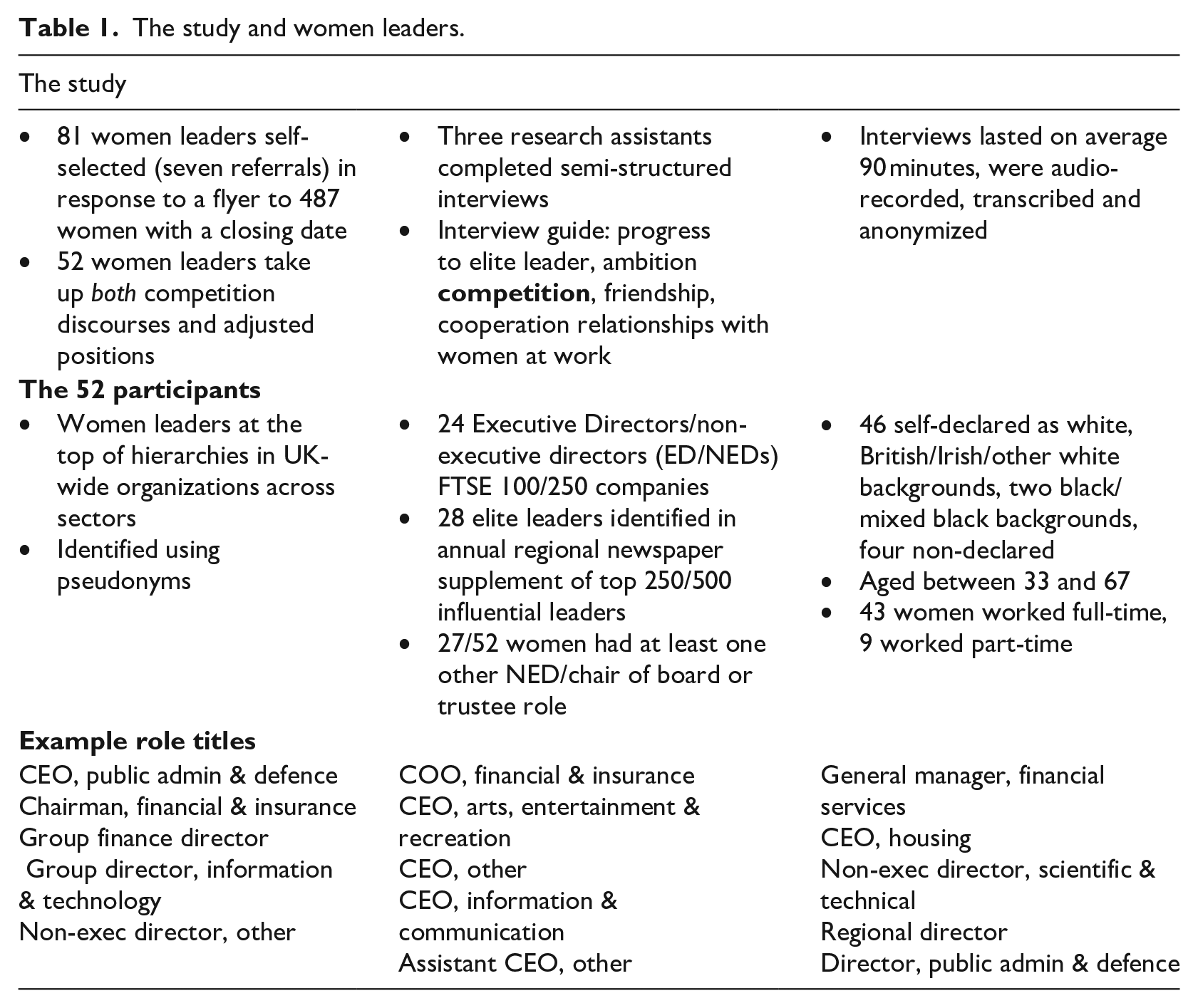
Women are underrepresented in UK senior leadership, which remains male dominated with embedded norms of hegemonic masculinity. We were able to access a sample of 81 women at the top of UK organizational hierarchies who were either holding executive and non-executive director roles in Financial Times Stock Exchange (FTSE) 100/250 listed companies or included in the lists of 250/500 influential leaders. The study considers 52 women leaders, 24 from FTSE listed companies and 28 influential leaders.
The Study
The study follows social constructionism, informed by feminist epistemology (Belenky, Clinchy, Goldberger, & Tarule, 1986; Griffin, 1995), where ‘women’s [leaders] ways of knowing, developed on the margins of the dominant knowledge system, offer valuable and alternative resources [in comparison] to those available in the prevailing epistemological frameworks’ (Bryans & Mavin, 2003, p. 240). Following Bell, Meriläinen, Taylor and Tienari (2020) and Manne (2018), our feminist scholarship reflects motivation for social change and interrogating established power relations, including rationalizations of exclusion and violence which are patriarchal and misogynistic. We view realities as multiple and constructed, researcher positionality and theoretical background as inseparable from results, and inquiry as inherently value bound (Denzin & Lincoln, 2008).
The authors are white, cis-gender, sometimes privileged women, originating from different countries and one holds a leader role. As gender scholars, we are well equipped to detect and resist limiting and discriminatory gender norms. It was our uneasiness with the prevalence of the gendered competition discourse in contemporary organizations that motivated this research. The first author’s experiences as a woman leader resonated with some of the women’s narratives, especially with their experiences of gender backlash in response to claiming ambition and competition. Through the development of this paper, we were struck by how strongly our professional academic lives are shaped by the neoliberal competition discourse, pushing us to work harder and achieve while simultaneously undermining any sense of achievement, since, under neoliberalism it is never enough.
Our feminist commitment and theoretical backgrounds lead us to view gender, competition and discourses as laden with power and inequalities and maintaining unequal power relations. For us, women leaders are interpellated by discourses inviting them to adopt certain worldviews and construct positions considering those worldviews (Davies & Harré, 1990). We recognize both the ‘force of a symbolic order of gender which shapes discursive practices and the ability to exercise choice in relation to those practices’ (Gherardi, 1996, p. 189) and view the women’s narratives as interpretations of lived experiences with material aspects.
The empirical data are from semi-structured interviews in a wider qualitative study of women leaders exploring experiences of achieving their leadership roles, ambition, competition, friendship and cooperation. During the interview, women were asked the following questions about competition with various follow-ups: Would you describe yourself as a competitive person? What behaviours do you see in yourself that tell you that you are being competitive? Where do you think your attitude towards competition and being competitive comes from? Can you tell me about a time when you have been competitive with other women to develop your career? Details of the protocols, women leaders and role titles are in Table 1.
The study and women leaders.
Data Analysis
Following Benschop et al. (2013), women’s narratives were analysed using critical discourse analysis (CDA). CDA highlights ‘social wrongs’ through critical analysis of social events, practices and structures in discourse (Fairclough, 2010) and concerns ‘the power dimensions of the way language is applied and how ideology is produced and reproduced’ (Gatto & Callahan, 2021, p. 182). Our aim was to: situate women leaders in contexts; recognize gender as an expression of power; consider competition as a key mechanism of inequality; and explore discursive activity which sustains unequal power relations.
We utilized Fairclough’s (2010) stages of: text analysis (description of patterns in language use relative to the analytical focus); processing analysis (interpreting what the women mean and why something is said in a certain way, including why they may shift positions); and sociocultural analysis (explaining relationships between texts and their institutional and socio-ideological contexts). In the first stage, there were three areas of focus: (i) how women leaders construct competition, in which contexts, for what purpose and with what effect, paying attention to how women claim competition and distance themselves from it; (ii) what types of competition they claim; and (iii) what types they seek to avoid (van Dijk, 1997). We coded separately and then together agreed codes for all transcripts. We were struck by some of the narratives conveying an intense, recurrent and paradoxical switching between ‘I’m competitive’ and ‘I’m not competitive’, often within the span of one sentence.
Next, in the second stage, we repeated analysis to interpret underlying meanings of words and messages conveyed through the narratives (Locke, 2004). We concentrated on how the women continually adjusted positions and explored inconsistencies in and between women’s talk (Benschop et al., 2013). We found various expressions of ‘extremely competitive’, ‘previously competitive’, ‘not competitive’ and patterns such as irony, denial, reticence, struggle and paradox. Going back and forth with literature, we identified two prevailing socio-cultural discourses of competition (gendered competition and neoliberal competition), and how the two discourses jostle together, fighting for attention and contradicting each other in the narratives. Fifty-two women leaders take up both gendered competition and neoliberal competition discourses, positioning paradoxically as ‘competitive’ and ‘not competitive’ and continually adjusting positions. The remaining women: avoided completely the competition questions; declared unambiguously as competitive or not, without adjusting claims; talked of competition observed in others, not themselves; or claimed competition in stereotypically masculine ways without adjustment.
We were curious to know more about how both discourses were taken up by the women and completed further cycles of interpretation. Returning to the data several times to refine analysis, we finally agreed upon four interconnected strategies used to self-position in relation to the discourses; ‘denying’, ‘masking and reframing’, ‘moving on’ from and ‘diverting’ competition. The women always utilize more than one strategy in their narratives. We cannot say whether the strategies are conscious, but they are embedded across narratives, and we interpret intent behind their positioning.
In the final stage, we viewed holistically our previous analysis and, following Benschop et al. (2013), considered the ideological and hegemonic functions of discourse (Dick & Cassell, 2002); the taken-for-granted contradictory obligations and limitations of competition for the women leaders which contribute to the production, reproduction and alteration of power relations (Fairclough, 2010). This stage identified how the discourses create ambiguity and the implications for the women as they continually reposition, oscillating between ‘I’m competitive–not competitive’ to find the ‘right’ expression of competition and avoid structural invisibility (Turner, 1967). We considered competition as a sense of struggle and in-betweenness in the narratives. This brought us to liminality scholarship which we use to theorize women’s positioning in the discussion.
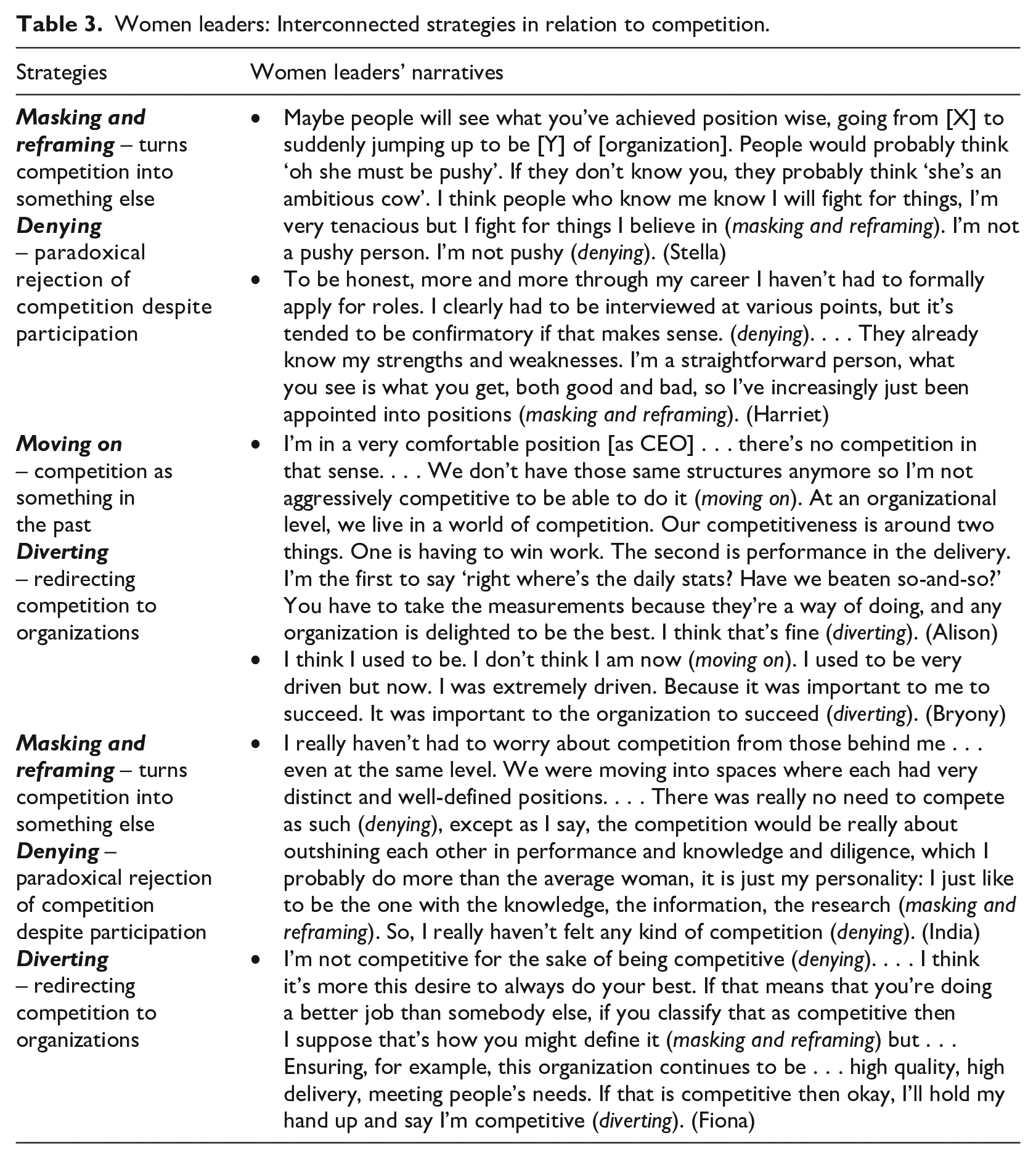
Recognizing that social life and organizations are ‘notoriously complex and every attempt to describe or study them is, by necessity, an exercise in reducing that complexity’ (Kociatkiewicz & Kostera, 2023, p. 3), we begin by outlining the discourses of gendered competition and neoliberal competition. We discuss how the two discourses jostle together (Sunderland, 2004) pushing, pressurizing and fighting for attention and priority in the women’s talk, while carrying contradictory obligations. We then present four interconnected strategies to explain the women’s self-positioning. Following Bell et al. (2020) our feminist approach is based on situated knowledges (Haraway, 1988), where situatedness ‘is not just a place from which to know’, but a place of negotiation about ‘which pieces of evidence to count and which to leave aside’ (Code, 2014, p. 100). We use ‘power quotes’ (Pratt, 2009, p. 860) to illustrate the interconnected strategies and their discursive patterns evident across the data (see Table 3 for ‘proof quotes’ (Pratt, 2009, p. 860). Finally, we elucidate how, under pressure from the discourses, the women leaders continually switch positions in their quest for social acceptability, through claims of ‘I’m competitive’ and ‘I’m not competitive.’
Discourses of Gendered Competition and Neoliberal Competition
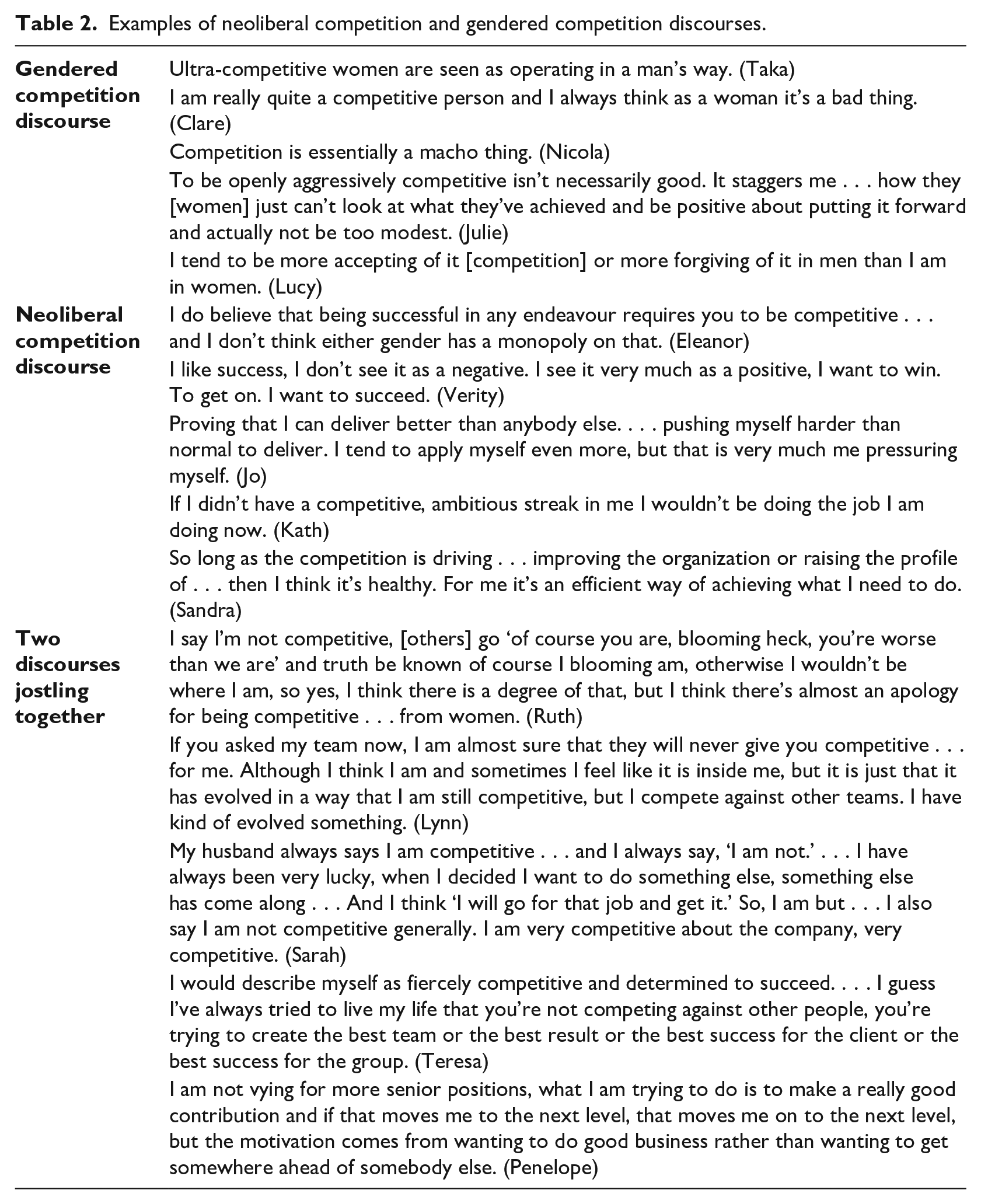
The gendered competition discourse is taken up in women’s narratives through expressions of competition as a masculine and masculinizing activity which holds social punishment for those women leaders who openly compete with others. The narratives refer to masculine connotations of competition, particularly with others where someone loses, although they insist they do not compete against other people. They illustrate how women are negatively judged when perceived as competitive and how women leaders also judge competitive women. The neoliberal competition discourse is taken up as promoting and celebrating competition as the ultimate gender-neutral tool for innovation, encouraging competitive individualism as a prerequisite for success. This is apparent through expressions of a dedicated competitive self, committed to excellence and growth, where entrepreneurial neoliberal rationality and the logic of constant competition is tied to the organization and continuous self-improvement, to work harder, reach higher and constantly better the self.
Both gendered competition and neoliberal competition discourses are active for women leaders as powerful forces operating at the socio-cultural level (Fairclough, 2010). Discourses grant access to certain subject positions and reject others, delineating who one is supposed to be as a leader, how one is supposed to act, how one is supposed to be seen by others. Yet the two discourses of competition hold contradictory social obligations in that, under neoliberalism, competition is expected from women, yet a competitive woman is atypical, a norm deviant, compromised by masculine instrumental rationality. These discourses jostle together and create ambiguity for the women leaders who respond by self-positioning using interconnected strategies. Table 2 illustrates the separate discourses identified in women’s talk and how, jostling together, they are both active for women leaders.
Examples of neoliberal competition and gendered competition discourses.
Women Leaders: Self-positioning strategies in relation to competition
The women leaders always use more than one strategy to self-position in relation to the gendered competition and neoliberal competition discourses. The ‘denying’ strategy describes the paradoxical rejection of competition despite one’s participation in it. The ‘masking and reframing’ strategy disguises and camouflages competition into something else. The ‘moving on’ strategy constructs competition as something in the past. The ‘diverting’ strategy reroutes competition from the self to competition on behalf of organizations. We next demonstrate how these strategies are used through illustrative narratives.
‘Denying’ competition and ‘masking and reframing’ competition
A ‘denying’ competition strategy is reflected through paradoxical rejection of competition, while simultaneously engaging in claims of competition. A strategy of ‘masking and reframing’ involves disguising competition, for instance: through boredom and luck; with moral intent; as a political game; as assumed in senior positions; by working harder for organizations; and by not having a career plan yet evidently being successful in career competitions. Ruth’s narrative illustrates these strategies: I have to say I would describe myself as not competitive and my family collapse laughing in hysteria every time I say that. They think I’m highly competitive. I suppose, if I’m really honest with myself, of course I’m competitive otherwise I wouldn’t be where I am, but I didn’t have a great game plan or a career . . . I’m one of those people who just kind of got bored and something came along and there I was. But I do like influence, and I do like the position. I do. I would be lying if I said I didn’t. . . . So, if I’m really honest I must be competitive but I’ve never in my life thought consciously I want to win that against you. I just don’t do that.
Ruth’s repetition of ‘if I’m really honest’ indicates her reticence to position as competitive. She employs a ‘denying’ strategy to negotiate negative gendered assumptions of competitive women by not describing herself as such and constructing her success as resulting from boredom and luck. However, Ruth immediately indicates her participation in competition, ‘of course I’m competitive’. She is perceived as ‘highly competitive’ and repositions as a competitive self, ‘I wouldn’t be where I am.’ To negotiate being negatively judged, she instantaneously ‘masks and reframes’ competition into something else as she ‘didn’t have a great game plan or a career . . .’. Her motivation for career success was desire for change (growth and improvement) rather than instrumental strategizing, which is not acceptable for women according to the gendered competition discourse. Ruth likes having ‘influence’ and ‘position’, status attributes strongly connoted as masculine within the gendered competition discourse. However, she repositions, negotiating the gendered competition discourse through ‘I’ve never in my life thought consciously I want to win that against you,’ and makes clear ‘I just don’t do that.’ As competition involves others, Ruth’s illogical statement following ‘I must be competitive’ illustrates in-betweenness as she continually swaps positions.
‘Moving on’ from competition and ‘diverting’ competition to the organization
A ‘moving on’ from competition strategy involves placing competition in the past. A ‘diverting’ strategy is reflected in claims of competition through redirecting it from the self to the organization, for example, becoming a team member, being competitive for organizations and winning at work. Lynn illustrates these strategies: When I was young, I was extremely competitive and trying to win everything. . . . I was really an individual person. I have goals during my life and now I know that I am the most stupid one, that I need my team. . . . I try then to be much better than me in every single thing. I have learned that it is easier to win with others than . . . if you asked my team now, I am almost sure that they will never give you competitive when asked one adjective for me. Although I think I am and sometimes I feel like it is inside me, but it is just that it has evolved in a way that I am still competitive, but I compete against other teams. I have kind of evolved something.
Lynn does gender differently. She openly positions her ‘extreme’ competitiveness, yet simultaneously negotiates the gendered competition discourse. She uses a ‘moving on’ strategy to place competitiveness in her past. She undermines past competitiveness (‘most stupid’) and distances from competition against others in the present. Lynn ‘diverts’ competition to the organization (‘I need my team’) and connects to the logic of the neoliberal competition discourse to work harder, reach higher and continually better herself (‘to be better than me in every single thing’). Lynn’s competitiveness remains undeniable (‘I am’, ‘it is inside me’), however she switches positions, conveying the importance of not being perceived as a competitive woman. She has ‘learned’ to be wary of and to manage competition; ‘it is easier to win with others than’ by herself. Lynn has a conscious approach to competition (‘I am still competitive’) and managing her reputation, hence her team do not see her competitiveness. Table 3 provides further illustrations of the interconnected strategies.
Women leaders: Interconnected strategies in relation to competition.
Women Leaders: I’m competitive–not competitive
We next discuss how the women leaders’ strategies for self-positioning are creative responses to the ‘jostling together’ of contradictory gendered competition and neoliberal competition discourses. Through illustrative narratives we highlight how both discourses are active, creating ambiguity and influencing how women leaders paradoxically self-position as ‘competitive’ and ‘not competitive’. Ruth says: ‘of course I’m competitive’ and continues: I do think there is a degree of truth in that, that it’s cool for a man to be macho and competitive, it’s almost not cool for a woman to do that and my kids laugh their heads off when I say I’m not competitive, go ‘of course you are, blooming heck, you’re worse than we are’ and truth be known of course I blooming am, otherwise I wouldn’t be where I am, so yes I think there is a degree of that but I think there’s almost an apology for being competitive . . . from women. Because it makes you look hard. It makes you look too macho and that’s not cool. And I don’t think that women, and me included, really know how to get the balance right on that, so we do apologize for being competitive.
A discourse conveys taken-for-granted assumptions and rules which sustain structures of domination and inequalities (Kress, 1989). Reflecting prevalent patterns in the data, as the two discourses jostle, fighting for attention, Ruth takes up the central messages of both discourses. She asserts a gendered understanding of competition as a masculinizing activity (‘cool for a man to be macho and competitive . . . not cool for a woman’) directly before ‘I’m not competitive’ (‘denying’). Aware of negative judgement, Ruth is clear that women ‘apologize for being competitive’. Paradoxically, Ruth positions as ‘I’m not competitive’ and ‘of course I blooming am’, effectively switching between opposites and adds ‘otherwise I wouldn’t be where I am’, taking up a neoliberal understanding of a competitive self as means of a successful career. Pressure from the expectations carried by the contradictory discourses provokes ambiguity, creating a dilemma for women in getting ‘the balance right’.
Lynn responds to ‘What does competitiveness look like in other women, in your experience?’: I think that it looks fine. I don’t think – just the fact, if you are on top you have to be competitive if you are a woman because otherwise you won’t have arrived. And sometimes – it looks more aggressive, they have to lose a little bit of woman empathy, to be more a man to rise up. Before they needed to be extremely tough and competitive and we still need to do a lot of marketing of ourselves. Now you are not expected to be tough, you can be normal – not soft, but normal. But your sex isn’t meant to be really clear, you have to be, everybody has to say, ‘what a fantastic professional’.
Lynn challenges the gendered competition discourse by doing gender differently; women ‘have to be competitive’ and are ‘fine’ but the way they are competitive is significant. She compares women’s competition in the past and present (‘moving on’), expressing how the expectations of this discourse constrain women. In the past women’s competition was perceived as more aggressive (‘more a man’, ‘tough’). In the present, the gendered competition discourse remains powerful and requires attention. To overcome social punishment for masculinized competitiveness, women must still work on themselves (‘do a lot of marketing’). Lynn switches positions, taking up the neoliberal competition discourse where competition is a gender-neutral prerequisite for success (‘when sex isn’t clear’, ‘normal not soft’). She negotiates the ambiguity created by the discourses jostling together using ‘masking and reframing’, disguising competitive women through reinvention into ‘a fantastic professional’. As the discourses fight for priority, Lynn competently positions and repositions; competitive but not perceived as competitive; competitive but not tough; competitive but not against other people. She conveys an ‘evolved’ strategy of ‘masking’ competition by introducing a neoliberal professional identity which conceals gender.
Illustrating how the gendered competition and neoliberal competition discourses operate across the data, Sarah, under discursive pressure from conflicting expectations, continually fluctuates between paradoxical positioning as competitive and not competitive. She responds to the question ‘Would you say you were a competitive person?’: I am laughing because my husband always says that I am ambitious, and I am competitive when it comes to my career and I always say, ‘I am not.’ We have this discussion, probably, on average, once every six months. I always say I get bored . . . and I have always been very lucky in that when I decided I want to do something else, something else has come along or somebody has said, ‘Oh they are setting up the [name of organization], do you not think you should have a look at that?’ And I will look and think ‘I will go for that job and get it.’ So, I am but, on the other hand, I also say that I am not competitive generally. I am very competitive about the company, very competitive. I want us to be better than the others. I want us to get awards. I want us to grow and get the recognition for that . . . Am I competitive about myself? I don’t know.
Sarah laughs at the question, inferring an awareness of the discursive contradictions, and puts effort into reconciling the conflicting expectations through her self-positioning. In taking up the gendered competition discourse, although competition is an important and regular discussion, Sarah contradicts her partner, claiming not to be competitive (‘denying’). She negotiates this discourse, explaining her career success as driven by boredom and luck (‘masking and reframing’). She immediately switches, claiming competitiveness; she goes for a job and ‘gets it’. Her claim of ‘So I am [competitive]’ is quickly repositioned, toning down any gendered judgement, ‘but . . . I also say I am not competitive generally’. Sarah is competitive but not competitive. As the discourses jostle for priority, she swaps position again, ‘Diverting’ competition to the organization, where she is ‘very competitive’. She takes up the neoliberal competition discourse in pursuing competitive economic gains and productivity (‘about the company’, ‘being better’, ‘growth’). Sarah struggles to position as competitive (‘am I competitive?’). When asked if others perceive her as competitive, Sarah says: Yeah, they would, they would. Definitely would. . . . I think people genuinely believe that the only way you get to a senior position is being prepared to be competitive. Where, to be honest, I don’t think I have had to do that much. . . . I have never really had to – it has not been a deliberate decision to compete. There have been times where I thought Oh, I am not going to apply for that and then I hear other people who have applied and thought ‘Well, if they can do it, I think I can’ so then I applied. . . . Perhaps I only compete when I know I have a good chance of winning. I don’t know. . . . What is most important for me is to get that feedback and be told I am doing a good job . . . If that’s competitive, well, I am driven enough to want good feedback, but I wouldn’t go all out – I can’t believe a situation where I’d go out and compete with another CEO.
Others perceive Sarah as ‘definitely’ competitive. This risks negative judgement in relation to the gendered competition discourse. She repositions, explaining how competitiveness is assumed when in a senior role but she has ‘never really had to’, nor has she deliberately competed (‘denying’). As the obligations of the discourses jostle together, Sarah moves between not having ‘to do that much’, to claiming competition; hearing of roles, comparing to others, and winning. She is a CEO who succeeds in career competitions. Sarah’s questioning of herself (‘perhaps I only compete when I have a good chance of winning’, ‘I don’t know’) illustrates her struggles with the ambiguity created by the conflicting discourses. Sensing proximity to negative judgement, she juxtaposes this with ‘but I wouldn’t go all out’ and negotiates the gendered competition discourse; when competition has a face, another CEO, Sarah will not compete with others. In taking up both discourses, Sarah’s claims of and doubts about her competitiveness are reflected in rapid changes of positioning; not being competitive–being ‘very competitive’; ‘go for that job and get it’–‘can’t believe a situation where I’d go out and compete with another. . .’. She continually adjusts between competitiveness and ‘diverting’, ‘denying and masking’ it (‘if they can do it, I think I can’–‘not . . . a deliberate decision’).
Teresa takes up the neoliberal competition discourse when asked ‘Can you tell me about a time when you’ve been competitive with other women to develop your career?’: I was very senior at [company]. Perhaps you get beyond the competitive when you’re at the [senior role] level. . . . If anything, I think women are quicker to recognize that’s the situation they’re in. Much less tolerant of the games that are played. And [I] would just say ‘oh God this is so silly, can we work it out and get to a sensible solution’. Much less time spent politicking. . . . Now then you hear a lot of stories of women who are fiercely competitive and driven. But I usually – when somebody’s talking that way you usually find the woman, you think well actually she’s no different than a hundred men, but it’s just because she’s the woman that they’re sort of characterizing the curve as her being – there is a curve isn’t there, of competitiveness. I don’t think that the average or the mean or the range is any different, it’s just that when it’s a woman, because there’s fewer of them, people say oh she’s so, so aggressive or she’s so driven. I must have been very competitive. . . . That’s the only reason that explains why I wanted to get to the top. Yeah, I would describe myself as fiercely competitive and determined to succeed. I guess I’ve always tried to live my life that you’re not competing against other people, you’re trying to create the best team or the best result or the best success for the client or the best success for the group.
Teresa positions as beyond competition; senior roles no longer require it (‘moving on’). She ‘reframes’ competition as a political game which women are ‘quicker to recognize’, are ‘less tolerant’ of and who spend ‘much less time . . . politicking’. Then, doing gender differently, Teresa explicitly challenges the gendered competition discourse, in that women are particularly visible in senior roles and negatively judged for being competitive (‘so aggressive’, ‘driven’). She switches position from very competitive to no longer competitive once in role. Teresa repositions again, stressing her competitive self. She ‘must have been very competitive’ as motivation to achieve a senior role. Under pressure from both discourses, she positions as ‘determined to succeed’, reflecting the neoliberal competition discourse, as an alternative to ‘she’s so driven’ which holds negative connotations from the gendered competition discourse. This ‘reframing’ strategy allows Teresa to reposition as ‘fiercely competitive’ in the present. Nevertheless, she modifies this competitiveness by ‘not competing against other people’, negotiating a central norm carried by the gendered competition discourse. Paradoxically she switches again to position the ‘best team . . . best result . . . best success’, reflecting the logic of constant competition as an expression of the neoliberal competition discourse. As the discourses jostle for attention and priority, Teresa continually oscillates, positioning and repositioning herself in seeking social acceptability in relation to competition.
Teresa is asked ‘Is there anything you want to say about competition before we move on?’: It’s important. It really is important – you need people to be personally ambitious in a way that ties to the organization’s objectives. I really do believe that having a bit of competition is good, but it has to be managed so it’s not destructive. It’s another one of those, aggression to assertiveness, competitiveness to over-competitive environments. You’re in danger of losing your values and people stepping outside the lines.
Teresa expresses competition as important by ‘diverting’ it to organizations and connects to the neoliberal competition discourse, where the competitive self as ‘personally ambitious’ is tied to the organization as a prerequisite for success. Jostling together, the two discourses provoke ambiguity for the women leaders and Teresa conveys how competition has to be ‘managed’ to prevent ‘people stepping outside of the lines’ and the struggle to achieve ‘acceptable’ competition without it becoming ‘destructive’. She fluidly changes positions, switching between conflicting discursive obligations.
Penelope further illustrates how the two discourses are active across the data and continually changes positions. In response to ‘Would you describe yourself as competitive?’ she says: No, I wouldn’t actually. People misread two things in me . . . for being competitive and being ambitious. . . . I would describe myself . . . as not especially ambitious, particularly not now in my career. I have aspirations for things I want to do, but fundamentally I want to do a good job. I am not vying for more senior positions, what I am trying to do is make a really good contribution and if that moves me to the next level that moves me on to the next level, but the motivation comes from wanting to do good business rather than wanting to get somewhere ahead of somebody else. I see amongst my sort of peer group an awful lot of competition for different jobs, and it can be so destructive, and I don’t feel it is necessarily helping people.
Penelope positions as not competitive, yet others perceive her as such (‘they misread me’) (‘denying’). She contrasts being ‘not especially ambitious, particularly not now in my career’ (‘moving on’), with having ‘aspirations’ and doing ‘a good job’, which is still expected to produce career progression (‘the next level’, i.e. a competitive process). Penelope negotiates the gendered competition discourse by ‘not vying for senior positions’ yet successfully competed for her senior role. Pressured by the gendered competition discourse and possible negative assessment as a competitive woman, she repositions as only wanting to do ‘good business’. Negotiating the gendered competition discourse, Penelope will not compete against other people (‘to get somewhere ahead of somebody else’). Paradoxically, she then takes up the gendered competition discourse, negatively judging her peers for competition (‘destructive’). When asked ‘Where do you think your attitudes to competitiveness come from?’ she continues: I think . . . perhaps, seeing other people that are very competitive and how it therefore influences their behaviours and business decisions and takes them down certain routes that is not necessarily for the good of the company. . . . The politicking that often goes with that, particularly in very male-dominated companies. . . . A particular incident where a couple of the [senior role] had been behaving in a very politically motivated way. . . . I said to this – [man] peer. . ., ‘If that is how people are going to behave, I will put my hand up first to lose because it is just not for me.’ . . . I will bring forward business opportunities but, if that’s the approach, count me as the first to lose, I withdraw from that because it just doesn’t do anything for me. I don’t think it does any good for the company, it turns people off, it is inefficient. What I want people to do is to get behind a good business idea and roll up their sleeves and really work hard to achieve that.
Penelope describes the type of competition in men-dominated companies she will not do (‘politicking’, ‘politically motivated’, ‘inefficient’). She takes up the neoliberal competition discourse (‘bring forward business opportunities’), through commitment to incessant productivity for the organization (‘good job’, ‘good business’, ‘good contribution’, ‘good for the company’), expecting others to do the same (‘get behind a good business idea’, ‘really work hard to achieve’). Reflective of prevailing patterns across the data, continual manoeuvring moderates her positioning in an ambiguous context where the two discourses of competition jostle together, pushing and pressuring, and discouraging and encouraging women to compete. The complex ways in which Penelope takes up the two jostling discourses of competition highlights the social ambiguity provoked for her and the women leaders as they find themselves in-between social and cultural states (Söderlund & Borg, 2018).
Discussion and Conclusion
Advancing research into social processes of competition in organizations, the study provides empirical evidence of competition as a multidimensional, fluid, gendered and gendering process (Mavin & Yusupova, 2021), where, for women leaders, the jostling together of the gendered competition and neoliberal competition discourses creates ambiguity and liminality. The women leaders are obligated to negotiate the gendered competition discourse yet, under the discourse of neoliberal competition, competition is non-negotiable. Responding to calls for the social sciences to extend research into competition (Brankovic, 2024) and in taking a feminist approach, we make two central theoretical contributions. First, we advance what is known about gender and social processes of competition. Considering how feminism ‘in its most dangerous forms involves revision of what constitutes knowledge and why’ (Bell et al., 2020, p. 188), the study demonstrates how social processes of competition in organizations reflect unequal power balances and taken-for-granted gendered norms and rules, and how the women leaders face inescapable inequalities and violence in relation to competition because of their gender. We show how the two discourses jostle together, carrying contradictory obligations, pressurizing the women leaders to conform to gendered expectations and to perform through a competitive self. In taking up both discourses, the women paradoxically self-position as ‘competitive–not competitive’ using four interconnected strategies.
Second, we theorize how the discourses, fighting for attention and contradicting each other in the narratives, provoke social ambiguity and create liminality for the women leaders. This extends understandings of those who experience liminality in organizations, to include women leaders. We contend that, in a liminal space, the women’s take-up and disruption of the discourses and their paradoxical self-positioning, are social processes that afford them opportunities to discursively present as competitive. The study therefore adds new and nuanced understandings of social processes of competition and offers alternative knowledge to research arguing that women lack competitiveness or shy away from competition (e.g. Buser & Yuan, 2019; Niederle & Vesterlund, 2007).
Successful in competitive careers, the women exercise incredible power in hypercompetitive environments, yet when talking about competition, they read their audiences, actual and imagined, and react to judgements they believe are being projected onto them. While at times in their self-positioning the women convey conscious and ‘subconscious reproduction of their own subordination’ (Gatto & Callahan, 2021, p. 185), they have agency in making innovative responses, using discursive strategies to adjust their positioning to achieve desired subjectivity. This is evident in how they challenge assumptions underpinning the contradictory discourses of competition and deploy power-loaded concepts in new ways to subvert and rearticulate elements of the discourses into new meanings (Yoong, 2023). The women leaders contest gendered assumptions, do gender differently and normalize competition for women, thus disrupting the gendered competition discourse and playing ‘a disturbing role which points to struggles of social change’ (Sunderland, 2004, p. 13). Examples include, ‘Competitive women are “fine”’, ‘I am still competitive’ (Lynn); ‘She’s no different than a hundred men’, ‘ I would describe myself as fiercely competitive’ (Teresa). While such transgression of the gendered competition discourse creates ‘greater risk of violence and harm’ for women leaders, their ‘transgressions can create space for others to follow’ (Cislaghi & Heise, 2020, p. 415).
Signalling the women leaders’ liminal, in-between context, as they disrupt the gendered competition discourse they manage to negotiate one of its central norms, in that women do not compete against other people. The women leaders appear more comfortable when positioning as competitive in a general sense or on behalf of an organization but, if competition has a face and a person to compete against, they avoid positioning as competitive. For example, ‘The motivation comes from . . . rather than wanting to get ahead of somebody else’ (Penelope); ‘I’ve always tried to live my life that you’re not competing against other people’ (Teresa); and ‘I can’t believe a situation where I’d go out and compete with another CEO’ (Sarah). The women use strategies to not only switch between discourses but use contradictory discursive obligations to shape favourable positions, for example, ‘I must be competitive but I’ve never . . . thought I want to win that against you’ (Ruth).
Further, not all aspirations for achievement and delivering ‘good’ quality work reflect the neoliberal competition discourse. Key to indications of this discourse is women positioning as competitive ‘entrepreneurial neoliberal subjects par excellence’ (Scharff, 2016, p. 109), (e.g. ‘Sometimes I feel like it is inside me,’ Lynn), reflecting the logic of self-imposed competitiveness, and intensified self-scrutiny to deliver non-stop hard work and excellence for organizations (e.g. ‘Really work hard to achieve’, ‘Best team . . . best result . . . best success’, Teresa). However, take-up of the neoliberal competition discourse is combined with continual switching of positions with opposing obligations from the gendered competition discourse (e.g. ‘I try to be much better than me in every single thing, . . . I am almost sure that [my team] will never give you competitive. Although I think I am,’ Lynn). These new understandings are significant in identifying the women leaders’ self-positioning as efforts to deconstruct oppressive discursive structures (Gatto & Callahan, 2021).
At a surface level, the neoliberal competition discourse appears as a source of liberation for women leaders, disturbing old gender norms and hierarchies. At a deeper level, neoliberalism’s insistence on the insignificance of gender works to hide inequalities, for example, where ‘sex isn’t meant to be really clear’ and reinvented into a gender-neutral ‘fantastic professional’ (Lynn). This concealment of gender and gender inequalities reflects women as ideal subjects of neoliberalism, required to liberate themselves from gender oppression, and to self-transform to a greater extent than men (Adamson, 2017; Gill & Orgad, 2015). Such inequalities emerge as gendered expectations of the self (e.g. ‘Pushing myself harder to deliver, but that is very much me pressuring myself’, Jo; ‘For me [competition], it’s an efficient way of achieving what I need to do’, Sandra). This reflects a ‘highly hetero-normative vector of competition’ for women (McRobbie, 2015, p. 7), due to their ‘distance away from the masculine centred standard of the perfect “ideal worker” and their socio symbolism within patriarchy as “other”’ (Baker & Brewis, 2020, p. 10).
The women leaders self-position in relation to competition by oscillating in-between being competitive, perceived as competitive, not competitive, no longer competitive, and competitive for organizations. Their incessant manoeuvring of positions reflects struggle in a liminal space for social acceptability amid ambiguity and gendered power relations carried by the jostling discourses. Limited research has considered how women leaders might be stuck in between socio-cultural states, and what challenges and opportunities this might afford. Ford and Harding (2007) explain a ‘liminal space is neither inside nor outside the normal’ (p. 481), which aptly describes the in-between space that women leaders inhabit because of their gender in relation to competition.
Organization studies has recognized how liminality can be a permanent state for some in organizations (e.g. consultancy work in between organizational structures, Johnsen & Sørensen, 2015) and indicative of precarious and fluctuating careers (Ibarra & Obodaru, 2016). In contrast, the women leaders hold permanent senior roles, have completed role transitions, and are not beyond or between organizational structures. They experience liminality in relation to competition, neither inside nor outside the normal, evidenced through efforts to counter social ambiguity through articulating certain positions. The women’s self-positioning of ‘competitive–not competitive’ demonstrates how, while not ‘fitting’ extant descriptions of those experiencing liminality, they are in a perpetual liminal space, in between social and cultural states (Söderlund & Borg, 2018). This positioning extends understandings of leadership as a site of perpetual liminality (Simpson & Carroll, 2020).
The women leaders’ struggles with ambiguity reflect competition as a powerful, toxic and gendered social process, which is both harmful and aspirational. However, we also illustrate ‘how seemingly “negative” characteristics of in-betweenness’ (Lê & Lander, 2023, p. 1534) can have positive impact. An important contribution is how the women demonstrate agency, choosing different positions for various contexts, continually repositioning ‘in an instant’ (Ellis & Ybema, 2010, p. 300) by skilfully using interconnected strategies of ‘denying’, ‘masking and reframing’, ‘moving on’ from and ‘diverting’ competition, as liminal practices to convey the ‘right types’ of competition.
While liminality provokes potential challenges, crucially it provides opportunities for women leaders to discursively position as competitive in explicit, reticent and ironic ways. Liminality offers language other than victimhood in contexts where women are oppressed and, we propose, has potential ‘to fissure contemporary constructions of women’s victimhood’ (Gámez Fuentes, 2021, p. 94), illuminating how the women fluctuate in between. The women limit competition, dial it up or down, and adopt puzzling positions of ‘competitive–not competitive’. Here liminality ‘is not a state of limbo’ (Simpson & Carroll, 2020, p. 269), it offers potency to reproduce, negotiate and disrupt the discourses, provoking possible change in gender relations (Gherardi, 1996). The women display liminal competence (Borg & Söderlund, 2015) in positioning favourably and actively shape what favourable looks like. Competition is therefore a liminal challenge and an opportunity for women leaders.
Guided by a feminist epistemology (Belenky et al., 1986; Griffin, 1995), we have ‘actively sought out the ways in which [women leaders’] experiences and understandings do not conform to the prevalent model’ (Kociatkiewicz & Kostera, 2023, p. 13). Exploring women leaders’ self-positioning in relation to two discourses of competition uncovers new understandings of changing contours of power, inequalities and violence in the system, deeply embedded in language and culture. The study encourages attention to our lived experience of theorizing [to] make sense of what is happening around, and to, us (hooks, 1991). By demonstrating discriminatory social forces, confronting gendered discursive power and offering alternatives to sexist understandings of competition, the research increases awareness of what is happening behind our backs, revealing hidden motivations that influence our actions (Mogashoa, 2014). The study therefore contributes to ‘expressing what was previously inexpressible . . . as well as unresearched’ (Kociatkiewicz & Kostera, 2023, p. 14) and offers new avenues to extend research into social processes of competition.
Further feminist studies have opportunity to ‘identify the nature of the field [of social processes of competition in organizations] – and who and what is absent from field-defining and shaping debates’ (Fotaki & Pullen, 2024, p. 596). Future research directions include: exploring the discursive impact of competition for women at different organizational levels; extending understandings of doing gender differently in relation to competition; exploring women’s engagement with competition when securing scarce resources such as high-profile projects and when applying for new roles or promotion; scrutinizing women leaders’ silences, and non-engagement with competition; and examining experiences of competition in organizations for those without privilege, located in different geographies and marginalized through intersections, such as race, ethnicity, class, sexual orientation and gender identity. Our reading of women leaders experiencing liminality in relation to competition offers potential to apply a liminality lens to future research exploring gender and organizations, and with others who may experience liminality, particularly as contemporary workplace experiences become more precarious and complex.
Taking a feminist approach provided us with ‘opportunities for resisting gender inequality in theory and practice’ and presenting alternative ‘ways of seeing, reading, feeling’ (Fotaki & Pullen, 2024, p. 595) women leaders in relation to competition in organizations. Our aim is for these ‘insights to connect, reverberate’ and to ‘resonate . . . in ways that are meaningful and significant’ (Cunliffe, 2022, p. 7), raising consciousness and provoking reflection on our own and others’ relation to social processes of competition in organizations.
Footnotes
Acknowledgements
Appreciation and thanks to Dr. Sandra Corlett, Dr. Melissa Yoong, Professor Gina Grandy, Professor Paul Hibbert and Professor Nic Beech for their inciteful feedback, support and encouragement through various stages of developing the paper. We wish to acknowledge and thank Dr. Nicola Patterson, Dr. Jannine Williams and Dr. Trish Bryans, the research assistants on the wider Senior Women at Work project and the incredible women leaders who engaged in the study.
Funding
The author(s) received no financial support for the research, authorship, and/or publication of this article.
