




Abstract
This article seeks to explore youth experiences of responsibility and responsible leadership in leadership development. Noting that youth leadership development programmes have been criticised for prioritising positional and adult-based theories of leadership, we engage directly with youth participants in a leadership development programme to explore their experiences of responsible leadership. Using discourse and aesthetic approaches, we identify two primary discourses of ‘weight’ and ‘space’, which in conjunction with Young’s social-connection model of responsibility, we draw on to conceptualise a youth-oriented form of responsible leadership. In doing so, we offer leadership development a nuanced theorisation of responsibility while also extending and adapting Young’s work to more action-oriented forms of responsible leadership. We conclude by proposing five practices of responsible leadership development that can be effectively incorporated into leadership development programmes to support youth in negotiating the weight and space of responsibility.
Introduction
Scholarly work in responsible leadership (RL) is driven by concerns that more ethically orientated leadership is required if society is to effectively mitigate and adapt to ‘grand’ environmental and societal challenges, such as biodiversity loss, social injustice and climate change (Castillo et al., 2020; Kempster and Jackson, 2021). Leadership development (LD) has the potential to provide an important site for the development of responsible leaders who can navigate such complex, systemic and fundamentally ‘wicked’ challenges (Grint, 2022; Hull et al., 2018). Yet the fields of RL and LD have yet to meaningfully meet. In their bringing together, we unearth issues within these fields that marginalise the agency of youth; provide overly positional, managerialist and organisationally focused accounts of leadership; and offer a narrow and limited conceptualisation of responsibility (Carroll, 2016; Voegtlin, 2016). We, therefore, ask the following two research questions:
RQ1. How is responsibility in youth LD understood and experienced?
RQ2. How can youth LD better work with responsibility?
Our starting premise is that youth LD encourages and supports young people to lead in responsible ways that can confront the current systemic issues and challenges of our complex global society. Indeed, a common thread in the field of youth LD is that youth are ‘well positioned to identify and deconstruct social problems and develop strategies to remedy them’ (Govan et al., 2015: 88). As actors yet to be fully socialised into the ‘way things are done around here’, they may generate ‘important insights about how society should be different’ (Mortensen et al., 2014: 448) and LD may engage them in resisting, deconstructing and reforming systems and structures of oppression (Govan et al., 2015; Redmond and Dolan, 2016). Yet the ways in which youth LD has been implemented in tertiary settings have come under scrutiny for prioritising technocentric and authority-based theories of organisational leadership (Collinson and Tourish, 2015). Programmes are accused of favouring neoliberal, utilitarian and corporate agendas (Carroll and Firth, 2021), and circumventing broader discussions of global citizenship, and social and moral responsibility (Kiersch and Peters, 2017). Consequently, while business schools are among the biggest providers of youth LD (Grunwell, 2015), they appear to have provided limited guidance around how to mobilise and navigate morally and socially responsible forms of leadership. In response, a handful of scholars have made a call for connecting tertiary LD with more ethical and servant orientated leadership frameworks (Kiersch and Peters, 2017; Libby et al., 2006). Despite this, we have found no evidence of work which specifically addresses responsibility and its connection with, or inclusion in, youth LD.
The idea that responsibility is intimately connected with leadership theory is not new, but as Carroll (2016) notes, ‘responsibility has for a long time been given a default spot in the leadership canon meaning it is assumed rather than theoretically or empirically examined’ (p. 1). In seeking a robust theorisation of responsibility in leadership, we initially looked to the field of RL. While RL addresses important questions pertaining to the responsibilities of business leaders in a diverse and multivocal society (Pless and Maak, 2011), we found it too detached and disconnected from the experiences of youth to offer a relevant framework of responsibility for youth LD. This is because RL maintains a preoccupation with the use of positional power and individualised authority (Carroll, 2016; Lloyd and Carroll, 2023) and most often casts leadership purpose as invariably tied to corporate ends (By, 2021).
The challenge we engage with in this research is to identify and delineate a theorisation of RL that is better aligned with the experiences of youth, and relevant in informing their LD. To do so we engage with youth themselves. Our research subjects are participants in a youth LD programme designed and run at a tertiary institution. Our empirical work is prefaced by our understanding of LD as an aesthetic experience (Carroll and Smolovic Jones, 2018), in which sensory, embodied and non-cognitive ways of knowing are activated and traced. In our analysis, we use the ‘feel’ of responsibility to re-characterise a responsibility that is more immediate, more visceral and more like ‘practical wisdom’, instead of abstracting it out of a corporate position or role. Our approach is in line with Dempster and Lizzio (2007) who recommend that researchers talk directly with students so that the theory and practice of leadership for youth is informed by youth perspectives.
Our findings surface two core discourses of ‘weight’ and ‘space’ which constitute how youth LD participants experience RL. An analysis of leadership through these spatial metaphors provides a unique perspective which aligns with an aesthetic and situated engagement with experiences of responsibility. While we could find no reference to weight in the organisation or leadership literatures, we could of course find a literature on organisation, leadership and space. Such literatures have increasingly become concerned with the need to transform space from akin to a simple and static background to a central relational and processual phenomenon in the constitution of both organising and leading. Watkins (2005: 2010) talks about ‘an abyss’ that ‘has opened up between the theories of space and the empirical world of actions, interactions and understandings’ which has the effect of ‘leaving our lived experiences estranged from the conceptions that purport to represent them’. Broadly speaking contemporary theorisation on space is orientated towards reframing space from a ‘mental thing’ or ‘mental place’ (Watkins, 2005: 210) to an approach which understands space as ‘social as well as material, conceptual as well as physical’ (Crang and Thrift, 2000: 71). We can see such a shift emerging in the leadership literature where space and spatiality is drawn on to construct the ‘“thing-ness” and materiality of leadership’ (Ropo and Salovaara, 2019: 462). As such, leadership is decentred to involve spaces, artefacts and social processes, with spaces shaping, influencing and constituting leadership actively to the extent that Ropo and Salovaara (2019: 466) propose ‘there is leadership to spatiality and spatiality to leadership’. Of particular interest to this inquiry is that ‘feeling emotions in and of space is a key element in producing leadership’ (Ropo and Salovaara, 2019: 474) thus emphasising the visceral, sensory and aesthetic quality of the spatial.
Our contributions are threefold. First, we offer a fresh theorisation of RL as it is experienced by youth LD participants. Our commitment to an aesthetic and discursive methodology prioritises youth experiences and voices, thereby addressing the significant lack of youth perspectives in leadership research (Dempster and Lizzio, 2007; Dempster et al., 2011). Moreover, our focus on youth offers broader insights for LD in that it attends to the manifestation of RL beyond traditional forms of hierarchical power and pre-established stakeholder networks, enabling engagement in broader debates around leadership’s role in addressing grand societal challenges beyond organisational boundaries (Voegtlin, 2016). Second, our study integrates and extends Young’s (2006, 2011) social-connection model by adapting elements of her theorising to action-orientated forms of RL. Her theory offers a nuanced understanding of responsibility, and its integration brings a more relationally and ethically grounded perspective to youth leadership, which scholars have noted as absent (Collinson and Tourish, 2015; Ghoshal, 2005). Third, we propose a framework of five practices for responsible leadership development (RLD). This practical guidance is valuable for educators and practitioners in designing and implementing leadership programmes that are more aligned with the ethical, relational and responsible needs of young leaders.
In the following section, we traverse the domain of youth LD and clarify the limitations of applying current RL theory to the field. Opportunities for our theoretical contribution are exposed, and we conclude the section by contending that Young’s (2006, 2011) social-connection model of responsibility and her parameters of reasoning are relevant and salient theorisations of responsibility for our research agenda. Our method section then describes the programme at the centre of this research and presents our commitment to a methodology that draws from discourse and aesthetic approaches. In our findings we identify and unpack two central discourses of ‘weight’ and ‘space’ which represent youth experiences of RL, and we explore how they are navigated and negotiated in LD. Drawing from these dual discourses, as well as from Young’s (2006, 2011) work, we propose a theorisation of RL for youth that involves leading from privilege, focusing interest and entering power through positioning into collective ability. Finally, we delineate a framework for RLD, wherein five practices for LD are offered.
Youth LD
Research looking at the efficacy of university LD programmes has shown that participation can lead to long-term improvements in self-awareness and ethical sensibilities (Kiersch and Peters, 2017), civic responsibility, cultural intelligence and community orientation (Cress et al., 2001). Hence, developing leadership capabilities in students has become prevalent in the mission statements of universities throughout the West (Grunwell, 2015). Youth LD has been lauded as playing ‘a key role in the training of responsible leaders’ (Borges et al., 2017: 154) and has broadly aimed to ‘harness the energy and vitality of young people’ (Redmond and Dolan, 2016: 261) by providing them with resources and tools to mobilise and engage in social action and change (Govan et al., 2015).
At the same time, youth LD in business schools has been critiqued for promoting theories that are too narrowly focused on business prowess and orientated towards meeting short-term corporate goals and profit maximisation (Blasco, 2012). Critics have claimed that a common neoliberal and normative curriculum underlying LD programmes has ‘actively freed their students from any sense of moral responsibility’ (Ghoshal, 2005: 76). Collinson and Tourish (2015: 576) argue that increasingly leadership courses within business schools adhere to a narrow set of approaches that, in privileging the role of powerful individuals, are highly ‘leader-centred’. They note that leaders are framed as ‘heroes, saviours, and miracle workers’ (p.578), and that by studying leadership, students believe that they too can become successful and influential leaders with power over others. In reinforcing the ‘myth of heroic leadership’, the vision of the leader in achieving organisational ends is privileged, while the followers remain invisible (Collinson and Tourish, 2015). Relatedly, recent empirical work by Carroll and Firth (2021) identified a covert neoliberalism, and a regulatory and restraining nature to youth LD which binds the construction of a leadership identity to one that is abiding and concomitant to the status quo. In considering such critical commentary, we are concerned that while youth LD may espouse empowerment, transformational thought and social change, it ultimately ‘orientates youth to live within systems, norms, and existing practices as opposed to pursue redefinition, change and disruption’ (Carroll and Firth, 2021: 21).
One major implication of the above is that youth leadership may be rendered benign if youth LD fails to recognise and give youth power as youth. Carroll and Firth (2021: 21) observed that youth’s leadership identities were ‘paradoxically embedded in a relative comfort with powerlessness’ as they saw themselves as unable to influence the structures they inhabited. This may in part be explained by an enduring ‘adultism of leadership development’, no doubt exacerbated by the continuing absence of youth in LD theory and empirical research (MacNeil, 2006: 30), and by a ‘deficit model’ which frames youth as ‘a set of problems to fix’ (p.31). Typically, adult theories of leadership are mapped onto youth leadership programmes, with many of these theories originating from organisational and managerial settings and thus focused on leadership which utilises positional power and authoritative influence (Mortensen et al., 2014). MacNeil and McClean (2006: 100) similarly warn that such theorising pushes youth leadership out into the future and ‘prevents young people from having real voice and power today’. Ultimately then youth LD may inadvertently thwart the ability of youth to engage in transformational forms of RL. Youth’s agency is marginalised as the LD they partake in focuses on enabling corporate leadership whereby forms of positional power are wielded to efficiently meet managerial objectives. This is problematic if youth leadership is to be effective at mobilising and engaging in responsible forms of social change.
RL
In the seminal work of Maak and Pless (2006), RL is defined as ‘a relational and ethical phenomenon, which occurs in social processes of interaction with those who affect or are affected by leadership and have a stake in the purpose and vision of the leadership relationship’ (p. 103). Leaders are ‘responsible’ for developing and escalating motivation and commitment of all stakeholders to sustainable value creation (Pless, 2007; Pless and Maak, 2011; Pless et al., 2022) and for ensuring ‘Good Dividends’ across multiple forms of capital (Kempster and Jackson, 2021). From what we will term a ‘mainstream RL’ perspective, the scope of a leader’s responsibility sits within an organisations’ owner-stakeholder relationships (Miska and Mendenall, 2018) with responsible leaders encouraged to use their ‘moral imagination’ to navigate complex stakeholder conflicts (Pless et al., 2022), which consider the financial, social and environmental consequences of action (or inaction) for all involved. While there is a clear focus on the responsibilities of corporate leaders to relate and respond to the needs of stakeholders, RL has been consistently criticised for not providing a robust theorisation of responsibility itself. In Miska and Mendenall’s (2018) comprehensive review of the RL field, it is concluded that there remains no clear or commonly held definition of responsibility or RL. Similarly, in their more critical work on responsibility in leadership, both Carroll (2016) and Voegtlin (2016) critique the field for not specifying the values and ethical principles upon which RL should be based.
Fortunately, recent discussions on leadership purpose have begun to explicate the underlying principles that guide ethical and responsible forms of leadership. Kempster and Jackson (2021), for instance, argue that RL should be linked to the purpose of a ‘Moral Capitalism’, which emphasises the enhancement of humanistic and environmental capitals, in addition to financial capital. While this broader concept of responsibility is related to moral objectives, the fiduciary duties of business leaders still drive their responsibilities within their organisations. In line with mainstream RL, Kempster and Jackson (2021) focus on corporate leadership precisely because corporations possess the wealth, power, resources and influence to mobilise social change. However, this focus on power, agency and capital presents a challenge in connecting RL to youth leadership, as youth are unlikely to have access to these resources. Consequently, RL invariably presents as an adult-oriented theory of leadership (Mortensen et al., 2014) that relies on positional and authoritative power and pre-existing stakeholder relationships. Consequently, a theorisation of responsibility for youth cannot borrow from this work without abdicating RL to something achieved by a ‘future self’ rather than a ‘present self’. As such, and without a clear theorisation of responsibility, current RL does not extend to questions of how RL may be practised in contexts where an individual has no established power within a hierarchy, or where responsibility, accountability and purpose extend beyond specific business contexts.
Responsibility in youth leadership
We are not alone in wanting to bring responsibility into tertiary and youth development, though our focus on LD specifically is unique. In 2007, the UN published the Principles of Responsible Management Education (PRME, 2023) which have challenged tertiary institutions to fundamentally change management education with a view to improve students’ moral capacities and ability to address 21st century issues such as sustainability and climate change. In the PRME literature, business schools are identified as educating the business leaders of the future (see recent work by Shah et al., 2023; Smith et al., 2023 for detailed and critical accounts of PRME in this context), yet very little research engages robustly in discussions of LD and RL specifically. Responsibility is touched on by Hibbert and Cunliffe (2015), however, who argue that responsible management education requires students to be engaged in understanding the responsibilities of leaders to actively challenge irresponsible practices. While the authors do not extensively draw from RL theory, they note that there is both a stakeholder-orientation to RL as well as an interpersonal-orientation where agents are accountable to others in their everyday interactions with them. This dual focus is not unpacked further but it speaks to the challenge we face in defining responsibility for youth LD. That is, we find mainstream RL to be unwaveringly preoccupied with the former-stakeholder-orientation, offering little to help theorise the latter-interpersonal-orientation. In that endeavour, we have turned to Marion Iris Young’s social-connection model of responsibility which elaborates a relational and interpersonal-orientation which we think better aligns with youth LD.
Young’s (2006, 2011) social-connection model of responsibility provides a nuanced, expansive and collective understanding of responsibility that reaches beyond organisational and industry boundaries. The model itself proposes that all individuals bear responsibility because they are part of structural processes from which injustices are produced, reproduced and reinforced. An agent’s responsibility, therefore, can exist even if they cannot trace the outcome of their actions specifically to a harm caused. As a result, the focus of this model is not on identifying guilty parties, as finding a guilty party does not exonerate all others from being part of an ‘irresponsible’ process. Instead, we are all encouraged to see and take responsibility for structural injustices, and in doing so, also accept that ‘background conditions are not morally acceptable’ (Young, 2006: 120).
To complement her model, Young (2006) outlines four ‘parameters of reasoning’ which surface the variable difficulties people face in determining the degrees of responsibility they are able to assume – an important consideration given the extent of social-connections to injustices an actor is likely to have. These parameters are power, privilege, interest and collective ability, and are contingent on an actors’ structural positioning vis-à-vis the structural processes that generate injustices, noting that such positioning is indicative of the amount of resources they have access to, as well as the levels of constraint that they face with respect to processes that can contribute to structural change (Young, 2006). In brief, the power parameter relates to an actor’s influence within structural processes, encouraging a focus on areas where they can have a significant impact, despite those in power often resisting changes to maintain the status quo. Privilege involves recognising those who benefit from injustices and their moral duty to help rectify them, using their ability to adapt without major hardship. Interest considers the varying motivations behind maintaining or altering unjust structures, with victims of injustice often being the most motivated for change but needing support from others. Finally, collective ability pertains to the capacity for joint action to address justice issues, choosing targets based on the feasibility of organising effective collective responses and aiming for meaningful structural transformations.
To date, these parameters have not been addressed in leadership work drawing on Young’s model, yet an attentiveness to power, privilege, interest and collective ability is salient for RL as it offers an extension of the social-connection model that emphasises the individual experience of responsibility, and how it is worked with and met in a more practical and active sense. Indeed, leadership scholars have applied Young’s work to outline models of RL that are forward-looking and involve the sharing of responsibility and collective problem-solving (Carroll, 2016; Lloyd and Carroll, 2023; Voegtlin, 2016), yet this work has been primarily conceptual in nature. Applying Young’s model to more active forms of leadership and LD is therefore crucial to bridge the gap between theoretical concepts pertaining to RL, and more practical applications.
Methodology and research context
Our research focuses foremost on how RL is experienced by participants. Like Carroll and Smolovic-Jones (2018), we instinctively sensed the possibility to go beyond cognitive interpretations and illuminate important dimensions of the ‘felt-sense’ of responsibility within LD by applying aesthetic principles (Strati, 2000) in our research. Inherently constructionist, aesthetic approaches require researchers to ‘problematise the rational’ (Linstead and Hopfl, 2000), by seeking alternative means with which to uncover meaning in organisational processes (including LD). By providing access to and paying attention to tacit and non-verbal ways of knowing, an aesthetic methodology can reveal interactions between language, discourses, materialities and embodied felt-sense. It can help illuminate, occupy and explore the spaces between regulatory and experiential, cognitive and sensory, stimulus and response (Linstead and Hopfl, 2000) by heeding senses, feelings, desires, talents, tastes and passions (Strati, 2010) and the way these come together in interaction.
Strati (2010) describes three organisational research approaches that explicitly assign knowledge value to aesthetics. They exist on a spectrum according to how actively researchers participate in the data generation process. Our methods most closely align with the second ‘empathic-logical’ approach in which researchers first observe the empirical setting, consciously paying attention to intuitions, sensations and expressions aroused by elements of the organisational environment. The researcher then interprets findings within the data by balancing empathic knowledge with ‘analytical detachment’. The final stage of analysis requires the suspension of empathic knowledge to develop findings in an aesthetically sensitive way. In the ensuing description of our site and design, we will explain further how such considerations feature in our research.
Research site
The empirical material for this article comes from interviews and group conversations with participants in a 9-month student leadership development programme (LDP) at a tertiary institution in Aotearoa, New Zealand. The LDP was a compulsory component of a year-long scholarship and was delivered in nine full days spread across the academic year from February to October. The 16 students were enrolled in programmes at postgraduate level in faculties including Science, Business and Economics, Law, Creative Arts and Industries, Education, Māori and Indigenous Studies, Engineering and Medical and Health Sciences. There were 10 female and 6 male students ranging in age from 20 to 35 years at the start of the programme.
Between the nine full-day face-to-face workshops across the year, participants were active in an online forum, posting and commenting on each other’s reflections. Participants were invited to contribute to the ongoing programme design by providing suggestions in these online forums for discussion topics and speakers. They were also encouraged to critically reflect on how their own sense of leadership values and personal purpose might intersect with others in the cohort and examples of leadership in the world around them. All three authors were present in the research as co-facilitators of the LDP and observers at varying points, and the first and third authors developed close relationships with all participants across the course of the programme. All 16 students took part in two group conversations of eight participants each, and 10 students were subsequently interviewed individually. These took place 6 months after the programme commenced.
Research design
Given our enquiry is concerned with how responsibility is perceived, felt, co-constructed and expressed by youth in LD, then verbalised thoughts and conversations generated in interaction form the backbone of our data generation approach. This builds on a consciousness of both the subjective and intersubjective dimensions of interaction and discourse (Warren, 2008), where ‘utterances reflect an intense subjectivity (but) the meaning they evoke is socially shaped and situated’ (Carroll and Smolovic Jones, 2018: 11). We wanted to create a space where this social shaping of meaning, in which the partial, inter-dependent and contested truth claims of participants, could be surfaced and shaped, with as little researcher interference as possible. We chose, therefore, to begin our fieldwork with collective group conversations, before progressing to individual interviews. We conducted two collective group discussions where we explored the idea of ‘responsibility’ and its connection with leadership. These discussions were followed by one-on-one interviews with 10 of the participants. At all times, we were conscious to identify early any potential ethical dilemmas or conflicts of interest between participants, particularly given the possibility that discussions would include personal anecdotes and reflections. Having already spent 6 months working alongside this group, we were confident that genuine trust had formed in the relationships between participants, but we were prepared to intervene if any discussion veered into ethically questionable territory. We also explained clearly at the outset of each group conversation and interview that participants could pause and/or exit the process at any time.
In our research design, we wanted participants to be able to access what Sutherland (2012) calls ‘aesthetic reflexivity’, which ‘mobilises the aesthetics of experience to develop self-knowledge’ (p.33). It was important to begin, therefore, by enabling participants to access what could be described as the aesthetic elements of an experience so the resultant ‘self-knowledge’ might contribute to a collective meaning-making process. Aesthetic experiences engage people at multiple levels simultaneously – sensory, cognitive, emotional, for example (Strati, 2000) – and reflecting on them can help conjure up the kind of imagery and narrative that infuse discursive enquiry. The collective discussions thus began by inviting the group of eight students to spend a few minutes reflecting on a story or moment that somehow captured the essence of responsibility for them. Participants were invited to describe how RL felt to them, in an unstructured fashion, rather than any predetermined order, and a rich discussion between participants ensued. The conversation lasted approximately 30 minutes in each case, and the first author, as facilitator, interjected minimally when she felt it necessary to query, clarify or extend a point that one of the participants had made. The group conversations were video-recorded and a written transcript of the audio recording was prepared.
During the fortnight following the group conversations, individual interviews were held between the first author and 10 of the participants involved in the two group conversations. For these, we adopted a ‘localised’ (Alvesson, 2003) ‘ethnographic interview’ (Taylor and Hansen, 2005) approach in which participants were invited to draw from their own cultural resources and immediate social environment. For example, some of our participants drew from their experiences within ceremonial conventions specific to the Māori culture. Others referred to their work as leaders within communities in South Auckland, an area well known to suffer from social deprivation. In a localised ethnographic approach, the researcher enters the world of the participant and is positioned as an active co-constructor in data generation, rather than as an external observer. In accordance with principles of participatory research, this helps to create more democratic processes and opportunities to challenge hegemonic knowledge than are commonly found in normative research practices, by reframing both researchers and participants as active co-creators of knowledge who bring their own agency and subjectivities to the process (O’Connor and Anderson, 2015). Such a reframe requires attendance to the ‘feelings, intuitions and multiple forms of rationality of both the researched and the researcher, rather than a single logic of objectification or purified rationality’ (Deetz, 2009: 27). In our interviews, conversations were tightly rooted in the local context of the individual, of which, due to the longevity of relationship, the researchers already had a solid understanding. Our impression was that participants responded positively to both the localised and ethnographic, co-creative element of our approach. They seemed to sense the expansive opportunity to share a wide range of ideas and perspectives that felt more visceral, personal and empathic than responses in more conventional interviews we have been involved with. This approach works particularly well where a researcher has already established relationships with participants and is very familiar with the context, as was the case with our enquiry.
Each of the three researchers did an initial scan of the written transcripts separately and came together for an analytic conversation. As is often found in aesthetics-based research, right from the beginning the analysis took a broadly narrative and discursive turn with a focus on the discursive patterns found within narratives told over both the course of the focus groups and the interviews. In line with our methodological intent to follow a participatory, democratic research design, all three researchers at this stage agreed to sustain an analytic approach that privileged the discursive voices of the participants and that suspended researcher frames and discourses being imposed until the more interpretive phase of the empirical process. In practice, this required a deliberate ‘holding back’ from the tendency to jump in to explain what we were noticing and sensing. As in the empathic-logical approach, having shared our initial observations, one of the researchers then worked through the empirical material again in its entirety, constructing discursive clusters around repeating discursive choices and particularly noting sensory, experiential and feeling orientated syntax and language.
Very quickly both ‘space’ and ‘weight’ emerged as the core constitutive discourses of RL in the final stage of our aesthetically sensitive analysis (Strati, 2010). In the following section, both are introduced, first, simply as discourses and then, second, in terms of the patterns of meanings identified in their use. The intersection of the weight and space discourses in a specifically LD context constitutes the third and final discourse section in our findings. Both ‘weight’ and ‘space’ evoke distinctive aesthetics which are carried in the analysis by a focus on prepositions (such as ‘on’ and ‘down’), pronouns (such as ‘I’, ‘it’ and ‘you’), imagery (such as ‘clock’ and ‘game’) and verbs (such as ‘paralysed’ and ‘feels’). Such choices travel directly into our commentary threading the different discourse tables together so that the sensory and experiential drivers of the analysis are not lost or substituted by researcher discursive choices.
Findings
When talking about responsibility and RL, our participants did not talk in abstractions or the type of conceptual definition that dominates the RL literature; they talked in experiential, sensory and aesthetic ways. Such talk was dominated by two discourses – weight and space – and it is their delineation, intersection and navigation that we present in this section as an approach to RL that is both original and profound.
Weight
The discourse of weight runs right through the data. In many ways that is no surprise as responsibility and weight can be considered synonyms of each other, given associated words like ‘load’ and ‘burden’ equally apply to both, and sayings such as ‘with great power comes great responsibility’ turn the relationship between the two often into a cliché.
Table 1 gives a small taster of such discourse.
Weight discourse excerpts.
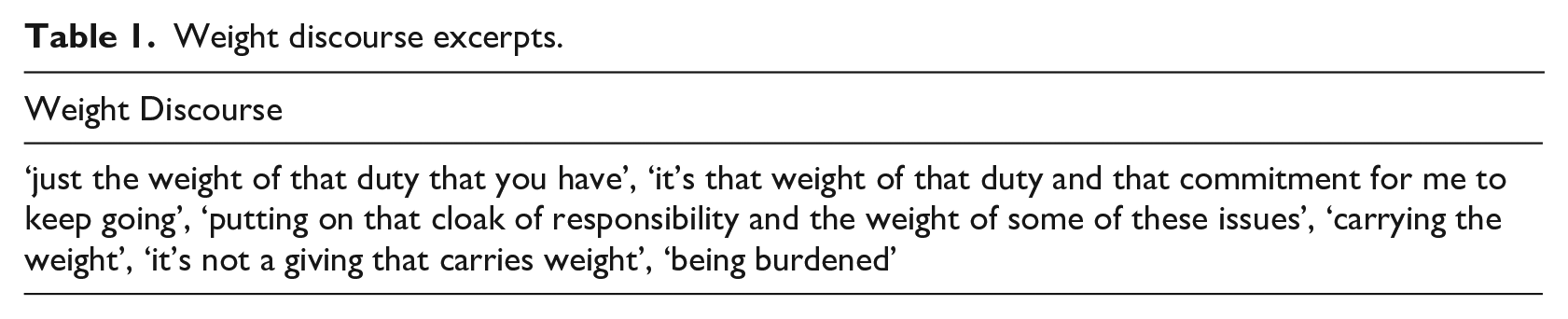
Many of the references to weight certainly do carry that cliché element with a sense that participants have picked up and used the two without even needing to think about the language and syntax. For instance, we note that weight is not infrequently linked to duty and is something that needs to be carried that can complicate the ability to keep going. The inference in such talk is that weight is a negative, with those bearing it as burdened. However, beyond the automatic pairing of weight and responsibility, we catch glimpses that there are ways of holding responsibility in leadership that lighten and lessen the weight and, in those glimpses, we see the fuller meaning of weight. While weight can simply mean mass and indicate a load, pressure or burden, it can also mean a force which is indicative of a strength, movement and energy. Table 2, therefore, probes the different meanings of weight in the discourse as it is this secondary, more nuanced, framing of weight that carries the promise of unlocking RL as a radical leadership force (or not).
Characteristics of the weight discourse.
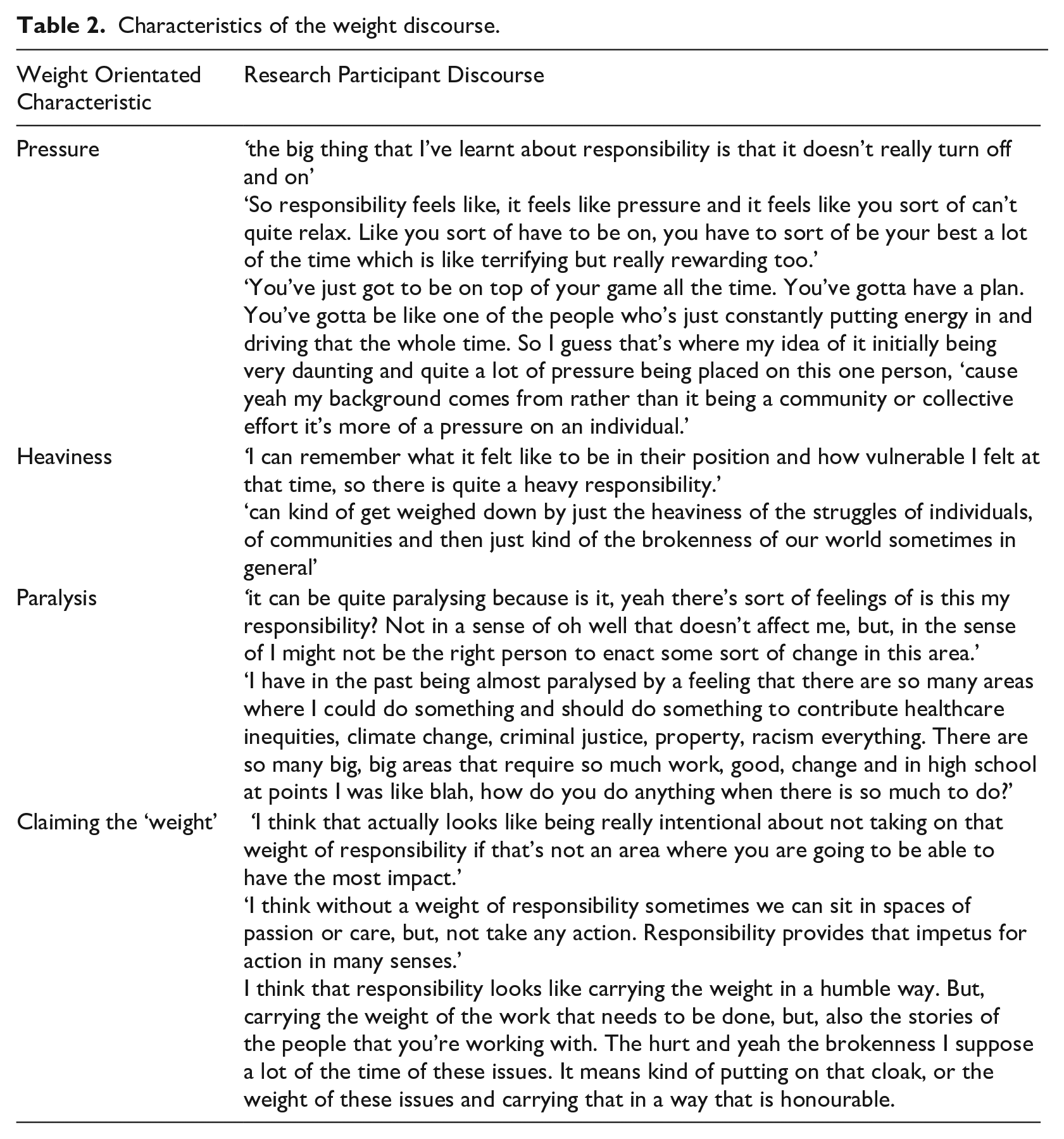
Pressure, heaviness and paralysis evoke the experience of weight in well understood ways, given the traditional theorisations of responsibility with liability, fault and expectation (Young, 2011). We note the centrality of on in terms of pressure where it doesn’t turn off and on, where you sort of have to be on and you have to be on top of your game all the time. We also note that the participants talk in the second person as a ‘you’ where you have to sort of be your best and you’ve gotta have a plan as if they are repeating admonishments that others have laid on them.
Responsibility is thus unrelenting and solitary with the feel of ‘pressure on an individual’. The heaviness discourse builds on the notion of pressure through phenomena that present as problematic and substantive in terms of being vulnerable, struggles of individuals, of communities and brokenness of the world. These kinds of issues feel like being weighed down in responsibility. One could imagine being weighed down could cause paralysis but paralysis for these participants seems associated with struggles over legitimacy (is this my responsibility? (being) the right person) and agency (how do you do anything when there is so much to do?). This characteristic of the weight discourse is driven by could’s and should’s and paralysis is the feeling of being overwhelmed.
The final characteristic, though, is one where the weight of responsibility is claimed, chosen and shouldered. Responsibility can be exercised by not taking on weight. In contrast, responsibility is distinguished from passion or care precisely through accepting its weight as a force or impetus for action. Perhaps most important is how one is carrying the weight where carrying the weight in a humble way, a way that is honourable and how that engages with the meaning of that responsibility (the weight of the work that needs to be done, the stories of the people, the hurt and yeh the brokenness) that most gets to leadership. Carrying weight thus is reframed as a practice that constitutes RL.
Space
The discourse of space is equally as prevalent and more surprising as it is fundamentally the opposite of weight thus constituting a paradox where opposites are brought into relationship. Space in the dictionary generally refers to something that is free, available or unoccupied and be understood as a blank, an interval, a vacuum or expanse. As Table 3 below demonstrates, space is most commonly assumed to be desirable and associated with potential or possibility.
Space discourse excerpts.
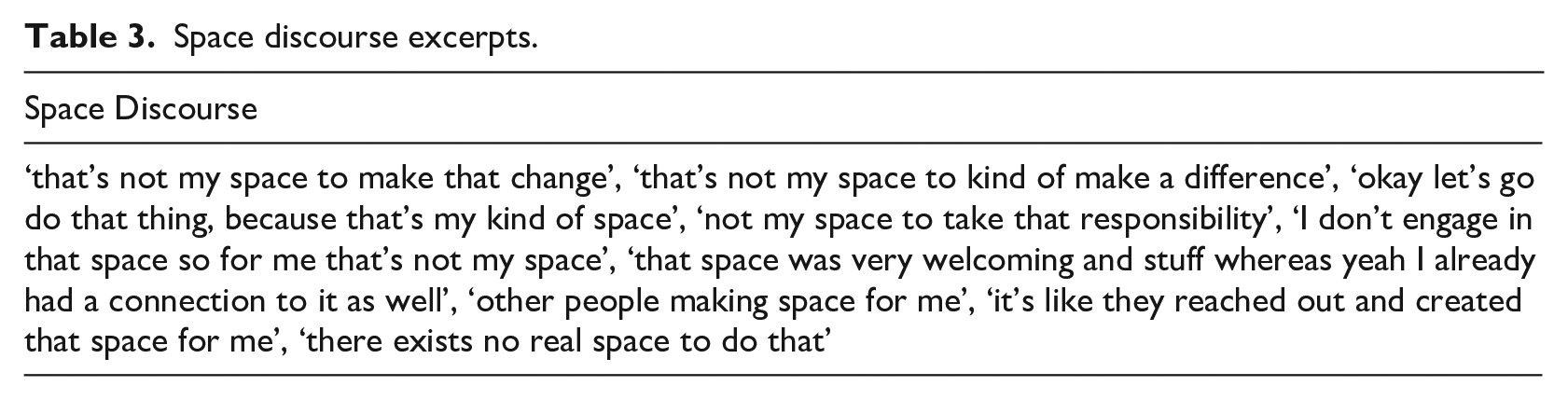
We note from the outset the pursuit, search, claiming and exercise of ‘my space’. The discourse of space carries a sense of assessing, evaluating and testing the location, promise and authenticity of those that are ‘not my space’ or ‘no real space’ as opposed to ‘my kind of space’ that is engaging and welcoming. Space though is not homogeneous, and Table 4 below shows the multiplicity of spaces that are in play for participants.
Characteristics of the space discourse.
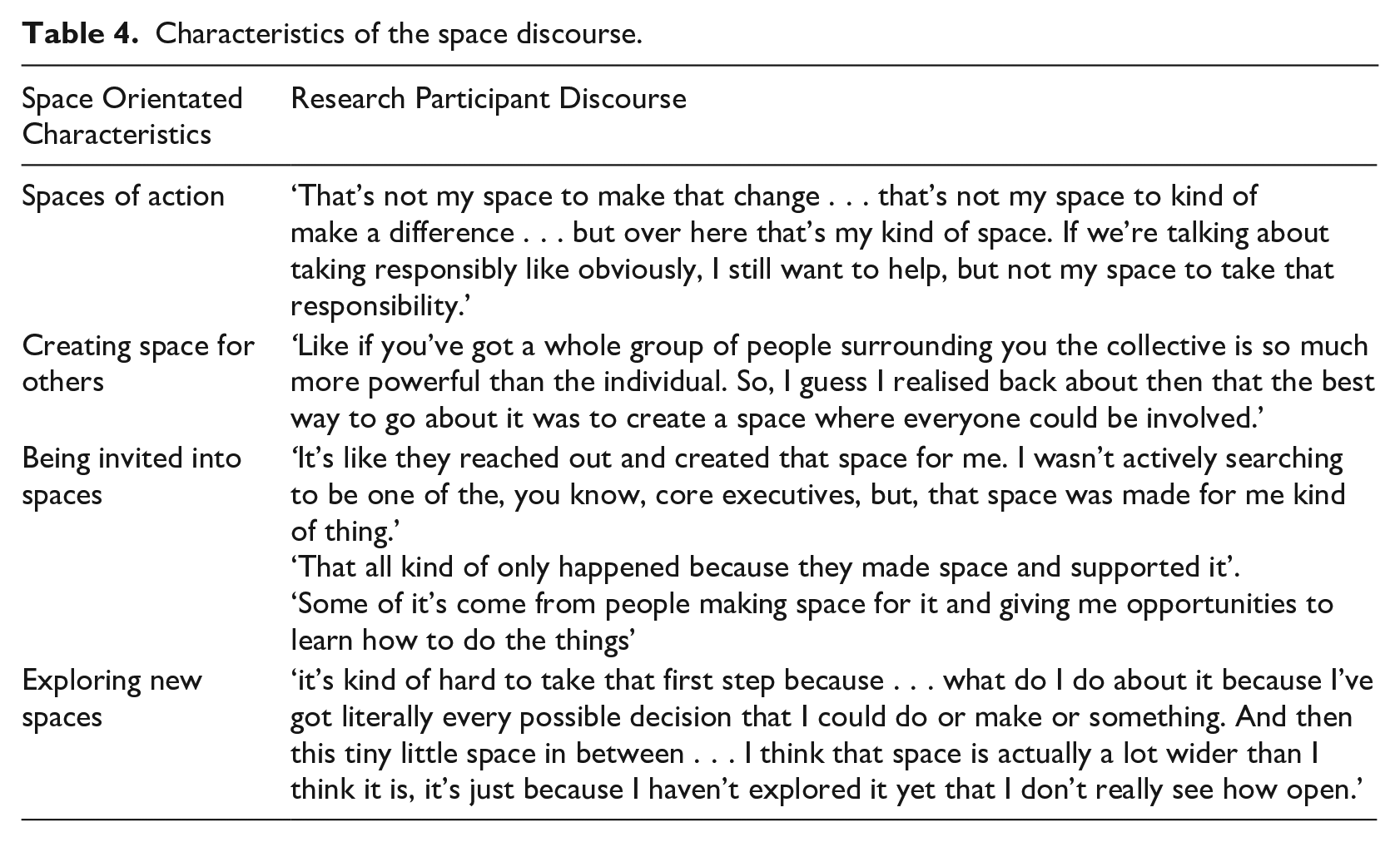
Above all else it seems participants are searching for spaces for action or what one participant terms a space to kind of make a difference. Essentially the quest for my space is a quest for a site to make that change. Responsibility has to be taken and the implication is that taking responsibility is more complex than a desire to want to help. Taking responsibility, then, would seem very complex in collective spaces although once one has ‘my space’ then create[ing] a space where everyone could be involved would appear to counter the solitary nature of responsibility explored in the weight discourse.
There seemed two routes to successfully achieving my space. The most common pathway was to be invited into spaces by others – often others already established into leadership (the they and core executives). There is an emergent quality to such spaces where the ‘they’ created that space for me and made space and supported it even when the participant wasn’t actively searching for it. Being invited into spaces would appear to remove the issues of legitimacy and agency discussed earlier.
Harder perhaps is discovering or creating a space oneself that the last category speaks to where even taking the first step is overwhelming, given literally every possible decision that I could do or make is yet to happen. The infinite nature of possible future decisions is contrasted and dwarfs a tiny little space in between the present, where only the potential exists, and the future which could actually [be] a lot wider. It is important that finding my space is linked with exploration (I haven’t explored it yet) and development (opportunities to learn how to do the things).
As outlined in the ‘introduction’ section, there is very little research on the ‘how’ of the development of RL. To contribute to this lacuna, in the next section, we theorise RLD as the active negotiation and intersection of weight and space.
Weight and space in LD
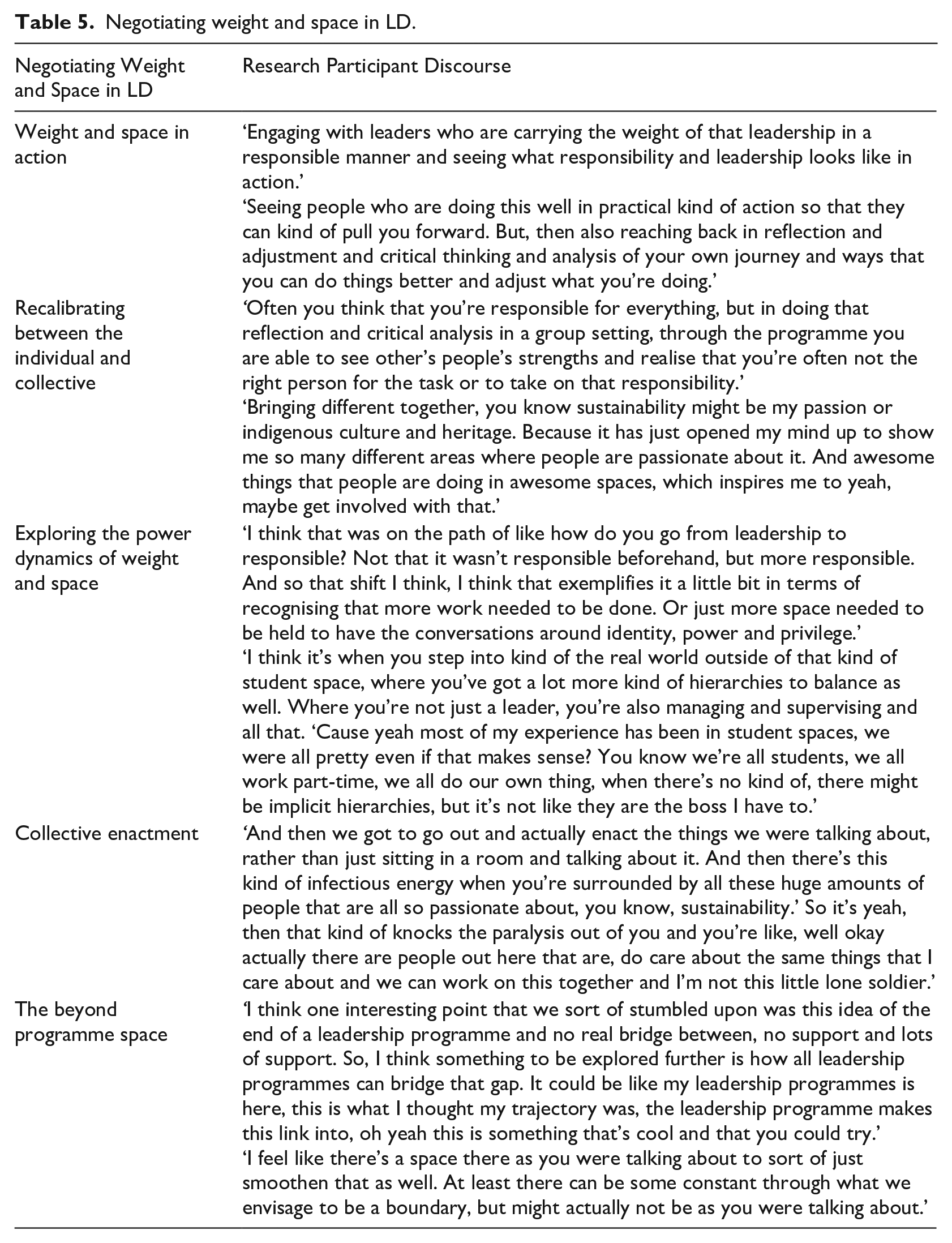
We propose that LD offers a site for exploring, developing and enacting RL. In the following section, we theorise that RL for youth in LD can be understood as the negotiation of weight and space through action, recalibration, the re-imagining of possibilities, collective enactment and participation in beyond programme spaces. The table below speaks to these experiences of weight, space and responsibility in LD.
LD can be a site where RL is modelled by those already in positions who are carrying the weight of that leadership in a responsible manner. Participants recognise this in terms of seeing what responsibility and leadership looks like in action and seeing people who are doing this well alongside their peers in the programme in the awesome things that people are doing in awesome spaces. While examples are available in the media and other platforms, LD can connect such modelling to learning and development processes such as reaching back in reflection and adjustment and critical thinking and analysis. This connection between seeing RL in action and developing reflexive, analytic and critical thinking skills lies in the capacity of LD to offer a space for the intersection of the individual and the collective in a group setting.
The group setting enables more complex interpersonal and intrapersonal development work. That work involves scrutiny and reflexivity in terms of ‘identity, power and privilege’ given as one participant says eventual entry into leadership in a ‘real world’ in which ‘you’ve got a lot more kind of hierarchies to balance’. The shift from ‘responsible to more responsible’ thus is one where individuals cannot remain ‘all pretty even’ in processes such as managing and supervising.
That LD is such a context for engaging with identity, power and privilege is of course highly contentious, but it would need to be if responsibility is to be truly explored in the leadership terrain. LD as a site of enactment also challenges the often benign and tame processes that LD too often constructs. According to one participant, enactment or collective action ‘kind of knocks the paralysis out of you’ as well as the isolation of responsibility (‘I’m not this little lone soldier’) – two consequences of feeling responsibility as ‘weight’ that were discussed earlier – replacing those with ‘infectious energy’ and collective activity.
In this empirical section, we have deconstructed weight and space and re-assembled them in relation to LD. In the discussion that follows, we first explore the implications for the ongoing theorisation of RL and, second, provide insights and practices for youth-orientated RLD itself.
Discussion
The field of RL has focused on the moral and relational leadership of senior leaders embedded within webs of organisation-stakeholder relationships (Miska and Mendenall, 2018; Pless et al., 2022). While shining a much-needed light on a broad spectrum of responsibilities that leadership navigates (Kempster and Jackson, 2021; Miska and Mendenall, 2018), we have argued that this field struggles to offer relevance and guidance to youth leadership (Dempster and Lizzio, 2007; Dempster et al., 2011). Indeed, we are reminded by Carroll and Firth (2021: 10) of the pervasive centrality and domination of adult perspectives in leadership theory, and that we ‘need to shift discourse and voice from adults to youth’ if we are going to robustly research LD for youth as leaders. In the following discussion we refer to Young’s (2006, 2011) social-connection model of responsibility and draw on her associated parameters of reasoning to offer a (re)theorisation of RL and a concomitant framework for RLD that is explicitly attuned to the needs of young leaders.
We structure our discussion around our weight and space discourses. While ‘space is the everywhere of modern thought’ (Crang and Thrift, 2000: 1), spatial metaphors have long been termed ‘insidious and almost invisible’ given they are also ‘deeply intertwined . . . in ordinary language’ (Silber, 1995: 326). They ‘structure some of our most fundamental concepts, including our concepts of time, quantity, similarity, good, and evil’ and ‘shape the way we think, feel, and act in predictable ways’ (Pitt and Casasanto, 2022: 2). It is the use of spatial metaphors to speak to ‘nonspatial aspects of social life’ (Silber, 1995: 326), such as leadership and responsibility, that is evoked in this inquiry. Below we develop a theorisation of RL by exploring these spatial discourses and drawing out four emergent features of youth experience which most vividly bring to light the tensions around responsibility experienced in LD. From our weight discourse, we focus on the global nature of responsibility and a non-heroic leader position. Both features highlight a complex relationship for youth between privilege, interest and responsibility and we suggest that such complexity can be navigated through a ‘claiming of weight’. From our space discourse, we explore the movement between spaces and the seeking of collective responsibility. Young’s (2006) power and collective ability parameters of reasoning are relevant and interrelated as youth seek to structurally position themselves and occupy spaces which can support RL. In the final part of our discussion, we draw from our analysis and turn to the question of how LD specifically can support youth in negotiating weight and space.
Weight
Weight speaks to the emotional valence and embodiment of RL where it is both felt and experienced as serious and difficult. Pitt and Casasanto (2022) note that ‘weight serves as a metaphor for various abstract concepts, such as importance, seriousness, and severity’ and is often evoked in largely negative terms that indicate a degree of hardship (Stroch et al., 2019: 198). The important quality about metaphors of weight then is that they are ‘grounded in subjective bodily sensation’ (Hotchkiss, 2013). Weight thus is an expression of embodiment and suggests a wariness, hesitation, struggle and even fear of a phenomenon of responsibility that is more than conceptual but felt. Throughout our data we noted talk of pressure, heaviness and paralysis which signalled a burden of responsibility. We also identified movement towards intentionally working with it and a ‘claiming of weight’ in areas where it felt appropriate and relevant. Rather than an organisationally defined pursuit of responsibility, our youth LD participants navigated a menagerie of environmental and societal challenges, seeking to identify particular ‘areas’ that best aligned with their expertise. The global nature of this felt responsibility presents in stark contracts to the instrumental and well-defined nature of responsibility in adult-oriented RL literature. For example, in Pless et al. (2022), responsibility sits in the ongoing resolution of a particular corporate challenge, inciting a specific range of implicated stakeholders. Alternatively, our participants experienced responsibility as an ‘always on’ pressure triggered by the ‘brokenness of our world sometimes in general’. The paralysis we identified comes from a feeling ‘that there are so many areas’ where something could be done, and so many ‘big, big areas that require so much work’. Notably, there was no articulation of an end result to be responsible for and instead RL may be best framed as an open-ended journey of carrying and wearing weight.
The scale of responsibility identified by participants also highlighted a broad and nuanced understanding of global issues, indicative of both our participants’ interests and their relative privilege as successful scholars. While from Young’s (2006) perspective, the social status and thus privilege of youth is likely to be minimal, both loosening their commitment to the status quo and limiting their responsibility to act, we must recognise the privileged positions of youth engaged in LD. Indeed, the nature of the weight discourse may be partially indicative of our participants’ enrolment in a high-profile LD programme, and a resultant feeling that they may have ‘special moral responsibilities’ to contribute to the correction of injustices (Young 2006: 128). We therefore start our theorisation of RL by noting that its undertaking, at least for our participants, was an act of leading from privilege, manifest in various forms and with our LD programme potentially providing a source of resources to support favourable positioning.
Given that themes of heroics are common in mainstream leadership theory and student leadership education (Collinson and Tourish, 2015), it is interesting that our findings are void of heroic framings of RL. Instead of presenting as gallant protagonists, when speaking of weight, our participants evoked apathy, fear (‘terrifying but also rewarding’) and feelings of being overwhelmed by the scale of things. In line with Young (2006), we might then understand a heightened interest in responsibility as motivated by a perception of being casualties or victims of a broad range of injustices. While for Young, being victimised heightens interest in responsibility and social change, we also identify intentional efforts to focus interest which provided a means to manage the weight. Making a choice about what not to take responsibility for appeared necessary to avoid apathy and disengagement (‘I was like blah; how do you do anything when there is so much to do?’). When participants connected themselves to a specific area of responsibility, we witnessed a ‘claiming of weight’ which underpinned an ‘impetus for action’. As such, we suggest that RL requires both a recognition of issues and an intentional rejection of actions in favour of focusing interests and efforts elsewhere, and where more of a difference may be made.
Space
The ‘spaces’ discussed in the empirical part of this research are largely figurative sites of leadership that the youthful participants in this LD programme are extrapolating from their previous experience or imagining as part of their future experience. ‘Space’ as a metaphor evokes what is both ‘pliable and abstract’ (Silber, 1995: 327) given the youth are not yet fully comfortable, confident or yet located in them. They evoke an understanding of leading at the intersection of the relational, social and material where responsibility is ‘concrete, tangible, embodied’ (Silber, 1995: 326) somewhere. This metaphor appears to reflect that responsibility happens in defined sites, and participants of LD programmes such as this one have to gain entry to such sites. The frequency with which the language of space and spaces is evoked speaks to the essential situatedness of RL, and the challenges faced by youth in positioning themselves in ways that socially and tangibly connect them to the issues and injustices that they wish to play a part in remedying.
To relate the various evocations of space to RL, we focus on two interrelated features of the discourse: the movement between spaces, and the seeking of collective responsibility. While spaces may be external, vague and require invitation, or be created and offered by others, in all instances, we identify the movement in, between and out of spaces as the active engagement of youth in structurally positioning themselves for RL, particularly in relation to areas they identify as ‘their space’. Indeed, Young (2006: 127) highlights how being positioned within structural processes which create unjust outcomes carries with it ‘potential or actionable power or influence’. This is sought for RL, as spaces will ideally provide youth with opportunities and a greater capacity to influence structural processes, indicating an important progression from the claiming of weight, towards the identification of a relational, social and material somewhere from which to act. Notably, responsibility appeared solitary in nature in our weight discourse, yet we can see that when evoking space, our participants are of the opinion that it is ‘more powerful’ to act collectively as opposed to individually.
The above informs an extension of Young’s (2006) parameters of power and collective ability into RL. She argues that where actors do not have sufficient resources to respond to all structural injustices to which they are connected, they should focus on where they have a greater capacity to influence structural processes (power), and where it is relatively easier for people to organise collective action to address the injustice (collective ability). While these are strong parameters for determining degrees of responsibility for individuals, we recognise them as interwoven and suggest that for RL, there is an imperative for youth to seek collective ability. This movement requires actors to enter into power relationships and dynamics through which forms of co-responsible leadership (Lloyd and Carroll, 2023) may be actioned. Thus, the discourse of space is externally focused and reminds us that RL is primarily a relational phenomenon which occurs in processes of interaction (Miska and Mendenall, 2018). While for mainstream RL these interactions exist at a ‘leader-stakeholder’ level (Pless and Maak, 2011: 4), the lack of organisationally established networks for youth highlight how entering power and positioning for collective ability can itself be a core component of RL, particularly for young people.
In terms of our first research question then, the conceptualisation of RL assembled here constitutes a core contribution of our article and stems from an analysis of weight and space discourses which transfers Young’s (2006, 2011) theorisations on responsibility into the leadership domain. We intentionally shift her theory into a more action-orientated space whereby RL is shown to require dynamic endeavours to identify and isolate areas for responsibility, and to establish structural positions which provide access and opportunities for collective action. In extending Young’s parameters of reasoning, our theorisation of RL for youth construes it as an active and situated engagement in leading from privilege, focusing interest, entering power and positioning for collective ability. Our exploration of youth experiences also offers important insights to the broader RL field as it brings to the fore the challenges of power(lessness), accessibility and social positioning, as well as felt, embodied and spatial experiences of responsibility which are not visible in the more abstracted accounts of RL found in mainstream projects.
A framework for RL development
We propose an RLD framework which develops participants’ capacity to negotiate their experiences of responsibility as weight and space, and to find connections with issues and communities through which RL may be realised. To do so we connect our prior discussion to the representations of how participants experience the negotiation of weight and space (outlined in Table 5). In this final section, we frame and explore these as practices, which we see as central in steering youth LD participants to navigate and work with responsibility. For the purposes of our framing, we have actively constructed them as ‘doing’ and hence have headed them with verbs, as shown in Table 6.
Negotiating weight and space in LD.
Practices of RLD.
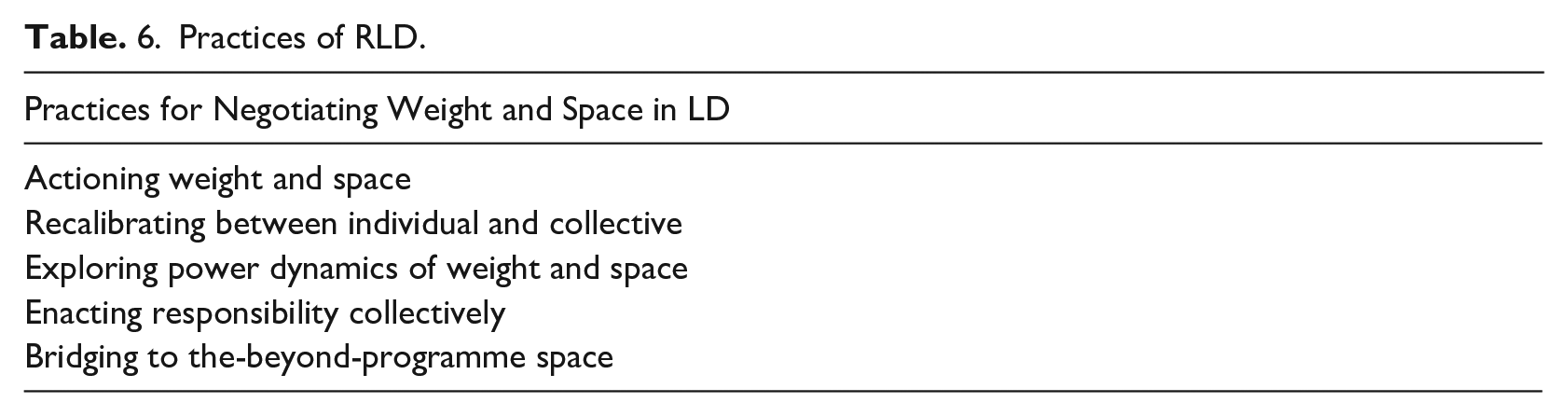
First, the balancing of weight and space must be modelled and seen in action. Witnessing others who are carrying the weight of responsibility and leading in a responsible manner provides important exemplars to those who are learning. We note that our research subjects sought to understand ‘practical kind of action’ that was not only inspirational (pull you forward) but also reflective (reaching back) suggesting that elements of both best practice and moments of disappointment or failure are both necessary to glimpse the complexities and ‘messiness’ of balancing the burden of weight and the possibilities of space. The importance of modelling has been flagged by previous youth LD researchers such as Govan et al. (2015) who recommend that youth leadership programmes emphasise opportunities for direct interaction between students and people actively engaged in social change efforts. Our findings show that opportunities for vicarious learning provide prompts for critical thinking, reflectivity and adjustment, which are important for youth looking to step outside of the status quo and enact forms of RL driven by a critical evaluation of prevailing norms (Voegtlin, 2016).
In navigating responsibility, we noted previously that our participants intentionally focused their interests and identified collective spaces to move them from a paralysing solitary experience of responsibility to a more relationally complex state of collective responsibility with others. Such a practice of positioning offers an important counterpoint to the leadership and LD fields which tend to separate out entity (individual) and relational approaches. The recalibration between individual and collective addressed here emphasises that moving in and out of responsibility only happens in relation to the movement of others, requiring responsive, sensory interaction between those who have existing responsibility, those who seek to acquire or share responsibility but lack a point of access or legitimacy and those who are blind or impervious to the need or opportunity to be responsible.
The seeking of access and legitimacy for youth also points to the complexity of power in youth RL. Our participants identified a new imperative to grapple with the realities of power as they moved from ‘a kind of student space’ to ‘a lot more kind of hierarchies’ which meant confronting ‘identity, power and privilege’ – both their own and those of others. Movement between spaces exposes our participants to other individuals and collectives, igniting and also legitimising their passion and (in)justice (‘there’s this kind of infectious energy’), which are valid trajectories to enacting responsibility (we can work on this together and I’m not this little lone soldier). LD for RL can, therefore, not be a site that ‘soothes existential distress, repairs damaged identities and protects individuals from disturbances’ but instead should ‘spark the opposite’ (Nicholson and Carroll, 2013: 1226). Allowing participants to explore their own experiences of power, privilege, anxiety and injustice could lead to them better understanding the weight they feel and identifying appropriate spaces within which to act.
These first four practices – actioning, recalibrating, exploring, collectively enacting responsibility – suggest to us a need to bring the ‘beyond programme space’ into the programme and make ‘the boundary’ between the two more porous. The students talked about negotiating this porousness in terms of ‘bridging’ and ‘smoothing’. ‘Bridging’ and ‘smoothing’ appeared more action-orientated than the conventional language of transition and transfer of learning. They revolved around dismantling and dissolving ‘what we envisage to be a boundary, but might actually not be link[ed] into’ and creating possibilities to ‘something that’s cool and that you could try’. These two movements highlight the importance of LD in supporting youth to work with power dynamics and enter spaces for collective enactment. Youth LD could, therefore, not just develop knowledge about working with and through power (in itself something we know to be lacking in much of youth LD (Carroll and Firth, 2021), but create entry points into spaces of power. This may involve encouraging connections and the development of networks between participants, their peers, mentors and external gatekeepers. Bridging participants out of LD, potentially into active enactment of RL, will require the kind of support that encourages them to enter and contribute to full and complex spaces.
Conclusion
We began this enquiry on the premise that positioning responsibility at the core of leadership practice is imperative for addressing the grand challenges facing society today and in the future. Noting scholarly opinion that responsibility has yet evaded critical scrutiny (Lloyd and Carroll, 2023; Voegtlin, 2016), we sensed an opportunity to interrogate the intersection between responsibility and LD. It was our research subjects in a youth LD programme that orientated us towards the embodied, felt and aesthetic qualities of responsibility and through so doing challenged our over-preoccupation with abstract and conceptual models in scholarly work. Given that the latter so dominate RL research, we offer a framework based on weight and space as a potential reframing of responsibility for leadership in general and RL specifically. Most of all, however, we hope to speak to the differences between adult- and youth-orientated LD, and the fresh perspective and contribution those in youth LD can make to how we identify, conceptualise and practice leadership both within and from such programmes. In short, we have followed their lead in approaching, characterising and manifesting such a significant but underresearched phenomena such as responsibility in leadership.
