



Abstract
In this article, we report an ethnographic, arts-based research inquiry into a leadership development initiative designed using principles of Organisational Theatre. We explore dynamics of relevance and intentionality that have been over-assumed and under-researched in leadership development to tease out implications for research and practice. Our empirical material is drawn from interviews, focus group workshops, an ethnodrama process, sustained observation and questionnaires. We offer two interconnected contributions: 1) the significance of ‘the politics of intentionality’ in a theoretical framing of leadership development and 2) the role of aesthetic reflexivity in navigating such politics. These contributions are accessed through a performance ontology anchored in the dramaturgical analysis of social life most famously applied by Goffman. Our overall framing of intentionality as a nuanced, fluid, plural and political alternative to purpose offers novel insight into the field of leadership development.
Introduction
The development of leadership is a ‘politically contentious activity’ (Mabey, 2013: 359), primarily because there are many, often incommensurable, understandings of what is being developed and for what purpose (Jackson and Parry, 2011). Relevance and motivation have traditionally been ‘almost invariably subsumed and taken for granted’ in contexts of leadership and its development (Kempster et al., 2011: 318). Commissioners of leadership development (LD), for example, may adopt an entirely different set of motivators from participants, and these may or may not be visible. Critical scholars, in particular, have noted the propensity for leadership development programmes (LDPs) to be laden with hierarchy and normalising practices (Gagnon and Collinson, 2017; Raelin et al., 2008), which can become problematic if brought into tension alongside more emergent, possibly emancipatory ideals of individual participants.
Although LD has become wildly popular across recent decades (Grint, 2000), scant research has attended to these diverse ways to make sense of purpose in LDPs. The ‘endemic vagueness’ of leadership (Alvesson and Spicer, 2012) and the mystique of its development may hinder the consistency with which objectives are met. As practitioners and researchers we have witnessed suspicion among participants who remain unclear as to why they are invited, or required, by an organisation to undergo LD. Indeed, others within LD scholarship now recognise more attention is required to explore the prevailing assumptions around the value leadership development programmes (LDPs) deliver to participants and society (Ryan et al., 2021). We agree with Bolden (2016) who notes that the ‘desired outcomes’ (p. 143) of LD are difficult, if not impossible, to achieve if underlying logics are not critically evaluated and understood.
In this article, we argue that even an enhanced focus on value, purpose and ‘desired outcomes’ may obscure some of the more nuanced and political dimensions underlying the design and delivery of LD. We explore instead an under-researched aspect of LD that we refer to as intentionality. In support of the growing ‘aesthetic turn’ in LD (Schedlitzki et al., 2015), we draw from tradition within the field of applied theatre that has long recognised the ‘politics of intention’ (Balfour, 2009), and use the term intentionality to encompass the complex and myriad micro-expressions of motivation, ideology, justification, desired outcome, expectation or goal that are often nested together under a wider framing of purpose in any interventional activity. Applied Theatre regularly debates the risks and impacts of developmental activities (Mullen, 2015; Prentki, 2015) and the majority concern appears to be an undercooked appreciation of the complex ideologies informing development work (Balfour, 2009). Practitioners and commissioners are advised to develop what Balfour (2009) calls ‘political intelligence’ (p. 354) so they might artfully weave together a multitude of intentionalities to ensure outcomes are best serving those most in need.
It is our intention in this paper to apply a similar critical scrutiny to purpose and intentionality in and of LD. We do so through an empirical study of an arts-based LDP carried out in an organisation we refer to as Toolzone, based in New Zealand. We ask two associated research questions: 1. How might expressions of purpose be better understood as actively constructed, shaped and negotiated in the practice and processes of LD? 2. In what ways might these expressions be productively navigated by actors involved in LD? In seeking to answer these questions, our findings lead us to offer two key contributions to LD scholarship and practice. First, we propose that our theoretical framing of LD as the negotiation of intentionality within performance invites further critical research to scrutinise assumptions around planned and emergent development. Second, we argue that understanding intentionality as a dynamic, subjective, collective and political construct, directly associated with perceptions of purpose and relevance in LD, offers implications for the design and delivery of LDPs and offers aesthetic reflexivity as a way in which to actively engage with the political dimensions of intentionality within and around LDPs. In these ways, our research contributes to understanding of the widely examined tensions around purpose, outcome, ideology, process and impact that continue to plague the field of leadership and its development (Schedlitzki et al., 2015).
Our article is structured as follows. We begin by examining tensions around purpose, process and outcome in LD to further frame our focus on intentionality. We then outline the way aesthetics, and performance, infuse our research design and methodology. In our empirical material, we trace the interplay of intentionality in a LDP carried out for employees of the New Zealand branch of a global construction supplier. Finally, we discuss the implications and limitations of this work and suggest future avenues for LD research and practice.
The contested territory of purpose, process and outcome in LD
Echoing the technicist perspective of management education (Holman, 2000), LD has traditionally adhered to a functionalist perspective (Mabey, 2013). Such a perspective sees leadership as ‘broadly self-evident and essentialist’ (Mabey, 2013) and development in instrumental terms: inputs are participants, the instrument is the development activity and outputs are ‘better’ participants (Larsson et al., 2020), equipped with practical skills and competencies to advance organisational goals and needs (Bolden, 2016). Even today, many commissioners of management or leadership development marry purpose to transactional or instrumental outcomes. They invest in programmes in the hope of seeing returns that might include ‘a greater skill in leading, alignment to organisational ethos and values, and greater commitment to the organisation’ (Larsson et al., 2020: 142).
Cast in opposition to functionalist paradigms, increasing numbers of scholars from critical and dialogic discourses (Mabey, 2013) recognise the limitations of such reductionist approaches (Larsson et al., 2020). Jones (2006), for example, asks ‘exactly how does an organisation measure the net present value of improved leadership capability’ and ‘is it possible to make a direct correlation between an LDP intervention and that team’s improved performance’ (p. 482). Adapting Holman’s (2000) model of contemporary management education, Bolden (2016) sees a need for experiential and critical approaches to LD that aim to generate leadership action that is less instrumental and more ‘emancipative’. In these more progressive LDP’s, ‘outcomes’ may be leaders and managers who are more critically reflexive and questioning of authority, willing to challenge traditional organisational values and practices. They may even be those most willing to bring conflict to a situation (Kennedy et al., 2015). While we recognise the appeal that a cohesive set of outcomes within a functionalist paradigm might offer, we align with this latter group that seeks to understand richer, more contextualised and diverse experiences of LD. One trajectory gathering momentum as it moves away from functionalist paradigms is anchored around a logic of practice. Scholars within the leadership-as-practice domain (Cunliffe and Hibbert, 2016; Raelin et al., 2018) claim a practice orientation can prevent leadership and its development from becoming ‘mechanistic’ (Carroll et al., 2008: 364). Where competency is rooted in objectivism, practice is explicitly constructionist and assumes relationality where bundles of practices are the source of meaning and identity construction (Schatzki, 2005). A practice perspective argues that the majority of action takes place ‘on the hoof’ (Chia and Holt, 2006) and involves situational, improvised response. Action is ‘immanent’ (Chia and Holt, 2006) and ‘unfolds along with identity through feeling, responding, coping and negotiating with the day-to-day’ (Carroll et al., 2008: 367). In the LD arena, a practice view focuses on the processes of development. Programmes are ‘not concerned with the transfer of knowledge about leadership, but rather with the generation of new knowledge that enables people to more effectively shape and take up their roles as leaders’ (Bolden and Kirk, 2009: 82).
The tussle between purpose/outcome- and practice- or process-oriented approaches to LD reveals an interesting paradox. Larsson et al. (2020) note that, while the vast majority of LDP’s pursue a unitary purpose associated with the alignment of organisational goals, their pedagogy remains focused on developing the capability and agency of individual leaders. This individual development, however, must by nature be a plural, contextual process with emergent outcomes. There is evidence that, by ignoring the subjective way participants individually and collectively make sense of an LD experience, destabilisation, dissatisfaction and distress may be felt (Larsson et al., 2020). LD activities that ignore or are misaligned to personal context may even be harmful, for example, where previously held impressions of identity are destabilised or threatened, or anxiety is generated through a perceived disconnect with institutional conditions emphasised in the programme (Kjellstrom et al., 2020). To avoid such harm, therefore, and instead to serve the wide-ranging development needs of both participants and organisations (Hansen and Bathurst, 2011), programme commissioners and facilitators can no longer assume a singular, fixed purpose. We believe the complexity of the relationship between a priori purpose-outcome, and the shifting wants, needs and hopes of participants in LD warrants closer inspection.
Arts-based development, aesthetics and intentionality
In an attempt to reach beyond the kind of benign, reductionist LD that favours competencies, stability and rationality (Schedlitzki et al., 2015), critical leadership scholars have called for research that helps understand the tensions and contradictions of collective sense-making in organisations (Bolden and Gosling, 2006; Carroll et al., 2008). There is an observed ‘necessity for developing leaders who are able to bring conflict and diverse perspectives into the conversation’ (Kennedy et al., 2015: 308). These calls have spawned a now well-established canon of scholarly activity that explores theoretical connections between organisations and aesthetics (Adler, 2006; Grint, 2000; Guillet de Monthoux et al., 2007; Hansen and Bathurst, 2011).
The word ‘aesthetic’ denotes a category of practices or artefacts of artistic or art-like nature (White, 2015) which may include beauty, grace, the comic, the ugly, the sublime, the picturesque (Strati, 2000). Aesthetic approaches ‘problematise the rational’, by, for example, challenging the assumed dominance of physical settings and highlighting neglected but potentially productive aspects of organising, such as poetics, symbolism and metaphor in organisations (Linstead and Hopfl, 2000). Despite the widespread recognition that aesthetic elements matter, however, an empirical focus on aesthetic practice still hovers at the fringes of LD research. Carroll and Smolovic-Jones (2018), for example, suggest that applying an aesthetic lens may open up alternative ways to articulate, frame and evaluate LD, but, aside from recognising the ‘rich and generative possibilities of aesthetic engagement’ (p. 191) they leave the imagining of these possibilities to others.
The empirical studies that do focus on practice explore the ways in which arts-based methods enable leaders and LD participants to access new forms of knowledge (Kennedy et al., 2015; Ladkin, 2008; Schedlitzki et al., 2015; Sutherland, 2012). Sutherland (2012), for example, advocates for arts-based methods to generate ‘aesthetic reflexivity’ and ‘memories with momentum’. Meisiek (2003) and Barry and Meisiek (2010), evidence sensemaking and catharsis as features of theatre-based development. Taylor (2008) describes the power of organisational theatre as an ‘unfreezing’ device. Ladkin and Taylor (2010) argue that aesthetic processes generate a form of ‘embodied authentic leadership’, while Nissley et al. (2004) examine the politics of employing theatre-based interventions in organisational development. Other leadership scholars have experimented with montage (Kennedy et al., 2015), storytelling (Hansen et al., 2007), dance (Springborg, 2010) and music (Bathurst and Williams, 2013) in their LD research. Practitioners using aesthetics and aesthetic activity recognise that, contrary to the assumption that ‘meaning is carried (unchanged) through time’ (Cunliffe et al., 2004: 261), meaning derived from the ‘aesthetic moment’ (Linstead, 1994) will find new forms and may even evaporate altogether.
Despite this hive of activity, we have found no aesthetically oriented research that brings together intentionality or purpose and LD. One related field that highlights the political dimension of intentionality is Applied Theatre (AT), a tradition that has its roots in the educational pedagogies of Paolo Freire, John Dewey and Augusto Boal. There is an acknowledgement within AT that intentionality has a relationship with aesthetics and is politically charged (Balfour, 2009). Like some in LD, applied theatre practitioners are concerned about ‘mechanistic outcomes’ (Carroll et al., 2008), and they warn against an imbalance whereupon a development activity can become too controlling, operational, or over-instrumentalised (White, 2015).
Arts-based LD has earned a reputation for accessing non-cognitive forms of knowing, or the ‘lived experience’ of development from a participant perspective. It has yet, however, to home in on the political dimensions of the ‘why’ or ‘what for’ in LD. Taking our lead from scholars within AT, therefore, we sense potential in applying aesthetics or arts-based approaches to extend understanding around the politics of intentionality within LD. It is, therefore, to our methodological approach and research design that we turn next.
A performance ontology
In this inquiry, we understand LD as a performance of the contemporary organisation’s management of change, culture, learning and development. Such an understanding stems from Goffman’s (1959) suggestion that life could be analysed using a dramaturgical perspective, with every interaction constituting a socially constructed performance. Performance has a rich and varied contemporary usage. At its broadest, performance is any action that is ‘framed, enacted, presented, highlighted, or displayed’ within an interaction (Schechner, 2013: 2).
The performance turn (Haseman, 2006) in organisation studies reflects a paradigm shift in understanding how all activity – including LD – is performed. An initial conceptualisation matters here; the idea of performance as a formal event, as opposed to performance as informal, everyday interaction (Schechner, 2013). While different forms of research can utilise both, Schechner imagines them on a continuum: this inquiry reflects that view. Towards one end, ‘formal performance’ events within LD might include the ‘staging’ of an intervention that follows some form of ‘script’ comprising pre-planned activities and intended outcomes ‘enacted’ by participants, facilitators and other stakeholders. At the other end of the continuum are the ‘informal performance’ elements that most interested Goffman (1959) as constituted by individual embodied responses, dialogic interactions, and the everyday practices surrounding LD activities.
For us, performance applies primarily as an ontology or ‘performance-sensitive way(s) of knowing’ (Conquergood, 1998: 26) that informs our methods of enquiry. We also use the term in its more common form to describe a theatrical event involving ‘the live presence of the performers and those witnessing it’ (McAuley, 2010: 45). Understanding something as performed implies that (1) performance informs the active social construction of reality; (2) performance offers methodological and analytical processes with which to explore social and cultural phenomena; and (3) performance enables one to see the symbolic, coded and framed dimensions of action and interaction.
McAuley (2010) proposes that the main aspect of performance is intentionality. Indeed, supporting Goffman’s (1959) arguments around expressions given and given off, Schechner (2013) claims ‘there must be some intentionality on the part of the performer or witness or both’ (p. 45). There is, however, a distinction between the intentionality of performance and in performance. Intentionality of performance would reflect what we might call purpose or the larger narrative driving LD usually held by some combination of organisational representatives such as CEO, Executive Team, HR, and Organisation Development managers. Intentionality in performance refers to the intention each actor brings to or generates dialogically within a performance context (Goffman, 1959; McAuley, 2010), which can constitute ‘a potentially infinite cycle of concealment, discovery, false revelation and rediscovery’ (Goffman, 1959: 20). Because performance is a socially constructed, spatio-temporal, subjective, reciprocal and relational form of activity, a performance ontology would search for intentions as dialogically expressed in the interactions between LD actors.
Research site
The research site was the New Zealand (NZ) branch of ‘Toolzone’, a global supplier to the construction industry. Due in part to a construction boom following the Christchurch earthquakes, the company was experiencing considerable growth, catalysing it to consider its structure, culture and leadership. Managing director (MD) Les had recognised the potential for an alternative leadership model to supplant the traditional, hierarchical ‘command and control’ approach that existed globally across Toolzone and a need for learning and development within the team. The partnership between Toolzone and the University of Auckland was positioned to participants as a research-based LD activity, with an expected duration of up to two years, and an intent to catalyse a more distributed leadership culture over time.
Research design
We are far from the first to propose an application of arts-based methods to empirical research within the fields of leadership and LD. A ‘growing realisation of the experiential, situated and contextually sensitive nature of leadership development (Carroll and Smolovic Jones, 2018: 2)’ has driven a surge in the use of non-cognitive methods that help access participant experience in the form of imagination, intuition, empathy, stories and in-the-moment awareness (Edwards et al., 2013). Suspecting that expressions of intentionality may be most accessibly found in these versatile forms, we were keen to study an LD process that incorporated arts-based methods.
Our research partner was open to a research design with its foundation in Organisational Theatre (OT) (Schreyogg, 2001), which fell within the capability of the first author. OT is thought to elicit change in organisations through several developmental processes; second-order observation (Schreyogg, 2001), ‘unfreezing’ (Taylor, 2008), psychological safety (Meisiek, 2003) and catharsis (Meisiek, 2004). There is, however, a line of critique within OT that claims theatre-based interventions in organisations may support, rather than challenge, consensus, power imbalances and top-down leadership paradigms (Clark and Mangham, 2004; Meisiek, 2002). With this in mind, we wanted our research design to offer possibilities for criticality and participant co-creation, a space for ‘individual utterances’ and ‘expressions of otherness’ (Mabey, 2013). The implementation of the development process, therefore, became a hybrid of OT processes and techniques found in applied theatre.
The research took place over 18 months, during which time the first author was immersed in Toolzone as a team member with her own workstation, email address and uniform. She took and transcribed extensive field notes and compiled documentation including reports and email communications. Alongside observation, 35 semi-structured, conversational interviews were conducted (Kvale, 2015).
As part of the research, an LDP anchored around two theatre-based interventions was delivered, primarily by the first author, but with support from the second and third. The first intervention was a two-day ‘playbuilding’ workshop that took place after interviews had been completed. Along with traditional methods of LD, such as small group discussions around situational provocations, it utilised principles of devising, forum theatre and playbuilding, applied by theatre practitioners Brecht (1964), Boal (1995) and Norris (2009) among others. The goal of the workshop was to collectively interpret themes uncovered in the earlier phases and generate further elements that would feed into the second LD intervention, the theatrical performance. This goal had been communicated to employees when inviting them to participate, and the resulting group of 13 volunteers was an almost direct representation of Toolzone NZ, with a proportional mix of gender, ethnicity, seniority and department. Building from anonymised material generated in interviews, improvisational activities were employed to develop characters, scenarios and dialogue relevant to the current leadership practices and challenges at Toolzone. This collaboratively created material became the foundation of the theatre event: as one participant attests: ‘There was so much in the final play from what we worked on in the workshop, it was really cool, it gave me goosebumps a couple of times when you heard little lines come out, it was like ‘woo’. Especially ones that made it into songs and things. You’re just like ‘Ah, there are little phrases that we worked on’ and obviously the characters were pretty much to a T, what we had described’.
This ‘final play’ – the second intervention – was a live, ethnodramatic (Saldaña, 2011) musical theatre performance, scripted by the researcher, and performed by professional actors approximately six months after the playbuilding workshop. It was designed to elicit reflexivity and collective meaning-making, important aspects of management and leadership development (Barry and Meisiek, 2010; Sutherland, 2012; Taylor and Ladkin, 2009). The 45-minute performance had an audience of approximately 85 Toolzone employees (the entire NZ business), and 25 invited guests (including Toolzone business partners).
Immediately following the performance, a LD workshop was conducted with Toolzone employees in the same space as the performance. Reflection and group sense-making activities were facilitated by the second and third authors, and themes that emerged were summarised in a whole-group discussion. In the following days, the researcher conducted 18 face-to-face unstructured interviews with employees to capture their responses to the play and workshop. An online questionnaire was circulated and 17 responses were received. Finally, the researcher collated and presented some interim findings to the leadership team, who used these to determine further development activities, beyond the scope of the research.
Our approach to analysis of the data included conventional thematic analysis, in which themes and discourses were identified, and arts-based methods such as dramaturgical coding, performance ethnography (Denzin, 2003), ethnodrama (Saldaña, 2011) and scripting as coding (Donmoyer and Yennie-Donmoyer, 1995). In performance ethnography, the dramatisation of data is both an analytic process and mode of representation. Always present in such processes is a reflective practice that helps ground the ethnographer, refining understanding and reminding the researcher of their responsibilities (Hamera, 2013). In an ethnodrama process, transcriptions or field notes are adapted to and heighten critical moments in the dramatic narrative, a technique that gives aesthetic shape while retaining respect and integrity for the voices of participants (Anderson, 2015). In scripting as coding, possible lines of dialogue are identified from original recordings during a coding cycle and analytic memos help flesh out the peripheral elements of the script (stage directions, descriptions, etc.). Such methods generate copious amounts of material but are ideal where a holistic approach is favoured and in research that seeks to raise awareness and critical consciousness (Leavy, 2009).
Empirical material
When selecting our empirical material, we were first interested in identifying intentionality as dialogically expressed in the processes of LD. It was important, therefore, to examine different types of social interaction across the arc of the whole LD programme, including but not limited to the two main interventions themselves (the playbuilding workshop and the theatrical performance). For example, while our first and third sections of empirical material are directly associated with the interventions, our second and fourth come from conversations and presentations around the periphery. We felt it important to include these excerpts from the wider LD programme ‘context’ to indicate how intentionality was collectively constructed and shaped across the journey of the programme.
We have chosen four points that align temporally with Schechner’s (2013) depiction of the performance process. Movement one is from the ‘proto-performance’ phase and is a direct, verbatim transcription from the first group activity, the playbuilding workshop, that took place early in the LDP. Movement two, the conversation within the wider LD context, represents the ‘performance’ phase as the data relate directly to the theatrical production at the heart of the LD process. In addition, as discussed in our methodology, we consider such organisational events as performances in themselves, and we have chosen to present the real-life event (meeting) as an ethnodramatic vignette that brings to life the meeting in which the researcher sought and secured final approval to proceed with the scheduled production.
Movement three comes from the ‘aftermath’ phase, during which participants reflected on the implications of both the final performance, and the entire LD process. Finally, movement four tracks shifts in the interpretation of intentionality across all phases, personified in the MD. All names in our empirical material are pseudonyms.
Movement one: does anyone have any idea?
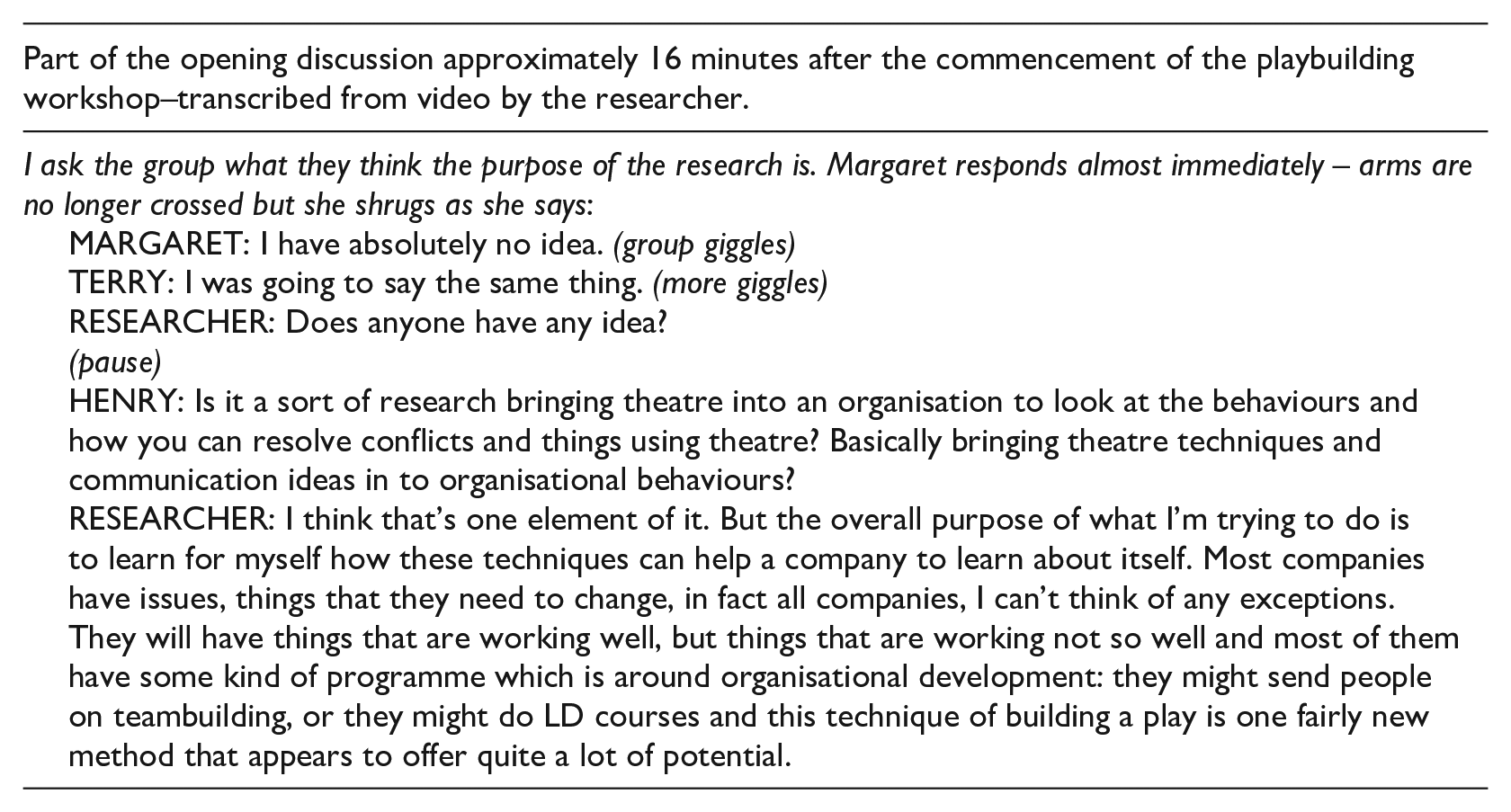
Movement one is our starting point for understanding the politics of intentionality in LD. It illustrates how organisational participants are inclined to make sense of how LD might intersect with their experience. We see expressions of individual intentionality that Goffman (1959) claims may be found in all interaction. The movement opens with a simple question designed to focus the group around ‘why’ they have come together. Although the 13 participants have volunteered to take part, the RESEARCHER does not assume a shared understanding of the motivations underlying both the overall research and the specific workshop activity. The first response – ‘I have absolutely no idea’ – is delivered quickly and emphatically by MARGARET. Her comment, supported by TERRY, could be understood as an attempt to claim a position of caution or even resistance in the face of the change prospect the activity represents. Rather than engage with this stance, the RESEARCHER diverts the question to the rest of the group, seeking additional input. She is rewarded by HENRY, who offers his interpretation of the purpose behind the intervention as ‘to look at the behaviours and how you can resolve conflict and things’. The RESEARCHER parries with her own version of ‘why’. Interestingly, however, she neither begins from a position of organisational commission, nor tries to ‘sell’ the group any ideas of what they might personally get out of the experience. Instead, she notes the assumed need for all organisations to change and develop over time and raises the inevitable provocation to explore ‘things that are not working well’. Indeed, later in this workshop, the group suggest ideas about how the leadership of this organisation might be improved. The episode can be viewed as an initial attempt by the researcher to directly engage with the need for change and to establish a space in which multiple expressions of intentionality may emerge, contest, and be shaped in a dialogic manner.
Movement two: It has got to be a celebration
Our second movement depicts part of an Executive Management Team (EMT) meeting at Toolzone, to which the RESEARCHER was invited. As discussed in our research design section, for these data except we have used a technique known as ethnodrama in which verbatim text is abridged or adapted to emphasise the dramatic sense of the dialogue. In this case, the ‘script’ below was generated through a combination of field notes made by the researcher and a recording of the meeting. The meeting took place after the workshop of movement one and in the lead up to the theatrical production. Although the original design was approved months ago, there are suggestions of uncertainty as to the future of the project, and ongoing negotiation seems necessary.
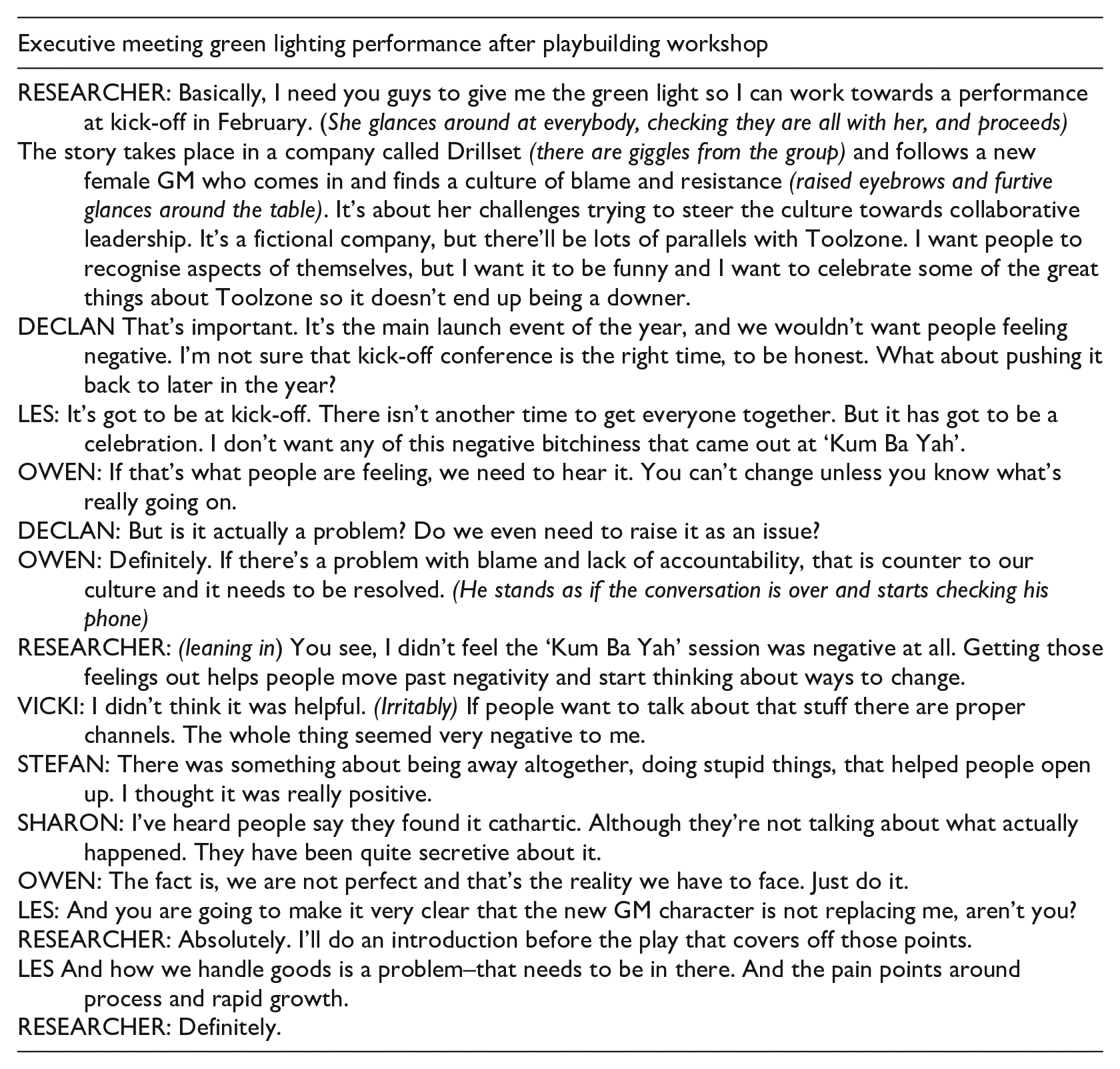
Intentionality features heavily in the dialogue of this vignette. There are multiple references to wants and needs, first from the RESEARCHER and then others present, expressed in both ‘I’ and ‘we’ terms, from personal and organisational vantage points. The subject under discussion–the main theatrical performance–is expected to meet several, possibly oppositional objectives, most notably revealed in the dialogue between OWEN and DECLAN. The events of the programme so far, including the playbuilding workshop (nicknamed ‘Kum Ba Yah’) appear to have generated an unsettling or ‘unfreezing’ of the status quo (Taylor, 2008) and there is a palpable anxiety around potential outcomes.
Our performance ontology invites us to consider the EMT meeting itself a performance, with all the political dimensions that entails (Kershaw, 2002). While the actors present were not consciously ‘performing’, it revolves around the dialogic framing and presentation of an issue (whether to proceed with the scheduled theatre event) and mediating between past experience (the LD process so far) and a plethora of individual and organisational intentionalities that may or may not eventuate. As in all performances, drama, tension and conflict are evident and the outcome (in this case the ‘green-lighting’ of the theatre performance), is contextually dependent on the relationships between actors, which may be determined by strategic or political allegiances. Yet, no matter how close a relationship, the other actors in any performance will never fully know the agenda behind each utterance, or, as Goffman (1959) puts it, ‘no amount of (such) past evidence can entirely obviate the necessity of acting on the basis of inferences’ (p. 2).
Here, such inferences lead to a form of power struggle. The battle over how LD is to be conducted, and its underlying intentionality, is fought collectively, with ‘sides’ being chosen. Ultimately it is the MD who controls the fate of the performance and in this meeting he takes the opportunity to apply new conditions. Where there had previously been a relatively loose understanding of how the organisational intentionality might be met, additional considerations are now mooted to protect his personal designs for change. With multiple, contested expressions of intentionality in a single organisational event (the meeting), this episode speaks to some of the core dynamics we seek to make visible through our understanding of LD as performance: the subjective, dialogic and political nature of intentionality in LD.
Movement three: post-performance responses
Our third empirical movement, comprising comments A–G, comes from the aftermath (Schechner, 2013) of the performance, where different parts of the organisation critically reflect on the experience in interviews. We have grouped the data according to seniority in the business, not because we perceive LD as any more or less necessary at each level, but because doing so reveals different agendas at different organisational levels.
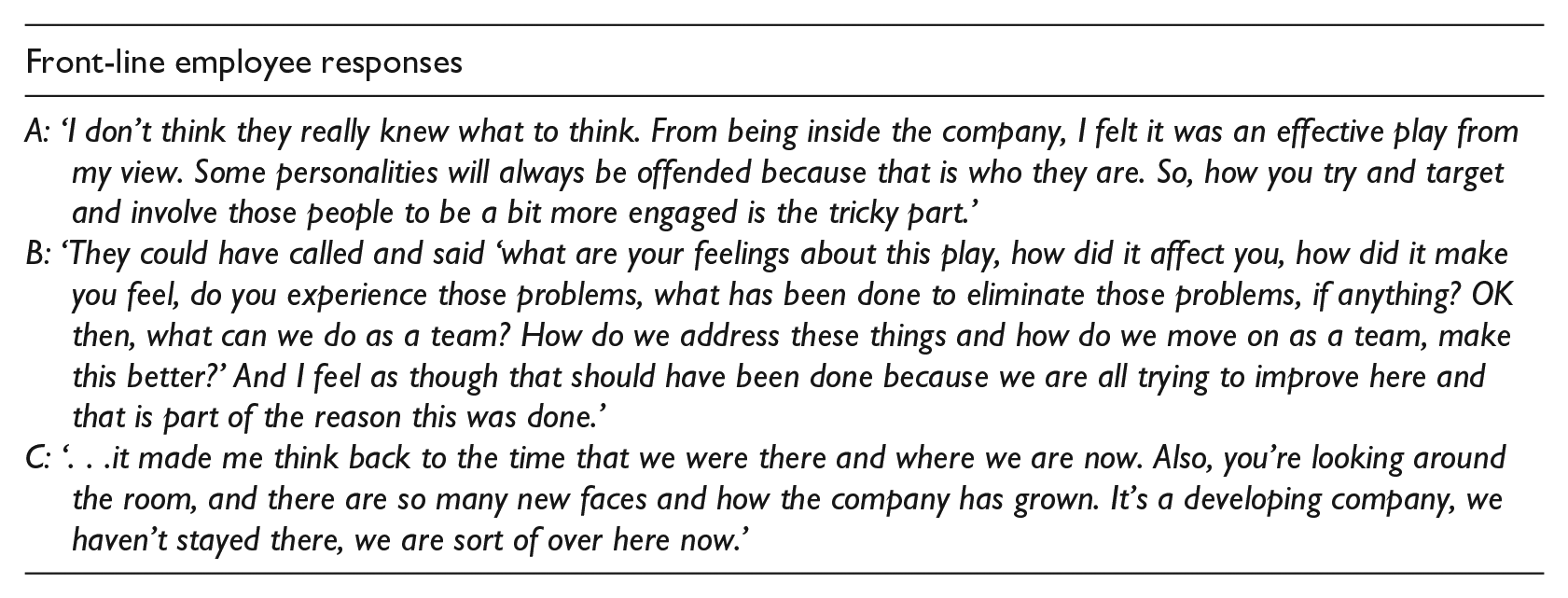
Comment A refers to effectiveness, suggesting the participant felt they had a solid understanding of the intervention’s proposed outcome through which to evaluate its effects. The comment indicates, however, that this participant felt other employees may have less developed intentionalities and struggled to make sense of the experience. It reveals that some, indeed, had been offended by aspects of the performance, perhaps where their own dominance or parameters of the existing social order inside the business were threatened in some way. If offence was an outcome of the performance as it is claimed here, it is unclear whether this employee would consider that ‘effective’. Participant A does, however, seem to think ‘engagement’ is a necessary aspect of successful development and that perhaps certain employees need to be ‘targeted’ more than others, perhaps by generating some kind of politically charged response.
Endorsing this, participant B is seeking greater engagement from leaders after the performance. This participant recognises that the objective of the intervention connects in some way to ‘trying to improve’ but is disappointed with missed opportunities to embed or operationalise the learning outcomes in a more intentional fashion. The use of ‘they’ and ‘we’ tells of an exclusionary discourse, where participant B may have been left out and let down by those holding power to deliver real change in the business. ‘Both A and B feature ‘feelings’ associated with the performance, suggesting their interpretation of intentionality may include the stirring up or harnessing of a collective emotional energy (Meisiek, 2003), or aesthetic ‘affect’ (Thompson, 2009).
Comment C illustrates an unanticipated outcome that was nevertheless welcomed by the researchers – the use of the performance as a comparative artefact with which to celebrate current success. As we have seen from movement two, there was an intention by senior management to use the performance for celebratory purposes, but it was a revelation that for some participants this celebration derived from recognising how far the company had moved away from the realities depicted on stage. There is a sense that this employee has been ‘awakened’ by the performance – recognising the journey they have been on, and perhaps beginning to question how and why the company has made such a shift. There is a sense, however, this participant believes it is organisations that change, rather than individuals. Strikingly, all three comments feature multiple characters. Rather than dwelling solely on their own response, each person refers to the actual or perceived responses of others, in either their reaction to the play, their inaction in the follow-up period or new arrivals into the business during the research indicating change over time. This excerpt suggests participants consider both change over time and the relative power individuals have over new orientations or outcomes in their interpretations of intentionality.
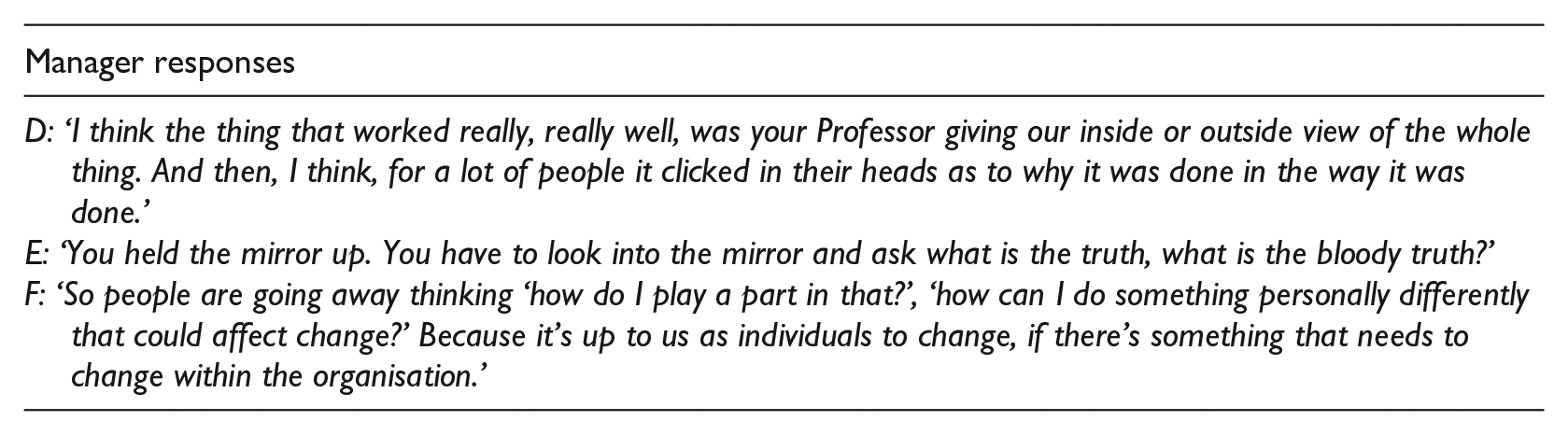
Comment D reveals the potential importance of peripheral activities that can reinforce the reasoning behind and relevance of development. In this context, the ‘Professor’ refers to the third author, who helped retrospectively frame the performance in the subsequent development workshop. The comment suggests that it may not be possible to understand the reasons for an experience’s design until after the experience.
Comment E also touches on different perspectives, this time using the image of a mirror, which appeared in multiple forms throughout the wider research as a symbol of reflection. Drama is often seen as ‘the magic mirror’ in which multiple ‘truths’ may be found. The wording of the comment is dramatic, in itself, and suggests some versions of ‘truth’ had been revealed in this performance in a way that has not been previously possible. While other comments feel relatively passive, this comment speaks to the active involvement of the spectator in the construction of meaning during performance (Kershaw, 2002). Of all the comments, this one most closely gets to the political power of theatre as a device for ‘surfacing undiscussibles’ (Schreyogg, 2001) or for giving voice to the marginalised (Prentki, 2015).
The questions in comment F focus on how to position oneself relative to the change delivered by the LD experience: ‘how do I play a part’, ‘what can I do’. In applied theatre theory, this corresponds to the shift from straightforward reflection or mimesis (the ‘what is’) to metaxis (the ‘what if’) where ‘things are seen in a new light, with a new awareness’ (Eriksson, 2011: 103). For this participant, the responsibility to deliver on the promise of the intervention rests with ‘us’. Yet, while the comment appears to align with the ‘we are all trying to improve’ attitude of comment B, one wonders if participant F may in fact represent the ‘they’ who have not yet followed up in any overtly intentional way. While there is clearly recognition that collective action is necessary to shift the status quo, having to ‘take a position’ on what that looks like may be beyond this participant, especially if that action risks destabilising the current ‘social order’.
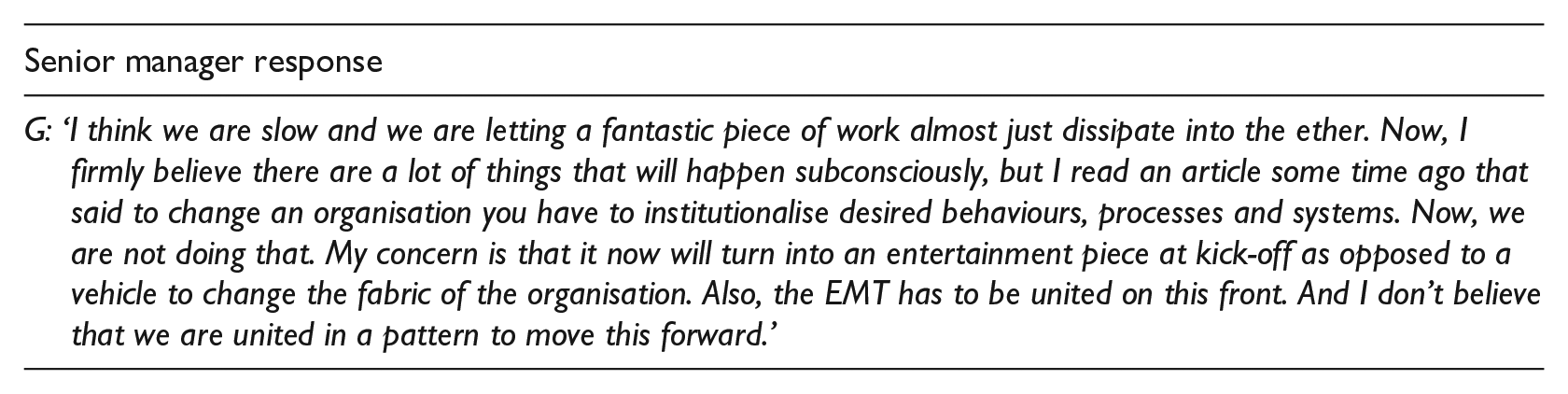
Comment G builds on comment B by reinforcing the view that the follow up to the performance has not been sufficiently considered. The language here is striking, arguably reminiscent of political rhetoric: ‘I firmly believe’. . . ‘a vehicle to change the fabric of the organisation’. . .. ‘I don’t believe that we are united’. To this participant, there is something key missing in the organisational response – the ‘institutionalisation [of] desired behaviours, processes and systems’. The comment feels somewhat like a rallying cry for mobilisation, but it also has echoes of the narrowing and homogenising practices condemned by many LD scholars (Gagnon and Collinson, 2014, 2017). Although other comments also recognise the diversity in reactions to the theatre event, this is the only one to talk about unity. It seems to assume that unified action, possibly connected to a singular understanding of expected outcome, is a necessary factor in LD or change more widely. By virtue of their seniority, this participant was present at the event depicted in movement two. When placed alongside the rapid-fire, dialogic construction of intentionality that unfolded during that meeting, this comment has a scripted, and politically sophisticated, feel.
Movement four: leap of faith
Our final movement captures three communications that are relevant to the construction of intentionality. All of these involve the MD, as author, editor or client. They span many months, the first having been drafted prior to the commencement of the research in December 2015, the second delivered during a conference in February 2016, and the last performed on stage in January 2017.
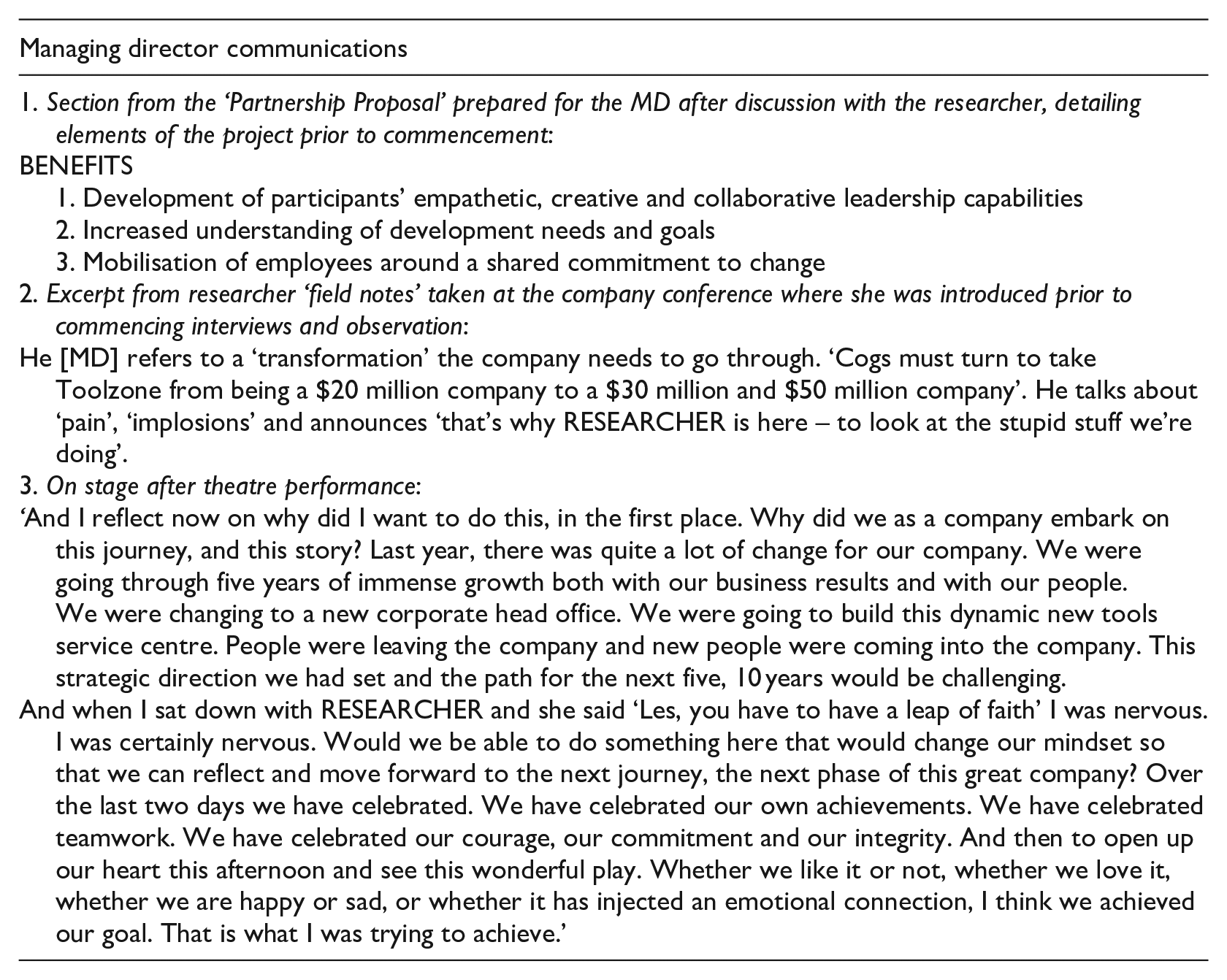
Evident in movement four is the way intentionality changes significantly even within a single person, not least the person who commissioned and sponsored this LD programme. While there are some parallels between the first two excerpts and the final speech on stage, the most striking element of this movement is the way the MD has retrospectively adapted his intentionality to match what has unfolded. His performance here constitutes the formal, public closing point of the programme – the ‘last word’, so to speak. There is a sense of summation, a ‘stepping back’ to appreciate the whole journey. The MD openly describes the reflective process by which he has reconnected with the original intentionality of the programme. With the juxtaposition of ‘why did I.’.. and then ‘why did we..’.. in the first two sentences, there is an indication that he has assumed ownership (or power) over and responsibility for the whole LD process from the outset, and that his interpretation has been both available and shared. Perhaps related to this personal responsibility, there is a sense of justification for the path chosen, particularly in the final statements around the ‘goal’. The MD’s current moment interpretation of that original goal seems to consist of two parts: first, the imperative to change the collective mind-set within the organisation in a way that will enable future success, and; second, the need to celebrate.
Yet, applying a more critical and political lens, there is a classic discourse visible here, one of a positional leader shrinking back into the safe and familiar ritual of ‘this has been a success’. Granted, different emotional responses are acknowledged, but nowhere visible is the courage to ask ‘what might now be possible’ through embracing all of the many diverse reactions that have been brought into the open. The statement ‘I think we achieved our goal’ seems to almost shut down any possible threads of future development that might evoke the cycle of discovery and rediscovery Goffman (1959) identifies.
Discussion
We believe this research makes two significant contributions to LD. First, our theoretical contribution is to introduce the politics of intentionality into LD scholarship. Our theorisation of intentionality as a political, dynamic and subjective construct – the lived experience of purpose – offers a novel way to track nuanced shifts in the ongoing political dynamics that weave through any LD intervention. Through this research, LD is understood to be a collective, emergent and potentially emancipatory process continually fashioned and refashioned by expressions of intentionality. This theoretical framing supports and develops existing critical theory and empirical research that seeks to further understand elements of power, resistance and identity within LD. Second, our primary practice contribution is our proposition of aesthetic reflexivity as one form of ‘how’ those engaged in LD might navigate the politics of intentionality. In this section, we will discuss these contributions and close with some observations around limitations and ethical considerations.
Earlier in this article, we observed that LD scholarship has traditionally rested upon assumptions around the concrete nature of purpose and outcome in LDPs. Our first research question, ‘How might expressions of purpose be better understood as actively constructed, shaped and negotiated in the practice and processes of LD?’ was intended to challenge such assumptions. A research methodology that employed arts-based development helped us to access the ‘far more difficult to untangle [and]. . … the hidden, assumed premises on which the work is based and the unstated purposes that may drive it’ (Jackson, 2007 in Balfour, 2009: 354), thereby revealing an under-researched aspect of LD that we refer to as intentionality.
As an answer to our first question, intentionality offers a more nuanced and practicably useful alternative to purpose. The latter has almost invariably been assumed to be singular, fixed, a priori, determined at the outset of a development intervention, often connected to economic or mechanistic outcomes, and revisited only in evaluative terms to calibrate against initial expectations. It is held closely by commissioners of development or change and is somehow separate to the realities unfolding within the development space. We believe what we see in movement one – participants arriving into LD essentially in a vacuum, with little consideration of or contextual understanding of why they are there – is a common feature in current LD practice.
In contrast, intentionality can be understood as the lived experience of purpose (Schedlitzki et al., 2015). It is this ‘lived’ quality with all its dynamism, plurality and political sensitivity that offers potential new theoretical insights for LD. For instance, Kjærgaard and Meier (2022) claim one of the major limitations of contemporary LD is a risk of loss of relevance, which they frame as the ability to carry learning through into action. Like earlier scholars, they pose an important question: how to prevent the learning from evaporating in the days and weeks following a LD intervention. Intentionality may be helpful here. Our participants in movement three use different terminology to denote relevance; ‘effective’ (comment A), ‘affect’ (comments B and F), ‘worked really, really well’ and ‘clicked in their heads’ (comment D). What they are describing are subjective, individual judgements of relevance, measured against a current moment lived-experience intentionality, as opposed to a lofty, abstract notion of purpose. In other words, when asking ‘is this relevant to me’, or even ‘what am I going to do as a result of it’, one needs to know what one is trying to achieve at the present time and in a sufficiently granular way as to provide meaning to the current context.
In any performance, as shown most clearly in movements two and four, this assessment of relevance or risk can happen on a moment-by-moment basis in relation to strategic and political alliances, ideologies and agendas. Such a process is part of the potentially infinite cycles of concealment, discovery and rediscovery Goffman (1959) identifies. Precisely because we are constantly shifting between the roles of performer and observer, simultaneously giving off and manage the impressions of our own and others’ intentionality in performance, it is inevitable that intentionality is shaped, or manipulated, by others. While there is certainly the potential that this sometimes happens in an insidious way, it is most evident in our data where contrasting positions openly collide. In movement two, for example, different expressions of intentionality, some overtly political, appear to contribute to moments of division and tension.
Performance studies argue that such moments are where intentionality is made most visible, potent and realisable. Kershaw (2002) describes ‘a knife-edge’ (p. 8) between continuity, the ‘real world’ of the audience’s socio-political experience (p. 26) and change towards what doesn’t yet exist, the ‘possible worlds’ created by performance (p. 26). Movement two constructs such a knife-edge between ‘a culture of blame and resistance’ (real world) and ‘a culture towards collaborative leadership’ (possible world). Different players argue different possible courses of action, essentially lobbying others to join their cause. We argue that LD researchers, commissioners and practitioners need to be more comfortable identifying, operating with, perhaps even deliberately generating, ‘knife-edge moments’ where contested positions, intentionalities and ideologies are more visible. Such moments may unsettle and energise LD in a way Carroll and Nicholson (2014) think necessary, and potentially enable participants and facilitators alike to access the kind of expansive ‘new knowledge’ Bolden and Kirk (2009) envisage.
The ability to face up to crisis without an irrevocable falling apart is something that Kershaw (2002) characterises as ‘the paradox of rule-breaking-within-rule-keeping’ (p. 28). It is this paradox that enables actors to ‘play’ with movement, difference and alternatives in dialogue without risking their relationships, and which can encompass multiple intentionalities within a single project. It is clearest when the MD asks, ‘And you are going to make it very clear that the new GM character is not replacing me, aren’t you?’. Given it was the MD who originally negotiated the intentionality of the intervention as distributing leadership beyond himself, his statement that he is not ‘replaceable’ confirms the ‘rule-keeping’ that the more ‘rule-breaking’ aspects of the conversation (an example being ‘The fact is, we are not perfect and that’s the reality we have to face’) have to respect. Struggling to reconcile what has previously been agreed and the current needs for both the group and the wider organisation is something we believe happens repeatedly in LD contexts. As Larsson et al observe, commissioners of development carry a kind of hope that is often over-simplified or reductionist. While they claim to want to develop the agency and capability of individual leaders, they may shy away from the implications of this, that can include destabilisation, dissatisfaction and even distress. The MD in Toolzone clearly struggles to navigate this tension. In movement two, he understands that ‘pain points’ must be addressed, but he still articulates the need to spin a positive, celebratory tale that contains no risk to him directly. In movement four, he is in full politician performance mode, exuding retrospective justification, emotional reflection and visionary rhetoric. Our theoretical focus on the politics of intentionality draws attention to what could be understood as inauthentic performances driven by political or ideological motivations. Applying a ‘politics of intentionality’ lens over an LD intervention may then bring to light possible alternative LD activities and dynamics that surface and call into question established leadership patterns. Through it we can see ‘how conflicting truth claims about leadership come into being and may actually coexist’ (Fairhurst and Grant, 2010: 175).
Our main practical contribution responds to our second research question. We asked, ‘In what ways might these expressions (of intentionality) be productively navigated by actors involved in LD?’ The response we offer, that emerged from the handling of our empirical material, is through the application of aesthetic reflexivity (Sutherland, 2012), defined as ‘the creation of knowing through the appropriation and transformation of the sensory–emotional characteristics of our experiences’ (p. 28). In our literature review, we identified that, although scholars have theorised connections between aesthetics and LD, there is no research that brings a politics of intentionality into the mix. Cognisant of calls for LD approaches that ‘embrace the dynamic, subjective, interactional environments of organisational life in ways that are critical, ethical, responsible and sensitive to the contemporary realities of managing and leading’ (Sutherland, 2012), we think this is an important nexus to explore. Describing their responses to the live performance intervention, a number of participants in movement three hint at an ‘aesthetic moment’ (Linstead, 1994) that generated a shift in their intentionality. In such moments, an aesthetic experience jolts a participant into ‘another mode of perception’ (p. 1322), usually requiring a transition from pre-conscious feeling to a state of conscious understanding – the ‘lightbulb moment’ in colloquial terms. Sutherland (2012) describes an emergent criticality present in such processes and refers to the way aesthetic experiences can drive ‘self-configuration’. In our research, there is evidence that participants did indeed begin to see themselves more clearly positioned within the organisational context of Toolzone. As with other arts-based learning methods, this dawning recognition was uncomfortable for some, yet possibly also cathartic; for example, participant E who claimed the performance had asked ‘what is the bloody truth?’. Our performance jolted people to ask themselves ‘where am I in this change’, a question that requires consideration of allegiances and ideologies, conscious or otherwise.
Building on the studies outlined in our literature review, our research shows that arts-based methods, such as those that generate the aesthetic reflexivity described here, help participants locate themselves within LD and may enable them to ‘go against the grain’. Like so many organisations, Toolzone is a place where ‘the necessity of robust conversations contends with the realities of power dynamics and habitual responses shaped by pressures for performance, order and efficiency’ (Kennedy et al., 2015: 316). It is also, however, a site where aesthetic moments, and a conscious politics of intention can create space and ways for LD participants to claim leadership, not just within a LD context, but beyond. Here, by connecting the seminal work of Goffman (1959) with more recent insights into aesthetics, Applied Theatre and critical LD we are offering something central to LD practice: A shift from viewing LD as a planned spectacle to an understanding of LD as an ongoing narrative where the seeds of future mobilisation, capacity building and relevance can emerge from the aesthetic reflexivity and negotiation of intentionality generated in interventions. Such a prospect creates the possibility of LD being more responsive, participant derived, ground up and emancipatory (Bolden, 2016) as opposed to a management led, top down and contracted.
Proposing a theoretical and practice connection between the politics of intentionality and the application of arts-based processes to generate aesthetic reflexivity generates complexities that need to be addressed. It is one thing for practitioners of LD to encourage ‘political intelligence’ and active negotiation of intentionality in an LDP, but it may take significant skill to then deliver the processes by which commissioners and participants can work with these ideas. One of the constraints that we see potentially limiting further application of this research is the breadth of experience and capability required to navigate these dynamics. For example, Balfour (2009) recognises that applying arts-based practices to generate learning in organisations is a risky and ‘messy’ process that requires care and vigilance. According to Balfour (2009), political awareness is vital, but can also ‘mis-guide’ facilitators tackling contradiction in the ‘complex political and social web’ that a development context entails (p. 347).
The implications from this practical contribution, therefore, include some recommendations for practitioners but also for researchers working in this space. We know from experience that utilising arts-based methods can generate strong emotional responses and associated ethical dilemmas. Ethical choices in design, such as how much to embellish the stories presented on stage, are beyond the scope of this article but did feature strongly within the wider research project from which it is drawn. We would recommend that any researcher or practitioner keen to expand upon our ideas equip themselves with the necessary supporting frameworks to handle political and ethical considerations effectively. We would also recommend a collective approach with sufficient diversity built in to mitigate against any risks of bias or ideological dominance from within the research/practitioner team.
Conclusion
Aligning with critical scholarship discussed earlier in this article, our research claims that for LD to deliver on its promise to enhance leadership capability for the benefit of individuals, organisations and society, those involved in its design and delivery need to be confident enough to move away from safe and benign practices that simply reinforce existing norms and conventions. Such a proposition overturns the assumptions underpinning functionalist LD and management education programmes that ‘emphasise measurable behaviours and outcomes to the exclusion of more subtle qualities, interactions and situational factors’ (Bolden and Gosling, 2006: 150).
In examination of our empirical movements, we have discussed how the consideration of intentionality as the lived experience of purpose may be pivotal to understanding what LD participants and stakeholders think they are engaging in, and why it might matter. A theorisation of LD as a process in which intentionality is continuously negotiated offers an alternative to the still-dominant, transactional view of LD as the pursuit of a predetermined purpose or outcome. It draws attention to the more localised expressions of power and politics within the micro-performances of LD, and it opens up pathways for new research that might further explore the relationships between planned and unplanned outcomes and participant experiences of relevance and purpose.
Our focus on the politics of intentionality underpins our theoretical proposition; that an LDP should be considered as a meaning-making process generating emergent, potentially emancipatory, outcomes that go far beyond the planned objectives of a transactional entity. Critical approaches to LD are often focused on power and politics within the high-level messaging or content of a programme, usually considered to be owned by management and/or external facilitation teams. Our research shows that the multiple moment-by-moment micro-interactions within the performances of LD may be as important in understanding the political nature of the development process. We propose, therefore, that our framing of LD as a performance encompassing myriad negotiations of intentionality opens up new and potentially disruptive possibilities for future LD scholarship. For example, we can sense opportunities to develop new research trajectories that explore the relationship between unplanned, or improvisational, moments within LD and perceptions of relevance and/or impact. We would also like to see more empirical research that investigates alternative ways that power and politics show up in the various performances of an LDP. Extending our conception of aesthetic reflexivity, we could imagine further studies that employ different arts-based methods to uncover other political aspects of learning and development in organisations.
Our practical contribution proposes aesthetic reflexivity as a way to navigate the politics of intentionality. Due to its political, dynamic and socially constructed nature, intentionality should be continually negotiated as LD is commissioned by and carried out in organisations. Such a recognition appears to engage directly with the very point of leadership (as opposed to leader) development where social capital, collective capacity and distributed dynamics depend on conflicting truths being recognised and negotiated. Only then can LD deliver the kind of transformation that will truly impact upon individuals, organisations and society.
This research calls on practitioners and facilitators who work with organisations to identify, examine and potentially challenge an existing culture of development, in an attempt to break down some of the political power dynamics that may prevent LD from hitting the mark. Our recommendation is that practitioners and commissioners of LD avoid the temptation to fix or assume an expression of purpose at the outset of an LD process. Instead, they should work together to continuously flush out and navigate the politics of intentionality in both their own planning processes, and in the development space itself. Finding opportunities to elicit aesthetic reflexivity is one way in which they may do so, and there is a wealth of arts-based methods in the LD field from which they may begin such an artful journey.
Our research is limited by the data generated within a single LDP taking place in one organisation. Nevertheless, we see potential in applying similar techniques to other contexts, in particular other mid-sized organisations that may be experiencing rapid growth or a shift to a more democratic, collective leadership culture. We wish to acknowledge the ‘faith’ of senior managers at Toolzone that enabled this sometimes discomfiting research and we hope the practice of aesthetic reflexivity and associated learnings continue to flourish in their many leadership performances. We also hope that other organisations and practitioners will embrace the opportunity to engage with intentionality as a shifting and political construct shaped by the participants and commissioners of LD. We believe an active and continuous negotiation of intentionality across the course of an LDP will help to engage and cement relevance (Kjærgaard and Meier, 2022) for all involved.
