




Abstract
This article explores a conceptually modified notion of liminality in order to make better sense of contemporary ‘flexible’ working life. Previous conceptualizations of liminality rely on the assumed existence of socially sustained boundaries and the possibility of boundary spanning. Under conditions of liquid modernity, however, boundaries or thresholds have been destabilized to the point of collapse. Nonetheless, individuals still feel the need to establish and maintain intersubjective boundaries to preserve their own sense of well-being. To understand the new predicament faced by employees, we reconceptualise liminality for liquid times – through the notion of liquid liminality – and, simultaneously, problematize dominant conceptions of work-life balance. The implications that liquid liminality carries for the notion of flexible knowledge work are discussed. Our auto-ethnographic visual study of an academic returning from maternity leave uses a socio-material lens to exemplify the struggles of the contemporary flexible knowledge worker. It also demonstrates how the constant transition between workplace and home life is freighted with anxiety and exhaustion. We also outline opportunities for establishing new learning habits that follow from our theoretical framing and empirical analysis.
Keywords
Introduction
In times of decreased permanence in social and institutional contracts, ‘liquid modernity’ is thought to leave bonds between social actors both short-lived and transitory (Bauman, 2003). Organization studies contend that contemporary organizational and wider life has become increasingly precarious and vulnerable, as risk and uncertainty displace social trust and confidence (Lee, 2006). From these perspectives, process- and change-oriented institutions (Abrahamson, 2004) make stability a myth and predictability an illusion (Lee, 2006). This has revised thinking and raised questions about where we work and our contemporary working practices. Workplaces increasingly resemble camping sites, visited occasionally, for a short time and characterized by the possibility of vacating the space ‘at any moment’ (Bauman, 2000: 149). Simultaneously, work and non-work intersubjectively converge, as both are now construed in terms of leisure activities, ‘the trick is [. . .] to efface altogether the line dividing vocation from avocation, job from hobby, work from recreation’ (Bauman, 2005a: 34). The workplace is one that has seen a collapse in boundaries particularly with regard to work and home/public and private spaces (Halford, 2006) and as such we witness an erosion of traditional, more ‘stable’ working practices which evolved over the course of the 20th century. 1 Accordingly, the main question that we wish to pose in this article is as follows: how do workers, and particularly knowledge workers, negotiate work-life and home-life in the absence of fixed boundaries.
Despite this erosion of boundaries and increased sense of liquidity, much of the literature in organization and management domains appears to assume the existence of a threshold or a boundary dividing them in one sense or another. Specifically, the notion of work-life balance, understood as achieving a degree of equilibrium between work and personal/homelife (Allen et al., 2013: 348) is focused on stabilizing the relationship between the two states which, at least tacitly, is assumed to be distinctive. For instance, the proper balance between the two is considered to be ‘the most important issue in people’s working lives’ (ACAS, 2020). Work-life balance is widely perceived as a favourable outcome of increased autonomy associated with a variety of flexible working options and arrangements available to employees (Executive Office of the President Council of Economic Advisors, 2010; Kersley et al., 2006). Alternatively, it has been claimed that the same flexible working arrangements inhibit it. For instance, working from home for part of the week can be associated with intensification of work (Kelliher and Anderson, 2010) and therefore with poorer work-life balance (Abdoolla and Govender, 2017). Others warn that work-life balance discourse is driven by a focus on individual achievement and instrumental rationality, hence it may precondition the kinds of choices made, thus paradoxically ‘entrenching people in the work/life imbalance’ (Caproni, 2004: 208). It has also been found that while individuals may strive towards ‘segmentation’ between work and life ‘domains’ (Rothbard et al., 2005) they may end up being ‘integrated’ due to reliance on mobile technologies (Sarker et al., 2012). Indeed, once the complex factors involved in striving for equilibrium between work and life are taken into account, the simple idea of achieving work-life balance afforded by increased flexibility and autonomy needs problematizing (Warren, 2004). However, we propose that the very notion of ‘balance’ between ‘work’ and ‘life’ – a putative balance, moreover, that has been brought into acute focus by the impacts of the COVID-19 pandemic on the world of work – warrants much closer critical scrutiny and reconceptualization.
Critiques of structuralist approaches to the work-life boundary issue have already problematized the facility of construing them as manageable (Fleming and Spicer, 2004), finding the quest for balance between them ‘a cultural fantasy’ (Bloom, 2016: 588) and proposed that they are ‘continuously modulated’ (Kristensen and Pedersen, 2017: 68). Embracing those critiques, we view work-life balance as a construct involving a set of somewhat arbitrary ‘individual and organizational factors’ (Kristensen and Pedersen, 2017: 75), and find intriguing the conclusion that ‘there is no boundary between work and home, but a permanent existence of work and life’ (Kristensen and Pedersen, 2017: 76). However, we also recognize that these researchers assume the possibility of approaching ones’ ‘work’ and ‘life’ as ‘problems’ (Kristensen and Pedersen, 2017: 77), somehow accessible to an external gaze (i.e. of a researcher) and made sense of via observation and/or interviewing. Their status as ‘problems’ implies, in our reading, analytical separation between them. We posit that the attempt to understand the process of emergence of work and life phenomenologically may shed light on intricacies of a modulation that is otherwise difficult to access. Social phenomenological lenses augmented by a socio-material sensitivity to the subject’s lifeworld, and certainly the places where this is experienced (Casey, 1993; Schutz, 1962; Shortt, 2015), may also enable us to identify and access further reasons why the fantasy of work-life balance persists.
In this article, therefore, we offer a counternarrative to work-life balance literature and develop a concept that helps understand (a) the contemporary collapse of boundaries between work and non-work, (b) emerging coping strategies and (c) ways and opportunities for establishing new learning habits required to navigate this state. We explore the experience of liminality in the context of modern knowledge work. Yet, rather than perceiving liminality as something a flexible worker can learn to deal with (Borg and Söderlund, 2014: 260), we see it as a defining element of this mode of work, within which (rather than against) such experience unfolds. Our theoretical contribution to studies of post-boundary flexible knowledge work is to better understand the predicaments associated with it, specifically in the context of ongoing discussions of work-life balance. The blurring of the boundaries between work and personal life has been recognized as posing ‘a risk for workers’ health and well-being’ (Eurofound and the International Labour Office, 2017: 40), and is often seen as increasing their exhaustion levels (Golden, 2012). Yet, the pressures which dissolution of socially mediated boundaries exert on individual boundary-making in the context of work have so far been given little attention.
As mentioned, much of the existing literature interrogates boundary-making from the ‘outside’ – surveying, interviewing or observing individuals who skate the work/non-work boundary (e.g. Nippert-Eng, 1996). However, it stands to reason that approaching them from the ‘inside’, that is, taking the emic perspective (Berry, 1990) of boundary-makers themselves, could contribute new insights to our understanding of the complex interplay between autonomy, coercion and restraint, as well as corresponding tensions which are implicated in mobile/flexible work (e.g. Putnam et al., 2014). If the etic approach favours the researcher and the emic one gives prominence to the viewpoint of the subject (Harris, 1976), then the way in which we conceive liminars and liminality in this article places our work very firmly at the emic end of the spectrum.
Scant as the existing emic studies are, some researchers have attempted to explore the experience of boundarylessness using phenomenological lenses (Cohen et al., 2009). However, positioning such an inquiry within the situational context of explicit boundary-making pressures in social phenomenological and socio-material terms – that is, exploring how the already dissolved boundaries are experienced and negotiated by the individual – to our best knowledge, is yet to be attempted.
In our reading, the scarcity of studies at hand may suggest that undertaking this task demands reconsidering the conceptual toolset in use. Therefore, we introduce a conceptually modified notion of liminality as a tool with which to make better sense of the fluidity of work and life from the intersubjective point of view of the liminar. The increasing precarity of workplace boundaries demands that conventional conceptions of liminality are challenged and reconfigured so they can be applied in meaningful analytical ways to contemporary organizational conditions and working practices.
Thus, the core research questions we pose in this article are thus: How does the contemporary knowledge worker negotiate and renegotiate work life and home life in the absence of objectively fixed boundaries? What do they learn from this process? And what implications might this carry for changes in organizational practice? The contributions that result from our engagement with these questions are (a) a reconceptualization of organizational liminality – what we term liquid liminality – which problematizes the boundary-oriented notion of work-life balance; (b) an empirical socio-material exploration of consequences which the liquid liminal workplace experience of a knowledge worker carries for the notion of flexible knowledge work and (c) a critical perspective on flexible working debates, simultaneously highlighting the strain experienced by workers in meeting the demands of continuous intersubjective boundary-making and opportunities for establishing new learning habits. We contend that the boundary-making process, and learning associated with it, constitutes a form of labour that needs to be accounted for by organizations, particularly during periods of transition.
The article begins with a theoretical review on what we propose to see as the dissolution of organizational boundaries and the need to view organizations from a post-structural perspective to afford better exposure and understanding of changing workplace/work–space relations. We review the emergence and evolution of liminality (and related terms) in the context of these destabilized boundaries between work and life, to build an argument for a more liquid consideration of liminality. We then introduce empirical data to illustrate the forms of reconceptualization we seek to advance. The case is based on an experiential account of one of the authors’ transition from maternity leave back into flexible working life as a professional academic. Our findings point towards attempts to contain the work/private life spillover phenomenologically, and the socio-material effort to anchor oneself within one domain or another; or, at least learn to control the processes mediating the overlap.
The dissolution of organizational boundaries: liminality, thresholds and the flexible workplace
Resonating with conceptual traditions in which social worlds are constantly on the move (Currie, 1998), ‘liquid’ (Bauman, 2000) or ‘becoming’ (Deleuze and Guattari, 1987), and organization emerges ‘from a sea of constant flux and change’ (Nayak and Chia, 2011: 281), monotony and regularity of bureaucratic routines is substituted by the new paradigm in which flexibility is cherished (Bauman, 2000), long-term employment is increasingly substituted by ‘short-term contracts, rolling contracts or no contracts’ (Bauman, 2000: 147). The increased work involved in enhancing employability in an era of ‘turbulent unpredictability’ (Smith, 2010), improvisation (Clegg and Baumeler, 2010) and the gig-economy (Webster, 2016), weakens the sense of workplace security.
While we do not suggest that mobility and flexibility are necessarily universal for all modern workplaces, for many, organizational boundaries have tended to dissolve, and therefore the fundamental boundary between work/non-work has become destabilized. While it is possible to suggest the sense of embeddedness inherent in this distinction has always been imaginary and constructed rather than belonging to the natural order of things (Etzioni, 1961), nowadays even the illusion of security – through structurally distinguishing ‘work’ from ‘life’ in line with boundary theory (Duxbury et al., 2014) – is in short supply. The permeability of work/non-work across time and space (Kelly et al., 2014), as well as the objects we use (Yanow, 2014) and the resulting blurring of work, home and family (Glavin and Schiema, 2010) renders the scrutiny of distinction between work and everything else both important – given the need to separate mentally and physically one domain from another (Yttri, 1999) – and difficult (Perin, 1998).
Crucially, we propose that such inquiry may be even more complex, as structural boundaries may no longer exist. Work and non-work may no longer signify two distinct states but, rather, become continuous modes of embodied enactment yet are distinguishable in social phenomenological and socio-material terms. This forces us to rethink equilibrium (or disequilibrium) oriented approaches to ‘balancing’ life and work, mentioned in the opening section, to the extent that the balancing act may no longer involve dealing with two distinct domains, but rather their confluence. Equally however, as discussed above, it prompts us to reconsider the position from which critique of a work-life boundary is performed, shifting emphasis towards the individual. The working subject is caught up in an ongoing attempt to navigate a liminal landscape that always consists in self-created responses to the fluid supporting conditions of organizational life. One might think of it as ‘fluidity squared’; destabilized individuals responding and adapting to destabilized and destabilizing life conditions. Therefore, it becomes critical to revisit the transitions between work and non-work and, by implication, to recast the concept of liminality. Indeed, the latter has yet to be made sense of in the context of a post-boundary world.
Originally meaning a threshold in the physical sense, liminality is a term used to connote a spatial boundary or transitional landscape (Andrews and Roberts, 2012). Anthropologists discuss ‘a liminal period’, that is, the stage of transition following the ‘separation’ from an initial social context and preceding the ‘re-assimilation’ into society upon the endowment of a new status (van Gennep, 1909/2004). Simmel (1997) expanded the concept to include psychic spaces of possibility, embracing not only the spatial and cultural but the temporal; a transitional period which marks both a beginning and an end, as well as duration. During the liminal period the subject is not only ‘socially ambiguous’ but also ‘invisible’ (Turner, 1967: 95): no entitlements and no new sources of authority emerge, since no stable coordinates are anchored in social perceptions. The liminar is thus ‘betwixt and between’ different orders, definitions and frames constantly moving in the no-(wo)man’s land of the unstructured and uncontained. Experiencing liminality may not always be pleasant (Newell et al., 2008), and may enforce the agency no less than provide space for it (Izak, 2015), but the liminal spaces (Rottenburg, 2000) and acts of organizational liminars are often perceived as indispensable in organizational worlds, for example, in terms of enhanced creativity (Clegg et al., 2004), seeking privacy (Shortt, 2015), freedom (Czarniawska and Mazza, 2003), learning (Hawkins and Edwards, 2015; Izak, 2013), identity reconstruction (Beech, 2011), improvisation and negotiation (Zabusky and Barley, 1997), as well as creating room for political agendas (Sturdy et al., 2006).
Beyond anthropologically inspired readings in which liminal stages mark a transition between different states, it is also proposed that liminality can be permanent; a state in which ambiguity is ongoing (Johnsen and Sørensen, 2015) and its duration indeterminate (Ellis and Ybema, 2010). Permanent liminars are ‘neither-X-nor-Y’ or ‘both-X-and-Y’, thus ‘constantly’ crossing the threshold (Ellis and Ybema, 2010: 300). Taking this opening of liminality to potentially encompass an overwhelming continuum of states and behaviours, Bamber et al. (2017) usefully delimit the extension of this concept. So, in order to map out these different states and, importantly, show how our concept of liquid liminality – a post-boundary context where boundaries are only constructed intersubjectively – we have charted these in Table 1. This, we hope, helps clarify and position the unique theoretical contribution of this article.
Main configurations of liminality – drawing on Bamber et al. (2017) distinctions.
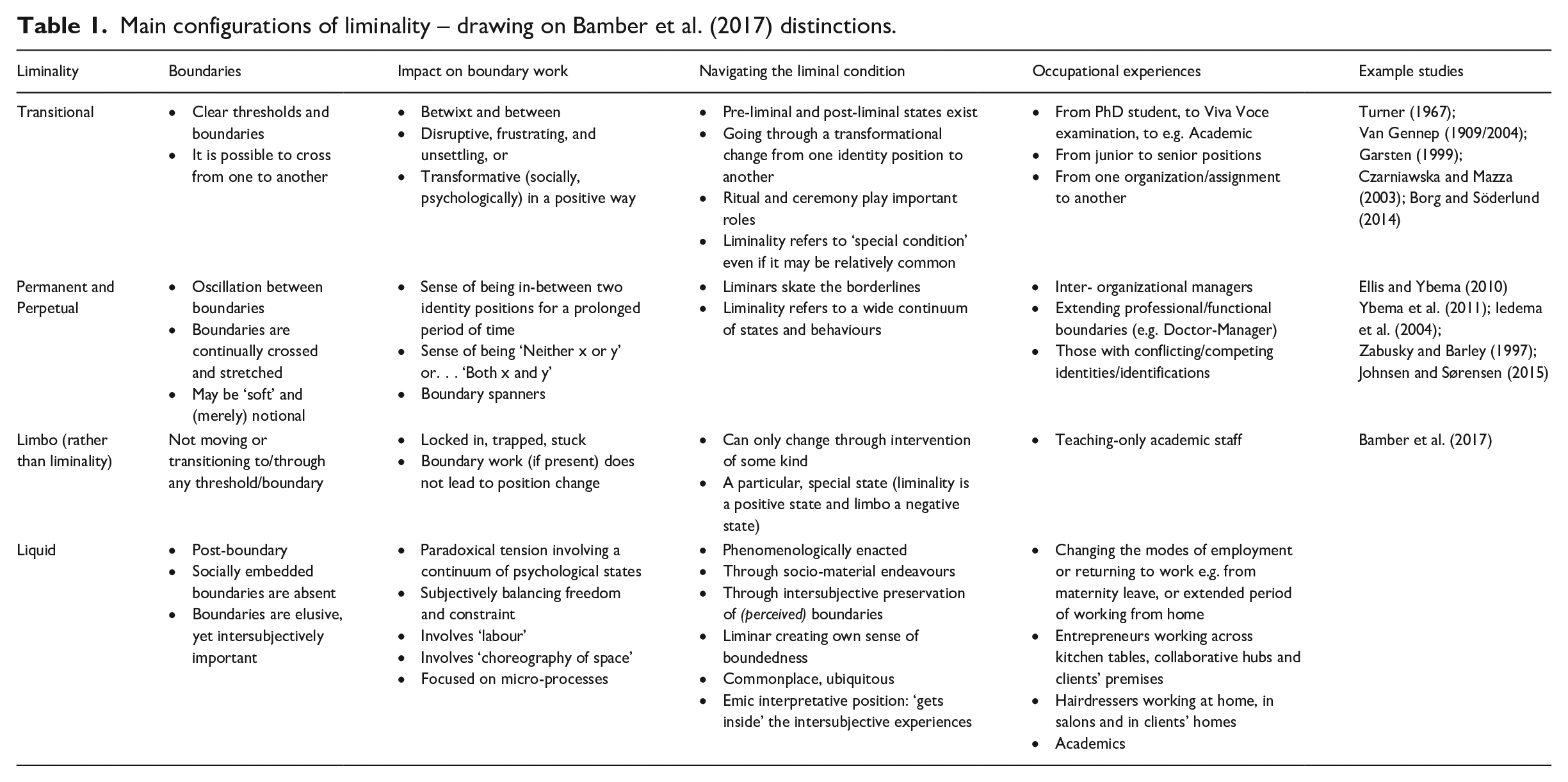
First, Table 1 shows how more traditional notions of liminality are conceived as ‘transitional’ – where boundaries are clear, and it is possible to cross from one state to another. Second, drawing on Bamber et al. (2017), there are further distinctions to be made between liminality and limbo. They propose the condition of permanently experiencing an aspirational position, perceived as inferior and/or unpleasant, while constantly striving towards a superior one with little chance of movement over the threshold, is more usefully captured in terms of ‘limbo’, rather than liminality. Third, the concepts of ‘permanent’ and ‘perpetual’ states of liminality are presented. In these states, it is suggested that the liminar is constantly crossing a boundary or oscillating between boundaries and is thus in-between two identity positions for a prolonged period.
While these contributions help to further qualify the blossoming discussion on liminality taking place in academia, all of the above assume the existence of a threshold or boundary of some kind, even where some are softer than others. Even permanent liminars are perceived as ‘boundary-spanners’ (Ellis and Ybema, 2010: 295).
At the bottom of Table 1, it is the notion and assumption of a boundary between work and non-work that we wish to challenge. The neologism of liquid liminality allows us to construe liminality in a post-boundary and post-structural context, that is, where the only boundaries that exist are those intersubjectively developed by the liminar. Therefore, while still drawing on earlier contributions to the field – particularly those emphasizing the ‘permanence’ of liminality – we believe the status of thresholds and boundaries needs to be problematized especially in the context of flexible work, the work-life balance literature, and emerging analyses of the socio-spatial/material construction of workplace conditions (see, for example, Daskalaki et al., 2016; Shortt, 2015). Thus, extending Ellis and Ybema’s concept, we explore the precise conditions under which liminality could be considered permanent. Yet, rather than seeing liminality as spanned between boundaries, we propose it needs conceptually to break its ties to notions of socially sustained and bounded domains.
Liminality provides an excellent conceptual tool for understanding the interplay between the organizational and individual construal of flexible work. While organizational preferences for increased adaptability (Way et al., 2015) and flexibility (Bal and Jansen, 2016) suggest an expectation to reduce the thresholds implied by liminality (e.g. between home and work), simultaneously the boundary work is inscribed in the individual – albeit intersubjective – performance of flexible work. Paradoxically, despite the conceptual association of liminality with boundaries, the less bounded our organizational life becomes, the greater the appeal and explanatory potential liminality seems to have. This can be seen in the classic liminal features emerging from our analysis below.
We now turn to a presentation and analysis of selected empirical data from one of the author’s visual diary in order to illustrate the fecundity of our liquid liminality concept and explore the notion of intersubjective boundary-making in a post-structural knowledge work context.
Methodology
Visual diary
The data presented below are drawn from Harriet’s auto-ethnographic visual diary that focuses on her experience of returning to full-time work, as an academic (at the time, a full-time Senior Lecturer in a business school), following 14 months maternity leave. Thus, this study occurs in the context of university employment in South West England and concerns the working life of a female academic preoccupied with post-maternity leave and early motherhood demands on her time and energy. The professional context of academics and work-life balance and the fluidity of such work-life boundaries have been explored before, particularly in relation to female academics (e.g. Toffoletti and Starr, 2016). However, our empirical data are specifically based on the experiences of an academic and early motherhood – it is this particular condition that, we feel, dramatically emphasizes the erosion and negotiation of boundaries, and experience of intersubjective boundary-making. We suggest that early parenthood is akin to liquid liminality ‘turbo driven’ and as such makes this context all the more salient in illuminating the value of understanding liminality as liquid.
This personal, visual and reflective diary documents the first 12 months of re-entering the workplace and the lived experience of the everyday tensions and ambiguities felt between work/non-work, professional/mother/wife, public/private, work life/home life and all the complexities in-between these spaces and roles. It considers how this liminal time/space is negotiated and experienced. Certainly, associations between various aspects of motherhood and the concept of liminality have been acknowledged by other researchers in fields such as health and social care, sociology, anthropology, and consumption studies: breastfeeding as a liminal act (Mahon-Daly and Andrews, 2002), liminality and women’s experiences of long-term breastfeeding (Dowling and Pontin, 2017), liminality and infertility (Allen, 2007), liminal space in cyber-space and new mothers’ identity construction (Madge and O’Conner, 2005), the liminal period of pregnancy and professional women’s experiences of multiple identities (Ladge et al., 2012), identity transition during pregnancy (Hennekam, 2016), ‘baby showers’ as rites of passage (Fischer and Gainer, 1993), and maternity dress consumption during the liminal transition of pregnancy (Ogle et al., 2013). In resonance with these contributions, but extending the methodological repertoire, Harriet chose to keep an auto-ethnographic visual diary and record her experiences of return from maternity leave (Chaplin, 2004; Holliday, 2004).
The aim here was to gather a rich, personal account that foregrounds the feelings, emotions, stories and events that were lived, felt and seen throughout this first year back in the workplace and in particular to highlight instances of liminality. As an auto-ethnographic account, this visual diary told an autobiographical story, through pictures, about Harriet’s experiences (Ellis and Bochner, 2003) and drew on the work of Chaplin (2004, 2005) and Holliday (2000, 2004), where images are used to consider the wider significance of what we see in everyday life. Harriet wanted to include images so that she might develop an ‘aesthetic sensibility’ (Chaplin, 2004: 43) to the complexities and struggles she was experiencing during this time, while writing an ‘evocative narrative’ (Bochner et al., 1997) so that the images and their meanings were individually captioned. The way in which text and image work together allows for the images not simply to be seen as documenting an experience or acting as ‘evidence’, but for them to hold meaning in and of themselves (Berger, 1974). As Chaplin argues, it is the image that ‘tends to lead, with words providing active support for that aesthetic’ (2004: 46).
Telling this story through text and image arguably allowed the intangible aspects of organizational life to be made more ‘tangible’ – picturing and using images to capture thoughts and feelings when words may fail – and ‘. . . elicit the non-verbal, tacit, emotional knowledge . . .’ (Jensen et al., 2007: 359) more readily. Indeed, rather than relying only on words and traditional auto-ethnographic text (Ellis and Bochner, 2003), the use of images helped to ‘. . . mine deeper shafts of different parts of the human consciousness than do words-alone . . .’ (Harper, 2002: 22). Words alone were not adequate to suitably capture or understand the physical, spatial, material transitioning that was occurring. Photography allowed Harriet to record and make sense of where flexible work was experienced and visually represent the blur of work/non-work.
Visual analysis
The analytical approach we adopt here is the grounded visual pattern analysis technique (Shortt and Warren, 2019). We chose this approach because it allows us, as researchers, to draw together both the discursive meanings of the images and the qualitative analysis of the narratives associated with the images, as noted above, as well as giving us the opportunity to analyse the content of the photographs and mine them for further ‘sedimented social knowledge’ (Meyer et al., 2013: 502). We felt this analytical technique was most appropriate in this context since it is grounded in privileging both narratives and images together and is led by the meanings given to the images by the maker – here, in this case, Harriet. This approach allowed us to therefore identify patterns across collections of photographs known as ‘image-sets’ (Shortt and Warren, 2019), so we might see how the negotiation of boundaries (or boundarylessness) manifests in social, material and spatial ways. These patterns then helped us to say (and see) more about the in-betweenness experienced, the transition between workplace and home life, and the personal struggles of the flexible modern knowledge worker.
To begin, Harriet returned to her visual hand-written diary and documented what each image meant to her developing, for example, codes such as ‘confused space’, ‘woolly feelings’ and ‘unclear who I am’. In turn, this dialogic process (Shortt and Warren, 2019) led to the development of the theme ‘ambiguous space’.
Next, images were grouped as ‘montages’ or ‘image-sets’ (Shortt and Warren, 2019: 545) where which enabled us to observe and comment on ‘broader field-level patterns’ (Collier, 2001). This facilitated a healthy distance from Harriet’s empirical account and allowed for a different perspective where the authorial voice might be challenged. We analysed these data as a team, with all three authors of this article viewing the image sets and conducting a ‘structured viewing’ (Shortt and Warren, 2019). As Collier (2001) suggests, team analysis offers an important opportunity to develop features of visual data and gather ‘multiple views of the same phenomena’ (p. 54). It is at this stage, Shortt and Warren (2019: 546) advise looking for patterns across the image sets, commenting on both the content and symbolic nature of the images (what they are of), and the compositional nature of the images. In, for example, the ‘ambiguous space’ image set, we noticed there were numerous images of clothes and accessories associated with appearance, various mundane objects, and notably no commonalities with regard to where the images were captured – all of them were captured in different spaces (train, handbag, study, carpark, wardrobe, etc.). Compositionally, we agreed that across the set, most images show a close-up view of the contents and a number of images are taken looking down, into a space/onto an object.
The final stage in Shortt and Warren’s analytical framework suggests ‘theorizing’, which invites to further the conceptual contributions from the analysis so far. For example, as a team of three researchers, what more do the patterns in the image sets tell us about how the contemporary liminar negotiates and re-negotiates work life and home life in the absence of objectively fixed boundaries? What do these patterns reveal about the socio-material fashioning of intersubjectively meaningful places for work in the ambiguous spaces of liquid modernity? We will return to these questions and our theorizing in the ‘Discussion’ section of this article.
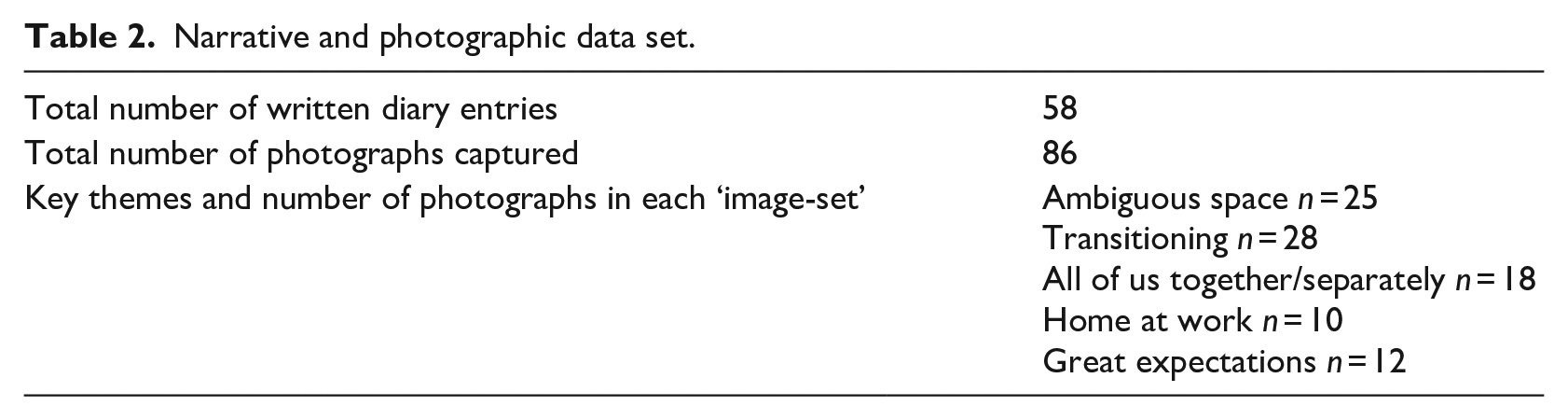
Table 2 gives an overview of the narrative and photographic data set from the 12-month visual diary, and the key themes that emerged from the grounded visual pattern analysis (two of which are discussed in this article: ambiguous space and transitioning–learning anew who I am at work).
Narrative and photographic data set.
In the following section we present an introduction, from Harriet, to her visual diary and data from two core themes that emerged from our analysis. In order to stay close and faithful to the experiential and representational account, we use first-person singular in its narrative, reflecting Harriet’s voice, in order to give the narrative voice of the liminar force and authenticity that other choices of tense would frustrate. At the point of discussion, we return to a first-person plural voice adopted elsewhere in the article.
My visual diary: seeing and narrating returning to work – an experience of liquid liminality
At the time of keeping my visual diary I was a Senior Lecturer in a business school at a university in South West England and had worked at the university for around 6 years before I had my daughter and took maternity leave. To investigate my experiences of returning to work from maternity leave, I chose to keep a visual diary for the first 12 months of my return to work. I captured photographs and notes that represented and spoke to my experience so I might better understand and reflect on the tensions and ambiguities between work/non-work, professional/mother/wife, and the public/private spheres of everyday life. It is worth noting here of course, that the mix of work/non-work had been present before the birth of my daughter – like many flexible knowledge workers/university academics, I brought work home and worked in my home. But it is early motherhood that dramatically emphasizes this mix of lives and as a new parent there is little that prepares you for the extraordinarily blurred lines that emerge, and one is expected to manage once you have returned to the workplace.
Ambiguous space
Throughout my visual diary there are numerous photographs of objects and spaces that combine home life and work life and the tensions and blurry boundaries between the two. There are images of baby wipes in my handbag next to my lecture notes and books; a pacifier left on top of my work diary; the baby monitor sat on top of a pile of books; my new baby daughter, Laura, sat in my office chair. In all these pictures, there appears to be a juxtaposition of two lives and my roles within them. They are not juxtaposed in the sense that they are contrasting but in the sense that I feel they are combined, jumbled and mixed up. There is an ambiguous nature to my spatial and material world. Whereas once there were spatial or material ‘labels’ that I might use to define where I was or what I was doing/using/consuming, now I feel all boundaries around me are fluid, leaky and up for grabs:
Today, after nursery, Russ sat Laura in my [home] office – it’s the first time she came to sit in my work space. It’s strange, I felt really resentful about her being in my space, but it also felt good – that I could sit and write a few more emails whilst she amused herself with a drink and a snack. It made me think about how this space might be mine during the day but shared with her after work hours. I’m not sure how I feel about that. I like that this is my space and is only mine. I felt really guilty about resenting her presence – does that make me a bad mother? I was preparing for some post-graduate teaching today and I found a book chapter by Debra Meyerson called ‘If Emotions were Honoured: a cultural analysis’ and she talked about working mothers and guilt! She talks about ‘simultaneous joy and anguish’ and I think that’s what I’m struggling with. Joy at the fact that I have all this flexibility and a work space that allows for fluidity but at the same time anguish that I’ve got no clear boundaries. I can’t seem to contain one thing or one activity . . . in one space. Although perhaps that’s no longer possible – maybe I’m trying to seek out a sacred space that doesn’t exist.
It is the resentment I feel here that is most significant – this space, this home office is a professional space that I feel should only be mine and I do not want to share it. On reflection, I see that since all other parts of my life have been blurred and mixed together by the arrival of my daughter, that this particular space, this professional space, is even more precious and I have become markedly more territorial and protective of it. I am desperate to defend this space as ‘mine’. This amalgamation of the socio-materiality of work and home life thus leaves me seeking hallowed ground on which I can stake claim as worker or mother but knowing and recognizing that this does not seem possible. It strikes me here, that even reading the academic books that are such defining symbols of my working life, I am absorbed by content that now speaks to a new and somewhat competing sense of who I am and where I am. Indeed, as I present these data, several years on from capturing some of the images and reflections in my diary, I still feel the same about Laura in my home office and the older she gets the more she talks and walks and wants to see and stay ‘where Mummy works’ (Figure 1). My office door is now covered in frog stickers and I have to work much harder at making it ‘my’ space.
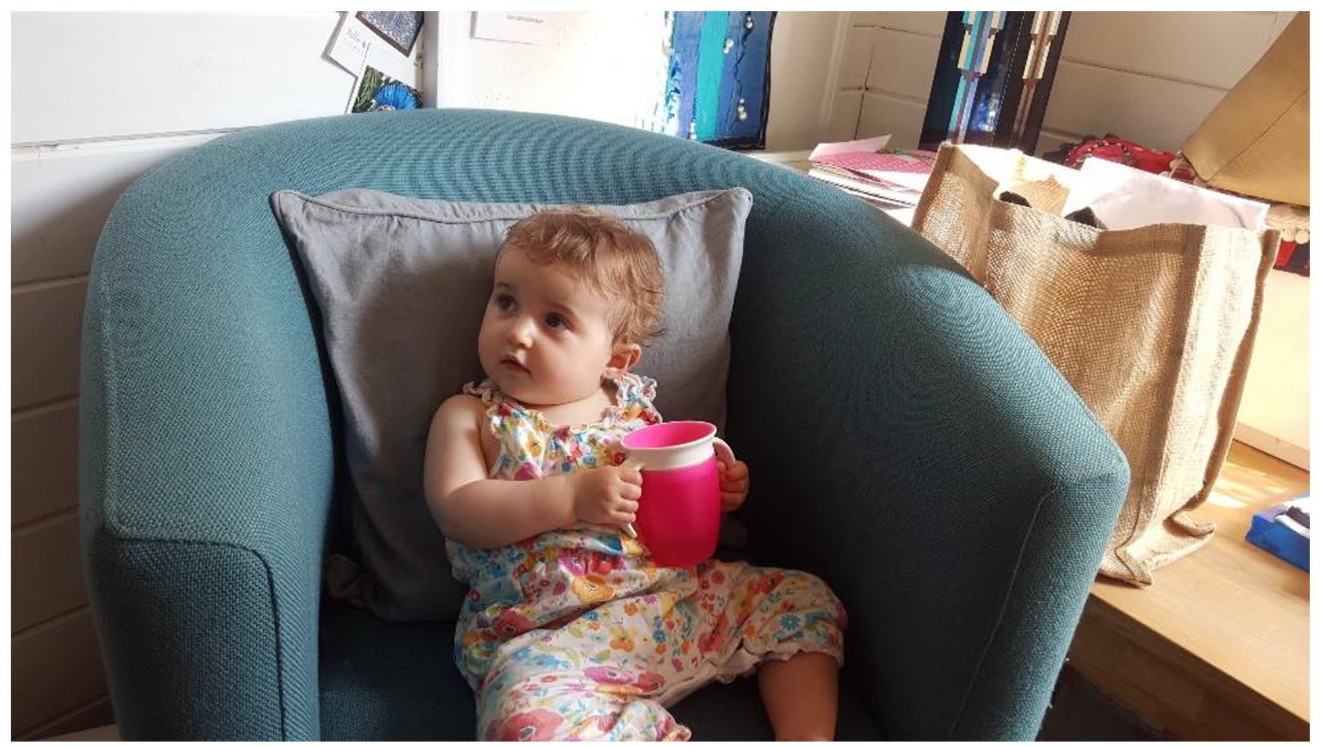
Laura in my home office – joy and anguish.
There continues to be a sense of subjectivity struggling and sometimes splitting with itself. This social phenomenological and socio-material conflict is exemplified in the liminal space of my handbag:
My handbag seems to have turned into a material container for everything to do with everything! I found a pack of baby wipes and an old dummy at the bottom of my work bag – it was actually quite useful having the baby wipes with me though . . . I could clean my desk at work. But it’s strange to find these things at work – it’s like Laura’s here at the University and with me in some way. It seems futile to try and distance myself from home life.
Even navigating the space in one’s handbag is a challenge – these baby items are to be found adjacent to an academic book. It is here again that we see early motherhood dramatically emphasizing the blur and mix between work and non-work. Before Laura, I might have had personal items in my handbag, such as make-up, but make-up was for work, the things I find in my handbag now are clear and different markers of home life (Figure 2).
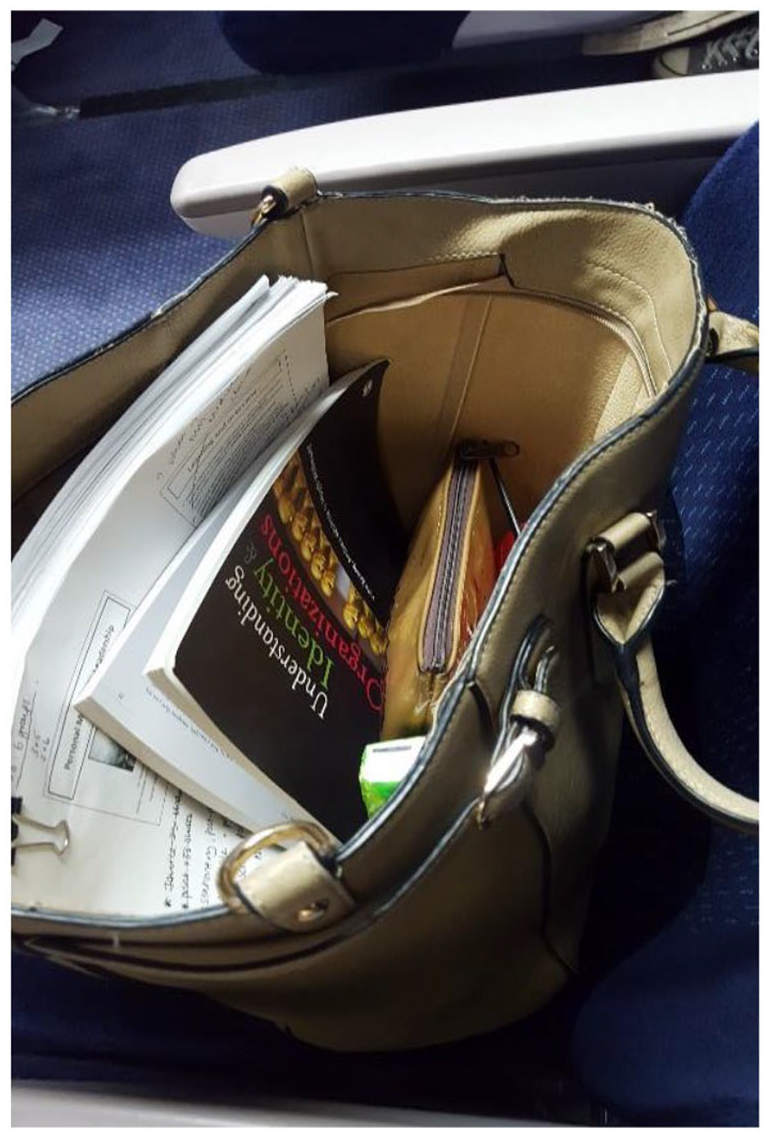
My handbag – Laura is always with me.
Throughout my visual narratives there seems to be a longing for sacred space – one that is purely defined and stable. Indeed, this longing and searching for such sacred space is evident in the very practice of my photography and the very content of the images; on reflection, very few photographs are taken in the same space and the juxtapositions are seen everywhere in multiple sites, from trains to handbags, from carparks to offices. But these multiple roles in multiple spaces create simultaneous feelings of joy and anguish. Here, my home office space and my handbag feel like lost spaces now – they have a hidden history (Bonnett, 2014) of a once self-contained ‘me’ that is fading away and, in a rather disorientating way, they are being rewritten as shared spaces.
At the same time as these struggling juxtapositions, I felt hopeful moments where the ‘blend’ of work and life might be working and ‘happening’. For example,
I took this photograph because it encapsulates everything in one – Laura, work, home, Russ . . . life in detail. It’s like that Robert Palmer song – ‘. . . you see your life in detail, such a close-up view, from another angle, like another you . . .’ Maybe this is me reshaping things – I feel a constant struggle and a sense of disorder with everything now sharing the same space but perhaps if I look at things from another angle, and by looking at the features and details of all of this, it might normalize it – rather than a somewhat chaotic destabilizing vague amalgamation of everything. Maybe it doesn’t all have to conflict. I can reconstruct a sense of continuity by seeing that this IS all working – if I take a ‘close-up view’ [like in this picture] I can see all these aspects of life are running alongside each other and that’s ok. I can have a glass of wine with my husband, whilst I do some teaching prep, whilst keeping an eye on Laura in bed. I can create spaces in which all these things work together, beside each other –I can see them as distinct but harmoniously sharing the same space.
Here, I am making and laminating worksheets for my university executive education module. I used to work on the living room floor before I had Laura – I like to be able to spread my work out and this is the biggest space – but the new fluid intrusion here is the baby monitor and again early motherhood is radically emphasizing my work/non-work mix. On reflection, and now several years back at work, I do not feel this notion of all that we are and all that we do can (or should be) ‘harmoniously running alongside each other’ is particularly helpful, certainly to working parents; that somehow it feels as if we are compelled to see it as a ‘natural’ and appropriate way of working and ‘having it all’ or ‘doing it all’ (Figure 3).
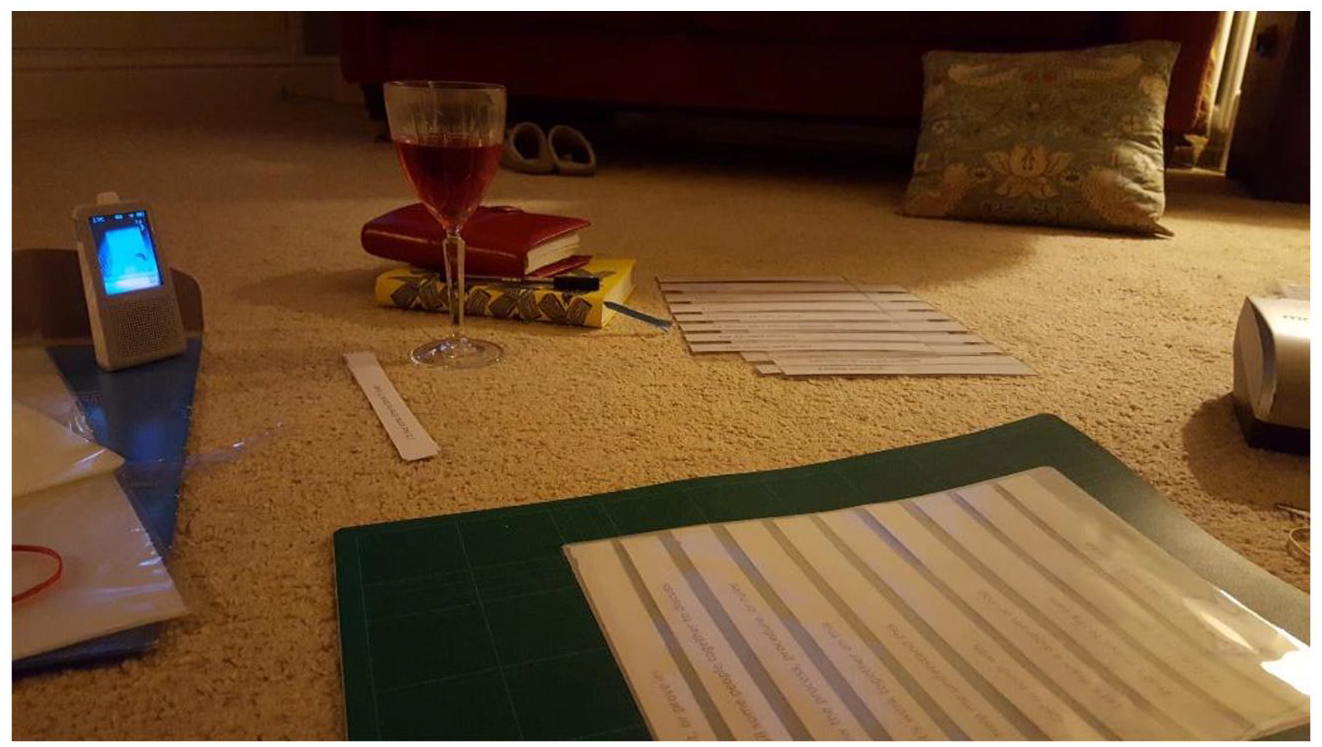
Working on the living room floor – a new configuration?.
Further considerations from this period of time extend beyond physical spaces and move to my physical appearance, including my clothes, hair and shoes. On return to work some of my clothes and shoes have changed and I have felt highly visible and insecure. The changes in my wardrobe when I first got back to work were noticed by others and I felt uncomfortable about that. For example, prior to maternity leave I was always seen in high heels, and on return to work, colleagues noticed I was wearing flat shoes more often (because I literally cannot pick up a child from nursery in 6-inch stilettos without breaking my back).
I’m so depressed about my wardrobe – it’s full of clothes from size 8 to size 18. It’s making me feel really confused about what I am supposed to be wearing. I went to a meeting today and someone said ‘oh you used to be so glamorous, always in heels’ –USED to be? . . . great, what on earth does THAT mean? So, I USED to be the glamourous one . . . so now I’m not? It really got to me and I wanted to cry. Today I stood in the queue for a coffee and one of my colleagues walked past – she said, ‘oh, I didn’t see you there . . . I don’t think I’ve ever seen you looking so casual! . . . I didn’t realise it was you, I had to do a double take!’
There is a sense of embodied ambiguity here as I negotiate my new body in old work clothes/my new body in new work clothes. However, there have been moments of rediscovery – getting myself back into clothes that I could not fit into or wearing heels that I had not been able to wear for a while. Perhaps this represents a sense of ‘anchoring’ me back into the past to ‘cope’ with this sense of ambiguity (Figure 4).
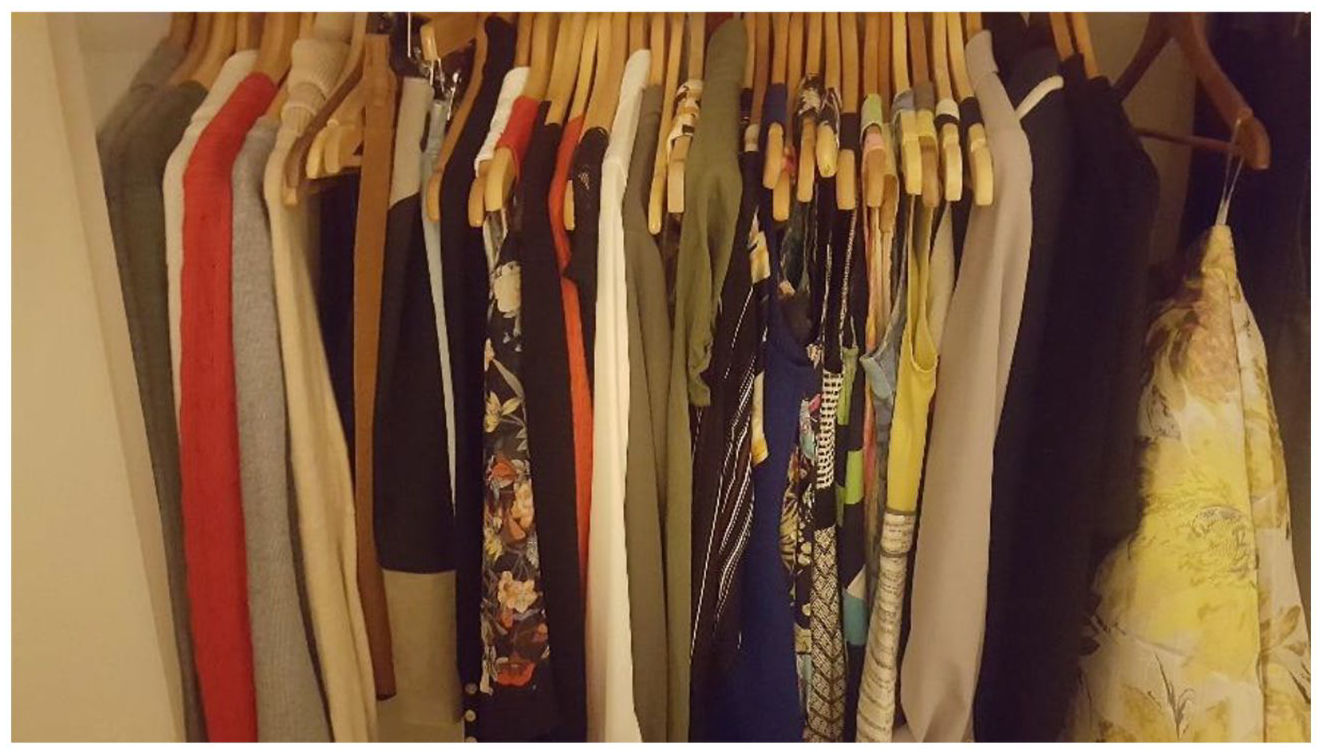
My wardrobe – confused about who I am.
Transitioning – learning anew who I am at work
Across my visual diary and the visual and textual narratives, there is a sense of travel, transitioning, moving, and learning things anew within my experiences of returning to university work. There are many photographs of spaces and objects that say something about transitioning at work, between work and home/home and work, and feeling at a distance or separated from one or the other; there are images of trains, cars, bars and cafes, office moves, doors, doorways, and windows. Compositionally, I am often at a distance when capturing these images and in relation to the scene, I am often peering through windows or separated by glass from the subject of the image. There is also a sense of coming to terms with the transition, albeit not seamlessly or without an effort.
Below is one of the many photographs I took of my journey and movements between my house (seen in the background of Figure 5) and my home office (where I am taking this photograph from):
This walk from my garden office back up to the house has become really significant. When I leave the house, I feel a sense of quiet and calm, going back down to work. Paradoxically I am usually prizing myself away from Laura if she is at home with my Mum or Russ’s mum and I feel guilty. As I walk up to the house I’m excited to see Laura but I know I might get waylaid with a hug, an enthusiastic conversation about what she has eaten, or the temptation to fall to the floor and get involved in a dolls’ tea party . . . and I’ll be away from work, with emails piling into my inbox . . . and I’ll need to leave again. Walking across this grass is a mood shifter, a distancer from one part of my life to another, a threshold that’s crossed multiple times a day. To and fro and back again, a shared boundary between mother and worker. I feel so lucky that I can work at home and pop up to see her now and again, but these to and fro feelings are exhausting’. It is not just the exhaustion of mentally creating my own boundaries, but the physical manoeuvring of stuff and things, getting myself to places that help to demarcate what I am doing – and setting them up. It’s a sort of choreography of space that needs to happen so that I can effectively establish what I’m doing and who I am. This physical, spatial choreography helps me construct the personal boundaries in my head – and vice versa.
There is a sense of push and pull here, of flitting in and out of one space, and way of being, to another, which leads to enabling the boundaries to be phenomenologically ‘choreographed’ into existence. Yet, here again, there are traces of the paradoxical experiences of liminality – the joy of flexible working within the defined, if fluid boundaries, yet at the same time the impossible feelings associated with confused and undefined spaces and a lack of boundaries, that is, one of the first things I saw when I turned on my computer on my first day back after maternity leave, was an Outlook diary reminder box stating I was 53 weeks ‘late’ for the faculty meeting.
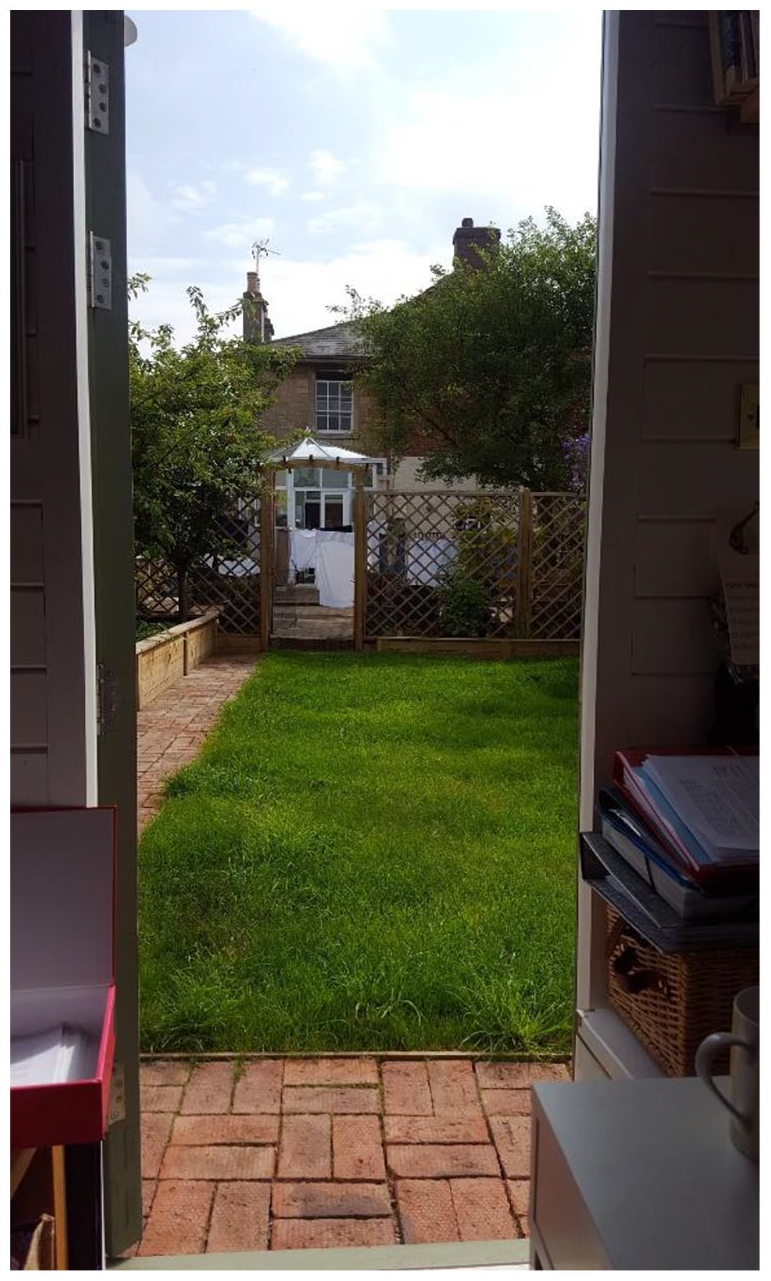
Walking from the house to my office – leaving, staying, and going, to and fro between things (I ended up taking a lot of photographs of this ‘walk’ from different angles).
Away from my home, my diary entries also include moments of transitioning back into my physical workplace. For example,
We’ve just moved into a new building and one of the first things I did when I moved into my new office and unpacked was put up little polaroid pictures on Laura across the top of my whiteboard, above my desk. It’s funny, when I first came back from maternity leave I found it odd having ‘her’ with me at work . . . the baby wipes and the dummy in the bottom of my work bag. But now I find myself colonising my new space with images of her. I’m deliberately shaping my space here and choosing that she shares this space with me now – it’s like I have moved on a bit since I first got back to work. Although when I think about it, I don’t mind her being with me at work – but I do still mind her being in my home office.
These reminders of Laura only serve to illustrate how, although physically and spatially distanced, she is with me at all times, manifested in mundane everyday objects. There are ongoing oscillations between wanting to feel close to ‘home’ and the attempt to carve out time and space ‘away’. And although – figuratively speaking – I am relentlessly in two places at once, I have now grasped how to, in my workplace office, deliberately and consciously shape and define that space through and with the use of, for example, images of my daughter (Figure 6).
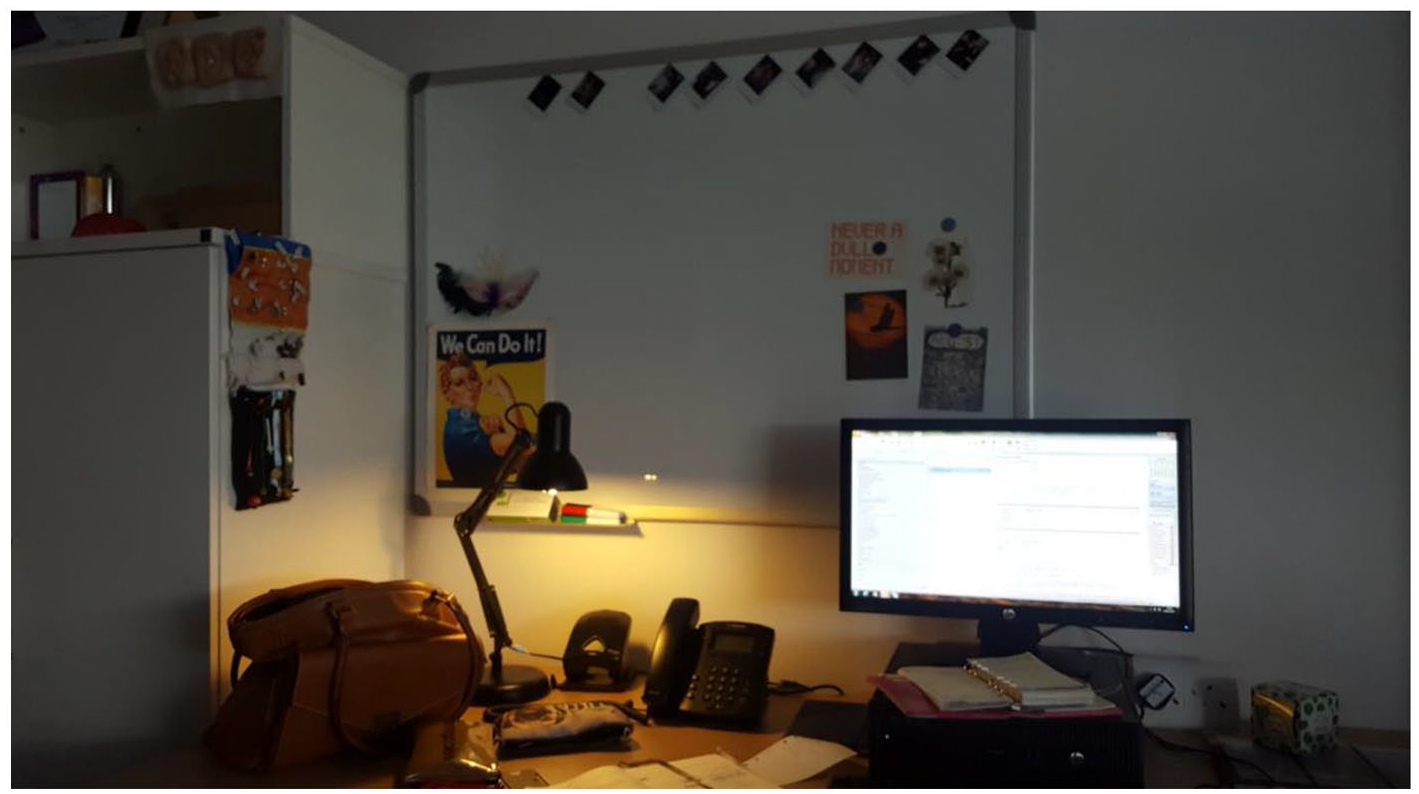
Moving into my new office and bringing Laura with me – developing a new balance.
In addition, there is an emerging difference here between how I shape and share my work office and my home office. It is perhaps because somehow, I feel I can control the seepage of home into the work office; I feel more in control of this space and I can allow Laura in how and when I wish. But the home office space is a contested space precisely because it is part of our home and our garden. It is a difficult space to manage and there is a constant sense of compromise on how it is used and who uses it. Its sense of fluidity is ever present and takes far more effort to control and defend as my own hallowed ground.
Discussion
At the outset we asked thus: How does the contemporary knowledge worker negotiate and re-negotiate work life and home life in the absence of objectively fixed boundaries, and what do they learn in the process? Having followed the final stage of Shortt and Warren’s (2019) analytical framework, ‘theorizing’, we discuss some of the patterns we observed in our readings of the image sets from the visual diary and we return to this core question, taking into account the paradoxical nature of the liquid modern liminar; someone who, bereft of structural boundaries, is endowed with all the freedom to shape their work-life, yet fundamentally denied the possibility of removing the hyphen connecting them.
We realize that none of this is ‘new’ in the sense that employees have experienced the dilemmas and pressures of returning to work after periods of maternity leave, prolonged illness, etc. for decades (see Miller, 2005, 2011); Nonetheless, our emic exploration of in-between, liminal ‘no (wo)man’s land’ in a UK university context, prompts us to (a) reconceptualise liminality for liquid times – through the notion of liquid liminality – and, simultaneously, problematize dominant conceptions of work-life balance, (b) discuss implications that liquid liminality carries for the notion of flexible knowledge work and (c) outline opportunities for establishing new learning habits that follow from our theoretical framing and empirical analysis.
Liquid liminality and work-life balance
Exploring the process of navigating the ambiguous boundary between work/private life which the case portrays, pushes the previously assumed structural distinction to breaking point. Returning from maternity leave, Harriet often felt bereft of support, lacking the means by which to reintegrate in the physical office space and thus having to learn to reinvent herself performatively and dramaturgically through, for example, choices of apparel and self-presentation. In the ‘home’ environment, the ambiguity was, if anything, even more strongly felt and seen – certainly compositionally the tight frames of the images captured, and close-up views of spaces and objects suggest these aspects are the focus and of greatest importance. The socio-material elements of work and home became intertwined in ways that evoked joy, at times, but also feelings of envy and resentment: consider the image of Laura in the ‘home office’. And in this context, the role of the handbag takes on unusual saliency. ‘Laura’ takes up occupancy in this transitional object (something carried between the physical spaces of home and work) through her association with certain contents of the bag, that is, ‘baby stuff’ sitting cheek-by-jowl with a work-related book. Even more so, the child figure is simultaneously implicated in both contexts, her exact positioning never being sufficiently immobilized to be categorized as belonging to either: Laura’s ‘presence’ at work (even in absentia) is mediated not only by her ‘stuff’, but equally by vivid recollections of her. When she is physically present in the office, the resentment becomes palpable, as if the overall system of objects were thrown off balance while, she (and work) come into some form of equilibrium; perhaps due to Harriet’s remarkable balancing act that enabled her to preserve the ‘best of both worlds’. The dynamics ‘at home’ are not different in that respect: the leisure time, having a bottle of wine with the significant other, watching over Laura, are, at times, seamlessly embedded with work, while occasionally they contrast and bring about uneasiness. A work email or teaching preparation can gate-crash a dolls’ tea party; and fun remains an option as long as the host – our liminar – perceives herself to be the one maintaining the balance.
Nonetheless, a challenge to the coherent sense of selfhood imagined by Harriet occurs when her gaze is mediated by the assessment of her status by colleagues based on the clothes she is wearing. Voicing of their disambiguating comments leaves the liminar little room for manoeuvre: she is seen as a mother, rendering it difficult to sustain the projected image of ‘a professional academic’ figure. If the self-reflective reaction is one of ‘confusion’ and ‘depression’, the feeling of disorientation is addressed and the sense of control regained by using the very same socio-material resources that were the source of the challenge to self-image: the content of ones’ wardrobe and their intersubjective symbolic value.
Liminality is experienced throughout the process of returning from maternity leave – spatial and emotional transitoriness, suspension between two worlds expressed by ambiguous relationships with objects and people, the sensation of ‘moving between’ are all liminal features. A pattern across the theme of ambiguous space speaks to this sense of searching and seeking stable ground. Across the image set there are a few duplications of the same locations and spaces; Harriet captures multiple sites such as the train, handbag, home office, work office, carpark, living room, wardrobe, garden, and at the station – all of which illustrate her constant navigation through spatial and emotional transitoriness. The permanence of this liminal state is not limited by boundaries, that is, home and office. Seeking meaningful places for work is clearly always contemplated throughout Harriet’s everyday journeying, from the micro-site of her handbag, to the margins of the carpark, to the sacred space of her home office. Fulfilment is lacking from both intersubjectively construed domains – work and home – while also being equally absent from the tiniest socio-material elements on which stability, familiarity and reassurance could be potentially built. Transitions here never seem quite complete, and the motion never leads to the port of destination; it never leads to a threshold in any other sense than phenomenologically, hence there can be no ‘crossing of thresholds’ either (cf. Ellis and Ybema, 2010). It is un-ending, boundaryless, integrated into one’s experience of flexible work: here liminality becomes liquid.
Transition, then, becomes perpetual and the states it has fallen between no longer promise stability and clear demarcation, it no longer fits the established liminal bill. Yet, the difficult-to-bear anxieties of liquid life (Bauman, 2005b) need containment and semblance of stability, thus our flexible liminar learns how to exercise agency – phenomenologically and socio-materially sustaining her interpretations of work/non-work boundaries. While some of those boundaries may not be transparent to the external observer (as our visual empirical illustration suggests, for example, when Harriet’s handbag’s content is discussed), they are not illusory – it is simply that they serve a valuable intersubjective meaning and purpose.
Since boundaries are no longer objectively discernible, intersubjective boundary-work does not ‘resolve’ the issue of establishing a work-life boundary in any absolute sense, but it does enable the liminar temporarily to make sense of their position in transitioning between what is intersubjectively defined to be differences between work life and home life. Unlike Bamber et al. (2017), we do not perceive liminality to be necessarily an enjoyable state. In our reading, it may encompass a diverse range of psychological states that typically accompany the challenges of uncertainty and ambiguity in everyday life. Liquid liminality is a name we offer to explain the process whereby the removal of socially sustained containment – a boundary between life and work –becomes re-created phenomenologically in intersubjective sensemaking and symbolically through mastering the socio-material manipulation of the spaces and objects that surround, and are meaningful to, that individual.
Hence, while work-life balance may be a ‘fantasy’ (Bloom, 2016), we posit that the individual’s capability to construe life and work as distinguishable domains provides a phenomenologically useful frame for dealing with constant change, and in this sense fantasizing a balance between them may be life-affirming rather than ‘lethal’ (cf. Bloom, 2016). Thus, we propose that even in the absence of ‘work’ and ‘life’ as objectively discernible domains, liquid liminality provides a new instrumental rationale for the phenomenological relevance of ‘work-life balance’: it seems to play an important role in this individualized (re)creative process.
Implications for flexible knowledge work
Liminality remains a useful conceptual tool only insofar as it enables the recovery and interpretation of post-boundary experiences; those under which notions of individuality, organization, work, leisure and so forth become profoundly conflated. Thus, while we do not suggest liquid liminality is a condition which can be ‘dealt with’, we propose it contributes to an understanding of a post-boundary world, and therefore creates a habitat for learning how to navigate it. The constant (re)negotiation and re-negotiation of intersubjective boundary-making in our case must be seen in the context of the broader discourse of the flexibilization of employees and the associated pressures exerted on their life beyond work (e.g. Beltrán-Martín and Roca-Puig, 2013; Wright and Snell, 1998). Returning from maternity leave, the boundaries are ‘up for grabs’. Here, our liminar is lacking the buffer-space within which her allegedly non-work experiences can be contemplated and made sense of – instead, she must have been at work all along, as the Outlook calendar mercilessly prompts invitations for the meetings to which she is already 12 months ‘late’. In line with Bauman’s theory, such interweaving of a private sphere (i.e. maternity) with the world of work becomes a default mode of relationship between work and private life. As such, the liquidification of liminality – depriving it of boundaries which used to constrict its permanence – is not a solipsistic act: it unfolds in the context of a ‘flexible’ immersion in work. Thus, ‘flexibility’ of knowledge work in our theorization does not imply dealing with existing boundaries by moving them (flexibly) towards finding a better balance between them and, presumably, remedying one’s exhaustion as a result. On the contrary: ‘flexibility’ involves an effort (along with potential exhaustion) implied by the compulsion to perform intersubjective boundary-work and by which ‘working life’ may be distinguished from ‘private life’. And it carries important implications for learning, to which we now turn.
Opportunities for establishing new learning habits
For our liquid liminar, in the process of transition, a need for culturally validated structural containment was compensated for by intersubjective boundary-work. At times, Harriet seems sanguine with the ‘blend’ of work and life that the new conditions present to her; yet at others, she experiences a range of emotional responses – confusion, perplexity – in the face of the ambiguities that persistently present themselves. It is this persistence that leaves Harriet exhausted, feeling bereft of support and precarious. Indeed, despite all this, lines are drawn. Exhaustion here is perhaps partly bound up in the responsibility Harriet has to draw her own lines and boundaries between experiences; joining the doll’s tea party in the middle of the working day is tempting (and which one could consider a ‘perk’ of such a working arrangement). Yet, since these lines are not drawn objectively, this task is left to our liminar who chooses not to join it or take advantage of this ‘home life’ moment. The past instances of such demarcations create opportunities for learning. Not learning how to cope with liminality however, but rather learning how to achieve a workable balance between its diverse consequences, including the opportunities it provides and the pressures and guilt it exerts. As described in our empirical material, this workable balance comprises an ongoing ‘choreography’ involving ‘space [as well as] constructing the intersubjective boundaries in [one’s] head – and vice versa’. This socio-material and intersubjectively-driven ‘balancing act’ is the liminar’s survival strategy; a deliverable from the learning process in the post-boundary context.
Liquid liminality and intersubjective boundary-making brings the added value of focusing on relatively micro-processes (momentary oscillations between bounded and unbounded phenomenological states) which – at least as far as flexible work is concerned – are ‘normal’, rather than ‘special’. In this respect liquid liminality constitutes a new environment for learning in the increasingly fluid organizational context. Many organizations have for some time pursued flexible working as an expedient means of saving costs and gaining economic advantage. ‘Working from home’ has also offered what appears to be a quick-fix for addressing work-life balance and employee well-being challenges. Such rationales for flexible working, however, have recently been superseded by the radical and widespread organizational responses to the COVID-19 pandemic and the consequences (intended and unintended) of mandatory ‘home working’. Yet, the micro-processes discussed in this article show just how complex and exhausting flexible working can be in terms of the emotional and aesthetic labour needed to supplant spatial and structural boundaries with intersubjectively constructed ones. To summarize, we propose two main ways in which learning is needed when liquid liminality is considered. First, an individual liminar needs to learn about the labour involved in intersubjective boundary-making in the absence of any objective boundaries and become adept at sustaining a socio-material, intersubjectively driven balancing act. Second, the learning here is organizationally focused. Workplaces and, in particular, human resource policies should be more cognisant of the individual labour involved in intersubjective boundary-making and the impact this can have on flexible workers. Significantly, this nuanced understanding should be part of any transition back to the workplace following a period of leave or absence.
So, how can a concept of ‘liquid liminality’ which, arguably, invokes a contradiction between boundary-embedded ‘liminality’ and an opposite sense of ‘liquidity’, be of use to us? We find the oxymoron offers fresh insight and theoretical value. Liquid liminality privileges personal and intersubjective experience while recognizing external factors which impinge and condition that experience. The deeply personal experiences described here are of and about a person, rendering liminality embodied and lived rather than abstractly theorized at a distance. Hence it may help in making sense of individual experiences of ‘flexible’ work, permanently spanned (Borg and Söderlund, 2014) between states which are always in transition, while also resonating with more conventional notions of liminality. As such, it could bring improved explanatory and analytical power to the study of increasingly mobile, technology-aided working arrangements, such as working from distance, working in or at multiple sites, and/or on the move. These trends in workplace transition and the increasing uptake of flexible working, moreover, have been turbocharged by the imperatives for organizational change prompted by the COVID-19 pandemic. This raises further reflections and questions about employed or self-employed individuals engaged in a whole variety of fluid working arrangements. Further work might question as follows: what new insights might we discover about workers’ intersubjective boundary-making? What other socio-material intersubjective boundary-making goes on in different workplace contexts? Would this impact on how organizations design and manage flexible work arrangements in the future, particularly now, ‘post-pandemic’? And perhaps, most significantly in this context, how might these insights influence what organizations learn from this experience, and whether it supports their understanding of how to design and manage return-to-work processes?
Conclusion
In this article, we sought to reconfigure the concept of liminality by rendering it more ‘fit for purpose’ under conditions of liquid modernity (Bauman, 2000) and to shed new light on work-life balance debates. Having set out how post-structural organization theory challenges the relatively stable boundaries between ‘work life’ and ‘home life’, ‘work spaces’ and ‘home spaces’ that evolved alongside bureaucratic corporate capitalism in the 20th century (Boltanski and Chiapello, 2005; Etzioni, 1961), we proceeded to examine the erosion of such boundaries that was concomitant with the emergence of flexible working. Liquid modernity and the associated precarity of working life demand that we rethink notions of liminality. The theoretical contribution of the article has been to expand the semantic scope of the concept of liminality in the context of radical reformulation of the work-life balance problem. Indeed, we attempted to deconstruct facile distinctions drawn between ‘work’ and ‘life’. Our intention has been to question traditional anthropological associations of liminality with thresholds, ceremony and ritual, while also retaining an emic intersubjective sensibility afforded by that discipline. To this end we introduced a term, liquid liminality, which serves to capture and represent the theoretical nuances we have identified and discussed.
When introducing and applying this new term, however, a caveat is needed: we do not see this concept as standing in a hegemonic relation to other readings of liminality (e.g. as ‘perpetual’, ‘transitional’) by somehow supplanting them. We contend that, conceptually, liquid liminality addresses an issue which has not been explicitly tackled: how the contemporary liminar in socio-material and emic experiential terms negotiates and re-negotiates work life and home life under post-boundary conditions. As such, our contribution is not rivalling attempts to use or apply liminality in specific organizational contexts; it seeks, instead to extend the explanatory and analytical strength of liminality.
In order to illustrate this expansion of scope and re-theorizing of liminality afforded by the concept of liquid liminality, we presented empirical data in the form of an auto-ethnographic visual diary developed around the experiences of one of the authors (a professional academic working in a UK university) as she transitioned from maternity leave back into full-time working life. We demonstrated that intersubjective boundary-making has emotional ramifications and can become a strain for workers. We have seen how constant and complex boundary-making becomes a fundamental part of the liminar’s everyday life. What flexible working debates might currently be missing is that individuals in their contemporary liquid liminal lives must perform intersubjective boundary-making, which, we argue, constitutes additional labour. For flexible workers like our liminar, constantly negotiating and renegotiating boundaries are now part of everyday life and learning how to blend them effectively is a necessity. The ‘balancing act’ involved in the intersubjective construal of ‘work’ and ‘life’ described in our case constitutes one way forward in this respect; yet it is a strategy that bears certain costs in terms of employee well-being, such as, the risk of exhaustion and even burnout. While the focus of this article is on the individual, if organizations are to continue to use agile working as a tool with which to make savings, respond organizationally to exigencies imposed by the COVID-19 pandemic, and help support their workface gain a ‘better work-life balance’ they must further consider the intersubjective complexities that such surplus effort entails.
