




Abstract
While the literature in relation to managing the work-nonwork boundary retains a strong focus on the consistent use of segmenting or integrating boundary management practices, recent studies indicate that individuals’ behaviours are often inconsistent. To add to this emerging strand of research, this article is set in the context of flexible working to examine how knowledge workers use time, space and objects to demarcate the work-nonwork boundary. The analysis identifies three configurations of boundary management practices with differing degrees of inconsistency in the use of time, space and objects. Its contribution is three-fold: (1) it provides an original, systematic exploration of boundary management practices that do not represent consistency; (2) it creates a framework within which differing degrees of inconsistency in people’s boundary management practices can be observed; and (3) it demonstrates new and crucial differences between distinct inconsistent approaches to demarcating the work-nonwork boundary.
Introduction
How do knowledge workers use time, space and objects to demarcate the work-nonwork boundaries when they have spatio-temporal flexibility regarding their workplace? To answer this question, this article draws on the boundary management literature (Nippert-Eng, 1996b), which posits a continuum of ideal-type boundary management strategies, with pure segmentation and integration at the poles. These strategies shape and are supported by individuals’ boundary management practices using time, space and objects as ‘structuring device[s] for human activity’ (Michelson and Hearn, 2006: 5). Segmentation means that within organizational and personal constraints individuals seek to keep the work and nonwork domains separate, and integration means that they seek to foster overlaps between them. People’s boundary management practices are assumed to be constructed in general alignment with their preference for segmentation or integration (Kreiner et al., 2009; Nippert-Eng, 1996b).
Advances in mobile information and communication technologies (ICTs) are decoupling work from time and space (Gajendran and Harrison, 2007). They make working environments more fluid (Bauman, 2000), enabling individuals to work flexibly at different times and in multiple spaces across a working day or week (Mullan and Wajcman, 2019; Wheatley, 2017). This is particularly pertinent for knowledge workers, highly educated and skilled individuals who undertake complex tasks in specialist or managerial roles to generate new knowledge and ideas (Benson and Brown, 2007; Truss et al., 2012). Knowledge workers tend to have significant autonomy over when and where they work (see Langfred and Rockmann, 2016), although perceptions of autonomy may be shaped by wider organizational expectations regarding individuals’ commitment and availability (e.g. Mazmanian et al., 2013). 1 Such conditions can make it hard to distinguish between work time and nonwork time, work spaces and nonwork spaces as well as work objects and nonwork objects, allowing individuals ‘to be physically located in one [. . .] domain but psychologically and/or behaviorally involved in another’ (Ashforth et al., 2000: 474). As many knowledge workers are highly flexible with respect to when and where they work, their use of time, space and objects in demarcating the work-nonwork boundary is highly varied as the analysis presented below indicates.
The boundary management literature has developed from Nippert-Eng (1996b) in two main ways. Firstly, since few individuals can be classified as pure segmentors or integrators, some scholars suggest a need to go beyond segmentation and integration (Ammons, 2013; Bulger et al., 2007) and consider a wider repertoire of boundary management practices. Secondly, individuals’ behaviours are not always consistent in their boundary management practices (Ammons, 2013; Sayah, 2013), and segmenting and integrating practices may even co-exist (Dumas and Sanchez-Burks, 2015). From this perspective, the question of how individuals use time, space and objects to demarcate the work-nonwork boundary through different configurations of segmenting and integrating behaviours is significant – particularly in the context of knowledge work where a high degree of flexibility is often expected. It is here that a contribution will be made to a more comprehensive and systematic understanding of inconsistency in individuals’ boundary management practices.
The analysis, deriving from semi-structured interviews with 24 knowledge workers (academics, professionals, managers, specialists) that have spatio-temporal flexibility regarding their workplace, focuses on how they construct the work-nonwork boundary through the use of time, space and objects. It shows that individuals combine them in three main configurations that are characterized by differing degrees of consistency. Firstly, congruence refers to the use of exclusively segmenting or integrating boundary management practices within and across the use of time, space and objects. Inconsistencies (understood as a lack of congruence rather than in an evaluative sense) in individuals’ boundary management practices emerge, to varying degrees, with the other two configurations. Variability refers to boundary management practices that are always consistent regarding the way time, space and objects are used, but where there is variation across their use. For example, with this configuration people reported using time in an integrating and space and objects in a segmenting manner. Fluidity is a novel configuration with the greatest level of inconsistency, where individuals’ boundary management practices are inconsistent not only across the use of space, time and objects but also with respect to at least one of them. For example, people reported sometimes utilizing a segmenting and at other times an integrating practice with respect to how they use time, space and objects. In the data, both the variability and fluidity configurations were common.
The findings thus make a timely contribution to the boundary management literature: in documenting and developing the variability and fluidity configurations, they contribute to the emerging strand of this literature that questions the assumption of consistency in people’s boundary management practices, thus emphasizing their complexity in the context of flexible knowledge work. This is done by: (1) undertaking a systematic exploration of approaches that do not represent consistency; (2) establishing a framework involving time, space and objects within which differing degrees of inconsistency can be observed; and (3) demonstrating crucial differences between distinct inconsistent approaches (particularly in relation to the novel fluidity configuration). These exploratory findings can inform future studies on work-nonwork boundary management in relation to different types of flexible working.
Boundary management practices
The sociologically-rooted boundary management literature explains how individuals ‘construct, maintain, negotiate and cross the boundaries’ between work and nonwork (Duxbury et al., 2014: 571). Nippert-Eng (1996b) identifies the ideal-type strategies of segmentation and integration that are socially constructed through boundary work, bring[ing] together what is mental and practical, cultural and structural, social and personal, as we actively create the categorical. Accordingly, by focusing on individuals’ boundary work [. . .] social scientists can [. . .] acquire unique insight about how individual members of society create and understand their everyday lives. (Nippert-Eng, 1996a: 564)
Conceptually, these strategies are manifested in individuals’ preferred relationship between work and nonwork. Behaviourally, they are enacted through boundary management practices that help ‘to organize potentially realm-specific matters, people, objects’ (Nippert-Eng, 1996b: 7). For example, Kreiner et al. (2009) examine the temporal, physical, behavioural and communicative segmenting behaviours that help maintain the work-nonwork boundary. Carlson et al. (2015) develop quantitative measures for each of these behaviours, exploring how preference influences individuals’ agency to obtain the desired level of segmentation. If people are unable to act in accordance with their preferences, they are assumed to experience conflict (Nippert-Eng, 1996b).
The traditional structuring devices of time, space and object use in people’s boundary work are challenged through increasingly ‘fluid’ working practices (Bauman, 2000). Firstly, since the late industrial era, in most developed countries, work has been temporally bounded into a designated working day. However, mobile ICTs enable individuals to work more flexibly (Gajendran and Harrison, 2007), eroding such temporal boundaries. For example, Tietze and Musson (2003) have found that, despite strict time management to maintain the work-nonwork boundary, teleworkers experience a ‘mingling’ (448) of activities from both domains, and Van Den Broek (2017: 915–916) speaks of facilitating more ‘integrated relations’ between work and nonwork.
Secondly, space is central to work and employment (Herod et al., 2007). Spatial boundaries, particularly for knowledge workers, used to be clear, with work taking place in the office and nonwork happening elsewhere. Indeed, as Halford (2008: 927) argues, ‘working lives are made and lived within [. . .] spaces’ such as the office, with workspaces underpinning working practices and organizational cultures (Strangleman, 2012). However, with work being increasingly spatially disconnected from formal and regular workplaces (Felstead et al., 2005), there is a ‘hollowing out of the fixed organisational workspace’ (Halford, 2005: 19) in favour of work taking place in multiple spaces. Not only does this result in concerns about personal visibility in a distant workplace (Brewer, 2000), the spatial disconnect common in flexible working can lead to a reinterpretation of what constitutes a workspace (Herod et al., 2007). Richardson and McKenna (2014), for instance, argue that work and home spaces have been functionally redefined: what was previously done in the workspace (work) is now done in the home, and what was done outside of the workspace (socializing) is why people go there.
Thirdly, the ways objects are used are well established through the concept of sociomateriality, which examines the practices used to accomplish work. In offices, for example, individuals use objects (rooms, desks) and technology (telephones, computers) to perform work (Orlikowski and Scott, 2008). The crossing of the work-nonwork boundary has also been associated with objects (e.g. clothes), physical spaces (e.g. commuting) and rituals (e.g. tidying), reinforcing temporal and spatial practices. However, knowledge workers often use the same objects for work and nonwork, such as smart phones, that straddle the work-nonwork boundary (Derks et al., 2016). For instance, Matusik and Mickel (2011) emphasize the pressures of being constantly connected via mobile ICTs, while Duxbury et al. (2014) highlight potential infringement of the work-nonwork boundary through the notion of struggling segmentors, that is people whose desire for separating work and nonwork is thwarted by having to continually deal with work when at home following the introduction of a work-related mobile phone.
These studies suggest that knowledge workers not only have significant levels of agency in demarcating the work-nonwork boundary but also increasing responsibility to do so (Lewis et al., 2017; Prowse and Prowse, 2015). This may foster the development of new boundary management behaviours in response to changing working practices that have not yet been systematically studied. Much research continues to assume that individuals have relatively clear, fixed and identifiable preferences on the segmentation-integration continuum (Carlson et al., 2015; Kreiner et al., 2009), although this has been challenged from at least two angles.
Firstly, the work-nonwork boundary has been regarded as bi-directional, with the way in which work impacts on the nonwork domain often being different from the way in which the nonwork domain impacts on work. For example, Bulger et al. (2007) establish that some individuals have a segmenting preference with regard to the nonwork domain (not wanting work to intrude into the home), alongside an integrating preference in the work domain (dealing with nonwork issues when at work, where necessary). Similarly, Sayah (2013) argues that individuals not only are often selective when allowing or refusing the work-nonwork boundary to be infringed but accept differing degrees of intrusion of work in the nonwork domain and vice versa. These studies thus question the alignment between people’s preferences and their actual practices with suggestions that segmentation and integration co-exist (Dumas and Sanchez-Burks, 2015).
Secondly, research suggests that people’s boundary preferences may not always be consistent (Ammons, 2013) and that the work and nonwork domains are ‘socially constructed, politicized, and contested’ (Cohen et al., 2009: 230). Kossek and Lautsch (2008), for instance, find that some individuals segment and integrate at different times across a working week. Moreover, Cohen et al. (2009) distinguish between situations where individuals have a high level of boundary control and situations where this is limited. They argue that in the latter situations, ‘although people might have a tendency towards strategies of either segmentation or integration, the dynamic contingencies of our daily lives mean that we frequently move between these poles as befits particular situations’ (232). Boundary management practices have thus been characterized as situationally responsive and more complex than originally conceptualized.
However, despite these pertinent insights, a more systematic study exploring the complexity of people’s boundary management practices and differing degrees of inconsistency has not yet been undertaken. To address this gap, the article examines how knowledge workers demarcate the work-nonwork boundary when possessing spatio-temporal flexibility regarding their workplace through the use of time, space and objects. Specifically, it documents and develops three configurations with differing degrees of inconsistency – congruence, variability and fluidity – that develop more comprehensive empirical insights into knowledge workers’ boundary management practices.
Methods
This study was set in the context of flexible working, where people have spatio-temporal flexibility regarding their workplace. It involved knowledge workers that have significant autonomy over – and responsibility for – when and where they work throughout a working day or week: in the office, on the move, from a hot desk, or their home. Knowledge workers are an ideal group to study boundary management practices because they do not have to be consistently present in a particular location to do their job: a laptop or smart phone and internet connection enables them to analyse data, write reports, and connect with clients and colleagues regardless of where they are. While flexible working may be employer-driven to save costs, in this study interviewees positioned it as their choice.
Data were collected between January and December 2017 through semi-structured interviews with 24 knowledge workers. Personal details about their gender, age, employment status (employed/self-employed), and industry sector were collected to monitor the sample (see Table 1 for details). The interviewees typically were self-employed, had a managerial or specialist role, or worked in settings with widespread spatio-temporal flexibility (e.g. academia). Most interviewees worked remotely from the office for at least 50 per cent of their time and regularly used institutional workspaces, home workspaces and public spaces for work. They were recruited through personal contacts, snowballing and a social media call, intentionally targeting individuals from a range of business sectors to examine commonly used boundary management practices. Although the dataset does not include all possible types of knowledge workers or flexible working practices, the findings suggest that the sample’s heterogeneity may enable wider applicability of the proposed framework as discussed below.
Interviewee profile and configurations of boundary management practices.
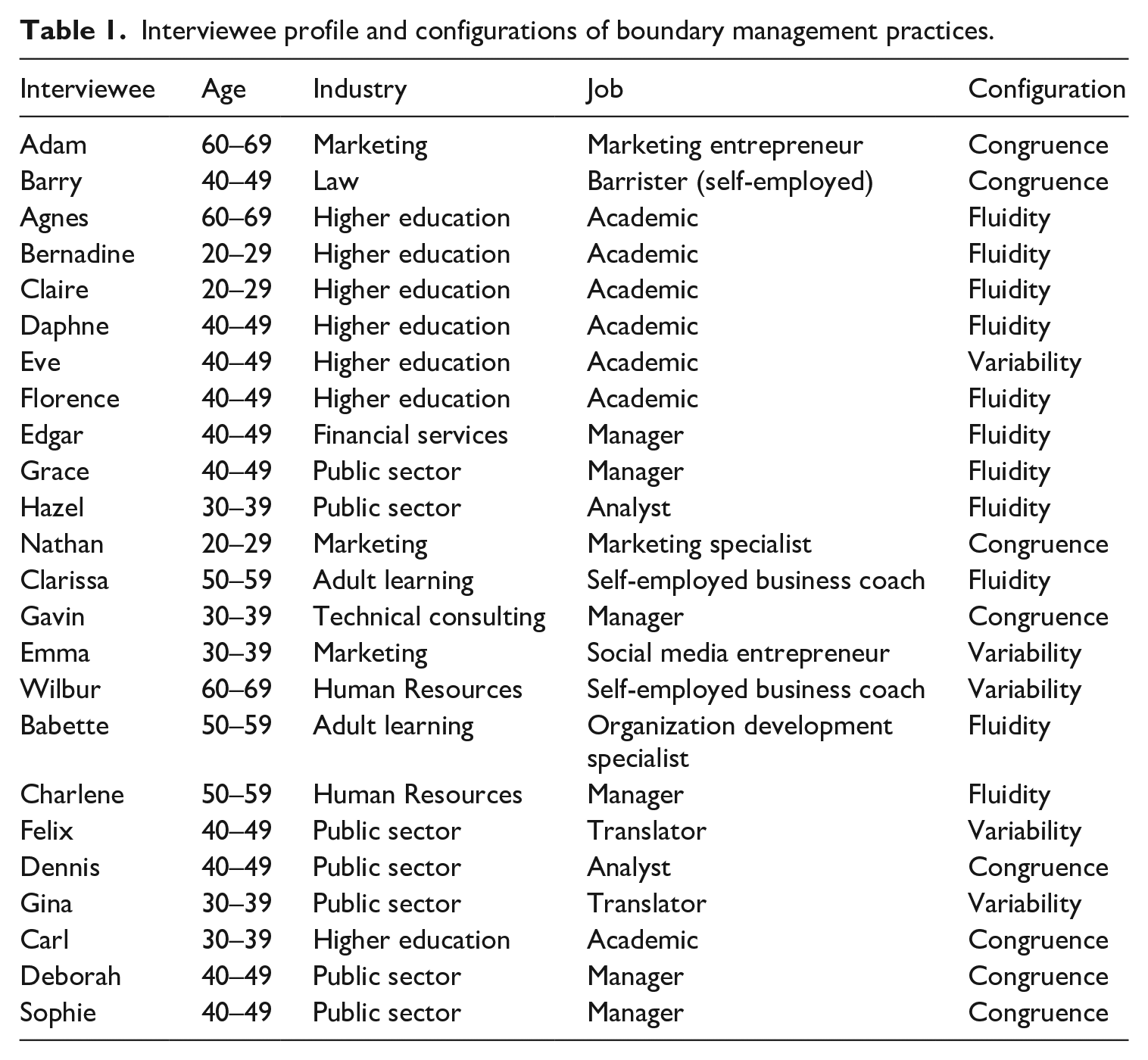
The interviews sought to explore individuals’ temporal, spatial and sociomaterial boundary management practices and therefore focused on: (1) interviewees’ work times and spaces; (2) the objects and activities associated with each; and (3) their reflections on how they manage their work-nonwork boundary. It also included questions about interviewees’ work context (see Appendix 1 for the interview guide). Following Nippert-Eng’s (1996b) approach, individuals’ reported boundary management practices were the focus of the analysis to help maximize the heterogeneity of the sample. Heeding Silverman’s (2017) advice that ‘the only identities that should matter in the qualitative analysis of interview data are those identities actually invoked by the participants’ (151, emphasis original), only those social categories mentioned in the interview (e.g. spouse, parent) were recognized in the analysis. The interviews lasted for 1 hour on average (generating a dataset of 1400 minutes of audio recording) and were transcribed verbatim.
The approach to data analysis was abductive, involving an iterative process between theory and data (Reichertz, 2010). More specifically, the transcripts were analysed qualitatively and interpretively (Kostera, 2007) using the three-stage process summarized in Figure 1.
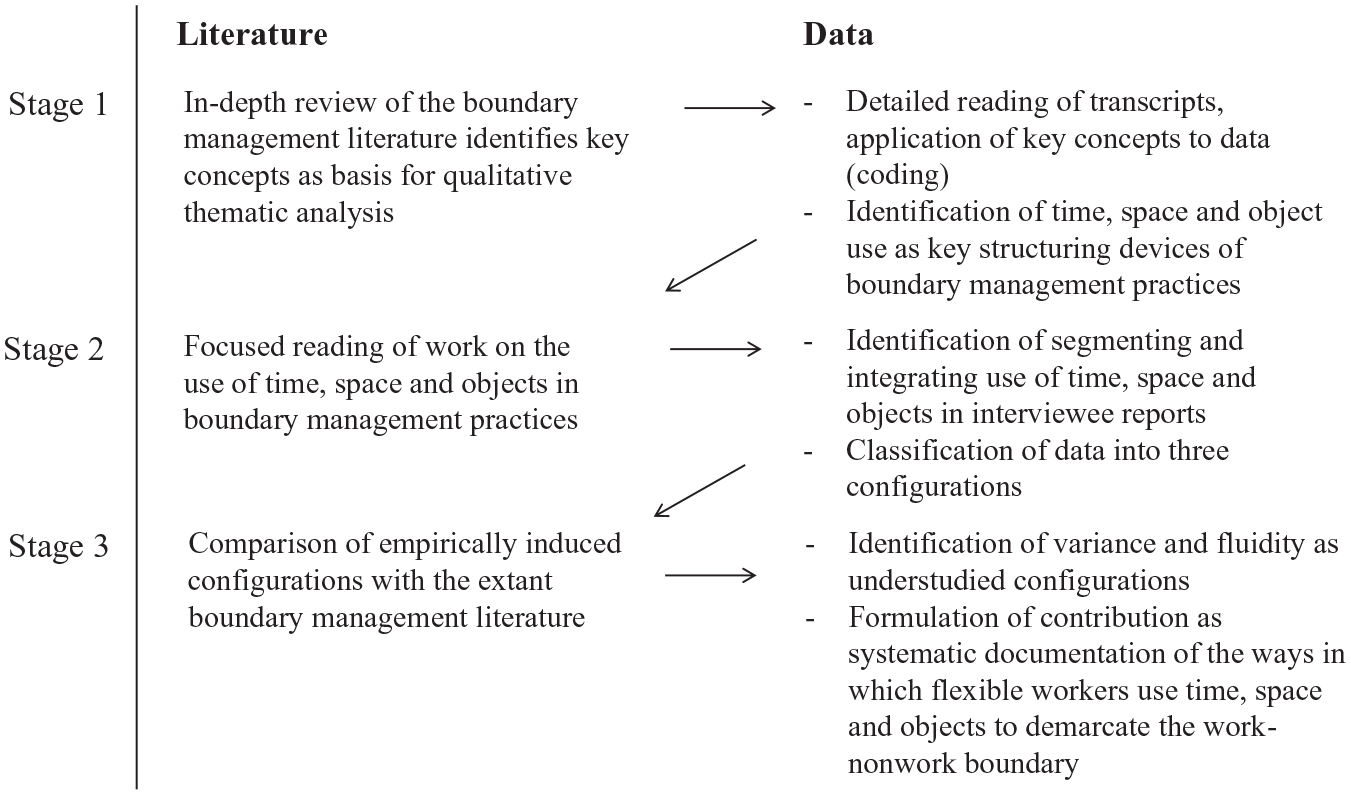
Data analysis process.
In Stage 1, the interview transcripts were read independently, and codes developed through an in-depth literature review were applied to the data. These codes included key concepts of the boundary management literature, such as life domains (work / nonwork), segmentation / integration, time, space, object use, personal preferences (e.g. completing intellectually challenging tasks at home), and contextual issues (e.g. office availability and layout). NVivo software was used for data management. Once the interviews had been coded, the emerging interpretations were compared, identifying different uses of time, space and objects that became the focus of the further analysis and theorizing.
In Stage 2, data excerpts were identified in all interviews that related to the use of time, space and objects, stating if a boundary management practice was segmenting or integrating, which led to three configurations; these have been mapped against each interviewee in Table 1. Congruence refers to reports of consistently segmenting or integrating use of time, space and objects as theorized by Nippert-Eng (1996b) and Kreiner et al. (2009). Variability refers to reports of a mix of segmenting and integrating behaviours
In Stage 3, these empirically induced configurations of individuals’ boundary management practices were compared with the extant literature. It was found that the combined utilization of segmenting and integrating behaviours within and across time, space and/or object use (the fluidity configuration) had not yet been documented. Such fluid boundary management practices question the still relatively widely accepted distinction between segmentation and integration, requiring reconsideration of the behavioural mechanisms of the boundary management literature. Next, illustrative empirical examples, selected from the wider dataset, are presented for each of the three configurations before the implications of the findings for a sociological understanding of knowledge workers’ boundary management practices are discussed.
Configurations of boundary management practices
Congruence
In the congruence configuration, the use of time, space and objects was characterized by the same type of behaviour (i.e. segmenting or integrating) within and across the use of time, space and objects. As this configuration is well established (Nippert-Eng, 1996b), brief empirical illustrations of congruent segmentation and congruent integration are provided using Adam’s and Carl’s accounts respectively. Individuals preferring segmentation set clear temporal boundaries through a relatively fixed start and end point to their working day, clear spatial boundaries by restricting spaces to work or nonwork use as well as clear association of objects with either the work or nonwork domain. For example, Adam (mainly working from home, married, grown-up children) described his typical working day as follows: A typical working day would be [. . .] arrival at the home office at [. . .] quarter to nine something like that. [. . .] I’d say on average [I stop working at] about half five, six o’clock. Sometimes it’s a bit before, it depends on the amount of work that’s coming in. Sometimes, I don’t get all that work done, so I need to do a little bit in the evening as well.
He also reported clear spatial segmentation in the following two interview excerpts: In my mind, I have my work-spaces and my leisure-spaces [. . .] One thing I’ve never done is somebody come to my house for a meeting. I always wanted to go to a [public] place or their office. [. . .] It would infringe on my home space. My wife wouldn’t be comfortable with that either. [. . .] That’s a step too far. By and large, the places we tend to go for work are generally different. There’s a garden centre nearby with a cafe. I go in there quite regularly with my wife [. . .] On two or three occasions, I had business meetings in there and this was strange. [. . .] An atmosphere of work came in there to a degree. And you didn’t want that. Now, there was a conflict there.
Adam reported being uncomfortable with using a nonwork space for a work meeting, which is common when a segmenting preference cannot be enacted (Duxbury et al., 2014; Nippert-Eng, 1996b). While not mentioning objects prominently, Adam continued with his account as follows: ‘[For this meeting] I was wearing a suit whereas if I go with my wife it’s just casual dress. So that was different. It was just a feeling of work creeping in there [laughter]’.
Hence, Adam made a clear distinction between work and nonwork, which he sought to enact through consistently segmenting use of time, space and objects. In contrast, individuals preferring integration combine work and nonwork activities across a working day without much distinction between the two domains as described by Nippert-Eng (1996b). An example in the dataset is Carl (working mainly from the office and from home, partner, no children), who described his typical working day as follows: [The] first thing I do when I wake up is to check my emails, still from bed [. . .]. I may go to the loo if I’m desperate [laughs], but if not I start with my emails. There is something immediately important I feel I need to do about it. Then I get up, have something to drink, something to eat, jump into the shower. Then I turn my laptop on.
He thus reported an integration of work activities (checking his emails) and nonwork activities (shower, breakfast) in his morning routine. A similar blurring was reported in terms of space: I’m just not good at saying ‘I will only work in my office’. Sometimes I work in bed, sometimes I work on the sofa and due to my discipline [film studies] even when I try to relax and watch a film or a TV show I’m still working.
The same applies to his association of objects with work and nonwork: A pint glass with some beer in it, that’s the kind of thing I wouldn’t associate with work [laugh]. Although, interestingly, I have a colleague with whom I’ve had a few disagreements at work recently and [. . .] we decided it would be a good idea to meet socially after work and clean the slate [. . .]. And we’ve ended up over pints having the same arguments. [. . .] Even the things I hold dearly as relaxation space, a beer meeting, can end up being work related.
These reflections were corroborated with Carl’s answer when asked to name five activities that he didn’t associate with work: ‘That’s a tough one! When I watch TV, but that is also associated with work, like I said. Eating or drinking is also sustaining me at my work. I would really struggle to name anything.’
Individuals categorized as enacting a congruence configuration, which was the case in a third of the dataset, consistently reported either segmenting or integrating practices across time, space and object use. The findings confirm that knowledge workers can have a relatively clear preference for segmentation or integration and enact it through time, space and object use (Nippert-Eng, 1996b), despite spatio-temporal flexibility regarding their workplace. While the study did not seek to make gender-specific conclusions, it is notable that most interviewees enacting a congruence configuration were men who did not mention family commitments affecting their boundary management practices.
Variability
In the variability configuration, reported by one-fifth of the sample, the use of time, space and objects was characterized by a mix of segmenting and integrating behaviours. The account by Emma (working from home and in public spaces, no partner or children mentioned) was a good example, reporting an integrating use of time and segmenting use of space and objects. In terms of time, Emma explained: I needed to be checking [my clients’ social media sites] at certain times. [. . .] I’d wake up between seven and eight, I’d start working straight away. Then take a break, might have some breakfast [laughs], have a shower, all those nice things. Maybe make some phone calls, check my emails [laughs], going back to the social media and do another check. Then have lunch. If I’m lucky I might be able to see someone in the afternoon, like a friend. But then I’d work throughout the afternoon [. . .] and [. . .] also in the evenings. I’d probably have a break between five and seven, have some dinner and then be working between nine and eleven again. And then I’d sleep [laughs].
Emma’s working day thus consisted of a combination of work activities (client work, phone calls, emails) and nonwork activities (breakfast, shower, lunch, meeting friends, dinner) that were interspersed during a 16-hour ‘working day’ as commonly associated with integration. In contrast, she emphasized the importance of spatial boundaries commonly associated with segmentation when asked about her home workspace: I’ve got my own office. [. . .] I couldn’t do [my work] if I didn’t have the space. In the last place that I lived in, I worked from the living room and [. . .] it was quite tricky, detaching from work and being in kind of leisure time because all the space was the same. [. . .] Now I can close the door and leave the work in that room. [. . .] That’s my workspace.
By relating to a time when she did not have a dedicated home workspace, Emma highlighted how important it was for her to be able to ‘close the door and leave the work in that room’. Her account implies that without such a spatial boundary between work and nonwork, she would struggle. While working at home may imply an integrating use of space, Emma emphasized spatial segmentation: the office was her workspace and the rest of her home was her nonwork space.
The excerpt illustrating Emma’s use of objects related primarily to a cafe that she frequently used as both a work and a social space. She outlined how she used objects within that space differently depending on whether she visited for leisure or for work: [There’s] this one cafe I’m using in particular, which I do go to a lot with friends, but I also go there and work. It’s often about where I sit. [. . .] With a friend I’d probably sit around a nice round table [. . .] whereas with me [on my own] I’m trying to get on the smallest table as possible. Away from people so that I can have my own space. [. . .] And usually I have my headphones in when I’m working.
The cafe thus had different meanings for Emma depending on whether she visited for work or for leisure, and she reported enacting different behaviours in terms of what kind of table she chose and where she sat in relation to other guests. Elsewhere in the interview, Emma mentioned that her headphones kept her (in her own words) ‘in the zone’ when she worked in the cafe – an object that appeared to be used only in a public workspace. In this way, Emma reported using different objects (and using objects differently) depending on her purpose for visiting the cafe. This account emphasized the construction of the work-nonwork boundary as the same space was associated with different life domains.
While Emma and other interviewees classed as enacting the variability configuration reported a mix of segmenting behaviours across the use of time, space and objects (in Emma’s case space and objects), they were not considered to be segmentors due to their apparently voluntarily integrating behaviour in the other dimension (time for Emma). In contrast to Duxbury et al.’s (2014) struggling segmentors, these interviewees did not appear to be struggling with their respective boundary management practices: Emma reported working actively around irregular working hours, creating a dedicated home workspace and modifying her behaviours when visiting a public space for work. Yet, given the widely reported challenges for people to get away from work (Duxbury et al., 2014; Mazmanian et al., 2013), it was surprising not to find clear references to boundary conflict in interviewees’ accounts. The boundary management practices reported in the variability configuration thus appear to emphasize a distinct type of inconsistent behaviour that is largely down to people’s choice. Moreover, accounts relating to this configuration did not appear to be directly affected by the individual’s personal context; Emma and most other interviewees reporting this configuration did not mention a partner, children or other commitments that might affect their boundary management practices. As such, while there are slightly more women in this configuration, the impact of gender is unclear. The variability configuration may thus represent a wider pattern of demarcating the work-nonwork boundary as discussed below.
Fluidity
In the fluidity configuration, the use of time, space and objects was characterized by a mix of segmenting and integrating behaviours not only across but also within one or more of these dimensions, thus comprising a variety of intermingling boundary management practices. Within the sample, this boundary management configuration was the most common, being reported by almost half of the interviewees (see Table 1). This is exemplified by Daphne (working in the office and at home, married, school-age children), who reported the following segmenting use of time, in describing a typical day working from home.
I wake up at about half past seven. [. . .] Then I dress, shower, help the children. [. . .] And then they go to school [at] about half past eight. And then [. . .] my husband makes coffee [laughs] [. . .] and then leaves too. And then I start working. [. . .]
In this excerpt, Daphne described a segmenting morning routine in which she got ready for the day, helped her family to get ready and then started working. Daphne’s desire to demarcate family and work time in the morning was corroborated by the following account of segmenting boundary management practices across time, space and object use.
Is it possible that checking the emails is the last thing you do before you go to sleep?
No, I don’t. Well, I could if I wanted, but I don’t do that [laughs]. I could even check it on my phone and then fall asleep, but no. I don’t want to do that. I leave my phone downstairs to make sure that I don’t do it in bed [. . .]. I find that is too [. . .] invasive. I want to keep it [laughs] [. . .] outside of the bedroom.
But your phone, is it your main device?
No, no the laptop, but the phone is easier to take with you all the time, so I don’t take my laptop into the bedroom. [. . .]
So, it goes into another room?
Yeah.
And your phone also goes into another room?
Yeah, I keep it mostly downstairs.
This exchange implies a demarcation of time at the end of the day. Simultaneously, Daphne distinguished between work objects (laptop) and nonwork objects (phone) and reported using space in a segmenting fashion. She explained that she never brought her laptop or mobile phone (work objects) into her bedroom (a nonwork space). This is regarded as a deliberate attempt to demarcate the work-nonwork boundary. However, elsewhere in the interview, Daphne related the following incident that highlights the integrating use of time, space and objects.
[. . .] And then my daughter has to go to hockey, so, I go to hockey. I take her, take my laptop with me [laughs]. [. . .] There’s a cafe at the hockey field.
Okay, so [your daughter] is doing hockey and you are in front of your laptop?
Yeah, yeah. And I watch how she’s doing [laughs].
Daphne explained that she took her laptop (a work object) into the cafe by the hockey field where her daughter trained (public space) and that she worked while watching her daughter train (family time). This instance could be ‘pure’ family time with Daphne just watching her daughter, but the laptop brought in an element of work commonly associated with integration. Such integration in terms of time, space and object use was further supported by the following exchange:
Do you keep checking your email?
Yeah, yeah. Too often. [laughs].
So, like every fifteen minutes?
No, no! But [. . .] even at the weekend I check it [. . .] like on Saturday evening, or Sunday.
Okay, so there is no boundary? [. . .]
No, no. It’s all mixed up.
Daphne explicitly acknowledged that there was no boundary for her email use as she reported checking work emails on weekends. Through her words of ‘it’s all mixed up’, she alluded to an integrating practice. Another empirical example for the fluidity configuration is Edgar (working in the office, on the move and from home, married, school-age children), who reported on his use of time as follows: My typical working day begins at about half-six, seven o’clock because I’m just an early riser. More often than not, that means me grabbing breakfast somewhere whilst catching up on emails and messages.
While the intermingling of work and nonwork activities implied an integrating use of time, Edgar also reported more segmenting temporal behaviours: ‘This evening, for instance, I’ll aim to stop at about five, five-thirty. You know, unless the phone rings and something critical is [happening], I’ll just walk away from it.’
Edgar thus suggested a clear temporal demarcation of his working day. In contrast to the simultaneous use of integrating and segmenting temporal practices, he reported only segmenting spatial behaviours, emphasizing the importance of a dedicated home workspace: ‘When we built this house, [dedicated workspace] was one of the things I expressly put into the design.’ In terms of object use, Edgar gave the following account: I have separate telephones for home and work. [. . .] Quite often on a Friday night, I’ll put the work phone down in the office and [. . .] don’t get back to it until a set point. [. . .] So, I got that separation. And I found that quite helpful.
Having one mobile phone for work and one for nonwork is a classic segmentation strategy (Nippert-Eng, 1996b). However, Edgar reflected on work objects as follows: When I think about home office, [. . .] I think about the [family] dog as well. Because in fact when I home-work, the dog walks in and lies down to my feet and pretty much stays there all day. And he’ll only move when he thinks ‘I’ll get some food’, which is fine until I have a conference call and he yowls [laughs]. [. . .] I definitely associate that with [my] home office.
While Edgar emphasized the need to demarcate the work-nonwork boundary, his account contained a combination of clear instances of integrating behaviours in terms of time and object use. While referring to an integrating morning routine (having breakfast while checking his emails), he explained that in the evenings he tended to draw a clearer line between work and nonwork. Moreover, while associating the family dog with work (which is interpreted as integrating), Edgar also referred explicitly to a separation of work and nonwork through the use of two mobile phones. In contrast, he appeared to use predominantly spatially segmenting behaviours, as his reflection on the importance of his home office suggests.
Such reports of both fairly clear segmenting and integrating behaviours across and in relation to time, space and object use are theoretically interesting because they provide new insights into how some knowledge workers demarcate the work-nonwork boundary. It can be argued that this is merely a reflection of most people’s boundary management practices being situated between segmentation and integration (e.g. Ammons, 2013; Kossek and Lautsch, 2008). However, the accounts enacting the fluidity configuration question the assumption that individuals have a clear conceptual preference for segmentation and integration and that this preference is enacted behaviourally (cf. Kreiner et al., 2009; Nippert-Eng, 1996b). Moreover, despite awareness of the inherent tension between work and nonwork and of the challenges in demarcating the work-nonwork boundary effectively, there was little evidence of struggle, conflict or unhappiness with boundary management in the dataset (cf. Duxbury et al., 2014) as already highlighted above. This configuration thus develops the current understanding of knowledge workers’ boundary management practices by elucidating a more complex use of time, space and objects than previously considered.
Discussion
The analysis was guided by the question of how knowledge workers use time, space and objects to demarcate the work-nonwork boundary when having spatio-temporal flexibility regarding their workplace. The findings indicate three main configurations of boundary management practices that are characterized by increasing inconsistency in the use of time, space and objects. The congruence configuration confirms research proposing that some people will enact a conceptual preference for segmentation or integration through consistent behaviours (Carlson et al., 2015; Kreiner et al., 2009; Nippert-Eng, 1996b). The variability configuration confirms suggestions that most people’s boundary management practices are somewhere between segmentation and integration (Ammons, 2013; Dumas and Sanchez-Burks, 2015; Sayah, 2013), and that there is some flexibility in people’s use of time, space and objects (Bulger et al., 2007; Cohen et al., 2009; Kossek and Lautsch, 2008). However, the analysis also indicates that inconsistency across (but not within) dimensions may not be merely a pragmatic response to external circumstances (cf. Cohen et al., 2009) but a deliberate decision to demarcate the work-nonwork boundary in a personally meaningful way (see Emma’s account).
The novel fluidity configuration, with its mix of segmenting and integrating practices across dimensions as well as within one or more of them shares an intermingling of activities with integrating behaviours (Nippert-Eng, 1996b). However, it is regarded as a configuration in its own right because interviewees’ accounts contain relatively clear examples of segmenting alongside integrating behaviours (while being frequently represented within the sample). There appears to be an implicit rationale in the empirical accounts as to why individuals reported enacting integrating boundary management practices in some situations and segmenting ones in others, emphasizing the comparative ease with which they enact such inconsistent behaviours and without clear reports of conflict (cf. Nippert-Eng, 1996b).
While the size and heterogeneity of the sample moderates the strength of conclusions that can be made about the impact of contextual factors on individuals’ reported boundary management practices, the analysis revealed three indicative patterns that contribute to the sociological understanding of the findings (with any numerical information merely intended as a broad indicator).
Firstly, in terms of gender, six of the eight interviewees categorized as enacting a congruence configuration were men with a preference for segmentation. In contrast, ten of the eleven interviewees categorized as enacting a fluidity configuration were women. The reported behaviours may be symptomatic of women generally bearing the burden of domestic and caring work alongside employment (Wheatley, 2017). While this makes women less able to shape their work-nonwork boundary (e.g. Kim and Gong, 2017), it does not preclude them from experiencing work-life balance (Munkejord, 2017) – particularly as high time demands can be juggled more effectively by working from home (Powell and Craig, 2015). It is therefore possible that the female interviewees enacted a fluidity configuration to mitigate tension between work and nonwork and manage the work-nonwork boundary in a way that prevented feelings of conflict. Interestingly, there was no clear pattern regarding the impact of having children in the dataset.
Secondly, in terms of job, seven interviewees worked in academia and six in managerial roles. It is notable that five of the academics but only three of the managers enacted a fluidity configuration with congruence being enacted by one academic but three managers. Given the trend towards managerialism in academia (Baldry and Barnes, 2012), these differences are surprising as working in academia may become less distinct than other jobs. However, the prevalence of a fluidity configuration among academics in the dataset may be a response to this trend and its associated spatial and power implications: inconsistency in their boundary management practices may enable academics to meet managerialist targets while enacting some academic freedom.
Thirdly, in terms of employment status, of the five self-employed interviewees two were categorized as enacting a congruence configuration and only one enacting a fluidity configuration. In contrast, of the 19 employed interviewees six were categorized as enacting a congruence and ten as enacting a fluidity configuration. Although the self-employed generally experience more work-life conflict (König and Cesinger, 2015), the findings suggest that self-employed knowledge workers may be better placed to manage the work-nonwork boundary. Flexible working among employees has been associated with pressures, stigmas and career penalties exerted by employers (Munsch, 2016; Prowse and Prowse, 2015), who are also found to portray work-life balance as employees’ personal responsibility (Lewis et al., 2017). Hence, comparative prevalence of employed interviewees enacting a fluidity configuration might be explained by the fact that employees’ alleged freedom and autonomy may go hand in hand with higher work intensity (Duxbury et al., 2014; Mazmanian et al., 2013), thus resulting in a largely inconsistent approach to boundary management (fluidity configuration).
However, while many interviewees commented on their personal situation (e.g. by referring to their spouse or children), none mentioned explicit or implicit organizational pressures that might have shaped their boundary management practices (cf. Duxbury et al., 2014; Mazmanian et al., 2013). As such, interviewees deemed their personal situation to impact on their boundary management practices more than organizational factors. While interviewees may not experience organizational pressures regarding their boundary management practices, they may simply take them for granted in the light of the flexible working discourse (Lewis et al., 2017; Munsch, 2016; Prowse and Prowse, 2015) and wider expectations of flexible workers discussed above.
Conclusion and areas for further research
The variability and fluidity configurations add to recent studies exploring the intricacies and complexities of people’s boundary management practices (Ammons, 2013; Bulger et al., 2007; Cohen et al., 2009; Kossek and Lautsch, 2008; Sayah, 2013). They elucidate individuals’ use of the structuring devices of time, space and objects in demarcating the work-nonwork boundary with differing degrees of inconsistency. By systematically going beyond segmentation and integration (and facilitated by the three configurations of boundary management practices presented in this article), scholars can ask more nuanced questions about how individuals demarcate the work-nonwork boundary at different times, in different spaces and using different objects.
Firstly, scholars can explore the meaning and importance of the work-nonwork boundary in flexible working. While mobile ICTs may not have lengthened working hours (Mullan and Wajcman, 2019), their use has facilitated boundary blurring. The unexpected abundance of accounts in the dataset relating to the fluidity configuration may not only indicate a wider shift in individuals’ understanding of the concept of work but also the development of more flexible boundary management practices. For example, are people more likely to succumb to the pressures of being constantly available through mobile ICTs (see Duxbury et al., 2014; Mazmanian et al., 2013)? What are the implications of constant connectivity on their health and wellbeing (see Kelliher and Anderson, 2010)? The inconsistencies in people’s boundary management practices discussed in this article – particularly when applied to specific occupational or organizational contexts – will help to address such questions in more sophisticated ways.
Secondly, scholars can examine further how gender and personal circumstances shape people’s boundary management practices. The distribution of interviewees across the congruence and fluidity configurations (see Table 1) indicates gender, job and employment patterns discussed above that ought to be studied with more systematic samples involving, for example, caring commitments in different stages of parenthood, responses to managerialist pressures, or the management of workload among the employed and the self-employed.
Thirdly, the variety of perceptions on and understandings of flexible working make it a diffused concept that is riddled with conflicting views (Bal and Jansen, 2016; Cañibano, 2019; Spreitzer et al., 2017). Specifically, flexibility may be for employees (flexible working arrangements) or organizations (numerical flexibility), or it may be expected of organizations (strategic flexibility) or employees (employee flexibility) (Bal and Izak, 2020). The richness of boundary management practices emerging from this study complements research on work-life conflict (Bailey and Madden, 2017; Munkejord, 2017) by suggesting deeper complexity in how flexibility is enacted. Thus, further research on the complex relationship between approaches to and experiences of flexibility, the management of the work-nonwork boundary, and people’s personal and organizational context is worthy of further exploration.
Widespread enforced homeworking in response to the COVID-19 pandemic in early 2020 has led to vibrant debates of flexible working and its implications on gender equality, employment prospects, and health and wellbeing. The three configurations of boundary management practices reported in this article will support further timely studies into boundary management practices in flexible working through a framework within which inconsistency in people’s reported boundary management practices in different sociological contexts can be systematically observed.
Footnotes
Appendix 1
Acknowledgements
We thank all research participants for their contribution to our study. We also thank all colleagues for their constructive feedback on this article at different stages of development, particularly participants in sub-theme 35 of the 2017 EGOS Colloquium, Dr Susan Kirk, the Editor and the three anonymous reviewers.
Funding
Funding by British Academy and Leverhulme Trust under the Small Grant Scheme (award No. SG152296) for this research is gratefully acknowledged.
