




Abstract
Crises trigger both learning and unlearning at both intra-organizational and inter-organizational levels. This article stresses the need to facilitate unlearning for effective crisis management and shows how we could use mindfulness practice to enhance unlearning and transformative learning in a crisis. This study proposes the conceptualization of mindful unlearning in crisis with different mechanisms to foster unlearning in three stages of crisis (pre-crisis, during-crisis, and post-crisis). These mechanisms include mindful awareness of impermanence and sensual processing (pre-crisis stage), mindful awareness of interdependence and right intention (crisis management stage), and mindful awareness of transiency and past experiences (post-crisis stage).
Introduction
The COVID-19 pandemic has affected all segments of lives (Verma and Gustafsson, 2020). It has led to a global socio-technical crisis, disrupting economic structures and existing business practices (Huynh, 2020). COVID-19 has devastated many businesses with mass store closures, triggering organizational crises across many industries. It has also forced many firms to reconsider alternative futures or a ‘new normal’ way of operating business, calling upon effective organizational crisis management practices. Organizational crisis management is known as ‘a systematic attempt by organizational members with external stakeholders to avert crises or to effectively manage those that do occur’ (Pearson and Clair, 1998: 61). Crisis disturbs the balance of an organization’s relational systems, affecting the systems’ cohesion, flexibility, and communication (Kahn et al., 2013). Therefore, it is essential to establish links to stakeholders in crisis management, avoid miscommunication and attain elusive critical information (Mitroff and Pearson, 1993). Effective communication and responses in crisis management involve a process of change, unlearning, and relearning at all organizational levels (Wang, 2008).
Unlearning is a theme in the literature of organizational learning (Easterby-Smith et al., 2004) and has received renewed attention (e.g. Becker, 2010; Brook et al., 2016; Cegarra-Navarro and Arcas-Lario, 2011; Hislop et al., 2014; Tsang and Zahra, 2008) in organizational studies. The literature mostly focused on the importance of organizational unlearning in discarding obsolete routines, beliefs, knowledge, and values to make room for new ones when needed (Cegarra-Navarro et al., 2010; Leal-Rodríguez et al., 2015; Tsang and Zahra, 2008). However, what unlearning entails is still open to discussion and debate (Howells and Scholderer, 2016; Lyu et al., 2020; Tsang, 2017). How unlearning can facilitate organizational resilience 1 to a crisis is yet to be explored. In particular, how unlearning connects with mindfulness is absent within the literature. Meanwhile, mindfulness entails some aspects of unlearning that can be well applied in dealing with externally imposed crises. These aspects include non-conceptual seeing into the world (Kabat-Zinn, 2006), creative thinking (Capurso et al., 2014), transformative learning (Vu and Burton, 2020), and the ability to limit intentional blindness for unexpected stimuli by enhancing attentional processes rather than passive control conditions through instructions to engage with unexpected contexts (Schofield et al., 2015). Weick et al. (1999) also identified and developed collective mindfulness to cater to unexpected events and hazards. Fraher et al. (2017) argue that mindfulness consists of both individual and collective attributes (comfort with uncertainty and chaos, positive orientation towards failure) that can facilitate learning from error experience.
In this article, we adopt the conceptualization of unlearning as part of the organizational change process (Tsang, 2008) to embrace the unknown (Antonacopoulou, 2009) in response to a crisis like the COVID-19 pandemic. We argue how mindfulness practices can facilitate unlearning and contribute to several reactions and responses needed in the crisis management process identified by Pearson and Clair (1998). Based on the practice of Buddhist right mindfulness, we contribute to the conceptualization of mindful unlearning at both intra- and inter-organizational levels and introduce different mechanisms of mindful unlearning at different stages of crisis management (Bundy et al., 2017) and provide implications for managers and organizations.
The article proceeds to a brief review of the literature on organizational unlearning and crisis management. We then conceptualize the notion of mindful unlearning at different stages of crisis management in an organizational context and discuss managerial learning and implications and avenues for future research.
Organizational unlearning
The concept of unlearning has been mentioned in the literature without a clear definition (e.g. Barkema and Vermeulen, 1998; Tsang and Zahra, 2008). It remains questionable and subject to critical scholarly conversations (e.g. Howells and Scholderer, 2016; Tsang, 2017). Howells and Scholderer (2016) claim that the concept of unlearning should be discarded as it has been imported artificially from psychology literature and should be replaced by theory-change. 2 However, Tsang (2017: 44) argues that organizational practices like unlearning do not explain phenomena, phenomena can be observed but not acquired and the replacement of an organizational practice by another is not necessary. Controversial debate remains on how unlearning is not just about discarding routines (Howells and Scholderer, 2016) but involves causal inferences (Tsang, 2017).
Nevertheless, most unlearning definitions follow Hedberg’s (1981) description of unlearning as part of a cycle in which knowledge grows, becomes obsolete, and is then discarded. Nystrom and Starbuck (1984) identified unlearning as a precondition for organizational learning. Unlearning is also a part of eliminating obsolete knowledge and routines to prepare for new and desired learning (Hislop et al., 2014). Based on Levitt and March’s (1988) routine-based approach, organizational unlearning refers to the disregard of old routines to make way for new ones, which is considered a type of organizational change process besides organizational learning that emphasizes the acquisition of new knowledge (Tsang, 2008). Unlearning is also a process of asking new questions to embrace the unknown (Antonacopoulou, 2009) and to release organizational members from dominant and taken-for-granted ideologies to explore various alternative variables (Hsu, 2013). It refers to an intentional and conscious process (Cegarra-Navarro and Wensley, 2019; Hislop et al., 2014; Tsang and Zahra, 2008), a voluntary effort (Lee and Sukoco, 2011) to eliminate outdated knowledge, values, and routines. The intentionality of unlearning is crucial as not all discarding of organizational knowledge is due to unlearning. Some knowledge is lost or forgotten without organizational awareness. By actively choosing to give up, abandon or stop using knowledge, values, or behaviours, organizations could prepare the ground for new knowledge and new knowledge structures (Cegarra-Navarro et al., 2019).
Unlearning happens at all levels within an organization and through inter-organizational interactions. It is a dynamic process among individuals, groups, and organizations (Cegarra-Navarro et al., 2019; Lee and Sukoco, 2011) and through different sub-processes, such as destabilization, discarding, and experimenting (Reese, 2017); mismatching, interruption, and recovery (Visser, 2017), or awareness, relinquishing and relearning (Cegarra-Navarro et al., 2014). While some studies unpack intra-organizational unlearning, inter-organizational unlearning is rarely investigated. Few studies suggest that organizational unlearning promotes knowledge transfer in mergers and acquisitions (Tsang, 2008; Yildiz and Fey, 2010), affecting innovation outcomes and performance (Leal-Rodríguez et al., 2015; Wang et al., 2017). In some studies of inter-organizational learning, traces of unlearning are embedded in inter-organizational learning. For instance, Hamel (1991) suggests that inter-organizational learning is affected by firms’ intent to approach forming alliances, including substitution and internalization intents. The substitution intent, which refers to a firm’s intention to replace its deficiency with a partner’s capabilities, leads the organization to unlearn its flaws. Many studies also showed that vicarious learning helps organizations make better strategic decisions (Gino and Pisano, 2011; Madsen, 2009) by reviewing drivers of failure and deliberately removing these drivers to avoid failures (Kim and Miner, 2007).
Crisis management and unlearning
There are many types of crises, including natural disasters, technological crises, confrontation, malevolence, organization misdeeds, workplace violence, and human-made disasters (Lerbinger, 1997). The threshold to declare some events as crises is based on several criteria, including amount and type of damage, threats to public health and safety, impact on critical facilities (FEMA, 2011), or perceptions on a violation of some firmly held expectations (Coombs, 2010). The COVID-19 pandemic is an accidental crisis that organizations have passively reacted to with a burst of frenetic activity (Wade and Bjerkan, 2020). The reactiveness in coping with an externally induced crisis like COVID-19 calls for a different perspective to manage the crisis, or not manage but live with it (Yawson, 2020). Furthermore, human behaviours contributed to the intensity and the wider spread of the pandemic (e.g. fear leading to ethnocentrism, panic buying, optimism bias in ignoring public health warnings and communication, the spread of fake news and harmful social behaviours through social media, etc.; Schaller and Neuberg, 2012; Van Bavel et al., 2020). Therefore, examining the interactions and interdependent nature of human relational behaviours in crisis management and a more mindful reaction in the context of the COVID-19 pandemic-like crisis is timely and important.
Crisis management literature has built various models to predict, prevent and handle crises with the mantra ‘when a threat can be anticipated, it can be avoided’ (Sellnow and Seeger, 2013; Turner, 1976). While some organizations could anticipate a crisis coming (Perrow, 1984; Seeger et al., 1998), most do not know when it would happen and how its detrimental effect would be. It is particularly true for an externally induced and perceived as accidental and prolonged pandemic like COVID-19. Although COVID-19 is not the first pandemic, it is probably the first one that significantly impacts individuals and organizations worldwide. One of the major differences between managing internally induced and externally induced one are in the perceptions of managing stakeholders’ (Bundy and Pfarrer, 2015). In the internally induced crisis, organizational legitimacy, reputation, and values are often in danger, leading to disturbance of organizational cohesion at the intra-organizational level (Kahn et al., 2013). While in the externally induced one, the disturbances of an organizational ecosystem at an inter-organizational level often put organizations in existence crisis (Orth and Schuldis, 2021). Furthermore, the predictive capabilities do not guarantee effective crisis handling due to crisis unpredictability, organizational capabilities, and crisis complexities (Coombs, 2010; Thorgen and Williams, 2020). Effective crisis management cannot be realized without organizations learning and unlearning to prepare and avoid or adapt to crises (Lampel et al., 2009; Pearson and Clair, 1998). Without unlearning, firms cannot establish new routines to obtain external knowledge (Morais-Storz and Nguyen, 2017).
Crisis management is usually divided into different phases and the evolving of initiating events and progress through response and recovery phases (Smith and Elliott, 2007). These phases often include the pre-crisis stage, the during-crisis or crisis management stage, and the post-crisis (Bundy et al., 2017). The pre-crisis stage entails organizational actions to prepare for a crisis and maintain balanced relational systems. These actions often include strategic efforts and technical and structural efforts (Pauchant et al., 1991) to prevent system breakdowns that may lead to or may be caused by a crisis. Unlearning plays a vital role in these efforts because, in many cases, the implementation of these strategic, technical, and structural changes leads to altering old routines, beliefs, and values (Akgün et al., 2007). The crisis management stage consists of efforts to respond to a crisis. Prior studies on crisis response management mainly focused on crisis communication (Coombs, 2010), crisis leadership (Bavik et al., 2021), efforts to estimate and manage crisis’ impacts (Bundy and Pfarrer, 2015), and stakeholder relationship management (Zavyalova et al., 2016). The post-crisis phase includes assessments of organizational reputation, legitimacy, and trust. It also includes unlearning (Nystrom and Starbuck, 1984) and learning processes (Bundy et al., 2017). Studies on organizational learning in crisis have emphasized learning as an outcome of crisis (i.e. learning from crisis). Few studies unpack organizational learning in all three phases of crisis management (Smith and Elliott, 2007), and much less investigate unlearning.
Unlearning in crisis is inevitable when organizations try to adapt to the new environment. The external environmental turbulence, such as the COVID-19 pandemic, destabilizes organizational knowledge and knowledge structures and triggers organizational unlearning (Lyu et al., 2020). During a crisis, behaviors were often interpreted differently. Long-held routines and values were challenged, creating fertile ground for unlearning (Starbuck, 1989). Organizational unlearning is an effective response to external crises and changes (Lyu et al., 2020; McKeown, 2012) as it can facilitate organizations to respond to crises with quick decision-making, removing outdated rules, enabling problem-solving, and discovering a solution (Peschl, 2019; Turc and Baumard, 2007). For instance, Fujitsu halved its office space in Japan to adapt to the ‘new normal’ of the coronavirus pandemic (BBC, 2020). Telenor Group swapped its traditional and hierarchical ways of working for a more cross-functional and project-based way of work (World Economic Forum, 2020). Car manufacturers, such as General Motors and Ford, modified some production lines to manufacture ventilators (Wade and Bjerkan, 2020). Unlearning is a key factor in successfully implementing organizational change (Hislop et al., 2014) in crises.
Mindful unlearning
While the notion of unlearning has received much attention recently (e.g. Becker, 2010; Brook et al., 2016; Cegarra-Navarro and Arcas-Lario, 2011; Hislop et al., 2014; Tsang and Zahra, 2008), it has not been connected to mindfulness. Meanwhile, mindfulness entails several practices that can facilitate unlearning (Vu and Burton, 2020). In particular, organizational mindfulness has been closely examined in high-performing organizations managing complexity and the unexpected (Weick and Sutcliffe, 2001) crucial for crisis management. This article provides a theoretical foundation of how mindfulness can facilitate unlearning at different stages of crisis management (pre-crisis, crisis, and post-crisis management; Bundy et al., 2017) at both inter- and intra-organizational levels to foster learning and knowledge sharing in attaining resilience to crises.
Mindfulness within the Noble Eightfold Path
Mindfulness is one of the eight core principles of the Noble Eightfold Path (Pali: ariyo aṭṭhaṅgiko maggo; Sanskrit: āryāṣṭāṅgamārga) known as right mindfulness (Pāli: sati; Sanskrit: smr̥ti). Right mindfulness is an ethics-based state of mindfulness (Purser and Milillo, 2015; Vu and Burton, 2020), considering the impermanent 3 and dependent-arising 4 nature of internal and external relationships. It is also guided by the other Noble Eightfold Path principles (right action, right intention, right view, right effort, right livelihood, right concentration, right speech). Right mindfulness is non-conceptual awareness (Gunaratana, 2002: 140), consisting of lucid awareness of the present and awareness to recall past experiences. It includes the repeated application of such awareness, to each experience of life, from the ethical point of view (Bodhi, 2011).
In the scope of this study, we adopt the notion of right mindfulness to further extend the conceptualization of organizational mindfulness, an organizational attribute in capturing emerging threats and enabling capabilities to act in response to these threats based on the effects of concentration and insights (Weick et al., 1999; Weick and Putnam, 2006). We are taking the non-conceptual mindfulness approach (Weick and Putnam, 2006) to examine how ‘right mindfulness’ can facilitate unlearning that moves beyond processing information by means of rules and perceptions that are attuned to a particular situation or limited by organizational agendas (Dreyfus and Dreyfus, 1986) since not all concepts or practices can be equally fine-grained and not all conceptualizations are context-relevant (Tsoukas, 2005). This approach allows us to explore unlearning with more intuition, less rule-bound, and with know-how (Weick and Putnam, 2006). It also helps bring in the notions of impermanence, dependent-arising, awareness of past experiences, ethics, and prosocial behaviours to facilitate organizational practices that embrace collective responses to deal with the COVID-19-like crises at intra- and inter-organizational levels (see Figure 1). Below, we unpack how the practice of right mindfulness promotes mechanisms facilitating inter- and intra-organizational unlearning in crisis management.
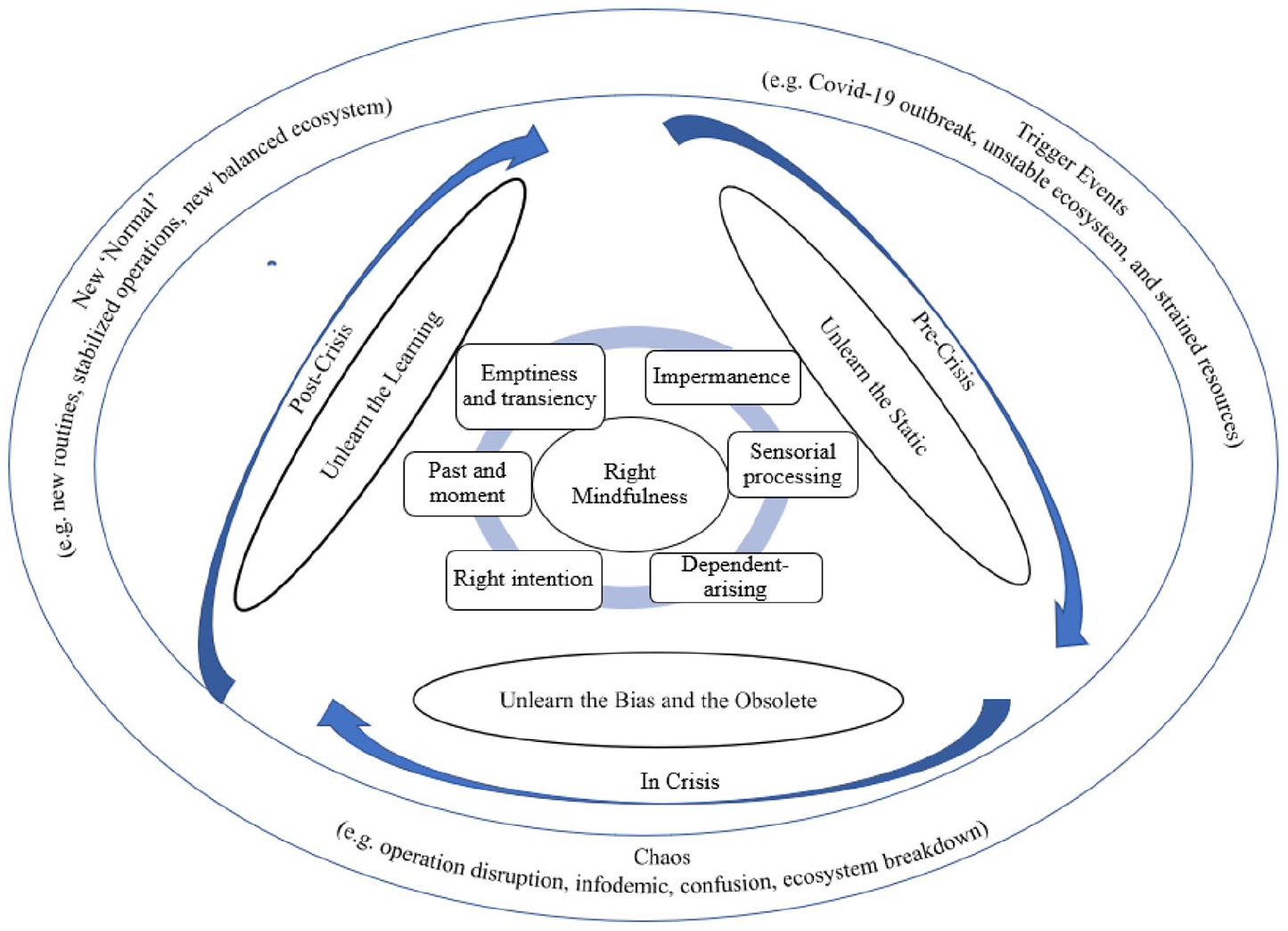
Mechanisms of mindful unlearning during crisis.
Unlearning the static
Organizations need to build dynamic capabilities and promote organizational flexibility in preparing for potential strategic and structural changes (Bundy et al., 2017; Kahn et al., 2013). Unlearning the static organizational norms, routines, structure, or strategy and exploring the potential possibilities for any changes needed in times of crisis are crucial. Most organizations tend to embrace certain types of routines or structures as primary means to achieve their goals (March and Simon, 1958; Nelson and Winter, 1982), or as sources of accountability and political protection needed to assist organizations to operate effectively and efficiently (Feldman and Pentland, 2003). However, these organizational static structures and routines can lead to stagnation, inflexibility, and mindlessness (Gersick and Hackman, 1990; Langer, 1989; Vu et al., 2018). Experience-based routines and structures may become an automatic performance that may lack vigilance, critical thinking resulting in biased or over-simplified analysis, blind spots, and side effects for organizational change (Becke, 2014). Therefore, there needs to be a willingness to abandon ineffective and static routines in times of disruptions and crisis and relearn new ones continuously. The COVID-19 pandemic has led to organizations’ need to consider ‘new normal’ states to improve operational resilience, embrace remote work, or reimage alternative ways of sustainable operation to establish new competitive advantages (Verma and Gustafsson, 2020). Mindfulness can provide the following mechanisms to unlearn the static at different organizational levels.
Mindful awareness of impermanence
Understanding impermanence is a fundamental facilitator of willingness to change and unlearn. Being mindful of the principle of impermanence helps individuals and organizations understand that phenomena are in a constant state of flux and do not indefinitely endure (Van Gordon et al., 2016). Impermanence helps one understand that it is natural for life to be uncertain and that trauma and crisis can occur anytime in life as a normal cycle of life and the universe (Cacciatore et al., 2014). With such awareness, at the intra-organizational level, individuals are more willing to be aware of the outdated routines and processes that may not be compatible with the sense of urgency within organizations to facilitate the needed intentional unlearning (Cegarra-Navarro and Wensley, 2019). It also helps individuals be more inclined to accept the situation, including a crisis one, moving individual frames from passively coping to crisis to proactively managing the situation (Weick and Putnam, 2006). As a result, they can more quickly form collective sensemaking and balance the organizational intra-interactions deranged during a crisis. Being mindful of impermanence helps individuals deactivate mindless routines (Langer, 1989) and inflexibility (Gersick and Hackman, 1990) to embrace context-flexibility within organizations (Vu et al., 2018). In other words, the mentality of impermanence facilitates unlearning and enhances organizational flexibility and cohesion.
At the inter-organizational level, the appreciation of impermanence promotes awareness over unexpected and unprecedented changes through the rise and fall of the process of dependence arising (Schroeder, 2004) that may be beyond one organization’s control. Such understanding can help organizations acknowledge the importance of mutual exchanges of ideas, resources, and knowledge to collaboratively govern potential shared problems caused by any crisis like the COVID-19 pandemic, facilitating awareness of relational context (Knoppen et al., 2011). Firms appreciate cooperative interactions with partners (Hult et al., 2007) to learn within the context of relationships to innovate by valuing and assimilating new external information (Cohen and Levinthal, 1990). Organizations do not need to hire new people to acquire knowledge, but novelty is attained through inter-organizational learning (Hult et al., 2007). With impermanence appreciation, organizations may be more willing to reorient organizational structures, dominant logics, or core assumptions (Cegarra-Navarro et al., 2014; Sinkula, 2002) according to the new circumstances while considering knowledge exchange with other organizations. They are more likely to activate an intentional process addressing the need to adapt to discrepancies between current reality and existing organizational knowledge through organizational unlearning (Wensley and Cegarra-Navarro, 2015) and actively facilitating organizational resilience and ecosystem to deal with similar crises in the future. Organizational ecosystems are usually plunged into chaos during a COVID-19-like crisis, including disruptions in the supply chain, sudden changes in relationships with customers and other stakeholders. Organizations need to restructure their ecosystems to better support a resilient system (Orth and Schuldis, 2021) during crises. For example, Prisma Health, a South Carolina-based organization, partnered with Johnson & Johnson Ethicon division to enhance capacity and distribution infrastructure based on a flattened structure with an open-source approach in sharing a mission to collaboratively design and distribute emergency ventilator-expansion devices (De Smet et al., 2020). When organizations are more aware of the ‘impermanent’ nature of the business context by building up agile transformations systems pre-COVID-19, they can perform and move faster post-COVID-19 both at inter- and intra-organizational levels (Handscomb et al., 2020). Those organizations are equipped with cross-functional teams, empowered frontline teams, and clear data on outputs and outcomes, that proved critical to adapting to the COVID-19 crisis. In 2019, Merck Sharp & Dohme Corporation in Japan transformed into an agile organization 5 that allowed a seamless up-and-down flow of information to keep up with teams’ health and workload effectively.
Mindful sensorial processing
In times of crisis and uncertainty, it is crucial to be able to filter the needed and right information. Mindfulness enables sensory, emotional, and cognitive processing through bare awareness (moment experiences), protective awareness (discernment to support moral judgment), introspective awareness, and inspiring conceptions (Kuan, 2008; Vu and Burton, 2020). At the intra-organizational level, a mindful sensorial processing approach is essential to assist organizational members in filtering out any harmful or misleading information leading to disruptions. This approach extends the present-centered non-judgmental awareness as it involves attending to and retaining experience to develop a clear understanding of the phenomena, particularly in the infodemic associated with the COVID-19-like pandemic. Furthermore, it helps organizational members exchange ideas, make sense of the information, and keep relevant information active and integrate them within meaning patterns for purposeful activities in the future (Dreyfus, 2011). Mindful sensorial processing involves retentive ability, cognitive transformations, and an ability to evaluate the nature of mental states and information processing. The information processing through mindfulness goes through evaluating information based on the recollection of past experience and the deconstruction of the information context through non-simplified interpretations. This approach reflects moves beyond the limitations of learning through cognitive approaches of information processing alone and acknowledging that knowledge needs to be situated through a constructionist and processual view (Marshall, 2008). Sensorial processing facilitates the interplay of cognitive and practice-based unlearning and information processing through processes of evaluations and non-simplified interpretations to filter out unhelpful information to identify what needs to be changed to unlearn the static.
At the inter-organizational level, the mindful sensorial process tends to increase network relationships among organizations through without bias information sharing, trust development and reciprocity (Diani, 2003), allowing the ideas exchange among organizations to occur more effectively. Besides, the awareness enabled by mindful sensorial processing promotes practice-based unlearning and information processing approaches to developing higher processes and capacity (Dance and Larson, 1985) to improve the information sensemaking and to monitor communication and relationships with external stakeholders (Cegarra-Navarro and Wensley, 2019). At the pre-crisis stage, mindful sensorial processing helps limit misinformation that leads to ineffective actions, overreactions, or underreactions (Pennycook et al., 2020). Being practical and staying alert can enhance risk communication’s effectiveness at the inter-organizational level because organizations that are mindful of people’s risk perceptions can understand how individuals may evaluate threats and receive information (Aven and Bouder, 2020). Risk perceptions of COVID-19 are affected by more than one factor, such as societal, cultural, and psychological factors, and they influence preparedness and planning (Nygren and Olofsson, 2020). The mindful sensorial process helps to filter out disruptions, such as infodemic during the COVID-19. The infodemic, which includes rumors, stigma, and conspiracy theories, makes it difficult to find credible sources for guidance and updates (Pulido et al., 2020) to cope with a crisis. Staying alert to assess the risks and mindfully processing the information are crucial for organizations to avoid the stretch of organizational resources to the point of impairment (Kahn et al., 2018) to identify what information is valid to unlearn the static.
Unlearning the bias and obsolete
The COVID-19 has been a complex crisis since it has caused changes to business models and requires organizations to constantly observe and adapt and adopt a proactive approach to respond to changes and unprecedented demands to alter strategies, services, and even products (Verma and Gustafsson, 2020). To facilitate such efforts in the crisis management stage, organizations may need to revise the existing knowledge and skills (Kuckertz et al., 2020), build capacity, and update employees’ technological skills (Carnevale and Hatak, 2020). They need to intentionally and consciously unlearn (Hislop et al., 2014; Tsang and Zahra, 2008) to discard obsolete knowledge, behaviours, and outdated skills to make room for new ones (Becker, 2010; Hedberg, 1981). Mindfulness can facilitate and guide such unlearning processes with the following mechanisms.
Mindful awareness of dependent-arising
All phenomena are intricately connected and arise in dependence upon each other (Thich, 1999). In other words, everything is interrelated in the universe, so there is a need for individuals to relate to others (Hibbert and Cunliffe, 2015) and interact with the world (Segal, 2011), in which communication to exchange information and interactions with the external world are fundamental. Within organizations, during a crisis, mindful communication is needed to understand people’s risk perceptions and communication (Aven and Bouder, 2020) to proactively communicate crisis management strategies and alter any misleading information within the organization. Information and knowledge must be transparently shared during a crisis as they influence all organizational members, especially in the COVID-19 pandemic when one individual’s health condition can affect other organizational members and organizational performance in general. During COVID-19, the interdependencies among different aspects of one’s life and others in an organization become more salient. The integration between work and life is increasingly strengthened. An acknowledgment of dependent-arising may help individuals be more open to sharing and being shared.
For many individuals who have kept their private and professional lives separate, the COVID-19 has forced them to loosen this assumption. The awareness of dependent-arising may facilitate these individuals to unlearn the work-life separation tradition and more quickly adjust to the different ways of working and living during the pandemic. Lee et al.’s (2020) study of 490 full-time employees in the United States across industries during the COVID-19 outbreak found that transparent internal communication increases employees’ intrinsic needs of satisfaction, fostering their job engagement and knowledge-sharing behaviour during the crisis. Such transparent communication among employees requires less effort to reach a consensus on collectively unlearning (Lyu et al., 2020) to respond to changes activated by a crisis. In larger organizations, communication systems can be more complex; thus, employees may be restrained from getting their voices heard, creating more barriers for organizational unlearning (Lyu et al., 2020). Appreciating the need for collective communication during a crisis is crucial to overcome rigid, constricted, closed, self-protective, and defensive communication (Minuchin, 1974; Staw et al., 1981) that may generate negative impacts or even chaotic responses to crises (Kahn et al., 2013).
Facilitating inter-organizational communication is crucial as organizations can acquire new information through ongoing communication with external stakeholders to respond to potential threats and harm of crises (Sellnow and Seeger, 2013). During a crisis like the COVID-19 pandemic, direct communication is disrupted, affecting business operations (Bofinger et al., 2020). Actors’ dependent-arising nature is more prevalent during the COVID-19 crisis and can promote constructive communication among organizations, which, in turn, would help organizations identify the needed new knowledge and competencies as innovation is impossible without unlearning (Assink, 2006), requiring competence-destroying and creative construction processes (Lawlor and Kavanagh, 2015). In the COVID-19 pandemic, technological skills have been greatly desired by the education sector to maintain remote learning and communication (Zhang et al., 2020). Digital technologies have become essential for economic and social functioning (Huynh, 2020). Artificial intelligence tools have brought great assistance to analytic needs (Panigutti et al., 2020). However, besides these newly learned skills, unlearning needs to be mindfully activated with a close examination of socio-technical systems. Without a consensus of justified governance, these emerging technologies can be easily associated with privacy, misinformation, and security issues (Huynh, 2020; Panigutti et al., 2020). Therefore, mindful awareness of dependent-arising embraces collective communication based on mindful collective consensus.
Mindful awareness of right intention
Right intention (samma san-kappa) in the Noble Eightfold Path emphasizes the purposive or conative aspects of mental activity for the intention of encouraging goodwill, empathy towards others without doing any harm (Bodhi, 2011). It translates into positive intentions to attain shared goals through constructive communication rather than engaging hidden interests and intentions in communication, which is crucial for intra- and inter-organizational learning. With the right intention in mindfulness, ethical awareness in motives and behaviours at the intra-organizational level is enhanced, orienting individuals to set aside their self-interests, leading to prosocial behaviours (Berry and Brown, 2017; Burton and Vu, 2021; Condon, 2017; Donald et al., 2019). This approach facilitates unlearning and learning with a prosocial mindset; unlearning toxic individualized and instrumental intents to encourage moral reflexivity for transformative learning approaches (Vu and Burton, 2020) to respond to crises. Organizational actors are intrinsically motivated to generate network resources based on prosocial behaviours to facilitate higher trust levels (Neubert et al., 2017). Hu et al. (2020) also found that during COVID-19, leaders who prioritize the needs of employees and other stakeholders are precious to keep anxious employees engaged at work and promote their prosocial behaviours. Leaders who show ethical awareness, such as sympathy, calling for cohesion, and unity, were able to mobilize support and achieve a positive outcome in managing the COVID-19 (Dirani et al., 2020). Communicating with compassion was also found to reduce burnout for nurses in hospitals during COVID-19 (Hofmeyer et al., 2020). With ethical awareness, communication is more likely to become trustful, resilient, sustainable, constructive, and collective in times of crisis, especially when uncertainty can create confusion and distrust among people (Verma and Gustafsson, 2020).
At the inter-organizational level, risk communication within the COVID-19 pandemic is crucial, highlighting the importance of promoting a prosocial mindset in maintaining trust in communicating with authorities and different stakeholders (Aven and Bouder, 2020). For instance, the tourism and hospitality industries were heavily affected during COVID-19. In India, industry associations have put forward proposals submitted to the government to help the industry stay alive (Kumar, 2020). These proposals would not take form without inter-organizational information sharing and trust. The pandemic also put unprecedented stress on the organization’s partnerships, calling for swift trust in these partnerships. Casady and Baxter (2020) pointed out the risk of failure in public-private-partnership in construction projects and how trustful communication of risk among involved organizations helps to promote sharing information and collective efforts to deal with the ordeal (Casady and Baxter, 2020). Cheng et al. (2020) also found that building trust and the long-term capacity of community-based organizations play a key role in containing the COVID-19 pandemic. Setting aside and unlearning organizational routines, ideologies, instrumental agendas, and practices that are no longer relevant in the relational context of a crisis like the pandemic is needed. Such an approach would facilitate trust and reciprocity in communication to enhance information sharing for collective action and learning (Diani, 2003) in crisis management.
Unlearning the learning
No crisis is similar to another. COVID-19, as a natural crisis, is quite different from the financial crisis in 2008. While both have impacted the global economy, COVID-19 is a human social and economic crisis directly attacking human health and existence. As a result, nations have made unique decisions to save lives before saving the economy by announcing lockdowns and social distancing, severely damaging businesses across industries (Donthu and Gustafsson, 2020; Leite et al., 2020). Therefore, it is essential to be mindful of how the accumulated experiences gained in managing one crisis may need to be unlearned in other disruptive contexts at some point. To facilitate this awareness for the post-crisis stage, we suggest the following two mechanisms.
Mindful awareness of emptiness and transiency
Based on impermanence, the notion of emptiness (Pāli: suññatā, Sanskrit: śūnyatā) emphasizes that all perceived phenomena are empty of intrinsic existence and that emptiness is the very nature and fabric of the reality we find ourselves (Soeng, 1995). In other words, when the mind abandons attachment to a particular phenomenon, knowledge, or even to the ‘self’, it can expand to its full capacity (Khyentse, 2007). Everything becomes ‘new’ again, and the process of unlearning the learning is embraced.
At the intra-organizational level, it is natural to celebrate the fruits of the previous unlearning process to deal with a crisis by gaining new knowledge to facilitate innovation (Wang et al., 2013). However, it is more important for organizations and their members not to be overly attached or arrogant with the newly gained knowledge and organizational practices. Such attachment may draw organizations back to mindless routines constraining further intra-organizational unlearning or learning or potentially limiting mindful awareness of impermanence and future crises. Emptiness and transiency stress a continuous process rather than an outcome to facilitate behavioural unlearning accompanied by cognitive unlearning (Hislop et al., 2014) to unlearn inappropriate behaviours in response to different contexts at a fast pace (Johannessen and Hauan, 1994) to promote flexibility and prevent rigidity (Akgün et al., 2007).
All learning will have to be unlearnt at some point, just as how ‘unlearning context’—the investigation of the existing knowledge state in an organization and/or the revision or re-creation of this knowledge (Wensley and Cegarra-Navarro, 2015: 1563)—is needed in a crisis, impacting inter-organizational relationships (Kahn et al., 2013). In the post-crisis context, new policies have to be established, such as new labour policies to boost demand for labour, renewed health protection measures and economic support to build resilience in the future (Bell and Blanchflower, 2020). These policies involve another unlearning process at inter-organizational levels to rescale the temporary measures and policies implemented during the pandemic (Carnevale and Hatak, 2020).
Mindful awareness of past and moment
It is, however, fair to say that not all knowledge and skills need to be unlearned to attain a new required set of knowledge and skills. Organizations need to be mindful of what can be applied and learned from the past since wisdom is articulated from past experiences (Bodhi, 2011; Gethin, 2011). Past experiences can highlight the need to abandon communication or system networks that did not prove helpful or complimentary, facilitating a smoother process of unlearning at an intra-organizational level. Unlearning the learning operates selectively based on understanding the current circumstances of the crisis and taking away the necessary and useful lessons learned from past experiences. For instance, one of the lessons from the COVID-19 pandemic is that organizations need to be willing to unlearn organizational systems. The unlearning should be done by reevaluating and revisiting supply chains, rules, regulations, increasing digital footprint (Verma and Gustafsson, 2020). Organizations should be mindful of the impermanent context to enhance flexibility and proactive context-sensitive organizational approaches to a crisis.
Moment awareness is crucially contributing to unlearning context to identify and adapt to new circumstances of any new crisis. It takes inter-organizational collective efforts to mindfully acknowledge the depending arising nature of phenomena when a crisis happens to increase inter-organizational partnerships proactively. A recent study by Orth and Schuldis (2021) found that during the COVID-19 pandemic, organizations are more likely to adopt an open system culture to facilitate the adaptive capacity of resilience to withstand adversity. Such an approach would promote resilient ecological systems to collectively and more effectively deal with ecological burdens (Huynh, 2020) to lay a mindful foundation for the future (Ivanov, 2020). It would encourage organizations to move forward to transform into agile organizations that embrace both the impermanent and dependent-arising notions embedded in organizational mindfulness practices.
Implications for management learning
Organizations learn and unlearn from their own experiences and others’ experiences in crisis (Akgün et al., 2007; Smith and Elliott, 2007), thus in this article, we focused on the different mechanisms that facilitate the unlearning process at both intra- and inter-organizational levels. We emphasize the mindful unlearning journey to tackle predetermined and preoccupied behaviours that may result in rhetorical barriers (Heath and Millar, 2004), restricting organizations from seeing warning signals in time for crisis management. Based on our conceptualization of mindful unlearning, we highlight the following implications for management learning.
First, it is important for managers and organizations to unblock and unlearn any static states that may obstruct the learning process to cope with unexpected crises. How knowledge is disseminated and interpreted has a significant impact on how organizations will make cultural adjustments to prepare and respond to a crisis (Smith and Elliott, 2007). We tend to experience the world and categorize information to attain a certain form of comfort by getting things in place (Langer, 1989). However, there is a danger in becoming mindless and hampered by a single perspective and automatic behaviour to categorize and limit signals from the context around us (Langer, 1989). The crisis incubation periods often occur when signals go unnoticed without sensorial processing because of accepted beliefs and norms, faulty rationalizations from preoccupied management beliefs (Mitroff and Pearson, 1993; Nystrom and Starbuck, 1984). To overcome such challenges, mindful awareness of the impermanent nature of context and sensorial processing facilitates the unlearning process of categorized information and preoccupied behaviours of managers and organizations to encourage proactiveness and flexibility rather than reactiveness in responding to a crisis (Yawson, 2020). For instance, many small restaurants which were known for their great dine-in services were in existential crisis during the pandemic. However, they managed to keep their core employees and moved fast to quick services (drive-through, pick up, and mobile ordering) to sustain themselves during difficult times. Upon closure during COVID-19 lockdown, some local bars and distilleries quickly switched to producing hand sanitizer within a few days to support local short supply (McKeon, 2020). Science museums reinvented their programmes to engage the public outside the museums’ walls, such as offering virtual science workshops to schools and organizing distance learning hubs for children (Anthes, 2021). For higher education institutions with robust technological systems, they have been able to configure and allocate resources and capabilities flexibly to adapt and prepare for the dynamic changes and student’s demands when the pandemic happened, offering online and blended deliveries.
Besides, inter-organizational learning should be facilitated with coordination and deliberate efforts to be more predictive and strategically flexible (Yawson, 2020), unlearning preoccupied assumptions as competitors in normal times with sensorial processing to avoid bias and misleading information. Higher education institutions, for example, have made collaborative decisions to offer flexible and context-sensitive delivery modes across universities. An innovative employee sharing plan was formed in China so participating organizations could ‘borrow’ employees from the pool to meet its urgent need for labour during the pandemic (Wade and Bjerkan, 2020). Unblocking prior assumptions with mindful sensorial and impermanent awareness can also contribute to a reflective approach to unlearning (Matsuo, 2019). Prior preparations and context sensitivity may attend to emotional challenges, stress, and anxiety, or frustration that can potentially be involved in the process of unlearning (Cotter and Cullen, 2012; Visser, 2017).
Second, in the crisis management stage, awareness of dependent arising and right intention can facilitate managers and organizations with the right attitudes and approaches to unlearn ineffective skills and knowledge to acquire more relevant ones. The COVID-19 pandemic has a global impact, affecting everyone’s lives. Therefore, the pandemic itself involves a depending arising outcome with it. It is crucial to acknowledge the interdependence nature of relationships and networks in such a reality. While mutual efforts are crucial, it is also critical for such efforts to be implemented with the ‘right intention’. For instance, some organizations have been trying to profiteer from the crisis, switching towards short-term gains, and even engaging in fraud and misconduct with the excuse of being suffering from slack resources and pressures for survival (He and Harris, 2020). However, such unethical and opportunistic business practices can result in long-term consequences and brand damage. Knowledge of competitiveness may not be as important as promoting sustainability, proactiveness, and resilience during the crisis. With ‘right intention’, managers and organizations can establish stronger bonds within and with stakeholders, facilitating learning for all to combat the impact of the pandemic. Some retailers had to lay off their employees following store closures during the pandemic but have found ways to redeploy them to drive online sales (Wade and Bjerkan, 2020). Many manufacturing companies have transformed their factories, using and updating their knowledge and skills to produce ventilators, and personal protective equipment, with some donating instead of selling (He and Harris, 2020). Supermarkets in the United Kingdom and the United States have offered allocated hours for the elders, high COVID risk people, and national health service (NHS) workers (Lindsay, 2020). Scandinavian Airlines laid-off workers were offered fast-track training to help the country’s health care system (Wade and Bjerkan, 2020). Right intention and dependent arising also attend to concerns over how unlearning can discard value judgment (Tsang and Zahra, 2008). Right intention facilitates managers’ and organizations’ mindful awareness and acknowledgment of stakeholders’ judgment and communication rather than being tempted to manipulate stakeholder judgments to serve one’s interests over the interest of stakeholder welfare (Lankoski et al., 2016). In other words, right mindfulness covers the intentions of renunciation, goodwill, and harmlessness (Bodhi, 1994). All such intentions can bring forward more sustainable bonding relationships across organizations and a compelling adaptation of skills and knowledge in learning to adjust to a new reality in how organizations can operate ethically and sustainably during a crisis.
During the COVID-19 pandemic, we have observed how mindful unlearning of individualistic organizational approaches have taken place with an awareness of dependent arising. Such an approach has fostered the partnerships of many organizations to successfully distribute emergency ventilator-expansion devices (De Smet et al., 2020). Right intention embedded in mindful unlearning enabled more responsible approaches in management. Compared to 2019, when boards mainly were focused on innovation and growth, during the COVID-19 pandemic, corporate resilience has risen to become an equally important topic (Huber et al., 2021).
Third, after experiences, exposures, and lessons learned from any crisis, managers, and organizations should consider unlearning some skills and knowledge in the post-pandemic world after workforce shifts and the need for reskilling (Yawson, 2020). They also need to consider and establish a ‘new normal’ way of operating and prepare for any unexpected crises in the future. For instance, managers should consider developing and being equipped with new skills to attend to uncertainties, which often includes redefining new leadership skills and approaches to attend to the complex challenges during and post-crisis times (D’Auria and De Smet, 2020). It is, therefore, important for managers to be able to abandon habitual responses and unconscious bias to unfamiliar problems (Brassey and Kruyt, 2020). Managers need to let go of their ‘ego’ and appreciate the transiency and ‘empty’ nature of their roles as leaders or managers (Vu and Burton, 2021; Vu, 2021) in challenging times to capture employees’ feelings and needs. Such an approach can facilitate reflexivity and flexibility to acquire new skills for the ‘distance economy’ and the need for digitalization and agile workforce strategies to reinvent work (Yawson, 2020). Besides, being mindful of past experiences is significant for managers and organizations to learn to be resilient to crises, especially for failed experiences. Sitkin (1996) argues that we cannot learn without failure, and it is an essential prerequisite for effective organizational learning and adaptation. Therefore, appreciation of past failed experiences is salient because failure can contribute to ‘small doses of experience to discover uncertainties in advance’ (Wildavsky, 1988: 26). When failure is noticed and taken into consideration, it triggers a learning cycle. Mindful awareness of failed experiences and transiency also contributes to the temporal nature of management (Hernes and Irgens, 2013). Through the continuity of the unlearning or learning process in organizations, managers show a willingness to explore and examine broader implications of activities (Weick and Roberts, 1993) and re-interpret and learn from past experiences.
Crises are challenges but also opportunities to continuously unlearn and learn with reflexivity. It is likely that after the COVID-19 pandemic, a new cycle of unlearning or learning will take place as a recent study forecasted workforce transitions and found that 1 in 16 workers will need to switch to another occupation by 2030 in a post-COVID-19 scenario (Lund et al., 2021). Managers are also encouraged to adopt mindful unlearning to facilitate automation, artificial intelligence in workplaces with high physical proximity to enable organizational resilience. Such approaches will undoubtedly involve both inter- and intra-organizational efforts to cultivate resilient ecological systems to cope with potential future crises.
Conclusion
We have introduced and conceptualized the notion of mindful unlearning in an organizational crisis management context. Mindful unlearning is a continuous process of engaging and disengaging with knowledge context-sensitively to facilitate a cycle of unlearning or learning. Mindful unlearning enables the dynamic interplay of learning and unlearning at different stages of crisis management (Bundy et al., 2017) through several mechanisms: mindful awareness of impermanent and sensual processing (pre-crisis stage), mindful awareness of interdependence, and right intention (crisis management stage), and mindful awareness of transiency and past experiences (post-crisis stage). The concept of mindful unlearning contributes to the temporal nature of management and the learning continuity at the organizational level (Hernes and Irgens, 2013) with a critically reflective approach (Matsuo, 2019) guided by the principle of right intention from the Noble Eightfold Path. Mindful unlearning moves away from rigid conceptualizations of phenomena, static structures, routines, inflexibility, and mindlessness (Gersick and Hackman, 1990; Langer, 1989; Vu et al., 2018). It contributes to a non-conceptual mindful way of liberating organizational habits, structures, and concepts (Weick and Putnam, 2006; Weick and Sutcliffe, 2001) that embraces context-sensitive and temporal management needed in unprecedented crisis management. However, our approach in introducing mindful unlearning has its limitations. Without empirical data, our approach is limited in examining the continuity of the unlearning or learning cycle of mindful unlearning, where failures and painful lessons are part of the process and sometimes beyond individual and organizational control due to the impermanent nature of the crisis or context. Future studies may further explore such dynamic interplays and struggles within and among agencies, organizations, and institutions in the process of mindful unlearning. Different types of crises can also trigger different mindful unlearning mechanisms beyond this article’s scope. We encourage future studies to explore and examine these mechanisms. Moreover, we suggest the following interplays for future research in different organizational contexts that have undergone different crisis management or have coped with different crises like the COVID-19 pandemic to accumulate further meaningful lessons and new mechanisms for mindful unlearning in crisis management: (1) mindful awareness of impermanence and organizational flexibility, (2) mindful sensorial processing and cognitive and practice-based unlearning, (3) mindful awareness of dependent arising and collective unlearning, (4) mindful awareness of right intention and prosocial mind-set in unlearning, (5) mindful awareness of transiency and emptiness and organizational temporal unlearning practices and (6) mindful past and present awareness and organizational unlearning context.
