



Abstract
Why do so many organizations fail to respond to crises effectively, and what can be done to improve their crisis response? We aim to address these questions by developing a typology of boundaries that can help us understand and better prepare for future crises. Building on the existing literature on crisis management and boundaries, our typology seeks to address the critique of current crisis management models, such as these being too prescriptive and placing too much emphasis on assumptions that only the decisions made by the crisis management team (i.e., centralized decisions) will impact the crisis response. We address this critique by elaborating on four categories of boundaries that are relevant to manage crisis response, such as physical, mental, social, and temporal. Examples of these boundaries could include access to properties (physical), interpreting whether a crisis is happening (mental), shifting relationship dynamics (social), and the urgency of response time to a crisis (temporal). Our typology offers a lens to consider crisis management by taking into consideration the complexities and nuances that linear crisis management models have not yet adequately addressed. We argue that by identifying, defining, and understanding different configurations of boundaries, one can better manage crises toward a desired outcome.
Introduction
We live in times of constant crisis. A brief glance at the media on any given day will find references to the pandemic crisis, environmental crisis, cost of living crisis, refugee crisis, and financial crisis, among others. A Google Trends search from 2004 to 2023 shows a sharp increase in keyword searches for crisis and business crisis, particularly in Autumn 2008 and Winter 2020—arguably directly aligned with the financial crisis and the worldwide rise of COVID-19. Not surprisingly, academic research has matched this wide interest in crises (Hällgren et al., 2018), aiming to explore how to best manage and recover from crises. For instance, there was a sharp increase in publications in the late 1980s and 1990s following the Challenger Explosion, Chernobyl, and Tylenol Cyanide scare, as well as in 2000s following the USA 9/11 terrorist attacks, and the 2008 global financial crisis (Lampel et al., 2009; Lee et al., 2020; Marcus and Nichols, 1999; Smith and Elliott, 2006). Between late 2020 and 2023, we have seen a rise in the number of publications on crisis management, arguably illustrating a concern to better understand and prepare for future crises after experiencing the impact of COVID-19 (Chatterji et al., 2021; Choi and Valente, 2023).
However, despite the vast crisis management literature, our understanding of how organizations could more effectively prepare and respond to crises is limited (Iqbal et al., 2022). Most existing models and frameworks fail to sufficiently address the complexities of crises, which have been defined as “highly salient, unexpected and potentially disruptive” events (Bundy et al., 2017: 1663). Particularly linear stage models of crisis management (e.g., Fink, 1986; Pearson and Mitroff, 1993; Smith, 1990) seem to overly simplify the complex and difficult to predict reality surrounding the inherently unknown and unexpected outcomes of crisis response, leading to these models being too prescriptive (Gilpin and Murphy, 2010). Often, applying standard procedures to manage unknown problems can further escalate the crisis, leading to even worse outcomes than not trying to manage the crisis at all (Oliver et al., 2017).
In this paper, we aim to further our understanding of crisis response by drawing from the literature on boundaries, which offers a particularly useful insight to delineate how complex and unexpected phenomena like crises can be managed from different perspectives. Rather than trying to predict the unpredictable, organizational boundaries, typically considered as a dividing line, or demarcation of something inside and outside, which has the potential to be located, defined, and thus managed, are useful to improve our understanding of how organizations can manage their crisis response. Understanding the nature of boundaries can raise our awareness of different issues that organizations should be concerned about when planning their crisis response, making organizations more sensitive to what might change during crises.
We mainly draw from the work of Hernes (2004), Jæger and Pedersen (2020), and Ashforth et al. (2000) to develop a typology of four types of boundaries that can help us improve our current theorizing of crisis response. Whereas we borrow three types of boundaries from Hernes (2004) in terms of physical, social, and mental boundaries and illustrate how they can be applied to crisis management, Jæger and Pedersen (2020) were instrumental in guiding our understanding of how boundaries can be constructed, maintained, and understood by individuals and organizations. Their conceptualization of boundaries as a phenomenon that is constructed by individuals and groups that can offer insight into collaboration, identity, and organizational effectiveness underpins our constructivist understanding of boundaries as discussed in this paper.
Following Hernes (2004), we argue that physical boundaries, such as material or regulatory boundaries, help organizations manage crisis response because they tend to be formal and identifiable, and can be more easily managed to align with the response goals. By contrast, social boundaries are those that relate to interactions between different internal and external organizational stakeholders and the organization and its environment. Social boundaries are important for crisis management because they impact how people relate to one another. Such social interactions can become either more closely connected or more strained under crisis, leading to hesitancy to act. Mental boundaries are mainly related to individual and group understanding and decision-making. They can either improve or erode the crisis management response by impacting the perception of the crisis itself, as well as expected actions of individuals as those that may or may not align with organizational expectations. Expanding the work of Hernes (2004) and borrowing from Ashforth et al. (2000), we add temporal boundaries to our typology, which are those related to time. In the context of crisis management, they refer to the delineation of how long the crisis lasts, how quickly the organization can respond to it, and how the crisis changes shape as time passes. Given how important it is that organizations respond to crises quickly to prevent negative outcomes, temporal boundaries can be particularly important to decision-making, especially when acting in a time crunch without necessary information. Temporal boundaries are also important because excessively transcending individual temporal boundaries can lead to burnout, fatigue, and anxiety, and can thus negatively affect the crisis response.
By developing this novel typology of boundaries, we make three significant contributions. First, we draw from the boundary management literature to explore crisis management through the identification, definition, and understanding of the roles of boundaries, which can help us address the complex nature of crises and how to best manage and respond to them. The four types of boundaries can help organizational members focus on different perspectives that consider the thoughts, behaviors, and actions of individuals, as well as the organization, to respond to situations they are facing as a crisis unfolds. As such, we address the limitations of linear crisis management models, which are underpinned by overly rational assumptions. Second, our typology, grounded in boundary literature, also helps us bridge the divide between the internal and external perspectives of most crisis management models (Bundy et al., 2017). That is, our typology can help us address both the internal perspective dealing with the within-organization dynamics, such as managing risk, complexity, and technology, and external perspectives that focus on stakeholder management and how the organization interacts with its environment. Third, we also advance the boundary management literature by theorizing how boundaries and organizations are inseparable and mutually constituting entities using examples of crisis management response. By aiming to locate and define the boundaries that are present in crisis responses, and to further understand what role these boundaries play in supporting or impeding crisis management approaches in organizations, it may be possible to develop a more nuanced understanding of how the various shifting boundaries can potentially better prepare organizational members for a crisis response. In other words, our typology of boundaries to manage crisis response can ultimately help us improve our understanding of complex situations (Cilliers, 2001).
This paper unfolds as follows. We start by reviewing the crisis management literature. We then focus specifically on decision-making in crisis management, followed by defining boundaries, which sets the scene for the discussion of organizational boundaries that underpin the development of our typology of boundaries in crisis management. Finally, we illustrate our typology using the example of an organization that experienced a weather-related crisis in summer 2023. We conclude with a discussion of the implications of our typology and several future research considerations.
Crisis management
Crisis management developed from work on disasters, particularly natural disasters, popularized by Quarantelli (1977, 1988) as well as works that consider crises as separate from disasters (Hermann, 1963; Turner, 1976; Williams, 1976). Therefore, unsurprisingly several areas emerged in this literature including theory building through case studies of a variety of crises and disasters (Billings et al., 1980; Milburn et al., 1983; Lagadec, 1993; Shrivastava, 1992), exploring the role of perception and cognition in crisis management (Kuklan, 1988; Weick, 1995), and developing models and best practices for industry to prepare and respond to crises (Fink, 1986; Mitroff, 1994; Mitroff, et al., 1996; Pearson and Mitroff, 1993; Pearson and Clair, 1998).
The literature on crisis management has grown in recent decades to include insights from psychology, risk management, resilience, business continuity, public relations, complexity, stakeholder theory, and many others, although in the past 20 years the emphasis has been on public relations in response to crises (Brown-Devlin et al., 2021; Coombs, 2007; Ziek, 2015). Most of this research effort has resulted in different frameworks that conceptualize crisis by means of typologies of different types of crises (e.g., Coombs, 2006; Crandall et al., 1999—in Crandall et al., 2014; Marcus and Goodman, 1991; Myers, 1993; Pearson and Mitroff, 1993; Rosenthal and Kouzmin, 1993), the predictability/manageability of crises (e.g., Coombs, 2006; Gundel, 2005; James and Wooten, 2005; Taleb, 2007), or by proposing linear (Fink, 1986; Gonzalez-Herrero and Pratt, 1995; Myers, 1993; Pearson and Mitroff, 1993; Smith, 1990) or nonlinear (Jaques, 2007; Oscarsson, 2022) process models of crisis management (see Table 1). This growth has allowed new insights to develop, while also shedding light on challenges in the existing concepts and models that warrant further exploration.
Overview of major crisis management frameworks.
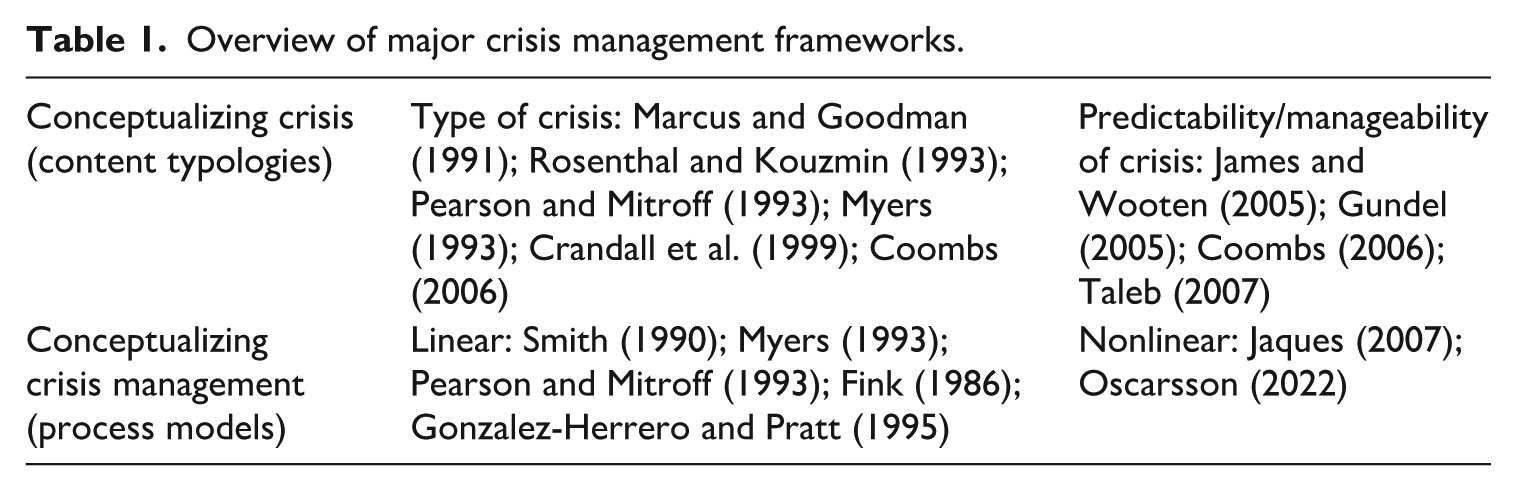
Much of the development of crisis management typologies has been focused on providing clarity on different types or families of crises (e.g., natural disaster, technological issue, reputational issue) to help identify what situations or scenarios are likely to occur with each type. The typologies proposing predictability or manageability (e.g., sudden vs. smouldering; James and Wooten, 2005), and probability/impact (e.g., Taleb, 2007) allow for identifying the types of management actions most likely suitable for a given crisis. By contrast, the process models do not seek to break the crisis into a specific type but instead propose action steps for responding to a given crisis (Fink, 1986; Jaques, 2007; Smith, 1990).
We build on the current crisis management models (see Table 1), specifically by addressing the concerns that many crisis management models are too linear. The linear models include different stage models, for instance, the three-stage model of before-, during-, and after-crisis (Smith, 1990) or the four-stage models that split the during-crisis phase into two separate phases focusing first on the immediate crisis response, followed by the lingering longer-term response (Fink, 1986; Myers, 1993). Some models also split the before-crisis phase into two parts, focusing on the internal and external environments of an organization that are impacting the crisis and planning for the crisis (Crandall et al., 2014). Yet, the five-stage models split both the before-crisis and after-crisis into two stages each, which emphasizes detection before preparation or prevention, and recovery as separate from post-crisis learning (Pearson and Mitroff, 1993). All these crisis management frameworks are underpinned by the same general idea that a crisis has a before, middle, and an end stage, and that the crisis response should proceed linearly from one stage to the next.
Questioning the suitability of linear frameworks for crisis management is not new. Jaques (2007) created a relational model of crisis management that asserts that many stages of crisis management are happening simultaneously and that instead of seeing crisis management as a series of steps to be taken, it should be seen as “clusters of related and integrated disciplines (2007: 150)” that can overlap and interact. Jaques’ model draws on studies in issue management that questioned the linear models (Bigelow et al., 1993; Lamertz et al., 2003 in Jaques 2007) and assumes that crisis management is in fact a type of issue management. Oscarsson (2022) took a different approach to challenging the linear models by questioning the foundational concept of crisis management, arguing that while most models see crisis as either an event or a process, it should be seen as a practice. Oscarsson’s argument that crisis management can be best understood as dispersed practices that occur across multiple levels and at different times within an organization also seeks to address linearity through overlapping and simultaneous actions instead of a series of steps. The Oscarsson model addresses the issues of linear models, focused on step-by-step procedures and assigning crisis response actions to specific individuals. Oscarsson asserts that in practice, people across all levels of the organization are responding to the crisis in their own ways, whether specifically trained and assigned to manage crises or not.
While not directly questioning the linear models as they present a meta-view of crisis management that still focuses on a three-stage before-during-after crisis model, Bundy et al. (2017) discuss two perspectives of crisis management—that is, internal and external. They argue that most organizations seek to manage crisis through one of the two, whereby the internal perspectives are focused on within-organization management of risk, complexity, and technology, while the external perspectives deal with the interactions of the organization with relevant stakeholders, aiming to manage positive relationships, perceptions, and reputation. Ultimately, they argue that an integrated approach of the internal and external perspectives could be a more holistic and beneficial approach to crisis response, which has also been echoed by Crandall et al. (2014) in their addition to the five-stage model. Although this revised model emphasized awareness of the aspects of the internal and external landscape of an organization that could facilitate a crisis response, this model is still underpinned by an assumption of linearity. The argument for integration of the internal and external perspectives, combined with Jaques’ (2007) call to move away from linear models and Oscarsson’s argument that crisis management should be seen as a more dispersed series of actions, indicates the need for crisis management to embrace a more holistic and integrated approach going forward. Echoing these sentiments is the critique that most crisis management frameworks are too prescriptive (Gilpin and Murphy, 2010), that they do not explain how organizations respond when prescribed plans are not appropriate to address the crisis (Schakel and Wolbers, 2021), and that they do not account for the actions of people within and outside the organization who are not part of a formal crisis response team (‘t Hart et al., 1993; Oscarsson, 2022; Sparf, 2018).
Finally, various multi-stage linear models of crisis management that have been a cornerstone of the field for more than 30 years, do not always account for crises that transcend the delineated parameters of the model, such as the broader “psycho-social, cultural, and systems-based issues within the organization” (Smith and Elliott, 2006: 99). While Smith and Elliott (2006) argue that crisis management without a reference to these wider issues fails to address the problems that allow crises to incubate (2006: 99), we could also argue that crisis management without addressing these wider issues fails to account for factors that may be enabling or restraining the crisis management plan. We propose that by considering the definition, location, coexistence, intersection, and interaction of organizational boundaries, the crisis management field can conceptualize crisis as something that does not move along pre-planned sequential paths but rather deviates from the assumed path at multiple points. We argue that crisis management should be better considered as a series of decisions and actions happening simultaneously across all levels of the organization, both internally and externally.
Decision-making in crisis management
Decision-making during a crisis is typified by time constraints, risk, and uncertainty; however, despite these constraints, actions must be taken. Dye et al. (2014) focus on what Bundy et al. (2017) call the external perspective, arguing that decision-making during crises is particularly impacted by a combination of stakeholder needs and desires and uncertain outcomes. Stakeholders often control vital resources of decision-makers, and thus their needs must be considered, which is difficult when the needs are heterogeneous and the outcomes of a given situation are uncertain or unknowable. Understanding how and to what extent stakeholder needs impact crisis decision-making is relevant to managing a crisis effectively. Some stakeholders may prioritize the financial impact, others reputation, and still others health and safety of employees and customers. All these foci must be adequately addressed in a crisis response. Similarly, we need to understand what leadership does within a context of decision-making when the complexity leads to an extensive list of unknowns (Bloomfield et al., 2024).
Stakeholder needs add a layer of complexity to crisis management. A focus on the larger picture of how both crisis response teams and leadership, as well as non-crisis personnel, make decisions would more likely consider the diverse needs of stakeholders. Alpaslan et al. (2009) explore how stakeholder saliency changes during times of crisis by building on Mitchell et al.’s (1997) framework of stakeholder identification and saliency. When putting the stakeholder saliency framework into a crisis management context, Alpaslan et al. (2009) highlight how the urgency of a crisis can shift the role and impact of stakeholder groups. This framework also highlights the idea that an “organization’s assumptions and understanding of its stakeholders’ behaviour shape that organization’s success in managing crises” (p. 39), which they argue can be directly impacted by whether the organization takes proactive or reactive approaches to addressing stakeholder needs during a crisis.
Despite the understanding of the importance of stakeholder needs, most of the literature on decision-making during a crisis focuses on the role of leadership. Against this backdrop, the question of centralization or decentralization was revisited by ‘t Hart et al. (1993), who argued that decision-making has at least seven possible response patterns. While centralized decision-making may seem appropriate given the potential impact on organizations, and the time sensitivity of crisis response—all of which have been supported by multiple examples in crisis situations—‘t Hart et al. (1993) also argue that crisis decision-making is impacted by whether the responder is engaged in strategic or operational response. The argument that crises tend to be more salient and feel more urgent at the operational level, while tempered by a longer-term view at the strategic level, means that response decisions across different organizational levels are likely to be different. Centralized decision-making, without a doubt, has a place in crisis response, particularly if delayed decisions are likely to be costly (Bakonyi, 2018) or have dire consequences. However, arguments for decentralized decision-making have been put forward, because the skills or expertise of a centralized body may be overestimated (Greer et al., 2022) or stretched to the point where decision-making may become poor because of ongoing stress or group dynamics (‘t Hart et al., 1993). A large body of work has explored the shortcomings of leadership decisions and decision-making teams during crisis, including areas such as cognition and understanding of the problem, actions and decision-making models, and communicating and justifying the decisions (Al-Dabbagh, 2020; Curnin et al., 2022; Higgins and Freedman, 2013; Janis, 1982; Lipshitz, 1996).
de Waard et al. (2014) argued that “organizational responsiveness strongly depends on the cumulative sensing effort of [all employees] acting at different organizational levels and within different functional areas” (2014: 382). This argument aligns with our belief that sensing and acting at every level, and not just by the centralized body, impact crisis response.
Previous research on the role of individuals who are not members of leadership teams, particularly those on the front lines of a crisis, illustrates how decentralized decision-making can impact a crisis response. Case studies on Bhopal (Weick, 1988b), Mann Gulch (Weick, 1993), the 2015 European refugee crisis (Oscarsson, 2022), and a waterborne parasite outbreak in Sweden (Sparf, 2018) all take into consideration the actions of those not considered as part of “leadership” or the crisis response team. Many of these cases fall into what ‘t Hart et al. (1993) refer to as “situational dominance,” where “faced with extreme threats and time pressures, operational-level actors may feel obliged to bypass formal rules of consultation and command and simply effect direct responses to a given situation (1993: 21).”
The case of the Mann Gulch fire disaster illustrates this situational dominance of decentralization quite clearly. There was a centralized command (the foreman) who had a clear and articulated response plan (he laid down in a pre-burned-out area) that was disregarded by the rest of the team, who responded to their own impulses in the face of imminent danger. The result was an escalation of the crisis that went from managing a wildfire to the deaths of 13 firefighters. The Bhopal gas crisis provides a similar example, though with a less immediate life-threatening aspect. In the case of Bhopal, “operator improvisation in the face of escalating problems in the operation of the system occurred (‘t Hart et al., 1993: 22).” It is notable that in both examples, this informal decentralization did not mitigate and/or actively worsen the situation. However, as ‘t Hart et al. (1993) note, in some cases of decentralized decision-making, such as that of Apollo 13, a conscious decision to decentralize the decision-making may lead to more creative, timely, and effective crisis management than would have occurred otherwise.
While rarely focusing specifically on decision-making, we argue that these case studies indicate that the decisions being made at the ground level of a crisis have an impact on the overall crisis management response. This is particularly relevant because, outside of high-reliability organizations or industries with a higher chance of catastrophic disaster, most organizations do not have exceptionally disciplined decision-making models, especially not at the level of employees without leadership responsibilities. We argue that decisions take place on an ongoing basis, and by all people during a crisis, including those “front-line” employees who are not necessarily trained in crisis response. It is with this perspective that we argue that centralization and decentralization of decision-making during a crisis should be considered as taking place simultaneously and shaping the overall crisis response.
Smith and Elliott (2006) noted that how we conceptualize the various processes that underpin a crisis will have a substantial impact on our understanding of how crises emerge and evolve. We add that these processes also have a substantial impact on how a crisis management plan is framed and carried out. In the remainder of this paper, we propose that boundaries provide one way of exploring the impact that decisions by individuals with and without formal crisis response responsibilities have on enabling or restraining crisis response.
One area of framing and responding to crisis that considers both the overall decision-making and various stakeholder voices is post-crisis analysis and organizational learning, specifically in the understanding of what decisions were made, how they were made, and who was making them. Fairhurst and Putnam (2024) provide multiple frameworks for working through tensions and paradoxes that arise in organizations, emphasizing collaboration, connection, and communication. We argue that while not all boundaries are inherently paradoxical or in tension (some may merely coexist or even act in synergy), it is highly likely that there are some areas where boundaries are in tension and may impact the crisis response negatively. As such, utilizing the both-and and more-than response frameworks presented by Fairhurst and Putnam (2024) gives practitioners tools for addressing these tensions in a time of crisis (if tensions need to be resolved to progress with crisis management). An example of more-than responses that Fairhurst and Putnam present includes “reflective practice and serious playfulness (p. 68),” which offers the option to resolve tensions by developing new options, often through trial and error. This type of reflective practice could be especially useful as “war gaming” a crisis plan to test out different scenarios and present areas where the tensions could be resolved or brought into synergy, which would allow a more reflexive crisis response. These tools can also be used as part of the post-crisis learning phase, allowing for the identification and resolution of tensions that impacted the response to prevent the same tensions from occurring during the next crisis.
Jæger and Pedersen (2020) argued that current boundary literature does not adequately theorize how boundaries are inseparable and mutually constituting entities. This includes the meaning-making that individuals ascribe to boundaries, which shapes organizations overall as well as the boundaries associated with stakeholder needs at the individual, group, and organizational levels. We argue that boundaries can help us address the challenges in crisis management associated with linear models such as these being overly simplified and prescriptive (Gilpin and Murphy, 2010), too segmented by assigned crisis response role (Oscarsson, 2022; Sparf, 2018), separated by internal or external perspectives (Bundy et al., 2017) and drawing distinctions between centralized and decentralized decision-making (‘t Hart et al., 1993). By conceptualizing organizations as an entity made up of interacting and intersecting boundaries, we aim to explore how boundaries impact and are impacted by heterogeneous stakeholder needs, groupthink and bias, time restriction, communications, social norms, and other key aspects of the decision-making processes. Our main argument is that a holistic view of the organization through the lens of boundaries allows for a greater understanding of how the crisis is evolving and changing, ultimately providing opportunities to make better decisions and enact overall more successful crisis management plans.
Defining boundaries
The field of organization studies has produced many variations on the definition of boundaries, including demarcations of difference, areas of intersection, and organizational processes that define a group (see Table 2). Drawing from boundary management literature, we propose that a boundary is a permeable element between two or more concepts or units that supports or impedes flows across heterogeneous spaces. We argue that the core attribute of a boundary is permeability, which regulates the flow of information, resources, and people while also being malleable by aspects of its environment (Kislov, 2018). It is for this reason that we focus on boundaries as opposed to barriers or limits. On one hand, barriers, generally defined as something that impedes, makes difficult, or blocks access to something else, are typically used in psychology, sociology, geography, and occasionally management literature (Caruso et al., 2008; Nedelsky, 1990; Newman, 2001) to indicate an inflexible demarcation meant to keep something out. As per our definition, this is opposed to how we view boundaries, which are inherently permeable and able to be crossed. On the other hand, organizational limits were developed as a concept by Farjoun and Starbuck (2007) and defined by Oliver et al. (2017: 730) as “factors that together restrict the overall ability of an organization to meet the demands made upon it.” Limits are the far reaches of what an organization or individual can accomplish before reaching possible perilous outcomes. Limits cannot be crossed; instead, they are moved further away as the abilities of the organization grow or change. While limits, like boundaries, are ambiguous, multifaceted, and dynamic, they lack the permeability inherent in boundaries.
An overview of definitions of boundaries in organizations.
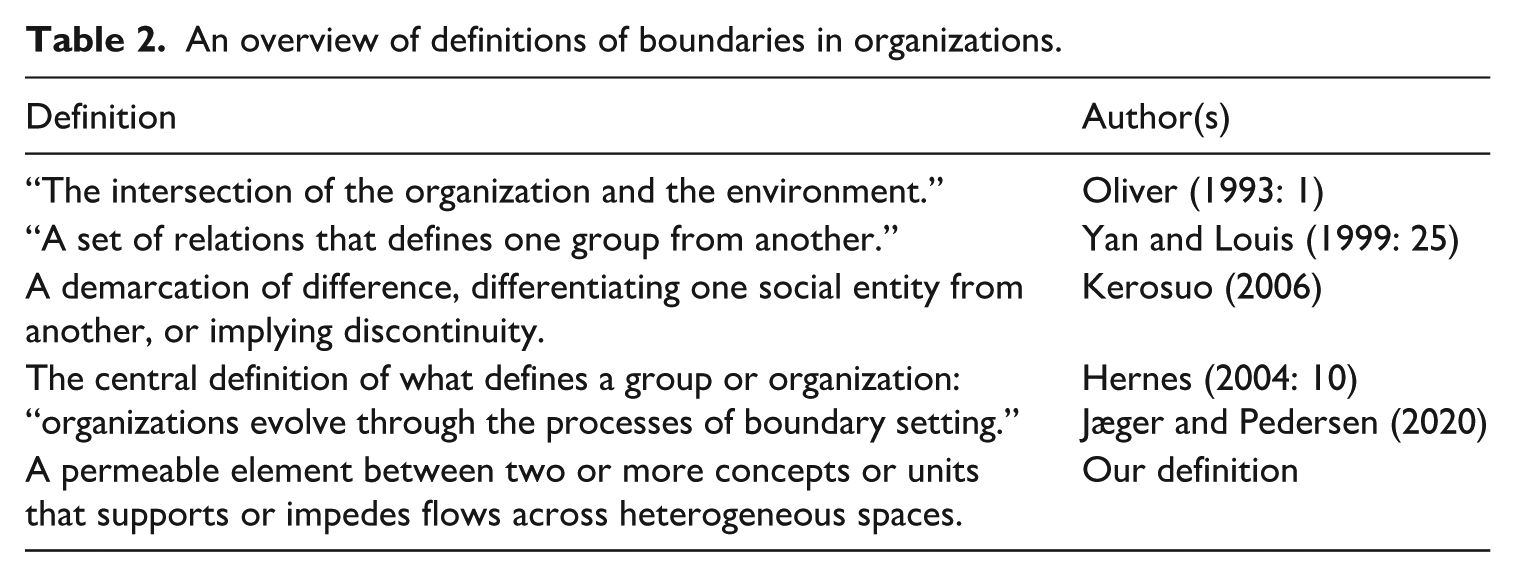
Boundaries are typified by four core characteristics: permeability, ambiguity, and having a multifaceted and dynamic nature as seen across vast boundary management literature (see Table 3). Whereas the existing definitions in Table 2 seem to indicate what a boundary does, our definition, based on a synthesis of the existing literature to identify and manage boundaries, seeks to define what a boundary is. Our definition proposes that boundaries must show an extent of each characteristic to be defined as a boundary. We also propose that the extent to which each characteristic exists within a boundary is a sliding scale from least to most, meaning that not every boundary will be permeable, ambiguous, multifaceted, or dynamic to the same extent, but all boundaries will have all characteristics. As noted above, concepts such as limits or barriers do not meet our definition of boundaries because they do not exhibit all four characteristics. For example, a limit is not permeable, and a barrier is unambiguous.
An overview of the characteristics of boundaries.
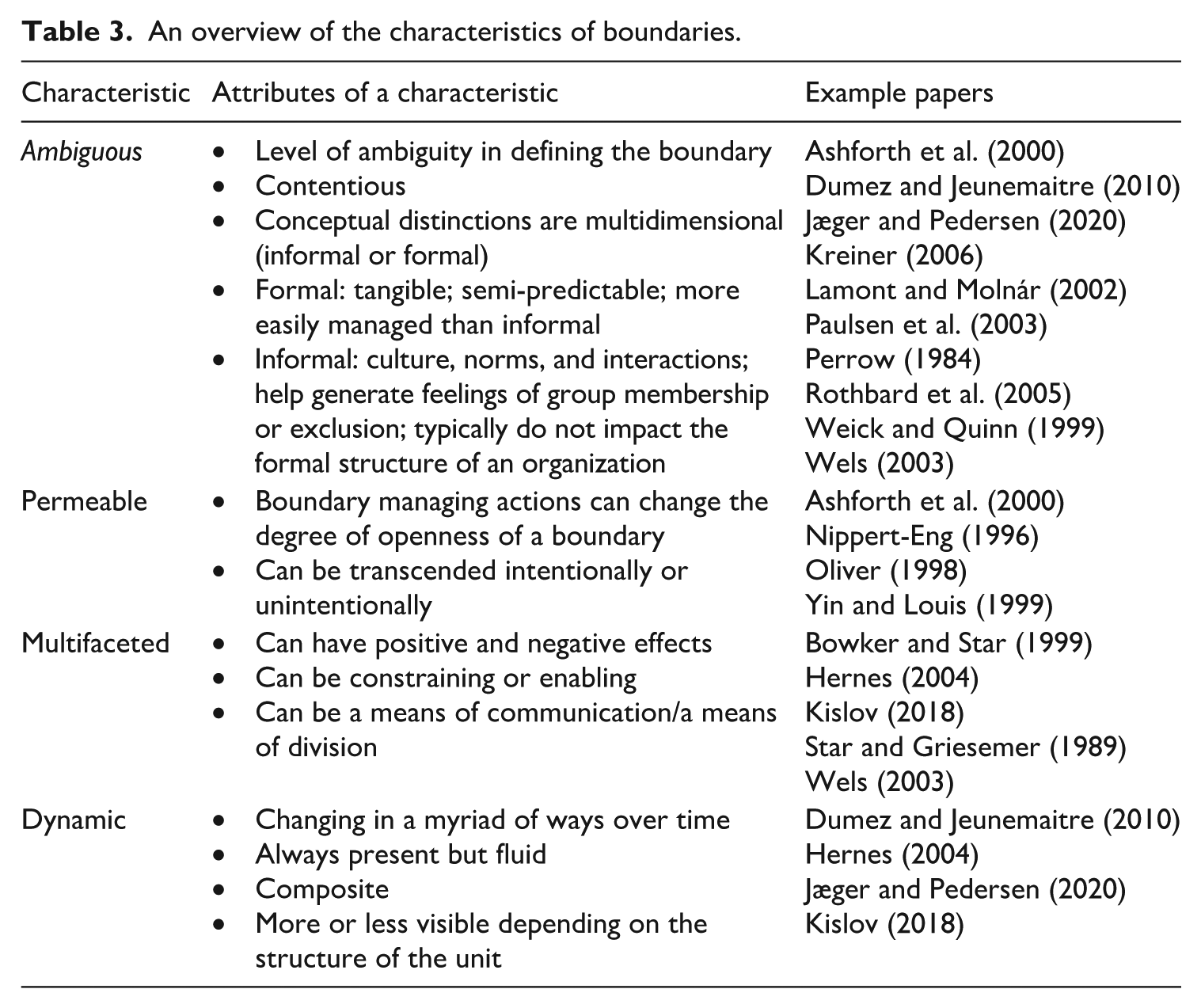
The characteristic of ambiguity indicates a lack of a clear definition of who or what is within or outside a given boundary and suggests that boundaries can be symbolic or material. As such, how a boundary is defined and its role is open to subjective interpretation. Paulsen and Hernes (2003: 9) note that one of the major conceptual difficulties of studying boundaries is contending with the fact that boundaries “belong to our inner mental structures as well as to the external structures of organizations”, which supports the idea that the ambiguity of boundaries is also a result of boundaries being either formal or informal (Lamont and Molnár, 2002; Wels, 2003).
The characteristic of permeability indicates that boundaries are crossable and regulate the flow of people, resources, or information, depending on the degree of permeability. The characteristic of multifaceted indicates that boundaries rarely have one purpose, are typically not exclusively positive or negative, can be both constraining and enabling, and their existence is subject to multiple factors.
Finally, the characteristic of dynamic indicates that boundaries are prone to change over time (Wels, 2003). While boundaries are always present (Jæger and Pedersen, 2020), they can also be fluid, changing, and composite (i.e., organizations operate within multiple sets of coexisting boundaries—Hernes, 2004). This dyanamic nature of boundaries can also be seen in the fact that they can be developed in a myriad of ways (Jæger and Pedersen, 2020). This can include unintended consequences resulting from setting boundaries or boundary management actions (Wels, 2003), which can change, reinforce, or remove a given boundary. Similar outcomes can result from the interaction and intersection of multiple boundaries as individual boundaries change and thus prompt changes in other boundaries.
Organizational boundaries
Having defined boundaries, in this paper, we draw from multiple schools of thought to inform our constructivist approach to boundary identification. Literature on bureaucracy (Weber and Tribe, 1922) provided insight into the boundary aspects of hierarchy and stratification within organizations. Boundaries in the social sciences more widely inform our understanding of boundaries as both formal and informal entities (Lamont and Molnár, 2002). The research on cognition and groupthink in particular informed our understanding of mental and social boundaries in decision-making (Bloomfield et al., 2024; Converse et al., 1993; Frandsen et al., 2023; Janis, 1982; Weick, 1988a). The stakeholder theory (Freeman et al., 2010) was instrumental in informing our understanding of how heterogeneous stakeholders’ needs impact decision-making. Psychology, geography, law, and management informed our definitions of boundaries versus barriers and limits (Caruso et al., 2008; Nedelsky, 1990; Newman, 2001), whereas work–life research provided an insight into boundary management actions (Ashforth et al., 2000; Nippert-Eng, 1996; Yan and Louis, 1999). Finally, the literature on organizational boundaries helped develop our understanding of how boundaries construct and define organizations (Dumez and Jeunemaitre, 2010; Hernes, 2004; Jæger and Pedersen, 2020; Oscarsson, 2022; Paulsen et al., 2003; Santos and Eisenhardt, 2005; Scott, 1998). Taking such a wide approach to researching boundaries allows for a better understanding of how the many complex locations and natures of boundaries come together during a crisis.
Utilizing a constructivist view of organizational boundaries aligns with earlier research from Hernes (2004) and Jæger and Pedersen (2020) that boundaries are not merely the demarcation of “inside” and “outside” an organization, but that composite boundaries interacting, intersecting, and compounding are, in fact, what defines the organization. These theories tend to look at boundaries as socially constructed processes of inclusion and exclusion instead of precise limits of containment (Marshall, 2001).
Calls for a greater emphasis on boundaries as a phenomenon worth studying in its own right have been echoed since at least the 2000s (Heracleous, 2004; Hernes, 2004; Vakkayil, 2012), though there is still little theorizing around boundaries and organizations as inseparable and mutually constituting entities. Conceptualizing the links between boundaries and the meanings that individuals or organizations ascribe to them has also been limited (Jæger and Pedersen 2020). Such theorizing could provide an important development in the study of boundaries, exploring how boundaries not only exist within organizations but also shape how organizations function and the very definition of what an organization is. Working within these ideas of boundaries as a social construction, our typology posits that crisis management—and organizing in general—is defined by the interaction and intersection of boundaries as they are constructed, reinforced, transcended or dissolved, take multiple forms, and have a broad variety of functions (Jæger and Pedersen, 2020; Marshall, 2001; Wels, 2003).
Most of the research has drawn from the idea of boundaries to analyze or delineate other aspects of organizations. Paulsen et al. (2003) argue that a greater emphasis on boundaries as a phenomenon is important and a logical next step in the development of the literature. The typology developed in this paper presents an opportunity to conceptualize boundaries as elements that can shape most, if not all, processes within organizations.
Boundary decisions, such as who is in or out of the decision-making process, what actions or resources are needed or not needed, or who or what role is on or off the response team, help draw the lines around the issues and shape the way the issue is seen and understood, and how the issue is responded to. As crisis management is typically a complex situation with many unknowable variables and often competing stakeholder interests, it benefits from consideration through the lens of boundaries. This is because boundaries are typically a large component of helping define and understand complex situations. Complexity can be seen in organizations where the relationships between various components that make up the organization are more important than the components themselves (Cilliers, 2001). It is with this perspective that a focus on boundaries can help us understand decision-making in crises. We argue that the relationships among the boundaries including where they coexist (i.e., multiple boundaries existing simultaneously without necessarily interacting or intersecting), intersect (i.e., multiple boundaries may be unfolding simultaneously and may be in contact with one another, but do not change the nature of the boundaries), and/or interact (i.e., multiple boundaries having a reciprocal action or influence on one another), shape the decisions made. By locating and defining the boundaries that shape organizational crisis management, there is a greater chance of consciously managing the boundaries toward a desired outcome.
Within the context of boundary theory, boundary management can be seen as the actions or ideas that are implemented to strengthen or minimize the integration-segmentation continuum. Rothbard and Ollier-Malaterre (2016) have suggested that the nature of different boundaries can have an impact on the boundary management process. Boundary management can take different forms depending on how the boundaries are conceptualized. According to Ashforth et al. (2000), boundaries can be strengthened or weakened in relation to actions related to the physical and temporal. For example, when an employee is reachable at all times due to the proliferation of technology that spans home and work, both the physical and temporal boundaries become thinner. Because the line between work and home is removed for a period of time, the individual’s segmentation is decreased and integration increased. In a crisis scenario in which physical or temporal boundaries change or dissolve due to crisis responses, the person’s normal segmentation-integration stance may be disrupted.
Boundary management impacts how a situation is framed and typically must consider multiple stakeholder needs. Boundary decisions will shape both the analyses of the problem as well as which response options are considered. Boundaries are drawn around a problem to compartmentalize, aiming to minimize complexity and make the issues more manageable. However, the boundaries may be seen differently depending on the stakeholders and their needs. Boundary management actions may enlarge (i.e., increase complexity) or shrink (i.e., decrease complexity) the boundary. This expansion or contraction of boundaries may shift which actors are “in” or “out” of the boundary and thus which stakeholder voices and concerns are addressed.
While much of the literature on boundary theory and boundary management refers to work–life domains or specific work units, the core concepts of flexibility/permeability, and integration/segmentation understand the role of boundaries within other contexts and between varying domains. Next, we draw from these concepts to conceptualize the boundaries in crisis management in particular.
Typology of boundaries in crisis management
We developed our typology drawing from the literature of boundaries across the fields of management, sociology, psychology, organization studies, and social sciences in general. Across these literatures, there is a wide range of perspectives as to how boundaries can or should be categorized. For instance, Oliver (1998) draws heavily on institutional theory and transaction cost economics in five categories of boundaries, including membership, role set, sphere of influence, transaction cost dichotomy, and institutional filter. Others explicitly steer their definitions away from boundary categories that are too closely aligned to transaction cost economics, arguing that the traditional institutional and transactional approach to understanding boundaries misses the subtleties of how organizations are impacted both internally and externally by boundaries (Heracleous, 2004; Hernes, 2004; Kreiner et al., 2006; Lamont and Molnár, 2002). Those who attempt to categorize boundaries from more balanced perspectives tend to focus on a combination of individual perspective and experience, social interactions, and physical boundaries set and upheld by groups or entities. These categorizations include the interplay of social and informal boundaries (Lamont and Molnár, 2002), knowledge boundaries (Carlile, 2004), power, roles and competence such as the boundaries between subordinate and superordinate (Hernes, 2004; Santos and Eisenhardt, 2005), identity such as the informal boundaries that exist between different social stratifications (Kreiner et al., 2006; Santos and Eisenhardt, 2005), the dynamics between physical and informal (Wels, 2003), and mental or cognitive understanding and awareness (Hernes, 2004).
Within these broader categories, there is an agreement that boundaries are not standalone entities, and a study of boundaries requires an awareness that they are likely to overlap, interact, and impact one another, intentionally or unintentionally. Drawing from the current bodies of literature on boundaries and crisis management, our proposed typology seeks to identify and locate boundaries with the intention of managing them toward a preferred crisis management outcome.
We engage with the framework of boundary configurations by Hernes (2004). He proposes that organizations can be distinguished based on loose, medium, or tight boundaries. In our typology, we posit that what and how boundaries exist prior to a crisis is aligned with Hernes’ (2004) conceptualization of organizations, and that how those boundaries are reinforced, transcended, or dissolved during a crisis will ultimately be impacted by the norms of the organization outside of crisis events. Specifically, our typology proposes four types of boundaries characterized by permeability, ambiguity, and being multifaceted and dynamic, which can exist on one of two dimensions—intentional and unintentional. Therefore, our typology illustrates eight possible configurations of boundary identification (see Figure 1).
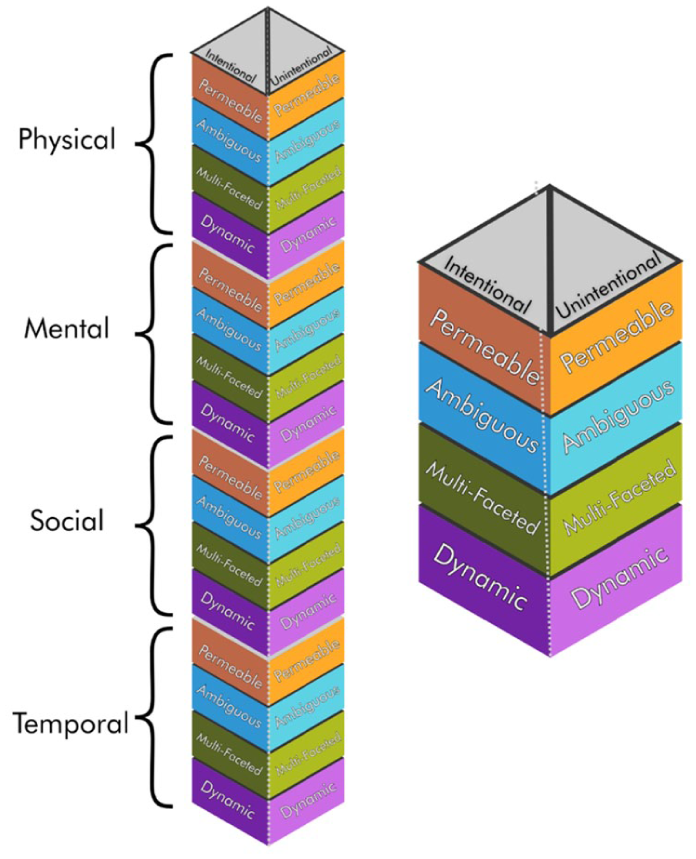
Typology of boundaries in crisis management.
Each of the four types of boundaries proposed in our typology is informed by the existing literature. We closely aligned our definitions of physical, social, and mental boundaries with those of Hernes (2004). His work influenced our understanding of physical boundaries to include those that are regulatory and/or provide order, not just those that exist within a physical space. We also drew from Hernes’ definitions to delineate between mental and social boundaries. These two types are similar in that they can be shaped by relationships, but while social boundaries are specifically those related to interpersonal connections, mental boundaries include not just how groups but also individuals understand and make sense of their environment. This concept has been supported by Santos and Eisenhardt (2005), who argued that mental boundaries could offer cognitive frameworks that help inform decision-making. While Hernes’ framework does not include the temporal boundary, we draw from the literature on work/life balance, specifically, Ashforth et al. (2000), Standen et al. (1999), and Hartig et al. (2007), who discuss temporality as a boundary that—combined with the physical and social boundaries—can strengthen or weaken the permeability between work and non-work domains and create ambiguity or stress for individuals. We utilize this conceptualization of temporality in relation to crisis management by embracing the work/life delineation that may shift during a particular crisis. We extend the temporal boundary to consider changes to all boundaries across the lifespan of a crisis and explore the role of urgency in crisis management. Lastly, we draw from Hernes (2004), Hartig et al. (2007), and Jæger and Pedersen (2020) to inform our understanding of how multiple boundaries exist simultaneously and interact or intersect to create, change, or dissolve boundaries.
As mentioned, each of the four types (physical, mental, social, temporal) fits our proposed definition of boundaries as a permeable area between two concepts or units, and shows characteristics of being ambiguous, multifaceted, and dynamic. Each of these characteristics exists on a continuum from low to high, but they all show each of the characteristics to a certain extent. We categorize the four types of boundaries and provide examples below.
Physical boundaries are those that are tangible—that is, they can be material boundaries or regulatory boundaries (Paulsen and Hernes, 2003), increase stability within an organization, and create an overall sense of location and structure. Physical boundaries could be considered as those providing order. Physical boundaries possess attributes that are typically less ambiguous than those of other boundaries and can often be clearly demonstrated (e.g., offices), and are very often formal boundaries. Physical boundaries can be highly multifaceted, acting as both constraining and enabling boundaries simultaneously—that is, closed offices may be constraining in that they keep out those not allowed within the boundary, but enabling in that they create a space for a particular goal or outcome for those within the boundary. Physical boundaries are dynamic in that they are directly related to the cause or purpose of the boundary. A formal physical boundary is likely low on the dynamic spectrum as it was set with an intention, while an informal physical boundary will be highly dynamic, and changing in relation to time and management actions. Within the organization itself, physical boundaries can create a hierarchy (e.g., organization charts, reporting structures), indicate power or competencies (e.g., “the c-suite”), produce clearly defined regulations and policies, and create a clear delineation between “inside” and “outside” (e.g., by means of initiation rituals). In crisis management, physical boundaries are often defined in terms of the locality of the crisis, material damage that changes the existing boundaries, and regulatory or technical ownership of the situation.
Social boundaries are relational boundaries as they relate to interactions between people or groups. They are just as likely to be informal as they are formal (i.e., friendships amongst coworkers vs. prescribed working teams). Social boundaries can be either highly ambiguous or completely unambiguous, depending on the nature of the boundary (e.g., overt racism vs. subjective exclusion, excluding individuals from given spaces vs. acting exclusionary in shared spaces). The permeability of social boundaries can be quite high (e.g., easily moving between differently defined groups) or quite low (e.g., needing to meet a variety of thresholds to move between groups). These boundaries are also exceptionally multifaceted, changing their nature depending on the actors involved. Social boundaries are highly dynamic, changing in relation to personal expectations and experiences as well as acts of the organization (such as changing team members), and depending on circumstances in the moment. Lamont and Molnár (2002) note that informal boundaries may separate people into groups and generate feelings of similarity and group membership, which can have a real consequence for crisis management. For example, the potential issues around mental boundaries, particularly sensemaking and groupthink, may become more thoroughly interconnected through social boundaries as responding to the crisis may be at odds with the opinions or actions of others. This can potentially impact the willingness of an individual to risk a social transgression by crossing a boundary that others are trying to reinforce.
Crisis management has a variety of social boundaries involving both internal and external stakeholders. Managing these boundaries requires taking into consideration the needs of different stakeholders while also maintaining awareness that the interaction and intersection of boundaries will likely result in addressing the goals of one stakeholder group at the expense of other stakeholders. Social boundaries can also arise between conflicting powers (i.e., government vs. organization—for example, managers who wanted to keep in-person work while the government was mandating lockdown procedures during COVID-19). A case study by Powley (2009) addressed ways in which social interactions changed, specifically in relation to crises. He argued that crises temporarily alter formal relationship structures and that those altered relationship structures, combined with shifting temporal boundaries (or as he called it, liminal suspension), allow for the formation of new or the renewal of existing social relationships.
Mental boundaries are those associated with understanding and beliefs, typically those that guide actions. Mental boundaries tend toward informal, most often developed from the norms and expectations of the actors involved in a situation. The attributes of mental boundaries are typically highly ambiguous as they are intangible and are subjectively interpreted and often contentious. Mental boundaries are typically highly multifaceted, both enabling and constraining decision-making. A crisis must be perceived and made sense of to be responded to. In crises, where the usual mechanisms of understanding and decision-making may be inaccurate, incomplete, or completely missing, the multifaceted nature of mental boundaries can potentially provide negative or constraining effects, such as a failure to perceive or acknowledge the crisis or a failure to accurately understand the situation. Mental boundaries could also provide enabling effects, such as developing a clear picture of the crisis (i.e., mental models) and acting upon such mental models.
Mental boundaries are dynamic in that they are impacted by other aspects, such as how permeable they are. Higher permeability increases the likelihood of being more dynamic as it allows for different types of understanding and thus changing mental models. Overall, mental boundaries influence sensemaking and can impact the way a crisis is perceived or even if it is perceived at all. These boundaries are the result of “the particular repertoire of terms and symbols that enable groups to communicate, act, and to further their understanding” (Hernes, 2004: 40) as well as the mental models that an individual uses to make sense of their environment. This conception of boundaries illustrates the ways in which the culture of an organization may impact crisis management. If an organization has a strong cultural identity predicated on “this is who we are and this is what we do,” and if that narrative does not include a consideration of how to act when or if something fails, then mental boundaries may prevent an appropriate crisis management response.
One area where mental boundaries are particularly relevant to crisis management is in relation to cognition, sensemaking, and groupthink. Examples in crisis management case studies have included groupthink during the Bay of Pigs (Janis, 1982), rationalization and decisions to not evacuate during 9/11, a breakdown of sensemaking in Bhopal (Weick, 1988b), cognitive bias in perception of whether a crisis is happening amongst boards of directors (Merendino and Sarens, 2020), sensemaking in organizations where blame for a crisis is being assigned (Frandsen et al., 2023) and the sensemaking and rationalization for getting or not getting involved in a crisis response situation (van der Giessen et al., 2022). Mental boundaries related to common language, discourse, rhetoric, and understanding can also play a big role in crisis management decisions—for instance, a lack of common language to explain a crisis can create boundaries in understanding (Hernes, 2004).
Temporal boundaries are those that are related to time. As noted previously, a crisis is typically defined as both time-bound (i.e., it will have a beginning and an end) and time sensitive (i.e., a response must be swift). Temporal boundaries include the boundaries that are placed around different periods of time to determine when something is active or inactive (Dumez and Jeunemaitre, 2010), relevant to determining when a crisis has moved from a disruption to an acute crisis response or to determining when a crisis is “done.” Temporal boundaries can be unambiguous when there is a strong segmentation of boundaries, but ambiguous when there is less strong segmentation (e.g., the temporal boundaries that designate work hours and non-work hours may become less segmented and more ambiguous during times of acute crisis response). Temporal boundaries are also highly permeable, which can be reflected in crisis response management, where activities are more likely to bleed together as segmentation decreases to address the crisis. For instance, during a hurricane, an organization’s crisis management team may be on-call to respond at any given time if needed, thus increasing the permeability of “at work” or “not at work.” The multifaceted nature of temporal boundaries is particularly relevant to whether the boundary acts as an enabling or constraining factor. Temporal boundaries can enable actors to accomplish tasks, have structure and a sense of stability, or they can create a sense of being rushed, anxiety, or frustration.
Along with the four boundary types, our typology also proposed two dimensions that help to identify the nature of the boundary, that is, whether the boundary is intentional (i.e., developed and/or managed with a specific goal) or unintentional (i.e., developed through interactions and experiences regardless of goals). Intentional boundaries typically result from conscious planning and management of boundaries, whereas unintentional boundaries are typically the unplanned byproduct of other boundary management actions or interactions between multiple types of boundaries. Below, we provide examples of the eight possible boundary configurations that could appear in various crises (see Table 4).
An illustration of different types of crises using our typology of boundaries.
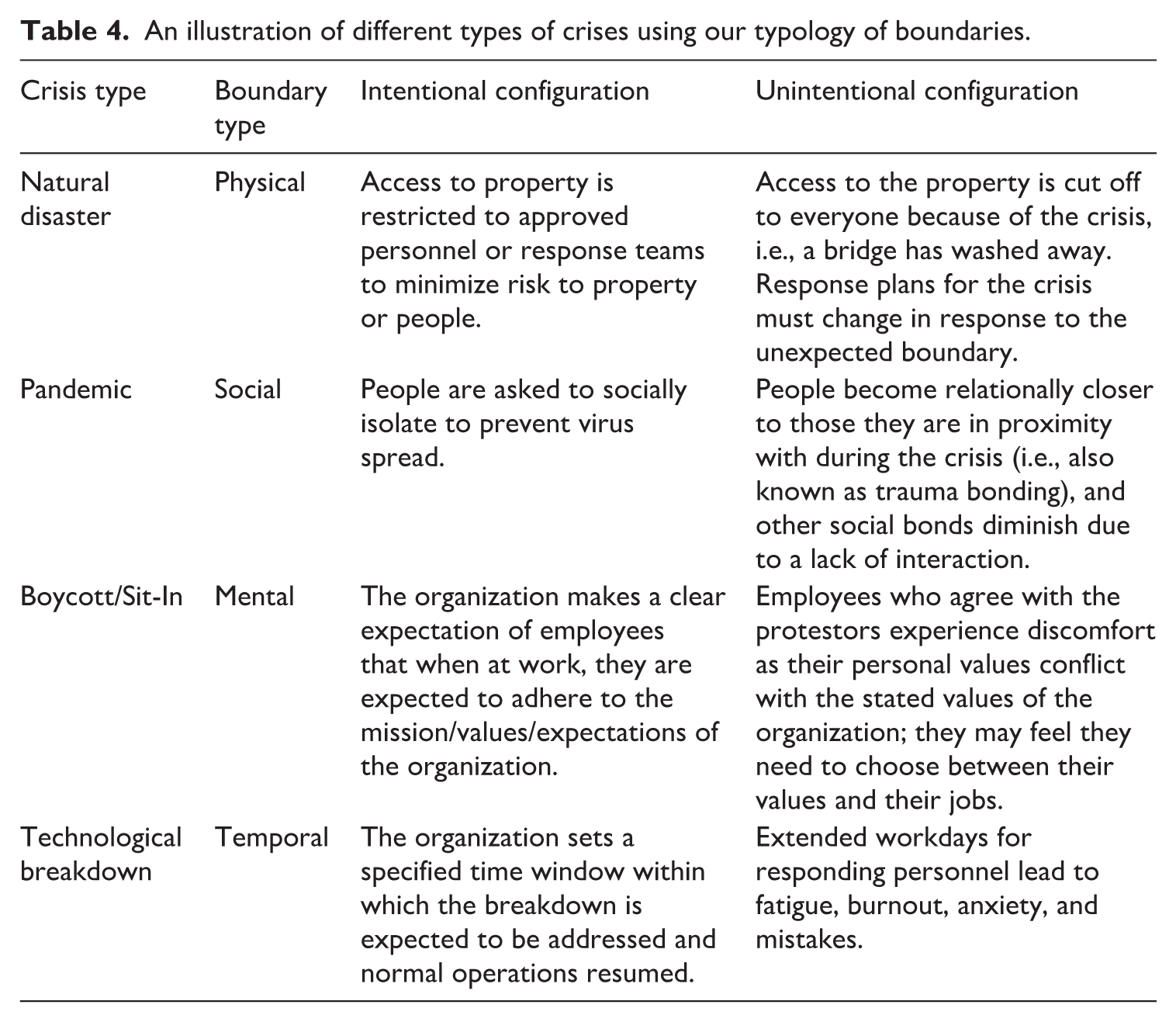
As stated by Hernes (2004), organizations are made up of multiple sets of boundaries coexisting simultaneously. We propose that coexisting boundaries exist, and they are also likely to intersect (i.e., cross or meet at a given point) and interact (i.e., act upon one another to produce a new outcome). An illustration of these intersections and interactions can be drawn from some of the examples provided in Table 4. Each configuration in the table was presented as a standalone type. However, if this table was extended to include configurations of all four types for each type of crisis presented, there would be evident areas where the boundary types overlap and impact crisis response. In the illustrative example below, we present a single type of crisis, referring to a natural disaster that impacted an organization. Through this example, we present identifications of the four types of boundaries during the crisis, examples of boundary management actions that may strengthen, weaken, or change the boundaries, and examples of how interactions and intersections of the boundary types can change the boundary. The goal of the example is to illustrate that our typology acknowledges that neither the crisis nor the boundaries exist in a vacuum and that all actions, either from the crisis incident itself or the response, produce boundary changes, and thus changes that impact the overall crisis response.
Illustrative example
Over 72 hours in summer 2023, “the organization” experienced a weather-related crisis. Unprecedented rainfall led to severe flooding, downed trees, power losses across the region, and extensive damage to roads and bridges. The organization was ostensibly “cut off” from the surrounding area due to flooding on one side and a bridge collapse on the other. The organization is an overnight summer camp in a rural area of the United States and includes seven distinct “camps” spread across two properties within 10 miles of each other. At the time of the crisis, there were approximately 300 year-round and seasonal staff and approximately 500 overnight and day-use campers on the property.
The natural disaster led to operational challenges, including but not limited to access to emergency/medical response if needed, access for deliveries of required items such as food and paper goods, water, sanitation, and safety, and how to safely get children who were supposed to be leaving off the property when the roads are damaged and closed. Within the first 24 hours, the “crisis response” team comprised the executive office, operations, maintenance/ facilities, and health teams. After the immediate emergency response, the crisis response team was narrowed to the executive director, head of facilities, and head of operations regarding crisis plan implementation and decision-making. Staff from across the operations, marketing/communications, health, and camp leadership teams were dispatched to oversee specific crisis response actions.
Changes to the physical boundaries of the property were the most immediately noticeable, as substantial road damage separated the organization from the community around it, as well as parts of the organization from each other. The development of this unintentional physical boundary thus created a ripple effect across all other boundaries within the organization. This new unintentional physical boundary interacted with the mental, social, and temporal boundaries to create changes and effects on the organization. As each boundary is changed, transcended, or dissolved, a ripple effect leads to changes to other boundaries. The physical boundary created by road damage subsequently led to new intentional physical boundaries in the form of rules, regulations, and mandates that had not existed or been necessary prior to the crisis.
The temporal boundaries of the organization had been a key aspect of the organization’s operations, mainly that campers exist on the property for 2-, 3-, or 7-week sessions and depart at the expected time. The seasonal staff stay on the property for 10 weeks, and when the season is over, so is their contract. However, the change in physical boundaries created a change in temporal boundaries. For 2-week campers, the session did not end at the end of 2 weeks, as parents could not safely enter the property, and the camp staff or campers could not safely exit. These changes thus precipitated a need for a change in both social and mental boundaries for the 2-week campers and their staff. Campers who had developed a clear image of when and how they would be leaving camp suddenly struggled with uncertainty, psychological safety, and anxiety at having their perceptions disrupted. Staff who had been expecting their campers to leave and then pursue their days off experienced a similar change in perception, with similar stress and anxiety resulting. The unintentional temporal boundary of an extended camp stay for the 2-week campers meant that intentional temporal boundaries changed. Staff days off were cancelled, creating unintended outcomes such as fatigue, anxiety, and “checking out” mentally on the part of the overworked staff. The social boundaries also changed for the 2-week campers and their staff as unintended changes to mental and temporal boundaries facilitated antisocial behavior such as arguments, fights, and other behavioral issues, which, in turn, led to social distance between the affected individuals.
Outside of the experiences of the 2-week campers, the unintentional physical boundary of the damaged road also changed boundaries around organizational operations. The new physical boundaries constrained daily operations and shifted temporal boundaries, facilitating the need to develop and put in place new operations within a restricted timeframe and with an incomplete picture of how the crisis would continue to unfold. The temporal boundaries continued to shift because of the interaction with the physical boundary. As time passed, the physical boundary changed because of property damage repair, and as the road changed, so did the physical boundaries of rules, regulations, and mandates. Simultaneously, the organization was responding to new social boundaries with the community outside of the organization, and new physical boundaries, such as governmental rules, were implemented and had to be adhered to. These boundary changes impacted who did or did not have control of organizational operations and planning. While the change in social boundaries created increased access to resources and information from outside the organization, it also increased physical boundaries relating to regulations and decreased autonomy and decision-making within the organization.
Finally, the unintended road damage boundary created a host of changes in the mental, social, and temporal boundaries regarding front-line staff who were not on the crisis response team. Mental boundaries that had not adequately shifted to perceive and respond to the crisis prevented individuals from acknowledging or accepting that a “crisis” was even happening. These particular mental boundaries played a role in the separation of centralized versus decentralized decision-making. While centralized decision-making was happening at an organizational level, individuals acting at the front lines of the programs themselves were making decisions that were not in line with the expectations set by the centralized decision-making team. This led to intentional physical and social boundaries within the individual programs being created and reinforced by those who saw the crisis response as overkill. These individuals created boundaries around their own groups of campers and staff in which they intended to continue normal daily operations.
The unintended change in social boundaries as a result included disruption to interactions with others in the organization, including arguments and blaming. The reinforcement of existing mental boundaries also resulted in temporal boundary changes, as what could have been a calmer, more orderly response to the crisis became a time-sensitive, greater issue that needed immediate resolution to prevent greater crisis impact. The intentional physical boundaries regarding rules and regulations were dissolved by the individuals who did not react as though a crisis was happening, leading to unintentional outcomes including strain on resources across the organization responding to issues that arose from the lack of response, disciplinary action on the part of the organization toward those who disregarded the new physical boundaries, and distrust among staff who saw the dissolution of expected social boundaries (such as the accepted norm that decentralized decisions were expected and supported by the organization) as a dissolution of social contracts. However, the unintended outcomes of these boundary shifts also led to a reconsideration of the physical and social boundaries that the organization considers “norms” and whether it is possible to properly support programs that are outside the immediate physical area of the organization. This led to a hiatus of several programs as the organization reconsiders the boundary changes and subsequent impacts on the organization over a longer period. This example of how individuals make decisions in addition to or despite centralized decisions emphasizes our argument that even if there is centralized decision-making, it is imperative to also consider the decisions being made by others throughout an organization that will impact the crisis response, regardless of the centralized response plan.
This example illustrates the ways in which boundaries interact to produce intended and unintended consequences during a crisis. Each action has a reaction, which compounds ad infinitum, leading to the near constant dissolution and recreation of boundaries. We propose that identifying boundaries and attempting to enact specific boundary management actions that can reinforce or dissolve boundaries in a slightly more predictable manner allows for a better chance of guiding crisis response toward a desired outcome.
Discussion
This paper aimed to propose and develop a typology of boundaries in crisis management, which moves away from prescriptive planning and views crisis management as a process of understanding and managing intersecting and interacting boundaries. Based on the existing literature on organizational boundaries that sees organizations as entities made up of a constant process of creating, shifting, and dissolving boundaries (Heracleous, 2004; Hernes, 2004; Jæger and Pedersen, 2020), we propose that the identification of four types of boundaries allows for their management, thus managing the overall organization, including its crisis response. If organizations are social constructs built of boundaries and those boundaries can be identified, then a more holistic view of the organization can emerge, allowing for a better understanding of managing actions during a crisis.
Our typology builds upon the existing works of boundary definition (Hernes, 2004; Jæger and Pedersen, 2020), boundary identification and boundary management (Ashforth et al., 2000; Paulsen et al., 2003; Hartig et al., 2007), and combines them to present a definition of boundaries that focuses on what a boundary is as opposed to what a boundary does. By pursuing this definition of boundaries, we center the boundary as the phenomenon to be located, defined, and managed as opposed to an entity that encircles and defines the “stuff” that needs managing (Jæger and Pedersen, 2020: 9). We center boundaries as a way to better understand crisis management and provide a more holistic view of an organization as a collection of boundaries that can be identified and managed.
Typology in context
Our typology can be used across various organizational contexts and crisis types. Hernes’ (2004) typology proposed three types of boundaries - social, mental, and physical - that help illustrate different organizational types. We argue that each type of organization (i.e., Hernes (2004) identified organizations by how tightly or loosely the boundaries ordered behavior in the organizations), organizational structure, size, and industry will have boundaries of different starting points (i.e., the boundaries as they exist prior to the crisis), and that the type of the organization will ultimately impact how the boundaries are reinforced, buffered, transcended, or resolved during a crisis.
We also propose that all crisis types can be considered through our typology because all crises occur in the context of organizations. Whether the organization is a business, government, NGO, sports team, or any other organization of individuals, it still fits within our understanding of organizations as an entity made up of intersecting and interacting boundaries. Since any crisis type is taking place within the context of an existing set of boundaries, then the assumption that the boundaries will change due to a crisis, is relevant. Our typology provides a way to identify those boundaries and take actions to manage any changes to them to achieve a favorable crisis resolution.
Boundary intersections and interactions
Our typology is underpinned by an assumption that it is impossible to know with certainty how an individual or a group will react in a crisis, what boundaries will come into play, and how the nature of those boundaries will impact the more formalized crisis response. While on the surface, formal and informal boundaries are opposites of one another, they may also work in tandem as composite boundaries tend to do. Jæger and Pedersen (2020) argue that organizational change happens at the intersection of the formal boundaries that circumscribe how an organization is organized and operated and the informal boundaries that form because of norms, behaviors, and interactions among various actors.
Boundaries can overlap and reinforce or dissolve each other, or one boundary can change the nature of different boundaries. As stated, these interactions and intersections are one important way that boundaries are created, crossed, or removed. As shown in our illustrative example, any change, big or small, that affects a boundary has a ripple effect, and the boundary changes also compound. As Hernes (2004) noted, boundaries are composite, meaning that multiple sets of boundaries coexist simultaneously. Within these multiple sets of boundaries, there are interactions. As a change in a boundary creates changes in other boundaries, those changes, in turn, impact the other sets of boundaries within which the changed boundary exists. These changes compound so that each change in the boundary, including whether it is reinforced, transcended, or dissolved, creates new boundaries that then undergo the entire process again as another change occurs. This illustrates that as each boundary interacts or intersects, it creates or changes other boundaries, whether intentionally managed to do so or unintentionally. This has implications for crisis management because if those boundaries can be located and defined, they can be better managed, including making educated guesses about what the ripple effect of the change may be.
Other examples of interactions may include mental, social, and temporal boundaries interacting in relation to groupthink and defining a crisis as something happening that requires a response. If an actor is hesitant to cross social boundaries, they may shy away from questioning the prevailing mental models framing the crisis response, potentially allowing incorrect mental models to prevail unquestioned. There is also a strong intersection of social and physical boundaries, particularly in relation to power and hierarchy. The overlap of these boundaries can create situations where there is either a “too many cooks in the kitchen” situation or alternatively, no one taking immediate control or ownership of crisis management.
In crisis management, the acute phase of crisis response is particularly likely to experience the rapid creation and dissolution of unintentional boundaries. Acting within a high-stress, time-sensitive environment with tangible outcomes that impact the organization and its stakeholders can lead to rapid decision-making that does not foresee the ripple effects. Sometimes, these unintentional boundary shifts can enable better crisis management, such as unintentionally creating an environment where the social boundaries between bosses and subordinates have been loosened and thus subordinates feel more comfortable sharing their perspectives on managing the crisis. At other times, unintentional boundary shifts can constrain crisis management, for instance by implementing an ad hoc crisis management team that was not previously established, thus impacting social boundaries and creating potential breakdowns in communication. While unintentional boundaries can be hard to predict and difficult to manage, in crisis management trying to foresee the unintentional boundaries is part of the task. During Hurricane Katrina, unintentional boundaries between governmental organizations at the local, state, and federal levels created gaps in emergency responses that allowed for failures of crisis management (Farazmand, 2009). Many case studies have since looked back on how these gaps formed and ways to mitigate them. These types of cases can provide organizations with some foresight into managing the unintentional boundaries that arise because of crisis management decisions.
Decision-making
Our primary argument has been that identifying and locating boundaries allows for a more holistic view of what is happening within the organization and that a more holistic view, in turn, provides more information, which can aid the decision-making process.
Throughout the paper, we have emphasized that centralized decision-making is an important part of crisis management, but we have also proposed that to focus solely on centralized decision-making falls into the same issues that most crisis management frameworks face—that is, it narrows the scope of understanding of crisis situations and assumes rational and linear actions on the part of the organization members. Our typology considers how the nuances of individual actions among dispersed members at all levels may be impacting the response approaches. We join Oscarsson (2022) and de Waard et al. (2014) in their attempts to understand crisis response as something that happens across all areas and all members of an organization simultaneously and cannot be regarded as simply a “control and command” situation. Specifically, we argue that non high-reliability organizations or those with highly regulated daily operations, such as the military, will benefit the most from considering centralized and decentralized decision-making as something taking place simultaneously, and which can work together or against one another.
Future research considerations
Our typology provides multiple avenues for future research. It assumes that boundary decisions and boundary management actions can be better understood by identifying boundaries relevant to crisis management. The location and definition of these boundaries will allow for greater boundary management toward a specific and desired crisis response outcome. While our typology is specifically looking at the management of boundaries in crisis decision-making, future research would benefit from finding a way to locate, illustrate, and explain the shifting nature of overlapping boundaries, as this could aid our understanding of organizing, readiness, and resilience in organizations more generally.
Another area of consideration for future research is the long-term implications of boundary shifts and boundary management actions during a crisis. Specifically, questions of whether boundaries return to their pre-crisis states or develop into a “new normal” for the organization would be a worthy research endeavor. This longer-term view also provides fruitful areas of research on stakeholder management, including how the shifting boundaries that unfolded during the crisis helped identify and act upon heterogeneous stakeholder needs. Future research could explore whether certain stakeholder needs were abandoned during the crisis response, and what implications this might have for the organization’s stakeholders going forward into a post-crisis time. An effort to understand the implications of boundary shifts and boundary management actions during crisis response on the overall health of the organization would provide insight into how practitioners may better prepare for the consequences of the crisis response.
Other research avenues include refining the typology via empirical data collection, considering ways of using the understanding of boundaries to provide actionable management procedures for practitioners, and investigating whether the typology is relevant to organizations outside the realm of crisis response. Empirical testing, including manipulation of specific boundaries toward a set goal, could be instrumental to this end. In the same vein, the possibility of developing a decision-making model to aid practitioners in identifying the necessary boundary management actions for their organizations and deciding whether to act on them could be beneficial for many organizations. Future research could assess the effectiveness of any such models using intervention studies.
Concluding remarks
Our typology engages with diverse bodies of literature to meaningfully define boundaries in crisis management, and illustrate how boundaries may change during crises, particularly whether any such change would constrain or enable crisis management decisions and actions. Overall, the focus on the location and identification of boundaries in crisis management allows for better understanding and thus management of inherently complex situations that unfold during crises. As Cilliers (2001) notes, it is exceedingly difficult to develop models that can accurately illustrate and thus provide prescriptive responses for complex systems. However, an attempt to do so may open further research opportunities that can support practitioners as they plan for, and respond to, crises. We hope that our typology is a step toward this direction.
Footnotes
Acknowledgements
We would like to thank Dr. Debora Gottardello for insightful and helpful comments as we were developing this paper, and Mx. Sam Green for helping us design the images in Figure 1. We would also like to thank the anonymous reviewers as well as our handling editor, Professor Mayowa Babalola, for their constructive feedback and recommendations throughout the review process.
Funding
The authors received no financial support for the research, authorship, and/or publication of this article.
AI usage declaration
The authors acknowledge that they have followed Human Relations’ AI policy. No AI was used for preparing the manuscript.
