




Abstract
This article draws on insights from the author’s doctoral training and fieldwork in pottery making to extend conversations about the ‘craft’ of qualitative research. Specifically, the imagery of potter and clay is introduced to explore the unfolding of craft – or the development of well-thought-out research – in the process of becoming a qualitative researcher. A longitudinal account of making research and making pottery zooms in on the deeply personal relationship between the craftsperson and their materials to explore the affective relations that emerge in craftwork. By tilting the emphasis towards the processes that bring things into being, rather than the objects that are produced, craft-in-research is conceptualised as a reciprocal shaping of bodies that unfolds in and through the simultaneous becoming of researcher and research.
Introduction
Researchers in management and organisation studies are increasingly drawing comparison between ‘craft’ and qualitative research (Bell and Wilmott, 2020; Cunliffe, 2011; Daft, 1983; Mills, 1959; Van Maanen, 2011). This is perhaps not surprising given the association of craft with skilled workmanship and the ‘mastery’ of doing a job well (Sennett, 2008). However, accounts of craft in qualitative research suggest that learning to navigate an ambiguous terrain shapes not only what researchers produce through skilled work, but also who they are becoming as practitioners (Barnacle and Dall’Alba, 2014; Dall’Alba, 2009). This has given rise to inquiry about the embodied aspects of the research process, wherein mind and body – perception and action – are seen as one, in complex synthesis (Gadamer, 1975/2013; Merleau-Ponty, 1945/2012). In turn, researchers have been shown to navigate the sensuous experiences of theorising (Essén and Winterstorm Värlander, 2012); the awkward encounters in the field that facilitate reflexivity (Koning and Ooi, 2013); and the emotional experience of academic writing (Badley, 2015; Kiriakos and Tienari, 2018) as they weave together headwork, fieldwork and textwork (Van Maanen, 2011).
Through this article, I build on these conversations by bringing together the craft of research and the craft of pottery to follow my own simultaneous becoming through my doctoral studies in a UK management School, and fieldwork in a UK studio Pottery. I zoom in (Nicolini, 2009) on the practices of making pottery and making research to explore how the deeply personal relationship with materials that is central to craftwork (Bozkurt and Cohen, 2018) unfolds in the process of becoming a qualitative researcher. In turn, I extend discussions on craft in qualitative research by ‘illuminating and challenging’ (Alvesson and Sandberg, 2011: 254) the assumptions underlying dominant views of craft as a sense of mastery represented through the production of well-made objects.
I take a process perspective, which pays particular attention to temporality, flow and change to reveal a world in the making rather than one ready-made (Langley and Tsoukas, 2010; Langley et al., 2013; Tsoukas and Chia, 2002). This has specific implications for how we understand research by shifting the focus from ‘the products of research to the processes that constitute what we label as “research”’ (Sergi and Hallin, 2011: 195). In turn, I propose that the imagery of pottery making reunites the objects of craft production with the material processes that bring them into being. This illustrates how in crafting research, researchers not only learn how to shape well-thought-out research in and through their unfolding relations with materials, but do so in careful and considered ways that shape who they are becoming (Cunliffe 2011; Dall’Alba, 2009).
The paper proceeds by exploring craft in qualitative research as both a skilful and embodied process. I then present a textured and embodied account that weaves together my own processes of headwork, fieldwork and textwork as I navigate qualitative research in messy and unpredictable ways. Through my simultaneous becoming in overlapping practices of making, I elaborate on the materially bound nature of craftwork in qualitative research. The paper concludes by exploring what the imagery of pottery making can offer our understanding of craft in qualitative research and shakes off expectations for the perfect completion of work.
Craft and the mastery of qualitative research
Craft is a tricky word that holds multiple meanings, however Bell et al. (2019) suggest its many definitions rest upon two common values. Firstly, craft’s mode of production involves a deeply personal bodily engagement with materials (Bozkurt and Cohen, 2018) that moves away from a Cartesian split of mind and body to focus on practical skill (Bell et al., 2019). Secondly, craft is considered apart from or outside mainstream means of economic production, and stands in opposition to processes of industrialisation and machination which result in predictable, standardised outcomes (Adamson, 2007; Dormer, 1997). Therefore, craft is traditionally associated with skilfully produced artefacts that result from the care and judgment of the maker’s hand (Pye, 1971/2007; Risatti, 2007). This tends to lead us to a craft ideal that involves a developing sense of mastery in overcoming the somewhat unpredictable nuances of one’s chosen material. Hence, the craftsperson is seen to employ and execute the ‘right’ methods, often understood through traditional skills, to produce an artefact that embodies the perfect completion of work (Boden, 2000; Inkson, 1987).
It is no surprise, then, that the craft of research is often considered to involve the production of high quality, well-thought-out research that melds theoretical traditions with experiences in the field (Cunliffe, 2011). In turn, craft is often used to signal the acquisition of a set of skills prior to or during the researcher’s participation in research practices (Atkinson and Morriss, 2017; Kvale and Brinkmann, 2009). For example, Van Maanen (2006, 2011) suggests that the craft of qualitative research – and specifically ethnography – can be mastered through the effective weaving together of headwork, fieldwork and textwork. Here, researchers begin by studying the existing literature and develop an orientation to the ontological and epistemological concerns of the discipline (Cunliffe, 2011). They then learn to move both ‘inside’ and ‘outside’ the field to deeply engage with their experiences while collecting and analysing data (Ybema et al., 2009). Finally, they develop a convincing authorial voice through written prose such as books, articles and research papers (Jarzabkwoski et al., 2014; Mills, 1959; Patriotta, 2017).
Viewing the craft of research through Van Maanen’s (2011) metaphor of weaving has led to the identification of a number of skills and practices common to a variety of qualitative methods. These include collecting and managing data; developing an understanding of the traditions of the field; and engaging in reflexive capabilities (Cassell et al., 2009). Identifying discreet sets of skills and practices related to qualitative research is useful in understanding the ways in which researchers can employ methods and tools, as well as how they experience and live through their studies to do good research (Sergi and Hallin, 2011). However, it is frequently acknowledged that the craft of qualitative research goes beyond the precise replication of formulaic procedures and rule book tendencies that scientific perspectives on academic work so often purvey (Atkinson, 2013; Flyvberg, 2001; Gherardi, 2015; Prasad, 2005).
Craft therefore implies that learning to do qualitative research is more than acquiring the knowledge of different methodologies and skill in applying certain methods. Indeed, becoming a researcher involves not only knowing what to do, but also how to do it (Lave, 2011). Despite this understanding, a tendency remains to separate the skills and practices required to develop well-thought-out research, and the process of becoming that the researcher experiences in enacting and embodying these skills (Sandberg et al., 2017). In turn, research-as-craft tends to adhere to a sense of ‘mastery’ which suggests that the researcher determines the outcomes of the research through ‘headwork’ and a detached interpretation of their experiences in the field. However, as Van Hulst et al. (2017) suggest, this overlooks the ‘sensework’ involved in doing research as the researcher becomes attuned to the hidden and concealed dimensions organisational life.
Craft and research as embodied process
Taking a processual view allows us to shift the emphasis away from mastery to explore the skilful knowing that craftwork affords as a social, embodied and situated performance (Gherardi, 2017; Nicolini, 2012; Strati, 2007). Here, knowing emerges through the changing orientations that develop through the long experience of conducting one’s life in a particular environment (Ingold, 2000: 25). This means that through our participation and immersion in living situations we become acculturated into the often taken for granted rules, standards and routines that shape the field. In turn, we grow into familiar ways-of-being that shape how we see and understand the world, and subsequently guide our action (Dall’Alba, 2009; Dall’Alba et al., 2018; Dreyfus, 2014).
According to this view, knowing is grounded in practical experiences and everyday situations that are prompted by the body’s constant need to maintain harmony with the environment (Merleau-Ponty, 1945/2012; Yakhelf, 2010). The body becomes a way of knowing the world as individuals develop a flexible responsiveness to the affective flows unfolding as part of a wider field of forces that shape everyday life (Gherardi, 2017; Ingold, 2000). This implies that materials are not passive – to be acted upon – but actively suggest possibilities for and also constrain ways of going on (Ingold, 2000). In turn, the craftsperson learns to experiment and improvise as they go, engaging in a formative process where ‘ways of doing are generated while activities are being performed’ (Gherardi and Perrotta, 2014: 137). This suggests that skilful individuals do not arrive at a definitive end point of understanding – or mastery – but are always continuing to find their way in the ongoing, generative flows that unfold between knowing and not knowing (Gadamer, 1975/2013).
Taking knowing as a situated performance opens the way to developing intersubjective and interpretivist approaches to research that take the view that realities are jointly constructed, and we are always ourselves-in-relation-to-others (Cunliffe, 2011: 267). This suggests that in the doing of qualitative research, the researcher embarks on a process of becoming, or transformation of self (Barnacle and Dall’Alba, 2014; Cunliffe, 2018; Järventie-Thesleff et al., 2016). This gives rise to an embodied understanding of qualitative research that acknowledges the intimacy, vulnerability and affect in the relations between researcher and research (Field-Springer, 2020; Gherardi, 2018; Hopwood, 2013). In turn, the researcher’s body becomes a site of knowing and means of meaning making that guides and shapes the researcher’s experiences in the field through physical as well as emotional responses to the research terrain (Ellingson, 2017; Gherardi, 2017). For example, it is through the quickening of a pulse (Carlsen, 2011), or the sense of relief on walking away from a difficult interview situation (Tomkins and Eatough, 2013) that the body ‘speaks’ in the doing of research (Findlay, 2006; Harris, 2015; Pink, 2011). This highlights how researchers make sense of the world in embodied ways and gives voice to the ‘dirty work’ – or emotionally laden and affective understanding – that emerges in the process of doing of qualitative research but is often hidden beneath our polished and tidy textwork (Ellingson, 2006; Pullen and Rhodes, 2008).
It is clear that craft signals both a skilful and embodied approach to qualitative research, however, as with other forms of craftwork the relationship between bodies and the objects and affects they encounter remains somewhat overlooked (Bell and Vachhani, 2020). Hence the researcher’s engagement with the matter of inquiry – which includes bodies, buildings, books, desks, policies, theories and discourses (Childers, 2013) – is often backgrounded or taken-for-granted in accounts of qualitative research as craft. This is problematic because the rhythmic and reciprocal relationship with materials is crucial in understanding the material and embodied practices of craftwork (Bell and Vachhani, 2020). In these terms, how craft actually unfolds in qualitative research remains underexplored. Therefore, questions arise about how well-thought-out research is accomplished with, and through, the body; and the significance of materials in shaping and giving meaning to the process of becoming a researcher (Nicolini, 2012).
Reframing the metaphor of craft in qualitative research
I propose that extending the metaphor of craft through the imagery of pottery making can illuminate subtle parallels and analogies (Cornelissen, 2005: 757) that help develop understanding of how craft is enacted between researcher and research in embodied ways; and also show how researchers incorporate taken for granted rules and routines into their bodily performances as they discover new and different ways of going on (Dall’Alba et al., 2018; Sandberg and Tsoukas, 2011). Acknowledging my ongoing position as researcher and participant, I take a ‘withness’ approach to doing research (Fachin and Langley, 2017) where the researcher learns ‘with’ rather than ‘about’ a particular phenomenon. This acknowledges that the researcher’s inner feelings and bodily awareness of specific situations play a crucial role in guiding their actions (Shotter, 2006: 586), and opens the way to understanding how the researcher’s own becoming unfolds in flux along with and in direct relation to the researched (Fachin and Langley, 2017; Gherardi, 2018; Langley and Tsoukas, 2017).
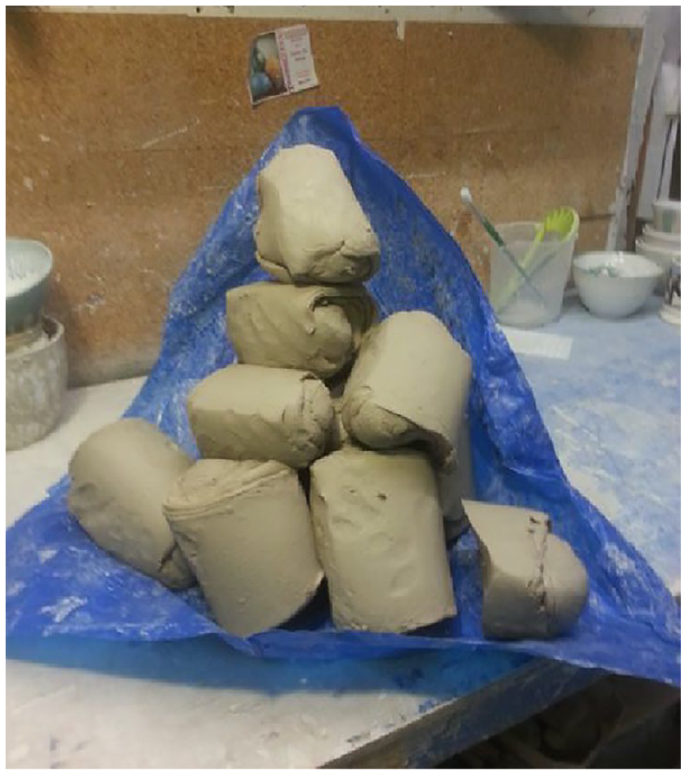
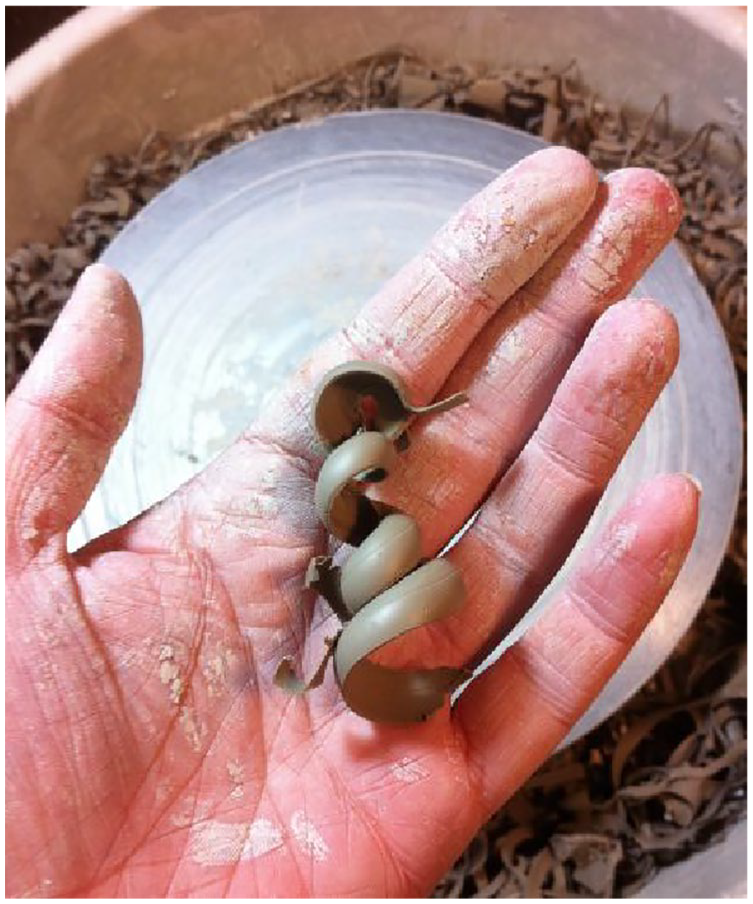
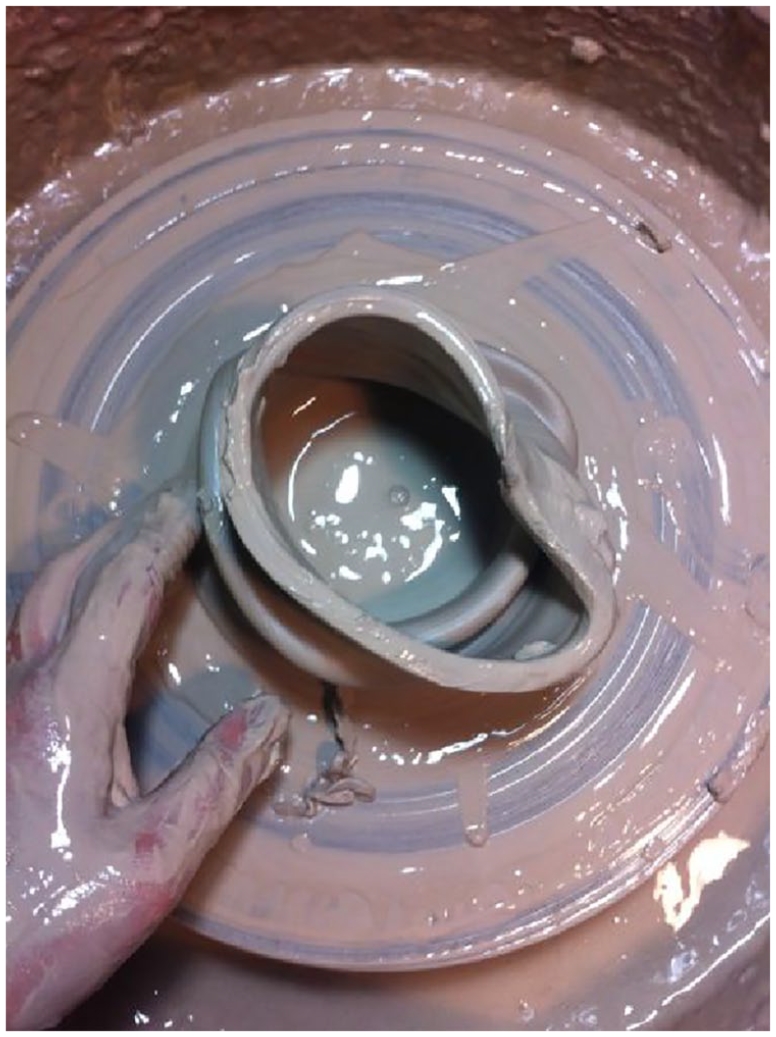
I draw together experiences of doing research and making pottery during my doctoral studies in a UK management school and fieldwork in a UK studio pottery. During this time I followed my own experience as a potter as I learned how to participate in the ‘wider institutional arrangements’ of the craft world to develop my own creative practice (Lave, 2011: 22). In this paper, I pay particular attention to my experiences of learning to prepare the clay for throwing on the potter’s wheel. This is a foundational aspect of making where the potter’s bodily relationship with materials is essential in applying ‘good’ technique to return recycled clay to an appropriate consistency for making (Phethean, 2012; see Figure 1 for an outline of this process).
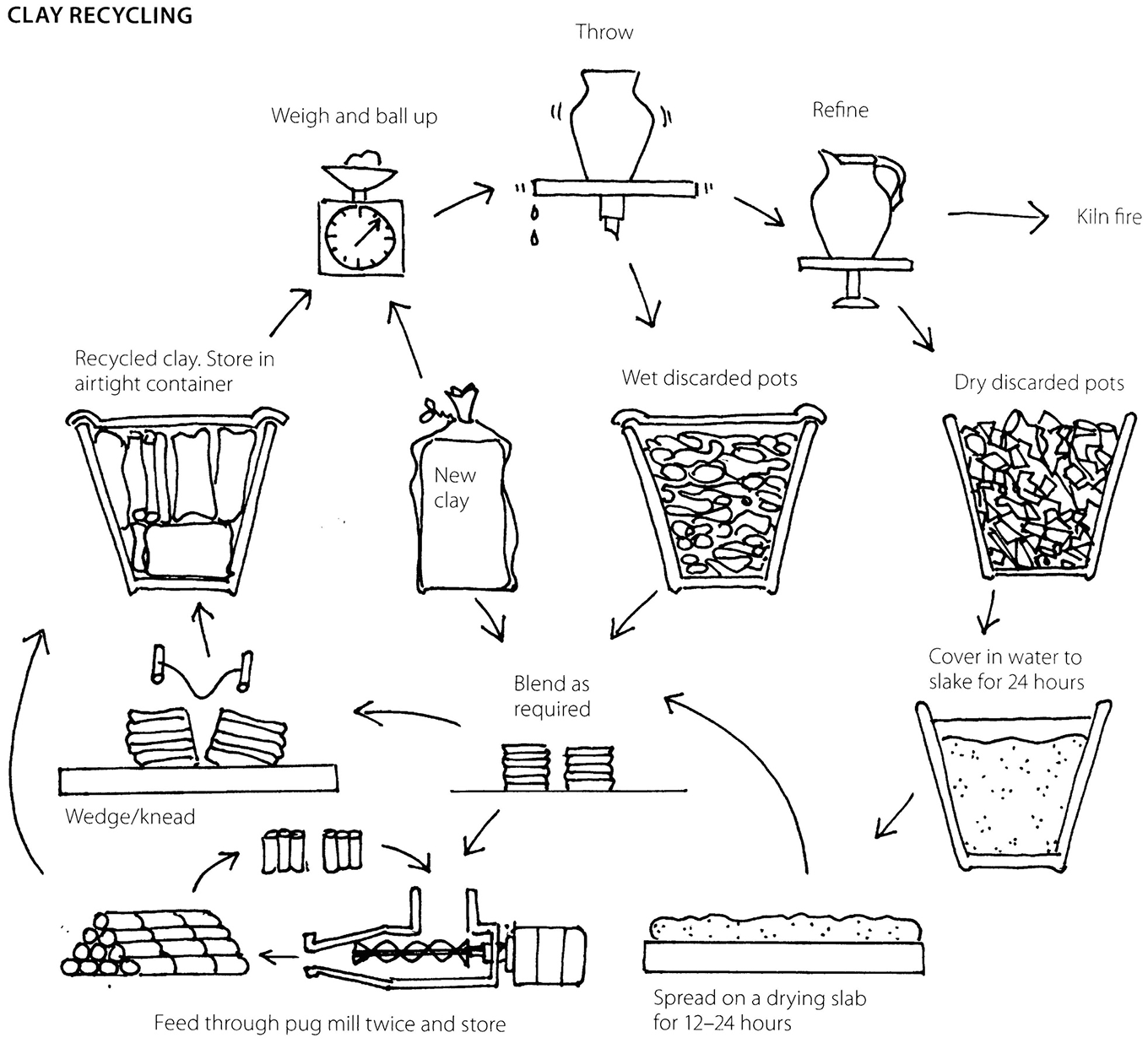
Clay recycling process (Image: © Phethean, 2012, The New Ceramics: Throwing, Herbert Press, an imprint of Bloomsbury Publishing Plc).
My experience in the pottery is juxtaposed with my experiences of learning how to conduct interviews as a novice researcher. Interviews are in themselves considered a ‘craft’ that involves the learning of technical skill and good technique (Kvale and Brinkmann, 2009). However, like pottery, interviewing goes beyond application of straightforward rules, instead unfolding as part of an emotional and embodied performance through which interviewer and interviewee (or potter and clay) jointly construct meaning (Ezzy, 2010; Garton and Copland, 2010; Lippke and Tanggaard, 2014).
As both a novice potter and researcher, this paper follows my struggles with the uncertain and indeterminate nature of learning how to make pottery and do fieldwork (Bartels and Wagenaar, 2018; Sergi and Hallin, 2011). As I am yet to fully appreciate the ‘traditions of the field’ I am increasingly open to the intensity of doubt (Klag and Langley, 2013) while I develop an attunement to situational cues in the environment and move towards becoming a competent potter and researcher (Dreyfus, 2014). Through this process of acculturation, I learn how to speak, how to act, what things mean and why things are important (Lave and Wenger, 1991; Wadel, 2015). Hence, the empirical materials document what was salient to me through my changing participation in overlapping practices, as I developed increasingly comprehensive understandings of how to work the clay and do research (Lave, 2011; Ray and Smith, 2012; Sandberg and Pinnington, 2009).
Crafting the narrative
The story retold is shaped by two 90-minute recorded conversations with my doctoral supervisors a year into fieldwork as well as my wider experiences of learning to do research. This is supported by seven reflective diaries kept during the research process, as well as 265 pages of written field notes generated during 14 months working in the Pottery. I also draw on the recording and transcript of a life history interview with Sarah who has been a potter in the UK for over 40 years and is widely considered to hold a central position in the field. In addition, over 2000 photographs taken in the field were used to stimulate reflection on experience to aid subsequent sense-making; as well as to present more comprehensive accounts of data by recording sensory experiences of materials that fieldnotes had not fully captured (Meyer et al., 2013: 502; Orr and Phoenix, 2014).
The resultant narrative presents a disorderly ‘textured’ or embodied text that follows my unfolding research process and thrives on its own incompleteness (Pullen and Rhodes, 2008: 244). It weaves between my co-mingled lives of research and pottery interjecting theoretical reflections on the nature of qualitative research with empirical reflections from my experiences of making research and making pottery. Three vignettes meet the reader as one of many iterations of textwork that emerged in the crafting of this paper. Hence, I acknowledge that what follows is only one of the many possible stories that could have been told (Bruner, 1991; Revsbæk and Tanggaard, 2015).
Making pottery, making research
When it comes to understanding qualitative research, Cunliffe (2011: 667) urges us to find craft in the ‘more exploratory expressions of embedded and aesthetic forms of knowledge’. She suggests that we do so by being open and responsive to the possibilities that emerge in our relations with others as we enact – and embody – the craft of research. I contend that pottery making exemplifies the aesthetic expression of craft work. This is because at the heart of pottery making is the potter’s relationship with clay. Clay, in its simplest form, is dirt that is shaped and given life in and through a dynamic tension with the maker (Malafouris, 2004, 2007). The clay transforms, in relation to the potter’s bodily movement, from wet shapeless sludge to a permeable plasticity from which its shape is borne. In its unfired malleable state, clay moves with deceptive ease at the hands of the maker as the potter exerts a ‘firm, tender, sensitive pressure which yields as much as it asserts’ (Richards, 1969/1989: 9).
In the relationship between potter and clay, it may seem that the hands are the obvious connector to the material – touching, squeezing, grasping, shaping – however this ‘handwork’ is embedded in a broader bodily ‘choreography’ or assemblage (Nicolini, 2012; O’Conner, 2017). Recycling the clay at the potter’s bench involves embracing the muscles of the core, firmly planting one’s feet on the floor, positioning the body in relation to the bench, pushing into the clay with the shoulders and torso, maintaining rhythm with the arms, and breathing steadily with the lungs; all the while listening and responding to the movement of the clay, and adhering to the traditions of the field. Within this dynamic, the clay is not passive and inert, but rather the material holds an ‘active’ energy that presses into the maker at the same time as the maker presses into the clay (Gherardi, 2017). This subtle, affective feeling of resistance highlights the ‘vitality’ of the material that guides the potter’s bodily choreography, and is central to the meaning that craft work brings (Bell and Vachhani, 2020; see also Ingold, 2000, 2013; Marchand, 2010; O’Conner, 2017).
Meeting resistance
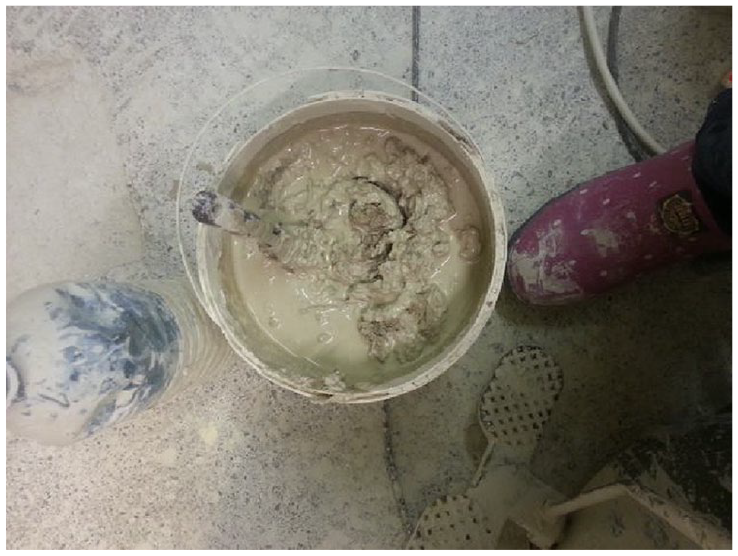
Standing contemplating a mess of wet clay I am unable to grasp how to bring this sludge back to a useable form. I’m compelled not to get found out by my fellow residents having presented a professional enough image to earn myself a place working in the Pottery. I begin by gathering the clay in a large, structureless lump. I sink my thumb into it, and meet resistance as I push through cold, damp clay to hit a tough skin forming where the clay meets the plaster bat. A copy of Bernard Leach’s ‘A Potter’s Book’ is propped open at an account of wedging clay. I follow the instruction, slice the clay with my cheese-wire and throw the thick slabs of clay heavily on top of one another. I hear and feel the impact of clay on clay as a sharp slap of air is expelled between the layers and bites on my arm. I continue on and count 50 slaps of the clay then cut the newly formed lump in half. I prod the clay gingerly with my fingers to check the consistency and see it is full of tiny air pockets. I am convinced these air-pockets will affect my ability to work the clay on the wheel, or worse still, expand in the heat of the kiln and pop, firing ceramic shards outwards and causing a domino effect of damage to surrounding work. Uncertain of the results I gather the next batch of clay on the plaster bat as I turn to kneading it – a different method – in the hope that I will eventually arrive at the desired consistency. I push the heavy mass of clay with my arms and it smears a muddy mess across my workspace; too hard in places and too soft in others. My frustration gains traction in a way that I can only hope the clay might as it skids across my bench. The clay returns towards my body and I feel the muscles in my arms begin to burn as the repetitive movement takes its toll. I have no rhythm: my movements are stunted and I’m at cross purpose with the material. I mirror the clay, spread before me like a pair of lungs. I feel my ribcage expand and I exhale deeply to release the tension building in my shoulders. I know not to bully the clay, to listen to my materials. But how can I listen when I don’t know what to listen for? With my hands anchored in the clay, the dampness of the untreated studio walls permeates my lungs as I pause to look around for clues.
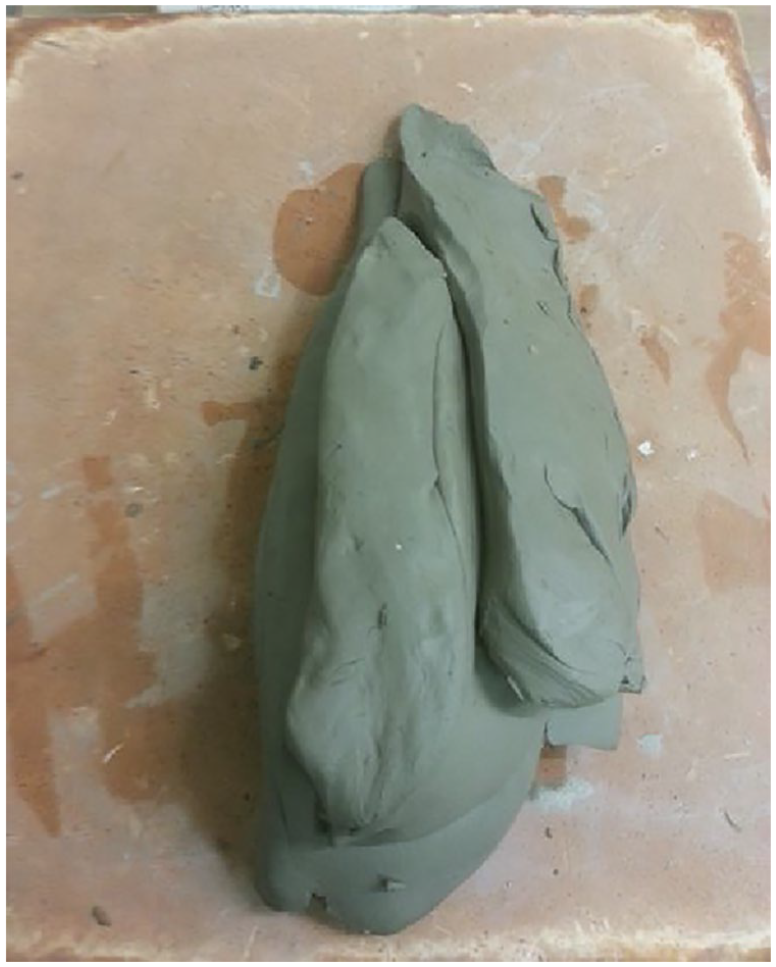

Muddy notions
I am struck by the similarity of this resistance I experience with clay and the formation of materials in research. I begin to reflect upon my research practice in light of my experiences of making pottery (Cornelissen, 2005) and dwell on a ‘loose and even sloppy’ notion (Mills, 1959: 212) that the resistance from materials felt in pottery making is also present in research. While the canonised texts may give us a ‘correct’ account of technical process such as learning how to wedge the clay to the right consistency for making with, I have experienced working with clay as a whole body understanding that can only be grasped through repetition and practice (Haase, 1998: 112). Following my hunch and ‘undifferentiated experience of something’ that I am yet unable to articulate I ‘feel my way’ towards a vaguely felt notion in my research (Locke et al., 2008: 913). I find myself revisiting a recording of a meeting with my supervisors as I navigate the melding of headwork and fieldwork and we discuss the process of interviewing, a year after my struggle with clay. As I listen, my body resonates with the naturally occurring ‘temporary breakdowns’ where expectations were thwarted and ‘practice is disrupted because unintended consequences emerge, new realisations come about, or standards of excellence are not met’ (Sandberg and Tsoukas, 2011: 348). I am reminded that it is in these spaces of unknowingness where there is something ‘other’ to challenge expectation or surprise us that we can begin to see the world anew (Cunliffe, 2018; Sandberg and Tsoukas, 2011; Yanow and Tsoukas, 2009).
Muddling through
My actions no longer feel ‘sincere’ as I cling to the ‘requirements’ for doing good research. I tell my supervisors that the structure of the interview ‘feels really false’. I am consumed by the path the questions of my interview schedule will lead me down, and the way in which they tie me to a specific course of action. The weight of the interviews mirrors the density of the clay as it hangs, heavy clad and smothering my skin, gripping my fingers and securing itself in my nailbeds. I long to wash the dirt clean and rinse myself of the shame and doubt of not knowing. I sense the need to let the structure of the interview emerge with my interviewee, but I am exposed and feel an overwhelming sense of getting things wrong; of not following the right path, or asking the right questions. I am unsure how this muddy mess will form the appropriate consistency to be recognised in my field. The overtly structured way of working by developing an interview schedule does not resonate with my experiences of a year in the pottery studio. My experience tells me to anticipate a visceral response from my materials. My body is primed to touch, feel and sense my way around a task; cobbling together a way forwards in response to the clay. My brain fogs when I try to articulate to my supervisors the resistance I am encountering in research. The pages of the methods texts stick in my throat as I clumsily recount how my reading has left me ‘feeling strange’. A silence hangs in the air as I search for the words to explain; the interview questions mocking the way in which the slabs of clay layer heavily atop one another, saturated with the weight of meaning that they hold. I anticipate how the interview might feel, embracing a sense of awkwardness, embarrassment even, as I face my respondents. I feel a resistance from my materials that pushes me to consider how I might approach questioning my participants, ‘I’m trying to lose the fact that there’s things that I would probably like them to say and find a way of just. . .having a conversation, I guess?’ I imagine the domino effect of air-pockets in the interviews and their potential to damage the research process, to blow my work apart and render it unusable. I dwell in moment of doubt and visualize the cascade of falling structures if I don’t prepare the interviews effectively and fail to collect adequate data: where I don’t ask the right questions or follow up as I should, talking too much or too little during the interview. I anticipate the clay shards firing forwards and fracturing my research exposing my (in)ability to weave together headwork, fieldwork and textwork to demonstrate the required skills of a researcher.
As the conversation with my supervisors presses against my body, I eventually begin to feel a sense of relief as we meet a crossing point where my experiences with clay meet with their experiences of research. My supervisor interjects, ‘the whole point of the open interviews and life history interviews is that they lead to a conversation . . . because you want to know what they understand about whatever it is that you are interested in . . . So, by letting people lead the conversation it will become clear to you what they value.’ I feel an opening, the clay reaches consistency, and our ‘bodies’ momentarily move as one.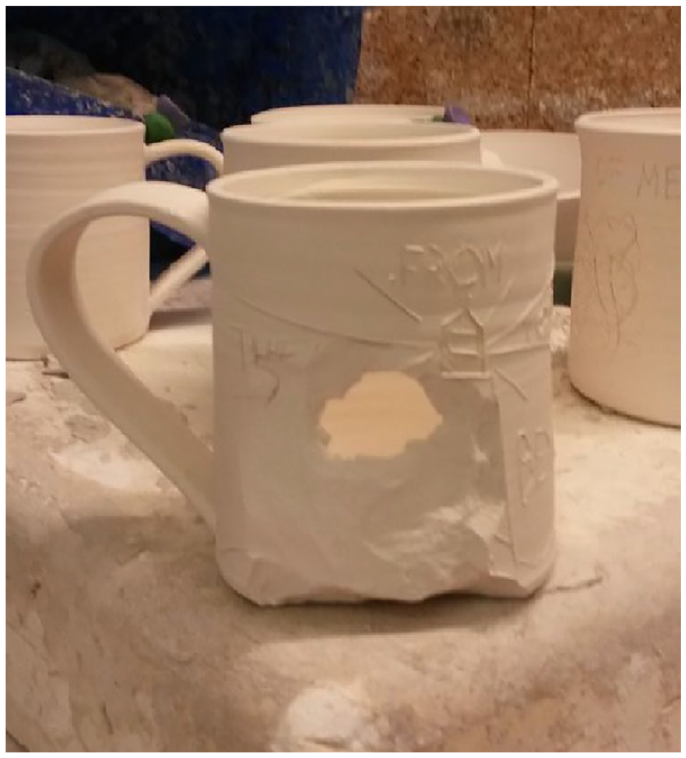
Grasping materials
The materials encountered in research, like clay, are disjointed, messy, unfinalised and elusive (Childers 2014; Koro-Ljunberg and MacLure, 2013). The empirical material slips out of grasp and slides away from my body without a rhythmic return. My experiences in the pottery and of doing craftwork have already shown me that the clay finds its form naturally, rather than through the agitation or bullying of the potter’s hand (Richards, 1969/1989). Hence, the fissure between the expectation and reality of textbook approaches, juxtaposed with the unruly unfolding of my fieldwork, challenges my assumptions of how to do research (Billo and Hiemstra, 2013). Like clay, fieldwork ‘rises up against the researcher, rubs up against her, and pushes back on interpretations’ (Childers, 2014: 882). In turn, the visceral affective engagement with materials is incorporated into my body and my orientation to doing research begins to change as I feel – as well as see and hear – the standards and expectations of the field (Dall’Alba et al., 2018; Lave, 2011).
The way in which the potter responds to the affordances of their tools and materials is described by Malafouris (2007) in his exploration of the deeply dynamic relationship between potter and clay. He suggests that potter, clay and tools enter into a ‘dance of agency’ through their ongoing interactions, where at any given moment the potter’s tools may ‘subsume the plans of the potter and define the contours of activity, or at another point serve as a passive instrument for his or her manufacturing purposes’ (Malafouris, 2004: 59). In research, material such as ‘data’ is rarely silent (Denzin, 2013). Affective resonances give life to the empirical material as it pushes back and disrupts my process. Events encountered during fieldwork glimmer and ‘glow’ encouraging me to follow a specific course of action, subsuming plans, and ‘firing up connections between concepts, theories and empirical events’ (MacLure, 2010: 282, 2013). Here, predetermined form is not simply imposed on materials by the researcher’s hand, rather form becomes an emergent property that unfolds in the doing of research. Hence, I find myself ‘muddling through’ or being ‘thrown into’ situations rather than following well-thought-out plans (Cunliffe, 2018; Gadamer, 1975/2013; Czarniawska, 2003).
Returning to my hunch, my plans continue to take on a life of their own as my attempts at textwork leaves one reviewer ‘long[ing] for an emotional textual glimpse into the dead-ends, re-attunements and wanderings in your life-interview’. I am shunted unexpectedly from the discussions with my supervisors towards the interview recording itself. I sit at my desk and re-immerse myself in that January evening and re-embody the feelings of delight and trepidation as I walked home from Sarah’s house to listen back to the recording for the first time. My stomach lurches in the ‘awkward moments’ (Koning and Ooi, 2013) in which I struggled to fill the silences during the interview, and I find myself weighty with despair once more as I revisit ‘blind alleys’ (Cunliffe, 2018) and renegotiate the ambiguous and uncertain terrain of the interview.
Discovering form
A sense of unknowing remains unresolved as I sit precariously balanced on the edge of the hard, wooden chair in Sarah’s kitchen. One leg is folded beneath me perched at a large table in the corner of the room, body braced and ready to turn to the interview. I glance upwards to get my bearings and catch a glimpse of the potteries of other makers proudly displayed on a high ledge that surrounds the room. In this moment my body shifts and I am reminded of my own status as a maker. My hands gently tremble as I reach across the table to switch on the recorder. I remind myself of my supervisor’s advice, ‘it’s a conversation, behave as if you were in a normal conversation.’ The interview proceeds and as if at the potter’s wheel the clay begins to gently move through the scaffold of my body. After a short pre-amble I say, ‘what I’m interested in is your story and how you became a potter and I wondered if you could tell me a little bit about that. We can start wherever you like, if that’s at the beginning. . . perhaps?’
Sarah dives in, talking about her childhood and her first experience of clay or ‘mud pie’. It all sounds familiar, perhaps a journey a little like my own albeit 40 years apart. I anticipate the conversation, how it might unfold, and I feel the clay push against my body. I try to sense what is useful, what is valuable and I question my questions; is this the data I want to collect, is this ‘good’ data, am I following up enough? I respond to the clay as it guides the next configuration of our bodies. The interview changes direction and after a few moments a silence emerges. I long to follow up as Sarah pauses: the moment swells as I hang in this air pocket, my fingers tracing the contours of the clay as I gently exhale and will the air to dispel with my hands. Sarah eventually sighs too; our voices overlap and the air seeps out of the cracks. I am saved from the disruptive shards of my inexperience and begin to follow her hands as much as her words as we begin to compare long days in the studio making pottery on the wheel. She recounts a story of throwing 100 mugs in a day ‘you do the same motion and you just go onto kind of autopilot you know?’ I get swept up in the flow of the conversation just as I might with the clay at the wheel and I feel the comparison of Sarah’s experience in my own, having spent days in the Pottery making largely domestic objects. Sarah tells me of her repetitive strain injury as if it were a trophy. Our bodies absorb into one another, we move synchronously, and I feel my own hands and arms ache after long days at the wheel followed by the long rhythmic pulling motion required to make handles. As the hour passes we eventually stumble. I spontaneously ask about craft and what it means to her, ‘I can’t quite answer that, give me a few hours!’ Our choreography is suspended. I hit a dead end and the clay collapses.
Sarah moves across the kitchen and switches on the oven. She’s making dinner. I pause. . . and grasp to catch hold of the threads of the conversation before the silence envelops us and we lose momentum. I draw my breath inwards and whisper, ‘where should we go?’ My body shifts: potter-researcher-potter. I’m in the University seeking out the clearing in my path and I hear my supervisor once more, ‘the silences are also very interesting. . . You give them the lead and let them take it where they want.’ ‘OK’, I mutter to myself as I gather the words together. I glance upwards from my notes to get a sense of where Sarah is in the room. There is physical distance between us now as she fusses over the oven just as she might the kiln. I steal Sarah’s attention from her appliances, unsure if she wants to continue. She draws breath sharply through her nose as she turns to make her way back to the table flashing her hands across her apron. I ask a question about the shared space in the Pottery. She responds, ‘I’m going to jump back because you haven’t asked much about glazes, and glazing I think is just such a . . . whole fascinating world.’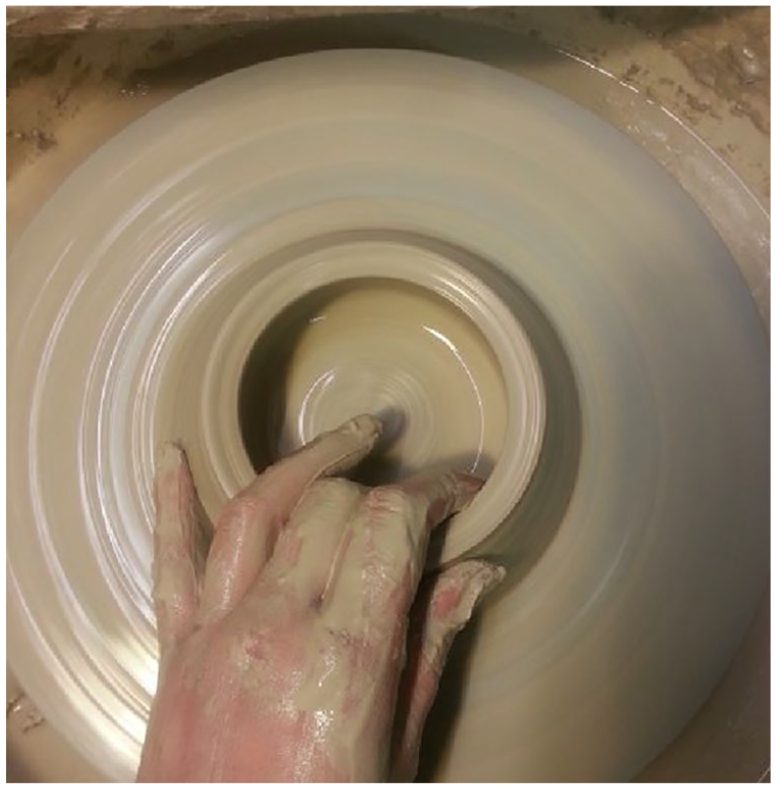
Following flow
In the flow of the interview Sarah’s body moves through the scaffold of my body and mine hers. Our conversation clings to my skin as I absorb the shared moments that go beyond the ‘threshold of awareness’ (Gherardi, 2017). Our bodies enmeshed, I follow the gestures of Sarah’s hands, share the vulnerability of silence, and reciprocate her bodily configurations as we dwell in a moment of oneness (Field-Springer, 2020; Findlay, 2006). In the pressing together of potter and clay we see how the potter learns to respond to their materials in a fluid and responsive way. Similarly, as the material of inquiry presses into the researcher, I am moved to give in to its latent potential (Holt and Yamauchi, 2019) as Sarah’s voice and experience guide the interview (Ezzy, 2010). My orientation to doing research shifts away from a method of interviewing where I ‘probe and question’ and instead I begin to grow into a way-of-being that mimics my experience with clay to encapsulate the co-formation of researcher and research (Ezzy, 2010; Garton and Copland, 2010; Ingold, 2013). Hence, over time, my understanding of materials – as moving, malleable and unpredictable – transcends the bounds of pottery practice and grows into the process of interviewing (Yakhelf, 2010).
This movement of material and maker reflects craft as giving-way to a sense of control and mastery, and a relinquishing of predetermined plans to follow the flow of material. The craftsperson’s understanding accumulates as they work with materials, ‘as if the form that grows within our acts sheds each successive moment like a skin’ (Richards, 1969/1989: 34), simultaneously shaping both the objects they produce and who they are becoming. This suggests that it is possible to re-frame the metaphor of craft and shift the emphasis towards the materially bound nature of qualitative research in order to reunite the objects that are produced with the processes that bring well-crafted research into being. In turn, the ongoing-ness of the deep physical and gestural movements through which bodies move and are moved, become enmeshed, and through which form emerges, can be illuminated (Gherardi, 2018; Gherardi and Perrotta, 2014).
The imperfections of craft
The objects that we produce and the things that we label as ‘research’ have a nuanced and specific history, or trajectory over time, that shapes their eventual formation (Hernes, 2014; Sergi and Hallin, 2011). However, common conceptions of craft often hide the material processes that bring these objects into being by focusing on the ‘perfect completion of work’ or the outcomes that are produced (Boden, 2000; Inkson, 1987). This means that the raw material that constitutes the object is hidden beneath the surface: in the case of pottery making behind the glazed clay; while in research practice, our data is ‘wiped clean’ by our textwork to eradicate the emotional and affective leakages that might violate the expectations and traditions of the field (Pullen and Rhodes, 2008: 246). However, when used as a metaphor, clay and its transformation open up an understanding not of what the craft of research is, but how it comes into being through the emotional affective relations – or what otherwise might be considered imperfections – that emerge in the movement between craftsperson and material.
In following the bodily choreography with materials that unfolds in craftwork the emphasis is tilted towards exploring how things are brought into being rather than what things are (Langley and Tsoukas, 2010; Sergi and Hallin, 2011). Taking this view moves away from understandings of research-as-craft where the emphasis seems to persist on the objects that are produced. Wherein ‘craft’ becomes a ‘resource’ that can be used to shape a specific type of research; albeit one that, as Bell and Wilmott (2020: 1368) identify, ‘connects the application of skill to the ethics of self-formation’, and encapsulates a research imagination that pushes beyond mainstream modes of production (see also Cunliffe, 2011; Mills, 1959). Drawing on the imagery of potter and clay, however, can yield a different response to explore craft-in-research. This articulates how craft actually unfolds in and through the doing of research and illuminates the way in which the researcher simultaneously imposes upon and surrenders to their materials.
The imagery of potter and clay shows craft to be an emergent and hard-won, iterative process where each bodily movement grows out of already established patterns between individuals and materials (Ingold, 2000; Langley and Tsoukas, 2010). These embodied techniques of craftwork are ‘repetitive and arduous, leaving marks on the body’ (Bell and Vachhani, 2020: 693). In the formation of potter and clay, the resistance of the material pushes back as the potter senses and listens while the skin ‘prickles and thrills’ responsively with the clay (Richards, 1969/1989). In a similar vein, Gherardi (2018: 742) proposes that ‘all elements of research – texts, actors, materialities, language, agencies – are already entangled in complex ways and that they should be read in their intra-actions, through one another, as data in motion/data that move.’ This means that materials encountered in research are in dynamic relation as part of ongoing living processes, and that the researcher’s nuanced and affective encounters with these materials moves them to act and respond in specific ways.
In turn, materials encountered in the field are not subordinate or passive objects waiting to be discovered, coded and given shape through the interpretation of the researcher (Koro-Ljunberg and MacLure, 2013), but rather are essential allies and a ‘constitutive force’ in the formation of research (Childers, 2013: 599). Here, matter resists and ‘disrupts’, with a ‘willfulness’ that leaves the researcher ‘dwelling in the affective qualities of encounters, rather than trying to name or fix them’ (Bell and Vachhani, 2020: 686). Encounters in the field, therefore, guide both the realisation of the object of research, and also actively form the researcher, for example, as their orientation shifts towards an openness to the unknown and contingent nature of materials. This brings to view the ways in which in undertaking craftwork, be it pottery or research, the craftsperson experiences a simultaneously unfolding process of transformation and growth (Gadamer, 1975/2013).
A reciprocal shaping of bodies
Through the imagery of potter and clay, I suggest that craft involves a reciprocal shaping of bodies that unfolds in and through the deeply meaningful material engagements that emerge in the everyday life of the craftsperson. When making pottery, the piece of clay can be seen to incorporate the nuances of the potter’s body into its own formation. As the potter shapes the clay the mark of their hand gives the finished piece of work its distinctive character. This can be reflected in the nuances in form and the flourishes that make a piece of ceramic ware ‘sing’ due to the synergy of its dimensions, or the specific line of a curve. The same can be said for the ways in which the researcher’s embodied understandings and emotional framing of events mould the doing of fieldwork (Ezzy, 2010; Gherardi, 2017; MacLure, 2013), or shape the development of an authorial voice in textwork (Patriotta, 2017). Yet at the same time, the resonant and invisible force of the material moves, connects, dislodges and choreographs the maker’s hand in specific ways. Potters learn to follow the flow of the clay, while researchers are struck by ‘aha moments’ as their data pushes and pulls them in specific directions (Cunliffe, 2004; MacLure, 2013). Hence, resistance from material shapes ongoing action, as successive movements of making are incorporated into the body. This illuminates new and different understandings that allow individuals – be it potter or researcher – to participate in increasingly comprehensive ways (Gadamer, 1975/2013; Sandberg and Pinnington, 2009).
While it may appear that the plasticity of the clay is stabilised in the ceramic ware, or that the messy nature of fieldwork (Langley, 1999) is neatly contained in textwork, this ‘finalised’ piece arguably accommodates degradation and attrition as it carries on through its lifetime, and is put to various uses or meets different audiences (Koren, 2008). This means that the representations that are formed in the relations between potter-clay, and researcher-research, are somehow imperfect, imprecise and unfinalised. Like the realised piece of pottery, beneath the polished surface of our textwork is the sense of discord, unsettling, or unknowing that inevitably unfolded in the process of making research (Cunliffe, 2018; Dall’Alba, 2009; Pullen and Rhodes, 2008).
Craftwork, therefore, acknowledges how the mark of the researcher’s hand is shaped by the imperfections that have emerged along the way; and how these imperfections shape the objects that are produced. In turn, craft-in-research can be considered an orientation to doing research that the researcher grows into in and through their accumulative experiences of becoming (Ingold, 2000). This accumulative process is not one of mastery over materials, but rather encompasses an openness to going on in new and different ways – to moving and being moved – as the vitality of the field presses into the researcher and leaves its mark, and vice versa. In this deeply personal relationship with materials, it is the moments where affective emotional understandings leak from the researcher’s body (Pullen and Rhodes, 2008) that gives the eventual form its meaning. Therefore, it is the ‘imperfections’ in the process of making that become constitutive of the well-crafted object, as the slight of the potter’s hand or the dead ends and detours of research shape and give life to the things produced in unexpected ways (Gadamer, 1975/2013).
Potentials for going on
It is acknowledged that this paper focusses specifically on immersive forms of research such as interviews, observations and ethnography. What results is a narrative constructed from a ‘lived database’ or repertoire of possible recollections drawn from my first-hand, personal experiences as I lived life and everything that involved (Bruner, 1991; Revsbæk and Tanggaard, 2015: 38). One of the imperfections of academic writing is that the narrative cannot capture the entire process of making pottery and making research. As a result, this paper is intended as an example of the unfolding relations between potter and clay; and researcher and research. However, this means there is potential to explore how craft unfolds in less immersive methods, for example instances where secondary data are the primary object of analysis, or quantitative methods. This is particularly valuable as a process perspective would suggest that craft in research will emerge differently in regards to the trajectory of events and the material engagements that unfold in the process of bringing research into being. This suggests that there is more than one way of achieving craft in research and it is not solely determined by skill, or ‘good’ technique, but by a combination of the researcher’s practical skill and a sensitivity to the ongoing situation that acknowledges the simultaneous becoming of researcher and research.
Footnotes
Acknowledgements
Thank you to the Editor and reviewers whose constructive feedback and continued encouragement have helped shape the eventual formation of this paper. I am also grateful to my doctoral supervisors for their unswerving support throughout my training, and beyond.
Funding
The author received no financial support for the research, authorship and/or publication of this article.
