




Abstract
This article is an intervention in current trends of thinking about competition and gender in essentialist and stereotypical ways. Such thinking has produced numerous comparative studies measuring competitiveness of women and men; ‘proving’ men as competitive and women as non-competitive. Based on experiments and written questionnaires, these studies reduce gender to perceived biological sex and treat competition as a ‘self-evident’, static and easily measurable phenomenon. To contribute new understandings and learning, we surface five fallacies of this comparative research, explaining why the approach is misleading, inequitable and socially harmful. Drawing upon gender as a social construction and women leaders’ narratives, we offer a blueprint for democratising knowledge production. We write differently, choosing not to provide a ‘balanced’ view of the field and construct competition as a processual, complex and contextually specific phenomenon with underlying gender dynamics, rather than a discrete, observable and fixed in time event. The article provides learning: for leaders and managers to resist automatic categorisation on the basis of perceived biological sex; for management educators to challenge the ways that leadership and management are traditionally taught; and, for executive coaches to support changes in practice, by embracing complexity of the contemporary contexts in which leaders operate.
Introduction
Perpetuating organisational discourses of ‘competitive men’ and ‘non-competitive, coy women’ in management, management education and everyday life contributes to impeding women and men’s career advancement and may preserve masculinist practices in organisations (e.g. excessive risk-taking, workplace bullying, misogyny, desire to win at all costs). Here, we provide a sharp and long overdue intervention into the current trend of essentialist thinking about competition and gender highly prevalent in research and replayed in everyday media. This thinking translates into beliefs that women have a set of biologically ascribed and/or socially acquired characteristics which ‘make them less competitive’. Research, via numerous comparative studies measuring competitiveness of women and men continues. Such studies reduce gender to perceived biological sex, in that women and men are perceived as different in ways aligned with their physical characteristics and treat competition as a ‘self-evident’ (obvious but unexplained), static and easily measurable phenomenon (e.g. Apicella and Dreber, 2015; Eckel and Füllbrunn, 2015; Gneezy et al., 2003; Niederle and Vesterlund, 2007). We explain why knowledge production based on this approach to competition and gender is misleading, inequitable and socially harmful; competition is a complex concept. We offer a blueprint for democratising knowledge production, where competition and gender are social constructions and competition is a processual, complex and contextually specific phenomenon.
Research into competition and gender in organisations is likely to increase within neoliberal societies; competition is a central mechanism of organisational development and individual career progression. ‘How’ we research this area is of significance to management learning, education and practice in shaping discourses and practices. Business and Management Studies (BMS) remains dominated by positivist, quantitative approaches to gender, viewing reality ‘out there’ as context-free, single, tangible and fragmented; evidence as separate from theoretical assumptions; researcher as independent from the object of inquiry; and inquiry itself as a value-free process. BMS research based on these assumptions promotes quantitative methods for establishing causal effects, emphasises ‘the business case’ over issues of social justice and treats gender as a binary, presuming each person is ‘a’ male or female based on immutable biological traits and/or gender socialisation (Calás and Smircich, 2009). This ignores the fluidity and complexity of holistic organisational practice, and, as we show, actively contributes to a proliferation of status quo inequality, with bias against women.
Non-feminist, essentialist approaches to researching competition which ‘prove’ men as competitive and women as less competitive, first, perpetuate embedded gender stereotypes and discourses in society which effectively disable women from fully participating in organisational life and, second, do not reflect what we, as women authors, researchers and leaders, experience. While we do not subscribe to fundamentals of neoliberalism and competition as solutions to societal problems, the persistent and seductive argument about ‘less’ competitive women is far removed from our societal and organisational experiences where competition and competitiveness happen in different ways.
We are motivated to provoke a significant move from a ‘self-evident’, static, measurable, generalisable and stereotypical view of competition, conducted mostly via experiments, to socially constructed, processual, complex, contextually specific and nuanced understandings of competition. We do this by outlining five interconnected fallacies with comparative studies of women and men’s competition and argue that the root of the problem lies in the persevering assumption that there must be gender differences in competition. The obstinate reinforcement of gendered stereotypes about competition by these studies is undemocratic and undermines equality. Drawing upon a narrative inquiry of women leaders in top hierarchical positions which surfaces social constructions of competition rather than through experiments, we illustrate how competition is a processual social phenomenon; relational, dynamic, multiple, complex, political and contextual, with underlying gender dynamics, rather than a discrete and observable event, fixed in time in designed experiments.
To do this, we explore three guiding research questions: (1) What ontological and epistemological assumptions underpin studies which compare women and men’s competition and claim that ‘women shy away from competition much more than men’? (2) What knowledge can we gain from critiquing such studies? (3) What can we learn about competition and gender by taking a social constructionist research approach informed by feminist epistemologies? Our contributions concern the following: first, highlighting key fallacies in the essentialist research base comparing competitiveness in women and men; second, offering an alternative approach where gender is a social construction and competition is a processual, complex and contextually specific phenomenon; third, disrupting education and learning which discusses how women and men compete in stereotypical ways; fourth, providing learning for leaders, managers and executive coaches to raise awareness of these fallacies and resist automatic categorisation on the basis of perceived biological sex; and, finally, writing differently, by choosing not to follow scientific conventions of providing a ‘balanced’ view of the field.
This article follows an unconventional format, which is our deliberate choice and attempt to broaden the straight and narrow contours of the scientific norm, where ‘a particular epistemology is forced on writers; (take out the emotion and focus on the intellectual!) and a particular form and style are to be followed (stop reflecting and get rigorous!)’ (Kiriakos and Tienari, 2018: 270). Our motivations are to provoke a rethinking of the study and practice of competition and as Bell and Bridgman (2019) note, ‘we must continually reflect on inequalities in practices of knowledge production and the need to foster more pluralistic communities of research practice in our field’ (p. 148). Our writing style is ‘knowingly’ assumptive and bold to reflect our personal feminist values and organisational experiences. We do not mask our voice or presence and as such use ‘we’ to refer to ourselves rather than neutralise.
We begin with review of comparative approaches to women and men’s competition and highlight five fallacies in the essentialist/positivist research base. We then reflect on the root of the problem and the tensions in different approaches. Next, we introduce the wider research study and offer a blueprint for democratising knowledge production into competition. This surfaces learning about constructions and experiences of ‘real-life’ competition in organisations. We present three accounts of women leaders talking about their experiences of competition to highlight how close attention to the meanings of competition, motivations behind it and accompanying social processes can bring about shifts in how we think, research and, therefore, practice in this area.
On comparing competitiveness: women and men
In past decades, there have been over a hundred comparative studies in economics, finance, decision-making science, psychology and BMS, which investigate gender differences in competition (e.g. Apicella and Dreber, 2015; Eckel and Füllbrunn, 2015; Gneezy et al., 2003, 2009; Ifcher and Zarghamee, 2015; Niederle and Vesterlund, 2007; Price, 2012a; Sutter and Glätzle-Rützler, 2015; Westbrook et al., 2011; for review of the field, see Niederle and Vesterlund, 2011; meta-analyses of gender and negotiator competitiveness can be found in Mazei et al., 2015 and Walters et al., 1998). It is commonplace to recruit women and men volunteers to take part in laboratory or field experiments with a choice of competitive and non-competitive participation schemes or to collect the data using written questionnaires. Here, any differences between responses and performances of women and men that reach statistical significance are provided as supporting evidence of important gender differences in ‘competitiveness’.
For example, economists Gneezy et al. (2009) invited 34 women and 40 men from Maasai tribe of Tanzania to undertake an experiment, designed to test the assumptions about biologically based competitiveness. The experiment involved throwing a tennis ball into a bucket from a distance of about 10 ft. Participants were given a choice: they could play it safe and receive 500 Tanzanian shilling (US$0.22) each time they hit the target or they could compete with another participant and receive 1500 shillings (US$0.66) for each successful throw – but only if their final result was better than their competitor. If their opponent had a better result, they received no payment. Assessing the results, the researchers compared a percentage of women who chose to compete against a percentage of men, found that Maasai men opt to compete at approximately twice the rate as Maasai women and drew conclusions on gender differences in competition in Maasai culture.
Niederle and Vesterlund’s (2007) experimental economics involved a similar choice. The researchers gave 80 paid women and men volunteers a series of simple math tasks. Participants were compensated either on a competitive winner-take-it-all or on a non-competitive basis. Non-competitive participation mode was rewarded with 50 cents for correct answer, while people who entered tournament had a chance to receive $2 per correct answer, but only if their overall score exceeds that of other group members. Having found that men participants selected tournaments significantly more often than women, the researchers concluded that ‘women shy away from competition and men embrace it’ (p. 1067). Management scholars Westbrook et al. (2011) used a questionnaire designed for self-assessment of competitive and hypercompetitive orientations and collected responses from working adults (82 women and 81 men) enrolled on a business degree. From participants’ responses, they concluded that ‘men are more generally competitive than women’; however, ‘women who score highly on the hypercompetitive scale are more likely to embrace the use of unethical bargaining behaviour’ (p. 289).
Later, we show how these types of research methods cannot be the basis for strong claims of difference between women and men; whether or not the choice of participants is random or whether or not researchers control for different variables, for example, attitudes, beliefs, risk aversion. Building on research problematising quantitative studies of gender (Hughes and Cohen, 2012), we explain why using such comparisons for claims about inherent or acquired characteristics of all men and all women is misleading, inequitable and socially harmful. Indeed, many such comparisons do not reach statistical significance, and those that do, should be interpreted in careful and reflective ways.
Research into organisations and business and management has developed through functionalist, quantitative and statistical approaches; viewed as ‘mainstream’, these are seductive in appeal to management researchers and practitioners – and also to popular media, who present such studies as ‘fact’. Our assumption is that comparative studies of women, men and competition travel into discourse and everyday media and sustain a stereotype that women shy away from competition at work; a crucial mechanism of career progression. As a way of disrupting thinking on how leaders and managers ‘read’ these studies and are primed to conduct research and practice in educational and learning programmes, we outline five fallacies with the assumptions that underpin research design, data collection and the ways comparative studies conceptualise competition and understand gender. These fallacies are particularly apparent in studies which claim a direct link between the lower levels of competitiveness among women and the persisting gender pay gap and scarcity of women in leadership roles. For example, economists Gneezy et al. (2003) suggest that gender differences in wages and lack of women in high-profile jobs can be explained by one simple fact – ‘women may be less effective than men in competitive environments’ (p. 1049). Twelve years later, in their Management Science article, Sutter and Glätzle-Rützler (2015) stated that
A successful career in business, politics, or science does not only depend on an individual’s ability and social skills, but also on a readiness to accept the challenge of competition for scarce jobs and rewards. However, recent research has provided ample evidence that
We research from a social constructionist paradigm and, after Calás and Smircich (2009), view positivist-quantitative research on gender differences in competition, which is not guided by feminist theory and does not have explicit concern for the disadvantages women face in society, as almost inevitably deterministic and reductionist. That said, the underlying assumptions behind comparisons based on perceived biological sex, their methodology and logical leaps from empirical results to law-like generalisations about gender differences do not just raise concerns for researchers working within a social constructionist paradigm, but as we show, these are also problematic if one adopts conventional trustworthiness criteria (internal and external validity, reliability and objectivity). It is time that inquiry into competition and gender from a positivist paradigm is reconsidered. We critique essentialist comparative approaches in terms of validity by including illustrations of how the above research considers the conventional credibility criteria.
Five fallacies with comparing competitiveness: women and men
Gender as a demographic variable and ‘a cause’
When reading comparative studies of competition and everyday media which draws on the results, leaders and managers should be aware of this first fallacy; the essentialist understanding of gender, which equates to perceived biological sex and/or a demographic variable. Such approaches largely ignore the socially constructed nature of gender and the last 50 years of gender scholarship. However, apart from using gender as a demographic variable, such studies also treat it as a cause of competition. From a casual inference perspective, and assuming for a minute that gender is a demographic variable (assigned at birth; a fixed attribute individuals possess), making causal statements about fixed variables is meaningless. If there is no way to change a variable, causal statements about this variable usually do not work or, as Holland (1986) states, there is ‘no causation without manipulation’. Unless comparativists recruit people intending to undergo sex reassignment surgery or interview gender fluid individuals who feel ‘more like a man’ or ‘more like a woman’ on different days, the simultaneous use of ‘gender as an attribute’ and ‘gender as a cause’ is contradictory.
This contradiction is quickly noticeable in comparativist studies which control for a number of different factors to maintain the ‘purity’ of the experiment and make claims of scientific objectivity. For example, the highly influential experiment conducted by Niederle and Vesterlund (2007), cited in 2419 later papers and replicated with only minor modification by numerous researchers (e.g. Healy and Pate, 2011; Niederle et al., 2012; Price, 2012b), controlled for
(a) attitudes toward competition (although men may feel comfortable performing in a competitive setting, women may be more anxious about such prospects), (b) beliefs about relative performance (men may be more confident that they are among the highest-performing participants and thus be more inclined to compete), and (c) risk and feedback aversion (the tournament is not only competitive but is also more uncertain and provides more information about relative performance than the piece-rate scheme; if women are more averse to such factors, they may be less inclined to select competitive compensation). (p. 603)
If gender is a fixed demographic variable, controlling for gender attitudes, beliefs and risk propensity to compute a ‘residual gender gap’ is epistemologically problematic. We did not find any studies, which measured whether these differences in attitudes, beliefs and risk aversion between women and men taking part in an experiment actually existed. The majority of studies are based on assumptions that gender differences in competition (1) exist and (2) would manifest themselves in any practice, task, test or experiment. Thus, essentialist studies designed to compare competitiveness in women and men ‘reproduce a circular logic and take us to a dead end’ (Ahl and Marlow, 2012: 3): (1) they investigate gender differences because they assume that women and men compete differently; (2) they find gender differences; (3) they assume that women and men compete differently.
Competition as a self-evident concept
The second fallacy leaders and managers could review for when drawing upon these studies is that the concept of ‘competition’ is very rarely defined (e.g. Almås et al., 2016; Gupta et al., 2013). If defined, then competition is understood as zero-sum game: a competitive exchange where one participant wins and the other loses. Examination of a recent surge of economic and BMS research on gender differences in competition reveals that much scholarship treats the central object of their study as a self-evident (obvious and unexplained) concept. This lack of conceptual clarity and/or differentiation between various kinds of competition means that the very existence of competition is sometimes implicitly attributed to individual attitudes and behaviours. For example, Westbrook et al. (2011) applied Ryckman et al.’s (1990, 1996) competitive and hypercompetitive attitude scales to look at gender differences in workplace negotiation strategies. Having documented competitive and hypercompetitive attitudes among women and men participants, the authors compared their results along gender lines, as if it was always an individual choice of how to negotiate with customers and establish inter-organisational relationships. This study deals with at least two different kinds of competition – individual and corporate, which happen to be conflated when competition is treated as a self-evident concept. This inattention to definition or conceptual understanding is highly problematic. We highlight through our social constructionist study that the prevalent research practice of approaching competition only as a zero-sum game is a distance away from the complexities of social and organisational environments.
Competition occupies a central place in different disciplines such as economics, BMS, evolutionary biology, psychology and sport studies. While researchers in different disciplines use the same term, they do not necessarily study the same phenomenon. For example, in evolutionary biology, competition has been traditionally studied in connection to natural selection and a fight for scarce resources; in economics, it is researched in connection to market processes; in psychology, competition is seen as a process implicitly or explicitly present in every human group. According to Fülöp (2004), when researchers ‘do not find it necessary to start with a precise definition’, ‘the multidimensional nature of competition eludes [them], because qualitatively different processes get lumped together within a single and one-dimensional construct of competition’ (p. 131).
Approaching competition as static and easy-to-measure phenomenon
The third fallacy leaders and managers could consider is how competition is approached as a static and easy to measure phenomenon. It has long been understood that behavioural complexity is difficult to measure. Recent studies revealed that three key phenomena were identified in the extant research as pertaining to gender differences – competition, risk propensity and confidence – that are (1) domain specific and (2) depend on one’s familiarity with and knowledge about that domain. Weber et al. (2002) investigated how likely people would take risks in five different domains: financial decisions (investing and gambling), health/safety, recreational, ethical and social decisions. They found no consistent patterns in risk-taking propensity across the different domains, that is, the people who exhibited high levels of risk-taking behaviour in one area (e.g. bungee jumping – recreational risk) were no more likely to invest in speculative stock (financial risk), ask their boss for a promotion (social risk) or shoplift a small item (ethical risk) than someone who would never consider a risk to have any recreational capacity (see also Hanoch et al., 2006). Wieland and Sarin (2012) found that for both women and men, the decision to compete was based on familiarity with a particular domain. The more knowledgeable a person feels about a particular task, the more likely she or he would be ‘to compete in that domain and show a stronger preference for competitive pay in the domain’ (p. 152; see also Günther et al., 2010; Lavy, 2012). Ivanova-Stenzela and Küblerb’s (2011) study showed that the gender of a competitor as well as gender composition of a team influence both women and men’s choices to compete (see also Grosse et al., 2014).
Competition is not a static and easily measurable phenomenon: it changes from one context to another; depends on who competes with whom; and, is influenced by one’s experience and knowledge. Thus, measuring and comparing ‘competitiveness’ between several women and men is futile without in-depth investigation into the background of participating research subjects and their contexts. Straightforward measurement of competition is even more problematic if we consider the interplay between competition and other social processes in real-life settings as opposed to laboratory experiments.
Neglecting a variety of individual motivations for competition and importance of context
The fourth fallacy leaders and managers could consider in resisting automatic categorisation based on perceived biological sex, lies in the lack of attention to a wide range of people’s motivations for engaging in competition or otherwise. This fallacy overlaps with the third fallacy, in that it downplays the importance of contexts where competition takes place and also lacks consideration of motivations for competition, which conceals processual ‘real-life’ nature of this phenomenon. In statistical terms, a point at issue is external validity, that is, the validity of applying the conclusions of a scientific study outside the context of that study. Experiments described above can only show that women and men pick competitive and non-competitive schemes at different rates. They cannot show that this is due to different propensities to compete, which is a prevalent but unsubstantiated interpretation (a similar point is made by Nobel laureate in economics, Angus Deaton (2010)).
By claiming competition as processual, we wish to highlight that it is a relational, dynamic and complex process rather than a discrete event fixed in time. Since most comparative studies on competition and gender rely on paid participants and use financial reward as a stimulus, other motivations for engaging in competition remain underexplored. Uncritical and unreflexive application of results from laboratory experiments which test how women and men compete for cash bonuses, generalised to explain complex issues such as gender pay gap or vertical gender segregation of the labour force, are questionable (see examples of such logical leaps in Gneezy et al., 2003 (economics); Sutter and Glätzle-Rützler, 2015 (management)). Manning and Saidi’s (2010) study confirms that the ability of results from laboratory experiments to explain gender pay gap is very limited. In contrast to these experiments, ‘real-life’ competition takes place in complex social contexts, is provoked or encouraged by a particular set of circumstances and sometimes restrained by ethical norms and existing relationships. As Rees and Segal (1984) state, different feelings and reactions to competition may be legitimate at different points at time.
Competition is not only a fight for resources and social status, it can also be an integral part of social fabric inseparable from other social processes, such as cooperation, conflict, friendship, education, adaptation and many more. We argue for competition to be understood as a processual, complex and dynamic process rather than a series of linear events. Attempts to make valid claims about how competition is gendered or how it organises gender on societal and organisational levels should take into account complexities of competition and consider environmental dynamism. In the face of environmental challenges, like funding cuts, Brexit or mergers and acquisitions, where ‘competitive change cannot be predicted but only responded to, more or less efficiently ex post’, then ‘adaptive capability’ (Volberda, 1996: 360) becomes a defining feature of ‘success’. In practice, this means that both individuals and organisations can quickly switch their behaviours from aggressively competing against one another to closing the ranks and selflessly helping out (Sennett, 2012).
Overlooking power relations
The fifth fallacy which leaders and managers could read for is a failure to acknowledge gender ‘as a system of relations, identity, and power’ (Hoobler et al., 2018: 2484). The act of comparison requires a researcher to name two or more entities whose similarities and differences they will then describe. When applied to women and men, a comparative approach erases in-group differences and between-group similarities, recycling a familiar set of gender characteristics – and taking us to a dead end (Ahl and Marlow, 2012). It depicts men as proactive, competitive and courageous and deems women as passive, shy, lacking confidence, bravery and competitive drive. Such approaches mistakenly portray women-as-a-group and men-as-a-group as parallel objects for study. Comparativists do not critique how almost every society in the world has a long history of social inequalities organised along class, race and gender lines. As a result, claims of scientific objectivity in such studies are only possible when the complexities of competition and nature of gender are ignored.
As historian Seigel (2005) comments, ‘[c]omparisons obscure the working of power’ (p. 65). The act of comparison of a group of people, who have never been a subject of structural discrimination (historically, men were not discriminated as men, only as black men, working class men etc.) with a historically oppressed group, which continues to be a subject of various forms of discrimination (women) is a highly political act. If we are not clear about our political goals of conducting comparisons between these groups, comparative method tends to co-construct its own data, that is, document how experimental design and experimenters’ assumptions about gender differences in competition affect people rather than recording some evidence about the nature and dispositions of research participants. Measuring competitiveness between women and men in such essentialist ways is both based on and feeds into the oppressive worldview portraying men and women as two distinct camps of people, with women as secondary. Comparative studies of women and men are not only misleading, they ultimately work to naturalise and reproduce gender divisions and gender inequality. What appears to be hypercompetitive behaviours among men and women shying away from competition may be not a result of inherent or acquired predispositions, but an effect of wider gendered processes.
The root of the problem
In problematising five separate but interconnected fallacies with comparative studies of women and men’s competition, we call for a systematic rethinking and for leaders and managers – a critical re-reading of previous research data. We follow economist Julie Nelson (2014, 2015) who revealed a discrepancy between the well-established claims that ‘women are more risk averse than men’ in results of comparative studies. Having re-examined empirical data from a sample of 35 published articles in economics, finance and decision science based on comparative approach to risk preferences among men and women, Nelson found that only 14 of the 35 studies had consistently positive and statistically significant results. Three statistically significant studies out of 14 found greater risk preference among women (Nelson, 2015). Nelson (2014) explains a leap from largely mixed evidence on gender differences in risk-taking to conclusions that women are innately more risk averse than men through the practice of stereotyping and confirmation bias among the researchers, publishers and peer-reviewers themselves and provides five reasons for this:
(1) earlier literatures are inaccurately cited in a stereotype-confirming way; (2) results that confirm the stereotype are emphasised, while results that do not are downplayed; (3) stereotype confirming results are more likely to be published; (4) the effect of confounding variables is neglected; and, (5) the areas of risk studied are selectively chosen. (p. 212)
Following Nelson, we see that the root of the problem lies in the persisting assumption that there must be gender differences in competition. The enduring enthusiasm for comparing how men and women ‘do competition’ is bewildering as attempts to integrate the diverse empirical results and develop a coherent scientific framework fail to give a clear picture (see Mazei et al., 2015; Niederle and Vesterlund, 2011; Walters et al., 1998). While one study designed to test gender differences in competition finds statistically significant differences, the next one, which replicates the previous research design, often do not replicate the result. For example, Gneezy et al. (2003) found that women are less effective than men in competitive environments, yet Günther et al. (2010), having replicated Gneezy et al.’s (2003) research design, found no difference between women’s and men’s performance under competitive pressures in word tasks. Shurchkov (2012) (who replicated the same study) found no gender differences in the low-pressure tournament math task, with women outperforming men in the verbal task.
A suspect paradox is that despite some recognition of the complexity of competition, a drive persists to compare how women and men compete. Lavy (2012) recognised that competing on a familiar task against well-known colleagues is not necessarily the same as competing on an unfamiliar task against strangers. His research examined competition among school teachers based on improvements in the test performance of their classes and found no gender differences. Gneezy et al.’s (2009) research on competition among women and men in the patriarchal Maasai society in Tanzania and the matrilineal Khasi society in India documented that the gender gap in the patriarchal society remains in place, but reverses in the matrilineal society where it is men who shy away from competition. Other research highlighting cross-cultural variations in competition and gender (e.g. Cárdenas et al., 2012; Khachatryan et al., 2015) poses further counterevidence to essentialist speculations.
In summary, the more ‘variables’ come to the researchers’ attention, the more complex competition is and the less evident what role perceived biological sex and/or social construction of gender play. Despite this, the broad claim that women are less competitive than men (Croson and Gneezy, 2009) remains in place. This claim continues to inform further comparative studies on women, men and competition and is widely used in popular media to explain a dearth of women in top leadership roles (Apicella and Mollerstrom, 2017; Guo, 2015). This agenda is embedded in foundations which position women as lacking; academic comparisons of women and men reproduce gender. This persistent research agenda seems to reach an epistemological dead end (Ahl and Marlow, 2012) and continually embedding stereotypes of women as ‘less’ will do little to advance understandings of competition.
An alternative: a socially constructed approach to competition and gender
Essentialist approaches to competition draw conclusions on who can and cannot be competitive, primarily based on perceived biological sex. They have contributed to the embedding of gendered expectations of competition. Therefore, women (or anyone perceived to be biologically so) are often sanctioned if they appear too competitive at work. Comparative research into competition between women and men is predominantly positivist, quantitative, context-free, researcher-free and singular. It approaches reality as something ‘out there’ rather than exploring people’s experiences in context-specific situations. To build our arguments for a more democratising approach to knowledge production, we see gender as socially constructed and as one of the central axes of social life signifying relationships of power and inequality (Marlow, 2014; Olesen, 2005; Scott, 1986).
There are a multitude of gendered constructions which can also lead to material differences. Yet, in drawing upon gender as socially constructed to scrutinise comparative studies of competition between women and men, it becomes crystalline how complex competition at work is. From a constructionist-interpretative paradigm, viewing realities as multiple and constructed, researchers’ positionality and theoretical background as inseparable from research results and inquiry as inherently value-bound (Denzin and Lincoln, 2008), we see critique of positivist research politics and methods, which subjugate women, as a constitutive part of our scholarly agenda.
As explained, there is also a problem of definition for ‘competition’ in comparative studies. As researchers, we view competition as a gendered concept and gendering process. However, we see the ‘gender differences in competition’ knowledge produced by comparative studies as meaningless, because of the impossibility to single out gender dynamics from a breadth of other factors influencing individual and group competition; and, ‘competition’ being an umbrella term for many different concepts and processes (Fülöp, 2004). Drawing on long-term critique of ‘gender as difference’ paradigm (Broadbridge and Hearn, 2008; Connell, 1985), we argue that attempts to provide essentialist definition to gender differences in competition requires a qualitative analysis of the circumstances that produce such a definition. We take issue with how competition is understood in comparative studies of competition between women and men and in the assumptions and methods of these studies. In drawing upon an alternative paradigm and a narrative inquiry with women leaders, we surface how competition is a processual social phenomenon; relational, dynamic, multiple, complex, political and contextual, with underlying gender dynamics and not, as essentialist studies claim, a discrete and observable event, fixed in time in designed experiments.
Can we change direction?
We are aware that any critique, which attempts to explain why an area of study and management practice is moving in the wrong direction, is ‘difficult to write and has to be compelling thorough and useful’ and are highly cognisant of accusations of ‘preaching to readers’ or of relying on sanctimony to ‘substitute for science’ (Cropanzano, 2009: 1309). Our rethinking of essentialist comparative studies of women, men and competition builds on Ahl and Marlow’s (2012) research into gender and entrepreneurship, where they identified a persistent gender bias in entrepreneurship discourse positioning women as lacking and incomplete and in turn perpetuated by a research agenda grounded in gendered assumptions and resting upon weak foundations. We are encouraged by Rhodes (2019), who argues that ‘within an intellectual community, the act of naming and questioning dominant approaches can contribute to usurping that dominance through a process of democratisation’ (p. 26). Following Gilmore et al. (2019) and Phillips et al. (2014), this article reflects a resistance to a preponderance of quantitative measurements of ‘gender differences’ within BMS and other ‘scientific’ disciplines such as economics and decision-making science, as well as the ‘scientific’ norms of academic writing.
Making transparent our own research tension
We draw upon a narrative inquiry as illustration of how we might democratise research into competition by using interviews and life experience as data, to understand the way people create meaning in their lives. As women researchers, our wider study with women elite leaders is characterised by a particular tension. We are driven by interpretative, poststructuralist, feminist and critical sensibilities, which challenge sex/gender binary and critically question the universality of the category of ‘woman’ (Fraser, 1997), yet we believe that highlighting women’s experiences of leadership is a critical step in overcoming historical and cultural association of management and leadership with men, and limited recognition of women’s experiences as equally important for consideration (Bryans and Mavin, 2003; Calás and Smircich, 2009). Postmodern and deconstructivist thoughts are extremely useful in challenging the dominant discourses and questioning taken for granted assumptions, yet overreliance on discursive effects of language and other practices of signification has potential for overlooking materiality of oppression and undermining social action (Collins, 1998). So, grounded in a feminist approach, with motivation to overcome the gender leadership gap, our impetus is to produce a more democratised knowledge that does not essentialise women’s experiences and unveil hidden structural and cultural conditions that disadvantage them.
A blueprint for democratising knowledge production
It is relatively easy to say that something is badly done, but it is much more difficult to provide workable guidelines for doing something better. A critique becomes a rant when it does not provide a blueprint for better inquiry. (Cropanzano, 2009: 1308–1309)
Next, we offer a more democratising approach to knowledge production about competition, where we see experiences as socially constructed in social life, signifying relationships of power and inequality. We propose an alternative approach to researching competition through women leaders’ socially constructed experiences, to illustrate the complexity of competition. Earlier, we outlined our constructionist-interpretative paradigm, where realities are multiple; the researcher’s positionality and theoretical background is inseparable from results, and exploration as inherently value-bound. We draw upon a wider study of women elite leaders based on interviews and use narrative inquiry (Czarniawska, 2011; Daiute, 2014), women talking about life experience, as data to understand the way they create meaning in their lives. A theoretical approach underpinning the wider study is how women leaders ‘do gender’ in these narratives.
In doing gender, we follow West and Zimmerman (1987) and Messerschmidt (2009), in that individuals do not possess gender, as immovable characteristics found in the comparative studies; rather gender is something we all do in everyday interactions with others, performed and accomplished in ways accountable to others (relational) and where specific gender constructions articulate with particular complex, social and micropolitical situations, in context (Mavin and Grandy, 2013). Women leaders do gender when constructing positive self-identities in their narratives which position themselves in relation to others and others’ expectations. From this perspective and for our analysis here, the interview itself becomes the peformative stage which women use to position themselves in relation to competition. We focus on how women’s performances of competition illustrate competition as processual, multiple, fluid and complex. While we use narrative inquiry and performativity, there are various strands of both with diverse underpinnings which would provide alternatives to comparative studies of competition and succeed in democratising knowledge production. Before we outline multiple understandings of competition emerging from the women leaders’ narratives and interpret three women leaders’ talk about their ‘real-life’ experiences of competition, we outline the background to the wider study.
Background to the wider study
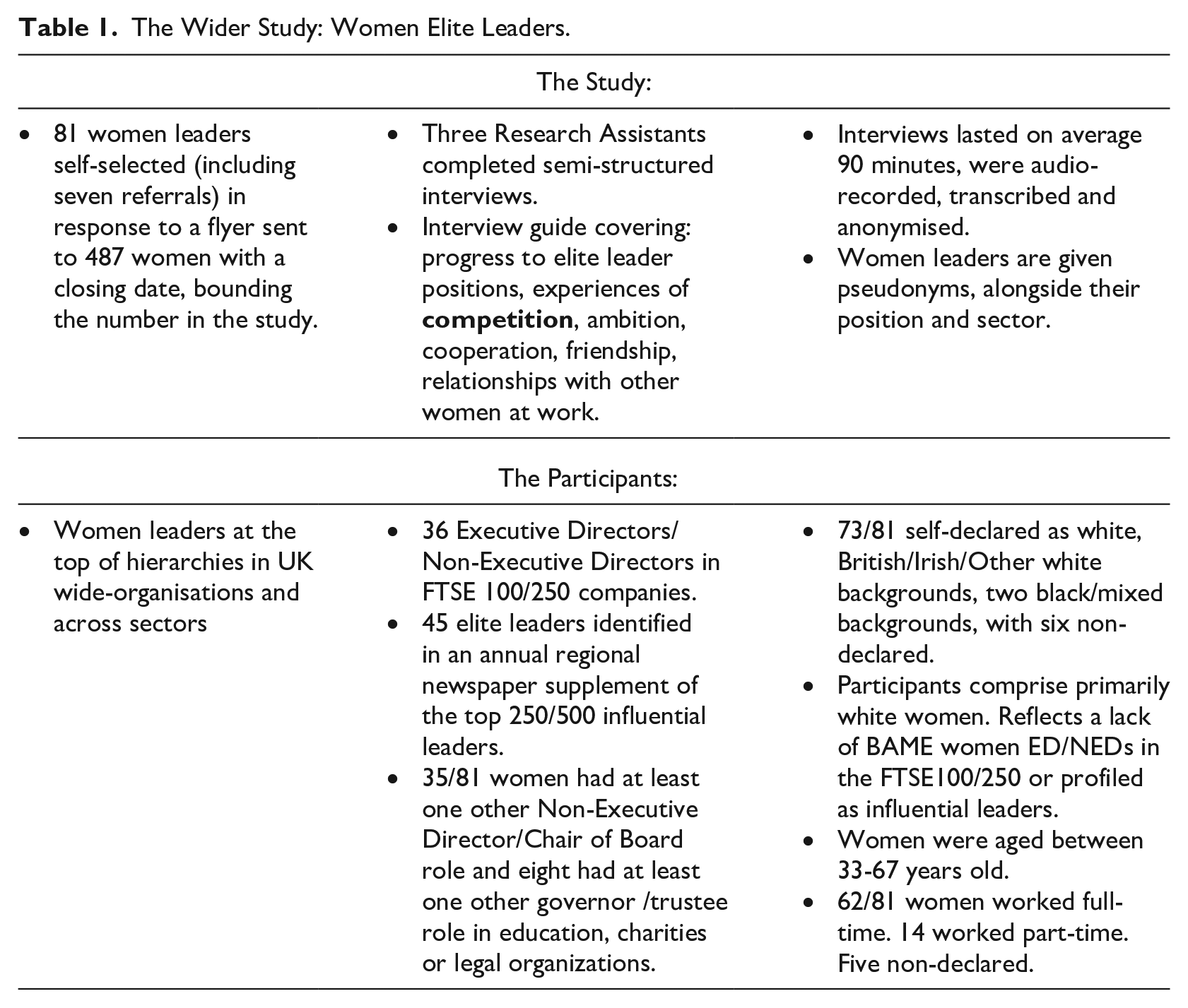
To contextualise the women leaders, the details of the wider study are included in Table 1 and discussed below.
The Wider Study: Women Elite Leaders.
Women leaders and competition
While relationships with other women at work was the background for the wider study, the data interpreted here came in response to general questions about competition. The overall research design enabled a rich and nuanced analysis of experiences of competition; women offered reflections and interpretations on competition rather than the research looking at competition in and of itself. An important guideline for the data generation process (Mason, 2002) was not to provide any definitions to the key concepts of the study (ambition, competition, cooperation and friendship), should the women ask for clarification. The aim was to elicit what meanings women attached to these terms.
To analyse the women’s talk about competition, all 81 interview transcripts were considered by Sharon for initial data analysis through interpretive and ‘literal’ readings (Denzin and Lincoln, 2008; Mason, 2002) and constant comparison to identify main themes. There was a process of close reading and reflexive coding discussions between Sharon and researchers involved in the data collection. Marina subsequently re-analysed all competition-related narratives through the process of going back and forth between the data and academic literature on gender and social construction of competition, and together, we interpreted this second analysis. In support of our research approach and as feminist qualitative researchers, we see women’s talk of experiences as highly valuable, and as interpretations of lived experiences that have material aspects created by historical and organisational circumstances.
Multiple understandings of competition
In addition to asking whether the women leaders would describe themselves as competitive, they were asked the following questions: Can you tell me about a time when you have been competitive with other women to develop your career? As your career has developed have you ever been in a situation when you have been competitive with a friend? What behaviours do you see in yourself that tell you that you’re being competitive? Where do you think your attitude towards competition and being competitive comes from? In exploring 81 women elite leaders’ understandings of competition; their motivations for engaging in competition or otherwise, types of competition they recognise and whether they identify with this competition, we were fascinated by a gap between a prevalent unproblematic understanding of competition as a zero-sum game in extant research and a multiplicity of meanings of competition within the women leaders’ narratives. This problematises comparative studies and opens up space for disruption to stereotypes related to competition.
Data analysis revealed multiple understandings of competition, where some can be distilled to widely accepted, common sense definitions: as a fight for limited resources (positions, promotions, funding); symbolic capital (recognition, prestige, fame); and establishing a place in a particular social hierarchy. Others were not connected to the notions of fight, rivalry or upward social mobility. Wider analysis surfaced how competition is also understood as foundation of long-term friendship or business cooperation; a struggle for establishing personal boundaries and higher ethical standards in an organisation and sector; a coping mechanism for a perceived lack of confidence; and a sense of security. This multiplicity of meanings was further complicated by vivid descriptions of different types of competition, various motivations behind competitive practices and attitudes, and conflicting value judgements. In what follows, we focus upon three women’s narratives which illustrate key aspects of competition which emerged from the wider analysis: multiplicity, flexibility and a fundamental dependency on context in which competition takes place.
Competition: multiplicity, fluidity and context
Women leaders: are you a competitive person?
An important finding, informing our central aim to provide a long overdue intervention into the current trend of essentialist thinking about competition, surfaced from an interview question asked to all 81 women leaders in the study. When asked ‘would you describe yourself as a competitive person?’, none of the women provided a straightforward ‘yes’ or ‘no’ answer. Most women responded via long, detailed elaborations on what they meant by competition; reflected on different forms of competitive practices; contemplated upon reasons behind competition; and some expressed moral judgement when discussing competition. There is little agreement in the data about what competition entails, whether it is a positive or a negative ‘thing’ or what competition looks like. There is both multiplicity and fluidity as women leaders talked about their understandings of competition. Since all women interviewed operate in hypercompetitive contexts and were asked to reflect on their own competitiveness, any understanding of competition or doing of competition they provided is grounded in self-conception, self-representations, context and performances of gender. We interpret this as women establishing their communication pattern, to ensure their words are interpreted carefully; they do not want to be negatively marked by competition in ways that may have negative implications.
Narratives from Anna, Rosa and Amelia are offered as ‘power quotes’ – ‘compelling bits of data . . . that effectively illustrate [our preceding] points’ (Pratt, 2009: 860). Simultaneously, the three narratives reflect the sense of complexity of competition we found across the interviews which we hope leaders and managers can identify with. We next highlight how close attention to the meaning of competition, motivations behind it and accompanying social processes reveals a need to overcome the self-evidence of competition prevalent in the positivist/essentialist research and, the processual, provisional and fluid nature of this social phenomenon.
Anna, a Chief Executive in Public Administration, was asked, ‘what would you say your attitude toward competitiveness is? And where do you think that comes from?’:
Well competitiveness is part of our business. We are competing so at the moment I am one of three women [name of senior role] in the [name of region] and in the [name of region] there are five of us working extremely closely together and in a sense we work very closely together but we are also competing for resources and funding and investment. And it has been interesting the dynamics of that because when I first came here, of the five there was only one other woman actually who was extremely competitive. And I didn’t find her easy to be close to . . .
Anna does not answer the question, rather she explains that competition is an integral part of the work that she is doing, thus distancing herself from competition. For those who desire to achieve in contemporary working environments and sustain competitive advantage, it is necessary to foster various forms of working together with competitors. We interpret Anna’s understanding of competition as a structural condition and a process intertwined with working together. Anna does talk of the dynamics of competition in relation to someone she perceived as ‘extremely competitive’ and we feel her discomfort and struggle to express what this competition means and how she can relate to this in a positive way, as ‘assertive’ and consensus driven, not as competitive. Anna continues,
. . . I don’t find it enormously easy to be really – I’m going to climb over – whether it is women or men, to get what I want. I would, – my preference would be to get what I want through working towards it or by achieving some form of consensus or some form of compromise. That is not to say I won’t do it and won’t be assertive, but it is not my natural – I have to gee myself up to that to think, ‘I know what I want here and I need to be very clear about it and I am going to go in’.
Anna outlines competition as a means to get what she wants but cannot express it as such and articulates that competition can take different forms – climbing over people or working together towards a consensus – and expresses an awareness that competition can be an emotionally charged exercise involving risk of negative judgement from others. Anna is asked a follow up question of ‘can you give me an example of a time you felt, “right I am going for it?”’:
Yes, in a work environment we were doing some work about relocating [name of organisation]. It was the last government, periodically they have a crack at this, and I felt very clearly that we, should take the lead in that in [name of town], I thought we were the best, were the best positioned. But I knew that everybody would be interested and be sniffing around it. So I very early on said, I want to make the case to lead on this for the following reasons, and what my intention in leading on it would be to keep you involved and informed and to explore with you opportunities where you could see some of the benefits of that location coming to you. So I put it out there that this is what I want, but I’ll also put it out there that I would want to try and bring something from that for you.
In relation to competition, Anna locates ‘it’ in her work environment and reattaches this competitiveness as on behalf of her organisation. Her motivation is to continue to be the best organisation in her field. However, she is aware that competition for this opportunity would be strong, ‘everybody would be interested and be sniffing around it’. Knowing that (presumably from her previous experiences of competition), she makes a pre-emptive move of inviting her potential competitors to a joint and mutually beneficial course of action. Taking the lead in a situation of uncertainty could be, of course, considered a separate form of competition per se. Anna’s narrative highlights the importance of the context where competition takes place, motivations, meanings and stakes behind it.
Rosa, a Chief Executive in the Housing sector, was asked ‘would you say that you were a competitive person?’:
I am laughing because my husband always says that I am ambitious and I am competitive when it comes to my career and I always say ‘I am not’. We have this discussion, probably on average, once every six months . . . I have always been very lucky in that when I decided I want to do something else, something else has come along or somebody as said, ‘Oh they are setting up the [name of organisation], do you not think you should have a look at that?’ And I will look and think ‘Oh, I like that job’; I will go for that job and get it.
Rosa does not present herself as competitive when it comes to her career and positions this as being ‘very lucky’. For Rosa’s husband her career success is strong evidence of her competitiveness; however, for Rosa, her professional path could be an opportunity to explore her talents, follow her interests and experience different activities. She then leaks the competitiveness that her husband sees ‘I will go for that job and get it’. This ambivalence in understanding what competitiveness is and is not, combined with the subjective nature of any attempt to mark a particular action as ‘competitive’, undermines the value of measuring competitiveness among people.
In resisting being labelled competitive, Rosa chooses to then talk of how she is not competitive generally:
But, on the other hand, I also say that I am not competitive generally. I mean, sports, I am the least competitive sports person in the world. I am going to the gym at the moment with my sister, and we were given a programme to do and every night she is trying to push to be a bit further, she is competing with herself and I am thinking, ‘Oh, I can’t be bothered to do that’ and I am not the slightest bit . . . – So I have got to go and see the personal trainer next week again and I am not the slightest bit worried that I haven’t upped my targets at all whereas my sister is quite pleased because she has, which is great. So I am not competitive from that angle. I am very competitive about the company, very competitive. I want us to be better than the others. I want us to get the awards. I want us to grow and I want us to get the recognition for that. Am I competitive about myself? I don’t know.
Rosa’s performance is stark; she ‘can’t be bothered’ competing in a social context but is ‘very competitive’ on behalf of her company, reflecting a zero-sum competition where her company beats others and is the best. Anna and Rosa’s narratives highlight an approach which diverts competition from themselves to the organisation and will inform our future research. A static and non-reflexive approach to competition would evaluate Rosa’s narrative as contradictory; she calls herself ‘competitive’ and ‘not competitive’ and her performance changes along with her understandings of competition. This definitional tension, we argue, comes from ‘competition’ being an umbrella term for numerous and various practices, the meanings of which are always open to interpretations and also judgement. Rosa’s seeming ‘unstable’ competition reflects research noting how ‘competitiveness’ is a domain/context-specific phenomenon (Günther et al., 2010; Wieland and Sarin, 2012). People willing to compete in one context can be entirely averse to competition in another arena.
Amelia, a National Leader in Education was asked, ‘how do you know when you’re being competitive? What behaviours do you see in yourself that tell you that you’re being competitive in a moment of time?’:
A determination. A determination to improve outcomes for . . . children in school. A determination to make it a better lot for teachers in a school. [Long pause] I do quite a lot of visits and things like – to, to other schools and to other places, to other organisations. And from those it’s always appreciative enquiry and I just go knowing I’m going to get, get something from it. And from those I’ll use and develop those to make systems and structures and procedures and practices better here. I don’t know if that’s necessarily competition but the outcome is.
Competition for Amelia is understood as ‘determination’ in her profession, a less risky term than competition, which she positions as improvement outcomes for children and teachers who provide education. She can describe how she performs this determination and then is not sure if this is really competition but confirms that the outcome is. Amelia’s ambivalence continues as she does not see Ofsted as a competition but she does want to be the best. This outstanding performance is positioned as good for the community, diluting any negative implications and not as competition with other schools:
I don’t see Ofsted as . . . a competition but I do – I would lie if I said I wasn’t pleased when we retained our outstanding. Because that is good for the community. I don’t, I don’t see it as a competition with other schools but I see it as an important outcome, irrespective of what your views may or may not be of Ofsted . . .
Reflecting on competition as an integral and ubiquitous feature of neoliberal economic and political orders, there are numerous relatively new structural conditions that also contribute to elevating individual and organisational competition. For example, recent scholarship has focused on how contemporary organisations increasingly operate under the ‘dictatorship’ of various ranking systems (e.g. Ofsted and the FTSE)
1
and publicly available league table and recognition awards (Amsler and Bolsmann, 2012; Baxter and Clarke, 2013).
2
Selection decisions for these rankings and awards are relative; candidates are assessed in relation to competitors’ achievements and moves. Understanding this structural condition, which institutionalises competition between schools, is crucial for appreciating why Amelia is eager to explain her ethical position in relation to targets and what she sees as the unethical competition. Amelia talks of what is morally best in this competitive context:
I know that there are some schools who may be selective about intake. Because that will influence outcomes in terms of data. And I don’t go down that road. But I know that is – whether that’s a competitive element, school versus school, or whether it’s just a competitive element in terms of staying above the floor targets and we do hover around floor targets. Because of the pupil churn and the – I’ll give you an example. If we take – well, last year we were dipped below the floor targets in attendance. And if we took out five children who had had extended visits to Pakistan for six months, a year, whatever, between key stage 1 and key stage 2, we would have been instantly above floor targets. Now I know that there are some people who may have taken those children off roll. And have been full when they came back. We wouldn’t, we wouldn’t do that. That would affect our attendance figures by three or four weeks. But they would be readmitted, because those children–if we have the spaces – because it’s in their best interest to be readmitted . . . For us it was morally which is best . . .
Ethical dilemmas of competition were often addressed by the women and could be considered in future research. Amelia’s talk illustrates how competition has different meaning and status in different social and professional contexts. In certain settings, competition between colleagues may have significantly negative connotations as an unnecessary and disruptive practice, preventing people from working towards a common goal. In others, competition between colleagues is not only normalised but actively encouraged. This stresses an earlier point that individual competitive dispositions might be less relevant than the motivation for and the professional contexts where competition happens, further challenging essentialist comparative studies. From Amelia’s narrative, the intersecting influence of responsibility for the well-being of the community can supersede institutionalised competition imposed by Ofsted. Simultaneously, we can interpret Amelia’s narrative as a ‘moral values’ competition, since she engages in building a moral hierarchy when she deems schools that take children with poor attendance record off roll to meet Ofsted targets as blameworthy. Thus, competition can be a morally charged process which affects people’s conceptions of the self.
The three narratives illustrate how experiences of ‘real-life’ competition are dynamic, flexible, definitionally elusive and inseparable from other social processes; they challenge essentialist approaches and democratise knowledge production about competition which subjugates women as ‘less’. That social and professional environments are never fixed and the outcomes of human interaction uncertain leads to competition and its intersection with other social processes as never stable. Social constructionist, qualitative approaches to competition, attentive to its relational and processual nature, the multiplicity of forms competition can take, which considers fluidity, complexity and political interaction with context, can capture patterns of ‘real-life’ competitive processes.
Learning from a long over-due intervention
Returning to our research objectives, outlining the five fallacies of essentialist comparative research into competition has ontological and epistemological implications which we can learn from. Approaching competition as a discrete event fixed in time; a product of individual behaviours and attitudes or mutually exclusive goal attainment and easily separable from existing social dynamics, limits and distorts our understanding of this social phenomenon. In contrast to lab experiments, ‘real-life’ competition cannot be fully understood outside adaptation to ever-changing social environments. By highlighting the subjective, processual and dynamic nature of competition and the importance of situational context, we disrupt essentialist approaches and show how consideration of the underlying social processes and contexts of competitive situations is critical to extending understandings of competition, which are not defined in comparative studies.
Despite the failure of essentialist comparative studies measuring competitiveness in women and men to acknowledge gender as a system of power relations, their results are generalised in practice, education and popular media to explain complex social phenomena, for example, gender pay gap or gender segregation of the labour market. The knowledge produced is misleading and contributes to perpetuating stereotypes of women as less competitive and less willing to take risks or take on big responsibilities. This travels into discourse, everyday media and feeds bias against women and men who want to progress as leaders. The presence of women working in hypercompetitive organisational contexts challenges essentialist claims about non-competitive and risk-averse women, yet essentialist comparative studies continue. A further challenge is that particular ‘samples’ of women and men cannot stand for all women and men (Fine, 2017: 156).
Through analysis of women leaders’ narrative accounts of their ‘real-life’ contexts, we construct the opportunity to shift focus from essentialist comparative studies measuring ‘competitiveness’ in women and men to learn about our key contribution – the nuanced understandings and processual, relational, political, complex, multiple and fluid constructions of competition. We extend qualitative studies in various disciplines which revealed that competition has different meanings in different spheres of life (Levy, 2002; Merten, 1997; Oxley et al., 2010), and within different cultural contexts (Fülöp, 2000, 2004). Our theoretical contributions are grounded in multiple understandings of competition and competition as processual. In not taking for granted the definition of competition as a zero-sum game, we surface competition as a phenomenon which has multiple forms, and manifestations, the meanings of which are always open to interpretations and also judgement. Furthermore, by exploring individual motivations for competition, we illustrate how women may be idiosyncratic when it comes to competition, which warrants caution in the process of ascribing or assuming motives that predetermine actions. Thus, in recognising that ‘real-life’ competition as inseparable from other social processes, we demonstrate competition as a processual social phenomenon.
Narrative inquiry with women leaders provides an alternative to comparative studies of women and men’s competitiveness, yet it is important to note that we expect that women elite leaders at the top of organisational hierarchies will have different individual competitive dispositions than those in other contexts. As research on stereotype threat phenomenon notes, due to cultural norms of femininity, some women indeed may have more difficulty than men in acknowledging competitive actions and attitudes (Eagly and Karau, 2002). However, this does not extrapolate to all women (or all men) and does not mean women compete less than men. The scope and focus of this article does not allow us to fully explore complex interconnections between competition and gender. The narrative inquiry aims to illustrate the five fallacies and complexity of competition. This is not to say that gender does not matter – it does.
We offer a blueprint for democratising research into competition via a social constructionist approach to rebalance essentialist fallacies and assumptions infused with inequality. Our non-essentialist approach to gender does not see that any characteristics – intrinsic or acquired – are common to all ‘women’ or all ‘men’, and resists a binary view where all people fall neatly within two mutually exclusive categories. Furthermore, we want to influence management learning in research and practice in several ways. First, by highlighting limitations of essentialist approaches to gender and basic or absent understandings of competition, we provoke a habit in leaders, managers, management educators and executive coaches with responsibility for developing leaders to resist automatic categorisation based on perceived biological sex which subjugate. Second, by building awareness that the background (or structural) conditions are important for understanding organisational processes; and, third, by encouraging attention to scholarship which provides alternative understandings when investigating the main axes of social power and inequalities.
The five fallacies and blueprint which offer competition as a processual social phenomenon – relational, dynamic, multiple, complex, political and contextual – have potential to disrupt organisational discourses of ‘competitive men’ and ‘non-competitive, coy women’. There is learning for management education and learning programmes in provoking the ways that leadership and management are traditionally taught and developed. For example, in MBA Personal and Professional Development and Strategy Modules, our debates can be a vehicle to destabilise gender stereotypes of leader behaviours, evaluations and decision-making and open up conversations of equality, diversity and inclusivity. Similarly, in research preparation modules, there is value for debates of positivistic approaches to researching social phenomena such as competition. This work also has utility for executive coaches, in raising awareness to problems with extant research which underpins stereotypes about competition and gender, and this may support changes in coaching practice when considering the contexts in which leaders are expected to compete and are evaluated.
Reflexivity and voice
In a reflexive process, as authors, we have struggled to find the right tone of voice in this article. While we share feminist epistemology, we are from different generations, backgrounds, countries, cultures, disciplines, hierarchical positions and have different life experiences – leading to sometimes diverse views of how sections in this article would be written. In positioning a critique of essentialist approaches to researching gender differences in competition, we have found it challenging not to appear defensive and hostile, and it was difficult not to replicate authorial and masculine-dominant ways of writing. We aim for our work to be, in some way, an act of resistance to a research base which leads us to a dead end and supports the current status quo of gender differences in competition which subjugates women. Our aim is for this dead end to be recognised and for our debates to influence more interdisciplinary and nuanced studies of competition and gender which pay attention to the conceptualisation of competition, analyse gender as a social construction and provide meaningful insights into the intersections of social phenomena. We anticipate that research into competition and gender will expand across Social Sciences as competition becomes increasingly embedded and normalised in neoliberal social practices. Competition is infiltrating all aspects of our lives; health and lifestyle, parenting and homemaking, appearance, tastes, cultural consumption and so on. Many of these newly competitive terrains are marked in history and culture as ‘feminine’. Therefore, the intersection of competition and gender may have much broader significance for future research and practice.
The end or just the start?
As we end the article, our contribution concerns theorising competition as multiple and processual, highly influenced by context, motivation, interpersonal relations, politics and power dynamics and as gendered. We hope that MBA, leader development programmes and executive coaching will incorporate this research to provoke reflexivity for participants and change in practice by destabilising gender stereotypes of leader behaviours; opening up discussions of equality, diversity and inclusivity; challenging positivist research; and, considering the contexts in which leaders are expected to compete and are evaluated.
We see future research agendas to include feminist underpinned mixed-methods approaches to understanding the interconnections between competition and gender; research into competition and gender, diversity and inclusion and in non-Western contexts; and personal and organisational consequences of competition. Exploring ‘why’ the women leaders in our study are ambivalent in their positioning as competitive or not is our next research endeavour.
We are just at the start . . . competition is a monolithic construct and the shift from essentialist comparative studies of competition may not be sharp. Change may happen over time; migrating from laboratory settings, set up field experiments and quantitative questionnaires designed for measurements and comparisons, . . . into ‘real-life’ contexts. Researching competition in ‘its natural habitat’, that is, everyday practices and discourses, organisational cultures and structures, ranking systems and promotion schemes, is a challenging and time-consuming task. However, this is invaluable in avoiding a dead end, advancing the field and for leaders and managers’ understandings of individual experiences, complex structures and contexts.
Footnotes
Acknowledgements
Thanks go to Dr. Jannine Williams, Dr. Nicola Patterson and Dr. Tricia Bryans for their invaluable work on the wider empirical study; Dr. Amy Stabler, Dr. Smriti Sharma and Professor Nils Braakman for valuable feedback as the article developed; and, the Associate Editor, Dr. Jamie McDonald and three anonymous reviewers for their supportive and constructive reviews.
Funding
The author(s) received no financial support for the research, authorship and/or publication of this article.
