




Abstract
This article contributes to the growing body of literature developed within the leadership-as-practice perspective, focusing on issues of learning and power. It draws on a co-constructed (auto)ethnographic account of an individual’s longitudinal experience of leadership in the context of an international development project in Laos. This person’s circumstances as a non-Lao-speaking foreigner provided him with a unique opportunity to learn about and participate in the embodied, sociomaterial unfolding of leadership practice in an unfamiliar setting. The analysis examines (1) what ‘leadership learning’ involves when viewed through an ‘entative soft’ leadership-as-practice lens and (2) how individual attempts at exercising power and influence can be understood and represented in leadership-as-practice terms. The study highlights that participants are not given equal scope to exercise power within the emerging, hybrid agency orienting the flow of leadership, and that one task of leadership learning at an individual level is to develop reflexive knowledge about one’s own and others’ contribution to the unfolding of leadership process. Such knowledge draws increased attention to the responsibilities commensurate with attempts to exercise influence within leadership practice.
Keywords
Introduction
When visiting Laos in an official capacity, my project work was typically split between: participating in, or facilitating, official workshops; field visits to various district sites to monitor progress of the Extension Management System (EMS) implementation; and visits to villages to garner farmers’ perceptions of how well they were being supported by project activities and what changes in practice, if any, had occurred. When interacting with in-country staff on these occasions, over the period of two years or so [. . .] I realised [that], in order for the Australian University project to get traction in [their] hearts and minds, it was imperative in certain formal working contexts that I should ‘come over’ as a credible phu nam, a leader.
In this extract, the first author – Peter – reflects on his work on a development project in Laos and comes to a personal realisation regarding the need to influence the direction of the project. This need is of a political nature, as Peter views his influence on the Extension Management System (EMS) implementation to be crucial for ensuring the project progresses and meets its objectives. Given time and exposure, at the point of recording this ethnographic note Peter has concluded that in order to be able to exercise power within the leadership of the project, he needs to (1) learn about and gain experience of participating in leadership practice in the local context and (2) within the ‘leadership configuration’ (Gronn, 2009; Raelin, 2014) of the project, become recognised by the local project partners, that is, the other participants in those practices, as a participant whose position is comparable with that of a local phu nam. The opening quote also hints at the fact that Peter sees leadership as occurring in specific physical, material environments – exemplified in this case by project workshop locations, district sites and farming villages.
Peter’s reflections and observations which he recorded while working in Laos, and subsequently our conversations about his involvement in the project that took place upon its completion, have inspired us to explore in greater depth how Peter’s experiences and learning can be interpreted in light of, and enrich, recent scholarly debates on leadership. Our intention in this article is to contribute to the growing body of leadership literature developed within the ‘leadership-as-practice’ (L-A-P) approach (e.g. Raelin, 2016b; Raelin et al., 2018), which views leadership as a collective sociomaterial achievement. Specifically, we develop an understanding, within the L-A-P perspective, of leadership learning at the level of an individual, and of individual attempts to exercise power. To do this, we use a co-constructed (auto)ethnographic narrative (Boyle and Parry, 2007; Kempster and Stewart, 2010) of Peter’s longitudinal experience of learning to participate in the practices of leadership in Laos – a non-Western, non-Anglophone context. The focus on the process of learning enables us to analyse the emergence of agency in leadership practice and, consequently, to address the issue of power from the L-A-P perspective.
L-A-P refocuses our attention from what (extraordinary) individuals are, to what ordinary people and objects do as they engage in leading. In proposing a conception of leadership that emphasises the importance of process and emergence – and that includes a range of participants, both human and non-human – L-A-P encourages agents to use ‘self-consciousness’ and ‘deliberation’, and to engage in ‘individual and collective reflexivity’ (Raelin, 2016a: 5). As such, it licences an enquiry into the experiences of leadership and leadership learning not only in collective terms, but also at the level of an individual, based on an understanding of leadership learning as an embodied, experiential process that involves observation and experimentation (Raelin, 2016a). Our empirical material speaks directly of the process of an individual learning to interpret and participate in the doings of leadership, enacted by symbolic artefacts, spaces, places and people, all of which combine relationally to produce ‘leadership effect’ (Kempster and Parry, 2019). Specifically, we discuss and demonstrate (1) what ‘leadership learning’, considered at the level of an individual human participant, involves when we adopt a conceptualisation of leadership consistent with the L-A-P approach and (2) how we can understand individual attempts at exercising power within the unfolding and emergence of leadership practice.
The article addresses calls in the L-A-P literature and critical commentaries for closer examination of learning, agency and power in the L-A-P approach (e.g. Collinson, 2018a, 2018b; Kempster et al., 2017; Raelin, 2016b; Raelin et al., 2018). Conceptually, we contribute by (1) including individual self-consciousness, reflexivity and deliberation (Raelin, 2016a) as important to the understanding of leadership learning within the L-A-P approach and (2) offering an understanding of how, within the relational configuration of leadership, individual attempts to exercise power contribute to producing ‘leadership effect’ (Kempster and Parry, 2019) through influencing the direction of leadership emergence and unfolding. Empirically, our article seeks to make a significant contribution to the extant literature by proffering a longitudinal exemplification of leadership learning and engagement in leadership practices from an L-A-P perspective. In this regard, it addresses Kempster et al.’s (2016) direct call for a ‘stronger commitment to conducting empirical work despite its time-consuming, expensive, and uncertain nature’, rather than engagement in ‘yet more conceptual critiques and polemic propositions’ (p. 258).
In the next section, we discuss the literature developed within the L-A-P approach and highlight the need for understanding issues pertaining to leadership learning and power within this perspective on leadership. We then present the background to our empirical study and discuss its methodology as a prelude to introducing the empirical analysis. In the subsequent discussion and conclusion, we expand on the main contributions of our research for an understanding of leadership learning and individual attempts at exercising power within the unfolding of leadership practice from a L-A-P perspective.
Leadership learning and power in L-A-P
The L-A-P approach to studying leadership
For over a decade now, there has been an interest in studying leadership from a practice perspective (e.g. Carroll et al., 2008; Crevani et al., 2010; Denis et al., 2005, 2010; Endrissat and Von Arx, 2013; Raelin, 2011, 2016a, 2016b; Raelin et al., 2018). According to Schatzki et al. (2001), practices are ‘embodied, materially mediated arrays of human activity centrally organized around shared practical understandings’ (p. 2). L-A-P has been proposed as a new ‘movement’ (Raelin, 2016a) in leadership research and practice, rooted in a ‘conception of leadership as occurring as a practice rather than residing in the traits and behaviors [sic] of particular individuals’ (p. 1). Here, practice – understood as both ‘routine activities’ and ‘a more perpetually unfolding dynamic’ – is defined as ‘a coordinative effort among participants who choose through their own rules to achieve a distinctive outcome’ (Raelin, 2016a: 2–3). L-A-P is concerned with the emergence and unfolding of leadership in the quotidian experience of the participants and sees people who affect leadership as embedded within it. Its proponents consider L-A-P’s novelty vis-a-vis more traditional perspectives on leadership in that
it does not rely on the attributes of individuals, nor does it focus on the dyadic relationship between leaders and followers [. . .] Rather, it depicts immanent collective action emerging from mutual, discursive, sometimes recurring and sometimes evolving patterns in the moment and over time among those engaged in the practice. (Raelin, 2016a: 3)
The conception of leadership underlying the L-A-P approach, then, differs from the understandings of leadership underpinning traditional leadership research. Specifically, Crevani and Endrissat (2016) define leadership in L-A-P as being about ‘producing direction for organizing processes’, ‘reorientation of the flow of practice’ and ‘the emergent co-construction through collaborative agency’ (p. 23). Discussions of L-A-P have been developing in line with entitative or relational ontologies. In the former, ontological priority is granted ‘to entities or social states that pre-exist relations and processes’, whereby the latter ‘gives ontological priority to unfolding relations’, through which ‘people and other entities are made and remade’ (Crevani and Endrissat, 2016: 23). These two ontological positions correspond to different empirical foci. The entitative approach explores practices as initiated by actors; the relational view, by contrast, is mirrored in an emphasis on the emergence and unfolding of practice.
We see leadership as emergent and unfolding through the ‘moment-by-moment production of direction’ (Crevani and Endrissat, 2016: 42). At the same time, our analysis brings to the fore the experiences of participation of an individual who, through the application of observation, experimentation and conscious reflexivity, engaged in a process of learning regarding his own embeddedness and complicity in the flow and accomplishment of leadership practices. This person also explored the possibilities of exercising power within the sociomaterial context of leadership he was part of. As such, our study follows what Crevani and Endrissat (2016) refer to as an ‘“entative-soft” (weak process)’ approach to L-A-P (p. 37). This perspective focuses on ‘decentering the leader’, paying attention to ‘subject–subject relationships’ and examining leadership empirically as a ‘situated activity’, through focusing on ‘the “doings” of leadership’, manifested in ‘typical/routinized behavior’ and ‘patterns of behaviour that are occurring’ (Crevani and Endrissat, 2016). Emotions, embodiment and materiality are also important in studying leadership from this perspective, and including them in empirical investigations makes it possible to address such questions as, ‘Which professional practices contribute to producing direction?’ and ‘How is leadership work achieved in the interaction between humans and non-humans?’ (Crevani and Endrissat, 2016: 37).
The need to move away from seeing leaders, as well as other human participants in leadership, as the only actors that have agency and to explore how ‘materiality intervenes in agency to co-generate leadership’ (Raelin, 2016a: 11) is persuasively advocated by Sergi (2016). She argues that while ‘leadership is about persons and [. . .] they need to be at the heart of our inquiries into leadership’, it is ‘by active accounting for the contribution of materiality to leadership interactions’ that we can ‘shift the focus of leadership from individuals to collective, material and embodied practices in context’ (Sergi, 2016: 111). Such a shift in focus offers the opportunity to generate insight into the phenomenon of leadership ‘as it is performed’ and unfolds in a processual, collective and mundane manner, including ‘a variety of elements that are woven into this performance’ (Sergi, 2016: 111). Sergi’s (2016) explanation of agency from a L-A-P perspective is also important to our analysis. As Sergi (2016) explains, rather than being located in actors, agency ‘emerges out of the associations between human and non-human actors as they happen in context’; this, however, ‘should not be interpreted as “removing” or “denying” agency to humans’ (p. 117). Our study directly speaks of the tension between recognising agency as collective and emergent, while at the same time acknowledging its existence at the level of individuals.
The above call for paying attention to materiality in leadership is consistent with the increased interest in ‘how matter matters’ (Carlile et al., 2013) in organisation studies. It also chimes with proclamations of the arrival of a spatial turn (Van Marrewijk and Yanow, 2010), as well as material and visual turns (Boxenbaum et al., 2018) in organisational research. In this context, of particular relevance to our analysis are discussions of materiality from a sociomaterial perspective, whereby ‘the social and the material are considered to be inextricably related – there is no social that is also not material, and no material that is not also social’ (Orlikowski, 2007: 1437). Following from the tenet that the social and the material are entangled (Orlikowski, 2010), exploring the processes of their intertwining, and the effects they have for organisational practice, is a key task in pursuing empirical research from this perspective (Boxenbaum et al., 2018). In recent studies of leadership, such an approach has been applied, for instance, by Oborn et al. (2013), who have demonstrated how a range of mundane material objects, from offices and meeting rooms to computers and reports, contribute to the enactment of leadership in the process of policy formulation. Another example of a study that addresses the entanglement of the social and the material in leadership, and explicitly adopts a ‘strong process’ approach to examine ‘the constant dynamics of how people and space interact’ is Ropo and Salovaara’s (2018) discussion of the ‘spacing of leadership’ (p. 4). Our own research, with a focus on leadership learning and power in L-A-P, contributes to this growing body of work, albeit – as explained above – through an investigation that can be located as belonging to the ‘weak process’ approach.
In the context of examining leadership practice empirically from a L-A-P perspective, and particularly in light of our study, a helpful contribution within recent broader organisation studies research has also been the recognition of the importance of the visual for understanding organisations and organising processes (e.g. Bell et al., 2014). With regard to the practice approach, this recognition has been manifested in a focus on the interweaving of visual artefacts in situ, that is, their performativity within organisational practices (Meyer et al., 2013). Importantly, as Boxenbaum et al. (2018) highlight, attending to both the material and the visual opens up space for examining power-related issues in organising in that it ‘can help make the invisible visible, [. . .] unmask social reality, or point to the embodied nature of organizational experiences’ (p. 610). As such, it holds a valuable potential for exploring leadership from a L-A-P perspective, which has been criticised for an insufficient engagement with power – a point we elaborate on below.
L-A-P, learning, agency and power
Exploring leadership through the L-A-P lens has implications for how we conceptualise leadership learning. As already mentioned, considering leadership as a collective sociomaterial achievement does not preclude the existence of individual consciousness and reflexivity (Raelin, 2016a). Consistent with the L-A-P approach is the understanding of leadership learning as involving lived experience and embedded in the specific context in which leadership occurs (Nicolini et al., 2003). At the level of an individual, this entails developing an awareness of the different human and non-human participants in leadership practice, the direction in which leadership is unfolding, and one’s own embeddedness and complicity within this process that is generative of ‘leadership effect’ (Kempster and Parry, 2019).
This is, inevitably, a complex process. Whereas traditional leadership theory takes the direction of leadership as a ‘given’, as linear and as unproblematic, the concept of practice allows us to appreciate the ‘organic’, relational nature of courses of action that change and/or intensify as people interact with each other, with objects and with the environment. This way of understanding leadership also places responsibility on individuals with regard to their own learning and participation in the practices of leadership. Adopting the L-A-P approach makes it clear that although formal courses of action may have been sanctioned by the upper management, what actually happens as people work will differ from what has been sanctioned, and is constantly under construction, contested, and changing.
When considered with an emphasis on individual self-consciousness and reflexivity, this points to the need to learn to see and experience leadership as ‘an effect of collective action’ and to appropriately interpret ‘(w)hat contributes to action and what makes a difference in it’ (Sergi, 2016: 117), including the contributions of both human and non-human participants in the practices of leadership. Working with others on mundane tasks, overcoming challenges and developing fluency in jointly conducting practices also require learning (Endrissat and Von Arx, 2013). All this implies that, as it moves away from a person-centred understanding of leadership, the L-A-P approach presents individuals with a unique and fascinating learning task. Through locating individuals within the complex and dynamic relational configuration of leadership practices (Gronn, 2009; Raelin, 2014), characterised by interactions involving both human and non-human participants (Crevani and Endrissat, 2016), the L-A-P perspective calls for the development of a concomitantly complex understanding of an individual’s situatedness within and contribution to the emergent flow and direction of leadership.
Acknowledging that there is room for consideration of individual-level leadership learning within L-A-P, and highlighting the importance of individual self-consciousness, experimentation and reflexivity in this process, raises questions about how to understand a situation where an individual wants to exercise power within the flow of leadership practice, and to effectuate ‘reorientation’ (Crevani and Endrissat, 2016: 23) of this flow. In other words, if individuals are granted the ability to understand, interpret and reflect on what goes around them and in what ways they affect and are affected by the context they are part of, then what happens if they decide consciously to influence the direction in which practice is unfolding? While L-A-P views agency as shared, co-constructed, based on reciprocal dependence and distributed among both human and non-human participants (Crevani and Endrissat, 2016; Gronn, 2002; Raelin, 2014; Sergi, 2016), again, this does not preclude the possibility of addressing the issue of the influence of individuals on the emergence of agency in the L-A-P approach. As Sergi (2016: 117) – following Latour’s (1994) conceptualisation of agency – explains, agency within L-A-P is of a ‘hybrid’ character: it ‘emerges out of the associations between human and non-human actors as they happen in context’. While within this view of agency all action is sociomaterial, this is not inconsistent with the view that individuals are considered to have the scope to influence leadership. Indeed, to follow Collinson’s (2018a) reasoning, adopting a L-A-P perspective should not result in treating individuals’ behaviours as irrelevant and dismissing them in favour of a notion of ‘agency emanating from an emerging collection of practices’: a statement that, to her, obscures more than it reveals (p. 389).
If we accept L-A-P’s contention that leadership is a ‘purposeful human activity’ (Kempster and Parry, 2019), and that individuals use their self-consciousness and reflexivity to understand their embeddedness and complicity in the emergence of leadership, what follows is that we can understand individuals trying to exercise power within the flow of practice as acting towards a specific purpose. Empirically, to quote Raelin’s (2016a) examples, exercising influence on the direction of the flow of practice by individuals can take place through proposing an idea or demonstrating an approach, following from which, ‘people build on each other’s moves’ (p. 5).
Such an understanding of the possibility of individuals exercising power within the flow of practice does not imply that leadership is located within a person, nor does it create a false dichotomy between the ‘active initiator’ and ‘passive recipients’ of action. At the same time, it draws attention to the need for addressing the issue of power in L-A-P. This is important because while power and power relations have been given prominence in critical leadership studies (e.g. Collinson, 2011), the L-A-P movement has been challenged for attributing ‘disproportionate significance’ (Collinson, 2018a: 389) to the concept of practice at the expense of structure and power. Central to Collinson’s (2018a) critique is that ‘LAP does not address power relations’ (p. 387; see also Collinson, 2018b), a point with which scholars contributing to L-A-P research concur. As Carroll – who herself sees power as existing ‘in a ceaseless series of mostly conversational choices and openings that present fleeting possibilities to shape, move, or confirm a trajectory’ (in Raelin et al., 2018: 378) – admits, ‘there is something about power with which L-A-P needs to grapple a whole lot better than it has and does’ (in Raelin et al., 2018: 377).
Following from the discussion above, and responding to calls for advancing the examination of power within L-A-P, we draw on empirical material to develop an understanding – from a L-A-P perspective – of individual engagement in leadership learning and attempts to exercise power within leadership practice. Our analysis demonstrates how through participating in leadership as a collective sociomaterial accomplishment, individuals are able to both develop an awareness of their embeddedness and complicity within the flow of practice, and attempt to influence it. We point to the part played by an individual in the emergence of hybrid agency that underpins ‘the action that re-orients the flow of practice towards new directions’ (Raelin, 2016a: 12).
Methodology
Contextual background
The first author, Peter, has had a formal position of responsibility for a team of researchers from an Australian University (AU), focussing on the design and delivery of three rural development projects in Lao PDR aimed at improving the institutional support offered by Government to the agriculture sector. The projects were funded by the Australian Centre for International Agricultural Research (ACIAR). Their intended longer term impact was to effect improvements on a national scale to agricultural productivity and to assist the Government of Lao meet Millennium Development Goals with respect to food security and poverty reduction. The initial phase of the project involved preliminary development and trialling of an EMS in four pilot districts within two provinces that represented suitably diverse agro-ecological conditions under which to test the design. The project ran over a 5-year period, 2011–2016, but the (auto)ethnographic data we present and analyse below relate to the first 2 years of the project, that is, a phase prior to Peter’s gaining any proficiency in the Lao language. Below, we elaborate on how Peter’s circumstances as a non-Lao-speaking foreigner provided him with a unique opportunity to learn about and participate in the leadership practice in Laos (see Carroll, 2016).
Linguistic and political aspects of leadership in Laos
As explained earlier, we draw on Peter’s experiences of learning and participation in leadership in the Lao context using the L-A-P approach. L-A-P is a concept developed in the context of Western, Anglophone leadership research. Although by virtue of the geographical location of our study, we do contribute to knowledge about leadership in a non-Western context (e.g. Case et al., 2011; Xing and Sims, 2011), we use a Western conceptual approach – rather than applying indigenous concepts associated with leadership – because in our analysis, we discuss leadership learning in the case of an individual who is a Westerner, and whose (auto)ethnographic sense-making is underpinned by conceptions of leadership familiar to him. Nonetheless, a brief exposition of the person-centric indigenous language of leadership in Laos, of Peter’s circumstances within this context, and of the political nature of Laotian leadership will help demonstrate why we saw the case of a foreigner entering an unfamiliar context as particularly suitable for developing an understanding of individuals trying to exercise power within leadership practice considered from a L-A-P perspective.
It should be made clear at the outset that the translation of the terms leader and leadership into the Lao language is not straightforward (Case et al., 2017). Lao is the official language of Lao PDR, widely spoken by an ethnically and linguistically diverse population totalling 6.9 million (World Bank, 2018). In Lao, as in many other languages, there is no equivalent to the English noun leadership (Case et al., 2011). There are, however, a variety of terms whose meanings approximate the English noun leader. These would include, inter alia, such expressions as nai baan (village head), hua nā (a term ubiquitously used in the workplace to refer to the ‘boss’), jeol muang (the term for ‘district governor’) and neo hom (village elders). Perhaps the most literal translation of the English term leader, however, is phu nam, although it is by no means a simple equivalent. Someone who is foreign (falang), for instance, is almost certainly not going to be seen by indigenous Lao as meriting the appellation phu nam. The closest leadership designation a falang may acquire, in practice, is phu nam na (literally, someone who takes others along with them).
While Peter decided that he would attempt to exercise power within leadership practice dominated by local phu nam, he had actually entered the context of leadership in Laos – a society that is both culturally and linguistically sensitive to social hierarchies – as an outsider with little understanding of this context. On the other hand, as a foreigner who initially could understand neither the local language nor the culture, Peter found himself in a decidedly unfamiliar situation. He realised that he wished to exercise power but first, he needed to know how to ‘decode’ the local power relations and structures, and to develop an awareness of the significance and contributions of different human and non-human participants that formed part of the hybrid agency within leadership practice in Laos. In that respect, his initial lack of linguistic proficiency sensitised Peter to the various aspects of the sociomateriality of leadership practice. As he could not understand the meaning of what was being said, he had the opportunity to build his interpretation of leadership in Laos through observing the spatial arrangements, artefacts, people’s dress, turn-taking in conventions, body language, tone of voice and so on – in other words, the ‘collective, material, and embodied’ (Sergi, 2016: 111) aspects of leadership practice. This further allowed Peter to sharpen his focus when learning about the differing ways and extents to which each of the participants in leadership practice – including himself – contributed to the emergent agency and direction of leadership.
Of importance for an understanding of the nuances associated with leadership-related concepts in the Lao context is also the fact that terms for leader are used exclusively to designate members of the Lao People’s Revolutionary Party (LPRP), since formal (i.e. designated) ‘leadership roles’ are exclusively occupied by LPRP members and ordered according to strict hierarchical positions (Case et al., 2017). The LPRP’s influence stretches from the highest tiers of government – the president, prime minister and deputies – through ministerial and departmental layers of hierarchy outward into the 17 provinces, 144 districts and, ultimately, thousands of villages. Heads of any state-recognised organisation or institution in Laos, including village heads (nai baan) and elders (neo hom) are LPRP members. In other words, there are no sanctioned ‘leaders’ in Laos outside of the LPRP hierarchical structure (Case et al., 2017) and no significant terms to designate leaders that have not been appropriated by the Party. It is important to note, therefore, that to understand and participate in the practices of leadership in Laos, is to understand participate in leadership practices that are consistent with a highly person-centric regime in which hierarchical differentials and associated rituals of deference and demeanour (Goffman, 1967) are a primary consideration and carry significant effects.
Research approach and process
The narrative analysed below was developed from qualitative material originally generated by Peter over the course of eight field trips to Laos between 2011 and 2013. During these trips – which involved visiting and interacting with villagers in the project’s pilot districts as well as attending and facilitating project workshops with in-country civil service staff – Peter conducted systematic field notes and kept a research diary of autoethnographic reflections (e.g. Boyle and Parry, 2007; Ellis and Bochner, 2000) on managing a complex Official Development Assistance (ODA) initiative for which he was formally responsible.
To analyse the process of learning and discovery, Martyna – the second author and co-participant in the ethnography – and Peter co-constructed an (auto)ethnographic narrative (Boyle and Parry, 2007), a research approach that has been previously applied by leadership scholars (Kempster and Gregory, 2017; Kempster and Iszatt-White, 2012; Kempster and Stewart, 2010). Autoethnography enables the adoption of a hyper-reflexive stance by the researcher (Hayano, 1979). In the case of leadership, it makes possible illuminating the complex, situated processes of learning and practice (Kempster and Stewart, 2010) at the level of an individual. It is also an approach consistent with the methodological advice and recommendations made for L-A-P research by Kempster et al. (2016).
In co-constructing the (auto)ethnographic account, we strove to ensure its dependability (e.g. Kempster and Parry, 2011) in that we prioritised the honesty and truthfulness of the account. We did this through repeated readings of Peter’s recorded reflections and through engagement in an ongoing dialogue which included face-to-face and Skype meetings, as well as email exchanges over the course of a year. Within this iterative and reflexive dialogue, Martyna’s role was to ask Peter questions about the project and its context (e.g. the locations in which meetings took place, the behaviours of participants, ‘critical incidents’ when something new and unexpected would happen) and about Peter’s experiences (e.g. his behaviours in specific situations, his feelings about the project at different points, his views in relation to particular instances). Martyna’s role was also to reflect back to Peter – both in writing and in conversations – the story he was presenting, thus facilitating ongoing reflexivity. In this way, subsequent versions of the co-produced narrative were generated, until it was felt by both Peter and Martyna that sufficient detail and insight had been obtained. Peter, as the person who underwent the learning experience was able to judge the honesty and truthfulness of the result. For Martyna, on the other hand, it was possible to assess the dependability of the narrative – specifically, through being satisfied that it had verisimilitude, that is, was able to ‘evoke in readers a feeling that the experience described is life-like, believable, and possible’ (Ellis and Bochner, 2000: 751).
While the empirical material we draw on comes mainly from the co-constructed verbal narrative, we have also included photographs as a way of supplementing the discursive insights and offering our readers at least a limited opportunity to access the sociomateriality of the leadership practice discussed in the analysis. As Pink (2004) argues, ‘using visual methods allows us to extend our research to incorporate knowledge that is not accessible verbally’ (p. 391). In the case of this research, the photographs fulfil the role of illustrations intended to reinforce the content of descriptions included in the verbal narrative.
Learning and participation in leadership practice in Laos
Below, we present an analysis of Peter’s narrative about learning and participation in leadership practice in the Lao context. For purposes of presentational clarity, we have divided it into three distinct stages. It would be a mistake, however, to infer that the learning process was linear with clear-cut boundaries between the stages. Indeed, as Peter’s learning involved experimentation, errors were inevitable. Nonetheless, there was an overall sense of the gradual gaining of practical and conceptual insight. In the analysis, we pay attention to Peter’s learning to understand and interpret the contributions of both human and non-human participants, including himself, to leadership practice; to his attempts at exercising power within the flow of leadership and, eventually, to his participating more self-consciously, purposefully and reflexively in the practices of leadership in Laos.
We show how the development of Peter’s knowledge about the sociomaterial and political context in which leadership emerged and unfolded and his place within it, coupled with experimenting with his own actions, have allowed Peter to attempt to influence leadership practice in a Lao professional context. We highlight how learning about his own embeddedness in the sociomateriality of leadership practice was intertwined with development and use of political knowledge about local hierarchies and power dynamics by Peter, as he tried to exercise power in pursuit of an agenda underpinned by his ethical beliefs and choices.
Peter documented his experiences of learning and participation in leadership practices in many settings (e.g. village meeting places, informally in cafés and bars, and banquets). However, to accommodate the limits on article length, in our analysis we focus on empirical vignettes that address leadership learning and the emergence and unfolding of leadership practices in the context of formal meetings.
Stage 1: understanding leadership practice
Peter’s initial learning about leadership practice in the context of the Laotian project took place through gaining an understanding of which human and hon-human participants contribute to leadership practice, and how they contribute to the emergence of leadership. Aware that organisational space communicates power in organisations (Dale and Burrell, 2008) and reflects and performs social relations (see Panayiotou, 2015), he realised that the spatial arrangement of formal meetings played a key role in establishing and reproducing the hierarchical political dynamics of leadership within the project. In particular, Participant Action Research workshops – which tended to be medium-sized gatherings involving 20–30 participants, and taking place in local government buildings or hotels in the pilot study provinces – as well as project team meetings offered Peter opportunities to learn about ‘spacing leadership’ (Ropo and Salovaara, 2018) in the local context, and about the political significance of the meeting spaces within the emergence of leadership:
Both the major workshops and the smaller gatherings followed similar kinds of protocols and forms of authority display. Regardless of whether they were convened in an official building or a hotel, room and seating configuration during the major workshops were standardised. The typical room layout comprised long hardwood teak tables and chairs, arranged in two or three parallel rows running the length of the room, with a table running crosswise at one end at which the phu nam [highest ranking, officially recognised leader] presided for key parts of proceedings. Typically, there were flowers – quite often fake ones – on the desks. In addition to the flowers, the room in which a given workshop or a meeting took place was typically adorned with artefacts that carried specific symbolic meanings and set the tone for the meeting. For example, directly behind the phu nam’s chair and on both sides, two flags would have been placed: one with the Communist Party hammer and sickle as well as Lao national flag. Further, the meeting would always take place in the symbolic ‘presence’ of Kaysone Phomvihane, leader of the LPRP from 1955 onwards and the country’s first Prime Minister (1975–1991) and first President (1991–1992), whose ‘bust’ would have been located in a visible place in the room [see Image 1 – bronze bust, far left].
1
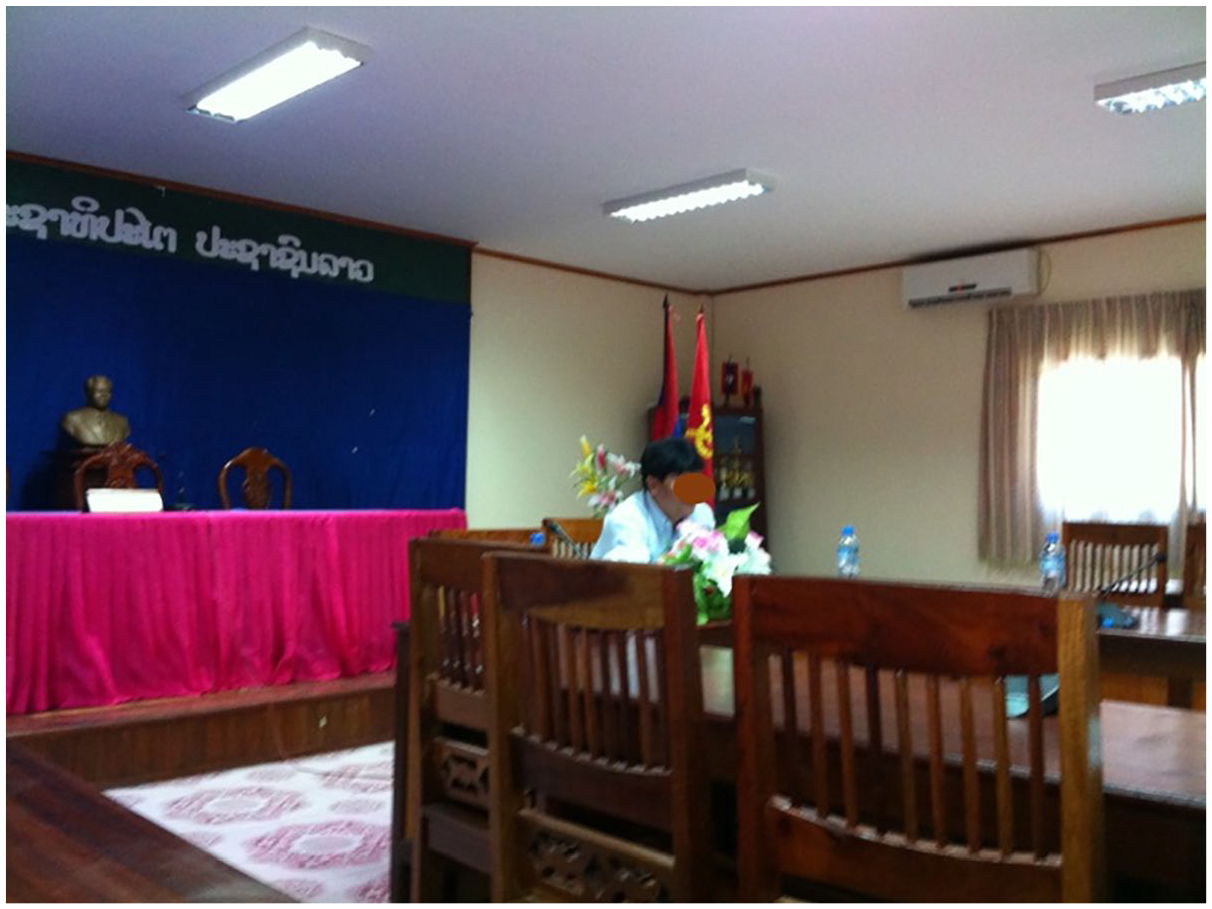
The lone phu nam: a senior civil servant chairs a meeting in a Provincial Agriculture and Forestry Office.
The two flags as well as the ‘bust’ of Kaysone Phomvihane symbolically embedded the meeting and, more broadly, the leadership practice in the political structures of Lao PDR and the country’s political agenda. The meanings of the political symbols – whether linked to power relations at an organisational or supra-organisational level – infused the space in which leadership was emerging and communicated the omnipresence of political structures that both constrained and contained leadership practice. The presence of the political symbols in meeting rooms also communicated and reinforced the superior importance within the leadership practice of those participants with the highest rank within the Communist Party structures. Learning to ‘decipher’ the meanings behind the politicisation of meeting spaces was for Peter key to understanding what leadership was locally ‘made of’ (Sergi, 2016: 110), and allowed him to gain knowledge that, as an outsider to the country and its political system, his contribution to the direction of leadership was pre-established and expected to be limited.
In the workshops and meetings, the presence of symbolic artefacts was coupled with a purposeful arrangement of participants in the room. This arrangement of who was located where, enacted the hierarchical ranking of each person in the room, as well as spatially configuring interactions between the participants.
The workshop participants were seated along the tables (see Image 2). Seats at the inner tables were reserved for more senior members of staff, for example, Provincial Agriculture and Forestry Office (PAFO) and District Agriculture and Forestry Office (DAFO) Heads, whereas the outer tables were occupied by more junior staff.
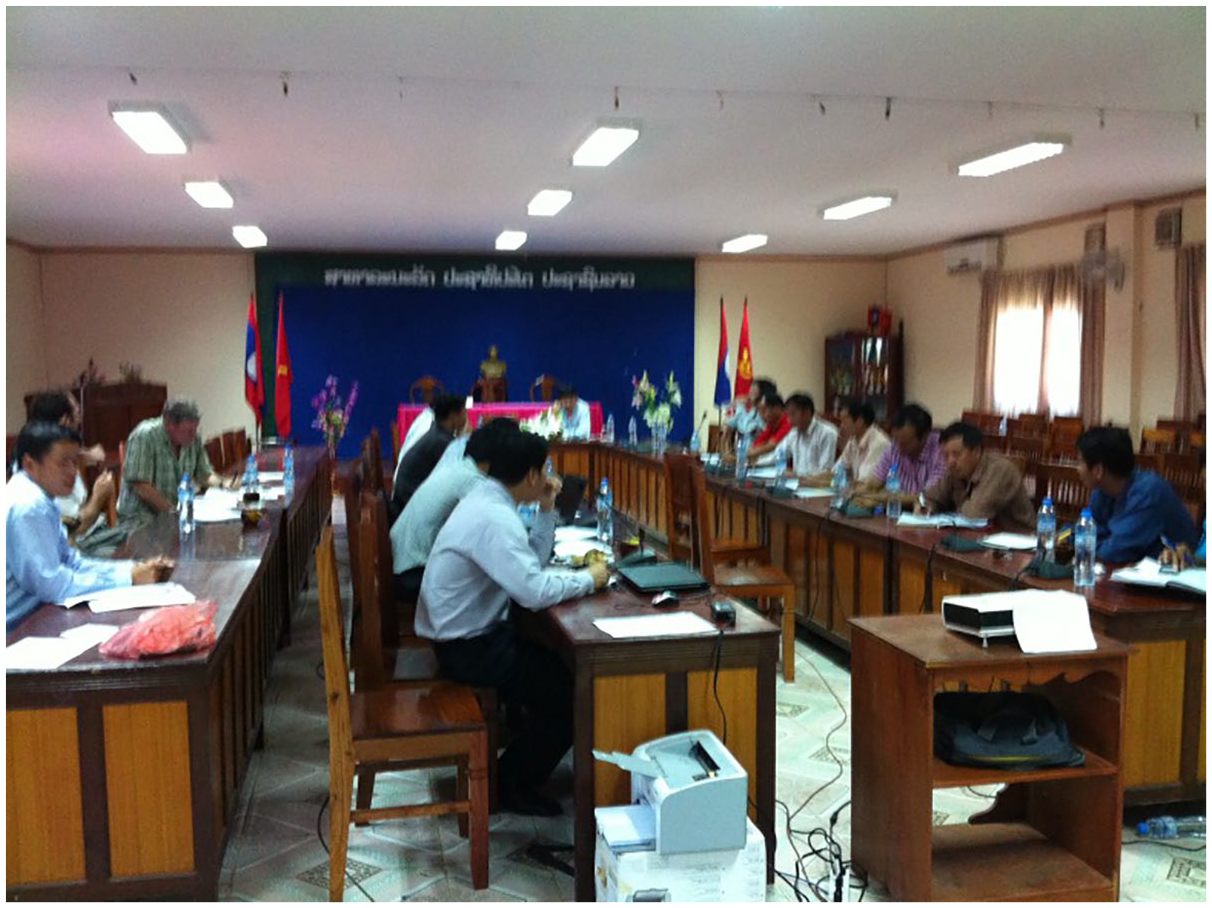
A formal meeting space presided over by a Lao phu nam.
As Sergi (2016) explains, ‘human actors formally identified as “leaders”’ can have a ‘decisive influence’ in meetings, including ‘the power to impose decisions’ (p. 123). In the case of the Lao project, Peter learned that the spatial location of the human participants communicated the extent of their mandate to exercise power during the meeting. On the other hand, he also understood that the spatial location of participants was granting them the power to influence the proceedings and decisions taken in the meeting. This led him to the realisation that the position of the seats allocated to him precluded him, in the eyes of other participants, from exercising power.
Peter also learned about the importance of another non-human aspect of the leadership practice, namely the routine protocols according to which workshops proceeded:
These included an opening speech by the most senior person or persons present; a prosaic outline of the workshop purpose and programme; formal discussions chaired by the most senior official present at the time [with open discussions typically being preceded by contributions from the floor that were taken in order of seniority, e.g. PAFO Heads, followed by DAFO Heads]; and a ‘closing’ process which entailed a summary of the key elements of the programme and relating an official version of ‘what has been achieved’, followed by closing speeches by the most senior staff present.
Such protocols exemplify what Simpson (2016: 167–168) describes as ‘practices’: ‘specific sequences of activities, or routines, which may be invoked repeatedly to simplify day-to-day experience’ and which ‘are valued for their routineness’. The routine that was (re)produced through these protocols was, as Peter realised, also infused with power. The protocols simultaneously gave voice to some participants while suppressing the voices of others (see Stowell and Warren, 2018).
In this initial stage of learning and participation in the unfolding of leadership, Peter observed how leadership emerged as a collective sociomaterial accomplishment (Crevani et al., 2010; Dovey et al., 2017; Raelin, 2018), co-constructed through contributions of those present in a meeting as well as the spatial arrangement and symbolic artefacts. These observations also allowed him to realise that the human participants were not given equal scope to exercise power within the emerging, hybrid agency orienting the leadership practice, and that his own power to influence it was highly constrained. Reflecting on his situation, Peter concluded that if he wanted to exercise power within the leadership of the project, he would need to begin purposefully (Kempster and Parry, 2019) to embody meanings and practices encountered at the initial stage of the learning process. The second stage of his leadership learning, which we discuss below, was marked by interactions with others, whereby Peter intentionally – in a self-reflexive, experimental and purposefully person-centric manner – drew on the knowledge developed during the first year of working in these formal meeting contexts in order to be able to exercise a more ‘decisive influence’ (Sergi, 2016: 123) on the effect of the collective, sociomaterial action.
Stage 2: learning to influence leadership practice
A sense of being invisible, of ‘disappearing’ in meetings in the first year of the project, made Peter realise that for him to be able to influence ‘the leadership effect’ (Kempster and Parry, 2019), his position within the relational configuration of leadership would have to change. In particular, he would need to be granted by other participants in the leadership practice the ability to exercise power. Peter’s reflections on this realisation provide an insight into his own political agenda and the ethical considerations behind wishing to exert a stronger influence upon the unfolding of the project’s leadership:
I wanted to assert power in order to be able to accomplish the pragmatic aims of the project, and in order to be taken seriously . . . [Otherwise] the day-to-day project activities and intended practical outcomes could have been significantly compromised . . . As such, my underlying intentions were geared toward improving the chances of project success – whatever that might eventually mean. The motives underlying these intentions, in turn, were premised on an ethical assessment of the overall worth and likely ‘positive effects’ on smallholder well-being of the project interventions.
2
Based on his prior learning, Peter was aware of how exercising power by individuals was enabled by the materiality of the leadership practice, in particular the meeting room layout and the positioning of the chairs at the discussion table. He knew that sitting on a chair situated at the head of the table would afford him the possibility to speak in meetings. Since sitting in a ‘central’ position would communicate to others that he was an influential participant, Peter felt that he would be given an opportunity not only to speak, but also to have his voice heard and considered important by others and thus to influence the decisions taken during the meetings. Moreover, Peter’s prior learning about how the routine protocols of the meetings were establishing and communicating the hierarchy and power relations among the participants, he strove to make these protocols provide him with an advantage in terms of what he wanted to achieve. Peter tried to accomplish this, for example, through speaking at times which the protocol prescribed as moments when the influential participants, namely local phu nam, speak:
I learned [and was given official permission] to occupy a chair at the head of the table alongside the other most senior staff in the room for the most symbolically critical moments of workshop meetings – typically, these were ‘openings’ and ‘closings’. I felt the need to do this as I understood that the leader’s authority was marked, in part, by the fact that he
3
would introduce himself to the rest of the meeting’s participants, and by having the first and last word at the official event. [. . .] In doing so, I had the explicit intention of establishing credibility in the eyes of participants with respect to the hierarchical order and hence to the importance of what I and, by association, members of my team had to say.
As Carroll and Smolović Jones (2018) point out, leadership practice is constructed through ‘embodiment, corporeality, relationality, positioning and movement through spaces, tacit assumptions and [. . .] gestures’ (p. 190). Peter’s attempts at exercising power within the project’s leadership were based on his ‘deciphering’ of agency within the leadership practice as hybrid and exercised by both human and non-human participants, but also as not distributed equally among all participants. He interpreted local understandings of leadership as being person-centric; when he began to locate himself within the spatial and relational order of leadership in a way that enacted power, be it through occupying a prominent location within the meeting room or influencing the turn-taking in speech delivery, he was mimicking the way in which, according to his observation, local phu nam participated in leadership practices. Importantly, his purposeful attempts at exercising ‘decisive influence’ (Sergi, 2016: 123) on leadership practice had a thoroughly thought-through purpose (Kempster and Carroll, 2016; Kempster and Parry, 2019), and were underpinned by what Peter considered to be a responsible ethical assessment of which ‘new directions’ ‘the flow of practice’ should be re-oriented (Raelin, 2016a: 12), in order to bring about a positive change for smallholder wellbeing and project success.
Eventually, all these careful efforts at developing an understanding of how ‘the assemblage of humans and non-humans contributes to creating leadership effects’ (Sergi, 2016: 123) in the Lao context, and at experimenting with modifying his own conduct within that assemblage, Peter began to feel that he was gaining greater visibility and influence upon the direction of leadership. He observed that ‘other people’ began to ‘build on [his] moves’ (Raelin, 2016a: 5), for example, through note-taking when he was speaking: ‘As I was gradually becoming more proactive in participating in the meetings, there came a time when I noticed several of the participants busily scribbling notes when my remarks were being translated’. The taking of notes – a routine activity that the meeting participants engaged in ‘when senior staff would make a comment’ – both confirmed and granted Peter influence on what decisions were made. The hybrid agency of material objects – pens and notebooks – in the hands of people taking notes ‘in what came across as an earnest and meticulous fashion’ was shifting the power relations within the project, giving Peter greater scope to influence it. This resulted in Peter’s realisation that he would now be able to participate in the leadership practice in a way that was both self-consciously and purposefully influential – a realisation that marked the transition to a third stage in Peter’s learning.
Stage 3: purposeful participation in leadership practice
Peter’s narrative frames the subsequent development in the level of his knowledge about and the extent of his attempts to influence the direction of leadership in Laos in terms of a transition from a superficial to a more active role. This carried consequences for the ‘leadership effect’ (Kempster and Parry, 2019) with regard to the outcomes of the project:
During a field trip that took place at the end of year two of the project [. . .] it was necessary for me to chair a meeting [see Image 3]. Up until this point, my role in proceedings had been more ceremonial than functional, as it were. I had given short opening and closing speeches during full workshop proceedings, as well as making presentations and answering questions about the project. However, by then I had accumulated enough observational knowledge of the context in order to run a meeting myself. There came a time when [given licence by senior officials to do so] I convened a meeting of a group comprising Heads of DAFO (who were all LPRP members) to discuss expansion of the EMS to other districts in the pilot provinces. Representatives of these ‘new’ districts were present alongside those Heads who had already been trialling the management systems.
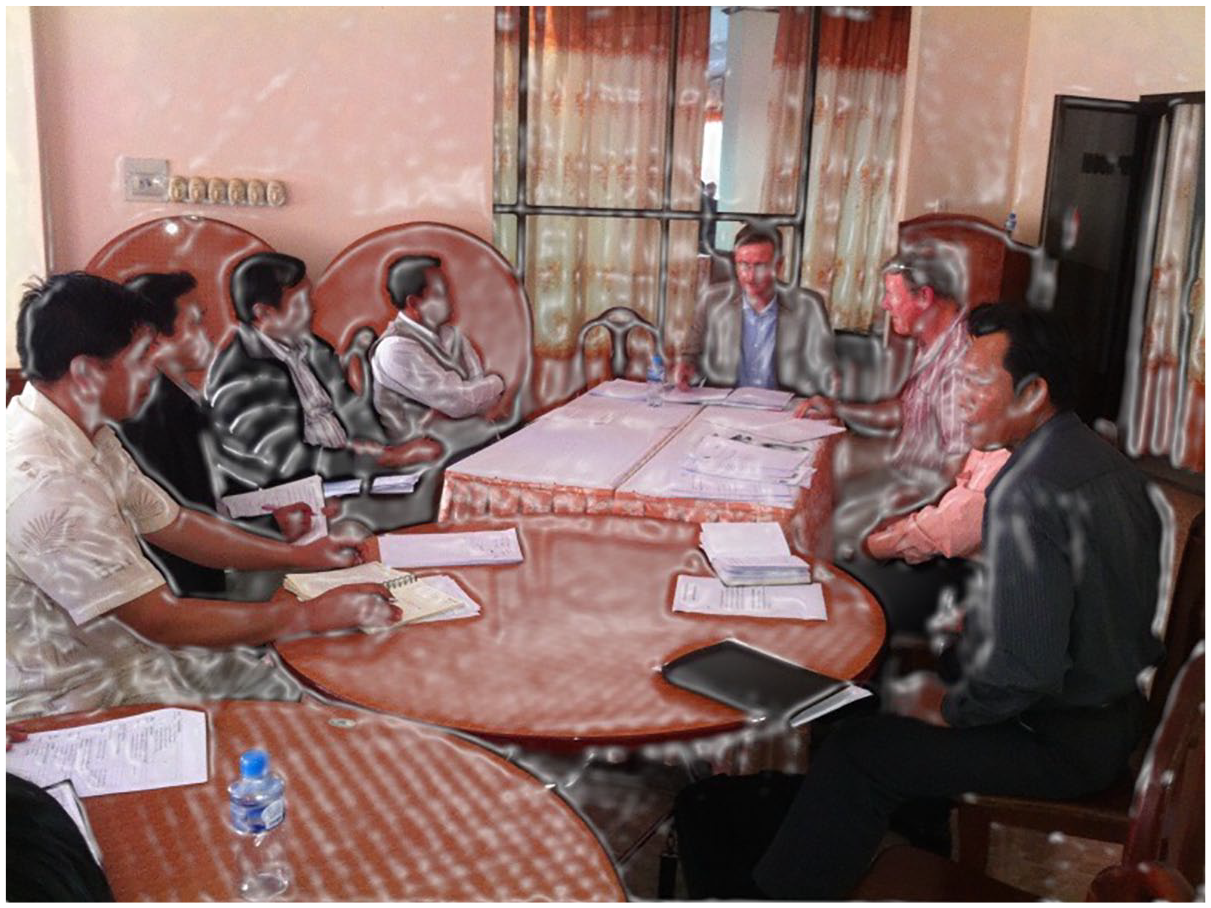
The first author (head of table) chairing a meeting of Heads of District Agriculture and Forestry Offices.
Aware of the significance of the meeting for the prospects of EMS expansion, in chairing the meeting, Peter made efforts to self-consciously and purposefully influence ‘what happened during this specific episode by impacting the orientation of the meeting’ (Sergi, 2016: 123) so that it reflected his understanding of collectively agreed objectives. Peter participated in the unfolding of leadership in a way which Sinclair (2005: 387) characterises as ‘a bodily practice . . . highly dramatic and full-bodied’:
I sat at the top of the table. To my right sat another falang member of the AU research team, an agricultural extension specialist, who spoke Lao extremely well and was able to act as translator. In preparation for the meeting, which took place in a hotel, I deliberately configured the room and chair placement to replicate that of the many other meetings in Laos that I had attended and observed. Furthermore, as I had come to learn, I began the meeting with a resolute-sounding, motivational speech which, in line with the party rhetoric, made reference to the 7th Party Congress proclamations, extolled the virtues and importance of the work we were doing for the people of Laos and emphasised the crucial role to be played by DAFO Heads in achieving our collective objectives of improving smallholder livelihoods [. . .] I used a forceful, authoritative tone of voice – devoid of humour – of the sort I had heard other Lao leaders employ for this kind of rousing talk. Following this speech, I then took firm control of the turn-taking from the floor. The discussion followed an agenda that I had prepared first in English and then asked one of the bilingual in-country project team members to translate for distribution to Lao members of the meeting.
In directing the discussion, Peter was self-reflexive about his and other human and non-human participants’ contribution to the emergence of collective sociomaterial action. He arranged the material aspects of the meeting space in such a way that they would communicate to others his relatively high position in the hierarchy of power, and would establish him as the most influential participant. He mimicked the body language and tone of voice he had heard local phu nam use, with the understanding that this would be more likely to afford him credibility among DAFO Heads. Another material object – the agenda which Peter had prepared – enabled him to influence the meeting’s sequence and content. Since his position within the relational configuration of the meeting made it possible for him to both enable and suppress the expression of voices by others (Stowell and Warren, 2018), he was also able to exert influence on the political dynamics of participation in the meeting by other human participants to achieve his understanding of intended project outcomes:
I deliberately invited comments from particular individuals – for example, starting with a request for feedback from the expansion district Heads on their impressions of the workshop and exposure to the EMS thus far. As I had seen other hua nā and phu nam do, I was careful to interpret and ‘edit’ responses, so that, wherever possible, comments from participants could be brought back into an overarching frame of the project aims and objectives.
Through proactively and purposefully mobilising his prior learning about how different participants contribute to the accomplishment of leadership in Laos, Peter was able to influence the leadership practice from a position akin to that of a phu nam. At the same time, he was conscious of the precarious, dynamic nature of his position within the unfolding of the project’s leadership. He was acutely aware that his place within the emergent leadership practice might quickly change in confrontation with the realities of the political regime in Laos and the strong influence of the local political leadership on organisational leadership. While he felt by that stage of the project that he had learnt ‘(w)hat contributes to action and what makes a difference in it’ (Sergi, 2016: 117), he also understood that he was only one in ‘a variety of elements that are woven into [leadership] performance’ (Sergi, 2016: 111), and that the flow of leadership might re-orient itself again at any time.
Discussion
‘What is palpably clear is that leadership practice needs attention’, state Kempster et al. (2017), ‘yet so few managers can describe in any detail how they practise to become better at leading’ (p. 11). Our study contributes to the so far limited empirical research using the L-A-P perspective, as well as adding conceptually to the understanding of leadership learning and power within this approach. We have drawn on a co-constructed (auto)ethnographic account of the experiences of an individual coming from a Western background, offering an analysis of his participation in leadership practice in the context of an international development project in Laos. As leadership research transitions from a focus on ‘leaders’ to a focus on ‘leadership’ and ‘practices’ (e.g. Kempster et al., 2017; Kempster and Parry, 2019; Raelin, 2014, 2016a), leadership scholars and practitioners alike need, we contend, to find a way to understand the role of individuals in leadership learning and practice. It is also necessary to find a way to discuss – while retaining the centrality of practices and processes associated with leadership rather than leaders – the experiences of individuals who learn to participate in leadership and who aspire to understand, reflect on and influence its emergence and unfolding. Below we elaborate on the key contributions to knowledge of our study with regard to (1) what ‘leadership learning’ – considered at the level of an individual human participant – involves when a L-A-P conceptualisation of leadership is adopted and (2) how we can understand individual attempts at exercising power within the unfolding and emergence of leadership practice.
As our analysis has shown, through the application of observation, experimentation and self-reflexivity, an individual can develop an understanding of an ‘assemblage of humans and non-humans’ (Sergi, 2016: 123) and the ways in which they contribute to the emergence of leadership. Obviously, when attempting to understand leadership practice in all its complexity, the knowledge gained by individuals will always be partial. After all, the social and material realms are ‘inextricably related’ (Orlikowski, 2007: 1437), and ‘subjects and objects co-emerge in their entangled engagements’ (Simpson, 2016: 165), making it impossible for the mind of an individual to fully apprehend the ever-changing flow of practice. Nevertheless, if the underlying assumption is that leadership practice emerges as a sociomaterial accomplishment, then, as our study has shown, an individual practitioner has the opportunity to engage in leadership learning that involves discerning who the human and non-human participants are, how agency emerges in sociomaterial interactions, and how it is distributed among the participants.
Learning to participate in leadership practice also involves experientially understanding not only how different participants contribute to the ‘leadership effect’ (Kempster and Parry, 2019), but which sociomaterial entanglements afford some participants, in certain circumstances, to attract privilege (Crevani, 2019) and therefore have greater scope to influence the reorientation of ‘the flow of practice towards new directions’ (Raelin, 2016a: 12). Building on this, our study has highlighted that not all participants are contextually embedded in the same way. A leadership learning task at an individual level, therefore, is to develop knowledge about one’s own and others’ embeddedness within leadership practice and to gain a practical appreciation of agentic possibilities and constraints.
Our study also offers insights into how we can understand individual attempts at exercising power within the unfolding and emergence of leadership practice. As long as we recognise that people participate in leadership, we also have to acknowledge the presence of individual self-consciousness and reflexivity; the manifestation of this is that individuals interpret their observations and experiences conventionally in terms of an ‘I’. 4 What this implies is that with shifting emphasis from ‘leaders’ and ‘leadership’, and while adopting an understanding of agency as hybrid and distributed among human and non-human participants, it is still possible and necessary to accommodate individual responsibility for both leadership learning and for the purposefulness of leadership practices (Kempster and Carroll, 2016). Put differently, if practitioners are able to understand their complicity in leadership practice, they are also able purposefully to work towards gaining greater influence on the direction of its unfolding. As demonstrated through our study, this can involve, for example, ensuring that the spatial arrangements that grant a greater opportunity to exercise influence in meetings to some and less opportunity to other participant ‘work’ to the advantage of the individual in question; or following routine meeting protocols in such a way that they both enable and confirm one’s influential position. In this way, while acknowledging that the direction in which leadership develops results from a conjoint, hybrid agency and reciprocal dependence (Crevani and Endrissat, 2016; Gronn, 2002; Raelin, 2014), our study has demonstrated how an individual can purposefully attempt to influence this direction.
While acknowledging the ‘democratic roots’ (Woods, 2016) of L-A-P, in our analytical approach we have focused on ‘recognizing and studying what is’ (p. 73). Specifically, what we have shown is how an individual can learn about their own embeddedness in the flow of practice and how an individual can learn to exercise power within this flow. Following from this emphasis, our analysis presents a provocation to L-A-P thinking insofar as it implies that ‘practice’ in ‘leadership practice’ might not necessarily always be about ‘noble means’ and ‘noble ends’. In other words, our study highlights that what Spoelstra and Ten Bos (2011), following Cuilla (2004), describe as ‘the Hitler problem’ in leadership studies 5 is as relevant to the L-A-P approach as it is to other approaches to leadership. In fact, although the actions discussed in the article were underpinned by what the protagonist considered to be ethically justifiable means aimed at achieving socially just ends, his intentional and self-reflexive interventions within the Lao leadership process can also be viewed as manipulative (although this certainly is not how we would like the article to be read). This may make for uncomfortable reading for leadership scholars who might argue that there are no circumstances under which manipulative conduct is justifiable; a stance that we understand fully and accept would lead to courses of action quite other than those adopted by our protagonist.
Nonetheless, we report candidly on the conscious ethical choices that Peter made in full recognition that they are open to critical ethical scrutiny by the Management Learning readership. To this extent, therefore, we contribute to the literature by unsettling assumptions that construe L-A-P as involving ‘fair dialogical exchange among those committed to a practice’ (Raelin, 2014: 137). Our argument is that in the context of the formal Lao meetings studied here, ‘fair dialogical exchange’ is an ideal that is impractical to aspire to. Once the overarching choice had been made to seek power and influence in that context to achieve a given set of ends, moment-by-moment enactments had, by necessity, to be consonant with the extant conditions of top-down authority relations prevalent in this Lao professional and organisational milieu. An alternative ethical choice would, of course, have been to refrain from trying to acquire power and influence and to have kept the engagement at a superficial level. But an inevitable consequence of such a choice would have been to forego any possibility of influencing leadership practice and effects. It is difficult to assess, in abstract, what affects this might have had on the longer term prospects of the project.
Our argument has significant implications for L-A-P in both conceptual and ethical terms. As a consequence of acknowledging that an individual can influence the direction of leadership practice, individual responsibility with regard to generating ‘leadership effect’ (Kempster and Parry, 2019) cannot be abdicated to emergent practice. On the contrary, when viewed from this perspective, individuals are afforded even greater levels of responsibility than within leader-centred approaches. The implications are twofold: first, individuals are invited to learn how leadership practice emerges in a given context, and second, to act purposefully so that what becomes sociomaterially accomplished satisfies broadly collective ethical criteria within a means-ends calculus. The responsibility for agreeing the collective ends, for doing no harm as leadership practice unfolds and for ensuring a positive impact of leadership practice on others’ wellbeing and the sustainability of the environment rests with people and requires the application of self-consciousness and reflexivity. Adopting a L-A-P lens makes possible accounting for the contribution of a range of actors to the direction of leadership and, importantly, allows for understanding the role of non-human actors in ‘facilitating, supporting, and advancing’ (Sergi, 2016: 119) specific projects.
Conclusion
In conclusion, it is important to highlight areas for future research emerging from our study. Our analysis has drawn attention to the link between the ethically motivated wish to take responsibility (Kempster and Carroll, 2016) for the direction of leadership in order for a particular ‘leadership effect’ (Kempster and Parry, 2019) to be generated in the form of meeting the project’s objectives and the political manoeuvrings that were involved to accomplish this. We call for further studies that take into account both the political and ethical dimension of leadership within the L-A-P approach, and that demonstrate how, through mundane practices, ethical and political agendas are pursued; studies that more fully realise the potential for L-A-P to be ‘alternatively critical’ (Raelin et al., 2018: 378).
A limitation of our analysis is the lack of an explicit discussion of gender and other aspects of diversity in leadership practices (Ford, 2016). Peter’s experiences of participation in leadership were experiences of a man in a context where leadership practices were both person-centric and male-dominated. In future studies, of broader value would be a consideration of whether and to what extent, in male-dominated contexts, the strategy of mimicry that Peter adopted in his efforts to participate in leadership purposefully could be effective for – or, indeed, should be adopted by – actors other than cis-men.
Our analytical focus has been on leadership learning and practice, rather than the actual ‘leadership effect’ (Kempster and Parry, 2019). As a final note, we wish to mention that the ODA project in question has resulted in the development of an EMS which enabled farmers better to adapt to external conditions that were potentially threatening to their traditional ways of life, such as moves towards mono-cropping, wage labour within foreign owned factory farms, and so forth. Helping them meet national mandates ‘to become more commercial’ in their farming practices not only helped stave off this threat but also significantly improved household incomes (Alexander et al., 2017). To this extent, the project also contributed to the alleviation of poverty and the development of sustainable livelihoods and wellbeing among Laotian communities of smallholders. Obviously, these outcomes emerged from complex, long-term ‘entangled engagements’ (Simpson, 2016: 165) of a range of actors embedded in the broad and contested context of international development aid (Frenzel et al., 2018). Nonetheless, the efforts to learn about and influence the project’s leadership discussed in this article, we contend, played at least a modest part in achieving what most stakeholders involved would view as ‘positive outcomes’ of the ‘leadership effect’.
Footnotes
Acknowledgements
The authors thank the Associate Editor, Professor Steve Kempster, and the anonymous reviewers for their highly constructive assistance in developing this paper for publication. The authors take full responsibility for any remaining technical errors or omissions in the published version. Research informing this work was supported by the Australian Centre for International Agricultural Research, award number ASEM/2011/075. The authors also acknowledge the following James Cook University co-researchers, who contributed to the international development work on which this article draws: John Connell, Michael Jones, Natalie Stoeckl and Simon Foale.
Funding
The author(s) disclosed receipt of the following financial support for the research, authorship, and/or publication of this article: Research informing this work was supported by the Australian Centre for International Agricultural Research, award number ASEM/2011/075, ‘Enhancing district delivery and management of agriculture extension in Lao PDR’.
