



Abstract
Local councils often struggle with how and when to insert novel urban planning ideas into local discourses and effect change from ‘above’. This article examines the pre-suasive communication strategies employed by the Moreton Bay Regional Council (MBRC) to realign the city's planning horizons and branding, and to convince stakeholders that the Moreton Bay Region (MBR) should become a city. Support for the proposed changes was initially uncertain and elusive. The application's ultimate success in the face of widespread scepticism warrants a closer examination of the MBRC's public communication strategies. This article uses theories of framing and rhetorical analysis to examine how MBRC crafted city-shaping narratives to mobilise stakeholder support across diverse audiences. We analyse two critical texts in this shaping process: the Local Government Reclassification Report submitted to the Local Government Change Commission, and the brief public-facing ‘discussion document’, Reimagining our Moreton Bay: A City of Amazing Places and Natural Spaces. We find that the Council deployed the notion of a ‘polycentric’ city as a ‘floating signifier’ early in the process, allowing stakeholders to refract and absorb meanings that mattered to them, thereby galvanising sufficient support to secure city status for Australia's third-largest Local Government Area (LGA). Results from this ‘pre-suasive’ communication process serve to complement future city and regional planning and participatory processes, contributing to broader scholarship on persuasive communication, framing and place-shaping.
Keywords
Introduction
The Moreton Bay Region (MBR), north of Brisbane in Southeast Queensland, emerged as the third-largest local government authority (LGA) by population in Australia after the 2008 Queensland Government's mandatory process of municipal consolidation across the state (see Dallinger, 2014; Dollery et al., 2008b; Walsh, 2015). This round of mostly unpopular amalgamations – smaller to larger LGAs and regions to cities – were spurred by concerns about the longer-term financial viability of many small local councils across Australia in the early 2000s and 2010s (see de Souza et al., 2015; McQuestin et al., 2017), reducing the number of authorities from 156 to 72 councils, often in the face of fierce opposition from residents and local stakeholders. Several studies on city planning – for example, Geraldton, Western Australia (Grant and Drew, 2017) and Greater Sydney's vision of a three-city metropolis (New South Wales Government, 2018) – present examples of place-shaping transitions based on similar regional connectivity. After the forced mergers, many new areas, including the MBR, struggled to develop a cohesive and distinctive regional identity (Walsh, 2015), as planners sought to integrate systems and infrastructure and take advantage of economies of scale and larger revenue bases offered by the new LGAs.
Concerns about this lack of local sense of place, seen by some as a ‘dormitory region’ for neighbouring Brisbane, with relatively low workforce containment and low self-sufficiency rates and the area's perceived parochial reputation, became critical drivers for seeking city status. There was also a strong sense in the council that the region was nowhere near as rural as the term ‘regional’ implied (Powell, 2021). This response underpinned a perception in the local council that the LGA was not receiving appropriate recognition and consideration, particularly in state and federal government planning deliberations and funding allocations (Powell, 2021; Stone, 2022).
We seek to understand the Moreton Bay Regional Council's (MBRC) communicative approach to this city-shaping process by exploring the interplay between urban planning ideas and the framing and rhetoric of key messages to Moreton Bay stakeholders (i.e. residents, businesses, state and federal governments) that convey those ideas to become a city in 2021–2023. We build on the UK government's foundational ‘Lyons Inquiry into Local Government’ (Government 2007) to understand how Cialdini's (2016) notions of pre-suasive rhetoric frame and foreshadow the City of Moreton Bay's place-shaping vision. This plan framed the ‘stitching together’ of multiple urban centres – Caboolture, North Lakes, Redcliffe, Strathpine and the Petrie ‘knowledge and business precinct’ – to reshape how residents, employees and business owners perceived and imagined their LGA. We argue that what emerged was a detailed set of urban planning concepts that needed layered explanation to advance towards a persuasive endpoint: an officially conferred and socially welcomed ‘city’ status. The success of the city-status-seeking campaign was by no means assured and required a public consultation process and a communication strategy of considerable rhetorical depth and dexterity.
We respond to two key research questions around the intersectionality of regional and urban planning, persuasive communication and public consultation: (1) How did the communication strategy evolve as MBRC set out to conceptualise and imagine itself as a city, faced with the reality of being a largely non-urban landscape adjacent to the metropolitan city of Brisbane and an unambiguously multi-centred region?; (2) How did the early communication materials frame the issues in ways that primed later engagement and support from a wide range of (sometimes competing) stakeholders for these city-seeking initiatives? The examination, analysis, and outcomes of the Council's use of pre-suasive strategies contributes to more effective city and regional planning, stakeholder engagement, participatory processes and the broader scholarship on persuasive communication, framing and place-shaping.
Theory and literature review
Reimagining places as cities involves intricate narrative and strategic communication processes in which local governments construct identity, legitimacy and future-oriented visions for their communities. Cities, as complex social systems, consist of multiple stakeholders: social, environmental and community interests, which demand a careful balance between competing interests; tiers of government; private development and public good; and shifting dynamics of local economies. Simultaneously, LGAs need to address persistent challenges related to social equity, environmental sustainability and liveability. As Grant and Drew (2017) argue, the most effective LGAs act as the ‘principal steward of the community and make representations on its behalf’ (p. 159). In this role, LGAs are not only involved in economic development but are also instrumental in shaping local identity – a process central to contemporary place-shaping. Dollery et al. (2008a) position ‘building and shaping local identity’ as the foremost of eight anchoring principles defining the normative, optimal role of local government (p. 484). Place-shaping, then, is not just a design or policy function but a communicative and symbolic act at the heart of public administration.
Processes of ‘visioning place’ and finding ways to optimise LGAs’ legitimacy and attractiveness are often seen as inherently valuable and progressive. However, the language of place-shaping and the construction of city visions can obfuscate underlying tensions and conflicts (Brorström et al., 2022). These visions can articulate, or, on occasion, default to mere place-shaping ‘mantras’ (Proshansky, 1978) rather than reflecting a tangible, shared vision of sustainable community development. Responding to the multifaceted tensions and potential conflicts in LGA visioning tasks thus requires a deft combination of views surfaced through consultation. For example, such views operate ‘below’ or through participatory approaches embodying Henri Lefebvre's (1996, 2003) reformist vision in ‘Right to the City’. Accordingly, the need to ‘imagine boldly with those who inhabit the city, and an ephemeral praxis of ways of living’ (Balug, 2019, p. 278) and deploy more ‘top down’ strategic planning activities that seek to adjudicate and manage tensions and limit uncertain outcomes (Peel and Lloyd, 2005; Ratcliffe and Krawczyk, 2011) must be carefully balanced. Managing these tensions often involves LGAs and their staff initiating and ‘shaping’ debate via multimedia communicative campaigns that can include ‘roadshows’, extensive focus groups, online surveys, and traditional and social media to structure narratives of change.
Such communication and consultation processes usually have to be undertaken as time-limited, requiring consultation with, or at least informing and engaging, as many key stakeholders and residents as quickly as possible (see Dixon and Tewdwr-Jones, 2021; Dixon et al., 2023) in a cost-effective manner. The need to work speedily often necessitates special attention to effective early or ‘pre-suasive’ constructions, including the initial ‘priming’ communication, to ensure the overall process lays the groundwork for stakeholder buy-in and engagement that shape and legitimise LGA decision making.
Framing the city and future visioning: normative and conceptual frameworks
LGAs constantly seek to balance their role in creating and managing longer-term place-shaping urban policy with the need to solicit public participation and garner support for key policy initiatives. They do so by framing noteworthy issues persuasively. Entman's (1993) influential framing theory explains how ‘some aspects of a perceived reality are selected and made more salient in a communicating text’ (p. 61). In doing so, the selection captures how the initial ‘frame construction’ process promotes specific causal interpretations, moral evaluations and treatment recommendations regarding any given subject matter, while delimiting or ‘framing out’ others. Additionally, Schon and Rein's (1994) concept of frames as ‘diagnostic-prescriptive stories’ allows insights into how frames can encompass the underlying structure of beliefs and values, the perception of which the frame construction seeks to evoke and contain. McGrail et al. (2015) identified how the interpretive orientations underpinning frame construction seek to limit potential ‘framing conflict’ and promote frame alignment across a communication package. This framing depends on whether it aims to ‘open up’ complex issues (i.e. surfacing and clarifying frames) or nudge audiences into a sense of agreement and promote a singular ‘consensual agenda’ (McGrail et al., 2015, p. 8649).
Ultimately, framing theory suggests that these strategies create certain predispositions, allowing the foreshadowing of the benefits of ‘looking at things’ in a specific way using rhetorical techniques. This initial stage is often where communicators ‘prime’ audiences for later communication with clearer and more specific calls to action/s, particularly for more conceptually complex ideas and messaging (see Higdon, 2010; Weingarten et al., 2016). As such, initial and specific messaging are often not weighed down with overt ‘calls to action’, but rather seek to ‘open minds’ to the possibility and desirability of change, and usually request audiences to be on standby for further discussion. Kelly (2012) emphasises that this kind of communication thus creates a ‘lens of interpretation’ via ‘frames through which the public and policymakers will view, interpret, and react to demands for action and policy proposals’ (p. 53).
The art and science of ‘pre-suasion’
Rhetorical analysis seeks to understand how audiences gain new knowledge, change attitudes and take action on issues (Lawson, 2013). In responding to the challenges of rhetorical communication, Kenneth Burke (1969) asked: ‘What is involved when we talk about what people are doing and why they are doing it?’ (p. xv). Burke (1969) implores scholars to explore how, in a given case, language goes beyond simple utterances to become produced, purposeful and strategic, shaping a specific audience's perception and reception of critical persuasive messages. Accordingly, communicators often use language that aligns with categories valued by the audience, allowing ‘the message, once completed, to stand largely independent of its production’ (Lawson, 2013, p. 87).
Cialdini (2016) contends that successful persuaders arrange for recipients to be receptive to a message before encountering it in more actionable detail, which requires a ‘pre-suasive’ strategy. In doing so, ‘pre-suasion’ relies on six ‘universal principles’ of social influence: reciprocity (sharing with others), liking (priorities), social proof (citing others following a similar path), authority (credibility to speak on the topic), scarcity (resources) and consistency (values). These principles allow the communicator to capitalise on the usually short-term window before delivering critical and more detailed messages to audiences that require action (Cialdini, 2016). This early and ‘privileged moment for change’ is thus an optimal time to prepare audiences to be more receptive to a message before they engage in the actions that might be required to implement the shifts the messages prefigure. For Cialdini (2016), a ‘pre-suader’ must also address ‘states of mind’ to change attitudes and behaviours.
A complementary rhetorical strategy builds rhetorical presence by strategically emphasising and presenting facts or ideas in ways that make the absent seem present (Perelman and Olbrechts-Tyteca, 1969). For example, foreshadowing advances an argument's ‘persuasive potential’ because it guides logic and ‘sets up’ the audience for new messages that might seem familiar and less intimidating (Higdon, 2010). It also acts as Lunden's (1999) ‘narrative seed’ to prepare the audience subtly and unobtrusively for the resolutions to the stated problem. Such seeding hints at resolving the tensions in the framing couplet, as suggested by Schön and Rein's (1994) ‘diagnostic-prescriptive story’. Foreshadowing thus offers the audience clues and builds anticipation for the ‘resolution’ to the ‘problem’ posed in the ‘diagnostic’ component.
We also draw briefly on three analogous socio-psychological theories to support foreshadowing: (1) priming theory, (2) schema theory and (3) inoculation theory. Priming theory refers to using a stimulus to alter or align audience perceptions of subsequent information affectively and cognitively. It occurs when an individual's exposure to a specific stimulus influences their response to a subsequent prompt without awareness of the connection (see Weingarten et al., 2016; Shapir et al., 2023). Schema theory refers to ‘cluster referents’ stored in memory as a unit (i.e. generic knowledge about events, sequences of events, precepts, situations, relations and objects). Such schemas take various forms: prototypes, templates and procedural patterns (see Eysenck and Keane, 2020; Higdon, 2010). Inoculation theory addresses negative discourse within narratives to mitigate potential objections the audience may harbour, thereby increasing the likelihood of positive responses to new ideas (Compton et al., 2021). When predicting an adverse reaction to the message, communicators often draw on all three theories to develop early prolepsis frames as part of a pre-suasive strategy to counter anticipated objections from individuals or stakeholder groups, well before potential respondents have voiced them (Higdon, 2010). Each of these theories and approaches contribute additional nuance to the broader notions of framing and pre-suasion that are central to this study.
We thus explore the necessity to integrate key strands of framing theory with these perspectives from consumer psychology and classical rhetorical analysis to create a set of lenses that more fully capture what the Council seeks to achieve when communicating with the audience, particularly on ‘big issues’. We argue that the carefully managed, multifaceted communication and engagement process that followed was built on a foundational set of propositions unpacked below.
Method
Rhetorical analysis
This article employs an in-depth case study of persuasive strategies developed and deployed by the MBRC to seek city status. The article draws on Oddo's (2013) ‘micro-rhetorical toolkit’ method to facilitate the analysis of written discourse as it undergoes ‘recontextualisation’ of concepts or ideas in persuasive language. Oddo (2013) situates this methodological framework in contemporary contexts, in which objects of study are increasingly intersemiotic and intertextual and incorporate fine-grained, defensible analytic techniques (see Haas and Bakke, 2013). As Linell (1998) points out, whenever an ‘original’ utterance is recontextualised in a new ‘discursive environment’, it is also transformed (i.e. ‘re-perspectivized’), contextually by and for a new situation (p. 157). Such recontextualisation is informative for analysing particular rhetorical appeals and devices designed to influence and ‘realign’ the City of Moreton Bay's three putative audiences: new and existing residents, new and existing businesses, and state and federal governments, including those responsible for the formal, highly procedural process of changing the LGA's designated status from regional to city status.
Data sources
This article draws on the text of the 240-page Moreton Bay Regional Council: Local Government Reclassification Report (MBRC, 2023a), submitted to the Queensland Government's Local Government Change Commission, but hones in on the MBRC's initial ‘discussion document’, Reimagining Our Moreton Bay – A City of Amazing Places and Natural Spaces (MBRC, 2022). In this article we focus on how the arguments were rhetorically constructed and the audience primed to receive frames designed to enrol them in supporting city-seeking status. We also draw on council minutes, MBRC press releases, and journalism reporting on the city-status bid and the associated communication and community consultation processes.
Data analysis
Our analytical procedure draws on Oddo's (2013) rhetorical toolkit to organise and identify those portions of the narrative that overtly indicate a given meaning attributed to the ‘becoming a city’ strategy and planning. The toolkit includes three components: (1) Systemic-Functional (SF) view of discourse (how rhetors use language to define reality, signal value commitments, and position putative audiences; (2) multi-modal transcription and analysis (how rhetors define reality or future realities and interact with audiences through images – see application in section Political, Communication, and Community Framing) and (3) micro-intertextual discourse analysis (how rhetors recontextualise and transform prior discourse to engage audiences in authentic and visionary imagery). Together, the components of the rhetorical toolkit support a systematic approach that ‘enabled analysts to discern the small verbal-visual modifications that impact how audiences are repositioned to see an “original” discourse event’ (Oddo, 2013, p. 265).
From this engagement with the nominated text, we developed novel coding categories from the data sources to form a list of general themes and sub-themes of the benefits and boons of city status, enabling exploration of specific transformations across the texts. Using analytic induction to identify and understand thematic relationships, we coded the source data with specific indicators based on five primary themes: community, connectivity, corridors, communication, and spatial and temporal themes, and interrogated, refined and validated these themes across the research team. The process included operationalising the five themes to deconstruct salient features and develop a list of 40 sub-themes (see Table 1; MBRC 2022; MBRC 2023a). These sub-themes were then analysed for their ‘rhetorical presence’, which strategically emphasises and presents specific facts or ideas (Perelman and Olbrechts-Tyteca, 1969). From these re/contextualisations, we identified ‘antecedent source material’ in the data sources that were presented in mayoral and council communication, which underpinned the framing, ‘pre-suasion’ and foreshadowing and, ultimately, set up a favourable response from local stakeholders.
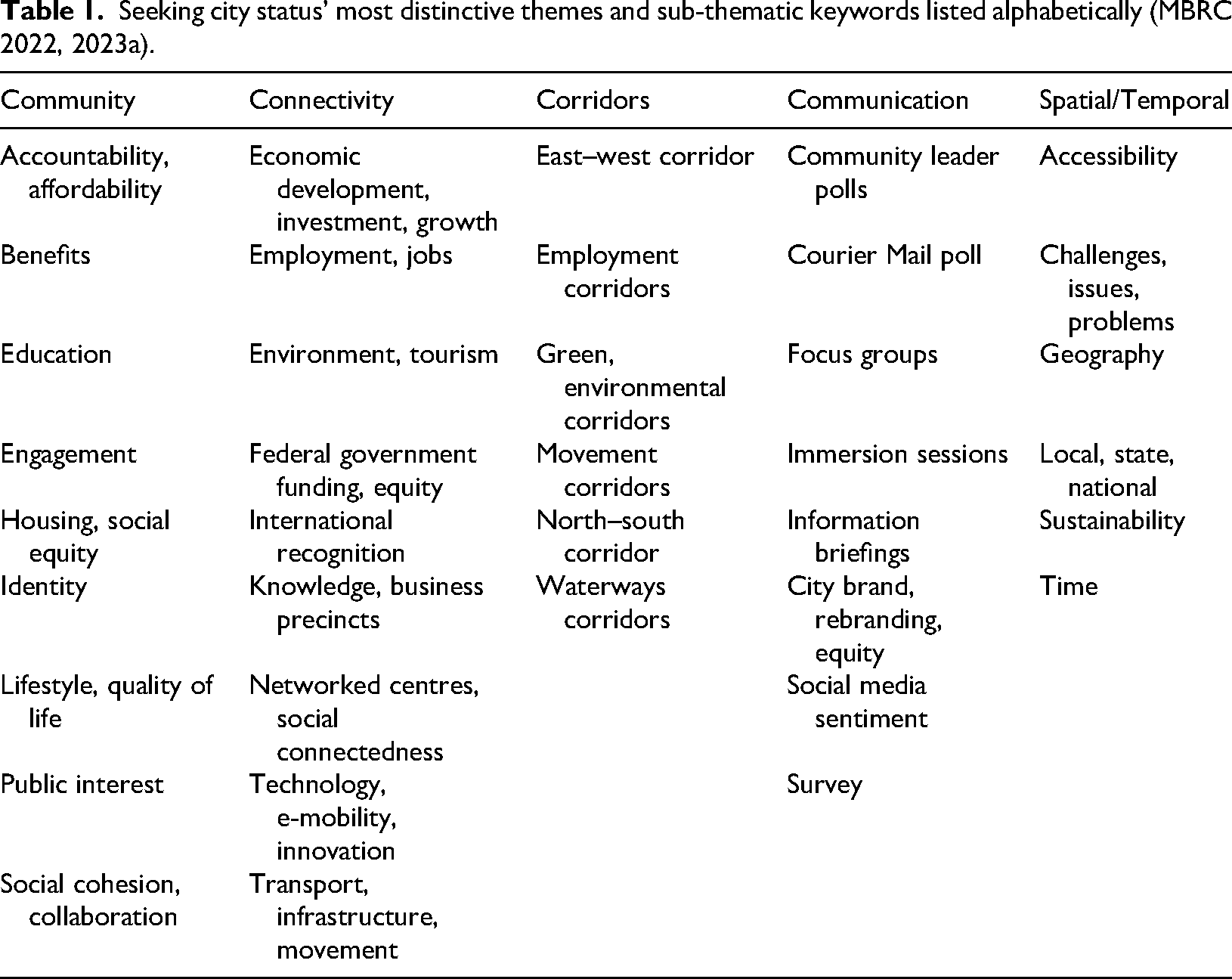
During the coding process, we added ‘notes and comments’ to further contextualise the data and show how a given transformation re/situated audiences in relation to specific place-shaping claims. In writing these notes and comments, we drew on our knowledge of rhetorical techniques and devices, supported by theories of framing and foreshadowing outlined above, to further re/contextualise the micro-intertextual data and related inferences. These comments identified how particular transformations added or suppressed ‘rhetorical presence’ to secure the attention (perception and awareness) of putative audiences. We then categorised and documented these different kinds of transformation indicated in the selected descriptive language (deletion, addition, re/lexicalisation and re/ordering). Finally, we aligned these transformations with the rhetorical intent, motivation and anticipated impact on audiences.
For context, we compiled a brief timeline of the City of Moreton Bay's path to becoming a city in Figure 1.
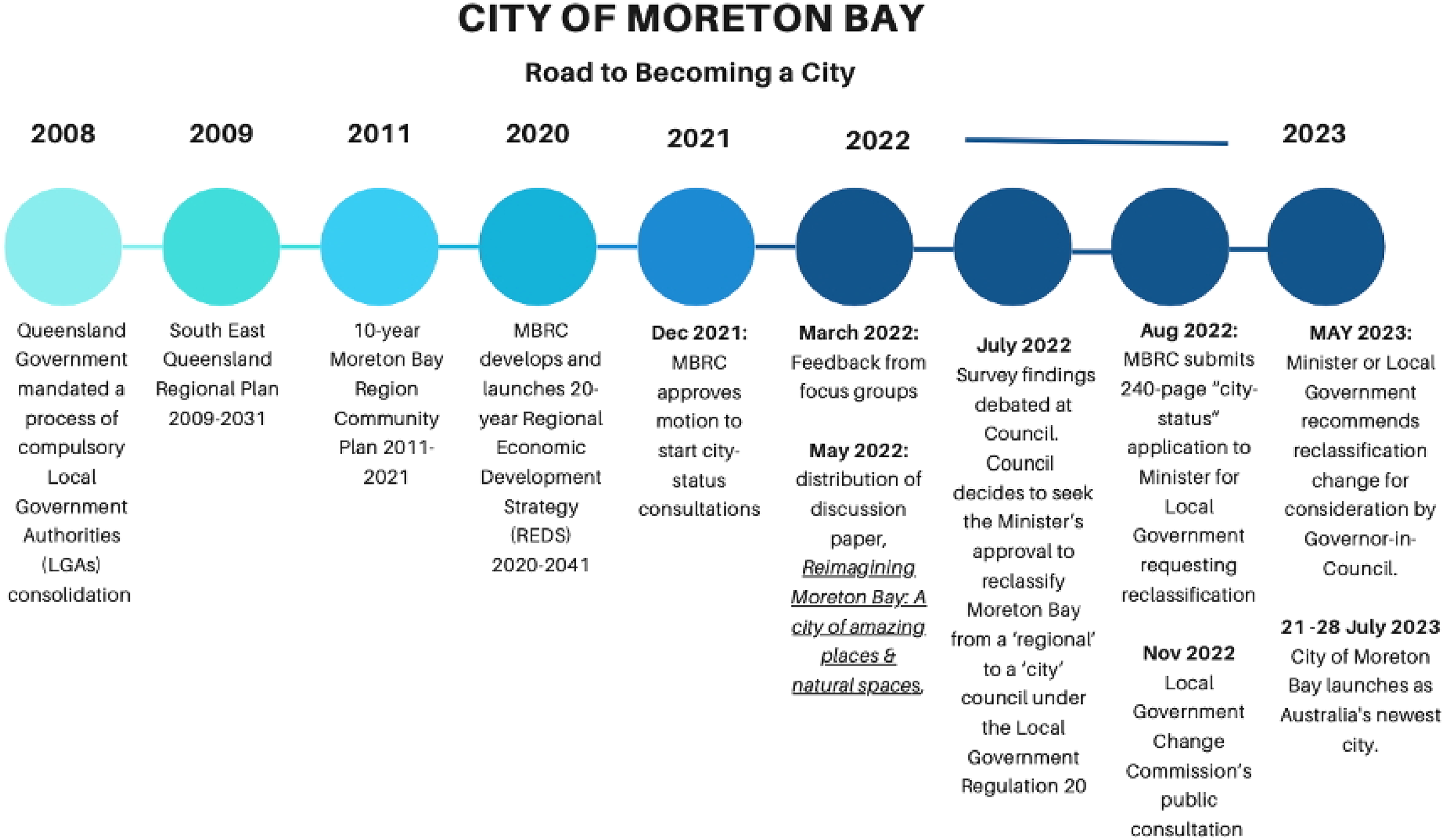
An illustrative schematic timeline of key developments on CMB's journey towards becoming a city, drawn from a range of histories, documents, press releases and news media coverage.
Analysis and findings
Results from the close parsing of the discussion document are organised and prioritised under a range of contextualised general themes. For relatability and analytical clarity, these are clustered into four broad framing schemas: spatial and temporal framing; political framing; communication and community framing; and environmental, connectivity and corridor framing.
Spatial and temporal framing
Picard (2020) argues that rhetoric and framing are ‘not merely parts of debates over policy but can also be evident even in the naming of proposed policy and legislation’. These aspects were evident in the initial communication shared by the LGA with residents, in the Reimagining Our Moreton Bay – A City of Amazing Places and Natural Spaces discussion document (MBRC, 2022). This opening visionary pitch to residents, complemented by the document's title, frames a collective sense of what is being asked of residents to reimagine the region as a city. It obliquely compliments audiences for their prescient choice of locale, foreshadows subsequent repeated references in this initial document to ‘our beautiful part of the world’ (MBRC, 2022, p. 3), and references the region as a ‘hidden gem’ (Stone, 2022) to entice the readers into an initial ‘discussion’ and set of processes that eventually ‘reimagines’ the region as a city. Picard (2020) refers to this strategy as evoking and framing ‘implicit memories’ to stimulate desired psychological responses, predisposing individuals’ perceptions of information or toward particular choices, which in this case supported the city vision.
The inclusion of the word ‘city’ in the title of the discussion document – a term not previously associated with the Moreton Bay region and thus a new idea to most local stakeholders – foreshadows future possibilities or a form of Higdon's (2010) ‘backwards causality’ that casts a shadow, in advance, of the future city. Higdon (2010) argues that these ‘shadows’ are often presented as not something that might happen, but as certain outcomes, by framing them, as the title does, as statements of fact. It can thus be seen, in the title and much of the messaging, as an advanced strategy of prolepsis as a persuasive strategy to counter anticipated objections well before stakeholders voice them (Higdon, 2010).
For the new city, this ‘opportunity’ becomes an urgent, time-barred ‘once-in-a-lifetime chance to showcase our natural beauty and attract visitors from our shores and beyond’ (MBRC, 2022, p. 16). The Council's foreshadowing of the new City of Moreton Bay in this early ‘pre-suasive’ form can also be seen as embodying Lunden's (1999) core ‘narrative seed’ (i.e. the injection of an idea that subtly and unobtrusively prepares, predicts and confirms an inevitable future) as a course of action the region must take to realise a sustainable city for all stakeholders.
Complementing this spatial visioning of the new City of Moreton Bay is the temporal framing of the city-status application as urgent and immediate, given the externally imposed and potential-laden ‘inflection’ points. These points include the announcement of the 2032 ‘Brisbane’ Olympics and the opening up of Australia's borders after two long years of COVID travel restrictions and quarantines, which provided immediate and pressing ‘critical opportunities to influence how Moreton Bay is perceived by decision-makers’ (MBRC, 2022, p. 16). The opening wording of Reimagining Our Moreton Bay – A City of Amazing Places and Natural Spaces (MBRC, 2022) provides a brief preface that explains why a new city vision is necessary and urgent. It accesses stored generic knowledge or schemas of events, situations and relations to present a cluster of features associated with a referent, stored in the memory of Moreton Bay residents, including their priorities, needs and calculable benefits (e.g. the environment, transport and lifestyle).
These features are then framed in the provision of a prototype or what a polycentric City of Moreton Bay would ‘look like’, establishing a proposition and expectations as a template or schema for a sustainable future (i.e. meeting stakeholder needs) and the procedural patterns or steps to achieve the vision (i.e. branding, urban planning and development, and budgetary implications). Through this lens, the novel polycentric vision is initially introduced and conveyed somewhat tentatively to keep open and encourage residents’ future participatory role in shaping a hoped-for collective future. This openness arguably allows the term and the notion of ‘polycentric’ to become a ‘floating signifier’ that facilitates the imagining of different meanings in different contexts, while retaining positive connotations of progress and development (see Stavrakakis, 1997; Colleoni et al., 2021). Acknowledging how diverse public opinion was, and how novel the polycentric city idea was, at that stage, allowed the Council to align with Lawson's (2013) notion of adopting values reflective of stakeholders and thus to leverage persuasive traction for the vision's five critical themes. These stakeholders, however, need to be cognisant of just how constrained those powers are within the context of state and federal government policies and regulations around zoning and funding LGAs (Grant and Drew, 2017).
Political, communication and community framing
The Reimagining Our Moreton Bay – A City of Amazing Places and Natural Spaces discussion document then focuses on the importance of developing a more recognised city identity, partly to boost the Council's economic development strategy, which focuses on, inter alia, attracting more visitors to the region and increasing state and federal government funding. This notion builds on the sense that Moreton Bay is perennially ‘undervalued’ by everyone except those living in the area. It also reflects the strong suggestion that the new city vision and status would rectify this distortion, getting the area recognised and rewarded for the substantial ‘heavy lifting we are doing as South East Queensland evolves’ (MBRC, 2022, p. 13). As MBRC Mayor Peter Flannery argued in various meetings, which the discussion document makes clear: … our population is already bigger than Canberra, but we are missing out on funding because politicians have mistaken our region as a regional centre … (Stone, 2022, np, emphasis added by authors)
This sense of not getting a ‘fair share’ of federal government funding – and the hope that city status would change that – aligns with four of Cialdini's (2016) six universal principles of social influence: reciprocity (sharing resources with businesses and residents), authority (the Council's credibility to speak on the topic of a new city), scarcity (securing resources from state and federal governments), and consistency (adopting appropriate values reflective of residents’ needs and desires). As Mayor Flannery reiterated, a new city would help to ‘cement our place as a power player in SEQ and hopefully make the nation sit up and pay attention to Moreton Bay’ (Knight, 2023, np, emphasis added by authors). The Mayor added that this statement aims to counter the common misconception among visitors from Canberra, who ‘many mistakenly believing we are a rural or remote council’ (MBRC 2022, p. 16).
It is also important to note that this rhetoric was developed partly in response to the announcement of a major 20-year partnership between the Australian Government, the Queensland Government, and the Council of Mayors (SEQ), titled ‘The SEQ City Deal’. The ‘City Deal’ was signed off in March 2022, two months before the ‘Reimagining our Moreton Bay’ discussion paper was shared with residents. Its adoption also came just a week before the federal election in 2022, with the ‘City Deal’ promising substantial investments in transport systems to reduce congestion and enable better access to jobs, services and recreation (Queensland Government, 2025). Importantly, it embraced language around ‘development corridors’, ‘transport connectivity’ and ‘greater mobility’ to enhance prosperity in Southeast Queensland (Queensland Government, 2025). The ‘SEQ City Deal’ thus implied that the region would have to become a city to get a ‘fair share’ of largesse as promised by the arrangement. As the Mayor said, ‘we need to change if we are to compete for investment to manage the growth we are experiencing as the closest northern neighbour of Brisbane’ (MBRC, 2022, p. 16).
The Reimagining Our Moreton Bay – A City of Amazing Places and Natural Spaces discussion document then presents a storied vision of how the area might evolve and what Moreton Bay would ‘look like’ as a future ‘polycentric’ city. Such positioning reflects Schon and Rein's (1994) concept of frames in which a ‘diagnostic-prescriptive story’ enables the explication of the underlying structure of beliefs, perceptions and appreciations of audiences. This certainty of outcomes – the ‘prescription’ – relates closely to Higdon's (2010) notion of the persuasive power of well-constructed foreshadowing that seeks to preclude the possibility or desirability of other options. The presented option relates only to the vision or end product, drawing on the interactive influences of the stimulus and on internal hypotheses, expectations and knowledge as motivating actors (Higdon, 2010). Even in their earliest ‘setting out their stall’, it is clear that the MBRC was aware that framing the region as a ‘joined up’ polycentric city would potentially activate Picard's (2020) notion of existing memory and knowledge of audiences. This discourse attempts to counter negative perceptions around the forced and fraught 2008 amalgamations, still resonant in ‘living memory’ among many residents. As a pre-suasive strategy, the importance of ‘inoculating’ the message becomes paramount in managing the persuasive intent to create an acceptable pathway of least resistance to city status. As Compton et al. (2021) assert, inoculating audiences against negative discourse in early narrative forms can address and mitigate objections that audiences harbour, thereby increasing the likelihood of positive responses to the new city vision.
Anticipating this response, the discussion document gently warns of the potential negative outcome of not having this ‘discussion’ now. Making these tough calls at this juncture will, audiences are told, prevent ‘us from waking up’ a decade later with deep regrets (MBRC, 2022, p. 5). The consequences of current inaction are then directly contrasted with the opportunity to ‘create the future we want’ now, and ‘set a clear direction’ by taking the ‘opportunity in front of us’ (MBRC, 2022, p. 5). These choices are then carefully framed around community engagement and inclusivity: The ideas within this paper are intended to start a conversation in our communities about the possibility of becoming a city … This discussion document aims to spark contemplation of a future that harnesses our assets as a region that is home to many unique centres and distinct communities. (MBRC, 2022, p. 5)
Throughout the document, acknowledging the divisive past, including the 2008 state-wide LGA amalgamation process as well as the region's current urban, rural and agrarian divisions, frames the expectation that the region's eclectic peri-urban distinctiveness can nonetheless be preserved against the inevitability of change. As MBRC Mayor Flannery remarked in 2023 when promoting the ‘becoming a city’ narrative: ‘We are a region but were never regional’ (Knight, 2023, np). From a foreshadowing perspective, this purposeful contemplation illustrates pre-suasive engagement to ‘inoculate’ the vision from inevitable criticism that comes with a wide-ranging change to the status quo. Echoing Cialdini's (2016) ‘pre-suasion’ language, Picard (2020) notes how frames prime mental responses to issues and policy proposals, so the invitation to ‘reimagine’ a new city's future is framed in inclusive and inviting language, to ‘start’ thinking about ‘what becoming a city could mean for you and your families’ (MBRC, 2002, p. 5). The Council also acknowledged that they created their vision of the new city constrained by macro forces, very aware that ‘…we can't stop growth happening in our beautiful part of the world’, but residents can reclaim their agency and ‘take charge and actively shape our future together’ (MBRC, 2022, p. 5).
From our initial coding and rhetorical analysis, we also observe how the Mayor and Deputy Mayor, as representatives of the Council, suggested or invited what can be seen as a collective investigation into the levels of manoeuvrability regarding sustainable change (i.e. what was possible and what was not). Accordingly, the document's messaging prepares the community for future challenges, recognising that local government's active navigation of power contestations is integral in Australia's three-tiered system of government. This approach reflects Weingarten et al. (2016) notion of priming audiences for critically important future outcomes, demanding that Moreton Bay secures its ‘fair share’ of government funding, job creation, and infrastructure development, including a fair share of the Olympic 2032 bounty. This messaging leverages its influence from the ongoing story schema, as outlined by Schon and Rein (1994), and positions Moreton Bay as also embarking on a transition to a more sustainable future. Higdon (2010) contends that such a story schema acts as a framework or mental structure of expectations that helps people understand and remember stories.
Accordingly, the opening pitch sets out in the starkest terms to anchor the challenges within opportunities for economic growth. In bold type, the document states: ‘More than 10,000 people are moving to our region every year’ (MBRC, 2022, p. 5). The discussion document ultimately seeks to reassure residents that it is indeed possible to balance the region's ‘much-loved places and natural spaces’ with the needs of a ‘growing population’, thus ‘to live in balance with our environment and provide better housing and work opportunities for everyone’ (MBRC, 2022, p. 7).
There are also repeated references to the absence of appropriate recognition of the region's outsized contribution to Queensland and Australia's economy, and the need to be granted greater ‘economic and financial standing’ by conferring city status. Here, the broader frames around city status should be ‘taken more seriously’ through obtaining additional reputational gravitas to advocate for more state and federal government investment (MBRC, 2023b; Moreton Daily, 2023). The discussion document argues that becoming a city will allow the region to aspire to ‘taking our place as one of Southeast Queensland's most preeminent cities’ (MBRC, 2022, p. 13) and that ‘officially becoming a city is the first step towards changing our identity locally, nationally, and internationally. With greater status, it will make it easier to advocate to the State and Federal Governments for investment in our region’ (MBRC, 2022, p. 13, emphasis added by authors).
Audiences are also told city status would correct the injustice of Moreton Bay's lack of alignment ‘with the other councils adjoining Brisbane, including Redland City, Ipswich City, Logan City’ and address the evident unfairness that ‘even though these three places have been anointed with cities’, Moreton Bay is larger than all these neighbours in terms of geography, population, and the number of local businesses … it's high time that we are recognised (MBRC, 2022, p. 4, emphasis added by authors). This notion of the region taking its ‘proper place’ and receiving due recognition would become critical to the Council's rhetorical positioning of its city seeking arguments, as it advanced its communication programme in 2022 and early 2023.
Environmental, connectivity and corridor framing
Manifesting from the political and community-focused themes and narratives are the more tangible dimensions of Moreton Bay as a polycentric city built around the tagline: ‘Moreton Bay, our Moreton Bay, a New Kind of City’ (MBRC, 2022, p. 8). Rhetorically, what is striking about this approach is that it frames the entire visioning exercise as especially innovative and forward-thinking. In doing so, it embraces contemporary urban development forms and seeks to avoid what the discussion document pointedly characterises as ‘the mistakes of other cities’ (MBRC, 2022, p. 13). This argument then positions the notion of the proposed polycentric city frame as inventive and unique to South East Queensland, and therefore a genuine ‘city of the future’ (MBRC, 2022, p. 8). This region would be recognisable as more urban and urbane, while retaining its many unique centres and distinct communities via making ‘sustainable choices’ in our ‘beautiful part of the world’ (MBRC, 2022, p. 3). This frame links residents’ feelings of identity and affection towards their four existing urban ‘mini-centres’ to future policy and urban planning innovations, which the vision promised will increase employment and attract investment. Embracing this vision would result in economic returns filtering down to stakeholders while maintaining the ‘multi-centred’ sense of locale.
At this point, the communication introduces the term polycentric, which, in planning terms, acknowledges that the region already had four distinct and disjointed urban centres. This acknowledgement was the first such public mention of the polycentric city concept, at least in the context of the proposal to seek city status. The ideas encapsulated by the term would become a central motif of council communication over the next year. To imbue pre-suasive meaning into the concept of ‘polycentric’, the document introduces a strong connectivity frame via an early pitch for new and expanded movement ‘corridors’ and a vision of digitally enhanced, futuristic ‘connectivity’ that knits the polycentric city together. This approach drew on tropes of living and working ‘close to home’, reducing road traffic congestion, and promising shorter commute times. These liveability-oriented connection and corridor frames are carefully weighted to appeal to those who enjoy or rely on flexible home-work arrangements. Weingarten et al. (2016) argue that moving people from concepts, such as understanding the boons of new city forms, to action by embracing the vision of a new kind of ‘place’ often relies on creating an association with an essential desire to prime the audience's expectations of benefits. The orientation document asserts, ‘unlike traditional cities, it's about spreading jobs across our communities and deliberately not wanting to create congestion by funnelling residents into a single CBD to work’ (MBRC, 2022, p. 8, emphasis added by authors). Indeed, council communications deliberately focus on the desire for greater work–life balance, convenience and cost savings, heightened by the legacy of the COVID-19 pandemic, to address concerns that half of residents commute out of the Moreton Bay region daily for work, predominantly in the greater Brisbane metropolitan area.
This approach also allowed the discussion document to explain why creating more local jobs was a key priority for the Council and all stakeholders, and to present the logic for why becoming a city would accelerate local job creation. The reasoning linking connectivity, corridors and polycentric city nomenclature is thus made explicit for the first time in the discussion document. It becomes a major theme and argument in later consultations and communication processes. The document artfully links city status with attracting inward investment and stimulating local job creation, thereby benefiting residents’ quality of life by reducing commuting time, which would in turn provide more time for recreation and family activities. These elements also have the advantage of ‘keeping money in our region with increased resident spending and income generated locally’ (MBRC, 2022, p. 8).
It should be noted that supporting these ‘connectivity’ and ‘corridor’ points, and a broader vision of a ‘polycentric’ city, are several colourful illustrations that show the region's five centres planned connectedness via ‘corridors’ that run both north and south in terms of transportation, and east to west in terms of the so-called green or environmental corridors. Although primarily ‘illustrative’ rather than explanatory at this early stage of a year-long communication process, the visual representation of these corridors (see Figure 2 below; MBRC, 2022, p. 9), suggests a presumption of planning already ‘in the works’ and seeks to convey a sense of the Council's thorough preparation in terms of what the proposed new city could and should ‘look like’.
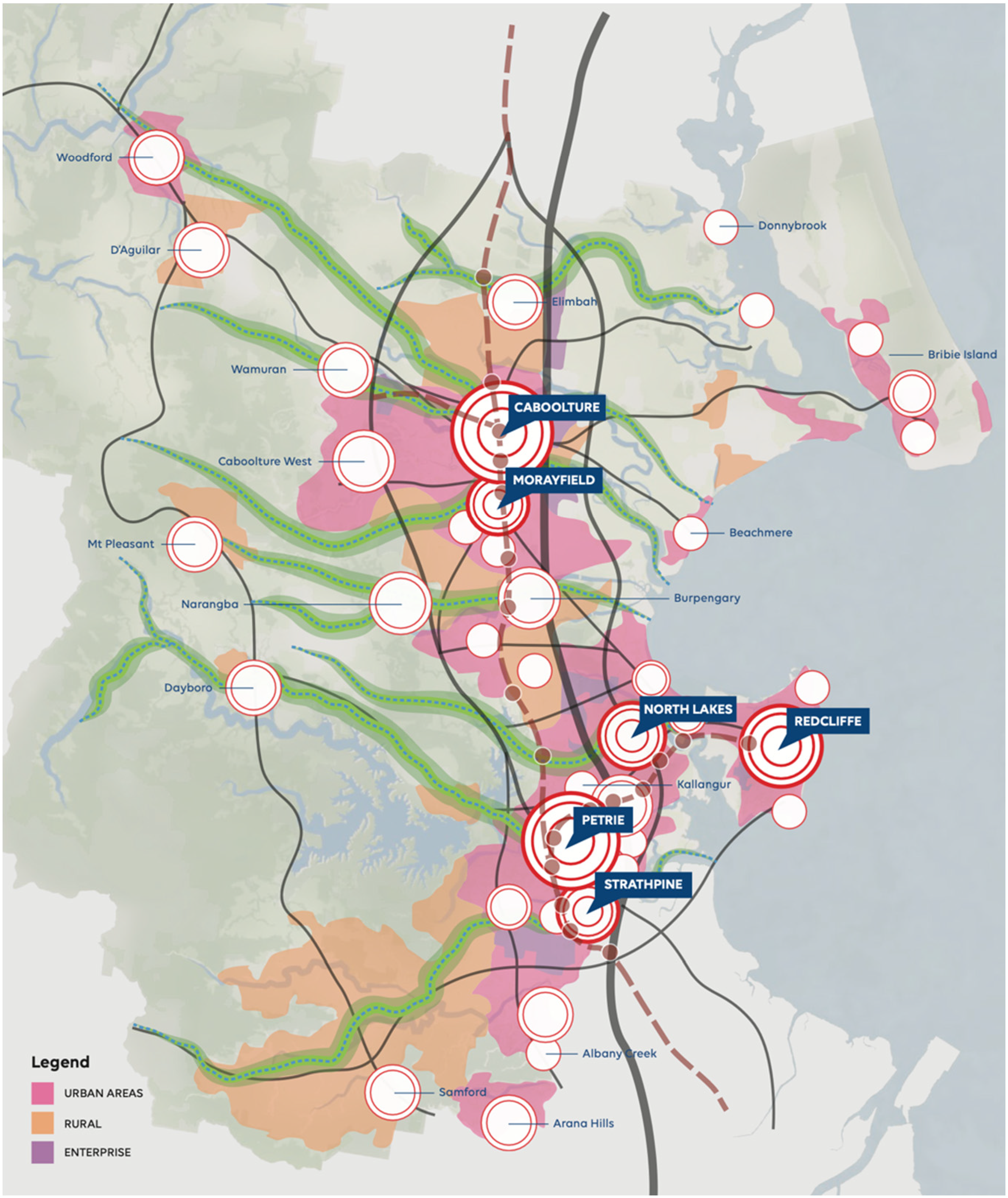
Depiction of the region's five centres shows the planned connectedness of the region's five centres via ‘corridors’ that run both north and south in terms of transportation and east to west in terms of the so-called green or environmental corridors (MBRC, 2022, p. 9).
This image is prefaced with captions that suggest polycentric urban planning will, as depicted here, ‘reduce travel demand’, ‘shorten journeys’ and ‘improve efficiency’ (MBRC, 2022, p. 9). Rhetorically, Oddo (2013) argues that visual resources (as depicted in Figure 2) perform the same three metafunctions as verbal resources: construe reality by representing participants, processes, and circumstances (ideational), enact relationships and social identities (interpersonal); and achieve compositional coherence (textual). Following this inventory, the Council's visual image (and others) helps audiences to think systematically about the conception and resulting benefits of the ‘connectedness of corridors’ as part of a visual grammar that the grander narrative represents in the new city vision.
To demonstrate the value of this visual grammar, for brevity, we examine how the Council accesses the two metafunctions – ideational and interpersonal (Oddo, 2013). Ideationally, this visual narrative tells a story about the represented participants (stakeholders) and serves as a conceptual image that establishes relationships among them. In this ideational sense, there is a conceptual structure. Specifically, we observe what Kress and Van Leeuwen (2006) refer to as an analytical process in which a showdown is linked to its Possessive Attributes (i.e. connectedness and corridors). That is, this image represents ‘each centre’ and their ‘connectedness’ as part of a larger polycentric whole: a ‘showdown’ between the present and the future, through embedded symbolic processes. Specifically, the urban areas, rural areas and enterprises are visually connected by physical (and imaginary) lines of corridor connectivity that run north-to-south, symbolising transportation corridors, and east-to-west, symbolising green or environmental corridors (MBRC, 2022, p. 9). Shifting to the interpersonal metafunction, the image also engages and positions the audience. On the surface, the image simply conveys information: the region's potential connectivity. On the other hand, it also encourages the audience to enter into an imaginary relationship with derived benefits (i.e. reduced travel demand, shorter journeys and improved efficiency). Specifically, the audience is positioned and invited to ‘look through’ a futuristic lens at residents’ lives, interconnected and harmonised with the region's environmental and transportation corridors.
Notably, the argument for city status sought to access residents’ stored knowledge (current frustration and future hope) of retaining and sustaining their current environment and lifestyle. This approach provides a platform for audiences to analyse and understand the relationship between individual actions and the community benefits of preserving the ‘region's natural beauty’ (MBRC, 2022, p. 5). Higdon (2010) suggests that thinking of two entities concerning one another acts potentially as ‘cognitive priming’ to increase their association in memory and the likelihood that calling attention to one event stimulates thoughts about the other. The emphasis on the various boons of being more locally focused links to urban planning terminology, such as retaining people within the region, allowing them to live, work and play, as popularly formulated in council literature.
As explored, the longer histories of contested ‘place identities’ (Proshansky, 1978) arising from the forced LGA amalgamations of 2007–2008, and the perceived lack, even in 2021, of a sense of being ‘in and of’ place, were reframed and re/contextualised as issues that would be resolved mainly by becoming a city. The dual urban planning promises of creating a more joined-up polycentric LGA – while not having to choose between the four regional centres that had some claim to become a singular ‘centre’ of any future city, all while spurring ‘efficiencies’ without depredating the beautiful ‘natural’ spaces – were artfully and skilfully woven into this initial ‘discussion document’.
Conclusion
This article examined how MBRC developed and staged a persuasive communication campaign to secure city status by reframing a peri-urban, multi-centred local government area as a coherent ‘polycentric city’. We address two research questions through rhetorical analysis to address the evolution of MBRC's communication strategy to conceptualise itself as a city despite challenges and how early communication materials framed to prime audiences for later engagement and secure support from divergent stakeholders. The analysis revealed that the Reimagining Our Moreton Bay: A City of Amazing Places and Natural Spaces document functioned as the first key text in a year-long communication strategy designed to invite engagement, shape consultation and build legitimacy for the city-seeking initiative. The document framed polycentrism as an enabling solution to longstanding identity tensions following the 2007–2008 amalgamations, while promising joined-up governance, connectivity, liveability and protection of natural spaces. It also mobilised diagnostic-prescriptive narratives linking city-status to emergent regional opportunities (e.g. Olympics-related growth and regional deals). Through rhetorical presence, foreshadowing and inoculation against scepticism, MBRC created a pre-suasive ‘lens of interpretation’ that prepared audiences for later consultation activities and decision-maker endorsement.
This article contributes to the literature in three ways. First, it extends framing theory by conceptualising and examining pre-suasion framing as a distinctive temporal phase of persuasion, showing how local governments prime residents, prior to place-shaping commitments. In this case, the concept of a ‘polycentric’ city was deployed as a floating signifier enabling coalition-building through productive ambiguity, allowing different stakeholders to attach their own meanings while sustaining early alignment. Second, it integrates framing with rhetorical and socio-psychological theories of persuasion (foreshadowing, schema activation and inoculation) to explain how receptivity is engineered in place-shaping campaigns. Finally, it positions city-seeking discourse as a form of mediated governance in which councils coordinate multi-genre texts to legitimise civic identity transformation and to secure authorisation for contested planning futures.
For practitioners, it is clear that communication can serve as both a planning instrument and a participatory process, enabling local governments to shape city place-making from ‘above’ and ‘below’. Complex urban planning ideas can be conveyed via careful framing of arguments, crafted to appeal to stakeholders’ senses of place and aspirations for the future of their LGAs, so as to elicit early support from local stakeholders for urban revitalisation and place-making.
These rhetorical manoeuvres prepared the ground for more intensive community consultations that followed, including community surveys, visually powerful ‘roadshow’ presentations, press conferences and expert consultancy reports. The polycentric promises made of greater connectivity, flowing movement corridors, enhanced liveability and substantial inward investment appeared to resonate with many residents, as did the prospect of heightened ‘standing’ and stature for the new city. This vision, it was hoped, would allow the polycentric city to be ‘found’ and ‘seen’, and finally assume its place as a ‘city of amazing places and natural spaces’ in Australia's burgeoning South East Queensland region.
Footnotes

Funding
The authors received no financial support for the research, authorship, and/or publication of this article.
Declaration of conflicting interests
The authors declared no potential conflicts of interest with respect to the research, authorship, and/or publication of this article.