




Abstract
In 2016, the New Scientist announced the birth and good health of the world’s first baby conceived using spindle nuclear transfer (SNT). The story was immediately circulated worldwide. In this article, we analyze 39 articles published within the first 48 hours of the announcement, in the Mexican, British, and U.S. press. These articles constitute the initial press reactions to the announcement, and as such, they offer a narrative ground on which SNT could thereafter be discussed. We argue that as a media event, the articles performed the task of rendering SNT, a “cultural novelty,” as culturally and technologically feasible.
Keywords
Introduction
On September 27, 2016, New Scientist’s science contributor Jessica Hamzelou published an exclusive breaking news story: The world’s first baby conceived using a new assisted reproductive technology (ART) called spindle nuclear transfer (SNT) had been born 5 months ago and was apparently healthy. SNT had been recently developed to help women carrying mitochondrial diseases to have the possibility of conceiving healthy offspring (more on this technique later). According to Hamzelou (personal communication, January 3, 2017), she found this story in the conference abstracts section of the August issue of the Fertility and Sterility journal (Zhang, Liu, et al., 2016) and decided to publish it. 1 Within the following 48 hours of Hamzelou’s publication, the story was taken up by a wide range of newspapers in many different countries and languages, all reproducing a similar story: A Jordanian couple had approached Dr. Zhang, a New York–based physician working on SNT, seeking his help to conceive a child free from Leigh syndrome, the mitochondrial disease responsible for the early death of their two previous children. Because SNT was not legal in the United States, Dr. Zhang carried out the procedure in Mexico (at the Mexican branch of his clinic, the New Hope Fertility Clinic) since, as he was frequently quoted saying, in Mexico “there are no rules” (Hamzelou, 2016).
These articles constitute the first press reactions to the announcement of this baby’s birth and conception story, and as such, they set out the narrative ground on which SNT and this particular birth were thereafter constructed, disseminated, and discussed, allowing journalists and commentators to configure and contest the ethical, practical, and social implications of SNT in the light of its first success. They framed the birth as a “world’s first” and as proof that SNT works; they depicted SNT as a successful and straightforward technology capable of “saving lives” as well as saving (preserving) the (nuclear) genetic link between mothers and their children; and based on these successes, the narrative suggests SNT should receive worldwide acceptance. By presenting a similar narrative, these articles worked to cast a form of singular audience, a global “we,” witnessing together this shared first.
In this article, we analyze 39 of these initial press reactions, all published between September 27, 2016, and September 28, 2016, in the Mexican, British, and U.S. press. We chose these countries due to their relevance in the story: Mexico and the United States were depicted as the territories where the clinical interactions took place, and the United Kingdom was constantly referred to as the first country in the world to formally legalize the procedure. With this analysis we highlight how these first press reactions contribute to the construction of SNT as a successful and feasible technology.
The article is divided into four sections. First, we offer a brief explanation of the SNT procedure and situate it within the legal framework of each of the three countries involved in this story. In the second section, we articulate our theoretical influences from Media Studies and Science and Technology Studies, and we explain how we collected and analyzed our data. In the third section, we present our cross-national press analysis, focusing on how the visual and textual narrative presented in these papers is leading to a particular framing of SNT as a straightforward technique that has proven successful and thus should be widely accepted. The fourth section discusses the performativity of these first press reactions. The article closes with a brief conclusion.
Situating SNT
SNT is one of two mitochondrial replacement techniques (MRTs) 2 developed to help women carrying disease causing mitochondrial mutations (e.g., Leigh syndrome) to have healthy children. It does this by transferring the spindle (which holds the nuclear DNA) from the egg of a woman with mutated mitochondria into a donated egg with healthy mitochondria, which previously had its own spindle extracted. The result is a reconstructed egg that has the nuclear DNA (spindle) of the mother and the mitochondria—as well as the rest of the cell’s organelles and cytoplasm—from the donor. This reconstructed egg is then fertilized. If fertilization and division occur, the embryo is transferred for gestation (Amato, Tachibana, Sparman, & Mitalipov, 2014). The difference between this technique and ova donation, which would also avoid inheriting the mother’s mutated mitochondria, is that through SNT the child will still inherit the nuclear DNA of the intended mother without inheriting the mitochondrial disease. This technique has sparked extensive debate in many countries over its safety and ethicality because it involves combining the genetic material from three people (the father, the mother, and the donor).These debates, however, have not taken place at the same pace nor with the same outcome in Mexico, the United States, and the United Kingdom, particularly because they have different regulatory configurations regarding ARTs in general.
When the New Scientist article was published, Mexico’s parliament was in the midst of discussing the two most recent proposals to regulate ARTs (Beltrones, 2016; Zuarth, 2016). To date, there have been over 20 proposals presented, yet none has ever been approved (González-Santos, 2016). Dr. Zhang’s pronouncement that he chose Mexico because there were “no rules” preoccupied some academics and physicians because they feared this would lead to the approval of the most restrictive of regulations (see, e.g., Palacios-Gonzalez, 2016). However, it is worth highlighting that Mexico does have certain laws that would pertain to the use of experimental ARTs and that would be applicable to SNT (Palacios-González & Medina-Arellano, 2017).
In the United States, debates about the safety and ethicality of MRTs date back to the late 1990s when Dr. Zhang and Dr. Grifo were starting to work on an earlier version of SNT, and when Dr. Cohen was carrying out ooplasmic transfer, a technique aimed at boosting fertility by transferring cytoplasm from a younger ova to the intended mother’s ova. Ooplasmic transfer led to the birth of over a dozen children, but due to safety concerns, it was restricted in 2001 (Cohen & Alikani, 2013). After these restrictions, Dr. Zhang moved his research to China, where these practices were also banned. Despite recent discussions regarding its legalization, SNT remains illegal in the United States (Castro, 2016).
In contrast, following extensive scientific enquiries and public debates, in 2015 the United Kingdom became the first, and still only, country to legalize MRTs (Dimond, 2015a; Dimond & Stephens, 2018b). However, it was not until December 2016 that the Human Fertilisation and Embryology Authority, following further calls for evidence, allowed clinics to apply for a license to include MRTs in their clinical practice. In March 2017, almost a year after the technique had been used by Dr. Zhang in Mexico, the first license was granted to the Wellcome Trust Centre for Mitochondrial Research; the Newcastle University–based group that pioneered U.K. research on MRTs and supports the United Kingdom’s largest mitochondrial disease patient clinic and patient research database.
Theory and Method
In this section, we explore two of the main theoretical tools that guided this work: the notions of cultural novelty and cultural feasibility as used by Oudshoorn (1999), and the notion of media events developed first by Dayan and Katz (1992) and then by Hepp and Couldry (2010). We then set out the methods we followed to generate and analyze our data set. We close this section highlighting the purpose of this article, which draws from Science and Technology Studies.
Cultural Novelties and Cultural Feasibility
This article considers the role played by the press in the construction of technoscience. It follows the premise that the media is an important actor in the construction, adoption, and rejection of technoscientific knowledge and artifacts (Condit, 1994; Marks, Kalaitzandonakes, Wilkins, & Zakharova, 2007; Mulkay, 1996; Nerlich & Clarke, 2003). It does this by framing and narrating technology and science in particular ways: invoking risks, benefits, and safety issues; laying out possible dangers and degrees of (un)certainty; using discursive tools that will highlight and obscure certain aspects of the story; establishing the time, place, and sequence of actions; and offering ways of articulating knowledge or artifacts with the rest of our lives (O’Keefe et al., 2015; Scheufele & Tewksbury, 2007; Van Gorp, 2007; Weaver, 2007).
Studying how scientific knowledge or technological artifacts are narrated and framed becomes particularly interesting when it concerns new scientific claims or artifacts (Dahlstrom & Ho, 2012). These “cultural novelties” (Oudshoorn, 1999) lack an agreed terminology to name and describe them, they are in need of agreed rituals and practices with associated sociocultural meanings, and they are still in the process of creating their demand and acceptability. In these cases, the media takes on the role of testing the new scientific claims or technologies and presenting the first successes usually using the “breakthrough” framing. Examples of this framing are the birth of Louise Brown, the first baby conceived using in vitro fertilization (IVF); the case of Dolly, the cloned sheep (Bauer & Gaskell, 2002); the first laboratory grown beef burger (O’Riordan, Fotopoulou, & Stephens, 2017); the first cloning of human cells (Haran & Kitzinger, 2009); and now the “world’s first” birth of a child conceived using SNT.
In these and other cases, the media participates in presenting the world’s first success or breakthrough as both technologically and culturally feasible (Oudshoorn, 1999). In her analysis of the male contraceptive injection, Oudshoorn (1999) identified how newspapers focus on the cultural feasibility of a technology by highlighting the needs and acceptability of its (potential) users, who in this case were men and women facing the pain and inconvenience of weekly injections. The way cultural feasibility is framed can have economic and sociopolitical consequences by accelerating policy changes, attracting investments, encouraging or discouraging public consumption or involvement, and promoting certain terms, phrases, and images to describe and represent how we should understand it (Nerlich & Clarke 2003). Aware of this, scientists and (bio)medical organizations have sought to manage the media as a way of managing the public debate and containing public anxiety regarding new technologies or scientific claims (Hansen, 2006). In this article, we take up Oudshoorn’s (1999) suggestion to ask to what extent has “the media played a role in enhancing the technical and cultural feasibility of [SNT as] the new technology” (p. 276).
Media Events
As mentioned, we focus on the first press reactions published in Mexico, the United Kingdom, and the United States, all of which mostly reproduced Hamzelou’s version of the story. Hence, turning to the work of Dayan and Katz (1992) on “media events” helps us explore the performative act of these articles as singular and outstanding ritual ceremonies, staged as historical moments that draw together mass audiences in a shared viewpoint. Within Dayan and Katz’s (1992) typology of media events, the SNT birth best fits the “conquest” narrative, which are events dealing with the conquest of new physical, technical, or symbolic territories, for example, the 1969 Moon landing, the cloning of a mammal, or the birth of the first IVF-conceived child. In this case, the SNT birth is a conquest within the territories of medicine, genetics, reproduction, and their associated ethics. Building on the ideas of Dayan and Katz (1992), Hepp and Couldry (2010) suggest recognizing media events in the information age as distributed across different media products, no longer tied to national boundaries, reaching a multiplicity of audiences, and less totalizing in coverage. We argue that analyzing these first press reactions to SNT as a media event helps us highlight the international nature of this story.
We draw from the Science and Technology Studies tradition of unblackboxing terms, assumptions, and time-space flows. The purpose of opening-the-black-box is to approach the facts with attention and care, identifying what they are made of and what they can do. Put in Latour’s (2004) terms, our overarching goal is to treat both SNT and the first reports of its “world’s first” success as matters of concern, considering their whole scenography to see what they are gathering, how they are made meaningful, and their world-making power.
Method
Media studies are generally divided into three inquiry areas: production, representation, and reception (Seale, 2003). Ours is a study of representation, as we are interested in identifying the way SNT is being both constructed and represented in the press. We started out by exploring four broad questions (1) which narrative tools were used to construct and represent SNT (e.g., metaphors, exemplars, arguments, and images), (2) which actors were assembled to create and sustain this particular story, (3) what keeps them tied up (Latour, 2004), and (4) what are these articles, taken as a media event, accomplishing by representing SNT in that particular way.
To select the newspapers for analysis, we consulted Statista and The Paper Boy, for U.K. papers; CISION, Agility PR, and State of the Media, for U.S. ones; and a broadcasting monitoring service for the Mexican papers. The sample was devised through searches in Google and the newspapers’ own search engines, for articles published between September 27, 2016, and September 28, 2016, using “mitochondrial donation,” “three parent baby,” and “Dr. Zhang” as search terms. We identified 39 articles that fit the criteria: 16 for Mexico, 13 for the United Kingdom, and 10 for the United States. 3 Spanish language articles were collected and analyzed by Author 1, who provided English translations of headlines and leadlines for Authors 2 and 3. English language articles were collected by Author 3. Both Authors 1 and 3 coded British and U.S. articles. The coding criteria was discussed and established between all three authors before starting to analyze the articles, then Authors 1 and 3 refined the criteria while undergoing the analysis and reanalyzed all articles with the new criteria.
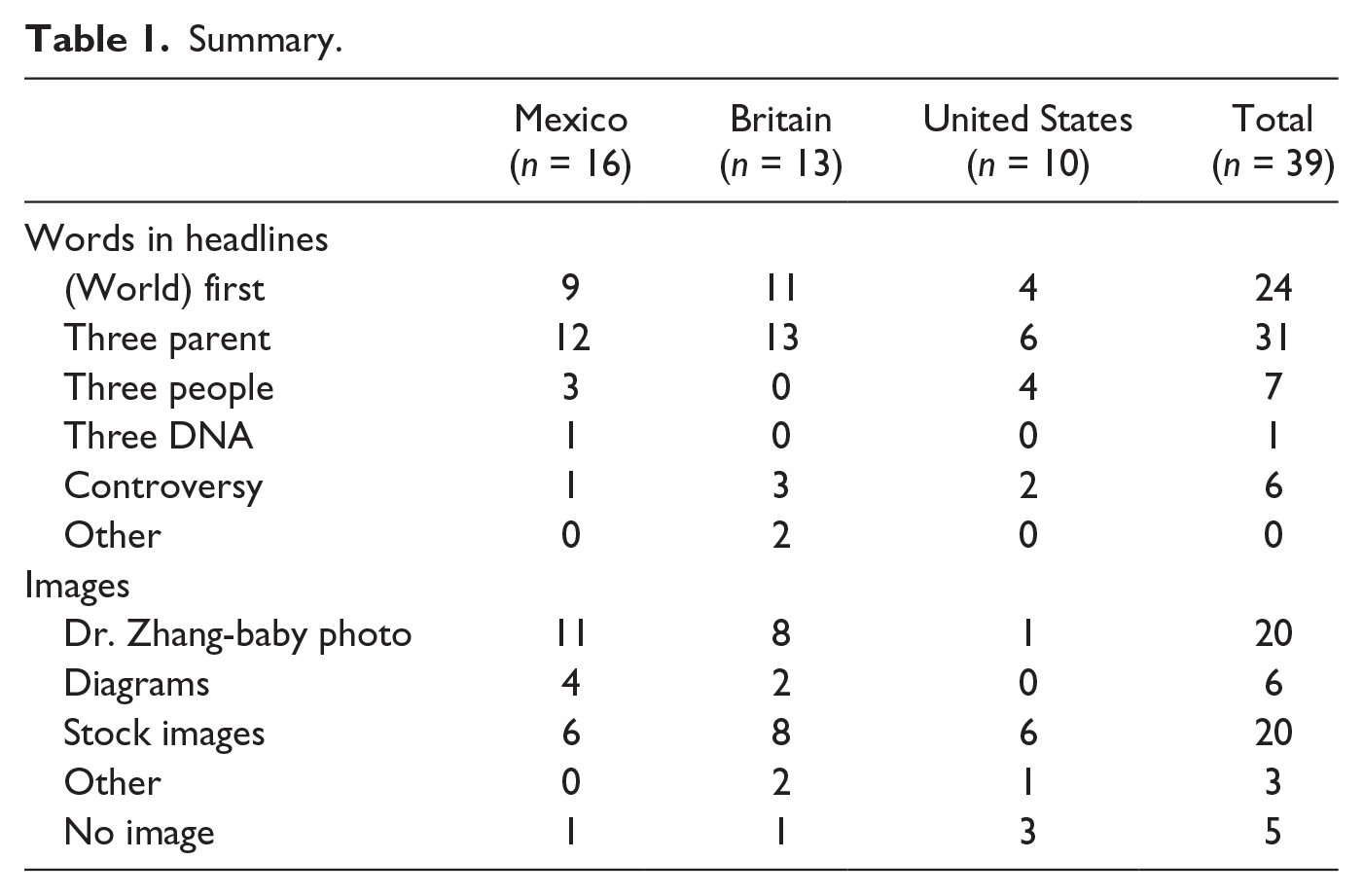
Then, we conducted a visual and textual analysis of both the 39 articles and Hamezlou’s New Scientist article. We systematically recorded, into a spreadsheet, the following elements: (1) the key words and phrases used in the headlines (e.g., “world’s first,” “three parent baby,” etc.), in the leadlines, and in the text; (2) the visual elements; (3) the actors invoked and their use in the story (e.g., who was identified as an expert, what type of expert this was, and which issues did they raise); (4) the source of the information presented; (5) and if the piece had bylines. Texts and visuals aids were analyzed as a unified narrative (Armon, 2017; Hodgetts & Chamberlain, 2014; Stephens & Ruivenkamp, 2016). By systematically analyzing the headlines, visuals, and body of these articles, we were able to identify the predominant narrative structures, discursive themes, and visual aids, to then conduct a cross-national comparison (Van Gorp, 2007; see Table 1).
Summary.
Cross-National Press Analysis
This section presents the analysis of the 39 articles. We begin by situating the articles in terms of their authorship and their information sources, we then look at how this media event was narrated and what this narration does. Drawing on the work by Stephens and Ruivenkamp (2016), we look at the different visual aids or what they call the “imagescape.” Then, we focus on the framing of the story as a biomedical breakthrough. The following subsections deal with how SNT was made culturally feasible (or not) by offering a particular genetic narrative, by framing the family and the technique as the right ones, by stating that the purpose of this procedure is indisputable since it “saves lives,” and by expressing concern over certain aspects of SNT and how it was used. The section closes with a discussion on the performativity of these first press reactions.
Situating the Articles: Bylines and Sources
Bylines not only situate the article in terms of its authorship but can also speak of a particular journalistic style and of a relationship between author and the topic. In our data set, we found that British articles were authored by journalists long involved in writing about the developments in mitochondria donation and for whom reporting on this entwines with their own career trajectory (e.g., Ian Sample from The Guardian, Oliver Moody from The Times). Similarly, most U.S. articles were authored by science journalists, some of whom have written science communication books or are editors of science communication magazines (e.g., Gina Kolata and Rachel Feltman, respectively). On the contrary, Mexican articles rarely had personal bylines, assigning authorship to the newspaper or an agency. These differences might account for the use of secondary or supplementary information. Although articles reproduced the New Scientist story line, suggesting that New Scientist was their first and in many cases only source of information (except the Daily Mail), most of the British and U.S. articles brought in other voices (e.g., researchers in the field and patients). In contrast, the Mexican press did not appear to capitalize on having access to the local context since they did not offer comments by the Mexican physician (Dr. Alejandro Chavez Badiola), the clinic’s staff, the Mexican authorities, or the Mexican medical association (Asociación Mexicana de Medicina Reproductiva).
The Imagescape Narrative
Stephens and Ruivenkamp (2016) studied the images of in vitro meat taken before and during the press conference where the unveiling and tasting of the world’s first laboratory-grown burger took place. They analyzed them as one single narrative, or as what they call “imagescape,” which they describe as “the expanse of images relating to a distinct object or subject” (p. 330). In this section, we too analyze the imagescape present in these first newspaper articles. We identified three main types of images: the photo of Dr. Zhang and the baby, stock images, and diagrams of the procedure. The photo and stock images were used in 20 articles, while diagrams were employed only in 6. Thirteen articles used more than one illustrating element; most of these were from the Mexican and British press, and most included the Dr. Zhang-baby photo. The U.S. articles were illustrated differently; they frequently used stock images instead of diagrams or the Dr. Zhang-baby image, which featured only in the New York Post (see Table 1).
To date, the only public photograph of the baby is the Dr. Zhang-baby photograph, which first appeared in the New Scientist. According to Hamzelou (personal communication, January 3, 2017), it was given to her by Dr. Zhang when she contacted him for comments as part of her work toward publishing the story. This picture is a half-body shot of Dr. Zhang dressed in scrubs (with his name on them), wearing a scrub cap, facing the camera, and holding up the newborn baby, who is wrapped in a blanket wearing a beanie. The photograph affords a particular interpretative package. First, it suggests proof that SNT works. It does this by presenting the baby to the camera, offering proof that SNT produced a healthy baby. Second, it helps claim authorship. While Zhang’s coauthors are listed in the scientific publications (Zhang et al., 2017; Zhang, Liu, et al., 2016), in this image, as well as in the body of text, only Dr. Zhang appears. (Paying close attention to this image, one can see, in the background, the shoulder of another person also wearing scrubs, somebody clearly left out of the picture.) By not showing their faces and not mentioning the names, roles, or affiliations, the work and personal investment of the “team of experts” were silenced, helping frame Dr. Zhang as the single author of this world’s first and as if he alone was able to achieve this biomedical conquest. Third, this image also served as a site where the privacy of the baby was enacted. The original publication of the New Scientist article included the unblurred image and the names of the couple and the baby; however, soon after publication, the face of the baby was blurred and the names were eliminated. Nonetheless, this information had already been disseminated, and the subsequent articles dealt with it in different ways. Many blurred the baby’s face as a way of anonymizing him, although the way this was done varied between articles: from not blurring, to blurring the entire face, even covering the eyes with a black strip. In most of the Mexican pieces, for example, regardless of the picture-blurring practice they followed, in the body of the text, and sometimes even in the leadlines, the full names of the baby and his parents were stated. As such, the decision on what to reveal and what not to reveal enacted different modes of appropriate and ethical treatments of the family and their child by the various publications. Finally, the staging of the photograph suggests that it could be the baby’s first picture. However, its composition and use, as well as the fact that there is only one photograph in public circulation, contrast with the many photographs produced in the other cases of world’s firsts mentioned earlier. When Louise Brown was born, for example, there were several images of her circulating, some with her family and some with a larger team of experts (e.g., in one physiologist Robert Edwards is holding baby Louise and standing next to fertility nurse Jean Purdy and gynecologist Patrick Steptoe). Similarly, the announcement of Dolly the cloned sheep included a series of pictures taken with Ian Wilmut and with the other sheep, and in the in vitro meat event studied by Stephens and Ruivenkamp (2016) there were images and videos of the meat being presented, cooked, and eaten.
Diagrams were used to explain the process. Despite the difference in language, the diagrams used in the Mexican and British press share key elements worth highlighting that relate to how they represent the people involved, how they depict assisted reproduction as a straightforward and unproblematic endeavor, and how they help render this procedure as viable for all those who wish to use. First, they present some of the actors who are absent in the Dr. Zhang-baby photo—the couple, the donor, the gametes, and some of the tools—and position these actors in specific roles. For example, they depicted the intended mother and the donor as equals using similar icons but with different colors, and although each was portrayed with different hair styles, attire, and postures, they were the same size and in the same tone. These diagrams place the donor as key for the success of the techniques. She is depicted pragmatically, as the originator of the donated egg and as the facilitator that makes this technique possible. However, within the text, little is said about her as an individual person; she is situated as the third person who contributes with the healthy mitochondria, omitting to mention that she is contributing with the entire body of the cell: organelles and cytoplasm. Although some details were revealed in a later publication (Zhang et al., 2017), in these first press stories there is scant reference to the donor’s recruitment and consent process, whether she was screened for other genetic diseases, whether she knew the family, and whether she was paid. This way of narrating the role of the donor renders her biologically significant but biographically insignificant. The diagrams also depicted the male biological contributor, sometimes as a male figurine or simply as a sperm (e.g., Mundo, Mexico). Second, these diagrams show an interrupted flow between each stage, as if there were no obstacles to overcome, tests to be conducted, or choices to be made. Third, they depict the actors involved as (to an extent) generic; anyone can be any of the actors. This contrasts with the textual narrative, which, as we will see further ahead, framed the Jordanian couple as the right couple (suggesting that there might be less suitable couples), and with the Dr. Zhang-baby picture, which highlights a specific physician (the scrubs have his name) and a specific baby (thus the anonymizing practices).
Finally, the stock images. Some articles used images with reference to reproduction as a biotechnology, images of a pipet holding a sperm puncturing an ova (depicting the intercitoplasmic sperm injection procedure), of microscopes, and of the double helix. Others linked reproduction to babies and parenting by featuring babies, baby feet/hands, fetus, and pregnant tummies. These images created a double link, on the one hand associating SNT to known high-tech biological imagery, while on the other relating it to cute images of babies (or baby parts) helping place SNT at a human level.
As an imagescape (Stephens & Ruivenkamp, 2016), the unified narrative of the photograph, diagrams, and stock images tells the story of how a single scientist was able to perform this cutting-edge technology, successfully proving that it works and that it can be used in other cases. It frames SNT as a technology involving body parts that are extracted, manipulated, and reinserted straightforwardly. The narrative invokes ideas about the importance of anonymity and privacy, about genetic relatedness, and about the power and licenses granted to science; all these ideas reappear in the text, as we will show in the following sections.
The Breakthrough Narrative
“Exclusive: World’s First Baby Born With New ‘3 parent’ Technique” (Jessica Hamzelou, New Scientist)
“Medical Breakthrough as World’s First Three Parent Baby Is Born” (Daily Express, UK)
“First-Ever Baby Born Using Three Parent Genetic Engineering Technique” (The Washington Post, USA)
“Historic: The First Baby With Three Genetic Parents Is Born” (Publimetro, Mexico)
The articles claim to be presenting a breaking news story; however, the event actually took place several months before the story made the headlines. On the day of the publication, September 27, 2016, nothing distinct happened in the life cycle of the child, its family, or the scientific team involved in his conception and birth. The making of this into an event on that day, the “eventisation” (Hepp & Couldry, 2010), the moment marking this firstness, all this was entirely a result of Hamzelou’s initiative to publish this story. It was her work as a journalist and the New Scientist’s institutional agency as a publishing site that mediated and narrated this as breakthrough both on that day and through that day (cf. Brown, 2000). All this was done apparently without the intentionality of the scientific team or the family, and there is no indication of Dr. Zhang’s interest in having his story published in the media at that time. Notwithstanding this Dr. Zhang was presenting this case at two scientific events a few days after the publication: first at the ART World Congress 2016 (New York, USA) and then at the American Society for Reproductive Medicine annual meeting (Salt Lake City, USA).
In these first press reactions, SNT was framed as a “first-ever” “historic” “breakthrough,” a metaphor that commonly “misrepresents the messy and indeterminate way in which knowledge is actually made and what it is capable of doing in the future” (Brown, 2000, p. 89). Framing this through the repetitive use of the “world’s first” narrative renders invisible the previous attempts and the people long involved in the field. Only four articles (The Guardian, The Independent, The New York Times, and USA Today) mention previous work in this field. The USA Today, for example, cites the work of Dr. Cohen on ooplasmic transfer from the late 1990s, and The New York Times mentions both the work of Dr. Grifo, from more than 20 years ago when he demonstrated that DNA swapping could work in mice models, and the attempts using pro nuclear transfer in humans conducted by Dr. Zhang in China in 2003 (Zhang, Zhuang, et al., 2016). However, none mentioned whether Dr. Zhang had any previous attempts with SNT, either with this couple or with other couples, implying success on the first attempt. Hence, by neither linking this case with earlier attempts at SNT nor mentioning a range of technologies with which SNT is associated, these narratives depict SNT as a standalone, first-attempt, successful technique that replicates a genius-eureka science narrative. Furthermore, this narrative contrasts with the high failure rate of ARTs in general and with other breakthrough cases such as Dolly the sheep, which followed 227 unsuccessful previous attempts (Callaway, 2016).
These initial stories also offered unspecific information regarding where the different stages of the procedure were carried out (the stimulating protocol, the ova reconstruction, the transference of the embryo, and the birth). Mexico was cited as the location where this world’s first took place, chosen not because of its technical expertise but for regulatory reasons. It was portrayed as a country lacking regulation, where scientists can do what is illegal or objected elsewhere:
By performing the treatment in Mexico, the team were not subject to the same stringent regulation as some other countries would insist on. [. . .] We have no way of knowing how skillful or prepared they were, and this may have been a risky thing to do. (Dr. Dusko Ilic, quoted in The Sun, UK)
The press uncritically reproduced this narrative, failing to reflect on the existing legal framework regarding reproduction and experimentation on human subjects in Mexico (Palacios-González & Medina-Arellano, 2017). However, it was never clear what parts of the procedures were done where; hence, there was a construction of a singular space of biomedical innovation, ambiguously, and unproblematically blurring the Mexican and American New Hope Fertility Centre clinics. It was implied but not confirmed that the team of experts travelled from New York to Mexico. By not addressing the implications of these different border crossings, the reporting renders invisible the negotiations that were inherent to the procedure, for example, how it was possible for Dr. Zhang to practice medicine in Mexico. This lack of geographical reference present in images, text, and headlines fosters uncertainty regarding the legality, safety, and professionalism of how the procedure was carried out, and helps divert attention from discussions regarding medical tourism (in the U.S. and Mexican press, not so in the U.K. press), making this “world’s first” even more worldly and less local. Finally, there was also a temporal compression of five temporal instances into a single simultaneous narration. These time-space instances—the prior attempts with the SNT technique; the ovarian stimulation and egg retrieval process, which both the Jordanian woman and the donor went through; the moment and place of fertilization; the moment and place when pregnancy was confirmed; and the birth of the baby boy—all these moments were narrated as if they happened simultaneously, collapsed on the day of the press announcement on September 27, 2016, when the boy was already 5 months old.
We consider differentiating between these moments important because it is during them that uncertainty, risks, and the ethical and legal issues emerge. Blurring them and omitting mention of important places, actors, and actions, while at the same time highlighting certain elements, helps portray SNT as technically straightforward and legally unproblematic, as a successful, viable, and desirable solution to the problem of mitochondrial disease.
The Cultural (Un)Feasibility of SNT
SNT and ARTs and MRTs in general have been subject to extensive debates over their ethical appropriateness and technical safety; these articles feed into these debates. We have already explored how these articles performed as witnesses testifying that SNT works, thus rendering SNT as technically possible. Our objective now is to explore how these articles articulated a narrative that rendered SNT, and the type of human being it creates, as culturally feasible, ethically solid, and socially acceptable. We first look at how they present the child as having the right genetic composition and then at how the Jordanian couple was portrayed as the right sort of couple; following this, we focus on how they highlight that the version of the procedure carried out was ethically the correct one and done for the right sorts of reasons; and we close the section thinking about the risks these articles raised.
Genetic Narrative
The genes for traits that make up a persons’ appearance and other characteristics are carried in the nuclear DNA [. . .]. Mitochondria do not define who you are. (The New York Times, USA) The technique does not affect the baby’s appearance, personality or any other features that make a person unique. (The Sun, UK). The baby [. . .] in addition to having his parents’ DNA he has a small amount of genetic code from a donor, which allowed him to be born healthy. (Milenio, Mexico)
For SNT to be technically correct and culturally feasible, it was important to prove that this child was healthy and with the right genetic composition. This meant having the nuclear DNA from both its parents, the mtDNA (mitochondrial DNA) from the donor, and only a low number of mutated mitochondria, which could have been carried over when the maternal spindle was transferred into the enucleated oocyte. Proof of this right genetic composition was given through recurrent phrases—“three parent baby,” “three person baby,” or “three DNA baby”—reiterating that the baby’s genetic composition contained DNA from three people. Haran, Kitzinger, McNeil, and O’Riordan (2007) identified the use of the “three parent” phrase as early as 2004, and Dimond and Stephens (2018) trace how this phrase was then used in the U.K. regulatory debate on mitochondrial donation as an “immutable grammar” that worked as a “family of terms with multiple reconfigurations” (p. 246) through which U.K. media coverage was framed, each variant representing different relation. Some variants indicated a genetic relationship, for example, “three person DNA”; others a social relationship, as in “three parent children”; and in some the relationship was of a technosocial order, as is the case with “three person IVF.” In our data set, the press mostly use the “three parent” phrase (in 31 of the 39 cases) invoking kinship with the donor. However, in contrast to Dimond and Stephens (2018), the articles in our data set made no reference to embryos. The birth of a child rendered obsolete the notion of a three parent/person embryo as a scientific and moral frontier. Omitting the term embryo functions as part of the collapsing of multiple time-space instances and establishes the success of the techniques in delivering a healthy baby. Hence, the recurrent phrase “three parent baby” served to not only prove the baby’s correct genetic composition but also move the discussion on SNT away from the hypothetical and into the accomplished.
As the quotes above illustrate, the articles highlighted a particular type of difference between nuclear DNA and mtDNA. While nuclear DNA was described as responsible for elements concerning appearance, identity, and kinship, mtDNA was depicted as crucial for the health of the future child yet insignificant for the person’s identity and physical makeup. This understanding of DNA supports the case that introducing mtDNA from a third party is unproblematic because it will not alter appearance, identity, or kinship. It helps establish a distinction between SNT and full gamete donation, reflecting with this a cultural priority placed on nuclear genetics as the prime element to establish biological relatedness, and thus the associated policies around the right of children to know their genetic backgrounds and the responsibilities of the donors toward full disclosure. In this context, constructing SNT as a technology that does not disrupt genetic parenthood renders it less of a challenge to existing systems surrounding ARTs. In the United Kingdom, for example, the mitochondria donor has no legal responsibilities toward the child and has the right to remain anonymous (Dimond, 2015b). The donor is therefore both overtly present both in the “three x x set” (Dimond & Stephens, 2018) and in the process diagrams—since she is one of the three and one of the female figurines—but then her role in the establishment of kinship, in the understanding of genetics, and in the framing of the technique is downplayed; however, we must not forget that the donor contributes not only the genetically healthy mitochondria but also the cell’s body and all its organelles, something that is seldom mentioned.
Right Couple
These articles articulated SNT’s power to help couples achieve what they have longed for—a genetically related child—as socially and ethically acceptable by depicting this particular couple as biographically, biologically, and morally the “right” couple for this procedure. Biographically, they were described as a heterosexual couple with a devastating reproduction story, yet determined not to give up their search for ways to fulfill their desire for a family. Biologically, they were the right couple, because although the 36-year-old woman was healthy, she was a carrier of a fatal mitochondrial disease that had taken the life of her two previous children. Having faulty genetics makes them, at least by U.K. standards, legally the right couple since these techniques are legal only for women at risk of passing down mitochondrial diseases. Morally this couple is presented as having strong ethical and religious values, thus choosing SNT over pronuclear transfer, which would have involved the destruction of embryos. This moral constraint is said to have led Dr. Zhang to use SNT.
The narrative structure used to present this family’s story followed what Nisbet, Brossard, and Kroepsch (2003) call “anecdotal personalization” or what Condit (1994) describes as “aestheticization,” the presentation of a particular technology through a highly synthesized yet emotional testimony of a successful case. It is a strategy employed to “make ‘high-tech’ procedures more relevant and personally meaningful to lay audiences by demonstrating their value for particular individuals” (Michelle, 2007, p. 645). These aestheticized stories can either omit the risks, difficulties, mishaps, and social implications of using these technologies or mention them but disregard them as the purpose of use is considered “well worth it” (Michelle, 2007, p. 646), thus rendering the techniques acceptable. In the U.K. press, aestheticization went beyond the story of the Jordanian couple to include stories of other parents at risk of transmitting mitochondrial diseases.
Right Procedure and Motive
It should boost the progress of these techniques worldwide. (La Prensa, Mexico) The announcement brings the conversation to the fore. (The Washington Post, USA)
As illustrated by the above quotes, some articles suggested that this “world’s first” should bring “the conversation [on mitochondrial replacement techniques] to the fore” and “boost” progress in this biomedical area, and because it was a success, they forecasted that questions and critiques would diminish. Moreover, this success was achieved using the “right” technique (SNT instead of pronuclear transfer) and the right embryo (a male embryo). Using a male embryo meant that the altered genetic composition would not be passed down to future generations, hence avoiding concerns over germ line modification (cf. National Academies of Science, Engineering, and Medicine, 2016). 4
The societal value of the technology was emphasized in the recurrent claim made by Dr. Zhang that SNT “saves lives.” This framing asserts a specific and particular notion of what “saving lives” means: one in which the life that is saved is the child who would have been born with life-threatening mitochondrial diseases had the same sperm and mother’s ovum with mutated mitochondria been used instead of the SNT procedure with donor material. In effect, the suggestion is that this technique saves the life of the child that would have been born in poor health had SNT not been used and is both premised on and is a further instantiation of the contested claim that the child born through SNT is the same child, with the same identity (but without inherited mitochondrial disease) that would have been born without SNT. This further establishes the genetic narrative and undermines views that SNT produces different lives and different people to a normal IVF procedure with the same sperm and ovum. Dr. Zhang’s account is that SNT is a practice of saving lives, as opposed to creating new and different lives free from disease.
Risks
The risks are still not known with certainty [. . .] with the little evidence that we have, we are unaware of the possible adverse effects. (Martínez Juárez, cited in El Universal, Mexico)
While most of the narrative focuses on framing SNT as an acceptable procedure, U.K. and U.S. newspapers and one Mexican newspaper also included scientific experts 5 flagging some concerns. They expressed concern regarding the consent: specifically, whether Dr. Zhang had fully informed the donor and the family about all the possible implications of SNT. This ethical concern was strengthened by the uncertainty of SNT’s adverse effects and thus the need to monitor the child’s development (see above quote from El Universal). Another concern was regarding technoscientific infrastructure and whether the Mexican clinic had the expertise to perform the procedure. This concern acquired relevance since there was also criticism regarding the way the announcement was made—through a conference abstract and a science communication magazine—allowing for a limited amount of scientific information to be revealed and the absence of a peer review process. A third concern addressed questions regarding future uses of this technique, particularly fears that SNT could lead to designer babies and human enhancement. These critiques feed into the breakthrough narrative and strengthen it. New procedures, or cultural novelties, tend to spark criticism precisely because they have a short history of use and because they are in the process of acquiring cultural feasibility. Hence, these observations serve to provide a journalistic balance and also to grant legitimacy to the account of technological accomplishment and sociomoral advance.
Discussion: The Performativity of the First Press Reactions
Central to our argument is that these articles had a performative capacity. They were simultaneously a witness and an active participant in constructing SNT as a technoscientific success with a particular cultural meaning. Collectively these first press reactions gave witness to the successful implementation of a novel biomedical IVF technique: SNT. They enacted a mode of reasoning and sense-making around SNT, what it produced (a “healthy child”), and how contemporary technoscience can circumvent constraints through international mobility. In Oudshoorn’s (1999) terms, they rendered the “cultural novelty” of human beings produced through SNT as knowable, appreciable, and adorable: as culturally feasible. They did this through the familiar and emotively heartening visual trope of a vulnerable newborn cradled in adult arms, by drawing on a set of textual rhetorics that asserted the global significance of this new way of producing humans free from disease, through straightforward and laudable means, and conducted by and for the right people, at the right time, in as-right-as-possible a location. They articulated a set of recurrent phrases like “world’s first,” “three parent baby,” and “saving lives,” with a visual and textual narrative that minimized the importance of certain actors (e.g., the donor and the Mexican team), certain actions (e.g., traveling between countries), and certain agreements (e.g., legal constraints), together with a narrative that collapsed time-space to depict the procedure as straightforward and unproblematic.
These first press reactions brought SNT into being for a global audience, as internationally distributed media trails echoing the cross-national effort to produce the boy. They helped consign the notion of the three-parent embryo—which was meaningful and hotly contested just a day before—to a status of near irrelevance as the premature uncertainty of an embryo was replaced with the here-and-now of a living and breathing baby, a testament to the viability of the technique, and a joyous addition to a family haunted by a history of infant mortality. Abandoning the reference to embryos when talking about the “three x x” and instead adopting the term baby helped present SNT as viable and socially acceptable.
These first press reactions also helped present this conception as technically straightforward. The first press publications of this case, the abstract published in Fertility and Sterility, and Hamzelou’s piece provided a broad account of the procedure. Due to the nature of these publications, the story could be told without referring to details about the methods and ethical procedures. The result was that Dr. Zhang could claim the prestige of being the world’s first, without having to explain or be held accountable for his methods; yet it was precisely by not explaining his methods and not following scientific etiquette (i.e., announcing results in peer-reviewed academic papers) that he attracted criticism. Furthermore, with the exception of the Daily Mail (UK), newspapers widely reported that they were unable to interview Dr. Zhang, leaving these criticisms unaddressed.
The coverage also performed the moral accountability of the procedure. This was achieved by drawing on Dr. Zhang’s rhetorical strategy—to frame this case as ethically appropriate because it “saves lives”—and asserting that the “right family” and the “right technique” were involved in this procedure. In addition, articles presented SNT as an example of scientific progress, one that marks the beginning of a new era in medical science, an era when mitochondrial disorders will be preventable. This move, in conjunction with the adjectivization of this being the first and only case, affords a slippage between the individual case and the broader ethics of SNT techniques. By framing the individual case as ethically robust (the right family, procedure, and embryo) and successful (we have a baby), SNT in general can then also be rendered as ethically robust (saving lives or eradicating diseases) and successful (we have a baby). Then, by arguing that Dr. Zhang’s priority was to protect the couple’s confidentiality, he was able to withhold from offering interviews to more papers and to provide limited information about the procedure, thus avoiding the risk of unsettling the dominant narrative of a successful “world’s first.”
Conclusion
This article focused on the first press reactions to the announcement of the SNT baby’s birth with the purpose of exploring Oudshoorn’s (1999) question regarding the role played by the media “in enhancing the technical and cultural feasibility of a new technology” (p. 276). Although we fully acknowledge that this moment has a prehistory, including the development and implementation of previous technologies and recent scientific, policy, and ethical debates, and a posthistory, during which further details have unfolded, we have worked to reiterate the importance of analyzing these initial 48 hours for understanding how breakthrough stories offer a narrative for making sense of new technologies and what they facilitate. These first press reactions constitute an exceptional performative moment of peak media visibility and a thickening of meaning around this “cultural novelty.” They granted visibility to specific narratives about saving lives and the rightness of the family, while obscuring others such as the complicated ethical history of the technique, and the role of the mitochondrial donor in the process and politics of the conception. In doing so, and in answer to Oudshoorn’s question, they played a clear role in enhancing the technical and cultural feasibility of SNT by providing symbolic resources for situating it as safe, desirable, and successful. In Latour’s terms, this is testament to their world-making power. Subsequently, this article presents an empirical record of a key moment in the global public enactment of SNT and its ethics, and a theoretical analysis of how the visible/invisible and accentuated/collapsed threads of the narrative render a particular version of these happenings as knowable and accountable to public audiences. By analyzing published articles in the three countries most implicated in the narratives, we offer a significant and robust account of the globally diffuse form of both biomedical innovation and the breakthrough media events that mediate their meanings and politics for global audiences.
Footnotes
Declaration of Conflicting Interests
The author(s) declared no potential conflicts of interest with respect to the research, authorship, and/or publication of this article.
Funding
The author(s) disclosed receipt of the following financial support for the research, authorship, and/or publication of this article: Dimond and Stephens were supported by the ESRC Future Research Leaders grant ref. ES/K00901X/1.
