



Abstract
This study investigates the motivations for the hostility towards the press by the audience and how to control online harassment of journalists in Nigeria. Data for this study are from online and face-to-face semi-structured interviews of 54 Nigerians in Nigeria. Finding shows that perceived journalistic malpractice and unethical behaviour motivate Nigerians to engage in online harassment of journalists in Nigeria. The study also uncovers what the audience in Nigeria offer as preventive measures to online harassment of journalists. These include (i) improved transparency, (ii) improved ethical conduct by journalists, and (iii) procedural and prosecutorial measures (e.g. implementation of a robust professional code of conduct and enacting safety laws for journalists) as ways of eradicating online harassment of journalists in Nigeria. Suggestions for future research areas were delineated.
Keywords
Introduction
Like many parts of the world, violence against journalists is not new in Nigeria. It has been around in some forms for decades. The violence includes killing, imprisonment, beating, harassing, censoring, badgering of journalists and harsh criticism of the profession (Le Cam et al., 2021; Ogbondah, 1997, 2000). Violence against the press by institutions and citizens is recorded, catalogued and condemned (Le Cam et al., 2021) and is subject of many studies in North America, Central America, the Middle East, Asian, Europe and Africa (Benítez, 2017; Frère, 2015; González de Bustamante and Relly, 2016; Ogbondah, 1991). However, this study evaluates motivations and suggests solutions to hostilities towards journalists and their institution by media audience in Nigeria.
Nerone (1994, 2008) has tracked some factors that indicate the likelihood of harassment of the press, and they include (i) cultural norms, (ii) prevalence of violence in the society, (iii) politics, (iv) professional norms or the level of professionalisation of the news media/journalists and (v) how useful violent acts are in shaping public opinion (Le Cam et al., 2021; Nerone, 1994, 2008). While others have looked at online harassment as flaming, that is ‘the hostile expression of strong emotions and feeling’ (Lea et al., 1992: 90). It has been noted that three main factors contribute to digital harassment of journalists in the USA. These factors include ‘easy public access to journalists, the presence of toxic internet ring-wing far-right cultures, and populist demonisation of the mainstream press’ (Waisbord, 2020a: 1037). These three factors brought about mob censorship which has been defined as ‘bottom-up citizen vigilantism aimed at disciplining and silencing the press’ (Waisbord, 2020a: 1031). Mob censorship is one of the hostilities towards the press online.
Motivations for the online harassment of journalists are ambiguous. Due to its complexity, it is daunting to assign motives to harassments targeted at journalists as it is challenging to identify when the audience members are doing so on their own volition. This is because genuine grassroots activities can sometimes be replaced by orchestrated content by political actors to usurp the activity and bend it to their benefit (Vergani, 2014). Other times, state-sponsored attackers may be involved through digital astroturfing (Kovic et al., 2018; Zerback et al., 2021). The perpetrators of such attacks may not like what a journalist published. They may be racists or misogynists whose objective is to silence journalists whose ethnicity or sexual orientation they do not like (Henrichsen and Shelton, 2022). In examining online harassment of journalists, scholars utilised a variety of definitions to discuss the phenomenon. While a consensus is lacking on how to define online harassment of journalists, two terms have consistently remained strong—harassment and attacks (Miller and Lewis, 2022; Stahel and Schoen, 2020). There is a relative agreement in literature that harassment relates to unwanted behaviours against the press. Miller (2021) defines harassment as unwanted abusive behaviours towards the press. This definition classifies both violent and non-violent unwanted behaviour as harassment.
In Nigeria, online harassment of journalists has been noted in reports, studies, and news stories. A prominent case was the online attacks that Kiki Mordi endured after the release of her 2019 documentary on BBC (Lorenz, 2023). Kiki Mordi was a female journalist in Nigeria who was forced to flee from Nigeria after becoming a target of online abuse. This online abuse started after she produced a documentary in 2019 for the BBC on sexual harassment and abuse of women in Nigerian universities (Lorenz, 2023). She received consistent attacks online and even threats on her life. The case of Ms Mordi is emblematic of the situation on ground in Nigeria. Journalists in Nigeria, particularly female journalists, are harassed and attacked online (Aribisala, 2023; MFWA, 2021; Onuche, 2021). The foregoing shows that online harassment of journalists is as prevalent in Nigeria as it is in other parts of the globe.
Studies have evaluated the presence of online harassment of journalists, particularly female journalists and those from minority groups (Holton et al., 2023; Hughes and Márquez-Ramírez, 2018; Lewis et al., 2020; Löfgren Nilsson and Örnebring, 2016; Posetti, 2018; Posetti et al., 2021; Posetti and Storm, 2018). Other studies have interrogated online harassment of journalists by state actors and the strategies that these state actors adopt (Henrichsen and Shelton, 2022; Higgins Joyce et al., 2022; Jones, 2021; Lewis and Westlund, 2015; Westlund and Lewis, 2014). In Nigeria, news and commissioned reports have highlighted online harassment of journalists and the safety concerns of female journalists online (Onuche, 2021). However, not much is known about the reason ordinary people attack journalists online. Also, little is known of the motivations of those that engage in online harassment of journalists. More importantly, these reports, studies and news stories do not attempt to understand how online harassment can be solved. This study will help us know how best to curb the phenomena of online harassment. Understanding the motivations of online harassment of journalists will provide journalism scholars with the data that can be used to suggest panacea to the problem. Majority of the prevailing studies on online harassment of journalist only evaluated responses from either journalists or state actors. Thus, there is a need to interface with the audience members and to ascertain their motivations and suggest solutions to online harassment of journalists and media organisation.
To assess this gap, we used Nerone's (1994) typologies and Martin's (2018) analytical framework for digital safety strategies for journalists such as creating awareness (promotional measures), digital safety and security (preventative measures) and those that aim to combat online harassment or seek remedies for its impact (procedural and prosecutorial measures). Through these analytical frameworks, this study extends our understanding of online harassment from the audience perspective by highlighting what audience members reported as their motivations to harass journalists online and their suggested solutions on how to reduce hostilities towards journalists and the journalism institutions.
From the foregoing, this study attempts to understand the motivations for the hostilities on the press and audience recommended solutions on how to control these hostilities towards journalists. Drawing on these typologies and frameworks, we asked the following questions: (1) What are the perceived motivations by the audience members for their hostilities towards the press in Nigeria? and (2) What are the recommended solutions from the audience on how to control their hostilities towards journalists in Nigeria?
Examining hostility towards the press and motivations
It is daunting to assign motives to harassments targeted at journalists as it is challenging to identify when the audience are doing so on their own volition. This is because genuine grassroots activities can sometimes be replaced by coordinated content by political actors to usurp the activity and bend it to their advantage (Vergani, 2014). Other times, state sponsored attackers may be involved through digital astroturfing (Kovic et al., 2018; Zerback et al., 2021). Besides critical views about journalistic standards such as impartiality, sensationalism, relevance and transparency that breed distrust in the media (Fisher et al., 2020; Fletcher and Park, 2017; Park et al., 2021; Uwalaka, 2020; Uwalaka and Amadi, 2023), motivations for hostility towards the press are myriad in nature. The perpetrators of the attacks may not like what a journalist published; they may be racists or misogynists whose objective is to silence journalists who are people of colour and female (Henrichsen and Shelton, 2022). Attackers could perceive journalists as enemy or just spiteful people that lash out. However, when attacks are large-scale or affect a particular group at a certain period of time or utilise sophisticated communication technologies, such as anonymised servers (Angwin, 2017), it has been noted that such attacks are most likely a proxy acting on a state actor's behalf. Sometimes, state-sponsored and state-aligned harassment can intersect with harassment involving regular audience members.
These hostilities towards the press have forced researchers to commenced interrogating issues around trolling, online harassment and mob censorship. Waisbord (2020a) sees online harassment in terms of mob censorship and defines it as ‘bottom up, citizen vigilantism aimed at disciplining and silencing journalists’ (Waisbord, 2020a: 1031). It has been argued that harassment of journalists happens for three related motives, ‘political motivation, accessibility to the press, and identity of journalists’ (Miller, 2021: 10). In terms of politics, democratic countries around the globe are seeing increasing rise of populists’ leadership. This move has seen the rise of misogyny and denigration of journalists (Carlson and Witt, 2020; Posetti et al., 2021). This rise in populist leadership had led to an increased harassment through Trumpian vitriols and flaming (Carlson et al., 2021; Lea et al., 1992; Miller, 2021; Waisbord, 2020a). Studies have uncovered that beyond the USA, populists’ politics and leaders have led to the demonisation of journalists around the world. According to Posetti et al. (2021: 28), ‘this has increased politically-motivated attacks on journalists around the world’. Crucially, over one in three journalist identified political actors as cardinal sources of online attacks.
Although political actors have been identified as the critical source of harassment and attacks, in many instances, they are just a spark in a larger trend of delegitimising journalists. This harassment and flaming attacks are used to demonise and delegitimise the press in ways that undermine their accountability, discredits them professionally and ultimately erodes trusts in facts (Miller, 2021; Uwalaka and Watkins, 2018). This chain of events ‘bolsters and expands the narrative that reporters are not to be trusted and that they peddle in shams to dupe an innocent public’ (Carlson et al., 2021: 14). This in turn breads hostility towards the press. Some of the critical views about harassment of journalists in Africa are objective reporting issues including brown envelop syndrome or soli, ownership of the media organisations and perceived elitism of journalists (Mabweazara et al., 2020; Okoro and Chinweobo-Onuoha, 2013; Skjerdal, 2018; Yaw Asomah, 2022). These suspicions gradually gravitate to intense disagreement with the press and in some cases graduate to harassment of journalists.
There is a belief that increased interactivity between journalists and their audience will produce positive consequences, but exposing journalists and increasing their accessibility by the public have its own downside as it has increased their online harassments. It has been noted that ‘as journalists transition in many respects from purveyors of truth to ones having to also brand themselves and their identity online’ (Miller, 2021: 11) there is harassment linked to the journalists as a highly accessible figure of the press (Finneman et al., 2019; Molyneux et al., 2019). While this branding among journalists helps them garner recognition and followership, it however gives journalists visibility that encourages harassment.
Nerone (1994; 2008) outlines typologies of violence against the press. Nerone distinguishes between violence against groups, violence against ideas, violence among individuals and violence against institutions (Griffith, 1995; List, 1995; Löfgren Nilsson and Örnebring, 2016; Nerone, 1994: 10–12). Nerone notes that violence against a group refers to harassment and violence against groups whose bases are ethical/racial and gendered rather than ideological. One of the appendices lists 55 incidents during the 1840s and 1850s. Although Nerone (1994) did not view anti-abolitionist violence as racial, it could be viewed as violence against a group, African-Americans and media houses espousing abolitionist views. There was a chilling example of the editor of a South Carolina weekly, whose muckraking got his home bombed in 1987 (Nerone, 1994; Nerone and Stevens, 1995). Recent studies highlight examples of how online harassment is perpetrated against women and minorities. Majority of the studies that evaluates digital harassment of journalist around the world finds that online and offline harassment of journalists are mostly gendered and that women and people of colour as well as the LBGTQI+ are targeted the most (Holton et al., 2023). Furthermore, studies show a greater correlation between gender and race and the likelihood of experiencing online harassment. There is compelling evidence that while all journalists face criticism from the public, online harassment is at its worst when the journalist is female and a person of colour (Blumell and Mulupi, 2021; Claesson, 2022; Everbach, 2018; Gardiner, 2018; Higgins Joyce et al., 2022; Kundu and Bhuiyan, 2021; Lewis et al., 2020; Martin, 2018; Mesmer and Jahng, 2021). It has been uncovered that Black, Indigenous Jewish, Arabs, Lesbians, and women ‘experience both the highest rates and most severe impacts of online violence’ (Posetti et al., 2021: 12). These digital harassments leave a lasting impact on journalists.
Political motivations, accessibility of the press and the identity of the journalists could breed mob censorship. It is fathomable that partisans could try to censor journalists that produce a critical piece of journalism against their leader. Mob censorship could also be used to target an objective journalist who refuses to be partisan in their report. For example, it has been argued that since the press in Nigeria was formed as an activist press; whose purpose was to drive the colonial masters and later the military out of power in Nigeria, that an objective press as a deviation from the past, hence, the vitriol against the press in current times (Amadi, 2006). Also, accessibility of journalists in Nigeria via online networks has given the people a direct access to pour out their frustrations. These direct access and diffusion of the social media technologies have given rise to digital activism and social movements in Nigeria (Adeniyi, 2022; Uwalaka and Nwala, 2023). These technologies are also used to engage in morally motivated networked harassment (Marwick, 2021) of journalists in Nigeria. Female journalists also are targeted because of their gender. Commentaries from renowned journalists have shown that Nigerian female journalists worry about the online safety as they fight networked harassment.
One key area in online harassment literature which has garnered less attention is proffering solutions to online harassment of journalists. Martin (2018) analysed the gender-specific digital safety initiatives proposed for female journalists by international anti-violence projects. In her analysis, she developed an analytical framework. She noted that many online harassment safety guidelines were heavy on strategy of care, in that their development requires that journalists listen to and raise awareness of women's anti-violence needs. She distinguished these guidelines to ensure digital safety and security of women into promotional, preventative, procedural and prosecutorial measures (Martin, 2018: 83). Promotional measures are those guides that try to create awareness of online harassment of female journalists. Preventative measures are guides or studies that aim to ensure digital safety and security of female journalists. Many studies (Antunovic, 2019; Benítez, 2017; Everbach, 2018; Ferrier and Garud-Patkar, 2018) that examined online harassment could be classified as not only looking at female journalists but also reporting on promotional and preventative measures.
Procedural and prosecutorial measures are studies and guides that attempt to combat online harassment of journalists or seeking remedies for the impact of digital harassment of journalists. This usually brings journalists into rights-based debates with ‘employers, state and judicial actors, plus publishing platforms’ (Martin, 2018: 83). This analytical framework is adopted alongside Nerone’s (1994) typologies for this study.
Method
This study reports on a mix of face-to-face and online semi-structured qualitative interviews of 54 audience members in Nigeria. The first 18 interviews were conducted via Zoom and WhatsApp video calls, while the remaining 36 interviews were conducted in person. Thirty-six of the face-to-face interviews were conducted in Port Harcourt, Lagos, Onitsha, Uyo and Abuja, while the 18 online interview participants were from Lagos, Port Harcourt, Kano, Kaduna, Calabar, Benin City, Asaba and Jalingo. The semi-structured interviews were conducted in English, and the interviews were audio-recorded with the consent of the participants.
The researchers adopted a snowball sampling approach in which audience members were recruited through referrals (Bryman, 2016). In this study, audience members were encouraged to recruit their friends and colleagues for the study. Utilising snowball sampling was important in this study as many audience members in Nigeria may not want to talk about online harassment of journalists. This method allowed for their friends, that is, those that they trust to pitch the research to them having themselves participated in the interviews. These referrals helped the researchers have increased interview participants. Although the researchers did not ask if the participating audience members have perpetrated online harassment, all 54 reported to have seen an online harassment of journalists.
The first participants were recruited online. The researchers posted a short SurveyMonkey-based survey asking for participation. In the survey, we explained the nature of the study and sought their personal contacts after they had consented to the study. Information such as their mobile number and email addresses with the Zoom links were sent and WhatsApp and interview booking calls directed. The survey link with notes about the research was posted to WhatsApp groups in Nigeria, on Twitter, and on Facebook including notable Facebook groups.
The interviews were transcribed verbatim. After proofreading the transcripts, the data were moved into qualitative NVivo software. The software then helped the researchers retrieve code and build a conceptual network that was handy at the theme development and meaning condensation stages. The codes drawn from the data were large. Consequently, the researchers submitted the codes to some form of analysis that would consolidate meaning. The researchers adopted thematic and meaning condensation approaches to make sense of the data. This approach ‘entails an abridgement of the meanings expressed by the interviewees into shorter formulations’ (Kvale, 1996: 196). At its essence, the approach rephrases what is said by participants into just few words of a more succinct nature, but in which the meaning is not lost. Meaning condensation starts with meaning categorisation, narrative structure and meaning interpretation. Its purpose allowed us to go ‘beyond what is directly said to work out structures and relations of meaning not immediately apparent in a text’ (Kvale, 1996: 201). In a nutshell, this analytical approach allowed us to add subjective interpretations based on what the meaning is perceived to be from the experience undergone during the interviews.
Our interview participants comprised of 33 male and 21 female audience members. Majority (40) of the participants in our study reported that they use Facebook, Instagram, Twitter and YouTube frequently. Our participants aged between 21 to 50 years. Majority of these participants reported to have between 3 years to 9 years of active participation online.
Results
Three broad themes emerged from our data: (i) awareness of online harassment, (ii) perceived journalistic malpractice and unethical reportage as motivators for hostility towards the press online and (iii) solutions—improved transparency and ethical conduct of journalists, enact journalists’ safety law and robust professional code of conduct for journalists in Nigeria.
Awareness of online harassment
One of the themes that emerged in our interviews was awareness of online harassment of journalists in Nigeria. This means that our interview participants were aware of online harassment of journalists in Nigeria. All our participants have either seen or participated in online harassment of journalists or know someone who have harassed journalists online and offline. A handful of our interview participants acknowledged that journalists in Nigeria are harassed and attacked both online and offline. Participants explained that they either have witnessed a journalist harassed or have perpetrated the harassment. One of the participants in admitting knowledge of online and offline harassment of journalists in Nigeria said, ‘journalists are attacked online all the time. I witnessed journalists’ home addresses posted on Facebook by lawmakers in Rivers State’ (Participant 22, PH, male 31).
This participant is aware of the harassment that journalists in Nigeria endure. They pointed out that the journalistic environment in Nigeria is fraught with danger and that journalists are often harassed in Nigeria. The responses of Participants 22 and 37 are like the views of Participant 27. She noted that she had once harassed a journalist online due to bias reporting. She said, ‘I called out a journalist once on Facebook because she lied in her reporting’ (Participant 27, Abuja, female 43). The respondent not only was aware of the harassment of journalists in Nigeria, she herself had harassed a journalist online. She did indicate that she only called the journalist out for false reporting. Regardless, the comments of Participant 27 show that people do indeed harass or ‘call out’ journalists online and offline in Nigeria. Two other participants narrated that they had seen journalists harassed before. One noted, ‘I have seen journalists harassed both online and offline’. Those perpetrating the harassment (such as Participant 54, Onitsha, female 30) accuse the journalists of reporting stories that were not factual. Another participant also discussed how he witnessed an assault on a journalist during the 2020 #EndSARS protests in Nigeria. He explained, ‘during the EndSARS protests, I came across some online activists post the home addresses, and car registration of some journalists from TVC. The journalists failed to accurately report the impetus of the protest and the demands of Nigerians’ (Participant 14, Lagos, male 39).
Through their responses, the two participants showed that they are aware of the harassment of journalists in Nigeria. One point is clear from the responses, that is, the fact that both our participants who are perpetrators and those who witnessed the harassment of journalists justified the act and blamed the journalists.
Motivations: perceived journalistic malpractice
In terms of what motivates audience members to harass journalists, the answer was overwhelmingly about the behaviour of Nigerian journalists. We reached saturation point on this question after the 11th interview. The participants blamed it on journalistic malpractice and unethical behaviour of the journalists, and there were a handful of those that blamed the anonymity affordances of social media platforms. A participant discussed how journalistic malpractice and unethical behaviour fuel cyber harassment of journalists in Nigeria. He noted: Unethical practices such as reporting of fake news as real news, corruption, ‘egunje’ – brown envelope syndrome – lead to mistrust of journalists in Nigeria. They (journalists) are then harassed because of their numerous failures. (Participant 21, PH, male 40)
Participant 11 alleges that the press has failed to report on critical issues in Nigeria. This failure according to him motivates the audience to harass journalists online as a way of reminding them of their duties. At least, 28 other participants blame harassment of journalists in Nigeria on journalistic malpractices and unethical behaviours. Participant 25 argued that ‘journalists are attacked basically because they consistently fail to do the right thing in Nigeria’ (Participant 25, Abuja, female 29). Another participant narrated similar stories as the reason journalists are harassed in Nigeria. He explained that journalists in Nigeria have not effectively and adequately carried out their fourth estate role. He then accused the journalists of selling their conscience to the highest bidder.
On their part, Participants 49, 48, 7, 19, 37 and 41 discussed how journalistic reports were unbalanced, sensationalised and misleading. These participants and others accused many journalists in Nigeria of false reportage and absence of objectivity. One of the participants notes: ‘what motivates citizens to harass journalists in Nigeria is lack of objectivity among the journalists. Unethical behaviour of the journalists like the brown envelope syndrome is also blamed as one of causes of digital hate’ (Participant 49, Kaduna, female 34). Participant 41 reiterates the points made by Participant 49. He opined, ‘journalists are attacked because they are not objective, and they don’t report accurate information.’ The two themes discussed so far help answer RQ1. These comments show that the people mistrust the press. This mistrust according to the responses was caused by journalistic malpractices such as lack of balance in news reporting, lack of objectivity, brown envelope syndrome and lack of fairness, among others. See Table 1 from sample themes.
Sample themes.
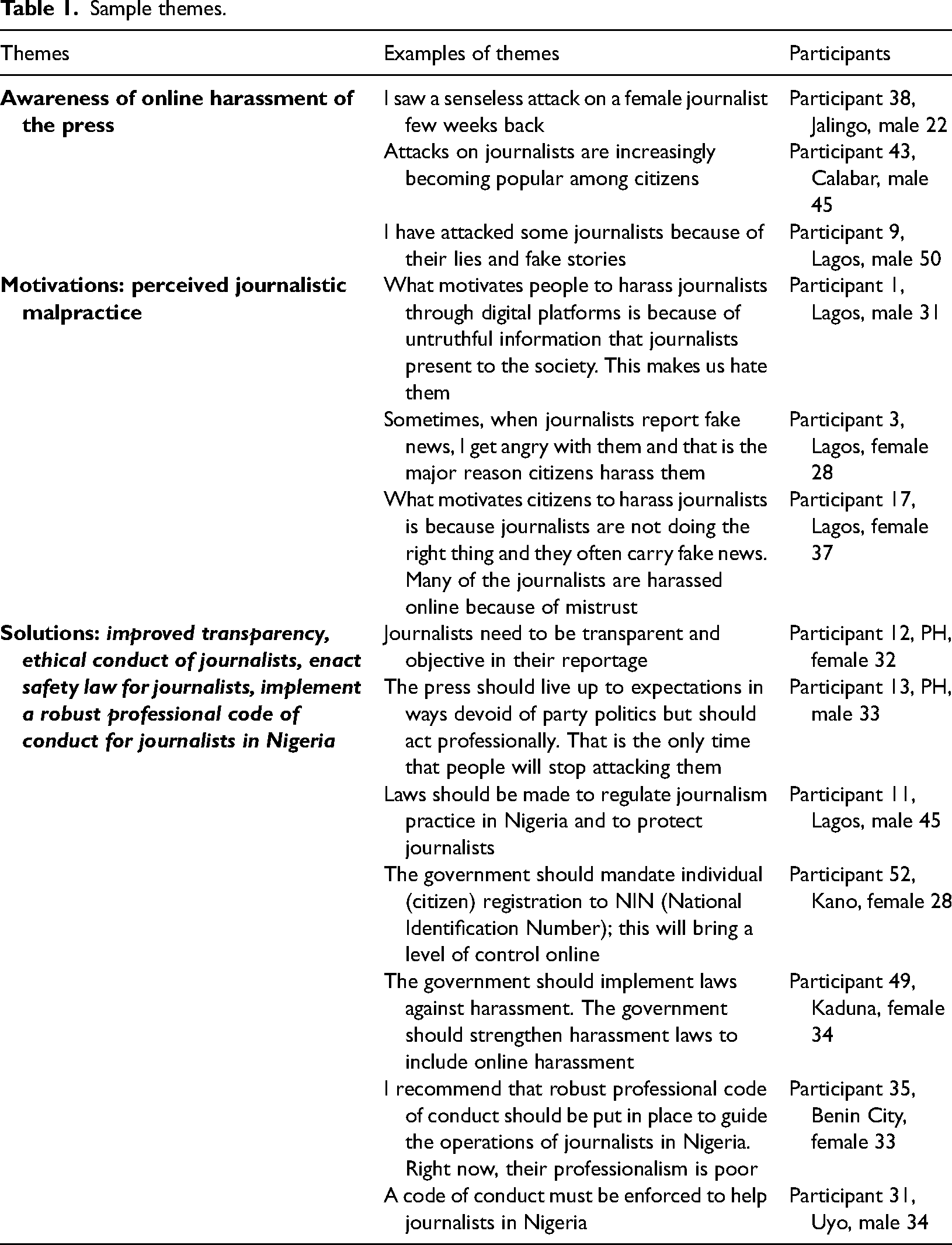
Solutions: improved transparency and ethical conduct
Participants suggested ways of resolving the online and offline harassment of journalists in Nigeria. The first solution highlighted by our interview participants is that journalists need to be accountable, transparent and conduct themselves in an ethical manner. Participant 19 believes that improved conduct and eschewing of corrupt practices by the journalists will reduce harassment of journalists in Nigeria. She explained that ‘corruption should be truly eliminated by journalists in Nigeria’. For Participant 19, journalists should be ‘objective and public oriented’. This participant recommends that journalists in Nigeria need to improve their professional conduct to obviate the harassment of journalists and press hate in Nigeria. Similarly, Participant 48 noted that journalists in Nigeria need to stop collecting brown envelope and to maintain their professional ethics by reporting in a balance manner. He admonished, ‘stop brown envelope syndrome, maintain professional ethical standard and importantly balance your reportage’ (Participant 48, Kaduna, male 32). This Participant believes that unethical behaviour impacts journalists’ reputation. He is of the opinion that curtailing journalistic malpractices enhances the trust audience members have for journalists in Nigeria.
Furthermore, Participants 22, 39, 25 and 26 suggested that improved transparency and ethical conducts by Nigerian journalists will solve, to a great extent, the harassment of journalists in Nigeria. Participant 22 suggests that journalists be independent in their reportage and should suppress any form of bias in their news reporting. Participant 39 suggests that journalists in Nigeria should ensure that they are providing accurate reporting. She recommended thus, ‘Journalists should provide accurate reporting to bolster people's confidence in the profession’. Also, Participant 25 suggested that the journalists in Nigeria should take the concept of neutrality seriously by desisting from lopsided reporting. Responses from participants of this study demonstrate that audience members in Nigeria are angry with journalists; they suggest that journalist eschew corrupt practices and unethical behaviours.
Enact laws
Participants noted many ways of effectively resolving the animosity between the press and her audience members. One of these themes is participants’ suggestion that laws be enacted to punish perpetrators of the act of harassment of journalists. The participants argued that regardless of the issues surrounding journalistic practices, journalists deserve to live freely without harassment. To curb harassment of journalists and to punish offenders, the participants urged the government to enact laws that will protect journalists by punishing perpetrators of harassment of journalists. For example, Participant 23 implored the government to ‘enact and implement laws to safeguard journalists in Nigeria’ (Participant 23, Abuja, male 28). Participant 28 asked the government ‘to make laws that will prohibit people from harassing journalists in Nigeria’ (Participant 28, PH, male 28). Also, Participant 11 recommends that laws be enacted to protect the press in Nigeria.
These comments and suggestions demonstrate that some audience members want political leaders in Nigeria to make anti-harassment laws and enforce such laws in order to protect journalists. This finding is like the finding of Pate and Dauda (2020) which showed how participants clamour for constitutional provisions to protect journalists from threats. Unlike Talabi et al. (2023) that focused on the safety challenges that journalists face in reporting during protests, findings from this study illustrate that audience members want more laws to be enacted to protect journalist and not blaming harassment of journalists on the journalists’ lack of safety training.
Implementing a robust professional code of conduct
Our participants suggested that the Nigerian Union of Journalists (NUJ) should implement a robust professional code of conduct that will help journalists in Nigeria improve their professional conduct and standardised journalism service delivery. The participants recommend that the government should constitute a professional body and code of conduct that will act as checks on journalism in Nigeria. According to these participants, a professional code of conduct should be written by their professional body to check and control the activities of journalists in Nigeria. Participant 1 suggested that the code of conduct should stipulate harsh penalties for journalists who run afoul their professional code of conduct. Participant 2 recommended that laws should be enacted to guide the operations of journalists in Nigeria.
On his part, Participant 4 suggested that journalists should have ‘rules and regulations’. Participant 8 recommended that the government should institute checks and balances policies and procedures that would help guide journalists’ activities in Nigeria. These comments show that audience members see provision and enforcement of robust code of conduct as key to improve the professional posture of the journalists in Nigeria. This improved professionalism will help quell the animosity between the press and their audience.
The last three themes answered RQ2. Our results show that audience members believe that improved transparency and ethical conduct would help restore the trust between the press and their audience. Our findings further reveal that when trust is restored, people would stop harassing the press in Nigeria. Our data also show that provision and implementation of a robust professional code of conduct and enacting of laws that protect journalists will also reduce harassment of journalists in Nigeria.
Discussion
Drawing from 54 semi-structured interviews with audience members in Nigeria, this study examined the motivations for online harassment of journalists in Nigeria and audience recommended solutions on how to control these hostilities towards the press. The study uncovers that majority of our interview participants harassed or know someone that has harassed journalists online. These harassments according to our interview participants were due to participants’ perception of journalists as partial or corrupt. The participants accused journalists of being part of the problems in Nigeria as they allegedly engage in corrupt practices such as brown envelop syndrome, covering for the politicians who are most times the owners of the media organisations. These findings reflect other studies. For example, other studies have demonstrated that Nigerians are distrustful and angry at the press due to unethical behaviours and shielding of the political elites in Nigeria from criticism during social movements (Ibrahim and Spikin, 2021). Findings from other studies (Mabweazara et al., 2020) have raised concerns around ownership of the media and its impact on journalistic integrity. This finding also relates to that of other studies regarding the moral and cultural effects of brown envelope journalism in Nigeria.
This finding resonates with the results of Okoro and Chinweobo-Onuoha (2013), Skjerdal (2018), as well as Ekeanyanwu and Obianigwe (2012) in addressing the dangers of brown envelope syndrome in journalism. In all, this finding demonstrates that perceived journalistic malpractice and unethical behaviour are factors in online harassment of journalists. Data indicate that this study reflects two of Nerone’s (1994) typologies: violence against a group and violence against an institution. Comments from the majority of our interview participants show that online harassment is targeted at journalists as a group and the press as an institution. The audience justifies that action by highlighting ownership structure of the Nigerian press and the accusation that journalists collect brown envelopes. At its core, online harassment of journalists relates to the journalists as a group and journalism as an institution.
In an intriguing finding, data uncover that even with an expressed lack of trust in journalists, our interview participants appear to still show solidarity with the journalists and suggested ways of reducing online harassment of journalists and how to improve the safety of journalists in Nigeria. Many participants encouraged enforcement and of accountability for acts of violence against the press. Our data show that this reconciliatory stance kicks in after the journalists and their professional bodies have implemented the first suggested solution—improved transparency and ethical conduct of journalists.
The solutions delineated by the participants of this study reflect three of the four analytical frameworks proffered by Martin (2018). The improved transparency and ethical conduct themes relate to the preventative measures outlined in her study. These measures espouse strategies of care and ensure digital safety and security of the journalists. For example, some of these reportorial misconducts include the squabble for the press to cover protest movements in Nigeria, the elitist posture, aggressive journalistic practices and overconfidence (Ibrahim et al., 2020). These excesses were some of the traits that audience members pointed to as things that need to change to ameliorate the relationship between the press and her audience in Nigeria. This result shows that audience members will be less frustrated and will lash out less if they perceive that journalist are professional and transparent and observe journalistic ethics.
The next two suggested solutions—enact laws and create a robust professional code of conduct—correlate with Martin’s (2018) procedural and prosecutorial measures. These measures are both strategies of care and campaigning in that their development requires that everyone listens to journalists’ anti-harassment needs and take responsibility to ensure that these needs are met.
Mob censorship and typologies of violence were useful in critically analysing online harassment in Nigeria. Through these frameworks, we were able to identify the motivations for online harassment of journalists in Nigeria. The motivations for online harassment of journalists in Nigeria echo the submissions of Waisbord (2020a), that is, political—partisans accusing the press of bias, accessibility of journalists online and identity of journalists. The theoretical frameworks were also useful in classifying the suggested solutions. The frameworks helped us differentiate between preventative, procedural and prosecutorial (Martin, 2018).
Also, the measures require that journalists get involved in campaign for justice through enforcement of harassment laws and enacting new laws to further protect journalists. This according to our data will bring the journalists and their audience into rights-based debates with states and judicial actors.
Conclusion
This paper drew on robust data from semi-structured interviews with 54 audience members. This study illustrates that journalist as a group and the press as an institution motivated hostility towards the press. The participants expressed their immediate motivation as journalistic malpractice and unethical behaviour by journalists in Nigeria. Comments from the participants showed that journalistic malpractice riles up the audience. This frustration leads to online harassment of the press in Nigeria. When Chen et al. (2020), Tandoc et al. (2021), Kim and Shin (2022) and Waisbord (2020a) are perused together with the findings of this study, the intensity of online harassment meted to journalists globally becomes clearer.
This study further uncovers that audience members in Nigeria believe that improved transparency and ethical conduct by the journalists will help quell the animosity and distrust of journalists in Nigeria. Audience members also recommended, among others, the enactment of laws to protect journalists and implementation of a robust professional code of conduct. Our findings suggest that when these recommended solutions are adhered to, the friction between the press and the audience will dissipate.
The study elaborates, corroborates and extends the findings of Mabweazara and his colleagues (Mabweazara, 2014; Mabweazara and Mare, 2021; Mabweazara et al., 2020), about the struggles of journalists in Africa in this digital age. One key contribution of this study is that it attempted to understand online harassment of journalists from audience members’ perspective. This study highlighted audience members’ recommendation on how to ameliorate the harassment of journalists in Nigeria. Findings from this study corroborate some of Nerone’s (1994) typologies on motivating factors to perpetrate violence or harassment on journalists. In this study, online harassment against journalists in Nigeria and hostilities towards the press reflect both the violence against a group and violence against institution typologies.
Data from this study also relate to and extend Martin's (2018) analytical framework. The suggested solutions, that is, improved transparency, ethical code of conducts of journalists, implementation of professional code of conduct and enactment of safety laws for journalists illustrate the preventative, procedural and prosecutorial measures expressed in Martin's (2018) analytical framework. This finding extends the applicability of the analytical framework to a wider group and not just to female groups only.
There are three policy implications of this study. First, political leaders in Nigeria should expand the sections of the 1999 constitution to protect journalists. There should be a form of safety laws for journalists in Nigeria. Such safety law will need to protect journalists from escalatory forms of online harassment (Holton et al., 2023). Second, journalists and media organisations will need to be more transparent in their news gathering and dissemination. The press should embark on an enlightenment campaign to educate and inform Nigerians that they have moved away from activist and advocacy types of journalism to a more objective type. Third, the NUJ should strengthen the professional code of conduct of journalists in Nigeria in order to remove appearance of any bias, particularly among journalists who move from journalists to spin doctors and back as journalists (Fisher, 2014).
Finally, while the semi-structured interviews offer robust data, the study depends on a medium and unrepresentative sample. Our aim was to find meaning via our participants’ comments and not to provide generalisable inferences. Future research should use a quantitative study to ascertain the extent and impact of online harassment of Nigeria journalists. Also, we suggest that a study be conducted to evaluate digital harassment of journalists in Nigeria.
Footnotes
Declaration of conflicting interests
The authors declared no potential conflicts of interest with respect to the research, authorship and/or publication of this article.
Funding
The authors received no financial support for the research, authorship and/or publication of this article.
