




Abstract
This study evaluates responses from Facebook and X users in Australia concerning the attack of Mr Paul Dowsley, a 7News reporter, during the 2021 anti-lockdown and vaccine protests in Melbourne, Australia. Data for this study were taken from a mix of quantitative and qualitative content analysis of Facebook and X posts, comments and replies (N = 22,389) by Facebook and X users in Australia who responded to the attack of the 7News reporter. The qualitative content analysis categorised the responses into the following types: Validators, Invalidators, Intimidators and Accusers. Results from this study show that unlike Validators, Intimidators and Accusers, the Invalidators defended and supported the journalist as they criticised both the attackers and their supporters online. The Invalidators are those whose responses were contrite, supported the journalists in Australia and criticised the actions of the attackers who assaulted the 7News reporter as ‘vile behaviour’. The study shows that many Facebook and X users in Australia who responded to the violent attack invalidated the attack and discouraged threats and violence against journalists in Australia. Finally, implications of the results are discussed.
Introduction
Many studies and non-governmental organisations’ reports have started detailing online harassment of journalists globally. In Australia, like in many parts of the world, harassment of journalists is not new. It is baked into the history of the country. Generally, harassment of journalists manifests in different forms such as killing, imprisonment, beating, disparagement, censoring, badgering and harsh criticism of journalists and their profession. As increased distrust of journalism professionals and their products among many people drives a wedge between the press and the society they serve, studies (Orgeret & Tayeebwa, 2020; Waisbord, 2020) have started uncovering the patterns and effects of such cynicism, and the results are concerning. The escalation of hate towards journalists is progressively becoming dark and dire. The escalation has been growing from meanness online to online harassment and sometimes to physical assaults (Uwalaka & Amadi, 2023a, 2023b; Uwalaka et al., 2024). These attacks can take the forms of harassing emails, blogging, web postings, doxing, online harassment, burning of media offices and so forth (Uwalaka et al., 2024; Uwalaka et al., 2023; Waisbord, 2020). Many studies and non-governmental organisations’ reports have detailed some of these harassments in many parts of the world (Hiltunen, 2019; Jamil, 2020; Mong, 2019; Orgeret & Tayeebwa, 2020).
According to the Committee to Protect Journalists, journalists in the US faced unprecedented attacks in 2020 as many journalists were arrested or criminally charged as well as assaulted in many US cities in relation to their reporting (Jacobsen, 2020). Similarly, in Europe, more journalists are facing dangerous attacks (physical and online). Attacks on journalists doubled between 2019 and 2021, with about 33 attacks recorded in 2019 compared to 51 attacks in 2020 and 78 in 2021 (Council of Europe, 2022). In the last decade, data show that at least 1,059 journalists have been murdered, and 387 were arbitrarily detained (Reporters Without Borders, 2022). Reporters Sans Frontiers’ (RSF) report states that ‘the impunity rate for crimes against journalists is still around 90%. Threats and hatred against journalists thrive on social media’ (Reporters Without Borders, 2022). The foregoing shows the increasing risks to journalistic safety around the world in both offline and digital spaces.
In Australia, journalists do not face violence or arbitrary detention. However, the perception of journalists around their security situation is no less worrying. For example, in a 2021 study, about 90% of journalists in Australia feared an increase in threats, harassment or intimidation (MEAA, 2021). The study outlined how threats from the government were the most concerning. This is why the attack against the 7News reporter is not only concerning but also provides an opportunity for scholars to examine how ordinary Australians feel about journalists and to reassess the safety of journalists in Australia.
Between 20September 20 and 22 of 2021, thousands of protesters marched through Melbourne’s Central Business District (CBD), chanting anti-vaccination and anti-lockdown messages. The protests were reactions from the construction workers regarding a snap two-week shutdown imposed by the Victorian Government. The protesters spent some hours roaming the CBD before marching to West Gate Freeway and forcing the police to divert traffic (ABC News, 2021). During the protest, Channel 7 (7News) reporter, Mr Paul Dowsley, was physically assaulted multiple times by some of the protesters as he filed his report from the protest venue. He had a drink thrown at him. The drink hit the back of his head while he was reporting live on air (ABC News, 2021; Treisman, 2021). It was also alleged that Mr Paul Dowsley was tackled and had urine thrown at him earlier by some sections of the protesters (ABC News, 2021). While still reporting, Mr Dowsley recounted, ‘I’ve been grabbed around the neck today, I’ve had urine tipped on me, and now, I’ve had a can of energy drink thrown at me’ (ABC News, 2021). The journalist bled around the back of his head due to this assault, and his injury was visible. The physical attack of Mr Dowsley in Australia illustrates increasingly the hostilities journalists and their organisations face in many parts of the world.
The effect of these hostilities towards the press and the frightening impacts it has on journalistic products in Australia is concerning. These hostilities can take the forms of unsolicited emails, damaging social media postings, doxing, burning of media offices and so forth (Uwalaka & Amadi, 2023b; Uwalaka et al., 2024; Waisbord, 2020). Due to its democratic posture, many studies that investigated the censorship and harassment of journalists have been quite quiet about Australia. It seems that scholars who study harassment and safety of journalists believe that journalists in Australia are not bullied, censored or attacked. This assumption is untrue as there is a history of government threats, such as the 2019 search of the home of a political journalist in Canberra and the headquarters of the Australian Broadcasting Corporation (ABC) by the Australian Federal Police (RSF, 2023). Further, the attack of the 7News reporter by some protesters in Melbourne calls for concern.
While studies have looked at harassment of journalists by state actors (Ogbondah, 1994, 1989, 1992), online harassment of journalists and mob censorship (Bombi et al., 2023; Burch et al., 2023; Marwick, 2021; Waisbord, 2020; Walulya & Selnes, 2023), online harassment of female journalists (Martin, 2018; Miller & Lewis, 2022) and sexual harassment and other gender-based issues faced by female journalists in Australia (Baker & Williams, 2019; North, 2012, 2016), little has been written about attacks against journalists by non-state actors such as ordinary people. More so, less is known about how digital citizens of a particular country respond to attacks on journalists. Examining the responses of social media users around incidents of physical attack or harassment of journalists will improve our understanding of the tolerance of such behaviour in the society. The tolerance of harassment and violent acts against journalists will provide us with a window into how commonplace and normative harassment of journalists (online and offline) has become and will point to a dangerous trend for the institution. However, a lack of tolerance for harassment of journalists will demonstrate that those who attack journalists are in the minority. This study is designed to address this shortcoming in journalism literature. The study analysed responses from Facebook and X users regarding the physical attack of a journalist in Australia.
Consequently, this study examines posts from Facebook and X users in Australia regarding the violent attack of Mr Paul Dowsley, a 7News reporter who was attacked during the 2021 anti-vaccine and anti-lockdown protests in Melbourne, Australia. To achieve these objectives, the study sought to answer the following research questions:
RQ1. What themes emerged from online responses by Facebook and X users in Australia on the physical attack of 7News reporter, Mr Paul Dowsley, during the 2021 anti-vaccine and anti-lockdown protests in Melbourne, Australia? RQ2. How do these online responses from Facebook and X users about the incident demonstrate the significance and motivation for hostilities towards the media in Australia?
Networked Responses to Attacks on Journalists
The type of responses that social media users from a particular country engage in after an attack on a journalist reflects how journalists are perceived in such climes. After an attack, if a journalist continues to receive threats and e-bile (Jane, 2014b) that could show a further safety threat, while a more sympathetic response could illustrate that the attack and attackers are in the minority. An overwhelming positive response to the attackers and a negative response to the journalist by the populace indicate both distrust of the press and a breakdown of the relationship between the people and the press. Such a sour relationship pushes the people sometimes into providing their ‘street’ corrective and remedial measures. Such remedial measures could be in the form of mob censorship, that is, citizen vigilantism aimed at disciplining and suppressing journalists (Waisbord, 2020) and other forms of online harassment (Holton et al., 2021; Lewis et al., 2021; Marwick, 2021; Uwalaka & Amadi, 2023a).
The nature of the response to such attacks reveals how free the press is in such a place. The response usually exposes the motivation for the attack, and the acceptance of such an attack further buttresses the danger of working as a journalist in that place. An overwhelming response in support of the perpetrators usually leads to online harassment of the journalist. Extravagant invective, threats of further violence and recreational nastiness constitute a dominant tenor of such responses against the journalists (Jane, 2014a, 2014b). Such responses could simply be a morally motivated networked harassment based on perceived journalistic failure or malpractice (Marwick, 2021; Uwalaka & Amadi, 2023a; Uwalaka et al., 2023).
Marwick (2023) has expanded our knowledge around hostilities towards the press by highlighting taxonomies of online harassment. For example, she used diverse typologies to differentiate between dyadic harassment, that is, when one person harasses another, such as stalking and networked harassment, in which an individual is harassed by a group of people connected by social media. Similarly, morally motivated networked harassment happens when a member of an online community accuses an individual of violating the network’s moral norms, and the accusation is ‘amplified by a highly networked node, triggering moral outrage throughout the network and leading to the sending of harassing messages to the individual’ (Marwick, 2021, p. 2).
Responses to attacks on journalists could fall into five categories: general commentary, critical commentary, humiliation and shaming, gender tropes and support and defence (Burch et al., 2023). In these categories, only the first and the last sympathise with the journalists or the victims. General commentary is unbiased comments around the underlying issue of the attack. Such a response asks more questions, seeks further clarification and supports the victim most of the time. Like general commentary, the support and defence responses are comments that sympathise with the journalists (Burch et al., 2023). These types of responses call out the abuses and discriminatory responses against the journalist. The responses usually acknowledge the abuses, call out the name-calling and attack belittling and ridiculing comments. These types of responses see the journalist as the victim.
The reverse is the case for the other three response types: critical commentary, humiliation and shaming and gender tropes. These responses are critical of the journalists and often cause psychological distress (Burch et al., 2023). Critical commentary against journalists includes disagreements, criticism, disrespect and challenges to gender equity, as well as ‘shift to negative sentiments to contents which contained forms of virtual maltreatment’ (Burch et al., 2023, p. 12). As the emotional elements within the content are heightened, ‘an abusive echo chamber and “waves” of online abuse emerge’ (Burch et al., 2023, p. 15). These types of responses are beyond flaming, that is, ‘the hostile expression of strong emotions and feelings’ (Lea et al., 1992, p. 90). In fact, it is a form of ‘e-bile’ (Jane, 2014a, 2014b; Uwalaka et al., 2024).
These forms of responses are strikingly similar to e-bile in terms of their reliance on profanities, ad hominem invective, hyperbolic vulgarity and extravagant imagery of graphic violence. Such responses show that those who attack journalists online gain some forms of pleasure from their activities online. Even when they do not explicitly accept that they cherish their e-bile status, the enthusiastic derision noticeable in their exchanges shows that they relish this stichomythic back and forth (Jane, 2014b).
Some of these responses that are critical of the journalists and support those that attack the journalists are mainly due to ideology. Some of these ideological-based groups include anti-COVID-19 vaccination movements, anti-lockdown movements and conspiracy theory groups (e.g., QAnon) that perpetrate violence against the press (Alade & Sanusi, 2022; González de Bustamante & Relly, 2016; Papadopoulou & Maniou, 2021; Pedersen & Burnett, 2022; Robie, 2022). During COVID-19 lockdowns, journalists were harassed so much that some dubbed it ‘the militarisation of the streets’ (Ndlovu & Sibanda, 2022, p. 1073). The flamboyant demands for neutering journalists and the garishly punctuated threats to torture, rape and execute journalists (Jane, 2014a,b) are ways perpetrators attempt to intimidate the press. Some of the hostilities towards journalists describe attacks by people who feel omitted from the news media sphere or those who critique the press to improve press performance and efficiency (Löfgren Nilsson & Örnebring, 2016; Nerone, 1994; von Krogh & Svensson, 2017). Conspiratorial eruptions against the press are instances of a non-violent exhibition of this typology.
In Australia, conspiratorial allegations about the quality of reportage and the editorial dependence of the press on the media owners have led to an increase in distrust of the press (Fisher et al., 2020; Park et al., 2022). For example, adherence to normative journalistic principles has been reported by the audience as a solution to trust issues in the media (Fisher et al., 2020). However, while journalists get criticised for journalistic mistakes, such criticism is different from an assault. In the case of Australia, such serious hostility towards journalists is not commonplace. In fact, until 2021, when Mr Dowsley, the 7News reporter, was attacked, Australia had not witnessed such behaviour; rather, online harassment has been noted to have increasingly becoming common and normalised (Baroni et al., 2022; Martin, 2018; Martin & Murrell, 2020, 2021).
Thus, while journalists are allowed to be criticised, that should not give people the leeway to assault them or harass them. Consequently, this study tries to determine the responses of social media users in Australia about the physical attack of Mr Paul Dowsley, a 7News reporter, during the 2021 anti-vaccine protests in Melbourne, Australia.
Methods
Data Collection
This study employed a mix of quantitative and qualitative content analyses approaches (Bryman, 2016). Using Netlytic (Malik et al., 2022; Meneses, 2019), the researcher scraped 14,089 posts from X and manually scraped 8,300 Facebook posts relating to the attack on Mr Paul Dowsley from the 20 September 2021 to 27 September 2021. The researcher used the hashtags ‘#7NewsReporterAttacked’, ‘#PaulDowsleyattack’ and ‘Melbourneprotest’. After scraping the data, the researcher downloaded the responses from Netlytic as an Excel document and added the responses from Facebook into the Excel file and then moved the excel file into NVivo (Crowley et al., 2002; Hilal & Alabri, 2013; Phillips & Lu, 2018; Uwalaka, 2023) for qualitative data analysis. The goal was to download responses (Facebook and X posts) relating to the physical attack of 7News reporter Mr Paul Dowsley during the 2021 anti-vaccine and lockdown protests in Melbourne, Australia.
Data Analyses
In analysing responses to the burning of a television station in Nigeria, Uwalaka et al. (2024) proffered a typology on how to study responses from social media users in Nigeria. They categorised their typology into four themes: validators, defenders, intimidators and accusers. This study adopts and adapts Uwalaka et al. ’s (2024) framework as a way to ascertain if the framework works in similar cases outside Nigeria. Thus, like Uwalaka et al. (2024), this study categorised the typology of responses from social media users in Australia. This study retained the validators, intimidators, and accusers’ labels. However, instead of using the ‘defenders’ label, this study adopted the ‘invalidators’ label to streamline the themes.
The study analysed Facebook and X posts from the hashtags ‘#7NewsReporterAttacked’, ‘#PaulDowsleyattack’ and ‘Melbourneprotest’ using Uwalaka et al. (2024) framework to determine the themes that emerged from these posts and comments about the physical assault of Mr Dowsley, the 7News reporter, during the 2021 protests in Melbourne, Australia. This is important as it helps capture societal dispositions towards harassment and physical attacks of journalists in Australia. The study provides a glimpse of how citizens framed their reactions to such incendiary events.
The data were moved into qualitative software called NVivo. The software then helped the researcher to retrieve code and build a conceptual framework that was handy at the theme development and meaning condensation stages. The codes drawn from the data were large in number. Consequently, the researcher submitted the codes to some form of analysis that would consolidate meaning. The researcher adopted thematic and meaning condensation approaches to make sense of the data. This approach ‘entails an abridgement of the meanings expressed by the interviewees into shorter formulations’ (Kvale, 1996, p. 192). At its core, the approach rephrases what is posted on social media into just a few words of a more succinct nature, but in which the meaning is not lost. Meaning condensation starts with meaning categorisation, narrative structure and meaning interpretation. Its purpose is to allow the researcher to go ‘beyond what is directly said (posted) to work out structures and relations of meaning not immediately apparent in a text’ (Kvale, 1996, p. 200). In a nutshell, it allowed the researcher to add subjective interpretations based on what the meaning is perceived to be from the experience undergone during the coding of the data.
After critically evaluating the responses from the Facebook and X posts, four broad categories emerged from the responses of Facebook and X users in Australia. The four categories are as follows: (a) validating the attack, (b) invalidating the attack, (c) intimidators and (d) accusers.
Result
Social media content from Facebook and X, relating to the physical attack of 7News reporter, Mr Paul Dowsley, during the 2021 anti-vaccine and lockdown protests in Melbourne was analysed to understand how social media users framed their responses. The themes that emerged enrich journalism literature and help explain the growing hostilities towards journalists around the world. Of the 22,389 posts and tweets relating to the attack, 8,300 were posts and comments from Facebook, while 14,089 were posts and replies by Australian X users. In terms of the categories, the researcher grouped the responses of Facebook and X users in Australia into the following categories: Validators, Invalidators, Intimidators and Accusers as well as other responses that did not fall into any of the highlighted categories. These latter responses were categorised as ‘Others’.
Validators: Fanning the Embers of Hostilities Toward Journalists and Media Organisations
Validators are X and Facebook users whose responses to the physical assault of Paul Dowsley, a 7News reporter, supported the violent act. Validators refers to social media users whose responses encouraged and praised the physical assault of the 7News reporter. They validated the violent act and encouraged the perpetrators to harm more journalists. According to Table 1, about 1,245 Facebook and 1,550 X posts validated the attack against the 7News reporter. The posts clearly supported and encouraged the actions of the protesters and hatred towards 7News and the journalist.
Themes from Posts and Comments About the Attack of Mr Paul Dowsley.
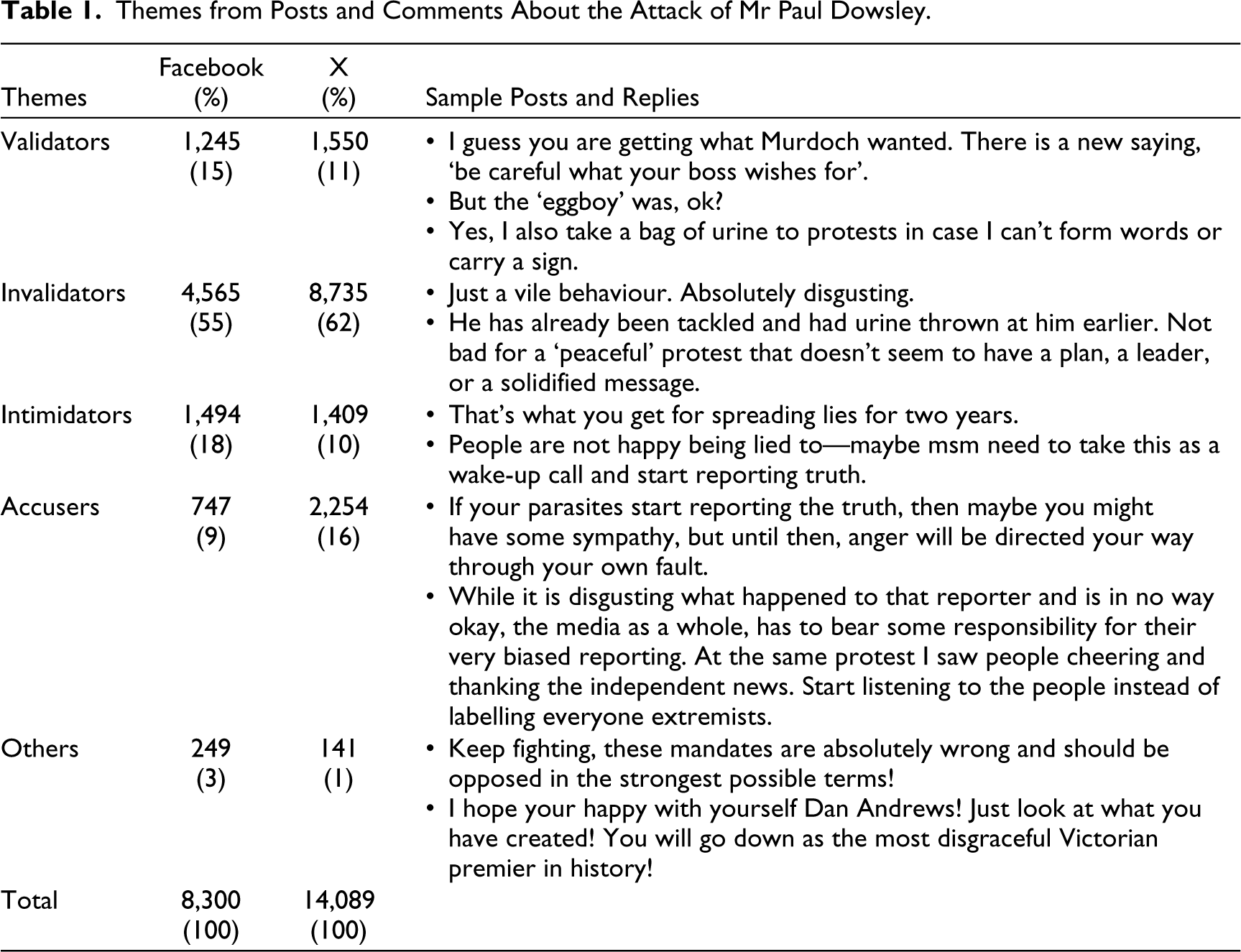
Though these social media users are in the minority, it was, however, still significant that people supported the physical attack of a reporter. One of the replies to the post about the attack reads, ‘I am sorry Paul. Jesus, could you all not have seen that Murdoch winding up Nazis over many years might have this result?’. This post may appear tamed and contrite, but it is an ‘I told you so’ kind of response that validates the behaviour of those that assaulted the journalist. Another X user posted, ‘pretty sure their message is centrally focused on forced mandatory vaxx in order to earn an income. Not that difficult to comprehend’. This user was responding to an invalidating tweet, and from the tone, he is validating the anti-lockdown protesters. A Facebook user validated the assault when he posted, ‘Not a fan of these protestors or anything they stand for but is it possible the bags of “urine” are bags of vinegar (to neutralise the capsicum spray)?’. These posts, comments and tweets are validating the actions of the protesters.
The posts that justified the physical assault of Mr Dowsley were sarcastic in nature. The posts showed an outpouring of vile against journalists and their institution in Australia. Specifically, the posts mocked journalists and the ownership of 7News. These Validators did not show any concern for the attacked journalist. The validators used satirical words to support the actions of the protesters. For example, a Facebook user posted, ‘it would not have happened if he was doing the right thing’. These posts were sarcastic but in a patronising way to the protesters that assaulted the 7News reporter. It means that those social media users do not only hold anti-press views but also sympathise with those that assaulted the reporter. They validated the attack by arguing that the journalist had it coming. These tweets show that these social media users are unconcerned about the danger that such violent actions hold for journalists in Australia. In contrast, these tweets succinctly display how those social media users approved of the physical assault of Mr Dowsley.
Beyond validating the protesters and their actions, some social media users also started rationalising the assault and blaming the journalists and their organisations for the incident. A Facebook user in rationalising the attack noted:
This has been brewing for quite some time and Sunrise is complicit through very biased reporting as well as condoning the brutal tactics adopted by police when dealing with demonstrators during previous protests through broadcasting vision of such incidents without comment regarding the unnecessary brutal tactics of police. (White, 2021)
These comments and tweets by Facebook and X users show that they approved of the hostilities towards the journalist. The last Facebook post attempted to rationalise the attack and to blame the journalist for the attack. It is obvious from the way that the Facebook user phrased the post that he was in support of not only the assault of Mr Dowsley but also wanted to further hurt journalists and their media organisations. With some of the comments, it is apparent that some Facebook and X users in Australia were in support of the harassment and assault of the 7News reporter. With such support and approval to assault journalists, these social media users tacitly are encouraging an increase in harassment and assault of journalists in Australia.
Invalidators: Defending Mr Dowsley and 7News Network
The majority of the posts that were analysed invalidated the attacked. These Facebook and X posts showed contrition and discouraged the harassment of journalists. Invalidators are Facebook and X users who criticised the attack against the 7News reporter. These posts were clear, and some of them were angry at the actions of their fellow citizens.
As shown in Table 1, 55% (4,565) of the Facebook posts and comments as well as 62% (8,735) of X posts and replies regarding the physical attack of the 7News reporter discouraged and invalidated the violent act. The fact that the majority of posts and tweets criticised the actions of the protesters is encouraging. This entails that the majority of those that responded to the physical assault of the reporter did not support the actions of the anti-vaccine and lockdown protesters. This is encouraging for journalists and journalism as a profession in Australia. It means that ordinary Australians have not given up on them as they demonstrated empathetic feeling towards the press. Some of the tweets and posts that invalidated the actions of the protesters were quite strong. For example, a Facebook user in a reply noted, ‘just a vile behaviour. Absolutely disgusting’. These posts show that a greater number of those that responded to the attacks against the journalists on Facebook and X were against the act. These persons frowned at the violent attack of the 7News reporter.
Some of the contrite posts and tweets were outraged that protesters could go that far. Due to the shock, some of the posts and tweets were cursive in nature. For example, in defending the 7News reporter and invalidating the actions of the protesters, a user on X posted, ‘wow, you are good. It’s not a protest, it’s not peaceful, it has no plan or message. Just a group of terrorists wanting violence and disorder. Well-done’. Another user posted, ‘they are man babies too scared of a little injection. They show their ignorance. Not bright enough to research.’ All these point to the debate that ensued after the protesters assaulted Mr Dowsley, a 7News reporter. Some of those that posted support for the journalist and invalidated the violent act were themselves trades people (tradies). They were not in support of the harassment and assault of the journalist. They tweeted their dissatisfaction with such action. The pushbacks from some social media users were encouraging, as the sheer number of posts, comments and replies on X and Facebook that were against the violent protesters demonstrates the lack of appetite for harassment of journalists in Australia. The graveness of the situation was captured by one of the tweets from an X user. The post reads, ‘this does not look like Australia, this is so un-Australian. Grow up Australia. So pathetic. Violent aggressive rioting is not the answer. Very sad.’ This post shows how disgusted the X user was and the absurdities of the situations.
A Facebook user defended the journalists after some posts blamed the journalist and 7News for the cause of the attack. In response to the responses that blamed the journalists, the Facebook user noted:
I was watching when this took place, Paul did nothing or said anything to deserve that. Which if he did, he would have every right to call them thugs and criminals, because that is exactly what they are. It was not the tradies who were violent it was the mob mentality of thugs who wouldn’t have the guts without their violent mates to even turn up. (Daley, 2021)
What the above Facebook user is disgusted about are the comments that blamed Mr Paul Dowsley of 7News as the cause of the violent attacks against him. Many comments on Facebook have alleged that he called the protesters ‘thugs’ in his media reports the previous day. Those allegations were rebuffed by the above Facebook user. According to the Facebook user, the 7News reporter did not put a foot wrong but was only doing his job. She perceived the violent attack as loathsome and unbecoming. She was not alone. Another Facebook user commented, ‘true blue Aussies don’t behave like this’. Yet another Facebook user posted, ‘this mob was just there to cause damage and destruction. A very sad sight to see’. One other Facebook remonstrated, ‘disgusting behaviour—if you want to protest go ahead and protest. Don’t terrorise innocent people that are just trying to go about their day’. These comments show that the Invalidators were as charged and angry as the Validators. This is encouraging as it shows that many Australians online have low tolerance for online harassment and offline harassment of journalists.
Intimidators and Accusers: Accusing the Media of Reportorial Misconduct
Beyond those that validated and invalidated the physical assault of the 7News reporter, some of the Facebook and X posts and replies were categorised as either intimidating or accusative in nature. Intimidating posts were posts that threatened journalists and their media organisations. These posts could easily be classified as online harassment of journalists and media organisations. These posts were meant to intimidate journalists in Australia. These threatening tweets ranged from acute, chronic to escalatory (Holton et al., 2021). The intimidating category consists of posts that threatened other media organisations and journalists beyond 7News and Mr Paul Dowsley. The category also applied to posts that further threatened Mr Dowsley and 7News. According to Table 1, about 18% (1,494) of the Facebook posts and comments and 10% (1,409) of posts and replies on X about the attack of the 7News reporter in Melbourne were intimidating and threatening. Some posts and tweets threatened further harassment of Mr Dowsley and 7News.
In response to the news of the violent attacks on Mr Paul Dowsley, an X user posted, ‘that’s what you get for spreading lies for two years’. In a subtle threat, a Facebook user commented, ‘really? Why didn’t you report the 70-year-old getting sprayed by police? Is she ok? Did you interview her?’. There were accusations of police brutality among the Validators of the violent attack on Mr Dowsley. According to them, the mainstream media’s ‘inability’ to report on the alleged police brutality is the cause of the violent attack on Mr Paul. The comment above emerged from that school of thought. A Another version of this threat is a comment from another Facebook user who noted, ‘I’m not surprised the media were targeted. Journalism has fallen to sensationalism’. The Facebook user inadvertently makes the point that unless journalists report what they think is the real news or appropriate news, they will be targeted.
These comments and posts, amongst others, blamed the attacks of journalists on the journalists themselves. However, these intimidating and threatening posts could silence and censor journalists and bring about a chilling situation that will adversely impact the functioning of journalism in Australia. These threats could be seen as harassment of journalists.
Accusers are Facebook and X users who posted critical messages about the attack. The Accusers post derogatory and critical views of journalists. Their post in some way validates the attack on the 7News reporter. The comments of the Accusers allege that journalists and media organisations in Australia are on the side of their oppressors. This category of posts refers to posts that accuse the media of bias and stoking tension in the society. Some of the posts also accuse media organisations of elitist mentality and that journalists work for and with those who are oppressing the masses.
Facebook and X users whose posts formed the basis for this category justified their hostilities towards journalists in Australia by accusing them journalists of biased reportage. These social media users, through their posts, believe that reportorial issues were the reasons for the violent attack on the reporter. This theme is a collection of posts online that accuse media organisations of reportorial misconduct. They accused the press of being biased and unprofessional. Some other social media users argue that the press is part of their oppressors. They assumed that the press shielded those in power. An X user argued, ‘the message is clear, you are fake news, great accuracy! Never shed a tear or care for these traitors in the media’. This post was sarcastic but in a patronising way to the protesters that assaulted the 7News reporter. Another user posted, ‘well, if only all journalists told the truth. I don’t follow this one, so don’t know, but there is very little of what matters being shown on mainstream media these days’. Accusing the press of biased reporting, among other things, was quite pronounced. It was more on the Facebook responses than the X responses.
A Facebook user accused the press of biased reporting. The users alleged, ‘…the media must bear some responsibility for their very biased reporting. At the same protest I saw people cheering and thanking the independent news. Start listening to the people instead of labelling everyone extremists.’ Another argued, ‘I do not condone violence but when TV media constantly lie and spread fear, this violence unfortunately will happen’. A comment from a Facebook user summed up the grouse of those that accused the press of bias:
Sorry CH7 but it had nothing to do on personal attack issue rather a reporting the events that took place. You guy’s and the MSM only show and report what you want and what you want the public to believe, however we are lucky to have some independent media that broadcasted live every moment leaving your lies and misinformation out in the cold. Wake up to yourselves and report the true facts on what’s going on.
Studies (Fisher et al., 2020; Park et al., 2022) have reported on the falling trust issues in the Australian press. Here, some Facebook and X users who responded to the news of the violent attack against the 7News reporter believe that it was a reportorial issue that led to the attack. This distrust and non-alignment of expectations between the public and the press have raised suspicion that the press have been bought and biased. Consequently, when the press refuses to sing from the same hymn book as some social media users, they then target and harass the press. The physical assault of Mr Dowsley is the manifestation of these parallel expectations and principles. The morphing of this seething anger into the violent attack on a journalist is serious and dangerous.
Discussion
This study probes the themes and framing from Facebook and X users regarding the attack of a 7News reporter, Mr Paul Dowsley, during the 2021 anti-lockdown and vaccine protests in Melbourne, Australia. This study classified the posts into the following categories: Validators of the violent attack of Mr Dowsley, Invalidators of the attack, Intimidators, and Accusers. Within the categories, this study shows that the majority of Australian X and Facebook users were not in support and invalidated the violent attack of the 7News reporter. Our findings further revealed that the majority of the posts abhorred the violent attack on the journalist.
Although many of the posts invalidated the attack and defended journalists, they often mentioned general dissatisfaction with journalistic products. Invalidators were unhappy with the assault of the journalist as they felt that he was doing his job and did not deserve to be assaulted. They mentioned how the violent behaviour was un-Australian and mob-like. Posts and tweets that invalidated the assault on Mr Dowsley alluded to the fact that physically assaulting a reporter because the reporter did not report what a set of people wanted could lead to ‘mob censorship’ (Waisbord, 2020) and could have a chilling effect on journalists. These contrite voices defended the rights of journalists and highlighted the importance of journalism as an institution in a democracy. These strong stances contrast with those of the Validators, Intimidators and even Accusers. They disavowed the assault and called for the cessation of such acts. They used their posts and tweets to highlight the danger of attacking the press.
Validators, while in the minority, were dissatisfied with the media, with many Facebook and X posts showing overwhelming disdain for the Australian press from their posts. Facebook and X users who validated the attack on 7News reporter as well as those that threatened journalists, including threatening further attacks on 7News journalists, perceived the media as ‘the enemy of the people’ (Carlson et al., 2021). These posts and comments, as well as tweets, were sarcastically validating and approving the attack. Some outrightly threatened both journalists and their media organisations with further violence. This study shows that Validators and Intimidators hated journalists and media organisations and believed that the press contributes to societal ills rather than solving them.
Intimidators or the posts that threatened journalists and media organisations have the hallmark of escalatory harassment. Data from this study demonstrate that unlike Validators, who simply praised protesters for assaulting Mr Dowsley, Intimidators displayed went further than validating the attack. Intimidators engaged in networked or online harassment of journalists (Holton et al., 2021; Marwick, 2021). Crucially, the posts conjure the definitional principles of harassment of the press and mob censorship.
This study demonstrates that Accusers validated the assault of the 7News reporter. Accusers are Facebook and X users in Australia whose posts and comments, as well as tweets and replies, accused and alleged reportorial misconduct. Some users of these social media platforms, particularly those on Facebook, blamed and accused the press of bias. They alleged that the press serves as shills for the leaders who the Accusers view as their oppressors. The accusation that the media is not doing enough and that the media act as a front for the political class is not uniquely Australian. This accusation has been labelled to the press in other countries (Akinola et al., 2022; Andersen et al., 2023; Tsfati & Peri, 2006; Uwalaka & Amadi, 2023a). See Figure 1 for sample tweets and Facebook posts.
Sample Facebook Comments and X Posts.
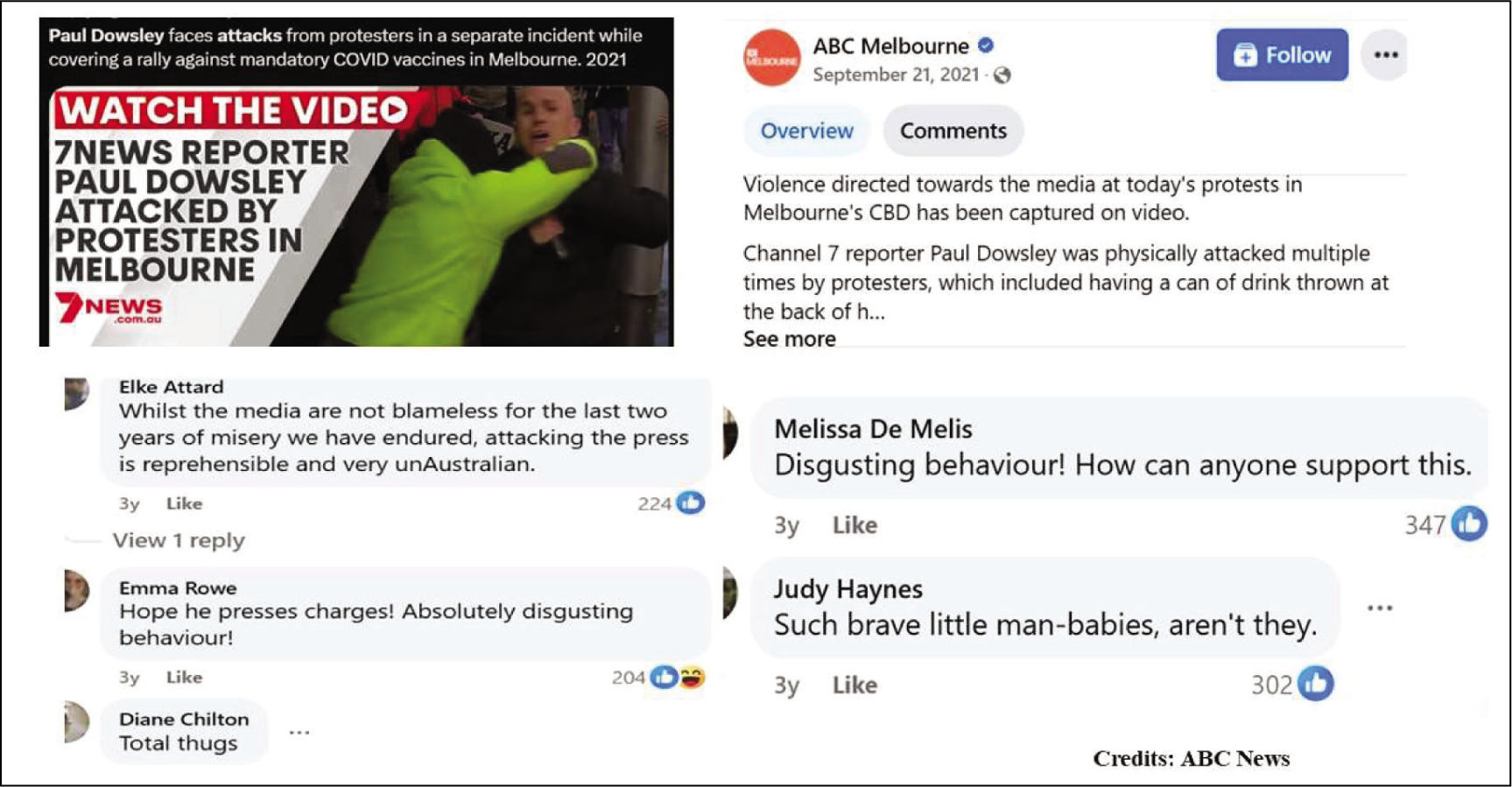
The response of Invalidators resonates with the defence and support forms of responses when a journalist is attacked (Burch et al., 2023). The defence and support responses during an attack on a journalist are usually comments sympathetic to the journalist who was attacked. This study labels those that sympathised with and defended the reporter that was attacked in Melbourne, Australia, as Invalidators. This is because they called out the abuses and the prejudices that online attackers directed at the reporter. Invalidators leaped to the defence and support of the 7News reporter. They acknowledged the abuses and rebuked the name-calling and ridiculing comments. These social media users saw Mr Dowsley as a victim.
In contrast, Validators, Intimidators and Accusers were critical, abusive, humiliated and shamed the journalist (Burch et al., 2023). Their response to the attack created an ‘abusive echo chamber’ (Burch et al., 2023, p. 15) where profanities, ad hominem invective, hyperbolic vulgarity and extravagant imagery of violence reigned supreme. These responses are forms of ‘e-bile’ (Jane, 2014a, 2014b). Responses from Validators, Intimidators and Accusers show that these social media users enjoy their activities online. The enthusiastic derision with which the Validators, Intimidators and Accusers responded to the attack on Mr Dowsley reveals that they relish their stichomythic exchanges. Their garishly punctuated threats to 7News and other media organisations approach recreational nastiness (Jane, 2014a).
This study illuminates the seriousness of hostilities towards the press from social media users. It reveals that Facebook and X users in Australia accused the press of supporting the political class in their oppressive behaviour. The study demonstrates that there are two sets of Australians: those that have embraced violence against the press and those who believe in the role of the press. Findings from this study contrast with those of some other studies (Burch et al., 2023; Jane, 2014a, 2014b), where e-bile and critical commentaries are in the majority. These e-bile and critical commentaries are used to shame and humiliate the journalist who was attacked. This study shows that posts that supported and defended the journalist were in the majority. This indicates that a greater number of Facebook and X users in Australia still appreciate the contributions of journalists to public debate and democracy.
This study contributes to journalism literature in two ways. First, the study demonstrates that even in these trying times, many Australians are good-mannered and democracy-loving citizens. This is more so with Australians who use social media platforms. The high number of social media users who invalidated the assault on the reporter shows that many Australian netizens acknowledge the need for the press and the salience of protecting their rights. This contribution is in contrast to cases in other countries, such as Nigeria (Uwalaka et al., 2024). In the Nigerian context, findings show that threats to press freedom are high. The attacks on journalists in areas such as Nigeria show that press freedom and the fourth estate role are in jeopardy (Uwalaka & Amadi, 2023b; Uwalaka et al., 2023, 2024). Although Australians are increasingly becoming angry with the press, they still understand the need for the press.
Second, this study makes a methodological contribution in that it tests a framework of investigating online responses. This study corroborates methodologically on how online responses should be studied. The study confirms the usability of Uwalaka et al. (2024) typology. This methodological contribution helps improve the literature by expanding methods through which social media posts and reactions could be studied in journalism studies. This study further illustrates how this typology and framework can be applied as a theoretical framework to analyse similar cases.
The foregoing has great implications for the journalism profession. With the sheer volume of the posts that invalidated the violent assault, it means that journalists are still loved and not in grave danger in Australia. This indicates that the Australian populace understands the nature of the job that journalists embark on. This study demonstrates that most Australian social media users do not wish harm to journalists and are intolerant of such behaviour.
Conclusion
This study analysed 22,389 posts and replies regarding the attack of a 7News reporter, Mr Paul Dowsley, during the 2021 anti-lockdown and vaccine protests in Melbourne, Australia. The study found that a small percentage of Facebook and X users in Australia validated the assault of the 7News reporter as well as threatened violence against journalists in Australia. The study further uncovers that some social media users who responded to the attack are distrustful of the media and see the media almost as the ‘enemy of the people’ rather than helpers (Carlson et al., 2021). This study argues that while criticism of the press is necessary and does have some praxeological benefits, that attack of journalists should not be misrecognised as an objective critique of journalism products.
The posts were classified into different categories. The Validators support the activities of the attackers, including the physical assault of Mr Dowsley. They posted congratulatory messages to those who attacked the reporter in Melbourne. It is not all gloom though. This study found posts from those who are labelled Invalidators. These are those that were not in support of the violent attack of the 7News journalist. These people sympathised with the journalist and criticised the actions of the attackers who attacked the journalist. Intimidators were labelled from posts that threatened more violence on the journalists and their institution. Then there were the Accusers. These people were from the posts that accused journalists in Australia of a lack of transparency in their reportage. From the categories, the study demonstrates that journalists in Australia are still fine, as many responses defended Mr Dowsley and the institution.
This study reported on social media content analysis. There are some drawbacks regarding the representativeness of the sample. However, the enormous dataset and the number of posts that were analysed, and the fact that these were direct contents of the users, give this study further legitimacy and completeness. This means that the results enunciated in this study are important in the journalism literature.
Finally, the study reveals that while Australian social media users validated and threatened to further harass the press, a greater percentage of Facebook and X users in Australia invalidated the actions of the protesters. This study demonstrates that while hostilities towards the press are serious and concerning, the majority of Australians on Facebook and X disapprove of violent attacks and harassments of journalists.
Footnotes
Declaration of Conflicting Interests
The author declared no potential conflicts of interest with respect to the research, authorship and/or publication of this article.
Funding
The author received no financial support for the research, authorship and/or publication of this article.