



Abstract
Increasingly, music festivals in Australia are being cancelled, postponed or otherwise impacted by extreme weather events, including floods throughout 2022 and bushfires in 2018–2019. These and other forms of extreme weather, such as dangerous heat and drought, are predicted to increase in frequency and severity due to climate change. However, relative to the size of the problem, there is a lack of attention in both public discussion and scholarly literature to the impacts of extreme weather and climate change on the festival sector, and the need to adapt in response. This study explores this issue in the context of Australian music festivals. The threat of extreme weather to the Australian music festival sector and its benefits is outlined, with reference to climate science predictions as against known festival activity, as well as a detailed overview of recent impacts. This is followed by an examination of how music festival stakeholders in industry and government are responding to this challenge, through the analysis of policy submissions, media comments and changes of practice. This article concludes by proposing a set of questions and issues for research, policy and action concerning the escalating impact of extreme weather on music festivals in Australia, with relevance to other places.
Introduction
The 20th edition of Splendour in the Grass, Australia's largest ticketed, annual music festival, was highly anticipated by the time of its staging near Byron Bay in July 2022. The milestone event was originally scheduled in 2020 and sold out of a record 50,000 tickets within an hour of their February release. Several weeks later, the first wave of the COVID-19 pandemic triggered the first of three postponements spanning the next two years. Patrons were repeatedly encouraged to retain their tickets and, with the core of the international performing lineup largely intact, Splendour 2022 was framed as a resumption of normal programming and a flagship for the festival season to follow. It was early afternoon, shortly before the opening act, when organisers announced the cancellation of all four main stages for the entire first day, citing safety concerns due to rain-flooded grounds and a threatening offshore weather system. The two remaining days proceeded despite inundation, with the attendant problems and complaints receiving major media coverage, during which the event was renamed ‘Splendour in the Mud’ (McMillen, 2022).
While Splendour generated the most prominent headlines, it was preceded and followed by numerous other, weather-related festival disruptions. Throughout 2022, more than 20 music festivals in Australia’s eastern states were postponed or cancelled due to rain and flooding. Notice ranged from hours to months, but in all cases the performers had been announced, marketing campaigns rolled out, and some or all tickets sold. Before the COVID-19 pandemic, Australia's Black Summer 2019–2020 bushfire season also impacted festivals. Among these, the Falls Festival in Lorne, Victoria, was cancelled on the second morning of its four-day run to New Year's Eve, with 9,000 camping patrons directed to leave and thousands more prohibited from arriving. Some festivals were impacted by both fire and flood, such as Yours and Owls festival of Wollongong, NSW, which was cancelled with less than a week's notice in both 2020 and 2022. Table 1 lists all these festivals and other festival cancellations. Reporting on the most recent spate of cancellations, Australian online magazine The Music suggested, ‘the growing risk of extreme weather events is just another unfortunate factor that promoters must consider when throwing a festival’ (Tritsiniotis, 2022, n.p.). Disruption by weather has been a risk for festival organisers in Australia since the first rock festivals in the early 1970s (Strong et al., 2023), but the dramatic increase in extreme events, and firm predictions that these will become even more common, necessitate new ways of approaching festival organising and related policy.
In this article, we explore this ‘unfortunate factor’ and its growing consequences for Australian music festivals. First, we consider how the relationship of weather and music festivals is recognised in the existing literature. This highlights the need to address a broader gap in understanding about the implications of climate change for events. Second, we outline the ways that extreme weather has affected, and is likely to affect, music festivals in Australia. We compile data from media reports on postponements and cancellations over the last ten years, and we analyse leading climate science predictions to ascertain the likely implications for Australian festivals and their benefits. Third, we examine how the music festival sector is responding to the challenge of extreme weather, based on our review of recent policy submissions, media comments and changes of practice. Finally, building on the previous sections, we propose a set of questions and issues for research, policy and action concerning the escalating impact of extreme weather on music festivals in Australia.
Literature review: festivals, weather and climate
Historically, across human cultures, festivals were linked to seasons and their localised environmental effects. Contemporary festivals have been somewhat abstracted from these contexts by processes of mobility, globalisation and commercialisation, yet they continue to represent and contribute to local places and communities (Bennett et al., 2014). In contrast to typical live music performances at indoor, urban venues, modern music festivals tend to be associated with outdoor, greenfield and rural settings (McKay, 2015). Such locations and the travel required to attend them contribute to the vaunted liminal (Luckman, 2014) or liminoid (Anderton, 2018) qualities of the music festival experience, especially in certain types of festival such as the ‘bush doofs’ of Australia's electronic dance music culture. Regional towns and scenic locations are central to the unique character and appeal of many festivals, as sites of destination tourism. In turn, festivals are thought to contribute to regional economic development and community cohesion, including in rural and remote places suffering from general decline or acute crisis such as drought (Gibson, 2007; Gibson & Connell, 2015). Regional festivals are an element of cultural tourism, which was inhibited during COVID-19, but a potential contributor to regional revitalisation in its aftermath (Flew & Kirkwood, 2021). Gibson and Connell (2012) observe that in regional Australia, music festivals are connected to local seasonality by environmental factors (such as the limited dry season in Darwin), as well as tourism economies. Festivals may anchor the high season or provide an off-peak attraction (as in Mount Hotham during the snowless summer).
Weather is a major factor affecting the operation of music festivals and the experiences of those who attend. Rain and wind, let alone extreme events like floods and fires, can discourage attendance, disrupt proceedings, increase costs and reduce viability (Gibson and Connell, 2012). This aspect of open-air festivals has often been framed in romantic terms, for example, in media representations and popular associations of mud at the iconic Woodstock and Glastonbury festivals, or dramatic conjunctions like instrumental group of the Dirty Three playing ‘with the backdrop of a giant electrical storm’ at the Meredith Music Festival in rural Victoria (Ash, 2011, n.p.). In Australia, Cummings and Herborn (2015) observe that music festivals have long been associated with the embodied experience of heat, including sweat, dust, exposed skin, sunburn and emotions of disgust and anger toward fellow patrons. In live music as in sports, Australia follows a seasonal calendar imported from the very different climatic context of northern Europe, resulting in dangerous heat at summer events like tennis, cricket and music festivals. Posters and merchandise for the second Splendour in the Grass festival in 2002 bore stylised snowflakes, not because they would be likely to fall in the humid subtropical climate of Byron Bay, but presumably to highlight the festival's then-unusual scheduling in late July, at the height of winter.
The relationship between music festivals and climate change has mostly been studied in terms of mitigation, focusing on moves by some event organisers to reduce and offset their carbon emissions and to promote environmental consciousness among patrons (Cummings, 2014; Duffy & Mair, 2021). There has been less attention to the impacts of climate change on the events themselves, and ways that organisers and other stakeholders might adapt. This is consistent with a ‘startling’ lack of research about the impact of climate change on festivals and events more generally (Duffy & Mair, 2021, p.11). This issue is addressed in Chris Gibson's (2007) study of Australian non-metropolitan festivals in the 2000s, which includes attention to the context of the Millennium Drought, and explored more specifically in Gibson and Connell's (2015) study of festivals in drought-affected Australian communities. They report that those events were affected by lack of water and bare ground as well as significant secondary factors like economic downturn, out-migration, reduced tourism and mental health crisis. Arts and music festivals reported fewer negative impacts than other types, such as agricultural and gardening shows. Rural festivals that did proceed were reported to contribute to community adaptation, in social and psychological respects as well as information sharing, technical innovation and creative frugality. There has been some consideration in events literature of how climate change impacts sporting events, such as quantifying the reduction in viable Olympic Games host cities due to predicted temperature and sea-level rises (DeChano-Cook & Shelley, 2017). Sports may be more obviously dependent on specific terrain and weather conditions, while also drawing sharper focus to the ways environmental specificities like air quality and temperature affect human activity. However, as discussed above, music festivals are also substantially defined and shaped by such factors, and certainly limited by extreme weather and natural disasters.
At the more general level of tourism and events, Judith Mair (2011) observes a gap in understanding of the implications of climate change and outlines an Australian perspective. There are biophysical impacts including rainfall, temperature, sea-level rise, storm surge, bushfire, reduced rainfall and water accessibility; and socio-economic impacts including infrastructure damage, destination image and demand, consumer behaviour and policy responses including those that increase travel costs. In terms of possible responses, Mair identifies technical adaptation, such as relocation or renovation; business management adaptation, such as costs and timing; and behavioural adaptation, such as clothing, equipment and consumer decisions by attendees. The capacity to adapt varies among regions, countries and socioeconomic groups, as well as between small and large events. According to Mair, attendees have the highest adaptive capacity, in terms of time, place and activity, which is a problem for the events that depend on their attendance. Major events and festivals have limited adaptive capacity, as relocation carries high financial risks. Hallmark events tied to certain destinations, and community events with limited resources, have the lowest adaptive capacity, while the impact of success or failure can be great. With specific regard to music festivals, Mair suggests that the extension of tourist season into less extreme ‘shoulder’ periods could provide opportunities for mid-summer festivals to move their dates, reducing competition over the New Year period, although new events might also emerge in these extended seasons. In the decade since Mair's (2011) overview, climate change impacts and predictions have worsened. However, there remains a gap in the systematic evaluation of adaptation measures in the context of events, and more troublingly a lack of any evidence of strategic efforts to adapt to climate-related risks (Mair, 2022). Among the many consequences of this gap is a need to consider the threat posed by extreme weather to the Australian music festival sector, and its implications for industry action, government policy and scholarly research. In the following sections, we begin to evaluate this threat, by enumerating known incidents and by examining relevant predictions, before turning to the issue of adaptation.
Extreme weather impacts on Australian music festivals 2013–2023
We searched online news archives, including metropolitan and regional newspapers as well as music publications (e.g., The Music and Music Feeds), to compile the table of festival cancellations, postponements, relocations and evacuations due to extreme weather in Australia between 2013 and 2023 (Table 1). Estimated attendance numbers are drawn from news reports, in some cases about other editions of the same festival. We have only included events that were promoted as music festivals (thus excluding, for example, agricultural, food and multicultural festivals that include live music) and where extreme weather was expressly cited as a reason for the action taken.
Australian music festivals and their cancellations.
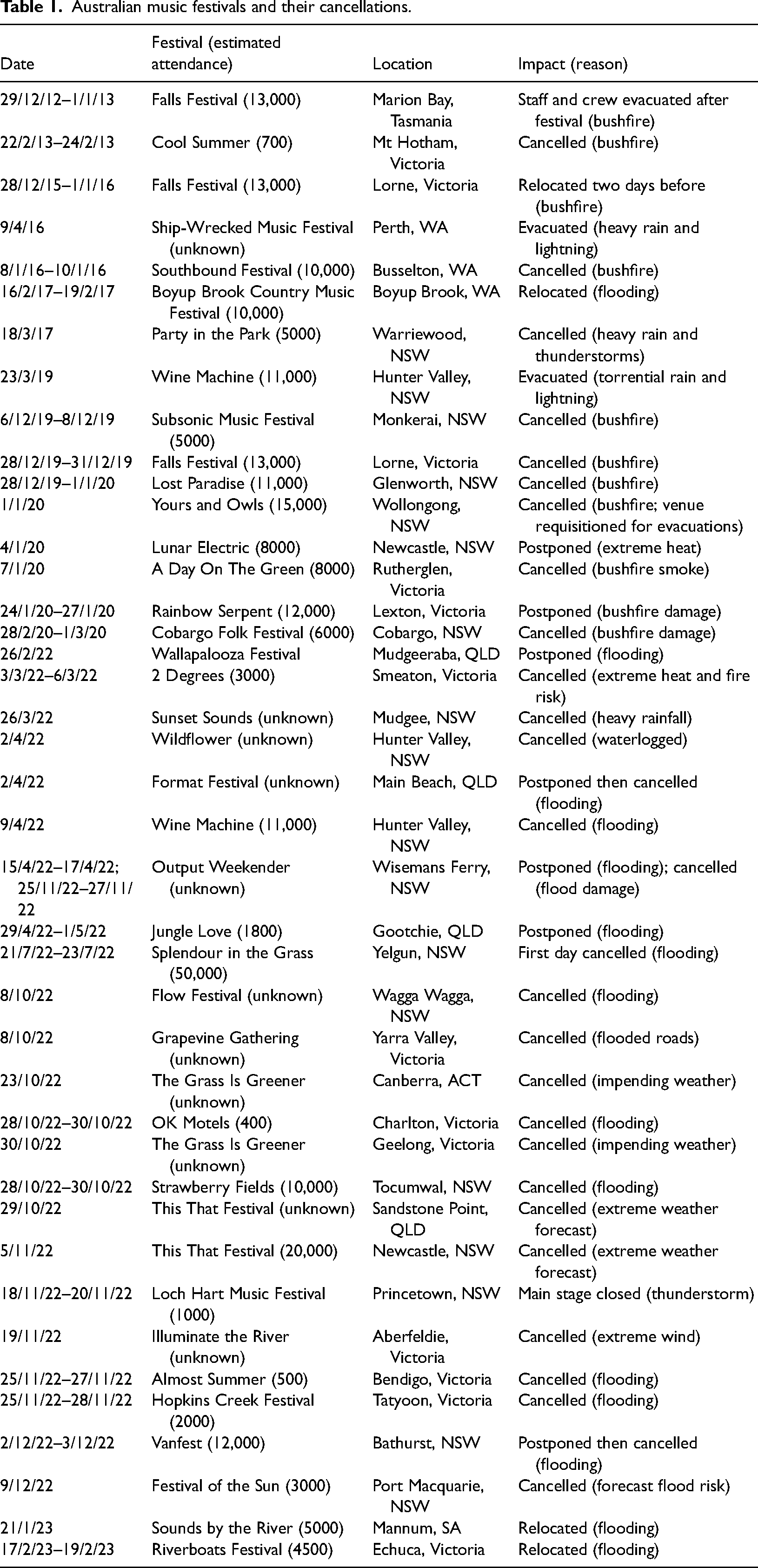
Table 1 shows a dramatic increase in weather-related festival disruptions since 2019. (Regarding the absence of incidents between March 2020 and February 2022, we note that very few festivals were attempted in Australia during this time due to the COVID-19 pandemic and associated public health regulations.) The trend may be attributable partly to a rise in the number of festivals over the last decade, especially smaller ‘boutique’ festivals, as well as the severity, extent and duration of the 2019–2020 bushfires and the 2022 rain and flood events. In these respects, the disasters are consistent with the climate science predictions discussed below.
Climate change impacts on Australian weather events
Climate change impacts are already affecting the continent in a variety of ways. For the following discussion, we have reviewed the leading international and national reports on the issue: the sixth and latest report of the Intergovernmental Panel on Climate Change (2022) (‘IPCC6’), and the sixth CSIRO/Bureau of Meteorology (2020) State of the Climate report, to identify the relevant observations and predictions. According to the CSIRO/BOM report, Australia has already experienced a 1.44° overall rise in temperatures since records began. Rainfall has increased in some areas and decreased in others, while an overall rise in sea levels and sea acidification and temperatures has been recorded. Furthermore: Over the coming decades, Australia is projected to experience: Continued warming, with more extremely hot days and fewer extremely cool days. A decrease in cool season rainfall across many regions of the south and east, likely leading to more time spent in drought. A longer fire season for the south and east and an increase in the number of dangerous fire weather days. More intense short-duration heavy rainfall events throughout the country. (CSIRO/BOM, 2020)
Noteworthy here is that on a continent the size of Australia, impacts will be significantly different in different areas, and the potential impact on any given festival will be highly dependent on its location and time. For example, IPCC6 (1583) notes that southern and eastern Australia will see more extreme fire weather and increased droughts, while northern Australia will have a higher risk of extreme floods (1612), although determining the extent of these is currently difficult. The IPCC6 also notes that urban areas will be at increased of pluvial flooding (i.e., flash floods from extreme rainfall), a risk that will also need to be considered by festivals that choose, as the Falls Festival has done in 2022, to relocate from a greenfield site to an urban one. Similarly, festivals held in coastal areas will face risks unique to those areas due to sea-level rise, which results in ‘changes in waves, storm surge, rising water tables, river flows and alterations in sediment delivery to the coast’ (IPCC6, 1621), although these will also be differentiated by region.
In some cases, the greenfield sites used for festivals are available precisely because of their vulnerability to weather. A festival site should accessible by road, with some open terrain that is not too steep or rocky, and ideally aesthetically pleasing. There is benefit, especially for major events, in proximity to emergency services, production and hospitality providers, and transport hubs. However, despite these qualities, the site must not have a conflicting use like agriculture, industry, housing or tourism, or be protected under conservation laws. These criteria often leave land that is prone to flooding. An example is the North Byron Parklands, the privately-owned site of Splendour in the Grass and Falls Festival as well as smaller events, which received permanent approval for such use in 2019 after a contested nine-year process in which flood and bushfire management were among the issues (Independent Planning Commission, 2019).
Just as weather impacts will play out differently for any given festival, planning for expected changes will also be complicated by the interactions between extreme events that may create non-linear and unpredictable outcomes. The CSIRO/BOM report (2020) notes that: … the warming trend, primarily caused by climate change, increases the likelihood of extreme events that are beyond our historical experience. Multiple lines of evidence, including from observations and future climate change projections, point to a continuing trend of more frequent compound extreme events. Projecting the occurrence and severity of extreme events is therefore essential for current and future risk assessments, and for climate adaptation strategies and responses. (p. 8)
Similarly, the ways that climate changes impacting on festivals intersect with and exacerbate other climate-related issues need to be understood. Changing landscapes, whether through rising waters, persistent floods and fires, or heat-affected vegetation, may alter a site's suitability for a festival, and these combined factors – the loss of a festival and its guaranteed influx of people, and a decreasingly appealing area – could have serious flow-on effects for tourism in regional areas. As the contribution of festivals to local economies and communities varies with their size, organisation and other factors (Gibson & Connell, 2012), so will the consequences of cancellation or relocation. Possible harms for festival-goers that already exist may also be exacerbated; for example, heat can increase the likelihood of adverse outcomes related to the use of drugs at festivals (Palamar & Sönmez, 2022).
Any breakdown in the festival circuit, or even the short-term interruptions associated with one iteration of a festival being cancelled, can have flow-on effects for the entire Australian live music ecosystem. Australia is a long way from the major touring circuits of other parts of the world (particularly the lucrative US and European markets), and is also a large geographic area with relatively few population centres. Festivals can make it financially viable for artists to tour who may not otherwise have been able to and, subject to the scope of their exclusivity commitments to festival promoters, those artists typically book ‘sideshows’ and increase their reach to new audiences. This has benefits to Australian audiences in increasing their access to international touring acts, as well as providing opportunities for local venues, support acts, road crew, production and technical providers, hospitality industries and other ancillary services and staff. The cancellation of a festival therefore has significant flow-on effects.
At the extremes of predicted outcomes, given a current barely (if at all)-mitigated continuing increase in greenhouse gases and predictions that the ‘safe’ limit of 1.5° of warming is almost certainly going to be breached (United Nations Environment Programme, 2022), global impacts on food supplies and infrastructure, increased migration and conflict, and the related unequal impacts of these, may lead to an outcome where leisure activities like music festivals simply become untenable in the way they have been conceived in recent decades. As a country expected to be affected more than most by climate impacts, substantial areas of the continent (particularly the top end) are expected to have their overall habitability negatively affected (Xu et al., 2020). It goes without saying that festivals would become impossible in such areas, and this would indeed be one of the least of our concerns in such a scenario.
How is the live music sector responding?
The live music sector, often overlooked previously in national policy discussions, focused on recorded music and exports, staked a more prominent place in public discourse during the COVID-19 pandemic. This included the publication of policy proposals, parliamentary submissions and media statements by industry actors, in many cases with a new level of unity across the sector, and the formation of the Live Entertainment Industry Forum and Australian Live Music Business Council (‘ALMBC’). This voice continued during the development of the Revive national cultural policy launched in January 2023, following the first change of government in a decade and the return of a dedicated Ministry for the Arts in 2022. In this section, we examine how music festival stakeholders have addressed the increasing impact of extreme weather on music festivals in this public discourse. We reviewed all submissions to the Commonwealth Parliamentary Inquiry into Australia's Creative and Cultural Industries & Institutions in 2020 (‘2020 Inquiry’) and the National Cultural Policy Review in 2022 (‘2022 Policy Review’); we also searched the websites of relevant organisations, along with online news archives, for media statements and other communications addressing weather, natural disaster and climate change in relation to live music events.
The Australian Festival Association Inc. (‘AFA’) was incorporated in New South Wales in 2018, in the context of a State parliamentary inquiry following deaths from suspected drug overdoses at music festivals. The AFA's constitutional remit includes advocacy, education, connection, representation and promotion for the festival industry. The AFA's submission to the 2020 Inquiry observes that festivals are especially vulnerable to environmental factors: The business model for a festival is distinctive from others in the live performance industry, with income centralised over a single day, or days, of operation … What if it rains? What if there are bushfires? (AFA, 2020)
There follows a recommendation for an ‘industry-led Live Entertainment Business Interruption Fund underwritten by Government’, to address a crisis of insurance coverage and cost for live events. The current and future impacts of climate change on the risk profile of festivals are not addressed. Two years later, the AFA's submission to the 2022 Policy Review refers only to ‘COVID-related cancellations’, with no further mention of weather or climate, in making the case again for a business interruption scheme (AFA, 2022).
Examining other submissions to both the 2020 Inquiry and the 2022 Policy Review provides further insight into the status of climate as a key issue for the live music and cultural events sector, though often indirectly. A search of submissions to the 2020 Inquiry using terms such as ‘climate, weather, [bush]fire, flood, disaster’ mainly results in submissions describing the difficulties of the previous year, dominated by COVID-19 along with a few, brief mentions of natural disasters in the past period, rather than as future threats that require planning. This may be a function of the inquiry's terms of reference, which included ‘the impact of COVID-19 on the creative and cultural industries’ but otherwise focused on future ‘benefits’ and ‘opportunities’, without reference to challenges that may exist outside the pandemic or into the future (Standing Committee on Communications and the Arts, 2020). Some of the submissions make a connection between festival cancellation and tourism impacts, particularly in regions, in relation to COVID-19, as in this statement from ARIA (2020): It is not just the music industry that has suffered from the loss of live performances. Local communities and economies, especially those in regional Australia, have also suffered from the loss of touring artists and music festivals.
While not extending to climate impacts, this establishes an understanding of the compound consequences of festival cancellations. The report of the Parliamentary Committee on the 2020 Inquiry acknowledges the bushfires and flooding preceding the pandemic, and comments that ‘these highlighted the need for industries, businesses, communities and individuals to innovate, pivot and adjust to new unanticipated realities’ (Commonwealth of Australia, 2021, p. 101). However, this only appears in the context of digital delivery for music, rather than in terms of thinking about either action on climate issues or climate-related barriers to live music consumption.
Submissions from music and live performance stakeholders to the 2022 Policy Review, while often repeating calls for an interruption fund or insurance scheme, make almost no mention of weather events or climate change. The problems of inaccessible insurance and forced cancellation are presented in the context of COVID-19, when context is given at all. Where climate and the environment are mentioned, the focus is on mitigation and not on adaptation. For example, the Live Performance Australia (‘LPA’) submission notes an opportunity for the industry to ‘revise operational models and practices to reduce, respond to and manage environmental and climate change impact’ (LPA, 2022). The submission by Green Music Australia (‘GMA’), which is endorsed via brief reference in the Music Victoria submission, observes that ‘the health of our creative industries depends upon the health of our natural ecosystems’, and includes proposals concerning the role that the music industry might play in reducing emissions and influencing action on climate (GMA, 2022). The submissions do not address how the industry has been and will be impacted by climate change or how these impacts might be ameliorated. This omission suggests the dominance of a ‘business as usual’ approach – even in the midst of the extreme weather events such as the one that affected Splendour in the Grass during the submission window for the review – that shows a continued lack of serious consideration of climate impacts in the Australian music industries.
Other recent policy proposals from the live performance sector include strategies for reducing the impact of disasters, usually focused on government support and insurance, and these are sometimes connected to natural disasters. For example, a pre-Budget submission from LPA in January 2022 observes, ‘Investment in regional creative and cultural industries are more relevant and necessary than ever as regions recover from natural disasters and the COVID-19 pandemic’ (emphasis added, LPA, 2022). Similarly, a ‘three-point plan’ published by a broad alliance of 16 music sector bodies, in the lead up to the Australian Federal election in 2022, calls for a ‘Commonwealth-backed insurance scheme to increase industry confidence and navigate further closures brought on by pandemic health orders and natural disasters’ (emphasis added, APRA AMCOS, 2022, n.p.). This is significant as an explicit recognition, in a formal policy proposal, that the live event insurance crisis extends beyond the pandemic to the consequences of extreme weather. Notably, these submissions do not mention the ongoing increase in the frequency and severity of such disasters due to climate change, despite its relevance to their case. Meanwhile, there have been representations made about the potential contribution of live music and the broader creative sector to natural disaster recovery. The 2020 Royal Commission into National Natural Disaster Arrangements received a submission from sector advocacy body the Live Music Office, proposing a role for live music in regional recovery from natural disasters, as a catalyst for community building and resilience (LMO, 2020). That commission did not receive representations or requests concerned with how the live music sector is affected by, and recovers from such disasters.
In marked contrast to the formal submissions discussed above, industry stakeholders including executive officers of the AFA and LPA have expounded in media comments on the threat posed by climate change to festivals. In July 2022, the AFA's then-General Manager Julia Robinson told SBS News that in the organisation's last annual risk assessment, ‘climate was certainly right up there as one of the biggest risks to the industry’ (Elias, 2022). Ms Robinson predicted that festivals will need to be ‘flexible with planning around dates and locations’, and that ‘conversations around infrastructure’ (such as drainage, evacuation routes and tertiary hospitals) would pick up over the next few years between the organisers, governments and communities. In the same article, the LPA chief executive Evelyn Richardson is quoted predicting that some established festival locations will be deemed too risky for future events (which are borne out by some relocations as listed in Table 1). In September 2022, new AFA managing director Mitch Wilson told ABC news: We’re seeing insurance premiums go through the roof because of both COVID and climate change impacts. We welcomed the federal government's commitment to a national business interruptions scheme. What we would love to do is for them to sit down with industry and work out how we can expand the scheme to include, not only COVID-related impacts, but some of these weather and climate related impacts. (Cross & Jambor, 2022)
As mentioned here, prior to that article the Australian government had announced a short-term ‘COVID-19 Live Performance Support Fund’ to compensate revenue lost due to national mandatory isolation rules (Burke A, 2022). Those isolation rules were lifted before the scheme commenced or was outlined in any detail, making it effectively redundant. However, as the year ended, it was reported that both the AFA and LPA were lobbying the government and ‘pleading’ for a purpose-built scheme to cover weather-driven cancellations (Burke K, 2022). In the light of this, and the explicit public statements we have outlined here, the absence of this issue from formal submissions to the 2022 Policy Review and other public policy submissions is perplexing. The omission may speak to the all-consuming nature of COVID-19 impacts, as well as the cumulative significance of the multiple floods and cancellations that have since occurred.
Unsurprisingly perhaps, given the lack of a focus on them in submissions, the new federal arts policy document resulting from the Policy Review, Revive (Commonwealth of Australia, 2023), says almost nothing about climate impacts. Climate change is mentioned once in the document, in the context of a case study of an art group (p. 83), and there is a passing reference to ‘the increase in event cancellations due to severe weather’ (p. 82). ‘Natural disasters’ are mentioned only in relation to the importance of the broadcasting sector, alongside COVID-19. Cancellations are mentioned but again only briefly, and there is no commitment to an insurance or interruption scheme of the type sought by industry, beyond a vague undertaking to ‘continue activities and programs that support live performance, festivals and touring’ (p. 87). Undertakings in the policy that Music Australia will ‘develop new strategic partnerships within and beyond the music sector, including to undertake research and data collection around key issues, including festivals and venues’ (p. 69), and that Creative Australia will ‘undertake specific research on the national qualitative, quantitative and economic impact of music festivals’ (p. 72) are likely to create scope for examination of the issues outlined in this paper in relation to festivals, but the absence of any specific indication of this is noteworthy. In any case, the approval, support and regulation of festivals will continue to also depend strongly on State and local governments, which are responsible for police, emergency services, traffic and land use approval.
Beyond their proposals to government, we might see live music stakeholders responding to the threat of extreme weather by their direct actions, such as relocations (listed in Table 1), as well as private contractual arrangements between festival promoters and performing artists, suppliers and ticket-holders. Such arrangements are typically confidential, but in the wake of the flood-affected Splendour in the Grass, promoter Secret Sounds was openly accused of using its market dominance (as part of the massive Live Nation group) to insist on clauses limiting the entitlements of performing artists in the event of cancellation, such as occurred on the first day. In the circumstances, the promoter provided ex gratia payments and claimed to have revised their weather cancellation clauses for future festivals (Sainsbury, 2022), but this nevertheless illustrates how the impacts of extreme weather and climate change on the music industries are likely to follow the shape of pre-existing power relations, in ways that may not be publicly visible. Another example is the refusal of insurer, Lloyd's, to accept that the cancellation of Subsonic 2019 was a ‘necessary’ response to nearby bushfires and water shortage, resulting in legal action by the festival organiser (Bolza, 2022).
At BIGSOUND 2022, a music industry conference held in Brisbane in September, a panel entitled ‘How Soon Is Now: How Climate Change Is Impacting Australia's Live Music Industry’ was focused almost entirely on mitigation and awareness-raising by artists and not-for-profit organisations. In the closing minutes, an audience member asked about ‘force majeure’ contract clauses such as those in place for Splendour. A panellist observed that such behind-the-scenes, commercial-legal actions would reveal the true assessment of climate change risks by powerful industry actors, in contrast with the more reassuring messages they might communicate to the ticket-buying public. This insightful comment illustrates the need for cautious, critical analysis of industry discourse about climate change. Open concern and calls for action might be contrary to some business interests, such as the need for consumer confidence in future events, while within the industry there exist multiple, competing interests with differing exposure to various risks. Anyone who would seek to understand responses to climate change within the music industries must take these interests and differences into account, including by observing action as well as rhetoric, and remaining attentive to relative power.
Discussion
By now it is clear that extreme weather is not a long-term risk but an immediate threat to music festivals in Australia. Events such as the record bushfires of 2019–2020 and the floods of 2022, which necessitated the cancellation, postponement and relocation of numerous festivals in multiple regions, provide an especially direct and large-scale demonstration of how climate change presses on the arts. However, this present and growing issue is not proportionately accounted for in the industry discourse that is otherwise flourishing with respect to Australian live music as an object of public policy. As discussed above, this suggests a level of inertia in the face of growing risk (hardly confined to the music industries), consistent with Mair’s (2022) diagnosis of an absence of strategic efforts in the broader events sector to adapt to climate-related risks. Based on the apparent trends and scientific predictions outlined in this article, we offer a summary of key challenges and possible strategies that require attention.
The event safety management plans that are already required of music festivals under local and State regulatory frameworks will need to account for an increased frequency and severity of extreme weather events, to reflect current forecasts provided by national and international bodies. For example, Splendour in the Grass developed a traffic management plan in consultation with various regulatory bodies, but was unable to comply with it due to the unprecedented conditions of July 2022, disrupting the surrounding roads and resulting in an enforceable undertaking to pay $100,000 to the NSW Department of Planning, Industry and Environment for distribution to 10 local schools (White & Herbert, 2022). As this example shows, developing realistic plans to manage both festival impacts and event safety is a joint responsibility of festival organisers and local governments.
Staging festivals in this context involves increasing responsibilities and costs. This compounds the issue of financial sustainability, including the availability and cost of insurance, highlighted during the COVID-19 pandemic. Industry stakeholders have been vocal and consistent in their requests to the national government for assistance in the form of a business interruption fund and insurance underwriting scheme, which are modelled in other industries. However, as discussed above, their public submissions have tended to be contextualised by reference to the pandemic with little or no reference to the existing, and growing, effects of natural disasters and extreme weather, and, moreover, appear to have fallen on deaf ears to date.
Rising financial costs and risks of staging a music festival will particularly impact newer and smaller events, thus inhibiting innovation and diversity, while exacerbating the concentration that has been observed in Australian, and global, live music industries (Sainsbury, 2022). This limits the potential benefits of festivals for regional and marginalised communities, including those impacted in other ways by natural disasters and changing climates (Gibson & Connell 2012, 2015). Local and State governments, who have embraced festivals for their economic and social benefits, must take this into account as part of their broader approach to climate adaptation. Within the broader live music sector, risks and costs are likely to be disproportionately borne by less powerful actors, such as small business suppliers and emerging artists. This supports the case for government intervention, while highlighting the need for such intervention to take into account the diverse interests within live music ecosystems.
All of the above issues point towards the need to develop a clear framework by which to assess festival risk. The most recent IPCC reports have adopted a risk-focused framework (as opposed to previous approaches centred on ‘vulnerability’) in determining how climate impacts will play out in specific areas. In this framework, ‘risk can be seen as a function of hazard, exposure, and vulnerability’ (Klopfer et al., 2021), where ‘exposure and vulnerability combine as the consequences (‘the impacts, if these [hazardous] events/trends occur’) whilst probability relates to the hazard; or the ‘probability of the occurrence of hazardous events/trends’ (Birkmann et al. cited in Connelly et al., 2018, p. 12). Bringing an understanding of this way of approaching how to assess festivals’ risk to the music sector in Australia will not only put it in line with the current international discourses on climate risk, but also it has been argued that a ‘common language and harmonized conceptual approach may help to promote the consideration of climate change adaptation into policy’ (Connelly et al., 2018) – in this case, in relation to how to protect Australia's festival sector. A sophisticated method of assessing risk, including where opportunities or potential advantages may be implicated in global heating, and based on the specificities of festival sites in Australia (and potential new sites) will provide further opportunities for advocacy and give festivals an increased chance of success.
In addition to this, the realities of a changing climate may necessitate cultural changes. The popular Australian tradition of mid-summer festivals may need to be revised in the light of the heightened risks of extreme weather, including both high temperatures and flooding. However, as the floods throughout 2022 demonstrate, extreme weather can strike at any time of year. There may also be a lack of appetite for these discussions because they do raise fundamentally uncomfortable questions about whether or not festivals in the way they have been conceived of from the latter part of the 20th century are in any real way ‘sustainable’ from an environmental perspective. Despite the best efforts of many festivals to find ways to improve their carbon footprints, the impact of festival travel remains difficult to offset. For example, in 2020 in the UK, ‘overall, total music festival carbon emissions from energy, waste, and water on-site have risen despite these gains [made by improving on-site waste management], driven by a nearly 50% increase in audience numbers in the past 5 years.’ (Badiali and Johnson, 2020, p. 6). In a media article about this report, one of the researchers involved, Kimberley Nicholas commented that ‘We can’t have hypermobility if we want a fast and fair transition to a fossil-free world. There is basically no low-carbon way to do that at scale’ (Preussen, 2022). There may also be a point at which social norms around travel begin to shift in Australia in the same way as they have started to do in parts of Europe as this message about the impacts of travel is more widely disseminated (Mkono & Hughes, 2020). Greenfield and regional festivals in particular may be less viable if travelling long distances to attend is less socially acceptable. The ability to travel to attend festivals is likely to also be impacted by costs imposed by governments on carbon emissions, which as Mair (2022) observes would have a corresponding effect on both fossil fuel-based travel and ticket prices for events. Fuel prices might also be impacted by decreasing oil production, and ‘direct climate change impacts [may] reduce global security and hence willingness to travel’ (Jones, 2012, p. 107), further impacting the cost and attendance. The prospect of a shift to smaller, more geographically distributed music festivals as an alternative to the current status quo is also challenged by the rising costs and risks of staging a festival, which may be prohibitive for smaller businesses, community organisations and local governments as compared to the larger and internationally-owned entertainment companies that operate the country's destination festivals.
Further possibilities for limiting both the immediate risks and long-term impacts of music festivals include remote performance and consumption via digital technology. Online live music events including virtual festivals proliferated during the COVID-19 pandemic, using the pre-existing technologies but achieving a new level of popular uptake when physical events were severely curtailed. Research to date indicates that while online concerts and festivals during the pandemic were significant sources of aesthetic experience, social connection and well-being for those who attended, as well as providing income and development opportunities for artists and other businesses, they were generally seen as an inferior consolation for the physical events (Anderton, 2021; Green, 2023; Rendell, 2021). The limitations are partly technological, thus offering some hope of ongoing improvement, but also cultural, as festival producers believe audiences do not accept the authenticity of online attendance as compared to physical attendance (Bossey, 2022).
Conclusion
Despite increasingly strident warnings from climate scientists, and despite a brief COVID-related dip, global emissions of CO2 continue to rise, reaching a new record high in 2022 (Tollefson, 2022). The failure of governments and industry to curb fossil fuel usage has created a situation where the types of extreme weather events that have played havoc with the Australian festival circuit in the early 2020s will almost certainly increase in frequency and in severity. The current slowness of government and industry in Australia to fully acknowledge or plan for festival organisation, in a country fundamentally altered from the time when norms were established around how and when these events are held, stems from many factors. These range from a fear of ‘spooking’ investors, artists or punters, to the conditions of the music industry that rarely allow for long-term strategic thinking and planning by organisers, to a more general failure seen in most countries to elevate climate change to the level of public discourse that is required by the threat it represents. The disruption being caused to events like festivals may have a positive outcome in helping to drive home the seriousness of the situation by interfering with the leisure activities of people in wealthy countries that are not feeling the worst of the impacts at this time.
However, more work needs to be done to fully understand the risks posed to all of the stakeholders affected by weather-driven festival cancellations, and support is needed for the sector as it experiments with new modes of festival delivery in a changing environment. Adopting the risk-centred approach discussed above on a large scale requires fundamental information about festivals in Australia that is currently missing, as well as a detailed mapping of all stakeholders in festivals and their position in terms of the risks and adaptation strategies that might be developed in this area. Research must take into account the various differences that pertain, including the location, size, funding and management of festivals, as well as their relationships with local communities and economies (see Gibson & Connell, 2012). In addition to this big-picture research, in-depth qualitative research with different types of festivals and stakeholders, to better understand decision-making processes and strategies that festivals are already considering or adopting to respond to this threat, will help improve policy responses and inform the development of ‘best practice’ approaches. The role of any potential insurance scheme in this also requires investigation, including developing an understanding of how insurance can be fully integrated with, rather than an alternative to, adaptation and mitigation processes (see Surminski et al., 2016). The commitment in the Revive cultural policy document ‘to undertake research and data collection around key issues, including festivals and venues’ (Commonwealth of Australia, 2023, p. 69), as discussed above, is an acknowledgement that current knowledge of the scope and impacts of the festival sector is patchy. Incorporating climate impacts into this research may open further opportunities to explore some of the research directions indicated as made possible by this moment of increased recognition of the value music brings to Australian life.
