



Abstract
Composing with children is a complex area that many generalist primary-school teachers in England report finding challenging or intimidating. This article draws on existing literature relating to composing in schools, child-centered learning, cultural capital, and classroom pedagogy to situate and discuss a longitudinal research project exploring composing with primary-aged children. The article focuses on one of eight schools involved in the project, in which children worked with a professional composer alongside their regular classroom teacher to compose operatic scenes to accompany the epic poem, Beowulf. The project utilized a collaborative action research framework, featuring researcher observations of the six composing sessions, semi-structured interviews and reflections with the teacher and composer, and a focus group with the children. The findings highlight seven themes relating to children’s understandings of the composing process, which are theorized into conceptualizations of musical knowledge. The article concludes by tracing some of the international implications for children composing in primary-school contexts.
Introduction
Composing is a key component of National Curriculum music in England, but one which has long been seen as problematic (Berkley, 2001; Devaney, 2022; Dogani, 2004; Glover, 2000; Lewis, 2012; Major & Cottle, 2010; Stauffer, 1999; Sundin et al., 1998; Swanwick & Franca, 1999). Despite having recently attracted substantial attention from music education researchers across the globe (Devaney et al., 2023b; Kaschub, 2024b), generalist primary-school teachers in England—who are responsible for delivering all aspects of the curriculum, including music—testify to having “surprisingly little clarity as to what children’s own music sounds like, what can be expected of children as composers, or how composing in school might connect to the musical worlds beyond” (Glover, 2000, p. 2). A lack of pedagogical content knowledge (Shulman, 1986) can cause issues in generalist classroom music teaching (McPhail et al., 2023), which can be compounded when teachers use technology for composing (Bauer, 2012). In addition, common myths and presumptions—such as “composers are geniuses!” or “composers lived long ago” (Kaschub, 2024a, p. 4) can act as a hindrance to the ways composing is operationalized in school classrooms. For example, a prominent assumption and practice within composing pedagogy is the belief that young people cannot compose or be creative without extensive knowledge of music theory first; the frequently expressed notion relating to this being that you have to know the rules before breaking them. (Devaney et al., 2023a, p. 1)
The very thought of composing with primary-school age children can therefore be off-putting—especially to teachers who are not music specialists.
To counter these ways of thinking, the research project Listen Imagine Compose Primary has been trialing ways in which children in primary schools across England can compose and the sorts of the music they produce through structured intervention. 1 This article describes the work of Listen Imagine Compose Primary in one mainstream primary school in south-west England, where two classes of children worked with an established composer to produce an opera. The children’s creative thought and activity challenged a pervasive orthodoxy centered on a need to “know more” (Didau, 2015, p. 15) that currently exists in schools in England. Children were immersed in the cultural capital afforded by the operatic genre and were enthused by a context that even advanced composition students are likely to find challenging. As such, the processes by which these children were able to engage in composing an opera in their classroom are worthy of presentation and discussion.
Historical context: Composing in the primary school
Despite composing having been part of the English National Curriculum since its inception in 1989, teachers commonly report it to be the part of the music curriculum they struggle with most (Ofsted, 2021). Their understandings of children as composers are often poor: gendered, classed, and racialized notions of composing as an individual, monodisciplinary “talent” prevail over broader understandings of the collaborative, transdisciplinary making and creating that characterizes children’s music (Burnard & Cooke, 2024). This can result in poorly structured and piecemeal approaches to composing where children repeat the same “composerly” thinking and doing throughout primary school, but seen through the lens of different styles or genres. Although children’s conjoint composing processes and collaborative creativity has attracted international research (Burland & Davidson, 2001; Burnard & Younker, 2008; Faulkner, 2003; Fautley, 2005; Veloso, 2017), teachers can find it difficult to conceptualize and operationalize (Dogani, 2004; Strand & Newberry, 2007). Sometimes schools therefore rely on external music schemes, reducing composing to a “painting by numbers” approach without a deeper understanding of how children learn (Burnard & Younker, 2008).
There is, however, a history of composers working in education, often as part of orchestral education programs. These have tended to be short-term projects with a performance outcome. This teleological approach can shift focus away from the composing process and lead to “composing on” or “with” rather than “by” children (Devaney et al., 2023b). In many instances, such performance-focused projects often serve other agendas, such as getting to know repertoire in preparation for attending a concert. By way of contrast, the project discussed in this article aimed to support children’s own original composing. By bringing generalist teachers together with professional composers, Listen Imagine Compose Primary harnessed their combined pedagogical and musical expertise to investigate the teaching and learning of composing in primary schools.
Literature review: Understanding composing contexts in the primary school
In understanding composing in the primary school, several inter-related concepts come into view. Composing emanates from child-centered learning, fostered by notions of cultural capital as a facet of knowledge, and is enacted through varied musical pedagogies.
Child-centered learning
The notion of child-centered learning is a well-established concept within the primary-school classroom. Building on Froebel’s notion of the child at the center of their world has led to multiple understandings of the meaning of child-centered learning (Chung & Walsh, 2000). Among these conceptualizations have been ideas that children are the focal point of their own schooling and have agency over the activities with which they choose to engage (Langford, 2010). Such approaches, it has been argued, can move beyond binaries of teaching and learning and highlight differences in the way that children are permitted to access curricula (Power et al., 2019). In education policy in England, child-centered thinking was prominent in the Every Child Matters discourse that emerged around 2003. Originating as a government report focused on safeguarding vulnerable children, surrounding discourse moved into related areas such as “being healthy” and “enjoying and achieving” (Her Majesty’s Stationery Office, 2003, p. 6), thereby affecting educational priorities of the time. Although safeguarding remains a primary focus of education, the wider discourse of Every Child Matters has since been superseded by other educational priorities, such as recent emphases on curriculum, attainment, and attendance (Ofsted, 2023).
The Every Child Matters aspect of child-centered learning affected the music education sector throughout the early 2000s, and led to several significant publications. The Music Manifesto Report Two (2006) stated that “music lies at the heart of the Every Child Matters vision” (p. 15) and the National Association of Music Educators (2007) followed this with their Ways into Music, which took as its philosophical underpinning the tenet that “everyone is musical and has the capacity to express themselves in music” (p. 1). This publication included articles discussing how to enable children to respond to music in a primary-school context.
Child-led music education, however, has much deeper roots than these early millennial perspectives. Paynter and Aston (1970) argued that music education “should be child-centered and start from the needs of the individual” (p. 2), and Swanwick (1988) described pedagogical framing as enabling musical encounters. More recently, music education in early years’ contexts has been described as learner-centered and as a critical part of enabling human flourishing (Huhtinen-Hilden & Pitt, 2018). Many educators, therefore, regard music education in the primary school as innately child-centred, with musical experience embedded in complex layers (Swanwick, 1992).
Cultural capital
Although the notion of cultural capital has been widely discussed and theorized, its place within the primary-school context is perhaps less clear than that of child-centered education. Bourdieu’s idea that children already have a cultural profile due to their family circumstances and societal position—where there is “implicit continuous education action which operates within cultured families” (Bourdieu, 1973, p. 58)—has far-reaching significance for schools. From this flows the notion that children are not blank canvases when they enter the primary-school classroom, but already have cultural knowledge and experiences as tacit knowledge (Ofsted, 2021) or embodied cultural capital (Bourdieu, 1986). Education, therefore, is not a process of banking knowledge into an empty account (Freire, 1996).
From its origins as a philosophical conceptualization of educational processes, the waters of cultural capital have become cloudy in contemporary policy discourse. The English state schools inspectorate, Ofsted (2019), have included in their inspection handbook the statement that their judgments will, in part, be framed around how schools are “equipping pupils with the knowledge and cultural capital they need to succeed in life” (p. 43). Ofsted describe cultural capital as emanating from the National Curriculum’s statement on teaching “the best that has been thought and said and helping to engender an appreciation of human creativity and achievement” (DfE, 2014, p. 6). Ofsted’s conceptualization of cultural capital has been criticized by some for being too narrow in focus (Cairns, 2019), confused with Hirsch’s notion of cultural literacy (Beadle, 2021), or part of an existing approach, which seeks to redefine existing concepts as part of the language of policymaking (Nightingale, 2020). As has been noted (Fautley, 2023), this reading of cultural capital presents challenges for music in primary schools, where the tension between “appreciating music” and “making music” can be particularly acute. A considered understanding of what is meant by cultural capital is, therefore, particularly important in enabling agentic musical development, especially as such development is frequently absent from policy discussions (Anderson, 2022).
Classroom pedagogy
Just as the philosophical underpinnings already discussed can be wide in their scope and realization, so can classroom music pedagogies be diverse in their design and use. Drawing on the work of Bernstein (1973), Swanwick (1988) considers types of pedagogical framing as strong or weak—not in effectiveness, but in the extent to which there is teacher or child agency. He considered strong framing as instruction and weak framing as musical encounter: “a pedagogy or teaching style more committed to choice for individuals” (p. 121). As Savage (2013) summarizes, stronger framing emphasizes “the teacher as the authority,” whereas weaker framing “gives control and ownership to the pupils” (p. 55). This is important for children making music, which requires the teacher to provide and promote a safe space for creative endeavor. Informal pedagogies, where children learn through sharing music and modeling musical ideas with each other, are well established in music education (Green, 2008). Discussions of the informal nature of musical response have continued to be developed, including the idea that the formal and informal could be linked in musical learning (McPhail, 2013) and that pedagogy is as much about learning to be musicians as it is learning about music (Cain & Cursley, 2017).
While conceptualizing pedagogic framing, Bernstein (1973, 2000) also identified the notion of classification. Within the context of Listen Imagine Compose Primary, through composing an opera, children were encouraged to integrate external objectified cultural capital with their own internal embodied cultural capital. This integration extended the range of “thinkable knowledge” (Wright & Froehlich, 2012, p. 216) that children could access to develop their musical understanding (Rogers, 2020). These ideas are closely related to the concept of classroom composing, where children are given the space and encouragement to articulate their musical selves in a school environment, in enactments which can be both innovative and disruptive (Olvera-Fernández et al., 2023).
Composing Beowulf Opera Scenes
Project context
The focus of this article—Beowulf Opera Scenes—was composed and performed as part of a broader research project into composing in primary schools: Listen Imagine Compose Primary. This project focused on developing composing activities for primary-school children and drew on the expertise of professional composers who, with input from teachers and guest musicians, devised and facilitated in-school composing sessions. The sessions were delivered between November 2021 and July 2023 and involved the same two classes, both of which moved from Year 4 (ages 7 to 8) into Year 5 (ages 8 to 9) over the course of the project. Composing was shaped by a range of stimuli including creating music for specific instruments, to accompany stories, and to express emotions.
The composing and performing of Beowulf Opera Scenes took place in a primary school in south-west England under the guidance of composer Richard Barnard. 2 It formed a substantial Scheme of Work (SoW) that ran during Year Two of Listen Imagine Compose Primary while children were in Year 5. The composer’s aims and objectives for the SoW were:
To facilitate the children in creating a dramatic response to the story of Beowulf, conjuring up scenes and characters from the story with their own music (instrumental, vocal, and electronic) and words.
To take inspiration from Baroque opera and oratorio, focusing on Handel’s Jephtha.
To learn about how to construct and compose with different rhythms and chords, and how harmony can convey different emotions and feelings.
To learn how to compose recitatives and arias for a professional singer as well as a chorus group.
To compose atmospheric music to go alongside poetry, storytelling, and other creative art forms.
The SoW promoted multidimensional musical learning and composerly thinking, giving children the opportunity to develop creative music and lyrical responses to the epic poem Beowulf, and to consider the affective qualities of their musical storytelling. Learning about, coupled with practically exploring how to develop rhythms, chords, and harmonies as “building blocks” for composing, was a key approach reflecting the teacher and composer’s shared belief in integrating knowledge of core musical concepts with practical engagement (Mills, 2005; Mills & Paynter, 2008). Composing also acted as an additional creative approach for extending cross-curricular learning (Barnes, 2015), because children were also exploring the poem through creative writing, poetry analysis, and history.
Two school-based sharing performances of Beowulf Opera Scenes took place in June 2023, given to an audience of the children’s families and other year groups. The opera was formed of co-created music from across both classes, and comprised two acts, each of several musical scenes composed by small groups (e.g., Beowulf Getting the Sword and The Dragon). All the participating children took part in the performance through playing, singing, and dramatizing each scene. The children were joined by award-winning mezzo-soprano, Helen Charlston, 3 who had attended some of the preceding sessions and supported children with composing for voice. She performed passages as both a soloist and with the children, and took the role of narrating the Beowulf story. The performance took place in the round, with performers seated in a large circle. Alongside the musical realizations, the scenes were acted out in the center of the circle and brought to life by colorful props, artwork, and costumes created by each class.
During the performance, the score for the opera—formed of the children’s compositions with parts added by the composer—was projected onto a screen enabling the audience to follow each scene in real time. Challenging traditional notions of a score, each musical scene was notated differently (e.g., staff notation, the letters of musical notes only, written directions, lyrics only, some with accompanying artwork), enabling a range of ways of documenting musical ideas to be recognized and valued. The score was sometimes a partial representation of what was being performed, as many children had learnt their parts by ear. This valuing of difference stemmed from the flexible framework established in the composing sessions. Although all the children had been given manuscript booklets in which to record their ideas—and the composer modeled how to write chords and notes using staff notation—other approaches deviating from staff notation were welcomed and legitimized. This freedom extended to the promotion of a range of composing approaches, some of which the children had explored in previous SoWs: the aim for the latter part of this [Beowulf] SoW is that students are able to progress and choose their own way of working, using previous experience (e.g., using music technology in the Soundtrap SoW, or notated instrumental scores, or song writing by ear) that develops a sense of autonomy and independent composing work inspired by a brief. (Composer)
The Beowulf performance drew on these influences and included music children had created on Soundtrap. The longitudinal nature of the project was a key factor in children being able to explore diverse pathways to creating music. As such, notions of what it meant to create an opera were reimagined.
Research methodology
Working in partnership with a professional music ensemble as part of its orchestral outreach program and a national charity for new music, Listen Imagine Compose Primary adopted an action research approach (McAteer, 2013; Merriam & Tisdell, 2016; Schubotz, 2020). Each SoW acted as an action research cycle, in which the practitioners and researchers planned, enacted, observed, and reflected upon the teaching and learning (see Figure 1). A subsidiary cycle took place during and after each lesson, when practitioners and researchers discussed their observations of the past lesson and expectations of the subsequent lesson (Duesbery & Twyman, 2020; McAteer, 2013). This collaborative stance ensured that the research had the potential to have a tangible impact on practice across varied school settings (Finney, 2013).
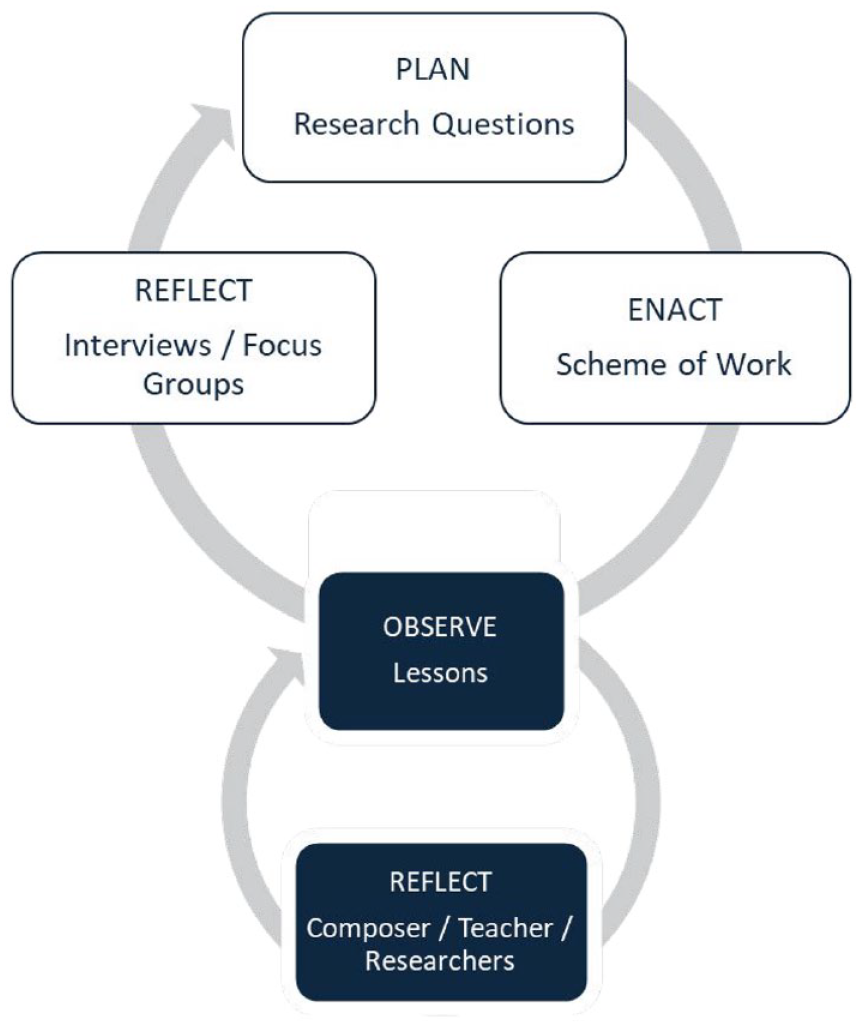
A Cycle and Subsidiary Cycle of Action Research During an SoW.
Four overarching research questions guided the project:
What can we learn about children in Years 4 and 5 as composers?
What is it to make progress as a composer in the primary classroom?
How do we structure or plan activities, lessons, and SoWs to support children’s learning and progress in composing?
What pedagogies support children learning and progressing as composers?
At each of the eight primary schools involved in the project, a visiting composer worked together with researchers from Birmingham Music Education Research Group to establish their own context-specific research questions. These questions guided the development and implementation of different SoWs and provided a focus for the regular reflections undertaken by the researchers, composers, and classroom teachers. As action research “requires not only the critical reflection on practice and theory–practice conversation, but also it designates ongoing and evolving action as part of that process” (McAteer, 2013, p. 12), these opportunities for evaluation equipped composers and teachers to make relevant pedagogical adaptations in later action research cycles.
Researchers from the Birmingham Music Education Research Group observed six Beowulf composing sessions and the final sharing day. Each observation was followed by a reflection session with the composer and teacher, and the final sharing day was followed by semi-structured online interviews with the composer and lead teacher and an in-person focus group with children. Analysis during the project was iterative and reflexive, and observations, reflections, and interviews were triangulated to provide internal validity (Duesbery & Twyman, 2020). Qualitative thematic analysis during cycles (between SoWs) and subsidiary cycles (between lessons) meant that factors relating to the research questions could be fed back into the planning and implementation of future lessons. Overall, themes that recurred over multiple action research cycles offered an opportunity to delve “beneath the surface” (Braun & Clarke, 2013, p. 174) and establish how participants’ experiences of composing could support the future development of good practice.
The research project was approved by the ethics committee of Birmingham City University and was conducted in adherence with the ethical guidelines of the British Educational Research Association (2018). Participants were informed of the research objectives and their right to withdraw via an information booklet and consent form. For children who consented to participate in the evaluation, further consent was also sought from their parent(s) or guardian(s). In this article, the school and its children and teachers have been pseudonymized for confidentiality.
Findings
From the observations, interviews, and focus groups undertaken in relation to Beowulf Opera Scenes, we identified seven emergent themes. Related to children’s conceptualizations of the composing process was “musical imaginings.” We then identified how children made progress through “prioritizing procedural knowledge,” and how the integration of declarative conceptual knowledge and procedural knowing enabled “boundary-crossing.” Working with whole Year 5 classes meant that “distributed cognition” was an important factor, and this in turn led to “diverse inclusion.” Finally, we considered the importance of the “extended timeframe” offered by Listen Imagine Compose Primary, and the potential “future directions” and priorities highlighted by the composer and lead teacher.
Theme 1: Musical imaginings
Initially the composer placed a great deal of emphasis on musical imaginings as part of the children’s composing processes. Although children sometimes had the opportunity to use a digital musical sequencing program for realizing musical ideas, they were encouraged to conceptualize the music before using the interface. The composer encouraged them to “imagine you are playing [the music] in some way” and the children took this to heart: with closed eyes and physical gestures, they appeared to enter an imaginary world without further prompting. The children were focused on visualizing their music in a three-dimensional manner, with some tracing out musical shapes in the air in front of them. This was then realized using graphic score representations in which the children conceptualized multiple elements simultaneously (e.g., textures, dynamics, and rhythms). It was only after this that they began to articulate their music in words: “I want two low notes, then a high one.”
The composing appeared, for these children, to happen as an integrated entity: musical imagining was conjoined with composing—to compose was to imagine. They did not require the tasks to be separated or differentiated by the composer, but regarded the composing experience as a unified whole. For example, “imagine what you want it to sound like and add all the parts to your liking” (Year One Focus Group); “imagine making your music and getting your wonderful ideas” (Year One Focus Group). Composing was not compartmentalized by these children; rather, it was an embodied and holistic act.
Theme 2: Prioritizing procedural knowledge
In line with children’s holistic perception of composing and imagining (Wiggins, 2007, p. 466), the composer and lead teacher both emphasized how children’s progress as composers could be observed when their declarative conceptual knowledge (external objectified cultural capital or “knowledge that”) was subsumed into procedural knowledge (internalized embodied cultural capital or “knowing how”). This was often made manifest through the employment of musical techniques that children had learnt during practical activities or games: [in Year 4] I taught them particular sorts of things, song writing or sequences or particular techniques [. . .]. [Year 5] would be a chance for them to use these in a very free way, a self-directed way, but within certain limits [. . .]. They often referred back to things they did in Year 4 and how they then used it to create an opera in Year 5 [. . .]. The children definitely made those connections, which was great. (Composer)
By the end of the project, the teacher had noticed children’s linguistic development, acknowledging the varied “language that they are using, in terms of their confidence of talking about different kinds of techniques that they were using” (Teacher). Children were using technical language associated with opera without hesitation or misunderstanding, which was achieved by ensuring the focus remained on procedural knowledge and how children enacted, embedded, and embodied technical language into their “knowing how”: I’m always wary of soundscapes [. . .] and although I’m sure they have their place [. . .] that is quite often just pure exploration [. . .] as opposed to using things that the children have actually learned to be able to put into their compositions. (Teacher)
Theme 3: Boundary-crossing
As evidenced by children’s integration of conceptual knowledge (knowledge that) and procedural knowing (knowing how), composing in the operatic genre provided an opportunity to subsume different knowledge types to promote creative thinking: there was the kind of learning around the performance as well [. . .] being able to put it together as a performance and talking to them about how quite a few of them [took] their bit home to practice or just practised out in the playground with a friend. [. . .] There was a bit which the euphonium was playing with a guitar and their evaluation was that they were both very proud of what they did, but they felt that they wouldn’t partner again because the euphonium was so loud, [the guitar] could not be heard. (Teacher)
The composer identified how one of the most successful sessions in Year 5 included a visit from the opera singer, Helen Charlston, who sang a recitative and an aria from a Handel opera for the children to listen to in their classrooms. This live performance inspired the children to use the singer as a role model when they were tasked with composing a recitative for a part of the Beowulf story and showed them “what actual composers do [when composing] a recitative” (Composer).
Demonstrating composing as an integrated practice (including performing, listening, and appraising) also provided opportunities to link with other subjects from the school curriculum: “one of the best things [. . .] was the fact that they had got to know the Beowulf story [. . .] as part of their English and history [lessons]” (Composer). In particular, the cultural context of opera was of crucial importance for the lead teacher: we would immerse children in texts, and we would do lots and lots and lots of looking at quality texts before we would expect them to be writers. And I think sometimes with art and with music we don’t, we don’t actually do that immersion before we ask them to be creative. And I think [. . .] real creatives have actually spent hours and years of their life immersing themselves in different traditions and different artists and learning, and then they’re able to be creative. (Teacher)
The contexts or “knowledge about” opera and the Beowulf story appeared to be central to promoting creative thinking by children. Composing developed children’s musical understanding (Rogers, 2020) through an integrated approach that enhanced connections between external knowledge and the children’s internal “knowings” or tacit knowledge (Candy et al., 2021). The teacher’s comment resonated with a perception of performances as “complex demonstrations of understanding” (Harpaz, 2014, pp. 114–119), where performances are not seen as single events but numerous events over time that enabled the evaluation and refining of musical ideas.
Theme 4: Distributed cognition
While composing Beowulf Opera Scenes, children were very keen to contribute their ideas, particularly when they were given conceptual frameworks through which to do so. But there also needed to be time and space for children to “plan” their ideas. Although this was challenging in a small classroom, allowing different groups to take ownership of different parts created space for creativity. Involving a range of children’s knowledge and skills—which has been conceptualized as distributed cognition (Salomon, 1993) or shared understanding (Wiggins, 1999/2000)—was more productive and “musical” than trying to make sure all the children were engaged in the same activity. This meant that what appeared to be basic ideas could be turned into more complex and extended pieces of music when textural distribution was employed (i.e., different groups of children creating and performing different parts). Different children contributed varied instrumental skills and creative uses of traditional notational forms (e.g., exchanging crotchets and quavers for “long” and “short” sounds denoted by “L” and “S”). The composer validated children’s contrasting contributions by celebrating their emerging musical ideas and creating the potential for children to experience a sense of “flow” (Csíkszentmihályi, 1990) through their composing.
The significance of distributed cognition meant that “sharing moments” became an important pedagogic feature. Children’s work-in-progress was shared for the class to decide which extracts would be combined. These decisions were informed by the composer asking questions that linked to a holistic perception of composing, highlighting the importance of purposeful, structured musical frameworks. Cultural reference points were helpful, including non-musical narratives that provided meaning.
Child-centered, open, and negotiated approaches facilitated and valued children’s own creative responses. Children enjoyed playing or improvising musical ideas but needed guidance to refine their ideas. This involved “choice” and “judgement” in relation to the context for which they were composing. The process of learning how to choose and refine ideas that were improvised was supported by the composer drawing upon conceptual language that was operationalized through procedural enaction and embodiment. For example, the idea of repetition using music technology was a significant feature, where “preferred” phrases were consolidated and repeated to increase their impact.
Theme 5: Diverse inclusion
Fautley (2005) has previously identified the value of distributed cognition in music education, where it becomes “multiple simultaneity shared between group members” (p. 42). In Beowulf Opera Scenes, distributed cognition was used to “promote or scaffold, rather than limit, the cultivation of individual competences” (Moll et al., 1993, p. 135), helping to create conditions where a diverse range of creative contributions from the children were valued by the composer but then evaluated according to the composing brief. This upheld a sense of inclusion and purpose: every child knew exactly what they had done [. . .] [but] I think as a teacher, sometimes we fall into the trap of thinking that children can’t cope with [some art forms] [. . .]. And I think that’s completely untrue. I think if it’s taught well and it’s inspirational, well, actually opera is as much for everyone as anything else. (Teacher)
The freedom to choose was an important aspect of inclusion: some children would be working as a table and some of them would be more writing and working on the lyrics, and then maybe one of them would be maybe improvising a melody, or thinking about rhythm and deciding about that and then someone would be thinking about how to notate it. Some would prefer to work on their own, on a laptop, creating music on the Soundtrap program. Whereas some of them were much more about working as a group of friends and creating a really amazing song and performing it themselves [. . .] [but] there was a messiness to that. (Composer)
The composer managed the “messiness” and brought the children’s ideas together in the final opera: I think that was my job, behind the scenes, to make sure that whatever they contributed fitted into the final product. [. . .] I think it would have been a struggle for [the children] to do that. Whereas they focused on creating a sort of mini scene themselves, taking ownership of that. (Composer)
Theme 6: Extended timeframe
The impressive final compilation of Beowulf Opera Scenes was only made possible by bringing the composer’s expertise into the classroom over an extended period of time. The lead teacher recognized that the children needed repeated and ongoing engagement to reinforce their learning: I’ve felt that actually the children themselves hadn’t really been taught about compositional techniques before this, [particularly] things that really worked, and so actually it needed the two years to really embed their learning [. . .] to give them enough learning to then be able to [. . .] go off and [. . .] compose. (Teacher)
In addition, the composer appreciated the longitudinal nature of the project because “that gave [me] enough time to really get to know the kids and then to support them in contributing” (Composer). He continually employed formative assessment to evaluate the children’s progress and introduce them to new skills: I think [the composer] [was] an amazing teacher, the formative assessment for me is the most powerful means for assessing where the children are [. . .]. It’s that ability for you to have that interaction with them and you to sort of talk through things [that they] then take on and then move forward. (Teacher)
This meant that at the completion of the Beowulf project the composer was well-equipped to understand, accommodate, and validate all the children’s ideas in the final score and performance: I was impressed by the [final] score. It really worked, the way that [the composer] created a score. I thought that was really important. The idea that it could theoretically be performed again and again and again. So that reinforced the idea of how important that was [. . .]. Quite often in music lessons we’re relying on that improvisation and that kind of “in the moment” music. (Teacher)
Theme 7: Future directions
Overall, the composer, lead teacher, and wider school community were pleased with the Beowulf Opera Scenes project, and it was deemed a success. However, the composer and teacher identified two areas for future improvement: classroom management and cultural diversity.
The composer believed that sometimes it was difficult to manage the composing process with lots of children working simultaneously in a noisy classroom. He identified several strategies that he would use more in the future to mitigate these issues: “setting up practically, thinking really carefully about noise levels and workspaces”; taking opportunities for sharing, when “one group share[s] with the rest of the group [. . .] that always focuses them much more”; and clearly defining roles—“you need to be really clear who’s in charge of what and [. . .] whose role is what.”
The teacher, on the contrary, would “keep the project exactly the same,” but hoped that in the future it might be possible to develop equivalent schemes of work to explore diverse cultures and genres: what I would really want to do is to be able to enrich and ensure that we kind of look [at] and celebrate other cultures by doing similar projects where we’re looking at other genres of music [. . .] so the children have that exposure and that real quality time that allows them to experience different genres and different ways of making music. (Teacher)
Discussion
The composer working with the children creating Beowulf Opera Scenes valued and celebrated the composing that children shared by balancing the external and internal dimensions of learning throughout the project (Illeris, 2009). External dimensions were exemplified by objectified cultural capital offered by the composer and teachers, including conceptual knowledge, or “knowledge that” (e.g., melody, harmony, aria, recitative), and contextual knowledge, or “knowledge about” (e.g., the Beowulf story with its characters and scenes, and the operatic genre). Internal dimensions were exemplified by children’s own embodied cultural capital, including “knowing how” (the children’s own vocal, instrumental, and music technology skills) but also their own tacit knowing or “knowing of” music brought into the classroom and developed through their absorption of technical language through musical activities (see Figure 2). This balancing of different forms of knowledge and knowing was achieved through an integration of objectified and embodied cultural capital. This enhanced opportunities for children to develop and share their own musical understanding (see Figure 3) and addressed the research questions, “what can we learn about children in Years 4 and 5 as composers?” and “what is it to make progress as a composer in the primary classroom?” The notion that “understanding is really memory as disguise” (Sherrington, 2019, p. 11) was contested here. Rather than musical understanding being perceived as “banking” declarative knowledge, children’s composing demonstrated how musical understanding was engendered by an integration of different forms of cultural capital (or knowledge and knowing).
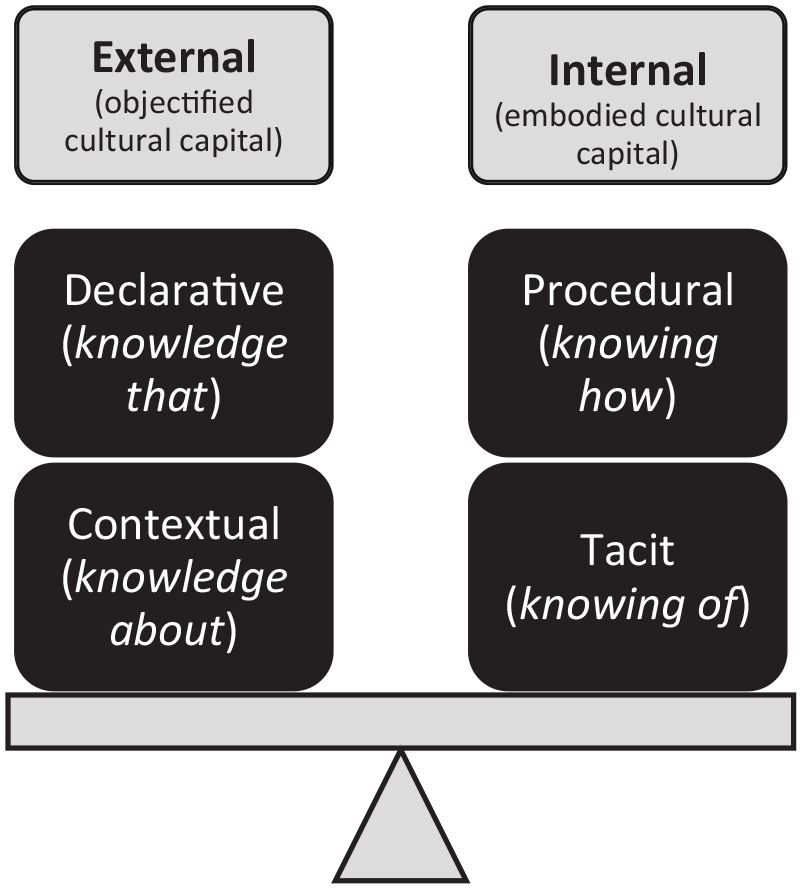
Balancing External and Internal Dimensions of Learning.
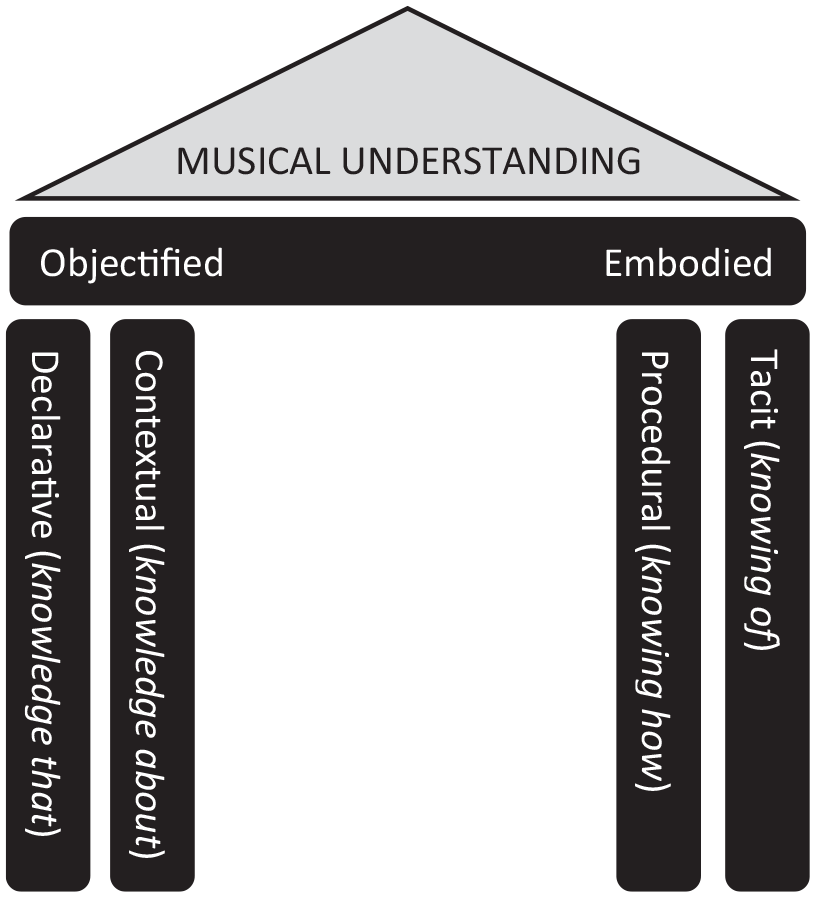
Balanced and Integrated Types of Cultural Capital (pillars of knowledge and knowing) to Support the Development of Musical Understanding.
The integrative and participatory nature of building musical understanding was further highlighted by the importance of performing and recording within the Beowulf Opera Scenes project. Performing was not seen as an object to be judged but was underpinned by creating and sharing. Composing started as an improvisatory process, playing with sounds and informed by musical imaginings. This improvisation was then refined into composing that could be shared through recording, either in real time electronically or through some form of notation (Burnard & Murphy, 2013). An important part of the refining process was children’s critical justification of their own composing. The composer actively elicited verbal and musical justifications from the children about their composing, employing weaker framing (Bernstein, 1973, 2000) to promote and value the children’s own musical thinking.
Composing using creative performing also provided a vehicle to integrate different forms of cultural capital. For example, children would be asked to compose a melody (knowledge that) for a particular character using their instrumental or music technology skills (knowing how). When children shared their composing through performing, with associated critical justifications, they were also sharing their understandings (Harpaz, 2014). By being genuinely interested in the children’s musical ideas—and also by providing time for children to share and refine their composing—the composer was demonstrating his “embodied, embedded, enactive and extended understanding of cognition” (van der Schyff et al., 2018, p. 1) and exemplified one response to the research question, “how do we structure or plan activities, lessons, and SoWs to support children’s learning and progress in composing?” The composer employed a signature pedagogy (Shulman, 2005) that was imbued with child-centered pedagogical content knowledge (Shulman, 1986). His pedagogy was genuinely “knowledge rich” because it considered, “what pedagogies support children learning and progressing as composers?” Throughout the project he consistently recognized and valued “children’s natural resources of wonder, imagination and inventiveness” (Mills & Paynter, 2008, p. 1).
Conclusion
In its impact across 2 years and eight schools, Listen Imagine Compose Primary has made a significant and innovative contribution to international research in music education by conceptualizing and characterizing children’s composing. Through building strong partnerships between researchers, composers, musicians, and primary-school teachers over a longitudinal timeframe, the project has established a rich and nuanced picture of different ways of knowing and understanding that contribute toward children’s creative classroom music-making. In Beowulf Opera Scenes, children came alive as composers, seeing themselves as part of something connected to others historically and culturally, greater than their individual selves, but not reliant on the adults around them to provide “the answers” based solely on “the best that has been thought and said” (DfE, 2014, p. 6).
Listen Imagine Compose Primary highlighted tensions that are increasingly evident in neotraditional and neoconservative moves to reform education (Sahlberg, 2012; Young, 2023); not least the limitations of notions of rich knowledge that are historical, declarative, separated, and objectified. In Beowulf Opera Scenes, objectified cultural capital became embodied through children’s developing, distributed, diverse, and inclusive musical understandings. This composerly thinking and musical imagining was valued and skillfully crafted by the collaborating composer to become an artistic experience that would be remembered by all those who were privileged enough to observe or take part.
Although the global impact of Listen Imagine Compose Primary has yet to be fully realized, there is already evidence of growing international interest in composing as part of music education (Devaney et al., 2023b; Kaschub, 2024b). Although this project was limited to specific partnerships between professional composers and English primary schools in two cities, its findings have the potential to be formative in shaping the way composing is introduced in primary education in schools across the world. Through the action research methodology, generalist classroom teachers were equipped with the skills and understanding necessary for facilitating composing with children in their classrooms, even after the project finished. It is hoped that this shared knowledge constructed through Listen Imagine Compose Primary will, in time, contribute to an accessible “toolkit” offering teachers in varied contexts resources that will equip them for classroom composing. Against the backdrop of an educational climate increasingly concerned with the strong framing of rich knowledge and cultural capital (Beadle, 2021; Cairns, 2019; Nightingale, 2020), Listen Imagine Compose Primary offers teachers an alternative pedagogical pathway with the potential to disrupt dominant paradigms of children’s composing and make space to explore diverse, inclusive, and multi-faceted ways of musical knowing.
Footnotes
Acknowledgements
The authors wish to thank all the teachers and pupils involved in Listen Imagine Compose Primary, and Nancy Evans, Richard Barnard, and Helen Charlston for their contributions to the Beowulf Opera Scenes project.
Author contribution(s)
Funding
The author(s) disclosed receipt of the following financial support for the research, authorship, and/or publication of this article: Research was funded by the Paul Hamlyn Foundation’s Education and Learning through the Arts Fund.
