




Abstract
Although teachers and researchers frequently acknowledge that music education can benefit pupils’ academic achievement, health and well-being, and social development, classroom music-making can have long-lasting, detrimental impacts. Individuals’ experiences of failure, disappointment, and exclusion in the music classroom highlight an urgent need for music education to be reframed by an understanding of “musical vulnerability”: individuals’ inherent and situational openness to being affected—positively or negatively—by the semantic and somatic properties of music-making. Drawing on existing vulnerability studies, I evaluate how classroom music-making can foster both positive receptivity and negative susceptibility, depending on its delineation of identity and physical embodiment. I then present reductive analyses of phenomenologically-informed interviews in which 12 secondary music teachers described their past experiences of being pupils, and their present experiences of teaching pupils, in music classrooms in the United Kingdom. Using excerpts from their observations of teaching pupils, I describe how interactions between individuals’ interpersonal and personal vulnerabilities—including personality, musical, and neurological differences—affected occasions of musical receptivity and susceptibility. As individuals negotiated conflicting musical expectations, they sometimes fostered fruitful resilience but sometimes encountered profound resignation. I draw on these findings to construct a preliminary typology of musical vulnerability and emphasize the need for future research into proactive differentiation in the music classroom.
Across academic disciplines, there exists a great wealth of research into the perceived benefits of music-making 1 on individuals’ lives. A recent scoping review published by the World Health Organization illustrates the extent of such research, mapping more than 900 publications concerning the outcomes of music and arts engagement on health and well-being across the lifespan (Fancourt & Finn, 2019). Reviews explicitly addressing the impact of musical engagement continue to be updated to account for ever-increasing research into the effect of music-making on academic achievement and socioemotional development (e.g., Hallam, 2010, 2015; Hallam & Himonides, 2022).
Although such research is often considered indispensable in advocating the importance of music education (DfE & DCMS, 2011, 2022), persistent adherence to extravagant—and sometimes unsubstantiated—claims for the beneficial effects of music-making risks perpetuating the misguided assumption that “music (all of it) is important because of things it (all of it, invariantly, because of its innermost nature) does that no other practice does” (Bowman, 2014, n.p.). This, in turn, can cause “the positive effects of [. . .] music [to be] overestimated and the negative dimensions underestimated” (Rinholm & Varkøy, 2020, p. 40). These negative dimensions vary from concerns over music-making in unknowledgeable ways (Hallam, 2015; MacDonald et al., 2012) to relational conflicts arising through musical participation (Kreutz & Brünger, 2012; Williamson & Bonshor, 2019).
In music education, studies have indicated that music-making can have long-lasting, detrimental effects on individuals’ lives. Temmerman’s (1993) study into preservice teachers’ recollections of school music-making found that there were “substantially more respondents who perceive[d] school related [. . .] music experiences unfavourably than favourably” (p. 64). Like participants in Gavin’s (2001) research into musical memories, Temmerman’s respondents often described school music-making as boring, repetitive, or irrelevant. For some, such memories could be associated with specific “wounding stories”—such as being identified as “unmusical” by a teacher—and result in long-term shame or embarrassment (Hogle, 2021; Palkki, 2022). This, in turn, could affect individuals’ musical participation as adults: some may find music-making to remain tainted by institutional values or detached from their personal preferences (Herbert & Dibben, 2018; Isbell & Stanley, 2011; Mantie & Tucker, 2008; Pitts & Robinson, 2016).
The breadth of research attesting to individuals’ experiences of failure, disappointment, and exclusion in classroom music-making highlights an urgent need to redress the incessant ongoing advocacy for music education’s benefits on academic achievement, health and well-being, and social development. In this article, I therefore propose how classroom music-making could be reframed by an understanding of “musical vulnerability” (MacGregor, 2022a). Drawing on the field of vulnerability studies, I first define and describe the concept of musical vulnerability. I then present reductive analyses of phenomenologically-informed interviews with 12 secondary music teachers who described their past experiences of being pupils, and their present experiences of teaching pupils, in music classrooms in the United Kingdom. Using excerpts from their experiences of teaching pupils, I conclude by proposing a preliminary typology of musical vulnerability in the secondary music classroom.
Conceptualizing musical vulnerability 2
Research into the beneficial and potentially detrimental effects of musical engagement demonstrates individuals’ vulnerability to music-making. Although the term vulnerability is typically defined negatively—as an openness to physical or nonphysical attack or injury (OED, 2019)—in recent years this conceptualization has come under scrutiny from researchers in the field of feminist vulnerability studies (e.g., Gilson, 2014; Mackenzie et al., 2014b). Theorists have sought to account for the ambiguity of vulnerability, redefining it as an affective openness (Gilson, 2014), “not merely [to] susceptibility to harm but also [to] receptivity to positive forms of intersubjectivity” (Cole, 2016, p. 261). This openness can be considered an inherent vulnerability: experienced by all humankind as a result of our corporeal, social, and affective nature. But it can also be exacerbated as a situational vulnerability by personal, social, political, economic, or environmental circumstances. Some such circumstances may even cause pathogenic vulnerability, which poses particular ethical challenges arising from oppression or injustice (Mackenzie et al., 2014a; Rogers et al., 2012; see Figure 1).
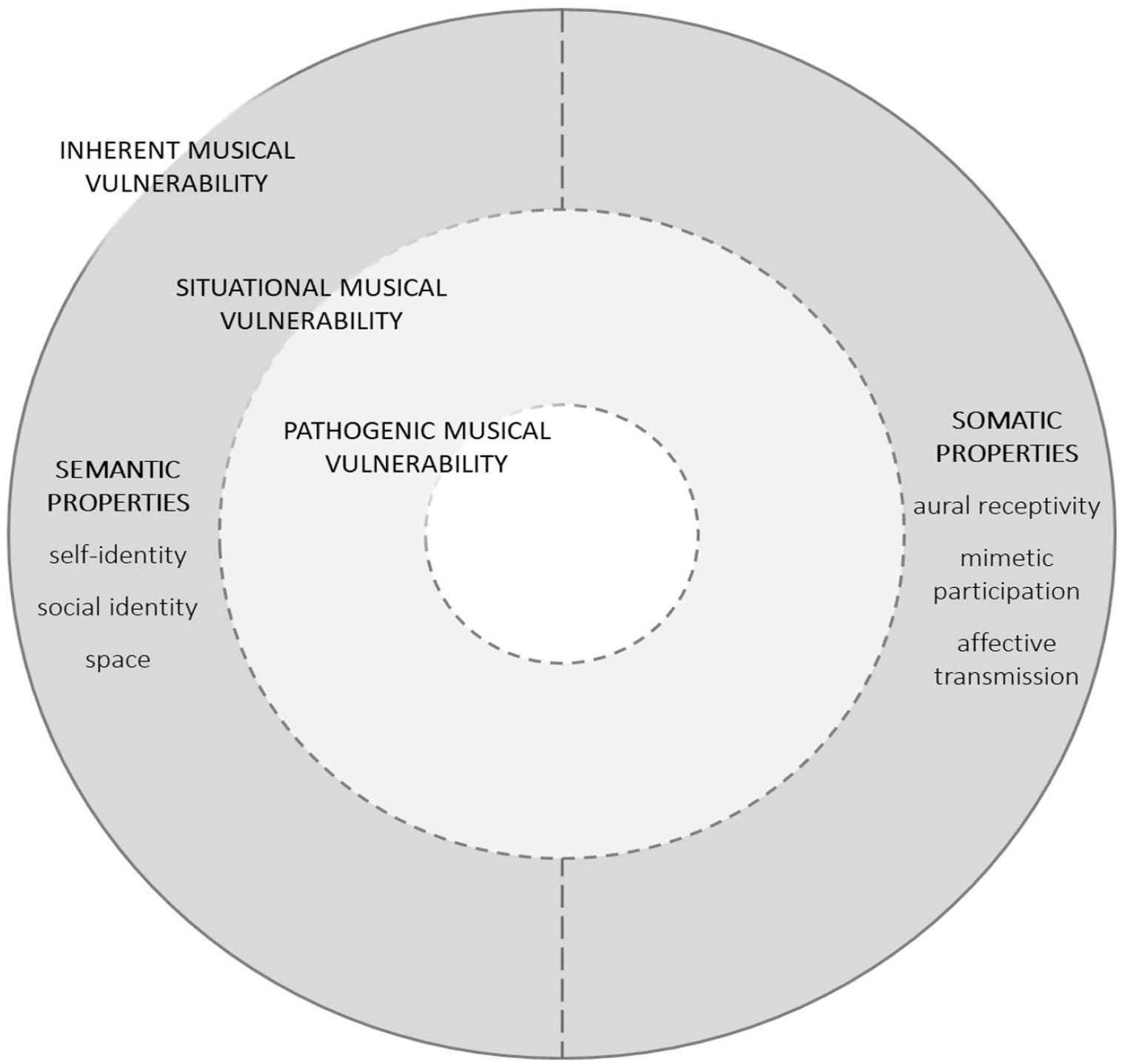
A Taxonomy of Musical Vulnerability and Music’s Semantic and Somatic Properties.
Drawing on vulnerability studies, I therefore define musical vulnerability as individuals’ inherent and situational openness to being affected by the semantic and somatic properties of music-making. This is closely comparable to Butler’s (1997) seminal theory of “linguistic vulnerability.” Like language, music-making can define identity or status, and arouse happiness or hatred. In a similar way to which words are citational—associated with a historic and social “legacy of interpellations” (p. 50)—music possesses semantic properties through which self-identities, social identities, and spaces are delineated. Music-making acts as “a citational practice through which available identities are regularly (re)constituted” (Westerlund et al., 2019, p. 61). The place of music-making in individuals’ lives defines their musical identities (Hargreaves et al., 2002), and similarities and differences between individuals’ musical identities can come to define in-groups, out-groups, and their respective territories (Elliott & Silverman, 2017; Ivaldi & O’Neill, 2009; Johnson & Cloonan, 2009; Tarrant et al., 2002).
Music also has somatic properties that enhance its semantic power: just as Butler (1997) locates speech as a “bodily act” (p. 152), music-making “territorialize[s] by virtue of combining physical vibration with bodily sensation and culturally conditioned meanings” (Eisenberg, 2015, p. 199). Music’s physical vibration leads to aural receptivity; the ear cannot be closed against its influence (Brauer, 2016). This in turn stimulates bodily mechanisms such as mimetic participation. Covert or overt imitation of music-making activates the theoretical mirror neuron system, which responds in the same way when an action is observed as when it is executed (Cox, 2016). All music-making, therefore, “is invariably corporeal, and is distinguished from other semiotic experience by its links to muscle, movement, and action” (Bowman, 2004, p. 38). Physical, chemical, and nervous entrainment also intensifies the experience of musical affect, interconnecting individuals through emotional contagion and affective association (Blackman, 2012; Born, 2011; Brennan, 2004).
As summarized in Figure 1, the semantic and somatic properties of music-making contribute toward inherent musical vulnerability. Usually, the resonance between these properties and an individual’s existing musical expectations leads to an enriching experience of vulnerability as positive receptivity—like when language is used to convey love and affirmation (Butler, 2011). However, “if we impose our own preferred music on someone else in a way that is beyond their control [. . .] we are more likely to take them closer to the experience of pain” (Johnson & Cloonan, 2009, p. 25). As when language is mobilized for repression and censorship (Butler, 1997), this disabling sense of negative susceptibility can occur in the music classroom. Teaching and learning methods can cause “musical suffering” when employed indiscriminately (Benedict, 2009, p. 221) or associated with oppressor–oppressed hierarchies (Allsup, 2016; Kanellopoulos, 2016). They may even disseminate discriminatory values relating to class (e.g., Baker, 2014; Bull, 2019), gender and sexuality (e.g., Gould, 2012; Mantie & Talbot, 2020), race and ethnicity (e.g., Gustafson, 2009; Thomas-Durrell, 2022), religion (e.g., Harris, 2006; Jorgensen, 2019), and disability and neurodiversity (e.g., Cheng, 2020; Churchill & Laes, 2021).
In recent years, the institutional mediation of music-making and the methods and values it perpetuates have garnered increased attention from teachers and researchers concerned with issues of social justice in music education (Benedict et al., 2015). However, research investigating individuals’ everyday lived experiences of the interpersonal and personal mediation of music-making in the classroom (see Figure 2) is scarce.
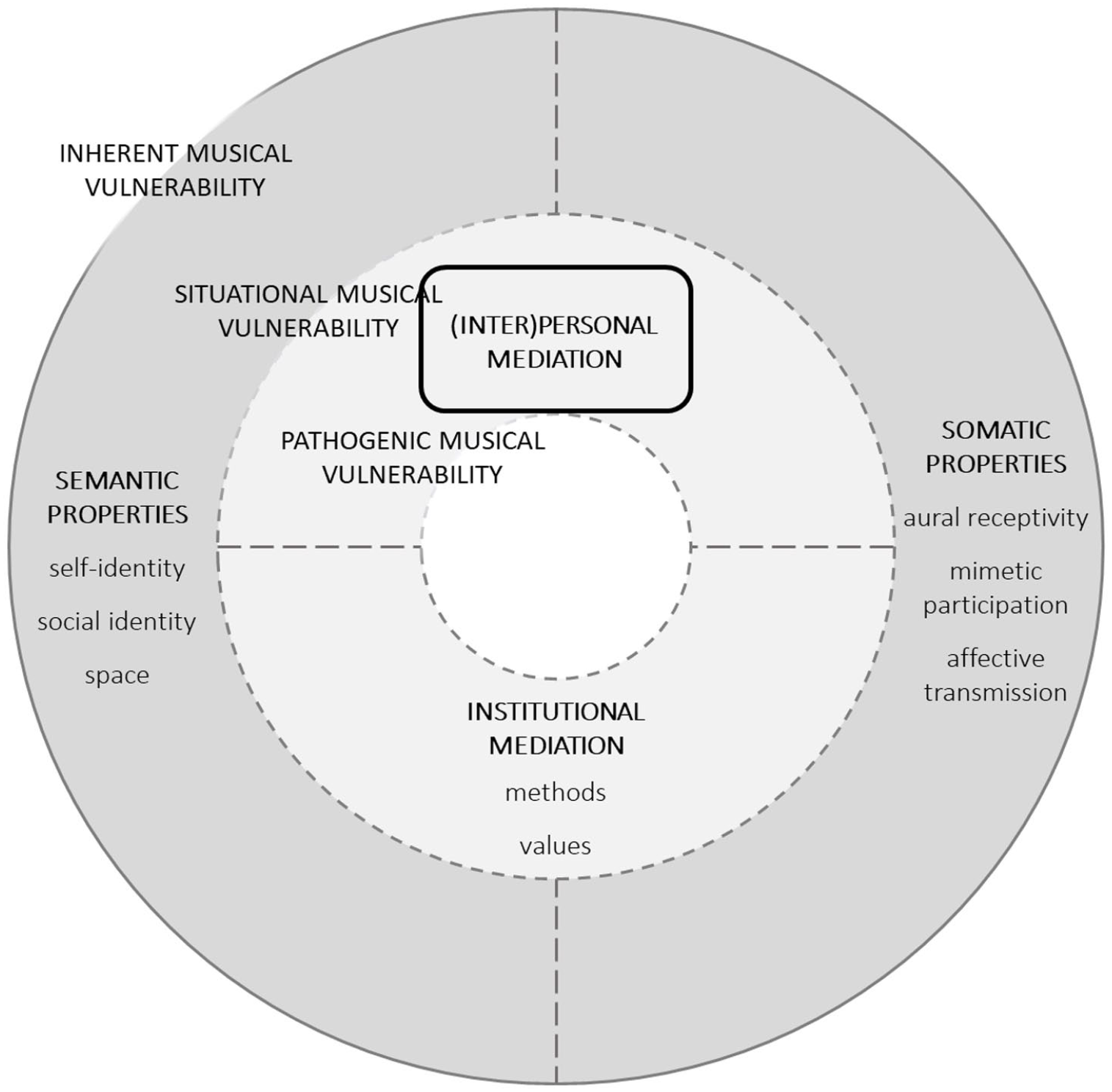
Music’s Institutional and (Inter)Personal Mediation.
Therefore, in this article, I ask, to what extent is musical vulnerability experienced in the secondary music classroom and how is it characterized? Drawing on interviews I carried out with secondary music teachers in the United Kingdom, I describe how interactions between individuals’ interpersonal and personal vulnerabilities—including personality, musical, and neurological differences—affected instances of musical receptivity, susceptibility, resilience, and resignation.
Method
Context
I carried out 12 phenomenologically-informed interviews online between May and November 2020, as part of a two-phase phenomenological ethnography completed in March 2022. 3 I aimed to elicit secondary music teachers’ descriptions of musical vulnerability based on accounts of their past experiences of being pupils, and their present experiences of teaching pupils, in the music classroom. I asked teachers about their own and their pupils’ experiences in the first three years of secondary school (ages 11–14), in which classroom music lessons are compulsory (DfE, 2013).
Methodology
Using in-depth, semi-structured interviews as its primary mode of elicitation, phenomenology is “well-suited to studying emotions and affective states” (Merriam & Tisdell, 2016, p. 28). It focuses on identifying the underlying structure of a given human experience by establishing concrete, pre-reflective descriptions of everyday phenomena. All phenomenological approaches are characterized by two common features: bracketing (or the epoché) and reduction (Moustakas, 1994; Valle et al., 1989; van Manen, 2014). Bracketing involves identifying and setting aside the researcher’s presuppositions to view the phenomenon with an open perspective. Reduction is then employed to establish textural and structural descriptions of the universal essence of the phenomenon by analyzing its “invariant constituents” using “horizonalization” and “imaginative variation” (van Manen, 2014).
Phenomenology has been widely used in cognitive science and education research (e.g., Gallagher & Francesconi, 2012; Trotman, 2006) and is becoming increasingly popular in music education. O’Neill and Senyshyn (2012) and Yackley (2019) have used phenomenological methods to evaluate pupils’ engagement with school music, while Jääskeläinen (2022) has investigated music students’ workload in higher education, and Coppola (2022) has characterized musical egotism. Such studies emphasize the value of phenomenology for exploring complex experiences in which analyzing intertwined aspects separately “would no longer accurately represent the experience as it was lived by the participants” (Yackley, 2019, p. 48).
In the present study, I initially hoped to platform diverse voices from the music classroom by eliciting lived experience descriptions from both teachers and pupils (cf. Flutter & Rudduck, 2004). However, due to COVID-19 restrictions and safeguarding protocols, I was unable to interview pupils and had to rely on teachers’ accounts as a proxy for attending directly to pupils’ experiences. I could not, therefore, adhere to a traditional phenomenological method because the mediation of pupils’ experiences through teachers’ recollections could not be guarded “against the effects and assumptions induced by [. . .] [teachers’] values, polemical discourses, and taken-for-granted prejudices” (van Manen, 2014, p. 61). Nonetheless, I aimed to maintain validity and trustworthiness in the broader, phenomenologically-informed procedure I adopted by cross-referencing teachers’ anecdotes of being pupils with those of teaching pupils, establishing data saturation, and applying a consistent method of reductive analysis.
Participants
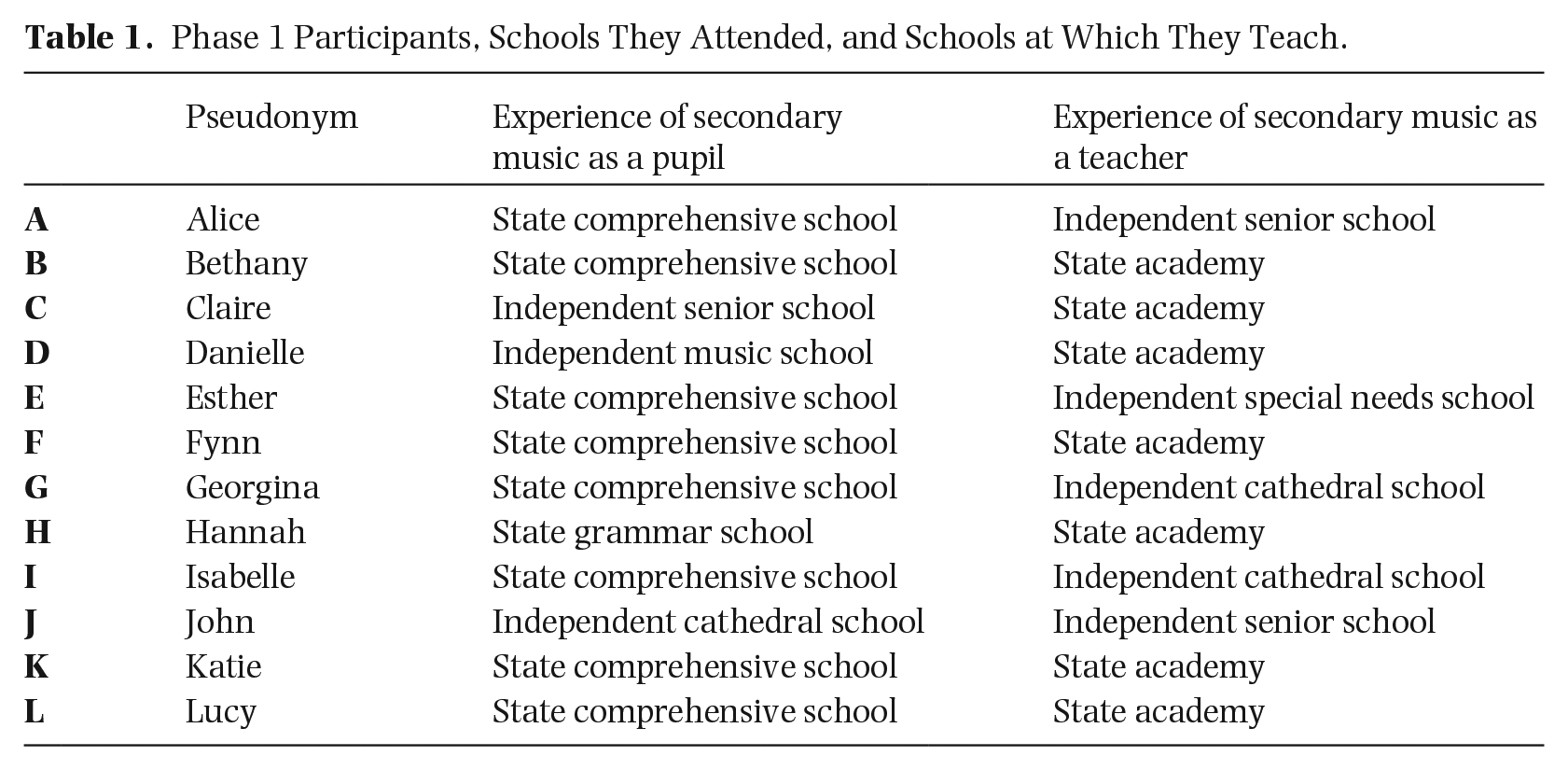
Using personal contacts, social media posts, and direct email contact with schools, I purposively recruited 12 teachers from a range of different varied backgrounds and school settings in the East of England (Table 1). Each teacher was emailed an invitation to take part in the study, an information booklet and consent form, and a demographics questionnaire. The study was ethically approved by the University of Sheffield Ethics Review Procedure, as administered by the Department of Music. All teachers provided their informed consent prior to participation, having been made aware of their right to withdraw from the project at any time and assured that their personal data would be stored securely and pseudonymized to maintain confidentiality.
Phase 1 Participants, Schools They Attended, and Schools at Which They Teach.
Procedure
All interviews were conducted and recorded using video-conferencing software, in line with legal restrictions introduced following the outbreak of the COVID-19 pandemic in England. Each began with an informal conversation, followed by two questions about participants’ teaching experience:
Can you remember a time when your pupils were positively affected by music during one of your classroom music lessons?
Can you remember a time when your pupils were negatively affected by music during one of your classroom music lessons? 4
In keeping with a phenomenologically informed approach, I sometimes used further prompts such as “what were the surroundings like?,” “who else was there?,” or “how did it make you feel?”
Analysis
I carried out data analysis as a continuous process to allow for the idiographic analysis of the lived experience accounts from each teacher. After transcribing each interview, I used reductive analysis to create anecdotes pinpointing the concrete experiences discussed, before member-checking each analysis with the participant. I then returned to each transcript and worked through the reductive processes outlined in van Manen’s (2014) reflective phenomenological methods (pp. 319–320) and Moustakas’s (1994) examples of phenomenological analyses (pp. 120–143). I identified participants’ two key anecdotes and analyzed them separately, as (1) positive experiences of teaching pupils in the classroom and (2) negative experiences of teaching pupils in the classroom. Hereafter, these accounts are identified using the first letter of the participant’s pseudonym and the corresponding number of the anecdote (e.g., A1, C2).
Once I had completed textural-structural descriptions for all the anecdotes, I clustered my analyses together to form small-scale composite descriptions and draw out invariant themes. I finally established one description accounting for all participants’ individual anecdotes. In what follows, I draw on an abridged version of this description of participants’ teaching experiences to illustrate the invariant themes characterizing individuals’ musical vulnerability in the secondary music classroom.
Characterizing musical vulnerability
Teachers’ experiences of teaching pupils aged between 11 and 13 years highlighted how emergent vulnerabilities in the music classroom related to interpersonal vulnerabilities (through relational concord and conflict) and personal vulnerabilities (associated with personality, musical, and neurological differences).
Interpersonal vulnerability
As music-making is so closely connected with self-identity, social identity, and spatial delineation, the influence of relationships between teachers, pupils, and other role models in the music classroom cannot be overestimated (cf. Killick, 2006). The interaction between different individuals’ musical values and expectations emerged at the heart of the experience of musical vulnerability, contributing toward both life-affirming and potentially debilitating encounters.
Relational concord
As is the case when well-chosen words powerfully reinforce relationships or affirm identities (Butler, 2011), when individuals experienced complementary values and expectations in the music classroom, the resulting relational concord stimulated positive musical receptivity. This was illustrated by the response of Danielle’s pupils, Charlotta and Carrie, when their teacher praised their music-making: “we were doing animal music, and Charlotta had gone to a practice room because she’s got some basic piano skills. But then I became aware of her at my heels, coming back to the classroom every five minutes” (D1). Though singled out as capable enough to work in a practice room, Charlotta clearly needed her teacher. She pursued her round the classroom, leaving Danielle frustrated: so I was like, “I will come to your practice room, I will.” But she was still there. I felt like saying, “I’ve explained it! Why do you need me?!” But she was like, “no, I’ve finished, I’ve finished!” “You can’t have finished, you’ve got 15 min-!” “I’ve finished!” (D1)
Danielle finally realized that Charlotta did not want assistance, but assurance. But she was skeptical of what her pupil could have achieved in such a short space of time, until I went to her room. She’d written the most beautiful piece, that not only had the right structure that we’d set up, but also went on to have a rondo structure. She’d been working with a girl called Carrie, who wasn’t very good at anything, but was a nice girl, and she’d even given Carrie a role. (D1)
In that moment, Danielle’s expectations of her pupils’ music-making were exceeded. She recognized that “they’d had a really great time, done some excellent work, and even used their initiative a bit” (D1). She was struck by how Charlotta invited Carrie into the relational experience of receptivity by enabling her to share in the positive feedback: “Carrie was very smiley because she couldn’t do anything before that lesson and then she could play a four-note ostinato, in time” (D1).
Fynn described a similar experience when he let his pupils determine their own unit of work: “last year I said to [one class], ‘what do you want to learn about?’ And they all said grime” (F1). 5 Fynn’s decision to let his pupils choose what to study was not unusual in the music classroom: popular projects such as Musical Futures emphasize how pupils’ agency in classroom music choice is important in fostering self-directed learning and improving engagement (Green, 2008). Despite initial reservations about the association between grime and cultures of violence and deprivation, Fynn’s research into the genre’s origins helped him realize the emancipatory potential of allowing his pupils to engage with such music (cf. Thorgerson & von Wachenfeldt, 2019): “[grime’s] got bad language and gang culture in it, but I was like, ‘OK, [. . .] I can get my teeth into this.’ So we bolted it onto protest music because it’s got that kind of message” (F1). He imposed few restrictions on his pupils’ music-making: “I was almost giving them free license—‘I’m going to come in and I want to hear what you’ve done, but there’s no expectation that you’ll have finished it’” (F1).
With the freedom to progress at their own pace, Fynn’s pupils discovered how their music-making related to their own interests and made significant investments in their creative work, unhindered by constant surveillance: so I went into one room, and there was this bunch of boys who’d taken a bass drum apart and put their iPad in there so they could record from inside it. They were playing a bass line on the piano, and making their own distortion. They were really proud of this—maybe because they got to take apart school equipment. (F1)
These pupils were clearly pleased with their creation. But like Charlotta, who sought assurance from her teacher, they seemed to appreciate their teacher’s legitimization of their achievement: I was like, “yes, that’s exactly what I want! That’s how people discover stuff!” When they listened back to the recording they were like, “this is really good, this is fantastic!” From then on there was a trust built: they trusted that I got what they thought, and that I wouldn’t make them do anything they couldn’t relate to. (F1)
Fynn’s praise reinforced the boys’ pride, and in time, this shared musical receptivity stimulated an affirmative, long-term relationship. Having found common ground in the grime project, pupils’ receptivity to their teacher’s musical ideas meant Fynn got more “buy-in” from them in future projects involving less familiar music, such as minimalism (F1).
Relational conflict
Pupil agency in the music classroom did not always result in positive musical receptivity. Though it is often related to increased engagement, intrinsic motivation, and personal investment (Burnard et al., 2008), Katie highlighted how it could cause conflict: we’d given pupils the choice of three songs to learn, including one more challenging one. One very able student was keen on doing the more challenging one, but could be quite overbearing in the way that they worked [. . .]. They felt that their idea would help everyone else do well, but everybody else felt they’d much rather do something else. (K2)
This one pupil quickly grew offended when their suggestions were overridden by their group: “the others said, ‘well, we don’t know that song, so no, we don’t think we’d like to.’ And the student was extremely upset because no-one was listening to them” (K2). Increasing pupils’ choice of music therefore heightened relational conflict and prompted susceptibility to frustration and exclusion.
Katie explained that, fortunately, such minor disagreements could usually be resolved quickly. Yet, she expressed concern that such mitigation may be only superficial. “Although it was resolved reasonably quickly and they all moved on and performed together, I imagine some of the others would not have wanted to work with that student again” (K2). A similar concern was expressed by Lucy, whose pupil Maddy often seemed alienated in the music classroom. Lucy recalled an occasion when Maddy stormed out of a lesson, rejected by her peers: Maddy had been in and out of our samba lessons because she’d get sent to the Reflection Room a lot to reflect on her poor behaviour. When she got back for the final lesson when her group were performing she found that they’d changed her instrument to try to adapt to the fact that she wasn’t there. Then she was really cross, and they were cross, and it was all quite tense. (L2)
Maddy’s initial susceptibility appeared to have arisen when she found that her samba group had changed her part without her permission. Although their decision was necessitated by her absence, it conflicted with her musical expectations and exacerbated her vulnerability to embarrassment: they all stood up apart from Maddy. They were like, “come on,” and she was like, “I’m not doing it.” I said, “you can do it,” “I’m not doing it,” “you will do it.” So she just stood up and [. . .] properly stormed off. It really hit a nerve, asking her to do something that she wasn’t confident doing because she’d missed so much time. She assumed that she was going to cock it up and everyone would know. (L2)
Although Lucy pointed out that storming out of the classroom was not unusual behavior for Maddy—and that it did not have long-term consequences for her engagement in music lessons—she noted that Maddy’s experience of musical vulnerability on this occasion did seem particularly pronounced. By walking out, Maddy effectively refused to be interpellated into further vulnerability at the confluence of the samba performance, the tension with her peers, and her fear of humiliation.
Personal vulnerability
As musical vulnerability was closely related to experiences of relational concord and conflict, it was often compounded by personal vulnerabilities affecting individuals’ predispositions toward music-making and relational competencies.
Personality differences
For marginalized pupils like Maddy, musical vulnerability could be exacerbated by individual personality differences (Vella & Mills, 2017). Although the impact of pupils’ personality traits 6 is not unique to the music classroom, some teachers described it as potentially problematic in group music-making. Georgina recalled the profound sense of vulnerability that occurred when teaching a class “where 11 of them are just fantastic musicians, and bonkers and boisterous. But there’s one little dot, who’s actually not a bad musician, but she’s so quiet she doesn’t want to be part of the madness” (G2). Georgina perceived this girl’s sense of otherness: she was not confident putting up her hand, and “to begin with there were some lessons where she really wasn’t happy” (G2).
However, although this girl’s vulnerability was initially realized as tearful, negative susceptibility, she gained confidence over the year. First, Georgina “made her captain of one of the ensemble compositions so that she could have a specific role.” Her group “worked together and came up with something really lovely” (G2), and her susceptibility began to be transformed into receptivity. When lessons moved online during COVID-19 lockdown, Georgina discovered that she’s really good at technology, and that she likes electronic music. That really levelled the playing field for her, and she introduced the class to a great piece of Chinese pop that we’d not have listened to if it hadn’t been for her. (G2)
Through the opportunity to share her own musical skills and interests, this girl no longer appeared to be the “odd one out” (G2). Georgina described how she entered into a reciprocal relationship of receptivity with her class, as they began to appreciate each other’s diverse musical preferences.
Musical differences
As in the case of Georgina’s pupil with an interest in electronic music, issues posed by personality differences in the music classroom were sometimes overcome when pupils engaged with music that resonated with their existing self-identity. For example, Claire described how I had a boy who was very bright, but not very musical. But he got on really well with the variations project because he saw it in a scientific way: he could see the logic behind it and came up with some really clever formulae. (C1)
Claire observed how the project connected with her pupil’s personal interests (mathematics and chess) in a way he found rewarding. He realized the complementarity of his self as a mathematician and his self as a musician—the latter of which had previously been othered—and gained a new appreciation of music-making: “he saw that if you retrograde, ‘oh, look, that happens!’ And then, ‘if I invert it I can work out . . .!’” (C1). Claire described how, through discovering different ways of music-making, her pupil seemed to develop a new receptivity to and motivation for classroom music lessons: “in the next project he had much more of a ‘can do’ attitude” (C1).
However, not all the teachers’ pupils found it rewarding when they uncovered personal resonances between their self-identity and their music-making. Bethany recalled a lesson that upset a pupil because of negative associations with his personal circumstances: this boy’s girlfriend had just dumped him. So he was feeling a little bit rubbish when he came in. We were doing blues, so we sang through the St Louis Blues together and then I discussed the lyrics with them. But at, “’cause my baby she done left this town,” he burst into tears. It obviously was not a great set of lyrics to hear when he was already really upset. (B2)
Bethany saw this boy’s musical vulnerability realized as negative susceptibility. He responded to the music’s semantic associations with his own situation as though defeated, reluctant to re-engage with the activity and seeking to avoid further vulnerability. Although by “next lesson he seemed fine,” Bethany became aware “that you’ve got to be really careful discussing lyrics because lots of songs are really sad and often talk about things which are quite difficult for children to hear” (B2) (cf. Bradley, 2022).
Neurological differences
Five teachers—Alice, Bethany, Esther, Fynn, and Lucy—independently drew on their experiences of teaching pupils with autism spectrum disorder (ASD) in describing musical encounters in their classrooms. For these pupils, the personality and musical differences that influenced their musical vulnerabilities appeared to be compounded by neurodivergence.
Teachers’ focus on ASD may, in part, have resulted from their awareness of the specific (and often idiosyncratic) needs of autistic pupils, but it also highlighted how such a condition may heighten the impact of situations contributing toward musical vulnerability. Fynn, for example, remembered a notable episode involving Jack: Jack is autistic and he’s very particular. Get him in the right group and he’ll play flute, he’ll play drums, he’ll even sing. But once his group were away, so I had to combine groups. And when I came into their practice room, I asked, “where’s Jack?” “He ran away.” We couldn’t find him. He’d hidden in one of the instrument cupboards and wouldn’t come out. Absolutely not. So the lesson basically went down the pan. (F2)
ASD is a complex neurodevelopmental disorder defined by two core domains: difficulties in social communication or interaction, and restricted, repetitive behaviors and interests (Geretsegger et al., 2014). For Jack, when his group unexpectedly changed, he may have struggled to adapt his musical ideas to suit the new social expectations: we’d been doing I Will Survive, and his new group started with the drumbeat, whereas his normal group had the first verse quite rubato. So he was trying to demonstrate how to use cymbal flourishes at the beginning, but he didn’t have the language or emotional ability to explain it in a calm way. The drummers were like, “no, this is the way we’re doing it.” And Jack couldn’t cope. (F2)
With his new group reluctant to listen to his ideas, Jack seemed to experience an intense sense of relational susceptibility associated with the group’s music-making. But like Maddy storming out of Lucy’s classroom, Jack’s “fight or flight” response enabled him to escape further interpellation by the invasive music-making.
According to Fynn, this instance of negative musical susceptibility did not have a lasting impact on Jack’s classroom music-making: “when his normal group came back he was able to get back on” (F2). However, soon afterward, I had to give him a [behavioural] warning. And he reacted very badly to that, so went off to the pastoral base and then wouldn’t come back to his music lessons for the rest of the half term. He was still engaging with music in school, but there was something about being in that classroom with that particular group dynamic. (F2)
Although Fynn was unsure why Jack developed a sudden aversion to classroom music lessons, Jack’s situational vulnerability evidently led to long-term avoidance of some kinds of music-making, with some people and in some spaces. Fynn highlighted that Jack continued attending his flute lessons and orchestra rehearsals, suggesting that his experience of musical vulnerability may have been place-specific (cf. Cook, 2013). Through avoiding the relational conflict typical of classroom music-making and engaging with other, extracurricular music activities, Jack did continue to foster a secure, positive musical identity.
The importance of adapting classroom music-making to meet the needs of pupils with ASD was reiterated by Esther, a teacher at a special school for pupils with autism. Although many of Esther’s pupils had little musical experience, others were musically gifted (cf. Sacks, 2011): I have one student at the moment who’s relatively new to the school. But he’ll walk in the room and he’ll go up to the piano and he’ll play the blues off the top of his head. He wasn’t listening to me in the slightest, but then I was like, “you can’t play the blues in C can you?” and he just went straight into another key. Then I went to the other end of the room and just played something really simple on the keyboard, and he played it back to me without even looking at me. It’s inspiring, it’s just incredible what you see from those glimmers. (E1)
In Esther’s observation, this pupil was defined by his music. His music offered a place of refuge and solipsistic reflection (DeNora, 2013), but it was also a place of receptivity. While his teachers were “still trying to understand his needs,” “when he’s in a rage the place he’ll want to come to is the music room, because he wants to be in that space and his way of relaxing is to play the blues” (E1).
Toward a typology of musical vulnerability
Virtuous cycle? From negative susceptibility to positive receptivity
Esther highlighted how differentiating classroom music-making activities to meet her pupils’ personal and musical needs emerged as an integral strategy for ensuring the positive realization of musical vulnerability in the secondary music classroom. This could mean focusing on their favorite music from Thomas the Tank Engine or using creative music-making in conjunction with critical conversation to facilitate their engagement with weighty social issues such as racism (Hess, 2021). Lucy also explained how careful differentiation could even transform explicitly negative experiences into enjoyable, positive ones. Her autistic pupil Stephen found school particularly anxiety-provoking, and “he’d been refusing to come into the [music] classroom” (L1). When he did join his peers in the classroom for a gamelan project, his susceptibility was pronounced: “we started off learning the balungan, and he really struggled with that because it’s quite a lot of coordination” (L1). But to alleviate his difficulties, Lucy offered him a more accessible role: the first additional instrument we added in was the kehtuk. I said, “OK Stephen, you’ve been trying really, really hard. Why don’t you have a go at this?” He really took to it. He had a good sense of timing and he managed it really quickly. He was just excited to come in every lesson and get his kehtuk. (L1)
Lucy’s provision of a suitably differentiated part transformed Stephen’s susceptibility into receptivity. He “got a lot of sensory gratification” from using the heavy beater and began to “learn different techniques” to create varied timbres (L1). His initial susceptibility to frustration and failure appeared to be alleviated through a somatic experience of music-making in which he was comfortable and confident.
Vicious cycle? From positive receptivity to negative susceptibility
Nonetheless, despite the possibility for negative musical susceptibility to be transformed into positive musical receptivity, for some individuals, in some circumstances, susceptibility appeared to be completely debilitating. This was exemplified in the case of Claire’s pupils Bertie and Thomas. While composing music to accompany a film clip, the boys “really took off” (C2) and worked enthusiastically. But then, their work got lost five times! It was supposed to be saved on the Shared Area, and when it first got lost they were like, “oh, OK, we’ll start again.” And that was fine. It had happened to a couple of other people once or twice. But then by the fourth time they were like, “nah, Miss, we’re not doing this again.” They’re the last boys I’d expect to turn around and say that, but they wouldn’t do it. (C2)
Claire saw how, having invested so much time and effort in their work, Bertie and Thomas’s disappointment when it was lost seemed to lead to a profound sense of negative musical susceptibility. Though they initially responded with resilience and started again, by the fourth time they were resigned to defeat. They gave up all hope of recovering their work: “I said, ‘well, look. Do what you can [. . . ] so I can see some of your ideas.’ But they were like, ‘yeah, but Miss, it was really good, and we had this bit. . . and this melody . . .’” (C2). Their sense of defeat could not be contained: Claire was left feeling “pathetic” and “out of control” (C2). She rightly worried about the long-term effects of similar experiences: “it’s those situations which make pupils ask, ‘why do we want to do another project like this if this is what happened last time?’” (C2).
Conclusion
Claire’s concern over the long-term impact of pupils’ negative susceptibility in her music classes reiterated the ubiquitous impact of musical vulnerability in the secondary music classroom. Musical vulnerability—characterized as susceptibility—was at the heart of Bertie and Thomas’s resignation when their work was lost. But it was also musical vulnerability—characterized as receptivity—that was at the heart of Fynn’s pupils’ pride over their grime project.
In Figure 3, I seek to capture the interrelationship between negative musical susceptibility and positive musical receptivity in a preliminary typology of individuals’ experiences of musical vulnerability in the secondary music classroom. Encounters with musical vulnerability were intimately connected with interpersonal relationships (Bowman, 2009). Relational concord often kindled positive receptivity and willingness to explore new ways of thinking (Wiggins, 2011). Relational conflict, on the other hand, often seemed to fuel negative susceptibility, belittlement, and exclusion (Frith, 2004). Deleterious or recurring experiences of susceptibility—such as those experienced by Maddy—led to attempts to escape further musical interpellation (cf. Cheng, 2016). But in favorable circumstances—as in Lucy’s work with her pupil Stephen—susceptibility stimulated resilience and renewed receptivity (cf. Kallio, 2021). Figure 3 also depicts how, in turn, interpersonal relationships were influenced by individuals’ different personalities, musical experiences, and neurological dispositions.
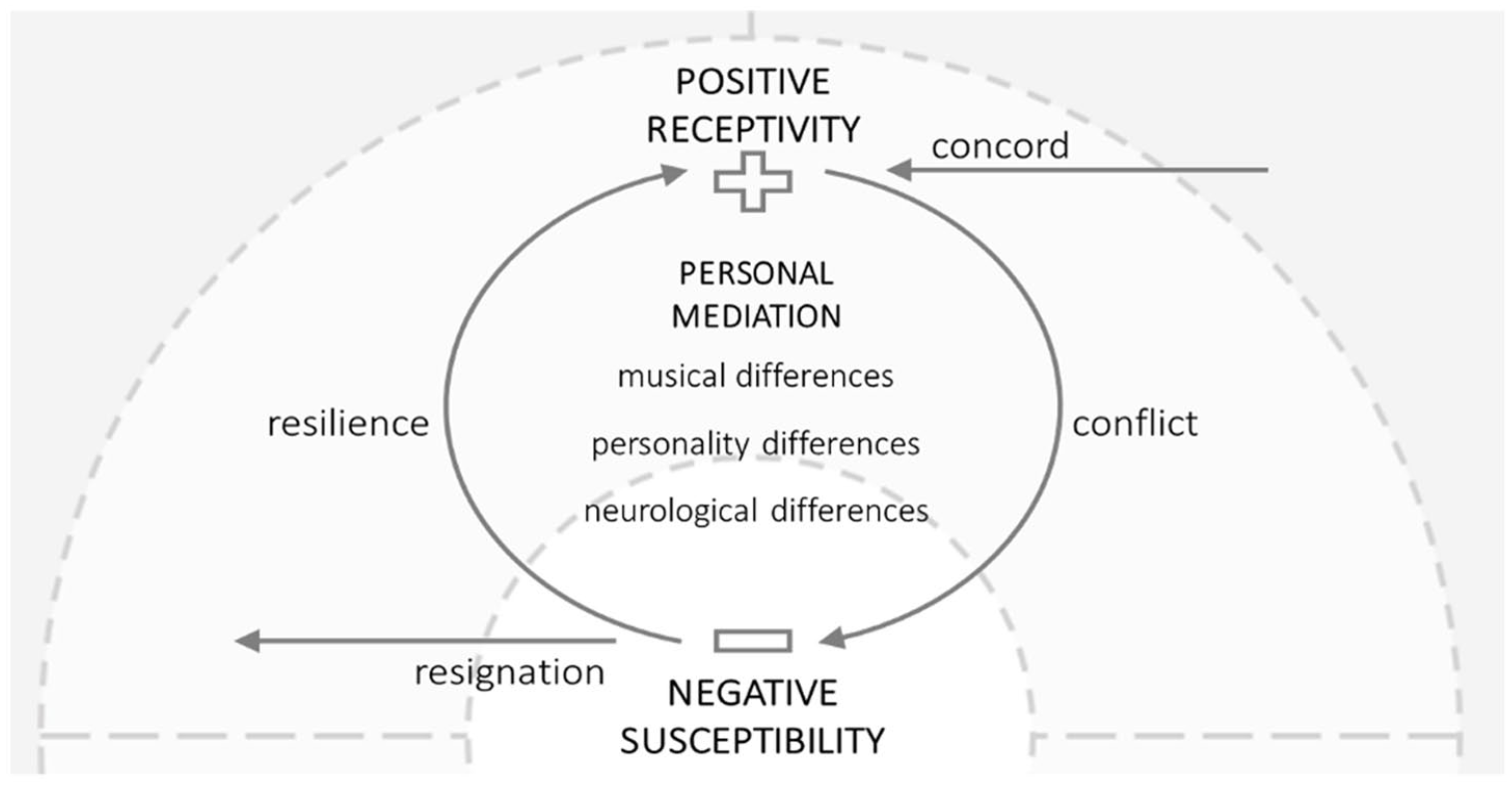
A Typology of Pupils’ Musical Vulnerability in the Secondary Music Classroom.
Limitations of the present research
As reflected in the present study, phenomenologically-informed research typically uses limited numbers of participants to achieve saturated descriptive analyses. This research is therefore restricted in the scope of its description of teachers’ lived experiences. Although I aimed to recruit participants from a range of backgrounds, predominantly White schools in affluent counties are overrepresented in my preliminary characterization of musical vulnerability.
More significantly, my characterization was limited by the lack of opportunity to interview pupils directly during the COVID-19 pandemic. Although this was disadvantageous for accurately describing pupils’ experiences, I sought to redress this in the subsequent phenomenological ethnographic study with one class of pupils and their music teacher (MacGregor, 2022b), which verified many of the assertions of the research discussed here.
Directions for future research
As I illustrate in Figure 3, this typology suggests that musical vulnerability in the secondary music classroom may emerge at the interpersonal interface between individuals’ musical expectations. As negative musical susceptibility is typically realized when these expectations come into conflict, future efforts to account for and respond to varied experiences of classroom music-making need to consider how individuals’ different musical expectations can be accommodated.
Considering such contrasting musical expectations will require future research into proactive differentiation in the music classroom. Typically, differentiation is associated with meeting the requirements of pupils with additional educational needs or disabilities, like Lucy’s pupil Stephen. Yet, this can be ineffective, because music teachers are often undereducated on how such needs may affect classroom music-making (Grimsby, 2022), lack sufficient resources for individualization within mixed-ability classes (Hallam, 1998), and risk overlooking the needs of some individuals in favor of others. Appropriate, proactive differentiation, therefore, needs to cater for all individuals in the classroom, taking time to recognize and cater for the personality, musical, and neurological differences that affect every individual’s music-making. In such a way, music classrooms may begin to prioritize the establishment of relational concord and musical receptivity, and foster “collective communities of care” (Michaeli, 2017, p. 54; cf. Elliott & Silverman, 2017) that understand and account for individuals’ diverse experiences of musical vulnerability.
Footnotes
Acknowledgements
The author is grateful to the anonymous reviewers and to Margaret Barrett, who fulfilled the role of Acting Editor-in-Chief for this article.
Correction (November 2023):
The article has been updated to include the acknowledgment statement.
Declaration of conflicting interests
The author(s) declared no potential conflicts of interest with respect to the research, authorship, and/or publication of this article.
Funding
The author(s) disclosed receipt of the following financial support for the research, authorship, and/or publication of this article: this research was funded by the University of Sheffield Faculty of Arts and Humanities Postgraduate Research Committee Scholarship and Postgraduate Research Publication Scholarship.

Notes
Author biography
Elizabeth H MacGregor completed her PhD in music education at the University of Sheffield, UK, under the supervision of Stephanie Pitts. Her research has appeared in publications including Philosophy of Music Education Review, Music Education Research, and A Practical Guide to Teaching Music in the Secondary Classroom (2nd ed.). She is currently a Research Fellow at Birmingham City University, UK, and Assistant Editor for Research Studies in Music Education.