



Abstract
Existing literature indicates that music teachers and educators working online need to encourage students to adopt self-regulating behaviors to succeed in their learning and performance. This study examines if and how string teachers promote selected self-regulated learning (SRL) processes in online lessons; specifically, how they teach and support motivation, self-efficacy, and task strategies for the self-regulation of students’ practice. Five string teachers and seven students at different levels of musical development participated in this study. The data sources included semi-structured interviews with teachers and lesson recordings. We analyzed the data using a coding scheme based on self-regulated learning theory. Our findings report that teachers used practices that can indirectly contribute to the self-regulation of students’ practice, such as using digital tools to help plan practice, discussing repertoire with the student, and requiring recordings to motivate students to practice. However, teachers’ direct approaches to instructing self-regulated learning behaviors did not stimulate students’ reflection; consequently, the development of students’ metacognition was poor. Therefore, a prominent implication underscored by this study highlights the potential created when online music educators take advantage of twenty-first-century technologies and the outstanding need to replace some traditional nineteenth-century approaches to music learning with more student-centered practices in which self-regulated learning plays a central role.
Keywords
Research on self-regulated learning (SRL) seeks to understand how students become more proactive and autonomous in their learning processes (Zimmerman, 2008). These characteristics are essential for music students, who spend most of their musical learning practicing at home without teacher supervision (Miksza, 2012)—thus requiring a certain level of study autonomy and self-directedness. Thereby, research on the self-regulation of musical learning proposes that teachers need to encourage self-regulated practice behaviors in their students (McPherson & Zimmerman, 2011; Miksza, 2015).
There is an emerging body of work stating that SRL and distance education are mutually well-suited because teachers are physically and sometimes temporally distant from their students, therefore requiring a more student-active role (Bol & Garner, 2011; Mutavdžin et al., 2021; Rowe & Rafferty, 2013; Schunk & Zimmerman, 1998). Hence, in online music lessons, teachers promoting self-regulated processes in their students seem even more crucial. Despite the number of studies about self-regulated practice behaviors (Austin & Berg, 2006; Bartolome, 2009; Cremaschi, 2012; Hewitt, 2015; Miksza, 2015; Miksza & Tan, 2015), and the influence of teachers in promoting these behaviors (Pereira, 2021; Warwick, 2015), very few works deal with the influence of music teachers in enhancing self-regulation practice skills in online educational settings (Mutavdžin et al., 2021).
Considering this theoretical gap and the literature pointing to how students engaged in online lessons need to adopt more self-regulatory processes, the objective of this study involves exploring teacher instruction and the role of the learning environment in promoting the self-regulated processes of the motive and method dimensions of SRL theory (see Theoretical frameworks section), such as motivation, self-efficacy, and task strategies.
Theoretical frameworks
Self-regulated learning
According to the social cognitive perspective, SRL constitutes a complex construct involving cognitive, metacognitive, motivational, affective, behavioral, and social aspects. Zimmerman (2000, 2008) defined self-regulation as a cyclical process composed of three phases: (a) the forethought phase (before), which involves the motivational beliefs of learners, and self-regulatory processes as goal setting and strategic planning; (b) the performance or volitional control phase (during) in which learners observe and control their thoughts, feelings, and behaviors during the learning activity; and (c) the self-reflection phase (after), which completes this cyclical model and involves self-assessment subprocesses that then inform the next new learning cycles.
The subprocesses that happen during the SRL cycle are divided into six key psychological dimensions (McPherson & Zimmerman, 2011, 1998). Each dimension is accompanied by a scientific question to point out its subcomponents: (a) motive (why?); (b) method (how?); (c) time (when?); (d) behavior (what?); (e) physical environment (where?); and (f) social (with whom?).
The motive dimension interlinks with motivational beliefs, which explain why students choose and persist in their efforts to learn music (McPherson & Zimmerman, 2011). The SRL processes related to this dimension occur in the forethought phase. One of the motivational beliefs present in this dimension is self-efficacy. Bandura (1997) defines self-efficacy as a student’s self-perception that s/he can succeed in reaching a set goal. Researchers have measured the levels of self-efficacy in music students and reported that self-efficacy beliefs play a vital role in learning and performance achievement (Hewitt, 2015; McCormick & McPherson, 2003, 2006; Nielsen, 2004). Other authors have sought to understand how teachers can develop their students’ self-efficacy (Ezra, 2019; Gill et al., 2024; Zelenak, 2020). According to Zelenak (2020), for example, boosting the self-efficacy of students significantly relates to the capacity of teachers to set goals and recognize and verbalize their performance accomplishments.
The method dimension relates to how music students practice—the task strategies they choose and apply during practice (e.g., setting goals, slowing down, using the metronome). According to Zimmerman (2000), “for a skill to be mastered or performed optimally, learners need methods that are appropriate for the task and the setting” (p. 17). Music psychology researchers connect the improvement of musical performance with the application of a variety of task strategies (Barry & Hallam, 2002; Jørgensen, 2004; Miksza, 2007). Task strategies interconnect with the self-control processes that occur during practice (Osborne et al., 2021) and, in turn, are an SRL component connected to the performance phase.
Ways to promote SRL
Several authors have set out two ways of promoting and supporting SRL strategies: (a) direct promotion through teacher-given instructions, and (b) indirect promotion through the learning environment, such as learning content and pedagogical approaches that indirectly activate SRL in students (Dignath-van Ewijk et al., 2013; Dignath & Veenman, 2021; Kistner et al., 2010; Spruce & Bol, 2015). According to Dignath and Veenman (2021), teachers can directly promote SRL through explicit or implicit strategy instruction. When teacher instructions induce students to adopt SRL strategies without mentioning this as a strategy, the teachers are deploying an implicit strategy instruction. Instructions are considered explicit whenever the teacher provides information about the importance of the strategy, explaining, demonstrating, clarifying, or overseeing the application of the respective strategy. Correspondingly, some researchers have reported that explicit strategy instruction more closely aligns with positive student outcomes than implicit strategy instruction (Brown et al., 1981; Kistner et al., 2010).
Dignath and Veenman (2021) have distinguished four levels of implicit and explicit instructions: (a) implicit/explicit demonstration, (b) implicit/explicit explanation, (c) implicit/explicit call, and (d) implicit/explicit asking. According to these authors, the most effective way of training students to apply SRL strategies is through explicit asking. This instruction refers to what Veenman et al. (2006) call the WWW&H rule: what to do, why, when, and how to apply it, engaging the student in metacognitive reflections.
Another means of activating SRL involves providing indirect support. The learning environment, which comprises the materials, tools, and curriculum, may also encourage SRL (Kistner et al., 2010). In the music education field, some studies focus attention on the analysis of digital tools to scaffold SRL, such as helping students to strategically plan their practice sessions, proposing task strategies, incorporating listening tools to assist aural familiarity, as well as aiding students in identifying their practice goals (Brook & Upitis, 2015; López-Calatayud & Tejada, 2024; Wan et al., 2023).
Examining the promotion of SRL in music educational settings
Few studies have focused on observations of regular music lessons to report on the promotion of SRL by teachers, and the research that has been done typically describes this experience in face-to-face settings. Warwick (2015) and Pereira (2021) conducted classroom observational studies to explore self-regulatory teaching instructions. Warwick’s (2015) findings convey how the frequency and types of interactions around self-regulation depend on the level of students—for example, teachers of beginner students emphasize planning strategies (forethought phase) more than teachers of advanced students who reinforce strategies from every SRL phase. Pereira’s (2021) study, which also observed students in practice, proposed the need for teacher instructions that reinforce not only effective practice strategies but also better identification of the learning goals.
Teaching strategies for online music instrumental lessons
Researchers studying online music instrumental lessons have reported that the teaching practices in online lessons differ from those in face-to-face lessons (Johnson, 2020). According to extant literature, instrumental teachers delivering online lessons need to adopt specific teaching strategies, for example: (a) spend more time planning the online lessons compared with face-to-face lessons (Brändström et al., 2012; P. Riley, 2009); (b) promote dialogue with the student as some types of face-to-face instructions are impossible to apply (e.g., physical contact with the student and playing together), and thus there is a tendency either to talk too much and not engage the student in dialogue or to provide unclear verbal instructions (Brändström et al., 2012; Lancaster, 2007); (c) work with asynchronous communications beyond the synchronous lessons (Okan & Arapgirlioglu, 2019). Furthermore, other studies reinforce how teachers adopting a social constructivist perspective are able to nurture better online learning environments (Johnson, 2017, 2020).
Researchers have highlighted certain limitations to online teaching, including problems with sound quality and audiovisual latency, especially when involving weak internet bandwidth (Dammers, 2009; King et al., 2015). To face these challenges that hinder the evaluation of sound and intonation and make playing together impossible, teachers employ a strategy that involves requiring students to make recordings and use backing tracks (Johnson, 2017; Pike, 2017). On the contrary, studies discussing the effectiveness of low-latency software, such as LOLA, have suggested a more positive experience of online lessons and/or musical performances (Drioli et al., 2013; H. Riley et al., 2016).
This study aimed to identify how string teachers, in online settings, promote motivation and self-efficacy, and teach task strategies for self-regulation of students’ practice. Thus, we developed the following research questions:
Research Question 1. How do teachers directly or indirectly encourage motivational strategies and self-efficacy beliefs in online lessons?
Research Question 2. How do teachers directly or indirectly encourage students to adopt task strategies in online lessons and which approaches do they apply to achieve this?
Method
Design
A collective case study (Stake, 2000) was designed, where each teacher was considered a case. As Stake (2000) described, the collective case study encompasses multiple cases, where each case is analyzed separately, and subsequently, a cross-analysis is performed to identify themes similar to all cases. Collective case studies allow researchers to explain phenomena or situations in detail (Robson & McCartan, 2016). Each case, individually and interconnected, illuminates the “why” and “how” of the phenomena under investigation (Yin, 2014). In this study, cases were bounded as they were “separated out for research in terms of time, place, or some physical boundaries” (Creswell, 2012, p. 465).
Participants
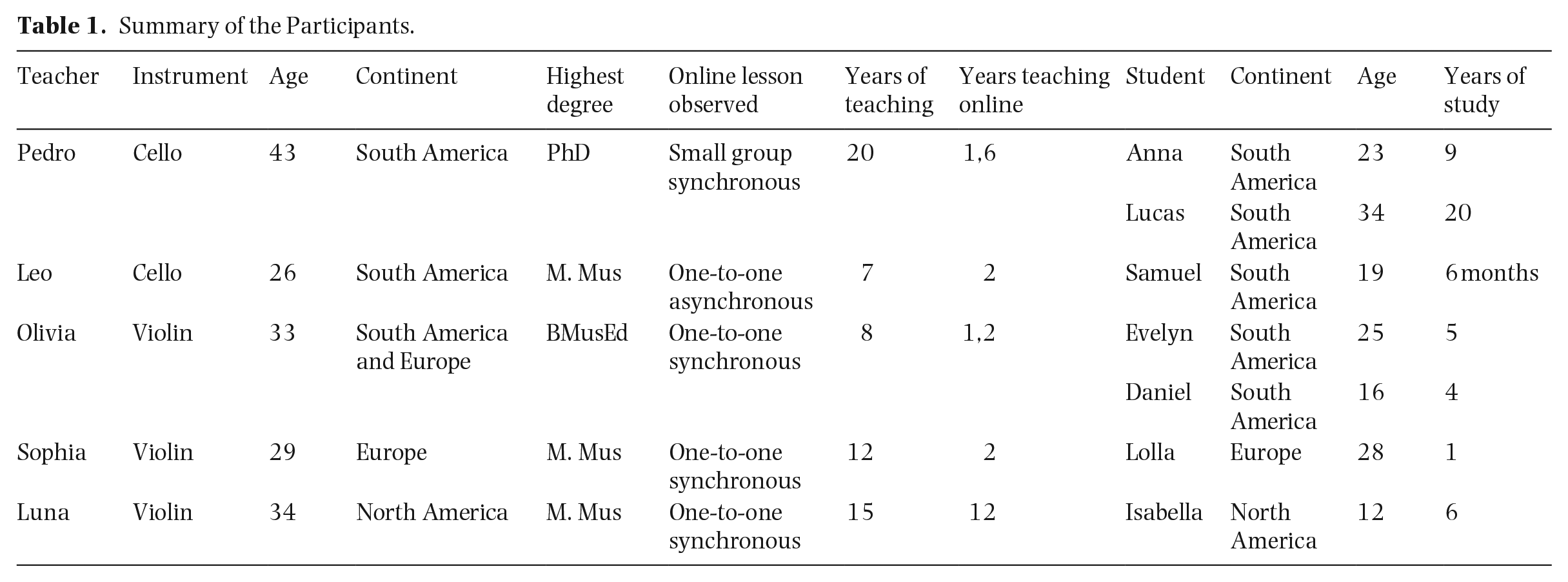
Five teachers—three violin and two cello—and seven students participated in this study. The participants were selected via criterion sampling (Cohen et al., 2007). The participant selection criteria were: (a) teachers with more than 5 years of teaching experience, and (b) experience of voluntarily teaching online for more than 1 year (i.e., not as an imposition due to the COVID-19 pandemic). Each teacher was responsible for selecting and inviting their students in accordance with the following criteria: (a) more than 12 years old, and (b) not professional musicians.
Table 1 sets out a description of the sample. All the teachers engage in traditional Western classical music in nonformal settings.
Summary of the Participants.
All participants gave informed consent prior to the start of data collection. To safeguard the identities of the participants, pseudonyms are used. The entire study received the approval of the Ethics and Deontology Committee and the Data Protection Officer of the University of Aveiro in 2021.
Procedures
Data collection took place between October and December 2021 through the following data sources: (a) video recording, (b) observation notes, (c) semi-structured interviews with teachers, and (d) analysis of teacher pedagogical materials.
Video recording and field diary
The synchronous lessons were observed by the first author and simultaneously video recorded. In total, 10 hr and 30 min of recordings and 20 pages of field diary were analyzed. We coded three synchronous lessons by teachers Pedro, Olivia, Sophia, and Luna, totaling 12 lessons, via the Zoom videoconferencing platform. The duration of the synchronous lessons given by teachers Pedro, Olivia, Sophia, and Luna was between 30 and 60 min. Unlike the other teachers, teacher Leo delivered asynchronous lessons—what he called a “recording exchange” (i.e., the student sent a performance recording and, after analyzing the recording, the teacher sent a video lesson with feedback). Thus, we also analyzed four video lessons from teacher Leo and nine recordings of student Samuel. Due to the format adopted by teacher Leo, his video lesson spanned between 5 and 8 min in duration and the recordings sent by his student Samuel lasted between 1 and 4 min.
Semi-structured interviews and teacher pedagogical materials
We carried out an online semi-structured interview with each teacher after observing the lesson. In total, 8 hr and 24 min of interviews were coded.
Observation instrument
An observation tool was designed to assess the quality and frequency of the direct strategy instructions given by teachers. To create the coding scheme related to the direct promotion of self-efficacy beliefs (e.g., “giving positive and detailed feedback”), we made recourse to some of the strategies proposed by Zelenak (2020) to develop the self-efficacy beliefs of students. To design the codes related to task strategies instructions (e.g., metronome, accompaniment), we adopted the following: Miksza (2012), Miksza and Tan (2015), Miksza et al. (2018), and Mieder and Bugos (2017). The coding scheme and the explanation of teacher behaviors within each code and for both categories can be found in Supplementary Appendices A and B.
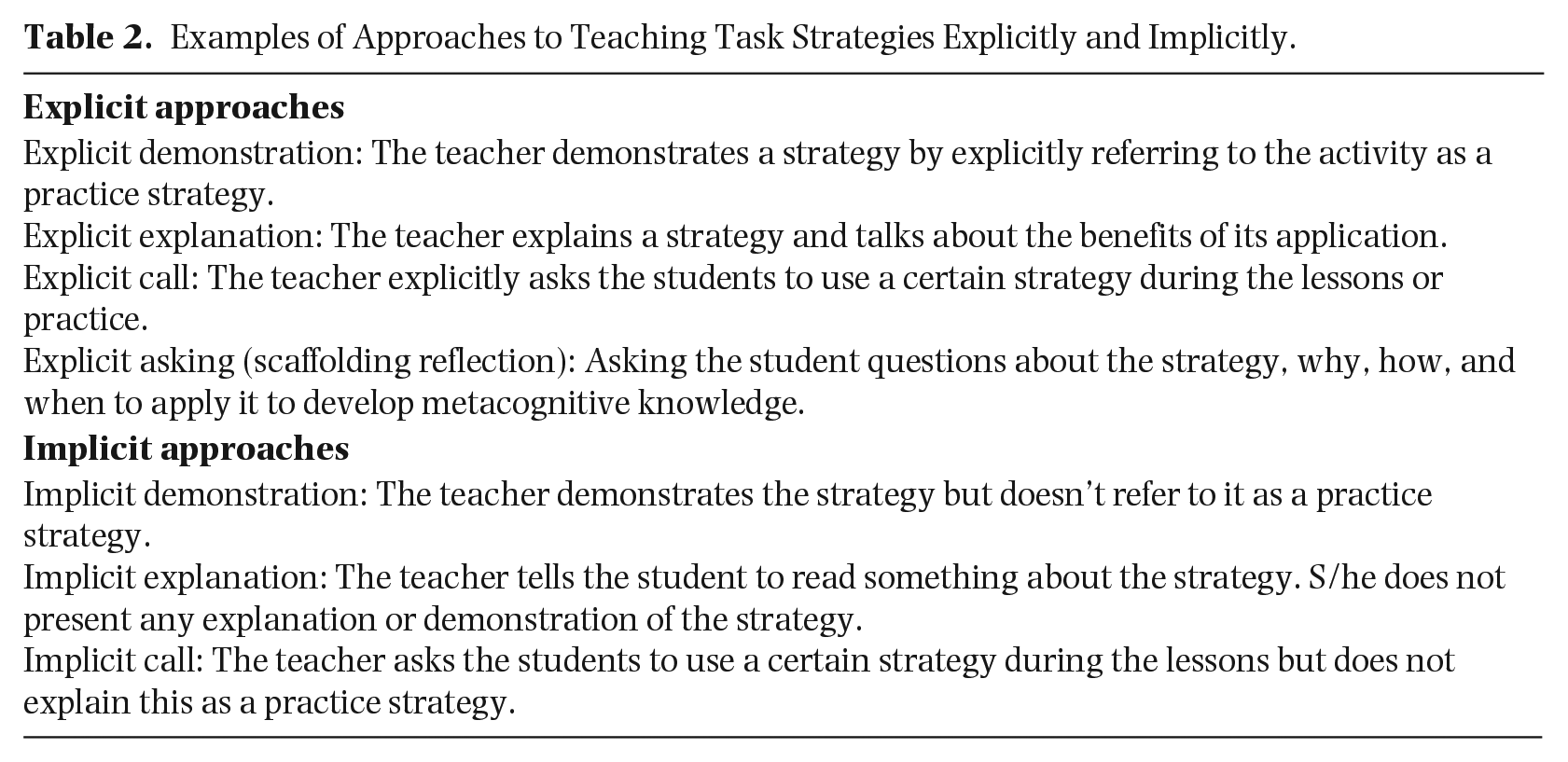
In keeping with Dignath and Veenman (2021), this study differentiated the task strategy instructions into implicit or explicit and categorized teachers’ approaches used to teach the strategy (demonstrating, explaining, calling, or asking). In the category of explicit strategy instructions, we coded those moments when teachers clearly referred to the instruction as a task strategy to be applied during practice (see Table 2). In the category of implicit strategy instructions, we coded those moments when teachers prompted students to deploy a task strategy during the lesson but did not refer to this as a strategy for application during practice (see Table 2).
Examples of Approaches to Teaching Task Strategies Explicitly and Implicitly.
The observation instrument was piloted to refine the coding scheme and to check its feasibility (Robson & McCartan, 2016). The pilot study used six lessons from this study and four recordings of online cello and violin lessons made available on YouTube by teachers with more than 5 years of experience. Reliability was assessed using two observers (first and third author) who had more than 10 years of experience teaching string instruments. The percentage of agreement was 100% for the type of instruction and 95% for the quality of the approach. The instrument was also checked through “peer debriefing sessions” (Lincoln & Guba, 1985) with an expert in self-regulation of musical learning.
Data analysis
We analyzed all data sources using the software NVivo, version 1.0. The first author observed, recorded, transcribed, and led the initial data analysis. The data was independently validated by the second author and the third author.
First, we applied the observation instrument in the lesson recordings, seeking to investigate the teachers’ direct instruction of SRL strategies. We coded each synchronous lesson using the rehearsal frame concept of Duke (2000). Thus, each frame where the teachers instructed self-regulation strategies represented a unit of analysis. We conducted a descriptive analysis to investigate direct instructions, where each teacher’s instruction frequency was recorded and means and standard deviations were calculated. Calculating the mean and standard deviation was a way to conduct a cross-analysis to understand the similarities or differences in the phenomenon studied between the multiple cases (Stake, 2000).
Second, in the teacher interviews, we applied thematic analysis. The interview questions sought to understand what pedagogical practices and tools teachers applied to motivate students to practice and use task strategies. The codes forming parts of the indirect support categories emerged from these interviews. We provided coding frequency and descriptive qualitative analysis with the aim of showing prevalent themes in the teachers’ discourse regarding the indirect support of SRL.
We compared cases crosswise to identify patterns of similarities and differences in teachers’ approaches to promoting SRL strategies. For this, all data sources were triangulated. This part of the analysis allowed us to establish patterns of results in each case. As indicated by Creswell (2012) and Robson and McCartan (2016), to minimize bias and reinforce the credibility of the data analysis, we used the following techniques: triangulation, engaging with other researchers to discuss the data, revisiting the data, and critical reflection. To maintain the voice of participants, the following section illustrates the participants’ testimonies regarding (a) support of motivation to practice, (b) development of self-efficacy beliefs, and (c) fostering the application of task strategies.
Findings
The findings are presented focusing on the SRL dimensions addressed in this research: motive and method. This study provides a descriptive overview and does not reflect statistical analysis due to a lack of quantitative data.
Motive dimension
Indirect support of motivation for practice
The different ways through which teachers nurtured motivation for practice emerged through the interviews. Discussing repertoire with the students (19 references) was the support activity that teachers Pedro, Olivia, Sophia, and Luna declared they applied most often in efforts to understand the musical preferences of their students and, in some cases, making musical arrangements adapted to the student’s level. Teacher Luna, for example, maintains this is an essential strategy for stimulating practice motivation and an important point to consider when working with adult students—because most string methods were written for children and contain songs that do not connect with adult musical preferences.
Another student, said to me “ah, teacher, I’m talking about Villa-Lobos at school.” I was like, “oh, that is cool, so how about you playing one of his pieces at school?” [. . .] so, I adapted Trenzinho do Caipira for her, and she played it at school. So, it is something that encourages her, that shows what she is studying to the family, to the school, [. . .] that motivates the student. . . [Olivia]
The teachers reported an increase in student motivation whenever they encouraged students to perform in public (16 references), which was the second most deployed support activity. As teacher Luna described, a recital or an audition “is a moment when they condense everything they’re learning and go for a specific goal.” Considering the modality, these teachers set strategies for their students to play in face-to-face recitals. For example, teacher Olivia asked students to play for their families or orchestral colleagues, make recordings, and send them to her. In the same way, in teacher Pedro’s lessons, we observed a series of instructions encouraging student Lucas to perform a recital in his hometown.
Something I noticed, everyone had difficulties playing for other people. So, I said, “wait a minute, then we have to start playing for other people; if you want to improve with this issue, you have to put yourself in that position.” This experience was cool [. . .], they also felt this public thing and lifted some of that burden [to play for a public]. . . [Olivia]
Teacher Leo, who once a week analyzes a video of one of his students in a synchronous group lesson, stated that this process provided a “recital experience”—the feeling of being “exposed”—and therefore he did not perceive face-to-face recitals as a priority.
The four teachers who based their teaching activities on synchronous lessons reported encountering difficulties in working sonority. Similarly, students identified difficulties in hearing the “real sound” of their instruments. During the observations, we noted the interruption of student or teacher sound happening on 21 occasions, often caused by internet connection issues or misuse of the audio features available in the video conferencing software.
1
As a strategy to overcome this, the teachers started to require recordings (10 references) to provide detailed feedback about sound quality, sound projection, and articulation. Some teachers required students to record the specific sections in which they encountered greater difficulties, which was identified as a way to help students set goals and plan their practice. According to teacher Sophia, this strategy did not just deal with the sound limitation but rather was “a tool to motivate students for the practice.”
There is a student who, when I ask for recordings, I know he is going to practise; he’s an adult, but I know he does it with pleasure, and I know he wants to record because otherwise, he won’t practise. [Sophia]
Direct strategy instructions for promoting self-efficacy beliefs
These teacher behaviors were identified right after hearing the students playing (M = 18.8; SD = 9.17). Teachers started instruction by giving positive and detailed feedback (39 references) or saying encouraging words (30 references). When students were anxious and worried about their mistakes, teachers sought to resort to the instruction of avoiding perfectionism and focusing on expression, fluidity, or well-being (23 references). The teachers’ discourse reinforced these observable instructions. Most teachers displayed concern over giving feedback by reinforcing the good aspects of student performances (seven references).
Furthermore, students expressing frustration during or after playing (21 references) was a behavior that appeared even in more advanced-level students.
In general, we work with people who have high expectations and little time to execute them. So, they are constantly frustrated. And then I must make feedback, precisely, to demonstrate, “wait a minute, but last week you weren’t doing this bow, look how you improved.” [Luna]
We rarely observed teachers paying compliments about the use of a practice strategy (two references). We did not code any incidence of teachers instructing students to reflect on their own performance by stimulating them to identify their own accomplishments (making the students highlight their accomplishments). Supplementary Appendix A presents the coding scheme for this category featuring the definitions of teacher behaviors, transcripts, and comments on lesson fragments.
Method dimension
Indirect support for the usage of task strategies
Teachers Olivia, Sophia, and Luna structured all their observed lessons in the same way: warm-up (scale, open strings), etudes, and musical pieces. Regarding this issue, teacher Luna stated this reflects a manner to help students and parents plan practice:
My lesson has to have, especially for the little ones, a structure that will be similar to what they will do at home [. . .]. So, I have to try to establish this routine. First, it’s better for the student, it’s better for the parents who know what the student has to be doing and knows what to ask because then, let’s suppose, the student takes the violin and starts playing, then the parent says “but you didn’t do your scales.” [Luna]
On the contrary, teacher Pedro, who works with more advanced students, affirmed he tries “deconstructing” the planning practices of some students. According to his perspective, students who always follow the same practice plan hinder their own progress because they feel their technical development depends only on a sequential practice routine when it depends, in his opinion, on more “dynamic” and “precise” practice:
I would rather talk to them about what I thought was not as effective than pass “prescriptions,” such as, “you spent too much time on this here and there was nothing here. You didn’t deal with what you needed to.” [Pedro]
Teachers Olivia and Luna used digital platforms like email and cloud-based storage to deliver practice routines to their students. These digital practice journals (15 references), which were made available to the researchers, contained: (a) what the student needed to practice, (b) some task strategies, (c) recordings and play-along, and (d) some considerations based on the student’s performance. Luna reported the importance of these tools for guiding parental support of student practice. She described how she applied this tool more with online students than with face-to-face students due to the practicality of being in front of the computer during online lessons:
For all my students, without exception, I have a folder in my Google Drive, “practice routines” [. . .]. So, it also becomes a way to follow up at home [. . .]. I give a direction of what he will do at home with a relatively interactive guide [. . .]. Especially for the young beginner student, I see a lot of difference. Parents love it here because they know what they must do at home. [Luna]
Teachers Leo and Luna declared it to be challenging to work on basic musical elements (e.g., intonation and rhythm) with beginner students in online lessons. To work on that and provide support for student practice within the online learning environment (11 references), teacher Leo provided Musical Instrument Digital Interface (MIDI) sounds with a metronome click for musical exercises, while teacher Luna provided audio recordings of her playing.
Both teachers declared that audio recordings permit beginner students, with no prior contact with music lessons, to “listen” to the recording while playing, “make comparisons,” and automatically “adjust” their playing. Teacher Luna would request students play with the audio recordings not just to support their practice but even during the synchronous lesson to overcome the delay and allow them to “play along with her,” thereby overcoming the impossibility of playing together, one of the limitations of online lessons through domestic internet connections.
Direct support for the usage of task strategies
Figure 1 displays the type and frequency of explicit and implicit strategy instructions, approaches, and the frequency per teacher. In general, the implicit strategy instructions happened in short fragments, without verbalizing that the instruction was a practice strategy and without any reinforcing of the indirect strategies. The results displayed a range of between 2 and 36 in teacher recourse to implicit instructions (M = 14.6; SD = 13.79). Analysis indicates wide usage of the implicit instruction “sing” as a resource to: (a) exemplify their feedback (the direction of the phrase or the type of articulation), (b) correct intonation, and (c) indicate the bars. On the contrary, we observed that, on only a single occasion, the teacher instructed the student to sing and use this as a practice strategy (see explicit strategy instructions). Hence, teachers mostly applied “sing” through the implicit demonstration approach. Other implicit strategy instructions that emerged were: (a) just the bow to correct bow stroke, articulation, or rhythm; (b) playing the notes without the original rhythm to correct intonation; (c) playing and counting to correct the rhythm; (d) whole-part-whole deliberately isolating challenges sections and, subsequently, recontextualizing the piece to correct mistakes; and (e) usage of an external tool to help motor control.
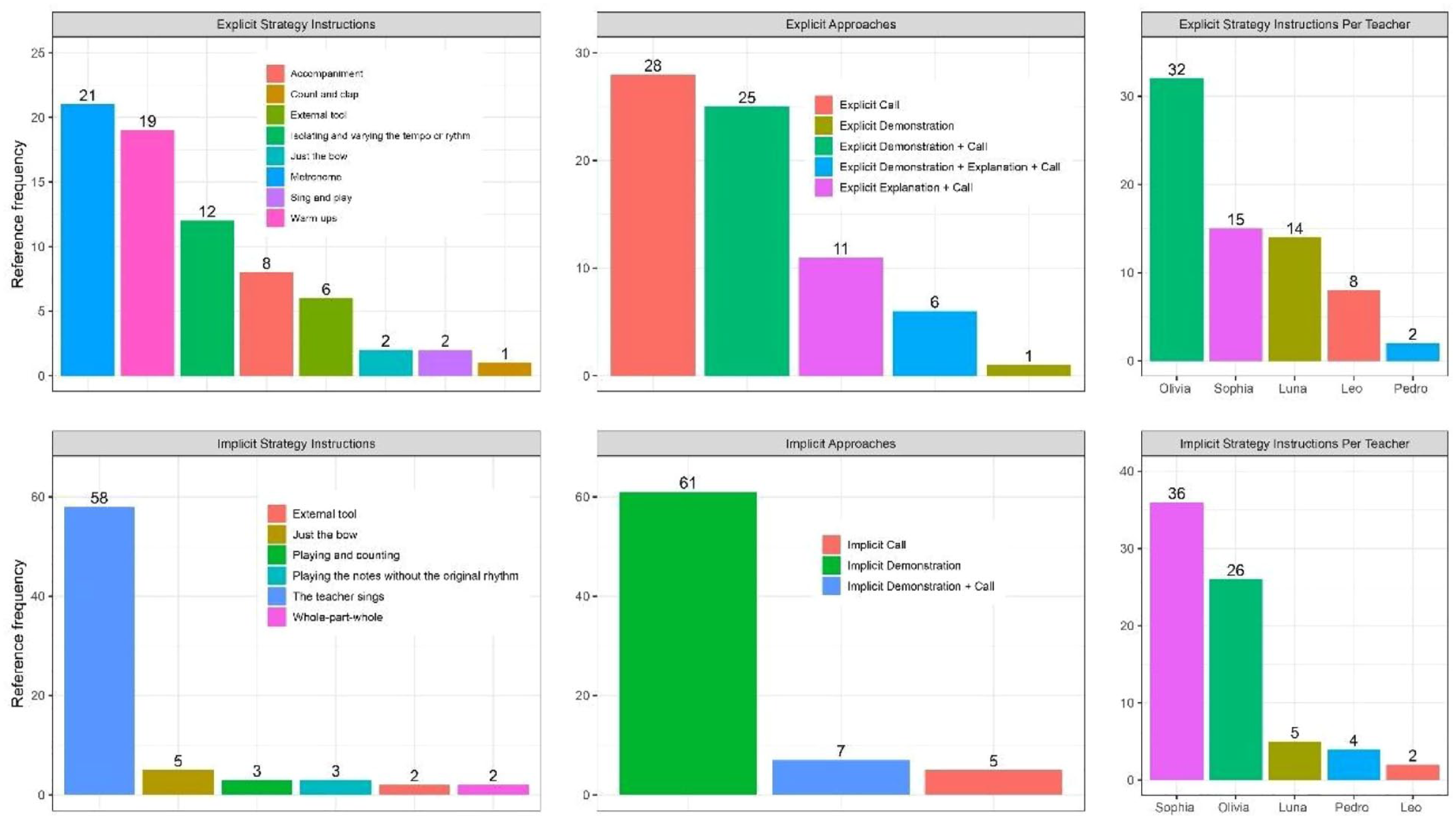
Frequency of Explicit and Implicit Strategy Instructions, Approaches, and the Frequency per Teacher.
Related to explicit strategy instructions, teachers deployed a greater variety of strategy instructions and approaches compared with implicit strategy instructions. However, there was also a wide variation in the frequency of explicit instructions per teacher, from 2 to 32 (M = 14.2; SD = 10.05). Teachers mostly ask their students to apply the strategy during the lesson (47 events). Other instructions happened when teachers requested students apply a strategy during practice without applying it during the lesson. The instructions that took more time involved teachers deploying more than one approach, for example, demonstrations plus explanation plus call. Supplementary Appendix B details the explicit strategy instructions observed and not observed, with the definitions divided by approach and with lesson fragments.
Teacher strategy instructions to play with the metronome were the often-most coded explicit strategy instructions. The analysis indicated that teachers applied this instruction to correct rhythm and tempo and to assist with motor control. A student’s use of a metronome during an online lesson was coded just twice after it was correspondingly noted that students requiring their smartphones to run the lesson could not simultaneously run a metronome app.
The instruction to play with the metronome was combined with the instruction isolating and varying the tempo or rhythm on five occasions. Teachers usually gave this instruction in the context of the lesson as a way to (a) correct intonation (e.g., asking the student to play slowly); (b) work on motor aspects (e.g., asking the student to play slower to have time to reflect and correct the movement); and (c) increase the tempo. The type of delivery for this instruction was, in general, demonstrating and calling.
Starting the lesson with warm-ups was observed in every lesson given by teachers Olivia, Sophia, and Luna. In general, these teachers requested their students start the lessons by playing one or two of these exercises: open strings, scales, arpeggios, and mechanical left-hand exercises providing some demonstration about how to proceed during the application. On the contrary, teacher Pedro started all his lessons with repertoire, and the content of teacher Leo’s video lessons featured songs from the Suzuki Method (Volume 1).
The strategy instruction to play with accompaniment was observed in the lessons of teachers Leo and Luna. Teacher Luna applied this instruction in a lesson context because the mother of student Isabella was a professional pianist and played with her whenever the teacher requested this. In the same manner, teacher Leo, in all of his video lessons, first asked the student to send recordings playing with a metronome; after this, he instructed the student to play with accompaniment (play along). The instructions metronome, isolating and varying the tempo or rhythm, warm-ups, and accompaniment were coded as explicit strategy instructions in keeping with teachers reinforcing them by indirect support (see indirect strategy in the Method section).
Teacher Luna explained that she uses external tools to help with student motor control. We observed recourse to an external tool (clothespin) to help student Isabella control the movement in her right arm. In addition, teachers Luna and Sophia asked for their students to practice in front of mirrors to watch and monitor their motoric movements.
Sing and play were observed in the lessons of teachers Sophia and Pedro. In Sophia’s lesson, this instruction took a long time (10 min), including demonstration, explanation, and application. This instruction arose from a student’s question (“Are there violinists who can sing while playing the violin?”). In Pedro’s lesson, this instruction was briefly demonstrated by the teacher and not applied by the student. Count or clap the rhythm was applied by teacher Sophia to correct rhythm problems.
Eight task strategy instructions from the coding scheme were not observed (marking troubling spots, observing the music and planning, skipping to critical sections, setting goals before the practice, chunking, sight-reading, singing or saying the name of the notes, and saying the notes and fingering). In terms of their instructional approaches, the data portrays how teachers applied the approaches of demonstration or call most often (event frequency = 127). Combined teacher approaches (demonstrating plus explaining plus call) were coded on a few occasions (event frequency = 17). The data identify how teachers combine approaches when the strategy is unknown to the student. We did not observe any task strategy instructions being delivered in an explicitly asking approach (i.e., asking questions to promote student reflections about task strategies). In fact, the observations noted a generally low frequency of teacher questions during the lessons and, on occasion, when the teacher asked, s/he did not then have the patience to wait for the student’s answer and swiftly provided their own answer.
Discussion and conclusion
The purpose of this study involved understanding how string teachers in online lessons instruct and indirectly activate their students’ motivation and self-efficacy beliefs, as well as the recourse to task strategies in practice and learning. Specifically, this study sought to understand teacher approaches to conveying task strategies in accordance with a deductive scheme. Overall, teachers applied specific instructions to promote the motivation of their students and the application of task strategies due to the characteristics of the online lesson, such as requiring recordings and using digital resources (play-along and practice journals). The approaches of teachers to instructing task strategies proved to be very teacher-centered—these teachers were not observed stimulating reflection in their students, or the consequent development of metacognitive skills. To explore this aspect further, we will now address our research questions.
The first research question was: How do teachers directly or indirectly encourage the motivational strategies and self-efficacy beliefs of their students in online lessons? One of the strongest findings regarding the indirect activation of motivation was the evidence that, in almost all cases, the choice of repertoire was student-centered (i.e., it was designed to meet the choices and goals of students). This is an indirect way of activating SRL in line with the study of Renwick and McPherson (2002), who found that student motivation and persistence to practice rose whenever curricular materials related to their self-interests.
Teacher discourses indicated the importance of encouraging students to play in public as an important strategy for setting learning goals, which is typically associated with motivational gains (e.g., Gaffe, 1990). This finding emerges as an important category because, despite physical barriers imposed by the lesson modality, teachers still found solutions for students to play for other people (e.g., for their families, at school, during orchestral rehearsals).
These findings also demonstrate how teachers are concerned about verbalizing their students’ progress, praising them, or making positive comments about their performances to foster students’ self-confidence. Furthermore, this behavior is identified as one of the sources for developing self-efficacy beliefs in students (Zelenak, 2020). Teachers also focused on musical expression and student well-being instead of striving only for musical perfectionism. This instruction holds particular relevance as socially compelled perfectionism can be connected with performance anxiety (Mor et al., 1995).
However, one aspect that drew attention in relation to students’ self-efficacy beliefs was teacher discourses about students encountering difficulties in recognizing their accomplishments and the negative reactions observed in students, even in advanced students. It is difficult to assess student beliefs about this behavior, but we may infer that music students are often hard on themselves as stated by these teachers. In contrast, teachers rarely made students reflect on their performance by encouraging them to undertake positive self-evaluation (“making the students highlight their accomplishments”), which represents another characteristic connected with increased self-efficacy beliefs (Schunk, 1991). This finding aligns with previous research in face-to-face musical settings that identifies how the traditional teaching system makes students dependent on external assessment because the pedagogical approaches do not emphasize independent thinking; thus making students see their teachers as “gurus” (Casas-Mas et al., 2019; Daniel, 2001). These findings would suggest that, in online lessons, teachers still adopt traditional teaching and learning processes in which even advanced students, with great performance outcomes and reaching the end of their studies, cannot cut the “umbilical cord” to their teachers, remaining highly dependent on comments and feedback from them even after graduating.
The second question this study addresses was: How do teachers in online lessons, directly or indirectly encourage students to adopt task strategies in online lessons? The usage of implicit instruction was concentrated on just one instruction type (the teacher sings). The variety of explicit teaching is more elevated than implicit. Even though teachers did not explore the entire scope of task strategy instruction possibilities, they did focus specifically on some instructions, such as using the metronome, warm-ups, or varying the tempo. These most coded explicit strategies instructions were reinforced by indirect activation. The data also suggest that teachers who taught advanced students promoted fewer SRL practice behaviors than teachers of beginner or intermediate students.
The limitations raised by the teachers, such as the difficulty of working on musical components with beginners (e.g., intonation, sonority), and the sound quality problems encountered during the synchronous lessons, outline another educational implication of this research:
The need to create a powerful learning environment when working online, combining synchronous and asynchronous interactions as indicated by previous research (Okan & Arapgirlioglu, 2019),
Incorporating digital tools to create aural familiarity (Wan et al., 2023), and
Requiring recordings between lessons to give better feedback and encourage practice motivation.
All these facets can strengthen motivation and encourage students to select task strategies, thereby building self-regulated learners.
The teachers did not use any explicit approaches to instruct task strategies for their students (i.e., the teachers did not pose questions to students encouraging them to analyze and reflect on what task strategies they might apply to best solve a challenging section). In some cases, the teachers asked but did not await any response, answering themselves immediately. Thus, the teachers did not engage students in critical thinking about using the strategies and did not raise questions with SRL characteristics. This finding is similar to research in face-to-face settings by Warwick (2015) and in online settings by Pozo et al. (2022). Both studies conclude that teachers mostly control the lessons, basing their approaches on reproductive teaching (teacher-centered). In the same vein, SRL observation studies in general settings found that teachers do not provide students “with conditional metacognitive knowledge about how, when, and why to apply a certain strategy” (Dignath & Veenman, 2021, p. 519).
One of the most striking features of this study stems from how online music education holds the potential to overcome geographical distance through technology from the twenty-first century, but not to overcome the traditional limitations of teacher instruction from the nineteenth century. However, it is important to note that this finding may also be influenced by the limited online teaching experience of most teachers participating in the study, which may have made teachers repeat face-to-face teaching practices. Thus, one implication of this study encapsulates how teachers should enable their students to embrace the autonomy facilitated by this mode, transitioning from a teacher-centered model to a more student-centered model in which a more questioning approach might increase the self-regulation of students and decrease their external regulation.
Considering the COVID-19 pandemic, where teachers and students were forced to switch to a format mediated by digital technologies, and the fact that online teaching initiatives lasted even after that period, this research offers reflections on the pedagogical practice of teachers who teach online. Hence, this research provides teachers with a series of teaching strategies to boost the motivational components and task strategies, focusing on the need for teaching approaches that provoke critical thinking to make students more self-regulated and consequently more autonomous.
The limitations of this research point to several routes for future research. The small sample participating might be expanded to ensure the results are representative. Due to the importance of the online environment and the digital tools used, it would be interesting to include an analysis of a larger number of activities proposed by teachers. Subsequent research might measure student improvement and observe student practice to understand what type of instruction is most effective. In addition, future studies could also explore the instructional methods employed by educators with more than 5 years of experience in online teaching and a deep understanding of SRL theory, and perform a comparative analysis of interviews and observational data to clarify the relationship between the stated instructions of teachers and their subsequent practices. Furthermore, the data collection procedures returned limited insights into student experiences of the promotion of SRL by their teachers. Therefore, future research should consider conducting semi-structured interviews to better understand student perspectives.
Supplemental Material
sj-docx-1-rsm-10.1177_1321103X241264943 – Supplemental material for Investigating if and how string teachers instruct and support the self-regulation of students’ practice in online lessons
Supplemental material, sj-docx-1-rsm-10.1177_1321103X241264943 for Investigating if and how string teachers instruct and support the self-regulation of students’ practice in online lessons by Dora Utermohl de Queiroz, Guadalupe López-Íñiguez and Clarissa Foletto in Research Studies in Music Education
Supplemental Material
sj-docx-2-rsm-10.1177_1321103X241264943 – Supplemental material for Investigating if and how string teachers instruct and support the self-regulation of students’ practice in online lessons
Supplemental material, sj-docx-2-rsm-10.1177_1321103X241264943 for Investigating if and how string teachers instruct and support the self-regulation of students’ practice in online lessons by Dora Utermohl de Queiroz, Guadalupe López-Íñiguez and Clarissa Foletto in Research Studies in Music Education
Footnotes
Author contribution(s)
Declaration of conflicting interests
The author(s) declared no potential conflicts of interest with respect to the research, authorship, and/or publication of this article.
Funding
The author(s) disclosed receipt of the following financial support for the research, authorship, and/or publication of this article: This research had the financial support of FCT (Fundação para a Ciência e a Tecnologia), Portugal, through the research grant awarded to the first author, with the reference UI/BD/151260/2021, and the scientific employment program awarded to the third author, with the reference DOI 10.54499/CEECIND/03404/2017/CP1459/CT0047.

Supplemental material
Supplemental material for this article is available online.
Notes
Author biographies
References
Supplementary Material
Please find the following supplemental material available below.
For Open Access articles published under a Creative Commons License, all supplemental material carries the same license as the article it is associated with.
For non-Open Access articles published, all supplemental material carries a non-exclusive license, and permission requests for re-use of supplemental material or any part of supplemental material shall be sent directly to the copyright owner as specified in the copyright notice associated with the article.
