



Abstract
Contemporary professional landscapes in classical music fields are rapidly changing and younger generations of musicians are confronting their creative careers, more often than not in connection to self-employment and freelancing. This narrative inquiry investigates the pathways and livelihoods of composers in a changing professional ecosystem through interviews with 10 bigenerational composers in Finland. The analysis is presented in three “factional stories,” in which the empirical material is crafted into “fictional form” by an anonymous first-person narrator. The stories depict how the secure, traditional careers of the older generation are found to be bound to traditional orchestras and ensembles, whereas the protean careers of the younger generation of composers involve passionate pathfinding amid pluralizing ecosystems, within but also beyond traditional contexts and through various collaborations. The younger composers are expanding significantly, or consciously distancing themselves from, the traditional model and values of a contemporary composer. Competition is found to be increasing and professional education described as too short and insufficient in its concentration on technique—this does not provide new understandings and skills beyond traditional composing craft needed for navigating the profession and securing livelihoods. Although similarities are found in the pathways of both composers’ generations, such as strong career callings and experiences of luck, the “struggle” for a composer to find a place in society is more strongly experienced by the younger generation, for which the development of an ongoing “learner identity” is required to embrace—and not resist—such a challenge. As a whole, the study provides a new understanding of composers’ pathfinding through changing ecosystems and suggests that traditional and protean music careers co-exist—even within a single person—while they can also be clearly separated from each other. The study informs higher music education programs in Western countries.
Keywords
Introduction
Contemporary professional landscapes in classical music fields are rapidly changing, and today’s new generation of musicians often confront their careers in relation to self-employment and freelancing. While most performing musicians are known to be insufficiently prepared for such a career (López-Íñiguez & Bennett, 2020), little research can be found on composers’ changing working landscapes and the consequences of those changes on their professional education. In higher music education, composers’ expertise has been considered individualistic (Partti & Westerlund, 2013), and to a great extent based on the mastery of composition techniques for orchestras and traditional ensembles (e.g., Lupton & Bruce, 2010), regardless of the recent significant expansion of the professional field to include electronic music, game music, sound art, multimedia composing, and co-composing (Böndum, 2019; Partti, 2012).
Despite these new career opportunities, it has been acknowledged that “emerging composers” attempting to build a career in the “neoliberal age” of contemporary classical music have difficulties both in becoming well established and making a living (e.g., Dowd & Kelly, 2011; Smith & Thwaites, 2019). Recent research highlights the barriers that female composers face (e.g., Hennekam & Bennett, 2017; Strong & Cannizzo, 2017), describing them as unprepared for their careers (Bennett et al., 2018), and suggesting an increased awareness of the practical aspects of forging careers (e.g., networking, online visibility), as well as economic and family support, to reduce the gender inequity in the industry (Hennekam et al., 2019). Yet, it is also known that only a very select few established composers, male or female, can survive on composition alone (Sound and Music, 2015).
In this narrative inquiry (Barrett & Stauffer, 2012), we recognize the individual motives, strategies, and mindsets of music professionals as starting points for investigating bigenerational Finnish composers’ careers and educational pathways by specifically focusing on their perceived and experienced conditions and livelihoods within their changing professional landscapes. Our research design underlines a working hypothesis that there may be an identifiable generational gap in professional composers’ career paths and livelihoods in Finland, while we also acknowledge that traditional careers in general are claimed to exist alongside contemporary careers (Baruch, 2006; Donald et al., 2017).
Theoretical frames and research questions
There is no full agreement among researchers on whether careers are becoming boundaryless or not (Inkson et al., 2012), with some suggesting a need to look beyond any dualities and emphasizing how careers are “shaped by a range of boundaries such that boundarylessness and embeddedness are co-existing career dimensions” (Rodrigues et al., 2016, p. 669). Baruch (2015) conceptualizes labor markets as “ecosystems” to reconcile this apparent disconnect between the coexistence of traditional and boundaryless careers (see also Baruch, 2014; Donald et al., 2017). Within the music field, Gaunt and Westerlund (2021a) describe how the ecosystemic change in music is manifested as “significant destabilisation of established structures of artistic production” and “professional arts practices expanding out of concert halls to more diverse, engaged, digital, and democratised contexts . . . moving into a greater range of physical spaces,” including “diverse collaborative and interdisciplinary ways of working” (p. xvi). This multilayered change not only “blurs structural boundaries” but also “threatens established value systems, providing challenges but also new opportunities for citizens, communities, and society at large, and equally for music and arts professionals” (pp. xvi-xvii). This change has resulted in the emergence of, for instance, portfolio careers as partly explaining how musicians can manage the multiplicity of options within the music industry (e.g., Bennett & Bridgstock, 2014), and protean careers emphasizing the entrepreneurial aspects of successfully navigating one’s employability (e.g., Bridgstock, 2005)—that is, to remain updated about and open to new trends in the work environment.
Although artists’ or composers’ careers are often seen as purely personal, they are not “immune to wider ecosystemic changes” (Smith & Thwaites, 2019, p. 590), which ought to be recognized by higher music education. The portfolio and protean career literature suggest a number of ways to support early-career professionals’ success in today’s changing professional ecosystem (ranging from enhancing the ability for staying flexible when it comes to career choices to supporting international mobility), yet very few studies exist on how to navigate the “boundaryless world” and what ecosystemic changes require from professional studies in general, and in music in particular. While studies usually concentrate on musicians who traditionally have been aiming toward institutional/organizational connections (e.g., orchestra, opera, educational institutions), in the context of this study we acknowledge that many composers have typically freelanced without any permanent institutional affiliation. The phenomenon of composers’ career paths should therefore be understood in relation to an actual “practice,” inherently tied to the changing and emerging workplaces where such practices are realized (see Tomlinson, 2017, p. 11).
Thus, we ask how the two generations of composers have experienced and reflected upon:
drivers and shifts in changing ecosystems, in their own career pathways and livelihoods, and in the field of composing in general, in relation to these ecosystems and
composers’ professional education as a site for envisioning or anticipating change(s) in emerging workplaces and existing environments.
Methods
Empirical material
The purposive sample (Creswell, 2009) consisted of 10 bigenerational composers, both male and female, either living in or professionally strongly linked to the Finnish music scene: some who started their careers in the 1970s and 1980s (five composers), as well as some having entered the business more recently (five composers). Semi-structured individual interviews (ranging from 60 to 90 min) were conducted by both authors via Zoom, in English. The questions addressed the participants’ career landmarks and learning pathways (e.g., Tell us about yourself, your educational background and career) but aimed to prompt not only the participants’ personal pathfinding but also their insider understanding of the field at large (e.g., Can you see any changes/emerging new practices in the music industry, and what challenges do they pose for composers? How can one survive/succeed as a professional composer, and how prepared are newly graduated students when entering the field?). We also asked about composers’ professional education in relation to the identified challenges in career and livelihoods.
Research approach
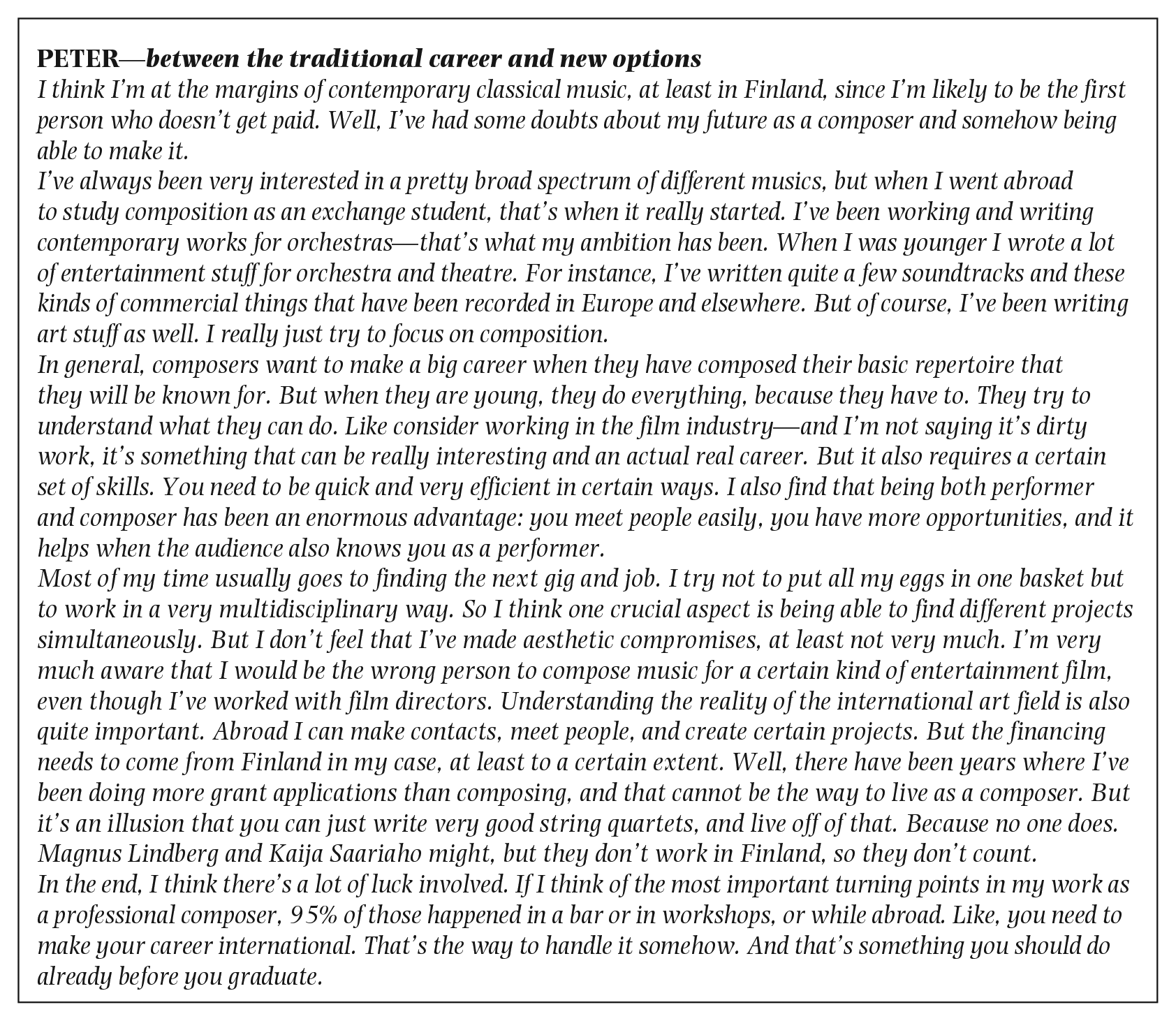
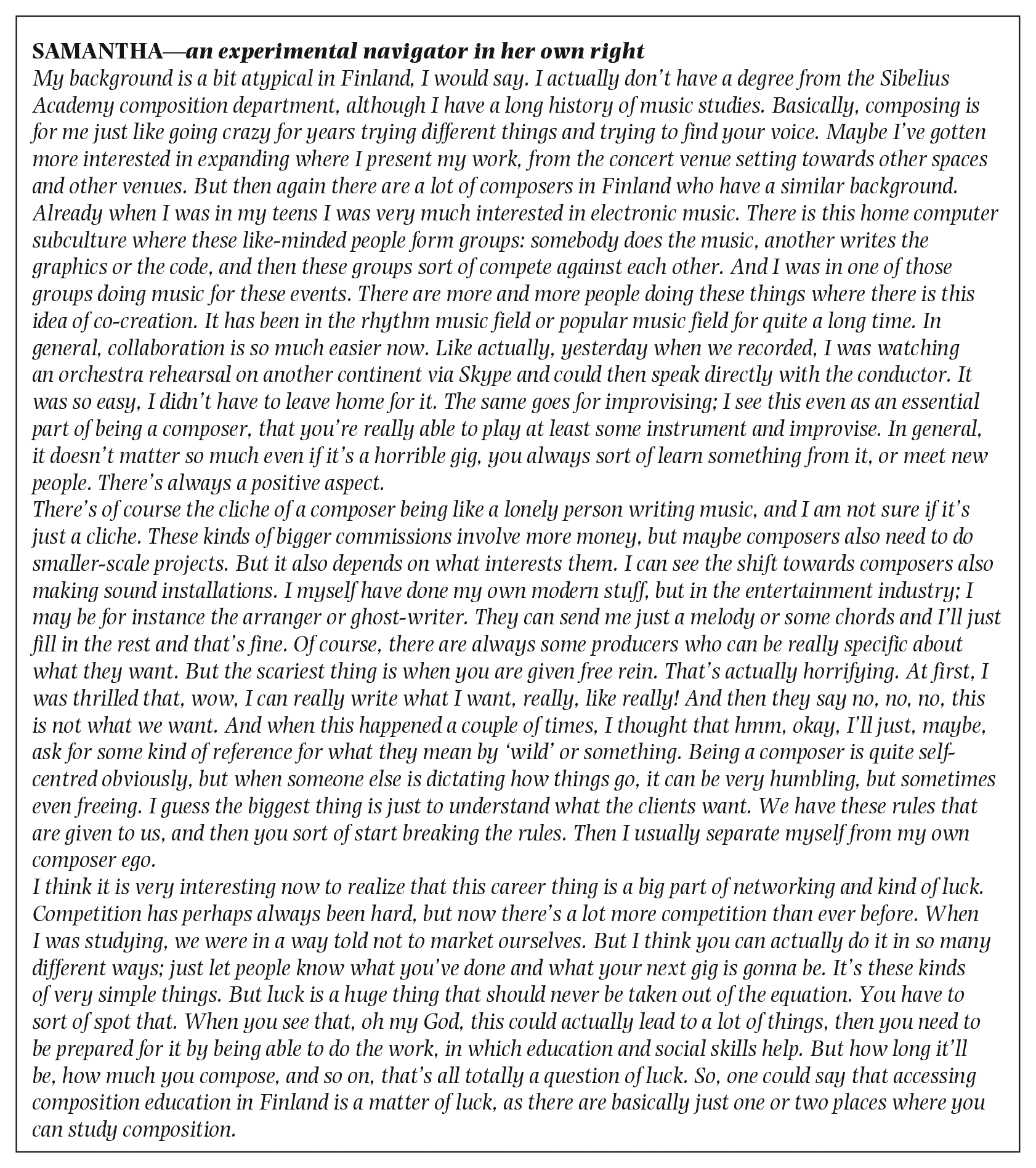
We investigated the composers’ experiences through their individual stories by using narrative techniques as a way to “make evident individual perspectives, social understandings, and local knowledge as revealed in the human practice of telling or storying” (Barrett & Stauffer, 2012, p. 2). We crafted the analysis in the form of composite narrative accounts with a first-person voice, seen as “factional stories” (Kallio, 2015, p. 4) that draw upon the stories of all participants. Three factional stories combine and condense individual narrative threads: one representing the older generation of composers (William), and two for the younger generation (Peter and Samantha), to illustrate the diversity in this generational group.
Each of the three factional stories involves more than two person’s accounts, and the female and male names do not necessarily relate to the gender of the interviewees. The bricolage of the excerpts (with occasionally added words to tie the story together) thus weaves together individual voices, aiming to illustrate the richness of details and the nuances of agreement between the interviewees without sacrificing the anonymity of individual participants (Leavy, 2013). Hence, the first-person “anonymous narrator” does not represent any single person in particular; however, the three stories are inseparable from the empirical material, as they are “made” by blending many voices—including our own interpretation of these voices (see Kallio, 2015; also Geertz, 1973), all aiming to voice polyphony through a reconstructed, (re)storied “fiction[al] form . . . laid over a ‘fact-oriented’ research process” (Agar, 1990, p. 74).
Together, the stories engage with temporal change while providing an understanding of the “past” through individual experiences and reflection, considering the “relationship to our present worlds and possible futures” (Barrett & Stauffer, 2012, p. 5). In this analysis, “trustworthiness is not a framework for ‘truth tests’” but rather emphasizes the need for respect and “responsibility (both to and for) in our conduct and our relationships with others” (p. 10)—in this case with the participating composers and the composers’ community in Finland. While the analysis can be seen as an outcome of a process in an “interpretive zone” (Bresler, 2005, p. 179) of two researchers with distinct areas of expertise, all interviewed composers were invited to comment on the narrative constructions to keep the interpretative zone as open as possible and to ensure the anonymity of the stories.
In this study, we engage with the concept of a protean career by highlighting the necessity for composers to be increasingly mobile and self-directed in their careers in a society in which “traditional occupations and state-supported institutions no longer provide a stable and permanent point of reference in terms of future work, principles and values, and professional identities” (Gaunt & Westerlund, 2021, p. xviii). The protean career theory emphasizes an individual’s “own career choices” (Hall, 1976, p. 201), highlighting that such pathways are values-driven and based on an individual’s self-directed career moves and motives (Gubler et al., 2014). It also highlights the strong “career calling” that arises from one’s self-defined musician identity rather than from benefiting others (see also Gubler et al., 2014, p. S35).
The characteristics of career calling, as described by Dobrow and Tosti-Kharas (2011), include aspects that overlap with conceptualizations of identity (e.g., how we define ourselves to others and describe passion and commitment to music). Thus, protean career choices and search for self-fulfillment become integrative of a person’s life: their career is shaped more by the individual than by any organization (Hall, 1976), and individuals define their own concept of a successful career and search for this success through their own actions (Gubler et al., 2014). In the abductive process of the analysis, we have interpreted the Finnish composers’ careers through the relational understanding of professional practice (Tomlinson, 2017) and the concept of a protean career, which resonated with the empirical material. The factional stories aim to use the power of narratives of the 10 composers’ experiences to generate meanings and reflections that can further enhance learning (e.g., Alterio & McDrury, 2003). Hence, the concept of a protean career is used to increase understanding of contemporary composers’ career challenges and their consequences for composers’ professional education, not for providing a normative model for higher music education.
Ethical statement
The study was reviewed by the Research Ethics Committee at the University of the Arts Helsinki, Finland. This research attends to the voluntary nature of participation, including the interviewees’ right to discontinue their participation. The participants provided their written informed consent and were not compensated for their time. All participants were informed about the possible retention of data by Zoom, following Goberna Caride’s (2021) recommendations to comply with the General Data Protection Regulation (EU) 2016/679 of 27 April 2016 (GDPR).
Findings
Three stories of contemporary composers’ career paths and livelihoods
The following three factional stories describe the shifts and drivers in composers’ career pathways and livelihoods in the past and present ecosystems. The first of them, William’s story, depicts a bounded and settled composer whose professional trajectory can be seen as a traditional career within the established classical music field.
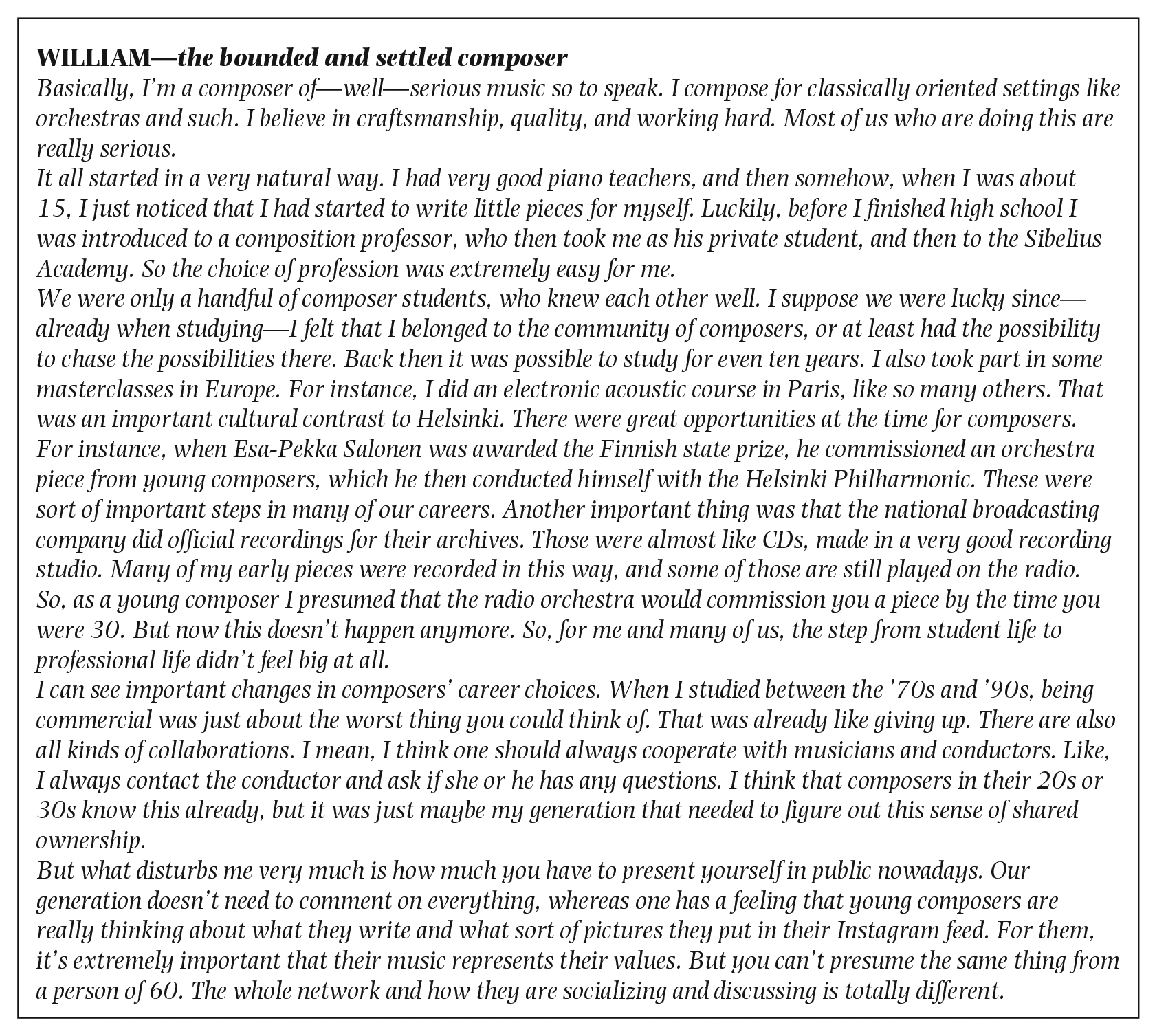
Whereas William’s generation reflected on changes in composers’ career pathways mostly from distance, the younger generation of composers included much more variety, and revealed that the shift from a traditional composing career to a protean career is not so clear (Baruch, 2014)—indeed, both aspects can be found in a single composer’s story. Peter’s story depicts the struggle of many interviewees when trying to enter or establish themselves in what is identified as a traditional composer’s path.
Samantha’s story demonstrates a protean career orientation (Gubler et al., 2014) in which the composer clearly defines their own concept of a successful career and sees success as a process of navigation in and through vastly diverse ecosystems that may provide neither safety nor continuity. Samantha finds satisfaction in all kinds of tasks, as all of them provide opportunities for learning. She has developed conscious strategies for attending to a variety of boundaries (Rodrigues et al., 2016), at the same time as she consciously departs from the traditional career with its limited options and bounded values.
Prospects of contemporary composers’ professional education in changing ecosystems
The older generation of composers identifies the diminishing interest of society in contemporary classical music, which has created for them a sense of having moved to the cultural margins. William explains how their music is not seen as a part of society in the same way as 30 years ago. People are generally interested in new theatre performances or visual arts, but not so much in contemporary composition. Indeed, the ecosystemic changes can be seen as directly related to what the younger generation is doing. However, for established composers, the diversifying spaces and forms of working in the contemporary music scene were a challenge beyond the boundaries of professional education. William recognizes how concerts tend to take place in new arenas; composers team up and skip clearly identifiable genre boundaries in favor of co-creation by several composers: The younger composers have fresh ideas, and somehow completely different ways or methods of doing things. They have no boundaries. Composers [of my generation] don’t know so much about working in galleries, how to present your work and make a living out of that, and what the rules are in these places. The youngsters have to mainly just figure things out by themselves.
Moreover, William—defining himself as a “serious” composer—explains how it is also unclear to him what the younger generation composers’ ambitions are when they enter professional education: Their fantasies may be basically doing a Lord of the Rings and writing their own orchestra simulations for different battle scenes. So, it’s not about becoming the next Ligeti, but it’s basically about having fun with different media.
However, while traditional careers are claimed to exist in addition to the protean career (Donald et al., 2017), William points out that this is not so much a matter of generational but individual differences: There are like two kinds of worlds in this field now. There is this classical music world where there are still rising figures who get commissions early. But then there is this plural world.
Furthermore, despite the multiple options, William emphasizes the value of extensive, professional education in the craft: For composers to succeed in their career, I would probably propose that they write a string quartet or find a quintet that is quite open to re-orchestrations. Quintet plus string quartet is the core of many contemporary music ensembles that try to develop their trademark language. If you’re aiming for a traditional professional career, you need to be able to know the craftsmanship. But if you think that nobody is ever going to commission a piece for orchestra from you, you don’t actually need these kinds of skills at all.
The younger composers also recognize the value of craftsmanship, which they relate to the most successful Finnish contemporary composers, but not necessarily to their own success or lack of it. Peter sees that, for him, this craftsmanship would be just finger exercises without end. Yet, I strongly appreciate that and understand that it’s part of the huge success of Kaija Saariaho and Magnus Lindberg. In his own career, it’s the many small things that actually bring in the money. Peter explains how one has to realize that a degree is not a promise of a job and a livelihood. Yet, the realities of composers’ livelihoods are recognized as a missing area in professional education. Peter describes, The kind of constant applying for everything, like residencies or grants for festivals, might come as a surprise after graduation, although that’s very essential for surviving. It requires quite a lot of persistence, self-motivation, and understanding that you’re doing many things.
Samantha confirms that one needs to develop skills that might be beyond the standard in many music institutions, and explains how professional education ought to help students find working opportunities in the future, including in public relations and marketing. Moreover, Samantha reflects at length on the responsibility of professional education in giving a positive push to minorities and providing many kinds of role models and voices in terms of both gender aspects and hierarchies between composers and performers: These questions of gender and sex are articulated more and more in a very loud and very intense way. I see this related to how aware institutions are of their policies for what kind of composers or students are invited. Somehow the hierarchies are getting flatter and flatter. It’s even more common to think that composers actually work for performers and composers compose something for these specific people with a certain kind of voice, certain personality, certain kind of body.
Finally, although there are no major changes in the professional education of bigenerational composers, the changes in governmental politics regarding culture and (arts) education are recognized as crucial in how university education has become scheduled in increasingly tight time slots. As William notes, if there was not this pressure to finish the studies in five and a half [the length of bachelor’s and master’s degrees at the Sibelius Academy] or two and a half years [master’s degree], there could be a little bit more added to compulsory things.
Discussion
In this narrative inquiry, the three factional stories represent the differentiated but also coexisting traditional and protean composer careers (Baruch, 2015; Donald et al., 2017; Rodrigues et al., 2016). The settled composer (William) is bound by traditional values and less oriented toward working with other people and communities, while the younger generation composers integrate their art and artistic voice in interactions and collaborations, and are more pragmatic and socially oriented. For them, digitalization facilitates having fun with the media; they accept entertainment as part of their work; they have curiosity beyond the mainstream compositional techniques and collaborations; and they are not afraid of being set conditions and expectations by a producer, player, or consumer of their music (e.g., facing new boundaries). Indeed, some of them distance themselves consciously from the traditional composer model, defining their career more through these many dependencies.
In describing the shifts and drivers in contemporary composers’ career pathways and livelihoods, composers use a different time horizon: the younger generation focuses more on the future being here and now, the older generation on the future being ahead of them. Although both generations describe a strong career calling based on personal artistic visions and motives, the younger generation accepts that composers may not achieve personal success in the same way as it was possible—and defined—just a few decades ago; furthermore, they have developed a strategy to embrace the struggle of engaging in plural professional ecosystems. In contrast, the older generation recognizes that while their career was possible at the time (at least for them), it was also bound to various funding opportunities which allowed their compositions to be performed in established contexts (e.g., orchestras, opera, traditional ensembles, concert halls).
This situation translates into a new reality for the younger composers who, as Smith and Thwaites (2019) argue, “need to be involved in a number of work activities in order to make a living” (p. 592). For them, navigating the ecosystem is a matter of understanding the realities and finding meaning in whatever they do. While recognized and accepted options now include commercial entertainment fields, competition has become greater and, as previous research already confirms, “shapes the development of aspiring composers” (p. 590). One of the key coping strategies amid increasing competition is being active, because, as Samantha puts it, nobody is going to get your music from your home. The composers unanimously agree on the changes in societal and ecosystemic values, and that social responsibility has become more relevant than ever (Partti, 2019)—the younger generation’s stories depict how things could be in this respect (e.g., acknowledging gender balance) but also exemplify it (e.g., generating and testing new educational ideas and working with communities).
Despite the emphasis being on hard work and constant searching, both generations see their own career success involving luck. 1 Luck was defined not only in terms of performance in entrance examinations, but also in terms of with whom you happened to study or work, and even as a kind of serendipity of interaction. The younger generation related luck to an ability to recognize emerging possibilities when they arise (to find luck), whereas the older generation referred to luck when describing their past educational context and working conditions (having been lucky). They all identified current opportunities as less structured—forcing the younger composers to search for multiple opportunities, create and use their networks, and find their specific niches—whereas the careers of the older generation already started during their professional studies. That was possible due to the media appreciation and 1970s and 1980s societal, cultural, and economic structures that supported emerging Western classical music composers and made it easier for them, for instance, to get their music performed by the highest level national orchestras well before their graduation.
Paradoxically, the older generation of composers represents the gatekeepers for the younger generation in festivals, concerts, funding decisions, and entrance examinations into higher music education. Indeed, one perspective to understand the gap between actual skills and finding one’s niche in the music industry—for both women and men in composing—is represented by the networks available to them and the gatekeepers of such networks. Hence, navigating a complex professional ecosystem where gatekeepers exist requires developing young composers’ critical mindsets regarding global networking, communication, negotiating, marketing, and navigating individual career pathways (Partti, 2020).
Our second research question concerned the narration of composers’ professional education in changing professional ecosystems. There was an agreement among the composers that technical education (i.e., craft) is not enough, and that you may indeed succeed without it. Many of their existing work options require skills that are not necessarily provided by higher education (in line with López-Íñiguez & Bennett, 2020) and include viewing studies as self-fulfillment (agency) for their own learning and artistic purposes (genuine interest) instead of getting a degree. Both these aspects strongly point toward career calling, with a strong emphasis on identity construction rather than service (Gubler et al., 2014). The motives, therefore, resonate with those for working in the creative industries in general; however, the younger generation relate more closely to an expanding professionalism (Westerlund & Gaunt, 2021) and a protean career that involves “a psychological contract with one’s self rather than an organisation or organisations” (Bridgstock, 2007, p. iv; also, Bridgstock, 2005). The boundaries of the traditional composer career are expanded but without necessarily compromising one’s calling and identity.
The older-generation composers describe how their education was conducted without haste and deadlines, whereas today’s education provides less time to focus on developing artistic ideas, causing an increasing workload (e.g., Jääskeläinen et al., 2020). One way to address such challenges relies on offering education related to brokering, social suitability, and peripheral participation in real work life (i.e., project- or task-based learning; see Westerlund, 2014; see also Wenger-Trayner et al., 2015). When asked about potential solutions for higher education that could support the current “expanding professionalism” (Westerlund & Gaunt, 2021), the younger composers identified actual skills that should be included in the curriculum, such as writing and articulating one’s own goals in better ways, developing networking skills, or writing successful funding applications. Samantha exemplifies a learner identity (López-Íñiguez & Bennett, 2021) in which all interactions are seen as providing multiple experiences and better chances to succeed in the long term. Both Peter and Samantha are also consciously resisting and distancing themselves from a negative dependence on hierarchical models for composers.
The findings confirm what Smith and Thwaites (2019) call a conflict between “a ‘way of life’ and a way of making a living” (p. 15): “the contesting conceptions of artistic labor manifest themselves in issues from remuneration to the subordinate position of the ‘emerging’ composer, relying on individuals who are skilled and experienced, yet keen to learn and willing to work for little reward” (p. 15). The Finnish composers point to two vital aspects that are intimately bound to each other when considering the career trajectory of composers: first, that composition opportunities by no means guarantee ongoing relationships with the funders, ensembles, and musicians involved, and second, that the true means by which such professional contacts and opportunities are gained remain opaque. As Smith and Thwaites (2019) argue, there needs to be a frank debate around the current role of competitive opportunities as a professional and pedagogical tool, and the role of the institutions—rather than the individual composer—in moving them forward. A more integrated approach would be beneficial, though it must have aesthetic diversity at its heart. (p. 17)
Although the structural mismatches between professional education and career demands can lead to compromises, and, as the literature suggests, to new graduates “trading down” their qualification in the search for more loosely matched job openings (Tomlinson, 2017, p. 22), the younger generation of composers situate this tension within the frames of their own pathfinding. While their professional education seems to fail in promoting the vital connection between the traditional craft and “the social and civic contexts in which many composers work” (O’Farrell & O’Connell, 2013, p. 6), the challenge is not simply about future employment, but how education is able to aid students in constructing their composer identities in today’s societies.
Limitations
This study involves some clear limitations. First, we chose rather successful and currently known composers, therefore offering less articulation on unsuccessful careers. Second, the sample in itself breaks the boundaries of what is considered a contemporary composer in the classical music field, as one of the interviewees clearly wanted to create distance from the traditionally understood classical music composer and composing scene.
Conclusion
This study highlights a shift in the contemporary composition field in Finland from the privileged position of full-time employment for life—where the older generation of composers could land during their studies—toward a continuing learner identity navigating multiple expanding professional ecosystems. Thus, the younger generation of composers reflects the protean careerist who is understood to have strong internal career motivations based on (a) self-directedness aligned with personal values, (b) occupational self-efficacy beliefs, and (c) a strategic mindset for success despite an insecure future (e.g., Hall, 2004). Importantly, while these qualities could also be related to the older-generation composers—although under very different ecosystemic conditions—our findings do not point exclusively to generational differences among composers, but to the coexistence of different realities and career options in parallel or as coexisting (nondescriptive) models (Baruch, 2015; Rodrigues et al., 2016) within the changing ecosystems. However, the generational gap is apparent in composers’ values, and how willing they are to reach beyond a single set of boundaries—or not. Hence, there is a need to rethink the professional models that higher music education institutions allow for composition students, and search for flexible curricula that support a variety of options in livelihoods; in other words, for students to have better opportunities to find their passion and values-driven identity, and their own definition for career success.
Footnotes
Acknowledgements
We would especially like to thank all of the composers participating in this study for generously sharing with us their journeys and reflections on their professional field. We also thank the Society of Finnish Composers (Suomen Säveltäjät ry) for their support of and collaboration in our study.
Declaration of conflicting interests
The author(s) declared no potential conflicts of interest with respect to the research, authorship, and/or publication of this article.
Funding
The author(s) disclosed receipt of the following financial support for the research, authorship, and/or publication of this article: This research was undertaken as part of the project “Expanding reflexivity of professional education in music in times of crises” funded by the Jenny and Antti Wihuri Foundation, and the research group initiative “Rethinking music performance in European higher education music institutions” funded by the European Commission’s Erasmus + Education and Training Programme (Ref. 2020-1-PT01-KA203-EB11CF50). The research has also been supported by the Sibelius Academy and the Center for Educational Research and Academic Development in the Arts (CERADA) at the University of the Arts Helsinki in Finland.
