



Abstract
This article reflects on the “Hiddenness Index” we developed, implemented, and evaluated for Concertgebouworkest Young (Young), the youth orchestra of the Dutch Royal Concertgebouw Orchestra (Concertgebouworkest) for musicians with “hidden talents.” “Hiddenness” alludes to various barriers that young musicians aspiring to a career in Western classical music may face, due to their social identity and positioning. These barriers may cause their talent to remain underdeveloped, invisible, or undiscovered; that is, “hidden.” We developed the Index in response to Concertgebouworkest’s request for an “evaluation and learning tool.” Informed by intersectionality theory, it is an alternative to quantitative research into arts and culture, which takes a single-axis approach to the explanation of inequality in access to cultural production and participation. The first phase of our design-based research consisted of a theory- and practice-based mapping of the dimensions of “hiddenness.” The outcome was that Geographical, Socio-economic, Family networks, Ethno-cultural, and Confidence-support dimensions should form the basis of the Hiddenness Index, which was constructed as a composite indicator. In the second phase of research, the Index was applied to the backgrounds of Young participants. The evaluation of the Index’s strengths and weaknesses was central to the third phase. Complementing qualitative research, the Index offered a statistical way to evaluate the extent to which Young participants’ talents were hidden and which dimensions of hiddenness were most prevalent at the group level. The Index affirmed and illustrated intersectionality theory, including the way two or more dimensions can compensate or reinforce one another. Through the use of the Index, the Young team gained a better understanding of intersectionality, which enabled them to fine-tune the selection process for future cohorts. The Index helped the team members to check their preconceptions (unconscious bias) and made them more aware of and able to attend to the different needs of individual participants.
Keywords
Introduction
In this article, we reflect on the “Hiddenness Index” we developed, implemented, and evaluated for Concertgebouworkest Young (Young), the youth orchestra of the Dutch Royal Concertgebouw Orchestra (Concertgebouworkest) for musicians with “hidden talents.” The concept of “hidden talent” is most commonly found in research on child adversity (e.g., Ellis et al., 2023; Young et al., 2022). In our case, “hiddenness” alludes to “hidden” (cf. Purves, 2017) and other barriers young musicians may face due to their social identity and positioning, which cause their talents to remain underdeveloped, invisible, or undiscovered. The Hiddenness Index evaluates the extent to which young musicians encounter such barriers, identifying opportunities to develop their talent.
Although the Hiddenness Index was developed specifically for the context of Young, we have discerned four overarching theoretical and practice-based reasons to design, and reflect on, such an index more generally. First, research studies show that cultural occupations were just as exclusive in the United Kingdom (UK) 40 years ago as they are now, irrespective of the vast social and cultural changes that have taken place (Brook et al., 2020). Similar patterns have been observed in The Netherlands (Centraal Bureau voor de Statistiek [CBS], 2021). Cultural occupations not only reflect, but also perpetuate social inequalities, as cultural production and consumption shape what is valued and given monetary worth in society. Currently, certain groups are missing from cultural occupations and these groups are often misrepresented or caricatured in artworks, if they are seen at all (Brook et al., 2020). Given that Brook et al. (2020) show that structural inequality within cultural occupations starts in childhood, we must study how young musicians are socialized in Western classical music and whether they have access to high-quality music education from a young age.
Second, several scholars have called upon colleagues to design research methods that embrace greater intersectional variation in explaining inequality in cultural production and participation (e.g., Brook et al., 2020; Vincent, 2017). Despite the long and varied history of the concept of intersectionality (Collins Hill & Bilge, 2020), quantitative research into arts and culture still predominantly seeks to explain differences in cultural production and participation by determining the single most dominant factor, most often age, social economic status, or level of education. Although such single-axis studies provide valuable insights into who is actively engaged in cultural production and participation, understanding intersectionality is core to effectively combatting the inequality of opportunity and to making cultural production and participation widely accessible. The question of how to deal with the intersectionality of factors in empirical, statistical analyses remains of great importance (Garry, 2011; McCall, 2005; Rodó-De-Zárate & Jorba, 2012).
Third, as the literature on intersectionality emphasizes contextualization (Collins Hill & Bilge, 2020), we have to determine the (interrelated) factors reproducing long-term inequality, in this case within the domain of Western classical music. Despite the many, and sometimes contradictory, applications and interpretations of intersectionality (cf. Cho et al., 2013), Collins Hill and Bilge offer a general description: Intersectionality investigates how intersecting power relations influence social relations across diverse societies as well as individual experiences in everyday life. As an analytical tool, intersectionality views categories of race, class, gender, sexuality, nation, ability, ethnicity, and age—among others—as interrelated and mutually shaping one another. Intersectionality is a way of understanding and explaining complexity in the world, in people, and in human experiences. (Collins Hill & Bilge, 2020, p. 2)
Within the field of Western classical music, Purves (2017) draws our attention to additional “hidden barriers” hampering equal cultural participation. This may include, for instance, covering the distance from one’s home to (high-quality) arts education facilities, described by indicators such as parental vehicle ownership, geographical distance from teaching/rehearsing sites, and instrument size and weight.
The fourth reason is practice-based: acknowledging and adequately dealing with intersectionality is not a straightforward process in arts institutions. For instance, the selection of participants for an orchestra such as Concertgebouworkest Young proves challenging, as limited information is available on relevant barriers and how they intersect for individual applicants. How can orchestras ensure that they reach out to and select young musicians for whom the intersectionality of factors may otherwise hamper their careers as professional musicians? A Hiddenness Index might facilitate such a process.
In this article, we use data from our four-year research project to explore the development of Concertgebouworkest Young (Trienekens & Escobar Campos, 2022). We focus on the selection of participants and how we developed a Hiddenness Index from an intersectional perspective to evaluate this process. We describe the results of the application of the Index and conclude with a discussion of its perceived strengths and weaknesses.
Concertgebouworkest Young and the Hiddenness Index
Their experience in the field of classical music taught the Concertgebouworkest that some young musicians face more challenges than others on their career paths due to structural barriers (e.g., socio-economic inequalities and discrimination). A country’s public policy and cultural infrastructure (i.e., how widespread, accessible, and affordable state-supported cultural facilities and music education are), along with barriers related to personal characteristics (including values, norms, and beliefs, cf. Butler et al., 2007), could have an impact on future career paths. Taking responsibility for their role as one link in the chain of institutions facilitating careers in classical music, the Concertgebouworkest Education and Diversity department designed a program whose ultimate aim was to broaden the talent pool from which top-of-the-bill orchestras recruit their future musicians.
Young’s 2019 edition kicked off a three-edition pilot program with a pan-European reach. Each edition brought together 73 new talented musicians in a 2.5-week-long, intensive Summer School in The Netherlands which culminated in concerts in the Concertgebouw and comparable concerts halls in Belgium or Germany. A new series of three editions began in 2023.
The Concertgebouworkest gained inspiration from the National Youth Orchestra NYO2 of Carnegie Hall in New York. In response to the particular societal dynamics of the United States, the NYO2 program strove toward gender, ethnic, racial, and geographic inclusion through its selection process. The Concertgebouworkest similarly extends the concept of “diversity on stage” beyond national identity by acknowledging that inequality of opportunities may result from a combination of social, cultural, geographical, and economic factors in the personal and family backgrounds of young musicians.
Consequently, one of the three goals of Young is to provide young musicians with “hidden talent” access to a high-quality music program. To reach these musicians, the admissions campaign focused on third-party nominators, such as local music teachers, directors of local youth orchestras, or directors of local music schools, who were reached through various European music (education) networks. From the second edition onwards, Young alumni were also entitled to nominate suitable candidates. In addition, social media played an important role in spreading the call for applications beyond the reach of traditional communication channels.
Annually, the Head of Education and Diversity and several musicians of the Concertgebouworkest selected the 73 young talented musicians from over 300 applicants. Rather than selecting only on the basis of the quality of the applicants’ musical performance, the team members kept reminding each other of the necessity to take additional factors into account. For this purpose, application forms were screened, among others, for differences in applicants’ nationality and country of residence, possibly indicating a history of migration. Application videos were screened for signs of the social status of applicants’ families (e.g., instrument quality), and for extra details spontaneously shared in application motivational videos. Occasionally, third-party nominators provided relevant information in their letters of recommendation. From the second edition onwards, questions were added to the application form, inviting applicants to explicitly reflect on how they could contribute to the diversity Young aims to foster and on why they could use some extra help on their musical trajectories.
Despite careful efforts to acknowledge a range of (interrelated) factors, after the selection process for the first edition of Young, admissions team members became aware that the available information on the hiddenness of the talent of young musicians had been limited. The team expressed their wish for a tool that could evaluate the outcome of their selection process, and make future selection processes more accurate. The team requested an “evaluation and learning tool” to increase the team members’ understanding of the workings of intersectionality with regard to hidden talent. They wanted this tool to address the intersectionality of factors explaining the hiddenness of talent at the level of individual participants and of the group. This tool would supplement the process of change in the Concertgebouworkest organization, which already included unconscious bias training for members, and the revision of their four-year institutional policy.
Their request prompted the research question: How can a Hiddenness Index be designed and applied after the selection process for Concertgebouworkest Young to evaluate the hiddenness of the talent of its participants? To answer this question, we set up a design-based research study and followed its recognized phases (Van den Berg & Kouwenhoven, 2008): Phase 1—Designing a tool; Phase 2—Applying the tool in practice; Phase 3—Evaluating the tool’s strengths and weaknesses. We elaborate on each phase in the following sections.
Phase 1: The design of the Hiddenness Index
Determining the indicators
The design of the Hiddenness Index was based on a literature study and a focus group interview. In the literature study, we used the search terms “music education” or “music tuition” in combination with terms such as “access,” “equitable,” and “inequality.” We selected articles that could be considered “meta studies” (e.g., Albert, 2006; Purves, 2017), covering or citing studies on music-educational practices in a range of countries from Sweden, England, Scotland, and Ireland, to the United States and Canada. We noticed the bias toward Anglo-Saxon practices and contexts, but had no reason to assume that there would ever be a context in which the presented indicators (e.g., lower socio-economic status) would provide an advantage.
In addition, in a focus group interview, indicators explaining the “hiddenness” of the talent of young musicians aspiring to a career in Western classical music were mapped, based on the practical experiences of participants. Participating in the focus group were three members of the Concertgebouworkest staff, who drew on their long-term involvement and experience in the field of Western classical music; two members of United World Colleges (the collaborating partner for the social program integral to the Young Summer School), who specialized in supporting personal growth and career development; a cultural diversity and participation expert, representing one of the major funders of the program; and the two researchers conducting the research into Young, with backgrounds in cultural sociology, mechanisms of exclusion, and cultural democracy. The focus group members were almost all female, of predominantly middle-class background, but representative of different ages and ethnicities. All participants gave active verbal consent for their participation in the research and for our use of the insights resulting from the focus group session.
Categorizing the indicators into five dimensions of Hiddenness
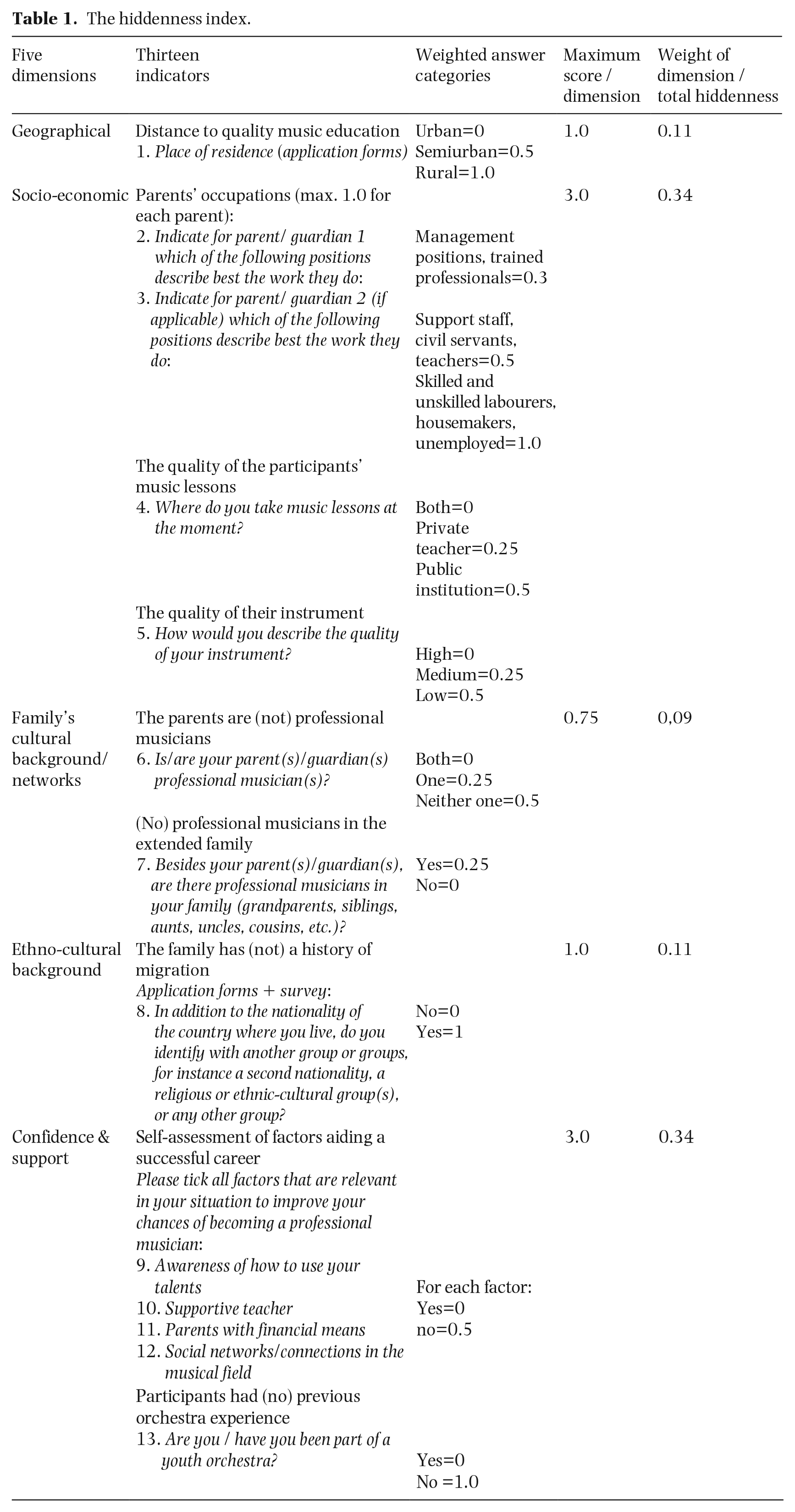
Based on the literature study and focus group interview, we identified 13 indicators of hiddenness (see Table 1). There was ample theoretical and practice-based support for the grouping of the 13 indicators into five dimensions of “hiddenness.”
The hiddenness index.
Geographical dimension
The focus group found that the talent of a young musician might stay hidden when they live far away from quality music education. The literature shows that the provision of music education “remains patchy” geographically, for instance, in the UK (HM Government, 2022) and Ireland (Conaghan, 2022). Variations in provision are explained by levels of urbanization. Purves (2017; cf. Henley & Barton, 2022) maintains that high transport costs and the impracticability of teaching groups in highly dispersed communities, particularly in rural areas, continues to impede access to tuition in some cases. Conaghan (2022) identifies the lack of a consistent national system of state-supported instrumental and vocal education as the cause of the geographically uneven and unequal access to performance music education; beyond major urban centers, in Ireland provision is largely a private or voluntary enterprise.
Socio-economic dimension
The focus group agreed that lower-economic classes are less likely to be able to afford costs associated with high-quality music tuition, which supports the start of any career in Western classical music. Brook et al. (2020) show that taking music lessons is even more class-stratified than other forms of cultural participation. All consulted literature indicates that family monetary capital endowment directly influences the extent to which families can afford (private) tuition fees, the purchase and maintenance of an instrument, transportation costs (or family’s vehicle ownership), and associated costs like reeds, oils, strings, sheet music, performance attire, and/or tickets to live classical music concerts. The Socio-economic dimension also concerns the availability of time: Is one of the parents able to take time off from work to take their children to extracurricular music lessons, which tend to take place during regular working hours (Conaghan, 2022; Purves, 2017)? Moreover, wealthier parents might choose a private school with ample music tuition for their children.
Studies from varied countries, cited in Albert (2006), find that socio-economic status is not related to “music attitude.” Parents of lower socio-economic status may value school activities, such as instrumental music programs, but the associated costs may prohibit their children from participating. The effects are considerable: the consulted literature offers evidence that socio-economic factors, measured as family income, socio-economic status, and/or parent occupation, are associated with the take-up of tuition, the duration of tuition (i.e., continuation of lessons for 2 years or more, cf. Purves, 2017, 2019), and achievement—children from middle-class backgrounds are more likely to reach higher levels of musical engagement and academic attainment (Cox, 2021; Wilson et al., 2020). Several consulted studies explain these effects by referencing the use of social and cultural capital by the middle-classes to reproduce socio-economic status, reflecting Bourdieu’s theory (e.g., Bull, 2019; Purves, 2017; Wilson et al., 2020).
Family networks dimension
The Socio-economic dimension refers to a family’s social, cultural, and economic capital, but the focus group additionally highlighted the specific advantage of having professional Western classical musicians among one’s (extended) family members. The Family networks dimension refers to a family’s cultural background and networks in the arts. Musicians in the family can teach their children or help them practice, and are likely to know the field of Western classical music well enough to make strategic decisions, to access the right networks, and to build helpful connections. Brook et al. (2020) unequivocally show that the children of cultural workers are the most culturally active of all. The cultural workers they interviewed, who were themselves children of cultural workers, almost took the rich cultural life of their childhood for granted. Classes, cultural events, networks, and cultural knowledge were all abundant. These interviewees recounted a steady progression of influences, events, and support, rather than one major influence (like having an encouraging teacher) or luck (like living close to local state-funded resources, such as a library or youth club). These interviewees also showed that children of creatives are perhaps most at home in the world of cultural work and never questioned whether cultural work could be a suitable career path (cf. Bull, 2019; Wagner, 2015).
Ethno-cultural dimension
The focus group found that barriers could also relate to ethnic, racial, and/or religious factors. These factors may cause a lack of diversity in symphony orchestras, as they might occasionally result in families being less aware of the opportunities or less supportive of a career in Western classical music. The consulted literature does not cover the musical values of families with a history of migration, as much as it focuses on the influence of racial demographics (and locations) of schools on the provision of state-school music instruction (e.g., Purves, 2017; Salvador & Allegood, 2014). Salvador and Allegood (2014) find significant differences in music instruction provision between schools with high and low proportions of non-White enrolment in the United States. Higher percentages of non-White students correlate with fewer or no offerings of music instruction. Purves (2017) similarly concludes that the overall take-up of tuition is higher in areas with greater numbers of White British young people, and that schools with fewer Black, Asian, or minority-ethnic (BAME) pupils have overall higher levels of provision. Even so, he also reports an increase in the number of pupils from BAME backgrounds taking up music service tuition, which is associated with a higher socio-economic status (cf. Yang, 2007).
Moreover, the literature offers insight into racial and ethnic inequalities in access to cultural occupations and in work experiences, or both, in the cultural sector (Brook et al., 2020; CBS, 2021). Kolbe (2021, 2022) analyzes processes of “race-making” and “elite reproduction,” particularly within the Western (in her case German) classical music sector.
Confidence-support dimension
Both the focus group and the literature mention confidence and support as important (interrelated) factors to a successful career in Western classical music. These enable a young person to continue on the long trajectory of becoming a professional classical musician, to deal with the pressure of a highly competitive environment, and to become visible as a talented musician (e.g., Brook et al., 2020; Purves, 2017; Wagner, 2015). For instance, too little self-confidence makes it difficult to succeed in the field of Western classical music and confidence is often gendered, classed, and/or racialized (Bull, 2014, 2019; Scharff, 2017; Thompson & Keith, 2001). In addition, lacking the emotional support of one’s family and/or having an unhelpful music teacher are factors of hiddenness to consider. The literature shows that childhood experiences with support are far from equal and that teacher encouragement is especially crucial for those without the necessary parental support and cultural and financial resources at home (Brook et al., 2020). Support may also come from the social networks of young musicians and their families, and networks around the youth orchestras of which they are a part. The support of these latter networks especially enhances visibility, as young musicians without orchestra experience may remain unnoticed by higher-level youth orchestras or top-of-the-bill Western classical music institutions that function as career stepping stones (Wagner, 2015).
Data collection on the indicators and dimensions
Table 1 lists the 13 indicators, clustered within the five dimensions. Data on these indicators and dimensions were collected from two sources. We learned about participants’ geographical location and possible history of migration from the application forms. We matched the postal codes of their places of residence to the NUTS3-classification of territorial units of the European Union, allowing for a comparison between countries. We established a possible history of migration by comparing nationality with country of residence (supplemented by information the respondents spontaneously offered in the “Baseline Survey”—see below). Following Dutch privacy protection legislation, which forbids companies to register the ethnicity of their workers, we did not enquire directly into participants’ ethnicity or race.
In addition, we designed a “Baseline Survey” in which we translated the remaining indicators into survey questions (Table 1 shows question and answer categories). This online survey was sent out to all the musicians of the orchestra between their formal acceptance to the program and the start of Young Summer School. Parents and guardians gave active written consent for their children’s participation in the research and for our use of the data.
To address gender discrimination in the classical music sector, the admissions team annually selected more or less equal numbers of girls and boys for the orchestras. The team strove toward a gender balance in the instrument sections to circumvent the common gender divide in instrument choice (cf. Cox, 2021). All participants were between 14 and 17 years old. Gender and age were thus “constants” in our research population, not affecting the hiddenness scores, and we refrained from assigning more weight to girls across the board (i.e., being a girl would axiomatically signify having more hidden talent than being a boy). Research shows that gender inequalities increase the further young people progress within their careers in classical music and that leadership positions remain male-dominated (for a recent collection of essays articles, see Bull et al., 2023). Simultaneously, research finds indications that gender patterns may be changing in and for the younger generation of musicians (Cox, 2021, p. 58; cf. Bull et al., 2023). Consequently, although gender is central to intersectionality theory, gender (along with age) was not incorporated in the Index.
Exploratory and confirmatory analysis
The Hiddenness Index was built as a composite indicator (Nardo et al., 2005), a mathematical aggregation of individual indicators that represent different dimensions of a concept subject to description. To assess the internal consistency of the proposed five components (dimensions), we conducted an exploratory factor analysis through principal component analysis (PCA), followed by a confirmatory factor analysis. This would verify if our a priori selection of five dimensions would stand a statistical test of reliability.
Scree plots and eigenvalues above 1.0 indicated that six dimensions would be an adequate grouping of the 13 indicators that could account for 67% of the variation of the data. By requesting rotated factor loadings (the variance of each indicator that a single component can explain), we enhanced the interpretability of results and determined statistically which dimensions fit each indicator best. The statistical model’s main divergence from our five-dimensions model was its consideration of “a supportive teacher” as a single sixth dimension (99% of the variance was explained by the dimension). Moreover, some indicators were assigned to more than one dimension, and not all combinations of indicators building a dimension could be supported by a sound theoretical or empirical explanation (e.g., a dimension combining geographic origin and awareness of talent). Therefore, we decided to continue working with our theory- and practice-based model, including the five dimensions, to reduce the complexity of the 13 indicators. To assess the goodness of fit of the five-dimension model against the collected data, we performed a confirmatory factor analysis, using parsimony, incremental, and absolute indices (root mean square error of approximation [RMSEA]; Comparative Fit Index [CFI]; standardized mean square residual [SMSR]; Bauer & Scheim, 2019; Zhang & Wang, 2017). The results of the analysis show that the model fits the data well, with all indices showing an acceptable-to-good fit (RMSEA = 0.042; CFI = 0.933; SMSR = 0.047). The results of the confirmatory analysis allowed us to accept the hypothesis that the covariance of the data does not differ from the covariance of the population.
Assigning weight to indicators
To complete the design of the Hiddenness Index, we assigned weights to the 13 indicators, aligned with the insight from the focus group and the literature that not all indicators matter equally. For indicators that signify particularly impactful barriers to access to quality music education, we assigned a maximum score of 1.0 (e.g., for “geographical location,” as this reflects inequalities in music education provision between urban and rural areas). Indicators that would only partially impact access to Western classical music received a maximum score between 0.25 and 0.75 (e.g., a maximum of 0.5 for “quality of one’s instrument”; see Table 1). Together, the linearly aggregated weighted indicators formed the composite Hiddenness Index. The sum of the score on each of the 13 weighted indicators indicated the overall hiddenness of the talent of a participant. We then normalized the scores of total hiddenness, expressing them as a proportion of the maximum score of 8.75 (the sum of the maximum score on all indicators), meaning that the closer to 1.0 participants score, the more they experience barriers to their Western classical music development.
Given that the five dimensions consist of one or more indicators, they also vary in weighting. Some dimensions thus contribute more to the overall score on the Hiddenness Index than others. For instance, while the Geographical dimension can contribute a maximum value of 1.0, the Socio-economic dimension can contribute a maximum of 3.0 to the overall hiddenness (the sum of the maximum scores on all four indicators of this dimension). Because of the method of aggregation, dimensions have compensatory effects: deficits in one dimension can be offset by surplus in another (Nardo et al., 2005). This aligns with the concept of intersectionality, which maintains that structural inequalities can compensate for each other. Consider the Geographical and Socio-economic dimensions of hiddenness: living in a rural area creates an absolute barrier for young musicians of low socio-economic status, but having a (slightly) higher socio-economic status might make this barrier easier to overcome. To allow for comparisons between dimensions of the Hiddenness Index, we also normalized the scores of each dimension; the closer a dimension scores to 1.0, the higher its impact on an individual participant or the orchestra as a whole.
Phase 2: Applying the Hiddenness Index and the results
After the Hiddenness Index was designed in 2019, it was applied to the three editions of Young and their 218 participating young musicians. With each consecutive data set that became available, the data were compared. Using descriptive statistics, we analyzed the distributions of each dimension of the total hiddenness among the 2019, 2021, and 2022 orchestras (the 2020 edition was postponed to 2021, due to the COVID-19 pandemic). To look for significant differences in the means of the three groups, an ANOVA test was performed, and the means per orchestra were compared in t-tests. We interviewed participants with the highest and lowest scores and used our observations during the Summer Schools to validate the Index.
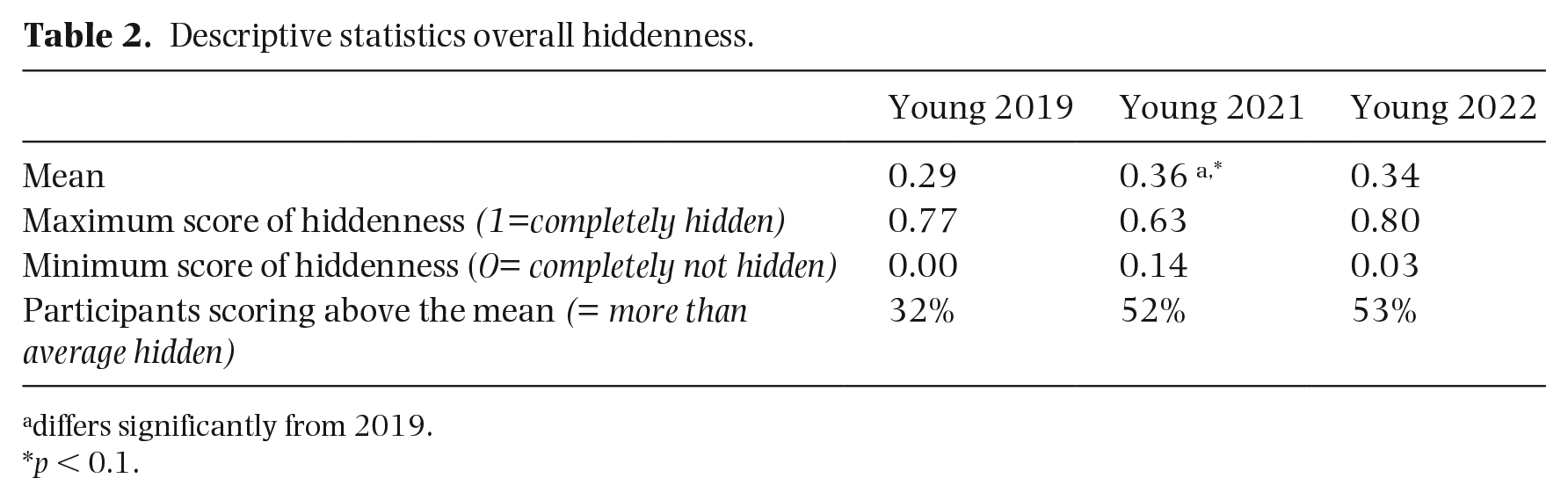
The results of the Hiddenness Index showed that the Young team was able to select a highly diverse group of participants for all three years, including more and less hidden talents (see maximum and minimum scores in Table 2). Table 2 shows that they were able to increase the level of (statistically significant) hiddenness for the second edition of Young, roughly maintaining that level for the third edition. The fact that alumni from the first edition onwards could nominate peers for the next edition of Young (which many did), allowed the Young team greater access to its target group. The 2021 orchestra cohort contained the most hidden talent. The 2022 orchestra was more comparable to the 2021 cohort than that of 2019, although there was no significant difference to the other cohorts. In the last two editions, a little over 50% of the participants scored above the average of their respective cohorts, scoring high on multiple, if not almost all, dimensions of hiddenness.
Descriptive statistics overall hiddenness.
differs significantly from 2019.
p < 0.1.
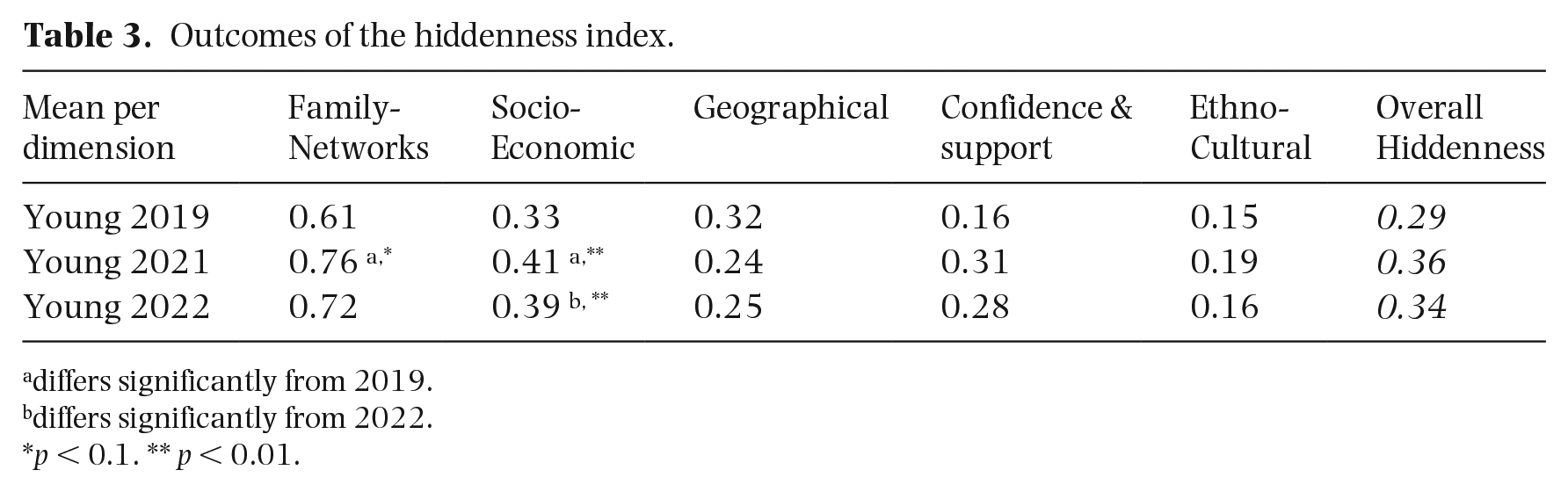
The Hiddenness Index revealed that the Family networks dimension was most prevalent among the participants, followed by the Socio-economic and Geographical dimensions (Table 3). The Young team had selected young musicians whose families lacked the cultural knowledge, networks, and economic means to support the development of their child’s talent, and many of them lived in rural areas. For the 2019 cohort, the results seemed to indicate that the Family networks and Socio-economic limitations to the development of a professional career in Western classical music were compensated (to some extent) by the Confidence-support dimension. This includes orchestra experience, a helpful teacher, self-confidence, or all of the above. The Ethno-cultural dimension (history of migration) played a role for, on average, 17% of the participants of the three editions.
Outcomes of the hiddenness index.
differs significantly from 2019.
differs significantly from 2022.
p < 0.1.
p < 0.01.
The Hiddenness Index also illustrated a difference in how dimensions of hiddenness intersect in young musicians. A comparison of individual participants with fairly equal scores of total hiddenness on the Index demonstrated that the “composition” of their hiddenness was not necessarily the same. For instance, the score of the second most hidden talent in the 2019 group was strongly informed by the Socio-economic dimension (0.86), but less strongly by the Confidence-support dimension (0.50). This indicates that this young musician had little economic support, but may have already played in an orchestra and had a supportive teacher. In contrast, number eight on the 2019 list of most hidden talent had a score of 0.43 on the Socio-economic dimension and 0.75 on the Confidence-support dimension, while number six on the list had a score of zero on the Confidence-support dimension (not hidden at all), but high scores on both the Socio-economic and Family networks dimensions.
Phase 3: Evaluating the Index’s strengths and weaknesses
From an empirical research perspective, one of the main strengths of the Index is its use of statistical analysis to illustrate the extent to which the Young orchestras consisted of young musicians with hidden talents, and the identification of which dimensions of hiddenness were most prevalent. Its main weakness is that not all (proxy) indicators are unambiguous, as not all answers to the survey questions offered sufficiently detailed information. For example, it matters whether the parents of a participant are Western classical musicians, but data on their level of skill were missing: were the parents musicians in internationally renowned orchestras or music teachers at a (local) music school? The extent of their networks in the field of music would vary accordingly.
From a theoretical perspective, a strength is that the Hiddenness Index demonstrates that one indicator or dimension of hiddenness is not necessarily more important than another. Two people may be as hidden as each other, but for entirely different reasons. What counts is how the category of hiddenness is (re)constituted by its intersections. The Index affirmed and illustrated—as intersectionality theory does—that two or more dimensions can (partly) compensate or reinforce one another, causing the overall hiddenness to decrease or increase, respectively. With the Index capturing the weighted sum of dimensions (rather than just the linear aggregation), the analysis approximated Crenshaw’s (1989) notion of intersectional experiences as “greater than the sum” of the dimensions (or lesser, for that matter).
A theoretical weakness may be the extent to which our method is indeed “intersectional.” Collins Hill and Bilge (2020) observe that in many studies that draw upon intersectionality, there are both continuities and breaches in the way intersectionality has been understood and practiced. This applies to our cultural sociology approach to intersectionality. Indeed, our Index developed from our combined inquiry and praxis, centered the experiences of disenfranchised groups, captured power relations shaping social positions, and established the relations between more than one category of analysis. As an analytical tool, the Index worked with intersectionality’s core ideas of intersecting power relations, social context (contextualization), relationality (a “both/and” analytical framework), complexity, and social inequality and justice (Collins Hill & Bilge, 2020). However, our Index did not incorporate gender, ethno-cultural, and age indicators. Consequently, for Young, the ways in which gender and racialized identities relate to different levels of exclusion in the field of classical music—a relation established in other studies (e.g., Cox, 2021)—could not be analyzed. To strengthen the Index as an “intersectional analytical tool,” future applications ought to include these factors. Our method further differs from common interpretations of intersectionality in that the Index did not center the most marginalized group. Instead, it included a broader, albeit disenfranchised, group. Moreover, we partly depoliticized the concept of intersectionality, as our praxis concerned an established arts institution rather than a grassroots movement. In our view, institutions also need to change if inequality is to be overcome. After three editions of Young, the Index has now become a tool for the inclusion debates the Young team engages in with the wider Dutch cultural sector, opening the predominant single-axis focus on ethno-cultural diversity to a more intersectional perspective.
From a practice-based perspective, the strengths and weaknesses of the Index were annually discussed in a “focus group evaluation session,” attended by all parties of the initial focus group interview. The minutes were integrally analyzed for the strengths and weaknesses of the tool, which were then validated by the focus group. A strength was that the group experienced the Index as a “learning and evaluation tool.” As intended, the Young team gained a better understanding of intersectionality which assisted them in fine-tuning the selection process (e.g., adapting the questions in the application form and continuing the practice of alumni nominations). The Hiddenness scores made the team more aware of, and able to attend to, the different needs of individual participants.
A weakness of the Index identified by the focus group revolves around indicators of people’s multilayered identities that were not addressed, but that may (negatively) influence people’s career opportunities. These may include sexual orientation, gender identity, citizenship status, political convictions, religion, and whether one identifies, for instance, as D/deaf, disabled, or neurodiverse. In our national context, where gathering and registering data on such indicators is not habitual, more discussion is needed about the desirability of collecting a wider number of inequality indicators (including protected characteristics, such as race, ethnicity, and gender identity). Researchers like Cox (2021) and Oman (2019) point out that consistent and high-quality data collection for a wider number of indicators is essential to understand particular combinations of effects. This will make underrepresented groups and their experiences (e.g., career paths in Western classical music) more visible in research. It may also facilitate more effective change in everyday practices within the classical music field. This requires the research community’s continuous exploration into the design of ethical survey questions inquiring about such indicators. They should further explore the undertaking of ethical analysis and the sharing of disclosed personal data. This deserves consideration, as respondents fear the repercussions of disclosure, including judgment (stigma), being identified as a minority, lack of data security, and feelings of surveillance and/or discomfort when having to answer questions about, for instance, parents’ occupations or the conditions in which one grew up (Oman, 2019, p. 34).
Reflection
This research focused on an arts institution that has started to address inclusion in Western classical music. Although we believe that individual arts institutions (inside and outside of The Netherlands) could be bolder in forging pathways for a wider range of talented young musicians, we simultaneously acknowledge the frustration of individuals and arts institutions in the face of structural barriers. As many aspects of hiddenness are strongly embedded structurally and politically, and impossible for individual organizations to resolve, the commitment of national governments is vital. Governments should provide all children with access to arts and culture as a part of school curricula, with a local cultural infrastructure, local art and music schools, attractive extended-school-day programs (extracurricular facilities), as well as the incentives, financial means, and appreciation needed for this infrastructure to succeed. Governments, together with schools, arts (educational) institutions, and other cultural facilities, should ensure that all children can easily experience a wide range of cultural expressions—ranging from classical, modern, contemporary, to experimental, and from Western to other cultural traditions—and can continue their artistic development up to the professional level. Conaghan (2022) maintains that as long as the principles of equality of (musical) educational opportunities are neither constitutionally nor legislatively supported, governments and state-supported institutions are exonerated from their responsibility for the adequate provision, quality, evaluation, and regulation of music education. Meritocracy is unlikely to become an everyday reality if governments continue to be complicit in the creation of structural inequalities that place the children of capital-rich families at a distinct advantage to access music education, which is the first step to a career in Western classical music.
Footnotes
Acknowledgements
The authors thank Emeritus Professor F. Haanstra, Professor K. van Eijck, and (soon-to-be Dr) B. Swartjes, and the two anonymous reviewers, for their feedback on earlier drafts of this article.
Author contribution(s)
Declaration of conflicting interests
The author(s) declared no potential conflicts of interest with respect to the research, authorship, and/or publication of this article.
Funding
The author(s) disclosed receipt of the following financial support for the research, authorship, and/or publication of this article: The research into Concertgebouworkest Young that provided the basis for this article was supported by the Porticus Foundation.

Ethical approval
Prior to embarking on the research, ethical approval was sought and gained from the Urban Paradoxes Research Group Ethical Review Board. This ensured that informed, written consent was given by parents or guardians of the participating youth.