



Abstract
This article explores taste processes within a group of musical theater students and their voice teacher, the latter also acting as researcher, while working with an aesthetically broad repertoire in a higher education setting in Norway. The study is designed using an action research approach, and the collected data—students’ reflection notes, the researcher’s field notes, and workshop recordings—are analyzed through Antoine Hennion’s theoretical framework of taste as a performance that acts, engages, transforms, and is felt, and which involves skills and sensitizing. In the social sciences, taste is commonly regarded as a matter of cultural consumption. This article argues that tastes are also part of cultural production: musicians, here musical theater performers, are to be seen as music lovers, performing tastes that stabilize or challenge established taste patterns in the form of styles, genres, or traditions. Accounting for situations where tastes are performed, tested, and negotiated, this article argues that tastes have a history but are brought into a negotiating presence, producing implications for the future; in this case, tastes form vocal behaviors and vocal behaviors form tastes. Hence, in musical theater education, taste, taste-making, and taste-testing are part of systematic and formal pedagogics and students’ ongoing vocal training.
The Perspectives Series is a scholarly forum for authors to present ideas and perspectives in music education. Perspectives may seek to engender debate from a personal values position or stake a claim on a new methodological, philosophical or pragmatic ‘space’.
Introduction
With its cross-disciplinary reach, taste is a core concept in the social sciences (Arsel & Bean, 2018; Wright, 2015), that through history has evolved from a metaphor of bodily necessities into multiple concepts of mind, perception, and aesthetic valuation (Vercelloni, 2016). In recent decades, taste has commonly been researched as a phenomenon within cultural consumption (Bennett et al., 2008; Peterson, 1992; Pomiès et al., 2021; Warde, 2018), and within music it has been explored in relation to audiences’, fans’, and listeners’ taste patterns and preferences (Nault et al., 2021; Vlegels & Lievens, 2017). Such research is arguably highly influenced by the writings of Pierre Bourdieu (1984), linking taste to distinction and, implicitly, to inequality, defining it as a structural element of class hierarchies connected to cultural capital. Many scholars within musicology and music education follow this trajectory (Bull, 2019; Burnard et al., 2015; Dyndahl et al., 2017), exploring tastes with regard to broader social dynamics and inclusion and exclusion.
In this article, taste is researched from a different angle: exploring tastes among musicians making music. More specifically, taste-making is examined among 10 musical theater students and their voice teacher—the latter in a dual role of teacher and researcher—in a higher education setting. Designed using an action research approach and situated within the frame of a second-year bachelor’s course, the study falls in a contemporary trajectory of practice-based taste theorizations foregrounding questions of agency (Pomiès et al., 2021). The empirical data, consisting of audio recordings of workshops, field notes, and students’ reflection notes, are analyzed through a theoretical framework developed by French sociologist Antoine Hennion (2015), who defines taste as a performance that “acts, engages, transforms and is felt” (p. 268). Even though tastes recurrently act on a personal level, they are collective techniques built on collaboration; through discussion, sharing, and self-reflexivity, we seek continuous support for our performance of taste (Hennion, 2007, 2010; Teil & Hennion, 2018). Thus, taste-testing and taste-negotiations make up a significant part of taste-making, turning it into more than a simple act of “yes or no” but instead an ongoing “making aware of.”
This article regards musical theater as a rapidly changing art form, adding and absorbing a range of musical styles into its repertoire (Kayes, 2015; LoVetri et al., 2014). Thereby, the ability to move vocally between genres has become imperative for performers. In addition to living as “triple threats”—performers expected to have mastered the art of singing, dancing, and acting—they are also expected to become highly versatile vocal performers, capable of performing a show in a specific style in the evening, rehearsing another by day, and auditioning for a third, all within various stylistic idioms. This is an expectation manifested in, among other things, musical theater education curricula, and the emphasis upon stylistic plurality means that criteria for aesthetic valuation in musical theater are not obvious and in flux. To explore this complexity of tastes within the musical theater profession, this article is guided by the following research question: How do students perform, test, and negotiate vocal tastes when exploring a new repertoire in a higher musical theater education course?
Previous research
Research on the varieties of musical styles, forms, and contents within musical theater is commonly conducted within musicology. Knapp et al. (2011, 2018a, 2018b, 2018c) offer a comprehensive overview labeling musical theater as a paradox regarding its plural roots, its status as art and entertainment, and its numerous contemporary forms (see also Hodge, 2020; Symonds & Taylor, 2013; Taylor, 2012; Taylor & Symonds, 2014; Wollman, 2017). Within musical theater voice research, long-standing beliefs that classical training and aesthetics are superior to other styles are declining (Edwin, 2007; Potter, 1998), allowing contemporary commercial singing (CCM) to garner higher levels of interest (Björkner et al., 2006; Fisher et al., 2019; Freeman et al., 2015; Green et al., 2014; Hoch, 2019; LoVetri et al., 2014; LoVetri & Weekly, 2003; Moore, 2017). Vocal cross-training, not only as a means to create marketable performers but also to secure voice sustainability and health, is high on the agenda (Bartlett, 2020; Edwin, 2008; Greschner, 2019; Wilson, 2021). Other scholars focus on the specifics of a singular style, arguing that the CCM bracket is too broad (e.g., Chandler, 2014; Edwin et al., 2018). Kayes’ (2015) work is influential here, exploring how genres shape female singers’ vocal behavior.
Commonly, contemporary voice research focuses on the biomechanical and acoustic sides of the vocal apparatus in close dialogue with voice science, intending to secure vocal health and effective vocal teaching (e.g., Aaen et al., 2020; Björkner, 2008; Bourne et al., 2011; Echternach et al., 2014). However, the culture and society in which vocal and musical preferences exist and the bearing these have on the sound qualities of the voice and development of vocal technique are largely undocumented (Harrison & O’Bryan, 2014). In other words, research that scrutinizes the social, culturally formed side of voice and vocal practices is sparse, including research focusing on the formation of vocal behaviors and styles within musical theater and musical theater education.
Research on the role of taste among musicians and other performing artists in creative practices is also an underexplored territory, with some exceptions such as Einarsdóttir’s (2020) scrutiny of “learned taste” in the context of an amateur choral ensemble, and Juslin and Isaksson’s (2014) comparison between psychology and music students’ subjective criteria for choice and aesthetic judgment of music. These research gaps may potentially lead to an understanding of vocal styles, traditions, and genres as stable entities to be reproduced during performance and a belief that taste is only a matter of cultural consumption, not cultural production. This article aims to contribute to a multifaceted view of voice and voice training by researching the role of taste among musicians making music, thus highlighting the active role of the individual and the collective in the formation of vocal behaviors and vocal styles.
Theoretical framework
Labeling his writings a “pragmatics of taste,” Hennion (2004, 2007, 2010, 2015) rejects perspectives that define tastes as merely arbitrary, unconscious reflections of social differentiation, education, background, identity games, or power. Even though tastes have a history, music lovers 1 discover their personal tastes and external determinisms, and reinforce or surpass them through ongoing questioning, self-criticism, or testing. Music lovers are, therefore, agentic, competent, reflexive, and inventive actors (Hennion, 2001, 2007, 2010).
According to Hennion, taste is not inert or an attribute, but is formed as it is expressed and expressed as it is formed. To valuate and know what and how we valuate, we test ourselves and our objects: uttering what and how one likes, playing, listening, or making others listen or play are already ways of appreciating something more, underlining taste’s performative and generative powers and possibilities (Hennion, 2004, 2010, 2015). In other words, taste is something we do. In his writings, Hennion adopts a broad definition of music lovers, including both those with and without an instrument in hand. He labels music lovers as the “starting point for any musical reality as it comes into being” (Hennion, 2015, p. 267). Through collaboration—not competition—music lovers form attachments, improve their skills and sensibilities, and reach compromises between sometimes incompatible criteria for appreciation (Hennion, 2004, 2007). Beginners rely on and test their tastes against more experienced peers, critics, or guides to identify and form preferences, and the plurality of words involved—love, passion, practices, habits, mania, obsessions—indicates taste’s many configurations, made apparent through contact: making oneself feel and feeling oneself doing (Hennion, 2003, 2010, 2015). Within this collective, music lovers work on the “musicalification” of their tastes, deciphering details of records and performances, equipping their tastes in the form of instruments, scores, performers, stages, and repertoires (Hennion, 2015; Teil & Hennion, 2018). These are not seen as neutral instrumental intermediators, carrying or dissolving the artwork, but as productive mediators, without which music and musical tastes would be impossible to perform (Hennion, 2003, 2015). Building on acts of engagement—such as long-term physical training—tastes take the form of a gradually more refined and defined competent act, produced in and with music, not just facing it (Hennion, 2004, 2010; Teil & Hennion, 2018).
Consequently, Hennion’s pragmatics rejects a dualism between an external and internal analysis of art, between aesthetics and sociology, and between the object tasted and the people who taste (Hennion, 2007, 2017; Pomiès & Hennion, 2021). Taste is not only about liking music; it is also a question of being touched by certain pieces at certain moments with certain people present. Accordingly, sensitizing makes up a large part of tasting because we cannot plan for beauty to come; at the same time, “beautiful things only offer themselves to those who offer themselves to beautiful things” (Hennion, 2004, p. 135).
Hennion encourages researchers to spend time where actors of interest gather and participate in activities in which habits, gestures, and dispositions naturally occur, to create meaningful work close to experiences and practices (Hennion, 2003, 2010; Pomiès & Hennion, 2021). In this article, I have taken this advice as a point of departure for exploring taste-performances, taste-testings, and taste-negotiations among a group of musical theater students and their voice teacher while working with new vocal repertoire.
Methodology
Developing the study
This study site is a second-year bachelor’s course within a higher Norwegian musical theater education. The course was created to examine present-day aspects and trends within musical theater, aiming to enable students to see themselves as active participants in the profession’s development. A premise for the course was that it should be research-integrated and offer students practical knowledge on research methodologies within the field. The course took place in January 2021 and lasted 4 weeks. Ten students participated, three women and seven men, all in their early- to mid-20s. I, the female author, age 40, acted in a double role as their voice teacher and researcher. This is a common duality within arts based research, arguing that artists using their own work to study creative processes offers different—maybe not as easily assemblable—knowledge to that of researchers entering the field from outside (Kjørup, 2011). In the course, the pluralities of aesthetics, styles, and genres within musical theater were chosen as a subject, as summarized in the following course goal: [T]he students should, after the course, both as part of a group and individually, be able to identify, reflect upon and perform different musical and vocal styles prevalent in contemporary musical theatre, and further be able to identify, reflect upon, and perform vocal choices that either stabilize or challenge the field’s or the style’s established vocal traditions and conventions.
Four musicals were chosen for exploration: A Gentleman’s Guide to Love and Murder (Lutvak & Freedman, 2014), Hamilton (Miranda, 2015), Dear Evan Hanson (Pasek & Paul, 2017), and Hadestown (Mitchell, 2019). These works offer a broad range of musical and vocal styles prevalent in contemporary musical theater: classical, rap, pop, singer/songwriter, folk, and New Orleans jazz, showcasing a wide variety of vocal demands and behaviors. The students worked with parts from all four musicals. In the ensemble workshops, I assigned pieces and parts; in individual singing lessons and masterclasses, the students chose their own repertoire.
To pass the course, the students had to actively attend the workshops and hand in personal reflection notes of 1,500 to 2,000 words. All workshops were recorded, comprising a total of 50 hr of recorded material. Together with the students’ reflection notes and my field notes, this formed the empirical data.
Research design
The study can be placed within the broader field of practitioner research (Cochran-Smith & Lytle, 2009), designed using an action research approach and organized into three cycles of planning, acting, observing, and reflecting (Gjøtterud et al., 2017; Kemmis, 2009; McNiff & Whitehead, 2010). The course activities (see Table 1 for an overview) were designed by attending to exploratory practice principles, focusing on understanding more than problem-solving, and involving the students as practitioners in their own right, within their everyday activities (Allwright, 2005). Consequently, workshops, voice lessons, and masterclasses were designed to be a part of the students’ existing work-lives and ongoing voice training. Conducted during the COVID-19 breakout, the project’s cyclic form became imperative as rules for social distancing constantly changed, demanding a continuous rethinking of the possibilities regarding course content and research activities. Over the 4-week course, the first 2 weeks took place on Zoom; then, a dispensation from the government allowed us to perform music together in week 3. Approaching week 4, this was withdrawn, turning the course and the research yet again into a virtual endeavor.
The Three Action Research Cycles and Course Content.
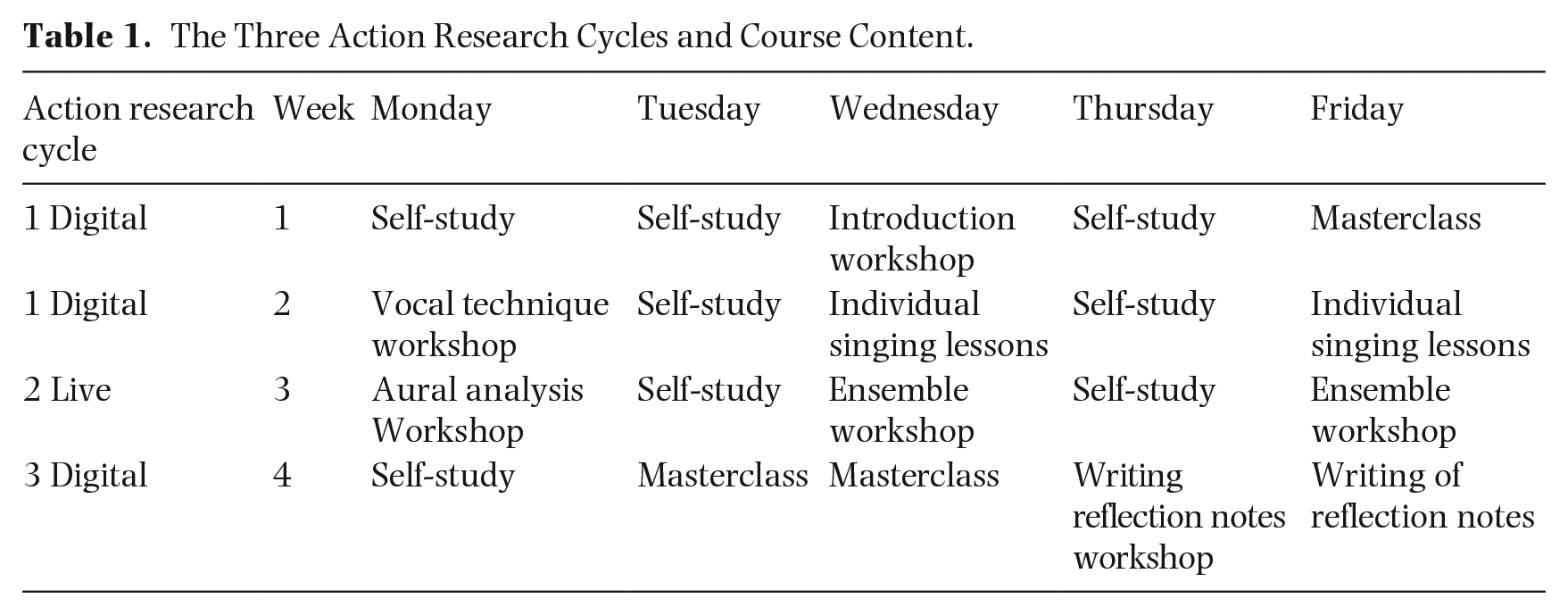
On the days of self-study, the students worked individually on their chosen and assigned repertoire. In the Introduction Workshop, action research as methodology and theory on the plurality of aesthetics within musical theater were presented and discussed. In the Vocal Technique workshop, a short course in Complete Vocal Technique (Sadolin, 2021) was offered as one way of cross-training voice. In the Aural Analysis Workshop, the students presented their vocal technical and stylistic understanding and aural analyses of the four musicals in question.
Ethical considerations
Conducting an action research inspired practitioner study raises various ethical considerations, foremost regarding the power asymmetry between the students and the teacher–researcher, because the event was both a mandatory educational course and a site for research. During the course, I positioned myself as a co-learner and co-explorer, repeatedly underlining the students’ strong positions as qualified practitioners, spending time discussing action research methodology, values, and its aim to reflect on and improve practices (Kemmis, 2009; Schmuck, 2006). The study was approved by the Norwegian Center for Research Data (NSD). All students signed written consent forms with the opportunity to withdraw at any time. The names presented are fictive, and the use of quotations and their translation from Norwegian to English has been approved by the students in question.
Analysis
The empirical data—workshop recordings, reflection notes, and field notes—were first transcribed, coded, and categorized concerning recurrent themes, similarities, and differences. Second, they were analyzed through a theoretically driven reading (Brinkmann & Kvale, 2015), incorporating Hennion’s core concepts and theories to sensitize the material in terms of suggesting where to look while not defining what to see (Brinkmann & Kvale, 2015). Through this theoretical reading, I aimed to identify and code prominent moments where the students and I performed, observed, and reflected on various acts of taste-making and taste-testing. Given the action research approach, a large amount of data was collected. Findings accounted for in this article stem foremost from the students’ written reflection notes and my field notes. Excerpts from workshop recordings are primarily included to validate situations and add details to students’ or my own reports. The following sections put forward descriptions of noteworthy situations within which (1) tastes were performed, (2) the musical object was central in taste-making, (3) tastes were equipped, (4) possible distastes of others were explored, (5) tastes were negotiated, and (6) the “sound of gender” was tasted.
Results
Performing tastes: “I like what I do and do what I like”
The first cycle of the course started by exploring participants’ paths into musical theater, their vocal challenges and goals, and their “dream roles.” The students presented images of being “struck” by musical theater, linking their loves from the past to wishes for their future, as described by Svenn: Everyone I went to school with hated it. They thought it was so dull. It played in English; they even spoke English [. . .]. So, they [the fellow students] fell asleep after half an hour. I was like: this is so cool. I was obsessed with the musical for many years afterward, with the music. The story is not all that. But I think the music is crazy good. So, if I were to choose a dream role, even though a lot would be fun to do, it has to be the American, Freddy, in Chess, because he has so much sickening cool music, and I think it is cool he is a bit rough around the edges, a bit crazy and all that. (Recording)
Deciphering potential dream roles, the students expressed attraction toward complex, emotionally demanding characters with impressive vocal parts. Sarah wanted to play Anastasia from the musical Anastasia because everything the character goes through leads to dramatic songs, and Sarah “loves dramatic songs.” Peter chose Javert and Phantom because the characters “have depth” and “are vulnerable,” and he defines both musicals—Les Misérables and Phantom of the Opera—as “masterpieces.” Peter was even motivated to participate in the course because he could explore dream roles: Some of what drives me, is to embark upon a big and demanding repertoire, usually done by the best of Broadway, and find ways to master it. What kind of a musical theatre artist am I if I don’t have dream roles, right? (Reflection note)
Scott, however, found it hard to picture a dream role, arguing that he is not quite “into the musical theatre world.” He described a process of “finding his voice”; figuring out what it is suited to do, and learning to like it, but he “is not there, yet” (recording). Anna described something similar: The first that comes to mind is Sophie in Mamma Mia or Zoe in Dear Evan Hanson. But for me, dance is even closer to [my] heart. An even bigger dream. A dance part. But I feel that I have not come far enough [in my artistic practice] to choose what my dream is. (Recording)
This part of our course made us aware that taste-making and taste-testing not only occurred through verbalization but that it also involved bodies and bodily behavior. Interestingly, it was not only the students’ tastes that shaped and impacted their vocal behaviors but also the other way around; the students liked and appreciated what they performed and were able to perform. In addition, this cycle made us aware that it was almost impossible to perform a neutral, “untasted sound” (field notes) as the students and I systematically, and unconsciously, perform musical and vocal idioms we appreciate. As described by Yosef, I have never had much of a vibrato; it has come during the last few years. I am used to singing “clean” [notes], straight ahead, in edge, because I played in a rock band. In a way, it was not “my voice.” But it had something cool about it. Then, it was the thing about getting me some vibrato. Because I realized, I think it is really nice. But I didn’t know how to produce vibrato. So, this, I have been working on and researching. (Recording)
Katherine observed that her vocal behavior was directly connected to her musical history, performing “So Big, So Small” from Dear Evan Hanson: Some vocal choices, for example, where I placed the vocal breaks, came from an overall understanding of the genre [stadium pop/rock]. Because I have listened so much to the music, the character Heidi is inspired by [. . .] I made unconscious choices that fitted the musical theatre genre. (Reflection note)
Statements like these highlight taste’s transformative and generative powers as we build valuated vocal behavior into our bodies’ physiology. But, the other way around, they also shed light upon how our vocal behaviors form tastes.
The object in tasting: “Tasting a musical work that doesn’t shy away”
Sarah was the only student performing from A Gentleman’s Guide to Love and Murder in the first cycle, a musical playing on idioms from the Western lyrical classical tradition. The first time she sang the piece, “I Don’t Know What to do Without You,” she had a “pop-ish” take on it. I challenged her to try a version embracing the part’s commonly preferred singing style: longer legato lines with extended vowels, raising her soft palate, adding a darker sound color, removing creaking onsets, increasing the use of “head voice,” and only switching into more speech-like singing in the lower range (recording). She embraced the task in an audibly different manner; however, coming to the middle of the song and the sentence “Why are men so dreary, Monty, and so deadly dull[?]” she abruptly burst into an extreme vocal effect, relatively unheard of for (especially female) singers in this style. In the close-up from the Zoom camera, two things became visible: Sarah’s unprepared reaction to the sound emerging from her mouth and my spontaneous, positive response toward it. Immediately, a message on the live chat pinged from her fellow student Yosef: “I think Sarah just booked the job” (field notes). A discussion unfolded: would this book her the job in all cases, or would this be dismissive, when facing other tastes and values in, for example, a real audition situation? In her reflection note, Sarah described it as “ironic” that this happened when she tried to sing like an opera singer, arguing that it probably happened naturally after “so much singing in such a funny song.”
Sarah’s story draws attention to the decisive role of the musical object in tasting (Hennion, 2004, 2007). As Sarah focused on more traditional performance conventions, she was in a way “taming” the song from the outside, concentrating on an even vocal line and the beauty of her voice’s “timbre.” However, the “funniness,” the spoken word, and the work’s potential meaning “burst” through her planned performance. In both versions, Sarah added elements from the popular musical styles that she claims to prefer (recording). However, in the second one, she showcased the piece’s sonic conventions as well, showing us a negotiation between a strong aesthetic performance tradition, the work itself, and her tastes and understandings. If Sarah kept on performing the piece with additional vocal effects, she would expand the frames of what we name a “legit” singing style in musical theater. If not, she would stabilize traditional vocal conventions; hence, both cases show that tastes play an active role in the development of musical styles and genres.
Equipping tastes: “I know how hard it is; now I like it better”
The second research cycle started with aural analyses of the four musicals. In groups of two or three, the students explored the original Broadway cast recordings as so-called “vocal scripts,” analyzing performed vocal behaviors. Throughout our course, A Gentleman’s Guide to Love and Murder was not as easily liked and embodied as the others. I kept on selling the show as “one of my big favorites” (recording) but was met with resistance, as Ben expressed, “Am I willing to put the work into something that doesn’t interest me, in opposition to other genres?” (reflection note). Yosef and Gorm were analyzing the musical, and started their presentation by Yosef stating, “Now I know how hard it is; now I like it better” (recording). Gorm and Yosef’s deciphering of the musical material changed their appreciation of the work, showcasing taste as the ability to form fondness from contact with a new thing, not only liking something we already know (Teil & Hennion, 2018).
The aural analyses were revisited throughout the course: what does Ben Platt
2
do when singing “For Forever”? Can we consider Bryce Pinkham
3
a purely “classical singer”? Is Patrick Page
4
singing, talking, or merely “sneering” his low notes? This ongoing dialogue, commonly in the form of imitating phrases and sounds, was intended to identify the performed tastes of “the best in the business,” reflecting on already valuated vocal practices. In addition, this helped us fix specific vocal challenges such as singing out of pitch, not reaching specific notes, or releasing vocal constrictions. This consequently increased our knowledge of vocal technique, which in turn impacted our taste-making. As described by Ben, As one who has recently found an interest in vocal technique, I have realized how I have been “delusional” regarding what is considered good technical work and considered “good” [in itself]. In my case, I have been impressed by “riffs and runs” and high notes, etc. But after finding this interest, I am becoming more impressed by [vocal] placements and more technically difficult things. Not that riffs and runs are not hard, but I ended up appreciating more voice qualities, not only the things that at first sight seem difficult. (Reflection note)
The recordings, thereby, became not only objects for our aesthetic delight but the standard by which we loved (Hennion, 2001); containing vocal “laws” that we chose whether or not to live by, and equipping our tastes (Hennion, 2015) with knowledge of vocal technique and performance practices.
Exploring the (dis-)taste of others: Avoiding an ironic distance while tasting
As cycle 2 opened up for live activities, we explored selected ensemble parts.
5
The idea of working against an ironic distance when tasting unfamiliar styles emerged as we embarked on the musical Hamilton. As the group gathered, the discussion was set in motion. Svenn describes, The day we should begin to work on Hamilton, I said, “I am curious if we can rap seriously.” I referred to how I often think people that are not used to rapping attack it with a sort of ironic distance by throwing in outbursts such as “yo” and waving “hip-ly” with their hands. We ended up talking about this for fifteen minutes. Why is this a form we find hard to take seriously compared with everything else we all the time try out? (Reflection note)
Peter also observed that even though everyone was vocally “well trained,” Hamilton was a challenge for most (reflection note), and the students worked hard to approach the piece and the style in a “real” and “authentic” manner (recording). This avoidance of irony was a repeated endeavor. As a genre, musical theater is often considered a “guilty pleasure,” embodying a “too-muchness” with performers bursting into song or dance at “the slightest provocation” (Johnson et al., 2019). Within the genre, there are perceived hierarchies between shows or parts as well. Katherine revealed her “guilty pleasure”: I am embarrassed to say it, but I am completely honest. I will just put it out there; I love High School Musical. I love it. I think it is such a good musical, and I want to star in High School Musical as Sharpay. First and foremost, she is so different from me, which is always exciting to embark upon. But you know what, Sharpay is so much more nuanced than people believe. I will fight for this, even though people might think I am lame, but she is a nuanced character. She is misunderstood. (Recording)
This utterance was accompanied by Katherine clapping her hands and adding small screams of excitement, highlighting a high level of enthusiasm and enjoyment in engaging with the musical material. Similar behavior was repeatedly observed through the course: clapping hands, smiles, thumbs up, hearts appearing in the Zoom chat, frequent use of the applause button, the appearance of dance moves, or students singing along in their bedrooms (field notes) were all signs of spontaneous feedback when testing vocal behavior. Although the students acknowledged and addressed the possible (dis-)tastes of others, they commonly kept on proclaiming their intense love for the parts in question. By systematically working on avoiding ironic distance, they surpassed the tastes of others and formed strong(er) attachments to the piece, part, or style in question.
Negotiating taste: Taste-making with a fictive other
In cycle 3, taste-testing became an ongoing activity, moving back and forth within the group and the explored musical material, often involving a fictive or imagined other. Peter kept questioning his tastes and vocal behaviors throughout the project. Describing his voice in the introduction workshop, he negotiates with his musical history: My voice is, in theory, a dark baryton/functioning bass. Good fullness. Good power. I would say I have a large range. I can work in the deeper registers and the higher. It is hard to tell. It is probably a welding of every artist one grew up with. I have listened a lot to Sinatra, Jonny Cash, Elvis [. . .]. It has perhaps become a small “compote” of that. (Recording)
Performing “Hey Little Songbird” from Hadestown, he negotiates with benchmarked performances by Broadway stars: The darkest note of “Hey Little Songbird” is G1 [ASPN]. I felt it was weak and constricted. But when I tried to sing the lowest note with “an airy flicker” to it, I felt I cracked the code. I have a totally different sound color than Page,
6
so I will never do it the same way as him. But then again, that is not what I want. (Reflection note)
He negotiates with a fictive casting agent: When I was asked if I would audition for the part, I answered, “yes.” Admittedly, Hades is an old man, but it struck me that the part suits a younger actor as well. Then again, Hades is an immortal god. (Reflection note)
He negotiates with the material and me as the voice teacher: In Hadestown [. . .], it is wise not to be afraid of the ugly. By that, I mean that the musical is so close to folk, a genre where the magic lies in what is not perfect. I got feedback from Guro [me] to try to make my Hades “less Elvis,” something I feel exemplifies my point. (Reflection note)
Peter is also seen negotiating with himself, actively expanding his tastes: When choosing a solo song on one of the last days, I decided on “If I Could Tell Her” from Dear Evan Hansen [. . .]. I wanted to try a song from that musical because I identify so little with it. Regarding taste and style, I am more connected to Hadestown. [. . .] [“If I Could Tell Her”] is a song with some “jumps” from chest voice to falsetto. It makes it a bit more “pop-ish,” but I wanted to take it on board. I think the music is very good, and I am learning to see myself in these types of roles as well. (Reflection note)
He negotiates with the profession in general, implicitly his ongoing education: I perceive that I have a pretty broad range in my voice but am commonly placed in a box with the low voices. I don’t see this as negative because I am a dark baryton, but I want to be a flexible actor, not just one you turn to for punch
7
and bass. (Reflection note)
By continuously negotiating his tastes with a present and fictive collective, Peter seemingly became more certain of his attachments, vocal choices, and what he had to offer a network of musical theater, making taste-making a “meaningful accomplishment” (Hennion, 2010, p. 25) nurturing artistic creation and motivation.
Tasting the “sound of gender”
Even before the course started, our taste-testing expanded from exploring styles and genres to testing what might be described as “gendered sounds.” Ben wrote an email, asking if he had to limit himself to singing songs written for men, wanting to sing “Burn” from Hamilton; he felt that it “suited him” and that he “could do it,” but was unsure of whether he could present the same meanings, feelings, or vocal behavior as a woman; the same “vocal signals” (reflection note). “Genderbending” became a red thread throughout the course and the area where we most actively broke with established vocal conventions. Performing “Chant” from Hadestown, we cast two men as the female First and Second Fates, and two female singers joined Alexander Hamilton’s crew, allowing for more girls to rap, not only sing, in the musical.
In the sheet music of the four musicals, ensemble parts were not written as traditionally gendered Soprano, Alto, Tenor, Bass constellations, but marked Company 8 or groups of “Workers,” for example, thereby not offering excessive information about what kinds of voices should perform what parts. In rehearsing, it became evident that the choice of sound color and idiosyncratic range possibilities blended out a traditional notion of a chorus divided into specific groups of men and women, and additionally rejected the notion that a voice’s sound may identify a body’s gender. The final voicings were decided by negotiation between the pianist present, the students, and me. We did not adhere to a “predetermined” notion of what a group of men and women singing together sounds like, but our decisions were built on concrete circumstances: these voices are available, these are the characters present, this is the chord written in the score, and these are the words spoken. This is a common practice in contemporary musical theater, where vocal arrangements and orchestrations are, at times, delegated to the musical director. Interestingly, our final casting decisions came from bodily responses: goosebumps, shivers, or auditive wellness. It was a physical feeling of “yes, there it is” that made the mark (field notes), underling taste as a corporeal performance (Hennion, 2015), a performance felt.
Actively breaking gender expectations showcased moments of joy when students claimed parts traditionally seen as “off the table.” We ended our course with Katherine spontaneously stating, “I too want to sing King George!” making Hamilton’s “You’ll Be Back” the last piece and most-performed song, accompanied by applause and spontaneous backup singing from the others, and highlighting taste’s role as a transformative, engaging, and efficient group-maker (Hennion, 2004, 2015).
Discussion
This article proclaims that taste is not only part of cultural consumption but cultural production as well. Musicians—here musical theater performers—are also music lovers; for audiences to have a performance to love, performers must have loved first, performing acts of taste and valuated vocal behavior. During the 4 weeks, our course not only took form as an explorative event searching for knowledge to convey, but became highly generative, containing acts of doing constituting new realities and new tastes along the way. Analyzing the data through Hennion’s framework, light was shed upon tastes as part of how musicians interact with the world and each other in and through aesthetic processes. Taste-making became a situated, creative, and meaningful activity; what we did and did not do in our tasted performances, in turn, stabilized, built upon, tore down, or challenged traditions, styles, and genres. Consequently, reappearing vocal taste patterns became sonic conventions—so-called vocal demands—collectively transmitted through repetition and imitation, thereby underlining the strong position of the field’s material mediators such as the original cast recordings. In addition, we shed light on how history, traditions, styles, and genres are written backward (Hennion & Fauquet, 2001) through stabilizing—or subversive—acts in the present, negotiation in the moment, and interaction with previously valuated aesthetical choices.
The pluralities of styles, traditions, and genres within musical theater formed our tastes as various attachments with a wide range of objects and circumstances, searching for the “right” piece, the “right” behavior, at the “right” moment, rather than for a catalog of superior works or a singular, stable personal preference. As described by Hennion (2007), taste depends, not leading to total relativism but to a wide array of experiences. Our study also illuminated that at this stage in the students’ education, we spent most time figuring out what others do, listening to and imitating those already making it in the business, and consequently stabilizing an attachment to a global network of musical theater. In exploring the “sound of gender,” it also became clear that tastes not only concern musical styles but include questions of who gets to tell which stories and in what manners. This demonstrates how notions such as one’s “own artistic expression” are not innate or “already there” when students begin training, but are an ongoing activity. Furthermore, personal tastes and expressions showed themselves not as the opposite of the collective; we did not seek to escape our social connections, but instead to create satisfactory ways to live with and within them that “felt good” and “felt right.” This made taste-making and taste-testing part of the course’s systematic and formal pedagogies, developed and refined through repetition, corporeal training, trial and error, time, and a variety of methods.
Voice is both a physical and a social matter; the size of our vocal folds and the room of our cavities make certain vocal behaviors and choices possible. At the same time, performed vocal repertoires and vocal choices form our voices’ physiologies, building some behaviors into our “muscle memory” and excluding others. Therefore, in the case of musical theater performers, tastes form vocal behaviors and vocal behaviors form tastes. In our course, performing vocal behaviors meant continuously testing the tastes of ourselves and others, and working on specific vocal techniques became acts of attachment. As singers, we are our instrument (O’Bryan, 2015), and this article illuminates that we are music lovers too, in every sense of the word. In the role of teacher and responsible researcher, I cannot argue that my presence and actions did not influence the self-representational utterances and acts performed by the students in the study. But within musical theater, as within all artistic processes, tastes and other artistic choices are constantly negotiated and tested between people of different experiences, rankings, or subject-positionings; taste is an act situated in time and place, and with others, human and non-human.
Concluding remarks
Although research on the development of (vocal) aesthetics within musical theater and musical theater education is sparse—and research on the role of taste among musicians making music is also rare—applying a performative view on taste, as done by Hennion and presented in this article, might be fruitful for future research within these areas. First, it may develop empirical understanding of how styles, genres, and traditions are formed, changed, or stabilized, while also highlighting and scrutinizing the role of performers’ passions and preferences both when working with repertoires of their own choice and those assigned by others. In addition, such research may potentially foreground, and thereby impact, acts of agency enabling musical theater and other performing arts students—and teachers—to see themselves as active members of their profession’s current and future values, traditions, and practices.
Footnotes
Acknowledgements
The author wishes to thank the wonderful students who participated, Ellen Marie Carlsen, Erik Schøyen, Hildegunn Pettersen, and all the other musical theater lovers at Kristiania University College for making this study come to life. She also wants to thank her colleagues at The Norwegian Academy of Music, especially Professor Sidsel Karlsen and Professor Sigrid Røyseng, Professor Håkon Larsen at Oslo Metropolitan University, and the two anonymous peer-reviewers for constructive comments and views on this article in progress.
Declaration of conflicting interests
The author(s) declared no potential conflicts of interest with respect to the research, authorship, and/or publication of this article.
Funding
The author(s) received no financial support for the research, authorship, and/or publication of this article.
