



Abstract
The purpose of this collaborative action research project was to examine eighth- and ninth-grade female (assigned at birth) students’ perspectives of their singing voice when implementing a practitioner/researcher designed curriculum titled Supporting Adolescent Female Vocal Development: Teaching Anatomy and Physiology in the Middle School Choral Classroom. The curriculum, designed specifically for the adolescent female voice, contained the following four units: the respiratory system, the larynx, the digestive system, and the skeletal system. The action research method, which contained four feedback loops, allowed us to assess, refine, and revise the curriculum to meet the needs of this specific group of adolescents. Salient themes that emerged from the data included participants’ perceptions of breath, passaggio, vocal range, vocal tone, feedback, and confidence. Overall, participants reported positive experiences throughout the unit; however, challenges emerged when we provided individual feedback and introduced complex terminology associated with vocal anatomy. Implications for practice include prioritizing a process-oriented curriculum theoretically grounded in the anatomy and physiology of the voice to serve the needs of adolescent singers.
Keywords
Female adolescent voices are beautiful and unique, and when combined, “the resulting sound of the girlchoir has a warm resonance unlike the boychoir, the women’s choir, or even the children’s choir. It is truly an entity unto itself” (Gackle, 2014, p. 552). However, there is a dearth of resources and curricula available aimed at empowering young female singers to understand and embrace the exceptional qualities of their growing instruments. As researchers and practitioners, we wanted to improve our understanding of the adolescent female voice and assist students through this pivotal stage in their vocal development. Therefore, through an action research approach, we created and studied a curriculum designed to support the nuanced and multifaceted layers of the adolescent female voice.
Review of related literature
Vocal production occurs when air moves up and through the folds, causing them to rapidly open and close, a process known as “self-sustained oscillation” (Titze, 2000, p. 91). When the vocal folds lengthen and decrease in mass, a high frequency is produced; the opposite is true for low frequencies (Abitbol et al., 1999; Colton & Leonard, 2006). The vocal folds are part of the respiratory system and housed in the larynx, and air moves through the larynx (voice box), pharynx (throat), trachea (windpipe), and lungs (Sundberg, 2017; Titze, 2000). The folds open during inhalation; then, the lungs push air through a narrow space in the folds, causing them to vibrate and produce sound (Sundberg, 2017). During adolescence, the mass and length of the vocal folds increase, with significant growth occurring between 10 and 12 years old (Markova et al., 2016; Xue et al., 2010). In this article, differences in vocal anatomy and physiology will be discussed in terms of gender assigned at birth, and not gender identity.
Adolescents can experience variability in their vocal range, a breathy tone quality, and pitch instability (Cooksey, 1977a, 1977b; Gackle, 1991, 2000, 2014) and these changes differ between males and females. From approximately ages 10–18 years, a female’s larynx has a greater tendency to grow in height, and their lowest terminal pitch can lower one-third; a male’s larynx generally grows front to back, which results in the Adam’s apple, and their lowest terminal pitch can lower one octave (Abitbol et al., 1999, 2019; Gackle, 2014; Sweet, 2019). Adolescent males experience a rise in testosterone levels, which cause “a descent of the larynx and consequent lengthening of the pharynx” (Fitch & Giedd, 1999, p. 1515). This laryngeal growth influences their vocal production—resulting in a lower fundamental frequency (Titze, 2000). For adolescent females, estrogen and progesterone influence vocal production, and the folds slightly increase in mass and lengthen (Abitbol, 2019). Researchers have also found that the fundamental frequency change for females “is more gradual” (Lee et al., 1999, p. 1460) when compared with males (Markova et al., 2016). Although the rate of growth is unique for every adolescent, these distinct differences affect how vocal music educators work with adolescents and how researchers examine the adolescent voice.
To support singers through the voice change, researchers have examined students’ perspectives and developed resources; however, seminal researchers in vocal music education focused on the adolescent male voice (Cooksey, 1977a, 1977b; Freer, 2006, 2009a, 2009b, 2016; Harrison et al., 2012; M. A. Kennedy, 2002, M. C. Kennedy, 2004; Swanson, 1977; Sweet, 2010). For example, Cooksey (1977b) identified characteristics and stages specific to the adolescent male voice and classified Stage IIIA as high mutation (ages 13–14) when the voice becomes “lower and huskier,” less agile, and encounters “range and tessitura restrictions” (p. 13). More recently, researchers have focused on adolescent female vocal development (Abitbol, 2019; Gackle, 2000, 2014; Sweet, 2010, 2015; Sweet & Parker, 2019). When working with adolescent female voices, Gackle (1991) classified Stage IIB as puberty/post-menarcheal (ages 13–14) and described that the female voice exhibits “increased huskiness/breathiness,” “inconsistent range,” and “difficulty managing pitches” (p. 553). Similarity, Sweet (2015) found that female adolescents experienced a breathy tone quality and struggled to produce certain pitches; but they also perceived vocal tone improvements, such as “increased control over the singing voice, improved strength, improved tone . . . broadened vocal range, and improved breath control” (p. 80). Although researchers have presented strategies for working with both adolescent male (Dilworth, 2012) and female (Sweet, 2013) voices, most available resources focus on how to support male voices in the choral classroom.
During adolescence, the voice change may also affect singers’ emotional health, and researchers have found that young singers can experience embarrassment, frustration, and self-doubt—which may have lasting impacts on the students’ choral music experiences (M.C. Kennedy, 2004; Killian, 1997; Sweet, 2018; Sweet & Parker, 2019). For example, Sweet (2015) examined the lived experiences of 14 female participants in Grades 6 through 12 who reported emotional experiences such as “fear and humiliation” in addition to “confidence and pride” (p. 80), although comments in the latter category were less frequently reported. In addition, researchers have suggested that junior high choral music educators tend to focus on performance-driven curricula and may lack the pedagogical content knowledge needed to support the adolescent voice (Gackle, 1991; Hamann, 2007; Trollinger & Sataloff, 2017). Educators can support adolescents when they provide individualized instruction and teach students about vocal anatomy and physiology (Sipley, 1993; Sweet, 2018, 2019; Toole, 2003). Therefore, music educators may benefit from a process-oriented curriculum that focuses on supporting the adolescent female voice.
Current study
The purpose of this collaborative action research project was to examine eighth- and ninth-grade female (assigned at birth) students’ perspectives of their singing voice when implementing a practitioner/researcher designed curriculum titled Supporting Adolescent Female Vocal Development: Teaching Anatomy and Physiology in the Middle School Choral Classroom. The following research questions guided this study: (a) What were the participants’ perceptions of their vocal production before, during, and after experiencing the curriculum? (b) How did the participants describe the benefits and challenges of the curriculum? And (c) What, if any, elements of the curriculum did the participants perceive as supportive and/or obstructive to their vocal development?
Method
We designed a qualitative action research study to offer practical solutions to support adolescent female vocal development (Cain, 2008; Hartwig, 2014; Reason & Bradbury, 2001). Findings from action research should be applicable to all parties involved—such as the researcher, practitioner, and participants (Cain, 2008; Patton, 2015). When conducted in schools, action research requires equal involvement and collaboration between the practitioner and researcher (Conway & Borst, 2001; Hartwig, 2014), and we worked to eliminate any power dynamics that emerged (Chen et al., 2018). For example, we both acknowledged and appreciated the varied levels of expertise we brought to the teaching and research processes. In addition, we viewed the student participants as researchers, because their perspectives informed each feedback loop, and we aimed to enhance their experiences in the choral classroom (Ballonoff Suleiman et al., 2021; von Germeten, 2022).
At the time of data collection, Emily was an assistant professor with 4 years’ experience at the university level and 9 years’ experience at the secondary level (of which five were middle school). Michael, who completed an undergraduate degree in choral music education, was in his fifth year teaching choir at the middle school where the action research project occurred. Two years before the study began, Emily presented a session on action research at a conference. Michael attended the session and asked Emily to collaborate on a study designed to support female singers in his middle school choral program. Prior to this study, Michael had received complaints from female students about receiving less instruction than male students. He had utilized a performance-based curriculum and addressed vocal anatomy and physiology when questions arose or when the content applied directly to an immediate vocal challenge. Content instruction occurred less often with female voices in part due to Michael’s personal experience with the adolescent male voice and perceived lack of training on the adolescent female voice.
Although we both worked on all aspects of the project together, Emily led the research design, and Michael led the curriculum design. The summer before data collection, we communicated over email and conducted three meetings (lasting 45–60 min each) to discuss the research and curriculum design. In addition, Michael asked Emily to become an active participant and co-teacher. Therefore, Emily attended two 45-min rehearsals each week for 12 weeks and taught for 20–45 min on the days she was present, which allowed her to “become an accepted part of the class” (Hartwig, 2014, pp. 81–82). Emily and Michael took turns leading warm-ups, vocal anatomy and physiology lessons, sectionals, and repertoire.
Curriculum
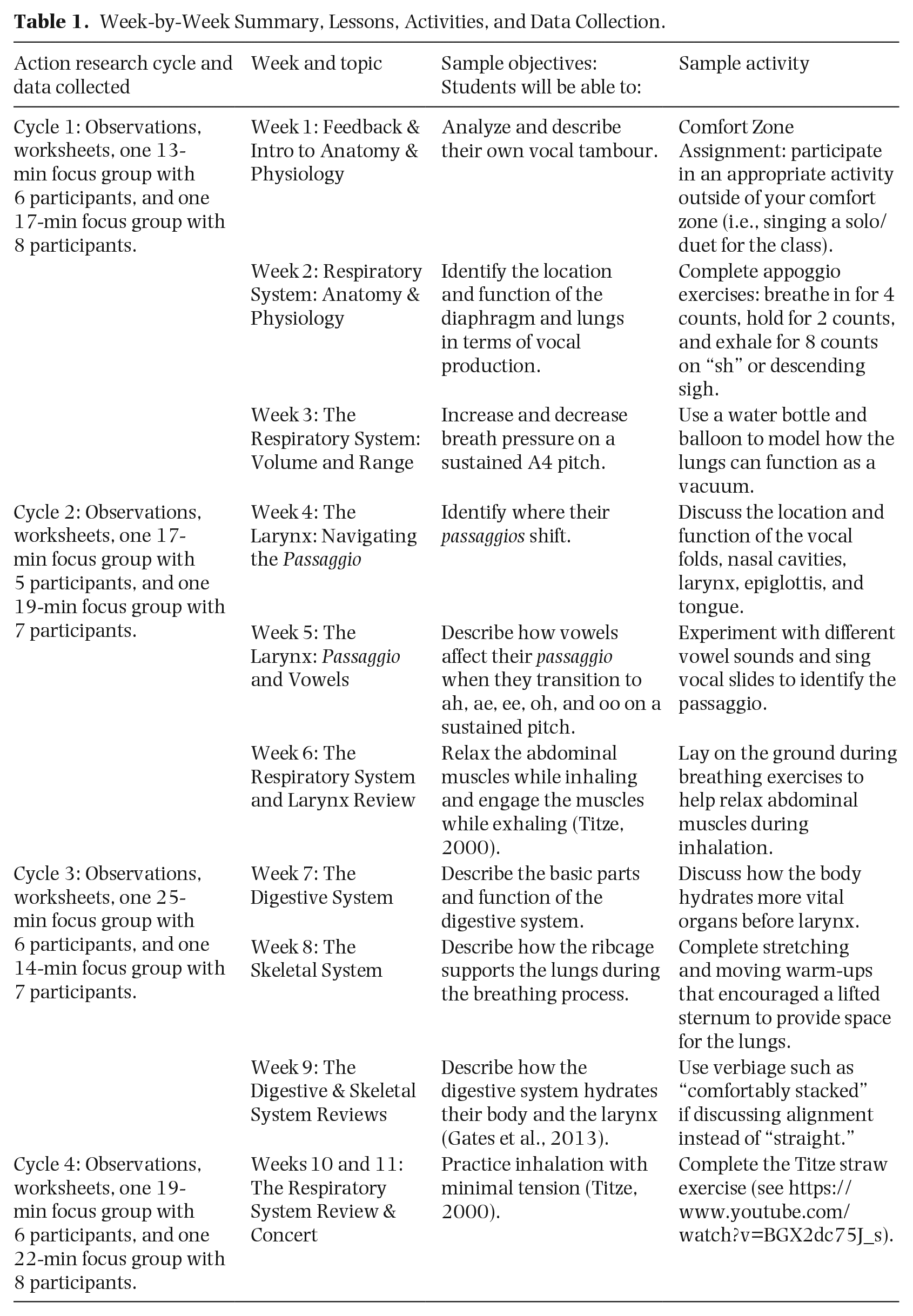
Teaching adolescents about vocal anatomy and physiology may empower and support singers (Sweet, 2019). Therefore, we used Sweet’s suggested categories and divided our curriculum into the following four units: the respiratory system, the larynx, the digestive system, and the skeletal system (see Table 1). We covered basic anatomy and physiology and led exercises designed to support participants’ vocal development (see Supplementary Files for detailed descriptions of objectives, activities, and resources). We conducted four action research cycles (each lasting 2–3 weeks) and used Cain’s (2008) cycle for action research: (a) plan—we wrote lesson plans with specific objectives, activities, and assessments; (b) act—we taught the lesson plans; (c) evaluate—we collected data in the form of weekly vocal experience worksheets from participants (see Online Supplementary Files), end of unit focus groups, and researcher/teacher observation notes taken during and after each class; and (d) analyze/reflect—we analyzed the data and adjusted the curriculum and subsequent lessons as needed (see Table 1). By engaging in an action research methodology, we examined a unique perspective into the phenomenon of adolescent vocal development (Cain, 2008).
Week-by-Week Summary, Lessons, Activities, and Data Collection.
Research site and participants
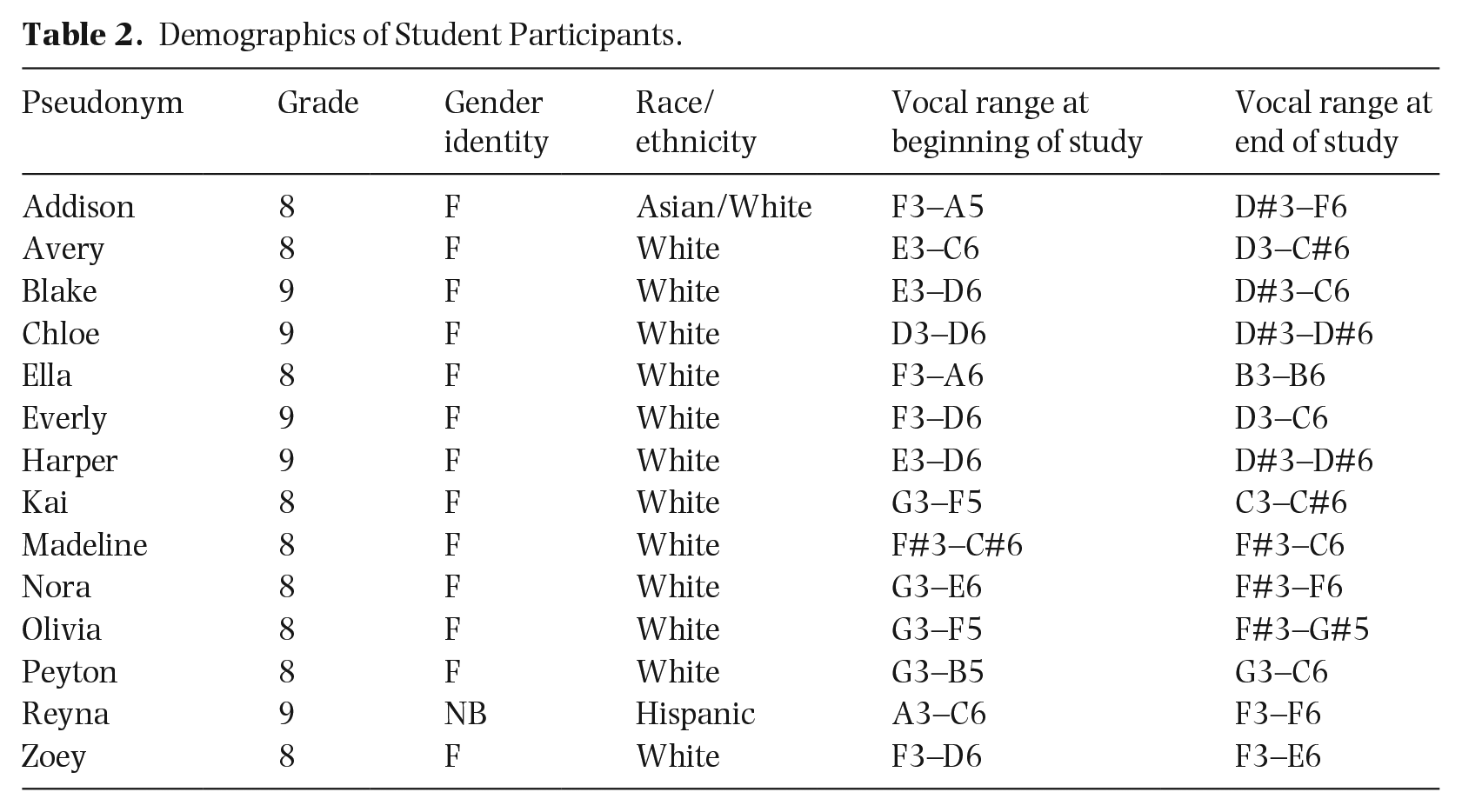
The middle school, which enrolls seventh- through ninth-grade students, is located in the Western United States and has a current enrollment of around 1,100 students and an ethnic distribution of approximately 66% White, 22% Hispanic, 4% Pacific Islander, 1% African American, 3% Asian, and 4% who identify as other—approximately 22% of students are eligible for free and reduced lunch. The choir program, which included a beginning mixed choir, an intermediate mixed choir, an advanced mixed choir, and an advanced treble choir, enrolled 132 students at the time of the study. There were 14 eighth- and ninth-grade students (ages 12–13) enrolled in the advanced treble choir, the ensemble of focus for this study (see Table 2). We chose the advanced treble choir because all registered students had been assigned female at birth, and we wanted to specifically focus on female vocal development. We received approval from the school district and the university’s institutional review board to conduct this research, and we collected participant consent and parent/guardian permission forms.
Demographics of Student Participants.
Data collection and analysis
Data collection included eight total student focus groups (lasting 13–25 min each), participants’ weekly vocal experience worksheets, lesson plans, and field notes (see Table 1). We conducted focus groups at the end of each unit and split the class into two groups. The focus groups occurred during lunchtime on the school’s stage, which was unoccupied, and we divided the groups based on their assigned lunch period. Group 1 contained six participants and Group 2 contained eight participants (see Supplementary Files for a complete list of focus group questions). The total transcribed data consisted of 115 pages of typed single-spaced data.
Emily and Michael coded the data separately and met twice per week to discuss emerging themes and make plans for future lessons. We manually coded the data in three cycles. To organize the codes, Emily used Atlas.ti, version 8.4.4, and Michael used word processing software. After each feedback loop, we completed evaluation coding “to improve program effectiveness” and practice (Saldaña, 2016, p. 141). For example, we analyzed the focus group transcripts and vocal experience worksheets for evidence of participants’ knowledge and attitudes toward the curriculum and their vocal development, and if needed, we adjusted subsequent lessons accordingly (Baumfield et al., 2012). At the end of the fourth curricular unit, but before the final focus group, we completed a second coding cycle on all data and used In Vivo coding to represent the participants’ and researchers’ perspectives (Saldaña, 2016). We extracted approximately 20 themes from this cycle of coding (see interview questions in Supplementary Files for the list of themes). The fourth and final focus group served as a form of member checking to address trustworthiness, and participants had the opportunity to agree or disagree with the themes, and then elaborate on their perspectives (Creswell & Poth, 2018). Finally, we completed focused coding “to develop the most salient categories in the data corpus” (Saldaña, 2016, p. 240). In addition to member checking, we also triangulated the data (Creswell & Poth, 2018). For example, we corroborated evidence from the focus groups with participants’ vocal experience charts, our field notes, and lesson plans.
Findings
The curriculum contained four units, and our findings reflect the participants’ perspectives of their singing voice during and after each unit, as manifested in the data. We have organized the findings into six sections regarding participants’ perceptions of breath, passaggio, vocal range, vocal tone, feedback, and confidence.
Perceptions of breath
During the first unit, we taught participants about the respiratory system and led exercises designed to improve inhalation and exhalation while singing. For example, Avery described how breath pressure affected her sound and wrote, “I can sing higher with more air” (Week 1 worksheet). However, Peyton stated, “[I was] confused with how to breathe” (Focus Group 1), and Harper reported that her abdominal muscles felt “clenchy” (Focus Group 3). During lessons, we observed that participants struggled to relax and expand their abdominal muscles during inhalation. Therefore, we incorporated exercises into rehearsals that relaxed the abdominal muscles, and participants reported less tension. During the skeletal system unit, we explained how our bones can function as a support system, and how proper alignment can help maximize breath support and minimize tension. For example, the following conversation occurred during Focus Group 4:
I can like tell when I’m starting to get breathy and then I can like put more air
Trying not to let all the air out at once. Like trying to steady breathe . . .
Not too much or too little . . .
It’s gotten easier now to not tense.
The participants perceived that learning about their respiratory and skeletal system helped with proper inhalation, exhalation, and airflow. However, challenges also emerged. For example, in Focus Group 4, Harper stated that she enjoyed learning how to “breathe with our diaphragm,” even though we explained that they breathe with their lungs. In the worksheets and focus groups, participants expressed misconceptions regarding the anatomy and physiology of the voice. Therefore, we retaught and reviewed these concepts during Week 10 (see Table 1 and Supplementary Files).
Perceptions of passaggio
Some participants struggled to produce pitches in the middle range of their voice. For example, Addison stated, “My voice just stops working . . . refuse[s] to make a sound, I’m like, . . .temperamental, are we?” (Focus Group 4). In this instance, Addison identified an “involuntary register transition” (Titze, 2000, p. 293), known as the passaggio, which translates to passage in Italian and signifies the movement between registers. During the second unit, we introduced the concept of passaggio. Several participants noted in their worksheets that they wanted their voice to stop sounding “raspy” (Avery and Nora), “cracky” (Reyna), and “airy” (Madeline and Nora). We explained that the presence of estrogens and progesterone during puberty causes the vocal folds to increase in length and mass, which can result in a loss of certain harmonics (Abitbol, 2019), and are more apparent when singing. In addition, hormones can affect vocal tissue on a cellular level, and “progesterone increases the viscosity of the secretions of the glandular cells and the level of acidity, but it decreases their volume, causing a relative dryness” (Abitbol, 2019, p. 116). When participants could not produce certain notes, and/or they struggled with pitch stability, we asked them to avoid the words “breaks” or “cracks” because their voices were not broken, but appropriately functioning at this point in their development (Sweet, 2019). From then on, we referred to these moments as the passaggio, and we helped participants identify the note(s) on which they occurred.
As participants learned how their voices functioned, they laughed and joked during rehearsals when experiencing unwanted register shifts (Week 4 fieldnotes). For example, after the fall concert, Kai shared, “I had a passaggio so loud . . . did anybody else hear that? That was nasty” (Focus Group 4). Although some participants learned to identify their passaggio, they struggled to anticipate exactly when it would happen. For example, Zoey compared approaching her passaggio with “a car crash” and stated, “you have to think fast, and if you don’t make the right decision, it might turn out bad” (Focus Group 3). For Addison, some exercises helped her identify her passaggio, but did not improve perceptions of her vocal tone, and she wrote, “the passaggio is here for the party” (Week 8 worksheet). Although most participants had little control over their passaggio, they described their awareness that dramatic register shifts are a normal part of adolescent vocal development.
Perceptions of vocal range
Some participants perceived that they increased their vocal range across 11 weeks. For example, Blake stated, “I definitely increased my vocal range. . .I can sing higher and way lower than I could before” (Focus Group 4). However, increased breath support could have contributed to a perceived range increase (Titze, 2000), and the exercises we implemented encouraged range extension. For example, Zoey stated, “I always thought . . . like, that my voice was low, when in reality it was really high” (Focus Group 2). We taught participants how to distinguish between and access their chest and head voice, and Avery stated, “I used my voice . . . down here, like, in my chest . . . but then. . .using my head voice, I got better at doing high notes” (Focus Group 4). The participants created more space in their vocal tract and perceived an increase in range. The vocal tract consists of the nasal cavity and pharynx and amplifies the voice at certain frequencies (Sundberg, 2017). For example, Blake stated, “When you hit the high notes, like it’s easier if like when you open your mouth and the vowels and stuff” (Focus Group 4). Although participants perceived range increases, enhanced breath pressure most likely led to the increase.
Some participants had developed identities as “altos” or “sopranos,” which they communicated to us during class (Week 5 fieldnotes). Therefore, we removed voice classifications from our rehearsal language, assigned participants to choral parts based on their range, and rotated part assignments. However, some participants reported challenges when they changed parts. For example, Avery stated, “sometimes it’s, like, hard. . . going from my head voice to my chest voice” (Focus Group 4). In addition, we misassigned parts to some participants, and they reported pain and/or discomfort when trying to sing too low or too high. For example, Kai stated, Today it was, like, hurting my voice going that high . . . It felt kinda bad . . . I didn’t realize it was hurting until I rested . . . and then I couldn’t, like, my voice kept going in and out because it was so strained from the last song. (Focus Group 2)
In response, we moved participants to a part on which they felt comfortable and checked in frequently regarding any pain, discomfort, and/or strain.
Perceptions of vocal tone
During Week 1, participants created a list of words to describe vocal tone such as “loud, soft, bold, raspy, beautiful, red, blue, and clear” (fieldnotes). Then, each week, participants described their individual vocal tone in their worksheets. During the first few weeks, participants mostly provided negative descriptions, such as “screechy” (Kai), “airy” (Madeline), and “like a pterodactyl” (Addison). However, a few participants reported positive qualities, such as “strong” (Olivia), “forward” (Nora), and “powerful and belonging” (Kai). When describing each other’s tone, they provided overwhelmingly positive comments. For example, Olivia said to Zoey, “Your voice is very beautiful” (Focus Group 3). Participants shared multiple affirming and positive comments with each other regarding their vocal tone during rehearsals (fieldwork notes).
During Weeks 4 and 5, we explained how mouth shape and vocal tract resonances, or formants, can affect their sound. For example, Sundberg (2017) explained that “the two lowest formants determine vowel quality, whereas the higher formants determine much of the personal voice characteristics, including voice classifications” and can affect the loudness of the voice (p. 186). To demonstrate this concept, we showed participants a video of their vocal tract, reviewed the anatomy and physiology of the larynx, and asked participants to experiment singing the same vowel sound while manipulating the height of their larynx. When they sang together and matched vowel sounds, they became visibly excited (Week 6 fieldnotes). Blake perceived that she produced a clear tone when focusing on her mouth shape and stated, “I don’t feel like I sound like a rat or screechy” (Focus Group 4). The lesson on formants may have also contributed to participants’ sense of vocal identity. For example, Addison stated, “Before I had a very set tone . . . now, I feel like I have a little bit more freedom to play around . . . I have options of where to place my sound . . . versus just straight whatever comes out of my mouth” (Focus Group 3). In this instance, Addison perceived that she could control tone quality with vowel placement.
The participants reported misunderstandings regarding the parts and function of the larynx, as evidenced in the following conversation:
The larynx I still struggle with . . . it’s like, right here [points to throat] somewhere, I think . . .
Yeah, it’s confusing . . . it’s nice to know how . . . to shape your mouth in certain ways . . .
Isn’t it that long thing?
I don’t even know what it does.
Go over the larynx again.
Is it just the voice box or . . .?
In one SpongeBob episode, Squidward is like, “If you laugh too much, you’re going to lose your voice box . . .”
That’s the little mermaid . . .
Sometimes it’s just like a lot to take in, and then I forget it all. (Focus Group 3)
Participants described the shape of their mouth and vocal tract while singing, but they still struggled to identify the parts and function of the larynx. These challenges persisted throughout the unit, as evidenced in following conversation from Focus Group 4:
The names of, like, parts of your body . . . it’s so complicated. I’m like-
Say that 50 more times.
That’s a 12-letter word, what the heck? . . . I still don’t get it, but it’s fun . . .
Right, like, I didn’t know it was called a larynx until, like, last month . . . I was just like, I hear an “ynx” at the end. . .
What’s the larynx? . . .
The voice box . . .
Yeah . . . that was weird stuff.
I didn’t remember the different parts of it, but I did remember that it was the voice box.
Although participants described beneficial vocal experiences, they struggled to retain and transfer information from the lessons.
Perceptions of feedback
Throughout each unit, we provided individual feedback to participants. For example, participants sang short warm-ups or phrases from the repertoire, and we provided positive and critical feedback on topics including breath support, pitch accuracy, and tone quality. Some participants enjoyed the individual feedback. However, in the second focus group, Addison stated, “When like, we’re all singing together, I feel like I sound good. But then I try to do it by myself and . . . everything goes out the window. And I’m like . . . what the frick-frack is my voice doing?” In contrast, Harper shared, Going individually and saying, like, well you could open your soft palate but you should drop your jaw . . . so that each of us can just sound, like, better individually. I like that because it’s more personal, and then I feel like I can fix how I sound. (Focus Group 1)
Some participants were also enrolled in a large mixed choir at the time of the study, and they discussed why they preferred not to sing alone in the mixed choir:
It’s easier, ’cause then all of us don’t have to worry about, like the guys . . .
We don’t have to worry about what we look like . . .
When you have, like, basses and tenors, you have to, like, teach them something separate about their voice than when you teach females . . .
And when you get, um, feedback . . . it’s a lot easier when there’s less people . . .
Yeah . . . you can focus on your voice. (Focus Group 4)
The participants suggested that their shared sense of gender identity and the small class size contributed to their willingness to sing by themselves and receive feedback.
During Focus Group 2, we asked participants how we could help them feel more comfortable to receive individual feedback, and some asked to sing with partners. Therefore, they self-selected groups, and we provided specific feedback individually or in groups of two or three. The participants also preferred when we provided positive feedback in combination with critical feedback. For example, Addison stated, “How like, you say, ‘that was good . . . keep doing that, but here’s a few things to like, focus on now’” (Focus Group 1). Overall, participants preferred individual or small group feedback, and they preferred a combination of constructive and positive/specific feedback.
Perceptions of confidence
As they progressed through the curriculum, some participants perceived an increase in confidence while singing. For example, Harper stated, “I feel, yeah, more confident in my voice because I know more about it” (Focus Group 1). And Olivia stated, “I have a talent that like, a lot of people can’t have . . . and I’m proud of it” (Focus Group 1). However, Peyton mentioned that her confidence went “up and down” throughout the unit, and she was less confident when singing at “the outer ends” of her vocal range (Focus Group 4). Nora shared that her confidence waivered because “sometimes I just have a bad singing day” (Focus Group 4). The curriculum, which contained four units on the anatomy and physiology of the female voice, appeared to improve participants’ perceptions of their tone quality, pitch matching, and range, which may have contributed to their perceived increase in confidence. However, they experienced confidence on a continuum, which varied based on each participant and outside factors.
Discussion and implications
In this study, participants reported perceptions of their singing voice during the implementation of a middle school choral curriculum theoretically grounded in anatomy and physiology of the adolescent female voice. The curriculum contained the following four units: the respiratory system, the larynx, the digestive system, and the skeletal system (Sweet, 2019). Notably, the most salient findings emerged from participants’ perceptions of their breath and vocal tone, which occurred during the units on the respiratory system and the larynx. Based on our observations, participants appeared comfortable with the content in the units on the skeletal system and digestive system, and fewer conversations and questions emerged from the focus groups and vocal experiences worksheets on these topics.
The action research methodology we employed allowed us to (a) receive frequent and detailed feedback from participants; (b) refine the curriculum, lesson plans, and repertoire to address misconceptions and vocal issues; and (c) cater to participants’ interests regarding their vocal development. Salient themes included participants’ perceptions of breath, passaggio, vocal range, vocal tone, feedback, and confidence. The participants reported positive experiences throughout the units; however, challenges emerged when introducing complex terminology associated with vocal anatomy.
At the end of the first unit, participants perceived that they controlled their inhalation and expiration of air while singing. However, participants displayed tension in their upper bodies when we addressed inhalation, especially when we introduced appoggio breathing (Emmons & Chase, 2006). To address tension, Titze (2000) suggested that vocal teachers incorporate relaxation exercises, because “in the inspiratory phase, abdominal muscles need to be trained to relax quickly and completely to allow maximum downward movement of the diaphragm” (p. 81). Although relaxation exercises might improve breath capacity during inhalation, participants in this study shared that their breath capacity varied from week to week. Abitbol (2019) suggested that “abdominal cramping associated with PMS [premenstrual syndrome] is known to compromise the specific breathing technique called appoggio, which is used by singers. This technique requires diaphragmatic breath support and use of intercostal and abdominal muscles” (p. 127). Although we did not ask participants to report their menstrual cycle each month, we informed participants that fluctuating hormones can affect their singing voice. When working with adolescent female voices, we suggest that teachers explain the effects of hormones on breath pressure and tone quality, so that students do not feel like something is “wrong” with their voice each month.
The participants reported an increase in upper and lower vocal ranges across the 11-week curriculum. However, increases in estrogen and progesterone can cause singers to produce higher and lower pitches, and “as a girl becomes a woman, she develops higher harmonics, as well as some lower ones that she previously lacked” (Abitbol, 2019, p. 93). In addition, “fundamental frequency also increases with lung pressure” (Titze, 2000, pp. 232–233). Therefore, any perceived increases in their range may have been a result of increased lung pressure and/or the presence of estrogen and progesterone, as it is unlikely that participants at this age would increase their vocal ranges in only 11 weeks. In addition, eighth- and ninth-grade female students mostly sing in the soprano range (Gackle, 2014); therefore, we did not classify participants as sopranos or altos. We chose music with a comfortable range and rotated voice parts as needed (Sweet, 2019; Titze, 2000). To improve vocal health and development in adolescent singers, we recommend that teachers choose simple songs, avoid voice classifications, and do not require adolescents to sing too loud or too soft at the outer edges of their range (Sweet & Parker, 2019).
The curriculum did not introduce components of sound to participants, such as frequency and intensity. However, in the focus groups and worksheets, participants sometimes discussed volume alongside tone. During the lessons, we observed that a perceived increase in volume was a result of increased breath pressure (Sataloff, 2017), because the “amplitude of vibration increases with lung pressure” (Titze, 2000, p. 232). After the first feedback loop, we noticed that some participants seemed to equate singing loud as “good” and quiet as “bad,” and we dispelled this misconception in subsequent lessons. We recommend that teachers focus on exercises that help students control the volume of their voice and program music in a comfortable range to avoid vocal discomfort and strain. In addition, hormones can cause the voice to fluctuate and “puberty can take a wrong turn . . . an imbalance between voicing and breathing produces a voice that ‘goes off the rails’, like a Tyrolean melody” (Abitbol, 2019, p. 93). We recommend that teachers explain to students why certain pitches are suddenly inaccessible during the voice change and explain that through proper training, those pitches will eventually return.
In this study, we provided individual feedback to participants on their vocal technique, and we found that frequent and open communication created an environment where participants conveyed their vocal needs. In a phenomenological study of female vocal identity development, Sweet and Parker (2019) found that choral music educators can be “powerful influences in labeling and reinforcing participants’ emerging vocal identities” (p. 69); however, participants in their study reported challenges when choral music educators focused more on the needs of the ensemble over the needs of the individual singers. In this study, the small group environment, shared sense of gender identity, and established relationships may have contributed to the participants’ appreciation for individual feedback they received. Researchers have found that adolescents may have an easier time learning when placed in single-sex classrooms (Bowe et al., 2017; Brutsaert & Van Houtte, 2004). We suggest that teachers place students in like-voiced ensembles based on their current stage of vocal development.
All genders and sexes can benefit from this work, and our findings may apply to adolescent males. Researchers have found that male adolescents also experience significant challenges while their voices change (Freer, 2006, 2016; Harrison et al., 2012; M.C. Kennedy, 2004; Sweet, 2010). For example, Freer (2016) reported that for some male singers, the “voice change was something to endure, ignore, or bemoan . . . an enigma” (p. 85). We recommend that all adolescents receive instruction on the anatomy and physiology of their voice; however, due to their unique vocal development, teachers should distinguish physiological changes between and within the sexes. For example, Abitbol found that female singers can experience Premenstrual Vocal Syndrome (PMVS) from 4 to 6 days before menses to 3 days after the first day of menses, which “is characterized by voice fatigue, decreased and narrow range, a loss of power in the singing voice, and [fewer] harmonics” (p. 114). We suggest that choral music educators consider the unique differences between adolescent male and female voices and take a nuanced approach when developing curriculum theoretically grounded in the anatomy and physiology of the voice.
This study did not examine adolescent transgender singers’ experiences, but this curriculum might also benefit transgender singers as they navigate the voice change. Researchers have examined the experiences of transgender music students and offered suggestions for supporting transgender singers (Abitbol, 2019; Cayari, 2019; Palkki, 2017; Palkki & Caldwell, 2018; Silveira & Goff, 2016). For example, vocal music educators should not assume that a student’s vocal identity coincides with their gender identity (Palkki, 2017, 2020). If singers decide to take hormone therapy and/or sing in a voice that does not coincide with their gender assigned at birth, they will need additional support (Abitbol, 2019; Sims, 2017). This transition can be difficult for transgender females during and after puberty, because introducing estrogen will not cause the vocal-tract to decrease in length (Abitbol, 2019). For example, Sims (2017) discussed strategies for helping transgender singers through this transition, such as vowel modification to manipulate the position of the larynx. Ultimately, teaching students about the anatomy and physiology of their voice may empower students through the variety of changes they can experience during adolescence.
Researchers have found that positive feedback may improve participants’ perceptions of their self-confidence; however, adolescent singers can also experience feelings such as embarrassment and frustration (Parker, 2014, 2018; Sweet, 2015, 2018; Sweet & Parker, 2019). In addition, classifying students as altos or sopranos during early adolescence may contribute to a “lack of confidence” (Sweet & Parker, 2019, p. 71). While students’ voices are developing, Abitbol (2019) suggested that “voice and physical appearance is one of puberty’s most delicate obstacles because the voice is seen to project its owner’s personality! Therefore, one should positively help adolescents to successfully complete this meta-morphosis, should this be necessary” (p. 90). We suggest that vocal music teachers allow adolescent singers to explore and describe their voice in a safe environment.
Limitations
Although readers may transfer these findings to their own experiences, the findings are the unique perspectives of this advanced middle school treble choir and cannot be generalized. The participants in this study described a perceived increase in their confidence as singers due to encouragement from teachers and peers. Therefore, participants’ perceived vocal development may not have been a direct result of the curriculum, but rather, a sense of positive support. Also, participants may have reported perceived benefits because as adolescents who had been assigned female at birth, they experienced vocal changes during data collection, so this curriculum may have kept their interest (Sweet, 2019).
Conclusion
Seminal past research on the adolescent voice mostly focused on the adolescent male voice (Cooksey, 1977a, 1977b; Freer, 2009a, 2009b; M. A. Kennedy, 2002, M. C. Kennedy, 2004; Swanson, 1977; Sweet, 2010); however, adolescent female singers experience voice changes that deserve a nuanced approach in vocal music education (Gackle, 1991, 2014; Sweet, 2010, 2015; Sweet & Parker, 2019). Future researchers might examine how older adolescent male and female singers, such as high school students, respond to a curriculum grounded in anatomy and physiology of the voice. Although we focused on the female changing voice, Freer (2016) found that adolescent males have expressed a desire to learn about their changing voices. In addition, there exists scant research on adolescent transgender singers. Therefore, teachers and researchers should continue to examine ways to support all adolescent singers. In this study, the small-group environment allowed us to provide individual feedback to participants. Therefore, future researchers might examine how directors of large choral music ensembles engage in differentiated instruction with adolescent singers. Although pressure to prepare choral performances for school concerts and festivals may create a perceived barrier to individualized instruction, we suggest that vocal music education should prioritize a process-oriented curriculum theoretically grounded in the anatomy and physiology of the voice to serve the needs of adolescent singers.
Supplemental Material
sj-docx-1-rsm-10.1177_1321103X221149661 – Supplemental material for Eighth- and ninth-grade students’ perceptions of a curriculum designed to support adolescent female vocal development: An action research study
Supplemental material, sj-docx-1-rsm-10.1177_1321103X221149661 for Eighth- and ninth-grade students’ perceptions of a curriculum designed to support adolescent female vocal development: An action research study by Emily M Mercado and D. Michael Draut in Research Studies in Music Education
Supplemental Material
sj-docx-2-rsm-10.1177_1321103X221149661 – Supplemental material for Eighth- and ninth-grade students’ perceptions of a curriculum designed to support adolescent female vocal development: An action research study
Supplemental material, sj-docx-2-rsm-10.1177_1321103X221149661 for Eighth- and ninth-grade students’ perceptions of a curriculum designed to support adolescent female vocal development: An action research study by Emily M Mercado and D. Michael Draut in Research Studies in Music Education
Supplemental Material
sj-docx-3-rsm-10.1177_1321103X221149661 – Supplemental material for Eighth- and ninth-grade students’ perceptions of a curriculum designed to support adolescent female vocal development: An action research study
Supplemental material, sj-docx-3-rsm-10.1177_1321103X221149661 for Eighth- and ninth-grade students’ perceptions of a curriculum designed to support adolescent female vocal development: An action research study by Emily M Mercado and D. Michael Draut in Research Studies in Music Education
Footnotes
Declaration of conflicting interests
The author(s) declared no potential conflicts of interest with respect to the research, authorship, and/or publication of this article.
Funding
The author(s) disclosed receipt of the following financial support for the research, authorship, and/or publication of this article: The University of Utah College of Fine Arts faculty grant program provided funding for this study.

Supplemental material
Supplemental material for this article is available online.
Author biographies
References
Supplementary Material
Please find the following supplemental material available below.
For Open Access articles published under a Creative Commons License, all supplemental material carries the same license as the article it is associated with.
For non-Open Access articles published, all supplemental material carries a non-exclusive license, and permission requests for re-use of supplemental material or any part of supplemental material shall be sent directly to the copyright owner as specified in the copyright notice associated with the article.
