



Abstract
Empathy enables successful communication and connection between teachers and their students, yet few studies have investigated its specific use in teaching singing. Addressing this gap, we interviewed voice teachers to discover how they articulate their pedagogy in terms of empathic practices and observed one-to-one lessons for evidence of the same. A sample of 27 classical and music theater voice teachers in Australia (70% females, 30% males), aged 35 to 75 years old (M = 55) were interviewed. Of this cohort, seven teachers were observed in their one-to-one teaching practices. Interviews and observations were analyzed using Interpretative Phenomenological Analysis. Results indicated that voice teachers tailor their practices to the needs of students and demonstrate characteristics of teacher empathy identified in previous literature: effective communication, positive relationships, care, welcoming learning environment, trust, morality, and listening. Empathic teaching facilitates an individualized approach in which singing students are supported and motivated in their own autonomous learning environment. These findings have implications for voice pedagogy that features the use of empathy to benefit future students.
Introduction
Teacher empathy is considered a professional asset (Lam et al., 2011) as well as one of the most important emotional characteristics of teachers (Stojiljković et al., 2012). Studies have identified that teacher empathy enables successful communication (Berkovich, 2020; Goroshit & Hen, 2016; Stojiljković et al., 2012) and connection with students (Arghode et al., 2013; Hutton, 2022). For voice teachers, empathy is essential for training students both physically and psychologically (Kiik-Salupere & Ross, 2011). A voice teacher’s success with their students is reportedly linked to their ability to empathize and demonstrate care (Helding, 2017b; Hendricks, 2022); support their student’s ability to cope in the performing arts industry (Kiik-Salupere & Ross, 2011); generate trust through demonstrating knowledge, experience, and candor (Lewis & Hendricks, 2022); and assist in diagnosing vocal issues in students (Brown, 2002). Given this evidence that voice teacher empathy is important and correlates with student success, examining voice teachers’ perceptions of their pedagogy and behaviors when teaching could offer greater insights as to how they demonstrate empathy. Thus, through qualitative data collection, our study examined how expert voice teachers both articulate and demonstrate their pedagogical approach to determine if, and how, empathy features in their practices.
Defining teacher empathy
Research in education has explored empathy specific to the dispositions and requirements of teachers (Barr, 2011; Berkovich, 2020; Cornelius-White, 2007; Goroshit & Hen, 2016). For example, empathic relationships in the learning environment are defined by the individual manner in which cognitive and affective empathy are offered and received in a reciprocal bond sustained over time (Berkovich, 2020). Communication in empathic teaching is conceptualized through verbal and nonverbal transactions, a conversational process that elicits an empathic exchange and understanding between a transmitter and a receiver (Berkovich, 2020). In studying the impact of environmental constraints on the teacher’s ability to engage empathically with their students, Cooper (2004) affirmed that empathy was more achievable in cohorts of fewer pupils, particularly in one-to-one interactions. Furthermore, the attitude of caring in teacher practices relates to empathy (Cooper, 2004, 2010; Hendricks, 2022; Parker, 2007; Swarra et al., 2017) and is considered essential in developing positive teacher–student relationships (Hattie, 2012; Hendricks, 2022; Hutton, 2022).
Findings indicate that teacher empathy promotes inclusivity and creates a welcoming atmosphere in the classroom (Burnard, 2008; Hendricks, 2022; Peck et al., 2015); facilitates a positive learning environment (Swan & Riley, 2015); serves to develop trust and comfort (Carter, 2017; Hendricks, 2022; Peck et al., 2015); promotes positive, healthy teacher–student relationships (Hutton, 2022; Lagou, 2018; Teding van Berkhout & Malouff, 2016); makes a student feel safe (Cooper, 2004; Swarra et al., 2017); and informs a teacher’s pedagogical approach with the student (Warren, 2014). Studies have also shown that empathic teaching positively influences students’ learning and engagement (Arghode et al., 2013), development (Rogers et al., 2014), achievement (Feshbach & Feshbach, 2009), and well-being (Berkovich, 2020; Cooper, 2004).
Specific to the genre of teaching singing, successful vocal pedagogy is said to “hinge” on the teacher’s ability to empathize with their students (Helding, 2017b, p. 547). However, there are currently no decisive criteria defining empathic behaviors specific to voice teachers. For example, “empathic listening” in voice teaching is considered a form of perspective-taking whereby the teacher can appreciate the student from their frame of reference as well as establish a warm atmosphere in which the student is encouraged to socialize comfortably (Wormhoudt, 2001, p. 138). This “hearing” and receiving singing students empathetically promote a caring student–teacher relationship (Parker, 2007). Care can also be established through engendering trust with vocal students (Hendricks, 2018). Voice teachers elicit trust through a demonstration of their knowledge and experience (Lewis & Hendricks, 2022), which might include sharing individual experiences and struggles as a singer (Helding, 2017a), or through genuine student–teacher interactions (Parker, 2007). Voice teacher empathy is also important in conveying knowledge of physiology and the acoustics of singing in a way that is sensitive to the singer’s future vocal capacity (McCoy, 2014). For example, Brown (2002) refers to empathy in voice teachers as a proprioceptive tool for diagnosing vocal faults in the student and for offering solutions.
Notably, students consider it especially important to have an empathic voice teacher. Kiik-Salupere and Ross (2011) found that: (a) singing students appreciate a calm, constructive, and supportive lesson atmosphere and expect their teachers to be positive and innovative; and (b) teachers should facilitate a partnership with their students based on mutual trust and develop their students’ psychological skills to help them cope in the industry. Trust also factors strongly into how students perceive their performance and development, as their relationship with their teacher influences their confidence (Lewis & Hendricks, 2022). In this manner, clear and candid communication is perceived as essential for voice students in their learning (Lewis & Hendricks, 2022).
Despite these collective assertions, research on voice teacher empathy specifically in one-to-one lessons has been underdocumented. Existing studies are frequently theoretical, stating the importance of voice teacher empathy while providing little or no empirical evidence to support such assertions. Therefore, the present study sought to examine and understand the approaches employed by exemplary Australian classical and music theater voice teachers to determine whether their perceptions of their practices, and their behaviors and actions when teaching, align with existing theories and concepts of empathic teaching.
To achieve this aim, a comprehensive definition of empathy has been considered in conjunction with the aforementioned characteristics identified in research on teacher empathy. Although there are as many definitions of empathy as there are those researching it (Decety & Jackson, 2004; de Vignemont & Singer, 2006), for the purposes of this study, empathy is defined as an “intersubjectively motivated experience marked by affective—and at times cognitive and motor—attunement” (Doğantan-Dack, 2015, p. 154). In the context of one-to-one voice lessons, “affective empathy” refers to the skill, capacity, and desire to recognize or share the emotional experiences of others, while “cognitive empathy” refers to the skill, capacity, or motivation in adopting another’s point of view (Batchelder et al., 2017). Motor attunement refers to an embodied and sensorially driven response informed by senses such as hearing or seeing, also known as kinesthetic empathy (Reynolds & Reason, 2012). This definition of empathy has also been used in broader research investigating music and empathy (King & Roussou, 2017; King & Waddington, 2017).
Upon reviewing research on teacher empathy, seven characteristics of empathic behaviors in teachers emerged; these are summarized in Table 1. Inclusion in the table depended on the frequency with which characteristics were referenced, the sources in which they were identified, and their compatibility with Doğantan-Dack’s (2015) definition of empathy. For example, affective ability or drive is demonstrated in positive relationships and care; cognitive empathy is identified through effective communication and good listening skills; and motor attunement is indicated in nonverbal behaviors such as body language.
Characteristics of Empathy in Education Research and Voice Teacher Practices.
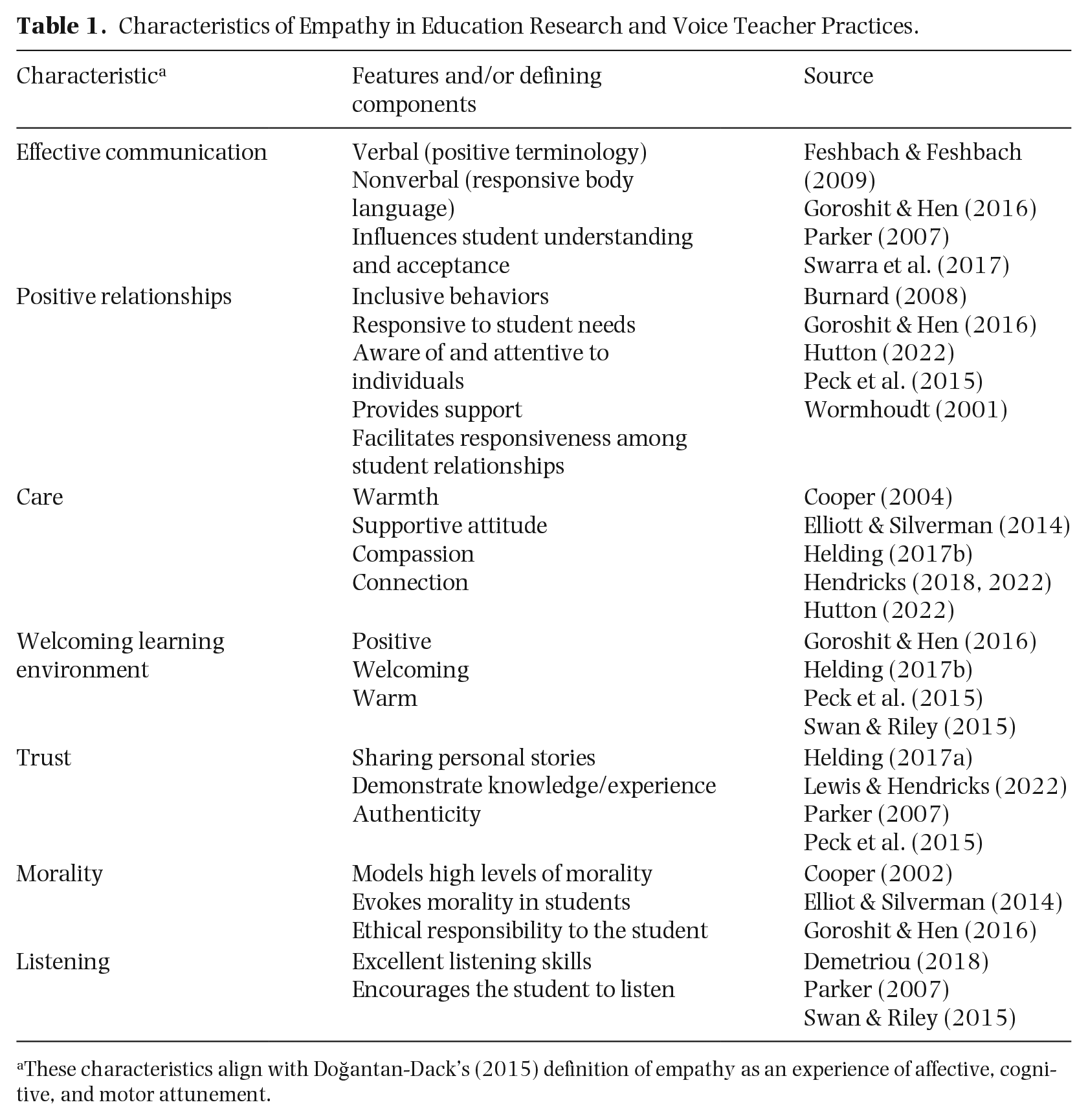
These characteristics align with Doğantan-Dack’s (2015) definition of empathy as an experience of affective, cognitive, and motor attunement.
Method
Data collection, procedure, and materials
Although no single form of data collection has been used to measure teacher empathy in the past, most studies have relied on self-report (Mehrabian & Epstein, 1972). As we were seeking to investigate empathy as an experience of affective, cognitive, and motor attunement in the behaviors of voice teachers, a qualitative approach was adopted. Data were collected both through semistructured, face-to-face interviews for their flexibility and benefit in smaller-scale research (Kallio et al., 2016) and through lesson observations investigating a more comprehensive understanding of voice teachers’ self-reported practices. Both collection methods allow for topics to emerge over time, facilitating a richer depth of qualitative data (Smith et al., 2009).
Participating teachers determined the location (private studio or tertiary institution office), date, and time of each interview and observation, and which students would be involved in the latter. 1 The interview questions were devised to capture participating teachers’ knowledge base, their approach to training singers, and their perception of their approach. Leading questions were avoided for academic integrity (Leech, 2002); thus, no direct questions about empathy were asked. If participants knew we were investigating empathy, they may have altered their behavior when being observed delivering lessons. Thus, to ensure the quality of the data, questions were developed specifically to investigate the approaches currently employed by voice teachers. Key questions included the following: Please explain what you do with a student at the start of a lesson; and What technical exercises do you use?
Observations took place with the lead investigator present in the lesson, positioned in view of the participating teacher. The impact of having an observer present in the lesson could have been perceived as “intrusive” (Young et al., 2003, p. 145), thereby potentially affecting the qualitative data (Livingston, 1987). However, data reliability increases when the observer takes notes in the lesson rather than relying on recorded data alone (Kostka, 1984; Serra-Dawa, 2010). In accordance with participant consent, interviews and observations were either video or audio recorded, with field notes taken focusing on participant verbal and nonverbal behaviors.
Participants
Recruitment for interviews involved contacting individuals (N = 51) via email. A total of 27 voice teachers gave their consent to participate (53%) and were subsequently interviewed, including 19 females (70%) and eight males (30%), aged 35 to 75 years old (M = 55). There were 13 classical teachers (48%), 11 music theater teachers (41%), and three who taught both styles (11%).
All participants were purposively sampled from expert singing teachers in Australia, who met at least three of the following criteria:
employment at a top-tier Australian university, ranked in accordance with the website QS World University Rankings by Subject—Performing Arts (2016);
employment at a conservatorium/school of music/academy with a strong national reputation based on the industry successes of their graduates;
reputation in their private studio based on the industry successes of their students;
hail from a performing background; and/or
demonstrated ongoing professional development and collaboration within the context of singing and vocal pedagogy, including:
contributing to published literature on relevant pedagogical topics, including voice science, vocal technique, vocal health, repertoire, vocal development, and historical vocal pedagogy; and/or
attending, conducting, and/or adjudicating workshops, masterclasses, conferences, eisteddfods, and competitions.
To ensure validity and prevent bias in determining the participant cohort, recommendations for teachers suitable for this study were sought from six university-level teachers (three classical, three music theater), six professional opera singers, six professional music theater singers and a professor in Creative and Performing Arts.
Seven of these interviewees (three classical and four music theater teachers) were observed in their one-to-one teaching practices. This subsample included five females (71%) and two males (29%), aged 35 to 75 years old (M = 55). These individuals were selected based on their diverse range of responses to the interview questions, thus achieving maximum variation (Glaser & Strauss, 1967). This sample size (N = 7) is consistent with similar studies (Cuadrado & Rusinek, 2016; Lamont et al., 2012). Recruitment for the observations involved contacting individuals (N = 7) via email with a 100% response rate.
Teachers participated as part of a larger study investigating practices of expert voice teachers in Australia (Fletcher, 2019). This article examines qualitative data specific to empathy in voice teachers. The Human Research Ethics Committee at The University of Melbourne approved this research (1647986.2 and 1852350.1).
Data analysis
Interviews and observations were analyzed using Interpretative Phenomenological Analysis (IPA) (Smith et al., 2009). The objective of IPA is to understand the individual’s set of beliefs as it pertains to a specific subject (Smith et al., 2009). Mitigating against the complexities of researching one-to-one music instruction (Kennell, 2002), IPA allows for a “more diverse exploration of the multi-facetted aspect of music and music making” (Oakland, 2010, p. 68) and has been used extensively in recent music psychology-based, singing-related research in Australia, including studies on community music (Godwin, 2015; Joseph & Southcott, 2014a, 2014b) and musical identity (Oakland et al., 2013; Sutherland, 2015).
Verbatim transcripts of interviews and observations, including nonverbal communication such as physical gestures or vocal demonstrations, were supplemented with field notes from follow-up interview questions (Chan et al., 2013; Smith et al., 2009). These combined materials provided the data for qualitative analysis. Two participants in the observation study (29%) accepted the option to review their transcripts and made no alterations.
IPA is an inductive analytical process through which five stages of rigorous analysis systematically identify thematic relationships, similarities and differences, and oppositional relationships. In this coding process, (a) transcribed interviews and observations were read aloud three times; (b) key and recurring concepts, trends, linguistics, statements, and ideals were identified and systematically annotated; (c) emerging patterns, connections, and interrelationships were identified and recorded in a separate document; (d) themes were collated into clusters of related themes and refined to create concise ideas (Braun & Clarke, 2006; Smith et al., 2009) which resulted in three to four comprehensive themes per participant; and (e) individual themes were cross-referenced among the data to identify commonalities and differences. Finally, themes congruent with behaviors of empathic teaching were then identified, and the results were presented according to the common themes identified among the participants (Smith et al., 1999). The lead researcher undertook analyses with verification and feedback being offered by the coresearchers, one of whom has long experience of using IPA.
To protect participant anonymity, minimal information of those interviewed and observed is included here (Kaiser, 2009). It is not possible to provide extensive examples in this article, particularly given the quantity of rich data generated; thus, it has been decided to provide the most representative samples of the various findings.
Findings
Interviews
All teachers said their lessons commenced with an exchange or dialogue that determined how the lesson would unfold. This initial “chat” was fundamental in gaining essential information about the student’s vocal well-being and situation relevant to the lesson. For example, one teacher stated: Five minutes of chat. That’s really important to find out where they’re up to. People think, you know, it’s so important. ’Cause you can tell from the time they walk in the door what kind of a day they’ve had. You know, whether they’ve done any practice or not, ’cause they come in very guiltily if they haven’t. Even though I don’t press home at all. I just don’t . . . but they still come in feeling guilty because they’ve disappointed themselves, you know? I’m kind of reflecting themselves to them when they come in.
This statement indicated a sensitivity to the student, an awareness that the teacher’s response could potentially validate the student’s guilt and negatively affect the lesson. The teacher said they picked up on physical and psychological cues, assessing their student’s circumstances so as to respond most effectively and create a positive workspace.
Another teacher explained how they differentiate their approach based on how long they have been teaching the student: At the start of a lesson, I greet the person. And depending on which part of their development we’re up to, it could be a shorthand if you’ve known that person for a while and been working with them. But if it’s a person who’s just starting out at this level with me, it’s finding out where they’ve been for that past week and what they’ve been doing with their voice. And also, you know, just finding out where they are. I find it’s a very helpful thing to do.
The teacher then spoke about a specific student who had been having a difficult time with her day job which did not “tick all the boxes for her as a human being.” This brief disclosure appeared to place the teacher “at the same level” as their student, resulting in “a really great lesson, which was fantastic.” The teacher made a point of saying that this exchange was not “a therapy session. That’s a [laugh] that’s what I say to them all, you know sometimes, ‘OK, that needs to be spoken about with somebody else.’”
Another teacher talked about determining student needs by tuning into their “energy”: I would say at the start of the lesson my main thing is to tune in to the energy of the student. And what’s going on for them. And whether we need to actually sing. And whether it needs to be a discussion. Yeah, obviously I’m not a psychologist. And it’s not about analysing them and having a psychology lesson but, energetically I think that would be the main thing. This is what I do at the beginning of a lesson.
Some teachers instigated a chat at the start of the lesson to determine the emotional and physical state of the student, with one teacher affirming that it created an “atmosphere” conducive to learning: At the very start of a lesson, I use as a very quick diagnostic time. So, the student comes in and they’re settling themselves out and I’m saying, “Hi, how are you?” and, “How’s your weekend?” While they’re doing that, they’re chatting to me. It’s kind, it’s partly chat, but it’s partly so that I do a little quick mental assessment of where they’re at . . . I use those first couple of minutes just to get a little picture of perhaps their emotional state, or if I notice anything particular about the way, you know, they’re holding themselves or they’re speaking to me, I might pick up on. If it’s a new student, I might notice the way they hold their jaw or something when they’re speaking to me, or whether their head is always on one side or if there’s, if they’re unbalanced. It’s a really quick little uh, probably an assessment I’d say that I do. And I guess, I’m also just drawing focus into, I’m trying to create a type of atmosphere or a focus to begin the lesson.
While the teacher’s “mental” assessment appeared to target the student’s emotional state, they also picked up on physical cues to determine what type of alignment work needed to be done in the lesson. Another teacher similarly talked about picking up on physical cues during the initial vocal warm-up, indicating what they would feel within themselves when a student sang, and how this was used as a diagnostic tool: I had a listen to her doing it, and it, what I was hearing was a larynx going sort of not up and down but it was not—there was no stability in it, and there was a bit of an awkwardness with the runs that I could sense in my body what she was doing. And she could feel it. I could feel it.
One teacher acknowledged that issues needing attention might be emotional rather than vocal, particularly if the student had had a “bad week.” They sought to create a safe space where the student could “debrief” and address anything that might otherwise affect their singing capacity. The teacher also seemed aware that students’ personalities affect their vocal training: You get to know your students’ personality types very quickly from the way they approach their lessons and the way they approach their practice, and the way they talk to you, and the way they talk about themselves.
After the initial social exchange, the teachers determined their student’s expectations or wishes for the content or direction of the lesson. In an indicative example, one teacher said that lessons could range from doing only technique to focusing entirely on audition preparation, depending on the student’s request at the start of the lesson, and particularly because “every student has their own way.”
All teachers appeared unanimous in customizing their approach to the individual student when addressing a technical issue or developing the singing instrument. As one teacher put it, “I don’t follow any particular methodology. I have the skills that I find I adapt and apply, depending on the student.” One teacher emphasized the uniqueness of each singer’s voice and stressed the importance of understanding the student’s own perceptions of their singing: With any instrument but with singers particularly, each one is so individual. You know, each voice is so individual. And that’s not to mention psychological issues, and all those sorts of things. So, just from a purely technical point of view, there’re enough challenges to manage, you know, the developing voice, from their point of view.
This teacher also acknowledged that, within their semistructured approach, they selected from a broad range of physical and vocal exercises dependent upon the student’s needs. When asked about technical exercises specifically, another teacher replied, “It really is on a case-by-case basis . . . I might do a very, very different set with one person with one set of needs than another that has another set.” Determining the individual needs of the student appears fundamental to meeting their needs through the voice teacher’s method or technical approach.
Observations
Observing one-to-one voice lessons afforded the opportunity to see how the voice teachers put their practices in action and further clarify how they customized their approach to meet the individual needs of their students.
From the start of each lesson, it was evident that the teachers tailored their approach to the individual personalities and voices of the students. This was particularly apparent with one teacher’s two 3rd-year university students with whom he had worked for the same number of years. The teacher was assertive with Student 1, directing the lesson with vigor and humor while indicating an understanding of Student 1’s individual instrument and vocal habits, “[stands close to the student] I know when you’re tired, and I know when you’re out. You’re attracted to old habits.” Student 2, on the contrary, was greeted with more sensitivity. As the lesson continued, it was apparent this was because Student 2 appeared to be quite hard on herself, talking about setting high standards and pushing herself to maintain a strong work ethic. The teacher seemed to act as a counterbalance to Student 2’s tenacity. Unlike Student 1, Student 2 did not appear to need inspiration or motivation, but rather acceptance and perspective: [makes eye contact, leans in] You’re 21, so I mean, it’s young. So much expectation, huh? The reason I say that is because I was very excited last week because it was an amazing shift . . . you’ve just done so much. You know what I mean? [nods].
By recognizing that Student 1 required more motivation and Student 2 required more acceptance, and by responding sensitively to their individual needs, the teacher demonstrated an ability to adopt the students’ perspectives and communicate effectively with them, coupled with open and supportive conversation.
Throughout their lessons, voice teachers appeared to pick up on vocal, physical, and emotional cues, responding in a sensitive manner that facilitated optimal student learning. This active listening and enquiry informed the teacher as to what adjustments needed to be made in their approach, if any, to effectively teach the student. Students were encouraged to talk and ask questions throughout the lesson while their teachers were overtly curious, encouraging, and engaging, thus demonstrating a strong desire to listen to and understand the students’ needs:
I’m really impressed. You’re very quick.
[laughs] I try, I try.
You’re quicker than you give yourself, yeah? You need to be a bit kinder to yourself, I think mate. Just a little, a little kinder would be nice. Yeah? I’m not picking on you [stands up]. What do you do when you’re not doing musical theater and singing? What’s the one thing you love to do?
In picking up on physical cues, one teacher indicated a sensation of what the student was doing, adjusting their posture the moment the student started singing and either mouthing the lyrics, dropping their jaw, visually engaging the zygomatic and levator muscles in their cheeks, grimacing when seeking squillo, or wiggling their head side-to-side to engender agility. When giving feedback in lessons, they often told students what they felt when the student was singing: The difference I’m noticing in your voice, is, this week, is that I am feeling in your middle register, a sort of a—an under-current of chest voice there. It’s not chest voice, but it’s got these lovely lower, um, partials on the sound.
Teachers assured their students that they were understood, often through verbal affirmation or by adjusting the vocal work they were doing. They frequently said “we” or “us” instead of “you” when referring to the student, suggesting that they were on board with them, doing the work together, rather than instructing the student as a separate entity. Although this could be read as patronizing, the tone of the voice teachers and the visibly relaxed reception of the students suggested “us” was used to establish connection. As the teachers responded empathically to their students’ needs, students appeared more comfortable in their technical work and confident in the lesson.
[looks down] I’m trying to probably do two things at once. Like I’m probably trying to sing the way that I’ve rehearsed into my body and then the way that sometimes I, like, panic in the moment. And then they kind of go in together into being like 50% one thing and 50% another thing, and I’m just like, “Oh, why won’t this be over?”
That’s no fun. We don’t want you to have to live with that. Um, OK. Because artistically, in this, the goal obviously isn’t to try to get your pure operatic sound . . . I just want it to feel efficient for you too. You feel like, great to be up there.
Yeah, sure. Yeah.
In fact, the most authentic kinda legit style isn’t as important as what works best for you.
Mm-hmm (affirmative) [nods].
Yeah [nods]. Let’s just make it feel right for your body.
It is noteworthy that, in the context of examining the teachers’ behaviors, the students were so positively engaged. All students appeared open and trusting, answering questions with care and actively participating in a two-way conversation about their own learning and comprehension. The result was often a dialogue between both parties that appeared to elicit a productive learning environment:
I can play brilliantly, but I can only play my way. You gotta do yours.
So, the question is, I gotta figure the chords out, yeah? So.
And they’re going to be the “Henry” version . . . I won’t give you the standard muso answer. I’ve got to say, as an artist, it’s your job. But I’m saying, it’s as open as this [extends arms out].
But I have to have the knowledge to do this.
How do you get the knowledge?
Yeah, it’s gonna be a lot of theory.
No, it’s not. What’s those things on the side of your head [points to student]?
Yeah, ears, yes, I know . . . [nods].
It’s like, coming from your viewpoint, I can’t give you a textbook.
’Cause there isn’t one.
And if I did, I would be denying your worth and individuality [smiles].
By offering clear, honest guidance, all the teachers created comfort for their students. Teachers actively showed that they knew the student and understood their technical strengths and weaknesses. In response, students often expressed appreciation, joy, relief, or awe for their teacher’s knowledge and input, both through verbal and nonverbal (e.g., nodding, laughing) exchanges. In this case, the teacher offered reassurance, something the student appeared to be seeking from their initial comments about their technical work:
It’s not, it’s not vocal fold [shakes head].
That’s good [nods]. I know that information, but it’s good to hear that because sometimes I feel like there’s something wrong with me and I can never do it.
It can often feel like that [nods]. I get that.
Some teachers shared personal stories, often related to performance and development, in what appeared to be an effort to establish positive and trustworthy relationships. Often these personal stories were focused on moments of vulnerability or challenging situations similar to that expressed by the student (e.g., recovering from a negative audition experience). Sharing their experiences also often brought humor to the learning environment:
I finally feel like I’m really enjoying and looking forward to singing this repertoire. I don’t feel like I’m “square peg round-holing it” anymore.
Right . . . [nods].
Everything feels illegal, though.
OK. That comes back to identity. Don’t you think [leans in]?
Yeah, yeah.
Because, um, it’s like when I have to play piano in front of somebody who’s a really great pianist. I fall to pieces. Because I feel like I’m treading in an area that I shouldn’t be.
Yeah.
And it’s really embarrassing [laughs]!
Determining and meeting the individual vocal, physical, and emotional needs of students appeared to strongly influence each voice teacher’s pedagogy. All teachers demonstrated an ability to tailor their approach according to the needs of their individual students.
Discussion
This study examined voice teacher practices to determine whether and how they demonstrate empathy in one-to-one lessons. Analysis of interviews and lesson observations revealed that voice teachers sought to determine how each student was feeling (e.g., physically, mentally, vocally), as well as their expectations for each lesson. Tailoring lessons accordingly, teacher-participants demonstrated a sensitivity to student voice type, ability, repertoire demands, vocal history, and personal circumstances. Their technical methodologies, based on decades of teaching and singing experience, were customized, and even sometimes created on the spot, to meet individual student needs.
Voice teachers’ behaviors demonstrated cognitive, affective, and motor attunement as defined by Doğantan-Dack (2015). For example, voice teachers demonstrated the cognitive ability and drive to adopt the perspective of their students, this being the first step in their empathic response (“At the start of the lesson my main thing is to tune into the energy of the student . . .”). Teachers’ behaviors were also indicative of affective ability and drive through appearing to share in the emotional experiences of their students to facilitate a safe and welcoming learning environment (“That meant that we were able to just sort of not discuss what that was, but be both at the same level, and it ended up being a really great lesson . . .”). Finally, voice teachers exhibited physical cues synonymous with motor attunement through nonverbal communication such as gestures and physical reactions (“I could sense in my body what she was doing”). Voice teachers also exhibited the characteristics of teacher empathy summarized in Table 1 (e.g., effective communication, positive relationships, care, welcoming learning environment, trust, morality, and listening). For example, the teachers sought to provide support to the student (Wormhoudt, 2001), respond to student needs (Peck et al., 2015), and demonstrate both good listening skills (Demetriou, 2018; Parker, 2007) and care (Cooper, 2004; Hendricks, 2018, 2022). Furthermore, they demonstrated effective communication through positive terminology (Feshbach & Feshbach, 2009), established a warm and welcoming learning environment (Helding, 2017b; Swan & Riley, 2015), and indicated trust and morality through sharing personal stories (Peck et al., 2015) and through inclusive behaviors (Goroshit & Hen, 2016; Hendricks, 2018). In the lesson observations, it was also evident that the teachers’ empathic responses developed over time with frequent interactions (Cooper, 2004; Hendricks, 2022).
Importantly, our findings establish that voice teachers not only demonstrate individual characteristics of empathy in one-to-one lessons but often employ several together, operating in tandem to meet the needs of the students. Observations showed that highly complex exchanges during one-to-one voice teaching took place through listening and effective communication. These exchanges facilitated positive, moral, caring, and trustworthy relationships, ultimately facilitating an effective and empathic learning environment as intended by the voice teacher and as evidenced in their students’ responses.
Limitations, implications, and future directions
While classical music and music theater teacher pedagogy is characteristically internationalized, the Australian context of the study may have a bearing on results, and the effect of local variances should not be discounted. To ascertain the extent to which social and cultural norms affect empathic voice teaching, a replication of the study in other countries would be useful. In addition, identifying the intricacies of motor attunement, or kinesthetic empathy, may require further investigation beyond qualitative self-report and observations. Although teachers did demonstrate physical cues sympathetic to motor attunement, a true investigation of their neuromuscular activity when teaching requires dedicated research.
Further limitations relate to the in-person observations of lessons because participants may have knowingly or unknowingly altered their behavior knowing that they were being observed. In addition, the environment at the start of the lesson was altered by the need to inform participating students of the research project and obtain signed consent forms. That said, given the evident positives of collecting detailed data in-person, these benefits outweighed the limitations. It is also notable that, despite the variety of participants sampled for this study, our analysis of the participants was largely positive in nature, with no strong, contrasting examples of unempathetic teaching behaviors identified. Nonetheless, this remains in alignment with relevant research that has found expert voice teachers are more in agreement than disagreement in their practices (Blades-Zeller, 1993; Dufault, 2008; Roll, 2014).
Longitudinal research designs may overcome potential compromises in the data by observing multiple lessons between the same teacher and student. In addition, while this study did not examine participant demographics, future research could investigate demographic variables, such as gender—especially as women have been found to be more empathic than men (Christov-Moore et al., 2014). As recent research has indicated that voice teacher performance achievement correlates with student success (Fletcher et al., 2023), additional teacher variables may also play a role in affecting student–teacher relationships and are worth investigating.
These findings have implications for voice teacher training and how empathic pedagogies might be developed. Despite calls for research to inform such training (Bouton, 2016; Stojiljković et al., 2012; Warren, 2014), few studies identify reliable or proven ways of achieving this (Bouton, 2016; Goroshit & Hen, 2016; Warren, 2014), and none specifically target voice teachers. Furthermore, given that voice teachers seek to understand their students and ask about their individual experiences to target their vocal needs, care in how they handle this sensitive information and exchange is vital. Teachers should be mindful of their position of power when working with students, consider their motivations when asking students to share information about themselves, and remain accountable (Hess, 2021).
Highlighting that clear, effective, and positive communication is one of the empathic behaviors of voice teachers (Lewis & Hendricks, 2022), this study resonates with Stojiljković et al.’s (2014) finding that training through social activities can contribute to developing an empathic practice. As students appear to seek trustworthy relationships with their teachers (Kiik-Salupere & Ross, 2011; Lewis & Hendricks, 2022), voice teachers should be trained to actively seek to understand their students through responsive listening (Parker, 2007). Above all, developing empathetic pedagogies must consider that voice teachers use multiple, intertwined empathic characteristics in their practices, and that the development of these can benefit not only their teaching but also their (future) students.
Footnotes
Acknowledgements
The authors express sincere gratitude to all the participants involved in this research.
Funding
The author(s) disclosed receipt of the following financial support for the research, authorship, and/or publication of this article: This work was supported by the Conservatorium of Music Director’s Writing Up Grant (The University of Melbourne).
