




Abstract
At present, the idea of teacher professional development is widely highlighted in education. The present qualitative study examines whether coteaching in collaboration between music lecturers at two universities could enable their professional development and improve student learning. Our study consisted of piano courses in two independent primary school teacher education programs. In this conceptual work, it appears that the definitions of coteaching also allow a distant collaborative professional development of the two music lecturers. The main challenges were identified as access to a shared physical space and a common group of students, which could be diminished using digitalization.
Keywords
Introduction
Quality professional development for in-service teachers, including music teachers, has aligned with Guskey’s (2002) approach emphasizing changes in teachers’ practices, attitudes, and beliefs and in student learning outcomes. One common way for in-service teachers to find new ideas and models to teach is through professional development seminars where some experts share their recent studies and best practices. Teachers who are undertaking professional development are replaced in the classrooms by substitute teachers. For an institute where the teachers work, this constitutes a double salary and other financial impost about traveling and accommodation. As a response to this challenge, the present study focuses on distant coteaching, which utilizes different expertise of colleagues being implemented in their original daily work. The current study considers two music lecturers’ piano courses from two separate primary school teacher education programs in two universities in Finland.
Several studies have focused on coteaching in general, including meta-analyses and systematic reviews, as well as on the professional development of music teachers through online collaboration (Biasutti et al., 2019; Cook & Friend, 1995; Gallo-Fox & Scantlebury, 2016; Kyndt et al., 2013; Rytivaara & Kershner, 2012; Sindberg, 2014; Upitis & Brook, 2017; Vangrieken et al., 2015). Referring to Roth and Tobin (2004a, p. 2), coteaching allows instructors to participate in a co-generative dialogue to “the collective and generative nature of theorizing praxis together.” As Badiali and Titus (2010) and Beers (2008) claim, co-generative dialogue enables reflection on a shared experience. Each music lecturer working in a university usually has specific expertise, which could enrich a colleague’s teaching practice in another university and vice versa through coteaching practices. This study investigates to what extent distant coteaching between music lecturers in two primary school teacher education programs is possible and what type of professional expertise might be shared during a distant collaboration. We share a number of previous studies that attempt to define coteaching and provide some examples of teachers collaborating in music education. Our case study of distant collaboration in optional piano studies in primary school teacher education programs between the two participating universities is compared with the definitions. We believe that the results in this first cycle of a three-cycle, design-based research project could be used to develop distant coteaching practices between different educational institutions, especially in national and international teacher education programs. To conclude, we share our experiences about all the three trials applied in the distant piano course in spring 2020.
Theoretical framework
Coteaching in general
One of the core principles of coteaching is that it should begin with an understanding of the potential benefits to students (Cook & Friend, 1995). Some scholars have observed that co-teaching enables the inclusion of students with special needs (e.g., Cook & Friend, 1995; Lester & Evans, 2009; Sirkko et al., 2018). The present study, carried out without any participants with special needs, is convergent with the more general definition of Murphy and Martin (2015), which emphasizes two or more lecturers teaching together, learning from each other, and sharing the responsibility of meeting students’ needs. In fact, Murphy and Martin (2015) found that the hyphenated co-teaching is primarily used in special education, whereas coteaching more generally brings two or more teachers together. In this paper, we authors prefer coteaching as pointing out teachers working together.
Coteachers should allocate time for planning and reflecting on their work together and be willing to share ideas regardless of how unequal their roles might be (Cook & Friend, 1995; Scantlebury et al., 2008; Tomlinson, 2016). Regarding the professional development of teachers, it should be noted that coteaching is probably the most effective way to share tacit, practical knowledge that has been achieved over many years (Roth et al., 1999; Rytivaara & Kershner, 2012; Sirkko et al., 2018). Despite its apparent benefits, Cook and Friend (1995) remind us that co-teaching may not be a comfortable arrangement for every participating professional. Working closely with a peer requires flexibility, trust, engagement, effective and ongoing communication, willingness to share aspects of one’s teaching, question one’s practices in teaching, and allow a colleague to notice one’s possible weaknesses (Cook & Friend, 1995).
According to several previous studies, the coteaching process includes different phases. Badiali and Titus (2010), Bacharach et al. (2010), Guise et al. (2017), and Murawski (2006) defined coteaching to be implemented as collaborative planning, instructing, and assessing. Murphy and Martin (2015) emphasized that coteaching requires teachers’ commitment to coplanning, copractice, and coreflection. On the other hand, coteaching has been implemented in different forms, places, and times. Cook and Friend (1995) observed parallel co-teaching, where co-teachers would instruct the same information simultaneously in groups of about equal sizes: the teachers plan the instruction together, although each teacher delivers it to their own group. Brawand and King-Sears (2017) define collaboration between teachers as parallel teaching, when students are divided into equal groups and each teacher works with half of the class. A somewhat different definition is provided by Thousand et al. (2006). They see parallel teaching as two or more people working with different groups of students in different parts of a shared classroom. Lester and Evans (2009) and Wenzlaff et al. (2002) defined coteaching coming true when two or more teachers come together in a collaborative relationship to share work to achieve what could not have been done as well alone. Referring to Anttila (2010) and Hietanen and Ruismäki (2017), it is obvious that primary-school student teachers differ according to their previous studies in music as well as their musical skills and knowledge. Moreover, student teachers’ individual needs seem to appear situationally, which requires close observation and their teachers’ expertise. Thus, in addition to the lecturers’ professional development, the current study also points out the possibilities of distant coteaching to better respond to diverse student teachers’ needs in ways that a single lecturer cannot (Cook & Friend, 1995; Roth & Tobin, 2004b; Wenzlaff et al., 2002).
Coteaching in music
Coteaching as a concept is not specifically very widely referenced in music education research. Nonetheless, there are some previous studies focusing on different ways to collaborate in music education. In Rikandi’s (2013) findings, the Finnish student teachers studying free piano accompaniment wanted to practice together in small groups, which was later acknowledged by the lecturer and the student teachers as peer-learning, and finally defined as peer-teaching, too. In Westerlund et al.’s (2015) study, the Finnish music student teachers found it fruitful for their pedagogical creativity to participate in the collaborative peer-learning and teaching projects with student teachers in Cambodia. Fitzpatrick (2014) noticed that music student teachers found the common negotiation through interactive weblogs as improving their practices while the field practicum period. Pellegrino et al. (2014) studied how to become a music teacher educator in a group-facilitated professional development community of doctoral students and early-career faculty members. Their study used the mentor-mentee approach between the doctoral students and college professors.
Coteaching may also improve non-musical aspects of teaching, particularly skills in online collaboration. Moore (2009) studied the professional development of 30 music teachers through a music composition and arranging project. While participants’ daily music teaching practices remained largely unchanged their reflective and online working skills improved (Moore, 2009). Biasutti et al. (2019) examined the professional development of in-service vocal and instrumental music teachers using both online classes and face-to-face workshops. The participating teachers noticed an improvement especially in the ongoing reflection and self-assessment of their didactic activities. In addition, the teachers found that their ability to collaborate with their colleagues and to work in teams improved due to the trial (Biasutti et al., 2019). Moreover, Crawford and Jenkins (2015) found that combining team teaching—as implemented in the same place with the same group of students but with two or more teachers—with blended learning (including, for example, blending face-to-face teaching with online teaching) should be experimented with and further studied.
Coteaching also facilitates teachers’ identification and development of their own and others’ expertise. As a teacher’s expertise is usually focused on specific areas of music and music teaching, coteaching enables teachers to recognize one another’s strengths and weaknesses, even situationally delineate the tasks, and act both as coteachers and colearners (Clauhs & Newell, 2013; see also Zanner & Stabb, 2013). When thinking about the student teachers’ future as in-service teachers, it is important to allow them to observe how their own teachers collaborate in each phase of the development process, including planning, instruction in practice, and assessment through reflection (Brandsford et al., 2005; Clauhs & Newell, 2013). Biasutti et al. (2019), Guskey (2002), Bryant et al. (2014), and Vangrieken et al. (2015) pointed out that, in coteaching trials, besides the gains for the teachers and the educational institutions where coteaching is implemented, it is essential to confirm the benefits for the students as the core educational goals.
Referring to the literature review in the current study, it is evident that many coteaching trials and examinations in music education have been carried out using the mentor-mentee approach or having a more experienced teacher or university professor collaborating with the students. Very often the focus in music coteaching trials has been on practical joint discussions, although coplanning, coreflecting, or coassessing were not as common. In music, collaborative trials also seemed to emphasize product over processes.
Methods
Study design
This study is a part of the ArkTOP project, which was funded by the Finnish Ministry of Education and Culture (2017–2020). One of the principles in the Finnish Government key projects has been to improve cooperation between different universities to strengthen the quality of tertiary-level education, especially in teacher education. Some goals of this project were to investigate the professional development of in-service teachers at different levels of education through long-distance teaching experiments. While coteaching—or co-teaching—as well as various ways of collaborating to make and teach music have been studied, there is a lack of studies that focus on distant coteaching between music lecturers in teacher education with emphasis on both the student teachers’ needs and the professional development of lecturers in higher education. This study examined whether previous results of coteaching trials and research studies could be utilized and developed in cooperative teaching between two separate primary school teacher education programs. To that end, the following research questions were formulated:
RQ1: What were the opportunities of and barriers to coteaching in the distant coteaching trial for the music lecturers?
RQ2: What type of professional development benefits did the coteaching music lecturers achieve?
The present qualitative study focused on the first of three cycles of a design-based research (DBR) study. DBR focuses on the research-based development of educational practices, which, while studying teaching and learning in natural learning environments, contributes to educational development, both practically and theoretically (Anderson & Shattuck, 2012; Brown, 1992; Sandovall & Bell, 2004). Theoretical and empirical development circles are typical in DBR, and, through subsequent iterations, theories of learning and teaching-learning practices can be improved (Anderson & Shattuck, 2012; Brown, 1992; Joseph, 2004). In the current study, DBR was chosen because of the novelty of the concept: distant coteaching. Prior to embarking on the research, ethical approvals were sought and gained following the guidelines of the Finnish Advisory Board on Research Integrity TENK.
Participants and data
The participating coteachers were two lecturers with long careers as music lecturers (about 30 and 40 years respectively) as qualified teachers in various levels and forms in music education. Beginning as student teachers with piano as the main instrument, both of the lecturers had taught piano since the end of the 1970’s. In current case, the lecturers were teaching their own groups of student teachers respectively; a group (N = 16) at university A and another group (N = 13) at university B. We should reiterate the goals of primary-school teacher education in Finland: student teachers should achieve skills and knowledge regarding how to teach different subjects at the lower grades of basic education (Finnish Government, 2004). In music, this means that student teachers develop both their own musical and pedagogical competence. Lecturer 1 at university A had broad experience in teaching free piano accompaniment both in university and informal settings. Lecturer 2 at university B had wide experience in using the piano in various music teaching-learning situations in basic and upper secondary education.
During the trial, the lecturers gave instructions to the student teachers in written and oral form. The oral instructions were shared in teaching-learning situations according to the needs of student teachers, but not recorded. In addition to the written instructions, the lecturers used e-mail for negotiations and reflections, which were collected as a part of the data. After the collaboration period, the lecturers underwent self-reflection and provided a shared assessment on the phone regarding the trial. The call was recorded and transcribed. This data revealed how the lecturers designed and implemented the course. The next step of data collection consisted in a joint interview conducted and transcribed by one of the authors of the present study. Finally, the lecturers assessed the benefits for their professional development provided by the current trial in a short phone call in autumn 2019, during their following joint distant-coteaching trial in their piano courses.
Contexts for the piano courses in the participating universities
Universities in Finland independently establish and implement their curricula. This means that, despite the nationally-common degree of teacher competence achieved in every university, music courses can be independently implemented and organized in primary school teacher education programs at each university. Furthermore, different teacher education programs can emphasize different musical content and be organized in their own way. Thus, it is necessary to share the integral details of the piano courses before the coteaching trial at the university A (A1) and at the university B (B1), as well as the changes that were made for the common trial (A2 and B2). The contexts of the piano courses before and during the current study, are shared in Table 1. Some of the changes were made due to curriculum renewal in both universities, but the main focus in this study was on the changes made for the collaboration.
The Contexts of the Piano Courses Previously, and During the Academic Year 2017 – 2018.
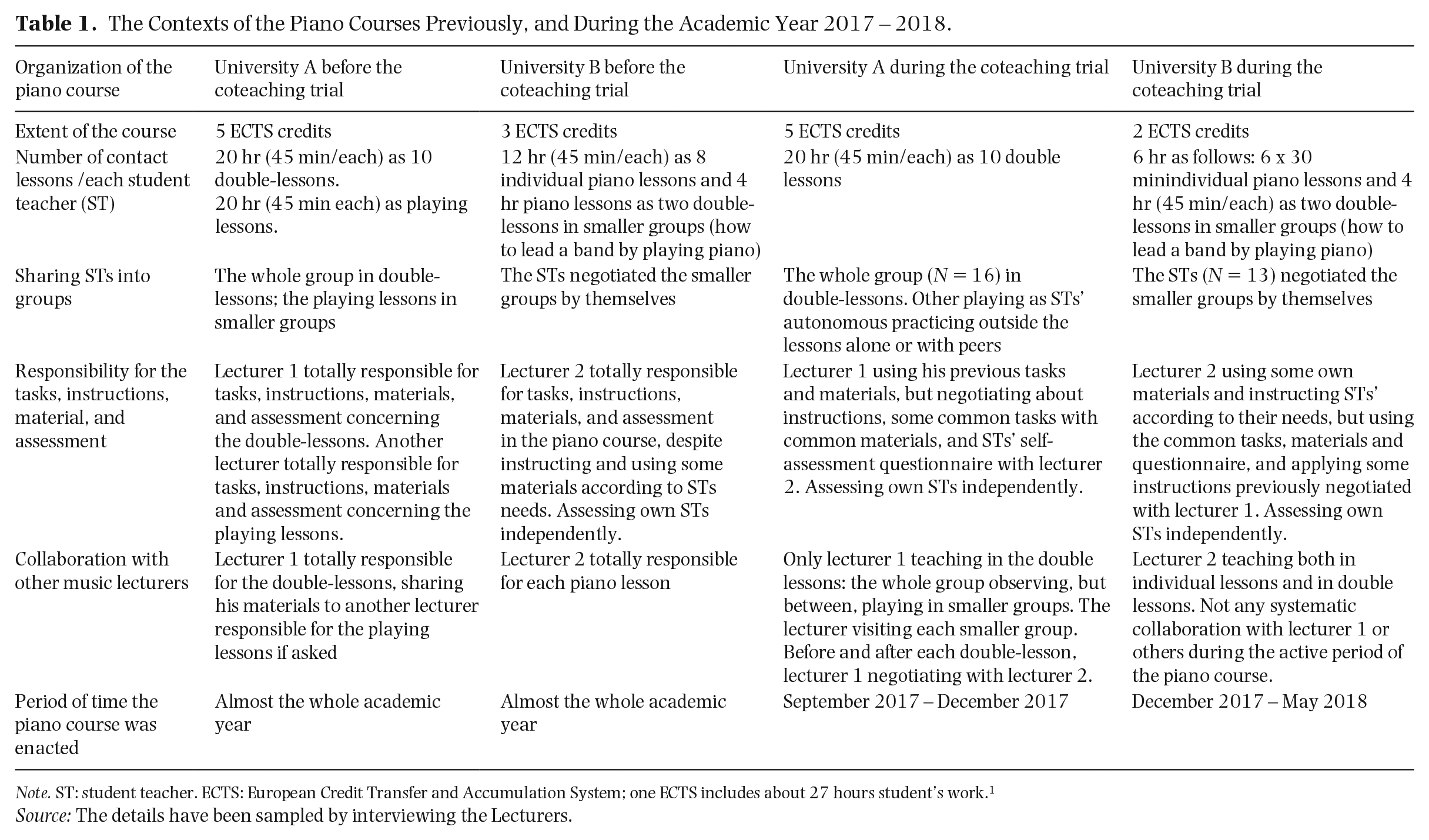
Note. ST: student teacher. ECTS: European Credit Transfer and Accumulation System; one ECTS includes about 27 hours student’s work. 1 Source: The details have been sampled by interviewing the Lecturers.
Analysis
In the present study, to identify the opportunities, limits, and achieved and possible professional benefits of distant coteaching, content analysis (Cohen et al., 2011; Krippendorff, 2004) was carried out in several phases. First, the definitions of coteaching were considered through data-based content analysis searching for the features and definitions, which seemed to be at the core of previously studied forms of coteaching. Second, it was considered how the identified core features and definitions of coteaching occurred in the distant coteaching trial. Third, as the other topic in this study was the professional development of instructors in coteaching, emerging benefits were analyzed following content analysis using Guskey’s (2002) definition regarding the dimensions in professional development: change in the teachers’ practices, attitudes, and beliefs and in the student learning outcomes. The third author not participating in the trial, was responsible for the analysis, discussion, and conclusions.
Findings
Opportunities and barriers of coteaching in current distant coteaching trial
Looking at the definitions of different forms of coteaching shared in the literature review, we were able to notice a few features, according to which different forms of coteaching were identified. Regardless of setting, a common purpose of coteaching seems to be to better respond to the needs of students. Similarly, the goal of how to achieve a better response and foci on the professional development of coteachers seems to be present in every form of coteaching. Some issues for coteaching settings include how the group of students is shared—if at all—and how the responsibility for the students is shared. Besides a common group of students and principles in dividing it, where coteaching is implemented is also emphasized in some of the definitions. In some coteaching settings, for example, the group and place may be the same, but the coteachers are not teaching simultaneously. As coteaching is a process, there are also definitions of its different phases. In every definition, common planning or coplanning is the first phase. In the second phase, some scholars emphasize joint instruction while others highlight joint practice, which seems to refer more to teaching a group in a shared space and at the same time. During the third (and last) phase, a number of studies focus only on common assessment, while others address common (shared) reflection as well.
In the current study, both of the participating lecturers had graduated as music teachers and worked as teacher educators in music in primary school teacher education programs for numerous years (lecturer 1 for 40 years; lecturer 2 for 9 years). The role of the piano course differs in the curriculum of each Advanced Music Program, although the joint national task of applying the shared mission of primary school teacher education is to increase student teachers’ competence in using the piano while teaching music at the lower grades of basic education. The implemented distant coteaching trial was analyzed using the core features in the definitions of different forms of coteaching. The results are shared in Table 2.
The Elements of Different Forms of Coteaching in the Studied Distant-Coteaching Trial.
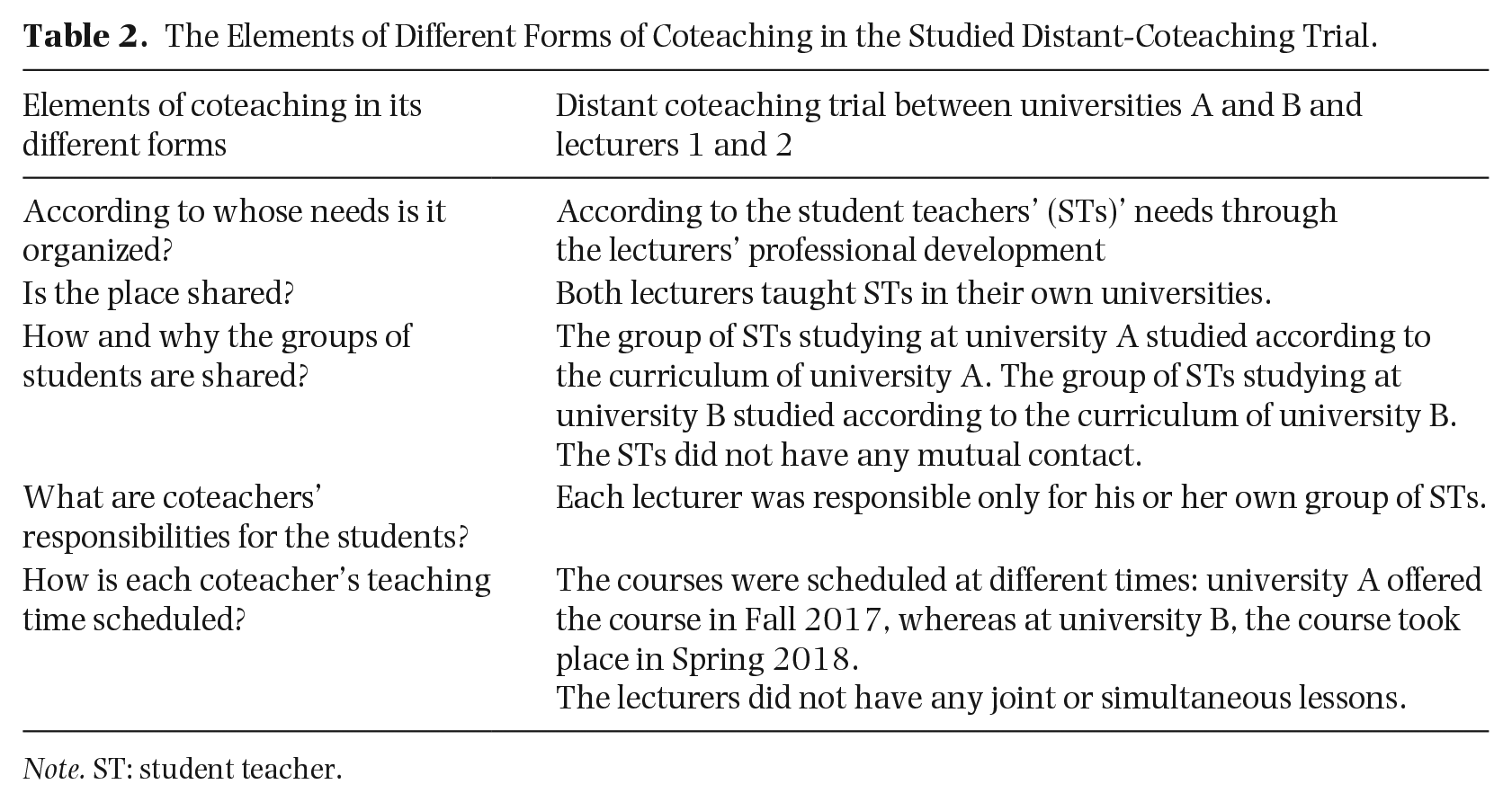
Note. ST: student teacher.
If the courses in the current trial took place at the same time and the lecturers simultaneously instructed their own groups—which were roughly equal in size—sharing the same information they planned together, to some extent, we could define their collaboration as parallel co-teaching (Cook & Friend, 1995). Another appropriate definition for the current trial could be parallel teaching, where, according to Brawand and King-Sears (2017), the students are divided into equal groups and each teacher works with half a class. Some scholars define parallel teaching being implemented in a common place and with the same students (Thousand et al., 2006), which was not possible in the current distant collaboration. Nonetheless, Cook and Friend (1995) underlined that, in parallel teaching, the teachers jointly plan the instruction, although each teaches a heterogeneous group, which requires the teachers to confirm that the students receive the same instruction in approximately the same time interval.
In addition to the different forms of coteaching, this research examined the phases of coteaching defined in previous literature: collaborative planning, instructing, practicing, reflecting, and assessing (Bacharach et al., 2010; Badiali & Titus, 2010; Guise et al., 2017; Murawski, 2006; Murphy & Martin, 2015). Both lecturers were willing to allocate time for planning, reflecting together, and sharing their ideas (Cook & Friend, 1995; Scantlebury et al., 2008; Tomlinson, 2016) in the form of thoughts about music education and the role of piano playing in the classroom. The following quotations reveal some details about the lecturers’ collaborative planning concerning the shared tasks: In addition to our collaboration, we can focus on our students’ learning processes, for example if every student teacher records his or her playing in the beginning and in the end . . . same song? Different variations by different rhythm patterns? Or if every student teacher makes a new arrangement of the song he/she has recorded and imagines a situation in his/her future music lesson where this kind of accompaniment could be needed? By the way, wouldn’t it be nice if we could organize an online common assessment situation between you and me and our groups of students? (E-mail 4 October 2017 from lecturer 2) I designed this task based on our previous discussions about student centeredness and the principles about peer-learning and students’ abilities to observe their learning processes, which we defined in the beginning of your course. You remember, that we also underlined to participate our students in many ways and decided to personalize our teaching? (E-mail 7 November 2017, from lecturer 2). Your task seems useful: you seem to have carefully considered the issues—and possibly already implemented the task? I think that I’ll share the task in the nearby future, too. (E-mail 15th Nov 2017, from lecturer 1)
When both teachers share the instruction of students, the collaboration is defined as team teaching (Cook & Friend, 1995). In our research, the lecturers shared the instruction of students and, thus, followed a team-teaching model. However, in some of the team-teaching practices, it is recommended that teachers take turns leading the discussion or one teacher should speak while the other is demonstrating, which clearly suggests a common group of students and a shared space (Cook & Friend, 1995). As the lessons at university B were organized as personal lessons and the previous skills in piano playing among the student teachers varied considerably, lecturer 2 applied the previous collaborative instructing approach in several different ways: I must apply your instructions, because I have so little number of lessons: instead of your two songs I have to manage with one recorded song from each student. With more lessons and time, you are able to allow them to act as peer-teachers and peer-learners more than I am. Of course, it would be important—you just understand the content better when you explain it to your peer also by words instead of just showing how to play. (E-mail 27 September from lecturer 2)
Due to the distance between the universities and the courses being scheduled at different times, collaborative practicing was not possible. Instead, collaborative reflecting was widely implemented. During the piano course enacted at university A, the lecturers negotiated a lot about playing the piano and its role in music education in primary school teacher education and in general education at schools. By negotiating concerning every lesson at university A, they reflected both for and on action (Schön, 1987). The only situation where the reflection did not happen was in action because lecturer 2 was not able to participate in the lessons at university A. Due to every student teacher’s individual needs and timing of their individual piano lessons at university B, the joint reflection between the lecturers during the piano course at university B was not particularly as regular as it took place during the piano course at university A. In the joint self-assessment after the piano course of lecturer 1, the lecturers reflected on some of the challenges they noticed in assessing the student teachers’ piano course: We discussed, if it is possible to assess the progress in piano studies—during these short courses, some students can progress only very little—how can we notice it? If they record their playing in the beginning of the course and then in the end, how can we find time to listen to their recordings so that we can remember how each of them played? How much we utilize the students’ self-assessments? We also have to remind us, that the student teachers should also be able to use their skills and knowledge when teaching music . . . what is the relationship between their progress in playing and abilities to teach by playing when assessing their piano course? (Lecturers’ common self-assessment by phone 18 December 2017).
Both of the lecturers assessed their own students. However, they planned together the type of exam the student teachers should have and discussed in depth the principles of assessing piano courses in primary school teacher education. As described below, the lecturers tried to find a way to collaboratively assess their students, but found it too challenging: Yes, it really would be nice if every student teacher in both universities would record all the main songs they think they want to have assessed—as a recorded portfolio. Then we both could listen to them, and assess our students together. But. . .if we have 30 student teachers, and every one of them record about 7 minutes (not so many songs) playing, we have to listen to 210 minutes playing—maybe even more times than once. 210 minutes is three and a half hours. How can we find that time and ability to differ who plays how? So, I think we are not assessing them together: it is easier to listen and assess recordings if you have been observing the real-time playing. (E-mail 17 November 2017, lecturer 2)
As Rytivaara and Kershner (2012) noticed, collaboration outside the shared classroom may also have a remarkable effect on the teachers’ professional development. In our research, cooperation outside the classroom was the only option. However, while the place and students were not common variables, the lecturers found the coplanning, constructing, and coreflecting fruitful.
Music lecturers’ professional development in the distant coteaching trial
The lecturers assessed their professional development by phone in autumn 2019 when they implemented their next collaborative teaching term. The self-assessment was organized and analyzed according to Guskey’s (2002) definitions of the three objectives to be recognized in the professional development of teachers: changes in teachers’ attitudes and beliefs, changes in teachers’ practices, and changes in students’ learning outcomes.
The collaborative planning, especially collaborative reflection for instructing, became somewhat critical, which both lecturers found fruitful. Through critical questioning regarding previous good practices, the lecturers somewhat surprisingly noticed that, despite their long, but different careers after graduating as music teachers, they focused on the same details while teaching primary school student teachers to play piano. Nonetheless, to strengthen the lecturers’ previous attitudes and beliefs, first, it was important to plan and reflect on their instructing and assessing together (Guskey, 2002) in co-generative dialogues (Badiali & Titus, 2010; Beers, 2008; Roth & Tobin, 2004a): In these conversations we easily go deeper—to consider the philosophy of music education: What exactly is music education? What is teaching music? What kind of music should we teach and learn? (Common interview 8th Feb 2018, lecturer 1) Although we have different backgrounds in teaching piano, I suddenly found that we emphasize the same things in free accompaniment. Together we found common ideas to develop our teaching further, asking the student teachers to record their playing, as one example. (Common interview 8 February 2018, lecturer 2)
Exploring these questions from a new perspective helped the lecturer participants strengthen their previous good practices. The main changes in practices were the more carefully negotiated and formulated written tasks for the student teachers, based on the lecturers’ tacit knowledge gained through long careers (Cook & Friend, 1995; Roth et al., 1999; Rytivaara & Kershner, 2012; Sirkko et al., 2018). Had the instructions been individually designed by each lecturer, they may not have been so considered. Yet through the research, the lecturers carefully negotiated every concept they used in the text and the words they used in the sentences. They found that together it was easier to reflect in every task in the piano course the mission of primary school teacher education: progressing in the subject is as important as progressing in the pedagogy.
In addition, the lecturers’ needs were acknowledged: they were willing to improve their teaching and to share their ideas (Scantlebury et al., 2008; Tomlinson, 2016) and tacit knowledge (Roth et al., 1999; Rytivaara & Kershner, 2012; Sirkko et al., 2018) by collaboration in teaching. They observed that it was easier to collaborate if the coteachers were familiar with each other’s teaching style, have deep respect for and trust each other, and are flexible and willing to question and even change their good practices (Cook & Friend, 1995). The basis of the attitudes, beliefs, and practices may be different, but they should be appreciated.
During this first phase of our research, only the lecturers collaborated but without visiting any lessons outside their own university. At this stage it seems that the student teachers did not even notice the distant coteaching trial carried out by the lecturers. In the questionnaire at the end of the course, the student teachers highlighted both the music lecturer’s face-to-face advice time and also the significance of the cooperation with more advanced peer-learners, which brought up the question of enhancing and enabling collaboration between the student teachers at universities A and B. However, we have to remember that the way to improve student support according to their needs may be the professional development of their teachers through some form of coteaching (Murphy & Martin, 2015; Roth et al., 1999; Rytivaara & Kershner, 2012; Sirkko et al., 2018).
Conclusion
Several coteaching models have previously been implemented and examined, although none in teacher education programs at separate universities, and between academic music lecturers with long careers, have been studied thoroughly. In this study, two lecturers independently teaching piano courses in two primary school teacher education programs at two Finnish universities during the 2017–2018 academic year collaborated as coteachers in the delivery of the primary school student teachers’ optional piano courses in the Advanced music programs (25 ECTS). This paper explored the professional development of the lecturers.
There are some definitions of coteaching which do not rely upon a common physical space and group of students, but rather on the collaboration between the teachers in the different phases of coteaching. The main deficiency considering understandings about “traditional coteaching” seemed to be that the lecturers were not in the same place sharing a common group of students. However, some of the different phases of coteaching were successfully implemented: collaborative planning and instructing, from one definition (Bacharach et al., 2010; Badiali & Titus, 2010; Guise et al., 2017; Murawski, 2006), and coplanning and coreflection, from another set of three phases from the definition by Murphy and Martin (2015). To some extent, in the studied distant coteaching trial, some features of parallel teaching, parallel coteaching, and team-teaching were implemented (Cook & Friend, 1995). Nonetheless, distant coteaching seemed to enhance the professional development of the participating lecturers, especially through reflection for and on action (Schön, 1987).
Through constant and detailed negotiations followed by carefully formulated concepts and sentences in the shared written tasks, the student teachers received more precise instructions than before. The lecturers emphasized that critical, reflective dialogue requires mutual respect, trust, and engagement toward the common good. Nonetheless, the discussions were fruitful and even strengthened the lecturers’ previous ways of teaching in primary school student teachers’ piano studies. One of the possible challenges may be the coteacher’s willingness to change and accept new approaches.
The findings of this study raise several questions and offer ideas for further discussion about coteaching. One of the topics concerns shared physical space, which was also under discussion during the present study. As a result, the possibilities of digitalization (sharing recordings, online lessons) were found to fade the barriers imposed by geographic distance. A question of cost-effectiveness has also been an issue of concern considering the cuts in university budgets. The participating lecturers taught piano to their own groups of student teachers in independent primary-school teacher-education programs and without any face-to-face or online meetings. Compared with the normal continuing education settings where the in-service teachers have to travel to some common seminar and some deputy-teachers are needed to teach their classes, the current trial was much more cost-effective. In addition, it focused straight on the lecturers’ needs in their daily work. It did not require any travel or special arrangements other than allocating time, needed for the lecturers to collaborate by e-mail and phone during the different coteaching phases, such as coplanning, constructing, and coreflecting (Murawski, 2006; Murphy & Martin, 2015). Even alone, every lecturer has to allocate some time to plan and reflect on his or her work.
The current coteaching trial was relatively short and was performed in almost original teaching-learning situations. Nevertheless, data triangulation was carried out and a significant part of this study was conceptual. Thus, the findings may provide the readers with a little encouragement to use and develop distant coteaching models as tools for professional development in music education.
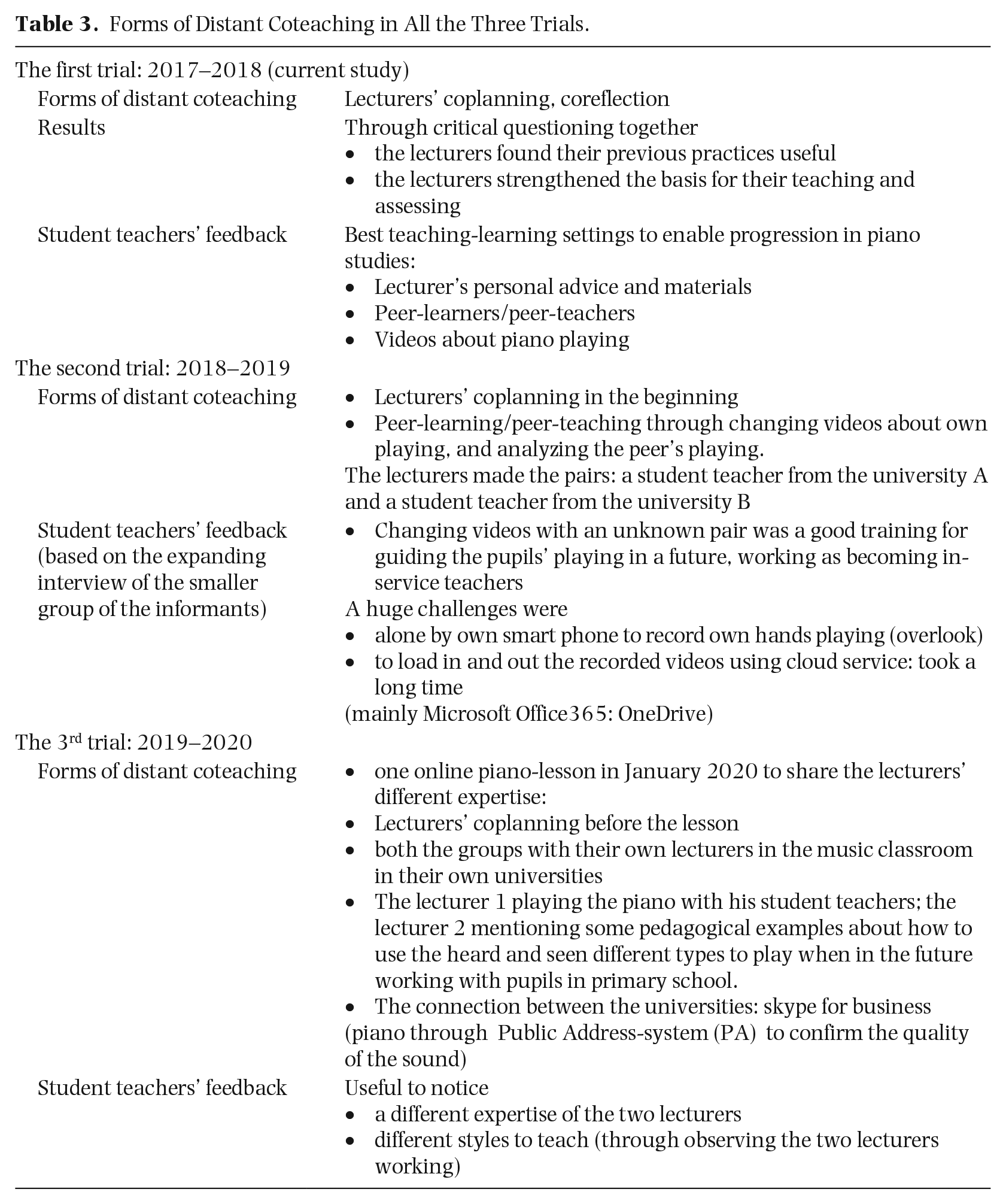
This was the first cycle in a design-based research study including three cycles, which follows the DBR methodology, with the aim to develop teaching as well as challenge and develop previous theories through investigating practical experiments (Anderson & Shattuck, 2012; Brown, 1992; Joseph, 2004; Sandovall & Bell, 2004). The second cycle was enacted in the academic year of 2018–2019, and the third one in the academic year of 2019–2020.
The distant piano lessons from March to June 2020, organized due to the COVID-19: Utilizing the experiences of the three previous trials
Due to the COVID-19 pandemic, in spring 2020, almost all educational institutes around the world suddenly had to transform all teaching-learning situations to be implemented distant—if at all. In Finland, the main principle was that in every educational institute at every educational level, the students had to be able to continue their studies. Thus, as an example, the lecturer 2 had to very quickly remodel five face-to-face music courses in the primary school teacher education program to be finalized or totally carried out as distant courses. One of them was the same kind of optional piano course as studied in the present paper. It was useful to apply the lecturer’s experiences and the students’ feedback from all the previous three trials carried out in the current design-based research entity. In the following paragraphs, some details are shared as examples of ways to apply and develop the experiences of these trials further.
The data of the two other cycles have been analyzed, but not yet carefully discussed with the appropriate previous studies. It is important to notice, that the authors are continuing to finalize the research papers about the other cycles, which herein allows only somewhat general descriptions of the trials and their preliminary results. The results of the current study and the preliminary results of the other two trials are shared in Table 3. The ways all the three trials were utilized in the optional piano studies in spring 2020, are shared in Table 4.
Forms of Distant Coteaching in All the Three Trials.
Experiences About the Trials Applied Into the Piano lessons During Spring 2020.
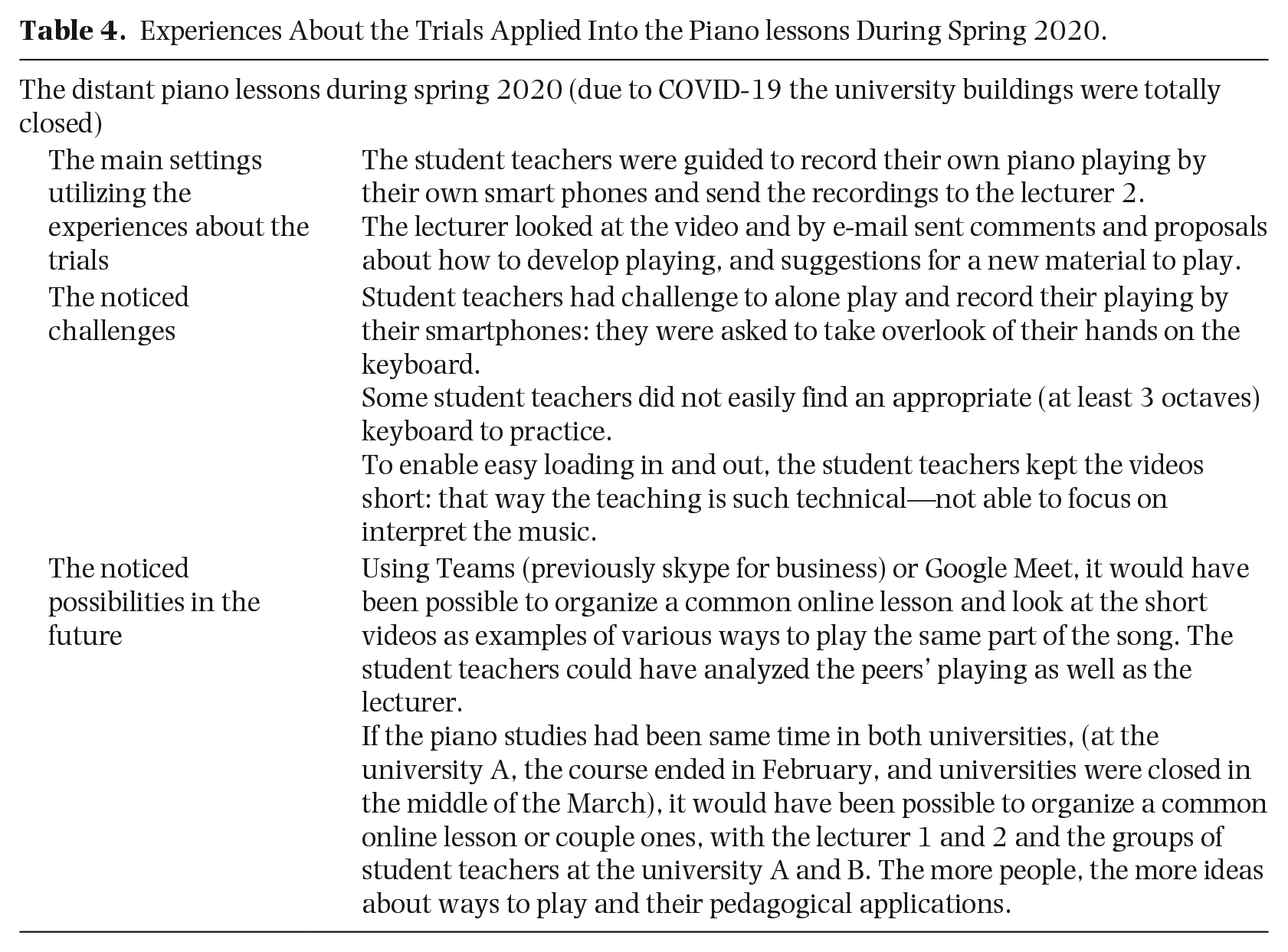
During the total distant teaching-learning period, the main benefits achieved in the previous piano teaching trials were that the lecturer was already familiar with looking at the videos, and knew something about the challenges with loading videos in and out the cloud service. Somewhat easily she was able to develop a kind of system for looking at and analyzing the main details about the student teachers’ playing. The main challenge was that writing down the feedback, including proposals to student teachers to develop their playing further, easily took more time than normal oral discussion in face-to-face piano lesson.
Considering cheap and easy ways to transform voice online with a good sound, produced even by acoustic instruments, is also important. To share acoustic piano playing—as an example—online by a good sound, using, for example, Teams, Zoom, or Google Meet, requires only such cheap devices, which are easy to use. As a part of their teacher studies, the student teachers should have a possibility to learn principles of using this kind of devices to be able to utilize them in their future work in distance teaching-learning situations. Naturally, some practical trials focusing on using these devices and also other acoustic instruments, are needed, too. The trials should be organized as developing cycles, which should be examined thoroughly.
Footnotes
Funding
The author(s) disclosed receipt of the following financial support for the research, authorship, and/or publication of this article: The present study was a part of ArkTOP project (Arctic Reformative and Exploratory Teaching Profession), funded by the Finnish Ministry of Education and Culture.
