




Abstract
One of the key trends that can be seen in gentrifying environments is the use of “street art” murals, which are increasingly connected to official government-sanctioned “street art festivals,” to decorate the walls of urban neighborhoods—sometimes located in officially designated “arts” or “creative districts.” In this article, I consider the role that Instagram practices have played in the popularization of such districts. In a case study of Denver’s RiNo Art District, I argue that as street art is used to turn everyday urban environments into sites of adventurous exploration, the sharing of images from these discoveries on social media helps to make territories more familiar and thus more open to socioeconomic change. This case is considered as an example of how mediatization is connected to gentrification processes.
When more than 100 artists gathered to paint the exterior walls of Denver, Colorado’s River North (RiNo) Art District during the 11th annual Crush Walls street art festival in September 2020, mural subjects included abstract geometric designs, fierce women, playful uplifting messages, fantasy landscapes, and moving portraits of Breonna Taylor and George Floyd. And, for the second year in a row, a mural critiquing how the art festival itself was implicated in the gentrification of the neighborhood. Painted by local artist, Jolt, the latter image featured a mobster-like scene where a wolf, a rhinoceros, and a vulture hovered over a table, peering greedily at a small model of a high-end condominium, with a stack of cash and a spray can nearby. A cartoon thought bubble above the image read, “So a rhino, a wolf & a vulture walk into a community. . .” The tableau referred to the rhinoceros that forms the RiNo Art District’s logo, the last name (Wolf) of a developer of some of the neighborhood’s most iconic projects, and a “culture vulture”—the derisive nickname given to a particular Denver artist considered by many others in the community to be capitalizing on the commercial success of the district, painting what amounted to “wallpaper . . . Instagrammable art,” as one artist explained to me.
Just days before the US Presidential Elections of November 2020, that mural was covered over with white paint in the middle of the night (a mural of George Floyd painted by artists Detour and Hiero was also vandalized; see Wenzel, 2020). The artist responded by writing, “This mural has been censored . . . due to white fragility” across the newly white wall and, in response, someone painted messages on the wall calling the artist himself a racist. While this discursive battle played out on the exterior of a prominent neighborhood bar, and was reported on by local media, Instagram posts from around the neighborhood reflected very little of it. There, the #rinoartdistrict hashtag, along with other posts made from the art district’s geo-location, displayed the usual fare: pictures of women, couples, families, and dogs posing in front of the art that lined alleyways and parking lots; plates of food or drink from neighborhood restaurants and bars; and images of individual murals. For the developers and artists who had spent the past 15 years building the neighborhood up from an industrial and warehouse district to one of the country’s premiere street art destinations, only to see property owners enriched while artists were priced out and residents in neighboring communities displaced due to unprecedented gentrification, this event marked a sign of an internal battle going public—via street art and graffiti, the very media that provided the lifeblood of the district’s development. Yet, for much of the public, it was business as usual in the art district: a destination for food and drink, as well as an aesthetically interesting spot from which to broadcast oneself on social media.
Similar situations are playing out in urban centers around the world, as gentrification in various guises changes the demographics, aesthetics, economics, and cultural life of cities, creating stark social stratification. City governments struggle to strike a balance between building an attractive, high quality-of-life urban environment that will attract young “talent” and business investment in a competitive place-market, and dealing with issues such as affordable housing, displacement of marginalized groups, transportation, and environmental impacts that accompany growth. In this article, I focus on one of the key trends that can be seen in these gentrifying environments—the use of “street art” murals, increasingly connected to official government-sanctioned “street art festivals,” to decorate the walls of urban neighborhoods, sometimes in officially designated “creative districts”—and consider the role that Instagram practices have played in the popularization of such districts. In a case study of Denver’s RiNo Art District, I argue that as street art is used to turn everyday urban environments into sites of adventurous exploration, the sharing of images from these discoveries on social media helps to make territories more familiar and thus more open to socioeconomic change. The example of street art and Instagram can further our understanding of how the broad, transformative consequences of mediated and mobile communication, which characterize processes known as “mediatization” (see Lundby, 2014), connect to gentrification.
Street Art and Gentrification
Writing 1 graffiti on the exterior walls of buildings or transportation vehicles was once a practice done in the shadows and considered a form of vandalism that connected to other types of criminality. In the United States, the influential “broken windows” theory suggested that governments should prioritize maintaining control over the aesthetics of urban space as a way of fostering greater social order (Molnár, 2017). In addition to cleanliness and general upkeep, that meant policing against the “defacement” of buildings by graffiti writers. By the 1980s, the graffiti movement that began as an expression of economic and cultural marginalization in the 1960s and 1970s had become, for elites, “one of several symbols promoted as a stand-in for the sense that something fundamental had gone wrong” in urban society (Austin, 2001, p. 5).
Since the late 1990s, however, the spray-painted urban environment has gained official cachet as both a symbol and vehicle of urban cool—integrated into postindustrial growth strategies wherein cities seek to develop creative industries as an “economic and cultural force that can do the work of revitalizing and transforming place and space through arts and culture” (Banet-Weiser, 2011, p. 641). In accordance with this strategy, a form of guerilla art that includes large- and small-scale murals as well as pasted-up posters, stickers, and even mischievously placed sculptures has been embraced as “street art” and marked its neighborhoods as having a dynamic culture worthy of attention and investment. Andron (2018) points out that street art and murals have not only become acceptable; they have come to be seen as potentially lucrative—able to be mobilized in support of place branding initiatives and as the tangible expression of creative cities. Reflecting on the rise of street art culture in the Shoreditch neighborhood of London, Andron (2018) says the murals contribute to “performing Shoreditch as a hub of vibrancy and urban creativity” (p. 1036). As artists create spaces that signal a welcome to the creative class, she finds that the street becomes not just a container of art, but a cultural destination in itself.
Increasingly such artworks are not only sanctioned but commissioned, through initiatives and fairs organized in cities around the world by governments seeking to foster urban tourism while beautifying neglected neighborhoods (Insch & Walters, 2017). Although spearheaded by governments, these efforts are supported through public and private partnerships (Costa & Lopes, 2015) as part of the place-branding strategies of the neoliberal city (Mould, 2015). A quick web search of “street art festival” yields results in places ranging from Dubai to Minneapolis, Amman to Kolkata to Grenoble. While such festivals are celebrated for fostering local development and attracting tourism, as well as supporting more general brand and marketing goals, Strom and Kusenbach (2020) also associate these endeavors with neighborhood gentrification, arguing they have become “in essence, handmaids to real estate development” (p. 59). Indeed, a diverse selection of scholarship on street art initiatives points to connections to gentrification in cities such as Istanbul (Türken, 2019), Amsterdam (Boy & Uitermark, 2017), Lisbon (Costa & Lopes, 2015), Austin (Romero, 2018), and Miami (Schacter, 2015). Rather than understanding the rising costs and resident displacement of gentrification as just an unfortunate consequence of creative district development, Cameron and Coaffee (2005) claim that art and gentrification might be seen as working in symbiosis, wielded jointly by public policymakers in efforts aimed at the physical and economic regeneration of declining cities. Ley (2003) points out that despite efforts artists may make to reject “spaces colonized by commerce or the state,” the “antipathy is not mutual” (p. 2335), and the cultural capital imbued in places inhabited by artists is converted to economic capital by entrepreneurs. Zukin (2008) notes that gentrification follows as practices built to be “alternative” lend an air of authenticity to consumer spaces.
Perhaps it is partially a backlash to the overly ordered Disneyfication that has taken place as downtown “city-centers” became designed primarily as sanitized, family-friendly shopping destinations (see Drummond-Cole et al., 2012), but pervading the current interest in urban regeneration is an effort to maintain just the right amount of spontaneity and grunge in the redeveloped environment—the aestheticization of “grit” as glamorous (Lloyd, 2005). To this point, Zukin (2010) observes how the way media frame the concept of gritty-ness has changed in recent years; she finds the word “gritty” is now used to evoke the “postindustrial spirit of the times” and perfectly captures “the symbolic economy’s ability to synthesize dirt and danger into new cultural commodities” (p. 51). Building and maintaining this symbolic capital requires a balancing act between the inclinations of corporate sponsors and property owners who prioritize security and control, and the uncensored creative street art practices that lend a necessary and valuable sense of “authenticity” to the neighborhood (Banet-Weiser, 2011).
Although many artists see their appropriation of the walls as a way of reclaiming public space in the face a neoliberal era in which the urban public sphere is shrinking (Markussen, 2012), the level to which artists should align with elites or remain as counter-publics fighting against gentrification finds no consensus among artists themselves. Romero (2018) notices a rather collaborative attitude among artists and elites working in a gentrifying area of Austin, while Ulmer’s (2017) study of street art in Detroit finds that although some simply “display a playful affection for urban space,” others do “activate critical awareness,” challenging policies, and “marking sites of gentrification” (p. 496).
Young (2013), reflecting on the gentrification of the Williamsburg neighborhood in Brooklyn, uses the term “artwashing” to describe how new corporate developments have used commissioned art to co-opt the creativity that lent “streetness and coolness” (p. 99) to the area. She notes how a new Starbucks hired a local artist to use wool yarn to knit an image into the fence fronting the construction of its new building project, hoping to win Williamsburg’s notoriously anti-franchise residents over by aligning itself to its hipness. Increasingly, however, she finds the Williamsburg murals themselves are actually advertisements, abstractly painted to seem like artwork that can be discovered by passersby. The appropriation of an art form that was once associated with underground culture, and even illegal practices, in support of cultural consumption and real estate development demonstrates that, at this point, this “countercultural art” should be seen, “not as an alternative to, but as a driver of the city’s growth” (Zukin, 2010, p. 53). Sarah Banet-Weiser (2011) refers to this as a form of convergence, where formerly social domains are recoded as economic ones. It seems that, just as Hardt and Negri (2000) pointed out that critical theorists had been “outflanked by the strategies of power” as corporate capitalism “evacuated the bastion they [were] attacking and circled around to their rear to join them in the assault in the name of [selling] difference” (p. 138), real estate developers have learned to harness what was once a manifest critique of the neoliberal encroachment over the city to confer an aura of authenticity and creative energy onto their investments.
The Social Media City
Citing the ephemeral nature of street art (which might appear only briefly before being covered up or replaced), Bengtsen (2020) explains that a central quality of the art form is its “potential to turn public space into a site of exploration” (p. 45). However, the ability to easily capture a photographic souvenir of the discovered art and broadcast the finding through social media has brought urban art exploration to a new level (see Jansson, 2018b, on the importance of photography by urban explorers to document their finds). A steep rise in street art’s popularity has occurred in parallel with the development and uptake of camera-equipped mobile communication devices and social media—technologies of the “media city” (McQuire, 2008) that have shifted how people experience and interact with urban space. Through growing and competing uses of location-aware mobile technologies, geographic places gain new meanings based on the information attached to them (de Souze e Silva & Frith, 2012). Wilken (2019) argues that the increasing embeddedness of geolocation into devices and apps has led to a “democratization of locative media” that fundamentally reshapes “everyday engagements with location, communication, and social interaction” (p. 7), and Halegoua (2019) points out that the geocoding of images enables people to make claims about the meaning of place to audiences beyond their own social networks. As Molnár (2017) argues, before the diffusion of smartphones with integrated cameras, and digital media platforms with networked infrastructure that enabled the dissemination of images, the impermanence of street art meant people had to be in a certain place at a certain time to discover the work. Since 2005, he says, “digital communications technolog[ies] have played a major role in the popularization and legitimation of street art by enabling the large-scale documentation, sharing, dissemination, and canonization” (p. 386) of this urban art form, which was “hitherto constrained by its transient nature and embeddedness in specific locales” (p. 400). This has affected the process of discovering art as an in situ experience while also opening up massive new audiences to encounter and exchange images of an artwork. Digital technologies have also been taken up by artists—not only as a way of documenting and sharing images of their graffiti or mural projects but also a priori, with artworks increasingly produced specifically for the digital audiences where the work will reach a much larger group and have a longer life as a digital object (MacDowall & de Souza, 2018).
Of the many digital technologies used to document and share street art images, MacDowall and de Souza (2018) argue for the primacy of one social media platform, Instagram, in shaping the practices of both artists and audiences. “Far from being simply a platform for the display of artworks” they claim, “Instagram is fundamentally reshaping the practices, aesthetics, and consumption of graffiti and street art” (MacDowall & de Souza, 2018, pp. 4–5). Using the Instagram app, users can take photos or short videos, edit them, add searchable hashtags, share them publicly or privately, explore other posts based on common hashtags, geolocation, or specific profile names, and add comments to one’s own posts or those of others. Because of its networked, visual, and geolocative affordances, Instagram has become an archive for informal and semiprofessional documentation of street art (MacDowall & de Souza, 2018).
The Instagram app launched in 2010 and gained 25,000 users in its first day of availability; by June 2018, one billion people were actively using it each month. The platform has elevated the currency of the everyday, allowing participants to share edited, stylized representations of what they see, what they do, and where they see/do it, with a potentially vast network. Toscano (2017) refers to Instagram as “one of the most relevant mass phenomena in the era of social media, for having implemented a process of democratization of artistic photography, and the sharing of moments of everyday life” (p. 275). However, as Zasina (2018) points out, it is important to recognize that Instagram representations of daily urban life are highly discriminating and partial; they do not reflect overall city geographies, but are rather selective, aestheticized versions of particular places and people.
Boy and Uitermark (2017) argue Instagram uniquely illustrates that the ability to use digital technologies to share images of the city is changing the way urban residents interact with each other and their environments. In a study of Amsterdam, they found the way Instagram users staged, composed, and edited impressions of places for their audiences imbued particular places with symbolic value. With photo feeds offering images of healthy and desirable faces, bodies, items, and food, accompanied by witty captions, select places were aestheticized and promoted for high-end consumption. One respondent referred to Instagram as her “search engine,” explaining geotagged images helped her decide where to go out. They propose that the ability of Instagram representations to confer status and visibility on particular places reinscribes sociospatial inequalities and reinforces processes of gentrification, noting, “as Instagram users boost their own status by picturing themselves in certain places, they also boost the status of those places” (Boy & Uitermark, 2017, p. 623). This process has been linked to other digital media, as well; for example, Zukin et al. (2017) found that online Yelp reviews of restaurants in Brooklyn contributed to “taste-driven processes of gentrification” (p. 459): Favorable reviews not only boost the image of a specific restaurant but may also change the image of its neighborhood . . . Intentionally or not, Yelp restaurant reviewers may encourage, confirm, or even accelerate processes of gentrification by signaling that a locality is good for people who share their tastes. (p. 462)
Signaling the value of place through digital media works to attract new visitors who then (re)broadcast their own participation in the trend. For example, in Zasina’s (2018) study of images posted on Instagram from Lodz, Poland, murals or graffiti accounted for almost 70% of the photos taken of public spaces, and in the case of a neighborhood with a high concentration of street art, she notes that “users [seem to] have visited the places purposely to take photos of the murals” (219). However, it is not only hip urbanites and tourists following the flow of social media to particular restaurants, shops, and neighborhoods—real estate developers are paying attention as well. A new data-aggregating industry is emerging to help developers use social media posts, tags, check-ins, and other location-aware data to predict where gentrification is about to occur, to know which city areas are ripe for investment (Stewart, 2019).
With these considerations of how street art and social media—in particular, Instagram—work symbiotically in bringing a level of cultural capital to neighborhoods that then attracts economic capital, I explore this convergence through a case study of an art district in a highly gentrifying US American city.
Denver’s RiNo Art District
The RiNo Art District has emerged as a cultural and economic force in Denver over the past 15 years. Located in the northeastern part of the city, with the Platte River and the Union Pacific railroad running through it, the core of today’s “RiNo” had been populated in the early 1900s by foundries, mills, a wholesale agricultural market, pattern shops, and other manufacturing (Our history, n.d.). By the end of the 20th century, many of those operations had been abandoned or relocated, and the area’s affordable warehouse spaces became a haven for artists who’d been priced out of the city center during its redevelopment in the late 1980s. One of the earliest redevelopment projects to capitalize on the area’s artistic ferment was a “live-work-and-play” space on a remediated brownfield site that included a former Yellow Cab depot building; the award-winning project, named Taxi, opened in 2001 and today includes nine buildings, 150 businesses, and 300 residents (About Taxi, n.d.). Although the lore around the project is that people were skeptical of its viability at the time (see Rebchook, 2018), today Taxi is seen as an early innovator and its developer has launched many additional multimillion dollar creative industry-focused endeavors in the neighborhood.
In 2005, two artists seeking to formalize the community of creators working in lofts and studio spaces around the area—and to build a collective market for their work—launched the RiNo Art District with just eight members and a budget of $8,000 (USD) per year. Although there was plentiful graffiti in the area, it was not until 2010—when a local artist (with permission from property owners) launched the Crush Walls festival, inviting other artists to spend a week together covering RiNo’s walls with murals—that the area started to be known particularly for its street art. In the years following, new restaurants and bars opened up, millions of square feet of new residences and office spaces were built or are currently under construction, the city added bike lanes and a commuter rail station, and real estate costs skyrocketed. By 2014, RiNo had become a Colorado state-certified “creative district” and, in 2015, successfully formed a property-tax-funded Business Improvement District and General Improvement District, raising its annual budget to $1.3 million. The newly formed art district negotiated to take over management of the Crush Walls festival, cementing its identity as a street art hub. As development expanded and property values continued to rise, the RiNo annual budget rose to $3.3 million in just two years (Dean, 2019) and the district, whose slogan is “Where art is made,” suddenly faced a shortage of affordable space for artists.
The Art District as an “Erasure”
Although much of RiNo’s redevelopment occurred in a former industrial area with few residents and open tracts of land, its growth has encroached upon and now encompasses large swaths of four North Denver neighborhoods—Globeville, Elyria-Swansea, Five Points and Cole—which have historically housed African American and Hispanic communities and are now experiencing resident displacement due to extreme gentrification. In fact, a recent study from the National Community Reinvestment Coalition (Richardson et al., 2020), using urban gentrification data from 2013 to 2017, found Denver to be the second most gentrifying city in the United States (with San Francisco as the first). And a 2019 report from the same organization found Denver leading the nation in Hispanic displacement due to gentrification (Richardson et al., 2019).
The gentrification of these neighborhoods follows similar waves that had previously changed the demographics and cultural life of other parts of the city, particularly the downtown area. The contours of Denver have been shaped historically through racially and economically discriminatory practices, beginning with “white flight” from the city center in the early 1900s with the advent of an electric streetcar system and the automobile; the subsequent settlement into affordable city neighborhoods by Hispanic migrants from the southwestern United States in the 1920s; and the 1930s practice of “redlining” that drew boundaries marking non-White parts of the city as high risk (and thus uninsurable) for homeownership, leading to a racially segregated city with White areas prioritized for homeownership as well as infrastructure and economic investment (see Clark, 2020). A series of renewal projects in the 1960s and 1970s led to the razing of a largely Mexican American neighborhood along the Western edge of downtown to make way for new skyscrapers, retail businesses, and a new urban college campus providing shared space for three local universities (see Page & Ross, 2017).
Meanwhile, by 1929, more than 75% of Denver’s Black population was living in the Five Points neighborhood, which borders the downtown to the northeast (Five Points, n.d.). Five Points is the neighborhood most occupied by today’s RiNo Art District. Although segregation and redlining meant crumbling infrastructure and buildings in disrepair during much of the 20th century, it also allowed the Five Points neighborhood to operate as a microcosm where businesses, restaurants, music, medical, and social services served a vibrant African American community; the neighborhood became known as the “Harlem of the West” (see Guy, 2020). Now, as Five Points finally receives both public and private economic investment, city officials struggle to come up with solutions to avoid displacing community members and businesses, and some fear it is already too late. From 2000 to 2017, the African American population of Five Points decreased from 26.3% to 10.6%, whereas the White population increased from 27.4% to 63.6% in the same period (Denver Metro Data Reports, 2017). The median home value in Five Points rose from $172,411 to $301,265 in the period from 2000 to 2015 (Urban Institute, 2017); in 2015, RiNo launched its Business Improvement District, and by July 2021, the median home sale price in Five Points had more than doubled to $607,500 (Five Points Housing Market, 2021).
The out-of-the-wayness of previously undeveloped fields and lots where much of the new RiNo is being built had made it an attractive area for informal housing encampments, and a variety of social service organizations operated nearby. 2 Today, new buildings fill the area and unhoused people, pushed out of their campsites, move around as police “sweeps” frequently upend their sheltering places.
In 2017, as development had made the neighborhood unrecognizable from just five years prior and construction cranes lining the horizon pointed at more to come, a coffee shop in RiNo put out a sidewalk sign reading, “Happily gentrifying the neighborhood since 2014.” The tone-deaf ad campaign, oblivious to the pain that many in the neighborhood were experiencing, was immediately denounced on social media, as well as in local and national newspapers, including the New York Times (see Turkewitz, 2017). Although the owner apologized for his insensitivity and misunderstanding of what gentrification entailed, someone quickly painted “White Coffee” on the coffee shop’s facade and hundreds of people showed up to protest outside the building. On social media and in street protests, the incident was used to critique not only the coffee shop but also the developers, the Mayor, and city council members whom many residents felt had sold out their community. There is now a petition to change the RiNo Art District’s name to Five Points, to acknowledge that it sits on what was already a neighborhood. As Light and Young (2015) explain in developing a theory of “critical toponymy,” “the renaming of urban places to reflect private interests” can disenfranchise residents by denying them “a voice in naming the environment in which they live” (p. 448). In the case of RiNo, one resident explained to a Denver journalist, “It’s not just a name, it’s the erasure of what was there before” (Bryant, 2017).
A Methodology of Digital Media and Place
This research is based on digital ethnographic research of #rinoartdistrict on Instagram (actively following that and related hashtags since 2017); five hour-plus-long interviews with art district personnel, artists, and a building owner 3 ; frequent in-person visits to the art district over the past 7 years, including during the annual Crush Walls street art festival; and analysis of RiNo media coverage since 2005, including journalists’ interviews with people displaced from Five Points and other surrounding neighborhoods. I developed an analytical lens derived from the literature reviewed above to explore how both the street art and the neighborhood changed (visually and in terms of popularity) over the years in relation to the evolution of the RiNo Art District and the growing ubiquity of Instagram. Although the circulation of narratives is never confined to just one social media platform (Postill & Pink, 2012), I concentrate here on Instagram as the most visual and aesthetically normative of social media and—as described in the literature above—that which is most utilized for informal documentation of street art.
To connect Instagram posts to the changing built environment, I use the concept of “digital placemaking”—which argues that digital media may be used to “create and control a sense of place” for “oneself and/or others” (Halegoua & Polson, 2021, pp. 573–574)—to trace how the physical environment is represented in social media posts and note how those representations are contested. I look not only at the representation of places but also at the sorts of photos and activities that are attached to them. Through this process, I explore how the hashtag might work as a territorial marker—laying claim not just to an image but a “place”—by considering how photos and captions assert what kind of place it is, who it is for, and who might be welcome there. By triangulating this analysis with data on a timeline of rising home prices and changing demographics of the neighborhoods making up RiNo, I make an argument for why Instagram, as a mobile media that circulates new representations of place, should be considered in connection to the gentrification of the area. Using a mediatization lens, I consider this case as an example of how media saturation can lead to “qualitative transformations of socio-material relations” (Jansson, 2018a, p. 7).
From the Tag to the Hashtag: RiNo on Instagram
The area that now houses the RiNo Art District was for years considered one of Denver’s most “dangerous” parts of town—due both to race and class-based stereotypes and to gang activity and crime that plagued the community from the 1960s. As recently as 2016 when I took a group of university students to the neighborhood (in the middle of the afternoon), I noticed some of them looking around with concern; when I told them not to worry, one said she would never have come to this part of town on her own. While those sheltered students were a bit late to know about the city’s most fashionable neighborhood, in recent years the district has certainly shed any reputation as a place to fear. In fact, in Fall 2017, Lonely Planet named RiNo one of the United States’s “hottest neighborhoods” to visit (“Hot ‘Hoods in the US,” 2017). The seemingly meteoric rise of RiNo and its transformation into an art and design center with an international reputation can be understood in connection with its use of street art to create the neighborhood as a destination, along with the ability for visitors to broadcast a hip version of themselves in association with that location through social media.
While in the Five Points neighborhood of the 1980s, graffiti was associated with lawlessness, gang symbols, and urban decay, the walls of today’s RiNo Art District are covered with street art murals, as well as just enough graffiti to maintain a sense of grit. By inviting the walls of industrial or dilapidated buildings to be painted, building owners were able to make the area beautiful, interesting, and approachable, even before it was “fully developed.” Instagram has proven to be an effective way to advertise the district. The #rinoartdistrict (and related) hashtag features a parade of people posing in front of the murals, rarely including the artist’s name in their list of hashtags. In fact, many photographers tag their own photography business names in their posts and still do not tag the artists. Dozens of professional photographers now take clients to the area for photoshoots, whether for engagement and wedding pictures, graduation photos, or just shots that glamorize everyday life.
At times, the artwork is integral to the narrative attached to the image, particularly when the image features a Black empowerment or other form of social justice theme—at which time the post is often accompanied by a comment supportive of the image’s message. For example, in 2018, international street art star Shepherd Fairey was hired to paint the prime wall during that year’s Crush festival. His contribution, based on a stencil of a well-known Angela Davis photo associated with the Civil Rights movement, with the words “Power to the People” painted around the edge, and “Power & Equality” written inside Davis’s iconic afro, was posted along with varying interpretations on Instagram. Some simply rebroadcast the empowerment message while others noted the work as an indicator that RiNo (and Denver) had “arrived”; others critiqued the festival and argued that the mural (painted by a White artist from another city) was a metaphor for the gentrification of the neighborhood.
Aside from the occasional controversy, however, most often the street art murals are simply a backdrop for a photo whose main subject is the human (or dog) standing in front of it. To take just a couple of illustrative examples, consider these: A woman poses in front of a striking geometric design and attaches the comment, “Parking lot, but make it fashion,” and the comments from friends include notes about her cute shoes, great earrings, and overall beauty. In another, a woman standing in front of a colorful mural, looking off in the distance, writes, “You are beautiful. You are worthy. You are enough.” Fans of the post write responses such as, “Beautiful woman!” and “You are definitely beautiful!” When comments refer to the art, it is normally as a nod to the district overall, such as “Love RiNo!” and “Denver has the best street art!” These posts brand the neighborhood as accessible, safe, and worthy of a visit. As one of the artists I interviewed explained, Ten years ago, a young woman like yourself wasn’t coming to this neighborhood even during the day, normally. You know? You wouldn’t be walking up this street. But now . . . so many of the artists make these patterns that are just like a “cool image” that you could have as like, your screen saver, or take a selfie in front of.
He pointed out that it was not just the images that made people feel safer in the area, it is the fact that when you go to RiNo, there are so many people around, hanging out and taking pictures, that even the presence of so many cameras puts people at ease: Every single time you go there—every moment of every day—there’s someone posing—not only selfies, sometimes with professional cameras . . . Social media made it more “safe” . . . There’s just more eyes, and more cameras too.
As discussed in the literature, awareness that an “Instagrammable” image is more likely to be circulated to a wide audience online has affected how some artists work. After the surprising and, for many people traumatizing, results of the 2016 US presidential elections, artist Kelly Montague created a mural with two enormous wings made of hundreds of fluttering hearts, with an empty space on the wall where a person could stand to take a photo that would portray themselves as having wings. The text on the wall, above the artist’s own Instagram profile name, encouraged people to post their photo with the hashtag, #WhatUnitesUs. Other Instagram-ready murals are focused more on being playful, carefree. For example, one RiNo wall features a painting of an enormous wave with a sunset and mountains in the background; just at the part of the wave where a surfer might stand, a ledge cuts into the wall where a former window has been boarded up. The ledge is nearly imperceptible in the painting, making it perfect for people to jump up and take a photo as if they are surfing.
Allford (2019) argues the global mobility of many artists means that murals such as the wings have become Instagram clichés, creating a similar aesthetic across cities. Indeed, even when not designed to go viral, the street art seems to have become gentrified along with the neighborhood itself. As graffiti artists once wrote tags based on stylized versions of their street names, today’s street artists paint their social media handles (see Figure 1).
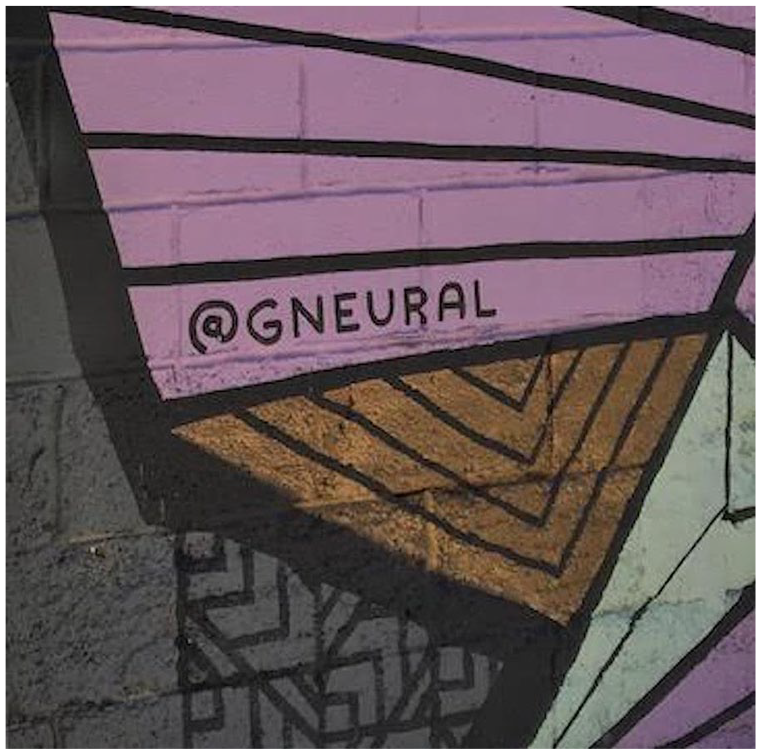
Artist’s “Tag” in an Instagram Era.
It is instructive to consider the aesthetic evolution of the Crush Walls festival, both on the walls and on Instagram (the event was known as the Colorado Crush until the art district took it over as an official event). In 2013, a search for the hashtag #coloradocrush2013 (the earliest year I could find an Instagram presence for the event) reads basically like a photo album of that year’s walls. Each image homes in on one wall and the dominant aesthetic is the graffiti art form known as “wild style,” where artists render the letters of their tag name in stretched out and distorted ways that can be nearly impossible for novices to read. Four years later, as Crush was launched as an official RiNo Arts District event, the #crushwalls2017 hashtag brings up a mix of mural and wild style graffiti, although at that point the posts are still mainly art-focused and only the rare post includes a picture of a person—usually the artist, in motion. By #crushwalls2020, murals have become the mainstay and people frequently post themselves in attendance at the festival (see Figure 2).
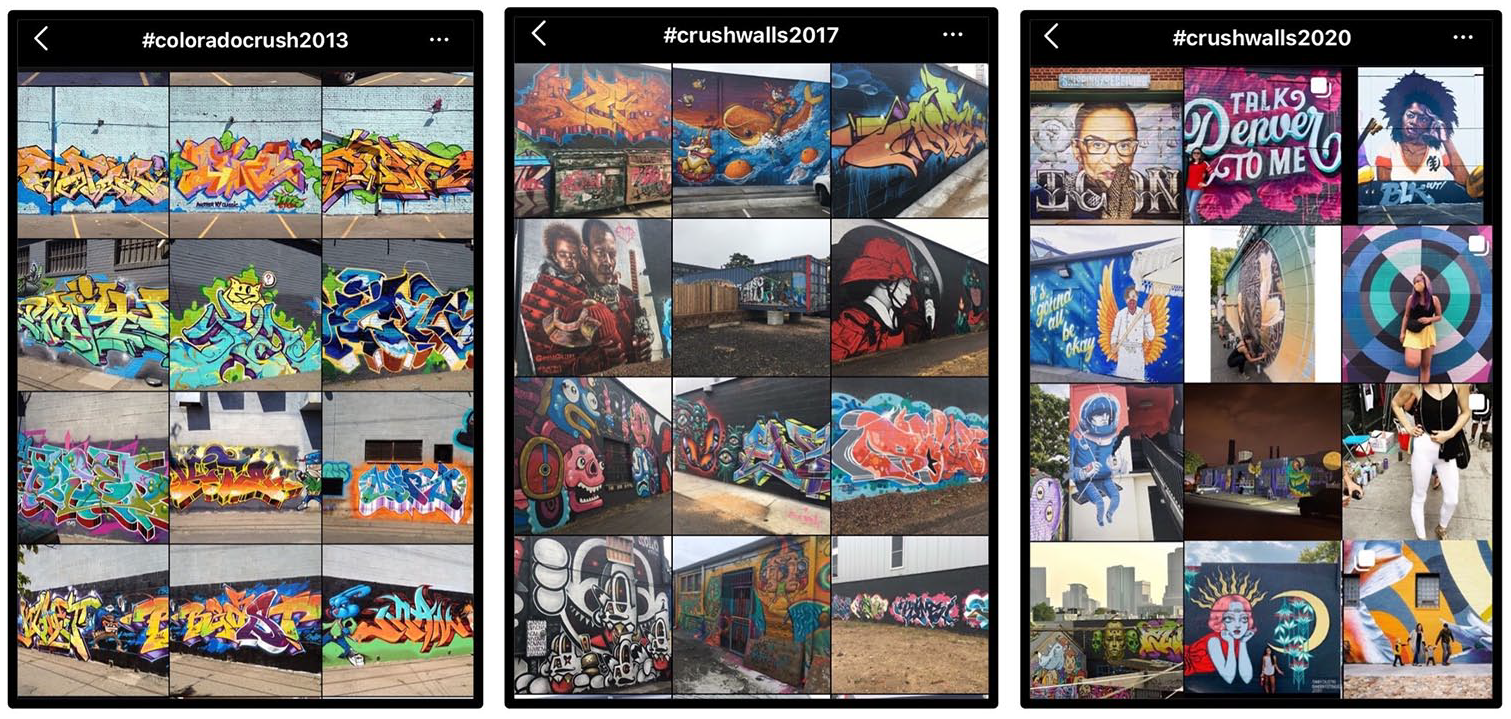
#CrushWalls Evolution From Graffiti Art to Murals and Spectators: 2013, 2017, and 2020.
Part of this process seems to be driven by artists with ambition for commercial success, but it also comes from the building owners who provide access to crucial wall space. An artist close to the Crush festival described how this is changing the creative environment: Now you have developers and property owners that want some beautiful imagery and a splash of color and flowers and patterns . . . and that’s been pretty prevalent in the past two to three years . . . some of them we work with are always mentioning, “well, we want an Instagrammable wall! We want something people will stand in front of and take a picture.” It’s like, let’s make something cool that’s like a tourist site, where people can come with their kids and get an ice cream cone and take a picture.
The Crush Walls festival is appreciated in the artist community for paying the artists, but the pay is tiered and attached to corporate sponsorship. The artist quoted above lamented, “Now sponsors and stuff, they want to be tagged, they want Instagram Stories . . . they want to know about the artist’s following on Instagram, like, ‘How many clicks are we going to get off of you?’”
Even as world-class restaurants, hotels, and design companies move in and new buildings and landscape design change the shape of the neighborhood, the murals remain the heart of the district. In Winter 2019, a RiNo Art District employee gave me access to their internal Instagram data, which showed that in terms of engagement with posts from their own account, 49 of the top 60 performing posts are focused on street art or graffiti, while only seven of their bottom 60 performing posts featured street art or graffiti. This likely explains why, as new buildings go up, space is continually set aside for walls, always with an effort to maintain the sense of raw space, not overly sanitized. Alleys are “cleaned up” by removing informal dwellings and their inhabitants, but the electrical wires, dumpsters, and weeds remain to give the walls that run along them just the right gritty backdrop for a good urban photoshoot (see Figure 3).
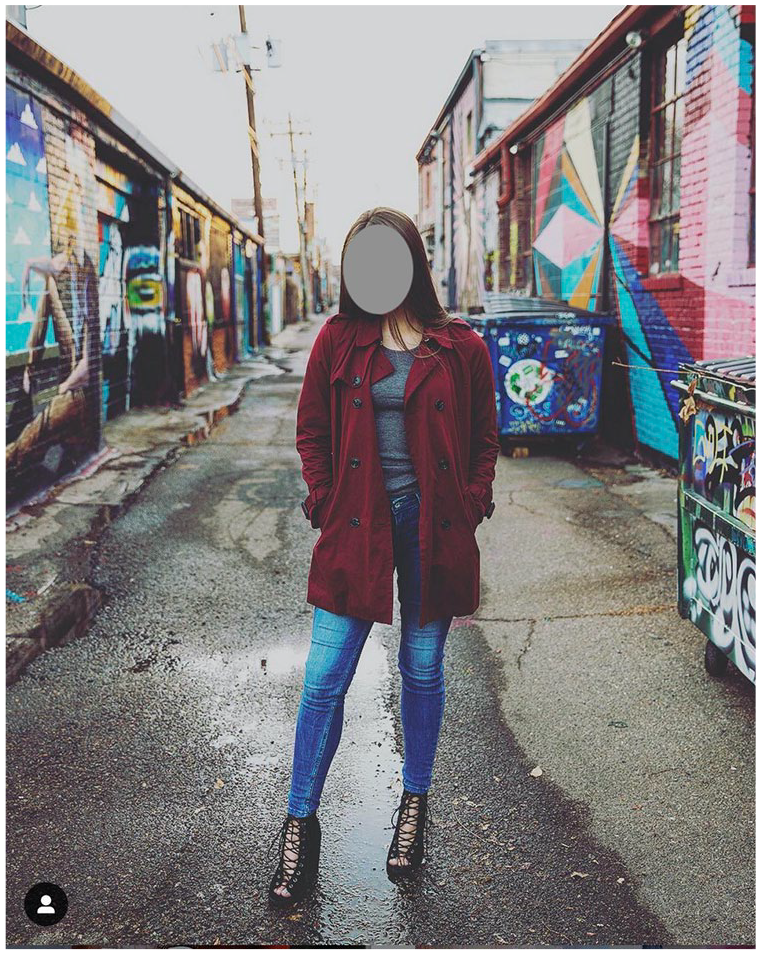
Posing for Instagram in a Street Art Alley.
Conclusion
Looking at a newly gentrified area of Denver, I have argued that street art and Instagram are complicit media in practices relating to a major neighborhood transformation. To conclude, it is useful to consider this example in relation to the broader issue of “mediatization,” or, how media (in this case digital, mobile media) are increasingly “relevant for the social construction of everyday life, society, and culture” (Krotz, 2009, p. 24). Jansson (2018a) argues that media are “culturally and materially embedded in gentrification processes” (p. 128, italics in original), with places gradually altered by cultural, social, economic, and technological adaptations to media.
In the case of street art, Instagram, and gentrification in RiNo, early collaboration between artists and building owners joined cultural and economic practices, which grew in social importance (and economic impact) as residents and visitors began posting and circulating images of the area. In the world of graffiti, the “tag” circulated through urban environments as a territorial marker that said, “X was here.” Through such tagging, “social status and peer group recognition was accrued” (MacDowall & de Souza, 2018, p. 16). As graffiti walls transitioned to mural-covered “street art” in an Instagram era, the tag has taken on new agency, propelled in varying directions by artists and audiences as they send images into the mediasphere with their own meanings attached. Although practices, aesthetics, and participants have changed, the tag itself remains used as a way to claim space and place. Instagram’s mobility, photo-centricity, and diffusion affordances are key: enabling online dissemination of striking visual, geocoded representations, the mass media functions of Instagram hashtags symbolically stamp a place. As the case study of RiNo has demonstrated, such a stamp of approval may read as a welcoming sign to gentrifiers.
Footnotes
Declaration of Conflicting Interests
The author(s) declared no potential conflicts of interest with respect to the research, authorship, and/or publication of this article.
Funding
The author(s) received no financial support for the research, authorship, and/or publication of this article.
