




Abstract
Green gentrification describes how greening neighbourhoods (e.g. by creating parks, community gardens, etc.) can result in higher-income households moving in and displacing/excluding marginalised residents. While some researchers assert that greening attracts higher-income households, this has rarely been empirically tested. Further, green gentrification research has focussed almost exclusively on greening attracting households to urban neighbourhoods, despite desire for more green space often being cited as motivating households to move to suburbs. Our study surveyed 104 households in gentrified downtown Vancouver and suburban Calgary neighbourhoods, to determine the relative importance of neighbourhood greenness and proximity to green space when they were deciding to move into new-build neighbourhoods. Our results indicate that green factors are of similar importance to non-green factors, such as safety, scenic views, ambience and, in Vancouver, proximity to entertainment and transit. Proximity to green space was more important than overall neighbourhood greenness. Residents in all neighbourhoods placed similar importance on green factors, although more importance was placed on private green space in the suburbs. These findings suggest that neighbourhood greenness and proximity to green space are not the only factors driving high-income households to move in and that green factors have played a similar role in motivating households to move to urban and suburban neighbourhoods. Thus, green-gentrification research needs to consider how preference for greened neighbourhoods intersects with other preferences/constraints to ultimately influence residential location choices. It also needs to widen the geography of green gentrification to understand how greening contributes to exclusion and displacement beyond dense city environments.
Introduction
Green gentrification refers to the theory that greening neighbourhoods (e.g. by creating new parks, community gardens, etc.) results in higher-income households moving in and displacing/excluding marginalised residents (Checker, 2011; Dooling, 2009; Gould and Lewis, 2017). This is often described as a ‘sustainability fix’ (While et al., 2004) or ‘greening of the growth machine’ (Dilworth and Stokes, 2013), in which environmental goals that will strengthen (or at least, not hinder) economic growth are selectively incorporated into urban planning/policy agendas to generate uneven financial gain. While some have suggested that this process is driven, at least in part, by consumer preference for greened neighbourhoods (e.g. Gould and Lewis, 2017; Kern, 2015; Reibel et al., 2021; Wolch et al., 2014), there is limited empirical evidence that greening (versus other non-green development occurring alongside it) is what motivates households to move in (Quinton et al., 2022; but see Anguelovski et al., 2022).
Green-gentrification research has focussed on processes of inverted suburbanisation that create green enclaves of privilege in dense urban environments (Anguelovski et al., 2019). Such processes reflect what has become a common-sense notion: ‘more city’ (e.g. increased density, mixing of land uses, etc.) is essential for mitigating negative environmental impacts (Angelo and Wachsmuth, 2020). This has resulted in a grey-green ideology of urban sustainability, wherein vegetation and technological solutions are combined to create liveable, resilient cities (Wachsmuth and Angelo, 2018). Despite this emphasis on ‘more city’, suburbanisation is still widespread and diversifying in form and demography (Keil, 2020). Greening has been common in suburban developments (Berger and Kotkin, 2017; Fishman, 1989; Jackson, 1987), suggesting that green gentrification may be occurring in suburbs but is currently overlooked in green gentrification research.
To address these gaps, we surveyed residents living in gentrified neighbourhoods in downtown Vancouver and suburban Calgary, Canada, to determine (i) the extent to which greening attracted households to move in and (ii) whether this differed between urban and suburban neighbourhoods. The rest of this section positions our study within existing literature on production and consumption factors driving (green) gentrification processes, as well as how notions of sustainability and liveability have influenced urbanisation and suburbanisation.
Production and consumption of (green) gentrification
Numerous consumption (or demand) and production (or supply) explanations of gentrification have been documented (Lees et al., 2008). Production-side explanations focus on instances in which it becomes more profitable for capital to switch from industry to real estate and the built environment, resulting in construction booms and inflation of real-estate markets (Harvey, 2009 [1973]; Lefebvre, 1976). This includes the creation and closing of rent gaps (i.e. the difference between potential and capitalised ground rents) that occur when developers can purchase relatively cheap land and redevelop it for sufficient profit (Smith, 1987). Rent gaps are created through, for example, redlining and the activation of territorial stigma (Schaffer and Smith, 1986); reducing building regulations and using upzoning to open up land for large-scale (re)development (López-Morales et al., 2019); and the rise of flexible working arrangements (Alexandri and Janoschka, 2020).
Consumption-side explanations focus on factors motivating gentrifiers to move into certain neighbourhoods (Lees et al., 2008) and reflect broader social, political and economic shifts that give rise to new occupational structures, lifestyles and values (Ley, 1996). This includes rejecting the suburbs and their associated conservative politics (Ley, 1996) in favour of environments more supportive of non-traditional households (Bondi, 1999; Castells, 1983). Aesthetics associated with artists (Zukin, 1989) and historic buildings (Knox, 1991), and the availability of good schools (Butler and Robson, 2001), public transit (Luckey et al., 2018) and condominiums (Kern, 2007), have also been noted as consumption factors attracting gentrifiers.
Green-gentrification research has documented the role that urban greening plays in closing rent gaps and has termed this a green gap (Anguelovski et al., 2019), environmental gap (Bryson, 2013) or ecological rent gap (Quastel, 2009). These terms describe how the value of lands (particularly former industrial lands in downtowns and along waterfronts) once depressed by pollution or other undesirable factors is increased due to environmental remediation, the creation of green neighbourhoods and increased energy costs affecting transportation to and from the suburbs. Numerous quantitative analyses have documented increased housing costs and/or property values in neighbourhoods where greening has occurred (Bockarjova et al., 2020; Donovan et al., 2021; Immergluck, 2009; Rigolon and Németh, 2020).
Less attention has been paid to the role of consumer preference (Anguelovski et al., 2019; Quinton et al., 2022), despite several researchers defining green gentrification as being, at least in part, driven by a preference for green neighbourhoods (e.g. Gould and Lewis, 2017; Kern, 2015; Reibel et al., 2021; Wolch et al., 2014). While green-gentrification research has engaged with residents living in gentrifying areas, this has largely focussed on the impacts of green gentrification on existing communities and/or associated mobilisation efforts against displacement (e.g. Curran and Hamilton, 2012; Harris et al., 2020; Kern and Kovesi, 2018). A few have incidentally gathered insight suggesting that greening attracted some households to move in, but this was not their explicit focus (Alkon and Cadji, 2020; Goossens et al., 2019). Research documenting that gentrifiers advocate for, and undertake, the greening of their neighbourhoods after moving in suggests a desire to live in greener neighbourhoods (Rigolon and Collins, 2022) but does not indicate that people move into a neighbourhood because it was greened.
Often, it seems the notion that greening attracts new residents is inferred based upon quantitative analyses (such as those mentioned above) and on the assumption that ‘green is good’ (Angelo, 2021) and thus everyone wants to live in a greener neighbourhood. However, such inferences overlook the fact that greening is often undertaken alongside the introduction of other amenities in the context of new developments (Quinton et al., 2024) – including the large-scale, state-led gentrification processes that have become the norm (Davidson and Lees, 2005; Hackworth and Smith, 2001). Further, greening commonly occurs across gentrifying areas (Quinton et al., 2023), suggesting that it may not be the driving force in decisions about moving to a particular gentrifying neighbourhood. Finally, research shows that greening undertaken closer to downtowns, previously gentrifying or park-poor areas or those lacking public housing, is more likely to result in gentrification (Anguelovski et al., 2017; Kim et al., 2024; Pearsall and Eller, 2020; Rigolon and Németh, 2020), suggesting that preference for greened neighbourhoods intersects with other considerations.
Sustainability and liveability in (sub)urbanisation
Green-gentrification research has mainly focussed on the impacts of greening dense urban environments. Many North American cities have experienced population growth and densification in their urban cores over the past few decades – although this has often occurred alongside continued suburbanisation (Gordon, 2022; Massey and Tannen, 2018). This population growth in the central city has been termed the back-to-the-city (or return-to-the-city) movement, or ‘the great inversion’, in the United States (Ehrenhalt, 2012; Hyra, 2015).
While Canadian cities have seen similar population growth, they did not experience the same preceding period of disinvestment in the central city (England and Mercer, 2006; Goldberg and Mercer, 1986). Regardless, recent population growth in the urban core has been attributed to the shifting lifestyle preferences (or constraints) of millennials, affluent retirees, progressives and ‘creative-class’ workers (Ehrenhalt, 2012; Glaeser et al., 2001; Ley, 1996), as well as political-economic processes facilitating the production and closing of rent gaps (Hackworth and Smith, 2001; Smith, 1979). As outlined previously, such patterns of consumption and production have been associated with gentrification.
Land-use planning in the past several decades has contributed to increased residential occupation of the city, as it has been driven by notions of sustainability and liveability that aim to kerb suburban sprawl and make downtown living more attractive (Angelo and Wachsmuth, 2020; Godschalk, 2004). Urban greening has been integral to this, resulting in a ‘parks, cafes and a riverwalk’ image of the sustainable, liveable city (Curran and Hamilton, 2012: 1028; see also Bunce, 2018; Connolly, 2019; Wachsmuth and Angelo, 2018). This approach to urbanisation has been posited to enable the preferred consumption patterns of an ecologically conscious ‘sustainability class’ (Goossens et al., 2019; Gould and Lewis, 2017; Quastel, 2009). This has been described as ‘inverted suburbanisation’ to highlight how the same desire for green neighbourhoods that motivated households to move to the suburbs (Berger and Kotkin, 2017; Fishman, 1989; Jackson, 1987) is now motivating households to move to the city (Anguelovski et al., 2019).
Some researchers have questioned the existence of a back-to-the-city movement, as net population growth has been higher in suburbs (Glaeser and Shapiro, 2003; Gordon, 2022) and demand remains high for single-family housing (Lauster, 2016). Even in Vancouver, where sustainability and liveability have motivated urban planning for decades, regional suburban growth has been widespread (Peck et al., 2014). Our other case city, Calgary, aimed to promote suburbanisation as a sustainable, liveable form of development (City of Calgary, 1995). Indeed, many Canadian cities have undertaken efforts to densify suburbs, particularly around transit stations, to enhance sustainability (Filion and Kramer, 2012). Beyond ‘inverted suburbanisation’, one can see processes of ‘suburban involution’ in Canadian cities in which urban and suburban modes of development are recombined across regions (Keil, 2020; Peck et al., 2014). Despite this, theorisation of green gentrification has not been extended to the suburbs.
Research objectives
Our study has two objectives. The first was to determine the relative importance of greening in decisions to move into gentrifying/gentrified new-build neighbourhoods. The second was to explore whether the importance of greening in neighbourhood choice differs between dense urban, and low-density suburban, new-build neighbourhoods. In addressing these objectives, our study (i) contributes to understanding greening as a consumption factor in gentrification, (ii) bridges the literatures on urban greening and new-build gentrification and (iii) expands the geography of green-gentrification research to the suburbs.
Methods
Neighbourhoods
Three neighbourhoods were selected as study sites: North False Creek in downtown Vancouver, and Crestmont and Valley Ridge in suburban Calgary. They experienced gentrification and the creation of multiple new parks (Quinton et al., 2023). Although development of these neighbourhoods began in the 1990s, as of 2021 they remain in the top quartile of median household incomes (Statistics Canada, 2021). All three neighbourhoods were (re)developed on land that was previously non-residential, and thus we contend that they all constitute forms of new-build gentrification (Davidson and Lees, 2005).
While not all scholars consider new-build gentrification to constitute gentrification (Boddy, 2007; Slater et al., 2004), many argue that in an era of state-led gentrification and large-scale deployments of capital, new-builds play an important role in the class remake of cities (Davidson and Lees, 2005, 2010; Hackworth and Smith, 2001; Smith, 1996). The common critique is that new-build gentrification does not result in direct physical displacement of residents (Boddy, 2007; Slater et al., 2004). However, it can lead to indirect displacement through exclusionary displacement wherein low-income segments of the city’s population will never be able to afford to live in these new neighbourhoods (Davidson and Lees, 2005). It can also lead to phenomenological displacement, in which gentrification results in the loss of sense of place (Davidson and Lees, 2010). Finally, gentrification is not neatly spatially and temporally bounded – gentrification and its impacts spill over to adjacent neighbourhoods (Davidson and Lees, 2005; Wilhelmsson et al., 2021). Thus, new-build gentrification on former industrial lands can result in the displacement (including physical displacement) of residents in adjacent residential neighbourhoods as gentrification spreads.
We believe new-build gentrification to be relevant to green gentrification, despite few studies explicitly discussing both together (Quinton and Nesbitt, 2024). This is because amidst the deindustrialisation of cities (MacKinnon and High, 2020) and the rising prominence of sustainability discourses in urban planning (Gunder and Hillier, 2009), former industrial lands have been targets for gentrification through environmental remediation, greening and redevelopment (Bryson, 2013; Quastel, 2009; Quinton and Nesbitt, 2024; Smith, 1996)
North False Creek, Vancouver
False Creek is an ocean inlet that creates Vancouver’s downtown peninsula. Redevelopment of industrial lands on the north shore began with preparations for Expo ‘86 (Olds, 1998). Following Expo, the lands were sold to the billionaire owner of Concord Pacific Ltd (Olds, 2002). The False Creek North Official Development Plan (ODP) was adopted in 1990, and much of the development was undertaken over the following 20 years. The area was developed to be largely residential and features numerous tower-and-podium buildings characteristic of ‘Vancouverism’ (Beasly, 2019), as well as some low- to mid-rise buildings surrounding private courtyards. Courtyards, rooftop gardens and balconies are the only private green space in this neighbourhood. The ODP set out requirements for affordable housing, and the city secured sites within the development for its provision. However, due to a lack of government funding, several sites were converted back to market housing (Mah and Hackworth, 2011). Concord Pacific was required to provide public amenities, including several parks and public access to the seawall, a popular waterfront pathway (Ley, 2012). However, the provincial government was responsible for remediation of the area (Fader, 2002). The neighbourhood is serviced by the Yaletown–Roundhouse SkyTrain station, the existing Roundhouse Community Centre and retail space developed by Concord Pacific. Real-estate ads for the area routinely boast of mountain, city and ocean views.
Valley Ridge and Crestmont, Calgary
The area for Valley Ridge was initially purchased by Tri-Media, and annexed by the City, with the intention of using it to enhance the province’s film industry (Pedwell, 1981). However, following an economic downturn, the land was sold to Barbican Developments (a Vancouver company later called ‘Century Group’) in 1989 (King, 1996). The Valley Ridge Area Structure Plan was adopted in 1991 and included plans for an 18-hole golf course to weave through the residential development. According to the plan, existing significant natural areas had to be preserved as environmental reserves.
Qualico Developments West Ltd (now Qualico Communities Calgary, based in Winnipeg, MB) purchased 165 ha to develop the Crestmont neighbourhood. The first lots were sold in 2000 (McCormick, 2001) and development is still ongoing. Similar to Valley Ridge, this neighbourhood includes a substantial amount of environmental reserve lands. Qualico also developed a community centre and two stormwater retention ponds, and started a homeowner’s association which pays for creating and maintaining public spaces beyond what the City will support (Hanson, 2002).
Both Calgary neighbourhoods comprise detached houses with a few semi-detached and terraced houses (Statistics Canada, 2021), and private backyards are the norm. Numerous large and small parks, environmental reserves and pathways were constructed as part of these developments. Non-residential land is limited to a few services and commercial uses, and a school and community centre in Crestmont. It takes approximately 15–20 minutes to get downtown by car. There is one bus that services these neighbourhoods, but only 3% of people commute via public transit (Statistics Canada, 2021). Both neighbourhoods are often described in real-estate ads as being family friendly and close to amenities like the golf course, the Canada Olympic Park and the Rocky Mountains.
Survey design and sampling
The online survey was developed using Qualtrics (https://www.qualtrics.com). It consisted of five main questions and seven demographic questions. Prior to beginning the survey, respondents were asked to confirm that they lived in one of the target neighbourhoods. Participants (n = 104; n = 55 in Vancouver and n = 49 in Calgary) were recruited through a community association newsletter, placing posters inside condominium towers in Vancouver and directly mailing invitations to random addresses (using a random number generator and list of addresses) within the neighbourhoods. 1 The demographic survey data indicates that the sample was similar to census data (Statistics Canada, 2021) for housing tenure (renters: 45.5% Vancouver survey, 44.0% census; 0% Calgary survey, 4.2% census) and average household size (1.96 Vancouver survey, 1.92 census; 2.75 Calgary survey, 2.85 census). Household-income data from the survey showed fewer households in the lower-income categories (<CA$50,000) in both cities (1.8% Vancouver, 0% Calgary) compared to the census (24.0% Vancouver, 5.1% Calgary) – but 17% of survey respondents declined to report their income.
The first question asked respondents to use slider scales (Nesbitt et al., 2023) to indicate the importance, ranging from 0 (Not at all important) to 10 (Extremely important), of four broad factors (financial, location, neighbourhood characteristics and housing characteristics) when considering whether to move into their current location. They were then presented with six ‘Neighbourhood characteristics’ (Scenic views; Overall neighbourhood greenness; Ambience (i.e. noise); Design of buildings; Safety; and Opportunities for social interaction) and asked to use Likert-scale radio buttons, ranging from 1 (Not at all important) to 5 (Extremely important), to indicate their importance when deciding whether to move in. The following question asked them to do the same for six ‘Location factors’ (near to: Entertainment; Work; Family/friends; Green space; Good schools; and Public transit). Neighbourhood characteristics and location factors were selected to represent a range of factors with the potential to influence household decisions about whether to move in. They were derived from consumption factors linked to gentrification in the existing literature (Butler and Robson, 2001; Knox, 1991; Lees et al., 2008; Ley, 1996; Luckey et al., 2018; Zukin, 1989) and factors frequently referenced in descriptions of these neighbourhoods in previous studies (Ley, 2012; Quastel, 2009) and real-estate ads. This was followed by a multiple-choice question asking respondents to indicate when they first considered the neighbourhood’s ‘greenness’ (i.e. presence/quality of trees, parks, backyards, etc.) in the decision-making process. Choices included that they were: (i) actively looking for a green place to live; (ii) impressed by greenness in the ad; (iii) impressed by greenness during their tour; or (iv) ‘other’. The final question asked respondents to use slider scales (ranging from 0 to 10) to indicate the importance of public and private green spaces, as this might be influenced by the higher quantity of private green space in Calgary.
Data analysis
Descriptive statistics were calculated for each question and used to make initial comparisons between urban and suburban neighbourhoods and between responses for each question (e.g. the relative importance of the ‘Neighbourhood characteristics’). Due to the types of data produced (and the non-normal distribution of the results), non-parametric statistical tests were conducted. This included (i) Wilcoxon rank-sum tests to compare slider- and Likert-scale responses between cities (Objective 2); (ii) Wilcoxon signed-rank tests to compare different factors within questions (e.g. relative importance of public versus private green spaces; Objective 1); and (iii) chi-square tests to compare the multiple-choice answers between cities. Statistical analyses were conducted using R v4.3.2 (R Core Team, 2020). The R base package was used for each test, and z-scores for the Wilcoxon tests were calculated using the qnorm() function.
Results
Demographics
The year respondents that moved in ranged from 1992 to 2023. Most households (48%) comprised two individuals, but Calgary had more households with 3+ people than Vancouver (55% versus 18%). More Calgary households had children (<18 years) than Vancouver (45% versus 16%). Respondents generally had a high level of education, with 38% of households specifying that someone had a Bachelor’s degree and 47% a Master’s degree. Master’s degrees were more common in Vancouver (55%) than Calgary (39%). Most households (71%) made over CA$100,000 before tax, and 36% made over CA$200,000. All households in Calgary owned their home, whereas only 55% did in Vancouver.
Housing, neighbourhood, location and financial characteristics/factors
When asked to rate on a scale of 0 (Not at all important) to 10 (Extremely important) the importance of four factors/characteristics considered when deciding whether to move into their current location, neighbourhood characteristics (e.g. safety, appearance, ambience, etc.) had the highest median rating overall (9.2; Figure 1). Financial factors received the lowest rating (7.5). The main difference between cities was the median rating given to location factors (e.g. near to work, good schools, amenities, family/friends, etc.): this was rated very highly in Vancouver (9.8) but was significantly less important in Calgary (7; Z = −4.97, p < 0.001).
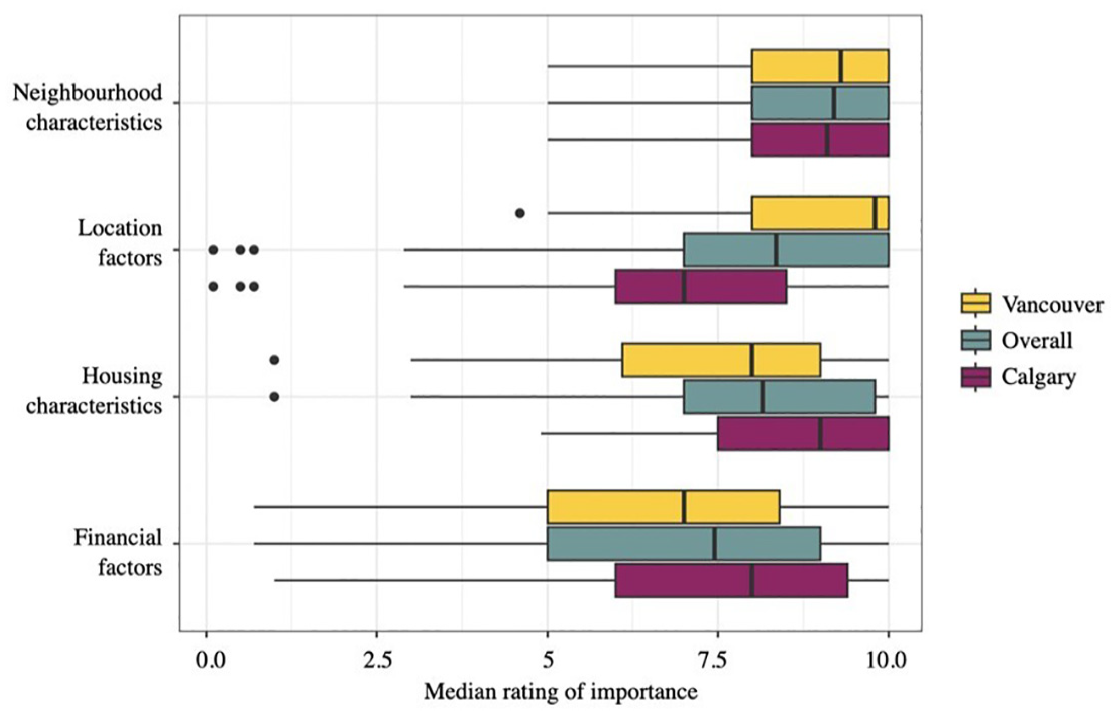
Median rating of importance on a scale of 0 (Not at all important) to 10 (Extremely important) of housing, neighbourhood, location and financial factors/characteristics when deciding to move into their current location.
Neighbourhood characteristics
When asked to complete Likert-scale questions ranging from 1 (Not at all important) to 5 (Extremely important) for six neighbourhood characteristics, safety was deemed most important (82% of respondents rated it a 4 or 5; Figure 2). Overall neighbourhood greenness was somewhat important (56% rated it a 4 or 5) but significantly less so than safety (Z = −4.87, p < 0.001). It was similarly important in Vancouver (53%) and Calgary (59%; Z = −0.90, p = 0.37). Ambience (e.g. noise/activity level), and in Vancouver scenic views, were similarly important to overall neighbourhood greenness.
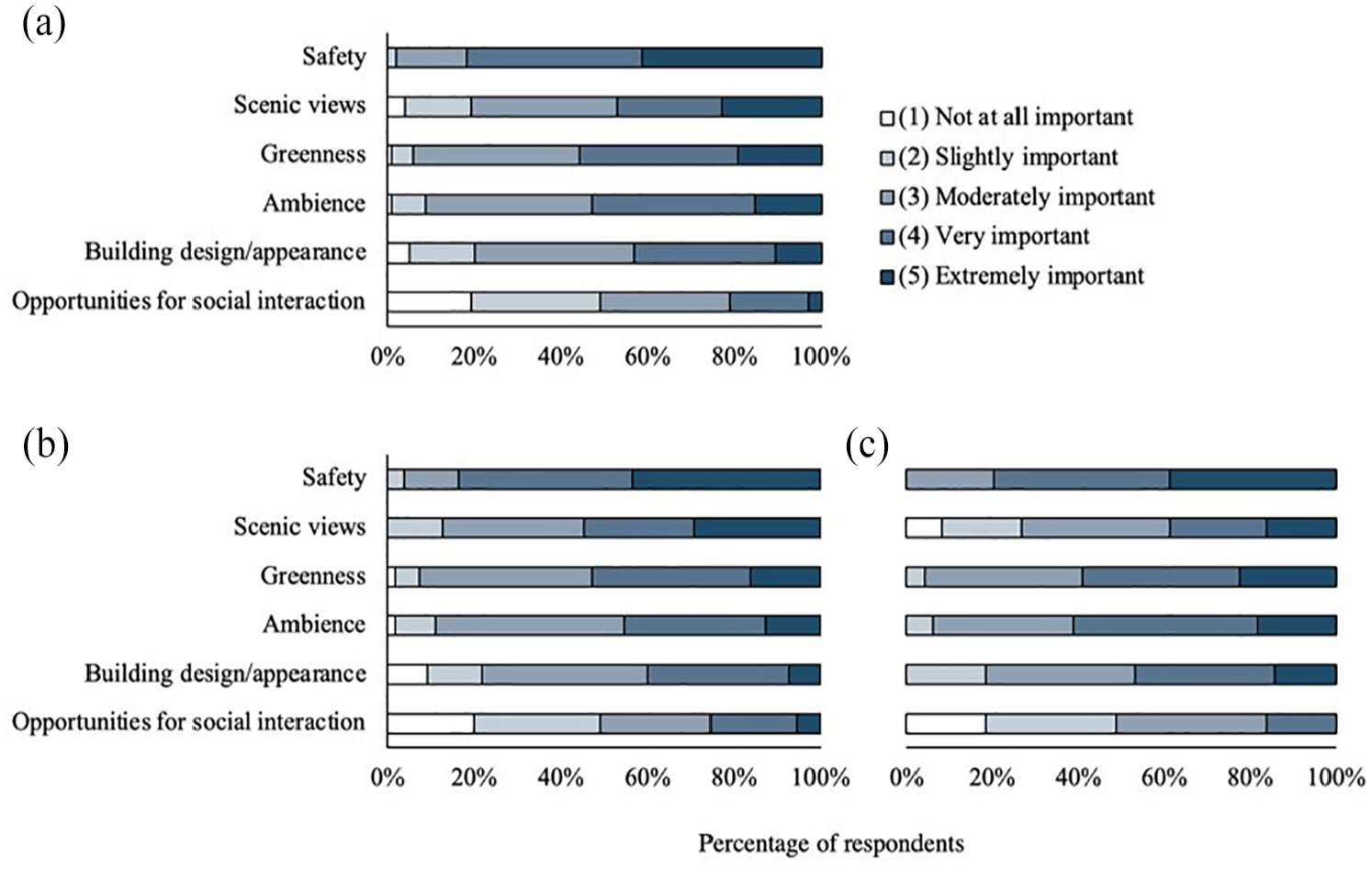
Percentage of respondents (a) overall and in (b) Vancouver and (c) Calgary indicating the importance (on a scale of 1–5) of six neighbourhood characteristics when deciding whether to move to their current location.
Location factors
Near to green space was the most important location factor (70% of respondents rated it a 4 or 5) influencing households to move in (Figure 3). The importance was very similar in both cities (Z = −0.51, p = 0.61). It was by far the most important location factor in Calgary (69% rated it a 4 or 5), with the next closest factor being near to work (25%). However, in Vancouver, although near to green space was rated most important, it was similar in importance to near to entertainment (Z = −0.26, p = 0.8) and near to public transit (Z = −1.85, p = 0.06) – this is particularly evident for the percentage of households rating them a 5.
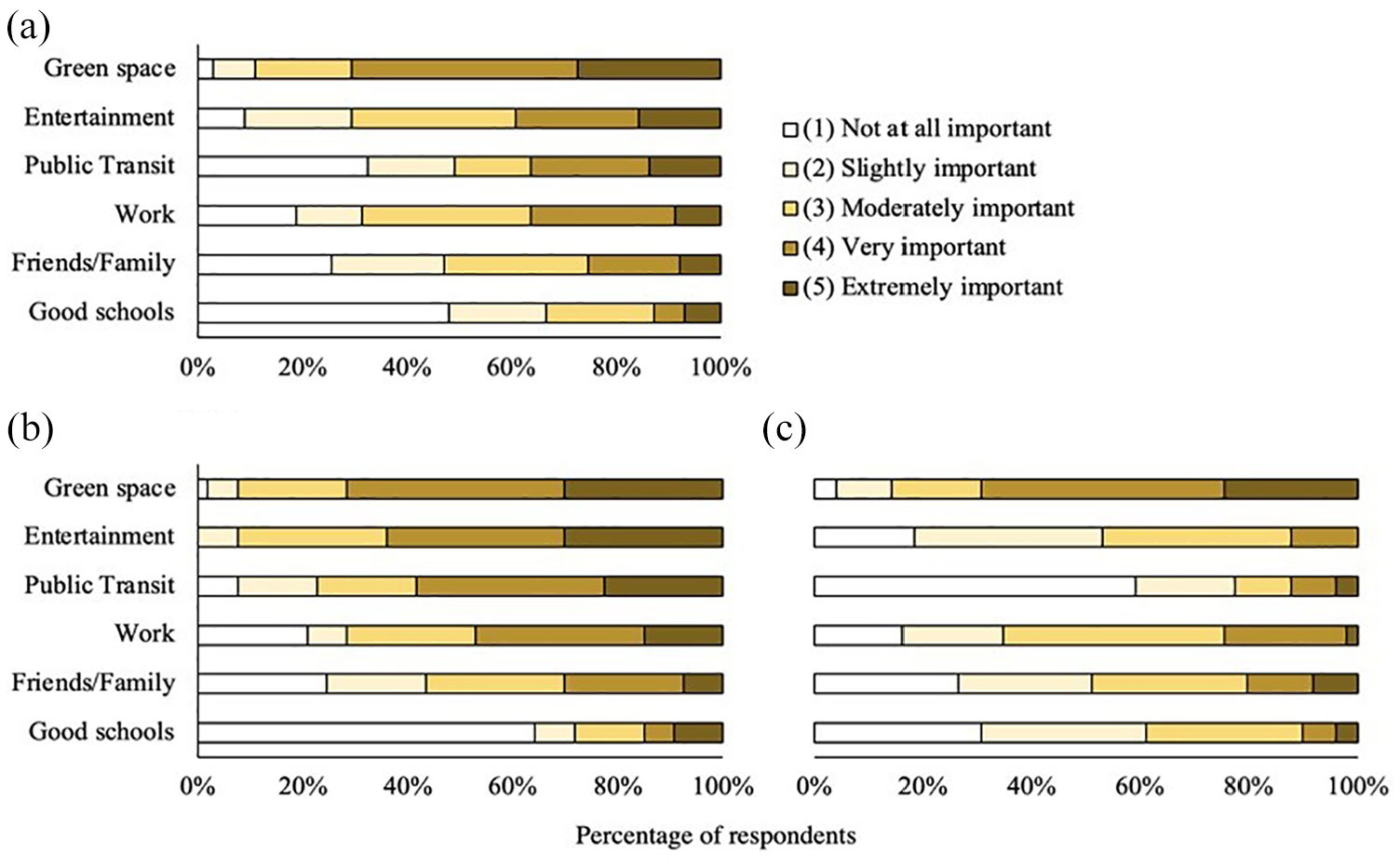
Percentage of respondents (a) overall and in (b) Vancouver and (c) Calgary indicating the importance of six location factors when deciding whether to move to their current location.
Comparison of urban greening factors
Overall greenness versus proximity to green space
Overall neighbourhood greenness was less important than being near green space in both cities, although not significantly so overall (Z = −1.61, p = 0.11). This difference was more prominent in Vancouver –near green space was rated a 4 or 5 by 70% of households but overall neighbourhood greenness was only this important to 53% (Z = −2.64, p = 0.008). In Calgary, these numbers were 69% versus 59%, respectively (Z = −0.24, p = 0.81).
Public versus private greening
On a scale of 0 (Not at all important) to 10 (Extremely important), private (8) and public green space (8.1) had similar median ratings of importance. Public green space had a slightly higher importance in Vancouver (8.5) than Calgary (8; Z = −0.91, p = 0.36). The importance of private green space was higher in Calgary (9) than Vancouver (7.1; Z = −3.77, p < 0.001).
Consideration of urban greening in the decision-making process
Most respondents indicated that greenness began factoring into their decision after they took a tour of their residence (38%), or they had been actively searching for a green neighbourhood (25%). Respondents who specified other either stated that greening was never a big factor (20% in Vancouver, 8% in Calgary) or that it was important, but it was unclear when it was considered (9% Vancouver, 12% Calgary). The differences between the two cities were not significant (χ = 8.63, p = 0.07).
Discussion
Greening as a consumption factor driving gentrification
Our results indicate that overall neighbourhood greenness and being near green space were both relatively important neighbourhood characteristics/location factors influencing household decisions about whether to move into our study neighbourhoods. Some households even actively sought out a green neighbourhood. However, green features were not the only important factors. This is especially true in Vancouver, where other location features (such as being near transit and near entertainment) were also important. This indicates that greening is viewed as one of a suite of amenities that people value, albeit an important one. Still, greening alone is not driving household decisions to move into greened neighbourhoods. Thus, defining green gentrification as a process in which greening alone attracts higher-income households to move in (e.g. Gould and Lewis, 2017; Kern, 2015; Reibel et al., 2021) does not fully reflect the confluence of factors motivating households to move into neighbourhoods that have experienced greening during (re)development. While greening matters, a sole focus on greening may overemphasise its centrality in decision making, as our results indicate that only a quarter of respondents had actively sought a green neighbourhood to live in.
Over the past several decades, gentrification research has documented a vast array of consumption factors motivating gentrifiers to move into certain neighbourhoods (see Lees et al. (2008) or the introduction for an overview). Thus, it is perhaps unsurprising that greening was not the only factor considered by our respondents – particularly when state-led, corporate-financed, large-scale (re)development projects provide (within one neighbourhood) many of the factors identified as important (Davidson and Lees, 2010; Hackworth and Smith, 2001; Lees et al., 2008). However, green-gentrification research has focussed on the impact of greening largely in isolation. This has involved examining whether certain characteristics of greening such as size, function or quality (Chen et al., 2021; Kim and Wu, 2021; Rigolon and Németh, 2020) influence gentrification outcomes. It has also, to a lesser extent, examined the relative role of greening compared to other potential drivers of gentrification (Anguelovski et al., 2022; Triguero-Mas et al., 2022). However, consideration of what other factors may be intersecting with greening has been limited to highlighting that gentrification is more likely to occur around new parks created near downtowns or other gentrifying areas (Anguelovski et al., 2017; Pearsall and Eller, 2020; Rigolon and Németh, 2020). Our results highlight the need to consider a broader range of factors that may combine with greening to attract gentrifiers – particularly factors like housing characteristics, safety, availability of scenic views and proximity to entertainment and public transit. There is a need to examine the synergistic effects of greening and other consumption factors to understand where gentrification is likely to occur and how to mitigate it.
Green space versus overall neighbourhood greenness
Respondents placed greater importance on being near green space (e.g. parks, natural areas and gardens) than overall neighbourhood greenness (i.e. the abundance/quality of vegetation) – particularly in Vancouver. While these are not discrete categories, as green space contributes to overall neighbourhood greenness, it suggests that ‘destination’ forms of greening are more important than having a high level of vegetation distributed throughout the neighbourhood. This aligns with the current emphasis in the green-gentrification literature on parks and community gardens rather than overall greenness (Quinton et al., 2022). Few gentrification studies have examined forms of greening that are typically distributed throughout neighbourhoods and contribute to overall greenness, such as trees (Donovan et al., 2021; Parish, 2020) or green infrastructure (Shokry et al., 2020). Numerous hedonic models have found that large parks, and those providing a wider range of benefits, have the greatest impact on housing prices (Bockarjova et al., 2020; Czembrowski et al., 2019). This has been attributed to a preference for green spaces with greater multifunctionality, including the provision of benefits that extend beyond those provided by vegetation itself (Czembrowski et al., 2019; Roberts et al., 2022). For example, whereas street trees may provide shade, a park with trees may provide shade plus a place to walk a dog, a playground for children and so on. These findings raise an interesting question regarding how much of the impact of the ‘green’ of green gentrification is due to verdant vegetation versus the provision of non-vegetative amenities/opportunities within green space. They also suggest that green vegetation alone is not a sufficient descriptor of what generates the link between greening and gentrification.
Greening and gentrification in downtown Vancouver versus suburban Calgary
Previous research has indicated that gentrification is more common surrounding parks created closer to downtowns (Anguelovski et al., 2017; Rigolon and Németh, 2020), but our study found a similar importance placed on greenness/green space in urban and suburban neighbourhoods. This – and the similar number of households who actively sought a green neighbourhood – highlights that preferences for greened neighbourhoods are enacted in both urban and suburban neighbourhoods. This suggests that a preference for green neighbourhoods is a fairly universal factor intersecting with other preferences or constraints to ultimately determine where households move. This can be seen, for example, in the fact that Calgary respondents placed a greater emphasis on housing characteristics, whereas Vancouver respondents were more concerned with location factors. This result makes intuitive sense, as the Calgary neighbourhoods comprise detached houses and few nearby amenities, whereas the Vancouver neighbourhood largely consists of residential towers and numerous amenities and entertainment venues.
These results also suggest that a preference for green neighbourhoods may have contributed as much to population growth in the urban core as it has to ongoing suburbanisation. Taking Vancouver as an example, the city itself has focussed on downtown densification, but its surrounding municipalities have continued to sprawl (Peck et al., 2014). While the urban and suburban are often held in contrast, the line between them has increasingly blurred in terms of spatiality and form (Keil, 2020). In Vancouver, downtown densification has internalised many suburban characteristics such as ‘class exclusivity, aesthetic predictability, purified streetscapes, [and] class and cultural conformity’ (Peck et al., 2014: 408), the purported success of which has inspired similar processes of densification in surrounding ‘suburban’ municipalities. In other words, the centrality of greening in shaping urban housing preferences can be seen as an extension of the suburban ideal of a green garden for all (Fishman, 1989).
We contend that sustainability and liveability contribute to this blurring between urban and suburban neighbourhoods, as we see similar processes occurring in both: a single developer buys a large tract of land, is required/incentivised to provide parkland and/or other greening (the costs of which are factored into sale prices) and develops housing targeted towards higher-income households. These neighbourhoods are then inhabited by households placing similar importance on greenness/green space. Beyond our study neighbourhoods, we see this continuing with current developments in the Vancouver region. Northeast False Creek, a downtown neighbourhood adjacent to North False Creek, promises new waterfront and High-Line-esque green spaces and that its new condos will have ‘greencierges’ to show residents how to work the techno-sustainability features (City of Vancouver, 2018). At the same time, Botanica– said to be ‘inspired by nature’, with a quarter of its grounds dedicated for outdoor space – is being developed amidst single-family houses in the largely suburban municipality of Coquitlam (Qualex-Landmark, n.d.).
Despite similar neoliberal approaches to sustainability occurring in both urban and suburban neighbourhoods, green-gentrification research has focussed largely on the redevelopment of former industrial lands in dense urban areas. While the change from industrial land to gleaming towers amidst swathes of vegetation is starker than the development of a greenfield area into lower-density housing surrounded by vegetation, the similarities between the two processes are noteworthy. This follows a general trend in eschewing the study of suburbs when developing theories about the future of cities, despite ongoing suburbanisation (Keil, 2020). As has been argued elsewhere, there is a need to consider how greening and gentrification become intertwined across time and space in processes of urban (re)development (Quinton et al., 2023). We also argue the need to consider this intertwining in the context of (sub)urban (re)development to fully grasp the extent to which greening has been integrated into processes of uneven development.
Public versus private urban greening
The biggest difference in green factors between the two cities was the importance of public versus private green space. While the importance of public green space was similar, there was a greater importance placed on the availability of private green space in the suburban neighbourhoods. There is a clear discrepancy in the availability and quality of private outdoor space between downtown Vancouver (which is limited to balconies and shared private courtyards/rooftop gardens) and suburban Calgary (where most houses have privately owned front/backyards). Private yards have been integral to the image and appeal of suburbs (Berger and Kotkin, 2017; Fishman, 1989; Jackson, 1987). The role of private green space in green gentrification has not been investigated, except when lumped with public greening in remote-sensing analyses (Sharifi et al., 2021), as the emphasis has been on parks and community gardens (Quinton et al., 2022). This emphasis is understandable, given the potential to use public green amenities to generate private financial gain (Anguelovski et al., 2019) and legitimise (re)development (Dooling, 2009). However, private greening is the most exclusionary type of greening, making it important to consider in the context of gentrification and displacement. Of course, the line between public and private green space is blurry due to the rise of privately owned public spaces and private management/surveillance of public spaces, both of which can contribute to social exclusion (Pearsall and Eller, 2020). However, determining the role of private green space in gentrification is necessary for expanding our understanding of the relationships between greening and gentrification and the mechanisms through which they become intertwined.
Mitigating green gentrification
This research points to multiple consumption factors attracting high-income households, suggesting that the oversimplified interpretation of the ‘Just Green Enough’ approach circulating in some academic and policy circles (i.e. that greening should be reduced) is insufficient to address gentrification. However, we also do not suggest that anything deemed attractive (e.g. safety or proximity to public transit) should be reduced, as we view this as unjust. Addressing gentrification requires an adequate supply of affordable housing in both urban and suburban areas, allowing households to exercise their location preferences. While we believe that housing affordability measures should be implemented across cities, governments may wish to prioritise anti-displacement efforts in areas most vulnerable to gentrification. In addition to demographic factors indicating vulnerability to gentrification, our research suggests that cities should prioritise areas experiencing development that enhances factors like safety, scenic views, ambience and proximity to transit and entertainment. ‘Attractive’ factors may differ between cities, and thus approaches to mitigate gentrification will need to reflect local contexts.
Limitations and further research
As we could not compel participation in our survey, and our sample size was relatively small, it may be biased towards residents for whom greening was more important. However, our sample demographics were generally similar to those of the 2021 census, and our study did not highlight greenness in its recruitment materials, reducing the likelihood of significant bias.
Many respondents had moved into these neighbourhoods recently, meaning they were not amongst the first gentrifying in-movers. However, as described in our methods, we do not believe that this will have substantially altered our findings – particularly because similar findings regarding the relative importance of green space were found in a study of North False Creek in-movers conducted shortly after development (UBC School of Community and Regional Planning, 2008).
These neighbourhoods represent a subset of the diversity of urban and suburban neighbourhoods, thus further research on how the importance of green factors varies between neighbourhoods with different characteristics is warranted. This includes examination of the importance of green factors in cities with different overall levels and distributional patterns of greening efforts or existing vegetation, as Calgary and Vancouver are both quite green overall. It could also examine whether cities facing different risks/challenges prioritise different types of greening.
We have highlighted potential areas for further research throughout this study, including examination of the connection between urban greening and gentrification in suburban neighbourhoods, greater theorisation around the role of private green spaces and more studies that examine how a preference for greener neighbourhoods intersects with other preferences and constraining factors to shape decisions about where high-income households move.
Conclusions
Our study highlights that greening is an important consumption factor driving gentrification, but is unlikely to be the sole factor in any case due to the similar importance that gentrifiers place on it and numerous other factors. Although this may seem self-evident, it has rarely been explicated in green-gentrification research. Greening is one of a suite of drivers, but considering it in isolation risks misattributing gentrification as the outcome of greening alone rather than as the outcome of a confluence of factors tailored towards consumption in an era marked by (often weak) sustainability concerns. This is particularly relevant to consider in an era where large-scale, state-led, new-build gentrification introducing numerous green and non-green amenities has become the norm. Related to this, the greater importance placed on green spaces versus overall neighbourhood greenness suggests that the literal ‘green’ is less attractive than the multi-faceted amenity provision of green spaces.
The similar importance given to green factors in downtown Vancouver and suburban Calgary indicates that greening new-build developments has played a similar role in encouraging population growth in the urban core and suburbs. It also suggests that our understanding of green gentrification is incomplete without consideration of the intertwining of greening and gentrification beyond urban neighbourhoods. This includes theorisation around the role that private green spaces play in gentrification, as this was more important for households moving into suburbs.
The intertwining of greening and gentrification in urban and suburban environments may not take the exact same physical form, but they both ultimately result in the consumption of space for private financial gain, under a veneer of green sustainability and liveability fit for 21st-century environmental concerns.
Footnotes
Declaration of conflicting interests
The author(s) declared no potential conflicts of interest with respect to the research, authorship, and/or publication of this article.
Funding
The author(s) disclosed receipt of the following financial support for the research, authorship, and/or publication of this article: This research was supported by the Social Sciences and Humanities Research Council of Canada, Doctoral Award # 767-2020-31021 and grant # 430-2020-00924.
