



Abstract
As digital platforms are woven into urban life, they become an intrinsic part of the urban experience. Here we examine how representations on digital platforms reflect and shape urban change. Which groups produce and share these representations? What places do they picture? What are their aesthetic registers and norms? And what are the material consequences of these representations? Elaborating on the concept of ‘discursive investing’ introduced by Zukin et al., we address these questions in a case study of Javastraat, a shopping street in a gentrifying neighbourhood in Amsterdam East. On the basis of an analysis of Instagram posts, street observations and interviews, we show that gentrifiers use social media to express their identity status, often creating posts that serve as advertisements for hip and high-class establishments. Meanwhile, other establishments are largely absent from digital platforms, with the notable exception of a number of shops that changed their aesthetics to appeal to gentrifiers. We further show that these uneven representations have material consequences, changing the aesthetics and composition of the shopping street.
Introduction
It might be hard to believe, but to me it felt like a victory when the Biertuin bar opened. Suddenly my friends wanted to go out for drinks in Oost, while before I had to cross the city to meet them.
1
Derek, a 30-year-old marketing professional, talked proudly about the recent opening of new bars and restaurants around Javastraat, a shopping street in Amsterdam East (‘Oost’). Besides his job in marketing, Derek owns a blog where he writes about new bars and restaurants in Oost. As we sat in one of his favourite restaurants, he said that ‘Oost got started a bit later than West, but now it’s really kicking off. And when something gets going, it’s nice to write about it.’ That his friends travel across town to visit bars in Oost feels to him like a personal victory. It shows that his decision to buy an apartment in the neighbourhood and his efforts to write about the new places opening up are finally paying off.
Derek’s blog is part of a broader trend: growing numbers of bloggers, social media users, online reviewers, journalists and city marketeers are writing about Javastraat. In recent years, the street has undergone profound changes as hip bars and exclusive shops have opened their doors (Sakızlıoğlu and Lees, 2020; Van Eck et al., 2020). This process has a racial and class dimension: low-status stores and cafés operated and frequented by immigrants are replaced by high-end establishments that cater mostly to white and middle-class customers (Fiore and Plate, 2021). While the changes in the street have been profound, the process of gentrification is even more pronounced online. Immigrant-run shops still have a strong presence in the street, but they are virtually absent from social media, review sites and blogs, which are dominated by the new establishments. Instagram users post selfies or food close-ups, Yelp reviewers talk about their experiences in one of the new restaurants or coffee bars, and marketing professionals brand the street as vibrant and diverse. All these representations radiate pride: people are proud to live in Oost and identify strongly with the neighbourhood. However, not all residents of Oost are equally zealous. Strikingly, those who are most vocal in expressing their identification with Oost and Javastraat are not long-term residents, but mostly white young adults who have recently moved to the neighbourhood. What motivates these people to express their affinity with the neighbourhood? Which places do they represent? What are their aesthetic registers and norms? And what are the material consequences of these representations?
To answer these questions, we develop the concept of ‘discursive investing’, building on the work of Zukin et al. (2017). By discursive investing, we mean that people use their time and skills to communicate visual, textual or physical representations of a place, be it an establishment, a street, a neighbourhood or a city. By shaping the image of the place they depict, such representations partake in the construction of place and define who belongs. Discursive investing implies that people take an interest in a place and produce narratives and images that have material consequences. To research these discursive dynamics and their material consequences, we use a mixed-method approach that combines online and offline research. Our argument is that social media representations, especially on visual and locative platforms like Instagram, selectively reflect and reinforce change on the ground. In the case of Javastraat, certain places (where gentrifiers go) and certain practices (of aspirational consumption) are highlighted, while other places and practices have only a marginal presence. These warped representations of space on digital platforms have material consequences, as they not only reflect but also promote gentrification. We refer to this resultant pattern as ‘amplified gentrification’, where amplified refers to both the visual and discursive enlargement of a part of a whole.
We start this paper by presenting a theoretical framework in which we develop the notion of discursive investing in relation to the literature on gentrification, media and social distinction. We then describe the context of Javastraat and the combination of methods used to answer our research questions. In the presentation of our findings, we first outline the patterns of uneven representation, then explain why some groups are motivated to post on Javastraat in the way they do, and finally we discuss the potential material consequences of uneven representations. We conclude the paper by outlining the relation between media representations and practices of social distinction, as well as their powerful role in shaping contemporary urban landscapes.
Social media, gentrification and discursive investing
The urban experience is increasingly mediated through digital technologies. Digital technologies enable users to navigate urban space, coordinate with remote contacts, and document and share experiences. A major theme in recent work is that digital technology does not erode but rather reinforces and complicates the experience of place: ‘people actually use digital media to become placemakers’ (Halegoua, 2020: 4; see also De Souza e Silva and Frith, 2012; Evans and Saker, 2017). Much of this literature has a phenomenological orientation as it is concerned with experience and meaning. The focus is on the individual user and their social contacts, not with inequalities among urban dwellers or the uneven impact of digitisation on cities. Such a focus is important though. While pioneers in the analysis of digital technologies argued that they facilitate horizontal networks and nurture critique (Castells, 2007, 2012; see also Benkler, 2006; Shirky, 2008), more recent work shows how the pervasion of everyday life by digital technology allows for fine-grained corporate and state control and engenders pronounced inequalities in terms of status and social networks (Marwick, 2015; O’Neil, 2017; Tufekci, 2017; Zhu and Lerman, 2016). This raises the question of how digital placemaking is implicated in the production of urban inequality (Graham et al., 2013; Shelton et al., 2015).
In this article, we address this question by examining how social media mediate – that is, reflect, reinforce and reshape – gentrification. To do so, we build on work that starts from Bourdieu’s seminal theory of distinction (Bourdieu, 1984) to address the social significance of consumption. Several studies have suggested that new middle classes are drawn to urban neighbourhoods because of the opportunities they offer for aspirational consumption (Currid-Halkett, 2017) and the celebration of diversity and cosmopolitanism (Ley, 2003; Lloyd, 2004). Thus, urban life and consumption become associated with sophistication and style (Jayne, 2005). Interestingly, authors have been developing similar arguments for social media. Visual social media like Instagram and Pinterest are well suited for marking distinction by showcasing consumption (Abidin, 2014, 2016; Hall and Zarro, 2012). Digital platforms as well as urban neighbourhoods thus serve as stages for the enactment of lifestyles and the expression of status, making it fruitful to examine the two realms in conjunction.
It is in this respect that Zukin et al. (2017) introduced the concept of discursive investors, which they use to explain the role of Yelp restaurant reviewers in the process of neighbourhood change. Following Zukin et al. (2017), Yelp reviewers make discursive investments by boosting the image of a specific restaurant that may boost the image of its neighbourhood, attracting more visitors and estate developers. Hence, ‘they participate publicly and discursively, with no financial reward, in the process of making “place”’ (Zukin et al., 2017: 462).
Although these scholars only write about discursive investors in reference to online restaurant reviewers, their concept has a wider scope and meaning. To develop and employ this concept, we define discursive investing as an activity that publicly communicates a visual, textual or physical representation of an urban locality that might, intentionally or unintentionally, contribute to neighbourhood change. Our understanding of discursive investing is grounded in a perspective of cities as both material constructions and ‘symbolic projects, developed by social representations’ (Zukin, 1996: 46). To understand the emergence of new spaces of consumption in cities, Zukin stated that we need to study whose tastes and representations form our urban imaginary and hence dominate our experience of the city: To ask ‘Whose city?’ suggests more than a politics of occupation: it also asks who has the right to inhabit the dominant image of the city. This often relates to real geographical strategies as different social groups battle over access to the center of the city and over symbolic representations in the center. (Zukin, 1996: 43)
We deliberately follow Zukin et al. (2017) in conceptualising representations of space as an investment. Whereas phenomenologically oriented scholars are interested in how people use digital technology to ascribe meaning to place through mundane practices, the concept of discursive investment brings out the broader political economy in which such meaning making is situated (Bourdieu, 1984). In particular, the concept draws attention to both the effort involved in the production of representations and the pay-off in terms of status. As an example of the effort involved in the creation of representations, consider an online review of a restaurant. Only people who can afford to dine at a restaurant would normally write a review. Apart from the economic capital needed to access the establishment, reviewers need the confidence to express their opinion and the writing skills to articulate it. Similarly, a successful Instagram post minimally requires equipment and technical skills, while specific genres have additional requirements. For instance, the food close-up, a very popular genre on Instagram, requires access to the place of consumption, money to purchase the item and a smart phone with a high-quality camera, and the artistic skills required to produce an appealing image. In other words, engaging in discursive investing requires a combination of economic, social and cultural capital.
Discursive investments in digital placemaking not only require investments in the form of capital but also promise a pay-off. Discursive investors, by posting an aesthetic picture of an urban place or wearing a certain clothing brand, are able to bring an ‘aesthetic disposition’ (Bourdieu, 1984: 28–30) to their consumption practices. Their discursive investments are then ways – or social strategies – for the urban middle class to distinguish themselves from those who cannot afford to go to these places, do not feel comfortable there, or are unable to valorise their access through aspirational and conspicuous consumption (cf. Currid-Halkett, 2017).
In their efforts to understand the relation between these distinction practices and processes of gentrification, various sociologists and geographers have emphasised the role of food culture and restaurants (Burnett, 2014; Hyde, 2014; Johnston and Baumann, 2007; Zukin et al., 2017). For example, studies on downtown Eastside Vancouver showed how restaurants have transformed the former low-rent neighbourhood into a dining destination, promoted by advertisements for ‘distinctive and authentic culinary adventures’ (Burnett, 2014), as well as how restaurant reviews create symbolic values around food that is cooked and consumed in ‘gritty’ urban neighbourhoods (Hyde, 2014).
Place is thus critical in the production and communication of status in that it provides a stage and marker for the enactment of lifestyle. In this context, Savage (2010) argued that middle-class households have the economic capital, cultural competence and social confidence to move into a neighbourhood and put down roots, claim it as their own and use it to mark their social status. Such ‘elective belonging’ (Savage et al., 2005) hinges on the power of these groups to move into places and, crucially, to develop discourses – narratives and imagery – in which they are central, ‘attaching their own biography to their “chosen” residential location’ (Savage et al., 2005: 29). Occasionally, the pay-off of digital placemaking is not only symbolic but also material. While the majority of social media users or blog authors are not compensated for their posts, some users – influencers or marketing agencies – receive a commission from establishments or subsidies from the government to craft appealing images and attract customers (Abidin, 2016).
Representations of places on digital platforms are important in themselves as they shape the experience of place and define who belongs. But there are strong reasons to believe that they also have material consequences: what they amplify visually, they support materially. Zukin (2010), Smith (1996) and other gentrification researchers have stressed that print media performs a critical role in marking neighbourhoods as safe for investment, and it is likely that digital platforms perform similar roles. As Boy and Uitermark (2017: 622) argued about digital platforms: ‘some places are elevated and feature centre stage, while others remain peripheral or are altogether ignored. […] By producing and circulating appealing pictures, users promote trendy bars, restaurants, coffee houses and stores.’
While we argue that social media representations figure in gentrification, we acknowledge that the roles of social media platforms are multiple and contradictory. For example, in The Digital Street, Lane (2018) shows how the use of digital tools enables Harlem youths to navigate the social world and maintain safe boundaries in their neighbourhood. Other scholars have shown how activists (Anheier et al., 2001; Castells, 2012) and countercultural communities (Lingel, 2017) use digital platforms to challenge authorities and norms. Although our case study does not allow us to generalise about social media platforms in general, it does help to identify the various ways in which digital representations are implicated in gentrification. While we are not able to specify with precision the independent effect of such representations on changes in the street, we can study in which direction they push.
Research area
This paper relies on a qualitative case study of Javastraat, which is the main shopping street in Indische Buurt, a neighbourhood in the Oost district of Amsterdam. It was built at the beginning of the 20th century and a sizeable proportion of it was social housing. After the suburbanisation of many of its Dutch working-class and middle-class residents, Indische Buurt became a multicultural working-class neighbourhood in the 1970s/1980s, with ethnic minorities constituting roughly half of the population. Transformations in Javastraat’s retail landscape were even more profound. While a couple of traditional Dutch shops remain to this day, the number of immigrant-run shops has increased drastically. In the 1990s, certain groups perceived the street as a thriving shopping space, and it attracted customers from far and wide because of its low prices and niche ethnic products (Schoemaker, 2017). However, from the perspective of the authorities and commentators in the media, Javastraat was a criminogenic street that dragged down the entire neighbourhood. In 2008, the local government commissioned the refurbishment of the street and its pavements, the renovation of shopfronts and the reduction of car parking spaces (Hagemans et al., 2016). Additionally, a zoning plan was developed to determine the kinds of businesses that could be established in the street (Hagemans et al., 2016).
These policy interventions should be understood in relation to a wider policy context, and more specifically to the shift in urban housing policies in Amsterdam and other Dutch cities over the past decades (Hochstenbach, 2017; Sakızlıoğlu and Lees, 2020). Whereas Amsterdam traditionally has a high share of social housing and strong tenant rights, these social rights started to erode when the Dutch government developed an urban renewal policy in the 1990s to make ‘marginalised’ neighbourhoods more ‘liveable’ by renewing and privatising the housing stock (Sakızlıoğlu and Uitermark, 2014). These policies were based on the idea that the ‘liveability’ in disadvantaged neighbourhoods could be improved by altering the social composition of neighbourhoods (Uitermark et al., 2007). This way, as Van Gent (2013), Hochstenbach (2017), Uitermark et al. (2007) and others have extensively shown, gentrification increasingly became used as a means to achieve such a ‘social mix’ and to manage disadvantaged neighbourhoods, as the influx of middle-class residents would decrease ethnic concentrations. As a result, large cities in the Netherlands including Amsterdam were confronted with state-led gentrification through large-scale renewal, the selling of social housing and the refurbishment of commercial districts such as Javastraat in Indische Buurt (Hochstenbach, 2017; Sakızlıoğlu and Lees, 2020; Van Gent, 2013).
In recent years, an increasing number of coffee shops, restaurants and designer clothing shops have emerged on Javastraat. At the same time, the share of social housing has declined from 93% to 63% and an influx of higher income groups has occurred (Sakızlıoğlu and Lees, 2020), although not at the same pace as the commercial gentrification of Javastraat. Javastraat is often written about and pictured in traditional media, blogs and on social media, enabling us to closely examine how it is represented across different platforms and by different groups. Another advantage of studying Javastraat is that the street has been extensively covered, in popular and academic literature, enabling us to build on a substantial base of secondary literature (Fiore and Plate, 2021; Sakızlıoğlu and Lees, 2020; Schoemaker, 2017; Smit, 2017; Van Eck et al., 2020). In this research, we focused on the intersection of physical and offline spaces. This means that we studied both the way the street is represented, and the social practices in the streetscape, which allowed us to examine the correspondences and discrepancies between the versatile reality of the street and its online representation.
Data and methods
Analysis of Instagram posts
To investigate the online representation of Javastraat, we analysed a corpus of online posts from Instagram. We focused on Instagram, because it is one of the most popular social media platforms in the Netherlands and worldwide. It is also more geared to ‘aesthetic visual communication’ (Manovich, 2016: 41) and features a larger proportion of geolocative posts than most digital platforms (Boy and Uitermark, 2017). Our first dataset of Instagram posts originates from 2015 and was created by using Instagram’s application programming interface (API). At that time, and before Instagram disabled this API in 2016, we were able to collect geo-tagged posts from an urban area through the use of Kijkeens, a tool developed by Boy (2015) that polls the Instagram API’s location at regular intervals. We created a dataset of all posts with geo-coordinates of Javastraat and its close surroundings over a three-month period. This resulted in a corpus of 748 posts, gathered between 31 August and 10 December 2015. This corpus allowed us to ascertain which Instagram users frequently posted on Javastraat and which places were tagged.
To examine more closely who posted about Javastraat, what they pictured, and how they did so, we selected a sample of 98 posts that specifically referred to ‘Javastraat’ for further analysis. The sample was created by selecting all posts in the initial corpus that contained either a placetag or a hashtag with ‘Javastraat’. We structured our analysis of posts by using a coding scheme that categorised the posts on the basis of (1) the genre of the post (e.g. consumption, street views, events), (2) the specific object (e.g. ‘coffee’, ‘interior’, ‘storefront’), (3) the setting (e.g. restaurants, shops, homes), and (4) meaning of place (e.g. ‘showcasing consumption’, ‘promoting place’). We also noted relevant details and captions. As usual in research on social media, we did not have comprehensive information on the users, but we gained an impression of their profile (age, gender, social group) through their biographies and timelines.
Ethnographic fieldwork
We also studied Javastraat on the ground. As both authors live in Amsterdam Oost (one of us in Indische Buurt at the time of the fieldwork) and close to Javastraat, we have witnessed the gradual transformation of Javastraat and the opening of new shops and restaurants over the past few years. We could thus easily find our way around the neighbourhood and visit the street regularly in the period 2015–2019. Our research started with five months of fieldwork in 2015/2016, during which we studied Javastraat by means of interviews, participant observation, informal conversations and online research (e.g. blogs, websites and review sites). The participant observations included a day of volunteering in a ‘local goods’ pop-up shop on Javastraat, participating in a photography excursion around the neighbourhood, and having many conversations with entrepreneurs and their regular customers. The fieldwork allowed us to compare online representations with the everyday reality of the street. We also used our visits to Javastraat to triangulate with the interview data (see below) and look for practices and voices that do not find their way to digital platforms.
In addition to the observations, we conducted 13 in-depth interviews on and around the street: seven with neighbourhood residents who were prominent Instagram users or bloggers, four with Javastraat entrepreneurs and two with local artists. Since we could rely on extensive interview-based research on immigrant entrepreneurs (Sakızlıoğlu and Lees, 2020) and policy makers (Sakızlıoğlu and Lees, 2020; Van Eck et al., 2020), we focused our selection of respondents on entrepreneurs and residents who were prominent in the blogosphere and on social media. Although this selective approach is expedient for obtaining insight in the motivations of prominent discursive investors, we acknowledge that less prominent social media users are not included in our interview data.
Most of the interviews were held in cafés and shops on Javastraat, according to the interviewees’ preference. The interviews lasted between one and two hours, in which we asked our interviewees about their background, their reasons for moving to or working in Indische Buurt and how they viewed Javastraat and its development over the years. We asked how they used Instagram and had them talk about their reasons for posting pictures or stories about Javastraat on Instagram and blogs, when relevant, by looking at their feeds. We used the interviews to obtain insights into the interests, motivations and attitudes of entrepreneurs and residents regarding Javastraat and the reasons for manifesting their appreciation of the street on social media. All interviewees consented to being cited in this article, provided that we anonymised their data. We obtained special permission from our interviewees to use their posts included in this article.
Experiencing Javastraat through Instagram
Although Instagram feeds are variegated, they project a certain image of cities. In the case of Amsterdam, Instagram users appear to exalt certain areas and establishments and largely ignore other parts of the city, resulting in a selective representation of the city (Boy and Uitermark, 2017). By mapping the distribution of geo-tagged Instagram posts from Amsterdam, Boy and Uitermark (2017) showed that places in the historical centre and the gentrifying 19th-century districts around it are most frequently geo-tagged. Indische Buurt is one of those gentrifying districts. For many Instagram users, this area and its shopping street Javastraat is a place worth photographing and discussing. Who are these users, what places and scenes on Javastraat do they photograph, and in what way?
The most prolific users in our corpus – that is accounts with more than five geo-tagged posts of Javastraat – belong to one of two groups: local bloggers and entrepreneurs. The local bloggers are mostly white women under the age of 35. Their posts and blogs often have a specific focus that is mentioned in their profile biographies, such as ‘food’, ‘city hotspots’, ‘interior’ or ‘urban gardening’. The strongly present entrepreneurs in the corpus all moved into Javastraat after the refurbishment and they use Instagram, and other platforms, to advertise their establishments and engage customers. They too are mostly young and white, but there is a more equal gender balance. Although these two groups account for a large share of posts, the majority of posts are produced by residents and visitors who incidentally post on the street. These users have a more eclectic feed and appear to use the platform to show their friends what they are up to. Although there is more variety among these incidental posters in terms of age, ethnic background and gender, young white women are overrepresented. Many of them exhibit a professional or a vocational interest in photography, modelling, fashion or creative writing.
To investigate which specific parts of Javastraat are represented, we first looked at the 17 locations in our corpus that had been place-tagged 10 or more times. The majority of these locations were businesses that had recently been set up in the shopping street. Only two of them had existed before the refurbishment of the street in 2008. One of those is a Turkish restaurant, the other a cultural centre for youths, right behind Javastraat. The locations with placetags are mostly trendy boutiques, bars and coffee shops. Among them is a bar that specialises in rum cocktails, and a designer clothing boutique that also serves as a coffee shop. Meanwhile, the older establishments, typically run by immigrants and catering to lower-income groups, still form the majority of the shops in the street but are barely place-tagged.
During the analysis of posts from our corpus, we found that posts on Javastraat conform closely to the aesthetic rules that apply to Instagram posts in general (see Leaver et al., 2020; Manovich, 2016). By posing and arranging objects and applying filters and effects, users attempt to capture specific moments in their daily lives in the most aesthetic way and to convey ‘good vibes’. Popular genres include pictures of people in bars, shop interiors and products, ‘cappuccino art’ and beautifully arranged plates of gourmet food. The posts depict scenes in one of the new cafés or shops in Javastraat, such as having a drink with friends or getting a haircut. When a place in the street or the street itself is pictured, this is mostly done in an aesthetic or artistic way, with the aim of highlighting the beauty or originality of the place or the food served. A subgenre is photographs of the shopfronts and Javastraat itself. Several posts depict the street view of Javastraat from the pavement, while others give a bird’s eye view of the street from an apartment’s window or balcony. A telling example is a post showing a young black man wearing sunglasses and a stylish streetwear outfit, walking confidently towards the camera on Javastraat. His caption reads ‘This street ma catwalk’.
Although the posts are diverse, a dominant trope emerges: the showcasing of consumption. About 70% of the posts from our analysed sample refer to consumption practices. There are close-ups of consumption items like coffee, cupcakes, cocktails and ice creams. Although the establishments where such items are consumed are literally in the background, they are apparently important since the users chose to append geo-coordinates and hashtags. Place is further signified in the captions, which mostly contain remarks that simultaneously celebrate the moment, the person writing the post and the establishment where the picture was taken, such as people reporting on ‘a perfect Friday night’ at an establishment they tagged. Another example is the Instagram post in Figure 1, in which a neighbourhood resident expresses her appreciation for a new restaurant by posting a food close-up and added a ‘love for Oost’ hashtag.
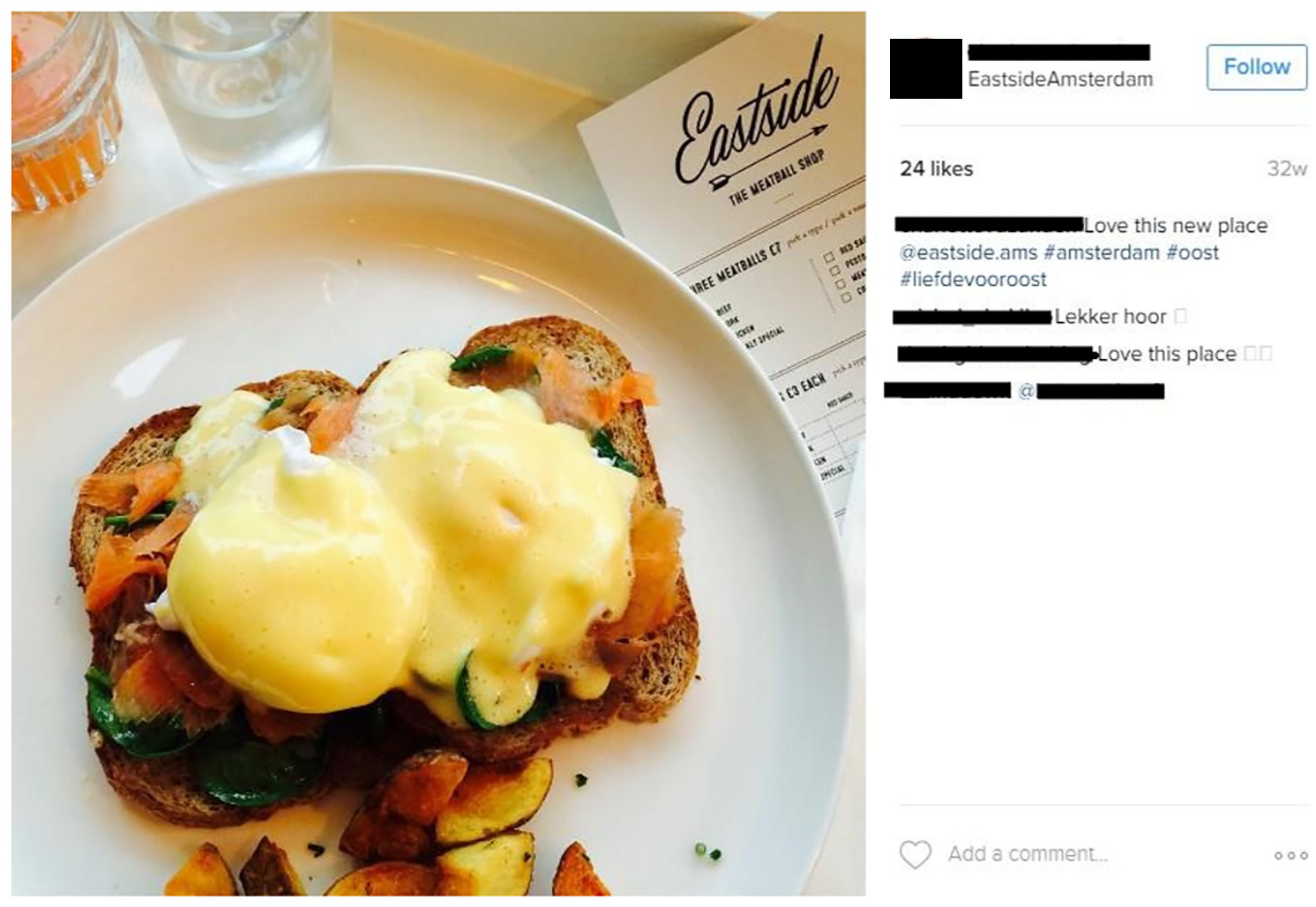
Instagram post showing a food plate in a new restaurant in Oost with a promotional comment (Instagram, 2016). Used with permission.
The promotion and celebration of the neighbourhood also occurs through neighbourhood merchandise. In several Instagram posts, people pose in sweaters and t-shirts bearing the word ‘Oost’. An example of such posts is Figure 2. To celebrate his move to Oost, the Instagram user made a composition featuring an ‘Oost sweater’, housekeys and a watch, powerfully illustrating how new residents engage in elective belonging (Savage et al., 2005). Several brands sell clothing and canvas bags that bear the word. One that is particularly successful is the designer clothing brand OOST/WEST, owned by two young men. They sell different types of sweaters and t-shirts with either ‘Oost’ or ‘West’ printed on them (see Figure 3).
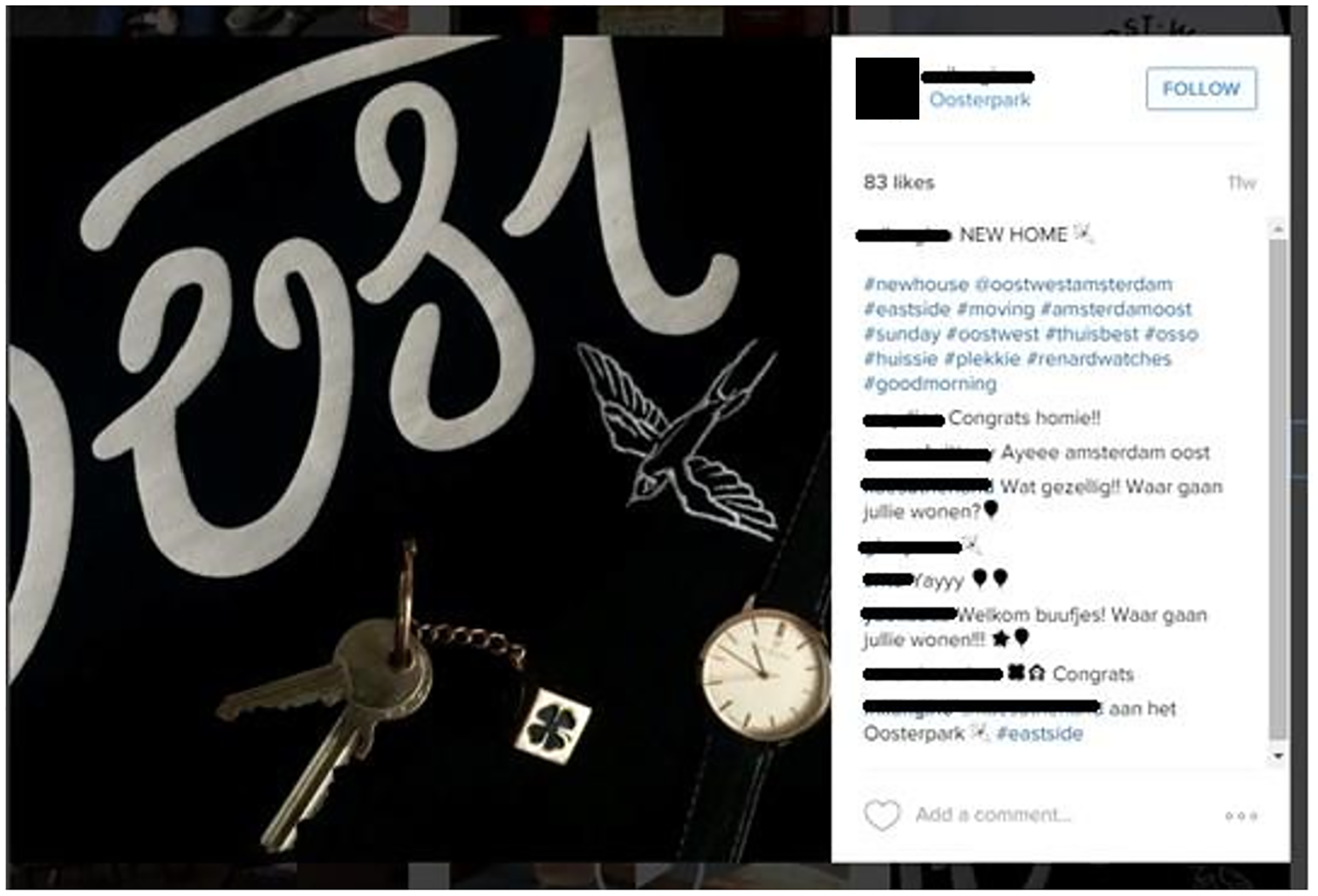
Instagram post showing an Oost sweater, keys and watch, geo-tagged at Oosterpark, with the comment ‘New home’ (Instagram, 2016). Used with permission.
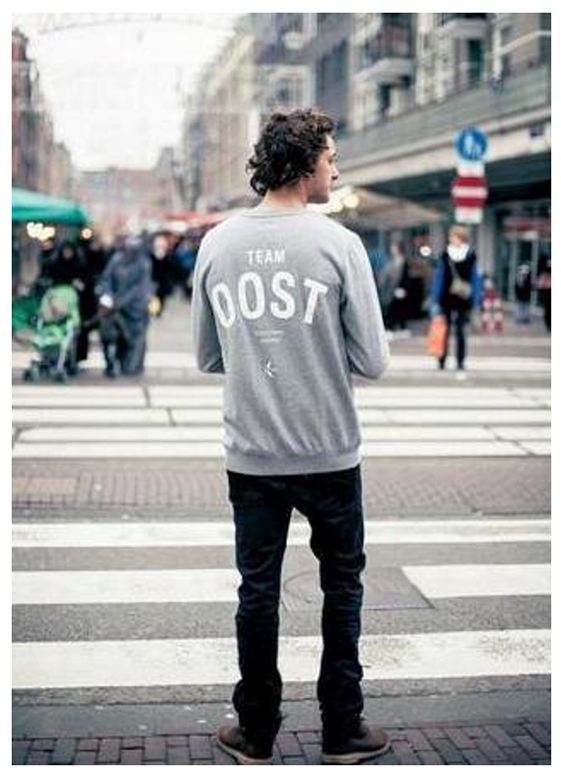
Man wearing an OOST/WEST sweater (photo by Linda Stulic, from Smit, 2016). Used with permission.
In a conversation with the owner of a designer clothing shop on Javastraat, which sells the brand, he connected the popularity of the clothing to the changes in the neighbourhood: There’s a process of gentrification going on in the neighbourhood and you see that the sales are going extremely well because of it. It appeals very much to the feeling that people have about living in Oost. Of course, it’s still a poor neighbourhood, but you notice that a growing number of people are proud of living here.
Although the majority of Javastraat posts in our corpus are from residents and customers who appear to post spontaneously, the most prolific bloggers often receive free products or commissions for their posts. The most visible account covering Javastraat on Instagram is operated by ‘Jill’s Eastside’, a small-scale advertising agency run by three women who are newcomers to the neighbourhood. On their Instagram feed and website, they post photos on a daily basis of different places in the neighbourhood, mostly coffee shops, bars and shops. Their activities are a telling example of discursive investing in Javastraat, as these entrepreneurs earn money by selectively representing the neighbourhood and its consumption spaces. While Jill and her colleagues do not miss an opportunity to profess their love for the neighbourhood, their affinity does not extend to all establishments. They specifically promote new places catering to gentrifiers while disparaging others. They explain that Javastraat used to be ‘really horrific’ but that the neighbourhood is now going in the right direction (cited in Smidt, 2015: 53). At first glance, their ‘Be local, buy local’ motto, used to promote their pop-up shop selling local products, seems to support all local entrepreneurs in the neighbourhood. It sells a selection of products from neighbourhood shops. But Jill only works for a select group of local shops in Javastraat. When asked about the absence of products from immigrant entrepreneurs, we were told they do not have ‘appropriate products’ and that cucumbers have no place in a pop-up shop.
While the vast majority of content is produced by and for white middle-class residents who take an interest in Javastraat as a space of aspirational consumption, we did on rare occasions encounter social media users who identify with the street and the neighbourhood for other reasons. For example, in a post with the placetag ‘Eastside’, we see a young black man posing in front of his apartment door wearing an outfit created by the streetwear fashion label ‘Filling Pieces’. Another post is a close-up of a young black man posing with a cap emblazoned with ‘Eastside’. The gothic letter font resembles a graffiti style and looks notably different from the hipster aesthetics on the ‘Oost’ clothing showcased by other social media users. During an interview, the poster, a local rapper named Capa, explained why he wears the cap: You just want to show where you’re from, you know. ‘This is me. This is what I stand for.’… Look, rappers are the neighbourhood and the city, you actually represent both. Wherever I go, when I wear that cap, they immediately know where I’m from.
While both Capa and gentrifiers wear place-branded clothing items, they do so for different reasons. For the gentrifiers, such clothing is part of elective belonging (cf. Savage et al., 2005): they moved to a neighbourhood that matches their aesthetic and lifestyle aspirations, and communicating their affinity with the neighbourhood is a way of valorising the move and marking their new-found status. For Capa, in contrast, the Eastside cap reflects his rootedness in the neighbourhood and thus tells a very different story of local belonging (Savage et al., 2005).
Rapper Capa is not an exception: there are many people like him who were part of the neighbourhood long before it was discovered by gentrifiers. Sakızlıoğlu and Lees (2020), for example, discuss immigrant entrepreneurs, who tell a very different story of the street. For these entrepreneurs, the street was at its zenith in the 1990s when it provided ample opportunities to start businesses and attracted mostly immigrant consumers from the neighbourhood and the wider urban region. The refurbishment and new establishments represent a development that has been thrust upon them and to which they have to adapt, whether they like it or not (Sakızlıoğlu and Lees, 2020).
Javastraat as a stage for status displays
Having discussed the various representations of Javastraat, we now turn to motivations. During interviews and fieldwork, respondents talked about their motivations for representing Javastraat and Oost. These conversations often resulted in praise of the neighbourhood and its recent development. Respondents enthusiastically expressed what it meant to them to live in Indische Buurt. With sparkling eyes, they talked about the neighbourhood’s many amenities, its ambiance and its urban character. While most of them had moved to the neighbourhood only recently, they identified strongly with Indische Buurt or ‘Oost’ as a whole and did not expect to leave soon. They cited lifestyle choices and emotions rather than practical considerations to explain why they lived in the neighbourhood. For example, for local blogger Karlijn, it ‘fitted her ideals’; another respondent said she ‘felt at home’ in Indische Buurt, and yet another referred to it as ‘my little neighbourhood’.
For most respondents, being proud of living in the neighbourhood and close to Javastraat were important motivations for their promotional representations. They enjoyed sharing posts on their visits to local establishments and following other accounts that share news about restaurants, bars and shops in the neighbourhood. Reading and posting about the neighbourhood valorises and enriches their presence there; they get more out of it. Some of the bloggers and Instagram users said that they appreciate the neighbourhood not so much for what it is, as for what it is becoming. While some friends and family members had expressed concern about their move to a ‘dangerous’ and peripheral neighbourhood, the Indische Buurt neighbourhood has been rapidly rising in status. As Derek’s quote in the introduction shows, he was proud to be a part of the gentrification process. He went on to explain that he started his blog after a conversation with the city council about improving the reputation of Javastraat: During an interview for a job with the council, I said I’d like to do something about Javastraat, because I thought it was such a nice street with great potential, but where very little was happening at the time. The job didn’t work out, but that’s how we came up with the idea for the blog. And now seven years later, I’m kind of proud that I said that, seeing what has happened to the street now.
Several respondents talked about their social media feeds as though they were trophy cabinets. As blogger Christel explained, they want to show that they have been to ‘the new cool place’. She said that the neighbourhood’s status was improving as hip places proliferated: ‘For young people, restaurants and bars are important and define the neighbourhood.’ She said she was determined to show her followers how nice her neighbourhood is. When asked if she herself was sensitive to those messages on Instagram and other platforms, she answered: I try not be swayed easily by what I see online, but if I notice like ‘all right, really everyone is going there’, not to say that I’d immediately run to that place, but then I know it’s apparently worth visiting, or it’s just cool if you’ve been there [laughs].
Although gentrification is celebrated unreservedly in many posts, discursive investors often have more ambivalent goals than simply promoting gentrification. When talking about the future of Javastraat, some interviewees expressed their worries about a possible loss of diversity: I’m a little afraid that it’ll become too much of a ‘hip’ place. That’d be a shame. I do hope this mix will stay. The Turkish supermarkets, everything is mixed. That’s nice.
Neighbourhood blogger and resident Nadia was not the only one who said she wanted to preserve the ‘old-timers’ and their shops. They are considered convenient for buying cheap vegetables and special ingredients. Mare, a resident, said that the ethnic supermarkets, greengrocers and bakeries made her feel ‘like being on holiday’. However, such appreciation is not reflected in their blogs or feeds: even when they frequent these establishments, they do not showcase their visits online. These findings show similarities with Tissot’s (2015) work on middle-class mobilisation in a Boston neighbourhood, in which she shows that upper middle-class residents highly valued diversity, but only under specific conditions and in particular places. Their drive was to discursively invest in places that boosted their own status and that of the neighbourhood. This drive contributes to what we refer to as amplified gentrification: when browsing online, Javastraat and Oost look much more gentrified than they do in reality.
Pushing for gentrification
We have now established patterns of uneven representation and discussed the motivations for writing about Javastraat and Oost. We have shown that place representations mostly do not reflect deep local roots but rather express elective belonging. A further question concerns the material impact of such representations on the street itself. It is impossible to provide a precise answer to this question since we cannot isolate the impact of representations. Nevertheless, it is possible to examine in what direction the discursive investors push. What sorts of neighbourhood change do they bring about?
Much like advertisements, many of the posts idealise and promote consumption. When we asked Christel, a young woman who had moved to Indische Buurt a couple of years previously, about her reasons for posting about Javastraat, she said that she wanted to express her pride in the neighbourhood. She also mentioned another reason for posting: It also has to do with drawing attention to your neighbourhood and supporting nice places. I was recently having lunch at a restaurant in Oost. And I posted something about that, because I really like the place and I think it should be seen. … People are more likely to go to places that are mentioned often. What other people write about you, that remains the best marketing.
By advertising places to their followers, social media users feel they contribute to their success. We cannot know for sure whether these representations indeed attract other gentrifiers, but many of the posts are intended to achieve this effect. Sometimes posts are actually advertisements posted by an establishment’s personnel, influencers or marketing agencies. For instance, local blogger Karlijn has built a network in the neighbourhood through her blog and she often gets offered complimentary dinners or other treats in return for promoting places to her extensive group of followers: I write about all the places I find cool, and I enjoy encouraging people to go there too, also people from outside of Amsterdam. Sometimes these places invite me to come. For example, one restaurant always invites me whenever they have a new vegan menu for me to try. And I like to share that with others. This way it really becomes your neighbourhood.
Altogether, these Instagram users push for neighbourhood change. Their social reputation and cultural capital allow them to define the street and the direction it is taking, reinforcing the framing of the street as an up-and-coming domain for high-end consumption. This push for change also affects the aesthetics of the neighbourhood, which are redesigned so that they conform to gentrifiers’ aesthetic expectations. One prominent example of aesthetic adaptation is an initiative by Aisha Tahiri, a creative entrepreneur, consultant and neighbourhood resident with a Moroccan background. She argues it is an outrage that the municipality heavily invested in the refurbishment of the street and the renewal of the neighbourhood without taking into account the detrimental consequences for the older, immigrant-run shops. Although Tahiri emphasises the investment decisions underlying upgrading, she suggests that aesthetic sensibilities and narratives also play an important role. Politicians, policy makers and gentrifiers, she feels, often fail to recognise quality or value unless it is presented to them in an aesthetic register they understand. ‘These people have an Instagram vision’, she says, and this means that the immigrant entrepreneurs fade into the background. When we asked her if she sees it as her task to educate new residents on what the neighbourhood has to offer, she smiled wryly. ‘If only …’ She would want to change the way gentrifiers perceive the neighbourhood but this is not within her power. So instead she tries to change the environment according to their vision. She described her work as helping immigrant entrepreneurs to make their shops ‘Insta-proof’ by adapting their storefronts, signage and offerings. She had some success – a couple of stores have been able to attract new customers in droves after their makeover – but she knows she cannot thwart gentrification and displacement, only cushion the impact and change its form.
As shown by Sakızlıoğlu and Lees (2020), these forms of ‘ethnic packaging’ in Javastraat have reinforced existing ethnic and class inequalities, as some entrepreneurs are better able than others to adapt to the changing street and clientele. A similar argument is made by Fiore and Plate (2021: 404): ‘[b]y cultivating an aesthetic normativity both in long-term residents and newcomers as to what “good” diversity means, policymakers were able to further legitimise their own regeneration strategies and at the same time obscure the unequal power relations and exclusionary measures intrinsic in the process’.
Conclusion
Scholars of community and urban studies have long argued that the development of digital communication technology adds to rather than supplants local community relations and place belonging (Halegoua, 2020; Hampton, 2016). Our analysis affirms this general insight but stresses the uneven nature of digital placemaking: only some kinds of relations and some types of place belonging are represented, while others are pushed into the background. Our case study of an Amsterdam shopping street – Javastraat – shows that gentrifiers are particularly active in producing and circulating images on Instagram. Moreover, they are selective in how they represent the street: while Javastraat is ethnically and economically mixed (Sakızlıoğlu and Lees, 2020), white gentrifiers predominate on Instagram and in blogs, where the street is mostly depicted and celebrated as a place for high-end consumption.
Using a Bourdieusian perspective, we understand these selective representations as part of distinction strategies. Bloggers and Instagrammers use digital platforms to showcase aspirational consumption (Currid-Halkett, 2017) and ‘elective belonging’ (Savage et al., 2005). The posts valorise their investments in terms of both status and belonging. Zukin et al.’s (2017) concept of discursive investing is particularly helpful in this context, as it draws attention to the resources and effort involved in the production of representations, the pay-off for their creators and the material effects on the urban landscape. The digital representations amplify specific places and practices, prefiguring and promoting high-end consumption in the street. While this is often only an unintended side-effect of users wanting to share experiences with their followers, in other cases bloggers and social media users deliberately amplify places because they like them or because they receive a commission for doing so. Regardless of the motives or incentives, in effect these digital representations amplify gentrification in a dual sense: they amplify the process visually and push for it materially.
By analysing the discursive investments around Javastraat, our research shows how urban spaces are partly shaped by discursive practices occurring on digital platforms. Since digital platforms are designed as stratified systems of rank (Boy and Uitermark, 2020), we suspect that it is not coincidental that they reflect and reinforce inequalities in terms of class, race and ethnicity (see Graham et al., 2013, 2015; Leszczynski, 2020; Zukin et al., 2017). An argument could be made that the commodification of culture promulgated through digital platforms will result in the commodification of cities (Törnberg and Chiappini, 2020). At the same time, we know that digital platforms do not always play this role and can also harbour criticism (Castells, 2012) or reinforce political polarisation (Berry and Sobieraj, 2013). While our paper focused on Instagram, it is likely that other platforms will mediate the urban experience in different ways and to different effects, suggesting the need to investigate how different kinds of social media dynamics emanate from and feed back into urban change. As our urban imagination is increasingly constituted on digital platforms, it becomes ever more crucial to study their role in the contemporary city.
Footnotes
Acknowledgements
The authors want to thank John Boy, the seminar group at the Urban Futures Studio, and the Urban Studies reviewers for their helpful comments and suggestions.
Declaration of conflicting interests
The author(s) declared no potential conflicts of interest with respect to the research, authorship, and/or publication of this article.
Funding
The author(s) received no financial support for the research, authorship, and/or publication of this article.
