



Abstract
The article approaches belonging using the conceptual tool of urban imaginary to demonstrate how a certain place can be represented in different ways, offering different scenarios for the emergence, explanation, and experience of belonging. Urban politics in St. Petersburg and Russia, in general, generate controversial imaginaries of the city and attach different meanings to belonging, forcing street artists to strike a balance between the hegemonic structures of governance and capitalism, local (national) and global (western), rebellion, and dependency, notably, to fulfill their ideas of belonging. Using sticker artists in St. Petersburg, based on ethnographic data, the article shows how young people assimilate several urban imaginaries and, following the logic inherent in each of these, position themselves and their activity in the city. Sticker artists are described as urban agents, who, by participating in place-making and transforming urban space using stickers, find their subjectivity and opportunities to wield microscale power.
Introduction
“I don’t know where I could live other than Piter [informal name of St. Petersburg]. Let’s say, even in Moscow, I do not know, I do not like it at all, and I cannot imagine living anywhere but in Piter”—sticker artist Boris (male, 22) once said to me. In another conversation, Piotr (male, 20) mentioned that “the whole of Russia was open to me, but I chose St. Petersburg because my heart goes out to this city.” Irina (female, 30) shared her story as follows: “Of course, I moved to Piter, because I thought, damn, like I will have opportunity here for sure. <. . .> Well, I cannot imagine, I cannot imagine living in any other city at all. <. . .> I love Minsk, I might have lived there if I did not love living in St. Petersburg.”
These quotes from interviews with various young people represent not a unified but a predominant opinion of sticker artists about living in St. Petersburg. The artists emphasized their emotional attachment to this city and articulated the lack of alternatives—they could not imagine living anywhere else. The social and personal value and meaning of any place are not inherent, but invoked (Cresswell, 1992; Moore, 1986). The article began from my curiosity about why sticker artists from different backgrounds seemed to have a similar relationship with the city, and they even expressed it in similar ways. What is the role of sticker art in the shaping of this emotional attachment to St. Petersburg? Moreover, if artists point out the importance of St. Petersburg for them, i.e., they belong to this city, does it mean that the city reciprocates? Is it possible to say that the city of St. Petersburg belongs to sticker artists?
Indeed, the uneven development of the Russian regions and their economic inequality (Zubarevich, 2019) provokes an increase in migration flows, notably to Moscow and St. Petersburg, which are more prosperous, in order “to have the opportunity” as sticker artist Irina said. The growth in the number of newcomers also raises the question of who has the right to transform and rule the city (Lefebvre, 1991) that has already been occupied by multiple stakeholders—local authorities, businesses, indigenous city residents, cultural intermediaries, and other artists.
Belonging to a Russian city also touches on the issue of national identity. St. Petersburg, geographically and, perhaps, ideologically closer to the West—the Other, in a counterbalance to which Russian national identity is usually constructed. Nation-building is implemented in many areas, but the culture and young people’s cultural engagement has been an extremely sensitive and contested area for decades (Litvina, 2019; Omelchenko, 2012; Pilkington, 2002).
This article focuses on the so-called “authors’ stickers” (avtorskie nakleyki—the Russified name that artists chose to identify their activity) treated by artists as small art forms and unauthorized urban interventions related to graffiti and street art, that came to Russia from the West in the 1980s and 1990s (Ponosov, 2016) and have already taken root and become an integral part of Russian cities. As Trubina (2018) and Lerner (2019) have noted, Russian cultural policy tries to adapt street art to the dominant national political agenda via financial support and approval, for example, by holding a festival.
The Russian hybrid political regime (Lerner, 2019; Turoma et al., 2018), combining conservative and neoliberal tendencies, is reflected in the logic of the production of the urban space of St. Petersburg. The conservative urban planning and preservation of the city space from any intervention (Zhelnina, 2013) co-exist with a neoliberal approach to street art as a valuable commercial asset in the development of the tourism and entertainment industries (Andron, 2018; Kanai, 2014; Trubina, 2018; Yúdice, 2003). Acting together, both forms of urban politics promote controversial imaginaries of the city and different meanings of belonging, and locate artists in a rigid framework, forcing them to balance between the hegemonic structures of governance and capitalism, local (national) and global (western), rebellion, and dependency, to fulfill their ideas of belonging.
Sticker artists are minor creators of urban space, whose voices at the macro-level are drowned in the urban polyphony. They establish relationships to the territory, approaching the city space from an extra micro-perspective, working with urban details. Sticker art is an art movement constituted through the creation and distribution of stickers in the city—little paper or vinyl objects with adhesive backing, which may appear in places where the presence of other street art and graffiti is difficult or even impossible. A sticker may show a character, symbol, nickname, or tag, the meanings of which are usually politically neutral.
This article, using ethnographic data, aims to reveal how sticker artists are involved in the urban identity-making process via small-scale local culture, placed in the global context. I analyze the role of stickering activity in the formation of artists’ emotional belonging to the city of St. Petersburg. I approach this through urban imaginaries—representations of the city internalized by artists and determining social inclusion and exclusion in the city (Dillabough & Kennelly, 2010; Leurs & Georgiou, 2016; Yuval-Davis, 2006). In order to do this, I first consider the specificity of sticker art as a subgenre and as a community of young people, then describe my theoretical and methodological approach to studying belonging in this group, and, finally, I explore how sticker artists identify themselves, build a relationship with the city and act, according to moral precepts provided by different imaginaries.
Urban Culture Sticker Art: Creativity, Communication, and Play
In St. Petersburg, sticker art appeared in the early 2000s, and nowadays this culture has attracted a number of participants and fans, who have formed one of the biggest communities of sticker artists in Russia. Sticker art is described as a branch of graffiti or street art, often inseparable from each other in the narratives of sticker artists in St. Petersburg and put in a broader context of hip-hop culture. On the one hand, another name for this activity—sticker bombing—unites it with graffiti because of the common idea of capturing or tagging space as well as its illicit nature 1 . On the other hand, stickers are targeted at a wider audience than graffiti, where letters and styles are mostly read by and recognizable only to other graffiti authors (Ferrell, 1993; Macdonald, 2001; Snyder, 2011). Stickers, by contrast, often feature characters—artists’ alter-egos and/or fictional protagonists—who address city residents, other artists, and peers. Public-oriented sticker art can also be seen both on the streets and in museums (Shirvanee, 2006). Many artists create other forms of street art (posters, murals, etc.) and have a background in graffiti.
Sticker art, like graffiti, is a communication game that allows telling about one’s movements (Macdonald, 2001). Encounters with stickers are similar to meetings with sticker artists, who may have been in that place before. Sticker artists create collages or so-called combos, superimposing their stickers next to those of other artists. However, this is not the same “fame game” which scholars usually attribute to graffiti (Macdonald, 2001; Snyder, 2011) that follows a specific street etiquette according to which the positioning of a tag relative to others, its size, and style embody and visualize the social relations and power within the subculture: the status of each writer, respect or disrespect. Stickers in most cases are not tailored specifically to be pasted alongside the work of any given author; a sticker is often printed in large numbers of copies, so the same image appears in different places.
Meager financial resources, little interest from the public and the cultural institutions, and, finally, the work of public utilities, who constantly paint over street art and graffiti, render the development of the sticker art movement quite challenging and voluntary, while recognition and respect from others are insignificant to the members. In such circumstances, sticker artists prefer to support each other’s endeavors and generate a friendly community, instead of cultivating rivalry, as someone has written on the wall “fuck fame, save the culture.” Sticker artists mention that they prefer not to judge the “quality” of stickers. Some also think that a single sticker may be beautiful and fascinating, but a “combo” is a more attractive and visible form of sticker art. Once, I watched an Instagram streaming—a tour of the exhibition, organized and curated by the sticker and street artist, who repeated several times words of gratitude to various artists who, as he said, “supported the exhibition” by providing their artworks. His idea that the exhibition, as well as the overall culture, is possible only due to the efforts, involvement, and presence of all participants—artists, curators, audiences—who through their interest, actions, assistance and just keeping in touch allows sticker art to arise and continue.
The key difference between sticker art and other subgenres of street art and graffiti is the specificity of a sticker as a medium, which is drawn by the artist not on the street, but beforehand. It means that the process of creating an artistic artifact and the act of introducing it into the urban space are separate, and can therefore potentially be carried out by different people. Artists send their stickers to sticker artists in other cities and countries or give them to friends who travel, so as to be located and appear through the stickers in places where the artists themselves have never been. Moreover, being a material object, stickers that were not placed in the city, but were exchanged, given or removed, can overcome their ephemeral nature, and be saved, for example, in someone’s collection.
Sticker artists and audiences are involved in “street art hunting”—a game based on searching and sharing stickers via social media (Foushée, 2019). Some artists even developed special strategies to encourage Instagram users to search for stickers and publish photos of them, tagging artists. Digital media makes it possible to document and preserve stickers as well as increase the number of viewers exposed to stickers (MacDowall & de Souza, 2018).
Sticker art as creative game communication allows artists to discover new potentialities of public space and to use it in unexpected and non-functional ways (Crossa, 2013; Stevens, 2007). For example, sticker artists hope to encounter later the same metro train they have put the sticker on, reimagining the metro as a place of ludic unpredictability and randomness. Their activity transforms the depersonalized spaces and metro mundane routine into something fun, relaxing, and familiar, thereby turning a rational technical system into a gaming site. Pyyry and Tani (2019) have suggested that the spontaneous playing of young people with the city challenges the normative ways of being, opening up new spaces of becoming, and creates micro-atmospheres of joy (Pyyry, 2016), from which everyday spatial politics can arise. Similarly, Shepard Fairey, the author of the famous sticker “OBEY” and the image of Andre the Giant, in his manifesto of sticker art, has described a sticker as a tool that can convey no idea or message itself, but provokes questioning of surroundings that are taken for granted surroundings and triggers new reactions and interpretations of a familiar environment (Fairey, 1990).
Politics of Belonging to the City and Urban Imaginaries
The city space is inhabited by people who are united by shared geographical, economic, social, and cultural meanings. In a sense, the inhabitants of one particular city can be called an imagined community based on the abstract sense of sameness or solidarity, which occurs in strangers who identify with a certain social group or territory, especially if that territory is actively mediated and branded—acquiring various images, myths, and representations created and disseminated through various media. The concept of imagined community was originally introduced by Anderson (2006) to analyze nation-building and the maintenance of a sense of belonging to a nation and then drawn upon to approach a wide range of communities, shaped e.g., by sexuality (Winer, 2020), age (Conway, 2003), appearance (Adamczyk, 2010), or the use of certain social media (Gruzd et al., 2011) to examine the dynamics of social inclusion and exclusion.
The imagined community is structured by discursively constructed boundaries—politics of belonging that separate the world into “us” and “them,” determine what status and entitlements membership in the community entails, and defines how individual and collective identities and attachments are valued and judged (Yuval-Davis, 2006). These boundaries are manifested and anchored in urban imaginaries (Leurs & Georgiou, 2016)—collectively manufactured symbolic representations and mental mappings of the city spaces (Graham et al., 2016) as sites of opportunity or exclusion—and experienced emotionally through the feeling of attachment to place or, on the contrary, rejection, fear, and dislike. Imaginary subsumes the present and the history of the city, memorized, and manifested in everyday practices and discourses (Dillabough & Kennelly, 2010), the anticipated future, local and global symbolic orders, intertwined and reconfigured in the certain geographical site. Imaginaries are included in a wide grid of power relations specific to a particular society; they are not imposed from above nor spontaneous and reflected multiple urban inequalities caused by class, race and ethnicity, religion, and locality (Leurs & Georgiou, 2016). As Massey (1994, p. 3) has noted, “the social relations of space are experienced differently, and variously interpreted, by those holding different positions as part of it.” Imaginaries interrelate with the production of discourses and cultural meaning-making “that are consumed and internalized by social groups and that subsequently materialize in social practices” (Leurs & Georgiou, 2016, p. 3692).
Ricoeur defined a social imaginary as a set of collective stories, histories, and ideologies that shape socio-political actions. Imaginary fulfills both the role of identification that saves and preserves ideology and the role of destruction that provides alternatives and creates new utopias (Kearney, 2004 cited in Dillabough & Kennelly, 2010). Leurs and Georgiou (2016) activated the concept of urban imaginary as a tool that allows researchers to grasp how action, morality, and imagination are intertwined and expressed in the everyday practices of city dwellers. Internalized images and ideas about the city are the basis of meaning-making mechanisms for understanding the city, its affordances, and its limits as well as a starting point for inhabitants to seek their places in the city and the world and, ultimately, for social change.
Urban imaginary generates some of the pivotal markers of imagined selfhood for many young people (Dillabough & Kennelly, 2010), mediates their belonging to the city and the sense-making of their own positionality, shaped and negotiated by many diverse and contradictory discourses of respectability, authenticity, and value (Stahl & Habib, 2017). This article examines how urban imaginaries are incorporated in a sticker art activity and determines young people’s identifications, subjectivities, and daily exposure to (sub)cultural, spatial, moral, and historical environments.
Methodology
I have accessed young people’s experiences of belonging to the city by approaching the urban imaginaries that manifest themselves in sticker artists’ narratives and practices. The empirical material for this article was collected during ethnographic work that took place in the summer of 2016 2 , autumn 2018, and summer 2019 in St. Petersburg. The data set includes in-depth interviews, ranging around 90–120 min (8 females, 16 males, aged 13–40 years), observations during participation in sticker art events (jams and festivals), and “go-along” tours. Moreover, I monitored social media connected with sticker activity in St. Petersburg: public groups in Vkontakte, such as Russian sticker art, Fymers (which was renamed in Sticky Unity), STICKASS, and the personal Instagram accounts of sticker artists. The research participants were recruited from social media and through the “snowball” procedure of peer recommendations. The personal data are anonymized and the names mentioned in this article are pseudonyms.
Sticker artists also participated in a photoshoot 3 for the art research exhibition “Visible Invisibility.” This activity involved them more profoundly in the research and helped me to establish trust with the young artists.
In this project, traditional methods such as interviews and observations are combined with spatial methods such as go-along (Kennelly, 2017) and photoshoots, which focus on the everyday spatial experience of people and ask them to position themselves in the space (Stahl & Habib, 2017). During the photoshoot, we invited sticker artists to show us “their city,” the city that they inhabit, some places that are important for them or the community, and connected somehow with the activity of sticker art.
Ethnography as a research method provides an opportunity to delve deeper into the everyday life of the research participants (Dillabough & Kennelly, 2010) both at the meaning-making level and sensory experience (Pink, 2015). I was trying to move beyond linguistic description and consider visual (the representations of stickers and their content), spatial (locations and choreography of urban motion), and sensorial data (feeling and sensations related to sticker art activity, indicating the various boundaries) collected during my digital and traditional observations. I conceive my research task as revealing categorization and classification, and the meanings related to them used by young people to define themselves in relation to sticker art and the city.
In order to examine how sticker artists imagine St. Petersburg, I mainly rely on the idea, introduced by Leurs and Georgiou (2016) assuming that in everyday life imaginary is implemented and structured by moral, action, and imagination, assigned to some place and time. I distinguished three imaginaries or “cities in the city” (Young, 2014) that are shared among sticker artists and appeared in their narratives. Each of these imaginaries provides a different representation of the city of St. Petersburg and is governed by a different moral order that allows and prohibits different types of actions. Different artists may adhere more to a particular imagery of the city, identify themselves with it, but to some extent, all three cities are inhabited by sticker artists.
Each imaginary activates sticker artists’ citizenship and participation in place-making in a different way and provides them with the repertoire of self-identification. Choosing politically neutral images and slogans (or images/slogans that are assumed to be neutral) for stickers and attaching them to different elements of infrastructure, which are interpreted by artists as a unified urban function, “gray space” or “nonplace” (Augé, 2009), not intensively covered by moral order in any imaginary and demanded only by the “marginalized” groups (as, for example, inconsistent advertising) whose right for these surfaces can be questioned, they create themselves an opportunity to maneuver between belonging to the different cities crafted by different imaginaries.
The Conservative “Museumificated” City
Even though the urban landscape of St. Petersburg is heterogeneous and diverse (Sementsov, 2007), the image of the city is often associated with the historic center. St. Petersburg is known as a “Northern Venice” and “cultural capital,” whose space is perceived as an embodiment of the illustrious history and culture and recognized as a world heritage site under UNESCO protection. 4 This urban landscape is represented as a value that was preserved and restored after the Second World War due to the valiant efforts of the inhabitants of the city (Trumbull, 2014) and should be preserved in the future. The so-called museumification of urban space supported by the strengthening of protective politics leads to the formation of a city whose public space is not intended for discussions or protests but cultural consumption—it should “be observed, but never touched or lived” (Zhelnina, 2013, p. 58).
Different actors articulate the imagery of the city as a museum and actively employ it in various contexts for various purposes. The city residents internalize this discourse and appeal to “moral authority and knowledge about the city and its history” to contest the urban space and express disagreement with the decisions on urban development (Dixon, 2010, p. 46). Agents who follow neoliberal logic also support the idea of the city as a heritage and consider urban space as a commodity that should look like a “postcard” to attract tourists and customers. Even the street artists of St. Petersburg emphasized in a magazine interview that “in the city like ours, you need to invade especially ethically and tactfully” (Generalova, 2019).
The marginal position of stickers in the conservative imaginary of St. Peterburg also applies to the artists themselves. I asked Stepan if he considered himself a St. Petersburgian, he answered: St. Petersburgians are good people; we are not them; we are just Piterers [Piter is an informal name of St. Petersburg]. <. . .> Because at school, when we did something [‘wrong’], we were told how can you be St. Petersburgians? (male, 13)
The “moral” image of St. Petersburgians, represented by Stepan, appeals to some unwritten norms of behavior collocating with specific ideas about culture, education, the morality of the city residents. Even the official name St. Petersburg can be seen as a legacy of imperial ambition, binding to something “great” and “gala.” Thus, to switch to the name Piter removes the veil and allows sticker artists to be not an “exemplary” citizen following the rules, but the user and inhabitant of this space.
Generally, sticker artists recognize and share this dominant imaginary of the city of St. Petersburg, governed by the normative order that defines sticker art in terms of vandalism or hooliganism and manifests in artists’ feeling that they are doing something wrong, are damaging something, and leaving garbage in the city. Graffiti is traditionally interpreted as dirt, disease, bodily waste, or threat (Dovey et al., 2012) that represents a danger to the image of the city or even the idea of civilization (Cresswell, 1992). This notion of “dirt” most clearly demonstrates the work of the politics of belonging: something becomes dirt when it is out of place and thereby disrespects the order (Douglas, 2003). In this regard, graffiti or stickers stigmatized as dirt are declared to belong in the place of others and to be produced by others (Cresswell, 1992). Sticker artist Eugenia said: In general, some borders should be everywhere, and it often happens that sticker art damages something. Especially the guys with the tags. When they write their tag on all the facades, it is not always pretty. More often, the visible part looks like dirt. For example, in Rome, if you were there, everything is shitty. It is unpleasant to walk around the city; everything is covered with these tags. (female, 31)
This quotation introduces the idea of borders, expressed in a number of stickers and the way they are located in the urban space that should protect residents from the dirt that does not belong in the city. Interestingly, in order to discuss stickers as dirt, Eugenia gave an example of a European city in which she has experienced a sense of dirt. Being initially the product of western culture, sticker art and its inherent principles were reinvented or at least adapted by artists to the Russian realities of St. Petersburg. Sticker artists emphasize that they usually look for spots that are already “dirty,” or where the damage from stickers will give the least offense. In some cases, these surfaces are usually located in abandoned places (refer to Figure 1), in young people’s spots like bars or clubs, but predominantly in different elements of infrastructure such as the reverse sides of road signs, posts, fences, drainpipes, protective shields, and metro cars. According to sticker artist Boris, stickers have to be put on objects that do not carry artistic value and are not beautiful in their own right. He said: That is, especially in St. Petersburg, we have many places. . . you have to understand that you will only make it worse, and it is okay if it can be fixed, so in St. Petersburg, I think there must be greater responsibility for what you do, you need to understand. (male, 22)
Boris mentioned “many places” that are not named but can be deduced from the context—museums, monuments, old architecture—that is traditionally covered by the concept of high culture. Thus, he touches the binary of “high” and “popular” cultures and expresses a protective attitude toward “high,” giving it a priority. This idea of “no harm” and responsibility for the city space is powerful among sticker artists. Attempts to minimize the “damage” to the museumificated city and introducing stickers as something that cover up the ugly are a way for sticker artists to exercise citizenship and demonstrate their belonging to the city. Moreover, the conservative approach to the city space implies adherence to a common set of traditional conservative values, which become visible in the sticker art movement when artists remove items from the city space that they interpret as inappropriate for St. Petersburg such as, for example, sex industry advertisements. Thus, the artists can assume both roles—as city makers and as the guardians of conservative urban moral order.
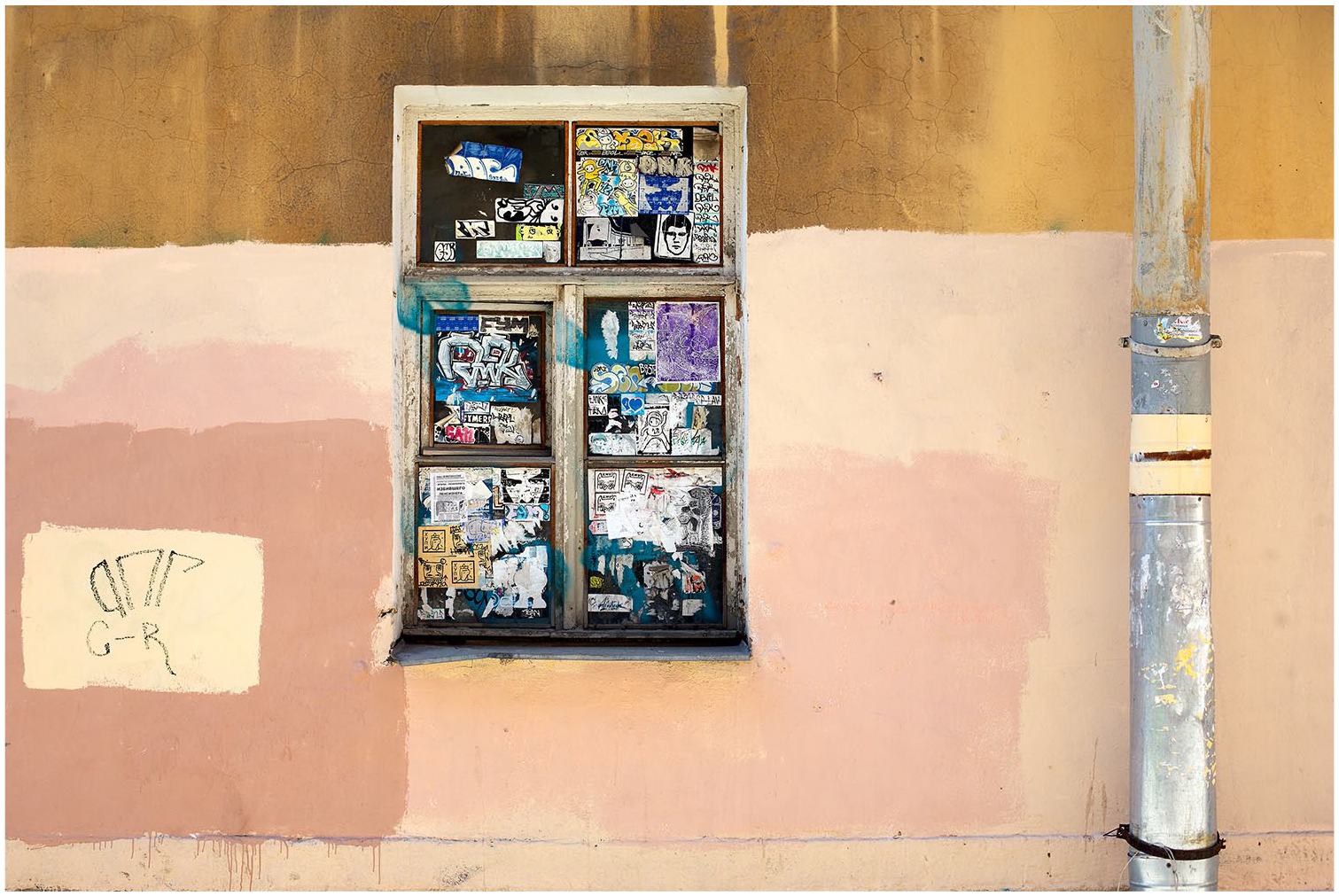
Abandoned Window and Stickers. Photo by Patrik Rastenberger.
The Creative City
Another imaginary visible in the sticker artists’ accounts represents St. Petersburg as a city attempting to be involved in global cultural trends, undergoing “modernization” and “internalization” (O’Connor, 2005), and seeking to diversify cultural production and consumption to attract tourists, investors, and developers. This imaginary is supported by neoliberal tendencies that together with traditional state-run cultural institutions promote the marketization of cultural industry (Turoma et al., 2018) and allows other cultural intermediaries to participate in cultural production and increase the diversity of the notion of culture.
The West and the western city act as a reference point and model for creative St. Peterburg. Sticker artist Elena mentioned: Well, it is just that I was always amazed in Europe, where this [sticker art] is normally treated and considered as a part of art; it’s like going to a museum. You, for example, saw a combo [combination of stickers], stood up, looked, realized what sticker you like, and then left. For you, it was like a mini-museum of street art. <. . .> Because for now [in Russia] street art is not recognized as massively as classicism or realism. Now it is considered hooliganism. Well, here [in sticker art] as in everything, Russia is lagging behind for many years even in fashion, I do not know, even in technology, even in lifestyle, yes. Also, Russia is lagging behind in art. (female, 24)
Nikolay also sought inspiration for sticker art abroad: I have a friend in America, another one. I remember, he started with zero followers on Instagram, now he has five thousand. He draws and sells awesome things. He has kind of a studio, he rented it recently. Well, everything is going well. And here. . .maybe people are lazy, me in particular, but somehow it doesn’t work. The feeling that it is easier to do it there, it is more in demand there. In our country, many people do not really recognize it and it is very poorly developed, or poorly developed. We are just beginning our journey in this regard. (male, 25)
Both artists expressed the idea that sticker art belongs to the (western) “progressive” society whereas “Russia is lagging behind.” Regretting the lack of recognition due to the “backwardness” of the city residents or the “laziness” of artists, they nevertheless manifested themselves these quotations as cultural innovators, who participate in the process of making the city more modern by appropriating a progressive culture and bringing it into the city. If in the conservative museumificated city, sticker artists interpret themselves as vandals, then the moral order belonging to the creative city allows them to appear as creators entitled to be in the city space and to transform it. Sticker artist Varvara (29, female) told me that she experiences an involvement in the arts through stickers and through the distribution of stickers in the city she demonstrates her presence in the art to others. Sticker artists fulfill their personal ambitions to express themselves, find the audience and make a contribution to the development of the city. They aim to embellish the urban space, initiate interactions between city dwellers, introduce them to different cultures and skills and inscribe sticker art and street art in the art history of the city (refer to Figure 2).
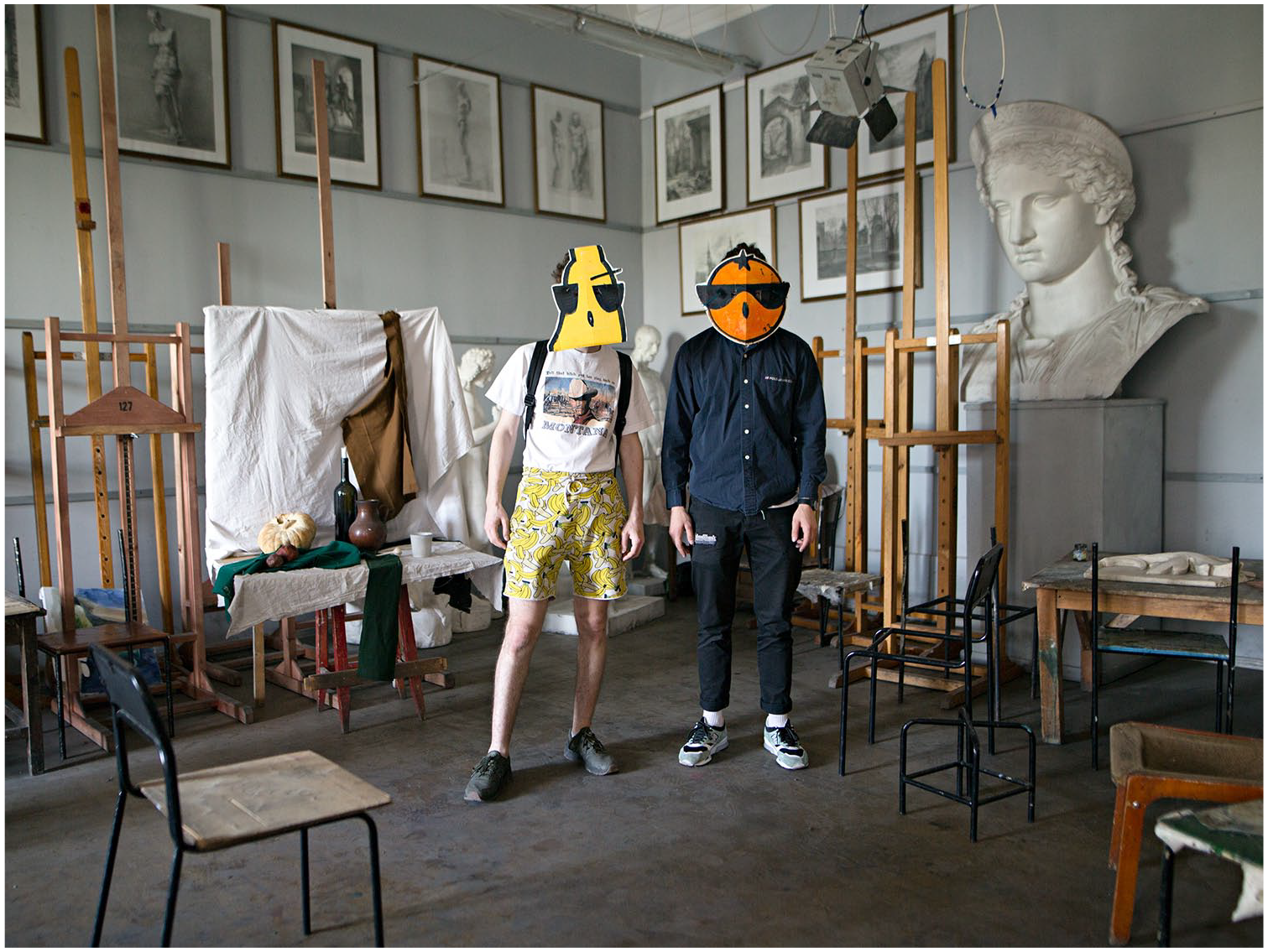
Sticker Artists in the Art Academy. Photo by Patrik Rastenberger.
The “Subcultural” City
St. Petersburg is surrounded by an aura of “informality,” “bohemianism,” and “alternativity,” shaped by the variety of artistic and subcultural practices attributed to the inhabitants of the city. The city is known as one of the centers of hip-hop culture in Russia with a long history of the development of the local community and infrastructure. Even one of the first graffiti writers in the USSR Basket was a resident of St. Petersburg while two other graffiti pioneers, Krys and Navigator, were from Riga and Kaliningrad (Ponosov, 2016). Young people involved in sticker art experience and imagine their belonging or at least proximity to these subcultural networks and subcultural St. Petersburg.
Traditionally, researchers describe subcultures as groups of young people who demonstrably distinguish themselves from others—parents, politicians, mainstream (Hall & Jefferson, 1993; Hebdige, 1979; Hodkinson, 2002). Occupying a subordinate position in society, they protest and symbolically resist the dominant culture, in particular, by violating its rules and regulations, and form a community of like-minded people, who share similar values from political to stylish. Thus, the normative order that governs a subcultural city implies disobedience to generally accepted norms as well as grassroots solidarity and a sense of community.
Sticker artists’ communities can hardly be called a subculture in the traditional sense; they have no shared articulated political ideology and do not voice any statements or protests. The members are connected by weak ties, which usually only manifest at a certain time such as festivals, exhibitions, or sticker jams. Members are from different backgrounds, and they are not united by having experienced any similar kind of discrimination based on class, ethnicity, sexuality, or gender. They have in common an interest in creative practices, communication, and partly hip-hop culture (or street culture) that opens the door to friendly space and new opportunities. In particular, participation in youth (sub)culture and the acquisition of subcultural capital (Thornton, 1996) may affect professional career paths inside the community and beyond. This may happen, for example, through realizing the entrepreneurial potential (McRobbie, 2002; Snyder, 2016) of sticker art, as in the case of Irina. She has launched her own hip-hop clothing brand. Irina described how she studied sticker art and got involved in this culture: And, then, it turns out, it [stickers art festival] inspired me so much. I spent the whole autumn and winter putting up stickers in the city. And I thought: damn, anyway! I started searching out the other guys, figuring out who they are. Well, somehow after this sticker fest, I began to read, watch who puts up what, and study it. I was so interested, I was discovering a new world, and it was really cool. (female, 30)
Irina’s example shows that learning culture mostly means learning the people who belong to it. Members of the community will see an artist behind every sticker, they know which sticker belongs to which author. This knowledge makes encounters with stickers on the street more meaningful and the perception of the city space more personal because they reflect the artists’ networks of friendship and communication.
Making unauthorized interventions in the city space, sticker artists violate and resist the legal norms and dominant moral rules that govern the city. Thus they consciously or unconsciously commit a political act in claiming their right to the city. This disobedience provides them with the experience of exercising their agency by being outside of or above the order. Piotr explained it with the example of his bodily sensations when he commits a public violation of the rules (refer to Figure 3): I experience a small adrenalin rush, especially when you, for example, walk along the busy Nevsky Prospekt, climb up somewhere, take a sticker out of a pocket and people throw some glances in your direction. You have, of course, some certain adrenalin rushes: it goes all over your body and you experience some certain pleasure because of this. (male, 20)
The communicative and collective nature of stickering activity also allows artists to sense the potential power of solidarity: they can attract the people’s attention to a certain place and initiate its transformation. Eugenia shared her feelings as follows: And the most fun thing is when I am the first one who opens up a “location” in some place, then after a while, there appear more-more-more [stickers], that increase. To know that you were the initiator of this disorder. (female, 31)
This microscale power that Eugenia experienced as a “disorder-starter” illustrates an experience of collective action and solidarity performed in a playful manner (Crossa, 2013) that can potentially inspire young people to mobilize when they wish. Thus, the subcultural city enables enhancing emotional attachment to St. Petersburg through belonging to the community and certain places where sticker artists can express themselves, find support, and subjectivity.
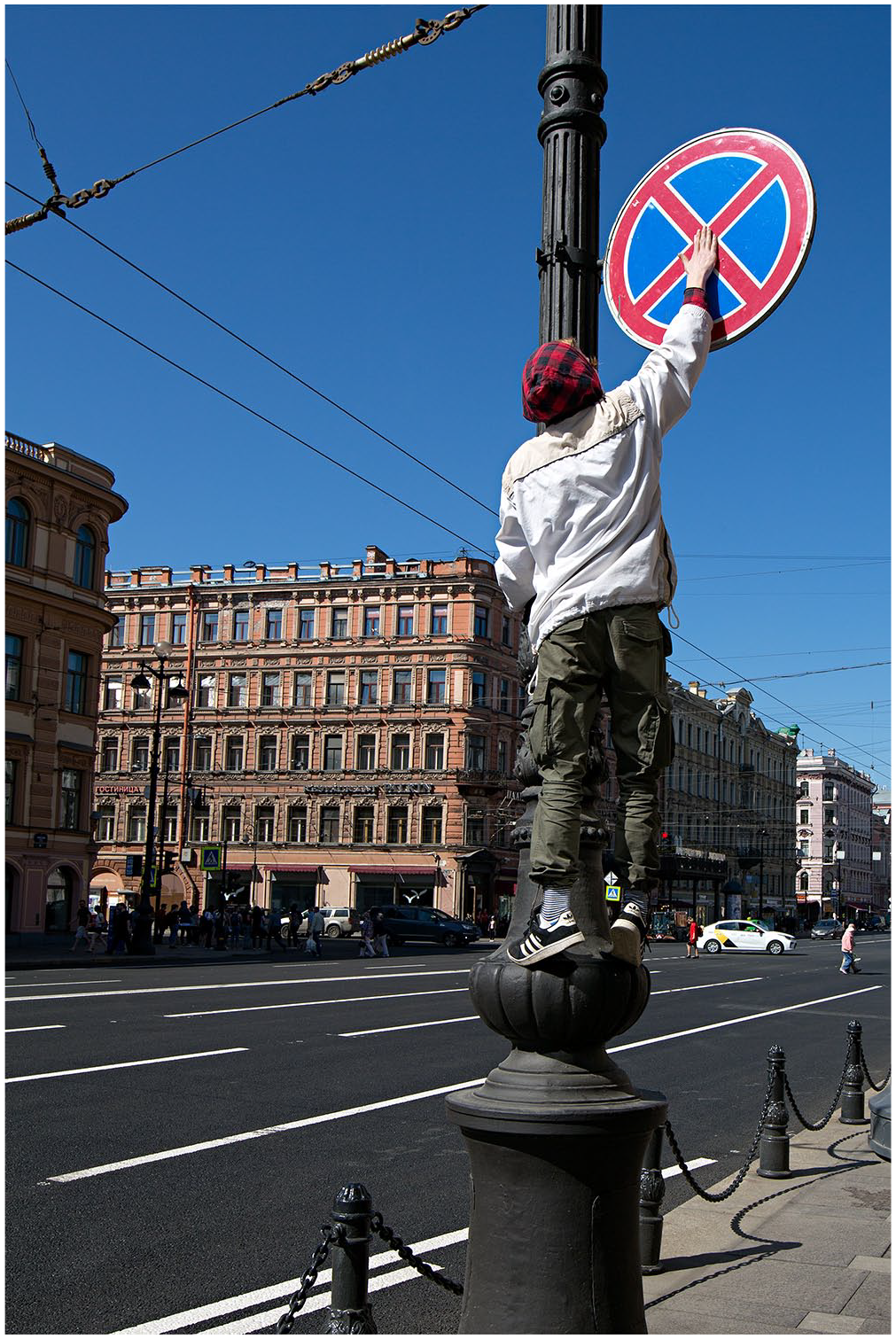
The Sticker Artist Puts up a Sticker on Nevsky Prospect—the Main Street in St. Petersburg. Photo by Patrik Rastenberger.
Conclusion
This article approaches belonging using a conceptual tool—urban imaginary—to demonstrate how a certain place can be mediated in different ways, offering different scenarios for the emergence, explanation, and experience of belonging. Through the example of sticker artists in St. Petersburg, I show how young people assimilate several urban imaginaries and, following the logic inherent in each of them, position themselves and their activity, and exercise their citizenship. The article, addressing the idea of the socially determined diversity of imaginaries (Dillabough & Kennelly, 2010; Leurs & Georgiou, 2016; Stahl & Habib, 2017), suggests the perspective of a multiplicity of imaginaries about the place or urban phenomenon that is shared by the group of people, whose daily lives and identities are shaped and affected by all of these imaginaries together. Numerous identifications, positionings, and interpretations are entwined in a tangle that needs to be analytically unraveled, separating the different imaginaries and their derivatives from each other, although sometimes they may overlap. Thus, the discussions on graffiti as vandalism-versus-art (Cresswell, 1992; Dovey et al., 2012; McAuliffe, 2012), and the negotiation of the meaning and manifestations of global and local in modern cities can be enhanced by approaching them through the perspective of a multiplicity of imaginaries that constitute different moral orders in which people act and to which they belong.
Earlier research has mostly ignored sticker art and merged it into broader artistic or subcultural categories. The article introduces sticker artists as agents, who by taking part in place-making and transforming urban space, find their subjectivity and microscale power. The analysis shows how the urban space is produced at different levels: globally, nationally, and locally. The local level is also divided into many layers, occupied by various stakeholders and participants. I suggest considering sticker artists as those who operate on an urban extra microscale, responding to others and expressing themselves in and through the urban details. Adapting their practices to different imaginaries, artists, on the one hand, legitimize and accept these imaginaries, and, on the other, subvert them by bringing the new and alternative elements, initiating urban change. Being a minor actor in an authoritarian and neoliberal society, artists prefer to form a culture of solidarity and support, involving in solidarian place-making (Christensen & Thor, 2017), and not to rebel but to look for loopholes to realize their aspirations about themselves and the city.
Footnotes
Acknowledgements
I would like to thank the DiMe project team, Yana Krupets and Margarita Kuleva for the inspiring joint fieldwork, anonymous reviewers, and Professor Päivi Honkatukia for insightful and very useful comments. Thanks also to everyone who helped me to develop this article at its various stages, especially Gusel Sabirova, Malin Fransberg, participants of the FRRESH summer school (2019), the Youth Research Seminar at Tampere University, and the colloquium of Eastern European History of the Universities of Kiel and Bremen.
Declaration of Conflicting Interests
The author declared no potential conflicts of interest with respect to the research, authorship, and/or publication of this article.
Funding
The author disclosed receipt of the following financial support for the research, authorship, and/or publication of this article: This research was financed by the Kone Foundation in the framework of the project “Digital Youth in the Media City” (DiMe 2016–2018) and through a doctoral fellowship by the EduFi Fellowship Programme (TM-19-11087).
