




Abstract
In this study, we interpret architecture not as a single imaginary stemming from architects and architectural patrons, but as the result of negotiating urban politics and urban imaginaries between different stakeholders, including policymakers, citizens, and developers. We focus in particular on the role of architects within this process as mediators between different stakeholders, who nevertheless have their own specific agenda to pursue. We draw on an empirical case of the Taipei Performing Arts Centre, a cultural flagship project built in Taiwan and designed by the Office for Metropolitan Architecture. Through a review of internal documents, interviews, and content analysis on archival data, we expose the controversy over the integration of the historical ‘low culture’ local food market into the design for the new ‘high culture’ Performing Arts Centre. Although the architects imagined and pursued the integration of the new centre into the existing local culture, both policymakers and local citizens contested this attempt. The study concludes that, despite claims from both policymakers and architects of representing ‘the people’, there were often misunderstandings, deliberate or otherwise, regarding the needs of ‘the people’ or indeed of who ‘the people’ are.
Introduction
The Taipei Performing Arts Centre (henceforth TPAC), designed by the international architecture studio, the Office for Metropolitan Architecture (henceforth OMA), recently opened its doors in one of Taipei’s oldest night market districts (see Figure 1). The project was commissioned to and conceived by the OMA at a time when ‘global’ architecture, interpreted as buildings designed by internationally recognised firms operating in different countries (McNeill, 2005), was widely embraced in Taiwan as a means of promoting Asian urban entrepreneurialism and global economic ambition through iconic cultural projects (Betsky, 2017). The original call for bids stipulated that the purpose of the TPAC building would be to provide ‘a world-class performing arts venue’ that would be embedded in the local, national, and East Asian cultural scene; … a ‘real People’s Theatre’ (Department of Cultural Affairs Taipei City Government, 2008: 3–7).
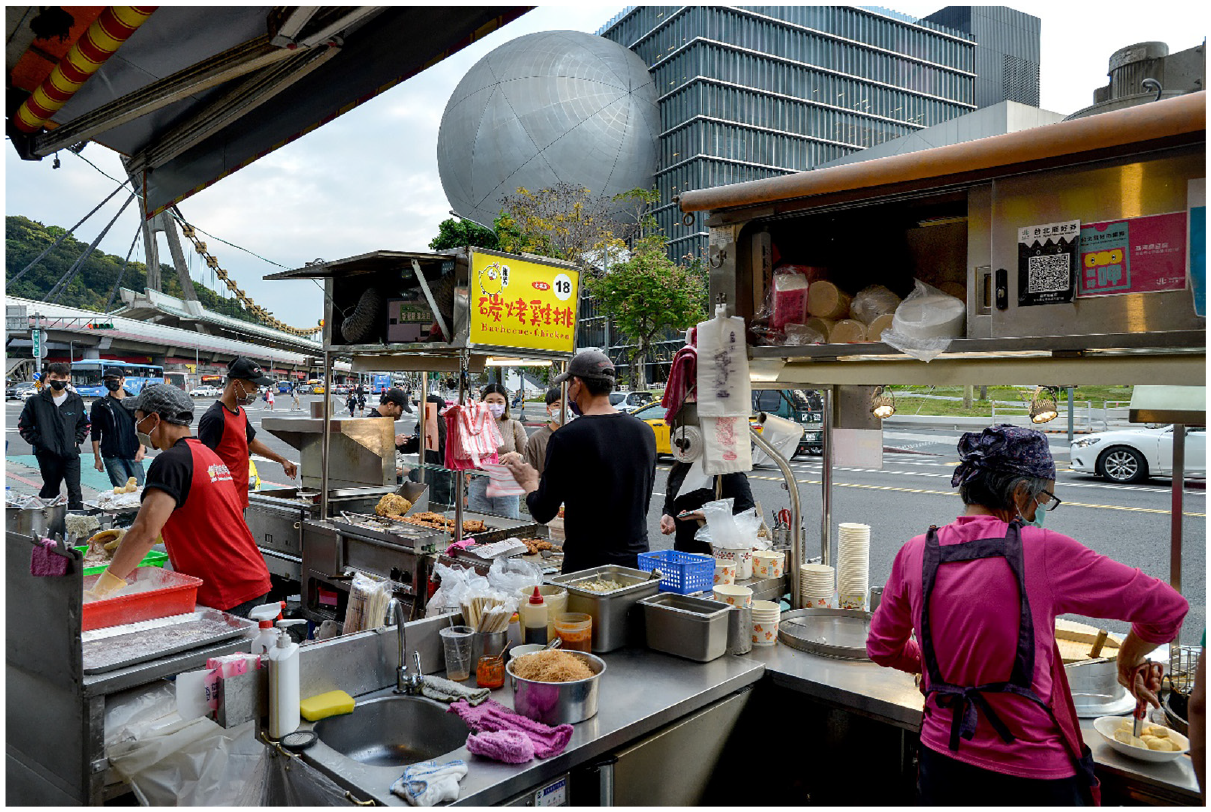
Shilin food vendors with TPAC in the background. This key image on the OMA website shows the architect’s imaginary of the juxtaposition between high culture and local culture. Copyrights OMA, Photography by Chris Stowers, reproduced with permission.
However, right from the start, the government’s narrative about the role, function, and embeddedness of the building in the local community conflicted strongly with the imaginaries and narratives of local residents and small entrepreneurs and market vendors.
As a result, upon its completion, the TPAC, which was supposed to have been conceived as a theatre for the people, is actually perceived by many local dwellers as a site for other people. As recent social media and community interviews (see Methods section) reflect, the TPAC is perceived as an anomaly within Shilin’s historical local market culture.
Interestingly, when the commissioned architects proposed integrating an existing night market into the design of the new cultural centre and theatre, they sought to integrate the new high culture (e.g. the theatre) with existing local culture (e.g. the long tradition of the night market). Both policymakers and local vendors contested this attempt, for different reasons that will be outlined below. As a result, the market became a focal point of local contestation about the meaning, ownership and aesthetics of place. As we shall show, the architect’s limited capacity to make decisions about this aspect allow us to rethink the architect’s role in negotiating urban imaginaries of the architecture they design.
While conflicting perspectives on flagship projects from stakeholders ‘from above’ and ‘on the ground’ have been recorded in the literature (Kong et al., 2015; Ong, 2011a), the role that architects themselves play as agents in negotiating decisions during the design process is generally under-documented. This study aims to dissect and critically analyse the complexity of the architect’s role, both within the public debate and behind the scenes. Architects must address the design brief and comply with the wishes and demands of their patrons to design an iconic cultural building. However, they also advocate their own agendas, which may be critical of the client’s imaginary of an emblematic cultural object used to regenerate a neighbourhood.
Kaika conceptualised architecture as a representation of urban imaginaries (Kaika, 2010, 2011, 2015) with architectural monuments embodying the desires and ambitions of particular social groups – most often those in power (Kaika, 2010). Public cultural buildings can function as totems, institutionalising a radical imaginary of high culture. Thus, such buildings’ design and construction processes are manifestations of emerging radical imaginaries and, once built, directly affect people’s daily practices on the ground.
Urban imaginaries have been developed as part of critical spatial theory, and a growing body of research on urban visions documents how they play a role in shaping global urban futures (Lindner and Meissner, 2018). Lynch stated that ‘we must consider not just the city as a thing in itself, but the city being perceived by its inhabitants’ (Lynch, 1960: 3). De Certeau (1984) and Lefebvre (1991) further emphasised different perspectives of the city from top-down and bottom-up, and the political implications of such socio-political power relations.
In this study we mobilise Castoriadis’s (1987) theoretical framework in which he uses the imaginary institution of society as a basis for an analytical structure to interpret the production of aesthetic symbols. Although urban developments have been analysed within the context of imaginaries using different understandings of the concept, to Castoriadis ‘the social world is […] constituted and articulated [through a] system of [imaginary] significations’ (Castoriadis, 1987: 146) through which a society can express itself and form a collective identity. Hence, he employed the imaginary within a social context rather than as individual understanding. While an imaginary does not correspond to anything ‘existent’ (Kavoulakos, 2006: 203), it can have genuine material implications. Castoriadis (1987) further distinguished actual imaginaries from radical imaginaries. While the former are markers of a pre-existing identity, radical imaginaries seek to construct a new communal identity.
Recently, scholars have engaged in debates about imaginaries in which the role of powerful elites is often foregrounded (Balke et al., 2018; Caprotti, 2019; Kaika, 2011; Kaika and Ruggiero, 2016). It is not only powerful elites, however, who seek to influence architects and with whom architects have to engage throughout the process of design and development. Citizens also have agendas and resources to influence the design process. We therefore analysed the imaginaries of both top-down and bottom-up stakeholders and examined how architects connect these imaginaries to their designs and use these to persuade others of their views. Several scholars have already highlighted the importance of understanding multiple situated forces in urban situations (Goudsmit, Nel, & Lin, 2023; Patterson, 2012; Raco and Tunney, 2010) and argued that the production of space occurs through its users (Lees, 2001; Llewellyn, 2003). Our analysis thus aims to redirect the examination of iconic buildings away from absolute interpretations of architecture as viewed objects towards a critical reflection on their constitutive and constituting aspects that are negotiated through both top-down and bottom-up forces.
The rest of this article is organised as follows: First, the research methodologies used to analyse different imaginaries are discussed. We then provide different theoretical perspectives on flagship architecture, mainly from political–economic literature and the architectural field. Next, we critically analyse the contrasting and conflicting imaginaries of three urban stakeholders: the policymakers ‘from above’, the architects ‘in the middle’, and the community ‘on the ground’, thereby analysing the role of the architects and how they attempt to negotiate between these perspectives, while addressing their own agenda.
Research methods
The first author worked as an associate architect within the OMA’s Hong Kong-based design team of the TPAC for 12 years (2009–2021), regularly travelling to the site location during the design and construction phases. The first author thus has profound knowledge of the project and exclusive access to data and insights into the negotiation processes that most researchers are unable to access. While research on the practice of architecture has previously been conducted (e.g. Blau, 1987; Cuff, 1992; Yaneva, 2009), such research has typically adopted an outsider’s perspective.
The positionality of the first author requires reflection. The proximity to the case can be problematised, but also allowed for a unique perspective. To bridge this contradiction and to enhance the dependability, credibility, transferability, and confirmability of the research, we used the method of triangulation to reflect on the findings using various data sources (Verloo and Bertolini, 2020). First, the first author had access and was permitted to review internal documents, including meeting minutes and presentation documents between 2009 and 2020, in which discussions among the client, consultants, and the design team were documented. In addition, we reviewed personal sketchbooks kept during the process.
Second, we conducted interviews during two periods of fieldwork. The first series of 10 face-to-face semi-structured interviews took place in Spring 2019. Interviewees were selected through purposive sampling within the first author’s network and included former employees of the client, Taipei’s Department of Cultural Affairs (DCA) and OMA architects. In these interviews, the author’s role as an academic researcher was clarified, the research intent clearly stated, consent to use the interview data was explicitly granted, and personal data were anonymised. The emphasis in these interviews was on the participant’s recollection of several project-related events, and interviewees were thus not expected to criticise the author or the design team. Most interviews were conducted in English, with some being conducted in Chinese in the presence of a translator. The second batch of nine interviews were conducted during the final stages of the TPAC construction in the winter and spring of 2021–22, when the first author was no longer employed as a project architect. These interviews aimed to understand the position of the local community towards the TPAC. Stakeholders in this group were more challenging to identify as they had no official representation. In collaboration with a local Shilin resident who functioned as a key informant, we used snowball sampling to contact two district councillors, a social activist, a former DCA employee, and five vendors (Shilin residents). We conducted these interviews partially in English and partially in Chinese and Taiwanese, using a semi-structured interview guide. Additionally, we interviewed around 20 visitors to the TPAC site during several pre-opening events in spring 2022 to elicit their early impressions.
Third, to allow for triangulation of the documents and interview data, we conducted content analysis on archives. We focused on several crucial periods where most negotiations between stakeholders took place, including the competition (August 2008–January 2009), the scheme and preliminary design stages (September 2009–May 2010), the opening of the interior night market building (April–June 2011), and the period before the TPAC’s completion (August 2021–February 2022). We reviewed public documents including Taipei City Council meeting minutes, cultural masterplans, and Shilin urban renewal plans. We also reviewed several online-accessible local newspapers including the Taipei Times, Liberty Times, Strait Times, and Commercial Times for insights into the daily news of local events. Online forums such as Twitter and PTT (Professional Technology Temple, a Taiwanese online discussion forum similar to Reddit) and the comment sections on TPAC-related web content (e.g. Building Surfer, 2021) were searched for the personal opinions of stakeholders prior to the opening (2021).
The combination of data sources and methods of investigation, including interviews, and the review of design and public documents, added greater credibility to the findings (Bryman, 2016) allowing for transferability of the case study to other contexts.
Theoretical perspectives on flagship architecture
In the last three decades, research on flagship architecture has been mostly concerned with the political economy perspective, while the architectural field has only marginally influenced the discourse (Alaily-Mattar et al., 2022). Iconic buildings are considered key instruments in the neoliberal shift in urban policy-making in growth-oriented regimes (Harvey, 1989). The work of Vale (1992), who demonstrates how the creation of flagship buildings aids in the communication and concentration of state power, forms the foundation for much of this literature. Discussions on the symbolism of postmodern iconic architecture were pioneered by Venturi et al. (1972). Flagships serve to form distinctive, recognisable images for the cultural (re)branding of urban areas (Evans, 2003; McNeill, 2009), whether to serve the ‘rich and powerful’ (Sudjic, 2011) brand corporations (Kaika, 2010; Kaika and Thielen, 2006), cultural institutions (Evans, 2005; Sorkin, 2002), cities and regions (Zukin, 1995) or nations (Ong, 2011a). Flagship architecture is often utilised as an expression of globalised urban ambitions (Sklair, 2006) and inter-urban competition (Kong, 2007). These studies emphasise the imaginaries from the top: they play a representational role for various local, national, and international audiences and support the construction or affirmation of certain identities (Minkenberg, 2014). Architecture is thus not considered a ‘neutral or free-floating cultural form’, but rather a reflection of political power, meaning that architectural practice is a political act closely associated with social order (Jones, 2011: 166).
Many flagships are designed by global architectural firms (McNeill, 2009), particularly the ‘star architects’, a small group of celebrity architects almost invariably from the West (Knox, 2011). The architectural ‘pieces’ they create are treated as commodities and, through media promotion, star architecture has become an (overvalued) brand in itself (Frampton, 2005: XIII). Besides the design, star architects offer media attention even before the building is built and connect their signature to the brand value (Thierstein et al., 2020). Furthermore, star architects help justify the investment and smooth the political processes (Ponzini, 2011). As such, clients use iconic architecture ‘as a way of embedding broader political–economic urban restructuring in a socially significant and sufficiently resonant form’ (Jones, 2009: 2526). The role of architecture is criticised as having retreated into a field of imagery through its ‘silent complicity’, supporting its illusion of ‘changing the world’, while actual control over projects rests with clients (Dovey, 2005). From this perspective, star architects further support the construction of imaginaries from the top.
However, several scholars have highlighted that the understanding of urban politics around iconic projects is dominated by global neoliberal urban entrepreneurialism (Faulconbridge, 2009; Ong, 2011b; Raco and Gilliam, 2012) and focuses too much on ‘specific aspects such as the architect’s fame, the iconicity of buildings, the spectacle of the urban environment or the alleged economic effects of the above’ (Alaily-Mattar et al., 2020: 309). Global architecture should not simply be understood in terms of international capital flows or international competition, but should be contextualised and ascribed to very specific actors, including planners, policy makers, and architects (Ponzini, 2020), and situated within its local context.
Furthermore, there is a persistent bifurcation between architecture as ‘business’ and architecture as ‘conviction’; in reality, the profession combines the two (Blau, 1987). While in most political-economy related literature the emphasis is on the business perspective, architectural practitioners tend to emphasise the profession as a conviction. Their ethos is generally to ‘change the world’; they view themselves as socially responsible professionals or social engineers (Faulconbridge, 2009) working within the limited capacity given by clients (Betsky, 2003).
From the perspective of communities, however, architects are not guardians of the public: For neighbourhood action groups, the architect is usually the servile, but also imperious handmaiden of capitalism willingly placing large structures where they don’t belong, producing wind and shadow and appropriating views, while causing more noise, traffic, and other phenomena that are felt to diminish the quality of life. (Betsky, 2003: 26)
Thus, various urban stakeholders perceive the role of the architect differently; it is either underrated (by academics) or overrated (by communities). While the heteronomous position of architecture is extensively discussed (Jones, 2009), few studies offer a methodology to assess the architect’s personal motives and interests and how they balance socio-economic pressures while designing socially meaningful projects.
This aspect can be clarified by focusing on the typology of the global cultural flagship, such as museums and theatres, the best-known examples being the Sydney opera house and the Guggenheim museum in Bilbao. These buildings attract the attention of policymakers, the mainstream media (Alaily-Mattar et al., 2022), and architectural press (Dovey, 2005) and can ‘arouse public attention, causing disputes and controversies’ (Yaneva, 2009: 8). As many cultural flagships are funded by public money, the usage of funds must be justified (Alaily-Mattar et al., 2018). Flagship public projects also dominate architectural discourse (McNeill, 2006) and architectural education (Stevens, 1998). Architects usually view public cultural buildings as the most prestigious type of projects, as they give them high international exposure and the opportunity to make a social statement.
Rem Koolhaas, who founded the OMA, the firm that designed the TPAC, claims that architects need to reinterpret the client’s brief: [y]ou must make a judgement about whether the client’s project will create value for society because you must answer that demand through your work. There is something in every project that we do that goes beyond how it was initially defined. We try to discover potentials that the client did not or would not realise (Fraioli, 2012: 114–115).
These potentials should be understood with reference to Koolhaas’ understanding of the city, as the apotheosis of the ideal of density per se … its architecture promotes a state of congestion on all possible levels, and exploits this congestion to inspire and support particular forms of social intercourse that together form a unique culture of congestion (Koolhaas, 1977: 322)
Most of OMA’s architectural projects build on this understanding and try to induce, through design, a culture of ‘congestion’, that is, a diversity of functions and forms that accentuate the multiplicities of urban life and create spaces ‘for indefinite function and chance encounter’ (Dovey, 2009: 104) and ‘non-specific flows and events’ (Kipnis, 1998: 30).
Furthermore, Koolhaas ([1978] 1994) has depicted market-led modern architecture as an alternative to rigid modernism. In several influential essays, including ‘the Generic City’, ‘Bigness’, and ‘Junkspace’ (Koolhaas and Mau, 1998), he observed and critiqued the limited role and power of architects to dictate the city or its social situations. To the modernist claim that architecture can lead society to a better world, Koolhaas juxtaposes the claim that at best, architecture can mirror the flux of the larger world in unprecedented designs and processes intended to defy predictable societal relationships. His architecture holds out the possibility that new, social configurations might emerge – but also the possibility that they won’t (Dunham-Jones, 2013: 162).
Since the start of the practice, the OMA has worked on projects in different global contexts through which Koolhaas’ ideas developed further. ‘Suddenly OMA was global, not in the form of multiple offices turning out a single “product” but of one involved more and more deeply in other cultures. We became an expert in difference’ (Koolhaas and Mau, 1998: 362). He observed that, global practices risk the ‘profit-driven repetition’ of buildings around the world. Instead, the OMA embraces the ‘encounter between ourselves and the local culture’ in a ‘three-dimensional anthropology lesson’ (Fraioli, 2012: 116).
Perhaps the most important thing that is necessary to produce an architecture which resonates with a local condition is to abandon arrogance to some extent […] and to admit that you don’t know everything about a given situation, and […] you need to surround yourself with knowledge of others (Koolhaas, 2009).
OMA’s headquarters are in the Netherlands, while smaller offices are located in other parts of the world, including New York, the Middle East, and Hong Kong, which primarily oversee projects within their respective regions. In such projects, OMA collaborates with local firms that supply local knowledge on building codes as well as political expertise. Furthermore, the staff in the local firms are partially international, but also partially embedded in the local context. In summary, OMA aspires to create context-specific, and thus distinctive works that are adjusted to local contexts which in return ‘might also have a deep effect on their own perception of things’. (Graft, 2020: 358).
Introduction to the case study
Key project data
The Taipei City Government instigated an international design competition for the TPAC in 2008. Out of the 137 international and local design firms that participated, the OMA team, led by partners Rem Koolhaas and David Gianotten, took first place. Compared to other projects in Taiwan, this project had a relatively high architects’ fee, making it feasible and interesting for international firms. The main programme comprises a 1500-seat grand theatre, an 800-seat proscenium playhouse, and an 800-seat multiform theatre. The design brief also included commercial spaces intended to ‘be in compliance with the character of the Centre and the Shilin Night Market’ (Department of Cultural Affairs Taipei City Government, 2008). After a design period of several years, the construction started in 2012 and the building was inaugurated in 2022. The next section sketches the political context surrounding the project. Figure 2 summarises the key events.
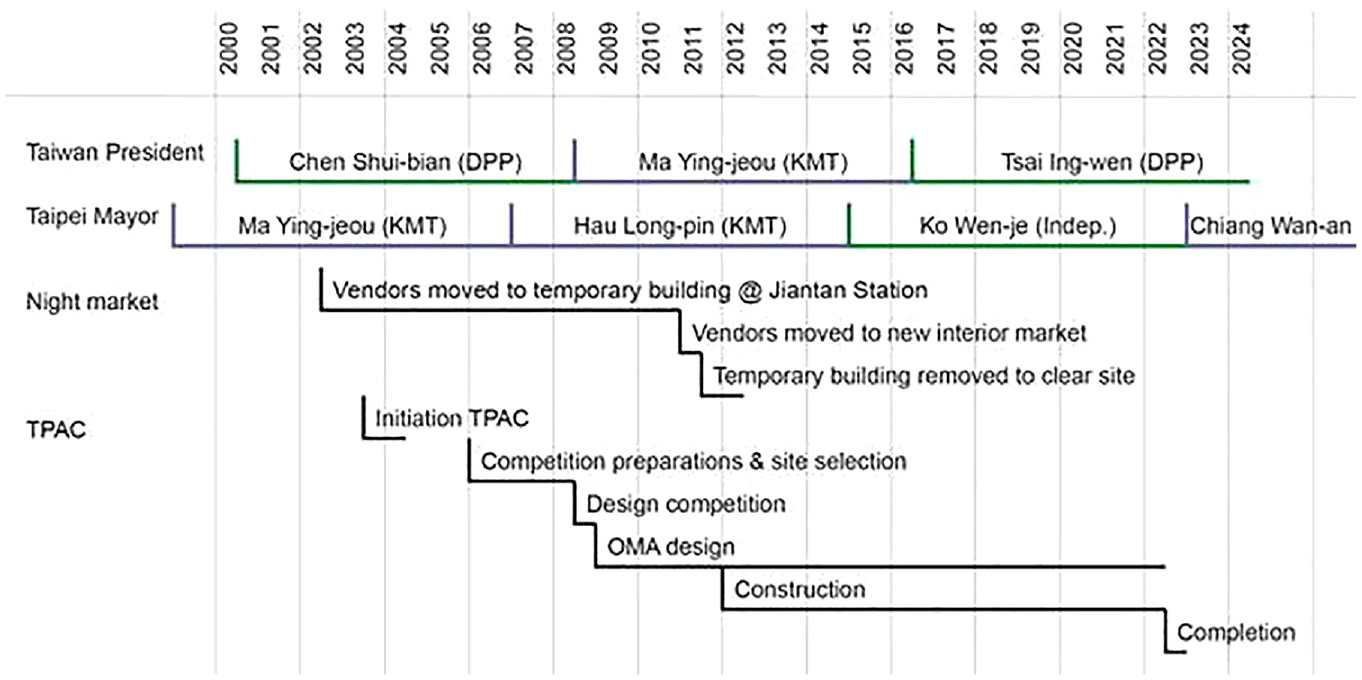
Timeline indicating key political figures in Taiwan/Taipei and key events related to the Night market and TPAC.
Policies and politics at the core of the new theatre
The Taipei theatre project originated from a national level. Following the Asian Crisis (1997) and the Global Financial Crisis (2008), Taiwanese authorities employed creative entrepreneurial initiatives to derive new sources of economic development and enhance international competitiveness (Karvelyte, 2020; Wang, 2011). National government programmes promoted cultural and creative urban strategies, including flagship architectural buildings, and over 24 international design competitions were launched between the early 2000s and 2015 (Tseng, 2015). Under the ‘Ten New Major Construction Projects Policy’ from 2003, two national performing arts centres, the Taichung Metropolitan Opera House and Wei-Wu-Ying Centre for Performing Arts in Kaohsiung, were completed. A new Grand Theatre was planned within this programme for Taipei, but a lack of financial resources and an unsuccessful public–private collaboration led to the project’s failure (Kong et al., 2015). However, this project set the foundations for the TPAC several years later, financed by municipal, rather than national budgets.
The rivalry between national and local levels should be understood in the context of Taiwan’s recent political history. In the late 1980s, Taiwan’s political system was restructured from an authoritarian government led by the Kuo Min Tang (KMT) to a democracy. The formation of the opposition Democratic Progressive Party (DPP) in 1986 was significant, marking a period of fierce competition between the two main political parties (Li et al., 2016). The older ‘blue’ KMT party is viewed as more pro-China, pro-business, and conservative. The newer ‘green’ DPP is pro-worker and promotes more redistributive policies. Since 1994, the DPP and KMT have taken turns in leading Taiwan and Taipei (see Figure 2), resulting in regular policy agenda shifts, including for foreign tourism. While the KMT promoted the increase of tourists from Mainland China, DPP President Tsai suspended cross-strait communications in 2016, causing the number of Chinese tourists to drop from 4.2 million in 2015 to 2.7 million in 2017. The COVID-19 pandemic had an even greater impact on international tourism when foreign tourists were prohibited.
After the failure of the DPP-led state to build a new theatre for Taipei, the city government took over and KMT mayor Ma (who would become president in 2008) initiated the project in 2003 (Taiwan Today, 2012). Under mayor Hau, the detailed brief was formulated and the site selected (personal interview, DCA official 2019). The architectural competition was held in 2008, when both Taipei and Taiwan were governed by the KMT (see Figure 2), as part of a cultural master plan for the city that envisioned several flagship buildings and creative clusters (Department of Cultural Affairs, 2011: n.p.). Although the project was financed by the Taipei City government, it supported the tourism-driven agenda of the national government. Both president Ma and mayor Hau attended the ground-breaking ceremony at the beginning of the construction, underlining its importance (Taiwan Today, 2012).
While most of Taipei’s flagship buildings are in the city centre, the TPAC is situated in Shilin’s northern district. However, the site was not a tabula rasa; its centre was the location of a famous day and night market, a crowded neighbourhood with small shops, food stalls, and hawkers.
Shilin market
Shilin was one of the areas where traditional Han Chinese migrants settled in the early 18th century (Li et al., 2016). In 1860, a small urban area developed around the Zichen Temple, which grew into a centre for wholesalers of fish and agriculture from the nearby Yangming Mountain and Keelung River. In the 1960s, night-time vendors began catering to students from several nearby university campuses (Chiu, 2013) and the Shilin market soon became Taipei’s most famous market.
In the early 2000s, under KMT Mayor Ma, the Taipei government began formalising the organically grown market to increase its attraction to tourists (Chiu, 2014). Consequently, in 2002, 538 licenced vendors operating in the area adjacent to the Zichen temple were temporarily relocated to a one-story building on a vacant government-owned site next to the Jiantan MRT station (Chiu, 2014) (see Figure 3). This allowed the government to demolish the original structures and construct a new 135-m-long building. During the construction of this new ‘interior’ market, the temporary market building next to Jiantan MTR station became a popular tourist night-time destination. In 2008, the temporary location was selected as the site for the TPAC, and in 2011 the vendors were relocated to the new interior market building (Mo, 2011). However, as the Shilin market predominantly targeted tourists, locals increasingly avoided the area. Once the COVID pandemic struck, this left the Shilin night market in a dire state (Wang, 2020).
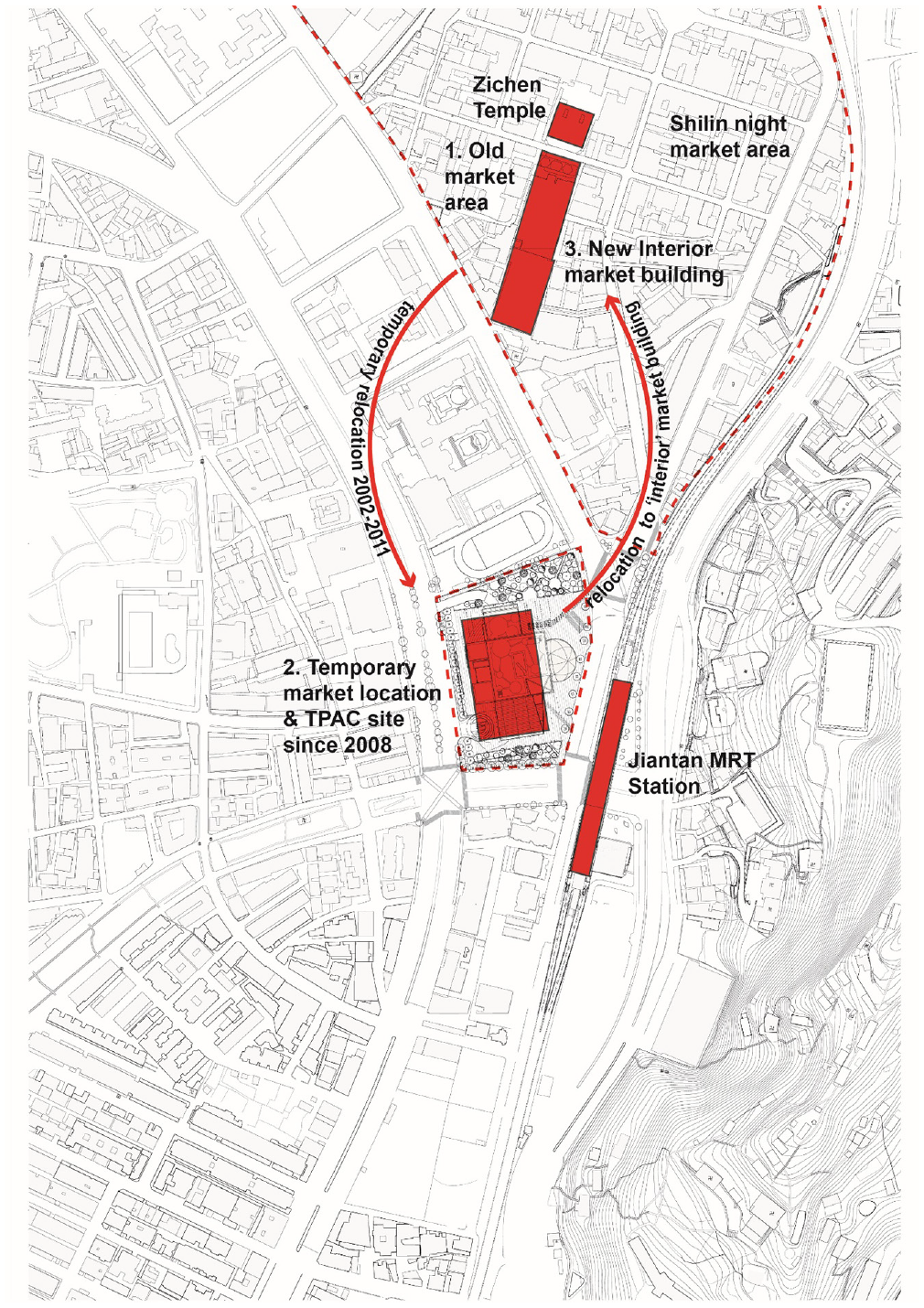
Site map of sequential market locations & TPAC site.
The location of the TPAC near the night market inevitably connects the flagship theatre to the local cultural identity of the market. These different identities were incorporated into OMA’s design concept. The initial winning architectural design commissioned by Mayor Hau included a near-exact copy of the temporary market building. This juxtaposition of market and theatre became the focus of a controversy between the policymakers, local vendors, and the architect, which is the main concern of this study. The proposal to incorporate the market building can be viewed as an extreme case (Flyvbjerg, 2006) of OMA’s design strategy of inducing a culture of congestion and chance encounters, and thereby provides rich information about the strategy.
Contrasting imaginaries
Imaginaries from the top
A series of imaginaries were attached to the TPAC at its initiation by national and urban officials. Besides increasing Taipei’s cultural infrastructure, Mayor Hau sought to compete with other Asian cities that had recently erected prominent theatres, such as Beijing, Shanghai, and Hong Kong (interview with a government official, March 2019). At the ground-breaking ceremony in 2012, President Ma declared that the TPAC would be a ‘pioneer in the development of Chinese culture’ (Mo, 2012) implying a cultural superiority over Mainland China. Furthermore, the commissioner of the Department of Cultural Affairs (DCA), Lee Yong Ping, defended the project to the city council, citing an expected steep increase in tourism from Mainland China (following recent KMT policies), and the need for tourist attractions (Taipei City Council, 2008: 2417). She emphasised how iconic cultural flagships can attract tourism: like Sydney Opera House, it took ten years to build, but afterwards, it brought in numerous tourists, same for Bilbao in Spain (Taipei City Council, 2009: 1196–1197).
Utilising the TPAC, policymakers attempted to institute a radical imaginary of Taipei as a cultural metropolis capable of competing for tourists (Kong, 2007). An iconic building by a renowned architect would attract publicity and foster an image of sophisticated cultural life and a new urban identity. This analysis concurs with typical assessments in the literature regarding flagship architecture discussed earlier (Jones, 2009, 2011; Sklair, 2017; Sorkin, 2002). Given the changing political and economic context, it was also necessary to re-brand the city to tap into tourism as a new income source. Thus, the TPAC, like other global architectural flagship projects (Tseng, 2015), portrays an image of urban change (Kaika, 2010) and the government’s attempt at instituting an emerging imaginary of new cultural life.
Architects’ imaginaries
And that is, for me, a source of particular pleasure. Instead of removing the old and introducing the new, […] what we propose is that the two coexist on the same site, that the stage apparatus is simply posed on the platform of the restaurants, and that they will continue to perform the same way they perform now (Koolhaas, 2009).
While the policymakers’ imaginaries for the TPAC were dominated by ideas of a cultural, global iconic building, the narrative of the architects focused on a different intention. As per Koolhaas’ quote above, in a presentation to the Taiwan Institute of Architects, the OMA envisioned the local night market and the new theatre as ‘coexisting’ (Koolhaas, 2009), attracting global tourism, but also incorporating local cultural life through the food market. From the policymakers’ perspective, Taipei’s food markets needed to be ‘cleaned up’ (Jennings, 2008), while Koolhaas celebrated the existing vernacular site area as: a spectacle of incredible variety, choice, highly organised and clearly offering almost anyone something that they find attractive, if not irresistible. […] The energy of the site and the beauty of the site currently is perhaps higher than we have ever experienced before. [It] is already intensely occupied by not only thousands of people, but also obviously all classes, all nationalities, locals and tourists, and therefore a site which is already known before there is a new building (Koolhaas, 2009).
Koolhaas carefully crafted a new imaginary addressing the ‘issue’ of the icon. He argued that the market economy had a powerful effect on architecture, as clients are increasingly located within the private realm.
This made architecture much more competitive, much more demonstrative, much more eccentric, and it introduced […] the age of the icon. […] So this is the climate in which we are currently working, and it is also the climate – because I don’t want to be hypocritical – to which we [OMA] are contributing. But as we contribute, we are […] trying to work on public architecture and trying to define what public architecture is and can be in the 21st century (Koolhaas, 2009).
Differentiating publicly and privately commissioned architecture, Koolhaas attempted to (re)institute an imaginary of the architect’s role as a public professional aligned with the people. Critical of ‘sculptural’ iconic objects, he thus emphasised the accessibility of the new theatre to the public and its assimilation with informal local culture. The intention was to create a ‘public’ icon (Kaika, 2011; Sklair, 2011) that would become part of local rituals and instil local pride. In addition to the local food market, numerous parts of the design strove to achieve this, such as the elevated auditoria that minimised the building’s footprint, providing more room for activities on the ground, and a public loop through the building.
The OMA thus created an iconic theatre, referred to as an ‘intelligent icon’ (OMA website, 2022), that responded to the project brief envisioned by the client. The imaginary of assimilating the existing local and a new global culture is closely related to the OMA’s design language as architecture driven by urban forces, inducing a culture of congestion that provides opportunities for chance encounters between different layers of social life. Adopting a position against the development of cultural flagships for the elites shows that architecture not only functions to enforce or maintain social order (Kaika, 2011), but is also used to question it. However, despite the intention to connect to the local culture, the question was whether the project would be embraced by the locals (Faulconbridge, 2009). Having established the OMA’s imaginaries for this design, we investigated how they negotiated their imaginaries with policymakers and the public through the vignettes below. We have foregrounded this particular controversy as the market directly embodies OMA’s imaginary of the culture of congestion, and the connection between different social groups.
The temporary food market that occupied the TPAC site during the competition phase in 2008 became an inspiration to the architects as it embodied the image of local cultural life. The OMA reiterated its design objective to the mayor, addressing the need to prevent ‘gentrifying the night market’ which was, at the time, endorsed by Mayor Hau and DCA commissioner Lee (meeting minutes, DCA and OMA, 2009/09/18).
In a following meeting, Taiwanese theatre ‘experts’ questioned the functionality and necessity of the food market and shared concerns that people might bring food into the theatre (Meeting minutes, DCA and OMA, 2009/10/06). Additionally, DCA Commissioner Lee formulated several arguments against the OMA’s design of the food market: the site was only temporarily zoned for a food market; the newly built interior market building further north would suffer unfair competition from the TPAC market; the complexity of managing a market; and an ‘animal and trash problem’ (Meeting minutes, DCA and OMA, 2009/10/06). Instead of a food market, the DCA recommended a craft market. During several months of ensuing discussions, the OMA attempted to retain the food market design, fearing that the craft market which caters to visitors and ‘upper-middle classes’, but not locals, would result in the dreaded gentrification (personal notes of internal discussions with Koolhaas and the OMA design team).
The design team was concerned with cost savings to achieve the capped budget and proposed removing the roof of the market from the design, it would then function as a temporary or movable feature for vendors to establish their stalls. Despite their inability to integrate the food market as part of the physical building design, the OMA collaborators attempted to include elements into the landscape design ‘to anticipate [the] return of the food market’ (Koolhaas, internal meeting notes 2010/04/05). The DCA, however, remained steadfast in its position against a food market: The DCA has already decided there will be no food market in the programme. Please don’t show any collages or photos illustrating the possibility of having a food market on the site anymore (Meeting minutes, DCA and OMA, 2010/05/07, emphasis added).
The architect’s imaginary of the theatre co-existing with the food market clashed with the city’s imaginary of an international flagship project. While the architects admired the vernacular urbanity of the existing market, Mayor Hau imagined formalising the Shilin market area, home to many unlicensed street vendors, for touristic purposes (Chiu, 2014; Jennings, 2008). Thus, government officials could not endorse illegal vendors and would not tolerate any references to the street vendors in their documents. An employee of the city government recollected: ‘In the government, there was a huge concern that we just didn’t get the “right” impression of an international project […]. They couldn’t accept that people would have to tip-toe over night market vendors’ (personal interview, November 2021).
Analysed within the framework of Castoriadis, the narrative above comprises a series of conflicting existing and radical imaginaries illustrating how policymakers and architects envisioned the new theatre to express their preferred urban identity deriving from different interpretations of the food market. However, while the OMA acted as a self-proclaimed guardian of local cultural life, the vendors rejected the proposed night market, as discussed in the following section.
Imaginaries from the ground
No written records can be found of the vendors’ perspectives on the food market design of the OMA at the time of the competition in 2008–09 as there appears to have been no public engagement process. Most vendors we interviewed 14 years later have no recollection of the OMA design, or any discussions. However, there were several formal and informal means of participating in the process. For example, an architect recalled that market vendors of the Shilin area informally disputed the food market with the DCA: After local food market vendors, who used the [temporary market] site and had to move to the new location, heard that there would be another night market [under the TPAC], they threatened to pull out as they feared too much competition, as the site under the TPAC is more accessible. Politicians feared [these vendors] too much … and told the OMA to remove it (personal interview, March 2019).
This vignette highlights two intriguing findings. First, this is a fascinating example of the implicit power of people ‘on the ground’ during urban negotiations. The vendors have considerable political power as the local city council members are elected within their district. There are close ties between the different market associations and district councillors in Taipei (personal interview, resident, September 2021). In this case, the lobby formed by the vendors to prevent the TPAC food market was successful. However, the fact that there are no official records of such protests indicates that the vendors were not officially included in the decision-making processes.
Second is the apparent lack of understanding of the workings of individual vendors within their locality (Chiu, 2013). In the government’s and OMA’s imaginary, vendors were considered not as individual inhabitants of the area, but as ‘standard bodies’ (Imrie, 2003) who could simply be relocated or replaced with minimal disruption. The DCA, when still supporting the market, clarified: While it may not be possible to get the same tenants back to the site, they will be the same type of tenants (meeting minutes, 2009/09/18).
It is not surprising that the vendors did not support the OMA’s ideas of the night market under the TPAC; they would most likely not have been located at the TPAC location and would have incurred increased competition.
For global projects such as the TPAC, it is not uncommon for the design to be created remotely with limited engagement on the site (Faulconbridge, 2009). The project started as an open and unpaid design competition and thus there were inadequate funds to pursue in-depth site studies, especially during the early design and decision stages. Furthermore, collaborations with the public were not facilitated nor expected by the client (Goudsmit, 2019). This led to an abstract interpretation of the local community networks, and possibly to a misunderstanding or disregard of local needs.
Furthermore, the client consistently showed little interest in the participation of the local population. Another vignette shows the critique from a Shilin district councillor in support of the vendors regarding the juxtaposition of the theatre in a night market district:
Can I enter the opera house if I eat stinky tofu, drink bubble milk tea with my chicken fillet?
Of course not.
I wear a sleeveless top, beach shorts, flip flops – this is my night market outfit, then can I enter the opera house?
We hope that that’s not the case.
(DPP councillor Mark Ho Chih-Wei and DCA commissioner Hsieh Hsiao-yu, Taipei City Council: 2011/05/28)
While the critique was mostly directed towards the government for selecting the TPAC site within the night market district, it also questions the OMA’s imaginary of the culture of congestion that triggers chance encounters between different societal layers. From the reply of the local government, it is clear that they did not support the OMA’s imaginary either. However, while the OMA disagreed with their client, at this point their main objective was to facilitate the start of the project.
Shortly before the TPAC opening we conducted a series of interviews to gauge the opinions of the local community. Most local interviewees had little interest in visiting the theatre (focus group interview with day market vendors, January 2022). Interestingly, one of the main reasons a vendor provided for disliking the TPAC was as follows: People here also have political objectives. Because Shilin people are of a different political colour [predominantly DPP “green”] than the government that made this egg [KMT “blue”], they don’t have a very good opinion about [the TPAC].
To some vendors who are residents of Shilin, the TPAC represents a political party and a totem of opposition. This is not surprising, as the city’s imaginary never included Shilin people, merely referring to the district as a tourist attractor. The building simultaneously embodies the local government’s ambitions and the rejection of such ambitions by local people. The architects, while attempting to include the public in their narrative, did not understand their needs and could thus not mediate appropriately on their behalf.
As one commenter correctly argued, facilities like the TPAC are meant to serve the greater community in Taipei or even Taiwan, beyond the neighbouring locality of Shilin. As the TPAC neared completion, the project was criticised frequently on traditional and social media. 1 However, given the scope of this study, a comprehensive analysis of the general opinions of the larger Taipei or Taiwan public was not possible. As this study focussed on OMA’s role in negotiating the juxtaposition between high culture and local culture, the stance of the project locally was considered most relevant.
Conclusions
The question is not whether architecture constructs identities and stabilises meanings, but how and in whose interests. (Dovey, 2009: 45)
This study discussed three urban imaginaries around a new flagship theatre in Taipei. Within Castoriadis’s (1987) framework, the imaginary is the basis for interpreting the production of aesthetic symbols through which we understand the world. Architecture, particularly through flagship buildings, symbolises and institutionalises emerging imaginaries as physical manifestations that are present in space. Furthermore, architecture is not only representative of existing urban imaginaries, but can also constitute new, radical imaginaries (Kaika, 2010). Thus, architecture is produced by power structures, but also re-produces and legitimises those structures (Minkenberg, 2014).
In recent debates, the imaginaries of the powerful are often foregrounded. In this study, we have shown that architecture should not be read as a single radical imaginary from architectural patrons, but as the result of urban political negotiation processes between a series of imaginaries from different stakeholders. By exposing the negotiation processes engaged in by architects (both actively and passively), we offer a more nuanced perspective on urban processes around flagship buildings and highlight the limitations of the architects’ role in the outcome of the process.
We analysed the urban imaginaries of three stakeholders regarding the TPAC: the local state which envisioned a high-end iconic cultural flagship building that would help to establish a new urban identity; the architects who desired a public cultural icon accessible to all; and lastly the local perspective which was somewhat alienated from the project, and thus clashed with both the city and the architects’ imaginaries. We monitored the controversy around the integration of the local food market into the design of the theatre which reflected these different positions. Selecting this controversy had some limitations as we neglected the dominant programme of the performing arts centre, the design of which was much less contested. It was also very specific to the case, and thus perhaps difficult to generalise. Nevertheless, a number of conclusions could be drawn by critically analysing the position of the architects with regards to the public space within the framework of negotiations over contrasting imaginaries.
Considering the profile of the OMA, the TPAC food market can be understood as a response to a critique on the rigid modernist social utopias that were implemented from the top down. To OMA, the market was an opportunity to create an urban culture of congestion allowing chance encounters between different urban users of ‘all classes, all nationalities, locals and tourists’ (Koolhaas, 2009). Furthermore, Koolhaas critiques the trend that architecture is increasingly privately commissioned. Funded by the public sector, the TPAC, to him, was an opportunity to redefine public architecture that is embedded in and feeds on local daily life. This also reinforces the specificity of the project to its location symbolised by the crowds in the original night market.
However, this imaginary conflicted with that of the city, which did not want the theatre to represent the night market and rejected the OMA’s depictions of food vendors. The OMA (perhaps strategically) misunderstood the client’s local and national branding intentions for the building. Public architecture is, to the government, more than a public service; it is a way to construct and affirm its political power (Minkenberg, 2014; Vale, 1992) as well as a local and national branding strategy (Evans, 2003). However, in exchange for the client using iconic architecture ‘as a way of embedding broader political–economic urban restructuring in a socially significant and sufficiently resonant form’ (Jones, 2009: 2526), OMA played counter-politics and used public architecture to embed social significance in iconic architecture.
Nonetheless, the community that was intended to be served was never asked. Like the modernist architecture that Koolhaas criticised, this project was conceived from above, even from abroad. In this case, as arguably in many other cases of flagship architecture (e.g. Kong et al., 2015), the public was not involved during the decision- making processes. The competitive system in which offices worldwide compete in unpaid competitions does not allow for intensive fieldwork or collaboration with people on the ground. Nor is it in the interests of the client, and arguably of the architect, to gain such knowledge and participation. Instead, interpretations are made of the communities’ imaginaries in which the public is reduced to standardised bodies.
Not surprisingly, responses from the Shilin vendors predominantly reflect criticism or indifference towards the building, partially as a response to the opposing political party and partially because the project has little to offer them. They practice their own politics of power and vote with their feet by ignoring the building. However, the opinion of the local community might change in the future as the building has only recently opened. For the moment, however, the lack of understanding and interest in local information means the project did not succeed in hosting public life as intended by the architects.
Returning to Dovey’s quote at the beginning of this section, the TPAC undoubtedly constructs identities and meanings. We demonstrated how the OMA played a role in negotiating these, and whose interests they purported to address. While believing to contribute to the public cause, the OMA might have overlooked, deliberately or otherwise, the needs of the people they claimed to support. Aware of the political practice of architectural production, the OMA refused to be ‘silently complicit’ (Dovey, 2005) in the way iconic buildings are typically produced, and made a robust vocal attempt to incorporate the food market to stimulate chance encounters. However, the architects’ main motivation was to make their own social cultural imaginary heard.
Footnotes
Acknowledgements
The authors would like to thank the OMA for providing access to their archives. We would also like to express our gratitude to Hank Tsai Min-han for his support during the fieldwork. Finally, we thank the editors and three anonymous reviewers for their valuable comments.
Declaration of conflicting interests
The author(s) declared no potential conflicts of interest with respect to the research, authorship, and/or publication of this article.
Funding
The author(s) disclosed receipt of the following financial support for the research, authorship, and/or publication of this article: The work described in this paper (data analysis) was partially supported by a grant from the Research Grants Council of the Hong Kong Special Administrative Region, China (CUHK 24611822).
