



Abstract
Efforts to decrease the risk of overweight and obesity should focus on children’s physical activity (PA) and fruit and vegetable (FV) consumption. Within school-based interventions, there is insufficient evidence on the effectiveness of the use of character modeling and goal setting to determine changes in step counts, MVPA, and FV consumption. Study participants were 187 students in grades 4 and 5 from 2 Title 1 elementary schools in the Southwest United States. The intervention was a quasi-experimental character modeling and goal setting program. New Lifestyles NL-1000 activity monitors were used to assess number of steps taken and MVPA by the participants. Fruit and vegetable consumption was measured by direct observation. School day steps, MVPA, and FV consumption were recorded at baseline, intervention, and during a 10-week follow-up. There were not differences between groups at baseline. Steps and MVPA were statistically significantly (P < .05; Δ = ~2500 steps and ~5 minutes of MVPA) greater in the intervention compared with the control group over time. Fruit and vegetable consumption was not significantly (P = .308) greater in the intervention compared with the control group over time. Students in the intervention school were significantly more active than students in the control school during the intervention phase and at follow-up. The findings reported here would suggest that character modeling and goal setting can increase PA among elementary aged children but did not increase FV consumption.
The prevalence of obesity and extreme obesity among children and adolescents in the United States (US) has significantly increased over the past 30 years. 1 Skinner et al 2 suggest that 35.1% of youth in the United States aged 2 to 19 years have a body mass index classified as overweight, 18.5% classified as obese. The consequences associated with childhood obesity include numerous medical, socio-emotional, and academic issues. 3
Decreasing the risk of overweight and obesity from an early age is imperative and efforts should focus on children’s physical activity (PA) and diet including fruit and vegetable (FV) consumption. 4 Studies have shown that children who are considered overweight or obese have lower levels of PA compared with children who are in a healthy weight range. 5 Other studies have shown that most of the children in the United States are not meeting the recommended daily FV consumption which contributes to the high obesity trends. 6 Interventions targeting PA 7 and FV 8 have shown decreases in overweight and obesity in children.
It is recommended that children engage in moderate to vigorous PA (MVPA) for 60 minutes every day or take a minimum of 12 000 steps/day 9 with 30 minutes 10 or 5505 steps 11 being accumulated at school. This amount of PA grants both short-term and long-term physical and psychological health benefits. Sustained levels of PA have a positive effect on children’s weight status, metabolic health, and body composition. 12 Regular participation in PA also offers substantial health benefits such as cardiovascular fitness and bone health. 13 Furthermore, psychological benefits include improved mental health, reduced symptoms of stress, depression, anxiety, and improved self-esteem. 12 Unfortunately, children are falling well short of recommended PA levels at school 14 and habitually. 15 Comprehensive school PA programming is one possible solution to increasing PA in children. 16
It is also suggested that children eat at least 5 servings of fruits and vegetables (FV) each day. A serving of fruit is equivalent to 1 cup (eg, 1 small apple, 1 banana, 32 seedless grapes, 8 large strawberries) and a serving of vegetables is equivalent to 1 cup as well (eg, 12 baby carrots, 1 large ear of corn, 1 medium potato, 3 long spears of broccoli). 17 On average, children are consuming much less than recommended. Only 20% of children ages 4 to 13 are eating the recommended servings per day and FV consumption continues to decrease with age within childhood. 18 Promoting early childhood nutrition programs aimed at improving diet has the potential to enhance intellectual development and academic success in the early years of development. 19 Food habits are developed during childhood and adolescence which makes it important to foster healthy eating behaviors such as eating fruits and vegetables at an early age. 20 Most children obtain, on average, more than one-third of their daily caloric intake from food consumed at school 21 and despite an increasing knowledge about health benefits of diets high in fruits and vegetables, school-aged children’s diets are lacking in fruits and vegetables. 22 School lunch room policies and practices have the opportunity to increase FV consumption among elementary children. Increasing the consumption of fruits and vegetables has also been found to be an important component of obesity prevention. 23 Increasing the amount of FV consumption among children may decrease the risk of cardiovascular diseases, diabetes, obesity, and certain types of cancer as they age. 24 A diet high in FV consumption also contributes to increased satiety and reduced food intake leading to healthy weight management. 25
Most of the children in the United States are in school for 30 to 35 hours per week which makes schools an ideal setting for promoting PA and FV consumption. 26 There is a significant need to foster PA and FV consumption in school because many studies indicate that children in the United States are falling well short of daily recommended step counts 27 and are eating less than 1 cup of fruits and vegetables while at school. 20 Encouraging PA and FV consumption while children are in elementary school is particularly important because these begin to decline swiftly during upper elementary years.22,28 It has been suggested that school-based interventions that combine PA and nutrition may be more beneficial for preventing overweight than either increased PA alone or appropriate diet alone. 29 Results from previous research have shown some success in increasing PA and FV consumption (eg, Evans et al 30 and Metcalf et al 31 ), there is, however, insufficient evidence on the effectiveness of the use of character modeling and goal setting on PA and FV consumption among children in the United States.
Two possible considerations for increasing PA and FV could be the use of character models and goal setting. Characters (eg, cartoons) have been found to change health behaviors including snack preference in children 32 . These brand mascots and cartoon characters have a powerful influence on diet and health of children. 33 Researchers have begun to use character models in school interventions to change PA 34 and FV 35 illustrating that the characters have the ability to affect behavior change. Similarly, goal setting has been an effective tool in changing PA 36 and FV consumption 30 in children. Goal setting has been identified as a leading psychological strategy for improving performance 37 and that goal setting can lead to behavior change due to the fact that they guide an individual’s attention and effort to obtain a specified level of proficiency. 38 More recently, studies have explored the role of characters with PA goals or targets both with 39 and without rewards 40 both showing successes in increasing PA.
Both PA and FV consumption are essential for health and school-based interventions targeting these behaviors have had success. To date, however, very little is known about the role that character modeling along with goal setting have on PA and FV consumption in children. Therefore, the purpose of this study was to examine the effectiveness of a character modeling (Fit “n” Cool Kids) and goal setting intervention on the PA and FV consumption of elementary school children.
Method
Participants and setting
A total of 200 students were initially recruited for the study. Participants were a convenience sample of 187 students (male = 101) between the ages of 8 and 10 in grades 4 and 5 from 2 schools in the Mountain West region of the United States. Intervention analysis included 159 participants. Analysis included 67 students from the intervention school and 92 students from the control school. Missing data points due to losing or resetting of activity monitors, absence from school, and field trips led to the decrease to 159 participants. Baseline characteristics of the sample included in the analysis are shown in Table 1. This age group was selected due to the fact that PA and FV decrease with age18,28 with PA peaking around age 11. One school was randomly assigned as the intervention school and one as the control. About 98% of the students in the study qualified for free or reduced lunch indicating that almost all participants were from low-income families. The schools had similar lunch periods (length of lunch period) and the same lunch menus. Approval from the University’s Institutional Review Board and School District Research Board was obtained. Child assent and parental consent were obtained prior to the study beginning. There were no exclusion criteria for the study although the pedometer required children to be ambulatory.
Baseline characteristics of the included sample.

Abbreviation: BMI, body mass index.
±, standard deviation.
PA measures
Piezoelectric activity monitors (New Lifestyles NL-1000) were used to assess the number of steps taken and the number of minutes in MVPA at school. The NL-1000 has been previously validated in elementary aged children 41 and has been used in elementary school–based studies. 42 The MVPA intensity level was set at 3 METS based on previous research 43 and is based on an internal algorithm of the monitor. Students practiced wearing the activity monitors prior to the study beginning; each monitor case was unsealed so that participants could open it at any point during the intervention and monitor their progress. A “Previous Day Activity” validity sheet was filled out by participants during baseline, intervention, and follow-up 44 to ensure data quality. All children completed this each day in their classroom which provided information about if they wore their pedometer the entire day and if they had recess or physical education class.
FV consumption measurement
Direct observation of FV consumption was used which has been used/validated in previous studies. 45 Observers counted the number of FV servings each grade took from the lunch line or the amount of servings they brought in a sack lunch from home. At the end of lunch, they stood at a designated garbage can and counted the amount of FV servings thrown away. The difference between servings taken at lunch and servings thrown away at the end of lunch determined the total amount of FV consumption for each day. The FV consumption was measured at the grade level. Multiple trained graduate student observers 46 were used in this study and inter-observer reliability was >.90.
For this study, potatoes or fruit juices were not considered a fruit or vegetable. Although potatoes are technically considered to be a vegetable under US Department of Agriculture (USDA) regulations, potato sides served at school are in the form of French fries. Fruit drinks were not considered given their increased sugar content.
Data collection and study procedures
Baseline
Height was measured in cm using a SECA 213 stadiometer (Chino, CA, USA); weight was measured in kilogram using a Tanita HD-314 electronic scale (Arlington Heights, IL, USA). Body mass index was calculated using the formula weight (kg)/height (m2). Students were instructed to wear their activity monitors on the right hip directly in line with the right. The student’s PA and MVPA were recorded daily. Three days of data were required to be included. 47 Each grades’ FV consumption was recorded daily. No feedback was given to the students during the duration of baseline data collection.
Intervention
Fit “n” Cool Kids was a school-based PA and nutrition intervention that encouraged children to be physically active and eat fruits and vegetables through character modeling and goal setting. The Fit “n” Cool Kids’ names were associated with PA; Endurance Eddie, Flexible Fiona, Strong Samantha, and Speedy Pete. Each character had skills and interests that embody the attributes of fitness representative of their name (eg, Eddie has great endurance which makes him a good soccer player). Each character model also had a favorite fruit or vegetable group that they promote as healthy and beneficial (eg, Samantha feels energized when she eats berries such as strawberries, raspberries, and blueberries). Figure 1 is a depiction of the Fit “n” Cool Kids characters. The characters were designed to provide different activities being performed by characters of different racial or ethnic backgrounds as well as sex. The interventions phase was 16 school days (4 weeks), Fridays were excluded as they were short school days. A 4-week school-based intervention has been effective for behavior change in previous studies. 34 Activity monitor step target goals were computed based on each individual student’s baseline step counts mean. This study added 10% to children’s step goal once per week based on the individual student’s previous weeks’ step averages. Previous research has shown that adding 10% to step goals once a week is sufficient for increasing daily step counts.39,40 Students who reached their goal were given a mean step increase of 10% at the end of each week; those students who struggled to meet their goal were given a mean step reduction of 10% to increase attainability and competence. Goals were provided individually from a personal note from the character models that the graduate students created each week and were distributed each Monday by the research assistants. Students were also verbally reminded by the researchers and classroom teachers each day to work toward their goal.

Fit “n” Cool Kids characters: Endurance Eddie, Flexible Fiona, Strong Samantha, and Speedy Pete.
The FV consumption target goals were computed based on each grades’ baseline FV consumption mean. Observing FV consumption at a group level instead of each student individually has been shown to be effective in previous studies. 48 This is important because it would have been challenging to identify each child individually in the lunch room to identify individual FV goals. Goal setting techniques followed the above PA protocol by recommending a 10% increase each week.
Students were introduced to the Fit “n” Cool Kids when teachers read a letter from the Fit “n” Cool Kids that introduced the program. An “Activity of the Day” and a “Fruit and Vegetable of the Day” letter were also read to each class encouraging students to eat fruits and vegetables and participate in MVPA. Colorful Fit “n” Cool Kids posters were displayed around the schools reminding students to be physically active and eat fruits and vegetables. Each student received an individualized letter from the Fit “n” Cool Kids with his or her step target goal and was instructed to reach their goal as many days as possible during the intervention. Homeroom class time was provided for students to read their letters throughout the week. At the end of each day, students were given verbal praise from the Fit “n” Cool Kids via personal letters and personal goals were adjusted accordingly on designated days.
Each class also received a letter from the Fit “n” Cool Kids with a grade FV consumption goal and was instructed to reach the goal as many days as possible.
Follow-up
A post intervention follow-up was conducted 10 weeks after the intervention. This timeline was consistent with previous research. 49 Step counts, MVPA, and FV consumption were recorded daily to determine the sustainability of the intervention.
Data analysis
Means and standard deviation for step counts, minutes spent in MVPA, and FV consumption during baseline, intervention, and follow-up phases were calculated. One-way analyses of variance were used to determine the presence of any group differences. Validity and outliers in the data were checked via “previous day activity” questionnaires and statistical tests (box and whisker plots). Assumptions of normality, homogeneity of variance, and sphericity were tested.
Results
Results showed no outliers, as assessed by boxplots. The data were normally distributed, as assessed by Shapiro-Wilk test of normality (P > .05). There was homogeneity or variances (P > .05) and covariances as assessed by Levene’s test of homogeneity of variances and Box’s M test, respectively (P = .430). Mauchly’s test of sphericity indicated that the assumption of sphericity was violated for the 2-way interaction, χ2(14) = 25.475, P = .030. Therefore, the degrees of freedom were adjusted in calculating the P value using Greenhouse-Geisser. There was a statistically significant interaction between the intervention group and step counts over time, F4.250, 271.991 = 4.635, P < .05, partial η2 = .068, ε = .850. Results showed no significant difference between the control school and intervention school at baseline F1, 186 = 3.62 (P > .05). Steps taken were statistically significantly greater in the intervention (M = 5631.471, SE = 249.443, P < .05) compared with the control group over time (M = 3151.027, SE = 182.432, P < .05). There was a statistically significant effect of time on step counts for the intervention group, F5, 110 = 4.082, P = .002, partial η2 = .157. Table 2 represents the mean steps during baseline, intervention, and follow-up phases for each school.
Means for steps and MVPA at baseline, intervention, and follow-up.
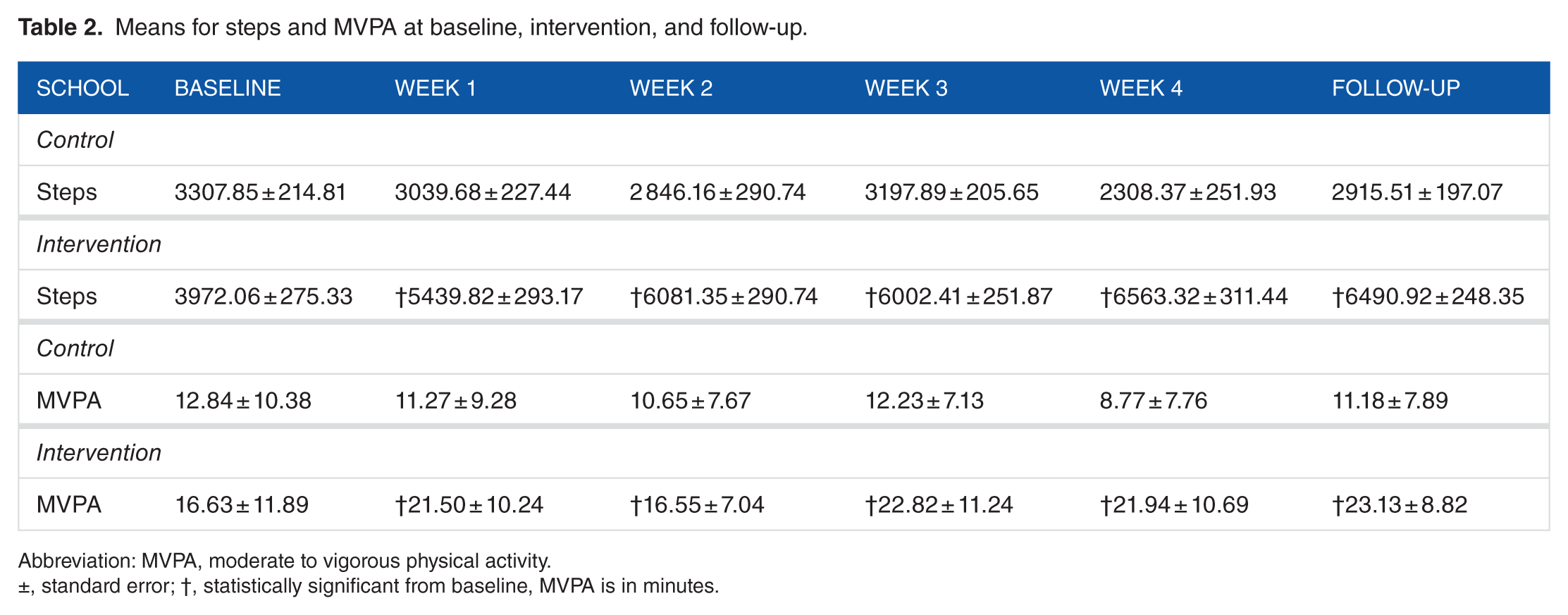
Abbreviation: MVPA, moderate to vigorous physical activity.
±, standard error; †, statistically significant from baseline, MVPA is in minutes.
There was a statistically significant interaction between the intervention group and MVPA over time, F4.222, 270.207 = 2.804, P < .05, partial η2 = .042, ε = .844. Results showed no significant difference between the control school and intervention school at baseline F1,186 = 3.86, P > .05. The MVPA was statistically significantly greater in the intervention (M = 20.43, SE = 0.990, P < .05) compared with the control group over time (M = 11.16, SE = 0.724, P < .05). There was no statistically significant effect of time on MVPA for the intervention group, F5, 110 = 2.176, P = .062, partial η2 = .090. Table 2 represents mean MVPA during baseline, intervention, and follow-up phases for each school.
Results showed no significant difference in FV consumption between the control school and intervention school at baseline F1,186 = 1.84 (P = .308). The FV consumption was not significantly greater in the intervention (M = 51.25, SE = 12.311, P > .05) compared with the control group over time (M = 53.63, SE = 12.024, P > .05). No significant interaction was found between the intervention group and FV consumption over time, F5, 10 = 2.265, P > .05, partial η2 = .531, ε = .266. There was no statistically significant effect of time on FV consumption for the intervention group, F5, 110 = 2.176, P = .062, partial η2 = .090. Table 3 represents mean FV consumption during baseline, intervention, and follow-up phases for each school.
FV consumption at baseline, intervention, and follow-up.

Abbreviation: FV, fruits and vegetables.
±, standard deviation, FV consumption is reported in servings.
Discussion
It was hypothesized that character modeling and goal setting would increase students’ step counts and MVPA. Results indicated that students in the intervention group significantly increased their step counts during the intervention and during the 10-week follow-up. This is in support of other studies, where children in a school-based intervention increased their step counts.34,50 Burns et al 51 examined the role step count goal setting had on PA in schools implementing a Comprehensive School Physical Activity Program. They found that schools that set step count goals had significantly larger increases in step counts that the programs not using goal setting. The goals were set based on recommended levels of school day step counts.
Similarly, students in the intervention school significantly increased their MVPA while being exposed to Fit “n” Cool Kids during the intervention as well as at the follow-up time point. These findings are similar to recent findings illustrating that school-based interventions can increase participants MVPA.16,52 Cradock et al 53 used a school-based intervention focused on having students reach 150 minutes of MVPA each week by promoting PA in PE, during recess and in the classroom. They found that students who were in the intervention school increased their MVPA significantly more than students in the control school. The findings from this study do contradict findings from a study in which a 16-lesson intervention was designed to increase PA, decrease sedentary behavior, and increase fruit and vegetables in children, which did not find a difference in MVPA between the intervention group and control group. 52 Our findings suggest that character modeling and goal setting together are effective at increasing children’s MVPA.
It was hypothesized that the Fit “n” Cool Kids intervention would increase students’ FV consumption. The FV consumption did not increase significantly during the intervention. Students were introduced to multiple fruits and vegetables per day; however, this did not lead to change in FV consumption. This may have been due to student’s lunch period variances and how the fruits and vegetables were presented to the students.
For example, the control school allowed the fourth grade students to have recess before lunch which gave them a set time to eat in the lunch room. The fourth graders in the intervention school had lunch before recess and were not required to stay in the lunch room for a specific time before going out to recess. Through direct observation, the researchers noted that the fourth graders in the intervention school spent much less time in the lunch room and were quick to dispose of their trays to get out to recess. This is consistent with previous research that suggests that when recess is before lunch, there is a reduction in food waste and an increase in FV consumption.45,54 The fifth graders in both the control school and the intervention school had recess before lunch.
The researchers also directly observed what was being served each day for lunch. They found that when children were served whole apples and whole bananas, and they were less likely to consume those foods. They observed children try to bite into an apple or peel a banana but give up before they could make progress and eat the piece of fruit. They also observed children eating more raw vegetables when compared with cooked vegetables. This may also have led to a lack of increase in FV consumption.
Strengths of the study include providing objective measures of PA using activity monitors; this is significant given the known limitations of using self-report instruments with children. 55 Other strengths involved the intervention incorporating both PA and FV consumption in one intervention, studying underserved populations, creating an intervention that does not require much time from teachers or administration and is low cost to school districts. These strengths add to the literature in our field.
A limitation to the study was the different lunch procedures between fourth graders in the control school and the intervention school. Another limitation was the shortness of the intervention. Although similar studies have used the short intervention periods, 56 a longer intervention period would have strengthened the article. The 10-week follow-up did show the sustainability of the intervention. Also, the study did not examine changes in PA and FV consumption outside of school which could have been affected by the intervention. Although this study results showed an increase in PA during the intervention and follow-up phase, the long-term maintenance of this behavior is an important issue that should be examined further. The transtheoretical model identifies maintenance as a period beginning 6 months after the initiation of the target behavior. 57 A follow-up of 6 months succeeding the removal of the intervention could be established in other studies to determine whether maintenance has occurred.
Conclusions
The Fit “n” Cool Kids school-based intervention produced significant increases in students’ PA. Further studies with elongated intervention and/or follow-up phases are desired to determine the extent to which this behavior change is maintained in the absence of an intervention. Although there were no significant increases in students’ FV consumption, students were introduced to unfamiliar fruits and vegetables and were given the opportunity to try these fruits and vegetables during lunch.
Footnotes
Funding:
The author(s) disclosed receipt of the following financial support for the research, authorship, and/or publication of this article: This work was supported by a research grant award from SHAPE America (Society of Health and Physical Educators).
Declaration of conflicting interests:
The author(s) declared no potential conflicts of interest with respect to the research, authorship, and/or publication of this article.
Author Contributions
Conceived and designed the study methods: all authors; Performed the study methods: JNL, TAB; Contributed to specific areas of methods, data analysis, statistics and write-up: all authors; Analyzed the data and wrote the first draft of the manuscript: JNL, TAB; Contributed to the writing of the manuscript and agree with the manuscript’s results and conclusions: all authors. All authors have read, and confirm that they meet ICMJE criteria for authorship.