




Abstract
Heart failure is a leading cause for hospitalisation and for readmission, especially in patients over the age of 65. Diabetes is an increasingly common companion to heart failure. The presence of diabetes and its associated comorbidity increases the risk of adverse outcomes and premature mortality in patients with heart failure. In particular, patients with diabetes are more likely to be readmitted to hospital soon after discharge. This may partly reflect the greater severity of heart disease in these patients. In addition, agents that reduce the chances of readmission such as β-blockers, renin-angiotensin-aldosterone system blockers, and mineralocorticoid receptor antagonists are underutilised because of the perceived increased risks of adverse drug reactions and other limitations. In some cases, readmission to hospital is precipitated by acute decompensation of heart failure (re-exacerbation) leading to pulmonary congestion and/or refractory oedema. However, it appears that for most of the patients admitted and then discharged with a primary diagnosis of heart failure, most readmissions are not due to heart failure, but rather due to comorbidity including arrhythmia, infection, adverse drug reactions, and renal impairment/reduced hydration. All of these are more common in patients who also have diabetes, and all may be partly preventable. The many different reasons for readmission underline the critical value of multidisciplinary comprehensive care in patients admitted with heart failure, especially those with diabetes. A number of new strategies are also being developed to address this area of need, including the use of SGLT2 inhibitors, novel nonsteroidal mineralocorticoid antagonists, and neprilysin inhibitors.
Introduction
Type 2 diabetes is a common finding in patients with heart failure, just as heart failure is a common finding in patients with type 2 diabetes. It has been suggested that at least 70% of all patients with heart failure may now have prediabetes or diabetes mellitus. 1 Today, at least a third of all patients admitted to hospital with heart failure have diabetes. 2 Equally, patients with type 2 diabetes have over twice the risk of incident heart failure than people without diabetes.3–5 The admission rate and readmission rate of patients with heart failure are also higher in those with diabetes, as diabetes and its associated comorbidity contributes to the progression, complexity, and severity of heart failure, making their cardiovascular homeostasis all the more precarious. 6 Even patients with prediabetes carry an increased risk for adverse outcomes. For example, in the PARADIGM-HF studies, prediabetes was associated with increased risk for hospitalisation for heart failure. 1 But with diabetes, that risk increased further, to almost twice that observed in non-diabetic patients.
Given the high prevalence rate of heart failure in patients with type 2 diabetes, its generally greater severity and complexity, relative resistance to treatment and the higher likelihood of their initial hospitalisation for it, 6 type 2 diabetes is also an increasingly common factor for readmission to hospital in patients with heart failure (Table 1). This article will review some of the key clinical challenges in managing heart failure specifically in patients with type 2 diabetes and explore some of the opportunities to reduce readmission rates in diabetic patients with established heart disease.
Some factors associated with unplanned readmission that may be more common in patients with heart failure and type 2 diabetes.

Readmission for heart failure
Heart failure is one of the leading causes for hospitalisation and for readmission, especially in patients over the age of 65. It is thought that almost 2 in 3 patients discharged from hospital with heart failure will be readmitted again within a year, a third of whom will be readmitted within 30 days of their initial discharge, many within the first week. 7 Many patients will be readmitted multiple times within a year of first hospitalisation, in what seems a futile cycle of readmission and discharge. 8 This represents an enormous burden to patients, the health system, and the financial structures that support them. So much so that the prevention of readmission for heart failure has been prioritised, closely audited, and in some countries targeted by pay-for-performance incentives, with financial penalties for hospitals with the highest readmission rates. 7
Another approach has been to try to identify patients at greatest risk of readmission and target them for specific interventions (out-of-hospital support and monitoring, follow-up telephone calls, communication with outpatient providers, optimisation of transitional care, reviews, discharge planning, and medication reconciliation, etc). Screening tools including the LACE index (standing for length of stay, acuity of admission, comorbidity, and previous presentations to emergency) and LACE+ (additionally incorporating age, sex, teaching status of the hospital, number of days on alternative level of care during admission, number of elective admissions in previous year, number of urgent admissions in previous year), the HOSPITAL score, and the 8Ps risk assessment tool have all been validated and the risks for readmission were predicted. 9 Similarly, the DERRI tool stratifies the risk of readmission in patients with diabetes 10 and a number of risk assessment models have also been proposed stratify the risk for readmission specifically in patients with heart failure, 11 including the Center for Outcome Research and Evaluation (CORE) online readmission risk calculator for heart failure (http://www.readmissionscore.org/heart_failure.php). However, in practical terms, there are few diabetic patients admitted to hospital with heart failure who are subsequently at low risk for readmission, 12 and the utility of such risk engines in this setting remains problematic, even in settings of limited resources.
In some cases, readmission to hospital is precipitated by acute decompensation of heart failure (or re-exacerbation) leading to pulmonary congestion and/or refractory oedema. However, it appears that for most of the patients admitted and then discharged with a primary diagnosis of heart failure, most readmissions are not due to heart failure, but rather due to comorbidity including arrhythmia, infection, adverse drug reactions (ADRs), and renal impairment/reduced hydration. 7 One reason for the excess of patients with type 2 diabetes needing readmission is that patients with diabetes are also independently more vulnerable to arrhythmia, infection, ADRs, and renal impairment/reduced hydration. Importantly, the many different reasons for readmission underline the critical value of multidisciplinary comprehensive care in patients admitted with heart failure. 13 This is especially important in patients with diabetes.
β-blockade and readmission in patients with heart failure
The widespread use of β-blockers in patients with heart failure is associated with not only an improvement in mortality but also a reduced risk of hospitalisation for heart failure and readmission. 14 A number of studies have identified that β-blocker prescription on discharge is an important predictor for readmission, such that patients not on β-blockers were more likely to be readmitted. 11 This may be partly due to the absence of β-blockers’ beneficial actions on rate control, arrythmogenicity, adverse remodelling, and myocardial oxygen demand in those patients not taking them. However, the comorbidity that determines why these agents are not being used in certain cases may also partly explain this association. For example, for many different reasons, patients with type 2 diabetes are less likely to receive β-blockers and less likely to be titrated to a maximum tolerated dose as recommended by guidelines. First, more patients with diabetes who present with heart failure have a preserved ejection fraction (HFpEF), whereas the weight of evidence for β-blockade remains in patients with heart failure with reduced ejection fraction (HFrEF). 14 Second, even in diabetic patients with heart failure with HFrEF in whom treatment with β-blockers is clearly able to improve morbidity, hospitalisation, and mortality,15,16 this strategy is underutilised to protect the diabetic heart. This is largely because of the historically poor tolerability of β-blockade in patients with diabetes including adverse actions on glucose and lipid control, hypoglycaemic awareness, and weight gain.17,18 Hyperkalaemia is also a common feature of diabetes and may be exacerbated by β-blockers, especially in the presence of renin-angiotensin-aldosterone system (RAAS) blockade or mineralocorticoid receptor antagonists (MRAs – see below). Depression, fatigue, and sexual dysfunction are also noted side effects of β-blockers, all of which are already more common in patients with diabetes. Finally, patients with diabetes also have high rates of peripheral vascular disease, which is often stated to be a relative contraindication for β-blockade. However, this concern may be overestimated in clinical practice, and in the absence of severe or active disease, the use of β1-selctive agents does not appear to be a risk for limb-threatening ischaemia. Some studies suggest that newer ‘vasodilating β-blockers’ may have superior tolerability in patients with diabetes to traditional β-blockers. 17 In addition, carvedilol which has actions on the α1 adreno-receptor may have particular advantages. For example, in the GEMINI study, patients receiving carvedilol maintained better glucose control that with metoprolol. 19
Blockade of the RAAS and readmission
Blockade of the RAAS is widely used to slow the development and progression of heart failure. As with β-blockade, there is an observed association between lack of use of this strategy and an increased rates of readmission. 20 Most patients with diabetes, and certainly the majority with cardiac disease or heart failure, are treated with an angiotensin receptor blocker or ACE inhibitor. Independent and additional to its actions on blood pressure control, blockade of the RAAS is associated with a reduced risk of heart failure in patients with type 2 diabetes. 21 For example, the HOPE (Heart Outcomes Prevention Evaluation) trial with the ACE inhibitor, ramipril, documented an 18% reduction in hospitalisation for heart failure when compared with placebo. 22 Equally, the Reduction of Endpoints in NIDDM with the Angiotensin II Antagonist Losartan (RENAAL) studies documented that treatment with losartan reduced the incidence of hospitalisations for heart failure by 26% (P = .037) when compared with placebo treatment. 23 A comparable reduction in hospitalisation was also seen in the Losartan Intervention for Endpoint reduction in hypertension (LIFE) (hazard ratio [HR] = 0.57, P = .019) when compared with the β-blocker, atenolol. 24 By contrast, the ADVANCE (Action in Diabetes and Vascular Disease: Preterax and Diamicron MR Controlled Evaluation) trial treating patients with type 2 diabetes with the combination of perindopril and indapamide did not reduce heart failure hospitalisation when compared with standard care, although deaths from cardiovascular causes and total mortality were modestly reduced by this strategy. 25 Yet, despite the clear data for efficacy, there are challenges using RAAS blockade in patients with diabetes. In particular, patients with diabetes are more likely to experience postural dizziness, hyperkalaemia, and acute chronic renal impairment with RAAS blockade which can limit their use as well as the maximal doses that are achieved.
Mineralocorticoid antagonists and heart failure readmission
Mineralocorticoid receptor antagonists (also known as aldosterone receptor antagonists) are widely recommended in patients with HFrEF who are already on ACE inhibitors (or ARBs) and/or β-blockers. 23 Mineralocorticoid receptor antagonists have been shown to reduce heart failure readmission rates in patients with cardiovascular disease, including those with diabetes. 26 In addition, MRA therapy is associated with improvements in diastolic function and markers of cardiac fibrosis in patients with HFpEF. 27 Yet, despite clear evidence of efficacy, the use of MRAs in patients with diabetes is often problematic due to the increased risk of life-threatening hyperkalaemia or renal impairment, especially in those patients with moderate to severe renal impairment, in whom MRAs should be used with great caution, if at all. To minimise the risk of hyperkalaemia, low doses of MRAs or alternate-day dosing may be appropriate in some patients with lesser renal impairment. All patients receiving MRAs should be counselled to avoid foods high in potassium and nonsteroidal anti-inflammatory drugs (NSAIDs). Potassium levels and renal function should be closely monitored after initiation of an MRA and the development of potassium levels >5.5 mEq/L should trigger discontinuation or dose reduction unless other causes are identified. Sick day rules should also be applied whereby MRAs are discontinued if patients are at risk of volume depletion (eg, evidence of weight loss, diarrhoea, reduced fluid intake, fasting prior to procedures). Most diabetic patients are familiar with sick day rules and drug discontinuation (eg, with metformin and SGLT2 inhibitors). There are some data to that the side effect profile of eplerenone may be superior to spironolactone in diabetic patients. 28 Newer novel nonsteroidal MRAs such as apararenone, esaxerenone, and finerenone with potentially improved safety profiles are currently in advanced clinical trials in patients with heart failure. 29 The use of combined angiotensin-neprilysin inhibitors and novel potassium binding agents may also have a role to reduce the risk of hyperkalaemia. 30
Chronic kidney disease and heart failure
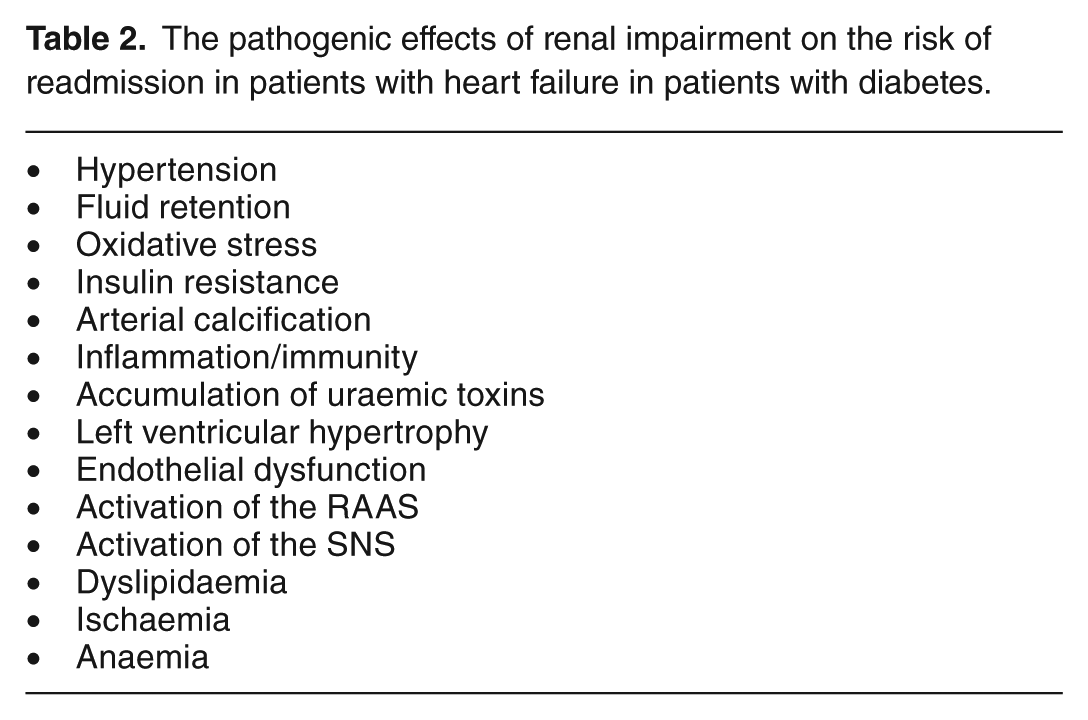
Chronic kidney disease (CKD) is widely regarded a key risk factor for adverse outcomes in patients with heart failure, including mortality, admission, and readmission for heart failure.31,32 Patients with diabetes have a higher prevalence of CKD, which may be a key determinant of the adverse risks associated with diabetes. Indeed, adverse outcomes associated with diabetes may be largely confined to those patients with comorbid CKD (NHANES III [National Health and Nutrition Examination Survey III]). 33 Impaired renal function may be a reflection of impaired cardiac function or systemic pathogenic processes that lead to poor health outcomes in patients with CKD. However, renal impairment also has many direct effects on cardiac function that influence its vulnerability to decompensation (Table 2).
The pathogenic effects of renal impairment on the risk of readmission in patients with heart failure in patients with diabetes.
Although the presence and severity of CKD may be considered an irreversible risk factor for readmission, by no means does this mean that intervention is futile. In particular, CKD places patients with heart failure at risk for acute-on-chronic renal impairment in the event of reduced renal perfusion. This may occur, for example, in discharged patients who become dehydrated (eg, over diuresis, uncontrolled diabetes, high climatic temperature, gastro-enteritis, reduced fluid intake) or if cardiac function declines subsequently. In some cases, self-medication with NSAIDs can also alter renal perfusion and, particularly in patients also taking loop diuretics and or blockers of the RAAS, quietly precipitate acute renal impairment. Acute renal impairment can be hard to detect clinically, and patients’ fatigue, oedema or malaise is easily attributed to other conditions, including diabetes and heart failure. Importantly, renal impairment may not be associated with oliguria. However, if untreated, acute renal impairment can not only lead to readmission but increasingly is also a precipitating cause of decompensation and premature mortality. Consequently, careful and regular evaluation of fluid status is valuable in discharged patients with CKD. This may be simply achieved with regular weighing and setting thresholds’ appropriate intervention (eg, notification of practitioner, holding of diuretic therapy) in the event of excessive fluid loss.
It is also important to note that ADRs are more common in patients with CKD, especially with renal-cleared drugs. Frequent changes in medication type and dose during admission can readily expose patients to ADRs on discharge, especially in patients with diabetes and CKD who often have a considerable pill burden. In addition to the increased risk for excessive diuresis and hyperkalaemia detailed above, patients with CKD are also more prone to bradycardia with atenolol, as atenolol is cleared by the kidney. 34 Finally, the utility of antiplatelet therapy with clopidogrel is problematic in patients with CKD, with the CHARISMA (Clopidogrel for High Atherothrombotic Risk and Ischemic Stabilization, Management, and Avoidance) study showing increased mortality in patients with CKD. 35
Anaemia, heart failure, and readmission
Patients with diabetes are nearly twice as likely to have anaemia, when compared with those without diabetes, 36 even after adjusting for the higher frequency of CKD in diabetic patients.37,38 Over and above conventional risk factors, the presence and severity of anaemia is a biomarker for poor clinical outcomes in patients with heart failure, including the development of more severe symptoms, need for initiation of diuretic therapy, acute hospitalisation, and premature mortality.39–43 We have shown in echocardiographic studies that 94% of diabetic patients with anaemia had evidence of some cardiac abnormality. In contrast, less than 5% of patients with normal cardiac findings had anaemia. But while identification of anaemia is a useful prognostic marker, whether anaemia plays any direct pathogenic role is unclear. Anaemia is often a marker of frailty or denotes the presence of some underlying comorbidities (ie, CKD, gastrointestinal bleeding, haematologic disorder) which themselves adversely influence patient prognosis. Certainly anaemia is also a risk factor for readmission of non-cardiology patients including oncology and internal medicine. Anaemia can cause symptoms which may be confused with heart failure and potentially precipitate readmission, such as lack of energy, breathlessness, dizziness, and reduced exertional capacity.44,45
The clear association between anaemia and adverse outcomes provides a rationale to correct anaemia, especially in patients with reduced performance associated with heart failure. Some small studies support this hypothesis and have suggested that hospitalisation may possibly be reduced following correction of anaemia in diabetes. 46 However, larger studies including the Reduction of Events with Darbepoetin Alfa in Heart Failure (RED-HF) trial failed to reduce the mortality or hospital admission for worsening heart failure in patients with HFrEF and anaemia, and thromboembolic events and stroke were modestly increased. 47 It may be that the reduction in viscosity associated with anaemia plays a compensatory role in the setting of heart failure, and despite the functional impact of a reduced haematocrit, correction of anaemia remains problematic in this setting.
Glycaemic control and heart failure
There is strong epidemiologic evidence linking poor glycaemic control in patients with diabetes and the risk of hospitalisation for heart failure. A linear relationship between glycaemic control and heart failure has also been reported across a number of prospective observational studies in type 2 diabetes, such that, on average, the risk of heart failure was increased by 15% for each percentage point higher haemoglobin A1c (HbA1c). 48 Similarly, in the UK Prospective Diabetes Study (UKPDS) study, for every 1% rise in HbA1c, there was a 16% rise in incident heart failure (P = .021). 49 Despite this clear association, in clinical trials testing the utility of glucose lowering in diabetes, intensive treatment has not been associated with any reduction in new-onset heart failure or a reduction in hospitalisation in patients with established heart disease. 50 One reason may be that glucose-lowering mega-trials were largely performed in patients with established cardiovascular damage, which may be irreversible through glucose control alone, at least over the short to medium time period over which these studies were conducted. Unfortunately, these are precisely the patients admitted to hospital with heart failure in whom careful consideration of the need and method of intensification must often be made.
Although there remains no evidence that glucose lowering per se is able to modulate heart failure outcomes in the short term, there are some data to suggest that inpatient review, optimisation, and where appropriate intensification of glycaemic control can reduce the risk of readmission following discharge, especially in those with poor glycaemic control (HbA1c ≥ 8% [64 mmol/mol]). 51 However, this must be done expertly. Changes in medication undertaken to improve glycaemic control in hospital may have very different outcomes once patients are discharged, as increased physical activity, dietary changes, dosing errors, and isolation from oversight can increase the risk of hypoglycaemia and readmission resulting from it. At the same time, under-treatment of hyperglycaemia can result in excessive fluid loss and dehydration. It is hardly surprising that readmission rates remain so high in complex patients with diabetes and heart failure. Nonetheless, careful discharge planning, patient education, and coordination of out-of-hospital care can minimise these risks.
There also remains a real potential to modulate heart failure and the chances of readmission through the pleiotropic actions of glucose-lowering agents. For example, treatment with thiazolidinediones (eg, rosiglitazone and pioglitazone) despite lowering glucose levels increases hospitalisation with heart failure by 30% to 40% due to their effects on sodium reabsorption in the kidney. 52 Recent data have also suggested dipeptidyl-peptidase 4 (DPP4) inhibitors may modestly increase the risk of hospitalisation from heart failure. 53 Whether this is a class effect or limited to only some DPP4 inhibitors is still unclear. Despite only saxagliptin reported an increased risk of heart failure hospitalisation in the SAVOR-TIMI 53 trial, 53 the confidence intervals for heart failure outcomes are wide and the observed heterogeneity between SAVOR-TIMI 53 and other cardiovascular safety trial with DPP4 inhibitors is not significant. The overall risk, however, is of borderline and uncertain significance. Moreover, the lack of effects of GLP-1 receptor agonists (which work through similar incretin-based mechanisms) on heart failure outcomes in recent clinical trials in type 2 diabetes supports the effectively neutral impact of agents of this class, especially when weighed against the risk of hypoglycaemia from sulphonylureas and insulin-based therapies.
By contrast, the use of the biguanide, metformin in patients with heart failure may be associated with a modest improvement in key clinical outcomes, including mortality and MACE outcomes. 54 In addition, a recent systematic review of observational studies reported a 13% lower chance of readmission for heart failure during follow-up for patients receiving metformin when compared with those not receiving it (HR = 0.87; 0.78-0.97; P = .009). 55 Metformin is often recommended to be discontinued (or at the very least used with caution) in patients with severe heart failure because of the increased risk of lactic acidosis, so this finding may be partly influenced by a treatment bias. However, even after adjusting for the propensity to use metformin, these beneficial effects appeared to persist.
The recent emergence of sodium glucose co-transporter 2 (SGLT2) inhibitors is also of great interest. Independent to their glucose-lowering actions, treatment with SGLT2 inhibitors is associated with a substantial reduction in hospitalisation for heart failure in patients with established heart disease. 56 It is likely that this action partly reflects the ~8% reduction in plasma volume achieved when using agents of this class. However, additional actions on rate control, cardiac metabolism, and neurogenic signalling cannot be excluded. Notably, this effect is observed rapidly, within a few months of commencing therapy, and persists with ongoing therapy, suggesting that this therapy may be effective in preventing both early and late readmission in patients with heart failure. 56 It should be noted, however, that heart failure was not the primary outcome of these safety studies, and specific trials testing the utility of SGLT2 inhibitors in patients with fully characterised cardiac status still need to be performed, including ones specifically in patients with HFpEF hold great promise for the future management of heart failure.
Vaccination in diabetic patients with heart failure
Community-acquired respiratory infections are a common cause of readmission to hospital in patients with heart failure and are associated with an increased risk on in-hospital mortality. Recent studies have demonstrated that vaccination against common respiratory infections can reduce hospitalisation in patients with heart failure. 57 For example, in the PARADIGM-HF study, influenza vaccination was associated with a 19% reduction in all-cause mortality (in participants with HFrEF). 58 Equally, a community-based study of more than 140 000 patients with heart failure also reported a 19% reduction in readmission to hospital in elderly patients who were vaccinated. 59
It is now widely recommended that patients with heart failure be vaccinated annually against influenza, unless contraindicated. Where available the high-dose intravenous formulation may be preferred due to reduced immune responsiveness to standard dose vaccination in this setting. In addition, pneumococcal vaccination is also recommended for high-risk patients, including those with diabetes and/or CKD. A dual stratagem using both PPSV23 (Pneumovax 23) and PCV13 (Prevnar 13) may be preferred in high-risk patients such as those with diabetes, CKD, or severe heart failure, although they should be administered a year or more apart. Revaccination with PPSV23 (but not PCV13) is also recommended every 10 years to cover waning immunity in older patients.
Conclusions
The management of heart failure is challenging at the best of times. The additional burden of diabetes and its comorbidities amplifies this challenge and increases the risk of adverse outcomes including readmission to hospital and premature mortality. The prognosis and survival of patients with diabetes and heart failure is approximately half that observed in non-diabetic individuals, even after adjusting for conventional risk factors.60–62 Recognising this risk, there are substantial opportunities to intervene. Not all readmissions are avoidable, such is the natural history of the disease, but many are. Modern management of heart failure must clearly involve multidisciplinary care 13 and increasingly must now actively involve diabetes professionals, not merely on an ad hoc basis. In addition to optimised cardiac therapy, it is clear that optimised antidiabetic therapy also plays an important role in reducing the risk of readmission. In particular, the reduction in hospitalisation for heart failure in diabetic patients with established heart following the use of SGLT2 inhibitors, reported in both clinical trials 56 and more recently in real-world setting, 63 strongly supports the utility of these agents in patients with diabetes and heart failure. However, much more needs to be done to improve poor clinical outcomes in diabetic patients. It is hoped that novel therapies currently under development including neprilysin inhibitors 64 will provide some much needed relief for patients with diabetes and heart failure.
Footnotes
Funding:
The author(s) received no financial support for the research, authorship, and/or publication of this article.
Declaration of conflicting interests:
The author(s) declared no potential conflicts of interest with respect to the research, authorship, and/or publication of this article.
Author Contributions
MCT conceived, wrote, edited, submitted and revised this manuscript.