




Abstract
Cigar initiation among youth is a public health hazard. The current study examines the relationship between perceived tobacco accessibility and cigar initiation, with a focus on exploring racial differences in this association. We studied a longitudinal cohort of 5399 youth aged 12-17 who had never used cigars (cigar-naïve) and were surveyed as part of the nationally representative Population Assessment of Tobacco and Health Study. Using multivariable regression and marginal effects, we modeled cigar initiation within 1-year after the measurement of the perceived tobacco accessibility (very easy/somewhat easy vs somewhat difficult/very difficult). We then explored the interaction between accessibility and race and ethnicity. We additionally used multivariable logistic regression to model changes in perceived accessibility. Approximately 4% of youth started smoking cigars by 1 year later. In our final adjusted model, perceiving tobacco accessibility as very easy/somewhat easy increased the estimated risk of initiating cigars by 59% (OR = 1.59; 95% CI: [1.18, 2.16]). The probability of cigar initiation also increased with each higher level of perceived accessibility. Compared to Non-Hispanic White youth who perceived tobacco to be inaccessible, Hispanic youth who perceived tobacco as accessible were 2 times (OR = 2.01; 95% CI: [1.09, 3.71]) more likely to initiate cigar use by 1 year later. Youth who believe they have easy access to tobacco are at an increased risk of starting to smoke cigars with the risk possibly higher among Hispanic groups. Multi-level approaches focused on reducing tobacco accessibility are needed to successfully reduce cigar initiation among all youth.
Introduction
Cigar initiation among youth represents a major public health threat, as approximately 1.3 million, or 4.8%, of adolescents currently smoke cigars. 1 Moreover, nearly 90% of established adult smokers initiate use before the age of 18, spotlighting adolescence as an especially impressionable period for cigar initiation. 2 Cigars contain the same carcinogenic compounds found in cigarettes and may contain between 6 and 335 mg of nicotine, a major component involved in nicotine dependence.3,4 The use of cigars in youth also has substantial health risks such as respiratory dysfunction, and early mortality.2,5,6 However, despite the threat of health risks, more than 800 youth experiment with cigar smoking daily, with those identifying as non-Hispanic Black having the highest past 30-day prevalence.7,8 The existing racial disparities and ongoing cigar consumption among youth populations, regardless of known health consequences, spotlights a need to elucidate distinctive risk factors that promote early cigar initiation in vulnerable adolescent populations.
Tobacco accessibility is a risk factor for initial tobacco use among youth. 9 Findings from a recent meta-analysis suggest that tobacco retail outlet density strongly correlates with youth cigarette usage in the past month, underscoring accessibility as a key driving factor in tobacco experimentation during impressionable development stages. 9 Few cigar-specific studies have revealed similar conclusions, suggesting that greater outlet density is associated with initiation of combustible tobacco products like cigars.10,11 Similarly, in a separate 2023 study of California youth, authors reported that greater number of tobacco outlets with outdoor marketing were associated with cigar use each day. 12 While the status quo of measuring tobacco availability has traditionally been done using objective variables (i.e., retail density), they do not consider the personal interpretations of tobacco accessibility on individual behavior. Subjective self-reported measures (i.e., perceived tobacco accessibility) can complement existing objective studies and provide insight on whether existing tobacco policies have had an impact at the individual level.
Evidence suggests that racial disparities in cigar use may be linked to racial disparities in accessibility.15-21 Findings of one study suggest that tobacco retailer density increased by 5.7% for every quartile increase in the proportion of Black- and Hispanic residents. 22 In a similar study using state-level geographic data, authors conclude that higher tobacco retailer density in Black and Hispanic communities are positively associated with smoking disparities in adults. 23 Additionally, results of a 2019 New York study concluded that tobacco retail products varied by racial distribution, with Black neighborhoods having increased cigar accessibility compared to White neighborhoods. 20 Geographic racial differences in accessibility between White, Hispanic and non-Hispanic Black racial groups may contribute to perceived differences in accessibility and impact early cigar initiation among youth. However, limitations such as assessing only racial differences in tobacco accessibility via objective measures fail to account for the ways in which environmental factors impact personal behavior and can lead to an incomplete understanding of the tobacco accessibility’s impact on early cigar use.2,24
Few studies have emphasized the role of self-reported measures like perceived tobacco accessibility as a risk factor for youth cigarette use.13,14 Findings from the second Development and Assessment of Nicotine Dependence in Youth, a four-year prospective cohort study, suggest that youth non-smokers who perceived tobacco as accessible have an increased risk of cigarette experimentation. 14 However, failure to evaluate the role of perceived tobacco access when it comes to alternative tobacco products, like cigars, and consideration of racial and ethnic differences remain limited in the current literature.
To address gaps in research, the current study aimed to understand whether perceived tobacco accessibility is associated with the risk of starting to smoke cigars among youth and examine racial and ethnic differences. Our secondary aim was to explore the impact of changes in perceived availability on cigar initiation within the same period.
Methods and Materials
Sample and Design
For this study, we used publicly available data from the Population Assessment of Tobacco Health Study (PATH), a nationally representative, longitudinal study of tobacco use and its health effects. The PATH Study was established to inform the Federal Drug Administration’s (FDA’s) Center for Tobacco Products regulatory authority of tobacco products under the Family Smoking Prevention and Tobacco Control Act (FSPTCA). 25 At Wave 1, the PATH Study utilized a multi-stage probability sampling design to select adults aged 18 and older and youth 12-17 years from the U.S. civilian, non-institutionalized population. All youth participants provided written assent alongside parental/legal guardian consent. The parents providing consent were also asked to complete a brief survey about their youth. 25 Youth respondents who were aged up (i.e., turned 18 by Wave 2) were not included in the final analytic sample, as the study sample was restricted to only those who were youth (aged 12-17) at Waves 1 and 2 of the study. The present study utilized data on Wave 1 youth who had never used cigars, participated in Wave 2 approximately 1-year later, and had complete data on key variables. Based on a priori power analysis, the final analytic sample consisted of 5399 youth, with 242 excluded due to missing data. This sample size provided sufficient statistical power to detect small-to-medium effect sizes at a significance level of α = 0.05 for the primary logistic regression analyses examining tobacco accessibility and cigar use initiation among youth participants. A priori Data collection for Waves 1 and 2 occurred between September 2013 and October 2015.
Interviews were conducted using audio computer-assisted self-interviewing methods to facilitate accurate reporting for sensitive topics. PATH study questions and scales have shown substantial validity and reliability in the assessment of tobacco behaviors, with an average kappa of 0.79 for adult and youth respondents. 26 Youths received a $35 incentive and two community service hours for completing an interview survey. Youth weighted survey response rates for Waves 1 and 2 were 78.4% and 87.3%, respectively. A detailed description of the study design and procedures can be found elsewhere. 27
Study Measures
Primary Outcome
The PATH study assessed ever use of traditional, cigarillo, and filtered cigars at Wave 1 and whether the respondent had used any of these cigar products in the prior 12 months at Wave 2 since the last follow-up. We defined cigar initiation as those respondents who had never used any cigar product at Wave 1 but indicated use by Wave 2.
Primary Exposure
The PATH Study assessed perceived tobacco accessibility by the following: “How easy do you think it is for people your age to buy tobacco products in a store?” The four responses options were very easy, somewhat easy, somewhat difficult, and very difficult. We dichotomized responses into very easy/somewhat easy vs somewhat difficult/very difficult, as the primary aim of our study was to assess the effect of perceived accessibility on cigar initiation.
Covariates
We considered the following covariates as potential confounders: age, gender, race and ethnicity, parental education based on parent self-report, past-month cigarette use (current smoking), tobacco availability in the home, whether the youth had obtained a free tobacco sample product in the past 6 months and internet use frequency.
Statistical Analyses
We used multivariable logistic regression to estimate the odds of cigar initiation associated with perceived tobacco availability controlling for other factors. We present odds ratios (OR) along with their 95% confidence intervals (CI) and P-values to aid in interpretation. Both full and reduced regression models were estimated to account for potential confounding effects, recognizing that some variables may be theoretically or empirically related to one another. Model fitness was determined based on a theoretical approach using current literature and how the inclusion of certain variables improved the area under the curve (AUC), with higher AUC values indicating better discriminatory performance of the predictive model. Detailed descriptions of variables included in the full and reduced models can be found in the corresponding table footnotes. Interaction effects between perceived tobacco accessibility and race and ethnicity were assessed by adding a product term to the regression model. In exploratory analyses, we examined the effect of changes in perceived tobacco accessibility from Wave 1 to 2 on cigar initiation and reported their marginal effects. All analyses accounted for the PATH Study’s complex survey design using balance repeated replicate (BRR) weights and a Fay correction factor of 0.3. 28 Analyses were conducted using SAS/STAT software, version 9.4. 29 . The current study was exempt and deemed non-human subjects research by the University of Arkansas for Medical Sciences Institutional Review Board (IRB: 276 961).
Results
Study Variables and Sociodemographic Characteristics
Baseline Characteristics of Youth by Cigar Initiation at Follow-Up

About 4% of youth who had never used cigars at baseline (Wave 1) initiated use approximately one year later at follow-up (Table 1). The percentage of youth who perceived tobacco to be very/ somewhat easy at baseline was proportionately greater among those who started using cigars at follow-up than those who did (45.8% vs 35.1%). At wave 2, most youth who did not initiate cigar use were aged 12-14 (57.7%), while most youth who initiated cigar use were 15-17 (59.9%). A higher percentage of youth who initiated cigar use were male (55.4%) while those that did not initiate were female (50.6%). Non-Hispanic White youth were the largest racial and ethnic group regardless of cigar initiation status by Wave 2, followed by non-Hispanic Black.
Among youth who initiated cigar use by Wave 2 and those who did not, the majority reported tobacco as unavailable at home, were not current cigarette users, and had not received free tobacco samples. Additionally, daily internet users constituted the largest subgroup in both categories. However, in parental education levels, fewer youth who initiated cigar use by Wave 2 had parents with college degrees compared to those who did not initiate use.
Parsimonious Multivariable Model
Odds of Cigar Initiation Associated With Perceived Tobacco Accessibility and Other Covariates Among Cigar Naïve Youth, PATH 2013-201
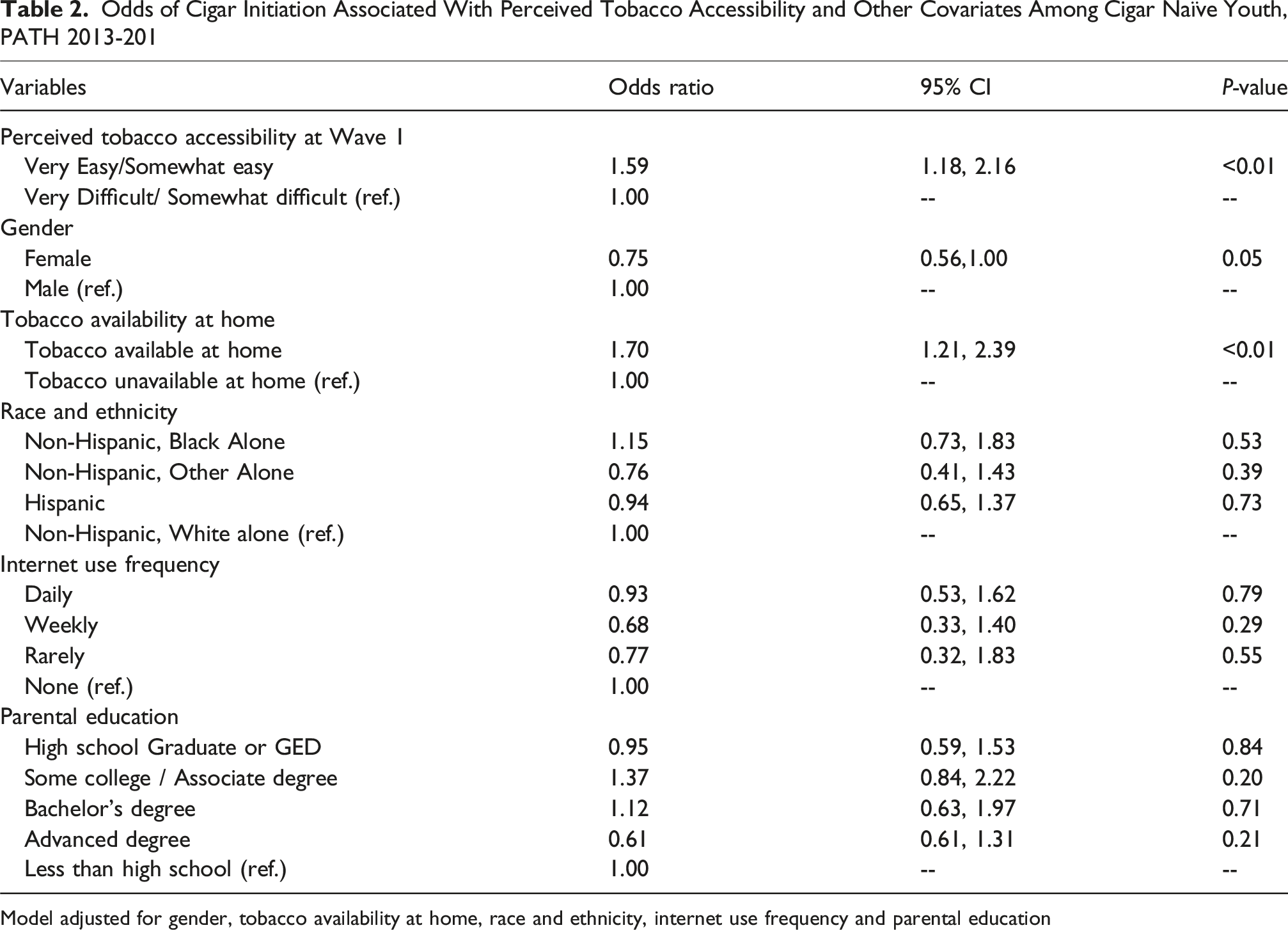
Model adjusted for gender, tobacco availability at home, race and ethnicity, internet use frequency and parental education
Model of Interaction Effects
Adjusted Multivariable Logistic Regression Interaction Effects of Race and Tobacco Accessibility on Cigar Initiation Among Cigar Naïve Youth, PATH 2013-2014

Model adjusted for gender, tobacco availability at home, race and ethnicity, internet use frequency and parental education
Changes in Tobacco Accessibility
Figure 1 highlights the estimated marginal probability of cigar initiation for different levels of perceived tobacco accessibility. The results indicate that as perceived tobacco accessibility increases from “Very Difficult” (Estimate: 0.03; 95% CI: 0.02 - 0.03) to “Very Easy” (Estimate: 0.06; 95% CI: 0.04 - 0.07) the probability of cigar initiation among cigar-naive youth also increases. Model estimates can be found in table S1 of the section ‘Supplemental Tables.’ Marginal Effects and 95% Confidence Intervals of Tobacco Accessibility Among Cigar Naïve Youth, PATH 2013-2015
Discussion
Among cigar naïve youth, we hypothesized that easier perceived tobacco accessibility would increase the likelihood of cigar initiation, especially among racial minorities. Consistent with this hypothesis, we found that perceiving tobacco as more accessible increases the risk of initiating cigars among young people. Furthermore, youth who perceive an increase in tobacco accessibility have a greater probability of initiating cigar use one year later.
Youth who perceive tobacco to be more accessible may increase tobacco acceptability, therefore increasing their likelihood of experimentation. Previous research on traditional cigarettes have supported this theory, suggesting that youth who perceive illegal tobacco substances as easily accessible (i.e., tobacco use under the legal age) are more likely to experiment with them.30-32 In a cigar-specific study, results from a 2018 qualitative study suggest that perceived tobacco accessibility was a major contributor to little cigar initiation, continued use and potential cessation among young adults. 33
Although Non-Hispanic Black youth experience greater tobacco accessibility and cigar product use, we did not find evidence that the effect of perceived tobacco accessibility was higher among this population.34-36 This finding may align with recent evidence showing that established Black cigar smokers typically begin smoking at older ages than their White counterparts. 37 However, since previous studies focused on adults, their findings offer limited insight into initiation of cigar use among youth.
Our adjusted analyses revealed a significant interaction between perceived tobacco accessibility and cigar initiation among Hispanic and White youth, with Hispanic youth showing a stronger combined effect. Previous research on this relationship has been mixed. One study using objective measures of tobacco accessibility in Florida found that retailers in Hispanic neighborhoods were more likely to sell to underage youth. 36 Conversely, a broader study across 97 U.S. counties found no association between Hispanic population density and tobacco outlet density. 38 While these earlier findings appear inconclusive, interaction effects observed in the current study provide new evidence about the complex interplay between structural, macro-level factors and racial and ethnic identities.
For nearly a decade, researchers of tobacco policy have attempted to mitigate tobacco accessibility among youth. For example, authorization of the 2009 FSPTCA, has reduced youth tobacco accessibility by 1) restricting all tobacco sales to minors (including face-to-face sales), with exceptions for vending machines and self-service displays in adult-only facilities, and 2) requiring age verification for all over-the-counter sales. 39 In response to the overwhelming federal support, state governments and localities have followed similar trends by engaging in higher minimum legal tobacco purchasing age requirements. 39
Despite initiatives at the federal and state levels, challenges such as poor regulation of internet sellers from illegal commercial markets have contested the current progress of tobacco accessibility in the United States.39,40 Additionally, although noncommercial distribution is illegal in most states there is little evidence to support whether such practices are maintained. 39 Unfilled gaps in regulation have resulted in a distorted perception of tobacco accessibility among youth. Furthermore, although previously discussed policies have demonstrated partial effectiveness in reducing tobacco accessibility behaviors, results of the current study imply that many youths still perceive tobacco as readily easy to acquire, highlighting a gap in the current reduction mechanisms.
Developing targeted policies and interventions to reduce youth access to tobacco products is crucial. Adolescent years represent a vulnerable window where environmental influences can engrain formative impressions, embedding unhealthy trajectories and addictive propensities that endure throughout the lifespan. Nicotine dependence among youth who use cigars can be magnified due to greater toxins, cancer-causing nitrosamines and addictive substances compared to traditional cigarette smoke. 41 To reduce the downstream health effects of nicotine, policymakers should consider increasing compliance checks at tobacco retailers and implement stricter penalties for selling to minors. At the community-level enhanced surveillance of tobacco retailers near schools and youth-centered locations and conducting regular assessments of neighborhood tobacco outlet density are necessary. Furthermore, public health programs should focus on reducing both actual and perceived tobacco accessibility through youth education campaigns, community engagement, and partnerships with local organizations. Incorporation of these comprehensive approaches at each level may help disrupt the pathway between perceived tobacco accessibility and cigar initiation.
This research is not without limitations, which could bias our findings. First, the PATH Study asked respondents about tobacco accessibility in general, potentially misclassifying respondents about their cigar accessibility. Nonetheless, most cigars are purchased via gas stations and convenience stores, which sell a variety of tobacco products. 42 Second, cigars purchased via illegal markets (e.g., via street vendors) may not be captured and could result in unmeasured confounding. However, approximately 59% of youth smokers purchase tobacco products through commercial retailers. 43 Third, the role of social media exposure to tobacco content has evolved significantly over the years, and our study may not fully capture the current influence of digital marketing and peer influence on cigar initiation, potentially limiting the generalizability of our findings to contemporary youth populations. 44 Lastly, these data were collected prior to the U.S. national prohibition on selling tobacco products to youth under the age of 21 in late 2019 (Tobacco 21). The applicability of our findings to the present regulatory landscape may be constrained given potential changes in youth perceptions of tobacco availability and cigar initiation rates following the implementation of Tobacco 21 legislation.
Conclusion
Despite previous public health reduction efforts tobacco accessibility among youth remains a public health concern. Youth who perceive tobacco to be accessible are more likely to initiate cigar use within the next year. Furthermore, the results of the present study highlight key ethnic disparities in the primary association, with accessibility’s effect on initiation in Hispanic youth greater than the accessibility effect in Non-Hispanic White youth. The way forward to reducing the perception of tobacco accessibility involves a multi-level approach between community organizations and political officials. Engaging local community leaders provides insight into the true driving mechanisms influencing the perception of tobacco accessibility among youth. By pinpointing context-specific contributors, policymakers can devise customized laws strategically aimed at disrupting pathways to initiation, safeguarding long-term public health.
Supplemental Material
Supplemental Material - Perceived Tobacco Accessibility and Cigar Initiation: Exploring Racial and Ethnic Differences
Supplemental Material for Perceived Tobacco Accessibility and Cigar Initiation: Exploring Racial and Ethnic Differences by Alisha Crump, Benjamin C. Amick, Reid D. Landes, Clare C. Brown, Austin Porter, Brian F. Fairman in Tobacco Use Insights
Footnotes
Author Contribution
A.C. – Conceptualization, Data curation, Investigation, Methodology, Writing (original, review and editing), Visualization
B.A. – Supervision, Project administration, Writing (original, review and editing)
R.L. – Data curation, Methodology, Writing (original, review and editing)
C.B. – Supervision, Writing (original, review and editing)
A.P. – Supervision
B.F. – Conceptualization, Investigation, Supervision, Methodology, Writing (original, review and editing)
Funding
CCB is supported by the National Institute on Minority Health and Health Disparities (NIMHD) of the National Institutes of Health (NIH; 1K01MD018072). The content of this paper is solely the responsibility of the authors and does not necessarily represent the official views of the funders. Funders had no role in the design, analysis, or writing of this article.
Declaration of Conflicting Interests
The authors declared no potential conflicts of interest with respect to the research, authorship, and/or publication of this article.
Data Availability Statement
All datasets analyzed in the current survey research study are available in the data repository,  .
45
.
45
Supplemental Material
Supplemental material for this article is available online.
References
Supplementary Material
Please find the following supplemental material available below.
For Open Access articles published under a Creative Commons License, all supplemental material carries the same license as the article it is associated with.
For non-Open Access articles published, all supplemental material carries a non-exclusive license, and permission requests for re-use of supplemental material or any part of supplemental material shall be sent directly to the copyright owner as specified in the copyright notice associated with the article.
