




Abstract
Although most tobacco users initiate this behavior before the age of 18, little is known about engaging in tobacco use prompting behaviors (TPBs) during childhood/adolescence and tobacco use in adulthood, particularly among women in low- and middle-income countries (LMICs). The purpose of this study was to examine engagement in TPBs during childhood or adolescence and tobacco use in adulthood among Colombian women and whether or not current/past tobacco users who were engaged in TPBs during their childhood or adolescence had more odds of engaging other children or adolescents in these behaviors as adults. There were 4262 adult women who were recruited and completed an interviewer-administered survey through a door-to-door approach across the 9 regions of Antioquia, Colombia using a multi-stage probabilistic sampling. TPBs were defined as someone being asked to: (1) empty an ashtray, (2) buy cigarettes, (3) put the cigarette in their mouth and light it, (4) light a cigarette without putting it in their mouth, or (5) smoke with the adult during childhood or adolescence. We conducted bivariate regression logistic models where variables with a P < .25 were included in a parsimonious model. Approximately 40% of participants (41%) reported engaging in TPBs in childhood or adolescence. Buying cigarettes, lighting cigarettes with their mouth, and smoking with an adult were significantly associated with tobacco use in adulthood. Current/past tobacco users who reported being engaged in TPBs during childhood or adolescence (except for smoking with an adult) had higher odds of prompting these behaviors as adults. TPBs during childhood or adolescence are relevant contributors to tobacco use in adulthood among Colombian women.
Tobacco use continues to be the leading cause of preventable deaths despite efforts at local, country, and global levels throughout the tobacco control continuum (production, prevention, cessation, environmental tobacco exposure, and policy). 1 Globally, it has been well documented that daily tobacco use is higher among men (25%) than women (5.4%). 2 Colombia follows the same pattern with prevalence of daily tobacco use among adult men at 11.1% and among women at 4.3%, and cigarettes continue to be the most frequently used tobacco product. 3
Although the World Health Organization Framework Convention on Tobacco Control (WHO FCTC) has specifically called for the need for a deeper understanding of women and tobacco-related issues as well as the development of gender-relevant tobacco control efforts, 4 most studies on factors associated with tobacco use initiation have been gender neutral. For instance, it has also been suggested that the association between family influences and substance use (including tobacco use) is stronger among girls as compared to boys while peer and neighborhood influences are stronger among boys as compared to girls.5,6 Gottfredson and colleagues 7 also found that the association between parental smoking and adolescent smoking was stronger when adolescent gender was congruent with parent gender.
Most studies have limited the examination of “family influences” to parental smoking and its association to adolescent smoking rather than engagement of children and adolescents in adults’ tobacco use. Previous cross-sectional research has shown that parental prompting and engagement in parental tobacco use behaviors were associated with tobacco use among youth 8 with “prompting” defined as engagement of the child in parental smoking behaviors (eg, parent asking the child to empty an ashtray, to bring his/her cigarettes, etc.). With regard to gender differences, this study found that girls had higher odds than boys to receive requests to bring the parent his/her cigarettes while boys had significantly more odds of receiving tobacco gear from parents than girls. 8 However, longitudinal examination of this association among youth did not show an association between parental prompting and subsequent adolescent trial smoking. 9 While these studies have made major contributions toward the understanding of parental influences and tobacco use initiation, there are still opportunities to further explore some gaps in the literature, namely: (1) association between engagement in adult tobacco use prompting behaviors during childhood and adolescence and tobacco use in adulthood by taking into account engagement in these behaviors by other adults in addition to parents; (2) whether or not current/past tobacco users who were engaged in tobacco use prompting behaviors during their childhood or adolescence had higher odds of engaging other children/adolescents in these behaviors as adults; and (3) an examination of these associations from a gender perspective, particularly in low- and middle-countries (LMICs) where tobacco use among girls is on the rise. A recent systematic review of substance abuse programs targeting youth strongly emphasized the need for effective interventions aimed at preventing and managing substance abuse among adolescents in LMICs, in particular, that are informed by high quality and rigorous research. 10
Therefore, the overall goal of this paper is 2-fold: (1) to examine engagement in tobacco use prompting behaviors during childhood or adolescence and tobacco use in adulthood among Colombian women; and (2) to examine whether or not current/past tobacco users who were engaged in tobacco use prompting behaviors during childhood or adolescence had higher odds of engaging children or adolescents in these behaviors as adults. Prompting is defined as someone requesting to: (1) empty an ashtray, (2) buy cigarettes, (3) put the cigarette in their mouth and light it, (4) light a cigarette without putting it in their mouth, or (5) smoke with the adult.
Methods
This observational cross-sectional study is reported according to the Strengthening the Reporting of Observational studies in Epidemiology (STROBE) guidelines. 11
Study design
This study was part of a larger initiative to build academic and community capacity to address gender-relevant tobacco control efforts in Antioquia, Colombia (Network for Tobacco Control among Women in Antioquia, Colombia). Antioquia is located in the central northwestern part of Colombia with total population of approximately 6.5 million. Medellin is the capital and the second largest city in the country which makes up about 55% of the population. Antioquia is divided into 9 regions: Bajo Cauca, Magdalena Medio, Nordeste, Norte, Occidente, Oriente, Suroeste, Urabá, and Valle de Aburra .
The first step toward the larger effort was the establishment of a network with representatives from different segments of society (eg, health care, education, business) in all 9 regions. In collaboration with network members, we proceeded to the second phase which consisted of a comprehensive needs/assets assessment that would inform research priorities with regard to tobacco control among women in Antioquia. The epidemiological survey was one of the components of the needs/assets assessment and data were gathered in 2017 to 2018.
In order to obtain a sample of adult women across the 9 regions, we used a multi-stage probabilistic sampling, stratified by region. First stage: municipality, second stage: block, third stage: household, fourth stage: individual. The calculations considered a prevalence of tobacco use of 10% with lower and upper limits between 6% and 14%. The design effect was 1.27, sampling error 0.03, relative sampling error 30%, and confidence 95%. The sampling consisted of 5 steps: (1) Random selection of 3 municipalities within each region; (2) Identification of blocks within the urban areas of each municipality where at least 70% are permanent residential houses (that is, houses that are built with durable materials); (3) Exclusion of blocks with less than 20 permanent residential houses; (4) Random selection of 5 to 10 blocks per municipality; and (5) Identification of a house at the geographical center point within each block. This house was considered the first house within that block. If there was an eligible participant, this home was the first house to be included in the study within a particular block. The subsequent selection was a house to the right, until we completed 15 to 18 interviews within a block.
Within each house, only 1 resident was eligible to participate in the study (woman, 18 years of age and older). If there was more than 1 resident eligible to participate, the interviewer chose the 1 with the closest upcoming birthday month. Interviews were conducted on weekends and weekdays to avoid bias toward homemakers. The data was collected via tablets by trained interviewers.
Measures
This survey instrument, based on the Global Adult Tobacco Survey 12 to allow comparisons with other studies in other regions around the world as well as other assessments of interest such as the adult tobacco use prompting behaviors, was based on the work of Laniado-Laborin and colleagues. 8 Participants were asked: “thinking about your childhood, adolescence and adulthood, did someone in your family or someone you know ever asked you to do any of the following behaviors?”—Empty an ashtray, buy cigarettes, put the cigarette in your mouth and light it, light a cigarette without putting it in your mouth, and smoke with him/her. If “yes” for each behavior, participants were asked if it was someone they knew or a family member. If it was a family member, they were asked to specify the relationship. They were also asked to indicate if the first time it happened was during their childhood, adolescence or adulthood. Given the research question, if they indicated “adulthood”, the answer was coded as “no”, and exposure during childhood and adolescence was coded as “yes”.
Although age was collected as a continuous variable, we dichotomized this variable based on the median. Educational attainment was collected through 9 categories ranging from “not attending school” to “complete post-college.” We collapsed this variable into 5 categories: incomplete elementary school, complete elementary school, incomplete high school, high school diploma, and post-high school education.
For the socioeconomic level, we asked participants to provide us the stratification given to each household by the government. This system has been in place since 1994 and it classifies the population into distinct strata with each stratum having similar social and economic characteristics. It is based on certain housing and neighborhood characteristics such as sidewalks, front yards, garages and/or characteristics, access roads, front size of the dwelling, facades, and roofing materials. Based on these characteristics, the dwelling is classified into 6 strata. The low-low, low, and medium-low strata, correspond to populations with fewer socioeconomic resources; the medium, medium-high, and high strata represent populations with more socioeconomic resources.
We asked participants if they belonged to an ethnic group. In Colombia, ethnic groups are populations whose social, cultural, and economic conditions and practices distinguish them from the rest of society. The government recognizes the following ethnic groups: Afro-descendants (including raizales and palenqueros), indigenous, and those identifying as Rom Gypsy. Participants were also asked whether or not anyone in their family used tobacco products as well as family member relationship and whether or not he/she/they lived in the same household as the participant. The relationship was classified as either father, mother, both parents, other relatives, and other.
Statistical analysis
A total of 4469 households were deemed eligible for the study (ie, having at least one 18 years of age or older woman resident). Out of these, 84 refused to participate, resulting in a final sample of 4385 (retention rate = 98.1%). A total of 70 women were excluded because they reported quitting tobacco use before the age of 18. An additional 46 women were excluded as they reported smoking less than 30 days in their lifetime. The final sample included in the analysis was 4262 adult women as 7 women were excluded due to missing data in one or more variables.
An adjustment weight was calculated for each survey respondent. The weights were used for computation of means, totals and percentages. We first conducted chi-square analyses between the tobacco use variable (current, past, never) and sociodemographic and tobacco use prompting behaviors. Then, the tobacco use variable was dichotomized into current/past and never smokers. With this variable, we run bivariate logistic regression models with each of the independent variables. Finally, all variables with a P < .25 were included in a parsimonious model. SPSS version 25 was used for the analysis.
This study was implemented as part of a formal partnership between the University of Alabama at Birmingham and Universidad de Antioquia. Thus, institution permission was obtained by the partnering institutions prior to study implementation. The research protocol and procedures were reviewed and approved by the Institutional Review Boards at both universities. Staff received training in protection of human subjects in research and procedures in obtaining consent from potential participants. After participants received an explanation of the study and agreed to participate, they signed a consent form and staff then proceeded to the interview.
Results
The mean age was 45 years (SD = 17.07). Only 3.4% of the participants recognized themselves as a member of an ethnic group, 3% as afro-descendants and 0.4% as indigenous. Most participants (92%) belonged to medium-low or lower socioeconomic stratum. In terms of educational attainment, 46% of participants had incomplete high school or less, 25% completed high school, and 28% had post-high school education (Table 1).
Sociodemographic characteristics and tobacco use prompting behaviors by tobacco use status among women in Antioquia, Colombia.

Weighten n.
Observed n.
Question: Throughout your life, has anyone in your family or an acquaintance consume/consumed tobacco products?
Question: Did the relative or acquaintance that consume/consumed tobacco products lives/lived in the same household?
Engaged in the tobacco prompting behavior in childhood or adolescence by any adult.
Bold: P-value <.05 (2-tailed test).
With regard to tobacco use, 11% of women reported being current tobacco users, 13% past tobacco users, and 76% had never used tobacco products. All participants indicated using smoked tobacco. Among current tobacco users, 79.1% reported smoking filtered cigarettes and 25.7% indicated smoking menthol cigarettes. Only 1.7% reported smoking electronic cigarettes. The majority (68%) of current tobacco users were between 45 and 95 years of age, whereas most (57%) of never tobacco users were between 18 and 44 years of age. Current and past tobacco users had higher odds of having lower educational attainment and be unemployed than never tobacco users (Table 1). There were no significant differences in tobacco use status across the socioeconomic strata.
The majority of participants (87%) reported having a relative or acquaintance that used tobacco products with 24% being their father, 20% their mother, 18% both parents, and 38% another relative/acquaintance. Approximately 80% of participants (78%) indicated that these individuals live/lived with them in the same household. Current/past tobacco users had higher odds of reporting having these individuals in the same household than never tobacco users.
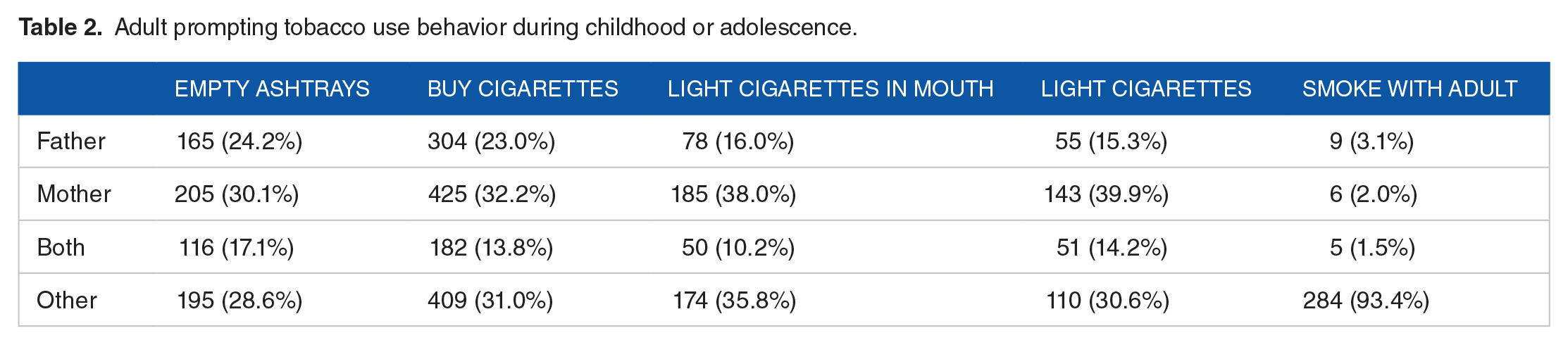
With regard to tobacco use prompting behaviors, 41% of participants reported being engaged in tobacco use prompting behavior(s) during childhood or adolescence. Approximately 15% (16%) of participants were asked to empty ashtrays, 31% to buy cigarettes, 12% to light cigarettes in their mouth, 9% to light cigarettes, and 7% were asked to smoke with and adult. Almost half of the participants (49%) reported being engaged in 5 behavior, 29% in 2, 15% in 3, 5% in 4, and 2% in 5 behaviors. Most of these behaviors, except smoking with an adult, were prompted in a higher proportion by the mother, followed by another person, mainly acquaintances (Table 2). Given the overlap in the categories (ie, participants could endorse more than 1 person), statistical comparisons were not made.
Adult prompting tobacco use behavior during childhood or adolescence.
In the bivariate logistic regression models, the following socio-demographic characteristics were statistically associated with current or past tobacco use: age, ethnicity, educational attainment, employment status, and sub-region of residence. Being engaged in tobacco use prompting behaviors (ie, emptying ashtrays, buying cigarettes, lighting cigarettes in mouth, lighting cigarettes, and smoking with an adult), parental smoking, and if they lived in the same household as participants were also associated with current or past tobacco use (Table 3).
Bivariate and multivariate logistic regression indicating current or past tobacco users versus never tobacco users taking into account sociodemographic characteristics and prompting tobacco use behaviors.

Included as a continuous variable.
Question: Throughout your life, has anyone in your family or an acquaintance consume/consumed tobacco products?
Question: The relative or acquaintance who consumes/consumed tobacco products lives/lived in the same household.
Engaged in the tobacco prompting behavior in childhood or adolescence by any adult.
Bold: P-value <.05 (2-tailed test).
All variables with P-values <.25 at bivariate level were entered in the multivariable model.
In the parsimonious model (Table 3), ethnicity, employment status, emptying ashtrays, and lighting cigarettes were no longer significant. In terms of age, women younger than 44 years of age had lower odds of endorsing current or past tobacco use than older women (OR 0.42, 95% CI: 0.35–0.52). Compared to women with post high school education, women at all lower levels of educational attainment had higher odds of being current/past tobacco users. This difference was highest among women without a formal education or with incomplete elementary school education (OR 2.87, 95% CI: 2.18–3.79). Women living in the Nordeste region and Norte had lower odds of being current/past smokers than women in Valle de Aburrá (capital of Antioquia).
Among tobacco use prompting behaviors during childhood or adolescence, buying cigarettes, lighting cigarettes with their mouth, and smoking with an adult remained significant in the parsimonious model. The tobacco use prompting behavior with the highest OR was smoking with an adult (OR 2.55, 95% CI: 1.89–3.45). Having the father and the mother using tobacco products was associated with current or past tobacco use (OR 2.33, 95% CI: 1.84–2.96). Having only the father, the mother, or other person were no longer associated with tobacco use in adulthood. If the relative or acquaintance using tobacco products lived in the household, women had higher odds of being current or past tobacco users (OR 1.55, 95% CI: 1.21–1.97; Table 3).
When examining whether or not current and past tobacco users in the sample prompted tobacco use behaviors among children/adolescents (empty ashtrays, buy cigarettes, light cigarettes in mouth, light cigarettes, or smoke with adult), 28% indicated doing so. There was no association between smoking with an adult during childhood or adolescence prompting a child/adolescent to do it in adulthood (P = .082). However, being engaged in other tobacco use prompting behaviors during childhood or adolescence was statistically associated with prompting the specific behaviors among children/adolescents in adulthood (Table 4).
Association between participant engagement in tobacco use prompting behaviors during childhood/adolescence and, in turn, engaging children/adolescents in these behaviors as adults.

Bold: P-value <.05, 2-tailed test.
Discussion
This study examined the association between engagement in tobacco use prompting behaviors during childhood or adolescence and tobacco use in adulthood in a large sample of adult Colombian women residing in the Antioquia region. Prevalence of current tobacco use among women was higher than previously reported but consistent with a national survey conducted in 2015 that indicated a prevalence of 5.6% among women 18 to 44 years of age and 7.9% among women 45 years of age and older (MInisterio de Salud y Protección Social, 2015). Also, this survey indicated that the central region of Colombia (where Antioquia is located) has the highest prevalence of tobacco use in the country among men and women. 13 However, as indicated by the obtained results, even within a region, tobacco use prevalence can vary across sub-regions and represents an opportunity to further explore these differences at the local levels.
The finding that younger women had lower odds of being tobacco users than older women is encouraging and it may reflect the impact of the tobacco control law passed in 2009 that included among other measures prohibition on tobacco promotion, sponsorship, advertising, individual cigarette sales, and sales to minors. 14 Uang and colleagues 15 explored the factors associated with the successful implementation of this law – monitoring by health organizations, support from the hospitality industry, and external funding. The inverse association found between educational attainment and tobacco use is consistent with previous studies which have shown that women with lower educational attainment are more likely to use tobacco products than women with higher educational attainment.16,17
Among the 5 prompting behaviors, 3 were strongly associated with tobacco use in adulthood – buying cigarettes for an adult, lighting cigarettes with their mouth, and smoking with an adult. In a previous cross-sectional study among adolescents, Laniado-Laborin and colleagues 8 found that Latinos were asked more often than non-Latinos to buy and light cigarettes while non-Latinos were more often asked to empty ashtrays. They also found that emptying ashtrays and lighting cigarettes (in the mouth or not in the mouth) were significantly associated with adolescent smoking among Latinos while lighting cigarettes (not in the mouth) were significantly associated with adolescent smoking among non-Latinos. However, in a longitudinal study examining the association between these prompting behaviors and trial smoking among adolescents, these associations were no longer significant. 9
In our study, we examined the association of these prompting behaviors and tobacco use in adulthood where the habit was formed rather than experimenting with smoking during adolescence. From a social learning perspective, by directly or indirectly engaging children and adolescents in tobacco use prompting behaviors, adults (including parents) are not only modeling these behaviors but also giving the message of normalcy and permissiveness. A number of studies have found that parental control/parental disapproval of smoking is inversely associated with adolescent smoking.18–20 Interestingly, when asked who engaged participants in tobacco use prompting behaviors during childhood or adolescence, a larger percentage indicated their mothers for all behaviors except smoking with an adult.
Contrary to the findings obtained by Gottfredson et al, 7 we did not find a gender congruence in parental smoking. Our findings indicate that tobacco use among both parents and living with any adult who smokes (including parents) were associated with tobacco use in adulthood. However, Gottfredson et al cross-sectionally examined the congruence among adolescents and their parents’ tobacco use status at the time while we have cross-sectionally examined women’s recollection of their parents’ tobacco use status during childhood or adolescence. 7
When we examined whether or not women who engaged in tobacco use prompting behaviors during childhood or adolescence had higher odds of engaging children/adolescents in these behaviors, we found that with the exception of smoking with a minor, they tended to engage children/adolescents in all other tobacco use prompting behaviors (ie, empty ashtrays, buy cigarettes light cigarettes, light cigarettes with their mouth), which, as previously discussed, indicates propagation of these modeling behaviors to another generation and reinforces the messages of normalcy and permissiveness.
The present study has some limitations that deserve mention. First, the obtained data were based on self-reporting and participants needed to rely on their recollection as to whether or not they were engaged in tobacco use prompting behaviors during childhood or adolescence. However, the data were collected in-person by a trained interviewer which provides greater assurance that participants understood the questions being asked, particularly the ones with limited literacy. Second, it was a cross-sectional study which precludes us from establishing causal associations. We also acknowledge there is vast literature that demonstrates the numerous other factors associated with tobacco use in adulthood. However, our focus was an under-studied association between tobacco use prompting behaviors in childhood or adolescence and tobacco use in adulthood.
Despite these limitations, we believe this study makes 3 relevant contributions to the literature. First, given the rigorous approach to sampling, we are assured that the sample is representative of the entire Antioquia Department, which is the second most populous region in the country, and, by focusing on 1 geographic area, we can better identify specific factors amenable to intervention that meets the needs of the target population. Second, it directly addresses one of the priorities identified by the World Health Organization 1 Framework Convention on Tobacco Control on the need of gender-relevant data that can inform gender-relevant tobacco control efforts, particularly in LMICs. Third, to our knowledge, this represents the first examination of engagement in tobacco use prompting behaviors during childhood or adolescence and tobacco use in adulthood among women. Given that most tobacco users initiate this behavior before the age of 18, these findings substantiate the need for tobacco prevention interventions targeting parents.
Footnotes
Funding:
The author(s) disclosed receipt of the following financial support for the research, authorship, and/or publication of this article: This work was supported by the Fogarty International Center in the U.S. (R21TW010637).
Declaration of conflicting interests:
The author(s) declared no potential conflicts of interest with respect to the research, authorship, and/or publication of this article.