




Abstract
Previous studies have found an association between maternal smoking and an increased risk of attention deficit hyperactivity disorder (ADHD) in offspring. However, the prevalence of maternal smoking, secondhand smoke (SHS) exposure during pregnancy, and ADHD in children within the Saudi Arabian context is not well-documented. Objective: To explore the prevalence of maternal smoking and SHS exposure during pregnancy among mothers of children diagnosed with ADHD and investigate exposure to smoking as a predictor of ADHD subtypes. Methods: A cross-sectional study was conducted from December 1, 2022, to February 28, 2023, using an online questionnaire. The study included 217 parents of children aged 4-17 years diagnosed with ADHD and without a family history of the disorder. Data on sociodemographic determinants, academic achievement, ADHD types, and maternal smoking habits during pregnancy were collected. Results: Among the mothers surveyed, 6.4% reported smoking during pregnancy, while 41% were exposed to SHS. The study found a predominance of the combined subtype of ADHD among the children. Logistic regression analysis revealed that families with monthly income <10 000 SR were 2.6 times more likely to have a child with inattentive or hyperactive ADHD (P < 0.03). Male gender was associated with a 46% reduced likelihood of these subtypes (P < 0.03). SHS smoking and active exposure to smoking during pregnancy did not show any significant effect on ADHD. Conclusion: The study found that child gender and family income were significantly associated with the distribution of ADHD subtypes, while maternal smoking and SHS exposure during pregnancy did not show a significant association. The high prevalence of SHS exposure emphasizes the need for increased public health awareness and interventions to promote smoke-free environments during pregnancy.
Introduction
Attention deficit hyperactivity disorder (ADHD) is 1 of the most common mental disorders with a heterogeneous prevalence worldwide. North America has the highest reported prevalence at 6.2%, followed by European countries and the Asian region, with 4.7% and 3.7%, respectively. 1 In Saudi Arabia, the prevalence of ADHD among children has been studied in several regions.2-5 A previous study reported that at least 1 child in every educational classroom has ADHD, affecting around 2.68% of primary school children in Saudi Arabia. 6
ADHD is classified into 3 subtypes: which are inattentive, hyperactive, and the combined types. A clinical evaluation is commonly performed to identify ADHD in children. This evaluation includes an interview to assess the child’s behavior, examine their symptoms, and evaluate their overall functioning. 7 Any symptoms such as inattention, hyperactivity, oppositionality, impulsivity, and poor academic progress at school are considered indications of ADHD. The exact cause of ADHD is not yet known; however, genetics and environmental (eg, smoking and obesity) factors have been identified as potential contributors.8,9
Maternal smoking during pregnancy has been associated with an increased risk of ADHD in offspring in several studies.9-11 A previous study demonstrated that parental smoking before and during pregnancy was associated with an increased risk of ADHD in offspring. The risk was higher for children whose mothers smoked during pregnancy than for those whose fathers smoked during or before pregnancy. 12 Another study also showed that parental smoking or exposure to nicotine during pregnancy could increase the likelihood of the offspring developing ADHD. 13 In addition, children born to smoking mothers are more likely to develop ADHD than those with non-smoking parents.11,14 The mechanism behind the effects of smoking during pregnancy and the increased risk of ADHD is unknown. However, it is suggested that nicotine and other chemicals in tobacco smoke can damage the developing brain and disrupt the production of neurotransmitters, such as dopamine, which are involved in attention and behavior. 15
In addition to direct maternal smoking, exposure to secondhand smoke (SHS) during pregnancy has also been linked to an increased risk of ADHD in children. A systematic review and meta-analysis by Huang et al. (2021) reported a pooled odds ratio of 1.35 (95% CI: 1.18-1.54) for the association between prenatal SHS exposure and ADHD. 16 Furthermore, a recent cohort study by Xu et al (2023) found that both maternal smoking and SHS exposure during pregnancy were associated with an increased risk of ADHD in offspring, even after adjusting for potential confounders. 17 Additionally, a US data analysis between 1999-2004 found a significant association between exposure to SHS during the postnatal period and ADHD in children, independent of other factors, including prenatal maternal smoking, other environmental exposures, and socioeconomic factors. 18
According to a recent systematic analysis examining the global prevalence of smoking during pregnancy, it was found that approximately 21% of mothers smoked while pregnant. 19 The World Health Organization (WHO) has identified smoking during pregnancy as the primary factor contributing to adverse pregnancy outcomes and prenatal mortality. In Saudi Arabia, the prevalence of smoking among the general population is relatively low, with 14.09% overall and a notable gender disparity (25.3% in males vs 1.9% in females). 20 However, exposure to SHS during pregnancy remains a significant public health concern, with previous studies reporting SHS exposure rates of 31%–50% among pregnant women in Saudi Arabia. 21 Therefore, there is a need for increased public health awareness and interventions to promote smoke-free environments during pregnancy. SHS exposure during pregnancy has also been linked to adverse pregnancy outcomes, including impaired fetal growth and low birth weight, and this should be a cause for concern and a call to action for all stakeholders in the health care system.21,22
ADHD is a common concern among children and adolescents in Saudi Arabia. Despite the potential impact of maternal smoking and SHS exposure on child health and development, there is a gap in the literature regarding smoking behaviors or exposure to SHS among mothers whose children have been diagnosed with ADHD. This study aimed to investigate the prevalence of maternal smoking and SHS exposure during pregnancy among mothers of children diagnosed with ADHD and to explore exposure to smoking as a predictor of ADHD subtypes in Saudi Arabia. The findings of this study have the potential to influence public health policies, raise awareness, and improve maternal and child health outcomes in Saudi Arabia.
Methods
Study design and participants
This cross-sectional survey study utilized a self-administered questionnaire from a previously published study by Zakariyah (2023). 4 As previously described, participants were recruited through the Eshraq Society for ADHD in Saudi Arabia. Eshraq is a nonprofit organization that provides support to patients diagnosed with ADHD from different regions in Saudi Arabia. The following recruitment strategies were employed between December 1, 2022, and February 28, 2023: The Eshraq Society announced the study and distributed the questionnaire link via their official Twitter account, reaching their followers. Also, the society directly messaged parents of children and adolescents registered with their organization from different regions across Saudi Arabia aged 2 to 17 years old, inviting them to participate in the study, which ensured the generalizability of the sample. Four weeks after the initial recruitment, a reminder message was sent to the participants, encouraging them to complete the questionnaire if they had not already done so. The study aimed to reach a representative sample of the ADHD population in Saudi Arabia by leveraging their social media presence and direct access to registered families from diverse regions. The sample size was predetermined in our prior publication by Zakariyah (2023). 4 Briefly, the total number of children registered with the Eshraq Society and diagnosed with ADHD was 900, aged between 2 and 17. According to a recent systematic review and meta-analysis that reported an ADHD prevalence of 12% in Saudi Arabia, 23 the requisite sample size for the study was calculated using OpenEpi, an open-source epidemiological calculator. 24 The minimum sample size required for a population of 900 individuals was 163 participants, with a 95% confidence level and a 5% margin of error. The original study by Zakariyah (2023) 4 included parents of 306 children aged 4-17 diagnosed with ADHD who also had a family history of ADHD. In the current study, we included only 217 responses from parents of children aged 4-17 diagnosed with ADHD, excluding participants with a family history of ADHD (22.8%, n = 89) to reduce the confounding influence of genetic factors and sharpen the focus on environmental contributions to ADHD.
Questionnaire
The questionnaire used in this study was the same as that employed in the previous study by Zakariyah (2023) 4 which was designed to collect data on sociodemographic determinants, academic achievement, ADHD types, and maternal smoking habits during pregnancy. The questionnaire was created using a Google form. To ensure the validity of the questionnaire, we conducted a pilot study with 10 participants from the target population to assess the questions’ clarity, relevance, and comprehensibility. Based on the feedback received, we made necessary modifications to improve the questionnaire’s content validity. Also, the obtained Cronbach’s alpha value of 0.6 indicates a satisfactory level of internal consistency for the questionnaire. 25 The questionnaire was initially written in Arabic and then translated into English by two fluent co-authors in both English and Arabic to ensure an accurate and comprehensive translation. The Arabic version of the questionnaire was distributed in Saudi Arabia because Arabic is the primary language spoken in the country.
The questionnaire was divided into 6 sections. For detailed information on the questionnaire sections 1 to 4, see the previously published study. 4 The fifth and sixth sections were designated for mothers who smoked or were exposed to SHS during pregnancy. In these sections, questions comprised the amount of smoking per day, smoke type, and the duration of smoking during the pregnancy period. See the questionnaire in (Appendix Table 1). A questionnaire link was circulated via Eshraq’s social media accounts (Twitter emails and text messages) along with a description of the study objectives, confidentiality statement, and consent for participation. Informed consent was obtained from all participants at the beginning of the questionnaire. Parents were asked to complete the questionnaire, and no incentives were offered to the parents to take part in the study. Informed consent was obtained online by participants willingly agreeing to participate in the study by answering the following questions: Do you agree to participate in the survey? “Yes” or “No” by clicking “Yes” was considered consent to participate in the study.
Data analysis
Data was entered into MS Excel while Statistical Package for Social Sciences (SPSS) version 26.0 was used for data analysis. Descriptive statistics were carried out using the frequency and percentages for the categorical variables like gender, age, family income, childbirth order, region of residence, ADHD type, and smoking habits. All baseline characteristics were a descriptive analysis. The Chi-squared test was used to compare the categorical variables. Data analysis was based on the aim of the study. In order to avoid an overfit model in logistic regression, there should be an acceptable number of events per independent variable, with common “rules of thumb” ranging from 10 to 20 events per covariate. 26 To ensure the adequacy of the model and for analysis purposes, the ADHD subtypes were divided into two groups. The combined ADHD subtype was included in 1 group, while inattentive and hyperactive ADHD subtypes were included in another group. A P-value less than 0.05 was statistically significant.
Institutional Review Board Statement
This study was reviewed and approved by the Bioethics Committee of Scientific and Medical Research at the University of Jeddah (HAP-02-J-094). The approval number is (UJ-REC-080).
Results
Sociodemographic information of the participants
Sociodemographic Characteristics of the Participants (n = 217).
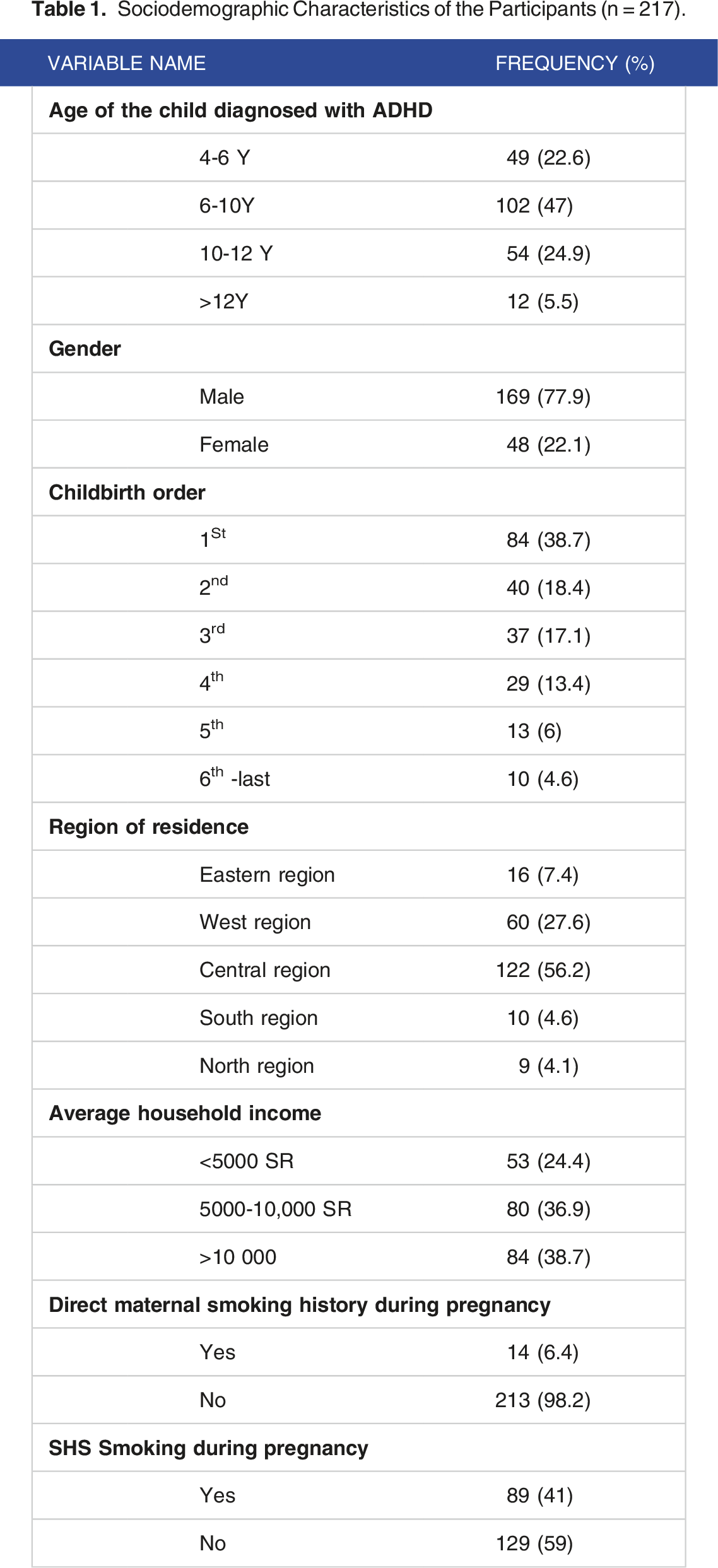
Regarding birth order, the data shows that 38.7% (n = 84) of the children are the firstborn, with the rest ranging from the second to the sixth or last child in their family. The regional distribution of the participants is predominantly from the Central region of Saudi Arabia, with 56.2% (n = 122) of responses, followed by the Western region at 27.6% (n = 60). Regarding household income, the study reveals a relatively even distribution across different income levels, with the highest income >10 000 Saudi Riyals (SR) accounting for 38.7% (n = 84) of the participants, followed closely by the middle-income group (5000-10,000 SR) at 36.9% (n = 80), and the lowest income (<5000 SR) at 24.4% (n = 53).
The results also showed that the most prevalent form of ADHD in both cohorts was the combined type 70% (n = 152), followed by the inattentive and hyperactive types, as shown in (Figure 1). This distribution highlights the predominance of the combined type of ADHD in the studied population. ADHD classification among the included participants in the study n = 217. A pie chart illustrating the distribution of ADHD classifications among the diagnosed children in the study.
Prevalence of direct smoking and SHS exposure during pregnancy among mothers of children with ADHD
We surveyed the smoking habits of 217 mothers during their pregnancies. Of these, 6.4% (n = 14) reported active smoking, and 41% (n = 89) reported exposure to SHS during pregnancy, while the remaining 59% (n = 128) had no such exposure (Table 1). The majority of mothers who smoked, 71.4% (n = 10), admitted to smoking during the first trimester. Cigarettes were the most common type of smoking (50%), followed by hookah (42.9%) and shisha (7.1%). A summary of direct smoking behaviors during pregnancy among mothers of children with ADHD is shown in (Appendix Table 2). Regarding SHS exposure, 70.7% of the mothers reported exposure to cigarette smoke. The frequency of exposure to smoking is shown in (Appendix Table 3).
Association between sociodemographic factors and ADHD subtypes in children
Association Between Sociodemographic Factors and ADHD Subtypes in Children.

chi-squared test.
Discussion
This study revealed a high prevalence (41%) of SHS exposure during pregnancy among mothers of children diagnosed with ADHD in Saudi Arabia. This finding aligns with previous studies conducted at tertiary hospitals in Saudi Arabia, which reported 31%–50% SHS exposure rates among pregnant women.21,27 Despite the known risks, our study and prior research suggest limited awareness among Saudi pregnant women regarding the specific harmful effects of SHS exposure.
In contrast, we found a relatively low proportion (6.4%) of mothers actively smoking during pregnancy. Previous studies have indicated low smoking prevalence among Saudi women and expectant mothers.20,21 The data suggest that Saudi women are generally aware of the consequences of smoking during pregnancy, consistent with findings that many quit smoking due to health concerns. 28 Several studies have shown an association between maternal smoking during pregnancy and increased ADHD risk in children.9-11 However, others suggest familial factors may also contribute to ADHD, potentially confounding the relationship between maternal smoking and offspring ADHD.14,29 For instance, 1 study concluded that the association might be influenced by unmeasured familial confounding rather than the direct effects of smoking during gestation. Another compared maternal and paternal smoking, indicating the link between maternal smoking and child ADHD could be attributed to genetic or household factors rather than direct causation. 30 In our study, the low prevalence of direct maternal smoking may have limited our statistical power to detect an association between maternal smoking and ADHD subtypes. Additionally, the observational nature of the data and potential recall bias further complicate establishing a direct causal link.
The current study reveals a predominance of the combined subtype of ADHD among participants, with 70% diagnosed with this type, aligning with previous findings in Saudi Arabia.4,5 Additionally, our study found that male gender was associated with a reduced likelihood of having the inattentive or hyperactive ADHD subtype compared to females. These proportions underscore the prevalence of the combined type of ADHD, which may have implications for clinical practice and resource allocation. Additionally, the study observed a higher prevalence of ADHD among males compared to females, with a male-to-female ratio of 3:1, as indicated in our previous study 4 and consistent with other population-based studies.31,32 Moreover, the majority of ADHD-diagnosed children were in the 6-10 age group, coinciding with the onset of formal schooling and reflecting the American Academy of Pediatrics guidelines that recommend diagnosing ADHD in children aged 4 to 18 years.7,33
We also examined the exposure to smoking as a predictor of ADHD subtypes among children within Saudi Arabia. We found that SHS exposure and active smoking during pregnancy did not show a significant effect on ADHD subtypes. The main finding of the association between socioeconomic factors and ADHD subtypes was that families with a monthly income lower than 10 000 SR were 2.6 times more likely to have a child suffering from the inattentive or hyperactive ADHD subtype compared to those with higher incomes. Multiple studies across different countries have found that children from lower-income families are at higher risk of being diagnosed with ADHD.34-36 For instance, a systematic review by Spencer et al (2022) identified a significant association between low family income and ADHD. Children from lower family incomes were twice as likely to have ADHD compared to those from high-income families. 36 However, specific associations with ADHD subtypes have not been extensively studied. Notably, a study in Taiwan found that parents experiencing higher levels of stress are more likely to have children with the combined type of ADHD. 37
The high rate of SHS exposure in the current study among pregnant women in Saudi Arabia is a significant public health concern. The prevalence of SHS exposure in this study lies within the internationally self-reported exposure rates ranging from 18% to 72.3%. 38 Educational interventions, such as counseling and awareness programs, have been found to effectively increase pregnant women’s understanding of the risks associated with SHS exposure. 39 However, these interventions have not significantly reduced actual SHS exposure, suggesting additional strategies may be needed. Reports from various countries have shown that implementing the World Health Organization’s (WHO) recommendations on tobacco control policies has been effective in reducing SHS exposure among pregnant women.40,41 To support the Saudi government’s initiatives in regulating tobacco consumption, it is recommended that health care providers offer counseling on the harmful effects of SHS during prenatal appointments.
Although our study revealed significant associations between family income and ADHD subtypes, as well as between gender and ADHD subtypes, we acknowledge several limitations in our study. The cross-sectional design limits our ability to infer causality between maternal smoking, SHS exposure, and ADHD subtypes. Additionally, the reliance on self-reported data for smoking habits and SHS exposure introduces the potential for recall bias. Also, a larger sample size would provide more power to detect smaller effect sizes and improve the generalizability of our findings.
Conclusion
In conclusion, the current study highlights that child gender and family income were significantly associated with the distribution of ADHD subtypes, while other factors like childbirth order, academic performance, maternal smoking/SHS exposure, and region of residence did not show a significant association. Our study provides information on the smoking habits during pregnancy of mothers whose children are diagnosed with ADHD. While we did not find a significant link between maternal smoking and ADHD in children, the high exposure rate to SHS during pregnancy, affecting 41% of the women in our study, emphasizes the need for increased awareness and preventive measures.
Supplemental Material
Supplemental Material - Exposure to Smoking as a Predictor of ADHD Subtypes Among Children Within Saudi Arabia: An Observational Study
Supplemental Material for Exposure to Smoking as a Predictor of ADHD Subtypes Among Children Within Saudi Arabia: An Observational Study by Abeer Zakariyah, Sulafa Al Qutub, Sereen Kazim, Reman Alharbi, Hams Alharthi, Hadeel Alharbi, Maram Albassami, Mehenaz Hanbazazh, and Morooj Mahnashi in Tobacco Use Insights
Footnotes
Acknowledgements
The author would like to thank the Eshraq Society for cooperating and distributing the questionnaire to the study participants.
Author Contributions
Conception, Supervision, Data collection, Writing, and Revision: A.Z.; Data analysis and interpretation of results: S.A.Q.; Draft manuscript preparation and Data collection: S.K., R.A., H.A., H.A., and M.A.; Writing and Revision: M.H. and M.M. All authors have read, revised, and agreed to the published version of the manuscript.
Declaration of Conflicting Interests
The author(s) declared no potential conflicts of interest with respect to the research, authorship, and/or publication of this article.
Funding
The author(s) received no financial support for the research, authorship, and/or publication of this article.
Institutional Review Board Statement
This study was reviewed and approved by the Bioethics Committee of Scientific and Medical Research of the University of Jeddah (HAP-02-J-094). The approval number is (UJ-REC-080).

Data Availability statement
The data supporting this research are available from the corresponding author upon reasonable request.
Supplemental Material
Supplemental material for this article is available online.
References
Supplementary Material
Please find the following supplemental material available below.
For Open Access articles published under a Creative Commons License, all supplemental material carries the same license as the article it is associated with.
For non-Open Access articles published, all supplemental material carries a non-exclusive license, and permission requests for re-use of supplemental material or any part of supplemental material shall be sent directly to the copyright owner as specified in the copyright notice associated with the article.
